Local Service Search
Engine Management
System (LSSEMS)
The Local Service Search Engine Management System (LSSEMS)
is a web-based application designed to simplify the process of
finding reliable local service providers. It addresses the common
challenges of finding trustworthy professionals for tasks like
home repairs, childcare, or tutoring. LSSEMS aims to connect
users with qualified service providers in their area, streamlining
the search and booking process.
Introduction
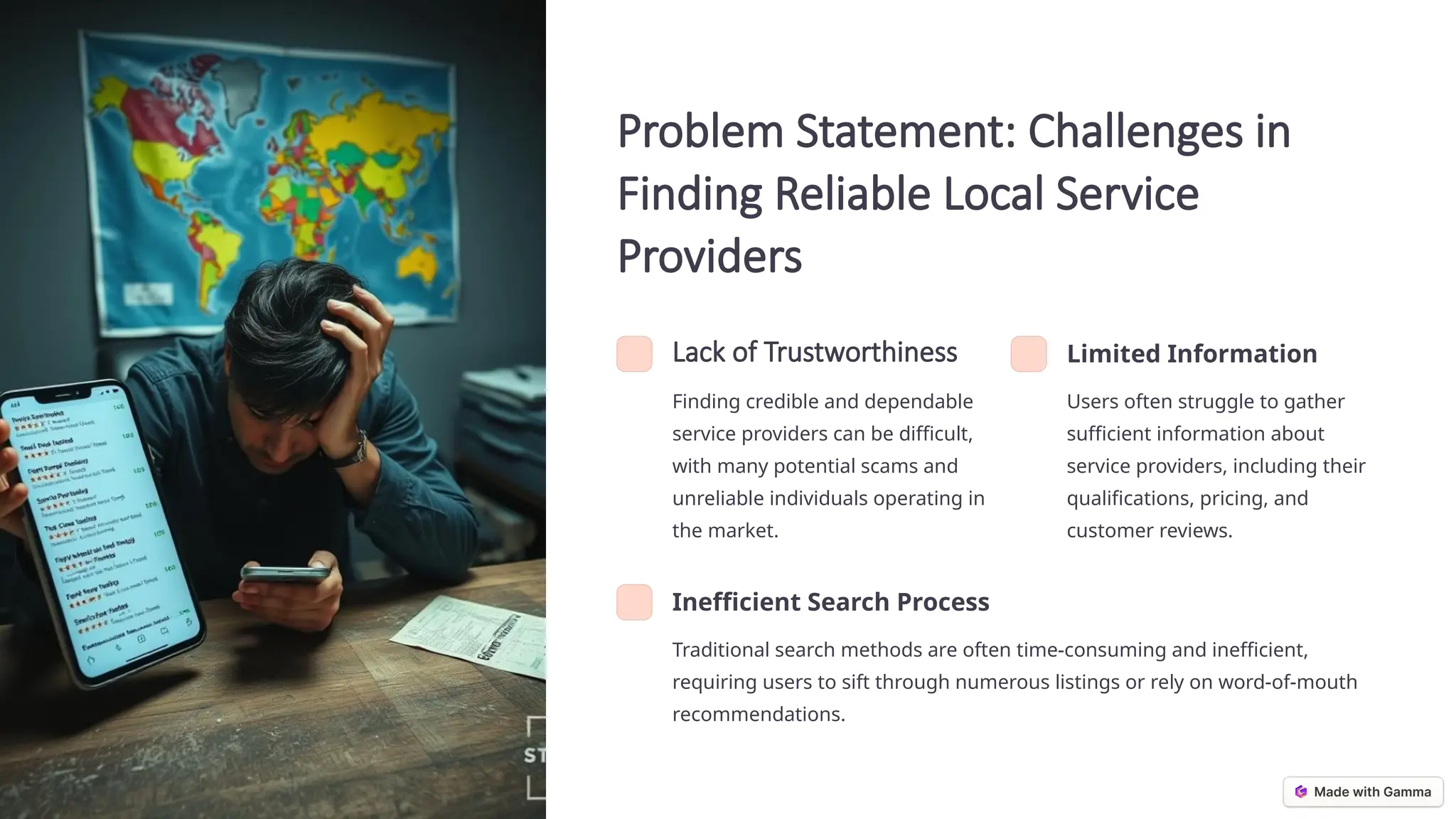
Problem Statement: Challenges in
Finding Reliable Local Service
Providers
Lack of Trustworthiness
Finding credible and dependable
service providers can be difficult,
with many potential scams and
unreliable individuals operating in
the market.
Limited Information
Users often struggle to gather
sufficient information about
service providers, including their
qualifications, pricing, and
customer reviews.
Inefficient Search Process
Traditional search methods are often time-consuming and inefficient,
requiring users to sift through numerous listings or rely on word-of-mouth
recommendations.
Aim and Objectives: Develop a
web-based application to
streamline local service search
Enhance Trustworthiness
To establish a platform where users can
confidently locate and engage with
trustworthy service providers.
Improve Information
Accessibility
To provide comprehensive information
about each service provider, including
qualifications, pricing, and customer
reviews.
Streamline Search Process
To simplify the search process by offering
a user-friendly interface and intelligent
filtering options based on location,
service, and user preferences.
Promote Transparency and
Communication
To facilitate direct communication
between users and service providers,
ensuring transparency and facilitating
efficient problem resolution.
Methodology: Research,
Design, and Implementation
Process
1 Research
In-depth market research and user surveys were conducted to identify
common challenges and requirements in local service search.
2 Design
A user-centered design approach was adopted, involving iterative
prototyping and feedback loops to refine the application's interface
and functionality.
3 Implementation
The application was developed using a robust technology stack,
ensuring scalability, security, and a user-friendly experience.
Based on this system, the methodology used for the Local Service Search
Engine Management System (LSSEMS) appears to align with the agile
methodology rather than waterfall methodology.
• Development environment: the system is
developed using PHP and MySQL, with a web
server like Apache.
• Tools like XAMPP or WAMP are used for local
development
• Database creation: A database(eg: lssemsdb) is
created to store service provider information, user
data, and other relevant records.
• Admin module: This includes functionalities for
managing service categories, user accounts, and
generating reports. Admins can update their
profiles, manage service listings, and oversee user
interactions
• User module: Users can search for local services by
category, view service provider details, and contact
them directly through the platform
System Setup
Module Development
Implementation
Implementation
User Interface Design
• The interface is designed to be intuitive,
allowing users to easily navigate through
categories and search for services based on
their location
Testing
• Unit testing: Each module is tested individually
to ensure they function correctly(e.g.: admin
login, service listing).
• Integration testing: The interaction between
different modules is tested to confirm that they
work together without issues
Analysis
Requirement gathering
• Understanding user needs through surveys or
interviews helps identify desired features such
as location-based searches and specific service
categories.
Functional Requirement
• Key functionalities such as user registration,
service provider profiles, advanced search
options(by category, ratings), and
communication channels between users and
providers
Analysis
Performance optimization
• Techniques such as caching and load balancing
are implemented to ensure fast response
times as user traffic increases.
User Feedback collection
• After deployment, feedback from users is
collected through surveys or beta testing to
identify areas for improvement.
• Regular updates are made based on user
feedback and changing market demands to
enhance functionality and user satisfaction.
Continuous Improvement Evaluation Metrics
• The system’s performance is regularly evaluated
based on metrics such as response time, user
satisfaction ratings, and the accuracy of search
results.
Implementation and Analysis
1
Front-End Development
A user-friendly interface was designed, incorporating interactive elements and clear navigation for a seamless search experience.
2
Back-End Development
A robust backend infrastructure was built to manage user data, service provider profiles, and search queries,
including database management, API development, and server-side logic.
3
Testing and Refinement
Rigorous testing was conducted to ensure the application's functionality, performance, and
security, with feedback incorporated for ongoing improvement.
4
Deployment and Monitoring
LSSEMS was deployed to a secure and scalable cloud infrastructure, with
continuous monitoring to track user engagement, performance metrics,
and identify areas for enhancement.
System Analysis
Current Challenges
Finding local services is often inefficient, time-
consuming, and relies on manual processes.
Disadvantages of Existing Systems
Existing systems are not user-friendly, prone to errors,
and require extensive paperwork.
User Engagement and Feedback Analysis
1
User Surveys
Regular surveys were
conducted to gather user
feedback on the platform's
usability, features, and overall
satisfaction.
2
In-App Feedback
An in-app feedback
mechanism allowed users to
provide immediate feedback
on specific features or issues
encountered while using
LSSEMS.
3
Social Media
Monitoring
Social media platforms were
monitored for user reviews,
mentions, and discussions
related to LSSEMS, providing
valuable insights into public
perception.
4
Data Analysis
Collected data was analyzed to
identify trends, patterns, and
areas for improvement,
informing future development
decisions.
Future Enhancements and Expansion Plans
1
Enhanced User Experience
Improved navigation, personalized recommendations, and advanced filtering options will enhance the user experience.
2
Expanded Service Categories
LSSEMS will expand its service categories to include a wider range of local service providers, catering to diverse
needs.
3
Integrated Payment System
A secure and convenient online payment system will be integrated to streamline the booking and
payment process.
4
Community Building Features
LSSEMS will incorporate community building features, enabling users to connect with each
other and share experiences.
5
Mobile App Development
A dedicated mobile application will provide users with on-the-go access to LSSEMS,
enhancing convenience and accessibility.
Conclusion: Transforming the
Local Service Search Experience
The LSSEMS is an effective web-based application designed to
connect users with local service providers, such as plumbers,
tutors, and cleaners. It offers a centralized platform that
simplifies the search process by categorizing services and
providing user-friendly features. The system’s dual modules for
administrators and users enhances its functionality and
management capabilities. However, there are areas for
improvement, including expanding geographical coverage and
service categories to better meet user needs
Recommendation for Local Service
Search Engine Management
System
To enhance the Local Service Search Engine Management
system(LSSEMS), it is recommended to expand geographic coverage
to include more regions and cities, broaden service categories to
include niche or specialized services, enhance user feedback and
mechanisms with robust collection methods like survey or rating
systems, optimize performance and scalability for efficient handling
of increased traffic and data, integrate advanced features such as
real-time chat support, appointment scheduling, or payment
processing, and establish a routine for regular updates based on
user feedback and technological advancements to ensue the
platform remains competitive and meet evolving user expectations.

Local-Service-Search-Engine-Management-System-LSSEMS1.pptx

  • 1.
    Local Service Search EngineManagement System (LSSEMS)
  • 2.
    The Local ServiceSearch Engine Management System (LSSEMS) is a web-based application designed to simplify the process of finding reliable local service providers. It addresses the common challenges of finding trustworthy professionals for tasks like home repairs, childcare, or tutoring. LSSEMS aims to connect users with qualified service providers in their area, streamlining the search and booking process. Introduction
  • 3.
    Problem Statement: Challengesin Finding Reliable Local Service Providers Lack of Trustworthiness Finding credible and dependable service providers can be difficult, with many potential scams and unreliable individuals operating in the market. Limited Information Users often struggle to gather sufficient information about service providers, including their qualifications, pricing, and customer reviews. Inefficient Search Process Traditional search methods are often time-consuming and inefficient, requiring users to sift through numerous listings or rely on word-of-mouth recommendations.
  • 4.
    Aim and Objectives:Develop a web-based application to streamline local service search Enhance Trustworthiness To establish a platform where users can confidently locate and engage with trustworthy service providers. Improve Information Accessibility To provide comprehensive information about each service provider, including qualifications, pricing, and customer reviews. Streamline Search Process To simplify the search process by offering a user-friendly interface and intelligent filtering options based on location, service, and user preferences. Promote Transparency and Communication To facilitate direct communication between users and service providers, ensuring transparency and facilitating efficient problem resolution.
  • 5.
    Methodology: Research, Design, andImplementation Process 1 Research In-depth market research and user surveys were conducted to identify common challenges and requirements in local service search. 2 Design A user-centered design approach was adopted, involving iterative prototyping and feedback loops to refine the application's interface and functionality. 3 Implementation The application was developed using a robust technology stack, ensuring scalability, security, and a user-friendly experience. Based on this system, the methodology used for the Local Service Search Engine Management System (LSSEMS) appears to align with the agile methodology rather than waterfall methodology.
  • 6.
    • Development environment:the system is developed using PHP and MySQL, with a web server like Apache. • Tools like XAMPP or WAMP are used for local development • Database creation: A database(eg: lssemsdb) is created to store service provider information, user data, and other relevant records. • Admin module: This includes functionalities for managing service categories, user accounts, and generating reports. Admins can update their profiles, manage service listings, and oversee user interactions • User module: Users can search for local services by category, view service provider details, and contact them directly through the platform System Setup Module Development Implementation
  • 7.
    Implementation User Interface Design •The interface is designed to be intuitive, allowing users to easily navigate through categories and search for services based on their location Testing • Unit testing: Each module is tested individually to ensure they function correctly(e.g.: admin login, service listing). • Integration testing: The interaction between different modules is tested to confirm that they work together without issues
  • 8.
    Analysis Requirement gathering • Understandinguser needs through surveys or interviews helps identify desired features such as location-based searches and specific service categories. Functional Requirement • Key functionalities such as user registration, service provider profiles, advanced search options(by category, ratings), and communication channels between users and providers
  • 9.
    Analysis Performance optimization • Techniquessuch as caching and load balancing are implemented to ensure fast response times as user traffic increases. User Feedback collection • After deployment, feedback from users is collected through surveys or beta testing to identify areas for improvement. • Regular updates are made based on user feedback and changing market demands to enhance functionality and user satisfaction. Continuous Improvement Evaluation Metrics • The system’s performance is regularly evaluated based on metrics such as response time, user satisfaction ratings, and the accuracy of search results.
  • 10.
    Implementation and Analysis 1 Front-EndDevelopment A user-friendly interface was designed, incorporating interactive elements and clear navigation for a seamless search experience. 2 Back-End Development A robust backend infrastructure was built to manage user data, service provider profiles, and search queries, including database management, API development, and server-side logic. 3 Testing and Refinement Rigorous testing was conducted to ensure the application's functionality, performance, and security, with feedback incorporated for ongoing improvement. 4 Deployment and Monitoring LSSEMS was deployed to a secure and scalable cloud infrastructure, with continuous monitoring to track user engagement, performance metrics, and identify areas for enhancement.
  • 11.
    System Analysis Current Challenges Findinglocal services is often inefficient, time- consuming, and relies on manual processes. Disadvantages of Existing Systems Existing systems are not user-friendly, prone to errors, and require extensive paperwork.
  • 12.
    User Engagement andFeedback Analysis 1 User Surveys Regular surveys were conducted to gather user feedback on the platform's usability, features, and overall satisfaction. 2 In-App Feedback An in-app feedback mechanism allowed users to provide immediate feedback on specific features or issues encountered while using LSSEMS. 3 Social Media Monitoring Social media platforms were monitored for user reviews, mentions, and discussions related to LSSEMS, providing valuable insights into public perception. 4 Data Analysis Collected data was analyzed to identify trends, patterns, and areas for improvement, informing future development decisions.
  • 13.
    Future Enhancements andExpansion Plans 1 Enhanced User Experience Improved navigation, personalized recommendations, and advanced filtering options will enhance the user experience. 2 Expanded Service Categories LSSEMS will expand its service categories to include a wider range of local service providers, catering to diverse needs. 3 Integrated Payment System A secure and convenient online payment system will be integrated to streamline the booking and payment process. 4 Community Building Features LSSEMS will incorporate community building features, enabling users to connect with each other and share experiences. 5 Mobile App Development A dedicated mobile application will provide users with on-the-go access to LSSEMS, enhancing convenience and accessibility.
  • 14.
    Conclusion: Transforming the LocalService Search Experience The LSSEMS is an effective web-based application designed to connect users with local service providers, such as plumbers, tutors, and cleaners. It offers a centralized platform that simplifies the search process by categorizing services and providing user-friendly features. The system’s dual modules for administrators and users enhances its functionality and management capabilities. However, there are areas for improvement, including expanding geographical coverage and service categories to better meet user needs
  • 15.
    Recommendation for LocalService Search Engine Management System To enhance the Local Service Search Engine Management system(LSSEMS), it is recommended to expand geographic coverage to include more regions and cities, broaden service categories to include niche or specialized services, enhance user feedback and mechanisms with robust collection methods like survey or rating systems, optimize performance and scalability for efficient handling of increased traffic and data, integrate advanced features such as real-time chat support, appointment scheduling, or payment processing, and establish a routine for regular updates based on user feedback and technological advancements to ensue the platform remains competitive and meet evolving user expectations.