Listening at Scale
1
Sarah Sheikh
Head of Customer Success
Camille E. Acey
Head of Customer Success
Shauntle Barley
Head of Growth
2
Camille E. Acey
Head of Customer Success
3
Nylas is the communications layer for
business, powering applications with the
most robust email, calendar, and
contacts API
4
Motherhood!
5
6
7
8
Q: How do we nurture
and support in a
“scalable” way?
9
A: We don’t!
Good scale comes to those
who listen (and deliver!)
10
11
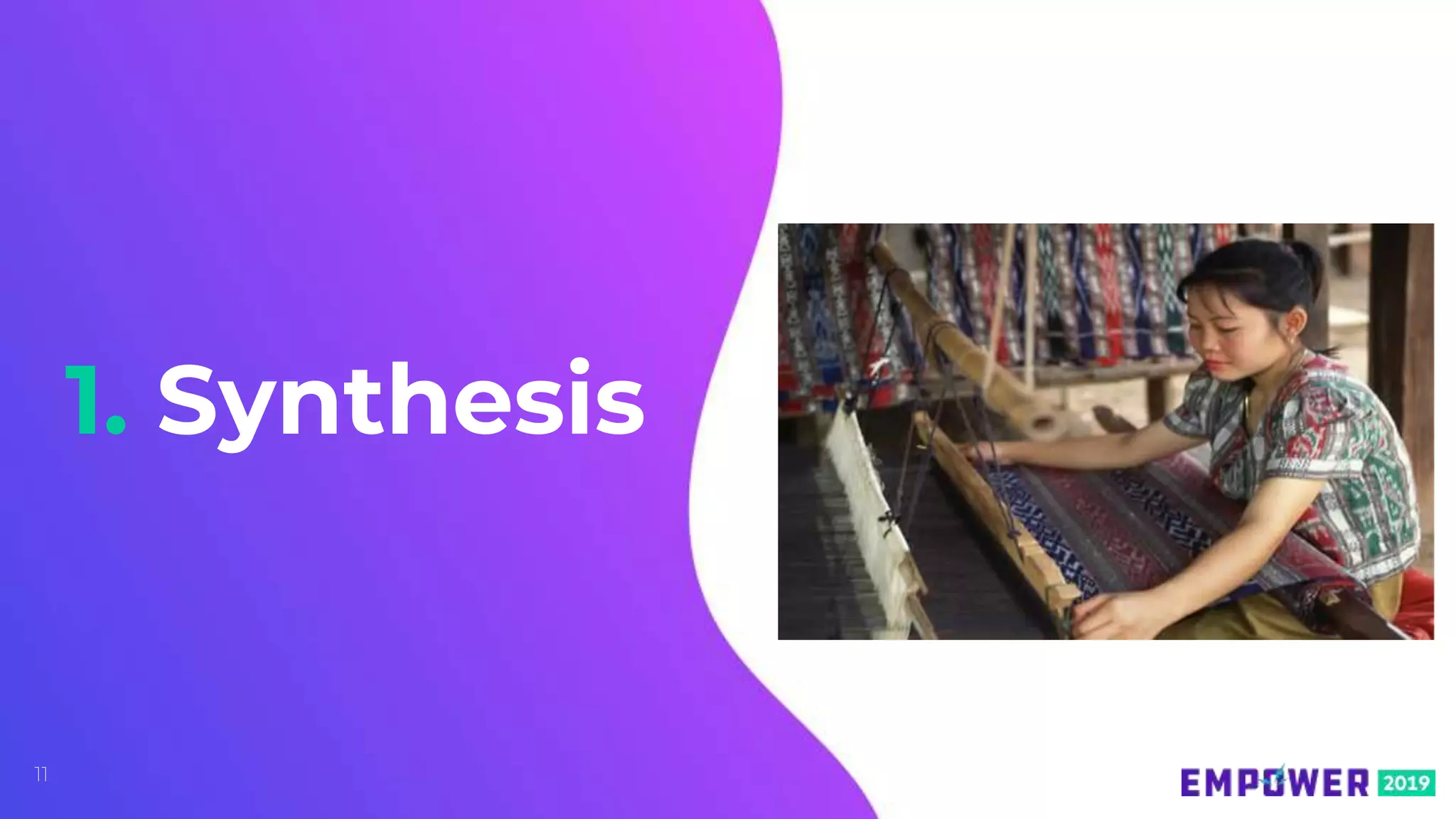
1. Synthesis
12
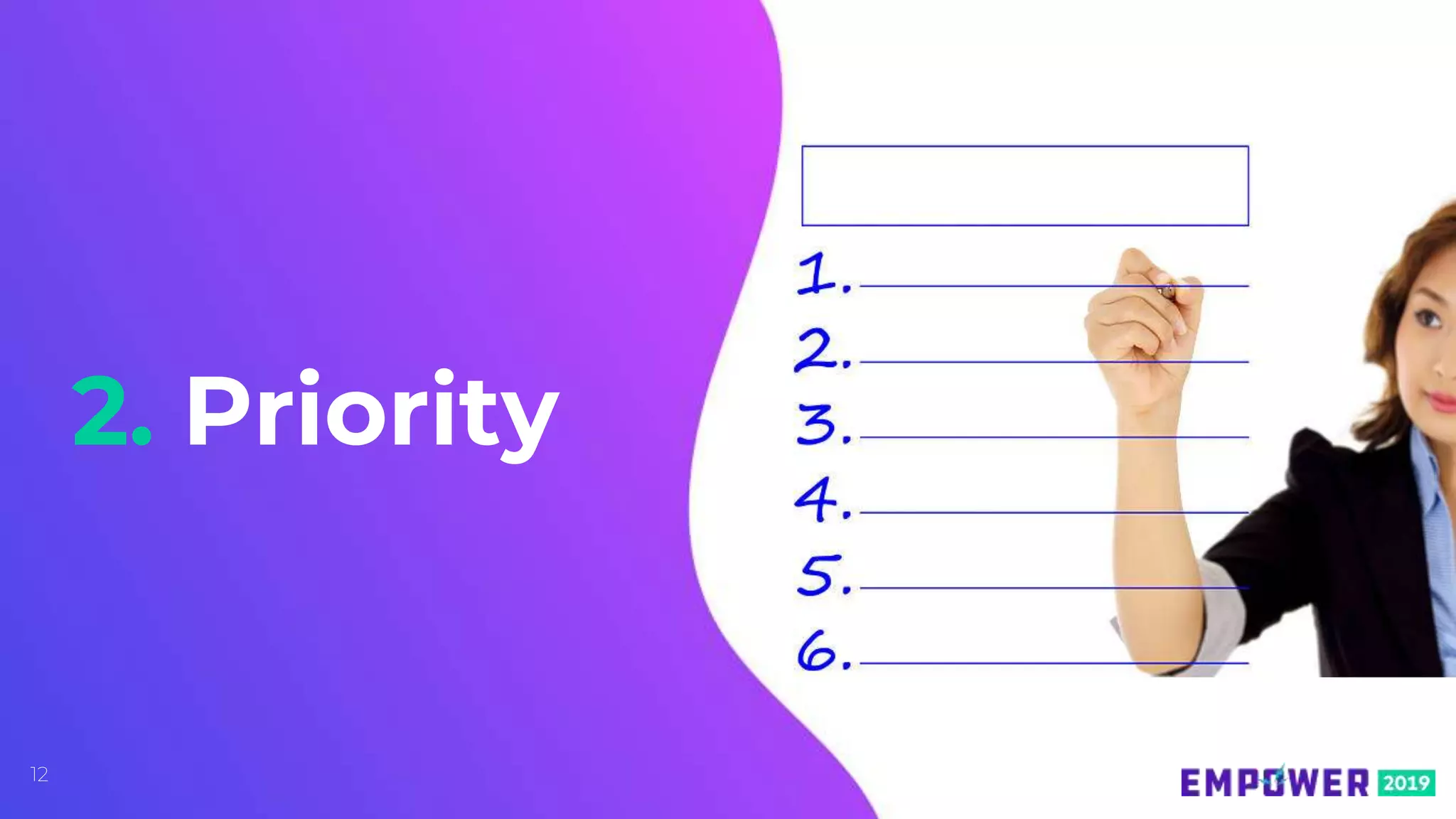
2. Priority
13
3. Delivery
14
15
16
Sarah Sheikh
Head of Customer Success
17
Balochistan, Pakistan
Content goes here!
18
Balochistan, Pakistan
19
Front is the collaborative inbox for teams. It brings all
your messages, emails, and apps into one platform,
so you can work more efficiently and get the full
picture of every customer.
Nearly 5,000 teams rely on their Front inbox to
manage their email and provide an excellent
customer experience.
20
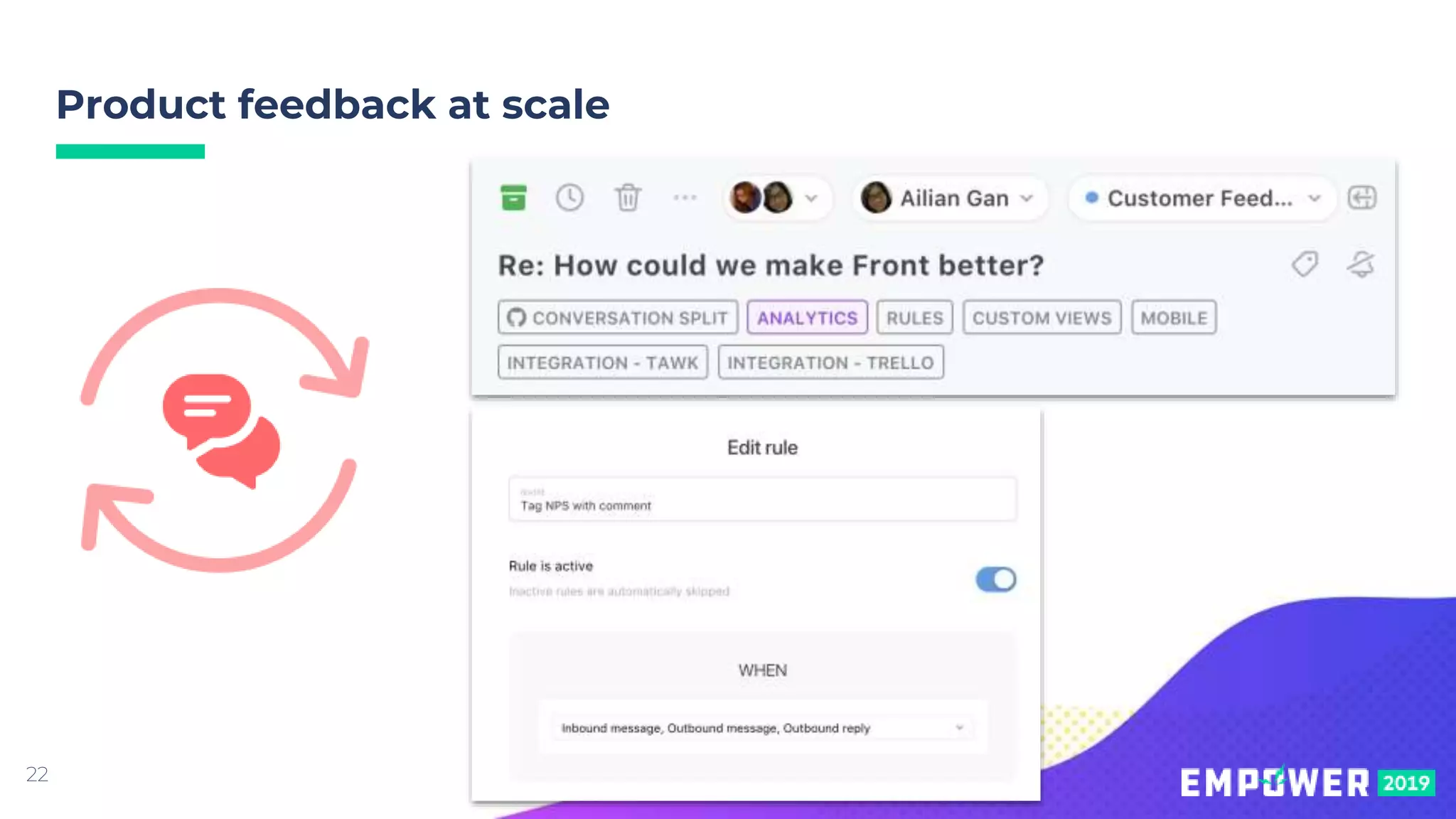
Effective listening at scale
means organization.
21
Product feedback at scale
22
Get your company to listen at scale
23
● Customer spotlights in
All Hands
● Physically post it
around the office
● Get leadership
involved
24
Shauntle Barley
Head of Growth
25
26
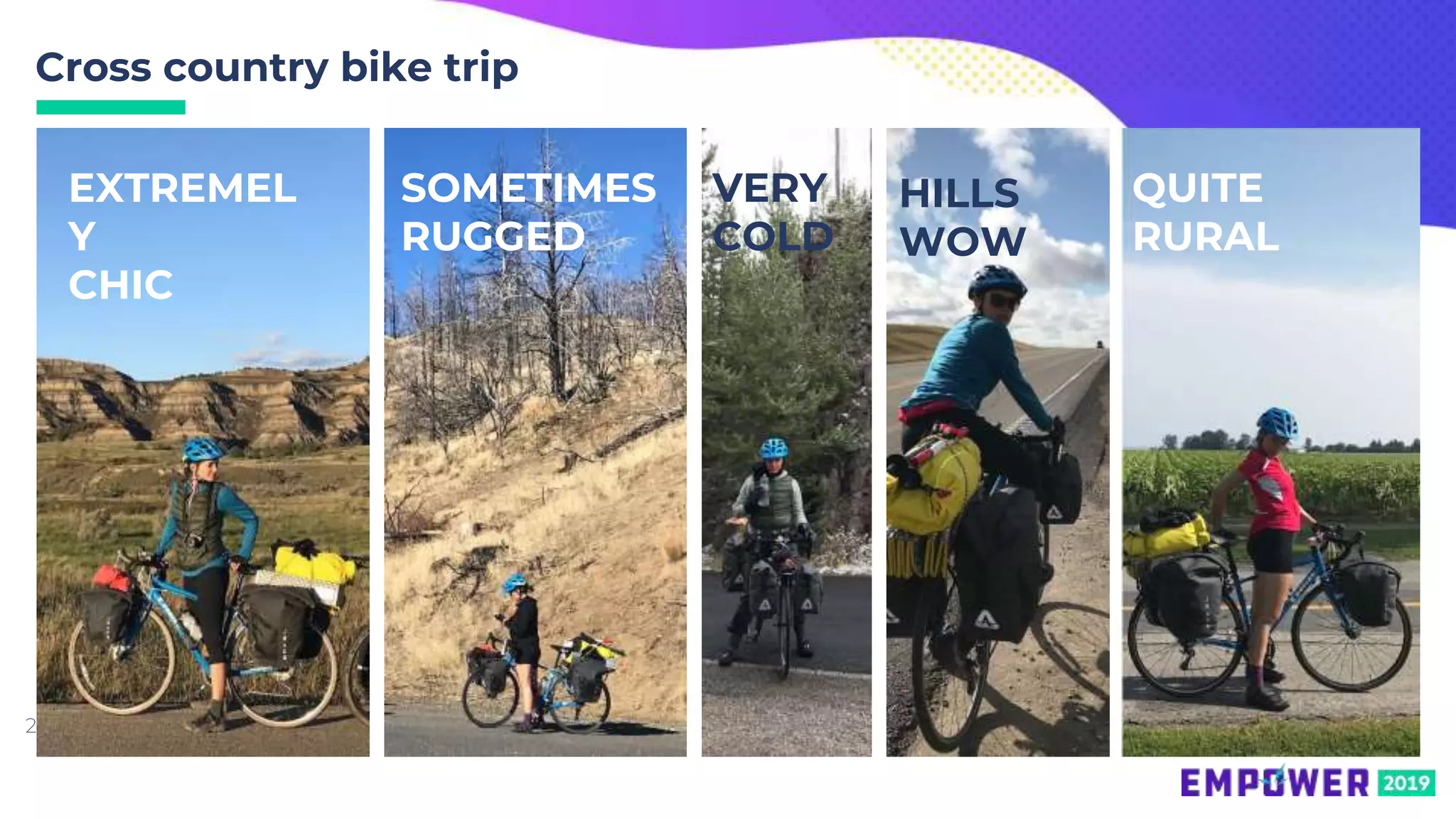
Cross country bike trip
EXTREMEL
Y
CHIC
VERY
COLD
QUITE
RURAL
SOMETIMES
RUGGED
HILLS
WOW
27
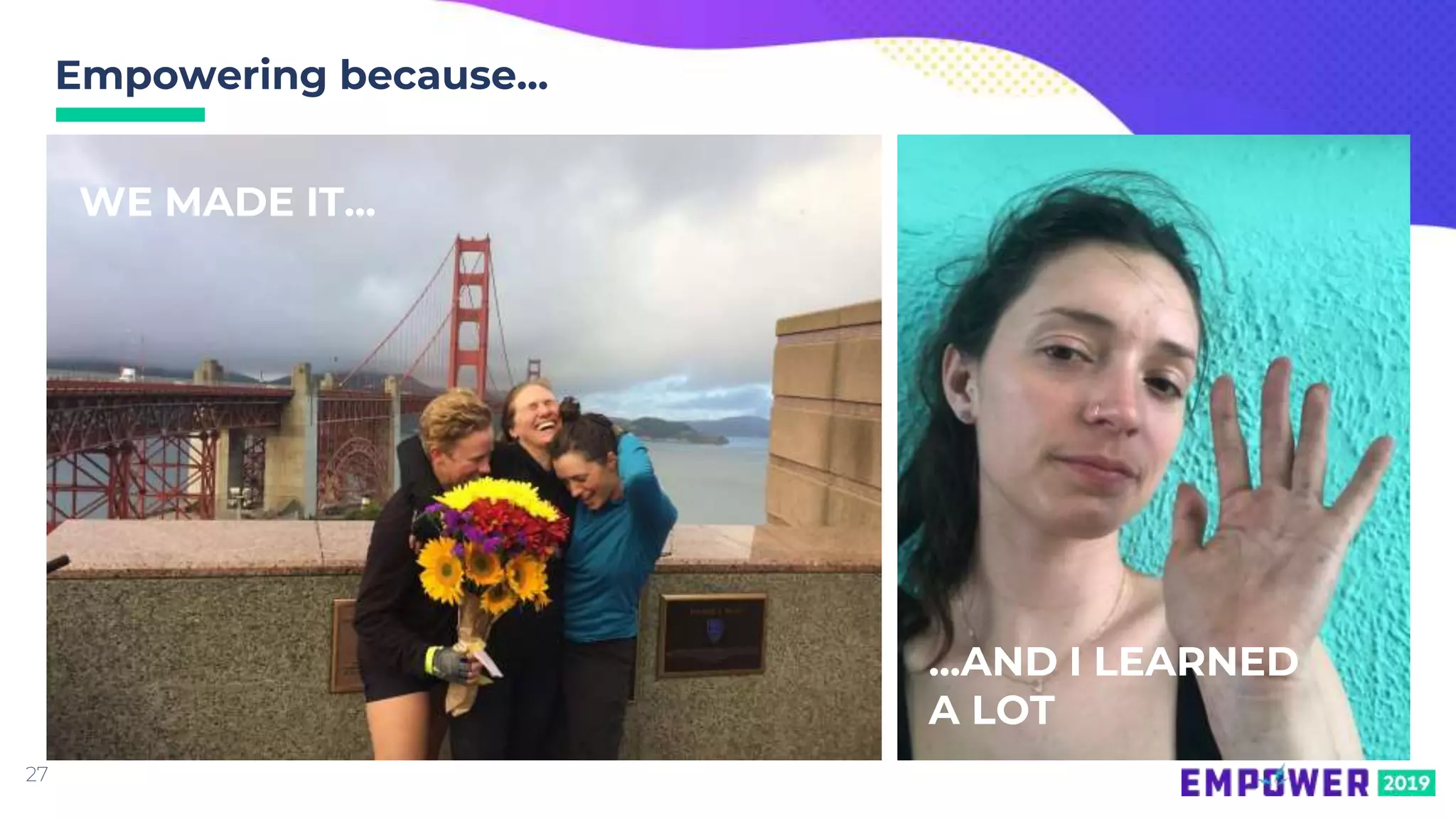
Empowering because...
WE MADE IT...
...AND I LEARNED
A LOT
The quality of agents affects the
NPS directly.
MaestroQA is a CX quality platform that helps
15,000 CX agents elevate the quality of
interactions they have with customers.
28
⋆ Record
⋆ Listen
⋆ Analyze
⋆ Track feedback
There are many
ways to listen at
scale. We...
29
30
We have four
categories of
analysis
1. Soft skills
2. Hard skills
3. Customer insights*
4. Product feedback*
31
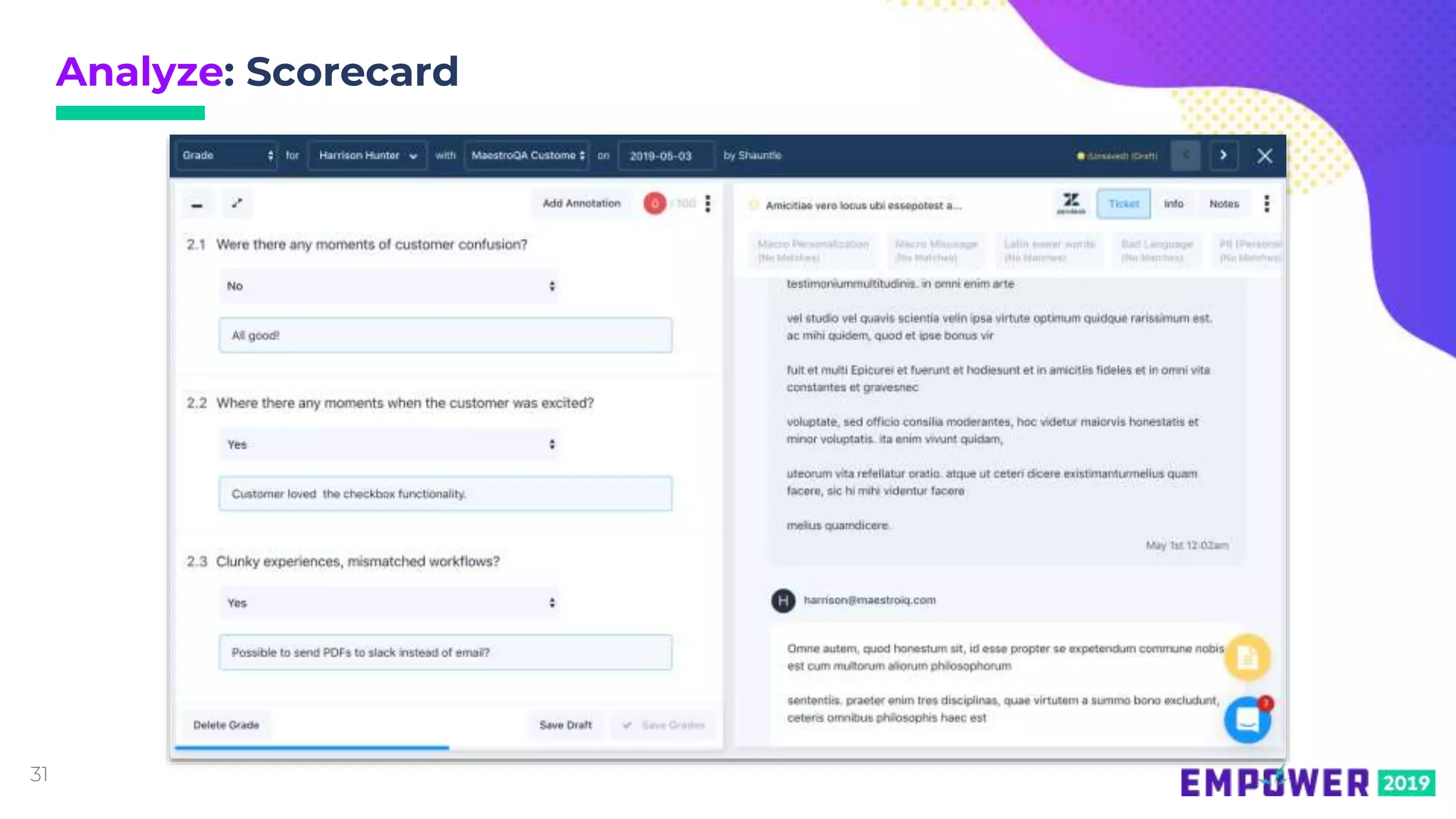
Analyze: Scorecard
Track Feedback: Pivotal
[Need to insert screenshot]
32
Q&A
33
Sarah Sheikh
Head of CS
Camille E. Acey
Head of CS
Shauntle Barley
Head of Growth
Moderated by:
Hillary Curran
Head of CX @ Guru
Thank you!
34
35

Listening at Scale: How to Glean Actionable Insights from Support & Success

Editor's Notes

  • #2  Title: “Listening at Scale” Goal: How do you integrate and share customer insights from a large volume of support and success interactions with your broader team? CS serves as the customer voice, so how do we listen and then speak on behalf of customers effectively? How do you get the signal out of the noise? Timing: 5 min MAX for slides and an example or 2 of how you "listen at scale" Template Slides 10-15 min of Q&A with Facilitator (Hillary from Guru)
  • #4 As was mentioned I am the Head of Customer Success where we provide the communications layer for modern business. I’ve been there for a short while only about two months, but I love the company and the team, and I feel empowered and appreciated every day I’m there.
  • #5 However, my Empower Moment for today is when I became a mother
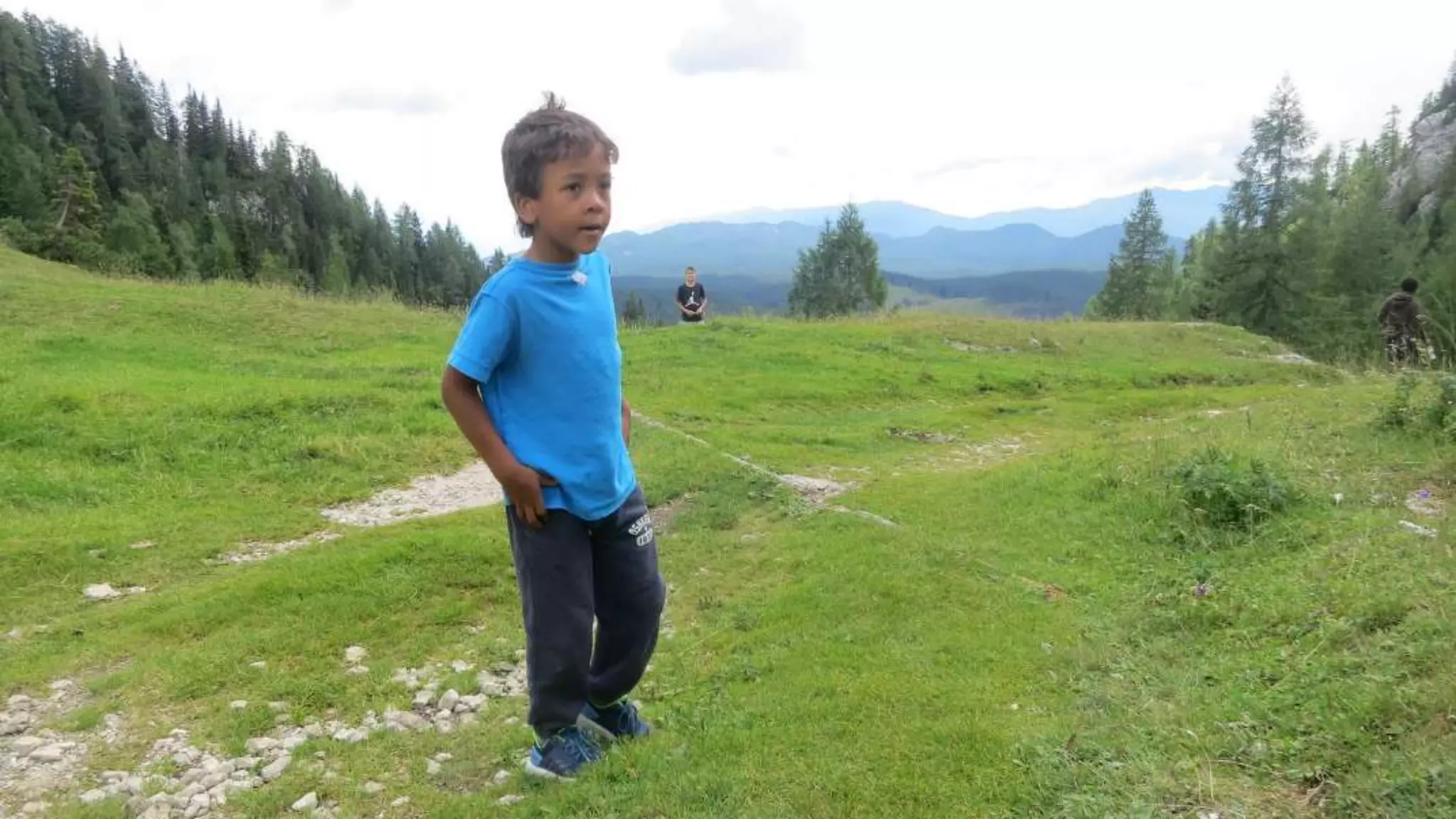
  • #6 This is my son and I the day after he was born. I’d of course spent over nine months being pregnant and several hours unto days delivering him into the world but none of this really prepared me for the power that was thrust into my hands (and his fathers’ hands) at the same moment that this little creature was. All of a sudden there were a million decisions to make and so many more that we could make - where would he go, who would he meet, what would his first food be? But alll that power only lasted a short while...
  • #7 That little guy grew up and started doing his own thing. Making his own friends and picking his own foods and my role changed and my power shifted.
  • #8 He’s on his own path now and my role is not to pick everything for him or dictate a vision for his life. It’s to listen to him and nurture him as he blazes his own trail. To protect him from big pitfalls if I can, but mostly to help him be great in his own unique way. It’s tough to do when you’re dealing with just one little customer and even tougher when we are dealing with hundreds, thousands, or even millions. So how do we do this in a scalable way?
  • #9 How do we do this in a scalable way?
  • #10 Oftentimes we get so narrowly focused on what will work when our company is 10X that we fail to realize that the best customer experiences are the ones where customers feel like we’ve listened to them and understood their pain. When we’ve done a little something extra to not necessarily fix the entire system but to reduce their burden and show we care. Our growth comes from these little, sometimes hard to repeat gestures.
  • #11 Good scale comes to those who listen and deliver. So we check into our customers and potential customers, who they are, what are their jobs to be done, and their painpoints via all the channels available to us: support tickets, CSAT, NPS, Voice of Customer systems, QBRs, demo calls, also inputs from sales and anyone else in the org who touches our users.
  • #12 As we do that listening, we want to find a regular cadence to pull together all the threads. What issues are rising to the top? The customer team should be leaders in synthesizing customer sentiment and sharing that with the rest of the company.
  • #13 After we synthesize the painpoints and demands, we have to prioritize them. Not every customer need is going to make the cut. Prioritize the biggest wins, the things that you think will move your team and your company forward, and align on a strategy to appeal to product, Engineering, and leadership. The CS team can be taken a lot more seriously if you are speaking with one voice and not just setting off alarms about *everything* that is wrong.
  • #14 The third step is delivery. Ideally you are delivering on the functionality the customer wants, a new feature or a bug fixed but sometimes all you have is feedback from the product manager about why it didn’t make the cut and maybe some idea of what it might take to get it prioritized. The other part of this is expectation-setting. When our companies are small we somehow think that one day we will work through our entire backlog and arrive at a fateful day when our product is feature complete. As we grow and the demands on us grow from all sides we soon become disabused of that. Delivery is not just giving customers everything they want, it is communicating that you’ve heard them and that you care.
  • #15 So synthesis of customer sentiment, priority of the few things you and your team will advocate for, and delivery not just of functionality but sentiment -- being clear on where things stand while doubling down on your commitment to their success.
  • #16 There’s definitely more. So I’m excited to discuss this great topic with the panel and the rest of you.
  • #21 Front is the collaborative inbox that helps teams work more efficiently together. It brings all your communication channels and apps into one platform, so you can work more efficiently and your customer gets a great experience. We work with over 5,000 teams so it’s important we listen to all or our customers. But it’s a lot of teams to work with.
  • #27 A very empowering experience for me was biking across the country At the time it was the hardest thing I’d ever done It wasn’t very glamorous It was windy and cold There were a lot of big hills (like the rockies) And days when the most action we saw were cow fields and gas stations
  • #28 But we made it, in spite of how miserable it sometimes was And it felt special that we were a group of just three women doing it on our own And it taught me that I could do hard things It taught me, by necessity, how to fix my own bike (also not very chic) which I never thought i’d be able to do And it gave me the confidence to take the job that i have today -- which i was definitely unqualified for when i took
  • #29 MaestroQA is the leader in CX quality software This is why we exist …. The quality of agents affects the NPS directly. We help our customers elevate the quality of agent-customer interactions build more human relationships (and ultimately) improve NPS MaestroQA is a CX quality platform that helps 15,000 CX agents elevate the quality of interactions they have with customers.
  • #30 There are many ways to listen at scale But I’ll be sharing what we do most uniquely This is also core to how we help our customers listen at scale, uniquely It starts by recording all of our customer facing interactions This includes success calls Sales calls Live chat We have people, people part of their job responsibilities are to listen to a portion of these conversations every week
  • #31 When we listen, we look out for four categories of things that we care about We have four categories of analysis Feedback to the individual on our team on softskills improvements Sometimes we interrupt Sometimes we don’t engage in small talk enough Information like hardskills Is this the right information being presented, are people asking the right questions Interesting customer insights Other tools they’re using Ask questions and we realize we can turn that into a blog post We look for two emotional responses from customers Confusion and excitement We’ve learned that customers are confused about our pricing page, or a workflow set up that’s confusing And that people are excited by automation Product feedback Mismatch in workflow and product Or cumbersome product experiences
  • #32 We run this process through MaestroQA On the right side, is the customer interaction, this is an example of what a live chat would look like IF it’s a zoom call, there would be a link there We document this feedback through a structured scorecard in maestroqa Scorecard: Employee Soft skill What were the areas of soft skills improvements Was this an interaction that makes me proud to work at Maestro? Hard skill Did the person give accurate and clear information Insights Customer Were there any moments of customer confusion Were there any moments where the customer was excited Product Clunky experiences, mismatched workflows?
  • #33 We collect the insights from this process in pivotal Feature requests Integration requests Mentions of hipaa compliance Additional notes: Before we started using maestro for this workflow, the ceo and product people would sit in on success calls, this wasn’t scalable. For sales and success, this started to be a way to train sales people on soft skills,
  • #34 How do you integrate and share customer insights from a large volume of support and success interactions with your broader team? CS serves as the customer voice, so how do we listen and then speak on behalf of customers effectively? How do you get the signal out of the noise?