Linear Search Algorithm
Searching is the process of finding some particular element in
the list. If the element is present in the list, then the process is
called successful, and the process returns the location of that
element; otherwise, the search is called unsuccessful.
Two popular search methods are Linear Search and Binary
Search.
Linear search is also called as sequential search
algorithm. It is the simplest searching algorithm. In Linear
search, we simply traverse the list completely and match each
element of the list with the item whose location is to be found.
If the match is found, then the location of the item is returned;
otherwise, the algorithm returns NULL.
It is widely used to search an element from the unordered
list, i.e., the list in which items are not sorted.
The steps used in the implementation of Linear Search
are listed as follows -
■ First, we have to traverse the array elements using a
for loop.
■ In each iteration of for loop, compare the search
element with the current array element, and –
■ If the element matches, then return the index of the
corresponding array element.
■ If the element does not match, then move to the next
element.
■ If there is no match or the search element is not
present in the given array, return -1.
Algorithm
Linear_Search(a, n, val) // 'a' is the given array, 'n' is the
size of given array, 'val' is the value to search
Step 1: set pos = -1
Step 2: set i = 1
Step 3: repeat step 4 while i <= n
Step 4: if a[i] == val
set pos = i
print pos
go to step 6
[end of if]
set ii = i + 1
[end of loop]
Step 5: if pos = -1
print "value is not present in the array "
[end of if]
Step 6: exit
Working of Linear search
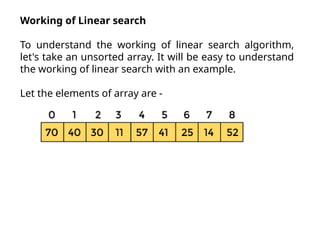
To understand the working of linear search algorithm,
let's take an unsorted array. It will be easy to understand
the working of linear search with an example.
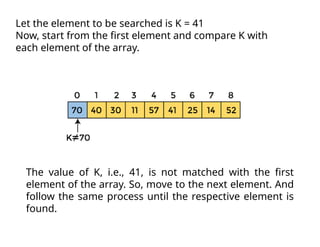
Let the elements of array are -
Let the element to be searched is K = 41
Now, start from the first element and compare K with
each element of the array.
The value of K, i.e., 41, is not matched with the first
element of the array. So, move to the next element. And
follow the same process until the respective element is
found.
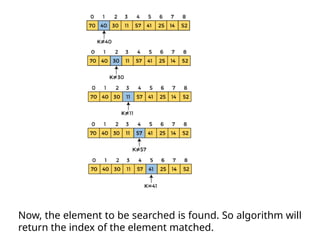
Now, the element to be searched is found. So algorithm will
return the index of the element matched.
Linear Search complexity
Now, let's see the time complexity of linear search in the
best case, average case, and worst case. We will also see
the space complexity of linear search.
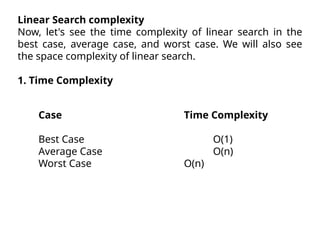
1. Time Complexity
Case Time Complexity
Best Case O(1)
Average Case O(n)
Worst Case O(n)
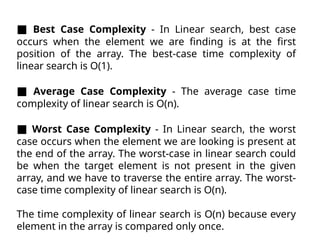
■ Best Case Complexity - In Linear search, best case
occurs when the element we are finding is at the first
position of the array. The best-case time complexity of
linear search is O(1).
■ Average Case Complexity - The average case time
complexity of linear search is O(n).
■ Worst Case Complexity - In Linear search, the worst
case occurs when the element we are looking is present at
the end of the array. The worst-case in linear search could
be when the target element is not present in the given
array, and we have to traverse the entire array. The worst-
case time complexity of linear search is O(n).
The time complexity of linear search is O(n) because every
element in the array is compared only once.
2. Space Complexity
Space Complexity O(1)
The space complexity of linear search is O(1).
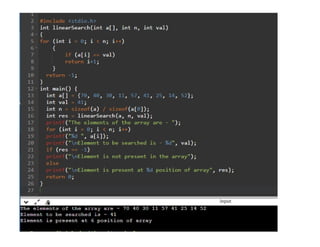
Implementation of Linear Search in C
#include <stdio.h>
int linearSearch(int a[], int n, int val)
{
for (int i = 0; i < n; i++)
{
if (a[i] == val)
return i+1;
}
return -1;
}
int main() {
int a[] = {70, 40, 30, 11, 57, 41, 25, 14, 52};
int val = 41;
int n = sizeof(a) / sizeof(a[0]);
int res = linearSearch(a, n, val);
printf("The elements of the array are - ");
for (int i = 0; i < n; i++)
printf("%d ", a[i]);
printf("nElement to be searched is - %d", val);
if (res == -1)
printf("nElement is not present in the array");
else
printf("nElement is present at %d position of array", res);
return 0;
}
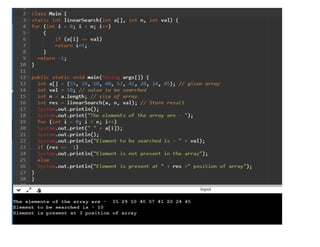
class LinearSearch {
static int linearSearch(int a[], int n, int val) {
for (int i = 0; i < n; i++)
{
if (a[i] == val)
return i+1;
}
return -1;
}
public static void main(String args[]) {
int a[] = {55, 29, 10, 40, 57, 41, 20, 24, 45};
int val = 10; // value to be searched
int n = a.length;
int res = linearSearch(a, n, val);
System.out.println();
System.out.print("The elements of the array are - ");
for (int i = 0; i < n; i++)
System.out.print(" " + a[i]);
System.out.println();
System.out.println("Element to be searched is - " + val);
if (res == -1)
System.out.println("Element is not present in the array");
else
System.out.println("Element is present at " + res +" position of array");
}
}
Implementation of Linear Search in Java
Linear Search Algorithm in Data Structure and Algorithm

Linear Search Algorithm in Data Structure and Algorithm

  • 1.
    Linear Search Algorithm Searchingis the process of finding some particular element in the list. If the element is present in the list, then the process is called successful, and the process returns the location of that element; otherwise, the search is called unsuccessful. Two popular search methods are Linear Search and Binary Search. Linear search is also called as sequential search algorithm. It is the simplest searching algorithm. In Linear search, we simply traverse the list completely and match each element of the list with the item whose location is to be found. If the match is found, then the location of the item is returned; otherwise, the algorithm returns NULL. It is widely used to search an element from the unordered list, i.e., the list in which items are not sorted.
  • 2.
    The steps usedin the implementation of Linear Search are listed as follows - ■ First, we have to traverse the array elements using a for loop. ■ In each iteration of for loop, compare the search element with the current array element, and – ■ If the element matches, then return the index of the corresponding array element. ■ If the element does not match, then move to the next element. ■ If there is no match or the search element is not present in the given array, return -1.
  • 3.
    Algorithm Linear_Search(a, n, val)// 'a' is the given array, 'n' is the size of given array, 'val' is the value to search Step 1: set pos = -1 Step 2: set i = 1 Step 3: repeat step 4 while i <= n Step 4: if a[i] == val set pos = i print pos go to step 6 [end of if] set ii = i + 1 [end of loop] Step 5: if pos = -1 print "value is not present in the array " [end of if] Step 6: exit
  • 4.
    Working of Linearsearch To understand the working of linear search algorithm, let's take an unsorted array. It will be easy to understand the working of linear search with an example. Let the elements of array are -
  • 5.
    Let the elementto be searched is K = 41 Now, start from the first element and compare K with each element of the array. The value of K, i.e., 41, is not matched with the first element of the array. So, move to the next element. And follow the same process until the respective element is found.
  • 6.
    Now, the elementto be searched is found. So algorithm will return the index of the element matched.
  • 7.
    Linear Search complexity Now,let's see the time complexity of linear search in the best case, average case, and worst case. We will also see the space complexity of linear search. 1. Time Complexity Case Time Complexity Best Case O(1) Average Case O(n) Worst Case O(n)
  • 8.
    ■ Best CaseComplexity - In Linear search, best case occurs when the element we are finding is at the first position of the array. The best-case time complexity of linear search is O(1). ■ Average Case Complexity - The average case time complexity of linear search is O(n). ■ Worst Case Complexity - In Linear search, the worst case occurs when the element we are looking is present at the end of the array. The worst-case in linear search could be when the target element is not present in the given array, and we have to traverse the entire array. The worst- case time complexity of linear search is O(n). The time complexity of linear search is O(n) because every element in the array is compared only once.
  • 9.
    2. Space Complexity SpaceComplexity O(1) The space complexity of linear search is O(1).
  • 10.
    Implementation of LinearSearch in C #include <stdio.h> int linearSearch(int a[], int n, int val) { for (int i = 0; i < n; i++) { if (a[i] == val) return i+1; } return -1; } int main() { int a[] = {70, 40, 30, 11, 57, 41, 25, 14, 52}; int val = 41; int n = sizeof(a) / sizeof(a[0]); int res = linearSearch(a, n, val); printf("The elements of the array are - "); for (int i = 0; i < n; i++) printf("%d ", a[i]); printf("nElement to be searched is - %d", val); if (res == -1) printf("nElement is not present in the array"); else printf("nElement is present at %d position of array", res); return 0; }
  • 12.
    class LinearSearch { staticint linearSearch(int a[], int n, int val) { for (int i = 0; i < n; i++) { if (a[i] == val) return i+1; } return -1; } public static void main(String args[]) { int a[] = {55, 29, 10, 40, 57, 41, 20, 24, 45}; int val = 10; // value to be searched int n = a.length; int res = linearSearch(a, n, val); System.out.println(); System.out.print("The elements of the array are - "); for (int i = 0; i < n; i++) System.out.print(" " + a[i]); System.out.println(); System.out.println("Element to be searched is - " + val); if (res == -1) System.out.println("Element is not present in the array"); else System.out.println("Element is present at " + res +" position of array"); } } Implementation of Linear Search in Java