limerickvoice
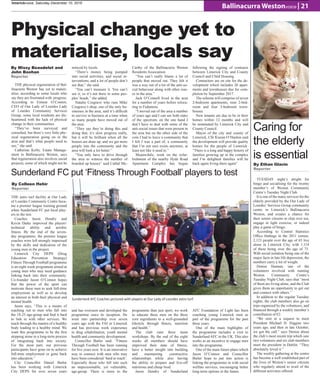
THE mother of a 25-year-old woman
stabbed to death with her two chil-
dren and best friend, has spoken for
-
release date.
-
ter Sarah Hines and grandchildren
Amy when they
by John Geary
at their home in
Newcastle West,
Co Limerick on
2010.
The 37-year-
ex-partner and
left him. He also
three-year-old
son Reece and
her friend Alicia
Limerick Voice
children keep me going,” said the
mother-of-six.
Originally from Milford in Co
-
ed by her fear of what might happen
when Geary is released.
my boys react?” she asked.
added.
-
to prepare me for what was going to
pains down my arm. It was the shock
of what I had been told.”
The heartbroken mother has
-
-
“He always wanted to know where
she was and who she was with,” Abi-
na recalled.
are,” she added.
“Violence is on the increase and
-
children.
Meanwhile, the mother of Alicia
-
-
to Alicia and so many other women
-
death. Speaking to Limerick Voice
MOTHER SPEAKS
OF HEARTBREAK
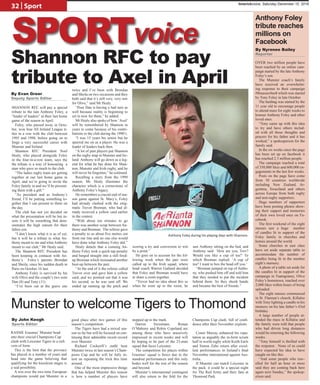
Abina bears the burden of four brutal murders
Ryan O’Rourke
Reporter
THE EIGHTH AMENDMENT SURVEY
EXCLUSIVE: University of Limerick students have their say: Page 7
See inSide for more on
maria’S Story: Page 5
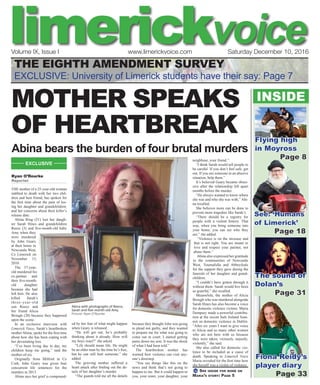
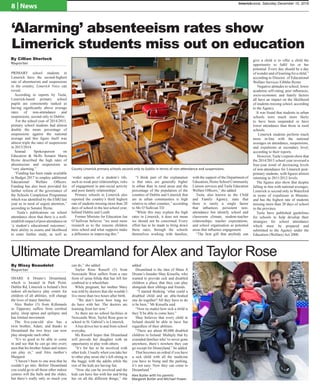
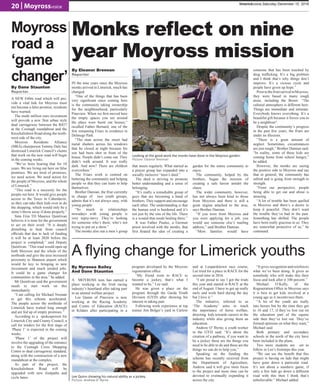
Abina with photographs of Reece,
Volume IX, Issue I www.limerickvoice.com Saturday December 10, 2016
EXCLUSIVE
Flying high
in Moyross
Page 8
See: ‘Humans
of Limerick’
Page 18
Fiona Reidy’s
player diary
Page 33
The sound of
Dolan’s
Page 31
INSIDE
2 | News limerickvoice, Saturday December 10, 2016
Editor - Michelle Hogan
News Editor - Ciara Phelan
Deputy News Editor - Michaela Keating
Features Editor - Jennifer Purcell
Deputy Features Editor - Robert Flynn
Business & Agri Editor - Martin
O’Donnell
Deputy Business Editor - Jerome
Glavin
Political Editor - Cillian Ryan
Deputy Political Editor - Fiona Reidy
Sports Editor - John Keogh
Deputy Sports Editor - Evan Greer
Regeneration Editor - Mark Quinn
Production Manager - Cillian Sherlock
Deputy Production Manager - Sally
Gorman
Photo Editor - Rebecca Stiffe
Deputy Photo Editor - Denise Curtin
Online Editor - Breda Graham
Social Media Manager - Seán Lynch
Online Editor Breda Graham and Social Media Manager Seán
Lynch look at the Limerick Voice 2016 website in headlines
Social media
The 2016 Team:
Limerick Voice online
Facebook - /limerickvoice
Twitter - @limerickvoice
Instagram - @limerickvoicenews
Actor turned restaurateur
to open vegan-friendly
establishment in Limerick
Limerick FC lift SSE
Airtricity First Division title
and return to top flight
First roll of dice for new
Limerick Monopoly board
Limerick in shock following
death of Munster Head
Coach Anthony Foley
Adi Roche highlights
volunteering in UL speech
Limerick toddler turns on
Christmas lights at Light Up
Limerick event
Welcome to the ninth edition
of Limerick Voice - an annual
publication produced by a team
of reporters from the BA in
Journalism and New Media and
the Grad Dip/MA in Journalism at
the University of Limerick.
Clear issues are emerging
in Limerick today, which are
fundamental to our society at large.
In the following 40 pages we aim
to give a voice to the voiceless.
The pressing issue of domestic
violence is highlighted in the
powerful stories of Abina Ring
and Maria Dempsey, two grieving
mothers who both tragically lost
daughters and grandchildren in a
horrific murder in Newcastle West
six years ago. These brave women
have decided to speak out about
their suffering in an effort to raise
awareness for domestic violence
victims everywhere.
As the latest homelessness
figures for Limerick reveal that
57 children will spend their
Christmas living in emergency
accommodation, we look at how
one community-supported bus
service in Moyross is ensuring
homeless children get to school
every day. Limerick’s alarming
suicide rates are also highlighted
along with the magnificent work
done by the many unsung heroes
who work tirelessly to help those
at their time of greatest need.
Strong figures standing up
for their place in society appear
throughout this edition. Joy Neville
who is not only a trailblazer in
Irish rugby refereeing, but also
a voice for young rugby players
features on our back page.
Our investigative reports
highlight the number of children
and young adults on mental health
waiting lists in the Mid West and
the worrying extent of absenteeism
rates in Limerick primary schools.
We also highlight the lack of
mental support for members of An
Garda Síochána.
We seek out real people on the
groundinour‘RiversideRamblers’
and ‘Humans of Limerick’ picture
specials.
As the year draws to a close
we look back at what has been an
annus horribilis for the Emergency
Department at University Hospital
Limerick and look forward to the
possibility of a new A&E in 2017.
I would like to extend a huge
thank you to everyone who
contributed to this publication
and I sincerely hope you enjoy the
2016 edition of Limerick Voice.
By Michelle Hogan
Editor
Robert Ahern	 Paul Keegan
Mark Allen	 Shane McNamara
Nyrenee Bailey	 Ryan O’Rourke
Missy Beaudelot Andrew Roberts
Eleanor Brennan	 Alessandro Mazzoleni
Sarah O’Brien	 Dane Staunton
Sinead Burke 	 Angela Weisgal
Adrian Dooley 	 Ethan Glavin
Aislinn Downling Colleen Hehir
Aine Freeman	 Daniel Keating
Frances Fitzgerald Amy Ryan
Reporters
Sports Reporters
David Byrne	 Tadhg O’Sullivan
John Boohan 	 Seamus Toomey
Darragh Bermingham
schools on the rise
Page 8
health support
Page 9
Spain on panto debut
Page 28
Absenteeism in primary
Lack of Garda mental
Limerick comedian Karl
Limerick
Page 29
Veganism on the rise in
Search and Rescue
Page 36
Heroes: Limerick Marine
Inside:
LimerickVoice 2016:
A voice for the voiceless
Posts: 220
Post likes: 2,801
Total reach: 110,889
New page likes: 398
Video views: 6,206
Tweets: 900
Profile visits: 638
Impressions: 208,700
Video views: 732
Posts: 68
Post likes: 703
Average post likes: 10
Video views: 286
The Limerick Voice was active across
social media from Sep to Dec 2016.
Here are some of our major stats:
By Sarah O’Brien By Rebecca Stiffe
By Michaela Keating By Angie Weisgal and Daniel Keating
By David Byrne By Evan Greer
limerickvoice, Saturday December 10, 2016
News | 3
UP TO 10 percent of children and
teenagers referred for mental health
treatment in the Mid West are wait-
ing a year or longer, the latest figures
from the Child and Adolescent Men-
tal Health Services (CAMHS) reveal.
Figures obtained under the Free-
dom of Information Act show there
are 263 young people currently on
the CAMHS waiting list in the Mid-
West, almost 10 percent of whom are
waiting more than 12 months.
Almost 40 percent of those cur-
rently on the overall CAMHS wait-
ing list are from Limerick, with
young people from Clare making up
almost 50 percent of the waiting list.
CAMHS provides a service for
young people up to the age of 18 and
their families who are experiencing
mental health difficulties that affect
their ability to function in day-to-day
activities.
According to Bernadette Kenny,
CEO of creative arts psychotherapy
service, The Blue Box, prolonged
waiting times can have devastating
consequences.
“If they [children and adolescents]
don’t get treatment they get worse.
It gets more and more ingrained in
their behaviour and how they see
themselves. It leads to suicide idea-
tion, if not completing a suicide,” she
warned.
The Blue Box service provides
creative arts psychotherapy for chil-
dren aged three to 18, using creative
mediums such as art, music, dance
and play, to explore their emotional
and mental health.
The Blue Box, which has 14 quali-
fied therapists, has seen children as
young as five suffering from anxiety,
“Children more and more are pre-
senting with anxiety. Even five and
six-year-olds are presenting with
anxiety. That anxiety can come from
anything from a new baby in the
house to mum or dad going to prison
or into a treatment programme or un-
employment.”
Ms Kenny who is a native of Clare,
said there are very little resources for
mental health in her local area, par-
ticularly for gay and lesbian people
who have to travel to Limerick for
some supports .
“I’ve worked with young gay men
who do get suicidal, there’s no re-
sources for them,” she explained.
According to Niall Loftus, a Guid-
ance Counsellor at Colaiste Nano
Nagle in Limerick, CAMHS is very
quick to act in urgent cases, however,
he says there is a “gap” in services
for young people presenting with low
level difficulties.
“If a student has self-harmed or if
a student has got significant issues,
it’s immediately acted upon,” ex-
plained Mr Loftus. “But if a student
is generally struggling, if a student is
just a little bit low, or there are vari-
ous things just wearing away at that
child, I think they’re the ones that are
the difficulty.”
Mr Loftus said that the Jigsaw ser-
vice coming to Limerick could “very
well be the solution”.	
The Jigsaw project is a free mental
health service for young people aged
12 to 25 and was due to open in Lim-
erick in December 2016. However,
it’s understood the project timeline
has been delayed by the inability to
secure a clinical co-ordinator.
Project co-ordinator and Deputy
Mayor of Limerick, Cllr Daniel But-
ler, said the project is a “vital ser-
vice” for young people in Limerick,.
However difficulties in appointing a
clinical co-ordinator, which requires
very specific qualifications, has de-
layed the opening of the facility.
The HSE was contacted repeatedly
by Limerick Voice for comment but
they had failed to respond at the time
of going to press.
“Still a lot of work to do” says
19-year-old charity founder
Katie Whelan’s charity one of three charites chosen for Monopoly Limerick
Edition.
Picture: Michaela Keating
A LIMERICK woman whose cous-
in’s tragic death inspired an aware-
ness campaign around suicide has
said charities must step in to provide
support for mental health sufferers as
a result of government inaction.
Katie Whelan from Limerick char-
ity Lisa’s Light has said smaller Lim-
erick charities “have to step in” as a
result of the lack of government ac-
tion on mental health.
Commenting on recent figures
from the National Office for Sui-
cide Prevention, which show Lim-
erick’s rate of suicide and self-harm
is twice the national average, Ms
Whelan said, “We are being failed
in certain ways by our government.
I know that Limerick city and county
are doing the best that they can and I
have myself noticed less of a stigma
attached to mental health and depres-
sion and people wanting to take their
own lives so I suppose in little ways
things are improving.”
The Limerick teenager, set up the
Lisa’s Light charity in memory of her
cousin Lisa, who very sadly took her
own life. The aim of the charity is to
promote positive mental health as a
means of suicide prevention, remind-
ing everyone that there is a reason to
smile in every single day.
The Lisa’s Light founder believes
that the government can do more for
those suffering with mental health
difficulties:
“There’s still a lot of work to be
done but if they realise that smaller
charities like Lisa’s Light and Cor-
bett’s Suicide Prevention have to
step up, then hopefully we’ll get the
support that we need for Limerick
people.”
Speaking about the support for lo-
cal charities, Ms Whelan who was
named Limerick Person of the Year
in 2015 said that Limerick people are
“absolutely amazing”.
“I went to sleep one night after I
started the Lisa’s Light Facebook
page and there was something like
100 likes from family and people I
know and I woke up the next day and
there was thousands. I’m so grateful
for the Limerick people for support-
ing it.”
Ms Whelan’s charity Lisa’s Light
is to star on its very own Community
Chest square on the board, developed
by Winning Moves UK under license
from MONOPOLY owners Hasbro.
Three Limerick charities were cho-
sen to feature on the board including
Lisa’s Light, Novas Initiatives and St
Gabriel’s School and Centre.
By Michaela Keating
Deputy News Editor
Children wait over a year
for mental health treatment
Limerick children make up
almost 40 percent of overall
mental health waiting list
By Jennifer Purcell
Features Editor
4 | News limerickvoice, Saturday December 10, 2016
The hope never fades
By Áine Freeman
Reporter
THERE will be empty seats and
heavy hearts in three Limerick homes
this Christmas.
Almost 20 years have passed since
three young men disappeared from
the city over the course of 30 months.
All three worked at the Dell com-
puter plant in Raheen and none of
them have ever been located.
Matthew Carroll, from Southill,
was last seen on June 8, 1998. He
had been socialising with friends in
the former The Steering Wheel pub,
in Roxboro.
Matthew’s mother Teresa died in
April 2015 without knowing what
happened to her son. Speaking be-
fore she died, she said “I want to
be buried with my son. I’ve told my
son Seamus he has to put Matthew’s
bones in on top of me, should I go
before his body is found.”
Aengus Shanahan, has been miss-
ing, presumed dead, for 16 years. He
was last seen on February 11, 2000
when he left Coopers pub at 11.30pm
and went down Old School House
Lane.
His mother Nancy died “of a bro-
ken heart” last May.
Bereaved father and widow, Bob
Shanahan said: “Christmas is going
to be very hard. It’ll be quiet without
them.”
It will also be a time of loneliness
for Dromkeen woman Julia Walsh
whose son Desmond disappeared 17
years ago.
Des Walsh was out socialising in
Limerick City on September 8, 1999
and left The Works club at 2am.
Her husband, Thomas, passed
away two years after Des was report-
ed missing.
“If Des’ body is found, we could
give him a proper burial and I could
visit the two of them together,” said
Julia.
Her appeal is remarkably similar
to that of Bob Shanahan: “I’m not
looking for any justice. I’m not in-
terested in taking someone to court.
All I want is his skeleton to bury with
Nancy. That would be her last wish
and our wish. We just want closure”.
Despite appeals for a murder in-
quiry to be launched, missing per-
sons files remain open for each case.
Some discrepancies have arisen
with CCTV footage in Aengus’s
case, as tapes used by Gardaí show
him leaving the pub at 10.30pm
while newly analysed tapes show
him leaving at 11.28pm.
The original tapes state the date as
11-02-2005, however Aengus went
missing in 2000.
Eight years ago, Bob Shanahan
received an anonymous phone call
which claimed to know where Aen-
gus’ body was.
“The person on the line said: “’My
phone is broken so you won’t be able
to trace it back to me. Aengus was in
the wrong place at the wrong time.
His body was thrown over a wall
near the railway station’,” said Mr
Shanahan.
The area was searched extensively
but to no avail.
An annonymous message was left
on the Missing Persons Helpline in
relation to Matthew Carroll which
claimed to know the wherabouts of
Matthew’s body. Despite appeals,
that person never called back.
Limerick native Catherine Costel-
lo spent her career with the London
Metropolitan Police. Since her retire-
ment, she has worked with the Walsh
family in the search for their son.
Ms Costello said: “In the weeks
prior to his disappearance, Des
moved out of his apartment in the
city and went back to the family
home for several weeks. He then got
a new property on St Nessans Road
which he only frequented briefly be-
fore returning to his mother, with se-
vere bruising and cracked ribs.”
His phone continued to ring for
three days after he disappeared, but
nobody answered.
A number of anonymous emails
were sent to Desmond’s cousin urg-
ing that Barrington Street, where
Desmond lived, be searched more
extensively.
“The families have been through a
lot of cruelty. I believe there has been
a lot of evil intent in these cases and
a level of complacency around these
cases which is not acceptable,” Ms
Costello said.
If you have any information, you
can ring Roxboro Garda Station on
061 214 340 or the Garda Confiden-
tial phone line on 1800 666111.
MISSING:
Matthew
Carroll (top),
Aengus
Shanhan and
Des Walsh.
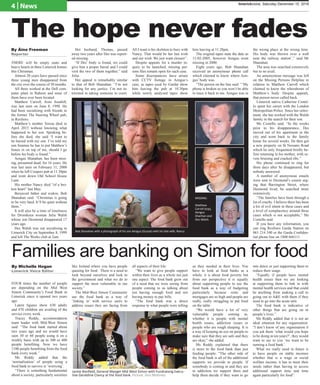
Bob Shanahan with a photograph of his son Aengus (Gussie) with his late wife, Nancy.
FOUR times the number of people
are depending on the Mid West
Simon Community’s Food Bank in
Limerick since it opened two years
ago.
Latest figures show 630 adults
and 470 children are availing of the
service every week.
Tracey Reddy, accommodation
team leader with Mid-West Simon
said: “The food bank started about
two years ago and we would have
seen 50 or 60 people using it on a
weekly basis with up to 300 or 400
people benefiting. Now we have
1100 people benefiting from the food
bank every week.”
Ms Reddy added that the
‘normalisation’ of people using a
food bank to survive is ‘worrying’.
“There is something fundamental
about a society, particularly societies
like Ireland where you have people
queuing for food. There is a need to
look beyond ourselves and look to
the government and what we do to
support the most vulnerable in our
society.”
The Mid-West Simon Community
use the food bank as a way of
‘linking in’ with service users to
address issues they are facing from
all aspects of their life:
“We want to give people support
within their lives as a whole not just
one aspect. The food bank grew out
of a need that we were seeing from
people coming to us talking about
not having enough food and not
having money to pay bills.
“The food bank was a direct
response to what people were telling
us they needed in their lives. You
have to look at food banks as a
whole, it is about food poverty but
from our perspective it is equally
about supporting people to use the
food bank as a way of budgeting
particularly because rents and
mortgages are so high and people are
really, really struggling to put food
on the table.
“We would have a lot of very
vulnerable people coming in,
whether it is people with mental
health issues, addiction issues or
people who are rough sleeping. It is
a way of keeping an eye on people to
make sure that they are safe and they
are okay,” she added.
Ms Reddy explained that there
is more to the food bank than just
feeding people: “The other side of
the food bank is all of the additional
supports we provide to people. If
somebody is coming in and they are
in addiction we support them and
help them decide if they want to go
into detox or just supporting them to
reduce their usage.
“Equally if people have mental
health issues then we are looking
at supporting them to link in with
mental health services and that could
be anything from making a call to
going out to A&E with them if they
need to go into the acute unit.
The food bank is indicative of
other things that are going on in
people’s lives.”
Ms Reddy added that it is not an
ideal situation for any organisation:
“I don’t know of any organisation if
you ask them ‘what would you hope
to be doing in ten years?’, they would
want to say to you ‘we want to be
running a food bank’.
What we really need in future is
to have people on stable incomes
whether that is a wage or social
welfare income, it has to meet their
needs rather than having to access
additional support time and time
again particularly for food”.
Families are banking on Simon for food
By Michelle Hogan
Limerick Voice Editor
Jackie Bonfield, General Manger Mid West Simon with Fundraising Execu-
tive Geraldine Clancy at the food bank. Picture: Don Moloney
limerickvoice, Saturday December 10, 2016
News | 5
Moyross school bus run for homeless children
By Daniel Keating
Reporter
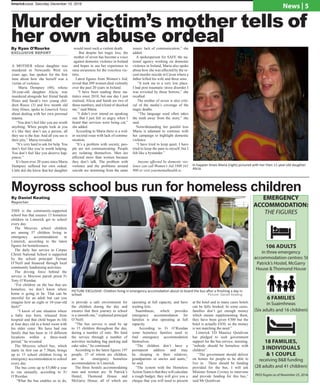
PICTURE EXCLUSIVE: Children living in emergency accomodation about to board the bus after a finishing a day in
school. 								 Picture: Daniel Keating
THIS is the community-supported
school bus that ensures 15 homeless
children in Limerick get to school
every day.
The Moyross school children
are among 57 children living in
emergency accommodation in
Limerick, according to the latest
figures for homelessness.
The daily bus service to Corpus
Christi National School is supported
by the school principal Tiernan
O’Neill and financed through local
community fundraising activities.
The driving force behind the
service is Moyross parish priest Fr
Tony O’Riordan.
“For children on the bus that are
homeless, we don’t know where
home is going to be. That can be
stressful for an adult but can you
imagine how an eight or 10-year-old
feels?”
“I know of one situation where
a baby was born, released from
hospital and that child began its life
at four days old in a hotel room with
his older sister. We have had one
family that has been in 14 different
locations within a three-week
period,” he revealed.
The Moyross school bus, which
starts its first run at 7.30am, brings
up to 15 school children living in
emergency accommodation to school
every day.
The bus costs up to €5,000 a year
to run annually, according to Fr
O’Riordan.
“What the bus enables us to do,
is provide a safe environment for
the children during the day and
ensures that their journey to school
is a smooth one,” explained principal
O’Neill.
“The bus service is used by up
to 15 children throughout the day,
during a number of runs. We fund
the service through a number of
activities including bag packing and
cake sales,” he continued.
According to the latest figures 197
people, 57 of whom are children,
are in emergency homeless
accommodation in Limerick.
The three hostels accommodating
men and women are: St Patrick’s
Hostel, Thomond House and
McGarry House; all of which are
operating at full capacity, and have
waiting lists.
Suaimhneas, which provides
emergency accommodation for
families is also operating at full
capacity.
According to Fr O’Riordan
some homeless families need to
find emergency accommodation
themselves.
“The children don’t have a
permanent address and may
be sleeping in their relatives,
grandparents or uncles and aunts,”
he said.
“The system with the Homeless
ActionTeamisthattheywillcalculate
a rough budget, they will give you a
cheque that you will need to present
at the hotel and in many cases hotels
can be fully booked. In some cases,
families don’t get enough money
which means supplementing them,
they have been given €300 but the
hotel is actually €450, so the money
is not matching the need.”
Limerick TD Maurice Quinlivan
has pledged to seek government
support for the bus service, insisting,
“nobody should be homeless with
children”.
“The government should deliver
on homes for people to be able to
live in. There should be funding
provided for the bus, I will ask
Minister Simon Covney to intervene
and provide funding for this bus,”
said Mr Quinlivan.
EMERGENCY
ACCOMMODATION:
THE FIGURES
106 ADULTS
in three emergency
accommodation centres: St
Patrick’s Hostel, McGarry
House & Thomond House
6 FAMILIES
in Suaimhneas
(Six adults and 16 children)
18 FAMILIES,
3 INDIVIDUALS
& 1 COUPLE
receiving B&B funding
(28 adults and 41 children)
PASS fiugres as of November 25, 2016.
Murder victim’s mother tells of
her own abuse ordeal
A MOTHER whose daughter was
murdered in Newcastle West six
years ago, has spoken for the first
time about how she herself was a
victim of violence.
Maria Dempsey (48), whose
20-year-old daughter Alicia, was
murdered alongside her friend Sarah
Hines and Sarah’s two young chil-
dren Reece (3) and five month old
Amy Hines, spoke to Limerick Voice
about dealing with her own personal
trauma.
“You don’t feel like you are worth
anything. When people look at you
it’s like they don’t see a person, all
they see is the fear. And all you see is
their pity,” Maria revealed.
“It’s very hard to ask for help. You
don’t feel like you’re worth helping.
You don’t feel like you deserve hap-
piness.”
It’s been over 20 years since Maria
Dempsey suffered her own ordeal.
Little did she know that her daughter
would meet such a violent death.
But despite her tragic loss, the
mother of seven has become a voice
against domestic violence in Ireland
and hopes to use her experience to
raise awareness for the voiceless vic-
tims.
Latest figures from Women’s Aid,
reveal that 209 women died violently
over the past 20 years in Ireland.
“I have been reading these sta-
tistics since 2010, but one day I just
realised, Alicia and Sarah are two of
those numbers, and it kind of shocked
me,” said Maria.
“I didn’t ever intend on speaking
out. But I just felt so angry when I
heard that services were being cut,”
she added.
According to Maria there is a wid-
er societal issue with lack of commu-
nication.
“It’s a problem with society, peo-
ple are not communicating. People
are isolating themselves. Men are
affected more than women because
they don’t talk. The problem with
violence and the problems around
suicide are stemming from the same
issues: lack of communication,” she
added.
A spokesperson for SAFE the na-
tional agency working on domestic
violence in Ireland, Maria also spoke
about how she was affected by the re-
cent murder suicide in Cavan where a
father killed his wife and three sons.
“It took me to a very low place.
I had post traumatic stress disorder I
was revisited by those horrors,” she
recalled.
The mother of seven is also criti-
cal of the media’s coverage of the
tragic deaths.
“The language used often takes
the truth away from the story,” she
said.
Notwithstanding her painful loss
Maria is adamant to continue with
her campaign to highlight domestic
violence.
“I have tried to keep quiet. I have
tried to keep the pain to myself, but I
felt like a bystander.”
Anyone affected by domestic vio-
lence can call Women’s Aid 1800 341
900 or visit yourmentalhealth.ie.
By Ryan O’Rourke
EXCLUSIVE REPORT
In happier times Maria (right) pictured with her then 11-year-old daughter
Alicia.
6 | News limerickvoice, Saturday December 10, 2016
Suicide patrol team braced
for busy Christmas period
By Jennifer Purcell
Features Editor
MEMBERS of a Limerick City sui-
cide patrol unit are bracing them-
selves for a busy Christmas.
With the latest figures showing that
the city has the highest suicide rate in
the country, the statistics come as no
surprise to the newly reformed Lim-
erick Suicide Watch Patrol team.
“2016 has been as busy as ever for
us,” explains Vice-Chairman Mike
O’Mara. “We’re coming into our
busiest time of year at Christmas. It
hasn’t gotten any better out there to
be honest with you.
“We’ve had them from as young
as 13,” said Mr O’Mara, who added
that the patrol team has dealt with
people up to the age of 85.
“Last Christmas we had eight in-
terventions in 12 nights. The previ-
ous year we had 16 in 12 nights. One
New Year’s Eve, we had five inter-
ventions alone.”
“We are on the front line. We work
hand-in-hand with Limerick Marine
Search and Rescue (LMSR) and
Limerick Fire and Rescue service,
explained Mr O’Mara.
“The lads in LMSR told us their
lives have been a lot quieter since we
started.”
To tackle suicide in Limerick, Mr
O’Mara said there needs to be a 27/4
drop in centre in place and urged that
“the council and the health board
need to supply something.”
“It’s very frustrating for us, we
could spend two hours with some-
one on the bridge and get them taken
away. They might be sent to the cri-
sis nurse in A&E but, unfortunately,
once they discharge them, they might
not have a follow-up for six to eight
weeks.”
“We could meet them a couple of
nights later in the same position they
had been in, when we first had taken
them off the bridge.”
He said that is ‘soul destroying’for
the team. “That is where the system
is failing us,” said O’Mara, “and fail-
ing the people that need the help.”
Provisional figures for 2013-2015
from the National Office for Suicide
Prevention show that the suicide rate
in Limerick City is more than twice
the national average.
This is reflected in the fact that the
MyMind Centre for Mental Wellbe-
ing in Limerick saw a 50 percent in-
crease in service use from its opening
in April 2014 to the end of 2015.
My Mind provides counselling and
psychotherapy sessions to people
with mild to moderate mental health
issues within 72 hours of initial con-
tact, with no GP referral required.
Over nine months of service in
2014, 808 appointments were carried
out. In 2015, this increased to 1241.
MyMind charges for their sessions
based on a client’s employment sta-
tus, as part of their self-sustainable
business model. They offer a reduced
rate for those retired, in part-time
jobs, unemployed and to students.
Centre Manager Michelle
O’Connor said: “We believe that ear-
ly intervention prevents more severe
or crisis issues from developing.”
In contrast, those who seek coun-
selling services through their GP wait
up to five months for an appointment
with the National Counselling Ser-
vice provided by the HSE.
There are currently 37 people on
the waiting list in Limerick to avail
of the service, which is free to medi-
cal card holders. More than 500 peo-
ple have availed of the service in the
last three years.
For information and support call
the Samaritans helpline (061) 412
111, or visit yourmentalhealth.ie.
Animal Welfare at risk as rents rise
MARION Fitzgibbon founder and director of
Limerick Animal Welfare (LAW) is at the end of
her tether trying to meet the €55,000 monthly cost
of keeping the organisation afloat.
“I don’t sleep at all at night, I’m gone crazy
with it,” Marion said as she made an appeal for
public donations instead of the food and gifts that
well-intentioned people bring for the animals.
The main source of income are the LAW shops
but they may have to close because of increased
rent.
“The shop on William Street is our busiest but
our lease is up at the end of the month and there is
a €7,000 increase in our rent,” Marion explained.
“Rent is going up all over the city but our in-
come isn’t. We have borrowed, fundraised and
begged to meet our debts”.
The €550,000 mortgage on the new animal
shelter in Kilfinane adds to the monthly bills of
between €12,000 and €15,000.
“To pay wages and meet bills, we need to bring
in a minimum of €55,000 a month. Recently, we
only brought in €36,000 and our vet bills alone
cost €18,000 last month,” Marion said.
Although the total annual contribution from
Limerick City and County Council amounts to
only around €2,000, the local author-
ity puts enormous pressure on the
group.
“They send out letters say-
ing if we can’t find a home
for an animal, we should
put a time limit on its
life.
“They don’t ap-
prove of us keeping
animals indefinitely
so we don’t have a
meeting of minds on
that matter because
LAW have a no-kill
policy.”
“Many people still
don’t have enough dispos-
able income to give to
charity but my Christ-
mas wish is that they
give a donation to
help us out.”
‘Adopt, don’t
shop’ this
Christmas
LIMERICK Animal
Welfare currently has
75 dogs looking for
a new home and
there has been
“an explo-
sion of cats
and kittens”
in the last
number of
weeks.
Founder
of LAW
M a r i o n
Fitzgibbon
is encour-
aging people
to adopt a dog
this Christmas
instead of buying
from puppy farms.
Marion Fitzgibbon.
Picture: Limerick Animal Welfare
Members of Limerick Suicide Watch Fergus Aherne, Colm O’Byrne, Shirley Johnston and Mandy Ellis.
Picture: Limerick Suicide Watch
A TRANSGENDER peer support
group has been set up in Limerick.
GOSHH, a Limerick-based charity
that offers support and services to the
lesbian, gay, bisexual and transgen-
der (LGBT) community.
They support LGBT young peo-
ple through one-to-one support, peer
support groups and awareness train-
ing for those working with young
people.
GOSHH launched a support group
for parents of transgender children
and adolescents, earlier this year. The
Limerick support group, which runs
once a month, is the third of its kind
in Ireland for parents of transgender
people, following Dublin and Car-
low.
The need for peer support groups
were highlighted in the findings of
a recent LGBT Ireland report which
showed that over 75 percent of
transgender people in Ireland have
thought about suicide and 35 percent
of the respondents have attempted
suicide.
Those aged between 19-25 show
the highest rate of suicide ideation
in the transgender community in Ire-
land.
The Transgender Equality Net-
work Ireland (TENI) launched Heads
Up: Trans Guide to Mental Health
and Wellbeing’ in October as part
of their TRANSforming Lives cam-
paign.
In addition to this, TENI offers
training to help sensitise health care
professionals in Ireland in dealing
with transgender people, and pro-
vides a list of trans-friendly health
care providers on their website.
Limerick
support for
trans people
By Ethan Glavin
Reporter
By Ciara Phelan
News Editor
limerickvoice, December , 2014limerickvoice, Saturday December 10, 2016
News | 7
Andrew Roberts, Angie Weisgal,
Alessandro Mazzoleni, and Frances
Fitzgerald collate the results of our
exclusive survey
MORE THAN two out of three University
of Limerick students want a complete
removal of the anti-abortion Eighth
Amendment from the Constitution,
according to an opinion poll conducted by
Limerick Voice.
The survey, which polled over 600
students on campus, reveals 68.6 percent
backing for the removal in its entirety of
the increasingly controversial amendment.
The opinion poll was conducted as a
specially convened Citizens’ Assembly
prepared to consider what, if anything,
should be done about the amendment
which gives the unborn child equal right
to life with the mother.
If another referendum is held, the two
most likely proposals will be - a complete
removal of the Eighth Amendment or a
removal of the Eighth Amendment and its
replacement by another wording.
While 68.6 percent of students want a
complete scrapping of the amendment
18.8 percent were opposed. A further 12.6
percent were undecided.
However, students were dramatically
less supportive of a proposal to remove the
Eighth Amendment and replace it with an
alternative wording.
Just over half UL students would
support such a move - at 52 percent. 25
percent of students opposed and a further
23 percent were undecided.
Repealing the Eighth Amendment is not
a clear-cut issue and uncertainty around
the proposed constitutional change is also
evident in the survey results, given the
number of people who answered yes to
both questions.
The survey also reveals that 42.4
percent of those who supported a complete
removal of the explicit ban on abortion
from the Constitution would nevertheless
support its removal and replacement if that
was the option to be considered.
Limerick Social Democrats representa-
tive Sarah Jane Hennelly, said the survey
findings weren’t surprising.
She maintained that the number of
students who didn’t know whether the
Eighth Amendment should be repealed
or replaced suggested a need for more
education on the issue.
“We need to give people a chance to
explore the issues, inform themselves, and
make a decision because that is their right.
It would empower them as citizens if we
could have a referendum.”
Meanwhile, Limerick AAA Councillor
Cian Prendiville has accused the
government of delay tactics.
“No woman in this country of repro-
ductive age has had a vote on the Eighth
Amendment. The establishment is still
kicking the can down the road.”
“It’s estimated that at least 5,000 more
women will have to travel for abortions
before there’s a referendum,” Mr
Prendiville said.
University of Limerick lecturer Máirtin
Ó Droma, who is patron of Life Society
in UL, a pro-life organisation, said he
wasn’t surprised by the findings because,
“the numbers in favour of removal seems
to reflect a popular trend.”
Referring to the nearly 13 percent who
“didn’t know”, Mr Ó Droma said it “raises
doubts about how well known the actual
wording of the amendment is.”
He maintained that the more than 50
percent favouring a replacement article
indicated “at least a readiness to recognise
the child in the womb as meriting some
protection.
“It reflects a desire for serious engage-
ment with the reality and a desire for
integrity in the discussions and debates
about the truths surrounding the issue,” he
added.
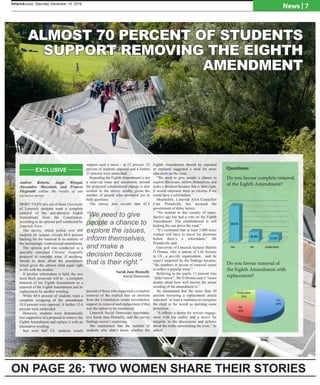
Yes	
   No	
   Undecided	
  
68.6%	
  
18.8%	
   12.6%	
  
Yes	
  
52%	
  
No	
  
25%	
  
Undecided	
  
23%	
  
Do you favour complete removal
of the Eighth Amendment?
ALMOST 70 PERCENT OF STUDENTS
SUPPORT REMOVING THE EIGHTH
AMENDMENT
ON PAGE 26: TWO WOMEN SHARE THEIR STORIES
Do you favour removal of
the Eighth Amendment with
replacement?
Questions:
“
“We need to give
people a chance to
explore the issues,
inform themselves,
and make a
decision because
that is their right.”
Sarah Jane Hennelly
Social Democrats
EXCLUSIVE
Alex Butler with his parents
Margaret Butler and Michael Power.
.
Ultimate Dreamland for Alex and Taylor Rose
‘Alarming’ absenteeism rates show
Limerick students miss out on education
By Cillian Sherlock
Reporter
PRIMARY school students in
Limerick have the second-highest
rate of absenteeism and suspensions
in the country, Limerick Voice can
reveal.
According to reports by Tusla,
Limerick-based primary school
pupils are consistently ranked as
having significantly above average
rates of non-attendance and
suspensions, second only to Dublin.
For the school year of 2014/2015,
primary school students had almost
double the mean percentage of
suspensions against the national
average and this figure itself was
almost triple the rates of suspensions
in 2013/2014.
Seanad Spokesperson on
Education & Skills Senator Maria
Byrne described the high rates of
absenteeism and suspensions as
“very alarming.”
“Funding has been made available
in Budget 2017 to employ additional
Educational Welfare Officers.
Funding has also been provided for
further reform of the governance of
the Schools Completion Programme
which was identified by the ESRI last
year as in need of urgent attention,”
according to Senator Byrne.
Tusla’s publications on school
attendance show that there is a well-
establishimpactofpoorattendanceon
‘a student’s educational outcomes’,
their ability in exams and likelihood
to enter further study, as well as
‘wider aspects of a student’s life,
such as weak peer relationships, risks
of engagement in anti-social activity
and poor family relationships’.
Primary schools in Limerick also
reported the country’s third highest
rate of students missing more than 20
days of school in the last school year,
behind Dublin and Louth.
Former Minister for Education Jan
O’Sullivan believes “we need more
research as to the reasons children
miss school and what supports make
a difference in improving this.”
“I think part of the explanation
is that rates are generally higher
in urban than in rural areas and the
percentage of the population of the
counties of Dublin and Limerick that
are in urban communities is high
relative to other counties,” according
to Ms O’Sullivan TD
“While this may explain the high
rates in Limerick, it does not mean
we should not be concerned. Every
effort has to be made to bring down
these rates, through the schools
themselves working with families,
with the support of the Department of
Education, Home School Community
Liaison services and Tusla Education
Welfare Officers,” she added.
Tusla, also known as the Child
and Family Agency, state that
there is rarely a single factor
that influences persistent non-
attendance but identify school and
classroom climate, student-teacher
relationships, teacher expectations,
and school organisation as potential
areas that influence engagement.
“The best gift that anybody can
give a child is to offer a child the
opportunity to fulfil his or her
potential. Every day should be a day
of wonder and of learning for a child,”
according to Director of Educational
Welfare Services Eibhlin Byrne.
Negative attitudes to school, lower
academic self-rating, peer influences,
socio-economic and family factors
all have an impact on the likelihood
of students missing school, according
to the Agency.
It was found that students in urban
schools were much more likely
to have been suspended or have
lower attendance than those in rural
schools.
Limerick students perform much
more in-line with the national
averages on attendance, suspensions,
and expulsions at secondary level,
according to their reports.
However,Tusla’s reports show that
the 2014/2015 school year reversed a
four-year trend of decreasing levels
of non-attendance for Limerick post-
primary students, with figures almost
returning to 2011/2012 levels.
The figures also show that despite
falling in-line with national averages,
Limerick is second only to Waterford
in terms of expulsions in Munster,
and has the highest rate of students
missing more than 20 days of school
in the province.
Tusla have published guidelines
for schools to help develop their
strategies for school attendance
which must be prepared and
submitted to the Agency under the
Education (Welfare) Act 2000.
County Limerick primary schools second only to Dublin in terms of non-attendance and suspensions.
SHARE A Dream’s Dreamland,
which is located in Park Point,
Dublin Rd, Limerick is Ireland’s first
indoor all-inclusive play centre for
children of all abilities, will change
the lives of many families.
Alex Butler (5) from Killenaule
in Tipperary suffers from cerebral
palsy, sleep apnea and epilepsy and
has limited movement.
The five-year-old also has a
twin brother, Adam, and thanks to
Dreamland the two boys can now
play alongside each other.
“It’s so good to be able to come
in and see that he can go into every
area that his brother Adam and sisters
can play in,” said Alex mother’s
Margaret.
“I haven’t been to one area that he
couldn’t go into. Before Dreamland
you could go to all those other indoor
centres will the balls and the slides,
but there’s really only so much you
can do,” she added.
Taylor Rose Russell (5) from
Newcastle West suffers from a rare
form of spina bifida that has left her
confined to a wheelchair.
While pregnant, her mother Mary
was told by doctors that she wouldn’t
live more than two hours after birth.
“We don’t know how long we
do have with her. The doctors are
learning from her now.”
As there are no school facilities in
Newcastle West, Taylor Rose goes to
school in St. Gabriel’s in Limerick.
Abus drives her to and from school
everyday.
Ms Russell hopes that Dreamland
will provide her daughter with an
opportunity to play with others.
“It’s for her to be involved with
other kids. Usually when you take her
to other play areas she’s left sitting in
the buggy with the adults while the
rest of the kids are having fun.
“Now she can be involved and the
kids can have fun with her and bring
her on all the different things,” she
added.
Dreamland is the idea of Share A
Dream’s founder Shay Kinsella, who
wanted to provide sick and disabled
children a place that they can play
alongside their siblings and friends.
“I started thinking ‘what could a
disabled child and an able-bodied
one do together? All they have to do
is be here,” Mr Kinsella said.
“Now no matter how sick a child is
they’ll be able to come here.”
Shay believes that every child in
Ireland should be able to have fun
regardless of their abilities.
“There are about 80,000 disabled
children in Ireland. Multiply that by
extended families who’ve never gone
anywhere, there’s nowhere they can
go except for Disneyland,” he added.
That becomes an ordeal if you have
a sick child with all the medicine
you have to being and the parking,
it’s not easy. Now they can come to
Dreamland.”
By Missy Beaudelot
Reporter
8 | News
limerickvoice, Saturday December 10, 2016
limerickvoice, Saturday December 10 , 2016
News | 9
Poor mental health
support is forcing
Gardaí off the beat
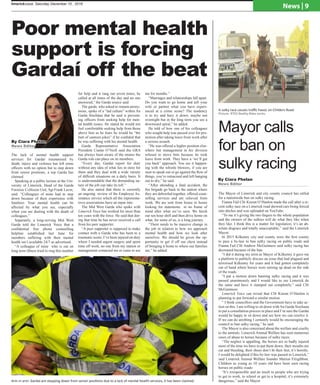
Arm in arm: Gardaí are stepping down from senior positions due to a lack of mental health services, it has been claimed.
A sulky race causes traffic havoc on Childers Road.
Picture: RTÉ2 Reality Bites series
The lack of mental health support
services for Gardaí traumatised by
death, injury and violence has left some
officers with no option but to step down
from senior positions, a top Garda has
claimed.
Speaking at a public lecture at the Uni-
versity of Limerick, Head of the Garda
Forensic Collision Unit, Sgt Frank Lavin,
said: “Colleagues of mine had to step
down because of their experience with
fatalities. Your mental health can be
affected by what you see, especially
when you are dealing with the death of
colleagues.”
Separately, a long-serving Mid West
Garda told the Limerick Voice that a
confidential free phone counselling
helpline established last June for
members suffering with their mental
health isn’t available 24/7 as advertised.
“A colleague of mine who is out on
long term illness tried to ring this number
for help and it rang out seven times, he
called at all times of the day and no one
answered,” the Garda source said.
The garda, who asked to remain anony-
mous, spoke of a “lad culture” within An
Garda Síochána that he said is prevent-
ing officers from seeking help for men-
tal health issues. He stated he would not
feel comfortable seeking help from those
above him as he fears he would be “the
butt of canteen jokes” if he confided that
he was suffering with his mental health
Garda Representative Association
President Ciarán O’Neill said the GRA
has always been aware of the strains the
Garda role can place on its members.
“Every day, Gardaí report for duty
without any idea of what lies in store for
them and they deal with a wide variety
of difficult situations on a daily basis. It
is understandable that the demanding na-
ture of the job can take its toll.”
He also stated that there is currently
an ongoing review of the Employee As-
sistance service which all the representa-
tives associations have an input into.
The Mid West Garda who spoke with
Limerick Voice has worked for more than
ten years with the force. He said that dur-
ing that time he has never received a call
from his peer supporter.
“A peer supporter is supposed to make
contact with a Garda who has been to a
traumatic scene, I’ve been injured on duty
where I needed urgent surgery and spent
time off work, no one from my station or
management contacted me or came to see
me for months.”
“Marriages and relationships fall apart.
Do you want to go home and tell your
wife or partner what you have experi-
enced at a crime scene? The tendency
is to try and bury it down, maybe not
overnight but in the long term you see a
downward spiral,” he added.
He told of how one of his colleagues
who sought help was passed over for pro-
motion after taking leave from work after
a serious assault.
“He was offered a higher position else-
where but management in his division
refused to move him because he took
leave from work. They have a ‘we’ll get
you back” approach. You see it happen-
ing with the whistle blowers, if you are
seen to speak out or go against the flow of
things, you’re ostracised and left hanging
out to dry,” he said.
“After attending a fatal accident, the
fire brigade go back to the station where
they are debriefed together, offered coun-
selling services and are relieved from
work. We are sent from house to house
looking for statements in no frame of
mind after what we’ve seen. We finish
our ten hour shift and then drive home on
what, for some of us, is a long journey.
“There needs to be massive change in
the job in relation to how we approach
mental health and how we look after
ourselves. We should be given the op-
portunity to get if off our chest instead
of bringing it home to where our families
are,” he added.
The Mayor of Limerick and city county council has called
for a nationwide ban on sulky racing.
Fianna Fáil Cllr Kieran O’Hanlon made the call after a re-
cent sulky race on a Limerick road showed cars being forced
into ditches and was uploaded on YouTube.
“To me it’s giving the two fingers to the whole population
and the owners of the sulkies will do what they like when
they like. I think this is a matter for legislation, it’s an ab-
solute disgrace and totally unacceptable,” said the Limerick
Mayor.
In 2015 Kilkenny city and county were the first county
to pass a by-law to ban sulky racing on public roads and
Fianna Fail Cllr Andrew McGuinness said sulky racing has
decreased because of the ban:
“I did it during my term as Mayor of Kilkenny it gave me
a platform to publicly discuss an issue that had plagued and
terrorised Kilkenny for years and it had gotten completely
out of hand where horses were turning up dead on the side
of the roads.
“I put a motion down banning sulky racing and it was
passed unanimously and I would like to see Limerick do
the same and have it stamped out completely,” said Cllr
McGuinness.
Limerick Voice can reveal that Cllr Kieran O’Hanlon is
planning to put forward a similar motion.
“ I think councillors and the Government have to take ac-
tion on this. I am willing to sit down withAn Garda Siochana
to put a consultation process in place and I’m sure the Gardai
would be happy to sit down and see how we can resolve it.
If we can do anything I certainly would be encouraging the
council to ban sulky racing,” he said.
The Mayor is also concerned about the welfare and cruelty
to the animals. Limerick Animal Welfare has seen numerous
cases of abuse to horses because of sulky races:
“The neglect is appalling, the horses are so badly injured
most of the time we have to put them down, their mouths are
cut and bleeding, their shoes don’t fit their feet, it’s horrific.
I would be delighted if this by-law was passed in Limerick,”
said Limerick Animal Welfare founder Marion Fitzgibbon.
Children as young as 10 years old have been seen racing
horses on public roads:
“It’s irresponsible and an insult to people who are trying
to get to work, to school or get to a hospital, it’s extremely
dangerous,” said the Mayor.
Mayor calls
for ban on
sulky racing
By Ciara Phelan
News Editor
By Ciara Phelan
News Editor
A LOCAL college offered students
discounted rates for accommoda-
tion after they were forced to share
rooms.
Shannon College of Hotel Man-
agement chose names from a hat to
designate who had to share rooms af-
ter they exceeded their bookings for
first year students seeking accommo-
dation on campus.
Students were told on their first
day of college that six boys and six
girls would have to share rooms de-
spite the college’s brochure stating
each student who booked to stay
in Castle Gardens would have their
own room and an en-suite bathroom.
Manzi Murenzi (18), a first year
student from Kildare who had to
share a room told Limerick Voice he
thought he was going to get his own
room when he enrolled this summer.
“I was looking forward to having
my own space. They said six girls
and six boys have to share a room
and if no one volunteered they’d pick
names from a hat.”
Fees for first year student lodgings
are set at €1,612 per semester. Utili-
ties cost an extra €450.
On top of the contribution fees and
student levy paid at all third level in-
stitutions, first years at Shannon Col-
lege pay more than €670 for manda-
tory uniforms, a €400 meal charge
and books cost €320 if bought first-
hand.
First year students are obliged to
stay in the student village unless they
live within 15 miles of the college, as
stated on their website.
A spokesperson for Shannon Col-
lege said that this is the first year that
the college has had such a problem.
“On induction the Head of the col-
lege briefed parents that a minority
of students would have to share a
room which would be allocated on a
lottery basis.
All students were accommodated
and we recently secured additional
houses to allow those who were shar-
ing to now have their own room,”
said the spokesperson.
However Murenzi claimed he was
not offered an alternative living situ-
ation by the college.
Students at all seven universities
in Ireland have seen accommoda-
tion prices soar as the housing crisis
worsens. In some cases, accommo-
dation is more than €1,000 more ex-
pensive than last year.
10 | News limerickvoice, Saturday December 10, 2016
Stable relationshipsBy Ciara Phelan	
News Editor
LIMERICK City and County Coun-
cil’s plans to develop an Equine Edu-
cation and Therapy Programme in
the New Year have run into a storm
of opposition.
The local authority has received
funding approval to offer the pro-
gramme to students attending DEIS
schools in Limerick city and partici-
pants in the Garda Youth Diversion
Programme.
According to a council spokesper-
son, the course is structured to pro-
vide a range of skills in stable and
yard routine to help them secure em-
ployment in the equine industry.
However, members of the Horse
Education Limerick Project (HELPS)
are angered at the council’s decision
and feel like they aren’t being lis-
tened to.
Anna Gallagher of the HELPS
committee believes local young-
sters need a project similar to that in
Clondalkin where horse owners have
a section of land to care for their
animals. She maintains that Barry’s
Field in Southill would be an ideal
location for the project.
“In Limerick, the council is going
ahead with a school type programme.
These Limerick kids aren’t interested
in horse riding or becoming a jockey.
They don’t come from the rich side
of horses, all they want is land, sta-
bling and some education,” she said.
“We want to create a sense of com-
munity and give them responsibil-
ity,” she said.
Seamus Curtin, another member of
the HELPS committee, said he grew
up with horses all of his life and
bonded with his father and wants to
do the same with his son.
“It’s in our blood, it’s our culture.
It will keep kids out of trouble if
they’re given the responsibility to
look after their own animal. There’s
no point in setting up a project and
not making the kids responsible for
the horse,” he added.
Anna states committee members
are trying their best to help: “We want
to comply with the bylaws about
horses roaming. It’s not a very nice
thing to see neglected horses falling
down, you don’t want your kids see-
ing this, it’s not fair on the public, we
want to help with this problem but
have no space to do so,” she said.
The Council operates a policy of
seizing and impounding stray horses
and this has led to some conflict with
HELPS. Concern is growing among
committee members that their horses
are being impounded and then sold.
“Horses from Barry’s field have
been spotted at a fair in Ballinasloe.
When we go to get our horse from
the pound, we’re told they’ve gone
to the pound in Mallow or we’re told
we’re too late the horse has been put
down,” Seamus said.
However, the council spokesper-
son said that the local authority is
required to keep seized horses im-
pounded until the statutory period of
five days has lapsed for the reclaim-
ing of horses and they are satisfied
the procedures are being adhered to.
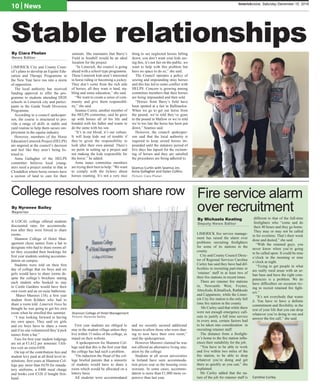
Seamus Curtin with Seamus Jnr,
Anna Gallagher and Dylan Collins.
By Nyrenee Bailey
Reporter
College resolves room share row
Shannon College of Hotel Management
Picture: Nyrenee Bailey
LIMERICK fire service manage-
ment has raised the alarm over
problems recruiting firefighters
for some of its stations in the
county.
City and County Council Direc-
tor of Regional Services Caroline
Curley has said they have had dif-
ficulties in recruiting part-time or
‘retainer’ staff in at least two of
their fire stations in recent times.
There are retainer fire stations
in, Newcastle West, Foynes,
Abeyfeale, Kilmallock, Rathkeale
and Cappamore, while the Limer-
ick City fire station is the only full
time fire station in the county.
Ms Curley said that while there
were not enough emergency call-
outs to justify a full time service
in every area, certain factors had
to be taken into consideration in
recruiting retainer staff.
The distance from a firefight-
er’s home to the fire station influ-
ences their suitability for the job.
“You have to be able to work
and live within two miles of the
fire station, to be able to drop
whatever you’re doing and get
there as quickly as you can,” she
explained.
Ms Curley added that the na-
ture of the job for retainer staff is
different to that of the full-time
firefighters who “come and do
their 40 hours and they go home.
They may or may not be called
in for overtime. That’s their week
done and dusted,” she said.
“With the retained guys, you
never know when you’re going
to be called upon. It could be nine
o’clock in the morning or nine
o’clock at night.
“Trying to get people in what
are really rural areas with an ur-
ban base and have the right com-
petencies is a problem. We do
have difficulties on occasion try-
ing to recruit retained fire fight-
ers.”
“It’s not everybody that wants
it. You have to have a definite
commitment and flexibility in the
rest of your life that you can drop
whatever you’re doing to run and
answer the fire call,” she said.
By Michaela Keating
Deputy News Editor
Fire service alarm
over recruitment
Caroline Curley.
Picture: Ciara Phelan
limerickvoice, December , 2014
UNIVERSITY Hospital Limerick
(UHL) has become the first hospital
in Ireland to perform colorectal, re-
nal and adrenal surgical procedures
using a state-of-the-art robot.
The Da Vinci Xi robot and equip-
ment, valued at approximately
€2.6m, was donated by the Midwest-
ern Hospitals Development Trust and
received substantial funding from the
JP McManus Benevolent fund.
According to Jim Canny, Chair-
man of Midwestern Hospitals Devel-
opment Trust, this state-of-the-art ro-
botic technology will facilitate better
outcomes for public patients in the
midwest requiring such surgeries.
“This is a great collaborative pro-
ject and the board of the Mid-West-
ern Hospitals Development Trust
are delighted to support it. We look
forward to working with the Hospital
and UL on projects of a similar na-
ture in future,” he said.  
Preliminary data from UL Hospi-
tals Group demonstrates that post-
operative recovery is twice as fast
with robotic surgery than with stand-
ard keyhole surgery, with an average
post-operative hospital stay of ap-
proximately four days. 
Foundation Chair of Surgery at
UL’s Graduate Entry Medical School
Professor J. Calvin Coffey was one
of the pioneering surgeons for the
project.
“Very early discharge is the excep-
tion rather than the rule in keyhole
intestinal surgery. It seems to be the
rule rather than the exception in ro-
botic assisted surgery,” he said.
As well as faster post-operative re-
covery time, there is also a reduction
in post-operative pain with robotic
surgery.   
“We have conducted 29 cases to
date in UHL predominantly for co-
lon, rectal and kidney cases, with
hugely encouraging results and a
high level of patient satisfaction, we
are delighted to have the Da Vinci
here in Limerick,” said Professor
Coffey.
UHL now also has the ability to
broadcast live surgery within the
hospital right to its junior doctors
on a small scale and will be able to
broadcast live to the University of
Limerick in the coming months.
limerickvoice, Saturday December 10, 2016
News | 11
New robot to improve
UHL surgery standards
By Amy Ryan
Reporter
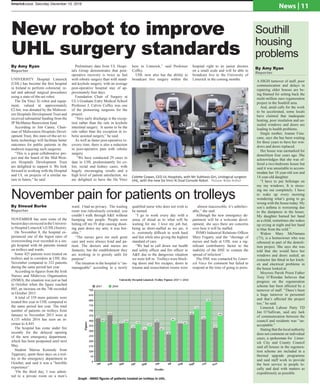
November pain for patients on trolleys
By Sinead Burke
Reporter
NOVEMBER has seen some of the
busiestdaysonrecordintheUniversi-
ty Hospital Limerick’s (UHL) history.
On November 8, the hospital ex-
perienced one of the higest rates of
overcrowding ever recorded in a sin-
gle hospital with 66 patients treated
on trolleys and wards.
Some 425 patients were treated on
trolleys and in corridors at UHL this
November compared to 332 patients
during the same period last year.
According to figures from the Irish
Nurses and Midwives Organisation
(INMO), the situation was just as bad
in October when the figure reached
885, an increase on the 746 recorded
in October 2015.
A total of 339 more patients were
treated this year in UHL compared to
the same period last year. The total
number of patients on trolleys from
January to November 2015 were at
4,135 whilst 2016 has seen an in-
crease to 4,445.
The hospital has come under fire
recently for the delayed opening
of the new emergency department,
which has been postponed until next
May.
Student Marisa Kennedy from
Tipperary, spent three days on a trol-
ley in the emergency department in
October, and said it was a “horrible
experience”.
“On the third day, I was admit-
ted to a private room on a men’s
ward. I had no privacy. The waiting
room was ridiculously crowded; you
couldn’t walk through A&E without
bumping into people. People were
hitting off my IV drip causing shoot-
ing pain down my arm; it was hor-
rible.”
“The nurses gave me such great
care and were always kind and pa-
tient. The doctors and nurses are
fantastic, but the establishment they
are working in is grossly unfit for
purpose”.
The situation in the hospital is “un-
manageable” according to a newly
qualified nurse who does not wish to
be named.
“I go to work every day with a
sense of dread as to what will be
waiting for me. I love my job but,
being as short-staffed as we are, it
is extremely difficult to work hard
and fast while also giving the highest
standard of care.
“We had to call down our health
and safety officer and fire officer to
A&E due to the dangerous situation
we were left in. Trolleys were block-
ing doors and fire escapes; doors to
trauma and resuscitation rooms were
 almost inaccessible, it’s unbeliev-
able,” she said.
Although the new emergency de-
partment will be a welcome devel-
opment, she says there are concerns
over how it will be staffed.
INMO Industrial Relations Officer
Mary Fogarty said the “shortage of
nurses and beds at UHL was a sig-
nificant contributory factor to the
inability of the HSE to contain the
spread of infection”.
The HSE was contacted by Limer-
ick Voice for comment but failed to
respond at the time of going to press.
Colette Cowan, CEO UL Hospitals, with Mr Subhasis Giri, Urological surgeon
UHL, with the new Da Vinci Xi Dual Console Robot. Picture: Brian Arthur
Graph - INMO figures of patients treated on trolleys in UHL.
A HIGH turnover of staff, poor
communication and delays in
repairing older houses are be-
ing blamed for setting back the
multi-million euro regeneration
project in the Southill area.
And, amid calls for the work
to be accelerated, some locals
have claimed that inadequate
heating, poor insulation and un-
sealed windows and doors are
leading to health problems.
Single mother, Joanne Finu-
cane, says she has been waiting
for three years to have her win-
dows and doors replaced.
Her house was earmarked for
demolition four years ago. She
acknowledges that she was of-
fered a two-bedroom house but
said it was unsuitable to accom-
modate her 18 year-old son and
14 year-old daughter.
“I have to put Sellotape on
my my windows. It is stress-
ing me out completely. I have
to wake up every morning
wondering what’s going to go
wrong with the house today. My
son’s asthma is worsening due
to the dampness in the house.
My daughter burned her hand
as a child, sometimes she wakes
up crying at night and her hand
is blue from the cold.”
Widow Mary McNamara
(73), is a homeowner who was
rehoused as part of the demoli-
tion project. She says she was
told that she would have her
windows and doors sealed; an
extractor fan fitted in her kitch-
en and electrical problems in
the house looked at.
Moyross Parish Priest Father
Tony O’Riordan believes that
progress on the regeneration
scheme has been affected by a
turnover of staff. “There’s been
a huge turnover in personnel
and that’s affected the project
too,” he said.
Limerick Labour Party TD
Jan O’Sullivan, said any lack
of communication between the
council and residents was “un-
acceptable.”
Stating that the local authority
does not comment on individual
cases, a spokesman for Limer-
ick City and County Council
said all houses in the regenera-
tion scheme are included in a
thermal upgrade programme
and said staff work to provide
the best service to people lo-
cally and deal with matters as
expeditiously as possible.
Southill
housing
problems
By Amy Ryan	
Reporter
Riverside
Ramblers
Reopened, remodeled riverbank walkway
provides the perfect haven for walkers,
cyclists and nature lovers in Limerick.
SINCE reopening after a €1.1m redevelopment
earlier this year, the riverbank walkway from the
University of Limerick (UL) to the city cente is
proving to be a hit with all walks of life.
The three-kilometre walkway route and cycle
track stretches from UL either into the city cen-
tre or Corbally right along the banks of the River
Shannon.
The footpath’s new asphalt surface means that
the route can now be enjoyed by all members of
the public, regardless of mobility, for the first time
ever.
New features of the walkway include public
lighting, new seating and CCTV cameras, which
have been installed to ensure maximum security.
Limerick Voice reporter Sally Gorman put on
her walking shoes and took to the track to meet
some of the riverside ramblers.
Nine closure orders served up on local eateries
NINE food businesses were served
with closure orders in Limerick since
January 2015, the Limerick Voice has
learned.
Records obtained under the
Freedom of Information Act reveal
the reasons why the premises were
ordered to clean up their acts.
Evidence of rodent droppings in
food preparation, storage and first
floor seating areas were among the
reasons Star Pizza on Limerick’s
Denmark Street was served with a
closure order on April 29, 2015. This
order was lifted five months later.
Meanwhile, a defective internal
drainage system and evidence of
rodent activity greeted one health
inspector at Chilli Kebabish on Ellen
Street. The Health Service Executive
(HSE) issued a closure order on May
14, 2015.
A lack of pest proofing and a
damaged ceiling led to Rockin Joe’s
on O’Connell Street, being served
with a closure order on July 21,
2015. The closure order was lifted
the following day.
A dead rat and exposed blocks
of wax rodent bait were among the
reasons why Roma Takeaway, North
Road, Dromcollogher, was issued
with a closure order on September
30.
This order was lifted a week
later after the problems had been
addressed.
Evidence of grimy kitchen floors
and insects in the storeroom and
preparation areas were among the
reasons Tasty Bites on Hyde Road,
Limerick was ordered to close on
December 18, 2015. The closure
order was lifted five days later.
Kashmir Kebab on Davis Street
was issued with a closure order
on May 25 last due to being in an
unclean and dirty condition. This
order was lifted on June 8 last.
Stained uncovered bins and a lack
of labelling and zoning were among
the reasons Fitto Café on Catherine
Street was ordered to close on
September 12. Following corrective
action, the closure order was lifted
three days later.
Cobwebs, an accumulation of flies,
stained walls and a lack of sanitiser
available for cleaning purposes led to
CoCo Asian and Chinese Takeaway
on Main Street, Ballingarry, Co.
Limerick being issued with a closure
order on October 4 last.
This order was lifted on October
10 when all the problems had been
sorted out.
Adana Char Grill on Cornmarket
Row, Limerick city was issued a
closure order on January 27 as the
floor and some kitchen equipment
were deemed unhygienic. The order
was lifted a week later.
By Sarah O’Brien
Reporter
Frank Hennigar, Rhebogue, & Iggy Lyons, Kennedy Park.
Elena Alberquilla, left, (Erasmus
student from Madrid, Spain) and
her visiting friends.
Mary Ryan & Muireann
Keogh, Parteen.
Angela Mortell, Lower Park.
Pat Reeves & Gerry
Gallagher, Rhebogue.
Michele Kennedy &
Misty, Rhebogue.
Jim Phelan, Limerick.
Tony Lillis & Cooper, Corbally.
12 | News limerickvoice, Saturday December 10, 2016
By Mark Quinn
Regeneration Editor
Building boom slow to
bite for Regeneration
THE LIMERICK REGENERATION
FRAMEWORK IMPLEMENTATION
REVIEW
96%
PROPORTION OF SECOND LEVEL
STUDENTS IN LIMERICK CITY WHO
COMPLETE THEIR JUNIOR CERT
NUMBER OF NEW JOBS CREATED
DIRECTLY WITH ASSISTANCE FROM
THE REGENERATION PROGRAMME
SINCE 2014
306
NUMBER OF SOCIAL PROJECTS
THAT RECEIVED SUPPORT OF
€10,000 OR MORE THROUGH
REGENERATION IN 2014
78
NUMBER OF NEW HOUSES BUILT
UNDER THE REGENERATION
PROGRAMME
110
NUMBER OF BUILDINGS
THERMALLY UPGRADED UNDER
THE PROGRAMME
2786,988
NUMBER OF REPORTED OFFENCES
ASSOCIATED WITH YOUTH CRIME
IN LIMERICK IN 2007
€28.6M
AVERAGE ANNUAL SPEND ON
REGENERATION
THE REGENERATION
REVIEW IN NUMBERS
450
THE NUMBER OF NEW JOBS
THAT REGENERATION AIMS TO
CREATE PER YEAR
€9.37M
REGENERATION INVESTMENT IN
THESE PROJECTS 2012-14
PROPORTION OF SECOND LEVEL
STUDENTS IN LIMERICK CITY WHO
COMPLETE THEIR LEAVING CERT
89% 92
DERELICT (LONG-TERM VOID)
HOUSES BACK IN USE
4,746
NUMBER OF REPORTED OFFENCES
ASSOCIATED WITH YOUTH CRIME
IN LIMERICK IN 2015
63%
REDUCTION IN Co2 EMISSIONS OF
UNITS COMPLETED, ON SITE AND IN
PREPARATION TO FEB '16
eneration Framework Implementation Plan
““Very impressed with a lot of the plans. As a
community we need to see progress. We need
to see an improvement in the appearance of
Southill. If the community wants to move
forward we need to keep the people in southill
and not move them out. We need to see some
building work to start."
O'Malley Park / Keyes Park Resident
”
ut 1 13/09/2013 21:21 Page 142
The need for houses was presented as acute in the
original report.
Limerick Regeneration Framework Implementation Plan
Regeneration contributing to
Limerick’s positive job figures
OVER 600 jobs have been directly
created or supported through Re-
generation a major new report has
revealed.
The 2016 review into the Limerick
Regeneration Framework Implemen-
tation Plan, seen by Limerick Voice,
shows that Limerick Regeneration
now supports 690 jobs annually.
This figure includes 320 full-time
roles created as a direct result of Re-
generation funding. It is foreseen that
Regeneration will create a further
450 jobs per year from 2017 to 2019.
Of the 690 jobs currently support-
ed, 484 were through investment in
community enterprise projects and
140 were created by investment in
training and skills, enterprise devel-
opment and strategic projects.
The Hospitality Education and
Training Centre (HETC) established
in 2014 in Roxboro has played a
crucial role in helping people into
employment. A total of 225 trainees
have received accredited qualifica-
tions in its first year and of this, 133
trainees from regeneration areas have
either successfully gained employ-
ment or gone on to further education.
Carmel Kirby, Programme Man-
ager for Limerick Regeneration, said
the process used by the HETC is now
being used as a model for regen-
eration initiatives in other sectors:
“We’re doing the same now with
Troy studios for film in Limerick.”
Innovate Limerick, backed by Re-
generation, purchased the Biblical
Centre in Limerick city to develop
a training centre for opportunities in
the film industry that are expected to
emerge as a result of efforts by Troy
studios in Plassey. As part of Re-
generation’s buy-in to the initiative,
20 percent of places on the training
courses are secured for residents of
regeneration areas.
According to Ms Kirby they are
working with the film industry to de-
velop that same “sector specific ap-
proach” as employed by the HETC.
“The people that the film indus-
try needs on set are beauticians,
hairdressers, set designers, caterers,
laundry. We have people in regen-
eration areas that are skilled in these
fields and are unemployed. We have
worked with Troy studios to identify
a basic set of skills that will always
be needed. The next step is to estab-
lish what training programmes we
need to provide to up-skill people
and make sure they’re ready to go
when the film comes to town.”
Efforts are also being made to inte-
grate regeneration work in the wider
food industry to ensure various ini-
tiatives are working together.
“We need to do the same thing with
the Rebuilding Ireland Programme
and to work with existing bodies and
organisations like Solas and Limer-
ick City Build to ensure our carpen-
ters, plasterers and so on from regen-
eration areas are properly trained and
ready to take advantage of upcoming
opportunities in the construction sec-
tor.” Ms Kirby added.
LESS than one fifth of new houses targeted for construc-
tion under the regeneration plan have been completed a
new report has confirmed.
A review into the Limerick Regeneration Framework
Implementation Plan (LRFIP) confirms that just 110
houses have been built since the first regeneration pro-
gramme began in 2008. However this figure is set to dou-
ble in the coming year with over 130 houses currently un-
der construction and plans underway for over 300 more.
Limerick City and County Council took over the regen-
eration programme in 2012 and is reviewing the imple-
mentation of the LRFIP, which they prepared and adopted
in 2014. Under the plan 593 houses were to be built how-
ever this was reduced to 564 after a review.
Of the 110 houses built 76 in are located in the four
traditional regeneration areas with the balance built in the
city centre. In addition 131 houses are under construction
on site, 273 are at the detailed planning stage and 50 have
preliminary approval.
Programme Manager of Limerick Regeneration Car-
mel Kirby said: “The early stages of regeneration concen-
trated on the implementation of social programmes and
reducing crime. It took considerable time to commence
the rebuilding programme. Social housing construction is
a complicated process with every stage requiring the ap-
proval of the Department of Housing, Planning, Commu-
nity and Local Government. However almost all projects
have now commenced.”
In addition to the houses that have been built 92 der-
elict (long term void) houses have been refurbished and
brought back into use in the regeneration areas.
Aprogramme of thermally upgrading houses is also un-
derway and the upgrades on 278 houses had led to a 63%
reduction in CO2
emissions by February 2016.
An ambition of the LRFIP is to identify green field sites
in and around regeneration areas for the development of
private housing. This is to be done in line with the Limer-
ick City Development Plan.
Under this plan 4,671 additional private homes are
envisaged for the regeneration areas by 2022 with 2,593
new houses to be built in Southill alone. According to
Carmel Kirby, “the original plan for housing investment
by the private sector was hit by the economic downturn. It
is important that the private sector is attracted to develop
private housing in the regeneration areas. The develop-
ment of the Northern Distributer Road and the M20 ac-
cess to Roxboro will be crucial projects for the Council to
progress in that regard.”
By Mark Quinn
Regeneration Editor
limerickvoice, Saturday December 10 , 2016
News | 13
EXCLUSIVE
14 | Agriculture limerickvoice, Saturday December 10, 2016
By Michaela Keating
Deputy News Editor
BETWEEN the cost of fuel, feed,
bedding and maintenance, the mar-
gins in poultry farming have never
been so tight. The only way to com-
bat this is to change the managerial
mindset altogether.
The vast majority of poultry hous-
es in the country are well over 20
years old, many of which have been
kept to a very high standard, and
were initially built to a very efficient
standard.
Most poultry houses use an aver-
age of 85 incandescent light bulbs to
light up the house, a mixture of 60w
and 100w are used. But it has been
proven that incandescent light bulbs,
initially cheap costing on average of
one euro, end up costing a lot more
in the long run.
These light bulbs are only about
10 percent efficient, with the other
90 percent of the energy creat-
ing heat. Also, incandescent light
bulbs have a life expectancy of 1200
hours, which is 50 days of constant
use, and are also very fragile which
leads to more maintenance.
IFA Poultry Chairman, Nigel Re-
naghan, spoke with the Limerick
Voice about carbon reduction and
reducing energy use overall in the
poultry industry:
“To help lower the running costs
on my farm in Monaghan, I have
recently installed a new computer
that regulates the ventilation in the
poultry house.”
Mr Renaghan added, “The hard-
ware that uses up a lot of electricity
in the houses has to be the recircu-
lation fan, normally up to nine fans
would be working at 20 percent of
their capacity to ventilate the hous-
es, but with the new system we have
a new fan that is regulated by the
computer, this computer receives
readings from sensors that are places
around the house at certain intervals,
and once this fan reaches 100 per-
cent of its capacity it switches off
and a supplementary fan cuts in.”
Another long-term cost reducing
option would be micro generator; a
small wind turbine. These are not
that uncommon in other parts of
Europe and can even be seen on a
number of farms already around the
country. Farmers can erect a small
wind turbine on their land to service
the needs of the sheds and poultry
houses. Along with the adoption of
a aircon based heating system this
would reduce and even remove the
need for LPG heaters in the houses.
When asked about micro genera-
tors, Nigel Renaghan described them
as a “great addition to any poultry
unit, and expressed the interest that
poultry farmers all over the country
are already looking into such invest-
ments in energy recovery.
“We already have a young farmer
in
Monaghan that started in recent
years who has opted to install a tur-
bine on his farm to both provide heat
and electricity to is poultry unit, and
so far it has been a great success for
him” said Nigel Renaghan.
The advantages of such a setup
is the complete control of energy
costs as the farmers producing their
own energy no longer have to worry
about the cost of the next electricity
bill. However, there would be an
added cost of maintaining and ser-
vicing the unit.
The obvious downside to a micro
generator is the initial setup costs,
the price of the unit and the planning
involved are not cheap. Most farms
have a single-phase connection
(230v); these farms would be able to
install a generator that has a limited
output of 5.75kW.
New regional social farming
office set for Newcastle West
WEST Limerick Resources is set
to establish a new Regional Office
for the Social Farming initiative in
Newcastle West.
The concept of social farming aims
to provide adults with mental and
intellectual disabilities, mental health
issues, or those who have experienced
a setback in life, the opportunity to
experience the workings of a farm
with the guidance of a local farmer.
Leitrim Development Company
(LDC), recently signed a contract
with the Department of Agriculture
to establish and develop a national
social farming network in Ireland
for the development and delivery of
social farming across the country.
Working with the LDC and with
the assistance of the Department of
Agriculture Food and the Marine and
the CEDRA Fund, West Limerick
Resources is currently recruiting
a part-time regional development
officer to move the project along.
Helen Doherty from the Social
Farming Support Offices said:
“At the moment we are looking at
developing a regional office in West
Limerick for the region, not just for
Limerick. That regional office will
be covering Clare, Limerick, North
Tipperary, North Kerry and North
Cork. We are recruiting a part-time
development worker that will be
based in the office.”
Ms Doherty highlighted that
those who would be participating
in the social farming service could
have mental health or intellectual
disabilities, adding:
“This activity can also be made
available to people recovering
from addictions, the elderly or ex-
offenders if farmers came forward
who were interested in working in
these sectors.”
Dearbhla Conlon Ahern from
West Limerick Resources explained
how social farming is an “incredible
opportunity” for local communities.
Speaking of the good turnout at
the social farming information day
held at the West Limerick Resources
office on April 20 of this year, Ms
Conlon Ahern said that there was
“a good mix” of service users and
providers, and community group
representatives but not enough
farmers.
The Social Inclusion Community
Activation Programme (SICAP)
Coordinator also said that the
outcomes for the participant are the
most important aspect of the scheme:
“It’s not work experience or an
extra set of hands for the farmer; it’s
very much around the outcomes that
can be achieved for that individual
in terms of their social development
and their personal development, with
equal benefits for the farmer.”
Ms Conlon Ahern said that those
with disabilities signing up to social
farming should be linked to and
referred from a service and over 18
years old.
She also spoke of the mental health
benefits of the programme, saying:
“The interaction with animals has
a therapeutic side to it. There’s the
fact that those that will be out [on the
farm] will be engaging in health and
fitness, walking the land, feeding the
animals, so these are very positive
things.”
Mike O’Connell is the first farmer
in Limerick to participate in the
social farming programme.
The 55- year-old Limerick man
owns a menswear and dress hire
store on Catherine’s Street in the
city centre but calls himself the
“caretaker of the land” of the small
farm he inherited from his parents
between Mungret and Clarina.
Mr O’Connell first discovered
social farming on a trip to the UK
and told the Limerick Voice:
“I knew that I had found what I
wanted to do with my farm. I know
in my heart and soul that it’s not
big enough for me to make a living
from.”
The small farmer added that
after suffering a stroke two years
ago “makes you more aware of the
important things in life” and farms
his land two days a week when taking
time out from his store.
Mr O’Connell said that there are
“huge benefits” in terms of mental
health for both the farmer and the
service user: “I feel that the farmer
will get as much out of it as the
person using the service.”
The Limerick native said that
his family are behind and him and
that the satisfaction he gets from
participating in the social farming
programme is “unbelievable”:
“It’s not about money; this is
simply about giving something
back.”
For more information
on social farming see
socialfarmingacrossborders.org
or wlr.ie.
by Martin O’Donnell
Farming EditorReducing your carbon footprint
Above: L-R: Stefanie Jaeger (WLR), Terence Liston, Patrick O’Shaughnessy
(service users), Mike O’Connell (farmer), Mike O’Flynn (Chairperson WLR),
Dearbhla Conlon Ahern (WLR) and Joe Kelleher (Teagasc) on the farm.
Below: Patrick O’Shaughnessy throws feed to the turkey’s on the farm.
Pictures: Michaela Keating
PALLASKENRY Agricultural
College has always kept up to date
with the latest teaching practices
and farming technologies. The best
example of this is the 24 unit milking
parlour which they installed back in
1992 along with a 20,000 litre bulk
tank, which even by today’s standards
is a very productive parlour.
To keep up with the latest
technologies, the college plans to
update its system to a more modern
and efficient 50-unit rotary setup,
which the Salesian fathers intend
building on a site located beside the
existing 200 cubicle dairy shed.
The dairy farm has over 250
high EBI dairy cattle, consisting of
Friesian, Jersey cross and Kiwi cross
cows.
This herd is entirely spring
calving. In the past the college had a
number of autumn calving cows, but
they decided to change this because
the majority of the students come
from farms that calve in the spring.
Efforts are currently undreway at
Pallaskenry College to get into the
top one percent of dairy producing
herds in the country. To achieve
this goal the college will have to
monitor all aspects of production
from paddock grazing rotation, right
down to diet.
Currently the college has grass pit
silage stocked from 2015, and the
first and second cuts from 2016. But
in the past they have experimented
with maize silage. But they have
chosen to move away from maze and
to use out what maize silage they
have left in stock, choosing to move
back to a grass based diet.
Along with the dairy farm, the
agricultural college also has a flock
of 320 sheep, 100 of which are
March lambing. Similar to the dairy
side of the farm the sheep sector is
constantly teaching new practices
and technologies such as dosing
techniques and how to improve star
rating.
The college also rears 170 beef
cattle annually, and they have a
new self-contained suckler unit for
60 cows. At a recnt open day in
the college, the beef unit had five
Aberdeen angus on display, which
are actually owned by the secondary
school. The secondary school
students who won them last year are
rearing them in the college.
Tony Petit, Head of the Teagasc
education programme said:
“Enrolments to agri colleges for full
time further education and Teagasc
linked higher education courses
increased by 150 percent over the
period 2006 to 2014. Teagasc enrols
around 1900 learners across full time
courses across agricultural colleges.
We anticipate 2017 to be broadly
similar around 1800 or slightly
more,” he said.
Of the 4,000 adult learners
enrolled in agricultural colleges
around the country in the past 2
years, approximately 2,400 have
enrolled on distance education and
the remainder in part-time green cert
courses.
Salesians have been working
in conjunction with the Limerick
Institute of Technology (LIT),
developing an Agricultural
Mechanisation level six course.
The course provides training
and development of agricultural
mechanisation. Each week the
training course is run from the farm
in Pallaskenry for four days and one
day in the college in LIT.
To meet these requirements
students must hold a non–agricultural
major award qualification at level
six or higher on the Irish National
Framework of Qualifications.
For entry requirements and
applications contact Pallaskenry
Agricultural College website or
teagasc.ie
By Michaela Keating
Deputy News Editor
Above: Pallaskenry mechanical workshop. Below: Machinery yard Pallaskenry. Pictures: Martin O’Donnell
A LIMERICK beef farmer says
the result of Brexit will focus
minds on exploring new export
markets and opportunities for the
sector.
Joe Burke who is also the Sector
Manager for beef and livestock
with An Bord Bia, is confident
Irish beef and dairy produce
will find new markets in other
European countries and further
afield as a result of Brexit. He
said: “Overall there are more than
80 supermarket groups around
Europe purchasing Irish beef
and these retailers are a major
focus for Bord Bia’s promotional
activity. In anticipation of the
current strong supplies of finished
cattle, Bord Bia’s market offices
have coordinated numerous
promotions to help drive sales
of Irish beef, particularly into
premium market channels.”
The Limerick based farmer also
added that Bord Bia is working
with chef’s worldwide to promote
the premium quality of Irish beef
with the ‘Chefs’ Irish Beef Club’.
“As Irish beef brand
ambassadors, these award-
winning chefs assist Bord Bia
in driving the premium image
of Irish beef. In total, there are
over eighty member chefs spread
across eight markets including
Belgium, France, Germany, Italy,
Netherlands, Sweden, Switzerland
and the UK,” he explained.
In spite of Brexit-related
difficulties, Mr Burke said that
the UK looks set to remain a key
market for a significant proportion
of Irish beef exports, “The key
objective of Bord Bia’s campaigns
in the UK market is to convince
both consumers and corporate
buyers that Irish beef is at least
equivalent to British product,” he
said.
Speaking from a farmer’s
perspective, Mr Burke said
“Brexit is certainly the major
challenge we are currently facing.
Beef farmers like myself have
been receiving €70 to €100 per
head, less for finished cattle from
meat plants compared to last
year. The weakening of Sterling
has certainly been a contributing
factor, along with slightly
slower demand in general across
Europe.”
The UK is currently Ireland’s
largest market for food and drink
accounting for over 41 percent
of Irish food and drink exports,
so there is concern in the sector
about the impact this will have
on the Irish industry when Britain
eventually pulls out of the EU.
Dairygold Sales Manager Pat
Laffan said that due to the amount
of dairy products Ireland exports
to the UK that, “what the future
holds is of great concern” to dairy
producers.
Mr Laffan added that “60
percent of our cheese and 80
percent of our butter goes to the
UK market. In that context Brexit
is a concern. We trade with the
UK on the basis that they are in
the EU with free trade.”
He highlighted that markets
outside of Europe will be a
promising opportunity for dairy
produce but that it won’t be
without its difficulties.
“You could find Irish guys
going to the far East and getting
the business there, similarly in
the Middle East; Egypt, Algeria,
Saudi Arabia, they’re all big
importers of dairy products.
“There might be a case where
we have to change from our
traditional market in the UK and
enter new markets with slightly
different products,” he said.
Mr Laffan also stated that the
dairy industry will not be going
into the “completely unknown”
with these markets.
“In some ways we’re looking
to expand Irish dairy exports
and we’re going to assess these
other markets anyway so we’re
not going into the completely
unknown, we are already dealing
with a lot of these markets at a
lower level in terms of trade,” he
concluded.
New markets being explored for Irish beef.
Picture: Michaela Keating
Pallaskenry Agricultural College celebrates its 94th
anniversary this
year. Standing on over 550 acres of farmland in the west of Limerick, the
Salesian Fathers have been running the farm and educating students of
all ages in both new, and tried and tested techniques of farming, writes
Martin O’Donnell.
Cream of the crop at
Pallaskenry College
Brexit drives farmers
to seek new markets
limerickvoice, Saturday December 10 , 2016
Agriculture | 15
THE Hanging Gardens, one of
the key strategic sites under the
Limerick Twenty Thirty initiative,
is set to become the first Leadership
in Energy and Environment Design
(LEED) Gold Standard building in
Limerick city.
LEED is a building certification
program used in the US that ensures
buildings meet a specific set of
standards in order to be labelled a
green building.
Analog Devices’ headquarters
in Raheen is the only other Gold
Standard building in Limerick
county.
Purchased from NAMA earlier this
year, Senior Executive Planner of
Limerick City and County Council
Kieran Reeves hopes that the
Hanging Gardens new standard will
attract a lot of interest from Foreign
Direct Investment (FDI).
“LEED is an environmental
standard that a lot of FDI companies,
especially from the US like to see,”
he said.
“The Hanging Gardens will
be an office development, we’re
completing the old office that was
half-built, and we’re building a new
wing that we acquired at No. 19
Thomond Office Supplies”.
Reeves said they hoped to have a
contractor on site in February of next
year with a timeline of one year to
complete.
Two other main sites that have
been acquired by Limerick Twenty
Thirty are the Castletroy Film Hub,
which was formally known as the
Dell factory, and the Opera Centre.
Councillor James Collins has also
singled out the latter as a target for
FDI.
“The Opera Centre will be an In-
dustrial Development Agency pipe-
line and we are speaking about major
FDI, it has also drawn the attention
of Sarsfield House and the Revenue
intend on moving there,” Cllr Collins
said.
However, Mr Reeves reiterated
some details such as ownership
which must be clarified before the
work goes ahead:
“We must go through a lot of de-
tails; how much is rent? Who will
maintain the buildings, who will own
the site? What happens to the build-
ing after the lease runs out? All these
things are currently in discussion
with the Revenue,” he said.
Meanwhile the largest studio in
Ireland, Troy studios is currently
undergoing a programme of
refurbishment and won’t open
until sometime next year, despite
hosting an open day back in October.
Production onsite could see up to 500
staff working on a project.
Cleeves still “ornament of city”
WORK on Cleeves, the largest of four
sites earmarked for development as part of
Limerick Twenty Thirty will commence over
the coming year.
The nine-acre site, located on the north
bank of the Shannon River and previously
home to the Condensed Milk Company of
Ireland, is the last site to be developed as part
of the €500m development programme.
According to Senior Executive Planner
Kieran Reeves, Limerick City and County
Council, the ambitious programme’s main
objective is to generate economic activity:
“The council, or Limerick
Twenty Thirty’s main interest is
not about making d e v e l o p e r s
profit, per say, it’s about generating
economic activity in Limerick and
making Limerick a much better
place.
You can’t do that unless the
d e v e l o p m e n t s t h e m s e l v e s
can pay for t h e m s e l v e s ,
there’s still got to be that reality in
terms of what you do.”
Among the developments
proposed for the site
were a substantial office development, a
national diaspora centre, a convention centre,
and a tourism, food science, and incubation
centre.
“It can take all of them. It can take one of
them,” explained Reeves. “I haeve an open
mind about what it can take. I have seen
proposals to turn the old mill building where
the chimney is into tourist attractions. On
the other side it would be a great New York
Style loft space for new business start-ups.
It could take any of these things. We’ve just
got to decide which one is the best one for
Limerick.”
Built by John Norris Russell in 1851, the
Cleeves factory was originally used as a flax
spinning and weaving mill. The site was
later to be made famous by Canadian émigré
Thomas Cleeve, who bought the factory in
1883 and set up the renowned Condensed
Milk Company of Ireland.
By 1893 60,000 tins of condensed
milk were being produced on site, with
purportedly 10,000 cows contributing to the
milk requirement.
Among the protected structures on the
Cleeves site are the iconic
c h i m n e y
stack and
the main building dressed of limestone, with
the latter being referred to as “an ornament to
the city” in a Limerick Chronicle article from
the early nineteen-fifties.
“The chimney stack is visible from most
parts of town and therefore it gives you that
landmark, and again, that history I think
is key to what we have to protect,” added
Reeves.
Speaking about the importance of the
timeframe of the Cleeve’s site, Mark
McConnell, who sits on the Environmental
Strategic Policy Committee said: “Some of
the benchmarks have been achieved, some
are in the process of being achieved.
Some people are sick of hearing the
same announcements over and over again,
[however] the wheels on this plan will move
really slowly, because they have to.”
The site has most recently been used as a
cultural space, hosting art installations that
include the eminent Eva international art
exhibition, perfect for promoting Limerick as
a burgeoning cultural hotspot.
By Mark Allen
Reporter
Hanging Gardens to be first LEED Gold Project in Limerick City
Iconic Cottage in
Adare on market
Launch of Twenty Thrirty project at the Gardens site. L/R: Conn Murray,
Patrick O’Donovan, and Denis Brosnan.
Picture: Sean Curtin True Media
St. Michael’s Boathouse/Cleeves 2030 Site.
Picture: Robert Flynn
ONE of Adare’s iconic thatched cottages, gut-
ted in a fire in June 2015 has been placed on the
market.
The 19th century cottage on Main Street is sell-
ing for €130,000. According to Adare Properties,
the sale of the 1,000sq foot site is a “rare oppor-
tunity”.
The unique property is distinguished by its red
window and door frames and the historic milk
cart holding old styled steel milk containers.
Since the fire the cottage, along with its neigh-
bouring dwelling, have been left without their
unique and historic thatched rooves.
Despite a notice stating “restoration process is
in progress” locals are unsure about the status of
the restoration stage.
According toAdam Tesky, local Councillor and
Cathaoirleach of the Adare/Rathkeale Municipal
District, ideally the cottages should be restored
to their former glory. However, a major question
over a public/private partnership still lingers.
“I would be for anything that could help to
bring them back to their former glory prior to the
fire,” said Cllr Teskey.
He also feels that refurbishment and preserva-
tion are key going forward: “They are part of Ire-
land’s past and must be treasured going into the
future,” he said
When asked if the local authority could motion
to purchase the site he said he could not make an
official comment.
By Shane McNamara
Reporter
By Robert Flynn	
Deputy Features Editor
16 | Business limerickvoice, Saturday December 10, 2016
Adare’s thatched cottages which were gutted
in a fire in June 2015.
THE Mid-West Regional Skills
Forum has launched a cam-
paign to address the best prob-
lem in decades - solving skills
shortages.
The campaign to fill over 3,000
jobs in IT and engineering over
the next three years, is timed
specifically for the Christmas
season to target emigrated IT
and enineering graduates as
they return home for the holi-
days.
The recruitment drive comes
against a backdrop of 7,800 job
announced for Limerick over
the last three years.
The campaign launch, which
took place at Castletroy Park
Hotel, gave companies the op-
portunity to hear from similar
operations about the measures
they took to deliver the skills
required to facilitate recent
growth.
“It’s the Mid-West region’s
time. The region probably suf-
fered disproportionately during
the crash but the rebound over
the past three years has been
remarkable. It’s a great time
for the mid-west and we want
to make sure we maximise it.
It’s also a great opportunity for
people who left during the crash
to return home.The campaign
is about ensuring the collective
skills needs across our SME and
MNC sectors are identified. The
Mid-West has a proud history
of successfully collaborating
and delivering innovative solu-
tions to skills needs,” said Or-
laith Borthwick, Regional Skills
Manager Mid West.
She added: “In the past year
there have been 300 new jobs
announced for Nenagh with
First Data and WP Engine cre-
ating 100 jobs, TrueSource 134
jobs. Then we have the indig-
enous sector powering ahead,
including Redfair, while in-
cumbents like J&J Automation
Centre of Excellence are also
creating very significant job
numbers. The progressive and
exciting career opportunities for
experienced talent to meet the
demand for IT talent has never
been so acute. It’s a great time
for the mid west.”
Niall O’Callaghan, IDA Mid
West said : “There are over 150
tech jobs currently advertised
on Techlifeireland.com for the
Mid -West Region.”
He added: “Notwithstand-
ing significant existing high end
companies in the region, a new
wave of Tech FDI are actively
recruiting all looking for tal-
ented and passionate people to
work and live in the Mid-West
Region.”
Skills Forum to
target returning
graduates
Nicholas Street “dead for business”
LIMERICK business owner Al Ryan
has said that Nicholas Street is “dead
for business” and a “disaster that has
never been addressed”.
Mr Ryan who owns Ryan Printers
Ltd. has been in business on Nicholas
Street for over 50 years.
Mr Ryan explained: “You can’t do
business on Nicholas Street, there is
nowhere for delivery trucks to park
up, there is nowhere for anyone to
park, all the business here died when
the parking was taken off the street.”
While parking is a huge issue for
his business, Mr Ryan added that
there is an overall bigger picture to
consider: “The problems on Nicholas
Street go beyond business’s not being
able to run this is a bigger issue for
the city and its people. Neighboring
Francis Street is nicknamed ‘Heroin
Hill’, it is a high-risk area for crime
and the Guards recognise it as that.
“When people come down here
they say ‘I would never go down
there again.’Tourists come here from
all over the world, they look up Nich-
olas Street on their phones and they
see nothing on the street, I’ve had
people from Brazil come in and say
that they wouldn’t come back here.
“We are in the centre of the city,
if this was any other city in Europe
it would be boosted as a huge tour-
ism area.
“It’s got to do with a bigger picture
of Limerick, our pride and our cul-
ture.
“If you are from Limerick you
should be able to take more pride
in your tourist areas. The Span-
ish Arch in Galway is known all
over the world. Imagine if they had
King John’s Castle in Galway, they
would take so much pride in it, there
wouldn’t be run down streets like
Nicholas Street surrounding it.”
Independent Councillor and For-
mer Mayor of Limerick John Gil-
ligan echoed Mr Ryan’s desire for
development, he said: “Nicholas
Street is one of the most ancient
streets in Limerick, we have a 12th
century cathedral and a 13th century
castle within a couple of minutes of
each other. In any other place in the
world this would be a prime exam-
ple of how to develop and what to
develop.”
Cllr Gilligan also commented on
the ‘fireplace’site on Nicholas Street:
“For 25 years and at the cost of hun-
dreds and thousands of euro we have
kept a derelict site in the centre of the
city within a couple of hundred yards
of city hall, it is an insult to intelli-
gence.”
A spokesperson from the local au-
thority said that there is a budget of
€300,000 for Nicholas Street in 2016
to carry out work such as “recon-
struction of buildings, waterproofing,
installation of windows, painting of
buildings, demolition of structural
works, archaeological investigation
works, excavation of medieval build-
ings and floor refurbishments.” They
added that this work is being carried
out on buildings across 24, 25, 26,
27, 29, 35 and 36-39 Nicholas Street.
Women encouraged to pursue careers in STEM
By Aislinn Dowling
Reporter
A LIMERICK engineering student -
one of only two women in her class
- is urging schools to encourage more
female pupils to study engineering.
Grace McManus is one of just two
two female fourth mechanical engi-
neering students studying at the Uni-
versity of Limerick.
“When I told my friends I wanted
to do this course they asked me things
like ‘will you be able to service my
car when you graduate?’ There’s a
lot more to the course than people
think and I feel it’s perceived as be-
ing a very ‘manly’ course, which re-
ally isn’t the case,” she explained.
“If you’ve an interest in maths,
physics and applied maths, you’ll
like this course,” she added.
The 21 year old admits engineer-
ing was not a popular choice at her
all girls secondary school, however
her love of maths and her family’s
history of engineers provided the
necessary encouragement.
“It was never a course that was
recommended to me nor was it a
popular choice for students as I went
to an all-girls school. I suppose the
main encouragement came from my
Dad as both my brothers and my Dad
did mechanical engineering and I’ve
always had an interest in maths and
problem solving.”
Ireland has the fewest female
graduates in engineering, according
to a 2014 Eurostat survey.
The study found that 85 percent of
graduates in engineering, manufac-
turing and construction were male
compared to the EU average of 73
percent.
However, according to Ms Mc-
Manus being in the minority can help
employment prospects.
“Companies today are eager to
employ women in order to balance
the hierarchy within management. I
think the concept of the “glass ceil-
ing” is outdated and there’s a lot of
opportunities for women in engineer-
ing as long as you have the determi-
nation to get where you want to go,”
she said.
“I would highly recommend it as a
course, I don’t feel intimidated by the
boy/girl ratio, from my experience
in UL there are so many great
opportunities especially through CO-
OP (work placement) as I got to do
eight months paid placement with an
engineering company,” she added.
Graham Morris, Managing Direc-
tor, HRM Recruit, said:
“Attracting more women into the
engineering profession is essential
and that begins by growing sec-
ondary level student engagement
in STEM (science, technology, en-
gineering, mathematics) subjects -
mathematics in particular. Demand
for engineering talent in the Irish
market is extremely high.”
According to Ms McManus
schools must be more involved in
encouraging women to study engi-
neering.
“I know it wouldn’t have been
a course I would have chosen if it
wasn’t for the guidance of my Dad.
But that’s not the case for everyone,
so I think it’s very important that
there’s more encouragement within
schools to apply for engineering
courses,” she concluded.
By Michelle Hogan
Editor
Pictured: Grace McManus, Engineering Student.
Picture: Aislinn Dowling
Councillor John Gilligan, Nicholas
Street
Pictures: Michelle Hogan
By Dane Staunton and
Paul Keegan
limerickvoice, Saturday December 10, 2016
Business | 17
HUMANS OF LIMERICK
“I’m originally from Mullingar but
moved to Limerick five years ago.
I would honestly call Limerick
my home now, It’s where I have
grown up.”
 Rachael Byrne
“It’s a day for shopping.“
Tara Wagner and Isabel McLaughlin
“We are best friends, we both
went to secondary school together in
Clare and now we are both attending
college here in Limerick.“
Emma Canavan and Sarah Gilligan
Two content kids, one peaceful dad.
James Moore with James Jr and Taylor
Kisses for his beautiful mother.
Riva and Jacob Días
“We are visiting from Hamburg in Germany,
Limerick is such a beautiful city full of culture
and history. It is great that we get to share this
experience together.“
Karina Loose and Bruno Misdke
“We are from Saudi
Arabia and Algeria. It’s
our first day here and
Yasir is on his way to
get his student card to
begin his PhD.”
Yasir and Riadh
Mahmoudi
“We are enjoying a break from work. As you
can tell we don’t work in the same place.“
Aidan O’Donoghue and Paul Sharp
“After my parents passed away I didn’t know what to do with myself
so I turned to music and I have been playing music and writing
poems here in the heart of Limerick City for the last 20 years.”
Tom McNamara
In a city immersed in culture and history, Denise Curtin takes to the
streets of Limerick to meet the people who make this city one of a kind.
limerickvoice, Saturday December 10, 2016
18 | Photo
Southillvoice| 19
Le Chéile sets standards for
schools accross the country
A CHILD Family Centre is set to be
located on the campus of Le Chéile
National School as part of a unique
national concept, set to be replicated
in other schools across Ireland.
Le Chéile National School, an
amalgamation of Galvone National
School and Southill Junior School
operates out of a brand new building
that now houses Gaelscoil Sheoirse
Clancy.
After opening its doors in
September 2015 to 200 students, a
newly developed special needs unit
has also been developed on the site,
with plans now in place to bring a
Child Family Centre to fruition.
“This will be a full wrap-around
service, comprising the likes of
TUSLA (Child and Family Agency)
and the HSE, complete with a public
health nurse, and speech and other
therapists,” explained a spokesperson
for the campus consortium.
This will be a unique campus in
Ireland, with only one similar entity,
St Ultan’s in Cherry Orchard, Dublin,
Similar campus models are only
currently in place in England and
Scotland where educational and
social services are offered on one
campus.
“Having all this on one campus will
create an energy and cohesiveness
that will benefit not just the children
fortunate to come through its gates
but, in the fullness of time the
southside of Limerick,” continued
the spokesperson.
LabourDeputyandformerMinister
for Education Jan O’Sullivan expects
this model will be replicated in other
parts of the country.
“Le Chéile should be a model for
other communities in other parts of
Limerick and Ireland. The services
are all working together. They have
a really good co-operative model
where the different agencies sit down
together and plan for the whole
community.”
Funding for the Le Chéile campus
concept was secured from the JP
McManus fund and the consortium
is confident “other monies will
follow” according to a spokesperson.
Above: Kevin Murray now concierge at the Castletroy Park Hotel.
Picture: Angela Weisgal
WHEN he left Limerick over 25
years ago little did Kevin Murray
know he would return someday and
become the heart and soul of one of
the city’s busiest hotels.
Returning to Ireland after
more than quarter of a century in
Vancouver, Canada, the 56-year-old
has made huge changes to his life.
A native of Wolfe Tone Street, the
returned immigrant wanted a change
from the warehouse industry where
he had worked for 28 years.
On his return home two years ago
Mr Murray was looking for career
advice when he came upon a poster
for the then, newly established
Limerick Clare Hospitality Education
and Training Centre, located near
Southill on the Roxboro road.
Speaking with a noticeable
Canadian twang, the Limerick man
explained: “I was about to meet a
guidance counselor to see what I was
going to do with my life and while
I was in the waiting room I saw a
poster for the pilot scheme of this
new hospitality centre.”
Before long, the 56-year-old
started working in the Castletroy
Park Hotel where within a few short
months he was promoted from bar
and waiter duties to the position of
concierge.
“I found the course to be very
beneficial and interesting. I was older
than the others on the course, but I’ve
always believed that if you want to
work, you can work,” he recalled.
Despite being significantly older
than his classmates age didn’t hold
him back.
“I found when I first came over I
hadn’t confidence and I wasn’t sure
about things but the centre really
helped me out a lot,” he explained.
“They find you a job placement
and help you with your CV, as well
as teaching you everything you need
to know to be prepared to come into
any hotel and work,” he added.
Kevin has positive memories of
on his time at the centre, where he
graduated with five distinctions: “I’d
recommend the course to anybody.
Even if you weren’t interested in the
industry, the skills can be applied to
any aspect of life. Not a week goes
by where I don’t reflect on the skills I
learnt at the training centre.
Speaking about his new job as
concierge Mr Murray added:
“I love people to be confident in
you and if you come in I will look
after you 100 per cent. I treat people
like I would like to be treated if I
came into a hotel or restaurant.”
The Limerick/Clare Hospitality
Education and Training centre was
recently awarded with the esteemed
EFQM Award for its services to the
hospitality industry in Limerick and,
on a national level.
The EFQM Excellence award is
a European award that recognises
Europe’s best performing
organisations, and achieving it makes
the Hospitality Training centre the
first education provider in Ireland to
have achieved the award.
The Limerick Clare Hospitality
Education and Training Centre is
currently recruiting for its next range
of classes.
For further information contact
Marcella Ryan on 061-400660 or
email info@hospitalitytraining.ie.
By Paul Keegan
Reporter
Heartbeat of
community needs
bigger home
Southill Family Resource
Co-ordinator - Jim Prior
Kevin offers service with a smile
LOCATED at the bottom of Southill
is a house that holds the heart of the
community.
The Southill Family Resource Centre
(FRC) has been operating in Southill
since its opening in 2000.
A victim of its own success, space
has become an issue for the facility
such has been the success of the
many services it provides.
“We are struggling to offer services to
the community in such tight confines.
Hopefully from the regeneration
process there will be a new building
which will have easy access,” said
co-ordinator Jim Prior.
The Southill FRC provides training
in different disciplines across a broad
range of areas from childcare to
carpentry.
“We have provided adult education
courses up to level 5,6,7 and 8, that
are accredited. This is unique and
fantastic.”
The centre also provides a health
service that is complementary to
families in Southill.
“Upstairs we provide acupuncture,
colour therapy, smoking cessation
program and allergy testing. It
is a voluntary service provided
for families who are struggling
financially and who can pay a small
donation to help towards its running,”
said Mr Prior.
Last December over 500 people
came to the Lime Tree Theatre to see
a play written and performed by the
local community and celebrating the
15 year anniversary of the Family
Resource Centre.
While Limerick Regeneration
has been very supportive, funding
many of the projects on offer at the
Resource centre space is an issue
when it comes to facilitating the
broad range of courses on offer.
“The most people we can fit in
our rooms is about 10 or 12 and I
suppose realistically we are very
limited. 340 people attend classes
every week, though not all here as
we collaborate with other facility
providers,” explained Mr Prior.
“In our own government funding,
we have enough for three full time
positions and four percent of the
overall cost of the project per year
goes to lighting and heating the
resource centre. The co-ordinator
hopes to see a bigger Family
Resource building.
A spokesperson for Limerick City
and County Council said almost
€80,000 has been paid to the Southill
Family Resource Centre through the
Social Intervention Grants over a
three-year period from 2014 to 2016.
“The local authority administers
a budget of €3m per annum through
the Social Intervention Grant
Scheme, with a wide range of
services being provided to groups
across the regeneration areas, in
the most efficient and cost effective
manner possible. In the three years,
2014 to 2016, 626 individual projects
were funded through the Social
Intervention Grant Scheme,” the
spokesperson added.
By Daniel Keating
Reporter
By Amy Ryan
Reporter
limerickvoice, Saturday December 10, 2016
20 | Moyrossvoice
limerickvoice,Saturday December 10, 2016
Moyross
road a
‘game
changer’
Monks reflect on nine
year Moyross mission
IN the nine years since the Moyross
monks arrived in Limerick, much has
changed.
“One of the things that has been
very significant since coming here
is the community taking ownership
for the neighbourhood, particularly
Pineview. When we first moved here
the empty spaces you see around
the place were burnt out houses,”
recalled Father Bernard, one of the
few remaining Friars in residence in
Delmege Park.
“The man across the street had
metal shutters across his windows
that he closed at night because his
son had been shot in front of the
house. People didn’t come out. They
didn’t walk around. It was really
dark. And now? There are children
everywhere.”
The Friars work is centred on
bettering the community and helping
people so that they can learn to help
themselves.
Brother Damian, the friar currently
in charge of two youth groups,
admits that it’s not always easy, with
young people.
“So much in relationships
nowadays with young people is
very topsy-turvy. They’re looking
for someone who’s there, who’s not
trying to put on a show.”
The monks also run a men’s group
that meets regularly. What started as
a prayer group has expanded into a
socially inclusive “men’s shed.”
The shed is striving to promote
better understanding and a sense of
belonging.
“It’s really a remarkable group of
guys that are becoming a band of
brothers.They support and encourage
each other. The understanding is that
the human soul is burdened and it’s
not just by the sins of the life. There
is a wound that needs healing there.”
It was Father Paulus, a German
priest involved with the monks, that
first floated the idea of creating a
garden for the entire community to
enjoy.
The community, helped by the
brothers, began the mission of
creating a safe haven amidst the
chaos.
The wider community, however,
has not always been kind to those
from Moyross and there is still a
great stigma attached to the area,
says Brother Damian.
“If you were from Moyross and
you were applying for a job, you
would use someone else’s mailing
address,” said Brother Damian.
“Most families would have
someone that has been touched by
drug trafficking. It’s a big problem
and I think that’s why things don’t
improve. It’s a vicious cycle and
people have given up hope.”
PriortothefriarsarrivalinMoyross,
they were based in many rough
areas, including the Bronx: “The
cultural atmosphere is different here.
Things are immediate and intimate.
Everybody knows everything. It’s a
beautiful gift because it forces you to
be a neighbour”.
Despite the community’s progress
in the past few years, the friars are
under no illusions.
“There is a great amount of
neglect. Sometimes, circumstances
are just tough,” Brother Damian said.
“In reality, some of these kids are
coming home from school hungry,”
he added.
However, the monks are seeing
the positive side to Moyross and say
that in general, the community has
rallied and is going from strength to
strength.
“From our perspective, people
being able to get out and about is
amazing.
“A lot of trouble has been quelled
in Moyross and there’s a desire to
keep it peaceful. They don’t want
the trouble they’ve had in the past.
Something has shifted. The people
have been really gracious to us. They
are somewhat protective of us,” he
continued.
Looking at the good work the monks have done in the Moyross garden.
Picture: Eleanor Brennan
A flying change for Limerick youths
By Nyrenee Bailey
And Dane Staunton
Lee Quinn showing his natural ability as a jockey.
Picture: Andrew O’ Byrne
A MOYROSS teen has earned a
place working in the Irish racing
industry’s heartland after taking part
in an animal welfare project.
Lee Quinn of Pineview is now
working at the Racing Academy
and Centre of Education (RACE)
in Kildare after participating in a
program developed by the Moyross
regeneration office.
“My friend went to RACE to
become a jockey, that’s what I
wanted to be,” Lee said.
He was given a place on the
program through the Garda Youth
Division (GYD) after showing his
interest in taking part.
Following work experience at top
trainer Jim Bolger’s yard in Carlow
and at Leopardstown race course,
Lee tried for a place in RACE for the
second time in 2016.
“I am proud to say I got the trials
this year and started in RACE at the
end of August. I have to get up really
early and work hard during the day
but I love it.”
The initiative, referred to as
‘The Academy’ aims to teach
the importance of horse welfare,
directing kids towards careers in the
industry while also giving them an
education.
Andrew O’ Byrne, a youth worker
in the GYD said; “It’s about the
creation of a pathway, if you want to
be a jockey these are the things you
need to be able to do and these are the
things we can do to help you,”
Speaking on the funding the
scheme has recently received from
the Department of Agriculture,
Andrew said it will give more focus
to the project and more time can be
devoted to eventually expanding it
across the city.
“It gives recognition and reinforces
what we’ve been doing. It gives us
somebody who will make this their
focus and look after it 100 percent.”
Michael O’Kelly, of the
Regeneration Office in Moyross says
it is best to get kids involved at a
young age as it incentivises them.
“A lot of the youth are really
into horses but by the time they get
to 16 and 17, if they’ve lost out on
the education part of the equine
side then they’ve lost out. They’ve
formed opinions on what they want,”
Michael said.
Both primary and secondary
schools in the north of the city have
been included in the plans.
Two more students are set to
follow in Lee’s footsteps this year.
“We can see the benefit that this
project is having on lads that might
have gone down a particular road.
It’s not about a numbers game, if
only a few lads go down a different
road with this then I think that’s
unbelievable.” Michael added.
By Eleanor Brennan
Reporter
By Dane Staunton
Reporter
A NEW €40m road which will pro-
vide a vital link for Moyross must
not become a false promise, residents
have warned.
The multi million euro investment
will provide a new 3km urban style
dual carriageway between the R857
at the Coonagh roundabout and the
Knockalisheen Road along the north-
west side of the city.
Moyross Residents Alliance
(MRA) chairperson Tommy Daly has
dismissed Limerick Council’s claims
that work on the new road will begin
in the coming weeks.
“We’ve been hearing that for 10
years. We are living out here on false
promises. We are tired of promises,
we need action. We need action for
the people of Moyross, and the whole
of Limerick.”
“This road is a necessity for the
people out here. It would give people
access to the Tesco in Caherdavin,
so they can take their kids over to do
the shopping, which would only be a
stone’s throw away if done properly.”
Sinn Fèin TD Maurice Quinlivan
believes it is time for the government
to act on their word: “It is deeply
disturbing to hear from council
officials that due to lack of funding
it will be at least 2020 before the
project is completed,” said Deputy
Quinlivan. “This road would open up
both Moyross and the whole of the
northside and give the area increased
proximity to Shannon airport which
would be key to bringing in new
investment and much needed jobs.
It could be a game changer for
communities in the area,” he added.
Mr Quinlivan said the government
needs to start work on this
immediately.
“I am calling for Michael Noonan
to get this scheme accelerated.
The people across the northside of
Limerick have waited long enough
and are fed up of empty promises.”
According to a spokesperson for
Limerick City and County Council, a
call for tenders for the first stage of
‘Phase 1’ is expected in the coming
weeks.
‘Phase 1’ of the project will
involve the upgrading of the entrance
to the Coonagh Cross Shopping
Centre to dual carriageway standard,
along with the construction of a new
roundabout at the complex.
As part of the project, the
Knockalisheen Road will be
upgraded with new footpaths and
cycle lanes.
Ballinacurra Westonvoice | 21
limerickvoice, Saturday December 10, 2016
Physical change yet to
materialise, locals say
THE physical regeneration of Bal-
linacurra Weston has yet to materi-
alise, according to some locals who
say they are frustrated with progress.
According to Eimear O’Connor,
CEO of Our Lady of Lourdes Lady
of Lourdes Community Services
Group, some local residents are dis-
heartened with the lack of physical
change in their communities.
“They’ve been surveyed and
consulted, but there’s very little phy-
sical regeneration going on in the
area and that’s what people need to
see,” she said.
Catherine Kirby, Estate Manage-
ment in Ballinacurra Weston, says
that regeneration also involves social
projects, some of which might not be
noticed by locals.
“There’s money being pumped
into social activities, and social in-
terventions, and a lot of people don’t
see that,” she said.
“You can’t measure it. You can’t
see it; so it’s not there in some peo-
ples’ heads,” she added.
Natalie Cosgrave who runs Mike
Cosgrave’s shop, one of the only bu-
sinesses in the area, said it’s difficult
to survive in business at a time when
so many people have moved out of
the area.
“They say they’re doing this and
doing that, it’s slow progress really,
but it will be brilliant when all the
houses are done up, and we get more
people into the community and the
area will look a lot better.”
“You only have to drive through
the area to witness the number of
boarded up houses” said Cathal Mc-
Carthy of the Ballinacurra Weston
Residents Association.
“You can’t really blame a lot of
people that moved out. They felt it
was a way out of a lot of the anti-so-
cial behaviour along with other issu-
es in the area.”
Jack O’Connell lived in the area
for a number of years before reloca-
ting to Fedamore.
“I moved out of the area a number
of years ago and I can see both sides
of the spectrum, on the one hand I
don’t have to deal with some of the
anti-social issues that were present in
the area but on the other side of the
coin I had to leave a community that
I felt I was a part of, a community
that I’m not sure exists anymore, at
least not like it used to.”
Meanwihile, work on the refur-
bishment of the nearby Hyde Road
Apartment Complex has begun
following the signing of contracts
between Limerick City and County
Council and Clúid Housing.
Contractors are on site for the de-
velopment which includes 20 apart-
ments and townhouses due for com-
pletion by September 2017.
The scheme will comprise of seven
2-bedroom apartments, nine 2-bed-
room and four 3-bedroom town-
houses.
New tenants are due to be in their
homes within 12 months and will
be nominated by Limerick City and
County Council.
Mayor of the city and county of
Limerick, Cllr Kieran O’Hanlon said
the development will provide quality
homes for the people of Limerick:
“There is a long and happy history of
families growing up in the complex
and I’m delighted families will be
back again living there again”.
Caring for
the elderly
is essential
TUESDAY night‘s alright for
bingo and socialising for the twenty
member’s of Weston Community
Centre’s Tuesday Night Club.
It is one of the many services for the
elderly provided by the Our Lady of
Lourdes’ Services Group community
centre in Limerick’s Ballinacurra
Weston, and creates a chance for
their senior citizens to chat over tea,
engage in light exercise, or indeed
play a game of bingo.
According to Central Statistics
Office findings in the 2011 census,
2,123 people over the age of 65 live
alone in Limerick City, with 1,114
of these being over the age of 75.
With social isolation being one of the
major facts in late life depression, the
numbers carry a lot of weight.
Denise Hannan, one of the
volunteers involved with running
Weston Community Centre’s
Tuesday Night Club, says that “most
of them are living alone, and the Club
gives them an opportunity to get out
and connect with others.”
In addition to the regular Tuesday
nights, the club members also go on
trips organized by the volunteers, and
financed through a weekly member’s
contribution of €2.
“We sent in a request to meet
President Michael D. Higgins two
years ago, and then in late October,
we got the call.” says Denise about
the club’s most recent trip which saw
two volunteers and six club members
meet the president in Dublin. “They
absolutely loved it.”
The weekly gathering at the centre
has become a well established part of
the lives of Weston’s senior citizens
who regularly attend to avail of the
different activities offered.
THE astro turf facility at Our Lady
of Lourdes Community Centre beca-
me a premier league training ground
when Sunderland FC put local play-
ers to the test.
Coaches Jason Hendry and
Kevin Darke improved the players’
technical ability and aerobic
fitness. By the end of the seven-
day programme, the premier league
coaches were left strongly impressed
by the skills and dedication of the
young men in the project.
Limerick City DEPS (Drug
Education Prevention Strategy)
Fitness Through Football programme
is an eight week programme aimed at
young men who may need guidance
linking back into their community.
Co-founder Jason O’Connor hopes
that the power of the sport can
motivate these men to seek full-time
employment as well as to develop
an interest in both their physical and
mental health. 
Jason says, “This is a means of
reaching out to men who fall into
the 18-25 age-group and find it hard
to link in with other services. We
teach through the mantra of a healthy
body leading to a healthy mind. We
want this programme to be the first
stepping stone in a long-term process
of integrating back into society.
For the most part, our previous
participants have gone on to achieve
full-time employment or gone back
into education.”
City Councillor Daniel Butler
has been working with Limerick
City DEPS for over seven years
and has overseen and developed the
programme since its inception. He
went into partnership over seven
years ago with the FAI in Limerick
and has previous work experience
in drug rehabilitation, youth mental
health and community development. 
Councillor Butler said: “Fitness
Through Football has been running
for five years now. It is an innovative
way to connect with men who may
have been considered ‘hard to reach’.
Especially those who fell into such
an impressionable, yet vulnerable,
age-group. There is more to the
programme than just sport, we work
to educate these men on the three
core ingredients to a well-grounded
lifestyle through fitness, nutrition
and health.”
The club runs three main
workshops. By the end of the eight
weeks all members should have
improved their state of fitness,
have a better insight into building
and maintaining constructive
relationships while also having
the ability to prepare and live-off
nutritious and cheap food.
Jason Hendry of Sunderland
AFC Foundation of Light has been
coaching young Limerick men as
part of the programme for the past
three years.
One of the main highlights of
the programme includes a visit to
Sunderland AFC in the UK. This also
works as an incentive to engage men
into the programme.
One of the main future plans which
Jason O’Connor and Councillor
Butler hope to put into action is
linking the programme in with social
welfare services, encouraging better
long-term options in the future.
Sunderland AFC Coaches pictured with players at Our Lady of Lourdes astro turf.
Sunderland FC put ‘Fitness Through Football’ players to test
By Ethan Glavin
Reporter
By Colleen Hehir
Reporter
By Missy Beaudelot and
John Boohan
Reporter
King’s Island area still not yet
prepared for the winter floods
FLOOD prone communities in St
Mary’s Park and Kings Island are
not prepared for the upcoming winter
a local councillor has warned. Af-
ter unprecedented flooding in 2014
that affected the lives and homes of
throusands of residents, Councillor
John Gilligan is concerned that the
area is not ready.
With the fear of flooding approach-
ing again this winter, Cllr Gilligan,
who lives in Lee Estate, said that,
despite works costing €1.3m com-
mencing at Verdant Crescent, he can-
not reassure locals.
“There’s nothing we or anybody
can really say to the residents to re-
assure them at the moment because
they know what the position is. We
have put bags along the river but
some of them are being breached.
I have been asking for them to be
looked at before the winter sets in but
until we get the new bags we cannot
say that they’re safe” he said
The flooding in February 2014
resulted in the army, emergency ser-
vices and local organisations dealing
with the devastating aftermath for
families left homeless, mainly in the
King’s Island area of the city.
The OPW and Limerick City and
County Council agreed in 2015 to
advance major works at Kings Island
as the first phase of a major flood re-
lief scheme for the city, as identified
in the Shannon CFRAM Report.
Earrlier this month Minister of
State for the Office of Public Works
and Flood Relief Seán Canney high-
lighted that since last winter, Dutch
experts “have benchmarked our ap-
proach to flood risk management and
concluded that Ireland is in line with
international best practice and is well
on track”.
Cllr Gilligan said, “We’re not
fully prepared for the winter. It hap-
pened once and given global warm-
ing, higher tides and more extreme
weather, the chances are it isn’t go-
ing to take another hundred odd
years to happen again so the sooner
the work gets done the better”. The
fear of people becoming homeless,
or houses being destroyed is still rife
according to Cllr Gilligan.
“We just have to hope that what-
ever work is done will be enough to
keep people safe.”
Some 2,000 people living in
hudreds of homes were affected buy
flooding in St Mary’s Park and Kings
Island in 2014, in what was the worst
flooding in living history.
Winter: John Gilligan anticipates
harsh weather in coming weeks.
Picture: Aislinn Dowling
It’s not a long way from St Mary’s Park
AS VICE President and General
Manager of Disney Ireland, Trish
Long might be forgiven for thinking
that her journey from Limerick’s St
Mary’s Park could be adapted into a
successful film script.
But whoever would take on the
starring role would have to possess
an abiding love for Limerick and a
passion for the city’s potential.
Those attributes were nowhere
more evident than at a recent func-
tion in Dublin’s Marker Hotel to
mark the establishment of the Capi-
tal Limerick project to build on the
momentum that is gathering around
Limerick’s resurgence.
Capital Limerick has been reach-
ing out to the many Limerick people
living, working and achieving at the
highest levels in Dublin and among
the first to answer the call was the
high-flying Disney executive who
proudly outlined her connections
with St Mary’s Park.
And it was clear that she wants to
see her native city ‘front and centre’
of Ireland’s economic, social and cul-
tural landscape.
She spoke of recent conversations
she had with people in Chicago who
spoke of how Limerick has now
gained an international reputation for
all the right reasons.
“We’ve begun to be seen almost
like a model on how to deal with
very difficult crime issues. We just
need to look at that and realise that
even some of the tough stuff actually
can help advance that international
reputation.”
The proud St. Mary’s park busi-
ness woman told the 250 attendees
what she thinks Limerick can do to
improve its international reputation.
“Limerick can define itself as what
it is - by defining the unique char-
acteristics that we have, owning it,
being proud of it, building on that I
think that’s where the international
reputation comes from.”
“Limerick is a truly wonderful city
with incredible people and initiatives
like this are vital as they further link
us together. I look forward to seeing
this leveraged further to the benefit
of Limerick and all its people”.
She spoke passionately about the
significant role that Limerick can
play for itself on the international
scale.
“I’ve spent a lot of time abroad and
I’ve noticed when I was in Ireland I
found myself defending Limerick
and when I was abroad I didn’t have
to defend it and people just asked me
to talk about it,” Ms Long explained.
“That freed me up to think about
it in a very different way. One of
the things I began to realise is that
Limerick hasn’t been pushed into,
or allowed itself to be pushed into, a
particular corner of having to define
itself of what it isn’t. Let’s own that!”
“That’s actually a great virtue be-
cause what it means is that we can,
instead of being a poor photocopy
of someone else, actually be the best
version of ourselves.”
“Who are we? We are many things.
We are a sporting city and we are a
cultural city. For me, it’s about many
things, it’s about home and it’s where
my activism and feminism came
from,” she declared.
By Aislinn Dowling
Reporter
Disney Ireland GM Trish Long at the launch of the Capital Limerick project. Picture: Sean Curtin True Media
By Aislinn Dowling
Reporter
St. Mary’s Park
Youth Projects
ST NICHOLAS STREET Youth
Space is home to two projects
supported by the Limerick Youth
Service in St. Mary’s Park
area: King’s Island Garda Youth
Diversion Project (GYDP) and
St. Mary’s Youth Club.
The Garda project works with
young people aged from 12-18
from the St. Mary’s Park and
Corbally areas, that are involved
in, or a risk of being involved in
anti-social behaviour and crime.
Working in partnership with
the Irish Youth Justice Service,
An Garda Síochána and the local
community, the King’s Island
project aims to build better
relationships between The Garda
and young people in the area.
The Garda Youth Diversion
Project engages with young
people in innovative programmes
such as iScoil initiative, animal
welfare, basic first aid, drug
awareness, leadership skills and
mental well-being.
St. Mary’s Youth Club works
with youths in the area, with after
school projects such as creative
arts, sports, interclub visits,
music, and day trips.
Based in Nicholas St Youth
Space, the youth club meets two
nights a week in King’s Island
Community Centre in St. Mary’s
Park. Young members between
10 to 13 years old from the St
Mary’s Parish area participate in
arts  crafts, bowling, cinema
trips, drug awareness and healthy
eating programmes.
By David Byrne
Reporter
22 | St. Mary’s Parkvoice
limerickvoice, Saturday December 10, 2016
Tom Neville
talks cultural
revolution
TOM NEVILLE’S first dail term came with
one of the biggest political crossroads in Irish
history.
“The first few months were a bit topsy turvy
because there was no government formed. The
people asked us to do something that had not
been done in a long time, form a minority gov-
ernment, so it took us a while to analyse and
ascertain the decision the public made, and to
grapple with that.
“Even after the government was formed,
that was in the back of my mind, would this
last? I don’t know if this type of government
would have survived five years ago because of
the difficult decisions that had to be made in
2011 and 2012.
“Five years ago, for example, we could only
pay public servants within a four month plan
and anything after that, we didn’t know where
the money was going to come from. It was
governing by the seat of our pants. But now we
have forward trajectory, and that changes the
dynamic. “
Mental health is a project Deputy Neville
is particularly passionate about, carrying the
torch, as it were, for those suffering with de-
pression and related problems as his father Dan
did. He’s determined to continue shedding light
on this area, raising awareness and effecting
change.
“Obviously I worked closely with my father
who is the President of the Irish Association of
Suicidology, where he started out getting sui-
cide decriminalised in 1993. I know it’s hard to
believe, in our generation.
“I remember canvassing in the 1990s, and
basically sometimes we had the mick taken
out of us on the doorstep, people saying ‘ha-ha
you’re the minister for suicide’, and that wasn’t
everyone, but there was a culture. I even saw
captions calling my father the ‘suicide sena-
tor’.”
Now the 41 year old TD feels that this cul-
ture is changing, but more work needs to be
done. “People are more informed. But there is
still a stigma and we need to break that down,”
he continues.
“That takes a lot. I know we need to be con-
scious of the language we use, because there
might be vulnerable people who are affected,
but the message I want to get out to people at
that crisis point is that when something triggers
you, reach out, talk to someone. It’s those small
steps that can make all the difference.”
Arts and culture are also hugely important to
the Limerick TD, who is an actor in his spare
time, and who took part in the monologue com-
petition of the Richard Harris film festival last
October.
On the future of Limerick’s cultural scene,
he said: “With Troy studios coming, there is
no excuse for Limerick not to become the film
making capital of Europe. People say I’m mad
for saying that but I honestly believe it.
“All the ingredients are there. You have the
city, the county, we have the talent. Commer-
cially, from an IT perspective, we have all the
multinationals who are based here, the infra-
structure is there, the airport is there. There’s
huge tourism potential there, just look at Skel-
lig Michael , in Star Wars. So why can’t this
happen for Limerick?”
From an artistic perspective, he told us how
Limerick has come through dark times, but
those dark times can breed great cultural move-
ments, likening the potential in Limerick to
the explosion of Britpop in the late eighties in
Manchester.
The Rathkeale native also gave some insight
as to what it’s like working with the father fig-
ure of Limerick politics, Finance Minister Mi-
chael Noonan.
“The one thing I love about Michael is that
he’s street smart, and he’s very on the ground.
He understands people, across all backgrounds.
I don’t know if people see the human side of
him, but there’s an undercurrent there, and he
has it on both levels, both intellectually and
street smart. You don’t stay in politics as long
as he has without being good at it.”
Limerick’s divided left: No hope for coalition?
Limerick-West’s Tom Neviile (right) on his first day in Leinster house with his father, Dan.
Picture: Irish Times (Copyright: Tom Neville)
Top: Jan O’Sullivan (Labour).
Bottom Left: Maurice Quinlivan (SF).
Bottom Right: Cian Prendiville (AAA).
With left-wing politics seeming more
visible and active than ever before,
Limerick Voice spoke to three rep-
resentatives of Limerick’s left, La-
bour’s Jan O’Sullivan, Sinn Fein’s
Maurice Quinlivan, and Anti Auster-
ity Alliance Councillor Cian Pren-
diville, to find out if it’s possible to
one day see a left-led government in
Ireland. Or is the left forever doomed
to the constant in-fighting that it’s
sometimes notorious for?
A leftist Government would usu-
ally be seen as one that favours work-
ers’ rights and social investment over
big business and fiscal conservatism.
However, exactly what a leftist gov-
ernment should stand for and priori-
tise has been one of the pivotal ques-
tions that the left has yet to answer.
When asked why there has never
been a left led Government, Labour
TD Jan O’Sullivan attributed it to the
spectre of civil war politics, and the
political domination that Fianna Fail
and Fine Gael have had on the Irish
political landscape. Sinn Fein’s Mau-
rice Quinlivan, however, said it was
due to “people not voting in their best
interests”.
On their position in Limerick, he
said: “It is doing well in relation to
the rest of the country, but it could
be doing better. In the 2014 Council
elections, four out of the six seats in
the Northern constituency were filled
by left or independent candidates.
There is a potential for at least two
leftist Dáil seats from Limerick in the
next general election”.
AAA Councillor Cian Prendiville
agrees with this, citing a shift towards
the left, but there’s more work to be
done. “We need to convince people
who are angry about the status quo
that capitalism has been the cause of
the housing crisis and the recent eco-
nomic crisis.”
Deputy Quinlivan and Council-
lor Prendiville were both quick to
question the Labour party’s claim to
representing the wing, based on the
party’s role in the previous coalition
government. Maurice Quinlivan
believes that in order to qualify as
a leftist party you can’t preside over
austerity policies.
“The Labour Party oversaw some
absolutely savage cuts during their
time in government, like the cuts to
the lone parent payment, and those
erosions will never be forgotten.”
“I don’t think Labour are a party of
the left” said Councillor Prendiville.
“They supported the water charges,
they cut social welfare payments,
and they have supported locking up
some of the Jobstown protesters, and
they are defending Apple’s right not
to pay taxes here. Labour are not a
party of the left, they are a party of
the establishment.”
Former Minister for Education, Jan
O’Sullivan rejects the idea that the
Labour party is not representative of
the left, however. She said that dur-
ing its previous stint in Government
Labour “helped reduce some of the
cuts that Fine Gael wanted to make.
They proposed a 2.1 ratio of tax cuts
versus investment in public service.
The Labour party helped bring that
down to a fifty-fifty balance. In ad-
dition to this, we also achieved great
things in workers rights, critically
raising the minimum wage.”
When asked whether or not she’d
be willing to enter into a programme
of government with either Sinn Fein
or the Anti Austerity Alliance, Jan
O’Sullivan said that she has “no
ideological reason against forming
a coalition with Sinn Fein,” but said
the AAA are not true leftist parties
and are instead “populism to try and
get votes.”
Councillor Cian Prendiville said:
“A left government must be one that
is willing to change the rule of big
business, challenge the establish-
ment, and take on the powerful in-
terests of the rich and the E.U. We
would we willing to discuss with
any party who wants to form such a
programme for change. Now, there is
some evidence that Sinn Fein would
not be prepared to enter into such a
programme.”
Maurice Quinlivan was not as
quick to rule out entering govern-
ment with any party, but stated Sinn
Feín’s desire to “lead a progressive,
leftist government.”
Cillian Ryan
Political editor
FINE GAEL’S Tom Neville sat down with Political Editor Cillian
Ryan to talk about his first year in the Dail, political background,
mental health issues, and Limerick’s potential.
limerickvoice, Saturday December 10, 2016
Politics | 23
By Cillian Ryan and Fiona
Reidy
LIMERICK figures from
the Limerick Chamber of
Commerce and the University
of Limerick have offered
predictions of the ramifications
of U.S President-Elect, Donald
J. Trump’s tax policy could
have on Ireland.
Since the start of his cam-
paign Donald Trump promised
to lower the rate of corporate
tax in the United States. This
could pose a threat to the Irish
economy, which is heavily de-
pendant on foreign investment.
“It’s a complex system” ac-
cording to Dr. Stephen Kinsella,
a Senior Lecturer in Economics
at the University of Limerick.
“Imagine two multinationals.
Multinational one invests over
a 15-20 year time horizon, the
lifetime depreciation of a typical
plant. Say multinational two has
just invested €100m in plant
equipment, staff and training.
No matter what the tax rate,
they will stay to their strategy of
producing a product in Ireland
to sell somewhere else, book-
ing their profits earned outside
the US in Ireland at somewhere
between two and 12.5 percent.
A 15 percent tax rate does not
change that though it may well
affect any extra investment the
multinational was planning to
make outside of the US.”
However, this is only applica-
ble to multinationals who set up
manufacturing plants here. Dr.
Kinsella has another prediction
for firms who rent office space
here and as such, do not have
as much initial expense in set-
ting up here. “A Trump tax rate
changes the calculus for them
quite considerably,” he warns,
“especially if IRS loopholes are
closed which facilitate move-
ments of and booking of profit
outside the USA.”
The Department of Finance
told Limerick Voice that while
“it is obviously too early to
predict what the impact of the
change in administration in
Washington might be on US tax
policy. Ireland will remain at-
tractive to US companies.”
This sentiment was echoed by
the Limerick Chamber’s Direc-
tor of Policy, Caroline Kelleher.
“American companies need a
base in Europe, and Ireland has
a lot to offer them in this re-
gard. We have a well educated
workforce, we act as a gateway
into the European market, even
down to our location.” She de-
scribed the threat of multina-
tional companies pulling out of
Limerick as being “quite slim.”
Doonbeg to be “Bigger
than Moneygall”
BUSINESSES in the close-knit com-
munity of Doonbeg say they were
not surprised at the election of Don-
ald Trump to the Office of President
of the United States.
Trump International Golf Links
and Hotel Doonbeg is the President-
elect’s only property in Ireland and
the news of his election has “already
provided a huge boost to tourism in
the area” according to local publican
Tommy Tubridy.
Tubridy’s pub in the town centre
has become a hub of activity follow-
ing Trump’s triumph in the US presi-
dential election and the result came
as no surprise to the publican.
“We expected him to come
through. He’s the second biggest
employer in West-Clare; 99 percent
of the people in Doonbeg are behind
Donald Trump and he’s spent over
€5m on the golf course,” he said.
Donald Trump’s campaign was
marred with controversy throughout
but Mr Tubridy thinks he will make a
great President.
“His business acumen will make
him a great peacemaker,” he said.
Whether or not the President elect
will visit Doonbeg remains unclear
but he noted that the Trump family
are regular visitors to the area check-
ing on their investment.
“We’re unsure if we can expect a
visit from the man himself but his
sons and daughters come to Doonbeg
to check on the hotel regularly.”
Martin Kelly, one of many Doon-
beg locals who worked on Trump’s
Doonbeg golf course is unconcerned
about Trump’s presidency.
“He’s only one man at the end of
it, everything will have to go through
congress.”
One tourist we spoke to told the
Limerick Voice: “I find it difficult
to believe that the American people
couldvoteforaconfessedtaxevader.”
On the wave of protests sweep-
ing America in the wake of Donald
Trump’s election and the potential
international ramifications of his
presidency she said: “people are
clearly disaffected by the status quo.
But if people want to vote against
the establishment, they should not be
surprised when the new Government
does things differently from the es-
tablishment.”
Kevin Kenny, manager of the
Trump Resort Golf Shop admitted
that the result was “a bit of a surprise”
but was nonetheless enthusiastic.
“It will be a positive thing for
Doonbeg” he told Limerick Voice
that the resort will make Doonbeg
“bigger than Moneygall.”
“There’s a great buzz around
the place, and we have big things
planned for inauguration weekend.”
Doonbeg publican Tommy Tubridy (left) celebrates with Trump banner.
Picture: Eamon Ward
Opinion: Donald Trump and the Republican party revolution
By Cillian Ryan and
Paul Keegan
NEWLY elected U.S President Don-
ald Trump is a divisive figure to say
the least. His election has divided
America but perhaps the most inter-
ersting schism that he has ushered
in is the one within the Republican
Party itself.
A conservative anti establish-
ment movement has been building
momentum ever since the days of
the Tea Party and now the populist
movement may have taken control of
the White House. The electorate have
clearly rejected that status quo.
So Donald Trump must decide his
cabinet and several of his appointees
are figures from this movement.
The most notorious of these is Ste-
ve Bannon who rose to prominence
as the CEO of Breitbart News, a pub-
lication that I can confidently call
sexist, racist, and a lot of other “ists”,
without fear of legal reprocusion.
Previous headlines include: “Would
you rather your child have feminism
or cancer?” and “Bill Kristol: Repub-
lican spoiler, Renegade Jew.”
However, there may still be room
for traditional Republican politics
in the reality star’s Cabinet. Former
Presidential Candidate Mitt Romney,
for example, is heavily rumoured for
the Secretary of State post, a very
crucial role in defining the Trump ad-
ministration. Romney is both a for-
mer governor of Massachusetts and
the head of Bain Capital which gives
him both a political credential and
business acumen that is so valued
by establishment Republicans. Ever
since the start of Trump’s campaign,
Romney has been one of his most
outspoken critics, calling the future
president a “con-man”, and echoing
democrats’ sentiment that the rich-
man’s poorman’s revolutionary has
“neither the temperament nor the
judgement to be president.”
Mitt Romney has since apologised
for these remarks in a clear move to
try and gain favour amongst Trump’s
more loyal potential appointees. He
even apologised for insulting Trump
Steaks.
However, no matter how many
well worded apologies that Mr. Rom-
ney puts into the New York Times his
real uphill battle will be currying fa-
vour with the a majority of the voters
who propelled Donald J. Trump to
office. If those voters wanted a poli-
tician like Mitt Romney he would be
president now.
Whether Trump leads an admisn-
istration close to his populist roots or
one closer to what established repub-
licans would like remains to be seen.
While the politically incorrect may
have won the election, will they lead
the future?
Trumpspierre: But what’s next for the politically incorrect revolution?
Cartoon Credit: Ethan Glavin
By Cillian Ryan
Political Editor
US tax reform
is “not a threat”
24 | Politics limerickvoice, Saturday December 10, 2016
“
limerickvoice, Saturday December 10, 2016
Features | 25
THE story of Limerick Marine
Search and Rescue (LMSR) starts
under the stairs of the old fire station
on Thomas Street.
For the first year or two, members
used their own diving equipment,
and a boat owned by the ESB.
The group is now celebrating
30 years at their own purpose-built
premises on the Dock Road.
Standing at the service station on
Atlas Avenue, with a view dominated
by the LMSR rescue base, the 30
year transition appears seamless.
Imbued in Limerick Marine
Search and Rescue is a sense of fam-
ily. That’s clear from the pictures
on the walls of Romeo Charlie [the
name they give to the rescue centre].
But when it comes down to it, a
sense of duty to the people of Limer-
ick is what prevails.
“At the end of the day, it is life and
death. It’s as serious as it can be. Our
massive focus here is on rescue. We
do recovery, it’s second nature here
and we still train for that, but we still
want to bring someone out alive,” ex-
plains Chairperson Joe Morgan.
A substantial amount of LMSR
training is focused on recovery
time and making the transition from
land to water as quick as possible.
The much-needed pontoon system
launched in August 2015, shaved
minutes off recovery time. A rescue
used to take six to seven minutes. It
now takes four to five.
Looking around the crew room it’s
not too dissimilar to a family sitting
room. A flat-screen television hangs
on the wall, alongside a walnut cabi-
net containing photos and awards.
Down the hall are four dormatories
where the night watch sleep.
Across the table, co-founder Jim-
my Connors earnestly recounts the
unfortunate side of the service the
volunteers have to face: recovery.
“You get used to more elderly peo-
ple when you take them out and they
passed away, but if you see young ba-
bies or teenagers and you go home to
your teenager of your own. They’re
the type of things that are a little
harder to accept.”
It is clear from Jimmy’s face that
every loss feels like the loss of a
family member. This deep-seated
emotional response is rooted in the
26 volunteers’ vision of themselves
as custodians of the River Shannon.
“We’re so lucky to have such a re-
source flowing through the city and
it’s beautiful. Over the last few years’
people hear the helicopter coming in
and it’s quite upsetting for people,
naturally it is, but there’s a lot of
great things happening on the river
and we’re very much involved,” ex-
plains PRO Karen Keehan.
LMSR have a fleet of five boats,
two trucks, two jeeps, three rescue
water craft (RWC) and a tractor,
which was recently donated.
Treasurer Terry Logan spoke
fondly of the largesse of the people
of Limerick: “You get every bob she
had in her purse: her false nails, her
earrings, her holy medals, the whole
lot. She just empties the purse in, ir-
respective of what’s in it.”
The safety of those involved in the
rescue is of paramount importance.
The recent death of Coast Guard vol-
unteer Caitriona Lucas highlights the
perils of rescue operations.
For Joe Morgan it has a deeply
personal resonance.
“You’re in the best possible equip-
ment that you can have, you have
great training, and you can kind of
get it in your head that I’m gonna
be fine, but the river or sea is such a
dynamic place, things can change [he
clicks his fingers] like that.”
LMSR is a member of Commu-
nity Rescue Boat Ireland (CRBI) – a
dedicated resource of the Irish Coast
Guard – and because of this have ac-
cess to naval counsels if any member
needed to talk. “We try and keep it
very professional here, especially if
someone is newer to it. We’ll give
them a ring the next day and just go
over it again,” explains Joe.
In the bay area it’s surprising to
feel an overwhelming sense of calm,
keeping in mind the high-octane lev-
els involved with rescues.
Karen shows me the control room
with three televisions. On the desk
underneath, there is a busy sign-in
book for visitors which I sign. There
are also many log books used for
equipment checks. The largest screen
is monitoring the River Shannon.
On the way to the crew room Ka-
ren describes some of the pictures on
the wall. Some depict dramatic res-
cue operations, while others are of
men, women and children: families.
Karen points out someone she rec-
ognises and laughs at the choice of
leather jacket.
Her laugh rings out on the landing,
falling gently down the steps, lapping
down to the quiet space underneath
the staircase.
By Robert Flynn
Deputy Features Editor
Traditional
role of ‘carer’
not beneficial
“THERE is a difference between
caring for somebody, and caring
about them. You will always care
about your family member in crisis,
but you don’t always have to care for
them.”
That’s the view of Ann Marie
Flanagan, Limerick Regional
Development Officer with Shine, the
mental health support group, that
advocates a new approach to dealing
with a loved one who has mental
health difficulties.
The FRIENDS Project, a Mid-West
organisation established by Shine and
the HSE, claims that the traditional
role of carer is not beneficial, as it can
create an element of co-dependency
between a ‘carer’ and a loved one.
“Stepping back is not done in a
cold or callous way, it is done in a very
compassionate way. You can’t love
somebody better,” says Sile Walsh,
Project training and development
officer with FRIENDS.
The recovery model promotes
self-awareness and independence,
encouragingtraditional‘carers’tostep
back from that role. Acknowledging
the instinctual urge to tend to a loved
one in crisis, Ms Flanagan says that
on-going care can hinder recovery.
“Stepping in when a person is
going through a mental health
difficulty is done from a position of
love, of course, but it is also done
from a position of fear.
“Most of the time, the person being
cared for by a traditional carer will
remain dependent because they have
a family member who is reinforcing
their illness by contributing to their
burden,” Ms Flanagan said.
Encouraging a ‘carer’ to accept
that they cannot control a situation is
“crucial” to recovery, with acceptance
being the preferred approach.
Ballinacurra native, Andrew
Cunneen echoes this need for
acceptance when recalling his own
situation of facing a loved one in
crisis:
“While I provided the time and
ears, they were able to focus on
themselves and felt empowered to
make bad decisions, as I would be
there to help, if they needed help.
My carer role was simply acting
how I believe anyone should act in
these situations – without labelling it
as an aid and without any obligation,”
Mr Cunneen said.
Reflecting on her work with
Shine and the FRIENDS Project, Ms
Flanagan recalls exceedingly positive
outcomes: “In almost every case I
have worked, people afterward tell
me that it was the first time they had
to really look at themselves, that they
have finally started to begin their
own lives,” Ms Flanagan finished.
By Frances Fitzgerald
Reporter
“We do recovery
and we still train
for that but we
still want to
bring someone
out alive.”
Joe Morgan,
LMSR Chairperson
Ordinary heroes
26 | Features limerickvoice, Saturday December 10, 2016
“Repeal won’t end the stigma around abortion.”
Picture: Mark Allen
One girl’s abortion story
By Cillian Ryan
Political Editor
EVERY week, 77 Irish women travel
to the UK in order to have an abortion
performed. With support for repeal
of the Eighth Amendment growing
daily, Limerick Voice speaks to one
Limerick city girl who made the trip.
Anne* found out she was pregnant
when she was 16. “I got really ill a
few weeks into it, and I went to the
hospital with what I thought was my
appendix and I just found out.”
She was with her father when she
found out and had to immediately
weigh up her options. The pregnancy
itself was the result of a one night
stand, and, to this day, her partner has
no idea she was ever pregnant.
“To be honest, it was either travel,
or have it, and that’s college gone out
the door. Those were my only two
options.” Anne eventually decided to
make the trip, and while her family
were very supportive for the most
part, she still found the trip “nerve
wracking”.
“The day of the procedure itself,
that was the worst part of it. There
were two people outside protesting,
trying to stop me from going
inside. Shouting abuse, calling me
a murderer. They even pushed my
father out of the way to try and give
me leaflets. That freaked me out a lot.
It was scary going over, but my aunt
was living there, and she told me that
there are girls my age going in and
out every single day. I was in there,
in the clinic, crying my eyes out,
hugging my father, and these other
girls were walking in and out, just
like it was a visit to a GP.”
Despite the support from her
family, Anne still feels there’s a huge
level of stigma around the experience
of flying over. She said: “If abortion
was available in Ireland, and you
didn’t have to fly to a foreign country
to have this procedure done, I think
that would make a huge difference to
the girls trying to make this decision,
that I had to make.”
When asked if she had anything to
say to anyone making this decision,
she said: “It’s actually not that big a
deal. It’s not nearly as big as it’s made
out to be, once you see how easily it’s
done. I was able to go over and back
over the space of a weekend, and that
was all the recovery time I needed.”
She said that repealing the Eighth
Amendment would not end the
stigma, however. She still only has
told a select few people that she had
this procedure done, and feels like if
it was widely known, she would be
heavily stigmatised.
Anne fully supports the call for a
repeal of the EighthAmendment,with
no limitations. “If I had had this
child, that would have meant taking
a year out of school, and I wouldn’t
have been able to enroll in college. I
wouldn’t have met my boyfriend, my
life would have been totally different
from what it is now, and not for the
better. No regrets, whatsoever.”
*Name changed to protect identity
Mary Kenny, pro-life campaign supporter, with daughter Hollie.
Picture: LoveBoth Project
Mother praises Eighth Amendment role
By Frances Fitzgerald
Reporter
AS THE campaign to repeal the
Eighth Amendment garners sup-
port and gains momentum, many
Irish women have embraced the
possible legislative change.
Despite the growing Repeal cam-
paign, many continue to support the
current Constitutional amendment,
urging the nation to protect both the
Eighth Amendment and the life of
the unborn.
Mary Kenny, Limerick native and
mother of one, recalls her decision to
continue with an unplanned pregnan-
cy at 19-years-old during her second
year of study at UL, after considering
terminating her pregnancy.
“Abortion was my first thought. As
someone who never wanted children,
this was the end of the world for me.
I felt it was my only option.
“I thought about booking flights
over to England and booking the
abortion, which I came very close to
doing,” said Ms Kenny.
Prior to her pregnancy, Ms Kenny
said she “never considered myself as
someone that needed to think about
the debate surrounding the pro-life
or pro-choice issue, because I never
wanted children”.
Recalling feelings of regret and
guilt that weighed heavily on the ex-
pectant mother during a routine scan,
Ms Kenny said: “I’ll never forget
seeing my little Hollie’s fingers and
toes, all perfectly formed, on her ten-
week scan.”
“I remember coming out of that
scan, crying for thinking of abortion,
because I had just seen a perfectly
formed little human.”
“The fact that I had life growing
inside of me was something to be cel-
ebrated, and not thought of as a death
sentence,” said Ms Kenny.
Ms Kenny regards the Eighth
Amendment as having played an in-
tegral role in the life of her child and
in her decision to continue with her
pregnancy, as she believes ready ac-
cess to abortion would have resulted
in a different outcome:
“The Eighth Amendment gave me
time to think and, thankfully, I have
my baby because of our right to life
amendment.
“I often wonder what the outcome
would have been, if I only had to sit
in my car and drive myself twenty
minutes down the road, into the Ma-
ternity Hospital in Limerick to end
the life of my own child,” she said.
“My beautiful Hollie is almost
three-years-old, and no two days are
the same with her. She has brought
more joy and happiness into my life
than I ever thought possible,” she
continued.
Urging women facing an un-
planned pregnancy to turn to avail-
able services, Ms Kenny praised the
Social Services Centre located on
Henry Street:
“They made everything sound so
positive and doable,” she said. “I re-
member one of the girls saying ‘you
can do this’, and that was all I needed
to hear.”
The young mother calls for fur-
ther services to be made available in
Limerick for women experiencing
unplanned pregnancies.
If you were affected by any of
the issues discussed in these
articles, please contact:
•Positive Options 1850 49 50 51
•Samaritans 061 412 111
•Cura Care 1850 622 626
By Seán Lynch and
Andrew Roberts
THE Eighth Amendment is an
article in the Irish Constitution
that gives the right of life to the
unborn. It was enacted into law
through a referendum in 1983,
following a campaign by the Pro-
Life Amendment Campaign to
provide legal protection for the
unborn.
In 1992, a 14-year-old girl in
Ireland, ‘X’, was raped and be-
came pregnant. She wished to ter-
minate the pregnancy in England.
Her parents notified the police
that they were leaving the coun-
try, as they wished to use DNA
samples from the foetus in any
subsequent criminal proceedings
for rape. The Attorney General
sought a High Court injunction to
stop the girl from travelling out of
Ireland for an abortion.
There was outrage at the idea
that X might be forced to pro-
ceed with an unwanted pregnancy
and an appeal against the injunc-
tion was heard within a matter of
weeks but was overturned.
Three referendums relating to
the right to life of the unborn were
held in 1992. Two of the referen-
dums were passed, which granted
Irish citizens the right to informa-
tion and the legal right to travel
for an abortion.
In 2012 Savita Halappanavar
died in Ireland due to complica-
tions of a septic miscarriage, after
being denied an abortion. Due to
public outcry the Irish Govern-
ment legislated the Protection of
Life During Pregnancy Act 2013.
Sections 7 and 8 of that Act pro-
vide for legal termination of preg-
nancies in cases of a risk of loss
of life from physical illness while
section 9 of the same act provides
for legal termination of pregnan-
cies in cases of a risk of loss of life
from suicide.
Currently, debate around this
issue has divided the public into,
broadly speaking, three groups.
There are those who want to
keep the Eighth Amendment with
the current legislation that allows
for abortions only if the life of the
mother is in danger, or if she is
suicidal.
There are those who want to
repeal and replace through a ref-
erendum, which would allow for
additional abortion access in the
cases of rape, incest and fatal foe-
tal abnormalities, but still have re-
strictions on full abortion access.
Finally, there are those who
want a full repeal of the Eighth
Amendment, which would com-
pletely remove the amendment.
This would still keep the current
ban on abortion in Ireland until
the Government makes new laws
through the Dáil, which could ex-
tend abortion rights beyond the
current legislation.
The amendment
issues explained
Artist Donald Teskey is returning to
exhibit in Limerick city for the first
time in over 10 years.
Teskey grew up in County Limer-
ick and graduated in Fine Art in the
Limerick School of Art and Design,
in 1978.
His work has been exhibited in the
UK, USA, Canada, China, Germany,
France, Finland and South Africa,
and he has held several international
residencies.
“LSAD helped me evolve as an
artist, I became interested in draw-
ing, painting, and abstract expres-
sionism. There was the influence of
tutors and fellow students. An energy
there that motivated. It was fresh and
lively,” he said.
Teskey didn’t consider himself a
landscape artist at LSAD but after
graduating he wanted to do some-
thing “very different”.
“I started to do urban based land-
scape drawings focusing on tonal
aspects and detail. This lasted about
10 years and I had a good deal of suc-
cess. It was a very formative time. I
had moved to Dublin and sold paint-
ings and did solo shows. It was a very
optimistic and promising time, there
was corporate interest and support to
develop Irish art,” he said.
This changed and Teskey said he
“was driven away by the frenetic,
unpleasant development in Dublin”.
Teskey returned to painting
in the 1990s in what he
described as a natural
progression for his
work: “I could no
longer keep fo-
cus on detail.
I transitioned
to painting
larger and freer
compositional
devices.”
He found
that the sub-
ject matter
of nature
and coast-
lines suited
him with their
“large forms,
colliding,
dynamic
compositions”.
“I’ve always been in-
terested in nature. Even
in my early work in the
city I would seek out
wild overgrown places
between demolished
buildings on the edge
of cities. Nature collided
with the hardness and
massiveness of architec-
ture,” Teskey added.
He seeks out natural ar-
chitectural forms in
nature, for
exam-
ple,
“massive dark areas” and “rock for-
mations”.
Teskey last exhibited here in the
Limerick City Gallery in 2005: “It
was especially for the space. A real
opportunity to stretch out and create
an immersive exhibition.”
The artist’s latest exhibition is
called Weather Gauge, suggesting
an accumulation of all these sensa-
tions in his work. He wants to “al-
low someone to get a sense of what a
place is like through a painting”.
“The scale is different but it is
equally immersive. There’s no such
thing as a weather gauge, it’s a com-
bination of instruments of measure-
ment. This is like the senses working
together to get an overall immersive
feel of something,” he said.
Weather Gauge runs in the Hunt
Museum from December 1 to Febru-
ary 19.
“IT FEELS like I’m coming full cir-
cle,” said Mike Finn, playwright and
first artist-in-residence of the newly
reopened Belltable Arts Centre.
Mr Finn is a former member of the
Island Theatre Company and says
“out of the 40 or so plays we put on
in Limerick, the majority of them
premiered here at the Belltable. This
place was our home pitch”.
The first regional arts centre out-
side Dublin since 1981, the Belltable
was closed in 2013 over a developer
dispute and was used only on an ad-
hoc basis by the Lime Tree Theatre.
It was officially reopened in April
this year when the Lime Tree Theatre
organised a five-year service agree-
ment with Limerick City and County
Council to run the facility full-time.
Mike Finn, most famously known
for his 1999 play Pigtown, which
premiered in the Belltable, says Lim-
erick has been a constant inspiration
for him, and he always finds himself
coming back and finding new stories
to tell.
“I love Limerick as much as it
sometimes frustrates me, but I think
everybody has a love/hate relation-
ship with their hometown,” Mr Finn
said. “James Joyce left Dublin and
lived in some of the most fantastic
places in Europe, yet he still contin-
ued to write about that city till his
death.”
His latest work-in-progress will
tell the story of the “Limerick Sovi-
et”, a conflict in 1919 when trade un-
ions declared a general strike across
the city, after British forces made
workers obtain permits to travel be-
tween different areas.
The Soviet lasted from 15 to 27
April, in which time the unions print-
ed their own money and took over
food distribution.
“The Limerick workers’ fight
against an oppressive force was what
interested me in the project,” he said.
“And it’s surprising to learn that not
many people are aware of it.”
“It hurt the British without resort-
ing to an armed conflict,” Mr Finn
said. “When the bosses started losing
money, the British paid attention and
the law that required workers to carry
travel permits went away.”
Mike hopes to speak to descend-
ants of people involved in the Soviet
and hopes to stage a performance of
the finished play, which is approach-
ing its 100 year anniversary in 2019,
at the Cleeves Factory that was in-
volved in the strike.
Marketa Dowling, Programme
Manager of the Belltable, is look-
ing forward to seeing the finished
product, and encourages other thea-
tre artists to get involved with de-
veloping their own skills through
Belltable:Connect, a new artist de-
velopment initiative at the theatre.
“I met with a lot of artists here in
Limerick and I wanted to know what
they expected from the Belltable,”
said the Programme Manager. “They
told us there wasn’t enough resourc-
es and programs designed to help
artists grow their skills. We intend to
change that,” she said.
“The recession hurt the arts com-
munity,” Dowling continued. “In
one day the amount of national thea-
tre communities went from nearly 30
to five or six, due to funding cuts.”
This included the aforementioned Is-
land Theatre Company where Mike
Finn had developed his skills.
It’s hoped the Belltable can be a
hub for developing local and regional
artists to hone their craft without hav-
ing to travel to Dublin or London, by
bringing in initiatives like Fishamble.
Led by Artistic Director Jim Cul-
leton and award-winning playwright
Gavin Kostick, Fishamble is a
10-month mentoring programme, en-
gaging writers and directors looking
to improve their skills and network
with like-minded creatives.
It is these initiatives, plus rehearsal
spaces and hot desks available on
site, that demonstrates the Belltable’s
desire to support artists taking that
next step in their careers, says Mar-
keta.
Along with a weekly cinema pro-
gram, the Belltable is proving that art
and culture will always have a seat at
the table in Limerick.
limerickvoice, Saturday December 10, 2016
Features | 27
Mike Finn becomes first artist in
residence at revamped Belltable
By Andrew Roberts
Reporter
By Cillian Sherlock
Reporter
Limerick artist returns after decade long absence
Donald Teskey.
Picture: Cillian Sherlock
Mike Finn, first “artist in
residence” 2017, at the
Belltable Arts Centre.
Picture: Andrew Roberts
“I love Limerick
as much as it
frustrates me
28 | Features
“FITTING into size 38 jeans for the
first time, Karl Spain is set to wear a
smaller costume than he could have
imagined as he makes his panto de-
but this Christmas.
The well-known comedian will
star in the University Concert Hall’s
Christmas pantomime Beauty and
the Beast. Initially weighing 19 stone
4.5 lbs, Mr Spain took part in RTÉ’s
Celebrity Operation Transformation
this year to regain control over his
weight, which he said first became a
problem in 1993.
The nation watched him lose
weight each week, where he shed
one and a half stone over 31 days of
filming.
From performing stand-up rou-
tines about his own life for over 16
years, to finding love on his own
TV show and standing in his bicy-
cle shorts to be weighed on Celeb-
rity Operation Transformation, Karl
Spain is no stranger to the limelight.
Being recognised in public is
common for the 45-year-old Limer-
ick man but he refuses to call him-
self famous. “A stranger could tell
their friend ‘that guy’s famous’ and
I always say if I was famous you
wouldn’t have to explain who I
am,” he says.
Healthier than ever, weigh-
ing 17 stone 2 lbs, Karl is con-
fident about having hundreds
of eyes firmly fixed on his
performance on the panto
stage.
The comedian’s first involvement
in panto came last year, when he co-
wrote the Olympia panto ‘Freezin’:
the Story of the Snow Queen, along-
side Al Porter.
Speaking about his ‘Freezin’ co-
writer, he sees Al Porter as someone
“on the cusp” of something really big
in Irish comedy. He’s known Al since
the Dublin comedian started doing
stand-up comedy. Karl will be writ-
ing the panto for the Olympia along-
side Al again this year, but says that
right now he’s not looking beyond
the Beauty and the Beast Panto this
Christmas.
This year, the Irish comedy veteran
will switch from working behind-
the-scenes to step back into
the limelight of the
stage, something
he’s familiar with
from working in
comedy for over
fifteen years.
Karl ad-
mits that he
can’t sing
or dance,
but he will
have an ex-
perienced
c o - c a s t
on the
panto stage, including West End star
John Brannoch, actor Myles Breen
and ‘You’re A Star’ winner Leanne
Moore.
Karl used the filming as motiva-
tion for his weight loss
during the show,
saying: “I liter-
ally couldn’t
stuff my face
in front of the
whole of Ire-
land.” While the
camera crew have
stopped follow-
ing his everyday
life, Karl doesn’t
see himself re-
turning to his old
unhealthy habits.
As someone
who confesses to
having been
“addicted”
to sugar and
fizzy drinks,
Karl sees
the sugar
tax, to be
introduced
in 2018, as “another tax joining the
old-reliable like petrol, cigarettes,
alcohol”.
Having his personal weight loss
journey broadcast to the nation was
not a new experience for Karl, as Ire-
land watched him find love on RTÉ’s
Karl Spain Wants a Woman in 2005.
He met girlfriend Rachel O'Keeffe
on the show, where he tested online
and speed dating for the Irish televi-
sion audience’s entertainment.
Karl believes that a similar show
would be so different now, with apps
like Tinder and Grindr taking over
the modern dating scene.
Karl’s diet is perhaps more boring
now as it features more porridge, sal-
ads and soups than takeaways.
One thing he seems to miss are
taco fries. “They’d feel bad inside
me, in my stomach and my brain, I’d
feel guilty about it,” he said. He now
puts more thought into what he eats,
saying a bowl of cereal at night has
become the biggest treat he allows
himself to indulge in.
Karl has to find more time to pre-
pare those healthy meals lately, as he
has taken over as the news presenter
in the latest series of The Republic of
Telly. He will be working alongside
Kevin McGahern, Bernard O’Shea
and other well-known Irish comedi-
ans for the show’s seventh series.
Rehearsing for a panto part on
stage for the first time this year and
fueling on just a bowl of porridge for
breakfast are firsts for Karl Spain.
Beauty and the Beast Panto runs
from December 19 until January 8
in the University Concert Hall.
limerickvoice, Saturday December 10, 2016
Snow White Panto
What’s happening: The panto
stars Emma O’Driscoll and
Dame Tim Cusack, alongside
young amateur performers. All
proceeds go to Enable Ireland.
Where: The Lime Tree Theatre.
When: December 28, to
January 8 at 12pm, 4pm and
7:30pm.
Price: €17 - Child/Concession |
€19 - Adult | €66 - Family of 4
(2 Adults and 2 Kids).
Santa Experience
What’s happening: Four fun-
filled rooms where kids can see
elves, reindeer and polar bears,
before meeting Santa himself.
Where: Jetland Shopping Centre.
When: November 25, to
December 23.
Price: €10 - Child | €3 - Adult |
€3 booking fee per transaction.
Christmas Market
What’s happening: The
Christmas Markets will bring
a magical atmosphere with
stalls, artisan food, craft and
entertainment.
Where: Limerick Milk Market
When: December 2, 		
to December 24.
Price: Free.
By Seán Lynch
Reporter
SPAIN
TAKES
STAGE
Karl Spain speaks to Limerick
Voice about his weight and
stepping onto the panto stage
for the first time.
Limerick on Ice
What’s happening: Ireland’s
longest established skating rink
is back in Limerick for its 13th
year this Christmas.
Where: Arthur’s Quay.
When: December 8, to January 8.
Price: €14 - Child | €16 - Adult |
€50 – Family.
Santa’s Post Box
What’s on: Join the elves in
their busy seasonal workshops
for a feast of activities including
Christmas tree decoration
making, gift wrapping, cookie
decorating, and storytelling.
Where: Bedford Row.
When: December 9, 10 and 11.
How much: Free.
LIMERICK
EVENTS THIS
CHRISTMAS
Karl Spain with Limerick Voice reporter Seán Lynch
on the University of Limerick Living Bridge.
Picture: Denise Curtin
“The sweatshirts
I bought last year
are too loose now.
That’s the real
measurement.”
Karl Spain
limerickvoice, December , 2014limerickvoice, Saturday December 10, 2016
Features | 29
Veganism on the
rise in Limerick
By Rebecca Stiffe
Feature Writer
Going nuts
for donuts
Two Limerick chefs are tasting sweet success with their
funky new food business that offers unique donut fla-
vours, from Pina Colada to Rocky Road.
Brothers Keith and David Hennessy, opened Funky
Donut  Co. on Little Catherine Street in early Septem-
ber, from where they have already sold over 120 differ-
ent flavours.
Within three months, the business became a fran-
chise, with stores now open across Limerick and Clare.
The Fedamore siblings have been working together
as chefs for over 22 years and Keith owns the Brim-
stone Steakhouse where David is head chef and general
manager.
“What better than two chefs to open up a little donut
shop?” said David.
“We know all the recipes, the flavours, we’re good
together. Everything is our own recipe and baked fresh.
We’re always thinking up new flavours, you can liter-
ally put anything on a donut.”
Keith was always drawn to the American theme and
figured why not give it a go in Limerick.
After six months of planning recipes, from Boston
Creme Crunch to Frosted Apple Crumble, waiting for
the prime location, and building the store from wooden
pallets, Funky Donut  Co. was born.
“Little Catherine Street was just brilliant because we
didn’t want a big shop,” explained Keith.
“If we had a big shop we were scared we were going
to lose our identity. You put in donuts and then you put
in bagels and we didn’t want that.”
Business has been so successful, that the brothers
have had to hire a delivery man, however their delivery
service to local companies won’t start until after Christ-
mas.
The original plan
was to distribute
a new set of 12
donuts each
month, but due
to growing de-
mand David
estimates they’ve
handed out 120
different fla-
vours since doors
opened.
The brother’s
next plan of ac-
tion is to open up
franchises in the
Crescent and ex-
panding to the rest
of Limerick and,
eventually, the rest
of Ireland.
“Sometimes it’s
the simple things
that work the best.
We’re still shocked
at how well it’s go-
ing for us, and long
may it last,” added
David.
AS Limerick responds to the growing
appetite for vegan and vegetarian menu
options, Limerick Voice reporter Sarah
O’Brien explores what’s on offer in the
Treaty city.
With a population of over 191,000,
Limerick now has three vegan and veg-
etarian restaurants. The latest addition lo-
cated at 35 Thomas Street, is set to open
just in time for the Christmas rush.
The Old Fire Station restaurant is
owned by local actor Kevin Kiely Jnr. and
business partners Sean and Marci McNa-
mara, and, pending a liquor licence, will
also serve a selection of vegan-friendly
craft beers and wine.
“You don’t have to be a vegan or veg-
etarian to come in and try our food.
Our aim is to challenge people’s
palettes, not intimidate them.
The last thing we want
to do is become the
vegan police,” Mr
Kiely said.
P r z e m e k
S t a w i a r s k i
opened Bub-
ble Tea Paradise
Café in 2014, with
the aim of bringing
healthy organic food to
the people of Limerick.
Nestled adjacent to Limer-
ick’s Hunt Museum on Rutland
Street, the 35-year-old’s fami-
ly-friendly eatery also holds a
colourful kiddie area.
Przemek believes in address-
ing the growing rate of child-
hood obesity and says it’s im-
perative parents start educating
themselves and their families about nutri-
tion. “It’s all about knowledge, if the par-
ents aren’t informed how can they expect
their children to make the right choices,”
he said.
Some of Bubble Cafe’s most popular
dishes include a gluten-free homemade
quinoa red lentil and spinach burger, veg-
etable curry, chickpea stew, and delicious
sweet potato kale.
Limerick’s very first vegan and veg-
etarian restaurant, a rustic establishment
on Upper Cecil Street, has been serving
the people of Limerick for more than 30
years. The Grove Kitchen’s owner Sue
Hassett is well known for using only the
freshest locally sourced ingredients in
her dishes, which h a s
gained the restaurant a loyal following
over the years. Some of the most popular
dishes on The Grove Kitchen’s menu in-
clude cheesy spinach pie, vegan nut burg-
ers, chickpea curry, mushroom leek and
hazelnut soup, beetroot, and feta tart.
“Vegans and vegetarians are not con-
cerned about having tasty Christmas din-
ners because they know there are lovely
alternatives available. However, some-
times their hosts worry about what to
cook for their vegan or vegetarian guests
as they associate Christmas with more
traditional menu options. For the past 18
years, one of our most popular demands
at Christmas is for nut roasts, which peo-
ple come back time and time again for,”
said Sue Hassett.
The latest figures from the UK Vegan
Society show that veganism has grown by
a whopping 360 percent in Britain over
the past 10 years. Though there are
no official stats for Ireland as of
yet, if Britain’s are anything
to go by, consumer de-
mand is there and
it’s growing at
a phenom-
enal pace.
Due to this
d e m a n d ,
T e s c o
have cu-
rated a
s p e c i a l
v e g a n
selection
box for
the 2016
h o l i d a y
season.
This recipe can be
adapted for vegans using
a sourdough crumb chai
seeds instead of eggs.
Also using sweet chilli
instead of honey.
1. Using a food processor
roughly chop nut mix.
2. In a shallow frying pan,
sauté red onion and red
pepper in a little oil, when
softened, add garlic, spices
and season. After a further
two mins add sweet chilli
and tinned tomatos. Sim-
mer this sauce on low for
10/15 mins
3. Mix nuts with bread-
crumbs and dried cranber-
ries and when sauce algae
cooked a little add this mix-
ing well. At this point taste
and check seasoning.
4. Line a 20cm x 4cm round
tin with parchment paper
and preheat oven to 180c or
gas mark 5.
5. Press your mix firmly into
your tin and top with flaked
almonds and chopped
pistachios. Bake for 35
mins in the centre of the
oven. Allow to cool. Serve
in slices.
INGREDIENTS
350g mixed nuts e.g. Cashews pistachios hazel-
nuts walnuts or pecans.
50g quality sourdough or gluten free bread-
crumbs
2 eggs or a heaped table spoon of chia seeds
mused with 100ml of water
30g of dried cranberries or chopped apricots
1 medium red onion
I medium red pepper
2 cloves of garlic
1/2 red chilli (optional)
1 teaspoon dried cumin
1/2 teaspoon of turmeric
2 heaped tablespoons of fresh chopped
coriander
1 tablespoon sweet chilli sauce or honey
Seasoning salt and pepper
A lifestyle leaving meat and animal products
in the past has taken off in the Treaty city
Sweet success
Nutloaf roasting,
by an open fire
LUXURY CHRISTMAS NUTLOAF
Sue Hassett, The Grove Veggie Kitchen.
Sue Hassett of The Grove Veggie Kitchen.
30 | Features
Placenta, the organ which pro-
vides nutrients and sustenance
for both mother and her unborn
child, and the internal home for
the developing foetus, has recent-
ly become a post-labour snack.
The phenomenon of eating pla-
centa has swept over Ireland in
the last five years and now thou-
sands of Irish mothers are eating
their placenta organ post-birth.
Placenta can be consumed in a
number of ways. Drank as a smooth-
ie, boiled and eaten, or, the most
common way; by encapsulation.
Encapsulation involves the placenta
being separated from the umbilical
cord,cleaned,sliced thinly,andplaced
into a dehydrator for up to 24 hours.
Once dehydrated, the slices of
placenta are placed into a grind-
er and ground down into a fine
powder and then placed into cap-
sules. The new mother takes one
capsule three times daily, usu-
ally for 6-8 weeks following birth.
But are these mothers reap-
ing the benefits, if any?
Pauline Gannon, ‘The Dynamic
Doula’, has been creating encap-
sulation tablets for the women of
Limerick for two and a half years.
She was the first person in Limer-
ick to offer the service to expectant
mothers and is now on the way to
encapsulating her 200th placenta.
Ms. Gannon hand delivers the
newly-formed placenta pills back to
the mother within three days of the
birth, with the entire process of get-
ting your placenta encapsulated cost-
ing €180.
Ms. Gannon said that it was the de-
mandthatgotherintotheindustryand
that the lack of research worried her.
“When I started work-
ing in this area and saw
the demand for this, I
began to look into it
and research it. What
I found is that there’s
no real research and
nothing to back up
what the women say
they get from placenta
encapsulation.”
Ms. Gannon
said when
g e t t i n g
feedback,
she fo-
cused on
w o m e n
who took
the en-
capsula-
tion pill
on their
s e c o n d
or third
child, so
that they
had some-
thing to com-
pare it to.
“The results
are consist-
ently good. Each woman has
reported having more ener-
gy, increase milk supply, no
post-natal depression, and
a general improvement
in hair, nails, and skin.”
It is not just the women
of Limerick who are ex-
periencing these results.
Thousands of wom-
en who took part
in research
all over the
globe testify
that, due to
c o n s u m p -
tion of pla-
centa, their
h o r m o n e s
levelled off,
s t o p p i n g
post-natal
depression
and in-
somnia in
their tracks.
Ms. Gannon be-
lieves that placen-
ta is nature’s own
pill, designed
for each new
m o t h e r .
“When you have a baby, you
go straight to the health shop and
you buy the vitamins and iron tab-
lets, but these placenta encapsu-
lation pills are designed specifi-
cally for that woman. Ms. Gannon
believes that the consumption
of placenta is a medical must.
“I’ve had women with mas-
sive blood loss after birth or some
who have suffered from iron defi-
ciency with other pregnancies and
then, on the pregnancy where they
take their pills, their iron levels
shoot right back up,” she explains.
As a result of that, the Limerick
Maternity Hospital now recommend
placenta encapsulation in their ante-
natal classes. Ms. Gannon says: “The
majority of consultants in Limerick
and further afield are delighted to
hear their clients are taking them.”
Scientific research on the benefits
of eating placenta are still vague but
for Pauline and almost 200 women
who have used her placenta encap-
sulation service, the proof is in the
pudding, for want of a better word.
“Ibelievethatwehaven’tgotteninto
exactly what or how much the placen-
ta can do,” Ms.Gannon concluded.
limerickvoice, Saturday December 10, 2016
Limerick set to become first
Compassionate City in Ireland
The rising trend of mothers eating placenta
By Áine Freeman
Reporter
As Limerick makes its bid to be-
come Ireland’s first Compassion-
ate City, Andrew Roberts dis-
covers how the new title could
change people’s views on death,
dying and illness in the community.
The Compassionate Communi-
ties Project, started by Milford Care
Centre in 2009, was inspired by re-
search done by the Midland Health
Board that found there was a fear and
stigma surrounding palliative care in
local communities.
“There was a fear of hospice and
palliative care,” said Dr Kathleen
McLoughlin, a member of the pro-
ject’s steering committee.“ Yet when
patients found themselves in those
services, they said they should have
been in them years ago, as they felt
their quality of life improved.”
“Patients told nurses to park their
cars around the corner so neighbours
wouldn’t see them coming into the
house,” she said.
The Compassionate Communities
Project began small, reaching out to
North-west Limerick City with a pi-
lot programme. Development work-
ers went into the neighbourhoods
and, over many cups of tea, talked
about death and dying.
Many families and community
members told the workers that, while
local communities were very helpful
at the time of a funeral, there was lit-
tle support leading up to the death of
a dying loved one.
“Communities don’t know how
to have the conversation with each
other and ask for or offer assistance,”
Ms McLoughlin said.
“It is hard on families having to
provide that constant care for a loved
one who is dying, and especially dif-
ficult in the months after the funeral
if they don’t have proper bereave-
ment support.”
“There has been a lot of negative
coverage of Limerick in years gone
by and people who have had a lot of
loss in their life,” said added. “So, to
be compassionate is crucial.”
In partnership with the Irish Hos-
pice Foundation, they began the
Good Neighbour Partnership that
trained volunteers to go into the com-
munity and provide support for peo-
ple who are in their last year of life.
“We recognised that most peo-
ple spend their last year of life at
home, so our volunteers assist with
their social and practical needs,” Dr
McLoughlin said.
It was important that the volunteer
doesn’t do all the work, she added, to
avoid them burning out and quitting.
Instead, they are meant to mobilise
the community around the patient.
This can be having a family mem-
ber mow the lawn or a neighbourhe-
lping with the groceries.
“They can seem like little things,
but if they’re not done they can cause
a lot of stress and worry,” said Dr
Loughlin.
Partly funded by the “Mayor’s
Prize,” Milford Care Centre, and
other agencies, the project has al-
lowed communities to create spe-
cial projects that range from memo-
rial gardens and community artworks
through their Seed Grant initiative
such as the Light on Stone Memorial
in Abbeyfeale.
In their bid to become Ireland’s
first Compassionate City, the Mil-
ford Care Centre will send repre-
sentatives to the Fifth International
Public Health and Palliative Care
Conference in Ottawa, Canada,
taking place in September, 2017,
and put Limerick’s case forward.
If selected, Limerick will establish
a Compassionate Cities Charter that
willaimtopubliclyrecogniseandsup-
port, through institutions like schools
and workplaces, people with life-
threatening or life-limiting illness,
their caregivers, and the bereaved.
Limerick would be the third
city in the world to have the ti-
tle, following Bradford in Eng-
land, and Seville in Spain.
Ruairi Dennis, stone carver, with the Light on Stone Memorial in Abbeyfeale.
Picture: Kathleen McLoughlin
The placenta tablets, balms and
ointments on offer.
Picture: Dagmara Ksciuk
Pauline Gannon with her Maternity
Advisor of the year 2016 award.
Picture: Rebecca Stiffe
limerickvoice, December , 2014limerickvoice, Saturday December 10, 2016
Features | 31
MUSIC
DIGESTDolan’s drives up the
volume for Big Top gigs
Christmas
Gig Guide
• December 10: Little Green Cars
- The Belltable.
• December 10: The Academic -
Dolan’s Warehouse
• December 10: Christy Moore -
University Concert Hall
• December 11: Limerick Guitar
Night - Kasbah Social Club
• December 16: The Blizzards -
The Big Top
• December 18: Tom Lucey -
Upstairs in Dolan’s
• December 18: Kíla - Dolan’s
Warehouse
• December 22: Liam O’Brien’s
Crooning at Christmas - Dolan’s
Warehouse
• December 27: The
Rubberbandits’ Christmas Special
- Dolan’s Warehouse
• December 27: Mick Flannery –
Dolan’s Warehouse
• December 30-31: Hermitage
Green - Dolan’s Warehouse
Lisa Canny makes plans for the future:
A new album and then world domination
By Alessandro Mazzoleni
Reporter
LISA CANNY, a Mayo native who
recently performed at Dolan’s, is
bringing a new offering to her fans.
Talking about the influences of her
new record, she compares the album
to a big, juicy, open sandwich: “The
filling is a mixture of soul and pop,
seasoned with a healthy pinch of
R’nB, served on a seriously floury
bap of traditional Irish music, hold-
ing it all together.”
During an interview after the con-
cert Lisa explained that she recently
moved to London to work more
closely with some of the producers
and co-writers she loves, in prepara-
tion for her debut album release.
“At 28 I’m no spring chicken for
the music industry, which I was made
acutely aware of by an executive of
Universal America who told me that
I was ‘four years too old’… when I
was just 23!” she joked after the con-
cert. “I’m clearly ancient now in his
wonderfully sexist eyes.”
Lisa is investing a lot of energy in
this project, and that clearly appears
when she’s on stage and she treats
her songs as little babies. It’s so ob-
vious that there’s a special bond be-
tween the artist and the songs; this is
transmitted to the audience and they
appreciate it.
Powerful, dynamic vocals, gutsy
harp playing and experience behind
her. That’s why the audience love
Lisa Canny. When she’s on stage, the
crowd enjoy every single lyric.
“I’m going to make sure that this
album is the very best of me and not
just some first attempt,” she said.
“If that means taking a few years to
write, then so be it. I’m doing this the
way that feels right to me.”
Lisa is now exploring producers
and financial backers. “Label, inves-
tor, crowdfund or get our balaclavas
out and rob a bank… not that we’d
get much out of that either I suppose,”
she laughed. “The final stage, the ac-
tual recording, mixing and mastering
should be the easiest and most enjoy-
able part. I have an incredible band,
bunch of loons too. Anytime I get to
spend with them is time well-spent,”
she added.
Her plans for the years to come?
“World domination. And justice for
gingers.”
By Angie Weisgal
and Alessandro Mazzoleni
Reporters
THIS year has been a year of
many losses in the music world,
especially of musicians from the
classic rock era.
The first big classic rock death
of 2016 was David Bowie, who
released Blackstar on his 69th
birthday, which was two days be-
fore his death.
A few months later, Prince
passed away, which surprised
his many fans around the world,
leaving many unanswered ques-
tions about what happened. Like
David Bowie, Prince also left a lot
of unreleased material. In the near
future, some posthumous albums
could be released.
After him a long list of legend-
ary musicians passed away during
the year. Glenn Frey of the Eagles,
Jimmy Bain of Rainbow, Jeffer-
son Airplane members Signe Toly
Anderson and Paul Kantner, Mau-
rice White of Earth, Wind  Fire,
Keith Emerson from ELP, Henry
McCullough of Wings, and most
recently Leonard Cohen, Mose
Allison, and Leon Russell.
These musicians have left a
legacy in music history and they
are remembered in the hearts of
all their fans.
Musicians we
lost this year
LIMERICK’s prime music venue The Big
Top played host to some of the biggest names
in music in 2016, culminating in a sell-out
performance by Scottish band Primal Scream.
The historic market place has helped put
Limerick on the world music map, thanks to
head booker Neil Dolan.
Neil is the son of Mick and Val Dolan, who
opened Dolan’s music bar on the Dock Road
in December 1994. The Limerick music hot-
spot has since expanded and is made up of
multiple venues from the smaller Upstairs
venue, which opened in 2004 to the larger
Warehouse venue, which opened in 1998.
The Kasbah is the newest venue at Dolan’s,
which opened three years ago. Dolan’s is con-
tinuing to put on big shows across the city.
Last year, they organised their first ever con-
cert at King John’s Castle.
The Big Top was established in 2005,
because of the need for a bigger venue to
Dolan’s. The Big Top is in the heart of the
Milk Market and has a capacity of 1,200.
“We were looking for somewhere to pro-
gress the bands that we already built up. The
idea was that we would start them off in the
Upstairs venue with 50 to 60 people, and then
build them up to the Warehouse, but then we
found we had no more steps to go, so we had
to find a different venue,” said Neil Dolan.
Some Limerick city music venues, such as
The Savoy Theatre and The Theatre Royal,
have closed in recent years. However, Dolan’s
continues to thrive. The Dolan family found
that there weren’t any music venues in Limer-
ick, besides the University Concert Hall.
He said “a gap in the market” was one of
the reasons for Dolan’s success as a music
venue in Limerick and describes his family’s
business as “an important medium to progress
Irish acts and to progress Limerick acts.”
The warmth of playing at Dolan’s is echoed
by many people who play there regularly.
Emma Langford, a Limerick based musi-
cian, believes the venue is a national treasure.
“Between the Kasbah, the Warehouse, Up-
stairs, the front bar and the musical and come-
dic selection on offer all year round, Dolan’s
is a national treasure. They draw crowds from
home and abroad on a nightly basis, and from
an artist’s point of view, you’re guaranteed a
room of appreciative listening ears.”
Lisa Canny recently played at Dolan’s and
after the gig declared: “Having a space you
like being in, allows you to be at your best. If
you like your surroundings, you’ll feel com-
fortable there. Once you are comfortable you
can create and perform at your best. Your au-
dience will feel it too.”
Neil Dolan reminisced on the years of hard
work that has been put into the venue: “21
years ago, when my family opened the pub,
nobody would have thought that in a couple
of decades, acts such as Primal Scream, Bell
X1 and Snow Patrol would have played here.”
By Angie Weisgal
and Alessandro Mazzoleni
Reporters
SHANNON RFC will pay a special
tribute to the late Anthony Foley, a
“leader of leaders” at their last home
game of the season in April.
Foley, who passed away in Octo-
ber, won four All Ireland League ti-
tles in a row with the club between
1995 and 1998, before going on to
forge a very successful career with
Munster and Ireland.
Shannon RFC President Noel
Healy, who played alongside Foley
in the four-in-a-row team, says the
the tribute is a way of honouring a
man who gave so much to the club.
“The ladies rugby team are getting
together at our last home game in
April, and we’re going to invite the
Foley family in and we’ll be present-
ing them with a gift.”
“As president and as Anthony’s
friend, I’ll be putting something to-
gether that I can present to them on
the day.
The club has not yet decided on
what the presentation will be but in-
sists it will be something that dem-
onstrates the high esteem for their
fallen son.
“I don’t know what it is as of yet,
but it will be a tribute to what An-
thony meant to me and whatAnthony
meant to our club,” Mr Healy said.
The Shannon RFC Preisdent has
been keeping in contacat with An-
thony’s Foley’s parents Brendan
and Sheila, since his sudden death in
Paris on October 16 last.
Anthony Foley is survived by his
wife Olive and the couple’s two sons
Dan (8) and Tony (11).
“I’ve been out at the grave site
twice and I’ve been with Brendan
and Sheila on two occasions and they
both said that it’s still very, very raw
for Olive,” said Mr Healy.
“Poor Dan is having a bad turn as
well because reality is beginning to
set in now for them,” he added.
Mr Healy also spoke of how ‘Axel’
will be remembered by Shannon in
years to come because of his contri-
butions to the club during the 1990’s.
“I was 15 years his senior but he
spurred me on as a player. He was a
leader of leaders back then.
“A lot of past players put Shannon
on the rugby map in Munster and Ire-
land. Anthony will go down as a leg-
end for what he has done for Shan-
non, Munster and Irish rugby, and he
will never be forgotten,” he cotinued.
Recalling a story from the 1999
season, Mr. Healy illustrates the
character which is a cornerstone of
Anthony Foley’s legacy.
He remembers a crucial end of sea-
son game against St. Mary’s, Foley
had already clashed with the enig-
matic Trevor Brennan, who had al-
ready recieved a yellow card earlier
in the contest.
“With about ten minutes to go
there was another scrap between An-
thony and Brennan. The referee gave
a penalty to us about five metres out
from our line and no one else would
have done what Anthony Foley did.”
Healy details that a cunning An-
thony Foley took a quick-tap penalty
and barged straight into a still fired-
up Brennan which insinuated another
bust-up between the pair.
“At the end of it the referee called
Trevor over and gave him a yellow
card, and we pointed out that it was
his second, so he was sent off. We
ended up running up the pitch and
scoring a try and conversion to win
by a point.”
He goes on to account for the fol-
lowing week when the pair were
called up to the Irish squad, where
head coach Warren Gatland decided
that Foley and Brennan would have
to share a room together.
“Trevor had no idea about this so
when he went up to the room, he
saw Anthony sitting on the bed, and
Anthony said: ‘How are you, Trev?
Would you like a cup of tea?’ To
which Brennan replied: ‘A cup of
tea? I want to box the head off you.’
“Brennan jumped on top of Antho-
ny, who pushed him off and told him
that they needed to put the incident
behind them. So they shook hands
and became the best of friends.”
Shannon RFC to pay
tribute to Axel in April
By John Keogh
Sports Editor
Anthony Foley during his playing days with Shannon.
Munster to welcome Tigers to Thomond
By Evan Greer
Deputy Sports Editor
RASSIE Erasmus’ Munster head
into their crucial Champions Cup
clash with Leicester Tigers in a rich
vein of form.
This is the best that the province
has played in a number of years and
head into the game believing that
qualifying for the knockout stages is
a real possibility.
A win over the two-time European
champions would put Munster in a
good place after two games of this
season’s competition.
The Tigers have had a mixed sea-
son so far but will be focused on con-
tinuing their admirable recent record
over Munster.
Richard Cockerill’s outfit beat
Munster twice in last season’s Cham-
pions Cup and he will be fully in-
tent on repeating the trick this time
around.
One of the most impressive things
that has helped Munster this season
is how a number of players have
stepped up to the mark.
Darren Sweetnam, Ronan
O’Mahony and Robin Copeland are
among those who have massively
impressed in recent weeks and will
be hoping to be part of the 23-man
squad that faces Leicester.
The competition for places within
Erasmus’ squad is fierce due to the
standout performances and this only
bodes well for the rest of the season
and beyond.
Munster’s international contingent
will also return to the fold for the
Champions Cup clash, full of confi-
dence after their November exploits.
Conor Murray enhanced his repu-
tation as arguably the in-form scrum
half in world rugby while Keith Earls
and Simon Zebo return after excel-
lent performances in Ireland’s final
November international against Aus-
tralia.
If Munster can match Leicester in
the pack, it could be a special night
for The Red Army and their fans at
Thomond Park.
32 | Sport limerickvoice, Saturday December 10, 2016
SPORTvoice
OVER two million people have
been reached by an online cam-
paign started by the late Anthony
Foley’s son.
The Munster coach’s family
have received an overwhelm-
ing response to their campaign
#8masses4no8 which was started
by Tony Foley in late October.
The hashtag was started by the
11 year old to encourage people
to attend mass for eight weeks to
honour Anthony Foley and other
loved ones.
“Tony came up with this idea
to try and have others includ-
ed with all those thoughts and
prayers for his father and it has
worked,” a spokesperson for the
family said.
In the six weeks since the page
has been set up on facebook it
has reached 2.3 million people.
The campaign reached a total
of 350,000 likes and 600,000 en-
gagements in the last few weeks.
Posts on the page have come
from 50 countries worldwide
including New Zealand, Ar-
gentina, Swaziland and others
across Europe from both rugby
and non-rugby supporters.
Huge numbers of supporters
have been posting photos show-
ing their support and memories
of their own loved ones on Fa-
cebook.
The first weekend of the eight
masses saw a huge number
of candles lit in support of the
Foley family in churches and
homes around the world.
Some churches in east clare
have set aside separate table to
accommodate the number of
candles being lit in the number
eight’s memory.
A photo of a table set aside for
the candles lit in support of the
campaign in Tuamgraney, Olive
Foley’s hometown, reached over
2,000 likes within hours of being
uploaded.
The eight masses commenced
in St. Flannan’s church, Killaloe
with Tony lighting a candle in his
memory on his late father’s 43rd
birthday.
A large number of people at-
tended the mass in Killaloe and
the family were told that people
who had driven long distances
would be returning the following
weeks.
“Tony himself is thrilled with
the response. None of us could
have expected his idea to have
caught on like this.
“And some people who trav-
elled for half an hour or more
said they are coming back here
again next Sunday,” the spokep-
erson said.
By Nyrenee Bailey
Reporter
Anthony Foley
tribute reaches
millions on
Facebook
THE build up to a squad announce-
ment is an anxious one. You spend
the day waiting for the phone to ring.
The Irish Women’s Rugby team
has an extended squad of 40 players
and every player put down a gru-
eling pre-season last May.
I am lucky in a sense that I am
back in college doing a masters in
Journalism as a result of a sports
scholarship I received from the Uni-
versity of Limerick.
As this is a World Cup year, it
gives me every opportunity to take
advantage of the training facilities at
UL while living on campus and pur-
suing further study.
We are amateur players who train
in a high performance environment
for approximately 40-45 weeks of
the year.
When Tom Tierney, our head
coach, is cutting the panel he calls
everyone on the extended squad and
either tells them the good news they
are desperately waiting to hear or the
bad news and the reasons why they
haven’t been selected.
Ireland V England, November
13, 2016
I was named on the bench for this
game but was hopeful of getting a
run out. It was one year since my
first cap against the same opposition
at the Twickenham Stoop, an occa-
sion that was the greatest for me on
my rugby journey.
The old enemy defeated us on that
occasion and again in the Six Na-
tions so we were hoping to put in a
big performance and come out on
top.
We had a three day camp build up
into the Sunday game so we all gath-
ered at the team hotel on Thursday
morning.
On game day we follow a sched-
ule and once you have eaten the
pre-match meal there is only time
to load the bus, have a quick meet-
ing and then hit the road to the game
venue. In a closely contested match,
England came out victorious on a
scoreline of 12-10.
Ireland V Canada, November
19, 2016
I received the call from Tom on
the Monday before the game telling
me that I would be starting at tight
head prop against Canada. It was
something I was relishing but this
game was always going to be a mas-
sive challenge for us.
It was a very physical game. Can-
ada were strong, athletic and fully
justified their high world ranking
with a comfortable win.
Ireland V New Zealand, Novem-
ber 27, 2016
The team reverted to one that was
very like the team that played Eng-
land. Our captain Niamh Briggs was
also returning from injury and there
was a real buzz about camp in the
build up to this game.
Our jersey presentation on Satur-
day night was a very emotional one.
Tom Tierney asked our centre
Sene Naoupu to present the shirts
because there was nobody more
Irish in spirit than her. It was very
fitting as Sene, originally from New
Zealand, moved to Ireland a few
years ago.
After presenting us with our shirts,
Sene spoke at length about our team
culture and how similar we are to
the Kiwis in many respects. It was
hugely emotional but we were all
inspired by her words and ready for
the game the following day.
Facing the Haka was a remarkable
and surreal experience. The Black
Ferns led 5-3 at the break but they
outplayed us in the second half and
the final score of 38-8 was disap-
pointing for us but we took some
huge positives from this game. .
Overall there are huge positives to
take from the November Series.
It highlighted what we need to
work on as individuals and as a
team to be in the best position to be
contenders for the Women’s Rugby
World Cup next August.
WHEN first approached to turn to
refereeing after retiring from inter-
national rugby Joy Neville received
mixed reaction from people she
spoke to in the rugby world.
“Not in my lifetime,” was the re-
sponse of one well respected gentle-
man in the rugby world when Nev-
ille suggested that one day a woman
could potentially referee a Division
1AAll-Ireland League game.
Fast forward a couple of years and
the former Ireland international has
enjoyed a remarkable rise through
the refereeing ranks.
“I’m the type of character that will
give something 100 percent,” Joy
explained. “When I started referee-
ing I didn’t think it would be possi-
ble to referee an Ulster Bank League
Division 1 game, yet alone even
contemplate officiating the European
Challenge Cup level or at the World
Sevens Series.”
In October of this year Limerick
born Neville made history once again
by being the first woman to ever
officiate a European game.
Again, in November, she repeated
this achievement at Irish level by be-
ing the first woman to referee a top-
level club game between Cork Con
and Clontarf, a game she enjoyed
immensely.
“I got more out of refereeing
that game than I did out of running
the line for the European game last
month.
“I felt a great sense of achievement
and was happy with my performance.
There were no controversial calls,
thank god,” she laughed.
Neville amassed 70 caps in her
11-year playing career and was part
of the Grand Slam winning team in
2013. She was also regarded as one
of the best back row forwards of her
generation.
Despite her extensive knowledge
of the game, Joy found the first year
of refereeing difficult. “I knew what
it took to be a top referee from my
interactions and experiences with
referees at the top level for a decade
but I found the transition difficult.
“You mess up, you learn from
your mistakes and you move on and
try not to make the same mistake a
second time,” she said.
Growing up in a family with four
older brothers on the North Circular
Road, Neville was immersed in sport
from an early age.
Her brother Paul, also a dynamic
number eight, captained Árd Scoil
Rís at school level and went on to
represent Connacht and Ireland 7’s.
He was a stalwart for Garryowen
in his playing days captaining them
to a senior treble; AIB League, AIB
Cup and Munster Senior Cup in the
2006-2007 season.
“I was a tomboy, always out in the
back garden playing with my sib-
lings,” Joy says. “I loved sport, it had
a very positive effect on me.”
Rugby came late for Joy however,
as at the time there were no underage
teams for girls, she concentrated on
other sports in school like basketball
and squash.
The opportunity to try out rugby
came through an encounter with fel-
low Limerick woman Jackie Mc Car-
thy, when she invited her to go out to
Shannon RFC and give it a go. .
It was the ideal learning environ-
ment for Neville, a 17-year-old with
rugby pedigree in her veins and an
enormous amount of potential wait-
ing to be discovered.
As a referee Neville is prag-
matic in her approach: “It’s
very hard to stamp your
authority on a game. You have to
get the message across in a fair and
balanced manner.
“You must be approachable but not
too approachable. Player manage-
ment is key to being a good referee.
It’s something I find fascinating”
Joy has a big refereeing year ahead
of her with the Women’s Rugby
World Cup taking place in Ireland
next year and she admits that it is a
target.
“I was delighted to be appointed
to the World Sevens Series and
hopefully I will get the opportunity
to officiate at a Women’s Six Nations
game next spring.
“The Women’s Rugby World Cup
2017 is my main target at the minute
but whatever is thrown at me I will
do to the best of my ability.”
More reffing Joy as
Neville’s stock rises
Joy Neville has become a top referee in a very short space of time.
Picture: Matt Browne, Sportsfile
By Fiona Reidy
Reporter
International Rugby Player Diary with Fiona Reidy
“Facing the
Haka was
remarkable
and surreal
Irish International Fiona Reidy.
Picture: True Media
limerickvoice, Saturday December 10, 2016
Sport | 33
By David Byrne
Reporter
Sport helping communities STEP up to the plate
FOR many, they are heroes on the
pitch but the reality is that a career in
the League of Ireland is often short-
lived, demanding and financially
unrewarding.
Dundalk’s success in the Europa
League this season shows that the
top players in Ireland can compete
alongside Europe’s elite, but the
truth is that the Irish-based players
must contend with much harsher
realities compared to their European
counterparts.
While the FAI presents the league
as a professional outfit, many SSE
Airtricity League of Ireland players
are forced to sign on for social
welfare during the off-season, or in
other cases, obtain seasonal work.
Former UCD, Drogheda and Sligo
Rovers midfielder Paul O’Conor
believes that the quality of the league
will never improve if players aren’t
able to fully commit to their playing
careers.
“I’ve experienced it when I was at
Drogheda and even since I’ve been
at Limerick, players are coming to
training and they are tired,” O’Conor
explains. “They are not at their full
peak when it comes to the games
and this is considered a professional
league.
“Being a League of Ireland player
often feels like a full-time job but
with part-time pay. It is detrimental
to the standard of the league.
“Players in the league need to be
realistic. Some have families and
many often tend to keep a job during
the season and stick to playing
football part-time, to guarantee an
income throughout the whole year,”
he added.
The well-travelled midfielder is
in the minority having secured a
two-year deal with Limerick, but
that doesn’t ensure financial security
during the off-season.
“I am on a two-year deal but there
is still a gap in the middle of not
getting paid during the off-season.
The last pay cheque comes in at the
end of October.
“A lot of the players I know would
go on the dole, thankfully I usually
have part-time work in a gym during
the off-season.” said O’Conor.
Despite his criticism of the
current situation in the League of
Ireland, Paul doesn’t believe that
there is much of an alternative until
attendances improve at games.
“The money coming in for the clubs
during the season isn’t that great, the
numbers are low in attendances.” he
added
Recently at The Professional
Footballers’ Association of Ireland
(PFAI) Awards, the PFAI chairman
Gary Rogers spoke out about pushing
for 52-week contracts for players in
the league but O’Conor believes that
this isn’t as easy as it seems.
“I think half of the teams in the
Premier Division could do it, the
other clubs couldn’t so you can’t
have a rule for the league.” he said.
UEFA rules mean that clubs have a
limited amount of money that can be
allocated to player’s wages, so even
if the clubs were to offer 52-week
contracts then they could only spend
65% of their revenue.
Due to the Salary Cost Protocol
(SCP) and Financial Fair Play (FFP),
unless club’s’ income increases, then
the idea of a 52-week contract would
mean that players would receive
the same amount, just over a longer
period.
O’Conor believes that the only
alternative for players who want
financial security and a full-time
career in football is to move abroad.
“I think the big thing about
players that go to England, they
are guaranteed longer contracts.
Sometimes the money isn’t always
going to be the same but the players
feel more security when they get the
opportunity to go across the water.
“In Ireland, if you have one bad
season or if you get injured, then at
the end of the season you could be
gone from that club.” he said.
It is not an ideal situation for
League of Ireland players but until
incomes improve for the clubs then
there is no alternative.
For many of the players still
applying their trade in Ireland, the
off-season comprises of spending
time talking to different managers,
hoping that they will get offered a
contract for the upcoming season.
Lack of job security puts League
of Ireland players at disadvantage
Limerick FC midfielder Paul O’Conor celebrates after victory in Sligo.	
Picture: Conor Wyse Photography
By David Byrne
Reporter
THE use of sport as a tool for
regenerating disadvantaged areas
in Limerick has increased in recent
years.
Since the programme kicked off
in 2008, Regeneration Limerick has
transformed areas of the city beyond
recognition with over 1,000 houses
being demolished, but not all changes
have been physical ones.
Originally, the scheme had
been thought of in economic and
environmental terms but recently
more emphasis has been placed on
the social and community aspects of
regeneration.
Sport has been a major catalyst
within urban regeneration in
Limerick city. Projects such as
RECLAIM and the late-night league
run by the FAI in The Factory
Southside Youth Space in Southill
are two key examples.
Barry Lynch of RECLAIM
believes that the project has had a
huge impact on life in Limerick city
and he has seen the benefits first-
hand.
“There is more to regeneration
in Limerick than bricks and mortar.
You are trying build role models in
communities, increase employment
and create opportunities for people.
“It is social integration and social
improvement in these areas as well as
improving housing. Unemployment
in these areas is huge.” he said.
RECLAIM is considered the
community wing of Limerick FC
but many other organisations are
involved with this project, such
as the Corpus Christi parish in
Moyross, the Southill parish, the
Moyross Development Company and
Limerick Institute of Technology.
Within the RECLAIM project,
there are two main programmes,
known as the Double Club
Programme and the STEP (Sport
Transition to Education Programme).
The purpose of RECLAIM is to
develop social transformation and
social cohesion through the medium
of sport, mainly football.
“The Double Club programme
is school-based, mainly in national
schools.
“We provide after school classes,
doing numeracy and literacy in a
fun, less formal environment and
afterwards, we do football coaching
with them.
“At the end of last year’s academic
term, we had 226 service users. It is
predominately based in regeneration
areas,” added Mr Lynch.
The STEP Programme is a Low
Threshold Application (LTA) that
targets young adults from Limerick
who have not engaged in any form of
education, training or employment.
“This year we have 10 participants
in the STEP Programme, who are all
Moyross or Southill based. Many
don’t have the Leaving Certificate
points required to push on into
further education and there aren’t any
jobs out there for them.
“We provide them with low-
level education and training. The
participantsdotheirECDL(European
Computer Driving Licence), Kick
Start 1, Kick Start 2 and a QQI in
Health and Safety,” said Mr Lynch.
As part of the STEP Programme,
the participants also travel to
Calcutta in India on a two-week work
placement where they teach English
and coach football to Calcutta’s
underprivileged children.
At the end of the year, graduates
of the STEP Programme achieve
accreditation and training in
several academic modules, but
they also experience vital personal
development and mentoring classes.
The FAI are involved in a
programme in Southill that aims to
integrate the Southside Garda Project
participants into local football clubs.
The FAI run the late-night league
in which Carew Park, Janesboro,
Limerick FC and Caherdavin Celtic
work with the Southside Garda Youth
Diversion Project.
“The idea behind the late-night
league is social inclusion. We have
the Gardaí refereeing the Futsal
games.
“The Garda project have their
own team, and play against the local
clubs. This is a behavioural change
that this programme is hoping for,”
explains FAI Development Officer
Jason O’Connor.
“You are bringing them into a
social setting, and the aim is to get
the youth to look at The Garda in a
different light.” said O’Connor.
Over 60 young men participate in
the league and so it far the organisers
believe that sport has been a
suitable tool in the aim to regenerate
areas that were traditionally
classified as disadvantaged with an
unemployment problem, anti-social
behaviour and high crime rates.
34 | Sport limerickvoice, Saturday December 10, 2016
Super Blues return
to top flight football
LIMERICK FC’s Markets Field has
won the 2016 SSE Airtricity League
Pitch of the Year Award.
Showcased during the sold-out
EA Sports Cup Final, the Garryowen
venue capped off a rewarding year
by receiving the prestigious award.
Since its reopening during the
2015 season, the Markets Field has
been a major boost for Limerick FC
as they returned to their spiritual
home.
The redeveloped surface has been
praised by Markets Field Stadium
manager George Lee of the Limerick
Enterprise Development Partnership
(LEDP).
“We are delighted that Markets
Field has received this prestigious
award. We would like to congratulate
our colleagues in Limerick FC and
the ground staff at Markets Field for
their excellent work in maintaining
the pitch to such a high standard.”
Director of the SSE Airtricity
League, Fran Gavin said: “I would
like to congratulate Limerick FC and
the LEDP on winning this award.”
“This is a sign that the partnership
between the club and LEDP has
worked well. It is fitting that the
ground will be hosting Premier
Division football again next season.
I would also like to thank the players
(PFAI) and the referees for their
assistance in this award.”
Club Chairman, Pat O’Sullivan,
stated: “We are extremely pleased
the hard work done by all at Markets
Field has been recognised by
winning the SSE Airtricity League
Pitch of the Year award this year.
“Together with the LEDP, we
believe it is a credit to the staff and
volunteers who work tirelessly to
keep the surface in top condition, and
I would like to congratulate them.
“Great credit has got to go to our
own Barry Lynch, Ralph McMahon
and Mick Murphy for the tireless
effort they put in to making the pitch
what it has now proven to be.”
The competition began in 2007
following the takeover of the
National League by the Football
Association of Ireland. Formally
known as the Groundsman of the
Year Award but was renamed Pitch
of the Year in 2009.
The Markets Field celebrated 125
years since the ground hosted its first
senior football match.
The “Pitch of the Year”,
redeveloped at a cost of €4.5 million,
got a glimpse of Premier Division
football during the second half of
the 2015 season and Limerick will
hope to make the Garryowen venue
a fortress in 2017.
MARTIN Russell’s Limerick FC
concluded their 2016 season as SSE
Airtricity First Division champions, a
far cry from this time last year when
a BJ Banda goal sunk Limerick’s
hearts in Ballybofey.
On that night away to Finn Harps,
it seemed all gloom and doom for
the Super Blues when they were
relegated to the First Division but
the 2016 season saw Martin Russell’s
side bounce back to Premier Division
football in style.
Inevitably, some players did depart
after relegation but credit is due to
Martin Russell, who quickly replaced
the outgoing squad members with
some eye-catching signings.
In the league, Limerick scored 86
goals, averaging 3.07 goals per game
across their 28 outings, finishing an
impressive 23 points ahead of second
placed Drogheda United.
Limerick’s form also carried over
into the cup competitions by reaching
the EA Sports Cup Final but it was
St. Patrick’s Athletic that stole the
show at the Markets Field with a 4-1
in front of a bumper crowd at the
Garryowen venue.
There had been a lot of speculation
that Russell was to leave his position
as manager but he his agreed to stay .
Super Blues captain Shane Duggan
and Mullhall have also signed new
deals to remain at the club.
Manager:
Martin Russell. Praised by chairman
Pat O’Sullivan for “playing an
attractive style of football,” the club
confirmed in November that Martin
Russell signed a contract to manage
the Super Blues in 2017.
Top Scorers:
John O’Flynn and Chris Mulhall (12
league goals each). At the end of the
2016 league season, both strikers
finished up as joint top goalscorers
for Martin Russell’s side.
Despite having only played
regularly in the first half of the
season, due to injury, John O’Flynn
impressed with 12 league goals for
the Super Blues.
Chris Mulhall joined the former
Cork City striker at the top of the
goal scoring charts for Limerick.
Both players finished an agonising
one goal behind the First Division’s
top goalscorer, UCD’s Gary O’
Neill.
Highest Attendance:
Limerick’s highest attendance
during the regular league season
came in their second game of the
season as 1,590 attended their
match against Munster rivals Cobh
Ramblers.
The highest attendance of the
overall season at the Markets Field
was in the EA Sports Cup final.
Although it wasn’t officially a home
game for the Super Blues, 4,362
people packed into the venue to see
St. Patrick’s Athletic take on Martin
Russell’s side.
Lowest Attendance:
Limerick’s lowest attendance
of the season was against
Athlone in their
second last home
game of the
season.
A combination
of having
already
won the
league,
recently losing their unbeaten run
in Cobh and a mid-week fixture
didn’t help the attendance that night.
Only 371 attended Limerick’s 1-0
victory against lowly Athlone Town.
Overall, in the league, Limerick had
an average attendance of 1,163.
Star Player:
Lee J Lynch. Both Freddy Hall and
Shane Duggan were worthy
contenders but Lee J Lynch
consistently performed
throughout the season.
Controlled and calm in
midfield, the Limerick native
is a crowd favourite at the
Markets Field.
Best New Signing:
Chris Mulhall.
Traditionally a winger,
Chris Mulhall began to
play a more central role
under Martin Russell.
The ex-UCD
man played a
key part as a
striker for the Super Blues by not
only contributing with 12 league
goals, but also his hard work and
physical strength were a major part
of Limerick’s success.
Best Young Player:
Paudie O’Connor. The 19-year-old
Limerick native is one of the most
promising talents in the League
of Ireland. Last season he formed
a solid partnership alongside the
experienced figure of Robbie
Williams.
Expectations Pre-Season:
Prior to the 2016 season, Limerick
were expected to win promotion.
What Limerick did:
As expected, the Super Blues ran
out comfortable winners of the
First Division by a margin of 23
points over second placed Drogheda
United.
Good times are back as record-breaking Limerick FC
deliver Premier Division comeback writes David Byrne.
Markets
Field is
Pitch
Perfect
Limerick FC captain Shane Duggan lifts the SSE Airtricity League First Division trophy.
Picture: Limerick FC
Limerick FC’s Lee J Lynch celebrates a goal in the
League Cup Final loss to St Patrick’s Athletic.
Picture: Conor Wyse Photography
limerickvoice, Saturday December 10, 2016
Sport | 35
IRELAND’S up and coming athletes
will feel the worst effect of the 17
percent sports funding cut announced
in this year’s Budget, top Irish Olym-
pian Thomas Barr has warned.
It was announced in October
that the allocation for sport fund-
ing in 2017 will drop more than €20
million, from €73.5 million to €51.91
million.
The 400m hurdler believes that
while he is in safe hands after his
performance at the Rio Olympic
Games, younger athletes who are
trying to break into higher level sport
will suffer.
“Because I performed so well in
the Olympics I should be well looked
after as regards sports funding and
facilities but it’s the people who are
up and coming and the people who
didn’t perform as well as they’d
hoped that are going to suffer,” he
said.
Barr, who recently graduated
with a Masters in Sports Perfor-
mance from the University of
Limerick now trains at the col-
lege full time.
“I’m quite glad that I stayed
in Ireland,” Barr said. “A lot of
people would go further afield
to America or wherever but I’m
proud of the fact that I’m Irish
grown as such.
“It was when I moved here
that things started to really go
right in terms of athletics and
I’ve been nurtured here under
the UL sport banner and under
my coaches Hayley and Drew
Harrison. They have a good set
up here.”
The Waterford native made
his Olympic debut after a year
of crippling injury but still
managed to impress in the
final. He advised those
dealing with setbacks
and coping with injuries:
“I suppose the one thing
I could say is that it’s
not going to last forever,
it might last a long time
but not forever.
“The hardest part for
me was that I thought
it was going to be
two or three
weeks and that
I’d get back to
training but
weeks turned
into months
and the
hardest thing
was not hav-
ing closure,
not knowing
what it was,” he
added.
The 24-year-old said friends,
family and a positive attitude helped
him pull through.
“Phone calls from my Mum helped
so much and my friends were a good
distraction away from it.
“I think I got to a point where I
was just like, worrying about this and
fretting is not going to make it hap-
pen any quicker, in fact, it’s probably
going to have a worse effect.”
Keeping cool is an approach that
seems to work for the Waterford
native and he insists that the Pat
Hickey ticket scandal and boxing
upset had no effect on his prepa-
ration at the Olympics.
“It didn’t really affect me as
such. It did drop morale in the
camp a little bit but we were
all professionals in the village
and athletes in some ways are
self-centred in that we didn’t
let it affect our own perfor-
mance, you have to go out
there and give your best
at the end of the day and
stay focused on your own
goals.”
When asked if Ire-
land had tarnished their
Olympic reputation Barr
responded: “Yes and no.
I think there was a lot of
negativity but there was
also a lot of positivity, I
think the bad judging
that went on in the
boxing wasn’t Ire-
land’s fault that was
down to corruption
within the sport.
“After that I think a
lot of people performed
to where they were ex-
pected or even better
and I think what was very promis-
ing about it, particularly in athletics
is that myself, Ciara Mageean and
Mark English all quite young so
there’s good depth coming through in
the sport and that put a positive spin
on it,” he added.
Since exceeding everyone’s ex-
pectations this summer Barr attained
something of a celebrity status which
he is struggling to deal with.
“Initially it was very busy,
everywhere I went it was constantly
just photos and handshakes and ‘well
dones’ which is brilliant because I
never thought I’d ever get to that
stage in my career or my life.
“I’m getting requests on a
daily basis to present at awards
ceremonies which is cool but there’s
only so much I can do. If I take
myself away from athletics and
training too much then I’m useless
to everybody because I’m not able to
perform. I just have to manage it well
but I’m getting there,” he joked.
“[Rio] has shown me the level that
I’m at, the potential that I have and
what can happen in four more years.”
“
Limerick-based Olympian and newly crowned National Athletics Athlete
of the Year Thomas Barr issues warning that up-and-coming athletes will
suffer the most due to Budget cutbacks, writes Sally Gorman.
I performed
so well in the
Olympics I
should be
looked after
Pictures: UL Press Office
No No’s
Takeaways. I do enjoy them now and again
but I have to avoid them and sweets, I’ve an
awful sweet tooth.
If you could have any takeaway what
would you have?
Either a pizza or a good burger and
chips from a greasy take away.
Do you drink alcohol?
I do enjoy a couple of
drinks every now and
again. Zaconey
and Club Lemon
is my latest
find.
Do you have a favourite shot?
Tequila, I like the lemon at the end.
When not training and
competing how do you relax?
I’m big into tinkering and messing with cars and drift
racing - drift cars are my latest passion.
Favourite movie?
Anchorman is definitely up there with one of the best.
Favourite band?
Fatboy Slim, I love them.
Favourite country you’ve visited?
It has to be the Bahamas.
Favourite place in Ireland?
Home, Dunmore East, Waterford.
In Limerick?
Anywhere on the River Shannon.
Favourite colour?
Blue.
The million dollar question, are you single?
Yes!
What are the three things you look for in a girl?
Personality, they have to be sound, laid back and not
high maintenance.
Someone who you can bring home to the Mammy.
Someone who I can get on well within company or out
of company and of course somebody who I’m attracted
to as well.
Breakfast: Scrambled eggs
and toast with ham and spinach
Lunch: Protein pancakes with
raisins and honey on top or
berries
Dinner: Salmon, rice and lots
of veg, spinach, peppers,
broccoli and carrots. Or
else lean meats like
chicken or beef so I’d
do a Bolognese or
chicken pasta or stir
fry’s, I love stir fry’s.
Life’s little hurdlesFood of
champions
Cuts will lower the Barr
36 | Sport limerickvoice, Saturday December 10, 2016
“MY FAMILY and I cannot express
our gratitude enough to all those peo-
ple involved in saving my life. I will
be eternally grateful to them.”
On October 9 of this year, Michelle
Herbert of Newcastle West camogie
club collapsed while playing a match
in Coolyroe GAA club. Her life was
saved due to the quick actions of
crowd members and the presence of
a defibrillator on the grounds.
“My life was saved thanks to the
quick reactions of several people, ex-
cellent CPR and the use of a defibril-
lator,” said Michelle.
However, this story could have had
a very different outcome.
In 2005, the GAA launched a na-
tionwide initiative to help clubs
tackle the phenomenon of Sudden
Arrhythmia Death Syndrome af-
ter the death of Tyrone’s Cormac
McAnallen. The GAA purchased
high-quality Automated External De-
fibrillators (AED) and provided them
at every County Ground for on-site
use by trained county personnel.
“Unfortunately it takes a terrible
event like Cormac’s death to high-
light the need for defibrillators,” said
GAA player welfare officer, Gearoid
Devitt.
“You hear about these
types of unfortunate
events more and
more. Too many
people have died
on pitches and in
training and with
the defibrillators
becoming more
common, this is
something we are
looking to prevent in
the future.”
“This incident
has clearly
highlighted
that a de-
fibrilla-
tor is an
essential
piece of
e q u i p -
m e n t
that should be installed in all sports
grounds and communities,” said
Newcastle West club secretary Sha-
ron Lyons.
“It’s important they’re maintained
properly after they’re installed
and that each team have a
member who is trained
in how to use it.”
Heart Safety So-
lutions launched
a similar cam-
paign to that of
the GAA in 2007
and have since
worked closely
with the GAA.
They
have provided over 2000 GAA clubs
with at least one defibrillator and are
keen to do more.
“The GAA have been one of the
more developed sporting organisa-
tions in terms of providing defibril-
lators to clubs and teams around
the country,” said Garreth Walsh of
Heartsafety Solutions.
However, it is not just the GAA
who Heartsafety Solutions wish to
work with.
“I would encourage all clubs and
sports to have a defibrillator close
by,” said Garreth.
GAA clubs can now purchase a de-
fibrillator from Heartsafety Solutions
at a reduced cost of €850 plus VAT.
The Medical, Scientific and Wel-
fare Committee in partnership with
Heartsafety Solutions are now offer-
ing GAA Clubs the opportunity to
avail of a defibrillator maintenance
inspection for a cost of €20 and with
a guarantee of a five day turn around.
While it is common to see defibril-
lators at GAA grounds, some in Lim-
erick feel soccer has been left behind.
The FAI promoted the Sports Capital
Programme in 2015 to encourage
clubs to apply for a full defibrillator
grant.
“We have worked with the FAI in
the past, although not to the same de-
gree as the GAA,” said Garreth. “We
would be very keen to work with
them and all sports organisations in
the future.
However, some in Limerick soccer
feel more should be done.
“There was a big push a few years
ago but I’m not sure if much came
of it,” said Mike Hurley, chairman of
Limerick County and District under-
age league.
“If the FAI did a big promotion
like the GAA and bought the defibril-
lators in bulk to then sell to clubs at
a reduced cost then this is something
we would definitely support,” said
Eoghan O’Donnell, PRO for Lim-
erick District and County underage
league.
To order a defibrillator or arrange a
maintenance inspection or a training
course, contact info@hearts.ie
or call 1850 432787.
AS THIS year draws to a close, it has
been yet another memorable year for
Limerick Golf Club.
In what is their 125th anniversary,
they added the Fred Daly champi-
onship to their already impressive
résumé.
Established in 1891, the same
year the Golfing Union of Ireland
(GUI) was formed, the Ballyclough
based club has enjoyed great suc-
cess throughout the years, winning
numerous Senior and Junior Cups, as
well as the European Club Champi-
onship in 1980.
Boasting close to 1000 members,
the club acted as the host for the JP
McManus Invitational Pro-Am from
1990 until 2000. Players such as Ti-
ger Woods played the Pro-Am while
it was hosted by Limerick Golf Club.
Limerick Golf Club Chairman and
Honorary Secretary Gerry McKeon,
who has been a member since 1977,
said that seeing the former World
Number One golfer up close was one
of his personal highlights.
“Just to see Tiger Woods play
around here was incredible. He was
generally a nice guy and it was great
experience to see him from a person-
al point of view,” Mr McKeon said.
With members such as Vincent
Nevin and Pat Murray, who are pre-
vious winners of the South of Ireland,
Limerick has earned a reputation as
one of Ireland’s most successful golf
clubs.
Mr McKeon believes that devel-
oping players from an early age
and constantly reaching out for new
members are the keys to maintaining
that success.
“The club is a fairly private mem-
bers club. It’s for the members and
we try to encourage the young play-
ers to become club members once
again when they are finished their
studies,” he said.
“Limerick is a nice club to join. It
is a friendly club and it has a tradition
of winning championships.”
The juniors from Limerick Golf
Club overcame stiff competition in
Munster and in the National Finals to
win the Fred Daly Trophy at Galway
Golf Club in August.
In doing so, they became the first
club from Munster to win the compe-
tition since its inauguration in 1995
and Mr McKeon hopes the players
involved will continue to play a role
for the club in the future.
“It will take some time for this suc-
cess to show at senior level because
these lads are doing their Leaving
Cert and are hoping to get scholar-
ships in America afterwards, but
hopefully they will come back and
play with Limerick, Munster and Ire-
land when they finish their studies.
“Hopefully it will encourage other
lads to practice to get their handicaps
down and make the team for next
year.”
By winning the Fred Daly Tro-
phy, Limerick Golf Club received
the award of Junior Club of the Year
from the GUI.
As for the future of the club, Mr
McKeon hopes that they will con-
tinue to attract new members and big
events like the Irish Mid-Amateur
Open Championship which it hosted
in June of this year, as well as its own
Pro-Am which was held this year.
“Like every golf club we need
to attract new members in order to
make sure the club remains viable
and we also need to be able to attract
big events like our own Pro-Am that
we ran last year
“Golf clubs can’t stand still. You
have to improve your course, im-
prove the facilities for members and
visitors and capitalise where you can
on all your teams.
“Once your name is up there at
national level you have a really good
profile. The club is in a good place
going forward for the next few years
and the mainstay of the club will be
the development of juniors.
“We have to continue doing what
we’re doing and do it better even.
There’s competition from other clubs
so you have to make sure your club
looks after its members well and that
when visitors come, they have a good
experience,” concluded Mr McKeon.
By Darragh Bermingham
Reporter
Juniors come to the fore as
Limerick Golf Club turns 125
By Evan Greer
Deputy Sports Editor
Limerick Golf Club’s Fred Daly team celebrate winning the trophy at Galway Golf Club. Picture: Pat Cashman
Need for defibrillators in county sports grounds
limerickvoice, Saturday December 10, 2016
Sport | 37
Michelle Herbert.
38 | Sport limerickvoice, Saturday December 10, 2016
RISING Limerick soccer coach Lorraine Couni-
han is calling for underage girls soccer to be given
a greater push.
The Fedamore native believes that it is vitally
important that more encouragement is needed if
the game is to grow.
“I see the establishment of more underage play-
ers and to encourage young girls to enjoy the game
being of huge importance,” said Counihan.
“I would also like to get more female coaches
and grow the game that way. I think it’s very im-
portant that young girls have women to look up to
and to have someone to aspire to be.”
Counihan has been the U-15 Girls Irish Schools
manager since 2012 and recently she also took on
the role of chairperson of the Mid-West Regional
Development Football Committee and also has a
hands on role with the FAI.
“I implement a style of play which comes from
FAI High Performance Director, Ruud Dokter,”
she explains..
Her start in coaching came when she took a job
as a secondary school teacher in Colaiste Mhuire
in Buttevant, Co Cork.
“I always had a love of developing underage
players. When I started teaching in Colaiste Mhu-
ire. There was a team of female players that needed
a coach so I took that on.
“From there I went on to coach at Kilmallock
Utd, Limerick County and District League, pro-
gressed to Munster and then to International level.”
There is no question that Counihan’s star is on
the rise but she is quite content, at the moment, to
keep going in her current role.
“My love is in the development of the underage
game,” she stated. “At the moment, I don’t think
that I want to step into a senior or League or Ire-
land level.”
A lot of her success so far has been down to her
own work but Counihan admits that she has gotten
plenty of help along the way.
“There are a number of people that would have
gotten me involved in football. Ireland women’s
senior manager Sue Ronan and U-16 manager
Sharon Boyle have also been hugely helpful in my
own development.”
Counihan’s immediate goal is to keep that curve
on an upward trajectory but there are changes she
would like to see come into the game.
“One change I would like to see is every young
girl getting the opportunity to play
“Every young girl now has an opportunity to
take part in football because they can also play
with the boys.
“That’s not necessarily known or parents don’t
know that. Part of my role as Chairperson of the
Mid-West Regional Development Council is to
spread that word and assist any young female
player that wants to get involved,” she concluded.
LIMEIRCK’s skaters have claimed
that more skate parks across the city
and county could alleviate anti-social
behaviour.
There are currently three
Skateparks in Limerick city: Mount
Kenentt Skatepark on the Dock
Road, Raw Cycles and Skatepark
in Delta Retail Park and Skatepark
Castletroy.
While there has been evidence of
anti-social behaviour at the Mount
Kennett park in the past, some local
skaters are convinced that Limerick
is a better place as a result of the
skateparks.
”Skating gives young people and
adults a designated spot to go to,”
John O’Connor says. “Before Mount
Kennett came along, we were skating
in the streets all the time and there
were additional factors that we had
to worry about.
“How much time will we get here?
Are the guards going to be called? It
has benefited the community because
now we can just show up and there
is a spot where we can do our thing
in peace”.
Limerick is the home county of
one of Ireland’s best skaters, Cian
Eades, who says “I wouldn’t have
got to where I am in skating if it
wasn’t for the skate park.
“With skating I have been able to
travel the world, pick up endorse-
ments, meet people and skate places
I never would have dreamed of trave-
ling to,” Eades said.
Roy O’ Halloran has won national
competitions for the county and also
recently featured in Alun Webb’s
hour long production the Baja Video,
a compilation of international skate-
boarders from countries such as Den-
mark, Germany, Spain and Wales.
“Skateboarding has done a lot of
nice things for me over the years. It
has been because of the people I met
and the places I got to visit that made
me love it more.
“I remember when I started skate-
boarding 10 years ago, I couldn’t
even look someone in the eye when I
was talking to them.
“Naturally over the years due to
meeting new people at the skate park
I became more outgoing and even
more confident from entering com-
petitions,” O’Halloran said.
Stephen McGuane filmed foot-
age for the Baja Video and to JART
Skateboards production the PROject.
“I took a bad injury a few years ago
which stopped me skating as much
so I started filming and taking photo-
graphs and that’s what I do now.
“Visiting numerous parts of the
country for skating and going on
trips abroad to the likes of Barcelona
is just amazing.”
The skate park would not exist
without the community who fought
tirelessly to get it. A smaller com-
munity had formed and would skate
semi-regularly at Georges Quay and
with the help of Councillor Tom
Shortt they convinced the council
to invest in a skate park.
The park immediately
drew skaters from
all over Ireland to
Limerick. “Shortly
after its open-
ing this park
was used for
five consecu-
tive All Ireland
skateboarding
championships
before other counties
around Ireland began to
build some of their own,”
O’Halloran said.
“This is not only the rea-
son why I believe more skate
parks would be beneficial but
because skateboarding has
been announced as part of the
next Olympics.
“This means people from all
over Ireland could have an op-
portunity to represent Ireland
in the coming years with the
right facilities to practise
in,” O’Halloran added.
Eades summarises what
we know for sure about
what this skate park has
done, “It has given us a
proving ground, an area
where we are allowed to go
and progress.
IN BRIEF
INTERNATIONAL acrobatic,
gymnastics and trampoline su-
perstar Greg Roe recently held
his first ever clinic in Ireland.
Roe is a Canadian acrobatic
specialist, coach, and athlete
who has won several national
gold medals in both trampoline
and gymnastics, as well as rep-
resenteing Canada at an interna-
tional level in several Trampo-
lining World Cups.
The Canadian’s inaugural visit
took place at the University of
Limerick and their very own
Trampoline and Gymnastics
Club (ULTGC) were heav-
ily involved.
The clinic, which saw
Roe spend more than six
hours coaching two classes,
was open to the public and fo-
cused on trampoline safety,
form, progression and coaching.
Trampolinists from all over
Ireland availed of the classes.
Conor Murphy who attended
one of the clinics said: “Eve-
ryone I’ve spoken to has en-
joyed the clinics.
“It was extremely beneficial
and I honestly feel as though my
performance has enhanced from
that night. “He gave us an under-
standing into biomechanics and
how particular skills work and
why specific techniques are im-
portant to our Trampoline sport”.
ULTGC’s Captain, Rebecca
Wray was quick to point out just
how important it was to have an
outsider coaching gymnastics in
Ireland:
“He’s new, alternative and
rich in experience,” she said. “It
was really nice to have received
a new perspective to our disci-
pline.
“I’ve always felt the Gymnas-
tics governing body in Ireland
were inexperienced and always
behind in coaching, competition
and especially in trampoline, but
as they are the only body in Ire-
land we have little choice but to
believe what we are given”.
This once-in-a-lifetime oppor-
tunity saw 32 of Ireland’s gym-
nasts get an in depth look into
what makes a great trampolinist.
“It was a once in a lifetime
opportunity, Wray added. “By
far Greg Roe was the biggest
Trampoline star to have come
to an Irish University, the other
clubs were in total astonishment
and awe”
This visit was part of his Greg
Roe Trampoline world tour
which continues throughout the
rest of this year.
Trampoline star
bounces into UL
Counihan climbs underage FAI ranks
By John Keogh
Sports Editor
By Seamus Toomey
Reporter
Ireland U-15’s girls schools manager Lorraine
Counihan. Picture: FAI Schools
Picture: Diarmuid Greene,
Sportsfile
By Seamus Toomey
Reporter
City skate parks on a roll
SEAN Finn is amongst the young
Limerick hurlers leading the county’s
charge for next season after an injury
ravaged 2016, writes John Boohan.
Finn is one of those named as part
of John Kiely’s 39-man panel for
2017.
The Bruff clubman has been going
through long hard months of reha-
bilitation and hopes to hit the ground
running next season.
“Yeah I suppose it did come at a
difficult time and it was hard to take
but all you can really do is get on
with your rehab and try and come
back as good as you can really,” the
defender explained.
Finn was drafted onto the senior
panel in last year but unfortunately
suffered an anterior cruciate ligament
injury during a Fitzgibbon Cup game
with the University of Limerick.
Galbally’s Kiely was in charge of
the Limerick U-21 side that won the
All-Ireland in 2015 and has now tak-
en on the role of managing the senior
team.
“Even again this year we will be
hoping to have a successful year
with the 21’s and there looks to be
another strong minor team again who
can hopefully challenge as well. The
more players there is coming through
and battling for places the better re-
ally.”
Finn is once again part of UL’s
Fitzgibbon Cup panel this season and
admits that it can be difficult to find
the time to fit everything in.
“Yeah it can be tough at times but
that’s just the way things have gone
but I suppose it’s the same for every-
one and you just have to adapt as best
you can.,” explained Finn.
One goal that Limerick are look-
ing at this year is reaching Division
1A status after several failed attempts
but as important as promotion is, the
league is also a chance to stake your
claim for the Championship come
summer time.
“Yeah I suppose the league is al-
ways there as a way to find your
strongest team but we also have to
look at getting to 1A which would
undoubtedly be a huge boost.
“There’s a lot of young hurlers on
the panel that are looking to make a
claim for their place in the team so
it’s also a good platform for that’
Limerick are certainly looking like
they are in the position to really con-
tend at the highest level over the next
couple of years due to their underage
success.
“We know that there is a good
team there and the challenge now is
to put that all together, but at the end
of the day we just have to take it as
it comes. We won’t look past Clare
at the moment. That’s the goal,” con-
cluded Finn.
LIMERICK GAA chiefs are hopeful
that a major music event will
take place at the Gaelic Grounds
within the next 12 months amid
concerns surounding the long term
sustainabilty of the venue.
Despite getting the go-ahead
from Limerick City Council in early
2013, there has yet to be a major
concert held at the Gaelic Grounds.
It is estimated that a sold-out concert
would benefit the Limerick region to
the tune of €10 million.
A crowd of 26,508 filed through
the turnstiles for the Tipperary-
Waterford Munster SHC final in July,
but no other game at the venue in
2016 recorded an attendance of over
10,000, with the sustainability of the
Ennis Road venue being questioned
by GAA fans in the city and county.
“It certainly requires more games
and events but we are hopeful that
over the next 12 months we will
have something concrete,” explains
Limerick GAA secretary Mike
O’Riordan.
“We’ve contacted all the various
concert promoters in the country and
outlined our stall, like other venues
throughout the country that look for
these events.
“The lack of games and events
at the Gaelic Grounds is a major
concern again this year,” he said.
It has been 12 years since the
Gaelic Grounds reopened its doors
after a major €12m redevelopment
and speaking to the Limerick Voice,
Mr O’ Riordan believes that his
recent concerns about the viability of
the Limerick city stadium could be
coming to an end.
“Any operation the size of the
Gaelic Grounds, you would always
be worried about the sustainability of
the facility,” he explains.
“When the Gaelic Grounds was
redeveloped, the issue was that only
field sports could be played at the
venue.
“A substantial cost was incurred
to remove the stipulation with
feasibility studies included in that.
The facility requires events such as
concerts to keep it going.” he added.
Despite concerns over the
sustainability of the Gaelic Grounds,
the Limerick GAA secretary believes
that there is a possibility in the future
to further develop the Ennis Road
venue.
“A part of the strategic plan going
for the next three years, there will be
a feasibility study done in relation to
the Mackey Stand and we are also
looking to cover the North Stand.”
added Mr. O’Riordan.
With the omission of the Gaelic
Grounds from the IRFU’s recent
Rugby World Cup bid and the fact
that there have only been six games
that have attracted attendances of
over 10,000 people to the venue since
2013, underlines the demand for a
major music event at the Limerick
GAA headquarters.
Tadhg O’Sullivan
Reporter
Sean Finn is back in the Limerick fold after a frustrating 2016 season.
Picture: Diarmuid Greene, Sportsfile
GAA gig hopes
for next season
By David Byrne
Reporter
Limerick GAA are hoping to host a major music concert at the Gaelic Grounds in 2017.
Picture: Sportsfile
Fit again Finn leads Treaty hurling youth charge
GPA calls for
more action on
gambling crisis
Gaelic Players Association
(GPA) President and Limerick
hurler Seamus Hickey believes
that the government has to do
more to combat the continuing
gambling issue.
Hickey said that social norms
and the growth of online gam-
bling are the factors that make
the GAA and GPA’s jobs even
tougher.
“Some of the habitual and
socially acceptable norms that
have grown up around the indus-
try are across society and require
intervention from our public rep-
resentatives.
“It’s difficult to take action
against a practice that is happen-
ing more and more online and
away from potential monitoring
and oversight.”
Gambling in the GAA has
reached crisis point. One third
of phone calls received by a 24/7
helpline are now gambling re-
lated.
These statistics come from
Oisin McConville, who spoke
recently about his own gambling
addiction.
The former all star footballer
started gambling at a young age
and it got so bad that his relation-
ships were affected.
At his fathers funeral, McCo-
nville admitted all he could think
about was his next bet.
The GPA operates an urgent
confidential counselling support
line for players which is avail-
able 24/7, 365 days a year. Call
1800 989 285.
limerickvoice, Saturday December 10, 2016
Sport | 39
40 | Sport
MALE GAA players were drug
tested 10 times more than their
female counterparts in the last five
years, Limerick Voice can reveal.
The figures, obtained from the Irish
Sports Council, show that in the last
five years, 453 drug tests have taken
place in hurling and gaelic football
while only 42 took place in ladies
gaelic football and camogie.
The 2015 findings show that
male GAA players were tested 95
times throughout the year but their
counterparts in ladies gaelic football
and camogie each had only four
players tested.
Despite the disparity in the testing,
Chairman of the Limerick Ladies
Gaelic Football Association, Peter
Sheehan, does not believe that
doping is an issue within the sport.
“I would be shocked if there was an
issue with drugs in ladies football,”
Mr Sheehan said.
“Maybe I’m being naïve but I don’t
see, certainly in Limerick, the level
of intensity and intense training and
the level of fitness that would often
push players towards drugs.
“I don’t see it. There wouldn’t be
the same emphasis on supplements
or diets or anything like that. In ladies
football, the strength part of the game
isn’t a major part of it.
“I have seen young fellas that are
involved in Munster Rugby squads
and to me, some of their shapes for
their age are unreal,” Mr Sheehan
added.
The drug testing that takes place in
men’s GAA is clearly more frequent
when compared to camogie and
ladies football.
The annual anti-doping reports that
are available to the public on the Irish
Sports Council website show, that in
the last five years, 237 of the 453
drug tests taken place in the GAA
were conducted out of competition.
That means that over half of the
drug tests took place when a player
was either finished training or the
test was administered before an
organised training session with their
respective inter-county teams.
There is a completely different
outcome when it comes to drug
testing in both camogie and ladies
football.
Thirty-eight of the 42 drug
tests that the Irish Sports Council
administered in both codes took
place in competition, or in other
words, after matches.
The only exception came in
2011 when there were four out-of-
competition drug tests during the
camogie season.
Previous figures, obtained under
the Freedom of Information Act,
show that the eight drug tests that
took place in the 2014 and 2015
camogie and ladies football seasons
happened on the day of the respective
All Ireland Senior Finals.
The Chairman of Limerick Ladies
Football believes that the same
pressures that exist in the men’s
game do not exist in women’s GAA.
“I don’t think there is the same sort
of push there in terms of strength and
shape: muscle against fat content
that they measure now. That really
doesn’t come into ladies football,”
Mr Sheehan concluded.
Sports Council says men drug tested
ten times more than women in GAA
By Fiona Reidy
Reporter
Referee and Rugby Development Officer Joy Neville has warned that the pressure in schools rugby could force more young players away from the game.
Picture: Sam Barnes, Sportsfile
Pressure
causing
young
players
to walk
By John Keogh
Sports Editor
David Byrne reviews Limerick FC’s season: Page 35
SPORTvoiceANTHONY FOLEY: PAGE 32 | PAUL O’CONOR: PAGE 34 | GOLF: PAGE 37
INTERNATIONAL rugby
referee Joy Neville has cautioned
that more resources are needed
in underage structures, if the
game is to continue flourishing
in Munster.
Neville, who works as a
Rugby Development Officer
in the Limerick Institute of
Technology, also believes that
players can be lost due to the
high pressure environment of the
school’s game.
“For some boys, Senior Cup
rugby in schools can be a high
pressure environment,” Neville
said. “Some talented players who
don’t make the senior cup team
feel rejected and fall through the
cracks. They are lost and they
drop out.”
Neville also stresses that: “For
the game to develop there need
to be further resources put into
developing underage structures,
and retaining players both male
and female in that critical period
where they transition from
school to university.
“They go onto university
and find other sports or other
activities which they enjoy in a
non-pressured environment.”
The Munster Schools Senior
Cup is a huge part of sport in
the province and there is a major
amount of time and money
devoted to it.
In last year’s final, Christian
Brothers College from Cork beat
Limerick’s Crescent Comp by
nine points to eight.
The late Anthony Foley, Paul
O’Connell, David Wallace and
Keith Earls are among those
that starred in the competition
and before going on to forge
successful professional careers.
limerickvoice, Saturday December 10, 2016

Limerick_20Voice_202016

  • 1.
    limerickvoice THE mother ofa 25-year-old woman stabbed to death with her two chil- dren and best friend, has spoken for - release date. - ter Sarah Hines and grandchildren Amy when they by John Geary at their home in Newcastle West, Co Limerick on 2010. The 37-year- ex-partner and left him. He also three-year-old son Reece and her friend Alicia Limerick Voice children keep me going,” said the mother-of-six. Originally from Milford in Co - ed by her fear of what might happen when Geary is released. my boys react?” she asked. added. - to prepare me for what was going to pains down my arm. It was the shock of what I had been told.” The heartbroken mother has - - “He always wanted to know where she was and who she was with,” Abi- na recalled. are,” she added. “Violence is on the increase and - children. Meanwhile, the mother of Alicia - - to Alicia and so many other women - death. Speaking to Limerick Voice MOTHER SPEAKS OF HEARTBREAK Abina bears the burden of four brutal murders Ryan O’Rourke Reporter THE EIGHTH AMENDMENT SURVEY EXCLUSIVE: University of Limerick students have their say: Page 7 See inSide for more on maria’S Story: Page 5 Abina with photographs of Reece, Volume IX, Issue I www.limerickvoice.com Saturday December 10, 2016 EXCLUSIVE Flying high in Moyross Page 8 See: ‘Humans of Limerick’ Page 18 Fiona Reidy’s player diary Page 33 The sound of Dolan’s Page 31 INSIDE
  • 2.
    2 | Newslimerickvoice, Saturday December 10, 2016 Editor - Michelle Hogan News Editor - Ciara Phelan Deputy News Editor - Michaela Keating Features Editor - Jennifer Purcell Deputy Features Editor - Robert Flynn Business & Agri Editor - Martin O’Donnell Deputy Business Editor - Jerome Glavin Political Editor - Cillian Ryan Deputy Political Editor - Fiona Reidy Sports Editor - John Keogh Deputy Sports Editor - Evan Greer Regeneration Editor - Mark Quinn Production Manager - Cillian Sherlock Deputy Production Manager - Sally Gorman Photo Editor - Rebecca Stiffe Deputy Photo Editor - Denise Curtin Online Editor - Breda Graham Social Media Manager - Seán Lynch Online Editor Breda Graham and Social Media Manager Seán Lynch look at the Limerick Voice 2016 website in headlines Social media The 2016 Team: Limerick Voice online Facebook - /limerickvoice Twitter - @limerickvoice Instagram - @limerickvoicenews Actor turned restaurateur to open vegan-friendly establishment in Limerick Limerick FC lift SSE Airtricity First Division title and return to top flight First roll of dice for new Limerick Monopoly board Limerick in shock following death of Munster Head Coach Anthony Foley Adi Roche highlights volunteering in UL speech Limerick toddler turns on Christmas lights at Light Up Limerick event Welcome to the ninth edition of Limerick Voice - an annual publication produced by a team of reporters from the BA in Journalism and New Media and the Grad Dip/MA in Journalism at the University of Limerick. Clear issues are emerging in Limerick today, which are fundamental to our society at large. In the following 40 pages we aim to give a voice to the voiceless. The pressing issue of domestic violence is highlighted in the powerful stories of Abina Ring and Maria Dempsey, two grieving mothers who both tragically lost daughters and grandchildren in a horrific murder in Newcastle West six years ago. These brave women have decided to speak out about their suffering in an effort to raise awareness for domestic violence victims everywhere. As the latest homelessness figures for Limerick reveal that 57 children will spend their Christmas living in emergency accommodation, we look at how one community-supported bus service in Moyross is ensuring homeless children get to school every day. Limerick’s alarming suicide rates are also highlighted along with the magnificent work done by the many unsung heroes who work tirelessly to help those at their time of greatest need. Strong figures standing up for their place in society appear throughout this edition. Joy Neville who is not only a trailblazer in Irish rugby refereeing, but also a voice for young rugby players features on our back page. Our investigative reports highlight the number of children and young adults on mental health waiting lists in the Mid West and the worrying extent of absenteeism rates in Limerick primary schools. We also highlight the lack of mental support for members of An Garda Síochána. We seek out real people on the groundinour‘RiversideRamblers’ and ‘Humans of Limerick’ picture specials. As the year draws to a close we look back at what has been an annus horribilis for the Emergency Department at University Hospital Limerick and look forward to the possibility of a new A&E in 2017. I would like to extend a huge thank you to everyone who contributed to this publication and I sincerely hope you enjoy the 2016 edition of Limerick Voice. By Michelle Hogan Editor Robert Ahern Paul Keegan Mark Allen Shane McNamara Nyrenee Bailey Ryan O’Rourke Missy Beaudelot Andrew Roberts Eleanor Brennan Alessandro Mazzoleni Sarah O’Brien Dane Staunton Sinead Burke Angela Weisgal Adrian Dooley Ethan Glavin Aislinn Downling Colleen Hehir Aine Freeman Daniel Keating Frances Fitzgerald Amy Ryan Reporters Sports Reporters David Byrne Tadhg O’Sullivan John Boohan Seamus Toomey Darragh Bermingham schools on the rise Page 8 health support Page 9 Spain on panto debut Page 28 Absenteeism in primary Lack of Garda mental Limerick comedian Karl Limerick Page 29 Veganism on the rise in Search and Rescue Page 36 Heroes: Limerick Marine Inside: LimerickVoice 2016: A voice for the voiceless Posts: 220 Post likes: 2,801 Total reach: 110,889 New page likes: 398 Video views: 6,206 Tweets: 900 Profile visits: 638 Impressions: 208,700 Video views: 732 Posts: 68 Post likes: 703 Average post likes: 10 Video views: 286 The Limerick Voice was active across social media from Sep to Dec 2016. Here are some of our major stats: By Sarah O’Brien By Rebecca Stiffe By Michaela Keating By Angie Weisgal and Daniel Keating By David Byrne By Evan Greer
  • 3.
    limerickvoice, Saturday December10, 2016 News | 3 UP TO 10 percent of children and teenagers referred for mental health treatment in the Mid West are wait- ing a year or longer, the latest figures from the Child and Adolescent Men- tal Health Services (CAMHS) reveal. Figures obtained under the Free- dom of Information Act show there are 263 young people currently on the CAMHS waiting list in the Mid- West, almost 10 percent of whom are waiting more than 12 months. Almost 40 percent of those cur- rently on the overall CAMHS wait- ing list are from Limerick, with young people from Clare making up almost 50 percent of the waiting list. CAMHS provides a service for young people up to the age of 18 and their families who are experiencing mental health difficulties that affect their ability to function in day-to-day activities. According to Bernadette Kenny, CEO of creative arts psychotherapy service, The Blue Box, prolonged waiting times can have devastating consequences. “If they [children and adolescents] don’t get treatment they get worse. It gets more and more ingrained in their behaviour and how they see themselves. It leads to suicide idea- tion, if not completing a suicide,” she warned. The Blue Box service provides creative arts psychotherapy for chil- dren aged three to 18, using creative mediums such as art, music, dance and play, to explore their emotional and mental health. The Blue Box, which has 14 quali- fied therapists, has seen children as young as five suffering from anxiety, “Children more and more are pre- senting with anxiety. Even five and six-year-olds are presenting with anxiety. That anxiety can come from anything from a new baby in the house to mum or dad going to prison or into a treatment programme or un- employment.” Ms Kenny who is a native of Clare, said there are very little resources for mental health in her local area, par- ticularly for gay and lesbian people who have to travel to Limerick for some supports . “I’ve worked with young gay men who do get suicidal, there’s no re- sources for them,” she explained. According to Niall Loftus, a Guid- ance Counsellor at Colaiste Nano Nagle in Limerick, CAMHS is very quick to act in urgent cases, however, he says there is a “gap” in services for young people presenting with low level difficulties. “If a student has self-harmed or if a student has got significant issues, it’s immediately acted upon,” ex- plained Mr Loftus. “But if a student is generally struggling, if a student is just a little bit low, or there are vari- ous things just wearing away at that child, I think they’re the ones that are the difficulty.” Mr Loftus said that the Jigsaw ser- vice coming to Limerick could “very well be the solution”. The Jigsaw project is a free mental health service for young people aged 12 to 25 and was due to open in Lim- erick in December 2016. However, it’s understood the project timeline has been delayed by the inability to secure a clinical co-ordinator. Project co-ordinator and Deputy Mayor of Limerick, Cllr Daniel But- ler, said the project is a “vital ser- vice” for young people in Limerick,. However difficulties in appointing a clinical co-ordinator, which requires very specific qualifications, has de- layed the opening of the facility. The HSE was contacted repeatedly by Limerick Voice for comment but they had failed to respond at the time of going to press. “Still a lot of work to do” says 19-year-old charity founder Katie Whelan’s charity one of three charites chosen for Monopoly Limerick Edition. Picture: Michaela Keating A LIMERICK woman whose cous- in’s tragic death inspired an aware- ness campaign around suicide has said charities must step in to provide support for mental health sufferers as a result of government inaction. Katie Whelan from Limerick char- ity Lisa’s Light has said smaller Lim- erick charities “have to step in” as a result of the lack of government ac- tion on mental health. Commenting on recent figures from the National Office for Sui- cide Prevention, which show Lim- erick’s rate of suicide and self-harm is twice the national average, Ms Whelan said, “We are being failed in certain ways by our government. I know that Limerick city and county are doing the best that they can and I have myself noticed less of a stigma attached to mental health and depres- sion and people wanting to take their own lives so I suppose in little ways things are improving.” The Limerick teenager, set up the Lisa’s Light charity in memory of her cousin Lisa, who very sadly took her own life. The aim of the charity is to promote positive mental health as a means of suicide prevention, remind- ing everyone that there is a reason to smile in every single day. The Lisa’s Light founder believes that the government can do more for those suffering with mental health difficulties: “There’s still a lot of work to be done but if they realise that smaller charities like Lisa’s Light and Cor- bett’s Suicide Prevention have to step up, then hopefully we’ll get the support that we need for Limerick people.” Speaking about the support for lo- cal charities, Ms Whelan who was named Limerick Person of the Year in 2015 said that Limerick people are “absolutely amazing”. “I went to sleep one night after I started the Lisa’s Light Facebook page and there was something like 100 likes from family and people I know and I woke up the next day and there was thousands. I’m so grateful for the Limerick people for support- ing it.” Ms Whelan’s charity Lisa’s Light is to star on its very own Community Chest square on the board, developed by Winning Moves UK under license from MONOPOLY owners Hasbro. Three Limerick charities were cho- sen to feature on the board including Lisa’s Light, Novas Initiatives and St Gabriel’s School and Centre. By Michaela Keating Deputy News Editor Children wait over a year for mental health treatment Limerick children make up almost 40 percent of overall mental health waiting list By Jennifer Purcell Features Editor
  • 4.
    4 | Newslimerickvoice, Saturday December 10, 2016 The hope never fades By Áine Freeman Reporter THERE will be empty seats and heavy hearts in three Limerick homes this Christmas. Almost 20 years have passed since three young men disappeared from the city over the course of 30 months. All three worked at the Dell com- puter plant in Raheen and none of them have ever been located. Matthew Carroll, from Southill, was last seen on June 8, 1998. He had been socialising with friends in the former The Steering Wheel pub, in Roxboro. Matthew’s mother Teresa died in April 2015 without knowing what happened to her son. Speaking be- fore she died, she said “I want to be buried with my son. I’ve told my son Seamus he has to put Matthew’s bones in on top of me, should I go before his body is found.” Aengus Shanahan, has been miss- ing, presumed dead, for 16 years. He was last seen on February 11, 2000 when he left Coopers pub at 11.30pm and went down Old School House Lane. His mother Nancy died “of a bro- ken heart” last May. Bereaved father and widow, Bob Shanahan said: “Christmas is going to be very hard. It’ll be quiet without them.” It will also be a time of loneliness for Dromkeen woman Julia Walsh whose son Desmond disappeared 17 years ago. Des Walsh was out socialising in Limerick City on September 8, 1999 and left The Works club at 2am. Her husband, Thomas, passed away two years after Des was report- ed missing. “If Des’ body is found, we could give him a proper burial and I could visit the two of them together,” said Julia. Her appeal is remarkably similar to that of Bob Shanahan: “I’m not looking for any justice. I’m not in- terested in taking someone to court. All I want is his skeleton to bury with Nancy. That would be her last wish and our wish. We just want closure”. Despite appeals for a murder in- quiry to be launched, missing per- sons files remain open for each case. Some discrepancies have arisen with CCTV footage in Aengus’s case, as tapes used by Gardaí show him leaving the pub at 10.30pm while newly analysed tapes show him leaving at 11.28pm. The original tapes state the date as 11-02-2005, however Aengus went missing in 2000. Eight years ago, Bob Shanahan received an anonymous phone call which claimed to know where Aen- gus’ body was. “The person on the line said: “’My phone is broken so you won’t be able to trace it back to me. Aengus was in the wrong place at the wrong time. His body was thrown over a wall near the railway station’,” said Mr Shanahan. The area was searched extensively but to no avail. An annonymous message was left on the Missing Persons Helpline in relation to Matthew Carroll which claimed to know the wherabouts of Matthew’s body. Despite appeals, that person never called back. Limerick native Catherine Costel- lo spent her career with the London Metropolitan Police. Since her retire- ment, she has worked with the Walsh family in the search for their son. Ms Costello said: “In the weeks prior to his disappearance, Des moved out of his apartment in the city and went back to the family home for several weeks. He then got a new property on St Nessans Road which he only frequented briefly be- fore returning to his mother, with se- vere bruising and cracked ribs.” His phone continued to ring for three days after he disappeared, but nobody answered. A number of anonymous emails were sent to Desmond’s cousin urg- ing that Barrington Street, where Desmond lived, be searched more extensively. “The families have been through a lot of cruelty. I believe there has been a lot of evil intent in these cases and a level of complacency around these cases which is not acceptable,” Ms Costello said. If you have any information, you can ring Roxboro Garda Station on 061 214 340 or the Garda Confiden- tial phone line on 1800 666111. MISSING: Matthew Carroll (top), Aengus Shanhan and Des Walsh. Bob Shanahan with a photograph of his son Aengus (Gussie) with his late wife, Nancy. FOUR times the number of people are depending on the Mid West Simon Community’s Food Bank in Limerick since it opened two years ago. Latest figures show 630 adults and 470 children are availing of the service every week. Tracey Reddy, accommodation team leader with Mid-West Simon said: “The food bank started about two years ago and we would have seen 50 or 60 people using it on a weekly basis with up to 300 or 400 people benefiting. Now we have 1100 people benefiting from the food bank every week.” Ms Reddy added that the ‘normalisation’ of people using a food bank to survive is ‘worrying’. “There is something fundamental about a society, particularly societies like Ireland where you have people queuing for food. There is a need to look beyond ourselves and look to the government and what we do to support the most vulnerable in our society.” The Mid-West Simon Community use the food bank as a way of ‘linking in’ with service users to address issues they are facing from all aspects of their life: “We want to give people support within their lives as a whole not just one aspect. The food bank grew out of a need that we were seeing from people coming to us talking about not having enough food and not having money to pay bills. “The food bank was a direct response to what people were telling us they needed in their lives. You have to look at food banks as a whole, it is about food poverty but from our perspective it is equally about supporting people to use the food bank as a way of budgeting particularly because rents and mortgages are so high and people are really, really struggling to put food on the table. “We would have a lot of very vulnerable people coming in, whether it is people with mental health issues, addiction issues or people who are rough sleeping. It is a way of keeping an eye on people to make sure that they are safe and they are okay,” she added. Ms Reddy explained that there is more to the food bank than just feeding people: “The other side of the food bank is all of the additional supports we provide to people. If somebody is coming in and they are in addiction we support them and help them decide if they want to go into detox or just supporting them to reduce their usage. “Equally if people have mental health issues then we are looking at supporting them to link in with mental health services and that could be anything from making a call to going out to A&E with them if they need to go into the acute unit. The food bank is indicative of other things that are going on in people’s lives.” Ms Reddy added that it is not an ideal situation for any organisation: “I don’t know of any organisation if you ask them ‘what would you hope to be doing in ten years?’, they would want to say to you ‘we want to be running a food bank’. What we really need in future is to have people on stable incomes whether that is a wage or social welfare income, it has to meet their needs rather than having to access additional support time and time again particularly for food”. Families are banking on Simon for food By Michelle Hogan Limerick Voice Editor Jackie Bonfield, General Manger Mid West Simon with Fundraising Execu- tive Geraldine Clancy at the food bank. Picture: Don Moloney
  • 5.
    limerickvoice, Saturday December10, 2016 News | 5 Moyross school bus run for homeless children By Daniel Keating Reporter PICTURE EXCLUSIVE: Children living in emergency accomodation about to board the bus after a finishing a day in school. Picture: Daniel Keating THIS is the community-supported school bus that ensures 15 homeless children in Limerick get to school every day. The Moyross school children are among 57 children living in emergency accommodation in Limerick, according to the latest figures for homelessness. The daily bus service to Corpus Christi National School is supported by the school principal Tiernan O’Neill and financed through local community fundraising activities. The driving force behind the service is Moyross parish priest Fr Tony O’Riordan. “For children on the bus that are homeless, we don’t know where home is going to be. That can be stressful for an adult but can you imagine how an eight or 10-year-old feels?” “I know of one situation where a baby was born, released from hospital and that child began its life at four days old in a hotel room with his older sister. We have had one family that has been in 14 different locations within a three-week period,” he revealed. The Moyross school bus, which starts its first run at 7.30am, brings up to 15 school children living in emergency accommodation to school every day. The bus costs up to €5,000 a year to run annually, according to Fr O’Riordan. “What the bus enables us to do, is provide a safe environment for the children during the day and ensures that their journey to school is a smooth one,” explained principal O’Neill. “The bus service is used by up to 15 children throughout the day, during a number of runs. We fund the service through a number of activities including bag packing and cake sales,” he continued. According to the latest figures 197 people, 57 of whom are children, are in emergency homeless accommodation in Limerick. The three hostels accommodating men and women are: St Patrick’s Hostel, Thomond House and McGarry House; all of which are operating at full capacity, and have waiting lists. Suaimhneas, which provides emergency accommodation for families is also operating at full capacity. According to Fr O’Riordan some homeless families need to find emergency accommodation themselves. “The children don’t have a permanent address and may be sleeping in their relatives, grandparents or uncles and aunts,” he said. “The system with the Homeless ActionTeamisthattheywillcalculate a rough budget, they will give you a cheque that you will need to present at the hotel and in many cases hotels can be fully booked. In some cases, families don’t get enough money which means supplementing them, they have been given €300 but the hotel is actually €450, so the money is not matching the need.” Limerick TD Maurice Quinlivan has pledged to seek government support for the bus service, insisting, “nobody should be homeless with children”. “The government should deliver on homes for people to be able to live in. There should be funding provided for the bus, I will ask Minister Simon Covney to intervene and provide funding for this bus,” said Mr Quinlivan. EMERGENCY ACCOMMODATION: THE FIGURES 106 ADULTS in three emergency accommodation centres: St Patrick’s Hostel, McGarry House & Thomond House 6 FAMILIES in Suaimhneas (Six adults and 16 children) 18 FAMILIES, 3 INDIVIDUALS & 1 COUPLE receiving B&B funding (28 adults and 41 children) PASS fiugres as of November 25, 2016. Murder victim’s mother tells of her own abuse ordeal A MOTHER whose daughter was murdered in Newcastle West six years ago, has spoken for the first time about how she herself was a victim of violence. Maria Dempsey (48), whose 20-year-old daughter Alicia, was murdered alongside her friend Sarah Hines and Sarah’s two young chil- dren Reece (3) and five month old Amy Hines, spoke to Limerick Voice about dealing with her own personal trauma. “You don’t feel like you are worth anything. When people look at you it’s like they don’t see a person, all they see is the fear. And all you see is their pity,” Maria revealed. “It’s very hard to ask for help. You don’t feel like you’re worth helping. You don’t feel like you deserve hap- piness.” It’s been over 20 years since Maria Dempsey suffered her own ordeal. Little did she know that her daughter would meet such a violent death. But despite her tragic loss, the mother of seven has become a voice against domestic violence in Ireland and hopes to use her experience to raise awareness for the voiceless vic- tims. Latest figures from Women’s Aid, reveal that 209 women died violently over the past 20 years in Ireland. “I have been reading these sta- tistics since 2010, but one day I just realised, Alicia and Sarah are two of those numbers, and it kind of shocked me,” said Maria. “I didn’t ever intend on speaking out. But I just felt so angry when I heard that services were being cut,” she added. According to Maria there is a wid- er societal issue with lack of commu- nication. “It’s a problem with society, peo- ple are not communicating. People are isolating themselves. Men are affected more than women because they don’t talk. The problem with violence and the problems around suicide are stemming from the same issues: lack of communication,” she added. A spokesperson for SAFE the na- tional agency working on domestic violence in Ireland, Maria also spoke about how she was affected by the re- cent murder suicide in Cavan where a father killed his wife and three sons. “It took me to a very low place. I had post traumatic stress disorder I was revisited by those horrors,” she recalled. The mother of seven is also criti- cal of the media’s coverage of the tragic deaths. “The language used often takes the truth away from the story,” she said. Notwithstanding her painful loss Maria is adamant to continue with her campaign to highlight domestic violence. “I have tried to keep quiet. I have tried to keep the pain to myself, but I felt like a bystander.” Anyone affected by domestic vio- lence can call Women’s Aid 1800 341 900 or visit yourmentalhealth.ie. By Ryan O’Rourke EXCLUSIVE REPORT In happier times Maria (right) pictured with her then 11-year-old daughter Alicia.
  • 6.
    6 | Newslimerickvoice, Saturday December 10, 2016 Suicide patrol team braced for busy Christmas period By Jennifer Purcell Features Editor MEMBERS of a Limerick City sui- cide patrol unit are bracing them- selves for a busy Christmas. With the latest figures showing that the city has the highest suicide rate in the country, the statistics come as no surprise to the newly reformed Lim- erick Suicide Watch Patrol team. “2016 has been as busy as ever for us,” explains Vice-Chairman Mike O’Mara. “We’re coming into our busiest time of year at Christmas. It hasn’t gotten any better out there to be honest with you. “We’ve had them from as young as 13,” said Mr O’Mara, who added that the patrol team has dealt with people up to the age of 85. “Last Christmas we had eight in- terventions in 12 nights. The previ- ous year we had 16 in 12 nights. One New Year’s Eve, we had five inter- ventions alone.” “We are on the front line. We work hand-in-hand with Limerick Marine Search and Rescue (LMSR) and Limerick Fire and Rescue service, explained Mr O’Mara. “The lads in LMSR told us their lives have been a lot quieter since we started.” To tackle suicide in Limerick, Mr O’Mara said there needs to be a 27/4 drop in centre in place and urged that “the council and the health board need to supply something.” “It’s very frustrating for us, we could spend two hours with some- one on the bridge and get them taken away. They might be sent to the cri- sis nurse in A&E but, unfortunately, once they discharge them, they might not have a follow-up for six to eight weeks.” “We could meet them a couple of nights later in the same position they had been in, when we first had taken them off the bridge.” He said that is ‘soul destroying’for the team. “That is where the system is failing us,” said O’Mara, “and fail- ing the people that need the help.” Provisional figures for 2013-2015 from the National Office for Suicide Prevention show that the suicide rate in Limerick City is more than twice the national average. This is reflected in the fact that the MyMind Centre for Mental Wellbe- ing in Limerick saw a 50 percent in- crease in service use from its opening in April 2014 to the end of 2015. My Mind provides counselling and psychotherapy sessions to people with mild to moderate mental health issues within 72 hours of initial con- tact, with no GP referral required. Over nine months of service in 2014, 808 appointments were carried out. In 2015, this increased to 1241. MyMind charges for their sessions based on a client’s employment sta- tus, as part of their self-sustainable business model. They offer a reduced rate for those retired, in part-time jobs, unemployed and to students. Centre Manager Michelle O’Connor said: “We believe that ear- ly intervention prevents more severe or crisis issues from developing.” In contrast, those who seek coun- selling services through their GP wait up to five months for an appointment with the National Counselling Ser- vice provided by the HSE. There are currently 37 people on the waiting list in Limerick to avail of the service, which is free to medi- cal card holders. More than 500 peo- ple have availed of the service in the last three years. For information and support call the Samaritans helpline (061) 412 111, or visit yourmentalhealth.ie. Animal Welfare at risk as rents rise MARION Fitzgibbon founder and director of Limerick Animal Welfare (LAW) is at the end of her tether trying to meet the €55,000 monthly cost of keeping the organisation afloat. “I don’t sleep at all at night, I’m gone crazy with it,” Marion said as she made an appeal for public donations instead of the food and gifts that well-intentioned people bring for the animals. The main source of income are the LAW shops but they may have to close because of increased rent. “The shop on William Street is our busiest but our lease is up at the end of the month and there is a €7,000 increase in our rent,” Marion explained. “Rent is going up all over the city but our in- come isn’t. We have borrowed, fundraised and begged to meet our debts”. The €550,000 mortgage on the new animal shelter in Kilfinane adds to the monthly bills of between €12,000 and €15,000. “To pay wages and meet bills, we need to bring in a minimum of €55,000 a month. Recently, we only brought in €36,000 and our vet bills alone cost €18,000 last month,” Marion said. Although the total annual contribution from Limerick City and County Council amounts to only around €2,000, the local author- ity puts enormous pressure on the group. “They send out letters say- ing if we can’t find a home for an animal, we should put a time limit on its life. “They don’t ap- prove of us keeping animals indefinitely so we don’t have a meeting of minds on that matter because LAW have a no-kill policy.” “Many people still don’t have enough dispos- able income to give to charity but my Christ- mas wish is that they give a donation to help us out.” ‘Adopt, don’t shop’ this Christmas LIMERICK Animal Welfare currently has 75 dogs looking for a new home and there has been “an explo- sion of cats and kittens” in the last number of weeks. Founder of LAW M a r i o n Fitzgibbon is encour- aging people to adopt a dog this Christmas instead of buying from puppy farms. Marion Fitzgibbon. Picture: Limerick Animal Welfare Members of Limerick Suicide Watch Fergus Aherne, Colm O’Byrne, Shirley Johnston and Mandy Ellis. Picture: Limerick Suicide Watch A TRANSGENDER peer support group has been set up in Limerick. GOSHH, a Limerick-based charity that offers support and services to the lesbian, gay, bisexual and transgen- der (LGBT) community. They support LGBT young peo- ple through one-to-one support, peer support groups and awareness train- ing for those working with young people. GOSHH launched a support group for parents of transgender children and adolescents, earlier this year. The Limerick support group, which runs once a month, is the third of its kind in Ireland for parents of transgender people, following Dublin and Car- low. The need for peer support groups were highlighted in the findings of a recent LGBT Ireland report which showed that over 75 percent of transgender people in Ireland have thought about suicide and 35 percent of the respondents have attempted suicide. Those aged between 19-25 show the highest rate of suicide ideation in the transgender community in Ire- land. The Transgender Equality Net- work Ireland (TENI) launched Heads Up: Trans Guide to Mental Health and Wellbeing’ in October as part of their TRANSforming Lives cam- paign. In addition to this, TENI offers training to help sensitise health care professionals in Ireland in dealing with transgender people, and pro- vides a list of trans-friendly health care providers on their website. Limerick support for trans people By Ethan Glavin Reporter By Ciara Phelan News Editor
  • 7.
    limerickvoice, December ,2014limerickvoice, Saturday December 10, 2016 News | 7 Andrew Roberts, Angie Weisgal, Alessandro Mazzoleni, and Frances Fitzgerald collate the results of our exclusive survey MORE THAN two out of three University of Limerick students want a complete removal of the anti-abortion Eighth Amendment from the Constitution, according to an opinion poll conducted by Limerick Voice. The survey, which polled over 600 students on campus, reveals 68.6 percent backing for the removal in its entirety of the increasingly controversial amendment. The opinion poll was conducted as a specially convened Citizens’ Assembly prepared to consider what, if anything, should be done about the amendment which gives the unborn child equal right to life with the mother. If another referendum is held, the two most likely proposals will be - a complete removal of the Eighth Amendment or a removal of the Eighth Amendment and its replacement by another wording. While 68.6 percent of students want a complete scrapping of the amendment 18.8 percent were opposed. A further 12.6 percent were undecided. However, students were dramatically less supportive of a proposal to remove the Eighth Amendment and replace it with an alternative wording. Just over half UL students would support such a move - at 52 percent. 25 percent of students opposed and a further 23 percent were undecided. Repealing the Eighth Amendment is not a clear-cut issue and uncertainty around the proposed constitutional change is also evident in the survey results, given the number of people who answered yes to both questions. The survey also reveals that 42.4 percent of those who supported a complete removal of the explicit ban on abortion from the Constitution would nevertheless support its removal and replacement if that was the option to be considered. Limerick Social Democrats representa- tive Sarah Jane Hennelly, said the survey findings weren’t surprising. She maintained that the number of students who didn’t know whether the Eighth Amendment should be repealed or replaced suggested a need for more education on the issue. “We need to give people a chance to explore the issues, inform themselves, and make a decision because that is their right. It would empower them as citizens if we could have a referendum.” Meanwhile, Limerick AAA Councillor Cian Prendiville has accused the government of delay tactics. “No woman in this country of repro- ductive age has had a vote on the Eighth Amendment. The establishment is still kicking the can down the road.” “It’s estimated that at least 5,000 more women will have to travel for abortions before there’s a referendum,” Mr Prendiville said. University of Limerick lecturer Máirtin Ó Droma, who is patron of Life Society in UL, a pro-life organisation, said he wasn’t surprised by the findings because, “the numbers in favour of removal seems to reflect a popular trend.” Referring to the nearly 13 percent who “didn’t know”, Mr Ó Droma said it “raises doubts about how well known the actual wording of the amendment is.” He maintained that the more than 50 percent favouring a replacement article indicated “at least a readiness to recognise the child in the womb as meriting some protection. “It reflects a desire for serious engage- ment with the reality and a desire for integrity in the discussions and debates about the truths surrounding the issue,” he added. Yes   No   Undecided   68.6%   18.8%   12.6%   Yes   52%   No   25%   Undecided   23%   Do you favour complete removal of the Eighth Amendment? ALMOST 70 PERCENT OF STUDENTS SUPPORT REMOVING THE EIGHTH AMENDMENT ON PAGE 26: TWO WOMEN SHARE THEIR STORIES Do you favour removal of the Eighth Amendment with replacement? Questions: “ “We need to give people a chance to explore the issues, inform themselves, and make a decision because that is their right.” Sarah Jane Hennelly Social Democrats EXCLUSIVE
  • 8.
    Alex Butler withhis parents Margaret Butler and Michael Power. . Ultimate Dreamland for Alex and Taylor Rose ‘Alarming’ absenteeism rates show Limerick students miss out on education By Cillian Sherlock Reporter PRIMARY school students in Limerick have the second-highest rate of absenteeism and suspensions in the country, Limerick Voice can reveal. According to reports by Tusla, Limerick-based primary school pupils are consistently ranked as having significantly above average rates of non-attendance and suspensions, second only to Dublin. For the school year of 2014/2015, primary school students had almost double the mean percentage of suspensions against the national average and this figure itself was almost triple the rates of suspensions in 2013/2014. Seanad Spokesperson on Education & Skills Senator Maria Byrne described the high rates of absenteeism and suspensions as “very alarming.” “Funding has been made available in Budget 2017 to employ additional Educational Welfare Officers. Funding has also been provided for further reform of the governance of the Schools Completion Programme which was identified by the ESRI last year as in need of urgent attention,” according to Senator Byrne. Tusla’s publications on school attendance show that there is a well- establishimpactofpoorattendanceon ‘a student’s educational outcomes’, their ability in exams and likelihood to enter further study, as well as ‘wider aspects of a student’s life, such as weak peer relationships, risks of engagement in anti-social activity and poor family relationships’. Primary schools in Limerick also reported the country’s third highest rate of students missing more than 20 days of school in the last school year, behind Dublin and Louth. Former Minister for Education Jan O’Sullivan believes “we need more research as to the reasons children miss school and what supports make a difference in improving this.” “I think part of the explanation is that rates are generally higher in urban than in rural areas and the percentage of the population of the counties of Dublin and Limerick that are in urban communities is high relative to other counties,” according to Ms O’Sullivan TD “While this may explain the high rates in Limerick, it does not mean we should not be concerned. Every effort has to be made to bring down these rates, through the schools themselves working with families, with the support of the Department of Education, Home School Community Liaison services and Tusla Education Welfare Officers,” she added. Tusla, also known as the Child and Family Agency, state that there is rarely a single factor that influences persistent non- attendance but identify school and classroom climate, student-teacher relationships, teacher expectations, and school organisation as potential areas that influence engagement. “The best gift that anybody can give a child is to offer a child the opportunity to fulfil his or her potential. Every day should be a day of wonder and of learning for a child,” according to Director of Educational Welfare Services Eibhlin Byrne. Negative attitudes to school, lower academic self-rating, peer influences, socio-economic and family factors all have an impact on the likelihood of students missing school, according to the Agency. It was found that students in urban schools were much more likely to have been suspended or have lower attendance than those in rural schools. Limerick students perform much more in-line with the national averages on attendance, suspensions, and expulsions at secondary level, according to their reports. However,Tusla’s reports show that the 2014/2015 school year reversed a four-year trend of decreasing levels of non-attendance for Limerick post- primary students, with figures almost returning to 2011/2012 levels. The figures also show that despite falling in-line with national averages, Limerick is second only to Waterford in terms of expulsions in Munster, and has the highest rate of students missing more than 20 days of school in the province. Tusla have published guidelines for schools to help develop their strategies for school attendance which must be prepared and submitted to the Agency under the Education (Welfare) Act 2000. County Limerick primary schools second only to Dublin in terms of non-attendance and suspensions. SHARE A Dream’s Dreamland, which is located in Park Point, Dublin Rd, Limerick is Ireland’s first indoor all-inclusive play centre for children of all abilities, will change the lives of many families. Alex Butler (5) from Killenaule in Tipperary suffers from cerebral palsy, sleep apnea and epilepsy and has limited movement. The five-year-old also has a twin brother, Adam, and thanks to Dreamland the two boys can now play alongside each other. “It’s so good to be able to come in and see that he can go into every area that his brother Adam and sisters can play in,” said Alex mother’s Margaret. “I haven’t been to one area that he couldn’t go into. Before Dreamland you could go to all those other indoor centres will the balls and the slides, but there’s really only so much you can do,” she added. Taylor Rose Russell (5) from Newcastle West suffers from a rare form of spina bifida that has left her confined to a wheelchair. While pregnant, her mother Mary was told by doctors that she wouldn’t live more than two hours after birth. “We don’t know how long we do have with her. The doctors are learning from her now.” As there are no school facilities in Newcastle West, Taylor Rose goes to school in St. Gabriel’s in Limerick. Abus drives her to and from school everyday. Ms Russell hopes that Dreamland will provide her daughter with an opportunity to play with others. “It’s for her to be involved with other kids. Usually when you take her to other play areas she’s left sitting in the buggy with the adults while the rest of the kids are having fun. “Now she can be involved and the kids can have fun with her and bring her on all the different things,” she added. Dreamland is the idea of Share A Dream’s founder Shay Kinsella, who wanted to provide sick and disabled children a place that they can play alongside their siblings and friends. “I started thinking ‘what could a disabled child and an able-bodied one do together? All they have to do is be here,” Mr Kinsella said. “Now no matter how sick a child is they’ll be able to come here.” Shay believes that every child in Ireland should be able to have fun regardless of their abilities. “There are about 80,000 disabled children in Ireland. Multiply that by extended families who’ve never gone anywhere, there’s nowhere they can go except for Disneyland,” he added. That becomes an ordeal if you have a sick child with all the medicine you have to being and the parking, it’s not easy. Now they can come to Dreamland.” By Missy Beaudelot Reporter 8 | News limerickvoice, Saturday December 10, 2016
  • 9.
    limerickvoice, Saturday December10 , 2016 News | 9 Poor mental health support is forcing Gardaí off the beat Arm in arm: Gardaí are stepping down from senior positions due to a lack of mental health services, it has been claimed. A sulky race causes traffic havoc on Childers Road. Picture: RTÉ2 Reality Bites series The lack of mental health support services for Gardaí traumatised by death, injury and violence has left some officers with no option but to step down from senior positions, a top Garda has claimed. Speaking at a public lecture at the Uni- versity of Limerick, Head of the Garda Forensic Collision Unit, Sgt Frank Lavin, said: “Colleagues of mine had to step down because of their experience with fatalities. Your mental health can be affected by what you see, especially when you are dealing with the death of colleagues.” Separately, a long-serving Mid West Garda told the Limerick Voice that a confidential free phone counselling helpline established last June for members suffering with their mental health isn’t available 24/7 as advertised. “A colleague of mine who is out on long term illness tried to ring this number for help and it rang out seven times, he called at all times of the day and no one answered,” the Garda source said. The garda, who asked to remain anony- mous, spoke of a “lad culture” within An Garda Síochána that he said is prevent- ing officers from seeking help for men- tal health issues. He stated he would not feel comfortable seeking help from those above him as he fears he would be “the butt of canteen jokes” if he confided that he was suffering with his mental health Garda Representative Association President Ciarán O’Neill said the GRA has always been aware of the strains the Garda role can place on its members. “Every day, Gardaí report for duty without any idea of what lies in store for them and they deal with a wide variety of difficult situations on a daily basis. It is understandable that the demanding na- ture of the job can take its toll.” He also stated that there is currently an ongoing review of the Employee As- sistance service which all the representa- tives associations have an input into. The Mid West Garda who spoke with Limerick Voice has worked for more than ten years with the force. He said that dur- ing that time he has never received a call from his peer supporter. “A peer supporter is supposed to make contact with a Garda who has been to a traumatic scene, I’ve been injured on duty where I needed urgent surgery and spent time off work, no one from my station or management contacted me or came to see me for months.” “Marriages and relationships fall apart. Do you want to go home and tell your wife or partner what you have experi- enced at a crime scene? The tendency is to try and bury it down, maybe not overnight but in the long term you see a downward spiral,” he added. He told of how one of his colleagues who sought help was passed over for pro- motion after taking leave from work after a serious assault. “He was offered a higher position else- where but management in his division refused to move him because he took leave from work. They have a ‘we’ll get you back” approach. You see it happen- ing with the whistle blowers, if you are seen to speak out or go against the flow of things, you’re ostracised and left hanging out to dry,” he said. “After attending a fatal accident, the fire brigade go back to the station where they are debriefed together, offered coun- selling services and are relieved from work. We are sent from house to house looking for statements in no frame of mind after what we’ve seen. We finish our ten hour shift and then drive home on what, for some of us, is a long journey. “There needs to be massive change in the job in relation to how we approach mental health and how we look after ourselves. We should be given the op- portunity to get if off our chest instead of bringing it home to where our families are,” he added. The Mayor of Limerick and city county council has called for a nationwide ban on sulky racing. Fianna Fáil Cllr Kieran O’Hanlon made the call after a re- cent sulky race on a Limerick road showed cars being forced into ditches and was uploaded on YouTube. “To me it’s giving the two fingers to the whole population and the owners of the sulkies will do what they like when they like. I think this is a matter for legislation, it’s an ab- solute disgrace and totally unacceptable,” said the Limerick Mayor. In 2015 Kilkenny city and county were the first county to pass a by-law to ban sulky racing on public roads and Fianna Fail Cllr Andrew McGuinness said sulky racing has decreased because of the ban: “I did it during my term as Mayor of Kilkenny it gave me a platform to publicly discuss an issue that had plagued and terrorised Kilkenny for years and it had gotten completely out of hand where horses were turning up dead on the side of the roads. “I put a motion down banning sulky racing and it was passed unanimously and I would like to see Limerick do the same and have it stamped out completely,” said Cllr McGuinness. Limerick Voice can reveal that Cllr Kieran O’Hanlon is planning to put forward a similar motion. “ I think councillors and the Government have to take ac- tion on this. I am willing to sit down withAn Garda Siochana to put a consultation process in place and I’m sure the Gardai would be happy to sit down and see how we can resolve it. If we can do anything I certainly would be encouraging the council to ban sulky racing,” he said. The Mayor is also concerned about the welfare and cruelty to the animals. Limerick Animal Welfare has seen numerous cases of abuse to horses because of sulky races: “The neglect is appalling, the horses are so badly injured most of the time we have to put them down, their mouths are cut and bleeding, their shoes don’t fit their feet, it’s horrific. I would be delighted if this by-law was passed in Limerick,” said Limerick Animal Welfare founder Marion Fitzgibbon. Children as young as 10 years old have been seen racing horses on public roads: “It’s irresponsible and an insult to people who are trying to get to work, to school or get to a hospital, it’s extremely dangerous,” said the Mayor. Mayor calls for ban on sulky racing By Ciara Phelan News Editor By Ciara Phelan News Editor
  • 10.
    A LOCAL collegeoffered students discounted rates for accommoda- tion after they were forced to share rooms. Shannon College of Hotel Man- agement chose names from a hat to designate who had to share rooms af- ter they exceeded their bookings for first year students seeking accommo- dation on campus. Students were told on their first day of college that six boys and six girls would have to share rooms de- spite the college’s brochure stating each student who booked to stay in Castle Gardens would have their own room and an en-suite bathroom. Manzi Murenzi (18), a first year student from Kildare who had to share a room told Limerick Voice he thought he was going to get his own room when he enrolled this summer. “I was looking forward to having my own space. They said six girls and six boys have to share a room and if no one volunteered they’d pick names from a hat.” Fees for first year student lodgings are set at €1,612 per semester. Utili- ties cost an extra €450. On top of the contribution fees and student levy paid at all third level in- stitutions, first years at Shannon Col- lege pay more than €670 for manda- tory uniforms, a €400 meal charge and books cost €320 if bought first- hand. First year students are obliged to stay in the student village unless they live within 15 miles of the college, as stated on their website. A spokesperson for Shannon Col- lege said that this is the first year that the college has had such a problem. “On induction the Head of the col- lege briefed parents that a minority of students would have to share a room which would be allocated on a lottery basis. All students were accommodated and we recently secured additional houses to allow those who were shar- ing to now have their own room,” said the spokesperson. However Murenzi claimed he was not offered an alternative living situ- ation by the college. Students at all seven universities in Ireland have seen accommoda- tion prices soar as the housing crisis worsens. In some cases, accommo- dation is more than €1,000 more ex- pensive than last year. 10 | News limerickvoice, Saturday December 10, 2016 Stable relationshipsBy Ciara Phelan News Editor LIMERICK City and County Coun- cil’s plans to develop an Equine Edu- cation and Therapy Programme in the New Year have run into a storm of opposition. The local authority has received funding approval to offer the pro- gramme to students attending DEIS schools in Limerick city and partici- pants in the Garda Youth Diversion Programme. According to a council spokesper- son, the course is structured to pro- vide a range of skills in stable and yard routine to help them secure em- ployment in the equine industry. However, members of the Horse Education Limerick Project (HELPS) are angered at the council’s decision and feel like they aren’t being lis- tened to. Anna Gallagher of the HELPS committee believes local young- sters need a project similar to that in Clondalkin where horse owners have a section of land to care for their animals. She maintains that Barry’s Field in Southill would be an ideal location for the project. “In Limerick, the council is going ahead with a school type programme. These Limerick kids aren’t interested in horse riding or becoming a jockey. They don’t come from the rich side of horses, all they want is land, sta- bling and some education,” she said. “We want to create a sense of com- munity and give them responsibil- ity,” she said. Seamus Curtin, another member of the HELPS committee, said he grew up with horses all of his life and bonded with his father and wants to do the same with his son. “It’s in our blood, it’s our culture. It will keep kids out of trouble if they’re given the responsibility to look after their own animal. There’s no point in setting up a project and not making the kids responsible for the horse,” he added. Anna states committee members are trying their best to help: “We want to comply with the bylaws about horses roaming. It’s not a very nice thing to see neglected horses falling down, you don’t want your kids see- ing this, it’s not fair on the public, we want to help with this problem but have no space to do so,” she said. The Council operates a policy of seizing and impounding stray horses and this has led to some conflict with HELPS. Concern is growing among committee members that their horses are being impounded and then sold. “Horses from Barry’s field have been spotted at a fair in Ballinasloe. When we go to get our horse from the pound, we’re told they’ve gone to the pound in Mallow or we’re told we’re too late the horse has been put down,” Seamus said. However, the council spokesper- son said that the local authority is required to keep seized horses im- pounded until the statutory period of five days has lapsed for the reclaim- ing of horses and they are satisfied the procedures are being adhered to. Seamus Curtin with Seamus Jnr, Anna Gallagher and Dylan Collins. By Nyrenee Bailey Reporter College resolves room share row Shannon College of Hotel Management Picture: Nyrenee Bailey LIMERICK fire service manage- ment has raised the alarm over problems recruiting firefighters for some of its stations in the county. City and County Council Direc- tor of Regional Services Caroline Curley has said they have had dif- ficulties in recruiting part-time or ‘retainer’ staff in at least two of their fire stations in recent times. There are retainer fire stations in, Newcastle West, Foynes, Abeyfeale, Kilmallock, Rathkeale and Cappamore, while the Limer- ick City fire station is the only full time fire station in the county. Ms Curley said that while there were not enough emergency call- outs to justify a full time service in every area, certain factors had to be taken into consideration in recruiting retainer staff. The distance from a firefight- er’s home to the fire station influ- ences their suitability for the job. “You have to be able to work and live within two miles of the fire station, to be able to drop whatever you’re doing and get there as quickly as you can,” she explained. Ms Curley added that the na- ture of the job for retainer staff is different to that of the full-time firefighters who “come and do their 40 hours and they go home. They may or may not be called in for overtime. That’s their week done and dusted,” she said. “With the retained guys, you never know when you’re going to be called upon. It could be nine o’clock in the morning or nine o’clock at night. “Trying to get people in what are really rural areas with an ur- ban base and have the right com- petencies is a problem. We do have difficulties on occasion try- ing to recruit retained fire fight- ers.” “It’s not everybody that wants it. You have to have a definite commitment and flexibility in the rest of your life that you can drop whatever you’re doing to run and answer the fire call,” she said. By Michaela Keating Deputy News Editor Fire service alarm over recruitment Caroline Curley. Picture: Ciara Phelan
  • 11.
    limerickvoice, December ,2014 UNIVERSITY Hospital Limerick (UHL) has become the first hospital in Ireland to perform colorectal, re- nal and adrenal surgical procedures using a state-of-the-art robot. The Da Vinci Xi robot and equip- ment, valued at approximately €2.6m, was donated by the Midwest- ern Hospitals Development Trust and received substantial funding from the JP McManus Benevolent fund. According to Jim Canny, Chair- man of Midwestern Hospitals Devel- opment Trust, this state-of-the-art ro- botic technology will facilitate better outcomes for public patients in the midwest requiring such surgeries. “This is a great collaborative pro- ject and the board of the Mid-West- ern Hospitals Development Trust are delighted to support it. We look forward to working with the Hospital and UL on projects of a similar na- ture in future,” he said.   Preliminary data from UL Hospi- tals Group demonstrates that post- operative recovery is twice as fast with robotic surgery than with stand- ard keyhole surgery, with an average post-operative hospital stay of ap- proximately four days.  Foundation Chair of Surgery at UL’s Graduate Entry Medical School Professor J. Calvin Coffey was one of the pioneering surgeons for the project. “Very early discharge is the excep- tion rather than the rule in keyhole intestinal surgery. It seems to be the rule rather than the exception in ro- botic assisted surgery,” he said. As well as faster post-operative re- covery time, there is also a reduction in post-operative pain with robotic surgery.    “We have conducted 29 cases to date in UHL predominantly for co- lon, rectal and kidney cases, with hugely encouraging results and a high level of patient satisfaction, we are delighted to have the Da Vinci here in Limerick,” said Professor Coffey. UHL now also has the ability to broadcast live surgery within the hospital right to its junior doctors on a small scale and will be able to broadcast live to the University of Limerick in the coming months. limerickvoice, Saturday December 10, 2016 News | 11 New robot to improve UHL surgery standards By Amy Ryan Reporter November pain for patients on trolleys By Sinead Burke Reporter NOVEMBER has seen some of the busiestdaysonrecordintheUniversi- ty Hospital Limerick’s (UHL) history. On November 8, the hospital ex- perienced one of the higest rates of overcrowding ever recorded in a sin- gle hospital with 66 patients treated on trolleys and wards. Some 425 patients were treated on trolleys and in corridors at UHL this November compared to 332 patients during the same period last year. According to figures from the Irish Nurses and Midwives Organisation (INMO), the situation was just as bad in October when the figure reached 885, an increase on the 746 recorded in October 2015. A total of 339 more patients were treated this year in UHL compared to the same period last year. The total number of patients on trolleys from January to November 2015 were at 4,135 whilst 2016 has seen an in- crease to 4,445. The hospital has come under fire recently for the delayed opening of the new emergency department, which has been postponed until next May. Student Marisa Kennedy from Tipperary, spent three days on a trol- ley in the emergency department in October, and said it was a “horrible experience”. “On the third day, I was admit- ted to a private room on a men’s ward. I had no privacy. The waiting room was ridiculously crowded; you couldn’t walk through A&E without bumping into people. People were hitting off my IV drip causing shoot- ing pain down my arm; it was hor- rible.” “The nurses gave me such great care and were always kind and pa- tient. The doctors and nurses are fantastic, but the establishment they are working in is grossly unfit for purpose”. The situation in the hospital is “un- manageable” according to a newly qualified nurse who does not wish to be named. “I go to work every day with a sense of dread as to what will be waiting for me. I love my job but, being as short-staffed as we are, it is extremely difficult to work hard and fast while also giving the highest standard of care. “We had to call down our health and safety officer and fire officer to A&E due to the dangerous situation we were left in. Trolleys were block- ing doors and fire escapes; doors to trauma and resuscitation rooms were  almost inaccessible, it’s unbeliev- able,” she said. Although the new emergency de- partment will be a welcome devel- opment, she says there are concerns over how it will be staffed. INMO Industrial Relations Officer Mary Fogarty said the “shortage of nurses and beds at UHL was a sig- nificant contributory factor to the inability of the HSE to contain the spread of infection”. The HSE was contacted by Limer- ick Voice for comment but failed to respond at the time of going to press. Colette Cowan, CEO UL Hospitals, with Mr Subhasis Giri, Urological surgeon UHL, with the new Da Vinci Xi Dual Console Robot. Picture: Brian Arthur Graph - INMO figures of patients treated on trolleys in UHL. A HIGH turnover of staff, poor communication and delays in repairing older houses are be- ing blamed for setting back the multi-million euro regeneration project in the Southill area. And, amid calls for the work to be accelerated, some locals have claimed that inadequate heating, poor insulation and un- sealed windows and doors are leading to health problems. Single mother, Joanne Finu- cane, says she has been waiting for three years to have her win- dows and doors replaced. Her house was earmarked for demolition four years ago. She acknowledges that she was of- fered a two-bedroom house but said it was unsuitable to accom- modate her 18 year-old son and 14 year-old daughter. “I have to put Sellotape on my my windows. It is stress- ing me out completely. I have to wake up every morning wondering what’s going to go wrong with the house today. My son’s asthma is worsening due to the dampness in the house. My daughter burned her hand as a child, sometimes she wakes up crying at night and her hand is blue from the cold.” Widow Mary McNamara (73), is a homeowner who was rehoused as part of the demoli- tion project. She says she was told that she would have her windows and doors sealed; an extractor fan fitted in her kitch- en and electrical problems in the house looked at. Moyross Parish Priest Father Tony O’Riordan believes that progress on the regeneration scheme has been affected by a turnover of staff. “There’s been a huge turnover in personnel and that’s affected the project too,” he said. Limerick Labour Party TD Jan O’Sullivan, said any lack of communication between the council and residents was “un- acceptable.” Stating that the local authority does not comment on individual cases, a spokesman for Limer- ick City and County Council said all houses in the regenera- tion scheme are included in a thermal upgrade programme and said staff work to provide the best service to people lo- cally and deal with matters as expeditiously as possible. Southill housing problems By Amy Ryan Reporter
  • 12.
    Riverside Ramblers Reopened, remodeled riverbankwalkway provides the perfect haven for walkers, cyclists and nature lovers in Limerick. SINCE reopening after a €1.1m redevelopment earlier this year, the riverbank walkway from the University of Limerick (UL) to the city cente is proving to be a hit with all walks of life. The three-kilometre walkway route and cycle track stretches from UL either into the city cen- tre or Corbally right along the banks of the River Shannon. The footpath’s new asphalt surface means that the route can now be enjoyed by all members of the public, regardless of mobility, for the first time ever. New features of the walkway include public lighting, new seating and CCTV cameras, which have been installed to ensure maximum security. Limerick Voice reporter Sally Gorman put on her walking shoes and took to the track to meet some of the riverside ramblers. Nine closure orders served up on local eateries NINE food businesses were served with closure orders in Limerick since January 2015, the Limerick Voice has learned. Records obtained under the Freedom of Information Act reveal the reasons why the premises were ordered to clean up their acts. Evidence of rodent droppings in food preparation, storage and first floor seating areas were among the reasons Star Pizza on Limerick’s Denmark Street was served with a closure order on April 29, 2015. This order was lifted five months later. Meanwhile, a defective internal drainage system and evidence of rodent activity greeted one health inspector at Chilli Kebabish on Ellen Street. The Health Service Executive (HSE) issued a closure order on May 14, 2015. A lack of pest proofing and a damaged ceiling led to Rockin Joe’s on O’Connell Street, being served with a closure order on July 21, 2015. The closure order was lifted the following day. A dead rat and exposed blocks of wax rodent bait were among the reasons why Roma Takeaway, North Road, Dromcollogher, was issued with a closure order on September 30. This order was lifted a week later after the problems had been addressed. Evidence of grimy kitchen floors and insects in the storeroom and preparation areas were among the reasons Tasty Bites on Hyde Road, Limerick was ordered to close on December 18, 2015. The closure order was lifted five days later. Kashmir Kebab on Davis Street was issued with a closure order on May 25 last due to being in an unclean and dirty condition. This order was lifted on June 8 last. Stained uncovered bins and a lack of labelling and zoning were among the reasons Fitto Café on Catherine Street was ordered to close on September 12. Following corrective action, the closure order was lifted three days later. Cobwebs, an accumulation of flies, stained walls and a lack of sanitiser available for cleaning purposes led to CoCo Asian and Chinese Takeaway on Main Street, Ballingarry, Co. Limerick being issued with a closure order on October 4 last. This order was lifted on October 10 when all the problems had been sorted out. Adana Char Grill on Cornmarket Row, Limerick city was issued a closure order on January 27 as the floor and some kitchen equipment were deemed unhygienic. The order was lifted a week later. By Sarah O’Brien Reporter Frank Hennigar, Rhebogue, & Iggy Lyons, Kennedy Park. Elena Alberquilla, left, (Erasmus student from Madrid, Spain) and her visiting friends. Mary Ryan & Muireann Keogh, Parteen. Angela Mortell, Lower Park. Pat Reeves & Gerry Gallagher, Rhebogue. Michele Kennedy & Misty, Rhebogue. Jim Phelan, Limerick. Tony Lillis & Cooper, Corbally. 12 | News limerickvoice, Saturday December 10, 2016
  • 13.
    By Mark Quinn RegenerationEditor Building boom slow to bite for Regeneration THE LIMERICK REGENERATION FRAMEWORK IMPLEMENTATION REVIEW 96% PROPORTION OF SECOND LEVEL STUDENTS IN LIMERICK CITY WHO COMPLETE THEIR JUNIOR CERT NUMBER OF NEW JOBS CREATED DIRECTLY WITH ASSISTANCE FROM THE REGENERATION PROGRAMME SINCE 2014 306 NUMBER OF SOCIAL PROJECTS THAT RECEIVED SUPPORT OF €10,000 OR MORE THROUGH REGENERATION IN 2014 78 NUMBER OF NEW HOUSES BUILT UNDER THE REGENERATION PROGRAMME 110 NUMBER OF BUILDINGS THERMALLY UPGRADED UNDER THE PROGRAMME 2786,988 NUMBER OF REPORTED OFFENCES ASSOCIATED WITH YOUTH CRIME IN LIMERICK IN 2007 €28.6M AVERAGE ANNUAL SPEND ON REGENERATION THE REGENERATION REVIEW IN NUMBERS 450 THE NUMBER OF NEW JOBS THAT REGENERATION AIMS TO CREATE PER YEAR €9.37M REGENERATION INVESTMENT IN THESE PROJECTS 2012-14 PROPORTION OF SECOND LEVEL STUDENTS IN LIMERICK CITY WHO COMPLETE THEIR LEAVING CERT 89% 92 DERELICT (LONG-TERM VOID) HOUSES BACK IN USE 4,746 NUMBER OF REPORTED OFFENCES ASSOCIATED WITH YOUTH CRIME IN LIMERICK IN 2015 63% REDUCTION IN Co2 EMISSIONS OF UNITS COMPLETED, ON SITE AND IN PREPARATION TO FEB '16 eneration Framework Implementation Plan ““Very impressed with a lot of the plans. As a community we need to see progress. We need to see an improvement in the appearance of Southill. If the community wants to move forward we need to keep the people in southill and not move them out. We need to see some building work to start." O'Malley Park / Keyes Park Resident ” ut 1 13/09/2013 21:21 Page 142 The need for houses was presented as acute in the original report. Limerick Regeneration Framework Implementation Plan Regeneration contributing to Limerick’s positive job figures OVER 600 jobs have been directly created or supported through Re- generation a major new report has revealed. The 2016 review into the Limerick Regeneration Framework Implemen- tation Plan, seen by Limerick Voice, shows that Limerick Regeneration now supports 690 jobs annually. This figure includes 320 full-time roles created as a direct result of Re- generation funding. It is foreseen that Regeneration will create a further 450 jobs per year from 2017 to 2019. Of the 690 jobs currently support- ed, 484 were through investment in community enterprise projects and 140 were created by investment in training and skills, enterprise devel- opment and strategic projects. The Hospitality Education and Training Centre (HETC) established in 2014 in Roxboro has played a crucial role in helping people into employment. A total of 225 trainees have received accredited qualifica- tions in its first year and of this, 133 trainees from regeneration areas have either successfully gained employ- ment or gone on to further education. Carmel Kirby, Programme Man- ager for Limerick Regeneration, said the process used by the HETC is now being used as a model for regen- eration initiatives in other sectors: “We’re doing the same now with Troy studios for film in Limerick.” Innovate Limerick, backed by Re- generation, purchased the Biblical Centre in Limerick city to develop a training centre for opportunities in the film industry that are expected to emerge as a result of efforts by Troy studios in Plassey. As part of Re- generation’s buy-in to the initiative, 20 percent of places on the training courses are secured for residents of regeneration areas. According to Ms Kirby they are working with the film industry to de- velop that same “sector specific ap- proach” as employed by the HETC. “The people that the film indus- try needs on set are beauticians, hairdressers, set designers, caterers, laundry. We have people in regen- eration areas that are skilled in these fields and are unemployed. We have worked with Troy studios to identify a basic set of skills that will always be needed. The next step is to estab- lish what training programmes we need to provide to up-skill people and make sure they’re ready to go when the film comes to town.” Efforts are also being made to inte- grate regeneration work in the wider food industry to ensure various ini- tiatives are working together. “We need to do the same thing with the Rebuilding Ireland Programme and to work with existing bodies and organisations like Solas and Limer- ick City Build to ensure our carpen- ters, plasterers and so on from regen- eration areas are properly trained and ready to take advantage of upcoming opportunities in the construction sec- tor.” Ms Kirby added. LESS than one fifth of new houses targeted for construc- tion under the regeneration plan have been completed a new report has confirmed. A review into the Limerick Regeneration Framework Implementation Plan (LRFIP) confirms that just 110 houses have been built since the first regeneration pro- gramme began in 2008. However this figure is set to dou- ble in the coming year with over 130 houses currently un- der construction and plans underway for over 300 more. Limerick City and County Council took over the regen- eration programme in 2012 and is reviewing the imple- mentation of the LRFIP, which they prepared and adopted in 2014. Under the plan 593 houses were to be built how- ever this was reduced to 564 after a review. Of the 110 houses built 76 in are located in the four traditional regeneration areas with the balance built in the city centre. In addition 131 houses are under construction on site, 273 are at the detailed planning stage and 50 have preliminary approval. Programme Manager of Limerick Regeneration Car- mel Kirby said: “The early stages of regeneration concen- trated on the implementation of social programmes and reducing crime. It took considerable time to commence the rebuilding programme. Social housing construction is a complicated process with every stage requiring the ap- proval of the Department of Housing, Planning, Commu- nity and Local Government. However almost all projects have now commenced.” In addition to the houses that have been built 92 der- elict (long term void) houses have been refurbished and brought back into use in the regeneration areas. Aprogramme of thermally upgrading houses is also un- derway and the upgrades on 278 houses had led to a 63% reduction in CO2 emissions by February 2016. An ambition of the LRFIP is to identify green field sites in and around regeneration areas for the development of private housing. This is to be done in line with the Limer- ick City Development Plan. Under this plan 4,671 additional private homes are envisaged for the regeneration areas by 2022 with 2,593 new houses to be built in Southill alone. According to Carmel Kirby, “the original plan for housing investment by the private sector was hit by the economic downturn. It is important that the private sector is attracted to develop private housing in the regeneration areas. The develop- ment of the Northern Distributer Road and the M20 ac- cess to Roxboro will be crucial projects for the Council to progress in that regard.” By Mark Quinn Regeneration Editor limerickvoice, Saturday December 10 , 2016 News | 13 EXCLUSIVE
  • 14.
    14 | Agriculturelimerickvoice, Saturday December 10, 2016 By Michaela Keating Deputy News Editor BETWEEN the cost of fuel, feed, bedding and maintenance, the mar- gins in poultry farming have never been so tight. The only way to com- bat this is to change the managerial mindset altogether. The vast majority of poultry hous- es in the country are well over 20 years old, many of which have been kept to a very high standard, and were initially built to a very efficient standard. Most poultry houses use an aver- age of 85 incandescent light bulbs to light up the house, a mixture of 60w and 100w are used. But it has been proven that incandescent light bulbs, initially cheap costing on average of one euro, end up costing a lot more in the long run. These light bulbs are only about 10 percent efficient, with the other 90 percent of the energy creat- ing heat. Also, incandescent light bulbs have a life expectancy of 1200 hours, which is 50 days of constant use, and are also very fragile which leads to more maintenance. IFA Poultry Chairman, Nigel Re- naghan, spoke with the Limerick Voice about carbon reduction and reducing energy use overall in the poultry industry: “To help lower the running costs on my farm in Monaghan, I have recently installed a new computer that regulates the ventilation in the poultry house.” Mr Renaghan added, “The hard- ware that uses up a lot of electricity in the houses has to be the recircu- lation fan, normally up to nine fans would be working at 20 percent of their capacity to ventilate the hous- es, but with the new system we have a new fan that is regulated by the computer, this computer receives readings from sensors that are places around the house at certain intervals, and once this fan reaches 100 per- cent of its capacity it switches off and a supplementary fan cuts in.” Another long-term cost reducing option would be micro generator; a small wind turbine. These are not that uncommon in other parts of Europe and can even be seen on a number of farms already around the country. Farmers can erect a small wind turbine on their land to service the needs of the sheds and poultry houses. Along with the adoption of a aircon based heating system this would reduce and even remove the need for LPG heaters in the houses. When asked about micro genera- tors, Nigel Renaghan described them as a “great addition to any poultry unit, and expressed the interest that poultry farmers all over the country are already looking into such invest- ments in energy recovery. “We already have a young farmer in Monaghan that started in recent years who has opted to install a tur- bine on his farm to both provide heat and electricity to is poultry unit, and so far it has been a great success for him” said Nigel Renaghan. The advantages of such a setup is the complete control of energy costs as the farmers producing their own energy no longer have to worry about the cost of the next electricity bill. However, there would be an added cost of maintaining and ser- vicing the unit. The obvious downside to a micro generator is the initial setup costs, the price of the unit and the planning involved are not cheap. Most farms have a single-phase connection (230v); these farms would be able to install a generator that has a limited output of 5.75kW. New regional social farming office set for Newcastle West WEST Limerick Resources is set to establish a new Regional Office for the Social Farming initiative in Newcastle West. The concept of social farming aims to provide adults with mental and intellectual disabilities, mental health issues, or those who have experienced a setback in life, the opportunity to experience the workings of a farm with the guidance of a local farmer. Leitrim Development Company (LDC), recently signed a contract with the Department of Agriculture to establish and develop a national social farming network in Ireland for the development and delivery of social farming across the country. Working with the LDC and with the assistance of the Department of Agriculture Food and the Marine and the CEDRA Fund, West Limerick Resources is currently recruiting a part-time regional development officer to move the project along. Helen Doherty from the Social Farming Support Offices said: “At the moment we are looking at developing a regional office in West Limerick for the region, not just for Limerick. That regional office will be covering Clare, Limerick, North Tipperary, North Kerry and North Cork. We are recruiting a part-time development worker that will be based in the office.” Ms Doherty highlighted that those who would be participating in the social farming service could have mental health or intellectual disabilities, adding: “This activity can also be made available to people recovering from addictions, the elderly or ex- offenders if farmers came forward who were interested in working in these sectors.” Dearbhla Conlon Ahern from West Limerick Resources explained how social farming is an “incredible opportunity” for local communities. Speaking of the good turnout at the social farming information day held at the West Limerick Resources office on April 20 of this year, Ms Conlon Ahern said that there was “a good mix” of service users and providers, and community group representatives but not enough farmers. The Social Inclusion Community Activation Programme (SICAP) Coordinator also said that the outcomes for the participant are the most important aspect of the scheme: “It’s not work experience or an extra set of hands for the farmer; it’s very much around the outcomes that can be achieved for that individual in terms of their social development and their personal development, with equal benefits for the farmer.” Ms Conlon Ahern said that those with disabilities signing up to social farming should be linked to and referred from a service and over 18 years old. She also spoke of the mental health benefits of the programme, saying: “The interaction with animals has a therapeutic side to it. There’s the fact that those that will be out [on the farm] will be engaging in health and fitness, walking the land, feeding the animals, so these are very positive things.” Mike O’Connell is the first farmer in Limerick to participate in the social farming programme. The 55- year-old Limerick man owns a menswear and dress hire store on Catherine’s Street in the city centre but calls himself the “caretaker of the land” of the small farm he inherited from his parents between Mungret and Clarina. Mr O’Connell first discovered social farming on a trip to the UK and told the Limerick Voice: “I knew that I had found what I wanted to do with my farm. I know in my heart and soul that it’s not big enough for me to make a living from.” The small farmer added that after suffering a stroke two years ago “makes you more aware of the important things in life” and farms his land two days a week when taking time out from his store. Mr O’Connell said that there are “huge benefits” in terms of mental health for both the farmer and the service user: “I feel that the farmer will get as much out of it as the person using the service.” The Limerick native said that his family are behind and him and that the satisfaction he gets from participating in the social farming programme is “unbelievable”: “It’s not about money; this is simply about giving something back.” For more information on social farming see socialfarmingacrossborders.org or wlr.ie. by Martin O’Donnell Farming EditorReducing your carbon footprint Above: L-R: Stefanie Jaeger (WLR), Terence Liston, Patrick O’Shaughnessy (service users), Mike O’Connell (farmer), Mike O’Flynn (Chairperson WLR), Dearbhla Conlon Ahern (WLR) and Joe Kelleher (Teagasc) on the farm. Below: Patrick O’Shaughnessy throws feed to the turkey’s on the farm. Pictures: Michaela Keating
  • 15.
    PALLASKENRY Agricultural College hasalways kept up to date with the latest teaching practices and farming technologies. The best example of this is the 24 unit milking parlour which they installed back in 1992 along with a 20,000 litre bulk tank, which even by today’s standards is a very productive parlour. To keep up with the latest technologies, the college plans to update its system to a more modern and efficient 50-unit rotary setup, which the Salesian fathers intend building on a site located beside the existing 200 cubicle dairy shed. The dairy farm has over 250 high EBI dairy cattle, consisting of Friesian, Jersey cross and Kiwi cross cows. This herd is entirely spring calving. In the past the college had a number of autumn calving cows, but they decided to change this because the majority of the students come from farms that calve in the spring. Efforts are currently undreway at Pallaskenry College to get into the top one percent of dairy producing herds in the country. To achieve this goal the college will have to monitor all aspects of production from paddock grazing rotation, right down to diet. Currently the college has grass pit silage stocked from 2015, and the first and second cuts from 2016. But in the past they have experimented with maize silage. But they have chosen to move away from maze and to use out what maize silage they have left in stock, choosing to move back to a grass based diet. Along with the dairy farm, the agricultural college also has a flock of 320 sheep, 100 of which are March lambing. Similar to the dairy side of the farm the sheep sector is constantly teaching new practices and technologies such as dosing techniques and how to improve star rating. The college also rears 170 beef cattle annually, and they have a new self-contained suckler unit for 60 cows. At a recnt open day in the college, the beef unit had five Aberdeen angus on display, which are actually owned by the secondary school. The secondary school students who won them last year are rearing them in the college. Tony Petit, Head of the Teagasc education programme said: “Enrolments to agri colleges for full time further education and Teagasc linked higher education courses increased by 150 percent over the period 2006 to 2014. Teagasc enrols around 1900 learners across full time courses across agricultural colleges. We anticipate 2017 to be broadly similar around 1800 or slightly more,” he said. Of the 4,000 adult learners enrolled in agricultural colleges around the country in the past 2 years, approximately 2,400 have enrolled on distance education and the remainder in part-time green cert courses. Salesians have been working in conjunction with the Limerick Institute of Technology (LIT), developing an Agricultural Mechanisation level six course. The course provides training and development of agricultural mechanisation. Each week the training course is run from the farm in Pallaskenry for four days and one day in the college in LIT. To meet these requirements students must hold a non–agricultural major award qualification at level six or higher on the Irish National Framework of Qualifications. For entry requirements and applications contact Pallaskenry Agricultural College website or teagasc.ie By Michaela Keating Deputy News Editor Above: Pallaskenry mechanical workshop. Below: Machinery yard Pallaskenry. Pictures: Martin O’Donnell A LIMERICK beef farmer says the result of Brexit will focus minds on exploring new export markets and opportunities for the sector. Joe Burke who is also the Sector Manager for beef and livestock with An Bord Bia, is confident Irish beef and dairy produce will find new markets in other European countries and further afield as a result of Brexit. He said: “Overall there are more than 80 supermarket groups around Europe purchasing Irish beef and these retailers are a major focus for Bord Bia’s promotional activity. In anticipation of the current strong supplies of finished cattle, Bord Bia’s market offices have coordinated numerous promotions to help drive sales of Irish beef, particularly into premium market channels.” The Limerick based farmer also added that Bord Bia is working with chef’s worldwide to promote the premium quality of Irish beef with the ‘Chefs’ Irish Beef Club’. “As Irish beef brand ambassadors, these award- winning chefs assist Bord Bia in driving the premium image of Irish beef. In total, there are over eighty member chefs spread across eight markets including Belgium, France, Germany, Italy, Netherlands, Sweden, Switzerland and the UK,” he explained. In spite of Brexit-related difficulties, Mr Burke said that the UK looks set to remain a key market for a significant proportion of Irish beef exports, “The key objective of Bord Bia’s campaigns in the UK market is to convince both consumers and corporate buyers that Irish beef is at least equivalent to British product,” he said. Speaking from a farmer’s perspective, Mr Burke said “Brexit is certainly the major challenge we are currently facing. Beef farmers like myself have been receiving €70 to €100 per head, less for finished cattle from meat plants compared to last year. The weakening of Sterling has certainly been a contributing factor, along with slightly slower demand in general across Europe.” The UK is currently Ireland’s largest market for food and drink accounting for over 41 percent of Irish food and drink exports, so there is concern in the sector about the impact this will have on the Irish industry when Britain eventually pulls out of the EU. Dairygold Sales Manager Pat Laffan said that due to the amount of dairy products Ireland exports to the UK that, “what the future holds is of great concern” to dairy producers. Mr Laffan added that “60 percent of our cheese and 80 percent of our butter goes to the UK market. In that context Brexit is a concern. We trade with the UK on the basis that they are in the EU with free trade.” He highlighted that markets outside of Europe will be a promising opportunity for dairy produce but that it won’t be without its difficulties. “You could find Irish guys going to the far East and getting the business there, similarly in the Middle East; Egypt, Algeria, Saudi Arabia, they’re all big importers of dairy products. “There might be a case where we have to change from our traditional market in the UK and enter new markets with slightly different products,” he said. Mr Laffan also stated that the dairy industry will not be going into the “completely unknown” with these markets. “In some ways we’re looking to expand Irish dairy exports and we’re going to assess these other markets anyway so we’re not going into the completely unknown, we are already dealing with a lot of these markets at a lower level in terms of trade,” he concluded. New markets being explored for Irish beef. Picture: Michaela Keating Pallaskenry Agricultural College celebrates its 94th anniversary this year. Standing on over 550 acres of farmland in the west of Limerick, the Salesian Fathers have been running the farm and educating students of all ages in both new, and tried and tested techniques of farming, writes Martin O’Donnell. Cream of the crop at Pallaskenry College Brexit drives farmers to seek new markets limerickvoice, Saturday December 10 , 2016 Agriculture | 15
  • 16.
    THE Hanging Gardens,one of the key strategic sites under the Limerick Twenty Thirty initiative, is set to become the first Leadership in Energy and Environment Design (LEED) Gold Standard building in Limerick city. LEED is a building certification program used in the US that ensures buildings meet a specific set of standards in order to be labelled a green building. Analog Devices’ headquarters in Raheen is the only other Gold Standard building in Limerick county. Purchased from NAMA earlier this year, Senior Executive Planner of Limerick City and County Council Kieran Reeves hopes that the Hanging Gardens new standard will attract a lot of interest from Foreign Direct Investment (FDI). “LEED is an environmental standard that a lot of FDI companies, especially from the US like to see,” he said. “The Hanging Gardens will be an office development, we’re completing the old office that was half-built, and we’re building a new wing that we acquired at No. 19 Thomond Office Supplies”. Reeves said they hoped to have a contractor on site in February of next year with a timeline of one year to complete. Two other main sites that have been acquired by Limerick Twenty Thirty are the Castletroy Film Hub, which was formally known as the Dell factory, and the Opera Centre. Councillor James Collins has also singled out the latter as a target for FDI. “The Opera Centre will be an In- dustrial Development Agency pipe- line and we are speaking about major FDI, it has also drawn the attention of Sarsfield House and the Revenue intend on moving there,” Cllr Collins said. However, Mr Reeves reiterated some details such as ownership which must be clarified before the work goes ahead: “We must go through a lot of de- tails; how much is rent? Who will maintain the buildings, who will own the site? What happens to the build- ing after the lease runs out? All these things are currently in discussion with the Revenue,” he said. Meanwhile the largest studio in Ireland, Troy studios is currently undergoing a programme of refurbishment and won’t open until sometime next year, despite hosting an open day back in October. Production onsite could see up to 500 staff working on a project. Cleeves still “ornament of city” WORK on Cleeves, the largest of four sites earmarked for development as part of Limerick Twenty Thirty will commence over the coming year. The nine-acre site, located on the north bank of the Shannon River and previously home to the Condensed Milk Company of Ireland, is the last site to be developed as part of the €500m development programme. According to Senior Executive Planner Kieran Reeves, Limerick City and County Council, the ambitious programme’s main objective is to generate economic activity: “The council, or Limerick Twenty Thirty’s main interest is not about making d e v e l o p e r s profit, per say, it’s about generating economic activity in Limerick and making Limerick a much better place. You can’t do that unless the d e v e l o p m e n t s t h e m s e l v e s can pay for t h e m s e l v e s , there’s still got to be that reality in terms of what you do.” Among the developments proposed for the site were a substantial office development, a national diaspora centre, a convention centre, and a tourism, food science, and incubation centre. “It can take all of them. It can take one of them,” explained Reeves. “I haeve an open mind about what it can take. I have seen proposals to turn the old mill building where the chimney is into tourist attractions. On the other side it would be a great New York Style loft space for new business start-ups. It could take any of these things. We’ve just got to decide which one is the best one for Limerick.” Built by John Norris Russell in 1851, the Cleeves factory was originally used as a flax spinning and weaving mill. The site was later to be made famous by Canadian émigré Thomas Cleeve, who bought the factory in 1883 and set up the renowned Condensed Milk Company of Ireland. By 1893 60,000 tins of condensed milk were being produced on site, with purportedly 10,000 cows contributing to the milk requirement. Among the protected structures on the Cleeves site are the iconic c h i m n e y stack and the main building dressed of limestone, with the latter being referred to as “an ornament to the city” in a Limerick Chronicle article from the early nineteen-fifties. “The chimney stack is visible from most parts of town and therefore it gives you that landmark, and again, that history I think is key to what we have to protect,” added Reeves. Speaking about the importance of the timeframe of the Cleeve’s site, Mark McConnell, who sits on the Environmental Strategic Policy Committee said: “Some of the benchmarks have been achieved, some are in the process of being achieved. Some people are sick of hearing the same announcements over and over again, [however] the wheels on this plan will move really slowly, because they have to.” The site has most recently been used as a cultural space, hosting art installations that include the eminent Eva international art exhibition, perfect for promoting Limerick as a burgeoning cultural hotspot. By Mark Allen Reporter Hanging Gardens to be first LEED Gold Project in Limerick City Iconic Cottage in Adare on market Launch of Twenty Thrirty project at the Gardens site. L/R: Conn Murray, Patrick O’Donovan, and Denis Brosnan. Picture: Sean Curtin True Media St. Michael’s Boathouse/Cleeves 2030 Site. Picture: Robert Flynn ONE of Adare’s iconic thatched cottages, gut- ted in a fire in June 2015 has been placed on the market. The 19th century cottage on Main Street is sell- ing for €130,000. According to Adare Properties, the sale of the 1,000sq foot site is a “rare oppor- tunity”. The unique property is distinguished by its red window and door frames and the historic milk cart holding old styled steel milk containers. Since the fire the cottage, along with its neigh- bouring dwelling, have been left without their unique and historic thatched rooves. Despite a notice stating “restoration process is in progress” locals are unsure about the status of the restoration stage. According toAdam Tesky, local Councillor and Cathaoirleach of the Adare/Rathkeale Municipal District, ideally the cottages should be restored to their former glory. However, a major question over a public/private partnership still lingers. “I would be for anything that could help to bring them back to their former glory prior to the fire,” said Cllr Teskey. He also feels that refurbishment and preserva- tion are key going forward: “They are part of Ire- land’s past and must be treasured going into the future,” he said When asked if the local authority could motion to purchase the site he said he could not make an official comment. By Shane McNamara Reporter By Robert Flynn Deputy Features Editor 16 | Business limerickvoice, Saturday December 10, 2016 Adare’s thatched cottages which were gutted in a fire in June 2015.
  • 17.
    THE Mid-West RegionalSkills Forum has launched a cam- paign to address the best prob- lem in decades - solving skills shortages. The campaign to fill over 3,000 jobs in IT and engineering over the next three years, is timed specifically for the Christmas season to target emigrated IT and enineering graduates as they return home for the holi- days. The recruitment drive comes against a backdrop of 7,800 job announced for Limerick over the last three years. The campaign launch, which took place at Castletroy Park Hotel, gave companies the op- portunity to hear from similar operations about the measures they took to deliver the skills required to facilitate recent growth. “It’s the Mid-West region’s time. The region probably suf- fered disproportionately during the crash but the rebound over the past three years has been remarkable. It’s a great time for the mid-west and we want to make sure we maximise it. It’s also a great opportunity for people who left during the crash to return home.The campaign is about ensuring the collective skills needs across our SME and MNC sectors are identified. The Mid-West has a proud history of successfully collaborating and delivering innovative solu- tions to skills needs,” said Or- laith Borthwick, Regional Skills Manager Mid West. She added: “In the past year there have been 300 new jobs announced for Nenagh with First Data and WP Engine cre- ating 100 jobs, TrueSource 134 jobs. Then we have the indig- enous sector powering ahead, including Redfair, while in- cumbents like J&J Automation Centre of Excellence are also creating very significant job numbers. The progressive and exciting career opportunities for experienced talent to meet the demand for IT talent has never been so acute. It’s a great time for the mid west.” Niall O’Callaghan, IDA Mid West said : “There are over 150 tech jobs currently advertised on Techlifeireland.com for the Mid -West Region.” He added: “Notwithstand- ing significant existing high end companies in the region, a new wave of Tech FDI are actively recruiting all looking for tal- ented and passionate people to work and live in the Mid-West Region.” Skills Forum to target returning graduates Nicholas Street “dead for business” LIMERICK business owner Al Ryan has said that Nicholas Street is “dead for business” and a “disaster that has never been addressed”. Mr Ryan who owns Ryan Printers Ltd. has been in business on Nicholas Street for over 50 years. Mr Ryan explained: “You can’t do business on Nicholas Street, there is nowhere for delivery trucks to park up, there is nowhere for anyone to park, all the business here died when the parking was taken off the street.” While parking is a huge issue for his business, Mr Ryan added that there is an overall bigger picture to consider: “The problems on Nicholas Street go beyond business’s not being able to run this is a bigger issue for the city and its people. Neighboring Francis Street is nicknamed ‘Heroin Hill’, it is a high-risk area for crime and the Guards recognise it as that. “When people come down here they say ‘I would never go down there again.’Tourists come here from all over the world, they look up Nich- olas Street on their phones and they see nothing on the street, I’ve had people from Brazil come in and say that they wouldn’t come back here. “We are in the centre of the city, if this was any other city in Europe it would be boosted as a huge tour- ism area. “It’s got to do with a bigger picture of Limerick, our pride and our cul- ture. “If you are from Limerick you should be able to take more pride in your tourist areas. The Span- ish Arch in Galway is known all over the world. Imagine if they had King John’s Castle in Galway, they would take so much pride in it, there wouldn’t be run down streets like Nicholas Street surrounding it.” Independent Councillor and For- mer Mayor of Limerick John Gil- ligan echoed Mr Ryan’s desire for development, he said: “Nicholas Street is one of the most ancient streets in Limerick, we have a 12th century cathedral and a 13th century castle within a couple of minutes of each other. In any other place in the world this would be a prime exam- ple of how to develop and what to develop.” Cllr Gilligan also commented on the ‘fireplace’site on Nicholas Street: “For 25 years and at the cost of hun- dreds and thousands of euro we have kept a derelict site in the centre of the city within a couple of hundred yards of city hall, it is an insult to intelli- gence.” A spokesperson from the local au- thority said that there is a budget of €300,000 for Nicholas Street in 2016 to carry out work such as “recon- struction of buildings, waterproofing, installation of windows, painting of buildings, demolition of structural works, archaeological investigation works, excavation of medieval build- ings and floor refurbishments.” They added that this work is being carried out on buildings across 24, 25, 26, 27, 29, 35 and 36-39 Nicholas Street. Women encouraged to pursue careers in STEM By Aislinn Dowling Reporter A LIMERICK engineering student - one of only two women in her class - is urging schools to encourage more female pupils to study engineering. Grace McManus is one of just two two female fourth mechanical engi- neering students studying at the Uni- versity of Limerick. “When I told my friends I wanted to do this course they asked me things like ‘will you be able to service my car when you graduate?’ There’s a lot more to the course than people think and I feel it’s perceived as be- ing a very ‘manly’ course, which re- ally isn’t the case,” she explained. “If you’ve an interest in maths, physics and applied maths, you’ll like this course,” she added. The 21 year old admits engineer- ing was not a popular choice at her all girls secondary school, however her love of maths and her family’s history of engineers provided the necessary encouragement. “It was never a course that was recommended to me nor was it a popular choice for students as I went to an all-girls school. I suppose the main encouragement came from my Dad as both my brothers and my Dad did mechanical engineering and I’ve always had an interest in maths and problem solving.” Ireland has the fewest female graduates in engineering, according to a 2014 Eurostat survey. The study found that 85 percent of graduates in engineering, manufac- turing and construction were male compared to the EU average of 73 percent. However, according to Ms Mc- Manus being in the minority can help employment prospects. “Companies today are eager to employ women in order to balance the hierarchy within management. I think the concept of the “glass ceil- ing” is outdated and there’s a lot of opportunities for women in engineer- ing as long as you have the determi- nation to get where you want to go,” she said. “I would highly recommend it as a course, I don’t feel intimidated by the boy/girl ratio, from my experience in UL there are so many great opportunities especially through CO- OP (work placement) as I got to do eight months paid placement with an engineering company,” she added. Graham Morris, Managing Direc- tor, HRM Recruit, said: “Attracting more women into the engineering profession is essential and that begins by growing sec- ondary level student engagement in STEM (science, technology, en- gineering, mathematics) subjects - mathematics in particular. Demand for engineering talent in the Irish market is extremely high.” According to Ms McManus schools must be more involved in encouraging women to study engi- neering. “I know it wouldn’t have been a course I would have chosen if it wasn’t for the guidance of my Dad. But that’s not the case for everyone, so I think it’s very important that there’s more encouragement within schools to apply for engineering courses,” she concluded. By Michelle Hogan Editor Pictured: Grace McManus, Engineering Student. Picture: Aislinn Dowling Councillor John Gilligan, Nicholas Street Pictures: Michelle Hogan By Dane Staunton and Paul Keegan limerickvoice, Saturday December 10, 2016 Business | 17
  • 18.
    HUMANS OF LIMERICK “I’moriginally from Mullingar but moved to Limerick five years ago. I would honestly call Limerick my home now, It’s where I have grown up.” Rachael Byrne “It’s a day for shopping.“ Tara Wagner and Isabel McLaughlin “We are best friends, we both went to secondary school together in Clare and now we are both attending college here in Limerick.“ Emma Canavan and Sarah Gilligan Two content kids, one peaceful dad. James Moore with James Jr and Taylor Kisses for his beautiful mother. Riva and Jacob Días “We are visiting from Hamburg in Germany, Limerick is such a beautiful city full of culture and history. It is great that we get to share this experience together.“ Karina Loose and Bruno Misdke “We are from Saudi Arabia and Algeria. It’s our first day here and Yasir is on his way to get his student card to begin his PhD.” Yasir and Riadh Mahmoudi “We are enjoying a break from work. As you can tell we don’t work in the same place.“ Aidan O’Donoghue and Paul Sharp “After my parents passed away I didn’t know what to do with myself so I turned to music and I have been playing music and writing poems here in the heart of Limerick City for the last 20 years.” Tom McNamara In a city immersed in culture and history, Denise Curtin takes to the streets of Limerick to meet the people who make this city one of a kind. limerickvoice, Saturday December 10, 2016 18 | Photo
  • 19.
    Southillvoice| 19 Le Chéilesets standards for schools accross the country A CHILD Family Centre is set to be located on the campus of Le Chéile National School as part of a unique national concept, set to be replicated in other schools across Ireland. Le Chéile National School, an amalgamation of Galvone National School and Southill Junior School operates out of a brand new building that now houses Gaelscoil Sheoirse Clancy. After opening its doors in September 2015 to 200 students, a newly developed special needs unit has also been developed on the site, with plans now in place to bring a Child Family Centre to fruition. “This will be a full wrap-around service, comprising the likes of TUSLA (Child and Family Agency) and the HSE, complete with a public health nurse, and speech and other therapists,” explained a spokesperson for the campus consortium. This will be a unique campus in Ireland, with only one similar entity, St Ultan’s in Cherry Orchard, Dublin, Similar campus models are only currently in place in England and Scotland where educational and social services are offered on one campus. “Having all this on one campus will create an energy and cohesiveness that will benefit not just the children fortunate to come through its gates but, in the fullness of time the southside of Limerick,” continued the spokesperson. LabourDeputyandformerMinister for Education Jan O’Sullivan expects this model will be replicated in other parts of the country. “Le Chéile should be a model for other communities in other parts of Limerick and Ireland. The services are all working together. They have a really good co-operative model where the different agencies sit down together and plan for the whole community.” Funding for the Le Chéile campus concept was secured from the JP McManus fund and the consortium is confident “other monies will follow” according to a spokesperson. Above: Kevin Murray now concierge at the Castletroy Park Hotel. Picture: Angela Weisgal WHEN he left Limerick over 25 years ago little did Kevin Murray know he would return someday and become the heart and soul of one of the city’s busiest hotels. Returning to Ireland after more than quarter of a century in Vancouver, Canada, the 56-year-old has made huge changes to his life. A native of Wolfe Tone Street, the returned immigrant wanted a change from the warehouse industry where he had worked for 28 years. On his return home two years ago Mr Murray was looking for career advice when he came upon a poster for the then, newly established Limerick Clare Hospitality Education and Training Centre, located near Southill on the Roxboro road. Speaking with a noticeable Canadian twang, the Limerick man explained: “I was about to meet a guidance counselor to see what I was going to do with my life and while I was in the waiting room I saw a poster for the pilot scheme of this new hospitality centre.” Before long, the 56-year-old started working in the Castletroy Park Hotel where within a few short months he was promoted from bar and waiter duties to the position of concierge. “I found the course to be very beneficial and interesting. I was older than the others on the course, but I’ve always believed that if you want to work, you can work,” he recalled. Despite being significantly older than his classmates age didn’t hold him back. “I found when I first came over I hadn’t confidence and I wasn’t sure about things but the centre really helped me out a lot,” he explained. “They find you a job placement and help you with your CV, as well as teaching you everything you need to know to be prepared to come into any hotel and work,” he added. Kevin has positive memories of on his time at the centre, where he graduated with five distinctions: “I’d recommend the course to anybody. Even if you weren’t interested in the industry, the skills can be applied to any aspect of life. Not a week goes by where I don’t reflect on the skills I learnt at the training centre. Speaking about his new job as concierge Mr Murray added: “I love people to be confident in you and if you come in I will look after you 100 per cent. I treat people like I would like to be treated if I came into a hotel or restaurant.” The Limerick/Clare Hospitality Education and Training centre was recently awarded with the esteemed EFQM Award for its services to the hospitality industry in Limerick and, on a national level. The EFQM Excellence award is a European award that recognises Europe’s best performing organisations, and achieving it makes the Hospitality Training centre the first education provider in Ireland to have achieved the award. The Limerick Clare Hospitality Education and Training Centre is currently recruiting for its next range of classes. For further information contact Marcella Ryan on 061-400660 or email info@hospitalitytraining.ie. By Paul Keegan Reporter Heartbeat of community needs bigger home Southill Family Resource Co-ordinator - Jim Prior Kevin offers service with a smile LOCATED at the bottom of Southill is a house that holds the heart of the community. The Southill Family Resource Centre (FRC) has been operating in Southill since its opening in 2000. A victim of its own success, space has become an issue for the facility such has been the success of the many services it provides. “We are struggling to offer services to the community in such tight confines. Hopefully from the regeneration process there will be a new building which will have easy access,” said co-ordinator Jim Prior. The Southill FRC provides training in different disciplines across a broad range of areas from childcare to carpentry. “We have provided adult education courses up to level 5,6,7 and 8, that are accredited. This is unique and fantastic.” The centre also provides a health service that is complementary to families in Southill. “Upstairs we provide acupuncture, colour therapy, smoking cessation program and allergy testing. It is a voluntary service provided for families who are struggling financially and who can pay a small donation to help towards its running,” said Mr Prior. Last December over 500 people came to the Lime Tree Theatre to see a play written and performed by the local community and celebrating the 15 year anniversary of the Family Resource Centre. While Limerick Regeneration has been very supportive, funding many of the projects on offer at the Resource centre space is an issue when it comes to facilitating the broad range of courses on offer. “The most people we can fit in our rooms is about 10 or 12 and I suppose realistically we are very limited. 340 people attend classes every week, though not all here as we collaborate with other facility providers,” explained Mr Prior. “In our own government funding, we have enough for three full time positions and four percent of the overall cost of the project per year goes to lighting and heating the resource centre. The co-ordinator hopes to see a bigger Family Resource building. A spokesperson for Limerick City and County Council said almost €80,000 has been paid to the Southill Family Resource Centre through the Social Intervention Grants over a three-year period from 2014 to 2016. “The local authority administers a budget of €3m per annum through the Social Intervention Grant Scheme, with a wide range of services being provided to groups across the regeneration areas, in the most efficient and cost effective manner possible. In the three years, 2014 to 2016, 626 individual projects were funded through the Social Intervention Grant Scheme,” the spokesperson added. By Daniel Keating Reporter By Amy Ryan Reporter limerickvoice, Saturday December 10, 2016
  • 20.
    20 | Moyrossvoice limerickvoice,SaturdayDecember 10, 2016 Moyross road a ‘game changer’ Monks reflect on nine year Moyross mission IN the nine years since the Moyross monks arrived in Limerick, much has changed. “One of the things that has been very significant since coming here is the community taking ownership for the neighbourhood, particularly Pineview. When we first moved here the empty spaces you see around the place were burnt out houses,” recalled Father Bernard, one of the few remaining Friars in residence in Delmege Park. “The man across the street had metal shutters across his windows that he closed at night because his son had been shot in front of the house. People didn’t come out. They didn’t walk around. It was really dark. And now? There are children everywhere.” The Friars work is centred on bettering the community and helping people so that they can learn to help themselves. Brother Damian, the friar currently in charge of two youth groups, admits that it’s not always easy, with young people. “So much in relationships nowadays with young people is very topsy-turvy. They’re looking for someone who’s there, who’s not trying to put on a show.” The monks also run a men’s group that meets regularly. What started as a prayer group has expanded into a socially inclusive “men’s shed.” The shed is striving to promote better understanding and a sense of belonging. “It’s really a remarkable group of guys that are becoming a band of brothers.They support and encourage each other. The understanding is that the human soul is burdened and it’s not just by the sins of the life. There is a wound that needs healing there.” It was Father Paulus, a German priest involved with the monks, that first floated the idea of creating a garden for the entire community to enjoy. The community, helped by the brothers, began the mission of creating a safe haven amidst the chaos. The wider community, however, has not always been kind to those from Moyross and there is still a great stigma attached to the area, says Brother Damian. “If you were from Moyross and you were applying for a job, you would use someone else’s mailing address,” said Brother Damian. “Most families would have someone that has been touched by drug trafficking. It’s a big problem and I think that’s why things don’t improve. It’s a vicious cycle and people have given up hope.” PriortothefriarsarrivalinMoyross, they were based in many rough areas, including the Bronx: “The cultural atmosphere is different here. Things are immediate and intimate. Everybody knows everything. It’s a beautiful gift because it forces you to be a neighbour”. Despite the community’s progress in the past few years, the friars are under no illusions. “There is a great amount of neglect. Sometimes, circumstances are just tough,” Brother Damian said. “In reality, some of these kids are coming home from school hungry,” he added. However, the monks are seeing the positive side to Moyross and say that in general, the community has rallied and is going from strength to strength. “From our perspective, people being able to get out and about is amazing. “A lot of trouble has been quelled in Moyross and there’s a desire to keep it peaceful. They don’t want the trouble they’ve had in the past. Something has shifted. The people have been really gracious to us. They are somewhat protective of us,” he continued. Looking at the good work the monks have done in the Moyross garden. Picture: Eleanor Brennan A flying change for Limerick youths By Nyrenee Bailey And Dane Staunton Lee Quinn showing his natural ability as a jockey. Picture: Andrew O’ Byrne A MOYROSS teen has earned a place working in the Irish racing industry’s heartland after taking part in an animal welfare project. Lee Quinn of Pineview is now working at the Racing Academy and Centre of Education (RACE) in Kildare after participating in a program developed by the Moyross regeneration office. “My friend went to RACE to become a jockey, that’s what I wanted to be,” Lee said. He was given a place on the program through the Garda Youth Division (GYD) after showing his interest in taking part. Following work experience at top trainer Jim Bolger’s yard in Carlow and at Leopardstown race course, Lee tried for a place in RACE for the second time in 2016. “I am proud to say I got the trials this year and started in RACE at the end of August. I have to get up really early and work hard during the day but I love it.” The initiative, referred to as ‘The Academy’ aims to teach the importance of horse welfare, directing kids towards careers in the industry while also giving them an education. Andrew O’ Byrne, a youth worker in the GYD said; “It’s about the creation of a pathway, if you want to be a jockey these are the things you need to be able to do and these are the things we can do to help you,” Speaking on the funding the scheme has recently received from the Department of Agriculture, Andrew said it will give more focus to the project and more time can be devoted to eventually expanding it across the city. “It gives recognition and reinforces what we’ve been doing. It gives us somebody who will make this their focus and look after it 100 percent.” Michael O’Kelly, of the Regeneration Office in Moyross says it is best to get kids involved at a young age as it incentivises them. “A lot of the youth are really into horses but by the time they get to 16 and 17, if they’ve lost out on the education part of the equine side then they’ve lost out. They’ve formed opinions on what they want,” Michael said. Both primary and secondary schools in the north of the city have been included in the plans. Two more students are set to follow in Lee’s footsteps this year. “We can see the benefit that this project is having on lads that might have gone down a particular road. It’s not about a numbers game, if only a few lads go down a different road with this then I think that’s unbelievable.” Michael added. By Eleanor Brennan Reporter By Dane Staunton Reporter A NEW €40m road which will pro- vide a vital link for Moyross must not become a false promise, residents have warned. The multi million euro investment will provide a new 3km urban style dual carriageway between the R857 at the Coonagh roundabout and the Knockalisheen Road along the north- west side of the city. Moyross Residents Alliance (MRA) chairperson Tommy Daly has dismissed Limerick Council’s claims that work on the new road will begin in the coming weeks. “We’ve been hearing that for 10 years. We are living out here on false promises. We are tired of promises, we need action. We need action for the people of Moyross, and the whole of Limerick.” “This road is a necessity for the people out here. It would give people access to the Tesco in Caherdavin, so they can take their kids over to do the shopping, which would only be a stone’s throw away if done properly.” Sinn Fèin TD Maurice Quinlivan believes it is time for the government to act on their word: “It is deeply disturbing to hear from council officials that due to lack of funding it will be at least 2020 before the project is completed,” said Deputy Quinlivan. “This road would open up both Moyross and the whole of the northside and give the area increased proximity to Shannon airport which would be key to bringing in new investment and much needed jobs. It could be a game changer for communities in the area,” he added. Mr Quinlivan said the government needs to start work on this immediately. “I am calling for Michael Noonan to get this scheme accelerated. The people across the northside of Limerick have waited long enough and are fed up of empty promises.” According to a spokesperson for Limerick City and County Council, a call for tenders for the first stage of ‘Phase 1’ is expected in the coming weeks. ‘Phase 1’ of the project will involve the upgrading of the entrance to the Coonagh Cross Shopping Centre to dual carriageway standard, along with the construction of a new roundabout at the complex. As part of the project, the Knockalisheen Road will be upgraded with new footpaths and cycle lanes.
  • 21.
    Ballinacurra Westonvoice |21 limerickvoice, Saturday December 10, 2016 Physical change yet to materialise, locals say THE physical regeneration of Bal- linacurra Weston has yet to materi- alise, according to some locals who say they are frustrated with progress. According to Eimear O’Connor, CEO of Our Lady of Lourdes Lady of Lourdes Community Services Group, some local residents are dis- heartened with the lack of physical change in their communities. “They’ve been surveyed and consulted, but there’s very little phy- sical regeneration going on in the area and that’s what people need to see,” she said. Catherine Kirby, Estate Manage- ment in Ballinacurra Weston, says that regeneration also involves social projects, some of which might not be noticed by locals. “There’s money being pumped into social activities, and social in- terventions, and a lot of people don’t see that,” she said. “You can’t measure it. You can’t see it; so it’s not there in some peo- ples’ heads,” she added. Natalie Cosgrave who runs Mike Cosgrave’s shop, one of the only bu- sinesses in the area, said it’s difficult to survive in business at a time when so many people have moved out of the area. “They say they’re doing this and doing that, it’s slow progress really, but it will be brilliant when all the houses are done up, and we get more people into the community and the area will look a lot better.” “You only have to drive through the area to witness the number of boarded up houses” said Cathal Mc- Carthy of the Ballinacurra Weston Residents Association. “You can’t really blame a lot of people that moved out. They felt it was a way out of a lot of the anti-so- cial behaviour along with other issu- es in the area.” Jack O’Connell lived in the area for a number of years before reloca- ting to Fedamore. “I moved out of the area a number of years ago and I can see both sides of the spectrum, on the one hand I don’t have to deal with some of the anti-social issues that were present in the area but on the other side of the coin I had to leave a community that I felt I was a part of, a community that I’m not sure exists anymore, at least not like it used to.” Meanwihile, work on the refur- bishment of the nearby Hyde Road Apartment Complex has begun following the signing of contracts between Limerick City and County Council and Clúid Housing. Contractors are on site for the de- velopment which includes 20 apart- ments and townhouses due for com- pletion by September 2017. The scheme will comprise of seven 2-bedroom apartments, nine 2-bed- room and four 3-bedroom town- houses. New tenants are due to be in their homes within 12 months and will be nominated by Limerick City and County Council. Mayor of the city and county of Limerick, Cllr Kieran O’Hanlon said the development will provide quality homes for the people of Limerick: “There is a long and happy history of families growing up in the complex and I’m delighted families will be back again living there again”. Caring for the elderly is essential TUESDAY night‘s alright for bingo and socialising for the twenty member’s of Weston Community Centre’s Tuesday Night Club. It is one of the many services for the elderly provided by the Our Lady of Lourdes’ Services Group community centre in Limerick’s Ballinacurra Weston, and creates a chance for their senior citizens to chat over tea, engage in light exercise, or indeed play a game of bingo. According to Central Statistics Office findings in the 2011 census, 2,123 people over the age of 65 live alone in Limerick City, with 1,114 of these being over the age of 75. With social isolation being one of the major facts in late life depression, the numbers carry a lot of weight. Denise Hannan, one of the volunteers involved with running Weston Community Centre’s Tuesday Night Club, says that “most of them are living alone, and the Club gives them an opportunity to get out and connect with others.” In addition to the regular Tuesday nights, the club members also go on trips organized by the volunteers, and financed through a weekly member’s contribution of €2. “We sent in a request to meet President Michael D. Higgins two years ago, and then in late October, we got the call.” says Denise about the club’s most recent trip which saw two volunteers and six club members meet the president in Dublin. “They absolutely loved it.” The weekly gathering at the centre has become a well established part of the lives of Weston’s senior citizens who regularly attend to avail of the different activities offered. THE astro turf facility at Our Lady of Lourdes Community Centre beca- me a premier league training ground when Sunderland FC put local play- ers to the test. Coaches Jason Hendry and Kevin Darke improved the players’ technical ability and aerobic fitness. By the end of the seven- day programme, the premier league coaches were left strongly impressed by the skills and dedication of the young men in the project. Limerick City DEPS (Drug Education Prevention Strategy) Fitness Through Football programme is an eight week programme aimed at young men who may need guidance linking back into their community. Co-founder Jason O’Connor hopes that the power of the sport can motivate these men to seek full-time employment as well as to develop an interest in both their physical and mental health.  Jason says, “This is a means of reaching out to men who fall into the 18-25 age-group and find it hard to link in with other services. We teach through the mantra of a healthy body leading to a healthy mind. We want this programme to be the first stepping stone in a long-term process of integrating back into society. For the most part, our previous participants have gone on to achieve full-time employment or gone back into education.” City Councillor Daniel Butler has been working with Limerick City DEPS for over seven years and has overseen and developed the programme since its inception. He went into partnership over seven years ago with the FAI in Limerick and has previous work experience in drug rehabilitation, youth mental health and community development.  Councillor Butler said: “Fitness Through Football has been running for five years now. It is an innovative way to connect with men who may have been considered ‘hard to reach’. Especially those who fell into such an impressionable, yet vulnerable, age-group. There is more to the programme than just sport, we work to educate these men on the three core ingredients to a well-grounded lifestyle through fitness, nutrition and health.” The club runs three main workshops. By the end of the eight weeks all members should have improved their state of fitness, have a better insight into building and maintaining constructive relationships while also having the ability to prepare and live-off nutritious and cheap food. Jason Hendry of Sunderland AFC Foundation of Light has been coaching young Limerick men as part of the programme for the past three years. One of the main highlights of the programme includes a visit to Sunderland AFC in the UK. This also works as an incentive to engage men into the programme. One of the main future plans which Jason O’Connor and Councillor Butler hope to put into action is linking the programme in with social welfare services, encouraging better long-term options in the future. Sunderland AFC Coaches pictured with players at Our Lady of Lourdes astro turf. Sunderland FC put ‘Fitness Through Football’ players to test By Ethan Glavin Reporter By Colleen Hehir Reporter By Missy Beaudelot and John Boohan Reporter
  • 22.
    King’s Island areastill not yet prepared for the winter floods FLOOD prone communities in St Mary’s Park and Kings Island are not prepared for the upcoming winter a local councillor has warned. Af- ter unprecedented flooding in 2014 that affected the lives and homes of throusands of residents, Councillor John Gilligan is concerned that the area is not ready. With the fear of flooding approach- ing again this winter, Cllr Gilligan, who lives in Lee Estate, said that, despite works costing €1.3m com- mencing at Verdant Crescent, he can- not reassure locals. “There’s nothing we or anybody can really say to the residents to re- assure them at the moment because they know what the position is. We have put bags along the river but some of them are being breached. I have been asking for them to be looked at before the winter sets in but until we get the new bags we cannot say that they’re safe” he said The flooding in February 2014 resulted in the army, emergency ser- vices and local organisations dealing with the devastating aftermath for families left homeless, mainly in the King’s Island area of the city. The OPW and Limerick City and County Council agreed in 2015 to advance major works at Kings Island as the first phase of a major flood re- lief scheme for the city, as identified in the Shannon CFRAM Report. Earrlier this month Minister of State for the Office of Public Works and Flood Relief Seán Canney high- lighted that since last winter, Dutch experts “have benchmarked our ap- proach to flood risk management and concluded that Ireland is in line with international best practice and is well on track”. Cllr Gilligan said, “We’re not fully prepared for the winter. It hap- pened once and given global warm- ing, higher tides and more extreme weather, the chances are it isn’t go- ing to take another hundred odd years to happen again so the sooner the work gets done the better”. The fear of people becoming homeless, or houses being destroyed is still rife according to Cllr Gilligan. “We just have to hope that what- ever work is done will be enough to keep people safe.” Some 2,000 people living in hudreds of homes were affected buy flooding in St Mary’s Park and Kings Island in 2014, in what was the worst flooding in living history. Winter: John Gilligan anticipates harsh weather in coming weeks. Picture: Aislinn Dowling It’s not a long way from St Mary’s Park AS VICE President and General Manager of Disney Ireland, Trish Long might be forgiven for thinking that her journey from Limerick’s St Mary’s Park could be adapted into a successful film script. But whoever would take on the starring role would have to possess an abiding love for Limerick and a passion for the city’s potential. Those attributes were nowhere more evident than at a recent func- tion in Dublin’s Marker Hotel to mark the establishment of the Capi- tal Limerick project to build on the momentum that is gathering around Limerick’s resurgence. Capital Limerick has been reach- ing out to the many Limerick people living, working and achieving at the highest levels in Dublin and among the first to answer the call was the high-flying Disney executive who proudly outlined her connections with St Mary’s Park. And it was clear that she wants to see her native city ‘front and centre’ of Ireland’s economic, social and cul- tural landscape. She spoke of recent conversations she had with people in Chicago who spoke of how Limerick has now gained an international reputation for all the right reasons. “We’ve begun to be seen almost like a model on how to deal with very difficult crime issues. We just need to look at that and realise that even some of the tough stuff actually can help advance that international reputation.” The proud St. Mary’s park busi- ness woman told the 250 attendees what she thinks Limerick can do to improve its international reputation. “Limerick can define itself as what it is - by defining the unique char- acteristics that we have, owning it, being proud of it, building on that I think that’s where the international reputation comes from.” “Limerick is a truly wonderful city with incredible people and initiatives like this are vital as they further link us together. I look forward to seeing this leveraged further to the benefit of Limerick and all its people”. She spoke passionately about the significant role that Limerick can play for itself on the international scale. “I’ve spent a lot of time abroad and I’ve noticed when I was in Ireland I found myself defending Limerick and when I was abroad I didn’t have to defend it and people just asked me to talk about it,” Ms Long explained. “That freed me up to think about it in a very different way. One of the things I began to realise is that Limerick hasn’t been pushed into, or allowed itself to be pushed into, a particular corner of having to define itself of what it isn’t. Let’s own that!” “That’s actually a great virtue be- cause what it means is that we can, instead of being a poor photocopy of someone else, actually be the best version of ourselves.” “Who are we? We are many things. We are a sporting city and we are a cultural city. For me, it’s about many things, it’s about home and it’s where my activism and feminism came from,” she declared. By Aislinn Dowling Reporter Disney Ireland GM Trish Long at the launch of the Capital Limerick project. Picture: Sean Curtin True Media By Aislinn Dowling Reporter St. Mary’s Park Youth Projects ST NICHOLAS STREET Youth Space is home to two projects supported by the Limerick Youth Service in St. Mary’s Park area: King’s Island Garda Youth Diversion Project (GYDP) and St. Mary’s Youth Club. The Garda project works with young people aged from 12-18 from the St. Mary’s Park and Corbally areas, that are involved in, or a risk of being involved in anti-social behaviour and crime. Working in partnership with the Irish Youth Justice Service, An Garda Síochána and the local community, the King’s Island project aims to build better relationships between The Garda and young people in the area. The Garda Youth Diversion Project engages with young people in innovative programmes such as iScoil initiative, animal welfare, basic first aid, drug awareness, leadership skills and mental well-being. St. Mary’s Youth Club works with youths in the area, with after school projects such as creative arts, sports, interclub visits, music, and day trips. Based in Nicholas St Youth Space, the youth club meets two nights a week in King’s Island Community Centre in St. Mary’s Park. Young members between 10 to 13 years old from the St Mary’s Parish area participate in arts crafts, bowling, cinema trips, drug awareness and healthy eating programmes. By David Byrne Reporter 22 | St. Mary’s Parkvoice limerickvoice, Saturday December 10, 2016
  • 23.
    Tom Neville talks cultural revolution TOMNEVILLE’S first dail term came with one of the biggest political crossroads in Irish history. “The first few months were a bit topsy turvy because there was no government formed. The people asked us to do something that had not been done in a long time, form a minority gov- ernment, so it took us a while to analyse and ascertain the decision the public made, and to grapple with that. “Even after the government was formed, that was in the back of my mind, would this last? I don’t know if this type of government would have survived five years ago because of the difficult decisions that had to be made in 2011 and 2012. “Five years ago, for example, we could only pay public servants within a four month plan and anything after that, we didn’t know where the money was going to come from. It was governing by the seat of our pants. But now we have forward trajectory, and that changes the dynamic. “ Mental health is a project Deputy Neville is particularly passionate about, carrying the torch, as it were, for those suffering with de- pression and related problems as his father Dan did. He’s determined to continue shedding light on this area, raising awareness and effecting change. “Obviously I worked closely with my father who is the President of the Irish Association of Suicidology, where he started out getting sui- cide decriminalised in 1993. I know it’s hard to believe, in our generation. “I remember canvassing in the 1990s, and basically sometimes we had the mick taken out of us on the doorstep, people saying ‘ha-ha you’re the minister for suicide’, and that wasn’t everyone, but there was a culture. I even saw captions calling my father the ‘suicide sena- tor’.” Now the 41 year old TD feels that this cul- ture is changing, but more work needs to be done. “People are more informed. But there is still a stigma and we need to break that down,” he continues. “That takes a lot. I know we need to be con- scious of the language we use, because there might be vulnerable people who are affected, but the message I want to get out to people at that crisis point is that when something triggers you, reach out, talk to someone. It’s those small steps that can make all the difference.” Arts and culture are also hugely important to the Limerick TD, who is an actor in his spare time, and who took part in the monologue com- petition of the Richard Harris film festival last October. On the future of Limerick’s cultural scene, he said: “With Troy studios coming, there is no excuse for Limerick not to become the film making capital of Europe. People say I’m mad for saying that but I honestly believe it. “All the ingredients are there. You have the city, the county, we have the talent. Commer- cially, from an IT perspective, we have all the multinationals who are based here, the infra- structure is there, the airport is there. There’s huge tourism potential there, just look at Skel- lig Michael , in Star Wars. So why can’t this happen for Limerick?” From an artistic perspective, he told us how Limerick has come through dark times, but those dark times can breed great cultural move- ments, likening the potential in Limerick to the explosion of Britpop in the late eighties in Manchester. The Rathkeale native also gave some insight as to what it’s like working with the father fig- ure of Limerick politics, Finance Minister Mi- chael Noonan. “The one thing I love about Michael is that he’s street smart, and he’s very on the ground. He understands people, across all backgrounds. I don’t know if people see the human side of him, but there’s an undercurrent there, and he has it on both levels, both intellectually and street smart. You don’t stay in politics as long as he has without being good at it.” Limerick’s divided left: No hope for coalition? Limerick-West’s Tom Neviile (right) on his first day in Leinster house with his father, Dan. Picture: Irish Times (Copyright: Tom Neville) Top: Jan O’Sullivan (Labour). Bottom Left: Maurice Quinlivan (SF). Bottom Right: Cian Prendiville (AAA). With left-wing politics seeming more visible and active than ever before, Limerick Voice spoke to three rep- resentatives of Limerick’s left, La- bour’s Jan O’Sullivan, Sinn Fein’s Maurice Quinlivan, and Anti Auster- ity Alliance Councillor Cian Pren- diville, to find out if it’s possible to one day see a left-led government in Ireland. Or is the left forever doomed to the constant in-fighting that it’s sometimes notorious for? A leftist Government would usu- ally be seen as one that favours work- ers’ rights and social investment over big business and fiscal conservatism. However, exactly what a leftist gov- ernment should stand for and priori- tise has been one of the pivotal ques- tions that the left has yet to answer. When asked why there has never been a left led Government, Labour TD Jan O’Sullivan attributed it to the spectre of civil war politics, and the political domination that Fianna Fail and Fine Gael have had on the Irish political landscape. Sinn Fein’s Mau- rice Quinlivan, however, said it was due to “people not voting in their best interests”. On their position in Limerick, he said: “It is doing well in relation to the rest of the country, but it could be doing better. In the 2014 Council elections, four out of the six seats in the Northern constituency were filled by left or independent candidates. There is a potential for at least two leftist Dáil seats from Limerick in the next general election”. AAA Councillor Cian Prendiville agrees with this, citing a shift towards the left, but there’s more work to be done. “We need to convince people who are angry about the status quo that capitalism has been the cause of the housing crisis and the recent eco- nomic crisis.” Deputy Quinlivan and Council- lor Prendiville were both quick to question the Labour party’s claim to representing the wing, based on the party’s role in the previous coalition government. Maurice Quinlivan believes that in order to qualify as a leftist party you can’t preside over austerity policies. “The Labour Party oversaw some absolutely savage cuts during their time in government, like the cuts to the lone parent payment, and those erosions will never be forgotten.” “I don’t think Labour are a party of the left” said Councillor Prendiville. “They supported the water charges, they cut social welfare payments, and they have supported locking up some of the Jobstown protesters, and they are defending Apple’s right not to pay taxes here. Labour are not a party of the left, they are a party of the establishment.” Former Minister for Education, Jan O’Sullivan rejects the idea that the Labour party is not representative of the left, however. She said that dur- ing its previous stint in Government Labour “helped reduce some of the cuts that Fine Gael wanted to make. They proposed a 2.1 ratio of tax cuts versus investment in public service. The Labour party helped bring that down to a fifty-fifty balance. In ad- dition to this, we also achieved great things in workers rights, critically raising the minimum wage.” When asked whether or not she’d be willing to enter into a programme of government with either Sinn Fein or the Anti Austerity Alliance, Jan O’Sullivan said that she has “no ideological reason against forming a coalition with Sinn Fein,” but said the AAA are not true leftist parties and are instead “populism to try and get votes.” Councillor Cian Prendiville said: “A left government must be one that is willing to change the rule of big business, challenge the establish- ment, and take on the powerful in- terests of the rich and the E.U. We would we willing to discuss with any party who wants to form such a programme for change. Now, there is some evidence that Sinn Fein would not be prepared to enter into such a programme.” Maurice Quinlivan was not as quick to rule out entering govern- ment with any party, but stated Sinn Feín’s desire to “lead a progressive, leftist government.” Cillian Ryan Political editor FINE GAEL’S Tom Neville sat down with Political Editor Cillian Ryan to talk about his first year in the Dail, political background, mental health issues, and Limerick’s potential. limerickvoice, Saturday December 10, 2016 Politics | 23
  • 24.
    By Cillian Ryanand Fiona Reidy LIMERICK figures from the Limerick Chamber of Commerce and the University of Limerick have offered predictions of the ramifications of U.S President-Elect, Donald J. Trump’s tax policy could have on Ireland. Since the start of his cam- paign Donald Trump promised to lower the rate of corporate tax in the United States. This could pose a threat to the Irish economy, which is heavily de- pendant on foreign investment. “It’s a complex system” ac- cording to Dr. Stephen Kinsella, a Senior Lecturer in Economics at the University of Limerick. “Imagine two multinationals. Multinational one invests over a 15-20 year time horizon, the lifetime depreciation of a typical plant. Say multinational two has just invested €100m in plant equipment, staff and training. No matter what the tax rate, they will stay to their strategy of producing a product in Ireland to sell somewhere else, book- ing their profits earned outside the US in Ireland at somewhere between two and 12.5 percent. A 15 percent tax rate does not change that though it may well affect any extra investment the multinational was planning to make outside of the US.” However, this is only applica- ble to multinationals who set up manufacturing plants here. Dr. Kinsella has another prediction for firms who rent office space here and as such, do not have as much initial expense in set- ting up here. “A Trump tax rate changes the calculus for them quite considerably,” he warns, “especially if IRS loopholes are closed which facilitate move- ments of and booking of profit outside the USA.” The Department of Finance told Limerick Voice that while “it is obviously too early to predict what the impact of the change in administration in Washington might be on US tax policy. Ireland will remain at- tractive to US companies.” This sentiment was echoed by the Limerick Chamber’s Direc- tor of Policy, Caroline Kelleher. “American companies need a base in Europe, and Ireland has a lot to offer them in this re- gard. We have a well educated workforce, we act as a gateway into the European market, even down to our location.” She de- scribed the threat of multina- tional companies pulling out of Limerick as being “quite slim.” Doonbeg to be “Bigger than Moneygall” BUSINESSES in the close-knit com- munity of Doonbeg say they were not surprised at the election of Don- ald Trump to the Office of President of the United States. Trump International Golf Links and Hotel Doonbeg is the President- elect’s only property in Ireland and the news of his election has “already provided a huge boost to tourism in the area” according to local publican Tommy Tubridy. Tubridy’s pub in the town centre has become a hub of activity follow- ing Trump’s triumph in the US presi- dential election and the result came as no surprise to the publican. “We expected him to come through. He’s the second biggest employer in West-Clare; 99 percent of the people in Doonbeg are behind Donald Trump and he’s spent over €5m on the golf course,” he said. Donald Trump’s campaign was marred with controversy throughout but Mr Tubridy thinks he will make a great President. “His business acumen will make him a great peacemaker,” he said. Whether or not the President elect will visit Doonbeg remains unclear but he noted that the Trump family are regular visitors to the area check- ing on their investment. “We’re unsure if we can expect a visit from the man himself but his sons and daughters come to Doonbeg to check on the hotel regularly.” Martin Kelly, one of many Doon- beg locals who worked on Trump’s Doonbeg golf course is unconcerned about Trump’s presidency. “He’s only one man at the end of it, everything will have to go through congress.” One tourist we spoke to told the Limerick Voice: “I find it difficult to believe that the American people couldvoteforaconfessedtaxevader.” On the wave of protests sweep- ing America in the wake of Donald Trump’s election and the potential international ramifications of his presidency she said: “people are clearly disaffected by the status quo. But if people want to vote against the establishment, they should not be surprised when the new Government does things differently from the es- tablishment.” Kevin Kenny, manager of the Trump Resort Golf Shop admitted that the result was “a bit of a surprise” but was nonetheless enthusiastic. “It will be a positive thing for Doonbeg” he told Limerick Voice that the resort will make Doonbeg “bigger than Moneygall.” “There’s a great buzz around the place, and we have big things planned for inauguration weekend.” Doonbeg publican Tommy Tubridy (left) celebrates with Trump banner. Picture: Eamon Ward Opinion: Donald Trump and the Republican party revolution By Cillian Ryan and Paul Keegan NEWLY elected U.S President Don- ald Trump is a divisive figure to say the least. His election has divided America but perhaps the most inter- ersting schism that he has ushered in is the one within the Republican Party itself. A conservative anti establish- ment movement has been building momentum ever since the days of the Tea Party and now the populist movement may have taken control of the White House. The electorate have clearly rejected that status quo. So Donald Trump must decide his cabinet and several of his appointees are figures from this movement. The most notorious of these is Ste- ve Bannon who rose to prominence as the CEO of Breitbart News, a pub- lication that I can confidently call sexist, racist, and a lot of other “ists”, without fear of legal reprocusion. Previous headlines include: “Would you rather your child have feminism or cancer?” and “Bill Kristol: Repub- lican spoiler, Renegade Jew.” However, there may still be room for traditional Republican politics in the reality star’s Cabinet. Former Presidential Candidate Mitt Romney, for example, is heavily rumoured for the Secretary of State post, a very crucial role in defining the Trump ad- ministration. Romney is both a for- mer governor of Massachusetts and the head of Bain Capital which gives him both a political credential and business acumen that is so valued by establishment Republicans. Ever since the start of Trump’s campaign, Romney has been one of his most outspoken critics, calling the future president a “con-man”, and echoing democrats’ sentiment that the rich- man’s poorman’s revolutionary has “neither the temperament nor the judgement to be president.” Mitt Romney has since apologised for these remarks in a clear move to try and gain favour amongst Trump’s more loyal potential appointees. He even apologised for insulting Trump Steaks. However, no matter how many well worded apologies that Mr. Rom- ney puts into the New York Times his real uphill battle will be currying fa- vour with the a majority of the voters who propelled Donald J. Trump to office. If those voters wanted a poli- tician like Mitt Romney he would be president now. Whether Trump leads an admisn- istration close to his populist roots or one closer to what established repub- licans would like remains to be seen. While the politically incorrect may have won the election, will they lead the future? Trumpspierre: But what’s next for the politically incorrect revolution? Cartoon Credit: Ethan Glavin By Cillian Ryan Political Editor US tax reform is “not a threat” 24 | Politics limerickvoice, Saturday December 10, 2016
  • 25.
    “ limerickvoice, Saturday December10, 2016 Features | 25 THE story of Limerick Marine Search and Rescue (LMSR) starts under the stairs of the old fire station on Thomas Street. For the first year or two, members used their own diving equipment, and a boat owned by the ESB. The group is now celebrating 30 years at their own purpose-built premises on the Dock Road. Standing at the service station on Atlas Avenue, with a view dominated by the LMSR rescue base, the 30 year transition appears seamless. Imbued in Limerick Marine Search and Rescue is a sense of fam- ily. That’s clear from the pictures on the walls of Romeo Charlie [the name they give to the rescue centre]. But when it comes down to it, a sense of duty to the people of Limer- ick is what prevails. “At the end of the day, it is life and death. It’s as serious as it can be. Our massive focus here is on rescue. We do recovery, it’s second nature here and we still train for that, but we still want to bring someone out alive,” ex- plains Chairperson Joe Morgan. A substantial amount of LMSR training is focused on recovery time and making the transition from land to water as quick as possible. The much-needed pontoon system launched in August 2015, shaved minutes off recovery time. A rescue used to take six to seven minutes. It now takes four to five. Looking around the crew room it’s not too dissimilar to a family sitting room. A flat-screen television hangs on the wall, alongside a walnut cabi- net containing photos and awards. Down the hall are four dormatories where the night watch sleep. Across the table, co-founder Jim- my Connors earnestly recounts the unfortunate side of the service the volunteers have to face: recovery. “You get used to more elderly peo- ple when you take them out and they passed away, but if you see young ba- bies or teenagers and you go home to your teenager of your own. They’re the type of things that are a little harder to accept.” It is clear from Jimmy’s face that every loss feels like the loss of a family member. This deep-seated emotional response is rooted in the 26 volunteers’ vision of themselves as custodians of the River Shannon. “We’re so lucky to have such a re- source flowing through the city and it’s beautiful. Over the last few years’ people hear the helicopter coming in and it’s quite upsetting for people, naturally it is, but there’s a lot of great things happening on the river and we’re very much involved,” ex- plains PRO Karen Keehan. LMSR have a fleet of five boats, two trucks, two jeeps, three rescue water craft (RWC) and a tractor, which was recently donated. Treasurer Terry Logan spoke fondly of the largesse of the people of Limerick: “You get every bob she had in her purse: her false nails, her earrings, her holy medals, the whole lot. She just empties the purse in, ir- respective of what’s in it.” The safety of those involved in the rescue is of paramount importance. The recent death of Coast Guard vol- unteer Caitriona Lucas highlights the perils of rescue operations. For Joe Morgan it has a deeply personal resonance. “You’re in the best possible equip- ment that you can have, you have great training, and you can kind of get it in your head that I’m gonna be fine, but the river or sea is such a dynamic place, things can change [he clicks his fingers] like that.” LMSR is a member of Commu- nity Rescue Boat Ireland (CRBI) – a dedicated resource of the Irish Coast Guard – and because of this have ac- cess to naval counsels if any member needed to talk. “We try and keep it very professional here, especially if someone is newer to it. We’ll give them a ring the next day and just go over it again,” explains Joe. In the bay area it’s surprising to feel an overwhelming sense of calm, keeping in mind the high-octane lev- els involved with rescues. Karen shows me the control room with three televisions. On the desk underneath, there is a busy sign-in book for visitors which I sign. There are also many log books used for equipment checks. The largest screen is monitoring the River Shannon. On the way to the crew room Ka- ren describes some of the pictures on the wall. Some depict dramatic res- cue operations, while others are of men, women and children: families. Karen points out someone she rec- ognises and laughs at the choice of leather jacket. Her laugh rings out on the landing, falling gently down the steps, lapping down to the quiet space underneath the staircase. By Robert Flynn Deputy Features Editor Traditional role of ‘carer’ not beneficial “THERE is a difference between caring for somebody, and caring about them. You will always care about your family member in crisis, but you don’t always have to care for them.” That’s the view of Ann Marie Flanagan, Limerick Regional Development Officer with Shine, the mental health support group, that advocates a new approach to dealing with a loved one who has mental health difficulties. The FRIENDS Project, a Mid-West organisation established by Shine and the HSE, claims that the traditional role of carer is not beneficial, as it can create an element of co-dependency between a ‘carer’ and a loved one. “Stepping back is not done in a cold or callous way, it is done in a very compassionate way. You can’t love somebody better,” says Sile Walsh, Project training and development officer with FRIENDS. The recovery model promotes self-awareness and independence, encouragingtraditional‘carers’tostep back from that role. Acknowledging the instinctual urge to tend to a loved one in crisis, Ms Flanagan says that on-going care can hinder recovery. “Stepping in when a person is going through a mental health difficulty is done from a position of love, of course, but it is also done from a position of fear. “Most of the time, the person being cared for by a traditional carer will remain dependent because they have a family member who is reinforcing their illness by contributing to their burden,” Ms Flanagan said. Encouraging a ‘carer’ to accept that they cannot control a situation is “crucial” to recovery, with acceptance being the preferred approach. Ballinacurra native, Andrew Cunneen echoes this need for acceptance when recalling his own situation of facing a loved one in crisis: “While I provided the time and ears, they were able to focus on themselves and felt empowered to make bad decisions, as I would be there to help, if they needed help. My carer role was simply acting how I believe anyone should act in these situations – without labelling it as an aid and without any obligation,” Mr Cunneen said. Reflecting on her work with Shine and the FRIENDS Project, Ms Flanagan recalls exceedingly positive outcomes: “In almost every case I have worked, people afterward tell me that it was the first time they had to really look at themselves, that they have finally started to begin their own lives,” Ms Flanagan finished. By Frances Fitzgerald Reporter “We do recovery and we still train for that but we still want to bring someone out alive.” Joe Morgan, LMSR Chairperson Ordinary heroes
  • 26.
    26 | Featureslimerickvoice, Saturday December 10, 2016 “Repeal won’t end the stigma around abortion.” Picture: Mark Allen One girl’s abortion story By Cillian Ryan Political Editor EVERY week, 77 Irish women travel to the UK in order to have an abortion performed. With support for repeal of the Eighth Amendment growing daily, Limerick Voice speaks to one Limerick city girl who made the trip. Anne* found out she was pregnant when she was 16. “I got really ill a few weeks into it, and I went to the hospital with what I thought was my appendix and I just found out.” She was with her father when she found out and had to immediately weigh up her options. The pregnancy itself was the result of a one night stand, and, to this day, her partner has no idea she was ever pregnant. “To be honest, it was either travel, or have it, and that’s college gone out the door. Those were my only two options.” Anne eventually decided to make the trip, and while her family were very supportive for the most part, she still found the trip “nerve wracking”. “The day of the procedure itself, that was the worst part of it. There were two people outside protesting, trying to stop me from going inside. Shouting abuse, calling me a murderer. They even pushed my father out of the way to try and give me leaflets. That freaked me out a lot. It was scary going over, but my aunt was living there, and she told me that there are girls my age going in and out every single day. I was in there, in the clinic, crying my eyes out, hugging my father, and these other girls were walking in and out, just like it was a visit to a GP.” Despite the support from her family, Anne still feels there’s a huge level of stigma around the experience of flying over. She said: “If abortion was available in Ireland, and you didn’t have to fly to a foreign country to have this procedure done, I think that would make a huge difference to the girls trying to make this decision, that I had to make.” When asked if she had anything to say to anyone making this decision, she said: “It’s actually not that big a deal. It’s not nearly as big as it’s made out to be, once you see how easily it’s done. I was able to go over and back over the space of a weekend, and that was all the recovery time I needed.” She said that repealing the Eighth Amendment would not end the stigma, however. She still only has told a select few people that she had this procedure done, and feels like if it was widely known, she would be heavily stigmatised. Anne fully supports the call for a repeal of the EighthAmendment,with no limitations. “If I had had this child, that would have meant taking a year out of school, and I wouldn’t have been able to enroll in college. I wouldn’t have met my boyfriend, my life would have been totally different from what it is now, and not for the better. No regrets, whatsoever.” *Name changed to protect identity Mary Kenny, pro-life campaign supporter, with daughter Hollie. Picture: LoveBoth Project Mother praises Eighth Amendment role By Frances Fitzgerald Reporter AS THE campaign to repeal the Eighth Amendment garners sup- port and gains momentum, many Irish women have embraced the possible legislative change. Despite the growing Repeal cam- paign, many continue to support the current Constitutional amendment, urging the nation to protect both the Eighth Amendment and the life of the unborn. Mary Kenny, Limerick native and mother of one, recalls her decision to continue with an unplanned pregnan- cy at 19-years-old during her second year of study at UL, after considering terminating her pregnancy. “Abortion was my first thought. As someone who never wanted children, this was the end of the world for me. I felt it was my only option. “I thought about booking flights over to England and booking the abortion, which I came very close to doing,” said Ms Kenny. Prior to her pregnancy, Ms Kenny said she “never considered myself as someone that needed to think about the debate surrounding the pro-life or pro-choice issue, because I never wanted children”. Recalling feelings of regret and guilt that weighed heavily on the ex- pectant mother during a routine scan, Ms Kenny said: “I’ll never forget seeing my little Hollie’s fingers and toes, all perfectly formed, on her ten- week scan.” “I remember coming out of that scan, crying for thinking of abortion, because I had just seen a perfectly formed little human.” “The fact that I had life growing inside of me was something to be cel- ebrated, and not thought of as a death sentence,” said Ms Kenny. Ms Kenny regards the Eighth Amendment as having played an in- tegral role in the life of her child and in her decision to continue with her pregnancy, as she believes ready ac- cess to abortion would have resulted in a different outcome: “The Eighth Amendment gave me time to think and, thankfully, I have my baby because of our right to life amendment. “I often wonder what the outcome would have been, if I only had to sit in my car and drive myself twenty minutes down the road, into the Ma- ternity Hospital in Limerick to end the life of my own child,” she said. “My beautiful Hollie is almost three-years-old, and no two days are the same with her. She has brought more joy and happiness into my life than I ever thought possible,” she continued. Urging women facing an un- planned pregnancy to turn to avail- able services, Ms Kenny praised the Social Services Centre located on Henry Street: “They made everything sound so positive and doable,” she said. “I re- member one of the girls saying ‘you can do this’, and that was all I needed to hear.” The young mother calls for fur- ther services to be made available in Limerick for women experiencing unplanned pregnancies. If you were affected by any of the issues discussed in these articles, please contact: •Positive Options 1850 49 50 51 •Samaritans 061 412 111 •Cura Care 1850 622 626 By Seán Lynch and Andrew Roberts THE Eighth Amendment is an article in the Irish Constitution that gives the right of life to the unborn. It was enacted into law through a referendum in 1983, following a campaign by the Pro- Life Amendment Campaign to provide legal protection for the unborn. In 1992, a 14-year-old girl in Ireland, ‘X’, was raped and be- came pregnant. She wished to ter- minate the pregnancy in England. Her parents notified the police that they were leaving the coun- try, as they wished to use DNA samples from the foetus in any subsequent criminal proceedings for rape. The Attorney General sought a High Court injunction to stop the girl from travelling out of Ireland for an abortion. There was outrage at the idea that X might be forced to pro- ceed with an unwanted pregnancy and an appeal against the injunc- tion was heard within a matter of weeks but was overturned. Three referendums relating to the right to life of the unborn were held in 1992. Two of the referen- dums were passed, which granted Irish citizens the right to informa- tion and the legal right to travel for an abortion. In 2012 Savita Halappanavar died in Ireland due to complica- tions of a septic miscarriage, after being denied an abortion. Due to public outcry the Irish Govern- ment legislated the Protection of Life During Pregnancy Act 2013. Sections 7 and 8 of that Act pro- vide for legal termination of preg- nancies in cases of a risk of loss of life from physical illness while section 9 of the same act provides for legal termination of pregnan- cies in cases of a risk of loss of life from suicide. Currently, debate around this issue has divided the public into, broadly speaking, three groups. There are those who want to keep the Eighth Amendment with the current legislation that allows for abortions only if the life of the mother is in danger, or if she is suicidal. There are those who want to repeal and replace through a ref- erendum, which would allow for additional abortion access in the cases of rape, incest and fatal foe- tal abnormalities, but still have re- strictions on full abortion access. Finally, there are those who want a full repeal of the Eighth Amendment, which would com- pletely remove the amendment. This would still keep the current ban on abortion in Ireland until the Government makes new laws through the Dáil, which could ex- tend abortion rights beyond the current legislation. The amendment issues explained
  • 27.
    Artist Donald Teskeyis returning to exhibit in Limerick city for the first time in over 10 years. Teskey grew up in County Limer- ick and graduated in Fine Art in the Limerick School of Art and Design, in 1978. His work has been exhibited in the UK, USA, Canada, China, Germany, France, Finland and South Africa, and he has held several international residencies. “LSAD helped me evolve as an artist, I became interested in draw- ing, painting, and abstract expres- sionism. There was the influence of tutors and fellow students. An energy there that motivated. It was fresh and lively,” he said. Teskey didn’t consider himself a landscape artist at LSAD but after graduating he wanted to do some- thing “very different”. “I started to do urban based land- scape drawings focusing on tonal aspects and detail. This lasted about 10 years and I had a good deal of suc- cess. It was a very formative time. I had moved to Dublin and sold paint- ings and did solo shows. It was a very optimistic and promising time, there was corporate interest and support to develop Irish art,” he said. This changed and Teskey said he “was driven away by the frenetic, unpleasant development in Dublin”. Teskey returned to painting in the 1990s in what he described as a natural progression for his work: “I could no longer keep fo- cus on detail. I transitioned to painting larger and freer compositional devices.” He found that the sub- ject matter of nature and coast- lines suited him with their “large forms, colliding, dynamic compositions”. “I’ve always been in- terested in nature. Even in my early work in the city I would seek out wild overgrown places between demolished buildings on the edge of cities. Nature collided with the hardness and massiveness of architec- ture,” Teskey added. He seeks out natural ar- chitectural forms in nature, for exam- ple, “massive dark areas” and “rock for- mations”. Teskey last exhibited here in the Limerick City Gallery in 2005: “It was especially for the space. A real opportunity to stretch out and create an immersive exhibition.” The artist’s latest exhibition is called Weather Gauge, suggesting an accumulation of all these sensa- tions in his work. He wants to “al- low someone to get a sense of what a place is like through a painting”. “The scale is different but it is equally immersive. There’s no such thing as a weather gauge, it’s a com- bination of instruments of measure- ment. This is like the senses working together to get an overall immersive feel of something,” he said. Weather Gauge runs in the Hunt Museum from December 1 to Febru- ary 19. “IT FEELS like I’m coming full cir- cle,” said Mike Finn, playwright and first artist-in-residence of the newly reopened Belltable Arts Centre. Mr Finn is a former member of the Island Theatre Company and says “out of the 40 or so plays we put on in Limerick, the majority of them premiered here at the Belltable. This place was our home pitch”. The first regional arts centre out- side Dublin since 1981, the Belltable was closed in 2013 over a developer dispute and was used only on an ad- hoc basis by the Lime Tree Theatre. It was officially reopened in April this year when the Lime Tree Theatre organised a five-year service agree- ment with Limerick City and County Council to run the facility full-time. Mike Finn, most famously known for his 1999 play Pigtown, which premiered in the Belltable, says Lim- erick has been a constant inspiration for him, and he always finds himself coming back and finding new stories to tell. “I love Limerick as much as it sometimes frustrates me, but I think everybody has a love/hate relation- ship with their hometown,” Mr Finn said. “James Joyce left Dublin and lived in some of the most fantastic places in Europe, yet he still contin- ued to write about that city till his death.” His latest work-in-progress will tell the story of the “Limerick Sovi- et”, a conflict in 1919 when trade un- ions declared a general strike across the city, after British forces made workers obtain permits to travel be- tween different areas. The Soviet lasted from 15 to 27 April, in which time the unions print- ed their own money and took over food distribution. “The Limerick workers’ fight against an oppressive force was what interested me in the project,” he said. “And it’s surprising to learn that not many people are aware of it.” “It hurt the British without resort- ing to an armed conflict,” Mr Finn said. “When the bosses started losing money, the British paid attention and the law that required workers to carry travel permits went away.” Mike hopes to speak to descend- ants of people involved in the Soviet and hopes to stage a performance of the finished play, which is approach- ing its 100 year anniversary in 2019, at the Cleeves Factory that was in- volved in the strike. Marketa Dowling, Programme Manager of the Belltable, is look- ing forward to seeing the finished product, and encourages other thea- tre artists to get involved with de- veloping their own skills through Belltable:Connect, a new artist de- velopment initiative at the theatre. “I met with a lot of artists here in Limerick and I wanted to know what they expected from the Belltable,” said the Programme Manager. “They told us there wasn’t enough resourc- es and programs designed to help artists grow their skills. We intend to change that,” she said. “The recession hurt the arts com- munity,” Dowling continued. “In one day the amount of national thea- tre communities went from nearly 30 to five or six, due to funding cuts.” This included the aforementioned Is- land Theatre Company where Mike Finn had developed his skills. It’s hoped the Belltable can be a hub for developing local and regional artists to hone their craft without hav- ing to travel to Dublin or London, by bringing in initiatives like Fishamble. Led by Artistic Director Jim Cul- leton and award-winning playwright Gavin Kostick, Fishamble is a 10-month mentoring programme, en- gaging writers and directors looking to improve their skills and network with like-minded creatives. It is these initiatives, plus rehearsal spaces and hot desks available on site, that demonstrates the Belltable’s desire to support artists taking that next step in their careers, says Mar- keta. Along with a weekly cinema pro- gram, the Belltable is proving that art and culture will always have a seat at the table in Limerick. limerickvoice, Saturday December 10, 2016 Features | 27 Mike Finn becomes first artist in residence at revamped Belltable By Andrew Roberts Reporter By Cillian Sherlock Reporter Limerick artist returns after decade long absence Donald Teskey. Picture: Cillian Sherlock Mike Finn, first “artist in residence” 2017, at the Belltable Arts Centre. Picture: Andrew Roberts “I love Limerick as much as it frustrates me
  • 28.
    28 | Features “FITTINGinto size 38 jeans for the first time, Karl Spain is set to wear a smaller costume than he could have imagined as he makes his panto de- but this Christmas. The well-known comedian will star in the University Concert Hall’s Christmas pantomime Beauty and the Beast. Initially weighing 19 stone 4.5 lbs, Mr Spain took part in RTÉ’s Celebrity Operation Transformation this year to regain control over his weight, which he said first became a problem in 1993. The nation watched him lose weight each week, where he shed one and a half stone over 31 days of filming. From performing stand-up rou- tines about his own life for over 16 years, to finding love on his own TV show and standing in his bicy- cle shorts to be weighed on Celeb- rity Operation Transformation, Karl Spain is no stranger to the limelight. Being recognised in public is common for the 45-year-old Limer- ick man but he refuses to call him- self famous. “A stranger could tell their friend ‘that guy’s famous’ and I always say if I was famous you wouldn’t have to explain who I am,” he says. Healthier than ever, weigh- ing 17 stone 2 lbs, Karl is con- fident about having hundreds of eyes firmly fixed on his performance on the panto stage. The comedian’s first involvement in panto came last year, when he co- wrote the Olympia panto ‘Freezin’: the Story of the Snow Queen, along- side Al Porter. Speaking about his ‘Freezin’ co- writer, he sees Al Porter as someone “on the cusp” of something really big in Irish comedy. He’s known Al since the Dublin comedian started doing stand-up comedy. Karl will be writ- ing the panto for the Olympia along- side Al again this year, but says that right now he’s not looking beyond the Beauty and the Beast Panto this Christmas. This year, the Irish comedy veteran will switch from working behind- the-scenes to step back into the limelight of the stage, something he’s familiar with from working in comedy for over fifteen years. Karl ad- mits that he can’t sing or dance, but he will have an ex- perienced c o - c a s t on the panto stage, including West End star John Brannoch, actor Myles Breen and ‘You’re A Star’ winner Leanne Moore. Karl used the filming as motiva- tion for his weight loss during the show, saying: “I liter- ally couldn’t stuff my face in front of the whole of Ire- land.” While the camera crew have stopped follow- ing his everyday life, Karl doesn’t see himself re- turning to his old unhealthy habits. As someone who confesses to having been “addicted” to sugar and fizzy drinks, Karl sees the sugar tax, to be introduced in 2018, as “another tax joining the old-reliable like petrol, cigarettes, alcohol”. Having his personal weight loss journey broadcast to the nation was not a new experience for Karl, as Ire- land watched him find love on RTÉ’s Karl Spain Wants a Woman in 2005. He met girlfriend Rachel O'Keeffe on the show, where he tested online and speed dating for the Irish televi- sion audience’s entertainment. Karl believes that a similar show would be so different now, with apps like Tinder and Grindr taking over the modern dating scene. Karl’s diet is perhaps more boring now as it features more porridge, sal- ads and soups than takeaways. One thing he seems to miss are taco fries. “They’d feel bad inside me, in my stomach and my brain, I’d feel guilty about it,” he said. He now puts more thought into what he eats, saying a bowl of cereal at night has become the biggest treat he allows himself to indulge in. Karl has to find more time to pre- pare those healthy meals lately, as he has taken over as the news presenter in the latest series of The Republic of Telly. He will be working alongside Kevin McGahern, Bernard O’Shea and other well-known Irish comedi- ans for the show’s seventh series. Rehearsing for a panto part on stage for the first time this year and fueling on just a bowl of porridge for breakfast are firsts for Karl Spain. Beauty and the Beast Panto runs from December 19 until January 8 in the University Concert Hall. limerickvoice, Saturday December 10, 2016 Snow White Panto What’s happening: The panto stars Emma O’Driscoll and Dame Tim Cusack, alongside young amateur performers. All proceeds go to Enable Ireland. Where: The Lime Tree Theatre. When: December 28, to January 8 at 12pm, 4pm and 7:30pm. Price: €17 - Child/Concession | €19 - Adult | €66 - Family of 4 (2 Adults and 2 Kids). Santa Experience What’s happening: Four fun- filled rooms where kids can see elves, reindeer and polar bears, before meeting Santa himself. Where: Jetland Shopping Centre. When: November 25, to December 23. Price: €10 - Child | €3 - Adult | €3 booking fee per transaction. Christmas Market What’s happening: The Christmas Markets will bring a magical atmosphere with stalls, artisan food, craft and entertainment. Where: Limerick Milk Market When: December 2, to December 24. Price: Free. By Seán Lynch Reporter SPAIN TAKES STAGE Karl Spain speaks to Limerick Voice about his weight and stepping onto the panto stage for the first time. Limerick on Ice What’s happening: Ireland’s longest established skating rink is back in Limerick for its 13th year this Christmas. Where: Arthur’s Quay. When: December 8, to January 8. Price: €14 - Child | €16 - Adult | €50 – Family. Santa’s Post Box What’s on: Join the elves in their busy seasonal workshops for a feast of activities including Christmas tree decoration making, gift wrapping, cookie decorating, and storytelling. Where: Bedford Row. When: December 9, 10 and 11. How much: Free. LIMERICK EVENTS THIS CHRISTMAS Karl Spain with Limerick Voice reporter Seán Lynch on the University of Limerick Living Bridge. Picture: Denise Curtin “The sweatshirts I bought last year are too loose now. That’s the real measurement.” Karl Spain
  • 29.
    limerickvoice, December ,2014limerickvoice, Saturday December 10, 2016 Features | 29 Veganism on the rise in Limerick By Rebecca Stiffe Feature Writer Going nuts for donuts Two Limerick chefs are tasting sweet success with their funky new food business that offers unique donut fla- vours, from Pina Colada to Rocky Road. Brothers Keith and David Hennessy, opened Funky Donut Co. on Little Catherine Street in early Septem- ber, from where they have already sold over 120 differ- ent flavours. Within three months, the business became a fran- chise, with stores now open across Limerick and Clare. The Fedamore siblings have been working together as chefs for over 22 years and Keith owns the Brim- stone Steakhouse where David is head chef and general manager. “What better than two chefs to open up a little donut shop?” said David. “We know all the recipes, the flavours, we’re good together. Everything is our own recipe and baked fresh. We’re always thinking up new flavours, you can liter- ally put anything on a donut.” Keith was always drawn to the American theme and figured why not give it a go in Limerick. After six months of planning recipes, from Boston Creme Crunch to Frosted Apple Crumble, waiting for the prime location, and building the store from wooden pallets, Funky Donut Co. was born. “Little Catherine Street was just brilliant because we didn’t want a big shop,” explained Keith. “If we had a big shop we were scared we were going to lose our identity. You put in donuts and then you put in bagels and we didn’t want that.” Business has been so successful, that the brothers have had to hire a delivery man, however their delivery service to local companies won’t start until after Christ- mas. The original plan was to distribute a new set of 12 donuts each month, but due to growing de- mand David estimates they’ve handed out 120 different fla- vours since doors opened. The brother’s next plan of ac- tion is to open up franchises in the Crescent and ex- panding to the rest of Limerick and, eventually, the rest of Ireland. “Sometimes it’s the simple things that work the best. We’re still shocked at how well it’s go- ing for us, and long may it last,” added David. AS Limerick responds to the growing appetite for vegan and vegetarian menu options, Limerick Voice reporter Sarah O’Brien explores what’s on offer in the Treaty city. With a population of over 191,000, Limerick now has three vegan and veg- etarian restaurants. The latest addition lo- cated at 35 Thomas Street, is set to open just in time for the Christmas rush. The Old Fire Station restaurant is owned by local actor Kevin Kiely Jnr. and business partners Sean and Marci McNa- mara, and, pending a liquor licence, will also serve a selection of vegan-friendly craft beers and wine. “You don’t have to be a vegan or veg- etarian to come in and try our food. Our aim is to challenge people’s palettes, not intimidate them. The last thing we want to do is become the vegan police,” Mr Kiely said. P r z e m e k S t a w i a r s k i opened Bub- ble Tea Paradise Café in 2014, with the aim of bringing healthy organic food to the people of Limerick. Nestled adjacent to Limer- ick’s Hunt Museum on Rutland Street, the 35-year-old’s fami- ly-friendly eatery also holds a colourful kiddie area. Przemek believes in address- ing the growing rate of child- hood obesity and says it’s im- perative parents start educating themselves and their families about nutri- tion. “It’s all about knowledge, if the par- ents aren’t informed how can they expect their children to make the right choices,” he said. Some of Bubble Cafe’s most popular dishes include a gluten-free homemade quinoa red lentil and spinach burger, veg- etable curry, chickpea stew, and delicious sweet potato kale. Limerick’s very first vegan and veg- etarian restaurant, a rustic establishment on Upper Cecil Street, has been serving the people of Limerick for more than 30 years. The Grove Kitchen’s owner Sue Hassett is well known for using only the freshest locally sourced ingredients in her dishes, which h a s gained the restaurant a loyal following over the years. Some of the most popular dishes on The Grove Kitchen’s menu in- clude cheesy spinach pie, vegan nut burg- ers, chickpea curry, mushroom leek and hazelnut soup, beetroot, and feta tart. “Vegans and vegetarians are not con- cerned about having tasty Christmas din- ners because they know there are lovely alternatives available. However, some- times their hosts worry about what to cook for their vegan or vegetarian guests as they associate Christmas with more traditional menu options. For the past 18 years, one of our most popular demands at Christmas is for nut roasts, which peo- ple come back time and time again for,” said Sue Hassett. The latest figures from the UK Vegan Society show that veganism has grown by a whopping 360 percent in Britain over the past 10 years. Though there are no official stats for Ireland as of yet, if Britain’s are anything to go by, consumer de- mand is there and it’s growing at a phenom- enal pace. Due to this d e m a n d , T e s c o have cu- rated a s p e c i a l v e g a n selection box for the 2016 h o l i d a y season. This recipe can be adapted for vegans using a sourdough crumb chai seeds instead of eggs. Also using sweet chilli instead of honey. 1. Using a food processor roughly chop nut mix. 2. In a shallow frying pan, sauté red onion and red pepper in a little oil, when softened, add garlic, spices and season. After a further two mins add sweet chilli and tinned tomatos. Sim- mer this sauce on low for 10/15 mins 3. Mix nuts with bread- crumbs and dried cranber- ries and when sauce algae cooked a little add this mix- ing well. At this point taste and check seasoning. 4. Line a 20cm x 4cm round tin with parchment paper and preheat oven to 180c or gas mark 5. 5. Press your mix firmly into your tin and top with flaked almonds and chopped pistachios. Bake for 35 mins in the centre of the oven. Allow to cool. Serve in slices. INGREDIENTS 350g mixed nuts e.g. Cashews pistachios hazel- nuts walnuts or pecans. 50g quality sourdough or gluten free bread- crumbs 2 eggs or a heaped table spoon of chia seeds mused with 100ml of water 30g of dried cranberries or chopped apricots 1 medium red onion I medium red pepper 2 cloves of garlic 1/2 red chilli (optional) 1 teaspoon dried cumin 1/2 teaspoon of turmeric 2 heaped tablespoons of fresh chopped coriander 1 tablespoon sweet chilli sauce or honey Seasoning salt and pepper A lifestyle leaving meat and animal products in the past has taken off in the Treaty city Sweet success Nutloaf roasting, by an open fire LUXURY CHRISTMAS NUTLOAF Sue Hassett, The Grove Veggie Kitchen. Sue Hassett of The Grove Veggie Kitchen.
  • 30.
    30 | Features Placenta,the organ which pro- vides nutrients and sustenance for both mother and her unborn child, and the internal home for the developing foetus, has recent- ly become a post-labour snack. The phenomenon of eating pla- centa has swept over Ireland in the last five years and now thou- sands of Irish mothers are eating their placenta organ post-birth. Placenta can be consumed in a number of ways. Drank as a smooth- ie, boiled and eaten, or, the most common way; by encapsulation. Encapsulation involves the placenta being separated from the umbilical cord,cleaned,sliced thinly,andplaced into a dehydrator for up to 24 hours. Once dehydrated, the slices of placenta are placed into a grind- er and ground down into a fine powder and then placed into cap- sules. The new mother takes one capsule three times daily, usu- ally for 6-8 weeks following birth. But are these mothers reap- ing the benefits, if any? Pauline Gannon, ‘The Dynamic Doula’, has been creating encap- sulation tablets for the women of Limerick for two and a half years. She was the first person in Limer- ick to offer the service to expectant mothers and is now on the way to encapsulating her 200th placenta. Ms. Gannon hand delivers the newly-formed placenta pills back to the mother within three days of the birth, with the entire process of get- ting your placenta encapsulated cost- ing €180. Ms. Gannon said that it was the de- mandthatgotherintotheindustryand that the lack of research worried her. “When I started work- ing in this area and saw the demand for this, I began to look into it and research it. What I found is that there’s no real research and nothing to back up what the women say they get from placenta encapsulation.” Ms. Gannon said when g e t t i n g feedback, she fo- cused on w o m e n who took the en- capsula- tion pill on their s e c o n d or third child, so that they had some- thing to com- pare it to. “The results are consist- ently good. Each woman has reported having more ener- gy, increase milk supply, no post-natal depression, and a general improvement in hair, nails, and skin.” It is not just the women of Limerick who are ex- periencing these results. Thousands of wom- en who took part in research all over the globe testify that, due to c o n s u m p - tion of pla- centa, their h o r m o n e s levelled off, s t o p p i n g post-natal depression and in- somnia in their tracks. Ms. Gannon be- lieves that placen- ta is nature’s own pill, designed for each new m o t h e r . “When you have a baby, you go straight to the health shop and you buy the vitamins and iron tab- lets, but these placenta encapsu- lation pills are designed specifi- cally for that woman. Ms. Gannon believes that the consumption of placenta is a medical must. “I’ve had women with mas- sive blood loss after birth or some who have suffered from iron defi- ciency with other pregnancies and then, on the pregnancy where they take their pills, their iron levels shoot right back up,” she explains. As a result of that, the Limerick Maternity Hospital now recommend placenta encapsulation in their ante- natal classes. Ms. Gannon says: “The majority of consultants in Limerick and further afield are delighted to hear their clients are taking them.” Scientific research on the benefits of eating placenta are still vague but for Pauline and almost 200 women who have used her placenta encap- sulation service, the proof is in the pudding, for want of a better word. “Ibelievethatwehaven’tgotteninto exactly what or how much the placen- ta can do,” Ms.Gannon concluded. limerickvoice, Saturday December 10, 2016 Limerick set to become first Compassionate City in Ireland The rising trend of mothers eating placenta By Áine Freeman Reporter As Limerick makes its bid to be- come Ireland’s first Compassion- ate City, Andrew Roberts dis- covers how the new title could change people’s views on death, dying and illness in the community. The Compassionate Communi- ties Project, started by Milford Care Centre in 2009, was inspired by re- search done by the Midland Health Board that found there was a fear and stigma surrounding palliative care in local communities. “There was a fear of hospice and palliative care,” said Dr Kathleen McLoughlin, a member of the pro- ject’s steering committee.“ Yet when patients found themselves in those services, they said they should have been in them years ago, as they felt their quality of life improved.” “Patients told nurses to park their cars around the corner so neighbours wouldn’t see them coming into the house,” she said. The Compassionate Communities Project began small, reaching out to North-west Limerick City with a pi- lot programme. Development work- ers went into the neighbourhoods and, over many cups of tea, talked about death and dying. Many families and community members told the workers that, while local communities were very helpful at the time of a funeral, there was lit- tle support leading up to the death of a dying loved one. “Communities don’t know how to have the conversation with each other and ask for or offer assistance,” Ms McLoughlin said. “It is hard on families having to provide that constant care for a loved one who is dying, and especially dif- ficult in the months after the funeral if they don’t have proper bereave- ment support.” “There has been a lot of negative coverage of Limerick in years gone by and people who have had a lot of loss in their life,” said added. “So, to be compassionate is crucial.” In partnership with the Irish Hos- pice Foundation, they began the Good Neighbour Partnership that trained volunteers to go into the com- munity and provide support for peo- ple who are in their last year of life. “We recognised that most peo- ple spend their last year of life at home, so our volunteers assist with their social and practical needs,” Dr McLoughlin said. It was important that the volunteer doesn’t do all the work, she added, to avoid them burning out and quitting. Instead, they are meant to mobilise the community around the patient. This can be having a family mem- ber mow the lawn or a neighbourhe- lping with the groceries. “They can seem like little things, but if they’re not done they can cause a lot of stress and worry,” said Dr Loughlin. Partly funded by the “Mayor’s Prize,” Milford Care Centre, and other agencies, the project has al- lowed communities to create spe- cial projects that range from memo- rial gardens and community artworks through their Seed Grant initiative such as the Light on Stone Memorial in Abbeyfeale. In their bid to become Ireland’s first Compassionate City, the Mil- ford Care Centre will send repre- sentatives to the Fifth International Public Health and Palliative Care Conference in Ottawa, Canada, taking place in September, 2017, and put Limerick’s case forward. If selected, Limerick will establish a Compassionate Cities Charter that willaimtopubliclyrecogniseandsup- port, through institutions like schools and workplaces, people with life- threatening or life-limiting illness, their caregivers, and the bereaved. Limerick would be the third city in the world to have the ti- tle, following Bradford in Eng- land, and Seville in Spain. Ruairi Dennis, stone carver, with the Light on Stone Memorial in Abbeyfeale. Picture: Kathleen McLoughlin The placenta tablets, balms and ointments on offer. Picture: Dagmara Ksciuk Pauline Gannon with her Maternity Advisor of the year 2016 award. Picture: Rebecca Stiffe
  • 31.
    limerickvoice, December ,2014limerickvoice, Saturday December 10, 2016 Features | 31 MUSIC DIGESTDolan’s drives up the volume for Big Top gigs Christmas Gig Guide • December 10: Little Green Cars - The Belltable. • December 10: The Academic - Dolan’s Warehouse • December 10: Christy Moore - University Concert Hall • December 11: Limerick Guitar Night - Kasbah Social Club • December 16: The Blizzards - The Big Top • December 18: Tom Lucey - Upstairs in Dolan’s • December 18: Kíla - Dolan’s Warehouse • December 22: Liam O’Brien’s Crooning at Christmas - Dolan’s Warehouse • December 27: The Rubberbandits’ Christmas Special - Dolan’s Warehouse • December 27: Mick Flannery – Dolan’s Warehouse • December 30-31: Hermitage Green - Dolan’s Warehouse Lisa Canny makes plans for the future: A new album and then world domination By Alessandro Mazzoleni Reporter LISA CANNY, a Mayo native who recently performed at Dolan’s, is bringing a new offering to her fans. Talking about the influences of her new record, she compares the album to a big, juicy, open sandwich: “The filling is a mixture of soul and pop, seasoned with a healthy pinch of R’nB, served on a seriously floury bap of traditional Irish music, hold- ing it all together.” During an interview after the con- cert Lisa explained that she recently moved to London to work more closely with some of the producers and co-writers she loves, in prepara- tion for her debut album release. “At 28 I’m no spring chicken for the music industry, which I was made acutely aware of by an executive of Universal America who told me that I was ‘four years too old’… when I was just 23!” she joked after the con- cert. “I’m clearly ancient now in his wonderfully sexist eyes.” Lisa is investing a lot of energy in this project, and that clearly appears when she’s on stage and she treats her songs as little babies. It’s so ob- vious that there’s a special bond be- tween the artist and the songs; this is transmitted to the audience and they appreciate it. Powerful, dynamic vocals, gutsy harp playing and experience behind her. That’s why the audience love Lisa Canny. When she’s on stage, the crowd enjoy every single lyric. “I’m going to make sure that this album is the very best of me and not just some first attempt,” she said. “If that means taking a few years to write, then so be it. I’m doing this the way that feels right to me.” Lisa is now exploring producers and financial backers. “Label, inves- tor, crowdfund or get our balaclavas out and rob a bank… not that we’d get much out of that either I suppose,” she laughed. “The final stage, the ac- tual recording, mixing and mastering should be the easiest and most enjoy- able part. I have an incredible band, bunch of loons too. Anytime I get to spend with them is time well-spent,” she added. Her plans for the years to come? “World domination. And justice for gingers.” By Angie Weisgal and Alessandro Mazzoleni Reporters THIS year has been a year of many losses in the music world, especially of musicians from the classic rock era. The first big classic rock death of 2016 was David Bowie, who released Blackstar on his 69th birthday, which was two days be- fore his death. A few months later, Prince passed away, which surprised his many fans around the world, leaving many unanswered ques- tions about what happened. Like David Bowie, Prince also left a lot of unreleased material. In the near future, some posthumous albums could be released. After him a long list of legend- ary musicians passed away during the year. Glenn Frey of the Eagles, Jimmy Bain of Rainbow, Jeffer- son Airplane members Signe Toly Anderson and Paul Kantner, Mau- rice White of Earth, Wind Fire, Keith Emerson from ELP, Henry McCullough of Wings, and most recently Leonard Cohen, Mose Allison, and Leon Russell. These musicians have left a legacy in music history and they are remembered in the hearts of all their fans. Musicians we lost this year LIMERICK’s prime music venue The Big Top played host to some of the biggest names in music in 2016, culminating in a sell-out performance by Scottish band Primal Scream. The historic market place has helped put Limerick on the world music map, thanks to head booker Neil Dolan. Neil is the son of Mick and Val Dolan, who opened Dolan’s music bar on the Dock Road in December 1994. The Limerick music hot- spot has since expanded and is made up of multiple venues from the smaller Upstairs venue, which opened in 2004 to the larger Warehouse venue, which opened in 1998. The Kasbah is the newest venue at Dolan’s, which opened three years ago. Dolan’s is con- tinuing to put on big shows across the city. Last year, they organised their first ever con- cert at King John’s Castle. The Big Top was established in 2005, because of the need for a bigger venue to Dolan’s. The Big Top is in the heart of the Milk Market and has a capacity of 1,200. “We were looking for somewhere to pro- gress the bands that we already built up. The idea was that we would start them off in the Upstairs venue with 50 to 60 people, and then build them up to the Warehouse, but then we found we had no more steps to go, so we had to find a different venue,” said Neil Dolan. Some Limerick city music venues, such as The Savoy Theatre and The Theatre Royal, have closed in recent years. However, Dolan’s continues to thrive. The Dolan family found that there weren’t any music venues in Limer- ick, besides the University Concert Hall. He said “a gap in the market” was one of the reasons for Dolan’s success as a music venue in Limerick and describes his family’s business as “an important medium to progress Irish acts and to progress Limerick acts.” The warmth of playing at Dolan’s is echoed by many people who play there regularly. Emma Langford, a Limerick based musi- cian, believes the venue is a national treasure. “Between the Kasbah, the Warehouse, Up- stairs, the front bar and the musical and come- dic selection on offer all year round, Dolan’s is a national treasure. They draw crowds from home and abroad on a nightly basis, and from an artist’s point of view, you’re guaranteed a room of appreciative listening ears.” Lisa Canny recently played at Dolan’s and after the gig declared: “Having a space you like being in, allows you to be at your best. If you like your surroundings, you’ll feel com- fortable there. Once you are comfortable you can create and perform at your best. Your au- dience will feel it too.” Neil Dolan reminisced on the years of hard work that has been put into the venue: “21 years ago, when my family opened the pub, nobody would have thought that in a couple of decades, acts such as Primal Scream, Bell X1 and Snow Patrol would have played here.” By Angie Weisgal and Alessandro Mazzoleni Reporters
  • 32.
    SHANNON RFC willpay a special tribute to the late Anthony Foley, a “leader of leaders” at their last home game of the season in April. Foley, who passed away in Octo- ber, won four All Ireland League ti- tles in a row with the club between 1995 and 1998, before going on to forge a very successful career with Munster and Ireland. Shannon RFC President Noel Healy, who played alongside Foley in the four-in-a-row team, says the the tribute is a way of honouring a man who gave so much to the club. “The ladies rugby team are getting together at our last home game in April, and we’re going to invite the Foley family in and we’ll be present- ing them with a gift.” “As president and as Anthony’s friend, I’ll be putting something to- gether that I can present to them on the day. The club has not yet decided on what the presentation will be but in- sists it will be something that dem- onstrates the high esteem for their fallen son. “I don’t know what it is as of yet, but it will be a tribute to what An- thony meant to me and whatAnthony meant to our club,” Mr Healy said. The Shannon RFC Preisdent has been keeping in contacat with An- thony’s Foley’s parents Brendan and Sheila, since his sudden death in Paris on October 16 last. Anthony Foley is survived by his wife Olive and the couple’s two sons Dan (8) and Tony (11). “I’ve been out at the grave site twice and I’ve been with Brendan and Sheila on two occasions and they both said that it’s still very, very raw for Olive,” said Mr Healy. “Poor Dan is having a bad turn as well because reality is beginning to set in now for them,” he added. Mr Healy also spoke of how ‘Axel’ will be remembered by Shannon in years to come because of his contri- butions to the club during the 1990’s. “I was 15 years his senior but he spurred me on as a player. He was a leader of leaders back then. “A lot of past players put Shannon on the rugby map in Munster and Ire- land. Anthony will go down as a leg- end for what he has done for Shan- non, Munster and Irish rugby, and he will never be forgotten,” he cotinued. Recalling a story from the 1999 season, Mr. Healy illustrates the character which is a cornerstone of Anthony Foley’s legacy. He remembers a crucial end of sea- son game against St. Mary’s, Foley had already clashed with the enig- matic Trevor Brennan, who had al- ready recieved a yellow card earlier in the contest. “With about ten minutes to go there was another scrap between An- thony and Brennan. The referee gave a penalty to us about five metres out from our line and no one else would have done what Anthony Foley did.” Healy details that a cunning An- thony Foley took a quick-tap penalty and barged straight into a still fired- up Brennan which insinuated another bust-up between the pair. “At the end of it the referee called Trevor over and gave him a yellow card, and we pointed out that it was his second, so he was sent off. We ended up running up the pitch and scoring a try and conversion to win by a point.” He goes on to account for the fol- lowing week when the pair were called up to the Irish squad, where head coach Warren Gatland decided that Foley and Brennan would have to share a room together. “Trevor had no idea about this so when he went up to the room, he saw Anthony sitting on the bed, and Anthony said: ‘How are you, Trev? Would you like a cup of tea?’ To which Brennan replied: ‘A cup of tea? I want to box the head off you.’ “Brennan jumped on top of Antho- ny, who pushed him off and told him that they needed to put the incident behind them. So they shook hands and became the best of friends.” Shannon RFC to pay tribute to Axel in April By John Keogh Sports Editor Anthony Foley during his playing days with Shannon. Munster to welcome Tigers to Thomond By Evan Greer Deputy Sports Editor RASSIE Erasmus’ Munster head into their crucial Champions Cup clash with Leicester Tigers in a rich vein of form. This is the best that the province has played in a number of years and head into the game believing that qualifying for the knockout stages is a real possibility. A win over the two-time European champions would put Munster in a good place after two games of this season’s competition. The Tigers have had a mixed sea- son so far but will be focused on con- tinuing their admirable recent record over Munster. Richard Cockerill’s outfit beat Munster twice in last season’s Cham- pions Cup and he will be fully in- tent on repeating the trick this time around. One of the most impressive things that has helped Munster this season is how a number of players have stepped up to the mark. Darren Sweetnam, Ronan O’Mahony and Robin Copeland are among those who have massively impressed in recent weeks and will be hoping to be part of the 23-man squad that faces Leicester. The competition for places within Erasmus’ squad is fierce due to the standout performances and this only bodes well for the rest of the season and beyond. Munster’s international contingent will also return to the fold for the Champions Cup clash, full of confi- dence after their November exploits. Conor Murray enhanced his repu- tation as arguably the in-form scrum half in world rugby while Keith Earls and Simon Zebo return after excel- lent performances in Ireland’s final November international against Aus- tralia. If Munster can match Leicester in the pack, it could be a special night for The Red Army and their fans at Thomond Park. 32 | Sport limerickvoice, Saturday December 10, 2016 SPORTvoice OVER two million people have been reached by an online cam- paign started by the late Anthony Foley’s son. The Munster coach’s family have received an overwhelm- ing response to their campaign #8masses4no8 which was started by Tony Foley in late October. The hashtag was started by the 11 year old to encourage people to attend mass for eight weeks to honour Anthony Foley and other loved ones. “Tony came up with this idea to try and have others includ- ed with all those thoughts and prayers for his father and it has worked,” a spokesperson for the family said. In the six weeks since the page has been set up on facebook it has reached 2.3 million people. The campaign reached a total of 350,000 likes and 600,000 en- gagements in the last few weeks. Posts on the page have come from 50 countries worldwide including New Zealand, Ar- gentina, Swaziland and others across Europe from both rugby and non-rugby supporters. Huge numbers of supporters have been posting photos show- ing their support and memories of their own loved ones on Fa- cebook. The first weekend of the eight masses saw a huge number of candles lit in support of the Foley family in churches and homes around the world. Some churches in east clare have set aside separate table to accommodate the number of candles being lit in the number eight’s memory. A photo of a table set aside for the candles lit in support of the campaign in Tuamgraney, Olive Foley’s hometown, reached over 2,000 likes within hours of being uploaded. The eight masses commenced in St. Flannan’s church, Killaloe with Tony lighting a candle in his memory on his late father’s 43rd birthday. A large number of people at- tended the mass in Killaloe and the family were told that people who had driven long distances would be returning the following weeks. “Tony himself is thrilled with the response. None of us could have expected his idea to have caught on like this. “And some people who trav- elled for half an hour or more said they are coming back here again next Sunday,” the spokep- erson said. By Nyrenee Bailey Reporter Anthony Foley tribute reaches millions on Facebook
  • 33.
    THE build upto a squad announce- ment is an anxious one. You spend the day waiting for the phone to ring. The Irish Women’s Rugby team has an extended squad of 40 players and every player put down a gru- eling pre-season last May. I am lucky in a sense that I am back in college doing a masters in Journalism as a result of a sports scholarship I received from the Uni- versity of Limerick. As this is a World Cup year, it gives me every opportunity to take advantage of the training facilities at UL while living on campus and pur- suing further study. We are amateur players who train in a high performance environment for approximately 40-45 weeks of the year. When Tom Tierney, our head coach, is cutting the panel he calls everyone on the extended squad and either tells them the good news they are desperately waiting to hear or the bad news and the reasons why they haven’t been selected. Ireland V England, November 13, 2016 I was named on the bench for this game but was hopeful of getting a run out. It was one year since my first cap against the same opposition at the Twickenham Stoop, an occa- sion that was the greatest for me on my rugby journey. The old enemy defeated us on that occasion and again in the Six Na- tions so we were hoping to put in a big performance and come out on top. We had a three day camp build up into the Sunday game so we all gath- ered at the team hotel on Thursday morning. On game day we follow a sched- ule and once you have eaten the pre-match meal there is only time to load the bus, have a quick meet- ing and then hit the road to the game venue. In a closely contested match, England came out victorious on a scoreline of 12-10. Ireland V Canada, November 19, 2016 I received the call from Tom on the Monday before the game telling me that I would be starting at tight head prop against Canada. It was something I was relishing but this game was always going to be a mas- sive challenge for us. It was a very physical game. Can- ada were strong, athletic and fully justified their high world ranking with a comfortable win. Ireland V New Zealand, Novem- ber 27, 2016 The team reverted to one that was very like the team that played Eng- land. Our captain Niamh Briggs was also returning from injury and there was a real buzz about camp in the build up to this game. Our jersey presentation on Satur- day night was a very emotional one. Tom Tierney asked our centre Sene Naoupu to present the shirts because there was nobody more Irish in spirit than her. It was very fitting as Sene, originally from New Zealand, moved to Ireland a few years ago. After presenting us with our shirts, Sene spoke at length about our team culture and how similar we are to the Kiwis in many respects. It was hugely emotional but we were all inspired by her words and ready for the game the following day. Facing the Haka was a remarkable and surreal experience. The Black Ferns led 5-3 at the break but they outplayed us in the second half and the final score of 38-8 was disap- pointing for us but we took some huge positives from this game. . Overall there are huge positives to take from the November Series. It highlighted what we need to work on as individuals and as a team to be in the best position to be contenders for the Women’s Rugby World Cup next August. WHEN first approached to turn to refereeing after retiring from inter- national rugby Joy Neville received mixed reaction from people she spoke to in the rugby world. “Not in my lifetime,” was the re- sponse of one well respected gentle- man in the rugby world when Nev- ille suggested that one day a woman could potentially referee a Division 1AAll-Ireland League game. Fast forward a couple of years and the former Ireland international has enjoyed a remarkable rise through the refereeing ranks. “I’m the type of character that will give something 100 percent,” Joy explained. “When I started referee- ing I didn’t think it would be possi- ble to referee an Ulster Bank League Division 1 game, yet alone even contemplate officiating the European Challenge Cup level or at the World Sevens Series.” In October of this year Limerick born Neville made history once again by being the first woman to ever officiate a European game. Again, in November, she repeated this achievement at Irish level by be- ing the first woman to referee a top- level club game between Cork Con and Clontarf, a game she enjoyed immensely. “I got more out of refereeing that game than I did out of running the line for the European game last month. “I felt a great sense of achievement and was happy with my performance. There were no controversial calls, thank god,” she laughed. Neville amassed 70 caps in her 11-year playing career and was part of the Grand Slam winning team in 2013. She was also regarded as one of the best back row forwards of her generation. Despite her extensive knowledge of the game, Joy found the first year of refereeing difficult. “I knew what it took to be a top referee from my interactions and experiences with referees at the top level for a decade but I found the transition difficult. “You mess up, you learn from your mistakes and you move on and try not to make the same mistake a second time,” she said. Growing up in a family with four older brothers on the North Circular Road, Neville was immersed in sport from an early age. Her brother Paul, also a dynamic number eight, captained Árd Scoil Rís at school level and went on to represent Connacht and Ireland 7’s. He was a stalwart for Garryowen in his playing days captaining them to a senior treble; AIB League, AIB Cup and Munster Senior Cup in the 2006-2007 season. “I was a tomboy, always out in the back garden playing with my sib- lings,” Joy says. “I loved sport, it had a very positive effect on me.” Rugby came late for Joy however, as at the time there were no underage teams for girls, she concentrated on other sports in school like basketball and squash. The opportunity to try out rugby came through an encounter with fel- low Limerick woman Jackie Mc Car- thy, when she invited her to go out to Shannon RFC and give it a go. . It was the ideal learning environ- ment for Neville, a 17-year-old with rugby pedigree in her veins and an enormous amount of potential wait- ing to be discovered. As a referee Neville is prag- matic in her approach: “It’s very hard to stamp your authority on a game. You have to get the message across in a fair and balanced manner. “You must be approachable but not too approachable. Player manage- ment is key to being a good referee. It’s something I find fascinating” Joy has a big refereeing year ahead of her with the Women’s Rugby World Cup taking place in Ireland next year and she admits that it is a target. “I was delighted to be appointed to the World Sevens Series and hopefully I will get the opportunity to officiate at a Women’s Six Nations game next spring. “The Women’s Rugby World Cup 2017 is my main target at the minute but whatever is thrown at me I will do to the best of my ability.” More reffing Joy as Neville’s stock rises Joy Neville has become a top referee in a very short space of time. Picture: Matt Browne, Sportsfile By Fiona Reidy Reporter International Rugby Player Diary with Fiona Reidy “Facing the Haka was remarkable and surreal Irish International Fiona Reidy. Picture: True Media limerickvoice, Saturday December 10, 2016 Sport | 33
  • 34.
    By David Byrne Reporter Sporthelping communities STEP up to the plate FOR many, they are heroes on the pitch but the reality is that a career in the League of Ireland is often short- lived, demanding and financially unrewarding. Dundalk’s success in the Europa League this season shows that the top players in Ireland can compete alongside Europe’s elite, but the truth is that the Irish-based players must contend with much harsher realities compared to their European counterparts. While the FAI presents the league as a professional outfit, many SSE Airtricity League of Ireland players are forced to sign on for social welfare during the off-season, or in other cases, obtain seasonal work. Former UCD, Drogheda and Sligo Rovers midfielder Paul O’Conor believes that the quality of the league will never improve if players aren’t able to fully commit to their playing careers. “I’ve experienced it when I was at Drogheda and even since I’ve been at Limerick, players are coming to training and they are tired,” O’Conor explains. “They are not at their full peak when it comes to the games and this is considered a professional league. “Being a League of Ireland player often feels like a full-time job but with part-time pay. It is detrimental to the standard of the league. “Players in the league need to be realistic. Some have families and many often tend to keep a job during the season and stick to playing football part-time, to guarantee an income throughout the whole year,” he added. The well-travelled midfielder is in the minority having secured a two-year deal with Limerick, but that doesn’t ensure financial security during the off-season. “I am on a two-year deal but there is still a gap in the middle of not getting paid during the off-season. The last pay cheque comes in at the end of October. “A lot of the players I know would go on the dole, thankfully I usually have part-time work in a gym during the off-season.” said O’Conor. Despite his criticism of the current situation in the League of Ireland, Paul doesn’t believe that there is much of an alternative until attendances improve at games. “The money coming in for the clubs during the season isn’t that great, the numbers are low in attendances.” he added Recently at The Professional Footballers’ Association of Ireland (PFAI) Awards, the PFAI chairman Gary Rogers spoke out about pushing for 52-week contracts for players in the league but O’Conor believes that this isn’t as easy as it seems. “I think half of the teams in the Premier Division could do it, the other clubs couldn’t so you can’t have a rule for the league.” he said. UEFA rules mean that clubs have a limited amount of money that can be allocated to player’s wages, so even if the clubs were to offer 52-week contracts then they could only spend 65% of their revenue. Due to the Salary Cost Protocol (SCP) and Financial Fair Play (FFP), unless club’s’ income increases, then the idea of a 52-week contract would mean that players would receive the same amount, just over a longer period. O’Conor believes that the only alternative for players who want financial security and a full-time career in football is to move abroad. “I think the big thing about players that go to England, they are guaranteed longer contracts. Sometimes the money isn’t always going to be the same but the players feel more security when they get the opportunity to go across the water. “In Ireland, if you have one bad season or if you get injured, then at the end of the season you could be gone from that club.” he said. It is not an ideal situation for League of Ireland players but until incomes improve for the clubs then there is no alternative. For many of the players still applying their trade in Ireland, the off-season comprises of spending time talking to different managers, hoping that they will get offered a contract for the upcoming season. Lack of job security puts League of Ireland players at disadvantage Limerick FC midfielder Paul O’Conor celebrates after victory in Sligo. Picture: Conor Wyse Photography By David Byrne Reporter THE use of sport as a tool for regenerating disadvantaged areas in Limerick has increased in recent years. Since the programme kicked off in 2008, Regeneration Limerick has transformed areas of the city beyond recognition with over 1,000 houses being demolished, but not all changes have been physical ones. Originally, the scheme had been thought of in economic and environmental terms but recently more emphasis has been placed on the social and community aspects of regeneration. Sport has been a major catalyst within urban regeneration in Limerick city. Projects such as RECLAIM and the late-night league run by the FAI in The Factory Southside Youth Space in Southill are two key examples. Barry Lynch of RECLAIM believes that the project has had a huge impact on life in Limerick city and he has seen the benefits first- hand. “There is more to regeneration in Limerick than bricks and mortar. You are trying build role models in communities, increase employment and create opportunities for people. “It is social integration and social improvement in these areas as well as improving housing. Unemployment in these areas is huge.” he said. RECLAIM is considered the community wing of Limerick FC but many other organisations are involved with this project, such as the Corpus Christi parish in Moyross, the Southill parish, the Moyross Development Company and Limerick Institute of Technology. Within the RECLAIM project, there are two main programmes, known as the Double Club Programme and the STEP (Sport Transition to Education Programme). The purpose of RECLAIM is to develop social transformation and social cohesion through the medium of sport, mainly football. “The Double Club programme is school-based, mainly in national schools. “We provide after school classes, doing numeracy and literacy in a fun, less formal environment and afterwards, we do football coaching with them. “At the end of last year’s academic term, we had 226 service users. It is predominately based in regeneration areas,” added Mr Lynch. The STEP Programme is a Low Threshold Application (LTA) that targets young adults from Limerick who have not engaged in any form of education, training or employment. “This year we have 10 participants in the STEP Programme, who are all Moyross or Southill based. Many don’t have the Leaving Certificate points required to push on into further education and there aren’t any jobs out there for them. “We provide them with low- level education and training. The participantsdotheirECDL(European Computer Driving Licence), Kick Start 1, Kick Start 2 and a QQI in Health and Safety,” said Mr Lynch. As part of the STEP Programme, the participants also travel to Calcutta in India on a two-week work placement where they teach English and coach football to Calcutta’s underprivileged children. At the end of the year, graduates of the STEP Programme achieve accreditation and training in several academic modules, but they also experience vital personal development and mentoring classes. The FAI are involved in a programme in Southill that aims to integrate the Southside Garda Project participants into local football clubs. The FAI run the late-night league in which Carew Park, Janesboro, Limerick FC and Caherdavin Celtic work with the Southside Garda Youth Diversion Project. “The idea behind the late-night league is social inclusion. We have the Gardaí refereeing the Futsal games. “The Garda project have their own team, and play against the local clubs. This is a behavioural change that this programme is hoping for,” explains FAI Development Officer Jason O’Connor. “You are bringing them into a social setting, and the aim is to get the youth to look at The Garda in a different light.” said O’Connor. Over 60 young men participate in the league and so it far the organisers believe that sport has been a suitable tool in the aim to regenerate areas that were traditionally classified as disadvantaged with an unemployment problem, anti-social behaviour and high crime rates. 34 | Sport limerickvoice, Saturday December 10, 2016
  • 35.
    Super Blues return totop flight football LIMERICK FC’s Markets Field has won the 2016 SSE Airtricity League Pitch of the Year Award. Showcased during the sold-out EA Sports Cup Final, the Garryowen venue capped off a rewarding year by receiving the prestigious award. Since its reopening during the 2015 season, the Markets Field has been a major boost for Limerick FC as they returned to their spiritual home. The redeveloped surface has been praised by Markets Field Stadium manager George Lee of the Limerick Enterprise Development Partnership (LEDP). “We are delighted that Markets Field has received this prestigious award. We would like to congratulate our colleagues in Limerick FC and the ground staff at Markets Field for their excellent work in maintaining the pitch to such a high standard.” Director of the SSE Airtricity League, Fran Gavin said: “I would like to congratulate Limerick FC and the LEDP on winning this award.” “This is a sign that the partnership between the club and LEDP has worked well. It is fitting that the ground will be hosting Premier Division football again next season. I would also like to thank the players (PFAI) and the referees for their assistance in this award.” Club Chairman, Pat O’Sullivan, stated: “We are extremely pleased the hard work done by all at Markets Field has been recognised by winning the SSE Airtricity League Pitch of the Year award this year. “Together with the LEDP, we believe it is a credit to the staff and volunteers who work tirelessly to keep the surface in top condition, and I would like to congratulate them. “Great credit has got to go to our own Barry Lynch, Ralph McMahon and Mick Murphy for the tireless effort they put in to making the pitch what it has now proven to be.” The competition began in 2007 following the takeover of the National League by the Football Association of Ireland. Formally known as the Groundsman of the Year Award but was renamed Pitch of the Year in 2009. The Markets Field celebrated 125 years since the ground hosted its first senior football match. The “Pitch of the Year”, redeveloped at a cost of €4.5 million, got a glimpse of Premier Division football during the second half of the 2015 season and Limerick will hope to make the Garryowen venue a fortress in 2017. MARTIN Russell’s Limerick FC concluded their 2016 season as SSE Airtricity First Division champions, a far cry from this time last year when a BJ Banda goal sunk Limerick’s hearts in Ballybofey. On that night away to Finn Harps, it seemed all gloom and doom for the Super Blues when they were relegated to the First Division but the 2016 season saw Martin Russell’s side bounce back to Premier Division football in style. Inevitably, some players did depart after relegation but credit is due to Martin Russell, who quickly replaced the outgoing squad members with some eye-catching signings. In the league, Limerick scored 86 goals, averaging 3.07 goals per game across their 28 outings, finishing an impressive 23 points ahead of second placed Drogheda United. Limerick’s form also carried over into the cup competitions by reaching the EA Sports Cup Final but it was St. Patrick’s Athletic that stole the show at the Markets Field with a 4-1 in front of a bumper crowd at the Garryowen venue. There had been a lot of speculation that Russell was to leave his position as manager but he his agreed to stay . Super Blues captain Shane Duggan and Mullhall have also signed new deals to remain at the club. Manager: Martin Russell. Praised by chairman Pat O’Sullivan for “playing an attractive style of football,” the club confirmed in November that Martin Russell signed a contract to manage the Super Blues in 2017. Top Scorers: John O’Flynn and Chris Mulhall (12 league goals each). At the end of the 2016 league season, both strikers finished up as joint top goalscorers for Martin Russell’s side. Despite having only played regularly in the first half of the season, due to injury, John O’Flynn impressed with 12 league goals for the Super Blues. Chris Mulhall joined the former Cork City striker at the top of the goal scoring charts for Limerick. Both players finished an agonising one goal behind the First Division’s top goalscorer, UCD’s Gary O’ Neill. Highest Attendance: Limerick’s highest attendance during the regular league season came in their second game of the season as 1,590 attended their match against Munster rivals Cobh Ramblers. The highest attendance of the overall season at the Markets Field was in the EA Sports Cup final. Although it wasn’t officially a home game for the Super Blues, 4,362 people packed into the venue to see St. Patrick’s Athletic take on Martin Russell’s side. Lowest Attendance: Limerick’s lowest attendance of the season was against Athlone in their second last home game of the season. A combination of having already won the league, recently losing their unbeaten run in Cobh and a mid-week fixture didn’t help the attendance that night. Only 371 attended Limerick’s 1-0 victory against lowly Athlone Town. Overall, in the league, Limerick had an average attendance of 1,163. Star Player: Lee J Lynch. Both Freddy Hall and Shane Duggan were worthy contenders but Lee J Lynch consistently performed throughout the season. Controlled and calm in midfield, the Limerick native is a crowd favourite at the Markets Field. Best New Signing: Chris Mulhall. Traditionally a winger, Chris Mulhall began to play a more central role under Martin Russell. The ex-UCD man played a key part as a striker for the Super Blues by not only contributing with 12 league goals, but also his hard work and physical strength were a major part of Limerick’s success. Best Young Player: Paudie O’Connor. The 19-year-old Limerick native is one of the most promising talents in the League of Ireland. Last season he formed a solid partnership alongside the experienced figure of Robbie Williams. Expectations Pre-Season: Prior to the 2016 season, Limerick were expected to win promotion. What Limerick did: As expected, the Super Blues ran out comfortable winners of the First Division by a margin of 23 points over second placed Drogheda United. Good times are back as record-breaking Limerick FC deliver Premier Division comeback writes David Byrne. Markets Field is Pitch Perfect Limerick FC captain Shane Duggan lifts the SSE Airtricity League First Division trophy. Picture: Limerick FC Limerick FC’s Lee J Lynch celebrates a goal in the League Cup Final loss to St Patrick’s Athletic. Picture: Conor Wyse Photography limerickvoice, Saturday December 10, 2016 Sport | 35
  • 36.
    IRELAND’S up andcoming athletes will feel the worst effect of the 17 percent sports funding cut announced in this year’s Budget, top Irish Olym- pian Thomas Barr has warned. It was announced in October that the allocation for sport fund- ing in 2017 will drop more than €20 million, from €73.5 million to €51.91 million. The 400m hurdler believes that while he is in safe hands after his performance at the Rio Olympic Games, younger athletes who are trying to break into higher level sport will suffer. “Because I performed so well in the Olympics I should be well looked after as regards sports funding and facilities but it’s the people who are up and coming and the people who didn’t perform as well as they’d hoped that are going to suffer,” he said. Barr, who recently graduated with a Masters in Sports Perfor- mance from the University of Limerick now trains at the col- lege full time. “I’m quite glad that I stayed in Ireland,” Barr said. “A lot of people would go further afield to America or wherever but I’m proud of the fact that I’m Irish grown as such. “It was when I moved here that things started to really go right in terms of athletics and I’ve been nurtured here under the UL sport banner and under my coaches Hayley and Drew Harrison. They have a good set up here.” The Waterford native made his Olympic debut after a year of crippling injury but still managed to impress in the final. He advised those dealing with setbacks and coping with injuries: “I suppose the one thing I could say is that it’s not going to last forever, it might last a long time but not forever. “The hardest part for me was that I thought it was going to be two or three weeks and that I’d get back to training but weeks turned into months and the hardest thing was not hav- ing closure, not knowing what it was,” he added. The 24-year-old said friends, family and a positive attitude helped him pull through. “Phone calls from my Mum helped so much and my friends were a good distraction away from it. “I think I got to a point where I was just like, worrying about this and fretting is not going to make it hap- pen any quicker, in fact, it’s probably going to have a worse effect.” Keeping cool is an approach that seems to work for the Waterford native and he insists that the Pat Hickey ticket scandal and boxing upset had no effect on his prepa- ration at the Olympics. “It didn’t really affect me as such. It did drop morale in the camp a little bit but we were all professionals in the village and athletes in some ways are self-centred in that we didn’t let it affect our own perfor- mance, you have to go out there and give your best at the end of the day and stay focused on your own goals.” When asked if Ire- land had tarnished their Olympic reputation Barr responded: “Yes and no. I think there was a lot of negativity but there was also a lot of positivity, I think the bad judging that went on in the boxing wasn’t Ire- land’s fault that was down to corruption within the sport. “After that I think a lot of people performed to where they were ex- pected or even better and I think what was very promis- ing about it, particularly in athletics is that myself, Ciara Mageean and Mark English all quite young so there’s good depth coming through in the sport and that put a positive spin on it,” he added. Since exceeding everyone’s ex- pectations this summer Barr attained something of a celebrity status which he is struggling to deal with. “Initially it was very busy, everywhere I went it was constantly just photos and handshakes and ‘well dones’ which is brilliant because I never thought I’d ever get to that stage in my career or my life. “I’m getting requests on a daily basis to present at awards ceremonies which is cool but there’s only so much I can do. If I take myself away from athletics and training too much then I’m useless to everybody because I’m not able to perform. I just have to manage it well but I’m getting there,” he joked. “[Rio] has shown me the level that I’m at, the potential that I have and what can happen in four more years.” “ Limerick-based Olympian and newly crowned National Athletics Athlete of the Year Thomas Barr issues warning that up-and-coming athletes will suffer the most due to Budget cutbacks, writes Sally Gorman. I performed so well in the Olympics I should be looked after Pictures: UL Press Office No No’s Takeaways. I do enjoy them now and again but I have to avoid them and sweets, I’ve an awful sweet tooth. If you could have any takeaway what would you have? Either a pizza or a good burger and chips from a greasy take away. Do you drink alcohol? I do enjoy a couple of drinks every now and again. Zaconey and Club Lemon is my latest find. Do you have a favourite shot? Tequila, I like the lemon at the end. When not training and competing how do you relax? I’m big into tinkering and messing with cars and drift racing - drift cars are my latest passion. Favourite movie? Anchorman is definitely up there with one of the best. Favourite band? Fatboy Slim, I love them. Favourite country you’ve visited? It has to be the Bahamas. Favourite place in Ireland? Home, Dunmore East, Waterford. In Limerick? Anywhere on the River Shannon. Favourite colour? Blue. The million dollar question, are you single? Yes! What are the three things you look for in a girl? Personality, they have to be sound, laid back and not high maintenance. Someone who you can bring home to the Mammy. Someone who I can get on well within company or out of company and of course somebody who I’m attracted to as well. Breakfast: Scrambled eggs and toast with ham and spinach Lunch: Protein pancakes with raisins and honey on top or berries Dinner: Salmon, rice and lots of veg, spinach, peppers, broccoli and carrots. Or else lean meats like chicken or beef so I’d do a Bolognese or chicken pasta or stir fry’s, I love stir fry’s. Life’s little hurdlesFood of champions Cuts will lower the Barr 36 | Sport limerickvoice, Saturday December 10, 2016
  • 37.
    “MY FAMILY andI cannot express our gratitude enough to all those peo- ple involved in saving my life. I will be eternally grateful to them.” On October 9 of this year, Michelle Herbert of Newcastle West camogie club collapsed while playing a match in Coolyroe GAA club. Her life was saved due to the quick actions of crowd members and the presence of a defibrillator on the grounds. “My life was saved thanks to the quick reactions of several people, ex- cellent CPR and the use of a defibril- lator,” said Michelle. However, this story could have had a very different outcome. In 2005, the GAA launched a na- tionwide initiative to help clubs tackle the phenomenon of Sudden Arrhythmia Death Syndrome af- ter the death of Tyrone’s Cormac McAnallen. The GAA purchased high-quality Automated External De- fibrillators (AED) and provided them at every County Ground for on-site use by trained county personnel. “Unfortunately it takes a terrible event like Cormac’s death to high- light the need for defibrillators,” said GAA player welfare officer, Gearoid Devitt. “You hear about these types of unfortunate events more and more. Too many people have died on pitches and in training and with the defibrillators becoming more common, this is something we are looking to prevent in the future.” “This incident has clearly highlighted that a de- fibrilla- tor is an essential piece of e q u i p - m e n t that should be installed in all sports grounds and communities,” said Newcastle West club secretary Sha- ron Lyons. “It’s important they’re maintained properly after they’re installed and that each team have a member who is trained in how to use it.” Heart Safety So- lutions launched a similar cam- paign to that of the GAA in 2007 and have since worked closely with the GAA. They have provided over 2000 GAA clubs with at least one defibrillator and are keen to do more. “The GAA have been one of the more developed sporting organisa- tions in terms of providing defibril- lators to clubs and teams around the country,” said Garreth Walsh of Heartsafety Solutions. However, it is not just the GAA who Heartsafety Solutions wish to work with. “I would encourage all clubs and sports to have a defibrillator close by,” said Garreth. GAA clubs can now purchase a de- fibrillator from Heartsafety Solutions at a reduced cost of €850 plus VAT. The Medical, Scientific and Wel- fare Committee in partnership with Heartsafety Solutions are now offer- ing GAA Clubs the opportunity to avail of a defibrillator maintenance inspection for a cost of €20 and with a guarantee of a five day turn around. While it is common to see defibril- lators at GAA grounds, some in Lim- erick feel soccer has been left behind. The FAI promoted the Sports Capital Programme in 2015 to encourage clubs to apply for a full defibrillator grant. “We have worked with the FAI in the past, although not to the same de- gree as the GAA,” said Garreth. “We would be very keen to work with them and all sports organisations in the future. However, some in Limerick soccer feel more should be done. “There was a big push a few years ago but I’m not sure if much came of it,” said Mike Hurley, chairman of Limerick County and District under- age league. “If the FAI did a big promotion like the GAA and bought the defibril- lators in bulk to then sell to clubs at a reduced cost then this is something we would definitely support,” said Eoghan O’Donnell, PRO for Lim- erick District and County underage league. To order a defibrillator or arrange a maintenance inspection or a training course, contact info@hearts.ie or call 1850 432787. AS THIS year draws to a close, it has been yet another memorable year for Limerick Golf Club. In what is their 125th anniversary, they added the Fred Daly champi- onship to their already impressive résumé. Established in 1891, the same year the Golfing Union of Ireland (GUI) was formed, the Ballyclough based club has enjoyed great suc- cess throughout the years, winning numerous Senior and Junior Cups, as well as the European Club Champi- onship in 1980. Boasting close to 1000 members, the club acted as the host for the JP McManus Invitational Pro-Am from 1990 until 2000. Players such as Ti- ger Woods played the Pro-Am while it was hosted by Limerick Golf Club. Limerick Golf Club Chairman and Honorary Secretary Gerry McKeon, who has been a member since 1977, said that seeing the former World Number One golfer up close was one of his personal highlights. “Just to see Tiger Woods play around here was incredible. He was generally a nice guy and it was great experience to see him from a person- al point of view,” Mr McKeon said. With members such as Vincent Nevin and Pat Murray, who are pre- vious winners of the South of Ireland, Limerick has earned a reputation as one of Ireland’s most successful golf clubs. Mr McKeon believes that devel- oping players from an early age and constantly reaching out for new members are the keys to maintaining that success. “The club is a fairly private mem- bers club. It’s for the members and we try to encourage the young play- ers to become club members once again when they are finished their studies,” he said. “Limerick is a nice club to join. It is a friendly club and it has a tradition of winning championships.” The juniors from Limerick Golf Club overcame stiff competition in Munster and in the National Finals to win the Fred Daly Trophy at Galway Golf Club in August. In doing so, they became the first club from Munster to win the compe- tition since its inauguration in 1995 and Mr McKeon hopes the players involved will continue to play a role for the club in the future. “It will take some time for this suc- cess to show at senior level because these lads are doing their Leaving Cert and are hoping to get scholar- ships in America afterwards, but hopefully they will come back and play with Limerick, Munster and Ire- land when they finish their studies. “Hopefully it will encourage other lads to practice to get their handicaps down and make the team for next year.” By winning the Fred Daly Tro- phy, Limerick Golf Club received the award of Junior Club of the Year from the GUI. As for the future of the club, Mr McKeon hopes that they will con- tinue to attract new members and big events like the Irish Mid-Amateur Open Championship which it hosted in June of this year, as well as its own Pro-Am which was held this year. “Like every golf club we need to attract new members in order to make sure the club remains viable and we also need to be able to attract big events like our own Pro-Am that we ran last year “Golf clubs can’t stand still. You have to improve your course, im- prove the facilities for members and visitors and capitalise where you can on all your teams. “Once your name is up there at national level you have a really good profile. The club is in a good place going forward for the next few years and the mainstay of the club will be the development of juniors. “We have to continue doing what we’re doing and do it better even. There’s competition from other clubs so you have to make sure your club looks after its members well and that when visitors come, they have a good experience,” concluded Mr McKeon. By Darragh Bermingham Reporter Juniors come to the fore as Limerick Golf Club turns 125 By Evan Greer Deputy Sports Editor Limerick Golf Club’s Fred Daly team celebrate winning the trophy at Galway Golf Club. Picture: Pat Cashman Need for defibrillators in county sports grounds limerickvoice, Saturday December 10, 2016 Sport | 37 Michelle Herbert.
  • 38.
    38 | Sportlimerickvoice, Saturday December 10, 2016 RISING Limerick soccer coach Lorraine Couni- han is calling for underage girls soccer to be given a greater push. The Fedamore native believes that it is vitally important that more encouragement is needed if the game is to grow. “I see the establishment of more underage play- ers and to encourage young girls to enjoy the game being of huge importance,” said Counihan. “I would also like to get more female coaches and grow the game that way. I think it’s very im- portant that young girls have women to look up to and to have someone to aspire to be.” Counihan has been the U-15 Girls Irish Schools manager since 2012 and recently she also took on the role of chairperson of the Mid-West Regional Development Football Committee and also has a hands on role with the FAI. “I implement a style of play which comes from FAI High Performance Director, Ruud Dokter,” she explains.. Her start in coaching came when she took a job as a secondary school teacher in Colaiste Mhuire in Buttevant, Co Cork. “I always had a love of developing underage players. When I started teaching in Colaiste Mhu- ire. There was a team of female players that needed a coach so I took that on. “From there I went on to coach at Kilmallock Utd, Limerick County and District League, pro- gressed to Munster and then to International level.” There is no question that Counihan’s star is on the rise but she is quite content, at the moment, to keep going in her current role. “My love is in the development of the underage game,” she stated. “At the moment, I don’t think that I want to step into a senior or League or Ire- land level.” A lot of her success so far has been down to her own work but Counihan admits that she has gotten plenty of help along the way. “There are a number of people that would have gotten me involved in football. Ireland women’s senior manager Sue Ronan and U-16 manager Sharon Boyle have also been hugely helpful in my own development.” Counihan’s immediate goal is to keep that curve on an upward trajectory but there are changes she would like to see come into the game. “One change I would like to see is every young girl getting the opportunity to play “Every young girl now has an opportunity to take part in football because they can also play with the boys. “That’s not necessarily known or parents don’t know that. Part of my role as Chairperson of the Mid-West Regional Development Council is to spread that word and assist any young female player that wants to get involved,” she concluded. LIMEIRCK’s skaters have claimed that more skate parks across the city and county could alleviate anti-social behaviour. There are currently three Skateparks in Limerick city: Mount Kenentt Skatepark on the Dock Road, Raw Cycles and Skatepark in Delta Retail Park and Skatepark Castletroy. While there has been evidence of anti-social behaviour at the Mount Kennett park in the past, some local skaters are convinced that Limerick is a better place as a result of the skateparks. ”Skating gives young people and adults a designated spot to go to,” John O’Connor says. “Before Mount Kennett came along, we were skating in the streets all the time and there were additional factors that we had to worry about. “How much time will we get here? Are the guards going to be called? It has benefited the community because now we can just show up and there is a spot where we can do our thing in peace”. Limerick is the home county of one of Ireland’s best skaters, Cian Eades, who says “I wouldn’t have got to where I am in skating if it wasn’t for the skate park. “With skating I have been able to travel the world, pick up endorse- ments, meet people and skate places I never would have dreamed of trave- ling to,” Eades said. Roy O’ Halloran has won national competitions for the county and also recently featured in Alun Webb’s hour long production the Baja Video, a compilation of international skate- boarders from countries such as Den- mark, Germany, Spain and Wales. “Skateboarding has done a lot of nice things for me over the years. It has been because of the people I met and the places I got to visit that made me love it more. “I remember when I started skate- boarding 10 years ago, I couldn’t even look someone in the eye when I was talking to them. “Naturally over the years due to meeting new people at the skate park I became more outgoing and even more confident from entering com- petitions,” O’Halloran said. Stephen McGuane filmed foot- age for the Baja Video and to JART Skateboards production the PROject. “I took a bad injury a few years ago which stopped me skating as much so I started filming and taking photo- graphs and that’s what I do now. “Visiting numerous parts of the country for skating and going on trips abroad to the likes of Barcelona is just amazing.” The skate park would not exist without the community who fought tirelessly to get it. A smaller com- munity had formed and would skate semi-regularly at Georges Quay and with the help of Councillor Tom Shortt they convinced the council to invest in a skate park. The park immediately drew skaters from all over Ireland to Limerick. “Shortly after its open- ing this park was used for five consecu- tive All Ireland skateboarding championships before other counties around Ireland began to build some of their own,” O’Halloran said. “This is not only the rea- son why I believe more skate parks would be beneficial but because skateboarding has been announced as part of the next Olympics. “This means people from all over Ireland could have an op- portunity to represent Ireland in the coming years with the right facilities to practise in,” O’Halloran added. Eades summarises what we know for sure about what this skate park has done, “It has given us a proving ground, an area where we are allowed to go and progress. IN BRIEF INTERNATIONAL acrobatic, gymnastics and trampoline su- perstar Greg Roe recently held his first ever clinic in Ireland. Roe is a Canadian acrobatic specialist, coach, and athlete who has won several national gold medals in both trampoline and gymnastics, as well as rep- resenteing Canada at an interna- tional level in several Trampo- lining World Cups. The Canadian’s inaugural visit took place at the University of Limerick and their very own Trampoline and Gymnastics Club (ULTGC) were heav- ily involved. The clinic, which saw Roe spend more than six hours coaching two classes, was open to the public and fo- cused on trampoline safety, form, progression and coaching. Trampolinists from all over Ireland availed of the classes. Conor Murphy who attended one of the clinics said: “Eve- ryone I’ve spoken to has en- joyed the clinics. “It was extremely beneficial and I honestly feel as though my performance has enhanced from that night. “He gave us an under- standing into biomechanics and how particular skills work and why specific techniques are im- portant to our Trampoline sport”. ULTGC’s Captain, Rebecca Wray was quick to point out just how important it was to have an outsider coaching gymnastics in Ireland: “He’s new, alternative and rich in experience,” she said. “It was really nice to have received a new perspective to our disci- pline. “I’ve always felt the Gymnas- tics governing body in Ireland were inexperienced and always behind in coaching, competition and especially in trampoline, but as they are the only body in Ire- land we have little choice but to believe what we are given”. This once-in-a-lifetime oppor- tunity saw 32 of Ireland’s gym- nasts get an in depth look into what makes a great trampolinist. “It was a once in a lifetime opportunity, Wray added. “By far Greg Roe was the biggest Trampoline star to have come to an Irish University, the other clubs were in total astonishment and awe” This visit was part of his Greg Roe Trampoline world tour which continues throughout the rest of this year. Trampoline star bounces into UL Counihan climbs underage FAI ranks By John Keogh Sports Editor By Seamus Toomey Reporter Ireland U-15’s girls schools manager Lorraine Counihan. Picture: FAI Schools Picture: Diarmuid Greene, Sportsfile By Seamus Toomey Reporter City skate parks on a roll
  • 39.
    SEAN Finn isamongst the young Limerick hurlers leading the county’s charge for next season after an injury ravaged 2016, writes John Boohan. Finn is one of those named as part of John Kiely’s 39-man panel for 2017. The Bruff clubman has been going through long hard months of reha- bilitation and hopes to hit the ground running next season. “Yeah I suppose it did come at a difficult time and it was hard to take but all you can really do is get on with your rehab and try and come back as good as you can really,” the defender explained. Finn was drafted onto the senior panel in last year but unfortunately suffered an anterior cruciate ligament injury during a Fitzgibbon Cup game with the University of Limerick. Galbally’s Kiely was in charge of the Limerick U-21 side that won the All-Ireland in 2015 and has now tak- en on the role of managing the senior team. “Even again this year we will be hoping to have a successful year with the 21’s and there looks to be another strong minor team again who can hopefully challenge as well. The more players there is coming through and battling for places the better re- ally.” Finn is once again part of UL’s Fitzgibbon Cup panel this season and admits that it can be difficult to find the time to fit everything in. “Yeah it can be tough at times but that’s just the way things have gone but I suppose it’s the same for every- one and you just have to adapt as best you can.,” explained Finn. One goal that Limerick are look- ing at this year is reaching Division 1A status after several failed attempts but as important as promotion is, the league is also a chance to stake your claim for the Championship come summer time. “Yeah I suppose the league is al- ways there as a way to find your strongest team but we also have to look at getting to 1A which would undoubtedly be a huge boost. “There’s a lot of young hurlers on the panel that are looking to make a claim for their place in the team so it’s also a good platform for that’ Limerick are certainly looking like they are in the position to really con- tend at the highest level over the next couple of years due to their underage success. “We know that there is a good team there and the challenge now is to put that all together, but at the end of the day we just have to take it as it comes. We won’t look past Clare at the moment. That’s the goal,” con- cluded Finn. LIMERICK GAA chiefs are hopeful that a major music event will take place at the Gaelic Grounds within the next 12 months amid concerns surounding the long term sustainabilty of the venue. Despite getting the go-ahead from Limerick City Council in early 2013, there has yet to be a major concert held at the Gaelic Grounds. It is estimated that a sold-out concert would benefit the Limerick region to the tune of €10 million. A crowd of 26,508 filed through the turnstiles for the Tipperary- Waterford Munster SHC final in July, but no other game at the venue in 2016 recorded an attendance of over 10,000, with the sustainability of the Ennis Road venue being questioned by GAA fans in the city and county. “It certainly requires more games and events but we are hopeful that over the next 12 months we will have something concrete,” explains Limerick GAA secretary Mike O’Riordan. “We’ve contacted all the various concert promoters in the country and outlined our stall, like other venues throughout the country that look for these events. “The lack of games and events at the Gaelic Grounds is a major concern again this year,” he said. It has been 12 years since the Gaelic Grounds reopened its doors after a major €12m redevelopment and speaking to the Limerick Voice, Mr O’ Riordan believes that his recent concerns about the viability of the Limerick city stadium could be coming to an end. “Any operation the size of the Gaelic Grounds, you would always be worried about the sustainability of the facility,” he explains. “When the Gaelic Grounds was redeveloped, the issue was that only field sports could be played at the venue. “A substantial cost was incurred to remove the stipulation with feasibility studies included in that. The facility requires events such as concerts to keep it going.” he added. Despite concerns over the sustainability of the Gaelic Grounds, the Limerick GAA secretary believes that there is a possibility in the future to further develop the Ennis Road venue. “A part of the strategic plan going for the next three years, there will be a feasibility study done in relation to the Mackey Stand and we are also looking to cover the North Stand.” added Mr. O’Riordan. With the omission of the Gaelic Grounds from the IRFU’s recent Rugby World Cup bid and the fact that there have only been six games that have attracted attendances of over 10,000 people to the venue since 2013, underlines the demand for a major music event at the Limerick GAA headquarters. Tadhg O’Sullivan Reporter Sean Finn is back in the Limerick fold after a frustrating 2016 season. Picture: Diarmuid Greene, Sportsfile GAA gig hopes for next season By David Byrne Reporter Limerick GAA are hoping to host a major music concert at the Gaelic Grounds in 2017. Picture: Sportsfile Fit again Finn leads Treaty hurling youth charge GPA calls for more action on gambling crisis Gaelic Players Association (GPA) President and Limerick hurler Seamus Hickey believes that the government has to do more to combat the continuing gambling issue. Hickey said that social norms and the growth of online gam- bling are the factors that make the GAA and GPA’s jobs even tougher. “Some of the habitual and socially acceptable norms that have grown up around the indus- try are across society and require intervention from our public rep- resentatives. “It’s difficult to take action against a practice that is happen- ing more and more online and away from potential monitoring and oversight.” Gambling in the GAA has reached crisis point. One third of phone calls received by a 24/7 helpline are now gambling re- lated. These statistics come from Oisin McConville, who spoke recently about his own gambling addiction. The former all star footballer started gambling at a young age and it got so bad that his relation- ships were affected. At his fathers funeral, McCo- nville admitted all he could think about was his next bet. The GPA operates an urgent confidential counselling support line for players which is avail- able 24/7, 365 days a year. Call 1800 989 285. limerickvoice, Saturday December 10, 2016 Sport | 39
  • 40.
    40 | Sport MALEGAA players were drug tested 10 times more than their female counterparts in the last five years, Limerick Voice can reveal. The figures, obtained from the Irish Sports Council, show that in the last five years, 453 drug tests have taken place in hurling and gaelic football while only 42 took place in ladies gaelic football and camogie. The 2015 findings show that male GAA players were tested 95 times throughout the year but their counterparts in ladies gaelic football and camogie each had only four players tested. Despite the disparity in the testing, Chairman of the Limerick Ladies Gaelic Football Association, Peter Sheehan, does not believe that doping is an issue within the sport. “I would be shocked if there was an issue with drugs in ladies football,” Mr Sheehan said. “Maybe I’m being naïve but I don’t see, certainly in Limerick, the level of intensity and intense training and the level of fitness that would often push players towards drugs. “I don’t see it. There wouldn’t be the same emphasis on supplements or diets or anything like that. In ladies football, the strength part of the game isn’t a major part of it. “I have seen young fellas that are involved in Munster Rugby squads and to me, some of their shapes for their age are unreal,” Mr Sheehan added. The drug testing that takes place in men’s GAA is clearly more frequent when compared to camogie and ladies football. The annual anti-doping reports that are available to the public on the Irish Sports Council website show, that in the last five years, 237 of the 453 drug tests taken place in the GAA were conducted out of competition. That means that over half of the drug tests took place when a player was either finished training or the test was administered before an organised training session with their respective inter-county teams. There is a completely different outcome when it comes to drug testing in both camogie and ladies football. Thirty-eight of the 42 drug tests that the Irish Sports Council administered in both codes took place in competition, or in other words, after matches. The only exception came in 2011 when there were four out-of- competition drug tests during the camogie season. Previous figures, obtained under the Freedom of Information Act, show that the eight drug tests that took place in the 2014 and 2015 camogie and ladies football seasons happened on the day of the respective All Ireland Senior Finals. The Chairman of Limerick Ladies Football believes that the same pressures that exist in the men’s game do not exist in women’s GAA. “I don’t think there is the same sort of push there in terms of strength and shape: muscle against fat content that they measure now. That really doesn’t come into ladies football,” Mr Sheehan concluded. Sports Council says men drug tested ten times more than women in GAA By Fiona Reidy Reporter Referee and Rugby Development Officer Joy Neville has warned that the pressure in schools rugby could force more young players away from the game. Picture: Sam Barnes, Sportsfile Pressure causing young players to walk By John Keogh Sports Editor David Byrne reviews Limerick FC’s season: Page 35 SPORTvoiceANTHONY FOLEY: PAGE 32 | PAUL O’CONOR: PAGE 34 | GOLF: PAGE 37 INTERNATIONAL rugby referee Joy Neville has cautioned that more resources are needed in underage structures, if the game is to continue flourishing in Munster. Neville, who works as a Rugby Development Officer in the Limerick Institute of Technology, also believes that players can be lost due to the high pressure environment of the school’s game. “For some boys, Senior Cup rugby in schools can be a high pressure environment,” Neville said. “Some talented players who don’t make the senior cup team feel rejected and fall through the cracks. They are lost and they drop out.” Neville also stresses that: “For the game to develop there need to be further resources put into developing underage structures, and retaining players both male and female in that critical period where they transition from school to university. “They go onto university and find other sports or other activities which they enjoy in a non-pressured environment.” The Munster Schools Senior Cup is a huge part of sport in the province and there is a major amount of time and money devoted to it. In last year’s final, Christian Brothers College from Cork beat Limerick’s Crescent Comp by nine points to eight. The late Anthony Foley, Paul O’Connell, David Wallace and Keith Earls are among those that starred in the competition and before going on to forge successful professional careers. limerickvoice, Saturday December 10, 2016