• What is Lightning Web Runtime (LWR).
• LWR Architecture.
• Should we use LWR?
• LWR Limitations.
Agenda
LWR
 LWR is the next generation technology for Experience Cloud Sites. It
focuses on performance and flexibility as this does not add abstraction
layer and uses more web standards.
 LWR has a neutral approach to configuring and loading the
JavaScript modules, services, and dependency providers when
it descends. Depending on our scenario, we can deploy on
various runtime environments.
 Unlike Aura templates, Lightning Web Runtime (LWR) optimizes
speed by caching components during site publication, ensuring
sub-second content delivery. While Aura dynamically loads
components, LWR’s static serving requires a site republish
for changes to take effect, offering unparalleled speed in
return.
 LWR operates in a local Node.js runtime or a standalone
Heroku instance.
LWR Architecture
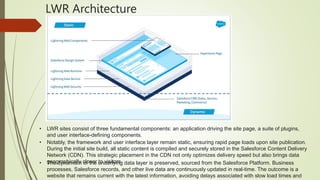
• LWR sites consist of three fundamental components: an application driving the site page, a suite of plugins,
and user interface-defining components.
• Notably, the framework and user interface layer remain static, ensuring rapid page loads upon site publication.
During the initial site build, all static content is compiled and securely stored in the Salesforce Content Delivery
Network (CDN). This strategic placement in the CDN not only optimizes delivery speed but also brings data
geographically closer to visitors.
• The dynamism of the underlying data layer is preserved, sourced from the Salesforce Platform. Business
processes, Salesforce records, and other live data are continuously updated in real-time. The outcome is a
website that remains current with the latest information, avoiding delays associated with slow load times and
Should we use LWR
 The LWR framework provides speed and flexibility, which makes it ideal for
high-volume sites that need to scale effectively. But as the new kid on the
block, it has fewer templates and out-of-the-box components. If your use case
requires a comprehensive set of prebuilt components, you may want to
consider sticking with Aura templates for the time being.
 The LWR frameworks’ speed and versatility make them perfect for high-
volume sites that need to scale successfully.
 Ease of Leveraging the latest web functionalities and constructs as we are not
depended on any additional abstraction, so all updates are available from day
one.
 Build Your own template. Additionally, LWR’s single-page HTML application
architecture enhances screen reader capabilities, dynamically adapting to
theme changes and intelligently resetting to the page’s top when content
shifts.
 LWR introduces upgraded accessibility standards, featuring F6 navigation for
seamless region traversal with a single keystroke, reducing the need for
multiple tab strokes. Define user regions, such as header and footer.
LWR Limitations
The following items are unavailable :
 The majority of the standard pages and components that come with
aura templates include object pages and record components.
 The navigation menu element by default. However, you can create
your own.
 Deploying a change set.
 Right-to-left languages.
 Configuration of contributors.
 Optimizer for the Salesforce community page.
 Theme management and out-of-the-box themes.

Lightning Web Runtime (LWR) session for Salesforce

  • 1.
    • What isLightning Web Runtime (LWR). • LWR Architecture. • Should we use LWR? • LWR Limitations. Agenda
  • 2.
    LWR  LWR isthe next generation technology for Experience Cloud Sites. It focuses on performance and flexibility as this does not add abstraction layer and uses more web standards.  LWR has a neutral approach to configuring and loading the JavaScript modules, services, and dependency providers when it descends. Depending on our scenario, we can deploy on various runtime environments.  Unlike Aura templates, Lightning Web Runtime (LWR) optimizes speed by caching components during site publication, ensuring sub-second content delivery. While Aura dynamically loads components, LWR’s static serving requires a site republish for changes to take effect, offering unparalleled speed in return.  LWR operates in a local Node.js runtime or a standalone Heroku instance.
  • 3.
    LWR Architecture • LWRsites consist of three fundamental components: an application driving the site page, a suite of plugins, and user interface-defining components. • Notably, the framework and user interface layer remain static, ensuring rapid page loads upon site publication. During the initial site build, all static content is compiled and securely stored in the Salesforce Content Delivery Network (CDN). This strategic placement in the CDN not only optimizes delivery speed but also brings data geographically closer to visitors. • The dynamism of the underlying data layer is preserved, sourced from the Salesforce Platform. Business processes, Salesforce records, and other live data are continuously updated in real-time. The outcome is a website that remains current with the latest information, avoiding delays associated with slow load times and
  • 4.
    Should we useLWR  The LWR framework provides speed and flexibility, which makes it ideal for high-volume sites that need to scale effectively. But as the new kid on the block, it has fewer templates and out-of-the-box components. If your use case requires a comprehensive set of prebuilt components, you may want to consider sticking with Aura templates for the time being.  The LWR frameworks’ speed and versatility make them perfect for high- volume sites that need to scale successfully.  Ease of Leveraging the latest web functionalities and constructs as we are not depended on any additional abstraction, so all updates are available from day one.  Build Your own template. Additionally, LWR’s single-page HTML application architecture enhances screen reader capabilities, dynamically adapting to theme changes and intelligently resetting to the page’s top when content shifts.  LWR introduces upgraded accessibility standards, featuring F6 navigation for seamless region traversal with a single keystroke, reducing the need for multiple tab strokes. Define user regions, such as header and footer.
  • 5.
    LWR Limitations The followingitems are unavailable :  The majority of the standard pages and components that come with aura templates include object pages and record components.  The navigation menu element by default. However, you can create your own.  Deploying a change set.  Right-to-left languages.  Configuration of contributors.  Optimizer for the Salesforce community page.  Theme management and out-of-the-box themes.