INTRODUCTION 
 Dimmers are devices used to vary the brightness of a light. By changing the voltage waveform applied to the lamp, 
it is possible to vary the intensity of the light output. Although variable-voltage devices are used for various 
purposes, the term dimmer is generally reserved for those intended to control light output from resistive 
incandescent, halogen, and (more recently) compact fluorescent lights (CFLs) and light-emitting diodes(LEDs). More 
specialized equipment is needed to dim fluorescent, mercury vapor, solid state and other arc lighting. 
 Dimmers range in size from small units ,the size of a light switch used for domestic lighting to high power units used 
in large theatre orarchitectural lighting installations. Small domestic dimmers are generally directly controlled, 
although remote control systems (such asX10) are available. Modern professional dimmers are generally controlled 
by a digital control system like DMX or DALI. In newer systems, these protocols are often used in conjunction 
with ethernet. 
 In the professional lighting industry, changes in intensity are called “fades” and can be “fade up” or “fade down”. 
Dimmers with direct manual control had a limit on the speed they could be varied at but this issue has been largely 
eliminated with modern digital units (although very fast changes in brightness may still be avoided for other reasons 
like lamp life). 
 Modern dimmers are built from silicon-controlled rectifiers (SCR) instead of variable resistors, because they have 
higher efficiency. A variable resistor would dissipate power as heat and acts as a voltage divider. Since a silicon 
controlled rectifier switches between a low resistance "on" state and a high resistance "off" state, it dissipates very 
little power compared with the controlled load.
I. One of the earliest recorded dimmers is Granville Woods' "Safety Dimmer", published in 1890; dimmers 
before that were liable to cause fires. 
II. Early dimmers were directly controlled through the manual manipulation of large dimmer panels. This 
required all power to come through the lighting control location, which could be inconvenient and 
potentially dangerous for large or high-powered systems, such as those used for stage lighting, 
III. When thyristor dimmers came into use, analog remote control systems (often 0-10 V lighting control 
systems) became feasible. The wire for the control systems was much smaller (with low current and lower 
danger) than the heavy power cables of previous lighting systems. Each dimmer had its own control 
wires, resulting in a huge number of wires leaving the lighting control location and running to each 
individual dimmer. Modern systems use a digital control protocol such as DMX512, DALI, or one of the 
many Ethernet-based protocols like Art-Net, ETCnet, sACN, Pathport, ShowNet or KiNET to control a 
large number of dimmers (and other stage equipment) through a single cable. 
IV. In 1959, Joel S. Spira, who would found the Lutron Electronics Company in 1961, invented the first solid-state 
dimmer, which switches the current on and off 120 times per second, saving energy and allowing 
the dimmer to be installed in a standard electrical wallbox. 
V. Many people attribute the invention of the first commercially viable light dimmer to Eugene Alessio, an 
electrical Engineer. In the sixties, Alessio began thinking about an electronic linear means for adjusting a 
light level on a single light bulb 
VI. . Using a Triac, he built several prototype breadboard circuits to experiment with this new concept. 
VII. Although the device interested Sears and other large department stores, Alessio's patent did not 
completely protect his idea. He passed along a working prototype to the Sears representatives, who took 
it to Texas Instruments to mass manufacture the product.
1) Rheostat Dimmer 
2) Salt water Dimmer 
3) Coil-Rotation Dimmer 
4) Autotransformer Dimmer 
5) Thyristor Dimmer
Rheostat Dimmers 
Dimmers based on rheostats were inefficient since they would 
dissipate a significant portion of the power rating of the load 
as heat. 
They were large and required plenty of cooling air. Because 
their dimming effect depended a great deal on the total load 
applied to each rheostat, the load needed to be matched 
fairly carefully to the power rating of the rheostat. Finally, as 
they relied on mechanical control they were slow and it was 
difficult to change many channels at a time. 
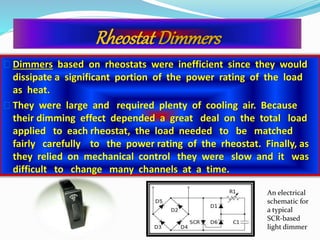
An electrical 
schematic for 
a typical 
SCR-based 
light dimmer
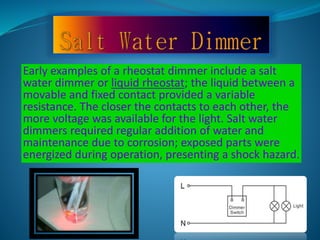
Early examples of a rheostat dimmer include a salt 
water dimmer or liquid rheostat; the liquid between a 
movable and fixed contact provided a variable 
resistance. The closer the contacts to each other, the 
more voltage was available for the light. Salt water 
dimmers required regular addition of water and 
maintenance due to corrosion; exposed parts were 
energized during operation, presenting a shock hazard.
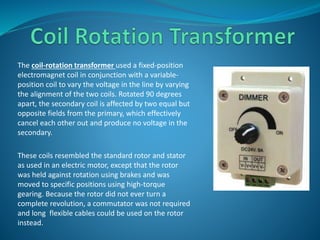
The coil-rotation transformer used a fixed-position 
electromagnet coil in conjunction with a variable-position 
coil to vary the voltage in the line by varying 
the alignment of the two coils. Rotated 90 degrees 
apart, the secondary coil is affected by two equal but 
opposite fields from the primary, which effectively 
cancel each other out and produce no voltage in the 
secondary. 
These coils resembled the standard rotor and stator 
as used in an electric motor, except that the rotor 
was held against rotation using brakes and was 
moved to specific positions using high-torque 
gearing. Because the rotor did not ever turn a 
complete revolution, a commutator was not required 
and long flexible cables could be used on the rotor 
instead.
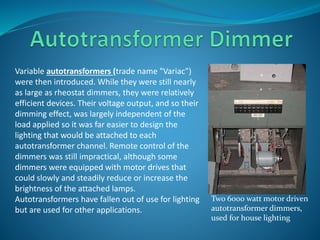
Variable autotransformers (trade name "Variac") 
were then introduced. While they were still nearly 
as large as rheostat dimmers, they were relatively 
efficient devices. Their voltage output, and so their 
dimming effect, was largely independent of the 
load applied so it was far easier to design the 
lighting that would be attached to each 
autotransformer channel. Remote control of the 
dimmers was still impractical, although some 
dimmers were equipped with motor drives that 
could slowly and steadily reduce or increase the 
brightness of the attached lamps. 
Autotransformers have fallen out of use for lighting 
but are used for other applications. 
Two 6000 watt motor driven 
autotransformer dimmers, 
used for house lighting
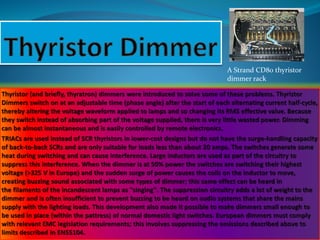
A Strand CD80 thyristor 
dimmer rack
In the electrical schematic to the right, a typical SCR-based light dimmer dims 
the light through phase angle control. This unit is wired in series with the load. 
Diodes (D2, D3, D4 and D5) form a bridge which generates pulsed DC. R1 and 
C1 form a circuit with a time constant. As the voltage increases from zero (at 
the start of every halfwave) C1 will charge up. When C1 is able to make Zener 
diode D6 conduct and inject current into the SCR, the SCR will fire. When the 
SCR conducts then D1 will discharge C1 via the SCR. The SCR will shut off when 
the current falls to zero when the supply voltage drops at the end of the half 
cycle, ready for the circuit to start work on the next half cycle. 
Sine-wave dimming promises to 
solve the weight and interference 
issues that afflict thyristor dimmers. 
These are effectively high power 
switched-mode power supplies. 
They rely on a new generation of 
insulated-gate bipolar transistors(IGBTs) 
which are still relatively expensive (2004). 
IGBT-Sine-wave-dimmer-PWM
Control 
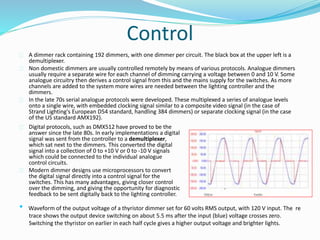
A dimmer rack containing 192 dimmers, with one dimmer per circuit. The black box at the upper left is a 
demultiplexer. 
Non domestic dimmers are usually controlled remotely by means of various protocols. Analogue dimmers 
usually require a separate wire for each channel of dimming carrying a voltage between 0 and 10 V. Some 
analogue circuitry then derives a control signal from this and the mains supply for the switches. As more 
channels are added to the system more wires are needed between the lighting controller and the 
dimmers. 
In the late 70s serial analogue protocols were developed. These multiplexed a series of analogue levels 
onto a single wire, with embedded clocking signal similar to a composite video signal (in the case of 
Strand Lighting's European D54 standard, handling 384 dimmers) or separate clocking signal (in the case 
of the US standard AMX192). 
Digital protocols, such as DMX512 have proved to be the 
answer since the late 80s. In early implementations a digital 
signal was sent from the controller to a demultiplexer, 
which sat next to the dimmers. This converted the digital 
signal into a collection of 0 to +10 V or 0 to -10 V signals 
which could be connected to the individual analogue 
control circuits. 
Modern dimmer designs use microprocessors to convert 
the digital signal directly into a control signal for the 
switches. This has many advantages, giving closer control 
over the dimming, and giving the opportunity for diagnostic 
feedback to be sent digitally back to the lighting controller. 
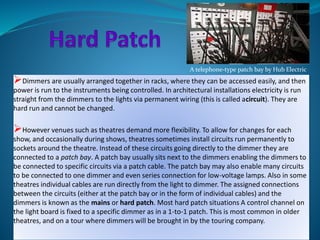
• Waveform of the output voltage of a thyristor dimmer set for 60 volts RMS output, with 120 V input. The re 
trace shows the output device switching on about 5.5 ms after the input (blue) voltage crosses zero. 
Switching the thyristor on earlier in each half cycle gives a higher output voltage and brighter lights.
Patching is the physical 
("hard patch") or virtual 
("soft patch") assignment 
to a circuit or channel for 
the purpose of control. 
Soft Patch 
Most modern fixed installations 
do not have patch bays, instead 
they have a dimmer-per-circuit 
and patch dimmers into 
channels using a computerised 
control consoles Soft Patch. An ElectroControls Slider Type Patch Bay
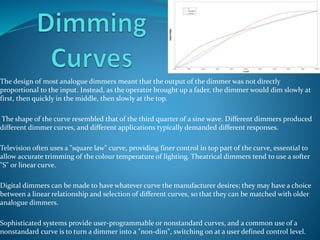
A telephone-type patch bay by Hub Electric 
Dimmers are usually arranged together in racks, where they can be accessed easily, and then 
power is run to the instruments being controlled. In architectural installations electricity is run 
straight from the dimmers to the lights via permanent wiring (this is called acircuit). They are 
hard run and cannot be changed. 
However venues such as theatres demand more flexibility. To allow for changes for each 
show, and occasionally during shows, theatres sometimes install circuits run permanently to 
sockets around the theatre. Instead of these circuits going directly to the dimmer they are 
connected to a patch bay. A patch bay usually sits next to the dimmers enabling the dimmers to 
be connected to specific circuits via a patch cable. The patch bay may also enable many circuits 
to be connected to one dimmer and even series connection for low-voltage lamps. Also in some 
theatres individual cables are run directly from the light to dimmer. The assigned connections 
between the circuits (either at the patch bay or in the form of individual cables) and the 
dimmers is known as the mains or hard patch. Most hard patch situations A control channel on 
the light board is fixed to a specific dimmer as in a 1-to-1 patch. This is most common in older 
theatres, and on a tour where dimmers will be brought in by the touring company.
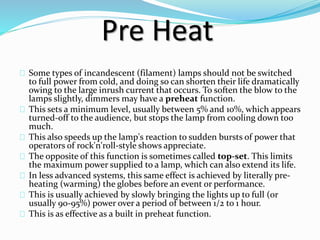
The design of most analogue dimmers meant that the output of the dimmer was not directly 
proportional to the input. Instead, as the operator brought up a fader, the dimmer would dim slowly at 
first, then quickly in the middle, then slowly at the top. 
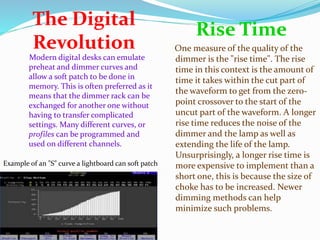
The shape of the curve resembled that of the third quarter of a sine wave. Different dimmers produced 
different dimmer curves, and different applications typically demanded different responses. 
Television often uses a "square law" curve, providing finer control in top part of the curve, essential to 
allow accurate trimming of the colour temperature of lighting. Theatrical dimmers tend to use a softer 
"S" or linear curve. 
Digital dimmers can be made to have whatever curve the manufacturer desires; they may have a choice 
between a linear relationship and selection of different curves, so that they can be matched with older 
analogue dimmers. 
Sophisticated systems provide user-programmable or nonstandard curves, and a common use of a 
nonstandard curve is to turn a dimmer into a "non-dim", switching on at a user defined control level.
Pre Heat 
Some types of incandescent (filament) lamps should not be switched 
to full power from cold, and doing so can shorten their life dramatically 
owing to the large inrush current that occurs. To soften the blow to the 
lamps slightly, dimmers may have a preheat function. 
This sets a minimum level, usually between 5% and 10%, which appears 
turned-off to the audience, but stops the lamp from cooling down too 
much. 
This also speeds up the lamp's reaction to sudden bursts of power that 
operators of rock'n'roll-style shows appreciate. 
The opposite of this function is sometimes called top-set. This limits 
the maximum power supplied to a lamp, which can also extend its life. 
In less advanced systems, this same effect is achieved by literally pre-heating 
(warming) the globes before an event or performance. 
This is usually achieved by slowly bringing the lights up to full (or 
usually 90-95%) power over a period of between 1/2 to 1 hour. 
This is as effective as a built in preheat function.
The Digital 
Revolution 
Rise Time 
Modern digital desks can emulate 
preheat and dimmer curves and 
allow a soft patch to be done in 
memory. This is often preferred as it 
means that the dimmer rack can be 
exchanged for another one without 
having to transfer complicated 
settings. Many different curves, or 
profiles can be programmed and 
used on different channels. 
One measure of the quality of the 
dimmer is the "rise time". The rise 
time in this context is the amount of 
time it takes within the cut part of 
the waveform to get from the zero-point 
crossover to the start of the 
uncut part of the waveform. A longer 
rise time reduces the noise of the 
dimmer and the lamp as well as 
extending the life of the lamp. 
Unsurprisingly, a longer rise time is 
more expensive to implement than a 
short one, this is because the size of 
choke has to be increased. Newer 
dimming methods can help 
minimize such problems. 
Example of an "S" curve a lightboard can soft patch

Light Dimmers

  • 2.
    INTRODUCTION  Dimmersare devices used to vary the brightness of a light. By changing the voltage waveform applied to the lamp, it is possible to vary the intensity of the light output. Although variable-voltage devices are used for various purposes, the term dimmer is generally reserved for those intended to control light output from resistive incandescent, halogen, and (more recently) compact fluorescent lights (CFLs) and light-emitting diodes(LEDs). More specialized equipment is needed to dim fluorescent, mercury vapor, solid state and other arc lighting.  Dimmers range in size from small units ,the size of a light switch used for domestic lighting to high power units used in large theatre orarchitectural lighting installations. Small domestic dimmers are generally directly controlled, although remote control systems (such asX10) are available. Modern professional dimmers are generally controlled by a digital control system like DMX or DALI. In newer systems, these protocols are often used in conjunction with ethernet.  In the professional lighting industry, changes in intensity are called “fades” and can be “fade up” or “fade down”. Dimmers with direct manual control had a limit on the speed they could be varied at but this issue has been largely eliminated with modern digital units (although very fast changes in brightness may still be avoided for other reasons like lamp life).  Modern dimmers are built from silicon-controlled rectifiers (SCR) instead of variable resistors, because they have higher efficiency. A variable resistor would dissipate power as heat and acts as a voltage divider. Since a silicon controlled rectifier switches between a low resistance "on" state and a high resistance "off" state, it dissipates very little power compared with the controlled load.
  • 3.
    I. One ofthe earliest recorded dimmers is Granville Woods' "Safety Dimmer", published in 1890; dimmers before that were liable to cause fires. II. Early dimmers were directly controlled through the manual manipulation of large dimmer panels. This required all power to come through the lighting control location, which could be inconvenient and potentially dangerous for large or high-powered systems, such as those used for stage lighting, III. When thyristor dimmers came into use, analog remote control systems (often 0-10 V lighting control systems) became feasible. The wire for the control systems was much smaller (with low current and lower danger) than the heavy power cables of previous lighting systems. Each dimmer had its own control wires, resulting in a huge number of wires leaving the lighting control location and running to each individual dimmer. Modern systems use a digital control protocol such as DMX512, DALI, or one of the many Ethernet-based protocols like Art-Net, ETCnet, sACN, Pathport, ShowNet or KiNET to control a large number of dimmers (and other stage equipment) through a single cable. IV. In 1959, Joel S. Spira, who would found the Lutron Electronics Company in 1961, invented the first solid-state dimmer, which switches the current on and off 120 times per second, saving energy and allowing the dimmer to be installed in a standard electrical wallbox. V. Many people attribute the invention of the first commercially viable light dimmer to Eugene Alessio, an electrical Engineer. In the sixties, Alessio began thinking about an electronic linear means for adjusting a light level on a single light bulb VI. . Using a Triac, he built several prototype breadboard circuits to experiment with this new concept. VII. Although the device interested Sears and other large department stores, Alessio's patent did not completely protect his idea. He passed along a working prototype to the Sears representatives, who took it to Texas Instruments to mass manufacture the product.
  • 4.
    1) Rheostat Dimmer 2) Salt water Dimmer 3) Coil-Rotation Dimmer 4) Autotransformer Dimmer 5) Thyristor Dimmer
  • 5.
    Rheostat Dimmers Dimmersbased on rheostats were inefficient since they would dissipate a significant portion of the power rating of the load as heat. They were large and required plenty of cooling air. Because their dimming effect depended a great deal on the total load applied to each rheostat, the load needed to be matched fairly carefully to the power rating of the rheostat. Finally, as they relied on mechanical control they were slow and it was difficult to change many channels at a time. An electrical schematic for a typical SCR-based light dimmer
  • 6.
    Early examples ofa rheostat dimmer include a salt water dimmer or liquid rheostat; the liquid between a movable and fixed contact provided a variable resistance. The closer the contacts to each other, the more voltage was available for the light. Salt water dimmers required regular addition of water and maintenance due to corrosion; exposed parts were energized during operation, presenting a shock hazard.
  • 7.
    The coil-rotation transformerused a fixed-position electromagnet coil in conjunction with a variable-position coil to vary the voltage in the line by varying the alignment of the two coils. Rotated 90 degrees apart, the secondary coil is affected by two equal but opposite fields from the primary, which effectively cancel each other out and produce no voltage in the secondary. These coils resembled the standard rotor and stator as used in an electric motor, except that the rotor was held against rotation using brakes and was moved to specific positions using high-torque gearing. Because the rotor did not ever turn a complete revolution, a commutator was not required and long flexible cables could be used on the rotor instead.
  • 8.
    Variable autotransformers (tradename "Variac") were then introduced. While they were still nearly as large as rheostat dimmers, they were relatively efficient devices. Their voltage output, and so their dimming effect, was largely independent of the load applied so it was far easier to design the lighting that would be attached to each autotransformer channel. Remote control of the dimmers was still impractical, although some dimmers were equipped with motor drives that could slowly and steadily reduce or increase the brightness of the attached lamps. Autotransformers have fallen out of use for lighting but are used for other applications. Two 6000 watt motor driven autotransformer dimmers, used for house lighting
  • 9.
    A Strand CD80thyristor dimmer rack
  • 10.
    In the electricalschematic to the right, a typical SCR-based light dimmer dims the light through phase angle control. This unit is wired in series with the load. Diodes (D2, D3, D4 and D5) form a bridge which generates pulsed DC. R1 and C1 form a circuit with a time constant. As the voltage increases from zero (at the start of every halfwave) C1 will charge up. When C1 is able to make Zener diode D6 conduct and inject current into the SCR, the SCR will fire. When the SCR conducts then D1 will discharge C1 via the SCR. The SCR will shut off when the current falls to zero when the supply voltage drops at the end of the half cycle, ready for the circuit to start work on the next half cycle. Sine-wave dimming promises to solve the weight and interference issues that afflict thyristor dimmers. These are effectively high power switched-mode power supplies. They rely on a new generation of insulated-gate bipolar transistors(IGBTs) which are still relatively expensive (2004). IGBT-Sine-wave-dimmer-PWM
  • 11.
    Control A dimmerrack containing 192 dimmers, with one dimmer per circuit. The black box at the upper left is a demultiplexer. Non domestic dimmers are usually controlled remotely by means of various protocols. Analogue dimmers usually require a separate wire for each channel of dimming carrying a voltage between 0 and 10 V. Some analogue circuitry then derives a control signal from this and the mains supply for the switches. As more channels are added to the system more wires are needed between the lighting controller and the dimmers. In the late 70s serial analogue protocols were developed. These multiplexed a series of analogue levels onto a single wire, with embedded clocking signal similar to a composite video signal (in the case of Strand Lighting's European D54 standard, handling 384 dimmers) or separate clocking signal (in the case of the US standard AMX192). Digital protocols, such as DMX512 have proved to be the answer since the late 80s. In early implementations a digital signal was sent from the controller to a demultiplexer, which sat next to the dimmers. This converted the digital signal into a collection of 0 to +10 V or 0 to -10 V signals which could be connected to the individual analogue control circuits. Modern dimmer designs use microprocessors to convert the digital signal directly into a control signal for the switches. This has many advantages, giving closer control over the dimming, and giving the opportunity for diagnostic feedback to be sent digitally back to the lighting controller. • Waveform of the output voltage of a thyristor dimmer set for 60 volts RMS output, with 120 V input. The re trace shows the output device switching on about 5.5 ms after the input (blue) voltage crosses zero. Switching the thyristor on earlier in each half cycle gives a higher output voltage and brighter lights.
  • 12.
    Patching is thephysical ("hard patch") or virtual ("soft patch") assignment to a circuit or channel for the purpose of control. Soft Patch Most modern fixed installations do not have patch bays, instead they have a dimmer-per-circuit and patch dimmers into channels using a computerised control consoles Soft Patch. An ElectroControls Slider Type Patch Bay
  • 13.
    A telephone-type patchbay by Hub Electric Dimmers are usually arranged together in racks, where they can be accessed easily, and then power is run to the instruments being controlled. In architectural installations electricity is run straight from the dimmers to the lights via permanent wiring (this is called acircuit). They are hard run and cannot be changed. However venues such as theatres demand more flexibility. To allow for changes for each show, and occasionally during shows, theatres sometimes install circuits run permanently to sockets around the theatre. Instead of these circuits going directly to the dimmer they are connected to a patch bay. A patch bay usually sits next to the dimmers enabling the dimmers to be connected to specific circuits via a patch cable. The patch bay may also enable many circuits to be connected to one dimmer and even series connection for low-voltage lamps. Also in some theatres individual cables are run directly from the light to dimmer. The assigned connections between the circuits (either at the patch bay or in the form of individual cables) and the dimmers is known as the mains or hard patch. Most hard patch situations A control channel on the light board is fixed to a specific dimmer as in a 1-to-1 patch. This is most common in older theatres, and on a tour where dimmers will be brought in by the touring company.
  • 14.
    The design ofmost analogue dimmers meant that the output of the dimmer was not directly proportional to the input. Instead, as the operator brought up a fader, the dimmer would dim slowly at first, then quickly in the middle, then slowly at the top. The shape of the curve resembled that of the third quarter of a sine wave. Different dimmers produced different dimmer curves, and different applications typically demanded different responses. Television often uses a "square law" curve, providing finer control in top part of the curve, essential to allow accurate trimming of the colour temperature of lighting. Theatrical dimmers tend to use a softer "S" or linear curve. Digital dimmers can be made to have whatever curve the manufacturer desires; they may have a choice between a linear relationship and selection of different curves, so that they can be matched with older analogue dimmers. Sophisticated systems provide user-programmable or nonstandard curves, and a common use of a nonstandard curve is to turn a dimmer into a "non-dim", switching on at a user defined control level.
  • 15.
    Pre Heat Sometypes of incandescent (filament) lamps should not be switched to full power from cold, and doing so can shorten their life dramatically owing to the large inrush current that occurs. To soften the blow to the lamps slightly, dimmers may have a preheat function. This sets a minimum level, usually between 5% and 10%, which appears turned-off to the audience, but stops the lamp from cooling down too much. This also speeds up the lamp's reaction to sudden bursts of power that operators of rock'n'roll-style shows appreciate. The opposite of this function is sometimes called top-set. This limits the maximum power supplied to a lamp, which can also extend its life. In less advanced systems, this same effect is achieved by literally pre-heating (warming) the globes before an event or performance. This is usually achieved by slowly bringing the lights up to full (or usually 90-95%) power over a period of between 1/2 to 1 hour. This is as effective as a built in preheat function.
  • 16.
    The Digital Revolution Rise Time Modern digital desks can emulate preheat and dimmer curves and allow a soft patch to be done in memory. This is often preferred as it means that the dimmer rack can be exchanged for another one without having to transfer complicated settings. Many different curves, or profiles can be programmed and used on different channels. One measure of the quality of the dimmer is the "rise time". The rise time in this context is the amount of time it takes within the cut part of the waveform to get from the zero-point crossover to the start of the uncut part of the waveform. A longer rise time reduces the noise of the dimmer and the lamp as well as extending the life of the lamp. Unsurprisingly, a longer rise time is more expensive to implement than a short one, this is because the size of choke has to be increased. Newer dimming methods can help minimize such problems. Example of an "S" curve a lightboard can soft patch

Editor's Notes

  • #3 Devices used to vary the Brightness of light. Used for domestic lighting as well as professional industry lighting. SCR are used in Modern Dimmers because of higher efficiency compared to variable resistors.
  • #5 5 Basic Types of Dimmers
  • #6 Rheostat Dimmers-Large in size and required plenty of cooling air. They are slow as they rely on mechanical control
  • #7 Salt water Dimmer example of Rheostat Dimmers
  • #8 The coil-rotation transformer used a fixed-position electromagnet coil in conjunction with a variable-position coil to vary the voltage Voltage is Varied in line by varying the alignment of the 2 coils. The 2 coils are used in Electric motor as stator and rotor.
  • #9 Basically a Variable Transformer. Better control on the dimming effect irrespective of the Load applied.
  • #10 TRIACs are used instead of SCR thyristors in lower-cost designs