EFFECTS OF LIFESTYLE IN
THE FUNCTION OF
RESPIRATORY AND
CIRCULATORY SYSTEM
Infer how one’s lifestyle can affect the functioning of
respiratory and circulatory systems – (S9LT-Ic -27)
After going through this module, you are expected to:
1.identify the effects of lifestyle to the respiratory and
circulatory system;
2.infer how one’s lifestyle can affect the functions of
respiratory and circulatory systems;
3.infer how to detect and prevent diseases in the
circulatory system and respiratory system;
4.create an infographic on effective ways of taking care
of the respiratory and circulatory system.
Let us recall the concepts learned from the
previous module by answering the following
questions:
● What are the primary functions of the respiratory
and circulatory systems?
● What are the parts of the respiratory system?
● How about the circulatory system?
Figure 1. No Tobacco Smoking Campaign by the Department of
Health (DOH)
Are you familiar with the posters shown above?
Do you know how we can acquire the
diseases?
Do you know how we can acquire the
diseases?
DISEASES OF THE RESPIRATORY SYSTEM
Diseases Causes Symptoms Treatment/Prevention
Asthma
(Not exactly the
causes but
triggers) Allergies
Smoking
Weather
Coughing,
Wheezing, Chest
Pain,
Shortness of breath,
Trouble Sleeping
Prevention:
Avoid asthma triggers
Get vaccinated for
influenza and Pneumonia
Treatment:
Asthma Inhalers
Nebulizer
DISEASES OF THE RESPIRATORY SYSTEM
Diseases Causes Symptoms Treatment/Prevention
Chronic
Obstructive
Pulmonary
Disease
Cigarette Smoking
Emphysema
Bronchitis
Shortness of
breath ,Wheezing,
Chest tightness,
Cough with
sputum
Prevention:
Do not smoke/quit smoking
Treatment:
Medication Lung
therapy
Bronchodilators
DISEASES OF THE RESPIRATORY SYSTEM
Diseases Causes Symptoms Treatment/Prevention
Chronic
Bronchitis
Cigarette Smoking
Dust
Smoke from
burning coal
Air pollution
Cough with
sputum ,Wheezing,
Tight chest,
Shortness of
breath.
Prevention:
Do not smoke/
Quit smoking
Treatment:
Bronchodilators
Surgical Procedures
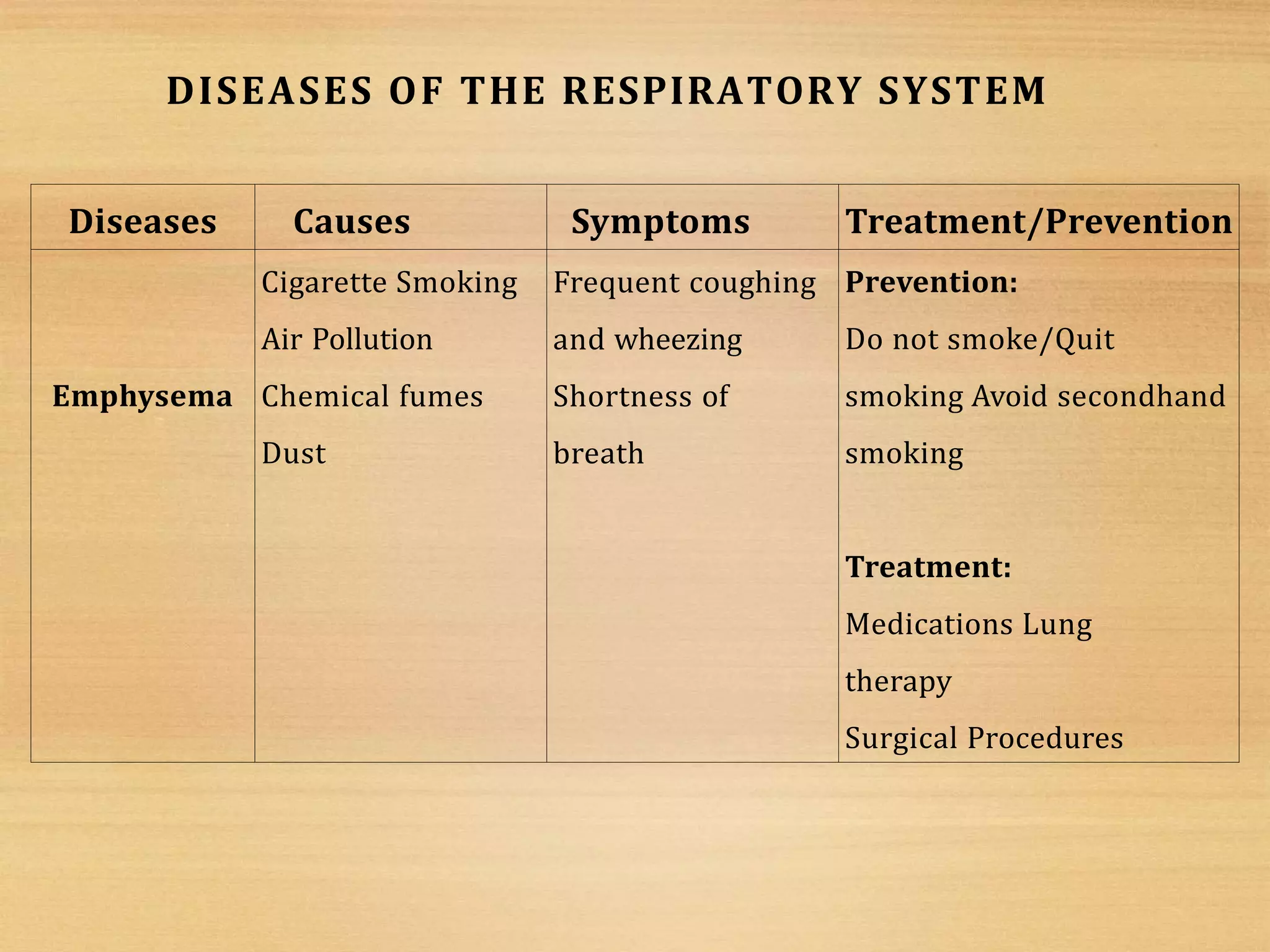
DISEASES OF THE RESPIRATORY SYSTEM
Diseases Causes Symptoms Treatment/Prevention
Emphysema
Cigarette Smoking
Air Pollution
Chemical fumes
Dust
Frequent coughing
and wheezing
Shortness of
breath
Prevention:
Do not smoke/Quit
smoking Avoid secondhand
smoking
Treatment:
Medications Lung
therapy
Surgical Procedures
DISEASES OF THE RESPIRATORY SYSTEM
Diseases Causes Symptoms Treatment/Prevention
Lung Cancer
Cigarette Smoking
Secondhand
smoke Gene
changes
Cough that does
not go away,
Coughing up blood,
Shortness of
breath,
Chest pain,
Headache,
Hoarseness
Prevention:
Do not smoke/
Quit smoking
Avoid secondhand smoke
Treatment:
Surgery
Chemotherapy
Radiotherapy
DISEASES OF THE RESPIRATORY SYSTEM
Diseases Causes Symptoms Treatment/Prevention
Tuberculosis
Bacteria called
Mycobacterium
Cough that lasts
for more than 3
weeks ,Chills and
Fever, Weight loss,
Chest pain,
Coughing up blood
Prevention:
Physical distancing
Good ventilation
Good hygiene
Treatment:
Medication
DISEASES OF THE RESPIRATORY SYSTEM
Diseases Causes Symptoms Treatment/Prevention
Pneumonia
Bacteria Fungi
Viruses (including
SARS-CoV, MERs-
CoV, and recently
SARS-CoV-2)
Chest pain,
Cough with
phlegm, Fatigue,
Chills and Fever,
Shortness of
breath, Nausea,
Vomiting
Prevention:
Get vaccinated
Good hygiene
Do not smoke
Cure:
If bacteria, Antibiotics
If viral, Rest with lots of
fluid intake
DISEASES OF THE RESPIRATORY SYSTEM
Diseases Causes Symptoms Treatment/Prevention
Coronavirus
Disease
(COVID-19)
Severe Acute
Respiratory
Syndrome
Coronavirus 2
(SARS-
CoV-2)
Fever
Dry cough
Tiredness
Aches and pains
Sore throat
Diarrhea
Conjunctivitis
(pink eye)
Headache
Loss of taste and
smell
Rashes
Prevention:
Wash your hands regularly.
Maintain physical
distancing.
Avoid touching your face.
Cover your mouth when
coughing and sneezing.
Avoid smoking.
Wear face mask.
STAY AT HOME.
1.Asthma
- a common, continuing respiratory condition that
causes difficulty breathing due to inflammation of the
airways.
2. Chronic Obstructive Pulmonary Disease (COPD)
- the development of sputum makes the infected
suffer from difficulty in breathing.
3. Chronic bronchitis
-a disease that makes the bronchial tubes swell.
4. Emphysema
- another form of COPD that causes damage to the
air sacs in the lungs or alveoli.
5. Lung Cancer
-bumps are shaped in the lungs that cause cancer.
6.Tuberculosis
-mycobacterium targets the lungs and damages the
other parts of the body.
7. Pneumonia
-the swelling of alveoli is caused by bacteria, virus, or
fungi.
8. Coronavirus Disease (COVID-19)
- this new disease comes from a type of coronavirus
named SARS-CoV-2. Symptoms show up to 14 days.
Some are asymptomatic that no symptoms show, but
they are already infected and can spread the virus if not
in isolation.
DISEASES OF THE CIRCULATORY SYSTEM
Diseases Causes Symptoms Treatment/Prevention
Arteriosclerosis/
Atherosclerosis
High Blood
Pressure,
High
Cholesterol,
Cigarette
Smoking
Chest pain,
Transient
ischemic
attack,
Kidney
failure
Prevention:
Do not smoke/quit
smoking Exercise
regularly
Eating healthy foods
Treatment:
Medication
Surgical procedures
DISEASES OF THE CIRCULATORY SYSTEM
Diseases Causes Symptoms Treatment/Prevention
Heart Attack
Blocked
arteries,
Coronary
artery disease
Pressure in
the chest,
Aching
sensation
that spreads
to neck or
jaw Cold
,Sweat,
Fatigue,
Shortness of
breath,
Nausea
Prevention:
Medication Exercise
regularly,
Eating healthy foods
Treatment:
Medication,
Surgical procedures,
Cardiac rehabilitation
DISEASES OF THE CIRCULATORY SYSTEM
Diseases Causes Symptoms Treatment/Prevention
Myocardial Ischemia
Blood Clot
Atheroscleros
is Coronary
artery spasm
Neck or jaw
pain
Shoulder or
arm pain
Fast
heartbeat
Nausea and
vomiting
Sweating
Fatigue
Prevention:
Do not smoke/quit
smoking Exercise
regularly
Eat healthy foods
Treatment:
Medication
Procedure to improve
blood
flow
DISEASES OF THE CIRCULATORY SYSTEM
Diseases Causes Symptoms Treatment/Prevention
Heart Failure
Faulty heart
valves
Hypertension
Abnormal
heart
rhythms
Chronic
diseases such
as diabetes and
AIDS
Shortness of
breath Fatigue
Rapid or
irregular
heartbeat
Increased
urination Chest
pain
Lack of appetite
and
nausea
Prevention:
Do not smoke/quit
smoking Exercise
regularly
Eating healthy foods
Treatment:
Medication
Surgical procedures
DISEASES OF THE CIRCULATORY SYSTEM
Diseases Causes Symptoms Treatment/Prevention
Stroke
Uncontrolled
hypertension
Trauma from
accident
Hemorrhage
Trouble
speaking
Paralysis
Headache
Trouble
walking
Prevention:
Control hypertension
Do not smoke/quit
smoking Exercise
regularly
Eating healthy foods
Treatment:
Medication
DISEASES OF THE CIRCULATORY SYSTEM
Diseases Causes Symptoms Treatment/Prevention
High Blood
Pressure
(Hypertension)
Kidney
problems
Adrenal gland
tumors
Illegal drugs
Most people do
not have any
symptom, but
few people may
have:
Headache
Shortness of
breath
Nosebleeds
Prevention and
Treatment: Do not
smoke/quit smoking
Exercise regularly
Eat healthy foods
DISEASES OF THE CIRCULATORY SYSTEM
Diseases Causes Symptoms Treatment/Prevention
Anemia
Your body
does not make
enough red
blood cell
Your body
destroys red
blood cell
Fatigue Pale
skin
Shortness of
breath
Dizziness Chest
pain
Prevention:
Eat iron-rich food
Take vitamins B-12
and C Eat healthy
foods
Treatment:
Medication
Blood transfusion
DISEASES OF THE CIRCULATORY SYSTEM
Diseases Causes Symptoms Treatment/Prevention
High Cholesterol
Too much
consumption
of
foods high in
bad
cholesterol
Usually has no
symptoms
Prevention:
Do not smoke/quit
smoking Exercise
regularly
Eat healthy foods
1.Atherosclerosis/Arteriosclerosis
- makes the arteries hard caused by high
consumption of a fatty diet that leaves fat deposits on the
lining of the blood vessels. These fat deposits make the
arteries rigid.
2.Heart Attack
-is caused when the heart is blocked from blood
supply due to a blood clot.
3. Myocardial ischemia
-the buildup of fat deposits congests the blood flow to
the heart.
4. High cholesterol
-cholesterol-rich food excessive consumption may lead
to hypertension.
5. Heart Failure
- the unstable behavior of the heart cannot pump
sufficient blood for the body’s needs.
6. Stroke
- can happen if a vessel that supplies blood to the
brain either becomes blocked by a blood clot or bursts.
These stop blood flow and prevent oxygen from getting
to the brain.
7. High Blood Pressure (Hypertension)
- the elevation of blood pressure in the vessels gets too
high that it can trigger other diseases.
8. Anemia
- the insufficient supply of red blood cells in the blood
can make you feel easily tired.
Here are the effects of lifestyles instigated diseases that
affect your respiratory and circulatory system.
1. Cigarette Smoking
Why is it dangerous? It
comprises a lot of substances that
are hurtful to both the smoker
and the individuals around the
smoker. It compromises both the
respiratory and circulatory
framework and even the entire
body!
2. Healthy Diet
A healthy dieting routine does
not mean you simply need to eat
berries and greens but also other
kinds of foods. Eating a well-balanced
diet can help prevent you from having
diseases. Your go-to guide on what’s
optimal to eat is the food pyramid.
Remember: You are what you eat!
3. Regular Exercise and Adequate Rest
Keeping your body active can
help your respiratory and
circulatory system strong. As per
the Centers for Disease Control
and Prevention's (CDC)
suggestion, at least 150 minutes
of exercise each week improves
the prevention of diseases.
4. Proper Hygiene
Washing your hands appropriately for
20 seconds, particularly in the wake of
wheezing, coughing, or cleaning out your nose,
assists with shielding you and others from
ailments, such as colds and influenza. Protect
yourself by wearing a protective mask. This is very
important especially this time that we are
confronting a pandemic.
Thank you!

Lifestyle- Week 4.pptx

  • 1.
    EFFECTS OF LIFESTYLEIN THE FUNCTION OF RESPIRATORY AND CIRCULATORY SYSTEM
  • 2.
    Infer how one’slifestyle can affect the functioning of respiratory and circulatory systems – (S9LT-Ic -27) After going through this module, you are expected to: 1.identify the effects of lifestyle to the respiratory and circulatory system; 2.infer how one’s lifestyle can affect the functions of respiratory and circulatory systems; 3.infer how to detect and prevent diseases in the circulatory system and respiratory system; 4.create an infographic on effective ways of taking care of the respiratory and circulatory system.
  • 3.
    Let us recallthe concepts learned from the previous module by answering the following questions: ● What are the primary functions of the respiratory and circulatory systems? ● What are the parts of the respiratory system? ● How about the circulatory system?
  • 4.
    Figure 1. NoTobacco Smoking Campaign by the Department of Health (DOH) Are you familiar with the posters shown above?
  • 5.
    Do you knowhow we can acquire the diseases?
  • 6.
    Do you knowhow we can acquire the diseases?
  • 7.
    DISEASES OF THERESPIRATORY SYSTEM Diseases Causes Symptoms Treatment/Prevention Asthma (Not exactly the causes but triggers) Allergies Smoking Weather Coughing, Wheezing, Chest Pain, Shortness of breath, Trouble Sleeping Prevention: Avoid asthma triggers Get vaccinated for influenza and Pneumonia Treatment: Asthma Inhalers Nebulizer
  • 8.
    DISEASES OF THERESPIRATORY SYSTEM Diseases Causes Symptoms Treatment/Prevention Chronic Obstructive Pulmonary Disease Cigarette Smoking Emphysema Bronchitis Shortness of breath ,Wheezing, Chest tightness, Cough with sputum Prevention: Do not smoke/quit smoking Treatment: Medication Lung therapy Bronchodilators
  • 9.
    DISEASES OF THERESPIRATORY SYSTEM Diseases Causes Symptoms Treatment/Prevention Chronic Bronchitis Cigarette Smoking Dust Smoke from burning coal Air pollution Cough with sputum ,Wheezing, Tight chest, Shortness of breath. Prevention: Do not smoke/ Quit smoking Treatment: Bronchodilators Surgical Procedures
  • 10.
    DISEASES OF THERESPIRATORY SYSTEM Diseases Causes Symptoms Treatment/Prevention Emphysema Cigarette Smoking Air Pollution Chemical fumes Dust Frequent coughing and wheezing Shortness of breath Prevention: Do not smoke/Quit smoking Avoid secondhand smoking Treatment: Medications Lung therapy Surgical Procedures
  • 11.
    DISEASES OF THERESPIRATORY SYSTEM Diseases Causes Symptoms Treatment/Prevention Lung Cancer Cigarette Smoking Secondhand smoke Gene changes Cough that does not go away, Coughing up blood, Shortness of breath, Chest pain, Headache, Hoarseness Prevention: Do not smoke/ Quit smoking Avoid secondhand smoke Treatment: Surgery Chemotherapy Radiotherapy
  • 12.
    DISEASES OF THERESPIRATORY SYSTEM Diseases Causes Symptoms Treatment/Prevention Tuberculosis Bacteria called Mycobacterium Cough that lasts for more than 3 weeks ,Chills and Fever, Weight loss, Chest pain, Coughing up blood Prevention: Physical distancing Good ventilation Good hygiene Treatment: Medication
  • 13.
    DISEASES OF THERESPIRATORY SYSTEM Diseases Causes Symptoms Treatment/Prevention Pneumonia Bacteria Fungi Viruses (including SARS-CoV, MERs- CoV, and recently SARS-CoV-2) Chest pain, Cough with phlegm, Fatigue, Chills and Fever, Shortness of breath, Nausea, Vomiting Prevention: Get vaccinated Good hygiene Do not smoke Cure: If bacteria, Antibiotics If viral, Rest with lots of fluid intake
  • 14.
    DISEASES OF THERESPIRATORY SYSTEM Diseases Causes Symptoms Treatment/Prevention Coronavirus Disease (COVID-19) Severe Acute Respiratory Syndrome Coronavirus 2 (SARS- CoV-2) Fever Dry cough Tiredness Aches and pains Sore throat Diarrhea Conjunctivitis (pink eye) Headache Loss of taste and smell Rashes Prevention: Wash your hands regularly. Maintain physical distancing. Avoid touching your face. Cover your mouth when coughing and sneezing. Avoid smoking. Wear face mask. STAY AT HOME.
  • 15.
    1.Asthma - a common,continuing respiratory condition that causes difficulty breathing due to inflammation of the airways.
  • 16.
    2. Chronic ObstructivePulmonary Disease (COPD) - the development of sputum makes the infected suffer from difficulty in breathing.
  • 17.
    3. Chronic bronchitis -adisease that makes the bronchial tubes swell.
  • 18.
    4. Emphysema - anotherform of COPD that causes damage to the air sacs in the lungs or alveoli.
  • 19.
    5. Lung Cancer -bumpsare shaped in the lungs that cause cancer.
  • 20.
    6.Tuberculosis -mycobacterium targets thelungs and damages the other parts of the body.
  • 21.
    7. Pneumonia -the swellingof alveoli is caused by bacteria, virus, or fungi.
  • 22.
    8. Coronavirus Disease(COVID-19) - this new disease comes from a type of coronavirus named SARS-CoV-2. Symptoms show up to 14 days. Some are asymptomatic that no symptoms show, but they are already infected and can spread the virus if not in isolation.
  • 23.
    DISEASES OF THECIRCULATORY SYSTEM Diseases Causes Symptoms Treatment/Prevention Arteriosclerosis/ Atherosclerosis High Blood Pressure, High Cholesterol, Cigarette Smoking Chest pain, Transient ischemic attack, Kidney failure Prevention: Do not smoke/quit smoking Exercise regularly Eating healthy foods Treatment: Medication Surgical procedures
  • 24.
    DISEASES OF THECIRCULATORY SYSTEM Diseases Causes Symptoms Treatment/Prevention Heart Attack Blocked arteries, Coronary artery disease Pressure in the chest, Aching sensation that spreads to neck or jaw Cold ,Sweat, Fatigue, Shortness of breath, Nausea Prevention: Medication Exercise regularly, Eating healthy foods Treatment: Medication, Surgical procedures, Cardiac rehabilitation
  • 25.
    DISEASES OF THECIRCULATORY SYSTEM Diseases Causes Symptoms Treatment/Prevention Myocardial Ischemia Blood Clot Atheroscleros is Coronary artery spasm Neck or jaw pain Shoulder or arm pain Fast heartbeat Nausea and vomiting Sweating Fatigue Prevention: Do not smoke/quit smoking Exercise regularly Eat healthy foods Treatment: Medication Procedure to improve blood flow
  • 26.
    DISEASES OF THECIRCULATORY SYSTEM Diseases Causes Symptoms Treatment/Prevention Heart Failure Faulty heart valves Hypertension Abnormal heart rhythms Chronic diseases such as diabetes and AIDS Shortness of breath Fatigue Rapid or irregular heartbeat Increased urination Chest pain Lack of appetite and nausea Prevention: Do not smoke/quit smoking Exercise regularly Eating healthy foods Treatment: Medication Surgical procedures
  • 27.
    DISEASES OF THECIRCULATORY SYSTEM Diseases Causes Symptoms Treatment/Prevention Stroke Uncontrolled hypertension Trauma from accident Hemorrhage Trouble speaking Paralysis Headache Trouble walking Prevention: Control hypertension Do not smoke/quit smoking Exercise regularly Eating healthy foods Treatment: Medication
  • 28.
    DISEASES OF THECIRCULATORY SYSTEM Diseases Causes Symptoms Treatment/Prevention High Blood Pressure (Hypertension) Kidney problems Adrenal gland tumors Illegal drugs Most people do not have any symptom, but few people may have: Headache Shortness of breath Nosebleeds Prevention and Treatment: Do not smoke/quit smoking Exercise regularly Eat healthy foods
  • 29.
    DISEASES OF THECIRCULATORY SYSTEM Diseases Causes Symptoms Treatment/Prevention Anemia Your body does not make enough red blood cell Your body destroys red blood cell Fatigue Pale skin Shortness of breath Dizziness Chest pain Prevention: Eat iron-rich food Take vitamins B-12 and C Eat healthy foods Treatment: Medication Blood transfusion
  • 30.
    DISEASES OF THECIRCULATORY SYSTEM Diseases Causes Symptoms Treatment/Prevention High Cholesterol Too much consumption of foods high in bad cholesterol Usually has no symptoms Prevention: Do not smoke/quit smoking Exercise regularly Eat healthy foods
  • 31.
    1.Atherosclerosis/Arteriosclerosis - makes thearteries hard caused by high consumption of a fatty diet that leaves fat deposits on the lining of the blood vessels. These fat deposits make the arteries rigid.
  • 32.
    2.Heart Attack -is causedwhen the heart is blocked from blood supply due to a blood clot.
  • 33.
    3. Myocardial ischemia -thebuildup of fat deposits congests the blood flow to the heart.
  • 34.
    4. High cholesterol -cholesterol-richfood excessive consumption may lead to hypertension.
  • 35.
    5. Heart Failure -the unstable behavior of the heart cannot pump sufficient blood for the body’s needs.
  • 36.
    6. Stroke - canhappen if a vessel that supplies blood to the brain either becomes blocked by a blood clot or bursts. These stop blood flow and prevent oxygen from getting to the brain.
  • 37.
    7. High BloodPressure (Hypertension) - the elevation of blood pressure in the vessels gets too high that it can trigger other diseases.
  • 38.
    8. Anemia - theinsufficient supply of red blood cells in the blood can make you feel easily tired.
  • 39.
    Here are theeffects of lifestyles instigated diseases that affect your respiratory and circulatory system. 1. Cigarette Smoking Why is it dangerous? It comprises a lot of substances that are hurtful to both the smoker and the individuals around the smoker. It compromises both the respiratory and circulatory framework and even the entire body!
  • 40.
    2. Healthy Diet Ahealthy dieting routine does not mean you simply need to eat berries and greens but also other kinds of foods. Eating a well-balanced diet can help prevent you from having diseases. Your go-to guide on what’s optimal to eat is the food pyramid. Remember: You are what you eat!
  • 41.
    3. Regular Exerciseand Adequate Rest Keeping your body active can help your respiratory and circulatory system strong. As per the Centers for Disease Control and Prevention's (CDC) suggestion, at least 150 minutes of exercise each week improves the prevention of diseases.
  • 42.
    4. Proper Hygiene Washingyour hands appropriately for 20 seconds, particularly in the wake of wheezing, coughing, or cleaning out your nose, assists with shielding you and others from ailments, such as colds and influenza. Protect yourself by wearing a protective mask. This is very important especially this time that we are confronting a pandemic.
  • 43.