Library Assessment Toolkit & Dashboard
Scoping Research Final Report
and Path Forward
OCTOBER 2016
Research funded by the Andrew W. Mellon Foundation
Project Collaborators:
University of California, Davis, USA
Bodleian Libraries, University of Oxford, UK
Staats und Universitätsbibliothek, Göttingen, Germany
Prepared by Athenaeum21 Consulting
www.athenaeum21.com
Table of Contents
Contents
Summary _________________________________________________________________________ 1
Review of Work Completed _______________________________________________________ 3
Conclusion and Future Plans_______________________________________________________ 7
Appendix 1: Scoping Research Detail _____________________________________________ 10
Appendix 2: Proposed Model Project Plan_________________________________________ 61
Contact_________________________________________________________________________ 84
Research Team
MacKenzie Smith
Principal Investigator
& University Librarian,
University of
California, Davis
(UCD)
William F. Garrity
Co-Principal
Investigator & Deputy
University Librarian,
UCD
Megan Hurst
Research Lead,
Athenaeum21
Consulting, US
Christine Madsen
Report Lead,
Athenaeum21
Consulting, UK
Frankie Wilson
Consulting
Assessment Expert &
Head of Assessment,
Bodleian Libraries
Wolfram Horstmann
Director,
Staats und
Universitätsbibliothek
(SUB), Göttingen,
Germany
Mustafa Dogan
Consulting Technical
Expert & Research
Lead, SUB
Christian Mahnke
Technical Research,
SUB
Peter Brantley
Technical Research,
UCD
Silke Glitsch,
Data & Framework
Research, SUB
Kerstin Helmkamp
Data & Framework
Research, SUB
Pg. 01 Summary
Summary
Research to scope a Library Assessment Toolkit and Dashboard, conducted
between January and June 2016, suggests that the majority of library managers
approach assessment and evaluation in an ad hoc and reactive manner as
questions arise. Managers spend valuable time manually collecting, cleaning,
and normalizing data from diverse systems, and then perform one-time or static
interpretations. The library managers that we interviewed during our research felt
that the availability of a toolkit and dashboard could free them to probe and
interpret more data, think more strategically, and develop more meaningful
questions about measuring and evaluating library performance. While the
scoping research focused on the performance of research libraries, the
proposed toolkit and dashboard framework could be adopted and customized
by any type of library, including smaller college and university libraries,
community college libraries, and public libraries. Institutionalizing the project
through sponsorship by an appropriate body or syndicate of libraries would help
assure its extensibility nationally and internationally.
Based on our research and interviews, the proposed toolkit would require the
following elements:
• Key library performance indicators and supporting data formulae
• Library data inventory
• Library data dictionary
• Data normalization script library
• Customizable web browser-based dashboard with data visualization
modules of key library performance indicators
• Recommendations and case studies for open data warehousing solutions
• Establishment of a membership consortium and online community to
enable the adoption and support long-term sustainability of the toolkit
and dashboard
The proposed toolkit and dashboard would build upon multiple important library
assessment efforts internationally, including ARL’s various assessment activities,
JISC and the Higher Education Statistical Association’s HEIDI plus initiatives (which
includes the former LAMP project), Wollongong’s Library Cube, the Public Library
Association’s Outcome Measures, ISO standard 11620:2014 of Library
The proposed toolkit
and dashboard
would build upon
multiple important
library assessment
efforts internationally
Pg. 02 Summary
Performance Indicators, and proprietary library collection assessment tools, such
as SpringShare’s LibAnalytics, OCLC’s GreenGlass, and Orange Boy’s
demographic analytics dashboard, Savannah. The proposed project diverges
from these important efforts, however, in that it would provide an “end-to-end,”
comprehensive framework that connects library key performance indicators
with the full range of library data sources -- from operational and financial data
to collection management data. The proposed project incorporates
recommendations and tools for the technical support of data aggregation and
normalization, efforts that are currently significant obstacles to libraries’
assessment efforts. All of these elements will be needed if library managers are
to be able to access and visualize current and historical library data in
meaningful ways in support of quicker and better decisions concerning
resources and services.
The parties involved in the scoping research -- University of California, Davis;
University of Oxford; Göttingen State and University Library; and Athenaeum21 --
estimate that three years would be needed to develop a full-blown toolkit and
dashboard as described. Establishing an open, online community and
membership consortium would be key to the adoption and sustainability of the
toolkit and dashboard. Likewise, an immediate first step towards the
development of the toolkit and dashboard would be technical assessment of
the feasibility and costs associated with open data warehousing solutions.
To advance this work, UC Davis and the project partners are in discussions with
the members of Association of Research Libraries’ Assessment Committee about
developing the metrics framework and a community of institutions that could
form the initial Dashboard community of users. With those elements of the
overall work in place, the technology element to build the toolkit and
dashboard can be more precisely scoped and costed. We will monitor the
market in the interim to ensure that the technology development can advance
quickly at that time.
Establishing an open,
online community
and membership
consortium would be
key to the adoption
and sustainability of
the toolkit and
dashboard
Pg. 03 Review of Work Completed
Review of Work Completed
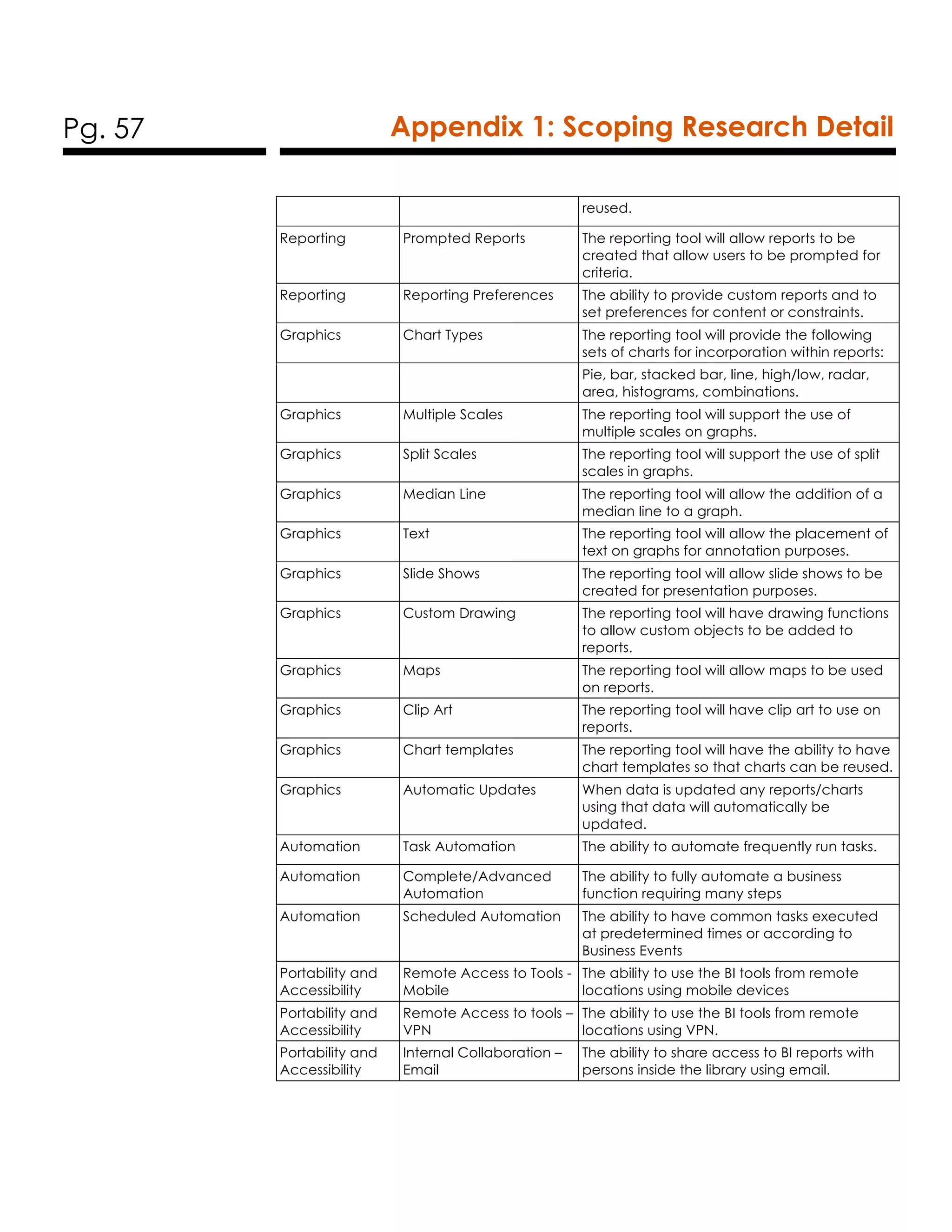
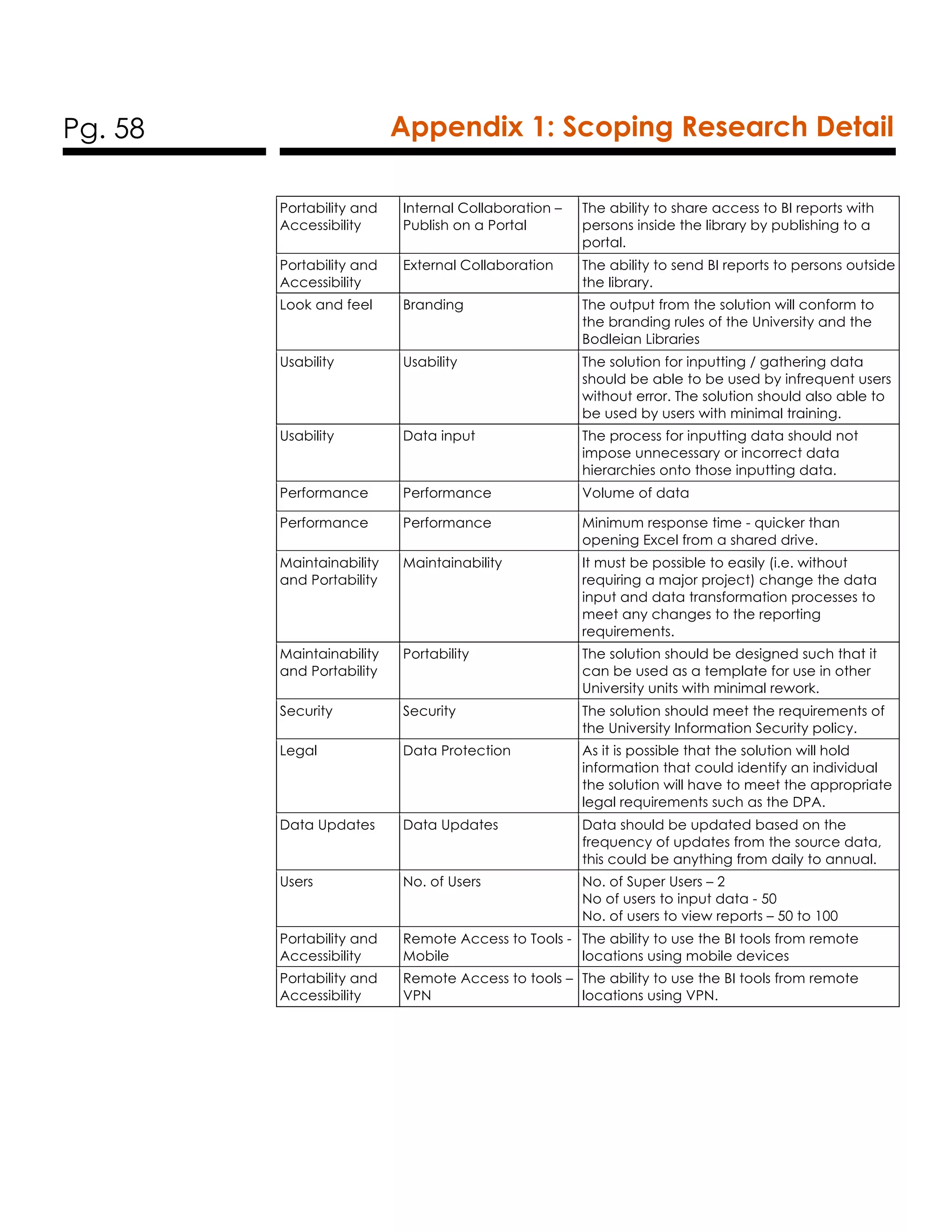
From January to June 2016, UC Davis and Athenaeum21, with collaborators at
Göttingen and the Bodleian, engaged in scoping research to determine the
nature and feasibility of a “library assessment dashboard toolkit.” The specific
purpose of the project was to scope the resources needed to design and build
the toolkit and dashboard. Outcomes of this scoping research included
• A draft framework for mapping relationships among data sources, metrics,
strategic and managerial questions, and service areas in libraries
(Appendix 1.1)
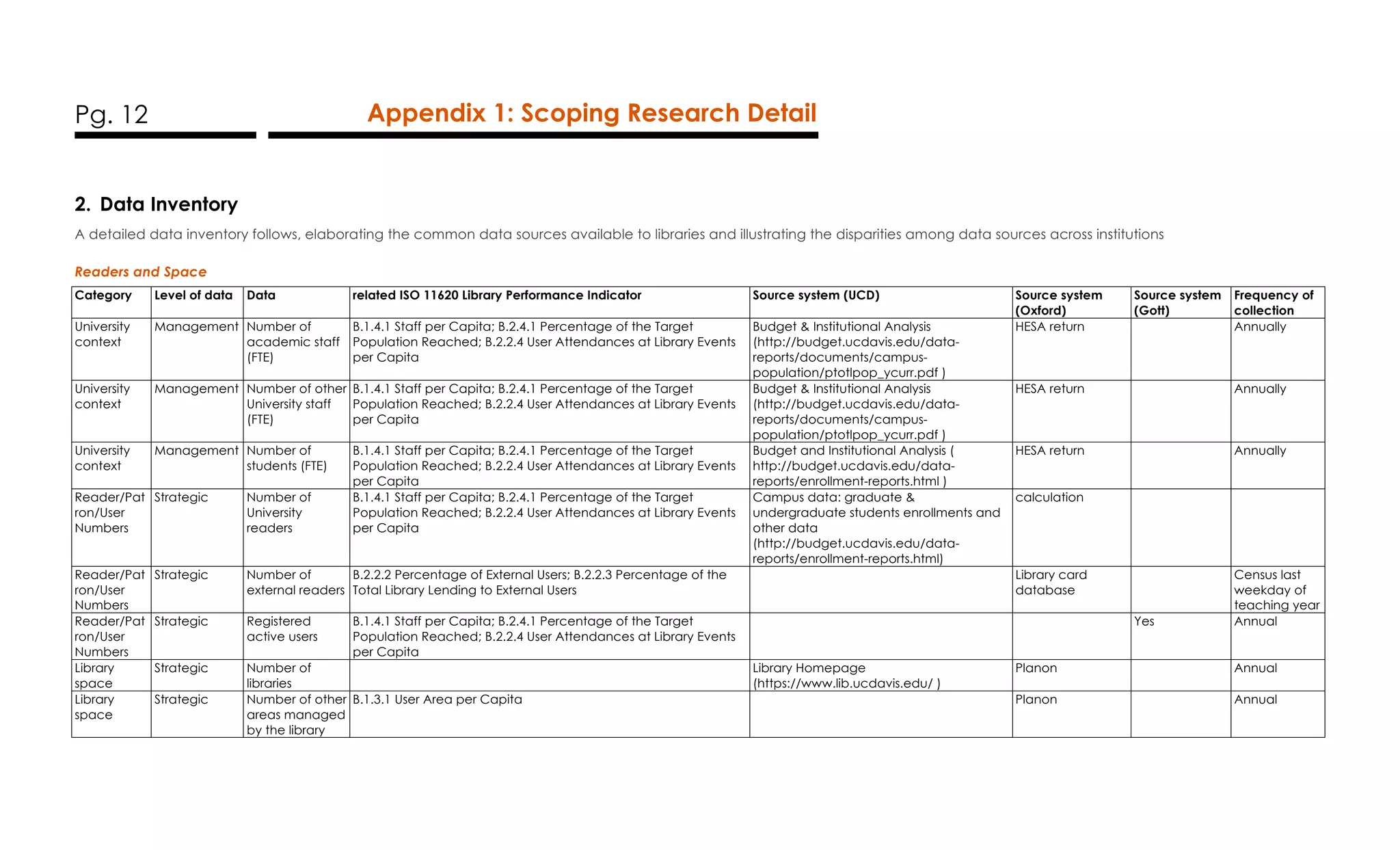
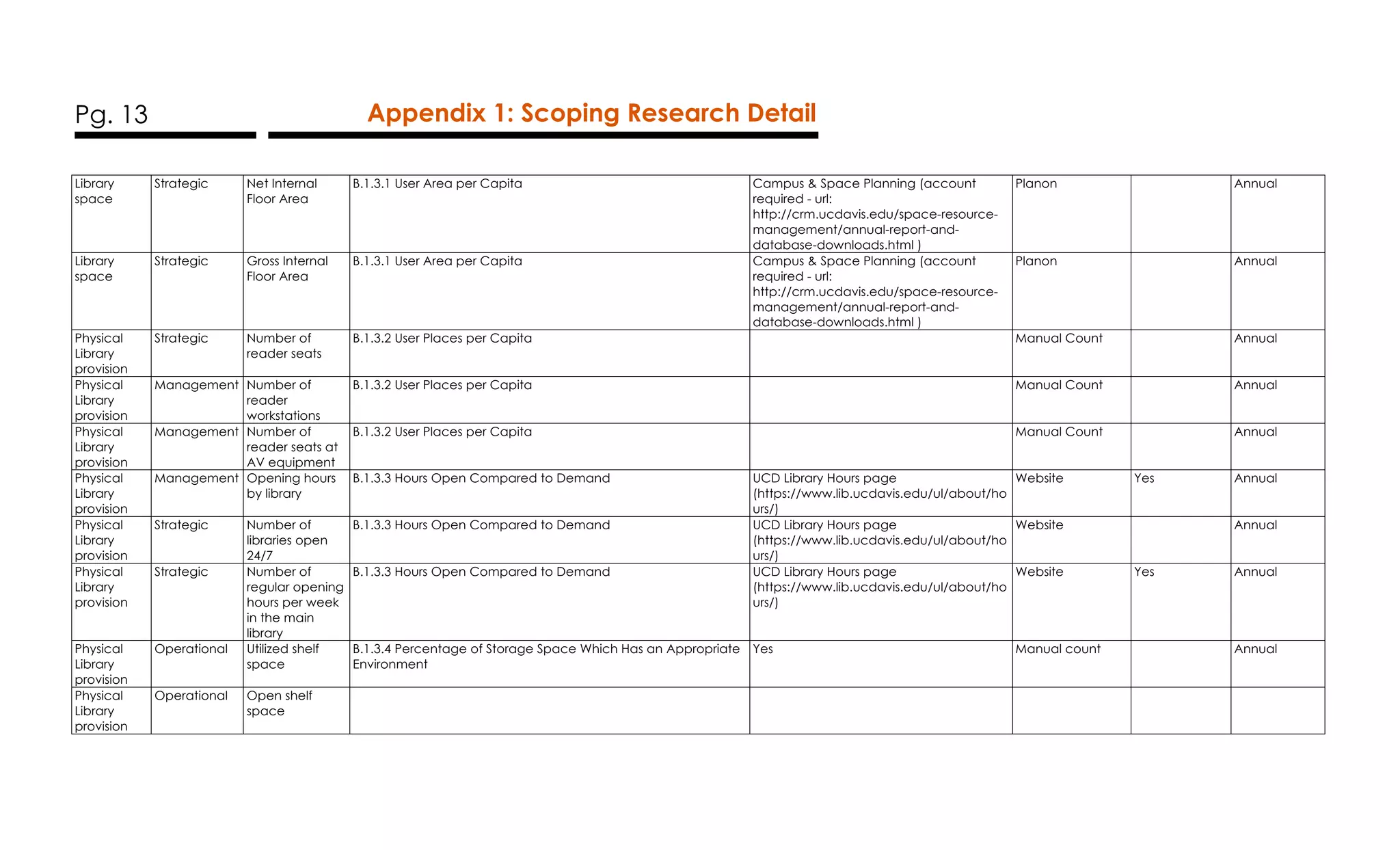
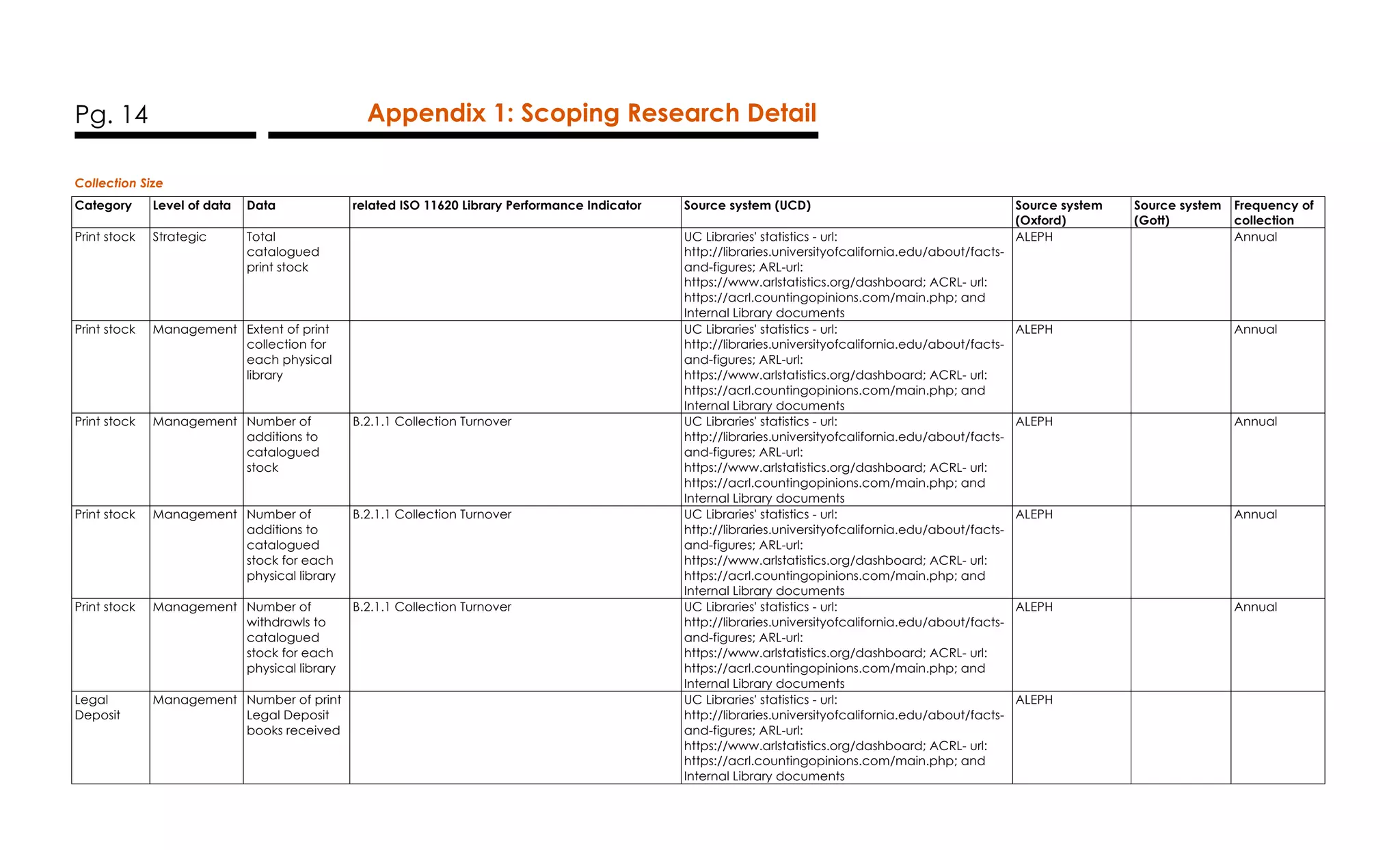
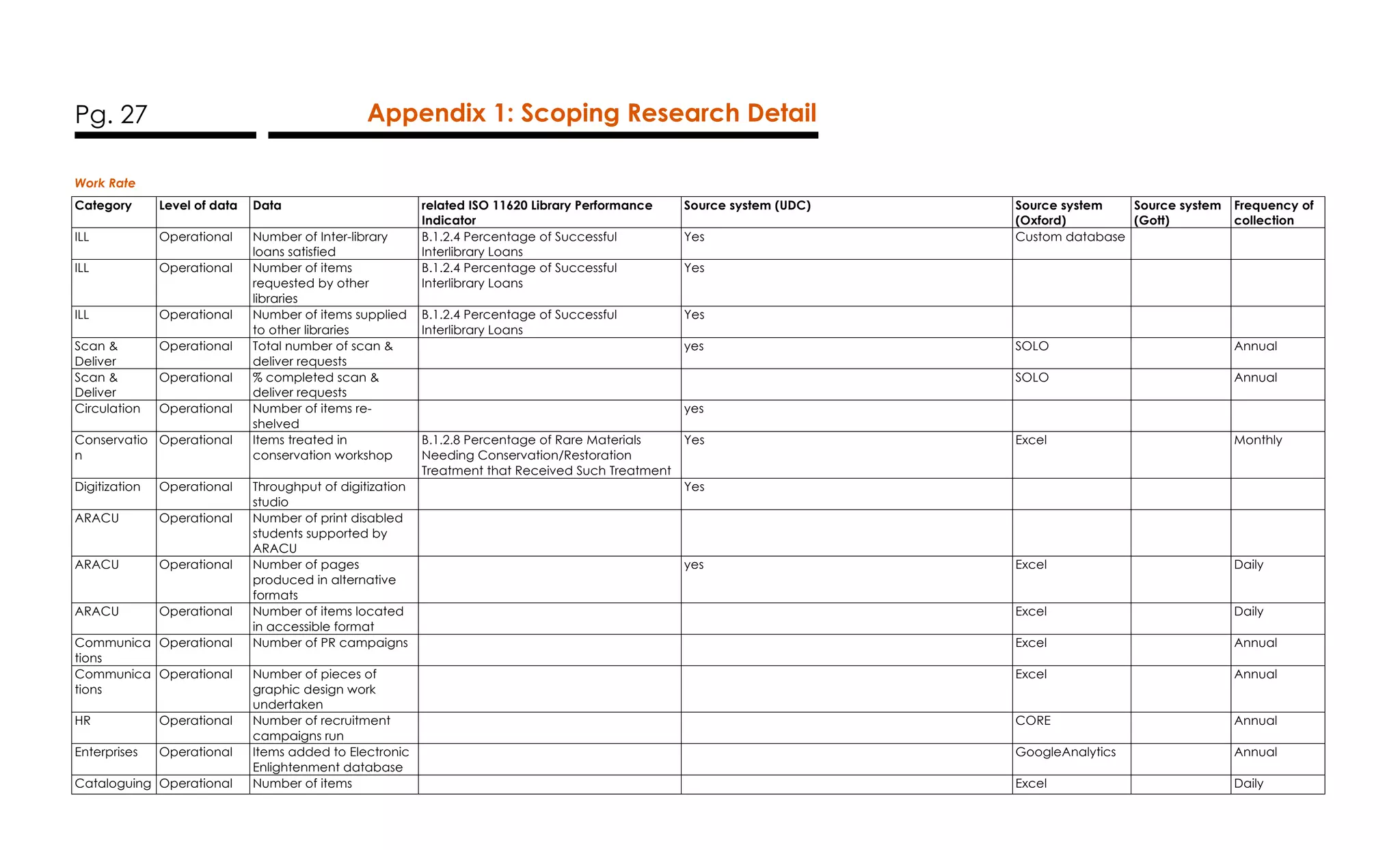
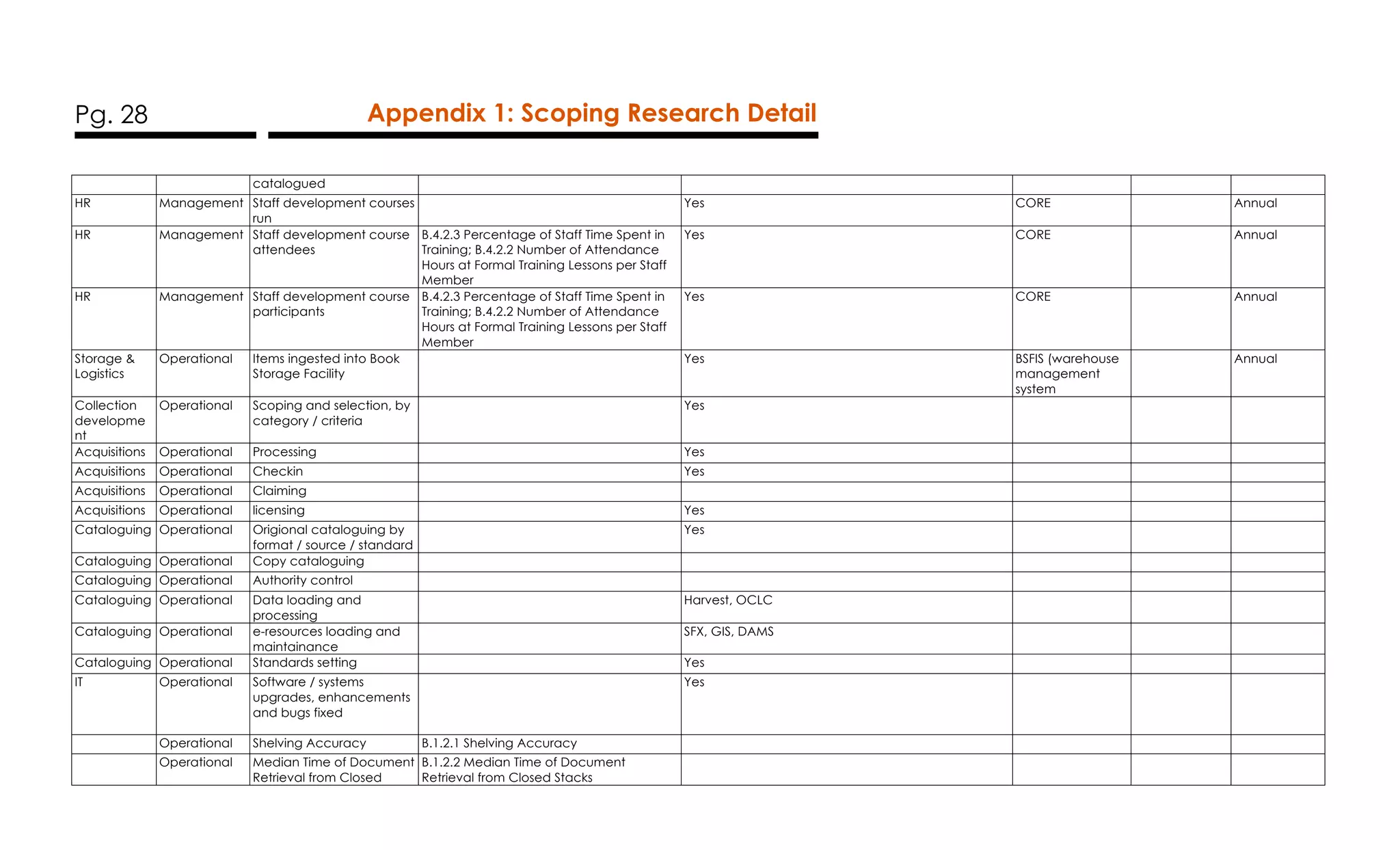
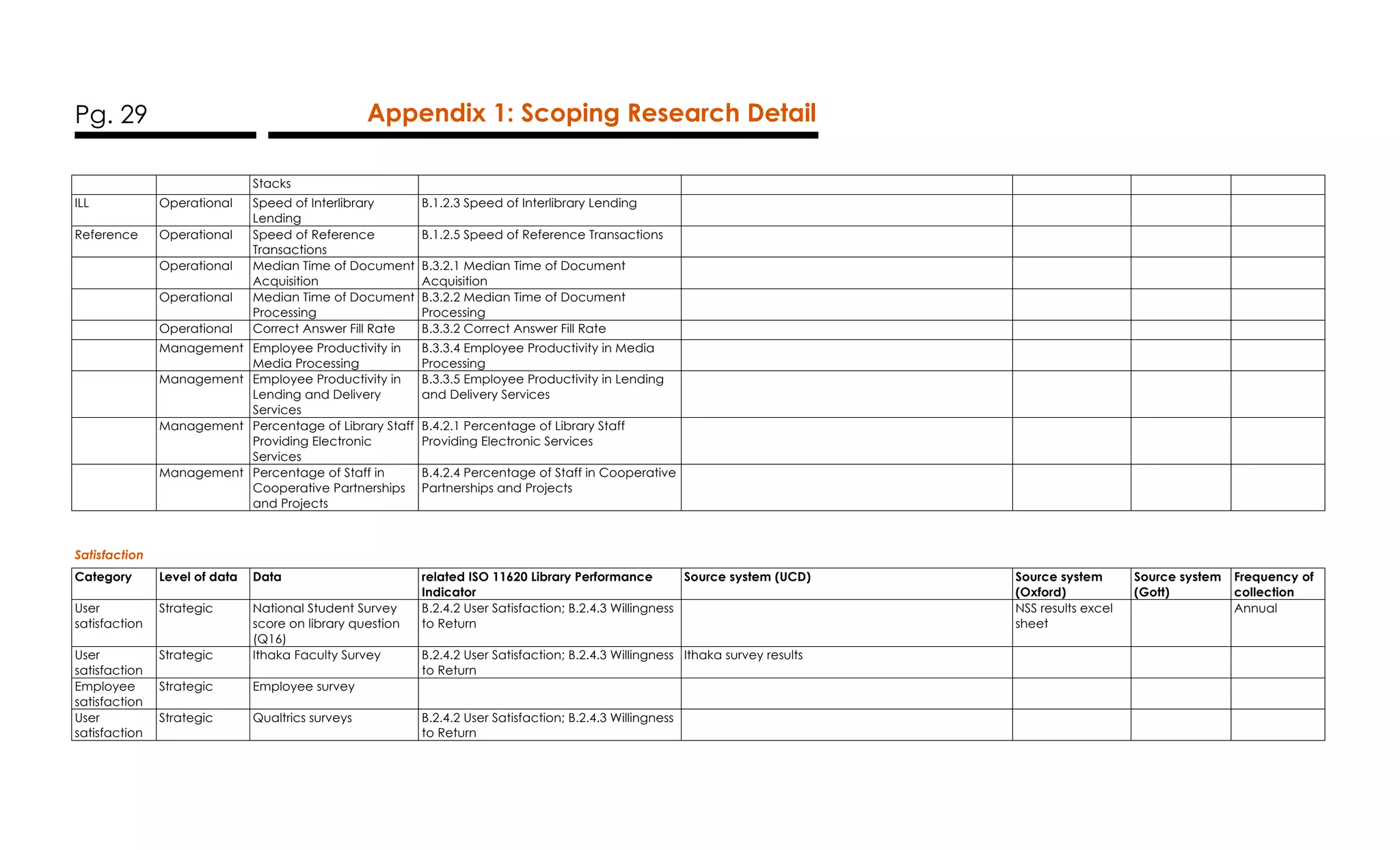
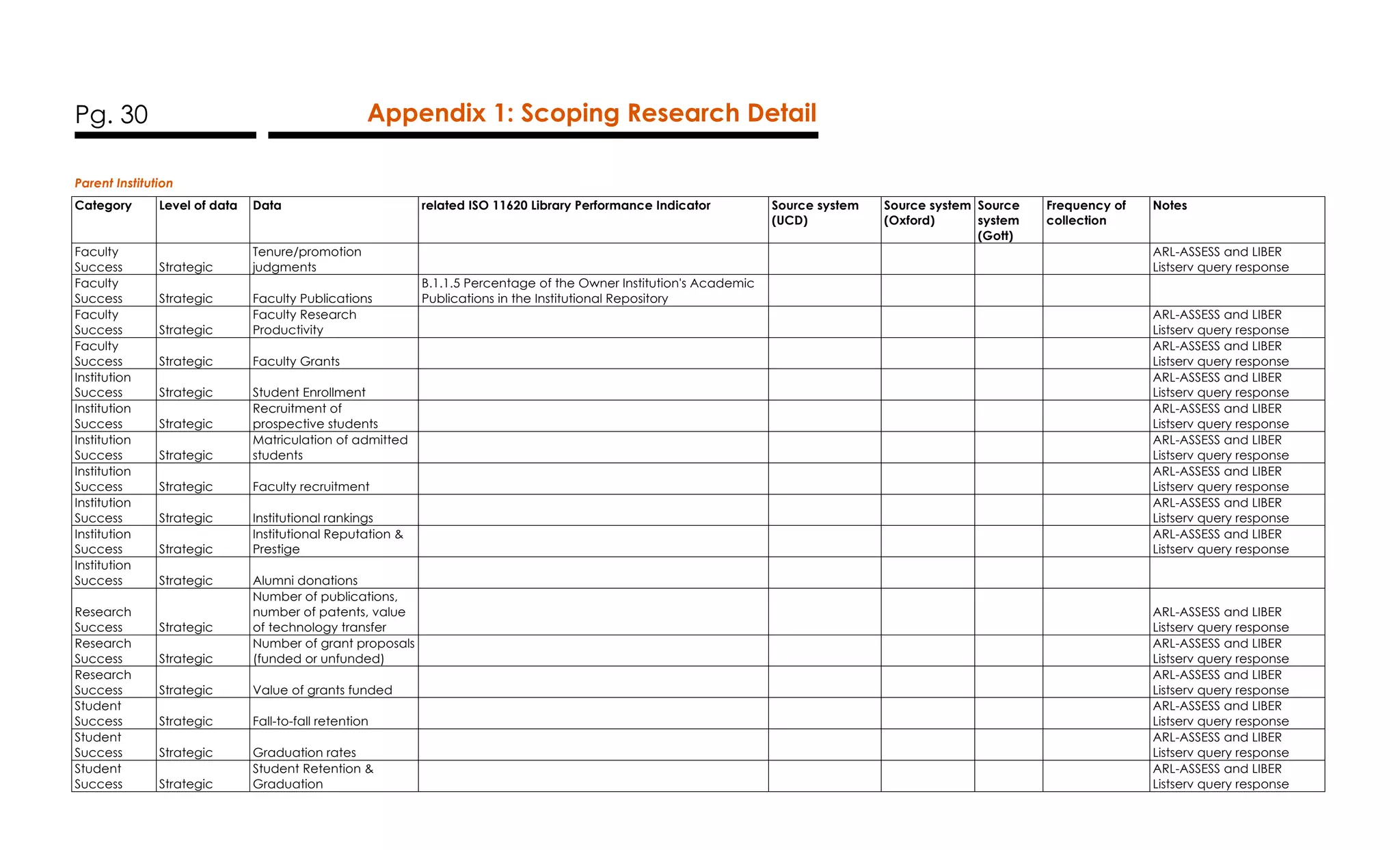
• A detailed data inventory elaborating the common data sources
available to libraries and the disparities among data sources across
institutions (Appendix 1.2)
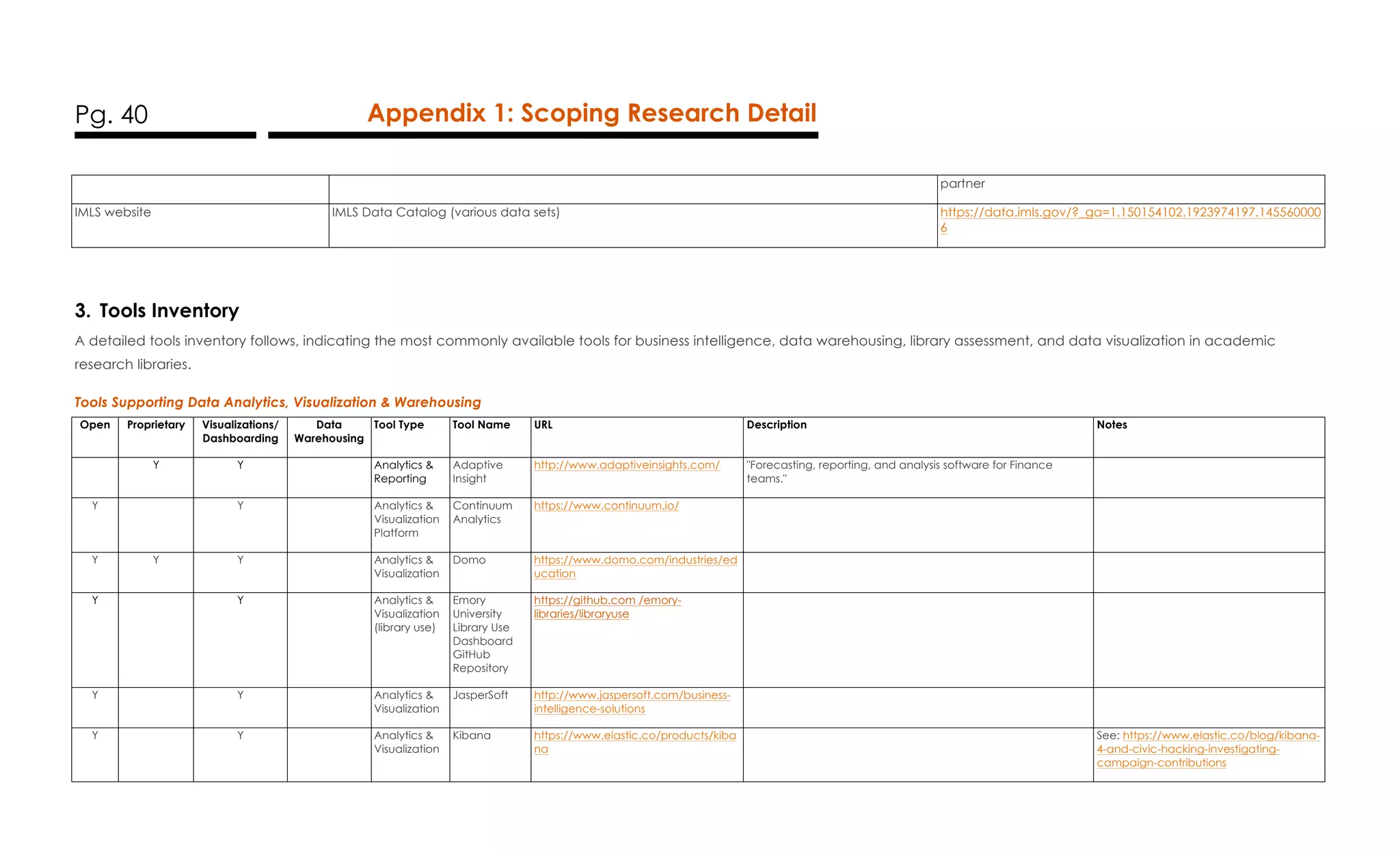
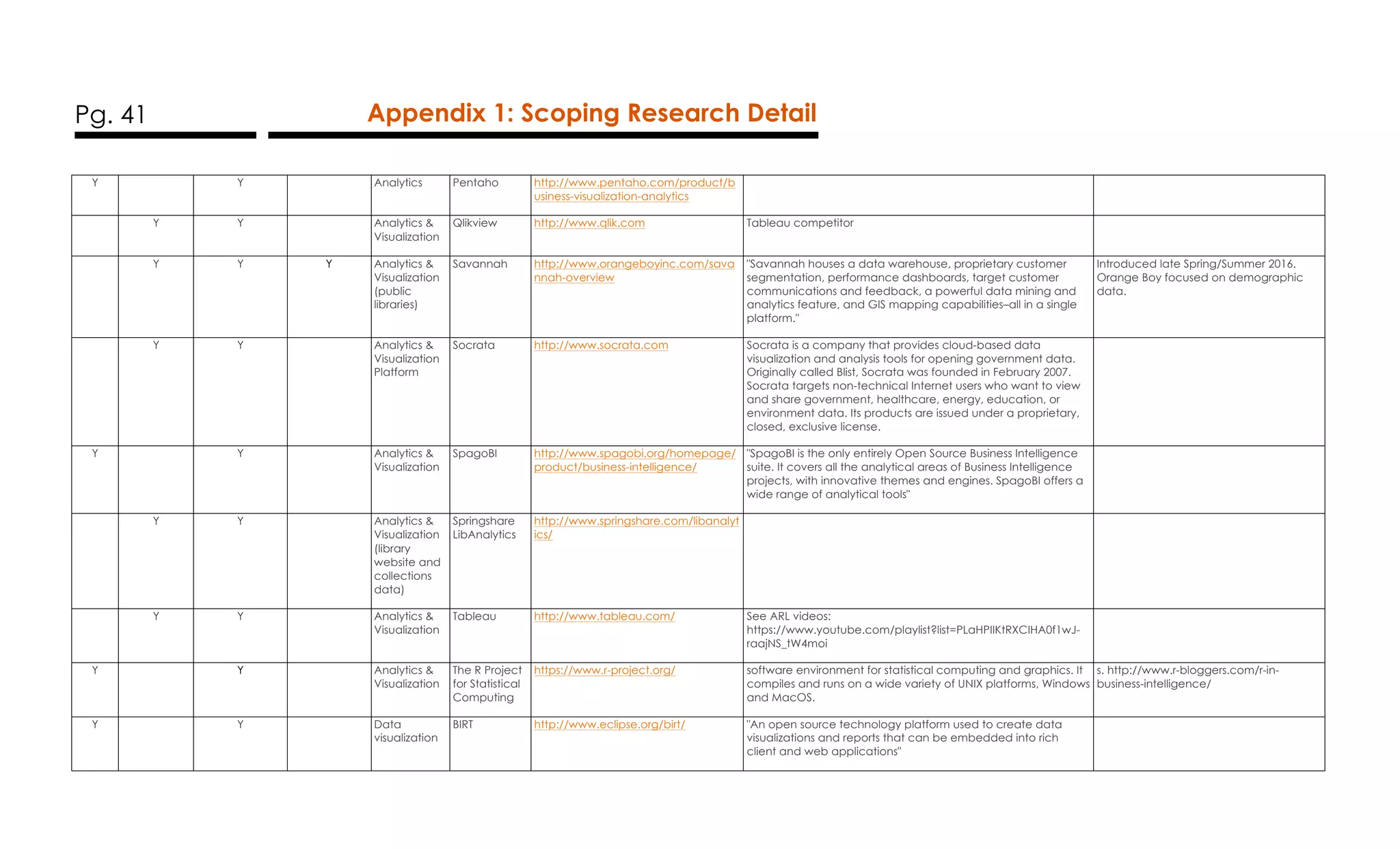
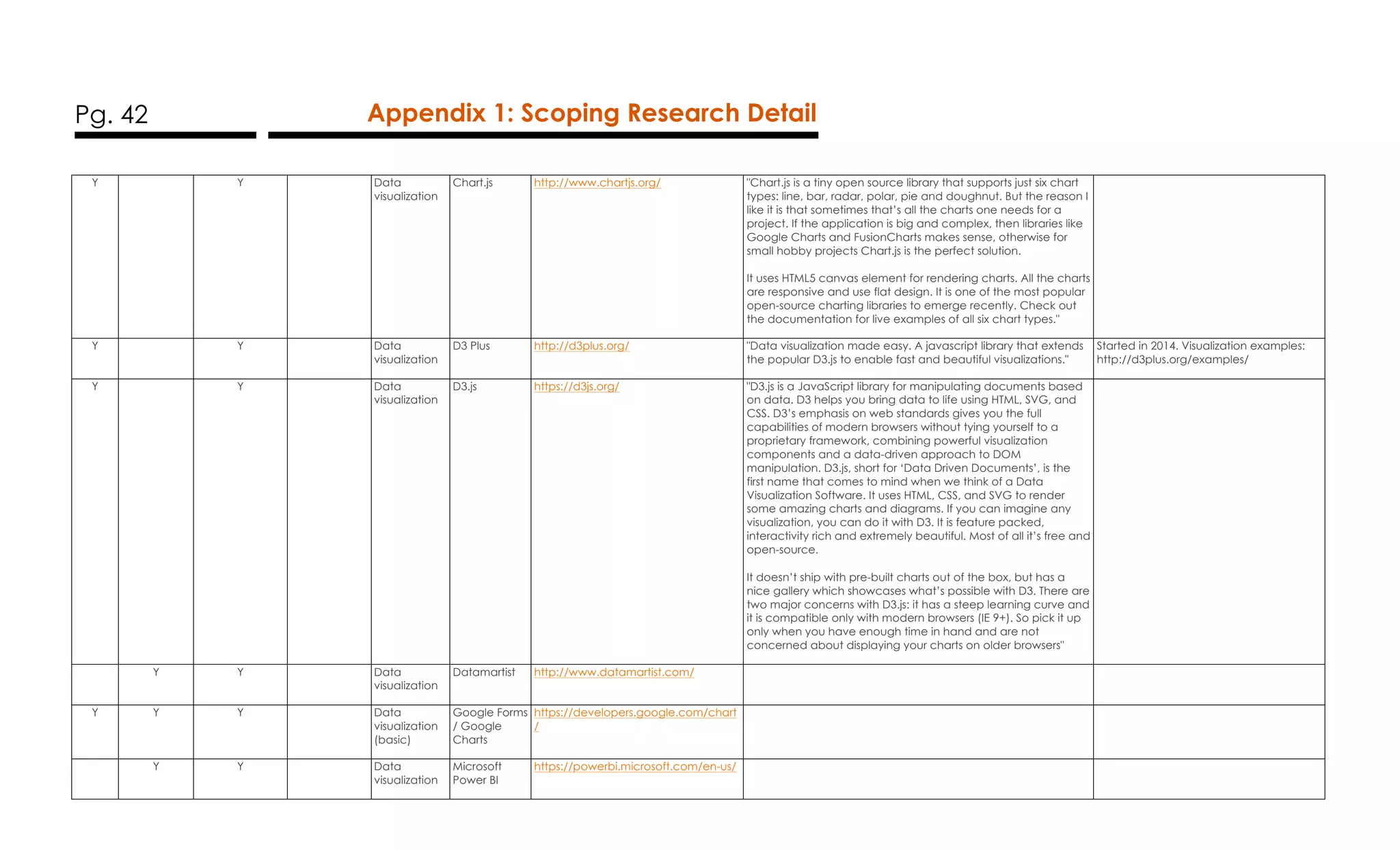
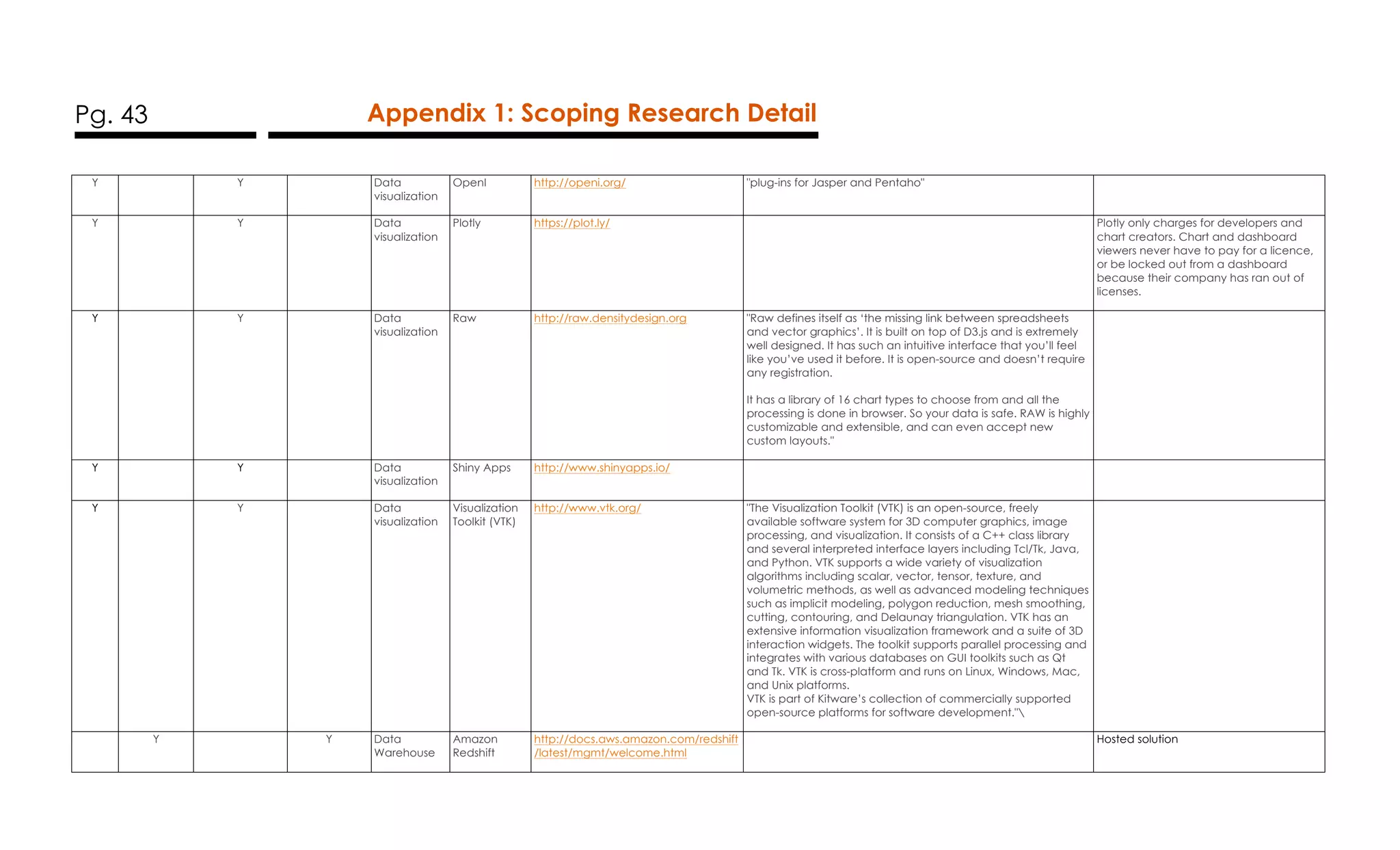
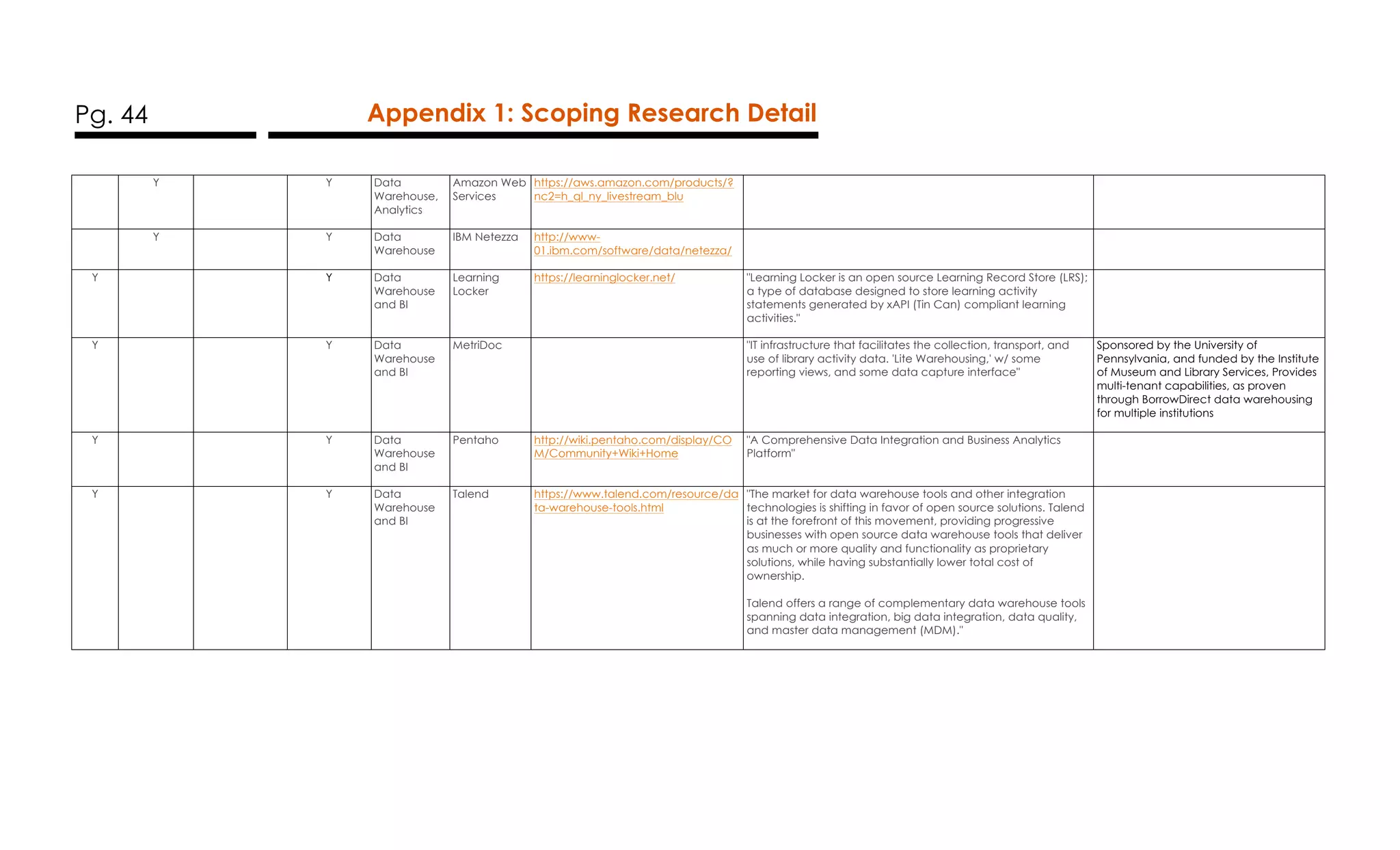
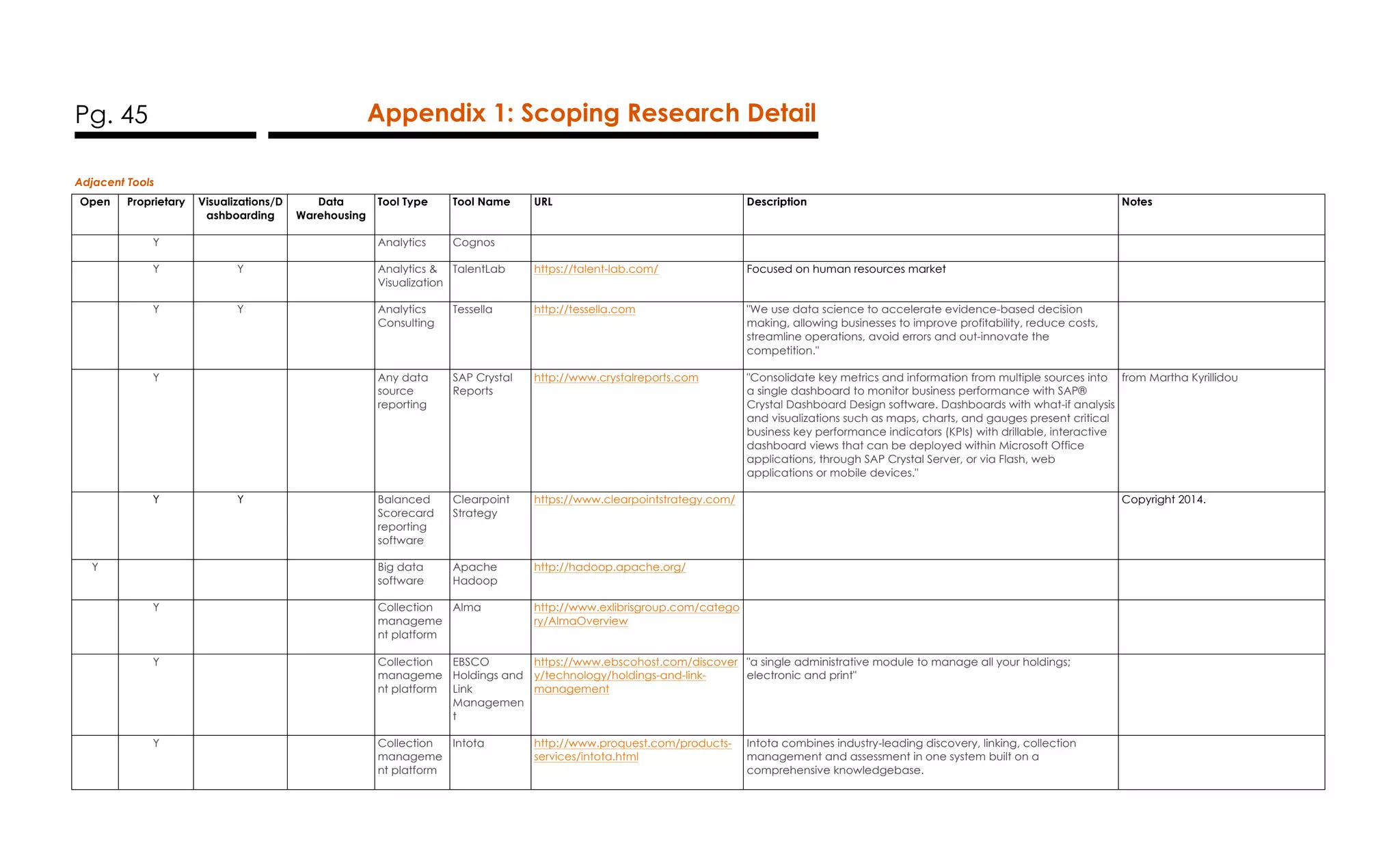
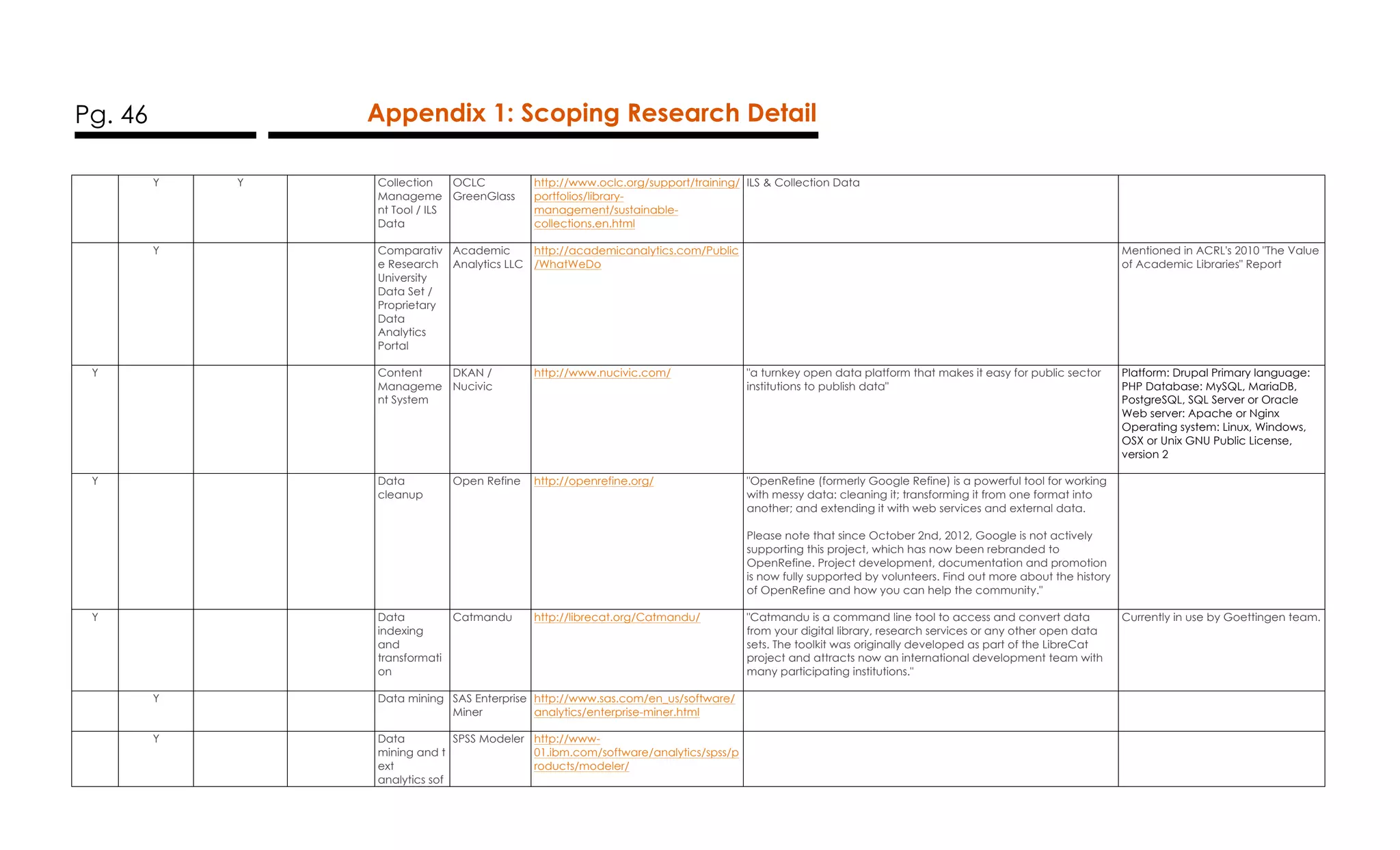
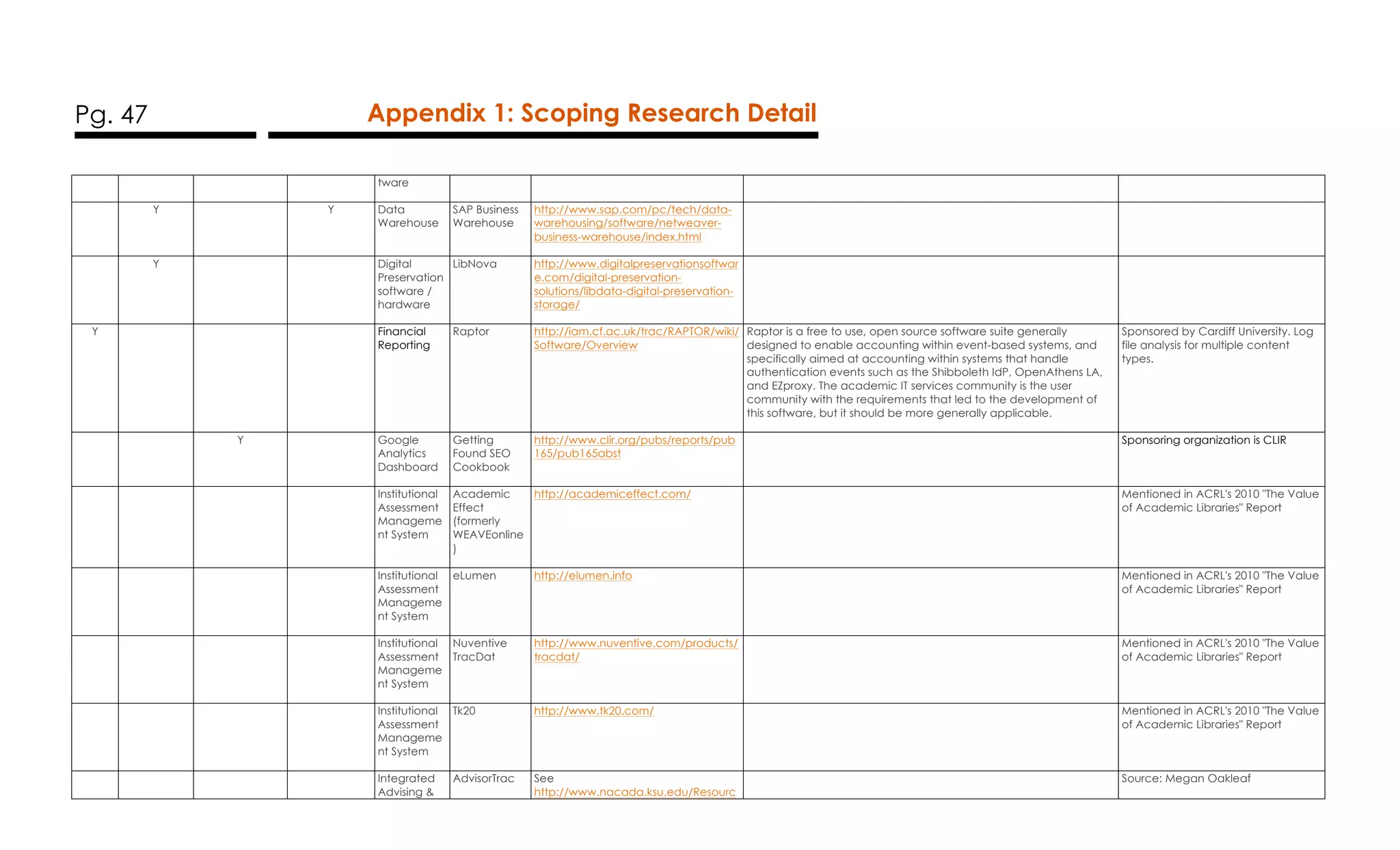
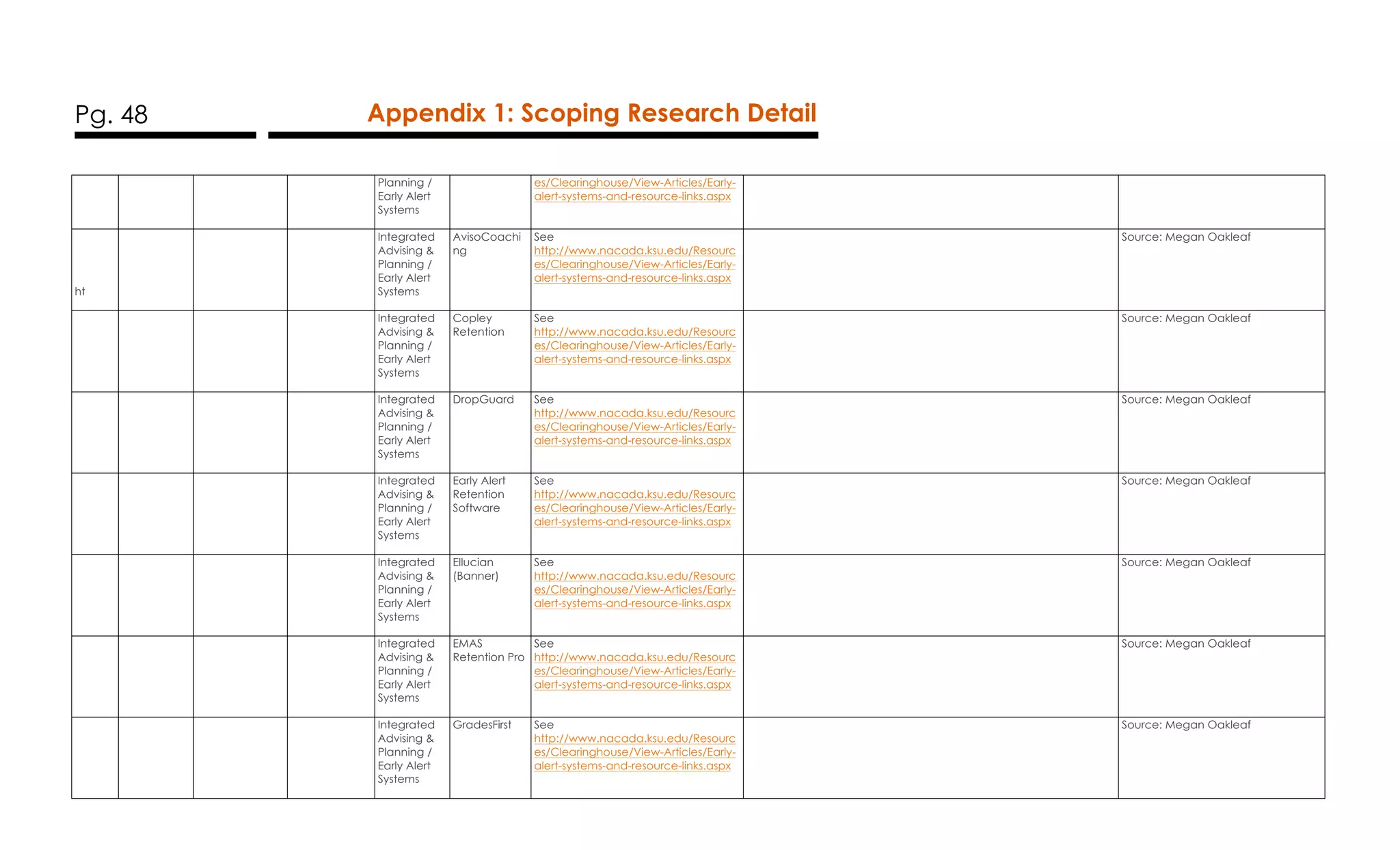
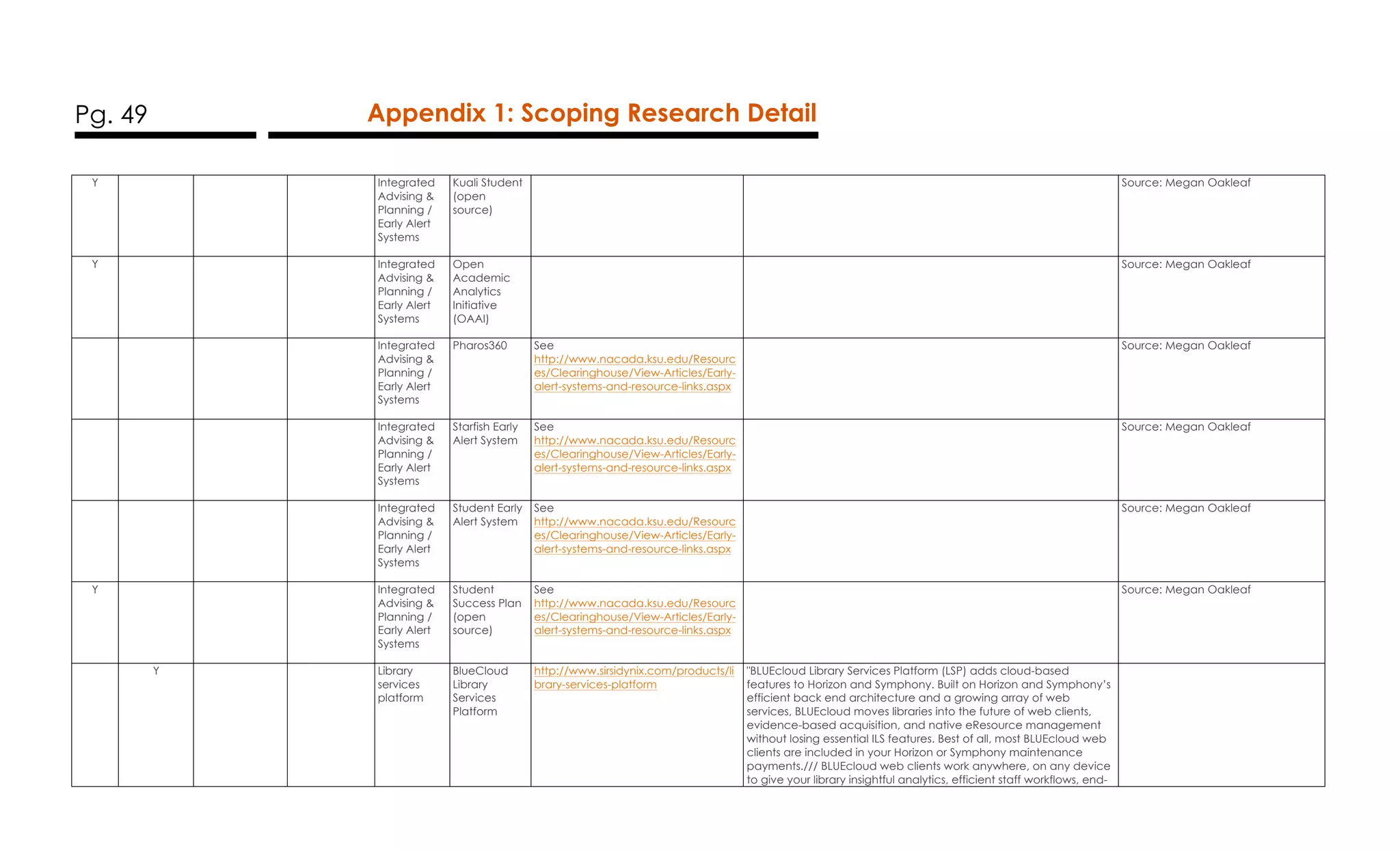
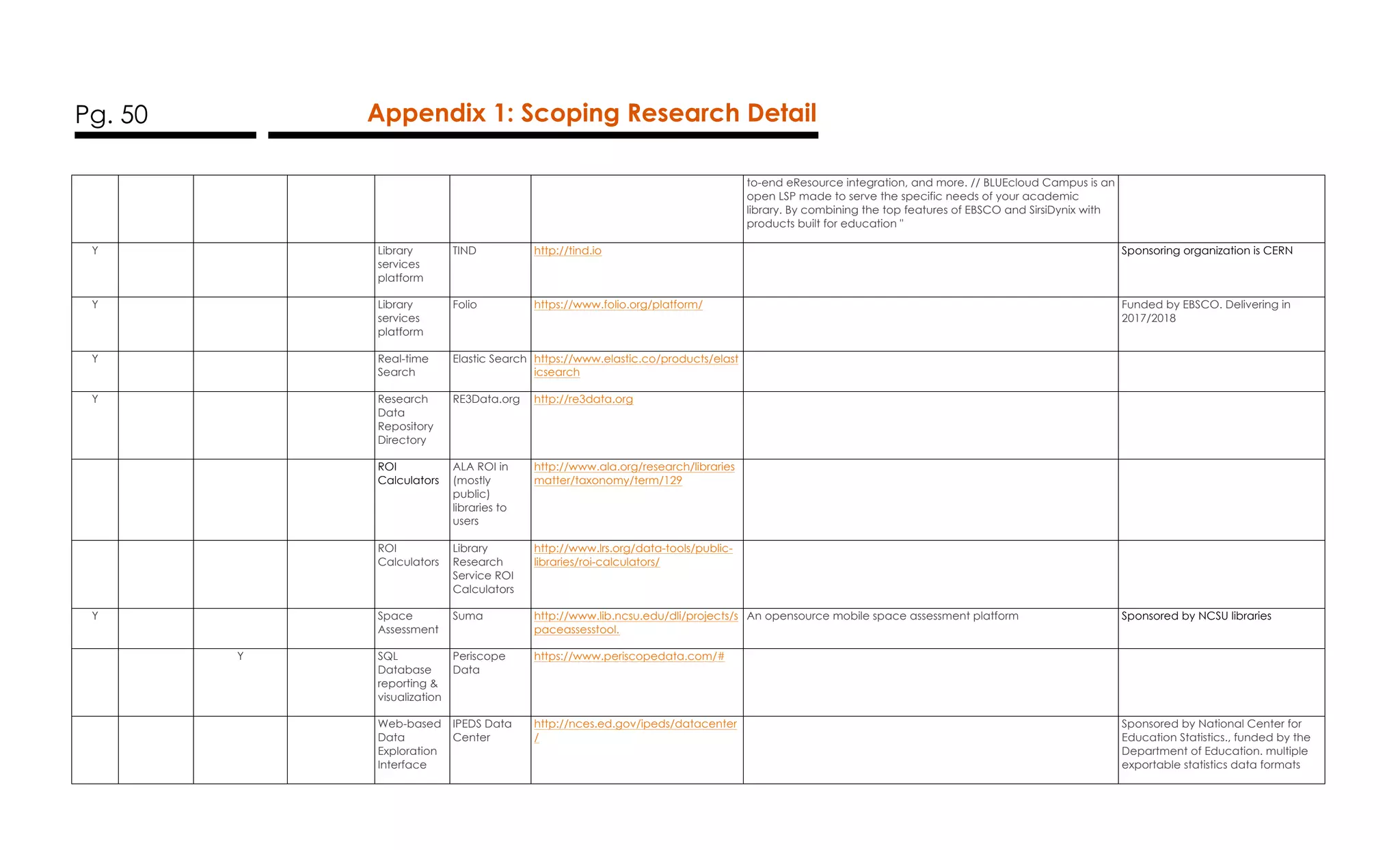
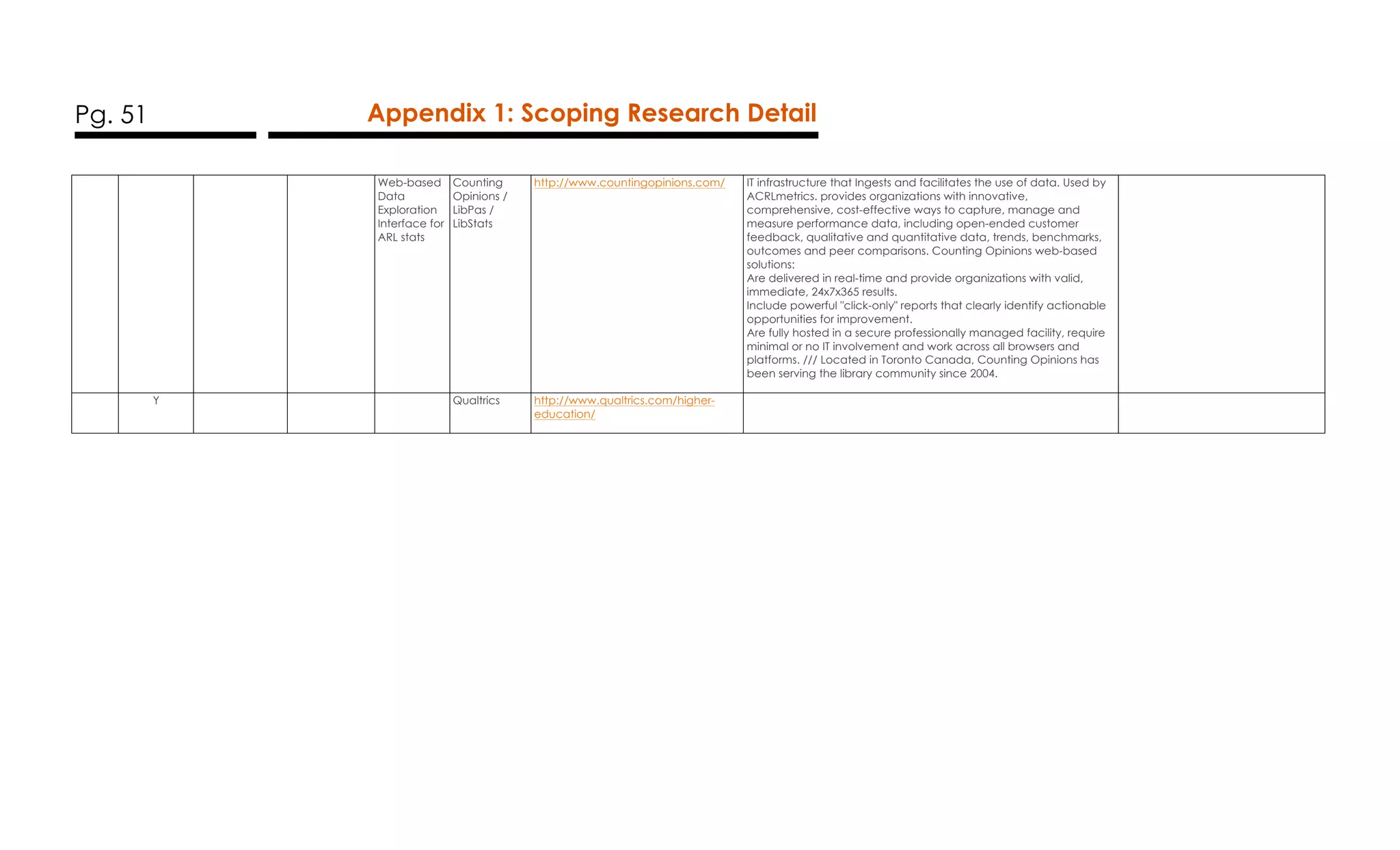
• A tools inventory summarizing the most commonly available tools for
business intelligence, data warehousing, library assessment, and data
visualization in academic research libraries (Appendix 1.3)
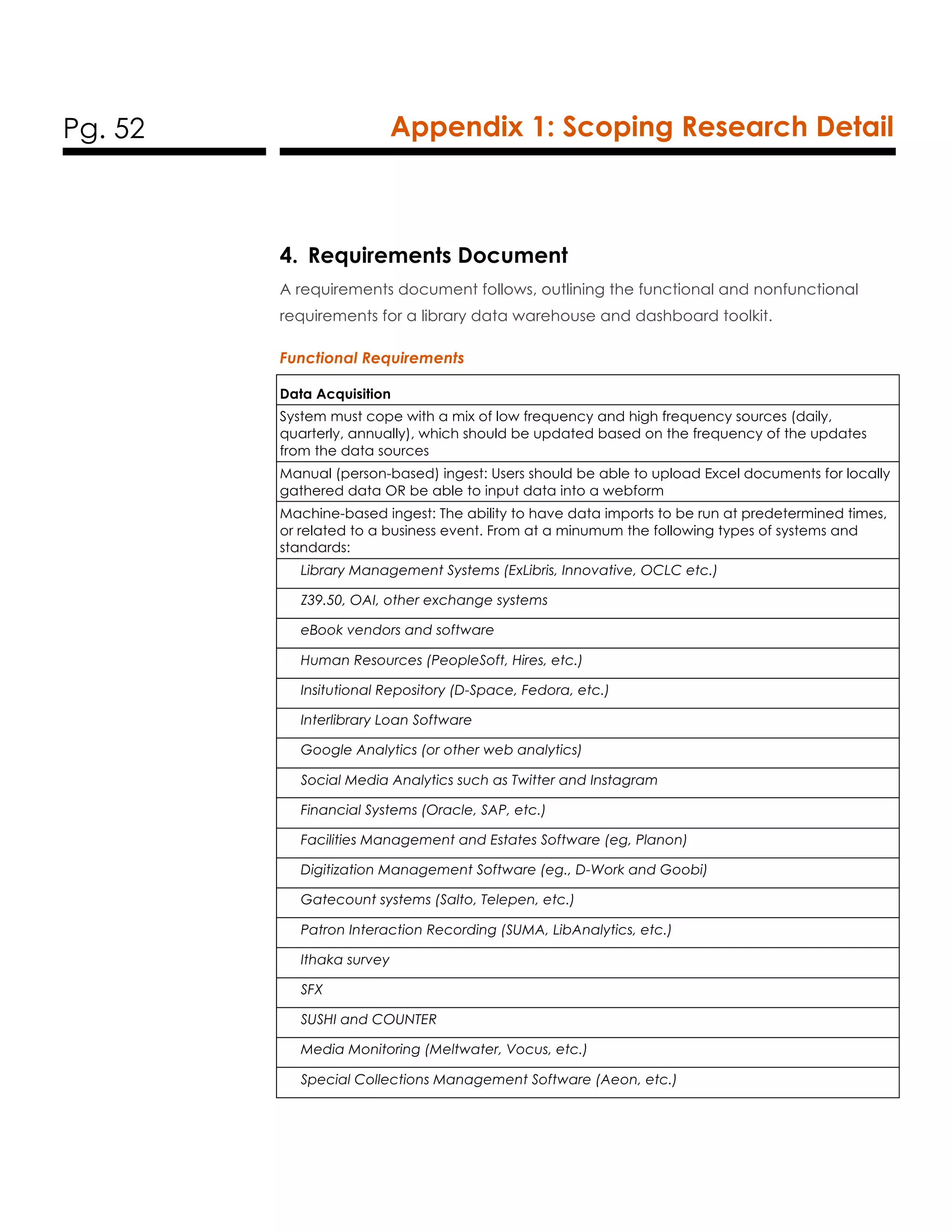
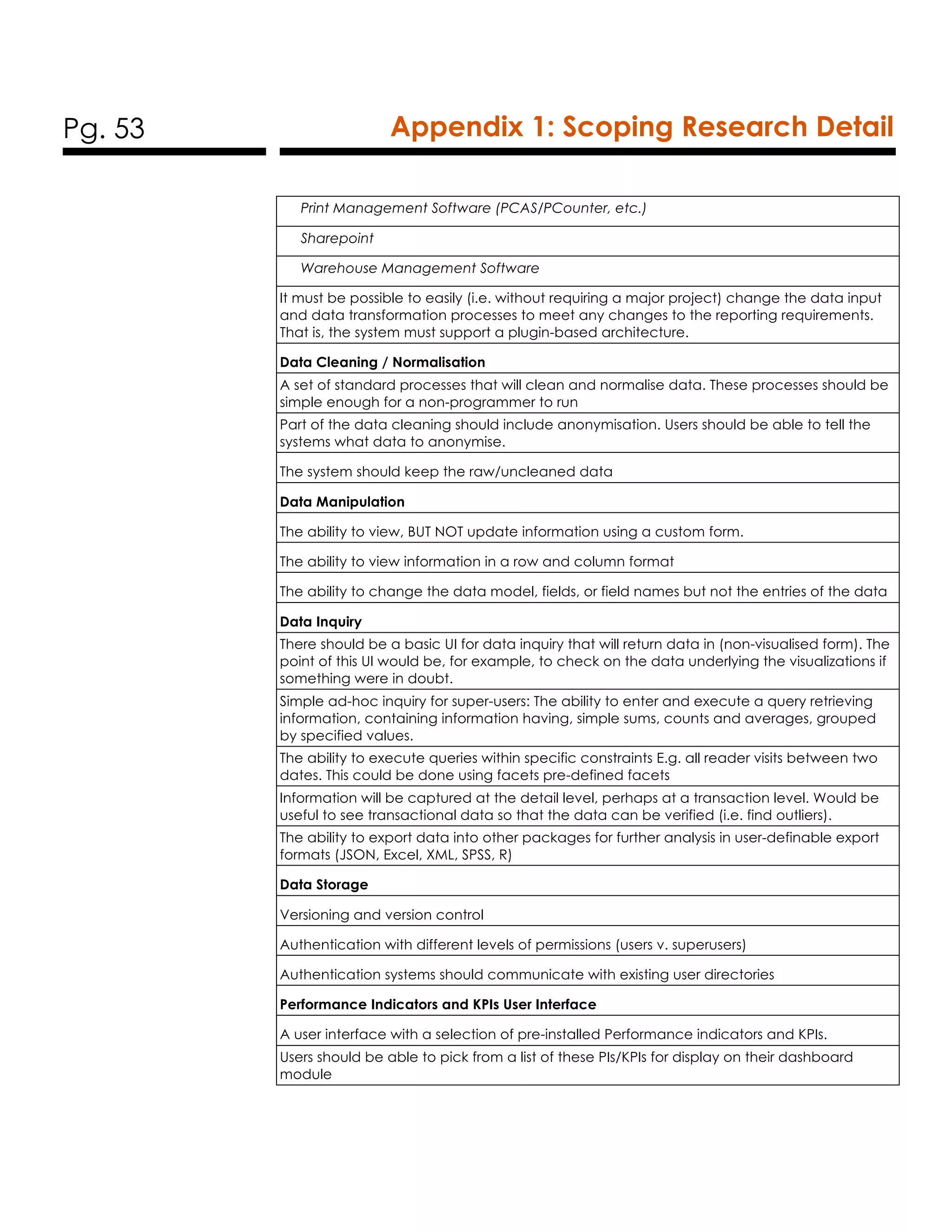
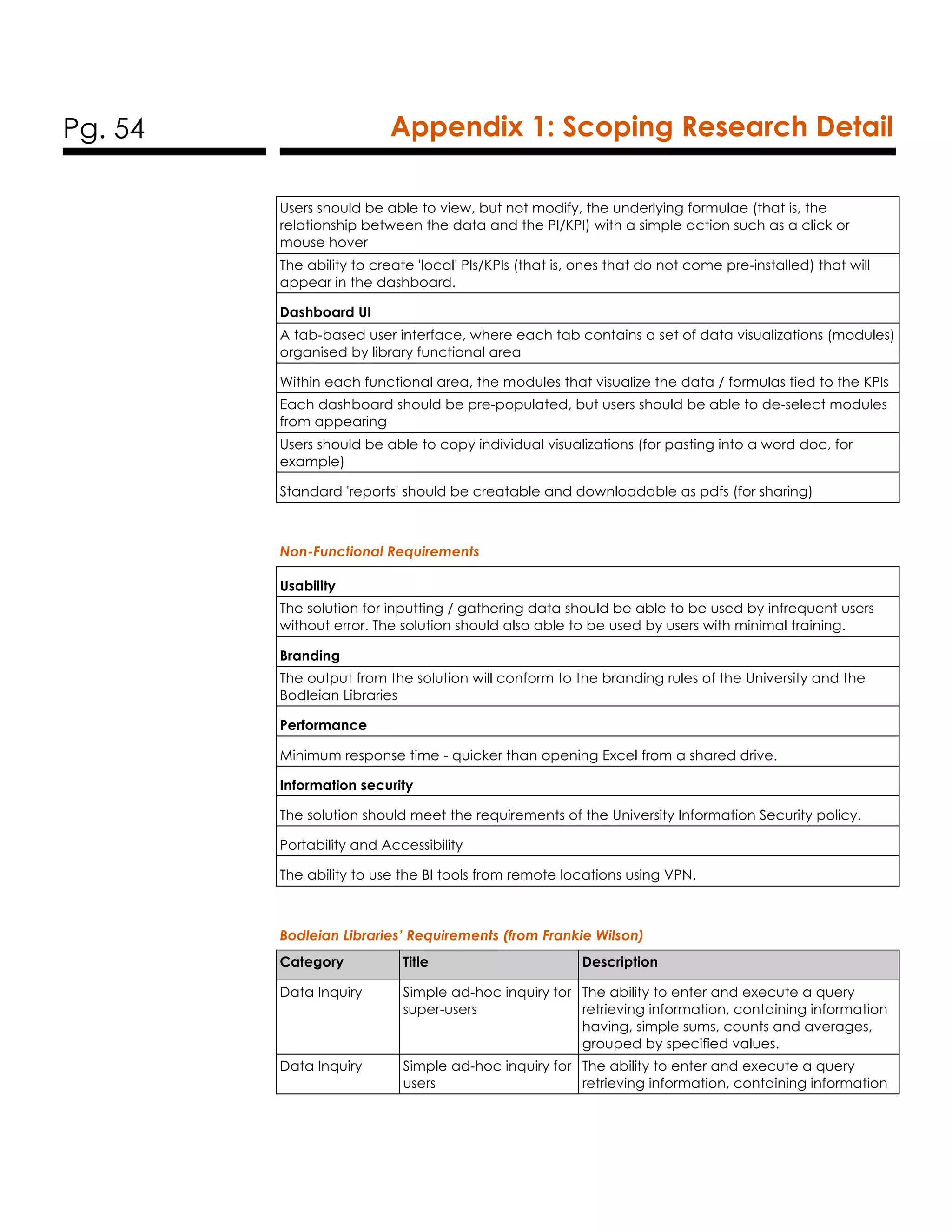
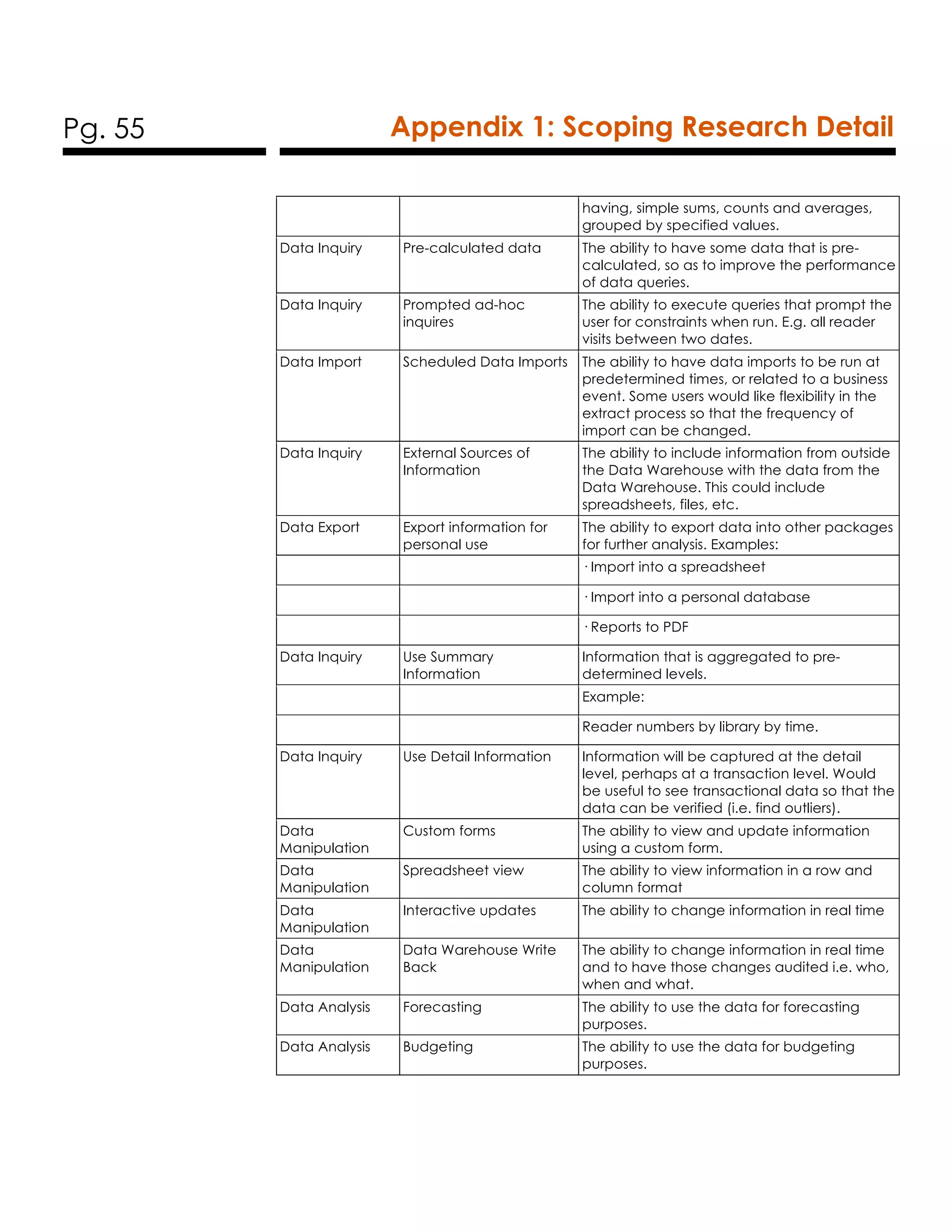
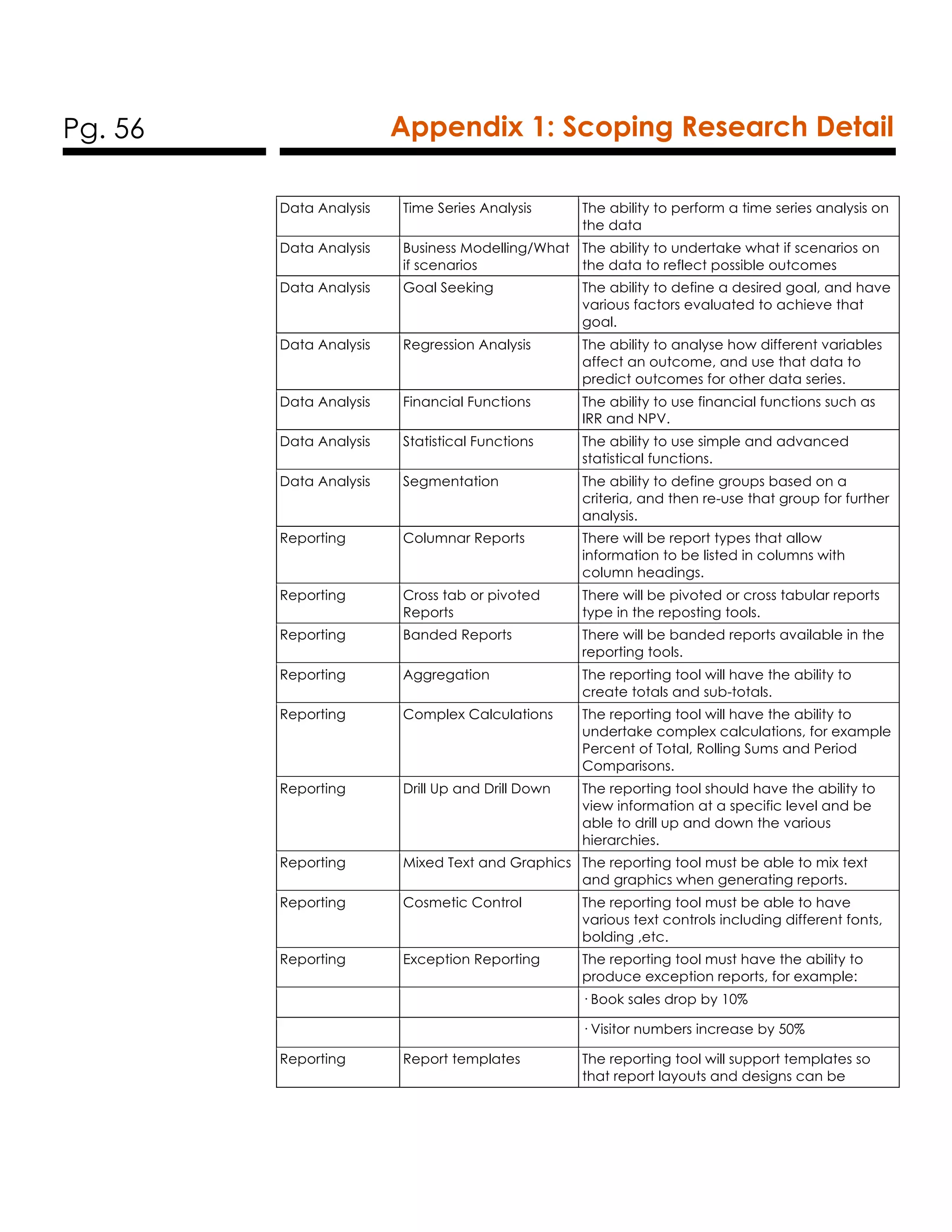
• A requirements document, outlining user needs for a library data
warehouse and dashboard toolkit (Appendix 1.4)
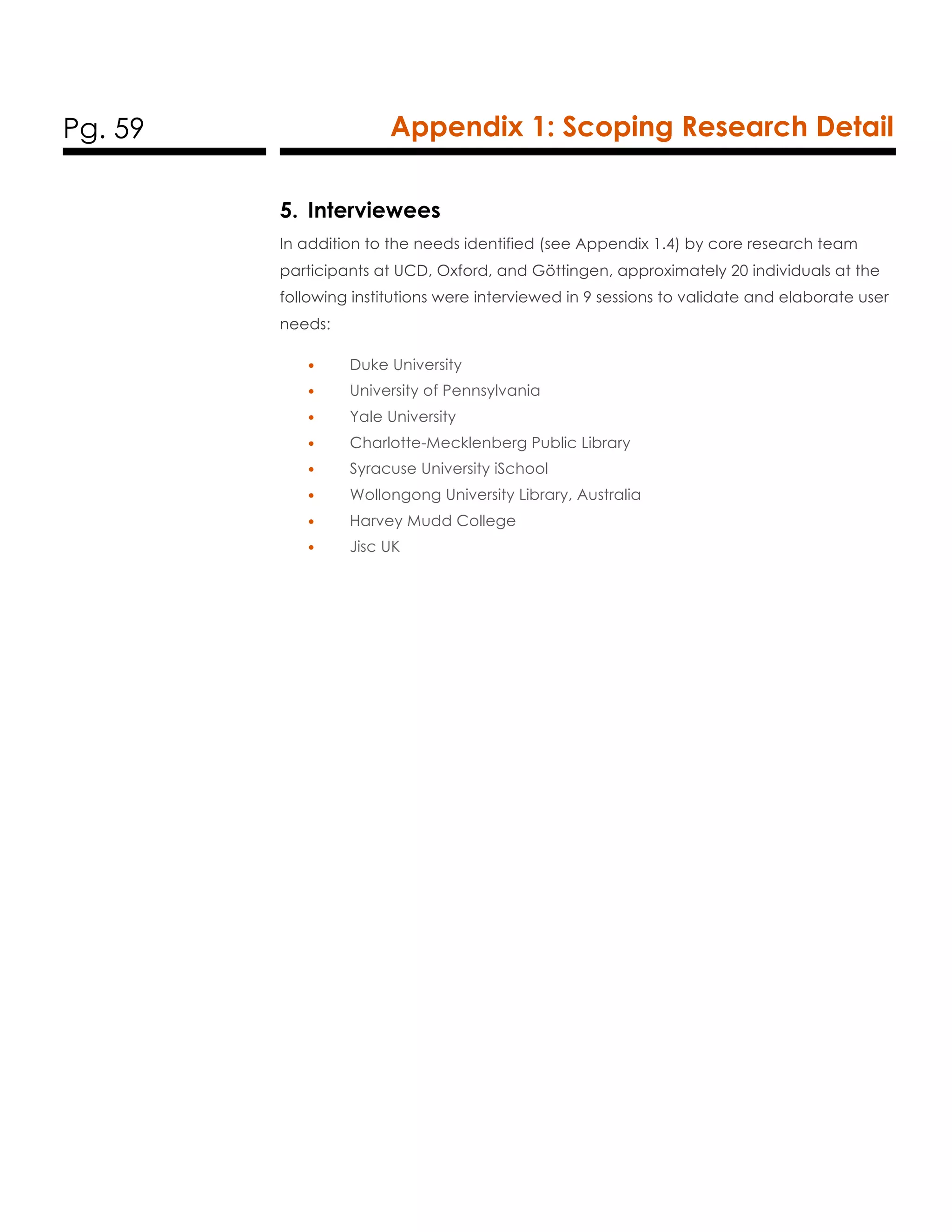
• User needs interviews, investigating potential typical users and their
immediate and future needs (Appendix 1.5).
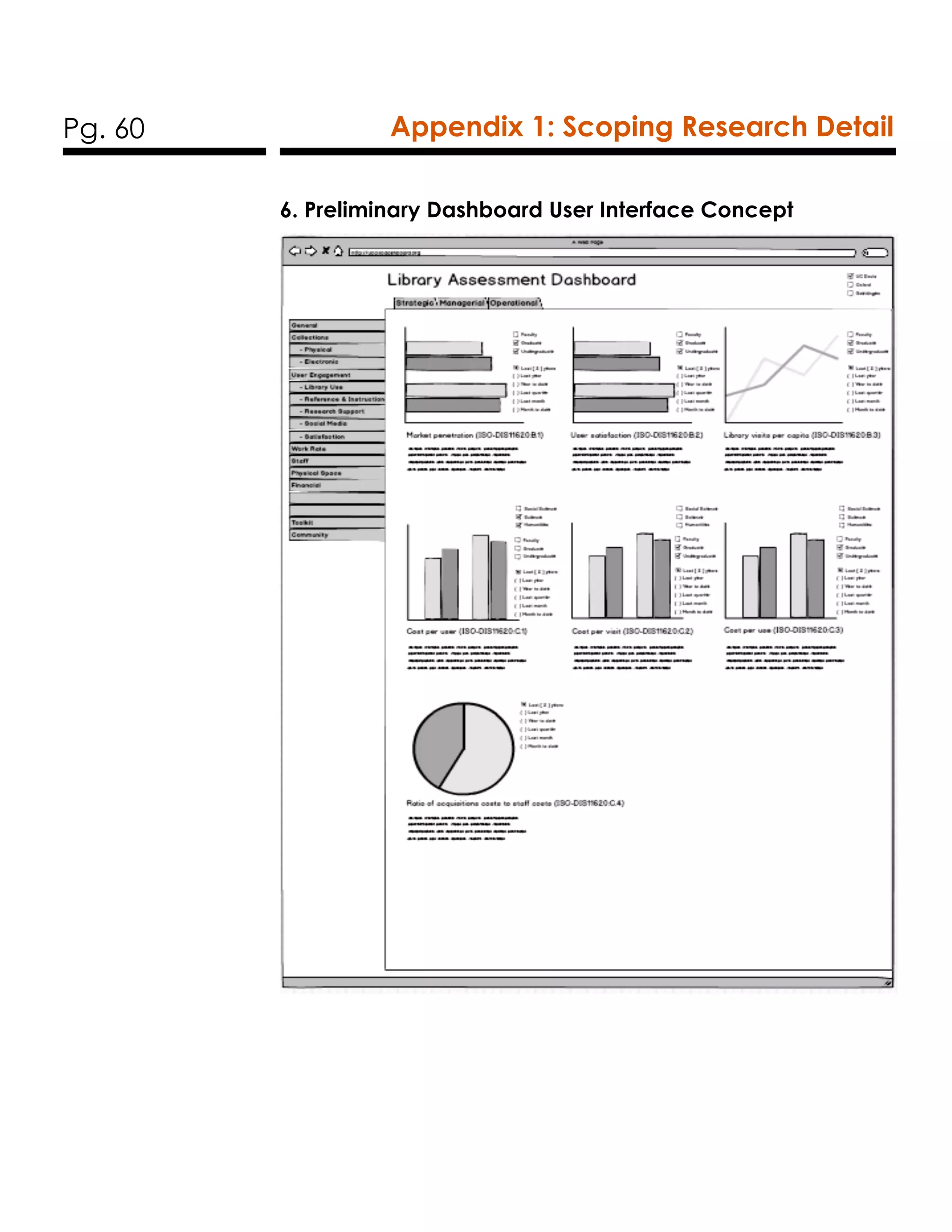
• A preliminary concept for the user interface of the dashboard based on
the draft framework (Appendix 1.6)
• A detailed project implementation plan including timeline, resource
estimates for implementation of a dashboard and toolkit (Appendix 2).
In addition to a review of current and recent projects and initiatives at research
libraries addressing the challenge of library assessment, the scoping team
conducted interviews with fourteen research library leaders and/or assessment
librarians at a number of pioneering institutions (including Yale, Duke, Penn,
Wollongong, Jisc) in order to assess
• Current status of or plans for assessment at their organization
• Key management and strategic questions that library managers and
executives want to be able to answer
The project team found that not only is there need for the development of a
toolkit and dashboard, the general approach represented by a toolkit and
the general
approach
represented by a
toolkit and
dashboard
resonated with the
community
Pg. 04 Review of Work Completed
dashboard resonated with the community. Notably, it was clear from both the
interviews and queries to relevant listservs that
• Library managers and leaders agree on the need for a set of assessment
tools and standards, ideally including capability to share and compare
data across institutions
• In some cases, current needs are partially met by ad hoc sets of existing
tools, sometimes via the library itself and at other times via access to
institution-wide business intelligence (BI) tools
• Access to tools and standards is inconsistent among libraries, with a
number of libraries having access to Tableau for visualizing data, but few
having access to a data warehousing solution and even fewer having the
resources to assemble the necessary components that would allow them
to make use of their data effectively and consistently
• Even in cases where libraries have access to institution-wide BI solutions,
these solutions may not be apt for their specific needs and often need to
be customized
• The majority of assessment librarians’ time is currently spent reacting to ad
hoc, unanticipated requests, and manually normalizing and transforming
the needed data. It was apparent from the interviews that libraries are
striving for a systematic and regular approach to assessment data, but
such an approach is not on the immediate horizon. As one interviewee
said, “The holy grail for me is: 1) Present plan, 2) report on cost, 3) identify
outcomes.” The reality, however, is that most assessment activities are
reactive: “Everything we’re doing now is done on a question/answer
basis”
• Many groups (such as LAMP in the UK, ISO standards for Library
Performance Indicators, the University of Pennsylvania's MetriDoc data
warehousing solution) have made significant efforts addressing aspects of
end-to-end library assessment solutions or frameworks, but these solutions
have not seen widespread adoption within the library community, and
each solution offers just one facet of what could be a comprehensive,
systematic solution for libraries
• The most sophisticated efforts that we encountered in the domain of
aggregating and presenting data to assess library performance (namely,
the Charlotte-Mecklenberg Public Library in North Carolina and the
Jisc/HESA HEIDI Plus project in the UK) emerged out of library response to
funding and budget cuts, or from reporting mandates tied to government
legislation
…most assessment
activities are
reactive: “Everything
we’re doing now is
done on a question/
answer basis”
Pg. 05 Review of Work Completed
The current state of the use of assessment tools at research libraries around the
world is inconsistent; our findings indicated that the need and desire for a
standard toolkit is both common and urgent. As one interviewee said, “I think we
will always have more complex, deep questions than a dashboard like this
would answer, but having the dashboard would enable us to spend less time on
getting answers to basic questions, and spend more time on the complex, deep
questions.”
Our research and interviews also suggested that library leaders are looking for
answers to many of the same questions. The most common questions were the
following (in the words of the interview respondents):
• Usage/Impact
• Who is not using the Library – is there a pattern in time or across
demographics?
• Conversely, who is using the library, and what are the usage patterns?
• How effective are our promotional activities?
• Are the right demographic groups using the right resources?
• How does Library usage benefit clients?
• Collections
• Are we buying the right resources?
• Are the resources we are buying being used?
• What is the overall cost per use of digital versus print materials?
• How many reproduction requests are we getting?
• Are we getting ILL requests for items we already own? Is it because items
are not being found via our systems, or because they are not available? If
they are not available, are there ways we can make items more quickly
available?
• When does it make sense to lease or borrow, versus purchase?
• How does time-sensitivity of fulfillment of requested item factor into the
equation?
• Work Rate and Project Management
• How quickly is our backlog growing?
• How long did a specific project take and what was the breakdown of
resources (costs for hardware, software, staff resources)?
• What is work volume by time of day, day of the week, and time during
academic term across multiple work areas/functions (e.g., circulation,
technical services, reference desk, research consultations, and
instructional sessions)
“…having the
dashboard would
enable us to spend
less time on getting
answers to basic
questions, and spend
more time on the
complex, deep
questions.”
Pg. 06 Review of Work Completed
• Staff time and cost per project
• Physical Space
• How is our physical space being used, by whom and when?
• How many people are in our reading room(s) on average?
• How frequently are our on-site print collections being used?
• Does frequency of use justify in-library location, or should certain print
items be stored off-site?
• Financial
• How are we spending our budget? What is the allocation, for example,
between application developers and purchased discovery services?
The commonality of the questions, in conjunction with the desire to compare
data across institutions, indicate that some effort may profitably be put to
developing and defining a framework of performance indicators and defined
data sources. With the right set of questions, identified and largely agreed to by
a community of users, the framework should provide an overall picture of
activities in a library sufficient to make many decisions about resource
allocation. In the longer term, providing such a foundation will also enable
libraries to more effectively demonstrate their contribution towards their parent
institutions’ teaching, learning, and research missions.
Other important findings of this scoping research include an understanding of
how to prioritize access to “live data.” That is, how important is it to update
data on a live basis -- say, hourly or daily? What is the preferred frequency to
update data? The project team found that for the interviewed library
managers and executives, real-time live data is not currently a high priority.
While dashboards often focus on live operational data, it was clear that in most
cases quarterly updates would be fine and, in some cases, annual updates are
sufficient. This preference will have the effect of lowering the costs of building
and maintaining the toolkit as it will not need to account for live connections to
all data sources. We anticipate, however, based on the responses of the more
sophisticated assessment efforts (chiefly, in our research, Charlotte-
Mecklenberg Public Library), that as quarterly and monthly data are normalized
and utilized in a dashboard, the demand will likely increase for live data as new
questions emerge.
Pg. 07 Conclusion and Future Plans
Conclusion and Future Plans
All of the evidence gathered in the scoping research points to a clear need in
the academic library community for a kit of standards and tools that would
facilitate analysis, sharing, and comparing (benchmarking) data across
institutions. Another outcome of this scoping research is a proposed model plan
for a three-year project to develop the dashboard and toolkit and deploy
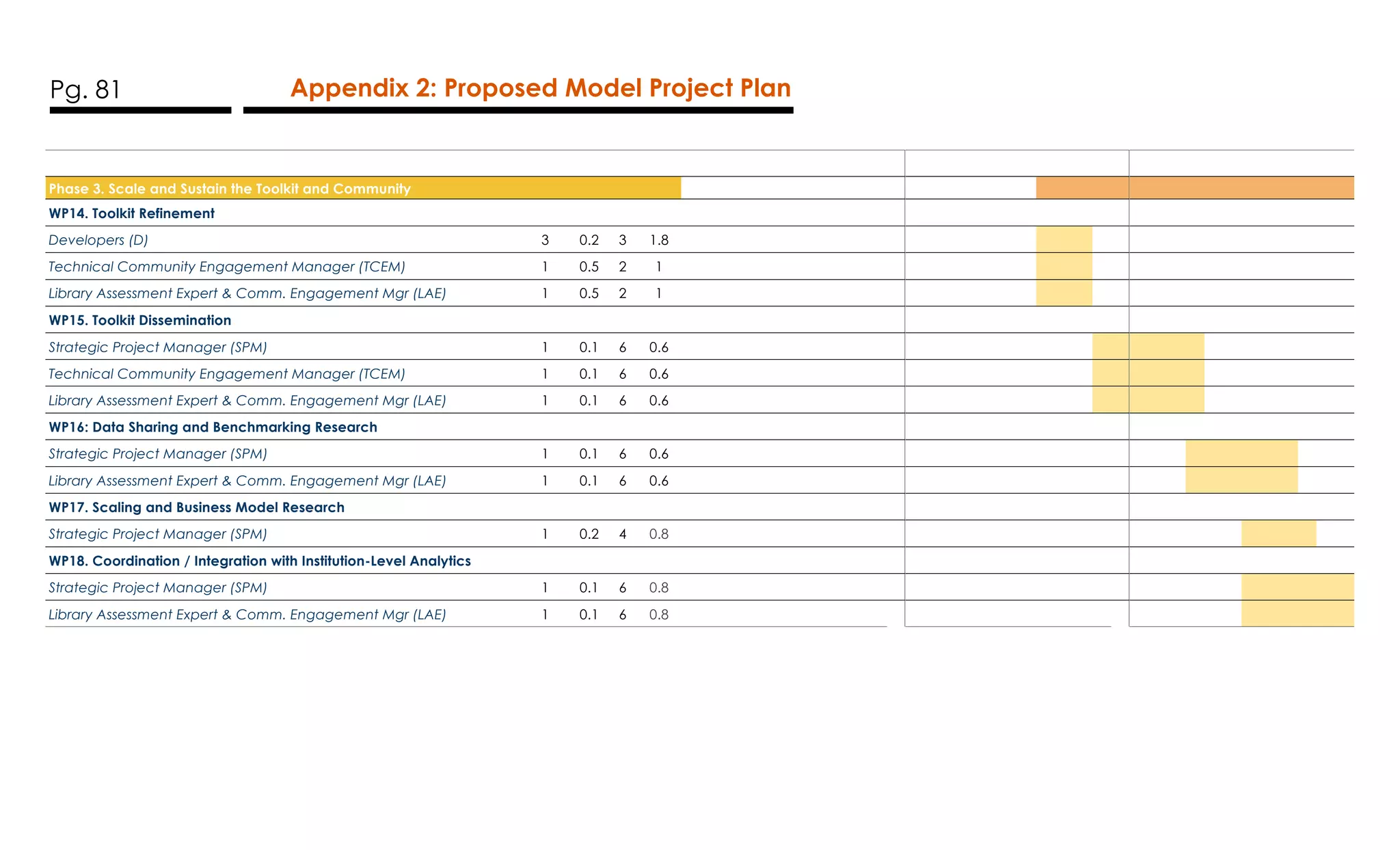
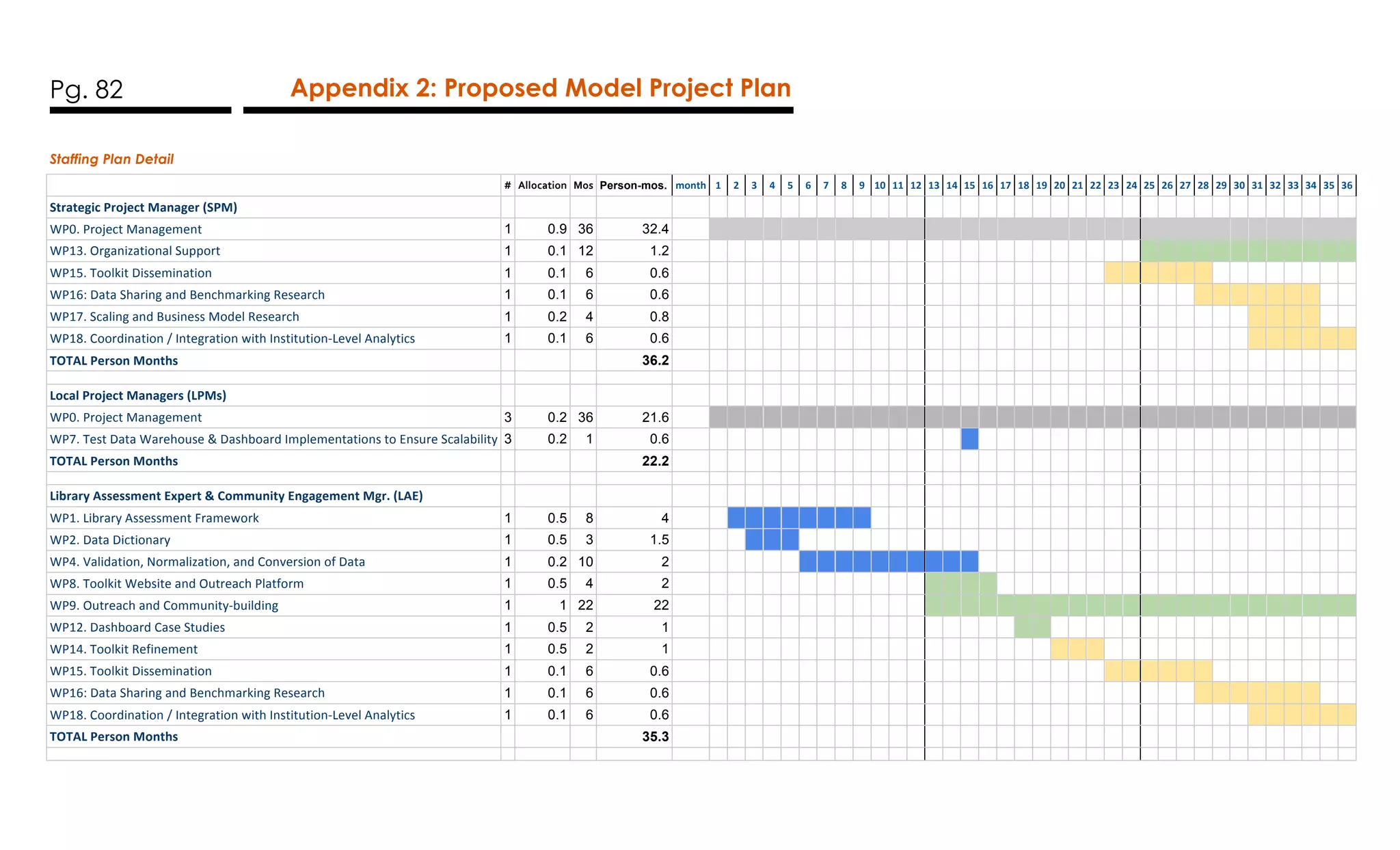
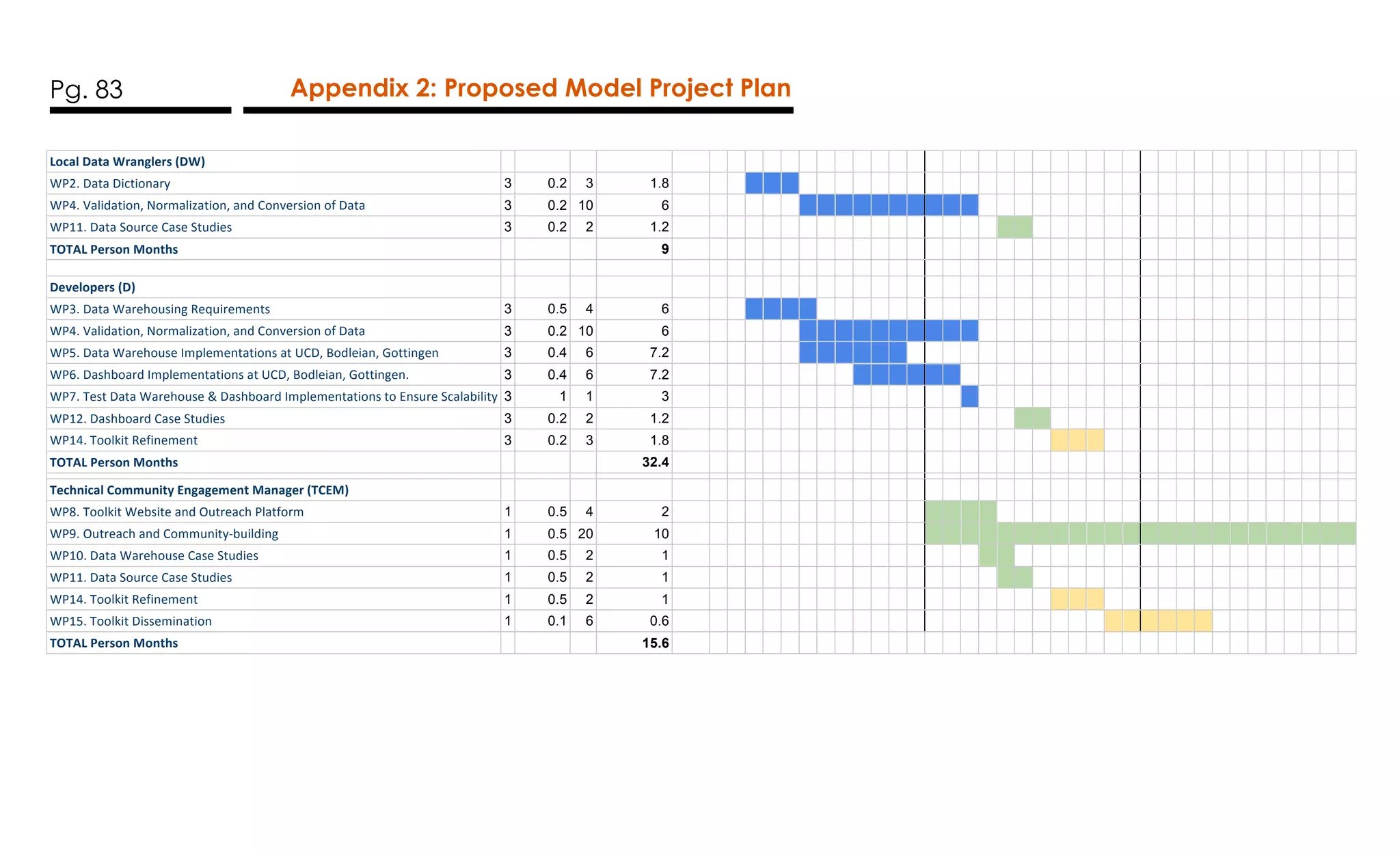
them across the academic library community. Appendix 2 describes in detail
this model project plan comprising a cooperative among multiple pilot
implementing libraries and a strategic and implementation lead able to work
across institutions. We estimate that such an approach to the effort would
break out into the following elements:
• Framework, Data Model, and UI Dashboard
• Technical Infrastructure
• Project Management/Collaboration
• Community Engagement/Sustainability
Our scoping research described the conceptual underpinnings, technical
elements, and a relatively detailed plan that would be required to develop a
common library assessment toolkit and dashboard. There is need for such a
framework and supporting infrastructure, according to our research, but limited
capacity and expertise to develop them at the individual institutional level. A
long-term goal and important extension of local practice supported by a
common library assessment toolkit and dashboard is infrastructure for institutions
to share and benchmark data with one another. An established, credible
organization that can or already does manage the collection and sharing of
data across individual institutions would be ideally situated to sponsor the
development of the toolkit, dashboard, supporting technical infrastructure, and
user community. Ideal entities would include mission-based, not-for-profit
organizations with established credibility in the library assessment community, a
focus on the success of research libraries, and capability of innovating, taking
risks, and leveraging technology.
Our research has uncovered that the possible technical approaches to
collecting, hosting, and managing data sources are varied and divergent,
Pg. 08 Conclusion and Future Plans
particularly in light of cloud-based solutions to managing data that provide
alternatives to more traditional data warehousing approaches. Initiatives in
institutions of higher education in the US and Europe that are in early stages of
development may reveal advantages and disadvantages of various potential
technical approaches within the next six to eighteen months.
Deeper research into the emerging approaches is needed before more precise
development time and cost estimates can be made for the technical
infrastructural components of the dashboard. However, work towards fully
developing the framework and data dictionary, with real library data sources,
can be undertaken in the near-term by individual institutions and/or sponsoring
organizations. We are in conversations with the Association of Research Libraries
and its Assessment Committee about the project, and are staying abreast of
technology and organizational developments at JISC and HESA in the UK, the
University of Pennsylvania (for the MetriDoc platform), the new Open Library
Foundation’s Folio system, and other initiatives. We expect the technology
landscape and potential partnerships and sponsorships to solidify over the next
year or so.
It was clear from our research that the responsibility for the long-term
sustainability of the shared framework and/or software should not fall on a
single institution. Therefore partnership with a membership organization or a
network of membership organizations is being considered as a logical home for
a new library assessment metrics framework and dashboard. That framework
will, in turn, allow us to finalize the scope and cost of the toolkit and dashboard
platform that libraries will need to collect, monitor, and use the metrics for more
effective management. With the technology landscape in this area evolving so
rapidly, beginning software developing before a widely agreed upon set of
metrics are adopted would be premature. So we will defer developing a full
grant proposal until the framework development is complete and the
technology landscape can be reassessed over the next year.
The appendices below provide detailed explanation of the project scope and
deliverables, as well as a project plan. While we are deferring the project
described below, the work on the Library Assessment Dashboard Framework
can continue through community collaboration and we remain confident that
Pg. 09 Conclusion and Future Plans
the project we planned will be ready to commence in a year, with only modest
updates to the plan.
We would like to thank the Mellon Foundation for making this work possible, and
for their ongoing support for scholarly communications and higher education
research.
Pg. 10 Appendix 1: Scoping Research Detail
Appendix 1: Scoping Research Detail
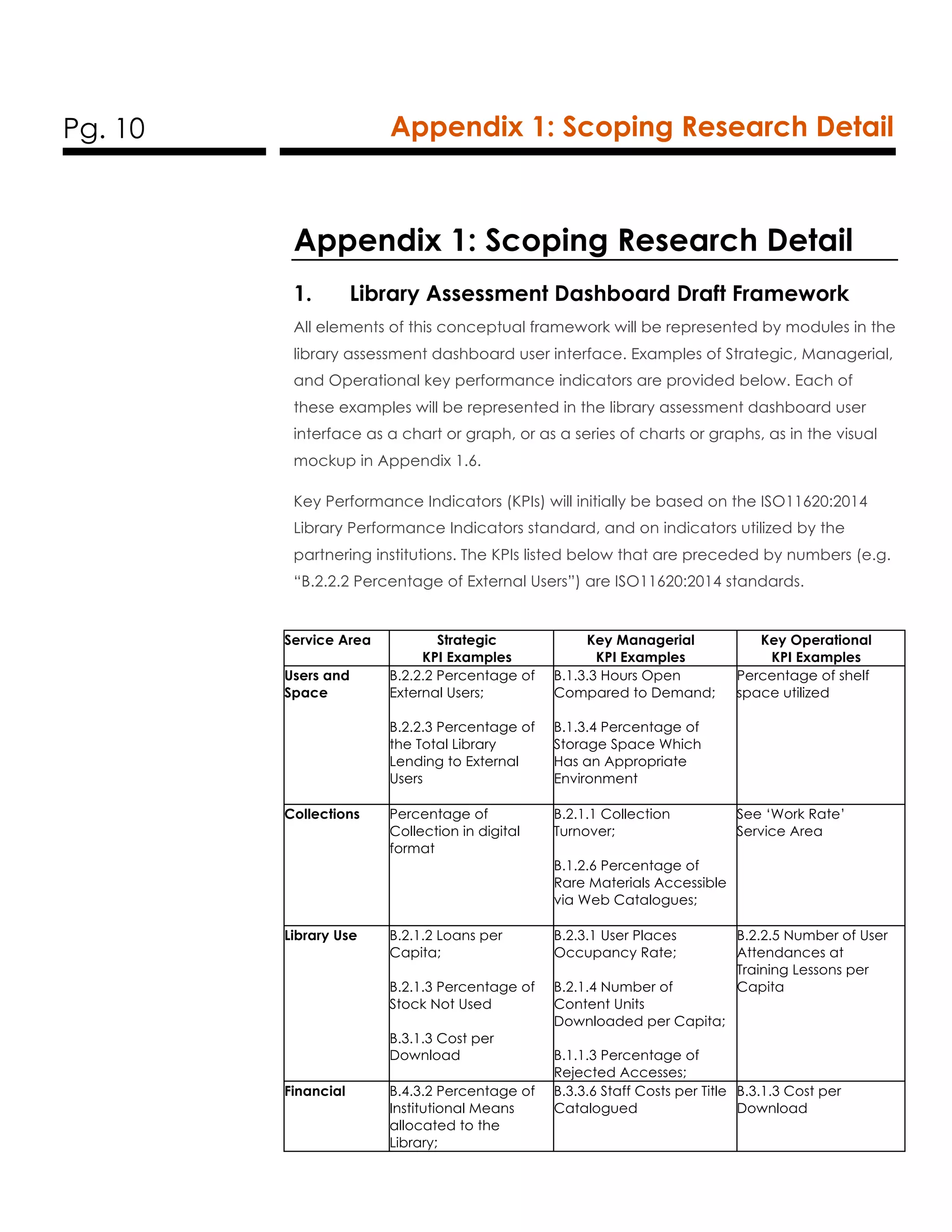
1. Library Assessment Dashboard Draft Framework
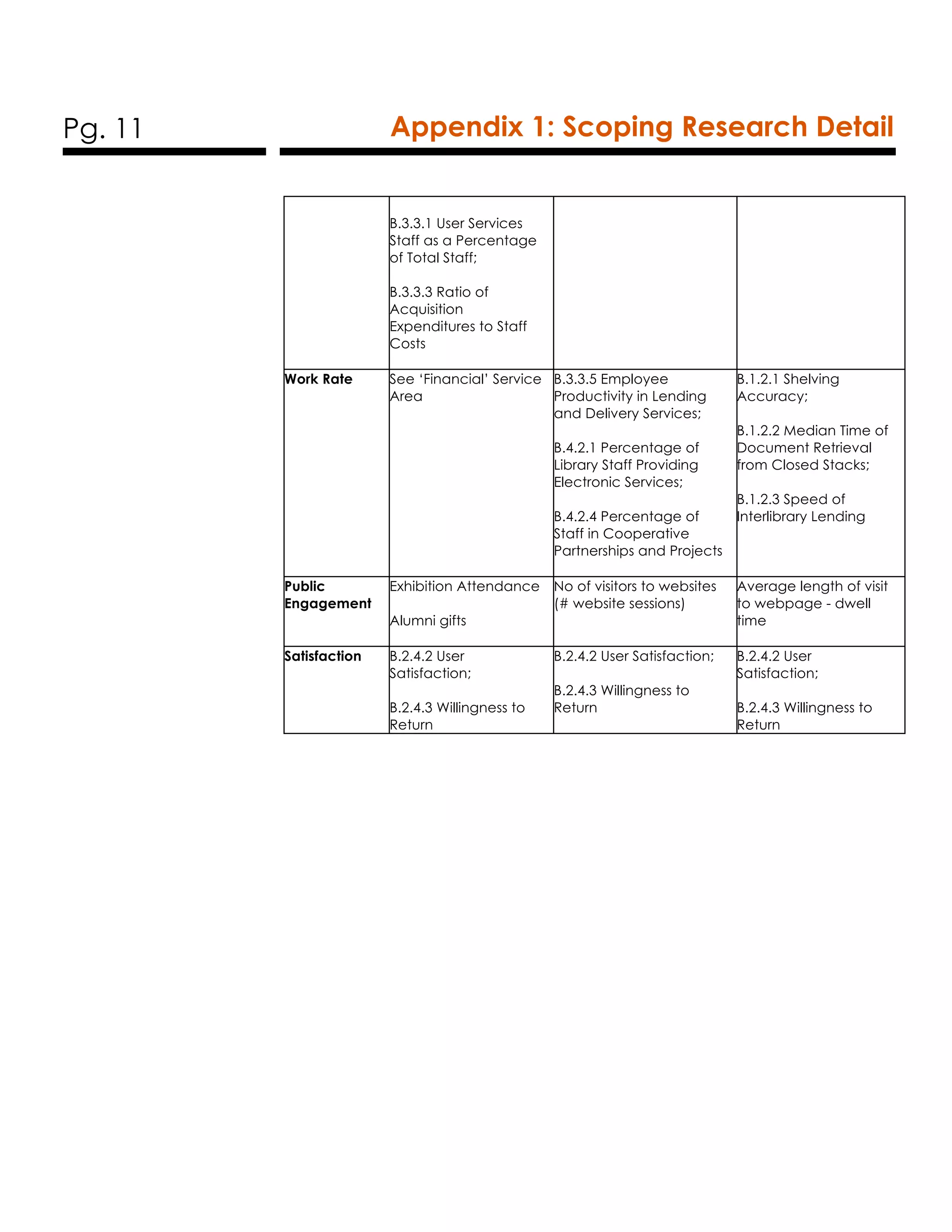
All elements of this conceptual framework will be represented by modules in the
library assessment dashboard user interface. Examples of Strategic, Managerial,
and Operational key performance indicators are provided below. Each of
these examples will be represented in the library assessment dashboard user
interface as a chart or graph, or as a series of charts or graphs, as in the visual
mockup in Appendix 1.6.
Key Performance Indicators (KPIs) will initially be based on the ISO11620:2014
Library Performance Indicators standard, and on indicators utilized by the
partnering institutions. The KPIs listed below that are preceded by numbers (e.g.
“B.2.2.2 Percentage of External Users”) are ISO11620:2014 standards.
Service Area Strategic
KPI Examples
Key Managerial
KPI Examples
Key Operational
KPI Examples
Users and
Space
B.2.2.2 Percentage of
External Users;
B.2.2.3 Percentage of
the Total Library
Lending to External
Users
B.1.3.3 Hours Open
Compared to Demand;
B.1.3.4 Percentage of
Storage Space Which
Has an Appropriate
Environment
Percentage of shelf
space utilized
Collections Percentage of
Collection in digital
format
B.2.1.1 Collection
Turnover;
B.1.2.6 Percentage of
Rare Materials Accessible
via Web Catalogues;
See ‘Work Rate’
Service Area
Library Use B.2.1.2 Loans per
Capita;
B.2.1.3 Percentage of
Stock Not Used
B.3.1.3 Cost per
Download
B.2.3.1 User Places
Occupancy Rate;
B.2.1.4 Number of
Content Units
Downloaded per Capita;
B.1.1.3 Percentage of
Rejected Accesses;
B.2.2.5 Number of User
Attendances at
Training Lessons per
Capita
Financial B.4.3.2 Percentage of
Institutional Means
allocated to the
Library;
B.3.3.6 Staff Costs per Title
Catalogued
B.3.1.3 Cost per
Download
Pg. 11 Appendix 1: Scoping Research Detail
B.3.3.1 User Services
Staff as a Percentage
of Total Staff;
B.3.3.3 Ratio of
Acquisition
Expenditures to Staff
Costs
Work Rate See ‘Financial’ Service
Area
B.3.3.5 Employee
Productivity in Lending
and Delivery Services;
B.4.2.1 Percentage of
Library Staff Providing
Electronic Services;
B.4.2.4 Percentage of
Staff in Cooperative
Partnerships and Projects
B.1.2.1 Shelving
Accuracy;
B.1.2.2 Median Time of
Document Retrieval
from Closed Stacks;
B.1.2.3 Speed of
Interlibrary Lending
Public
Engagement
Exhibition Attendance
Alumni gifts
No of visitors to websites
(# website sessions)
Average length of visit
to webpage - dwell
time
Satisfaction B.2.4.2 User
Satisfaction;
B.2.4.3 Willingness to
Return
B.2.4.2 User Satisfaction;
B.2.4.3 Willingness to
Return
B.2.4.2 User
Satisfaction;
B.2.4.3 Willingness to
Return
Pg. 12 Appendix 1: Scoping Research Detail
2. Data Inventory
A detailed data inventory follows, elaborating the common data sources available to libraries and illustrating the disparities among data sources across institutions
Readers and Space
Category Level of data Data related ISO 11620 Library Performance Indicator Source system (UCD) Source system
(Oxford)
Source system
(Gott)
Frequency of
collection
University
context
Management Number of
academic staff
(FTE)
B.1.4.1 Staff per Capita; B.2.4.1 Percentage of the Target
Population Reached; B.2.2.4 User Attendances at Library Events
per Capita
Budget & Institutional Analysis
(http://budget.ucdavis.edu/data-
reports/documents/campus-
population/ptotlpop_ycurr.pdf )
HESA return Annually
University
context
Management Number of other
University staff
(FTE)
B.1.4.1 Staff per Capita; B.2.4.1 Percentage of the Target
Population Reached; B.2.2.4 User Attendances at Library Events
per Capita
Budget & Institutional Analysis
(http://budget.ucdavis.edu/data-
reports/documents/campus-
population/ptotlpop_ycurr.pdf )
HESA return Annually
University
context
Management Number of
students (FTE)
B.1.4.1 Staff per Capita; B.2.4.1 Percentage of the Target
Population Reached; B.2.2.4 User Attendances at Library Events
per Capita
Budget and Institutional Analysis (
http://budget.ucdavis.edu/data-
reports/enrollment-reports.html )
HESA return Annually
Reader/Pat
ron/User
Numbers
Strategic Number of
University
readers
B.1.4.1 Staff per Capita; B.2.4.1 Percentage of the Target
Population Reached; B.2.2.4 User Attendances at Library Events
per Capita
Campus data: graduate &
undergraduate students enrollments and
other data
(http://budget.ucdavis.edu/data-
reports/enrollment-reports.html)
calculation
Reader/Pat
ron/User
Numbers
Strategic Number of
external readers
B.2.2.2 Percentage of External Users; B.2.2.3 Percentage of the
Total Library Lending to External Users
Library card
database
Census last
weekday of
teaching year
Reader/Pat
ron/User
Numbers
Strategic Registered
active users
B.1.4.1 Staff per Capita; B.2.4.1 Percentage of the Target
Population Reached; B.2.2.4 User Attendances at Library Events
per Capita
Yes Annual
Library
space
Strategic Number of
libraries
Library Homepage
(https://www.lib.ucdavis.edu/ )
Planon Annual
Library
space
Strategic Number of other
areas managed
by the library
B.1.3.1 User Area per Capita Planon Annual
Pg. 13 Appendix 1: Scoping Research Detail
Library
space
Strategic Net Internal
Floor Area
B.1.3.1 User Area per Capita Campus & Space Planning (account
required - url:
http://crm.ucdavis.edu/space-resource-
management/annual-report-and-
database-downloads.html )
Planon Annual
Library
space
Strategic Gross Internal
Floor Area
B.1.3.1 User Area per Capita Campus & Space Planning (account
required - url:
http://crm.ucdavis.edu/space-resource-
management/annual-report-and-
database-downloads.html )
Planon Annual
Physical
Library
provision
Strategic Number of
reader seats
B.1.3.2 User Places per Capita Manual Count Annual
Physical
Library
provision
Management Number of
reader
workstations
B.1.3.2 User Places per Capita Manual Count Annual
Physical
Library
provision
Management Number of
reader seats at
AV equipment
B.1.3.2 User Places per Capita Manual Count Annual
Physical
Library
provision
Management Opening hours
by library
B.1.3.3 Hours Open Compared to Demand UCD Library Hours page
(https://www.lib.ucdavis.edu/ul/about/ho
urs/)
Website Yes Annual
Physical
Library
provision
Strategic Number of
libraries open
24/7
B.1.3.3 Hours Open Compared to Demand UCD Library Hours page
(https://www.lib.ucdavis.edu/ul/about/ho
urs/)
Website Annual
Physical
Library
provision
Strategic Number of
regular opening
hours per week
in the main
library
B.1.3.3 Hours Open Compared to Demand UCD Library Hours page
(https://www.lib.ucdavis.edu/ul/about/ho
urs/)
Website Yes Annual
Physical
Library
provision
Operational Utilized shelf
space
B.1.3.4 Percentage of Storage Space Which Has an Appropriate
Environment
Yes Manual count Annual
Physical
Library
provision
Operational Open shelf
space
Pg. 14 Appendix 1: Scoping Research Detail
Collection Size
Category Level of data Data related ISO 11620 Library Performance Indicator Source system (UCD) Source system
(Oxford)
Source system
(Gott)
Frequency of
collection
Print stock Strategic Total
catalogued
print stock
UC Libraries' statistics - url:
http://libraries.universityofcalifornia.edu/about/facts-
and-figures; ARL-url:
https://www.arlstatistics.org/dashboard; ACRL- url:
https://acrl.countingopinions.com/main.php; and
Internal Library documents
ALEPH Annual
Print stock Management Extent of print
collection for
each physical
library
UC Libraries' statistics - url:
http://libraries.universityofcalifornia.edu/about/facts-
and-figures; ARL-url:
https://www.arlstatistics.org/dashboard; ACRL- url:
https://acrl.countingopinions.com/main.php; and
Internal Library documents
ALEPH Annual
Print stock Management Number of
additions to
catalogued
stock
B.2.1.1 Collection Turnover UC Libraries' statistics - url:
http://libraries.universityofcalifornia.edu/about/facts-
and-figures; ARL-url:
https://www.arlstatistics.org/dashboard; ACRL- url:
https://acrl.countingopinions.com/main.php; and
Internal Library documents
ALEPH Annual
Print stock Management Number of
additions to
catalogued
stock for each
physical library
B.2.1.1 Collection Turnover UC Libraries' statistics - url:
http://libraries.universityofcalifornia.edu/about/facts-
and-figures; ARL-url:
https://www.arlstatistics.org/dashboard; ACRL- url:
https://acrl.countingopinions.com/main.php; and
Internal Library documents
ALEPH Annual
Print stock Management Number of
withdrawls to
catalogued
stock for each
physical library
B.2.1.1 Collection Turnover UC Libraries' statistics - url:
http://libraries.universityofcalifornia.edu/about/facts-
and-figures; ARL-url:
https://www.arlstatistics.org/dashboard; ACRL- url:
https://acrl.countingopinions.com/main.php; and
Internal Library documents
ALEPH Annual
Legal
Deposit
Management Number of print
Legal Deposit
books received
UC Libraries' statistics - url:
http://libraries.universityofcalifornia.edu/about/facts-
and-figures; ARL-url:
https://www.arlstatistics.org/dashboard; ACRL- url:
https://acrl.countingopinions.com/main.php; and
Internal Library documents
ALEPH
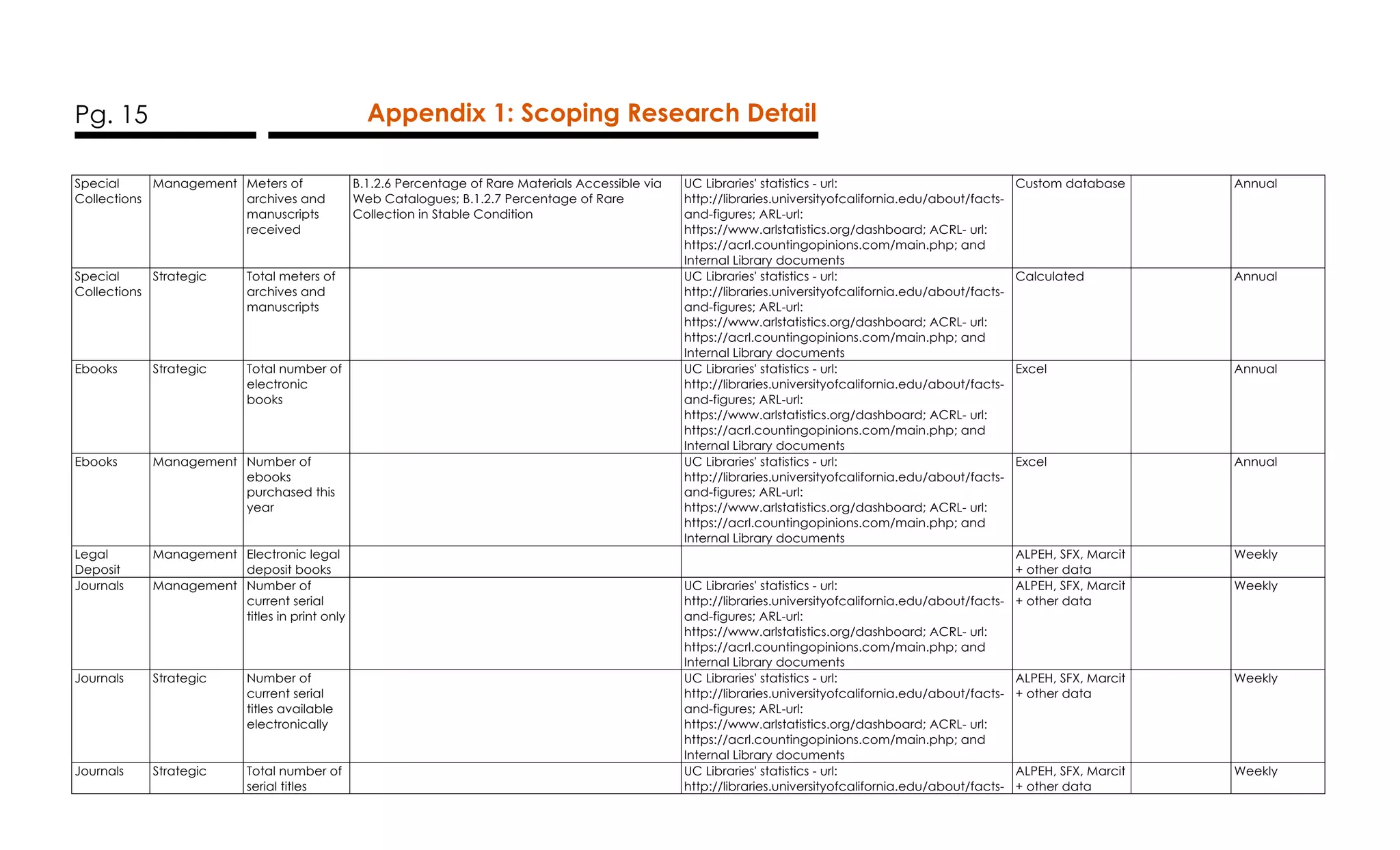
Pg. 15 Appendix 1: Scoping Research Detail
Special
Collections
Management Meters of
archives and
manuscripts
received
B.1.2.6 Percentage of Rare Materials Accessible via
Web Catalogues; B.1.2.7 Percentage of Rare
Collection in Stable Condition
UC Libraries' statistics - url:
http://libraries.universityofcalifornia.edu/about/facts-
and-figures; ARL-url:
https://www.arlstatistics.org/dashboard; ACRL- url:
https://acrl.countingopinions.com/main.php; and
Internal Library documents
Custom database Annual
Special
Collections
Strategic Total meters of
archives and
manuscripts
UC Libraries' statistics - url:
http://libraries.universityofcalifornia.edu/about/facts-
and-figures; ARL-url:
https://www.arlstatistics.org/dashboard; ACRL- url:
https://acrl.countingopinions.com/main.php; and
Internal Library documents
Calculated Annual
Ebooks Strategic Total number of
electronic
books
UC Libraries' statistics - url:
http://libraries.universityofcalifornia.edu/about/facts-
and-figures; ARL-url:
https://www.arlstatistics.org/dashboard; ACRL- url:
https://acrl.countingopinions.com/main.php; and
Internal Library documents
Excel Annual
Ebooks Management Number of
ebooks
purchased this
year
UC Libraries' statistics - url:
http://libraries.universityofcalifornia.edu/about/facts-
and-figures; ARL-url:
https://www.arlstatistics.org/dashboard; ACRL- url:
https://acrl.countingopinions.com/main.php; and
Internal Library documents
Excel Annual
Legal
Deposit
Management Electronic legal
deposit books
ALPEH, SFX, Marcit
+ other data
Weekly
Journals Management Number of
current serial
titles in print only
UC Libraries' statistics - url:
http://libraries.universityofcalifornia.edu/about/facts-
and-figures; ARL-url:
https://www.arlstatistics.org/dashboard; ACRL- url:
https://acrl.countingopinions.com/main.php; and
Internal Library documents
ALPEH, SFX, Marcit
+ other data
Weekly
Journals Strategic Number of
current serial
titles available
electronically
UC Libraries' statistics - url:
http://libraries.universityofcalifornia.edu/about/facts-
and-figures; ARL-url:
https://www.arlstatistics.org/dashboard; ACRL- url:
https://acrl.countingopinions.com/main.php; and
Internal Library documents
ALPEH, SFX, Marcit
+ other data
Weekly
Journals Strategic Total number of
serial titles
UC Libraries' statistics - url:
http://libraries.universityofcalifornia.edu/about/facts-
ALPEH, SFX, Marcit
+ other data
Weekly
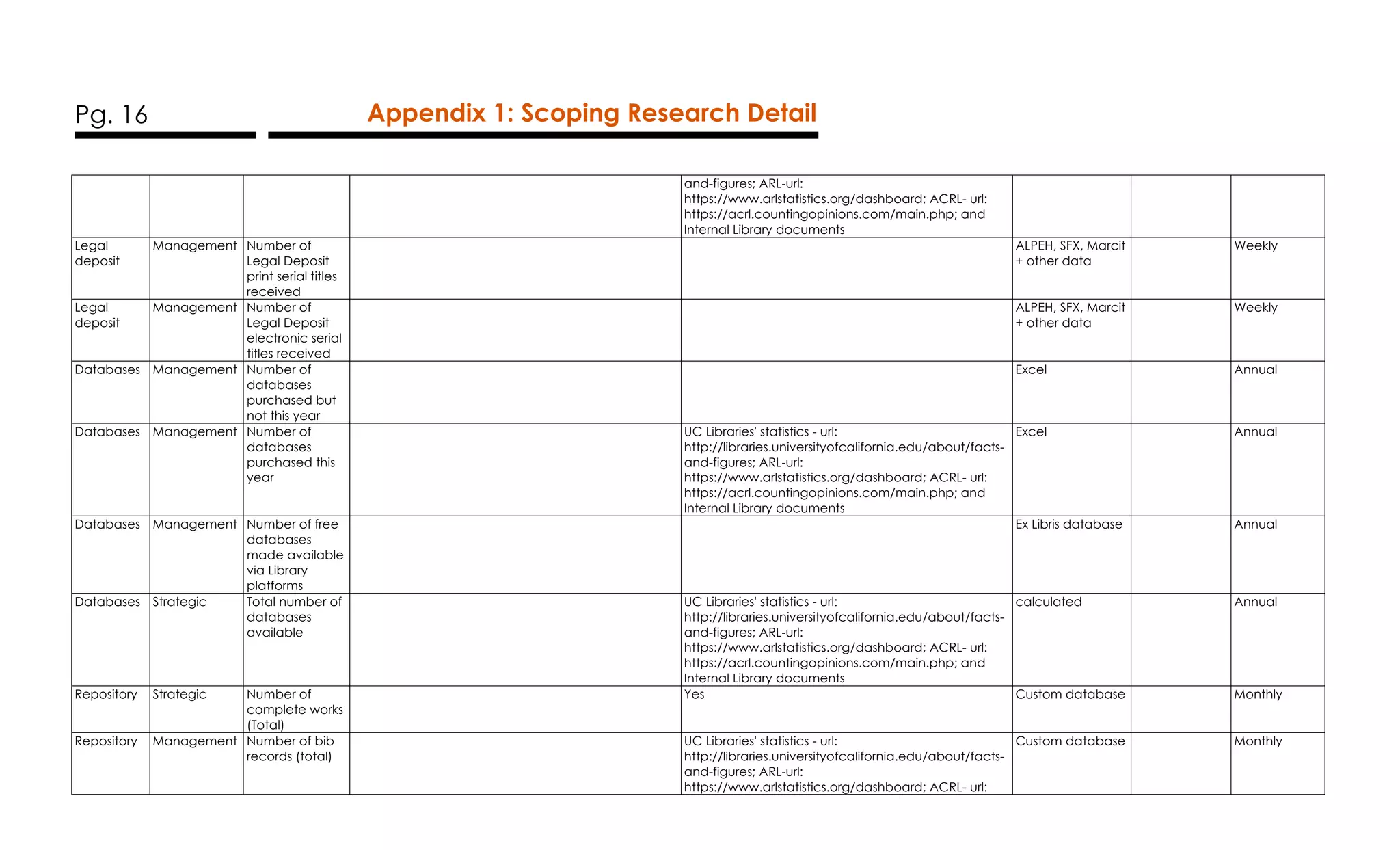
Pg. 16 Appendix 1: Scoping Research Detail
and-figures; ARL-url:
https://www.arlstatistics.org/dashboard; ACRL- url:
https://acrl.countingopinions.com/main.php; and
Internal Library documents
Legal
deposit
Management Number of
Legal Deposit
print serial titles
received
ALPEH, SFX, Marcit
+ other data
Weekly
Legal
deposit
Management Number of
Legal Deposit
electronic serial
titles received
ALPEH, SFX, Marcit
+ other data
Weekly
Databases Management Number of
databases
purchased but
not this year
Excel Annual
Databases Management Number of
databases
purchased this
year
UC Libraries' statistics - url:
http://libraries.universityofcalifornia.edu/about/facts-
and-figures; ARL-url:
https://www.arlstatistics.org/dashboard; ACRL- url:
https://acrl.countingopinions.com/main.php; and
Internal Library documents
Excel Annual
Databases Management Number of free
databases
made available
via Library
platforms
Ex Libris database Annual
Databases Strategic Total number of
databases
available
UC Libraries' statistics - url:
http://libraries.universityofcalifornia.edu/about/facts-
and-figures; ARL-url:
https://www.arlstatistics.org/dashboard; ACRL- url:
https://acrl.countingopinions.com/main.php; and
Internal Library documents
calculated Annual
Repository Strategic Number of
complete works
(Total)
Yes Custom database Monthly
Repository Management Number of bib
records (total)
UC Libraries' statistics - url:
http://libraries.universityofcalifornia.edu/about/facts-
and-figures; ARL-url:
https://www.arlstatistics.org/dashboard; ACRL- url:
Custom database Monthly
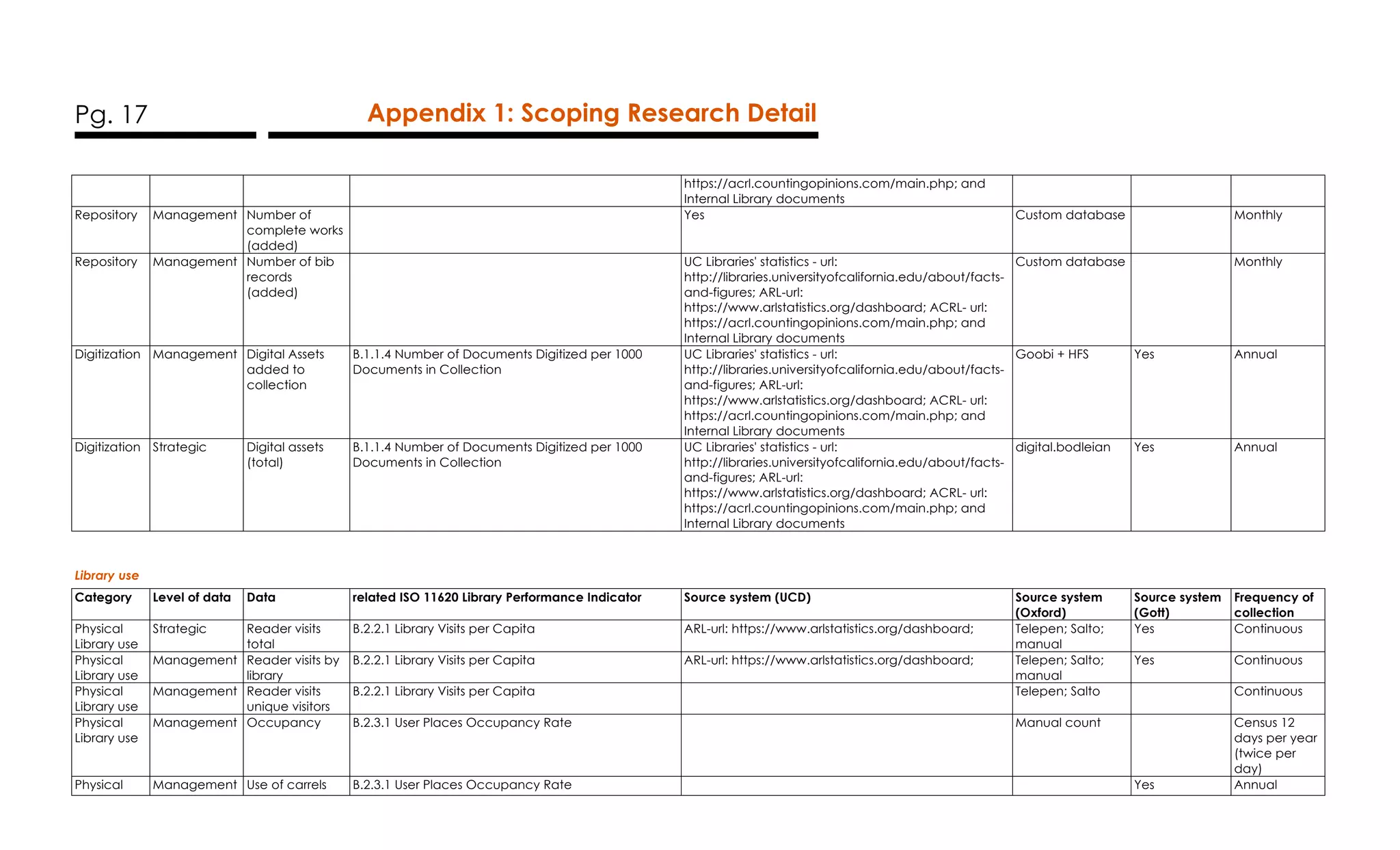
Pg. 17 Appendix 1: Scoping Research Detail
https://acrl.countingopinions.com/main.php; and
Internal Library documents
Repository Management Number of
complete works
(added)
Yes Custom database Monthly
Repository Management Number of bib
records
(added)
UC Libraries' statistics - url:
http://libraries.universityofcalifornia.edu/about/facts-
and-figures; ARL-url:
https://www.arlstatistics.org/dashboard; ACRL- url:
https://acrl.countingopinions.com/main.php; and
Internal Library documents
Custom database Monthly
Digitization Management Digital Assets
added to
collection
B.1.1.4 Number of Documents Digitized per 1000
Documents in Collection
UC Libraries' statistics - url:
http://libraries.universityofcalifornia.edu/about/facts-
and-figures; ARL-url:
https://www.arlstatistics.org/dashboard; ACRL- url:
https://acrl.countingopinions.com/main.php; and
Internal Library documents
Goobi + HFS Yes Annual
Digitization Strategic Digital assets
(total)
B.1.1.4 Number of Documents Digitized per 1000
Documents in Collection
UC Libraries' statistics - url:
http://libraries.universityofcalifornia.edu/about/facts-
and-figures; ARL-url:
https://www.arlstatistics.org/dashboard; ACRL- url:
https://acrl.countingopinions.com/main.php; and
Internal Library documents
digital.bodleian Yes Annual
Library use
Category Level of data Data related ISO 11620 Library Performance Indicator Source system (UCD) Source system
(Oxford)
Source system
(Gott)
Frequency of
collection
Physical
Library use
Strategic Reader visits
total
B.2.2.1 Library Visits per Capita ARL-url: https://www.arlstatistics.org/dashboard; Telepen; Salto;
manual
Yes Continuous
Physical
Library use
Management Reader visits by
library
B.2.2.1 Library Visits per Capita ARL-url: https://www.arlstatistics.org/dashboard; Telepen; Salto;
manual
Yes Continuous
Physical
Library use
Management Reader visits
unique visitors
B.2.2.1 Library Visits per Capita Telepen; Salto Continuous
Physical
Library use
Management Occupancy B.2.3.1 User Places Occupancy Rate Manual count Census 12
days per year
(twice per
day)
Physical Management Use of carrels B.2.3.1 User Places Occupancy Rate Yes Annual
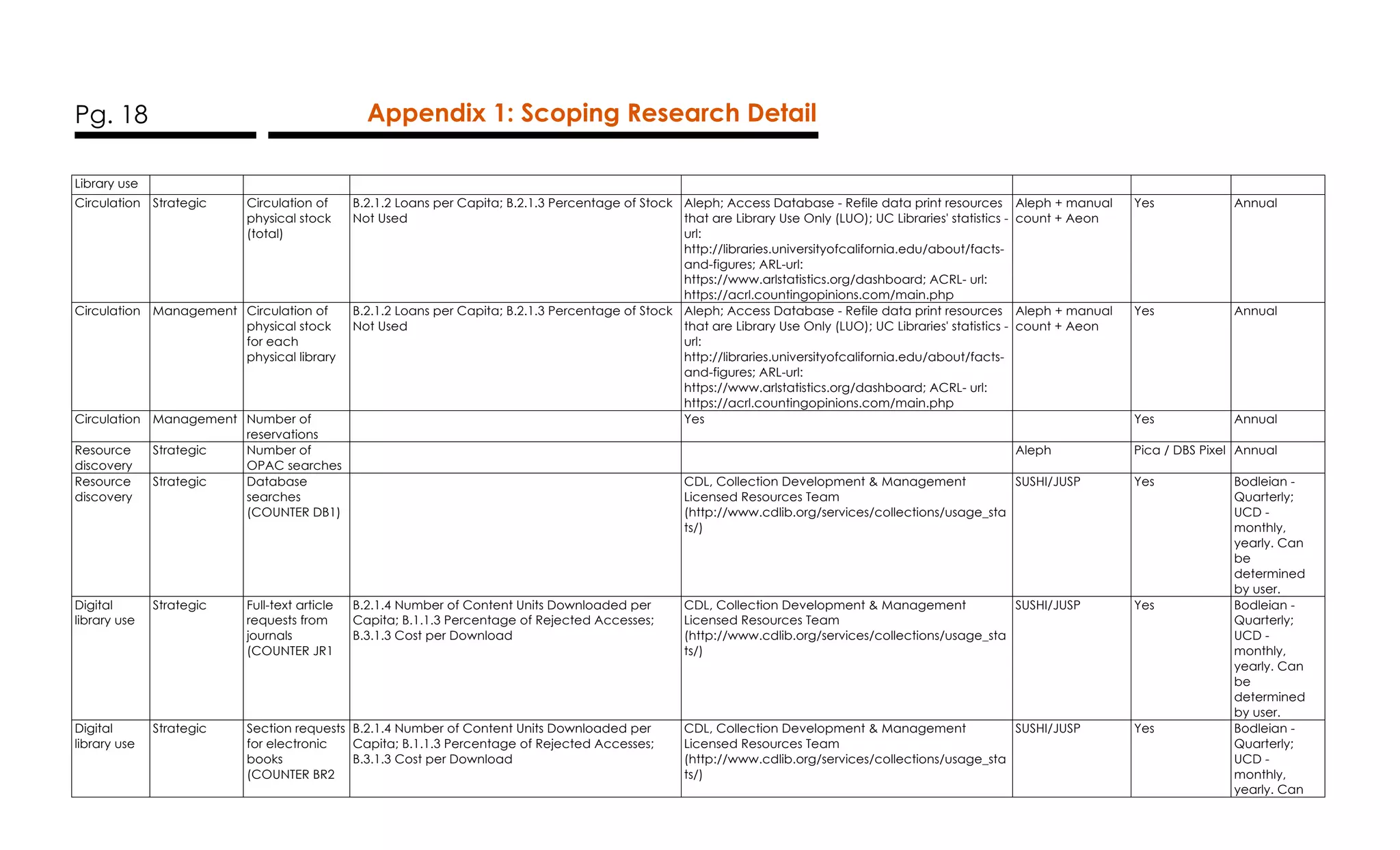
Pg. 18 Appendix 1: Scoping Research Detail
Library use
Circulation Strategic Circulation of
physical stock
(total)
B.2.1.2 Loans per Capita; B.2.1.3 Percentage of Stock
Not Used
Aleph; Access Database - Refile data print resources
that are Library Use Only (LUO); UC Libraries' statistics -
url:
http://libraries.universityofcalifornia.edu/about/facts-
and-figures; ARL-url:
https://www.arlstatistics.org/dashboard; ACRL- url:
https://acrl.countingopinions.com/main.php
Aleph + manual
count + Aeon
Yes Annual
Circulation Management Circulation of
physical stock
for each
physical library
B.2.1.2 Loans per Capita; B.2.1.3 Percentage of Stock
Not Used
Aleph; Access Database - Refile data print resources
that are Library Use Only (LUO); UC Libraries' statistics -
url:
http://libraries.universityofcalifornia.edu/about/facts-
and-figures; ARL-url:
https://www.arlstatistics.org/dashboard; ACRL- url:
https://acrl.countingopinions.com/main.php
Aleph + manual
count + Aeon
Yes Annual
Circulation Management Number of
reservations
Yes Yes Annual
Resource
discovery
Strategic Number of
OPAC searches
Aleph Pica / DBS Pixel Annual
Resource
discovery
Strategic Database
searches
(COUNTER DB1)
CDL, Collection Development & Management
Licensed Resources Team
(http://www.cdlib.org/services/collections/usage_sta
ts/)
SUSHI/JUSP Yes Bodleian -
Quarterly;
UCD -
monthly,
yearly. Can
be
determined
by user.
Digital
library use
Strategic Full-text article
requests from
journals
(COUNTER JR1
B.2.1.4 Number of Content Units Downloaded per
Capita; B.1.1.3 Percentage of Rejected Accesses;
B.3.1.3 Cost per Download
CDL, Collection Development & Management
Licensed Resources Team
(http://www.cdlib.org/services/collections/usage_sta
ts/)
SUSHI/JUSP Yes Bodleian -
Quarterly;
UCD -
monthly,
yearly. Can
be
determined
by user.
Digital
library use
Strategic Section requests
for electronic
books
(COUNTER BR2
B.2.1.4 Number of Content Units Downloaded per
Capita; B.1.1.3 Percentage of Rejected Accesses;
B.3.1.3 Cost per Download
CDL, Collection Development & Management
Licensed Resources Team
(http://www.cdlib.org/services/collections/usage_sta
ts/)
SUSHI/JUSP Yes Bodleian -
Quarterly;
UCD -
monthly,
yearly. Can
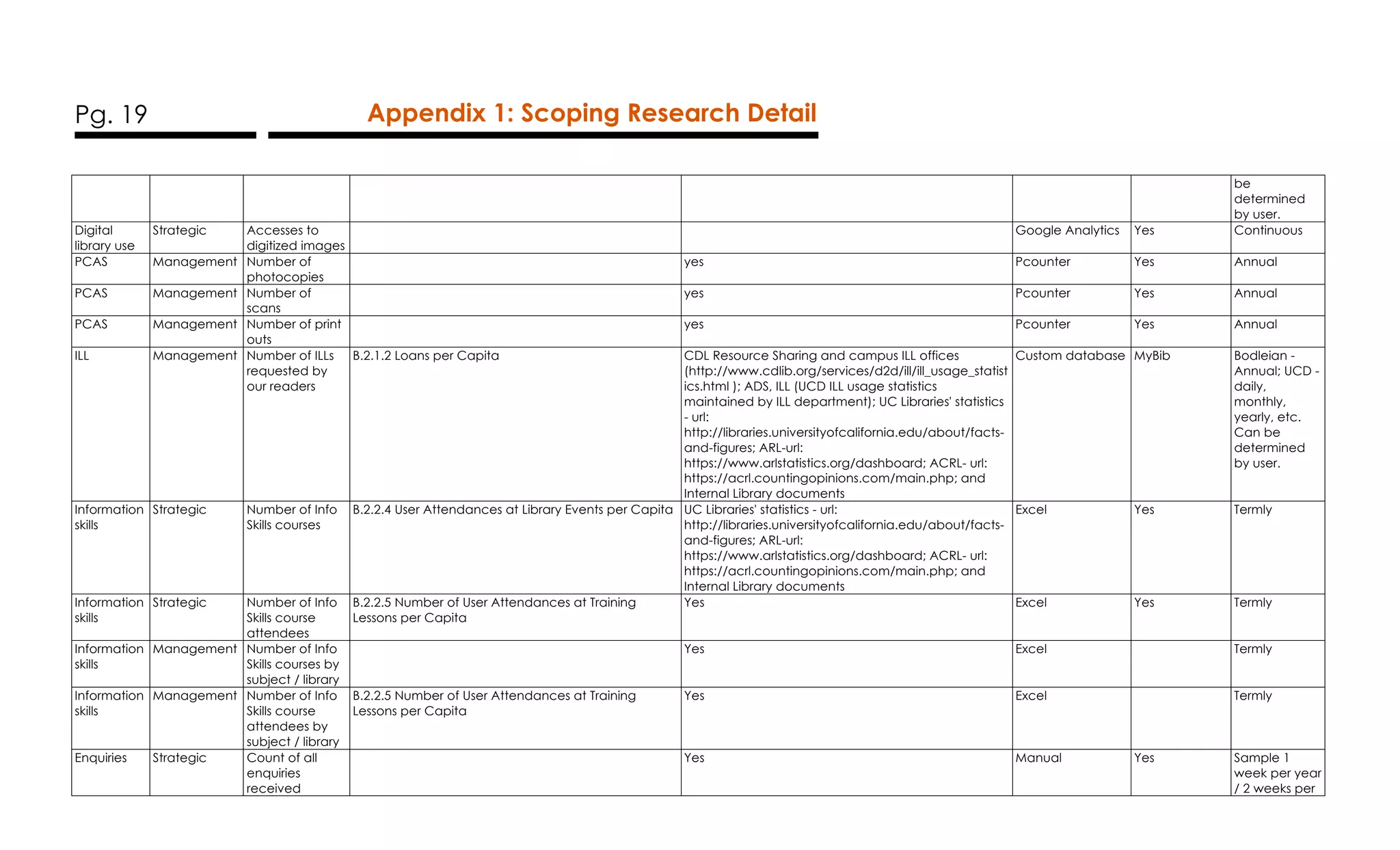
Pg. 19 Appendix 1: Scoping Research Detail
be
determined
by user.
Digital
library use
Strategic Accesses to
digitized images
Google Analytics Yes Continuous
PCAS Management Number of
photocopies
yes Pcounter Yes Annual
PCAS Management Number of
scans
yes Pcounter Yes Annual
PCAS Management Number of print
outs
yes Pcounter Yes Annual
ILL Management Number of ILLs
requested by
our readers
B.2.1.2 Loans per Capita CDL Resource Sharing and campus ILL offices
(http://www.cdlib.org/services/d2d/ill/ill_usage_statist
ics.html ); ADS, ILL (UCD ILL usage statistics
maintained by ILL department); UC Libraries' statistics
- url:
http://libraries.universityofcalifornia.edu/about/facts-
and-figures; ARL-url:
https://www.arlstatistics.org/dashboard; ACRL- url:
https://acrl.countingopinions.com/main.php; and
Internal Library documents
Custom database MyBib Bodleian -
Annual; UCD -
daily,
monthly,
yearly, etc.
Can be
determined
by user.
Information
skills
Strategic Number of Info
Skills courses
B.2.2.4 User Attendances at Library Events per Capita UC Libraries' statistics - url:
http://libraries.universityofcalifornia.edu/about/facts-
and-figures; ARL-url:
https://www.arlstatistics.org/dashboard; ACRL- url:
https://acrl.countingopinions.com/main.php; and
Internal Library documents
Excel Yes Termly
Information
skills
Strategic Number of Info
Skills course
attendees
B.2.2.5 Number of User Attendances at Training
Lessons per Capita
Yes Excel Yes Termly
Information
skills
Management Number of Info
Skills courses by
subject / library
Yes Excel Termly
Information
skills
Management Number of Info
Skills course
attendees by
subject / library
B.2.2.5 Number of User Attendances at Training
Lessons per Capita
Yes Excel Termly
Enquiries Strategic Count of all
enquiries
received
Yes Manual Yes Sample 1
week per year
/ 2 weeks per
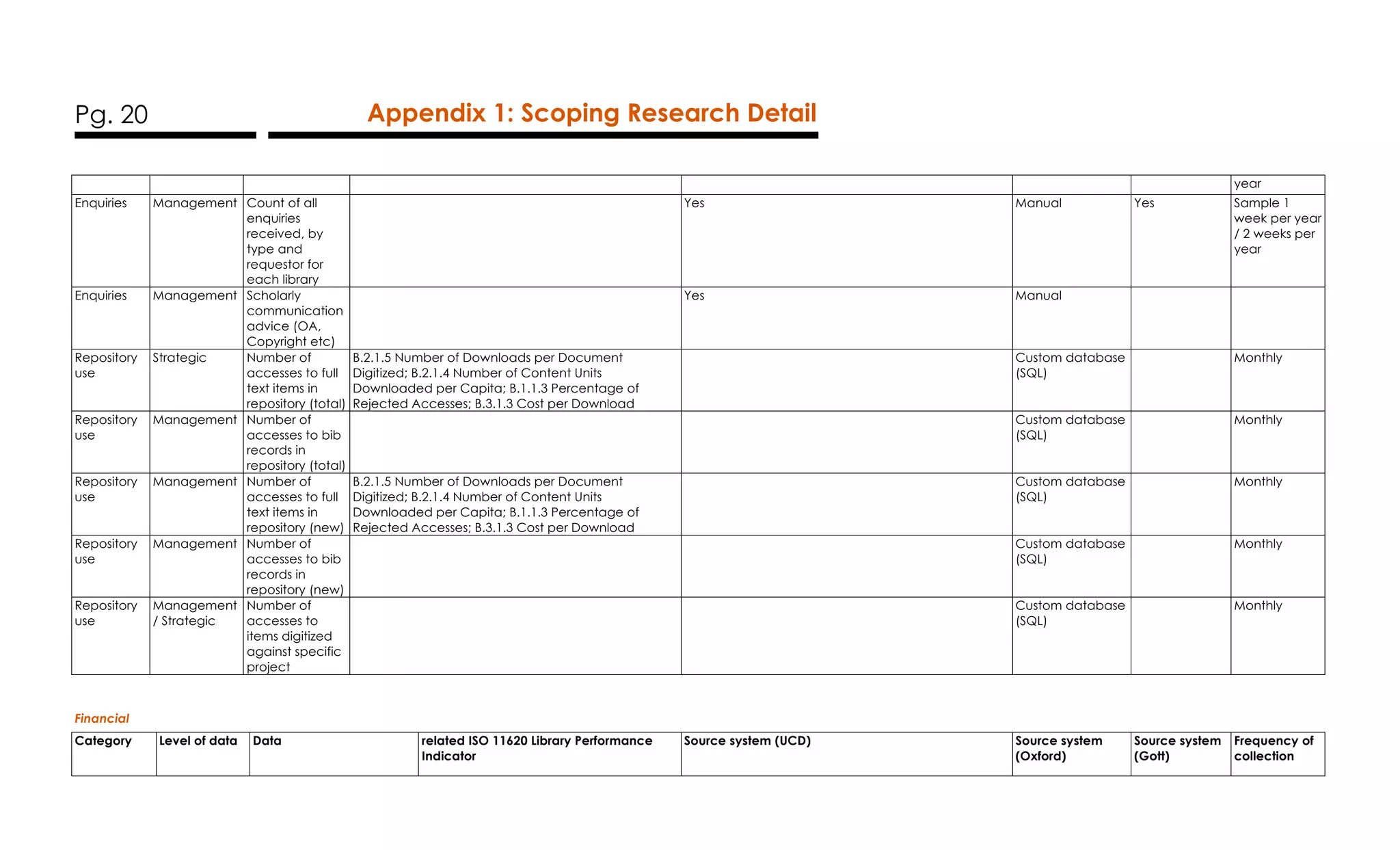
Pg. 20 Appendix 1: Scoping Research Detail
year
Enquiries Management Count of all
enquiries
received, by
type and
requestor for
each library
Yes Manual Yes Sample 1
week per year
/ 2 weeks per
year
Enquiries Management Scholarly
communication
advice (OA,
Copyright etc)
Yes Manual
Repository
use
Strategic Number of
accesses to full
text items in
repository (total)
B.2.1.5 Number of Downloads per Document
Digitized; B.2.1.4 Number of Content Units
Downloaded per Capita; B.1.1.3 Percentage of
Rejected Accesses; B.3.1.3 Cost per Download
Custom database
(SQL)
Monthly
Repository
use
Management Number of
accesses to bib
records in
repository (total)
Custom database
(SQL)
Monthly
Repository
use
Management Number of
accesses to full
text items in
repository (new)
B.2.1.5 Number of Downloads per Document
Digitized; B.2.1.4 Number of Content Units
Downloaded per Capita; B.1.1.3 Percentage of
Rejected Accesses; B.3.1.3 Cost per Download
Custom database
(SQL)
Monthly
Repository
use
Management Number of
accesses to bib
records in
repository (new)
Custom database
(SQL)
Monthly
Repository
use
Management
/ Strategic
Number of
accesses to
items digitized
against specific
project
Custom database
(SQL)
Monthly
Financial
Category Level of data Data related ISO 11620 Library Performance
Indicator
Source system (UCD) Source system
(Oxford)
Source system
(Gott)
Frequency of
collection
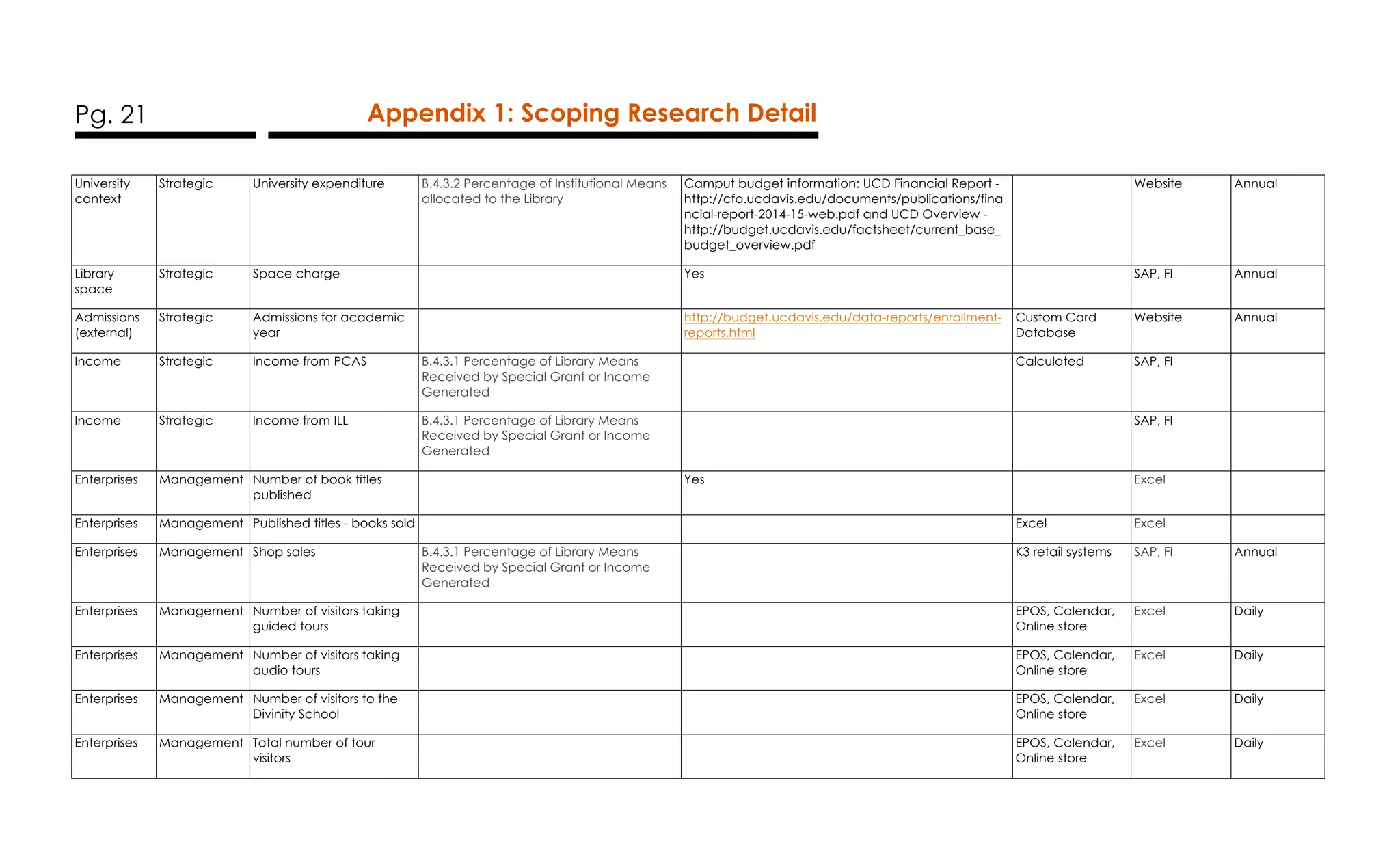
Pg. 21 Appendix 1: Scoping Research Detail
University
context
Strategic University expenditure B.4.3.2 Percentage of Institutional Means
allocated to the Library
Camput budget information: UCD Financial Report -
http://cfo.ucdavis.edu/documents/publications/fina
ncial-report-2014-15-web.pdf and UCD Overview -
http://budget.ucdavis.edu/factsheet/current_base_
budget_overview.pdf
Website Annual
Library
space
Strategic Space charge Yes SAP, FI Annual
Admissions
(external)
Strategic Admissions for academic
year
http://budget.ucdavis.edu/data-reports/enrollment-
reports.html
Custom Card
Database
Website Annual
Income Strategic Income from PCAS B.4.3.1 Percentage of Library Means
Received by Special Grant or Income
Generated
Calculated SAP, FI
Income Strategic Income from ILL B.4.3.1 Percentage of Library Means
Received by Special Grant or Income
Generated
SAP, FI
Enterprises Management Number of book titles
published
Yes Excel
Enterprises Management Published titles - books sold Excel Excel
Enterprises Management Shop sales B.4.3.1 Percentage of Library Means
Received by Special Grant or Income
Generated
K3 retail systems SAP, FI Annual
Enterprises Management Number of visitors taking
guided tours
EPOS, Calendar,
Online store
Excel Daily
Enterprises Management Number of visitors taking
audio tours
EPOS, Calendar,
Online store
Excel Daily
Enterprises Management Number of visitors to the
Divinity School
EPOS, Calendar,
Online store
Excel Daily
Enterprises Management Total number of tour
visitors
EPOS, Calendar,
Online store
Excel Daily
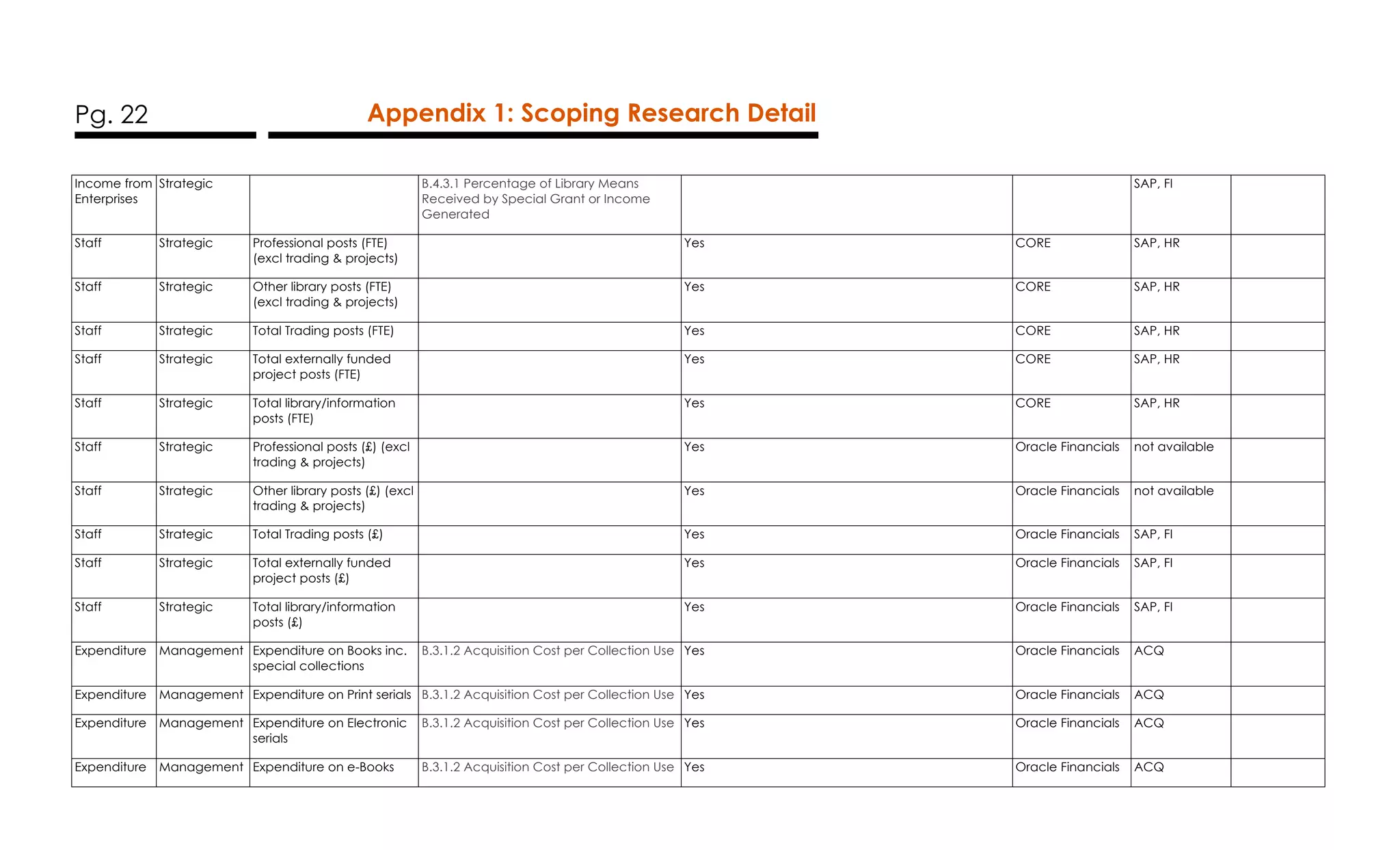
Pg. 22 Appendix 1: Scoping Research Detail
Income from
Enterprises
Strategic B.4.3.1 Percentage of Library Means
Received by Special Grant or Income
Generated
SAP, FI
Staff Strategic Professional posts (FTE)
(excl trading & projects)
Yes CORE SAP, HR
Staff Strategic Other library posts (FTE)
(excl trading & projects)
Yes CORE SAP, HR
Staff Strategic Total Trading posts (FTE) Yes CORE SAP, HR
Staff Strategic Total externally funded
project posts (FTE)
Yes CORE SAP, HR
Staff Strategic Total library/information
posts (FTE)
Yes CORE SAP, HR
Staff Strategic Professional posts (£) (excl
trading & projects)
Yes Oracle Financials not available
Staff Strategic Other library posts (£) (excl
trading & projects)
Yes Oracle Financials not available
Staff Strategic Total Trading posts (£) Yes Oracle Financials SAP, FI
Staff Strategic Total externally funded
project posts (£)
Yes Oracle Financials SAP, FI
Staff Strategic Total library/information
posts (£)
Yes Oracle Financials SAP, FI
Expenditure Management Expenditure on Books inc.
special collections
B.3.1.2 Acquisition Cost per Collection Use Yes Oracle Financials ACQ
Expenditure Management Expenditure on Print serials B.3.1.2 Acquisition Cost per Collection Use Yes Oracle Financials ACQ
Expenditure Management Expenditure on Electronic
serials
B.3.1.2 Acquisition Cost per Collection Use Yes Oracle Financials ACQ
Expenditure Management Expenditure on e-Books B.3.1.2 Acquisition Cost per Collection Use Yes Oracle Financials ACQ
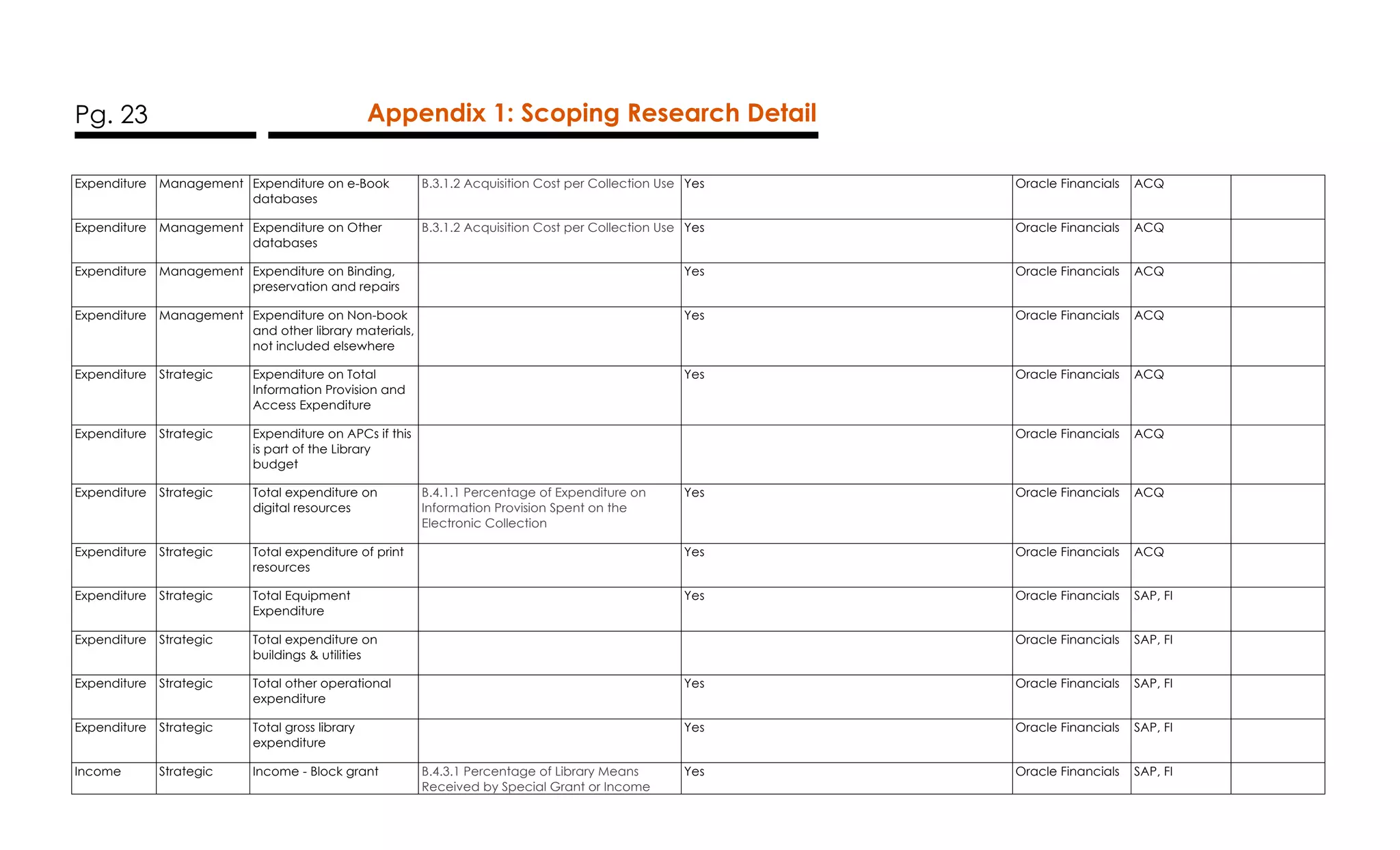
Pg. 23 Appendix 1: Scoping Research Detail
Expenditure Management Expenditure on e-Book
databases
B.3.1.2 Acquisition Cost per Collection Use Yes Oracle Financials ACQ
Expenditure Management Expenditure on Other
databases
B.3.1.2 Acquisition Cost per Collection Use Yes Oracle Financials ACQ
Expenditure Management Expenditure on Binding,
preservation and repairs
Yes Oracle Financials ACQ
Expenditure Management Expenditure on Non-book
and other library materials,
not included elsewhere
Yes Oracle Financials ACQ
Expenditure Strategic Expenditure on Total
Information Provision and
Access Expenditure
Yes Oracle Financials ACQ
Expenditure Strategic Expenditure on APCs if this
is part of the Library
budget
Oracle Financials ACQ
Expenditure Strategic Total expenditure on
digital resources
B.4.1.1 Percentage of Expenditure on
Information Provision Spent on the
Electronic Collection
Yes Oracle Financials ACQ
Expenditure Strategic Total expenditure of print
resources
Yes Oracle Financials ACQ
Expenditure Strategic Total Equipment
Expenditure
Yes Oracle Financials SAP, FI
Expenditure Strategic Total expenditure on
buildings & utilities
Oracle Financials SAP, FI
Expenditure Strategic Total other operational
expenditure
Yes Oracle Financials SAP, FI
Expenditure Strategic Total gross library
expenditure
Yes Oracle Financials SAP, FI
Income Strategic Income - Block grant B.4.3.1 Percentage of Library Means
Received by Special Grant or Income
Yes Oracle Financials SAP, FI
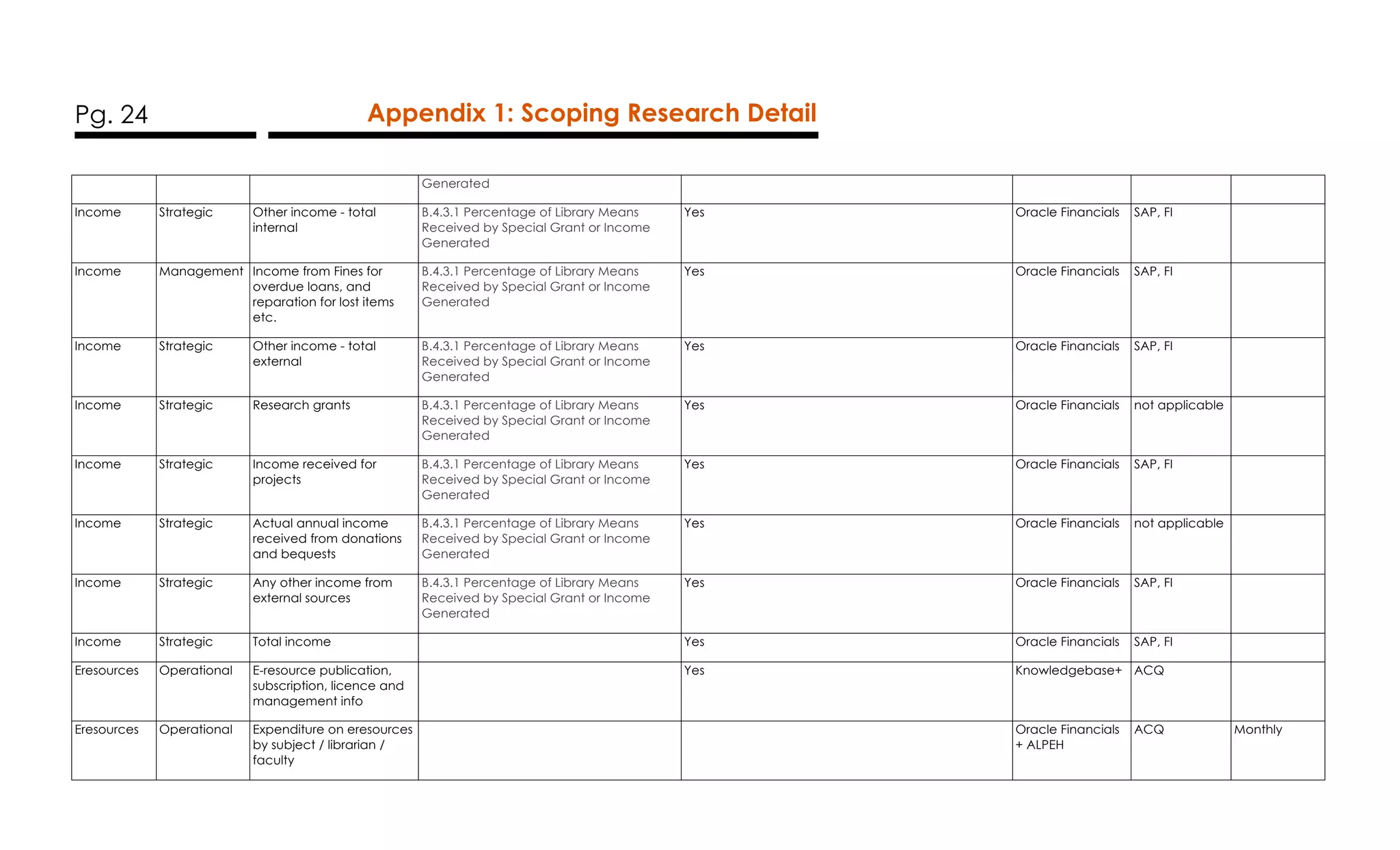
Pg. 24 Appendix 1: Scoping Research Detail
Generated
Income Strategic Other income - total
internal
B.4.3.1 Percentage of Library Means
Received by Special Grant or Income
Generated
Yes Oracle Financials SAP, FI
Income Management Income from Fines for
overdue loans, and
reparation for lost items
etc.
B.4.3.1 Percentage of Library Means
Received by Special Grant or Income
Generated
Yes Oracle Financials SAP, FI
Income Strategic Other income - total
external
B.4.3.1 Percentage of Library Means
Received by Special Grant or Income
Generated
Yes Oracle Financials SAP, FI
Income Strategic Research grants B.4.3.1 Percentage of Library Means
Received by Special Grant or Income
Generated
Yes Oracle Financials not applicable
Income Strategic Income received for
projects
B.4.3.1 Percentage of Library Means
Received by Special Grant or Income
Generated
Yes Oracle Financials SAP, FI
Income Strategic Actual annual income
received from donations
and bequests
B.4.3.1 Percentage of Library Means
Received by Special Grant or Income
Generated
Yes Oracle Financials not applicable
Income Strategic Any other income from
external sources
B.4.3.1 Percentage of Library Means
Received by Special Grant or Income
Generated
Yes Oracle Financials SAP, FI
Income Strategic Total income Yes Oracle Financials SAP, FI
Eresources Operational E-resource publication,
subscription, licence and
management info
Yes Knowledgebase+ ACQ
Eresources Operational Expenditure on eresources
by subject / librarian /
faculty
Oracle Financials
+ ALPEH
ACQ Monthly
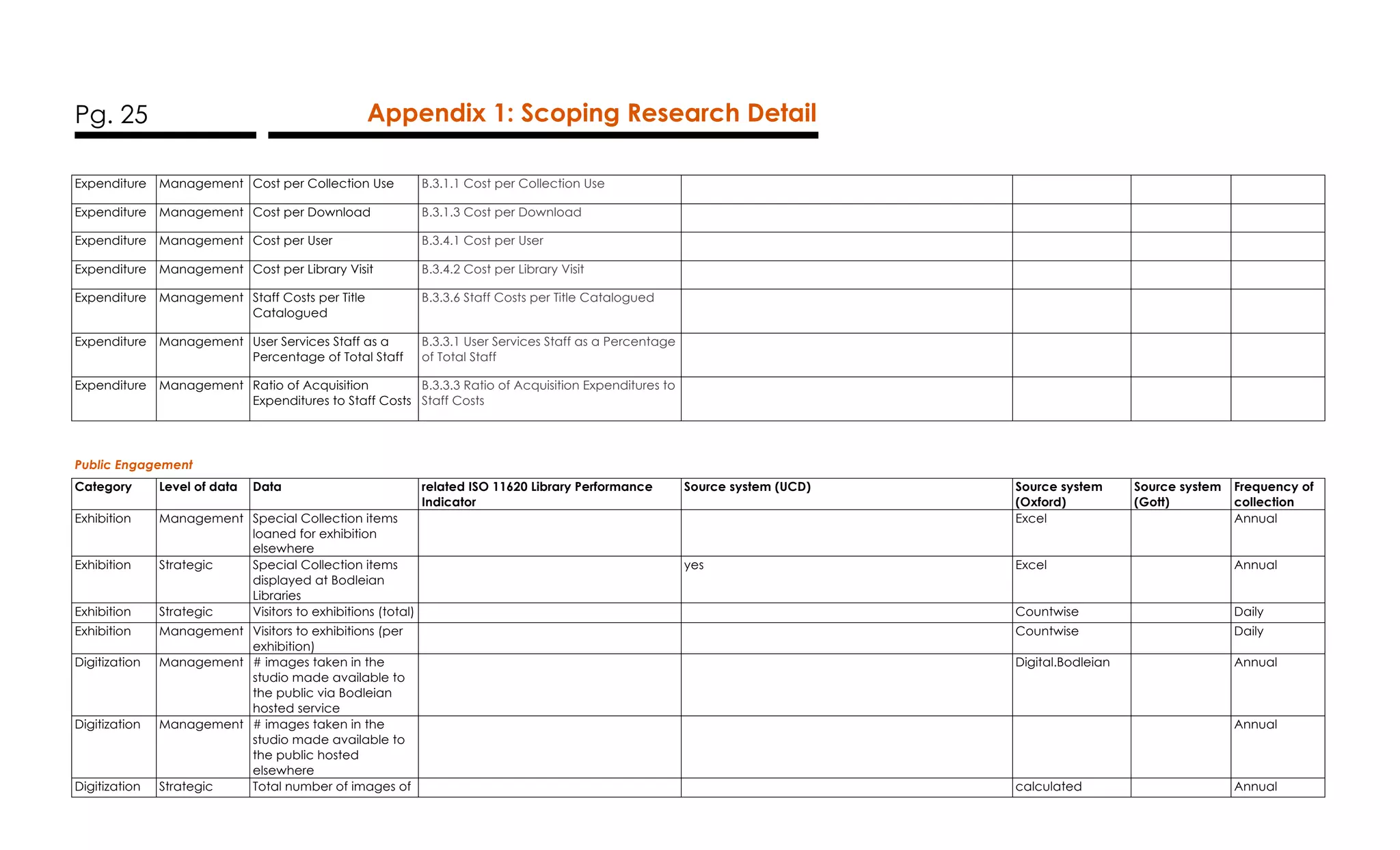
Pg. 25 Appendix 1: Scoping Research Detail
Expenditure Management Cost per Collection Use B.3.1.1 Cost per Collection Use
Expenditure Management Cost per Download B.3.1.3 Cost per Download
Expenditure Management Cost per User B.3.4.1 Cost per User
Expenditure Management Cost per Library Visit B.3.4.2 Cost per Library Visit
Expenditure Management Staff Costs per Title
Catalogued
B.3.3.6 Staff Costs per Title Catalogued
Expenditure Management User Services Staff as a
Percentage of Total Staff
B.3.3.1 User Services Staff as a Percentage
of Total Staff
Expenditure Management Ratio of Acquisition
Expenditures to Staff Costs
B.3.3.3 Ratio of Acquisition Expenditures to
Staff Costs
Public Engagement
Category Level of data Data related ISO 11620 Library Performance
Indicator
Source system (UCD) Source system
(Oxford)
Source system
(Gott)
Frequency of
collection
Exhibition Management Special Collection items
loaned for exhibition
elsewhere
Excel Annual
Exhibition Strategic Special Collection items
displayed at Bodleian
Libraries
yes Excel Annual
Exhibition Strategic Visitors to exhibitions (total) Countwise Daily
Exhibition Management Visitors to exhibitions (per
exhibition)
Countwise Daily
Digitization Management # images taken in the
studio made available to
the public via Bodleian
hosted service
Digital.Bodleian Annual
Digitization Management # images taken in the
studio made available to
the public hosted
elsewhere
Annual
Digitization Strategic Total number of images of calculated Annual
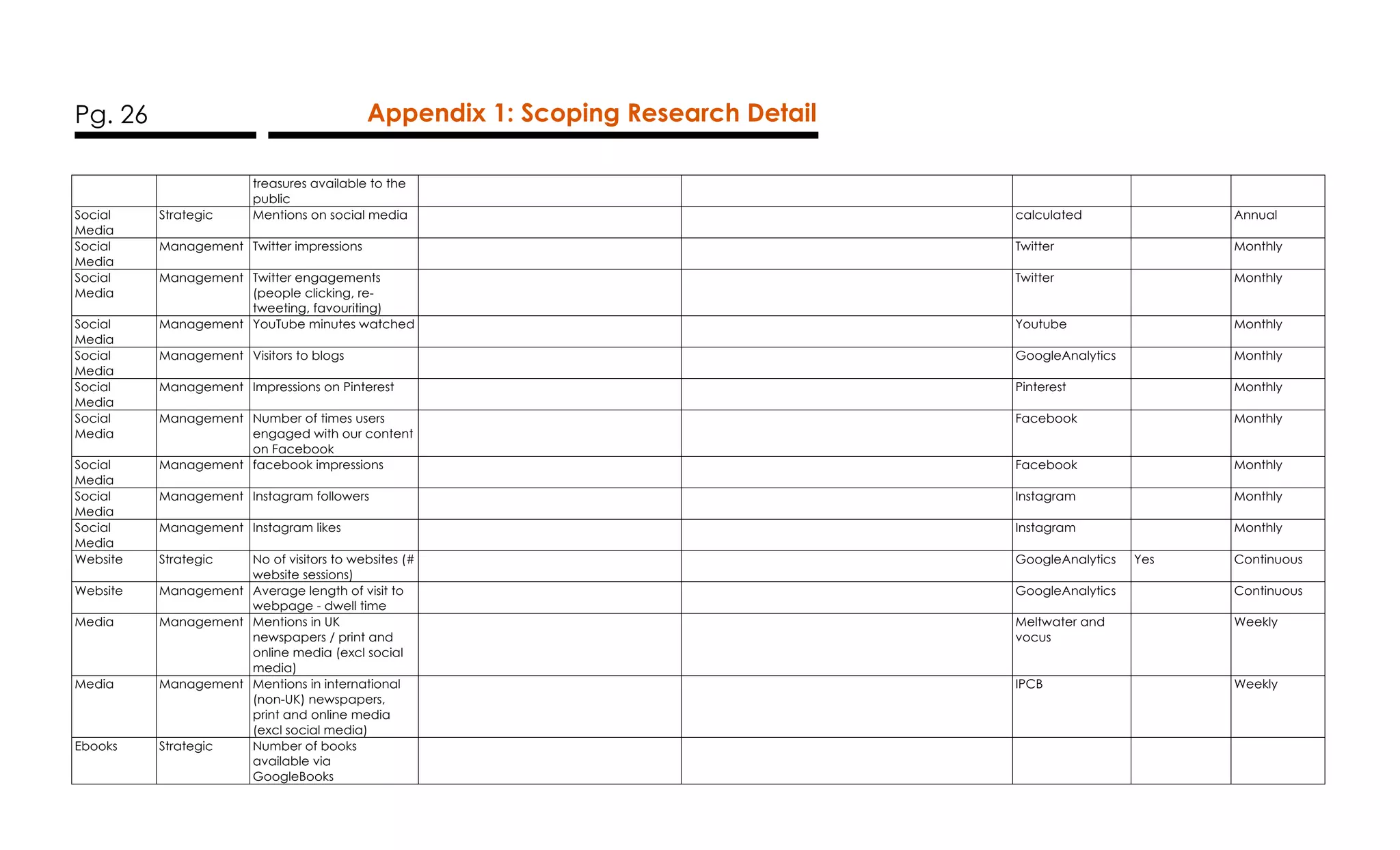
Pg. 26 Appendix 1: Scoping Research Detail
treasures available to the
public
Social
Media
Strategic Mentions on social media calculated Annual
Social
Media
Management Twitter impressions Twitter Monthly
Social
Media
Management Twitter engagements
(people clicking, re-
tweeting, favouriting)
Twitter Monthly
Social
Media
Management YouTube minutes watched Youtube Monthly
Social
Media
Management Visitors to blogs GoogleAnalytics Monthly
Social
Media
Management Impressions on Pinterest Pinterest Monthly
Social
Media
Management Number of times users
engaged with our content
on Facebook
Facebook Monthly
Social
Media
Management facebook impressions Facebook Monthly
Social
Media
Management Instagram followers Instagram Monthly
Social
Media
Management Instagram likes Instagram Monthly
Website Strategic No of visitors to websites (#
website sessions)
GoogleAnalytics Yes Continuous
Website Management Average length of visit to
webpage - dwell time
GoogleAnalytics Continuous
Media Management Mentions in UK
newspapers / print and
online media (excl social
media)
Meltwater and
vocus
Weekly
Media Management Mentions in international
(non-UK) newspapers,
print and online media
(excl social media)
IPCB Weekly
Ebooks Strategic Number of books
available via
GoogleBooks
Pg. 27 Appendix 1: Scoping Research Detail
Work Rate
Category Level of data Data related ISO 11620 Library Performance
Indicator
Source system (UDC) Source system
(Oxford)
Source system
(Gott)
Frequency of
collection
ILL Operational Number of Inter-library
loans satisfied
B.1.2.4 Percentage of Successful
Interlibrary Loans
Yes Custom database
ILL Operational Number of items
requested by other
libraries
B.1.2.4 Percentage of Successful
Interlibrary Loans
Yes
ILL Operational Number of items supplied
to other libraries
B.1.2.4 Percentage of Successful
Interlibrary Loans
Yes
Scan &
Deliver
Operational Total number of scan &
deliver requests
yes SOLO Annual
Scan &
Deliver
Operational % completed scan &
deliver requests
SOLO Annual
Circulation Operational Number of items re-
shelved
yes
Conservatio
n
Operational Items treated in
conservation workshop
B.1.2.8 Percentage of Rare Materials
Needing Conservation/Restoration
Treatment that Received Such Treatment
Yes Excel Monthly
Digitization Operational Throughput of digitization
studio
Yes
ARACU Operational Number of print disabled
students supported by
ARACU
ARACU Operational Number of pages
produced in alternative
formats
yes Excel Daily
ARACU Operational Number of items located
in accessible format
Excel Daily
Communica
tions
Operational Number of PR campaigns Excel Annual
Communica
tions
Operational Number of pieces of
graphic design work
undertaken
Excel Annual
HR Operational Number of recruitment
campaigns run
CORE Annual
Enterprises Operational Items added to Electronic
Enlightenment database
GoogleAnalytics Annual
Cataloguing Operational Number of items Excel Daily
Pg. 28 Appendix 1: Scoping Research Detail
catalogued
HR Management Staff development courses
run
Yes CORE Annual
HR Management Staff development course
attendees
B.4.2.3 Percentage of Staff Time Spent in
Training; B.4.2.2 Number of Attendance
Hours at Formal Training Lessons per Staff
Member
Yes CORE Annual
HR Management Staff development course
participants
B.4.2.3 Percentage of Staff Time Spent in
Training; B.4.2.2 Number of Attendance
Hours at Formal Training Lessons per Staff
Member
Yes CORE Annual
Storage &
Logistics
Operational Items ingested into Book
Storage Facility
Yes BSFIS (warehouse
management
system
Annual
Collection
developme
nt
Operational Scoping and selection, by
category / criteria
Yes
Acquisitions Operational Processing Yes
Acquisitions Operational Checkin Yes
Acquisitions Operational Claiming
Acquisitions Operational licensing Yes
Cataloguing Operational Origional cataloguing by
format / source / standard
Yes
Cataloguing Operational Copy cataloguing
Cataloguing Operational Authority control
Cataloguing Operational Data loading and
processing
Harvest, OCLC
Cataloguing Operational e-resources loading and
maintainance
SFX, GIS, DAMS
Cataloguing Operational Standards setting Yes
IT Operational Software / systems
upgrades, enhancements
and bugs fixed
Yes
Operational Shelving Accuracy B.1.2.1 Shelving Accuracy
Operational Median Time of Document
Retrieval from Closed
B.1.2.2 Median Time of Document
Retrieval from Closed Stacks
Pg. 29 Appendix 1: Scoping Research Detail
Stacks
ILL Operational Speed of Interlibrary
Lending
B.1.2.3 Speed of Interlibrary Lending
Reference Operational Speed of Reference
Transactions
B.1.2.5 Speed of Reference Transactions
Operational Median Time of Document
Acquisition
B.3.2.1 Median Time of Document
Acquisition
Operational Median Time of Document
Processing
B.3.2.2 Median Time of Document
Processing
Operational Correct Answer Fill Rate B.3.3.2 Correct Answer Fill Rate
Management Employee Productivity in
Media Processing
B.3.3.4 Employee Productivity in Media
Processing
Management Employee Productivity in
Lending and Delivery
Services
B.3.3.5 Employee Productivity in Lending
and Delivery Services
Management Percentage of Library Staff
Providing Electronic
Services
B.4.2.1 Percentage of Library Staff
Providing Electronic Services
Management Percentage of Staff in
Cooperative Partnerships
and Projects
B.4.2.4 Percentage of Staff in Cooperative
Partnerships and Projects
Satisfaction
Category Level of data Data related ISO 11620 Library Performance
Indicator
Source system (UCD) Source system
(Oxford)
Source system
(Gott)
Frequency of
collection
User
satisfaction
Strategic National Student Survey
score on library question
(Q16)
B.2.4.2 User Satisfaction; B.2.4.3 Willingness
to Return
NSS results excel
sheet
Annual
User
satisfaction
Strategic Ithaka Faculty Survey B.2.4.2 User Satisfaction; B.2.4.3 Willingness
to Return
Ithaka survey results
Employee
satisfaction
Strategic Employee survey
User
satisfaction
Strategic Qualtrics surveys B.2.4.2 User Satisfaction; B.2.4.3 Willingness
to Return
Pg. 30 Appendix 1: Scoping Research Detail
Parent Institution
Category Level of data Data related ISO 11620 Library Performance Indicator Source system
(UCD)
Source system
(Oxford)
Source
system
(Gott)
Frequency of
collection
Notes
Faculty
Success Strategic
Tenure/promotion
judgments
ARL-ASSESS and LIBER
Listserv query response
Faculty
Success Strategic Faculty Publications
B.1.1.5 Percentage of the Owner Institution's Academic
Publications in the Institutional Repository
Faculty
Success Strategic
Faculty Research
Productivity
ARL-ASSESS and LIBER
Listserv query response
Faculty
Success Strategic Faculty Grants
ARL-ASSESS and LIBER
Listserv query response
Institution
Success Strategic Student Enrollment
ARL-ASSESS and LIBER
Listserv query response
Institution
Success Strategic
Recruitment of
prospective students
ARL-ASSESS and LIBER
Listserv query response
Institution
Success Strategic
Matriculation of admitted
students
ARL-ASSESS and LIBER
Listserv query response
Institution
Success Strategic Faculty recruitment
ARL-ASSESS and LIBER
Listserv query response
Institution
Success Strategic Institutional rankings
ARL-ASSESS and LIBER
Listserv query response
Institution
Success Strategic
Institutional Reputation &
Prestige
ARL-ASSESS and LIBER
Listserv query response
Institution
Success Strategic Alumni donations
Research
Success Strategic
Number of publications,
number of patents, value
of technology transfer
ARL-ASSESS and LIBER
Listserv query response
Research
Success Strategic
Number of grant proposals
(funded or unfunded)
ARL-ASSESS and LIBER
Listserv query response
Research
Success Strategic Value of grants funded
ARL-ASSESS and LIBER
Listserv query response
Student
Success Strategic Fall-to-fall retention
ARL-ASSESS and LIBER
Listserv query response
Student
Success Strategic Graduation rates
ARL-ASSESS and LIBER
Listserv query response
Student
Success Strategic
Student Retention &
Graduation
ARL-ASSESS and LIBER
Listserv query response
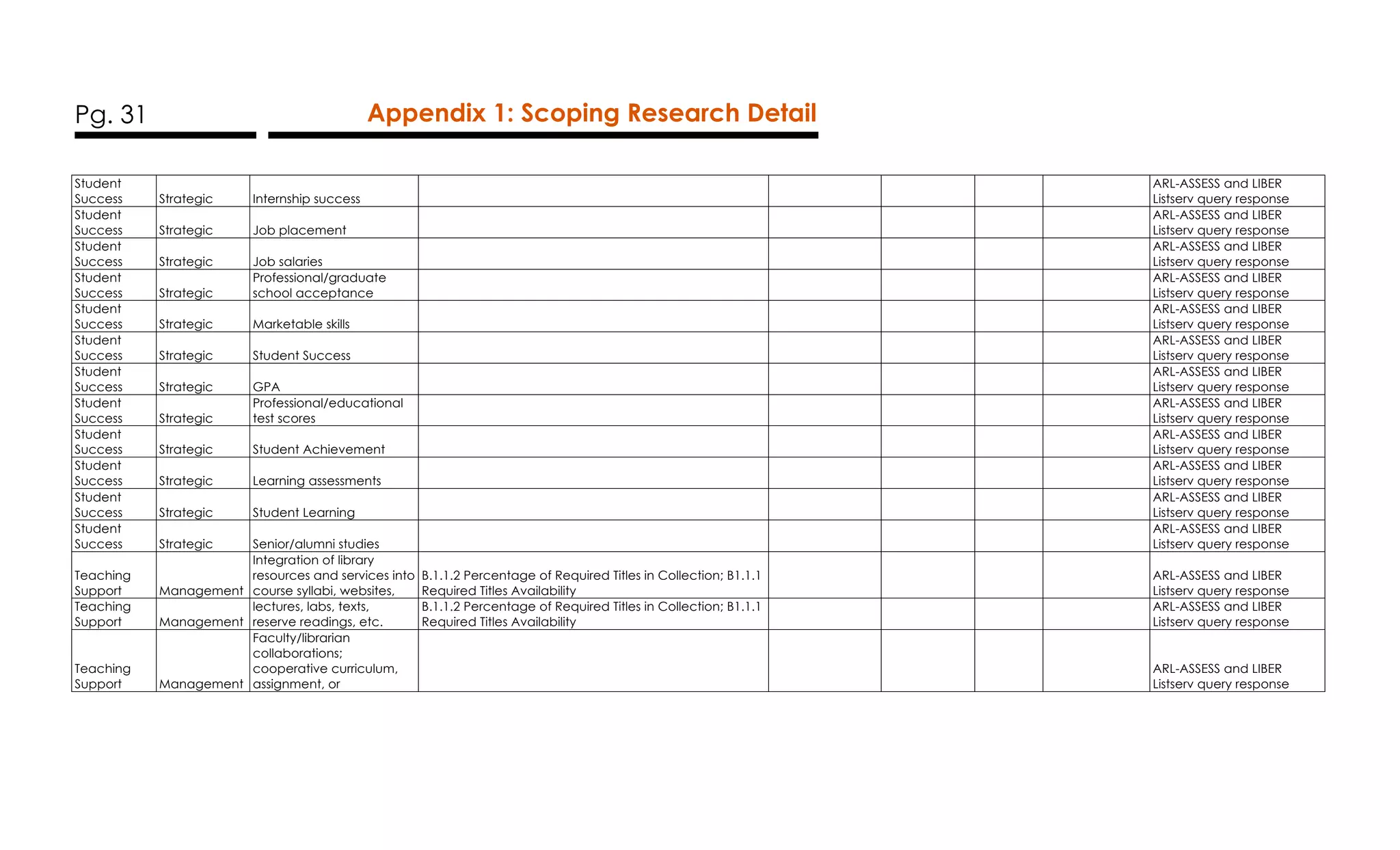
Pg. 31 Appendix 1: Scoping Research Detail
Student
Success Strategic Internship success
ARL-ASSESS and LIBER
Listserv query response
Student
Success Strategic Job placement
ARL-ASSESS and LIBER
Listserv query response
Student
Success Strategic Job salaries
ARL-ASSESS and LIBER
Listserv query response
Student
Success Strategic
Professional/graduate
school acceptance
ARL-ASSESS and LIBER
Listserv query response
Student
Success Strategic Marketable skills
ARL-ASSESS and LIBER
Listserv query response
Student
Success Strategic Student Success
ARL-ASSESS and LIBER
Listserv query response
Student
Success Strategic GPA
ARL-ASSESS and LIBER
Listserv query response
Student
Success Strategic
Professional/educational
test scores
ARL-ASSESS and LIBER
Listserv query response
Student
Success Strategic Student Achievement
ARL-ASSESS and LIBER
Listserv query response
Student
Success Strategic Learning assessments
ARL-ASSESS and LIBER
Listserv query response
Student
Success Strategic Student Learning
ARL-ASSESS and LIBER
Listserv query response
Student
Success Strategic Senior/alumni studies
ARL-ASSESS and LIBER
Listserv query response
Teaching
Support Management
Integration of library
resources and services into
course syllabi, websites,
B.1.1.2 Percentage of Required Titles in Collection; B1.1.1
Required Titles Availability
ARL-ASSESS and LIBER
Listserv query response
Teaching
Support Management
lectures, labs, texts,
reserve readings, etc.
B.1.1.2 Percentage of Required Titles in Collection; B1.1.1
Required Titles Availability
ARL-ASSESS and LIBER
Listserv query response
Teaching
Support Management
Faculty/librarian
collaborations;
cooperative curriculum,
assignment, or
ARL-ASSESS and LIBER
Listserv query response
Pg. 32 Appendix 1: Scoping Research Detail
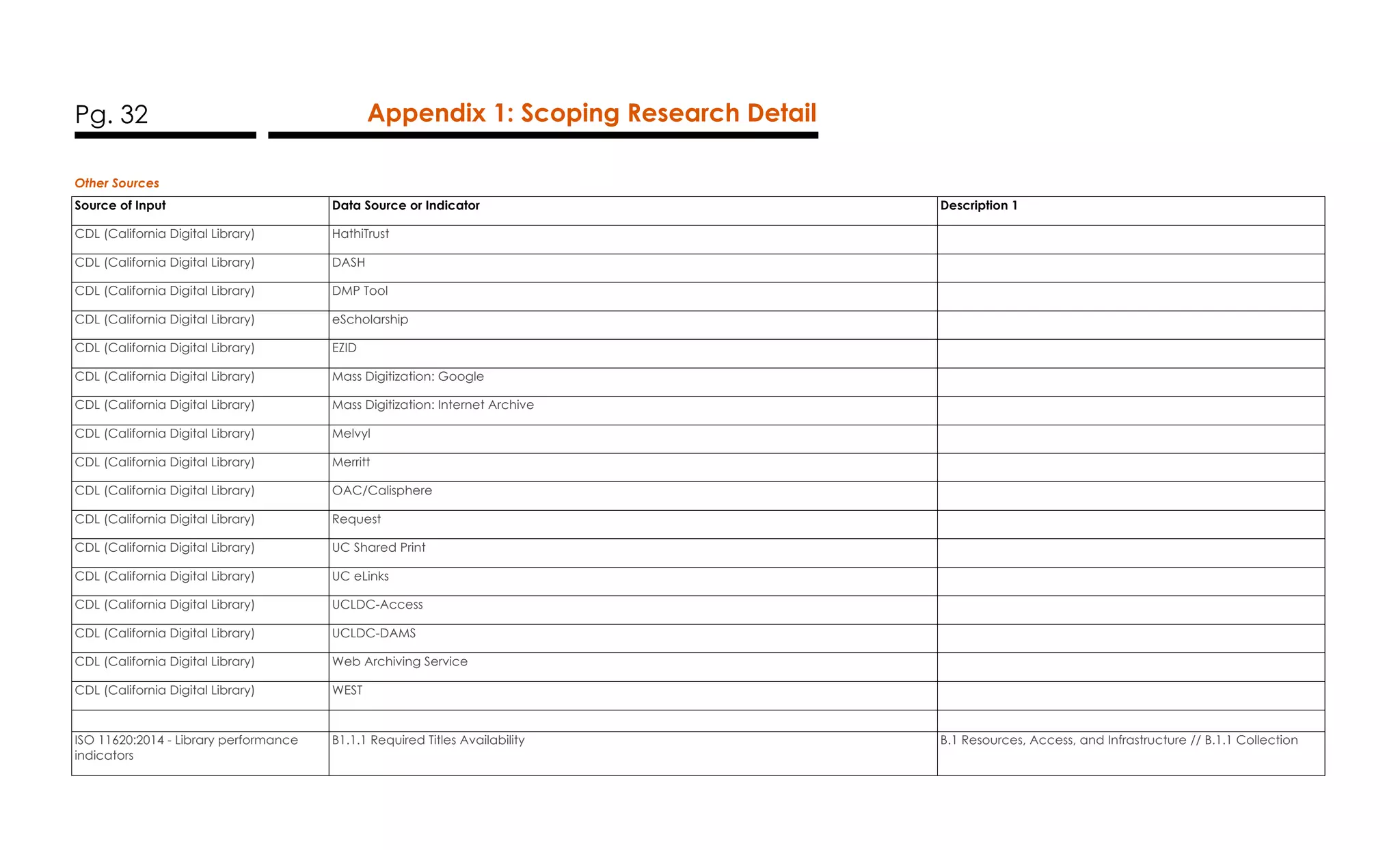
Other Sources
Source of Input Data Source or Indicator Description 1
CDL (California Digital Library) HathiTrust
CDL (California Digital Library) DASH
CDL (California Digital Library) DMP Tool
CDL (California Digital Library) eScholarship
CDL (California Digital Library) EZID
CDL (California Digital Library) Mass Digitization: Google
CDL (California Digital Library) Mass Digitization: Internet Archive
CDL (California Digital Library) Melvyl
CDL (California Digital Library) Merritt
CDL (California Digital Library) OAC/Calisphere
CDL (California Digital Library) Request
CDL (California Digital Library) UC Shared Print
CDL (California Digital Library) UC eLinks
CDL (California Digital Library) UCLDC-Access
CDL (California Digital Library) UCLDC-DAMS
CDL (California Digital Library) Web Archiving Service
CDL (California Digital Library) WEST
ISO 11620:2014 - Library performance
indicators
B1.1.1 Required Titles Availability B.1 Resources, Access, and Infrastructure // B.1.1 Collection
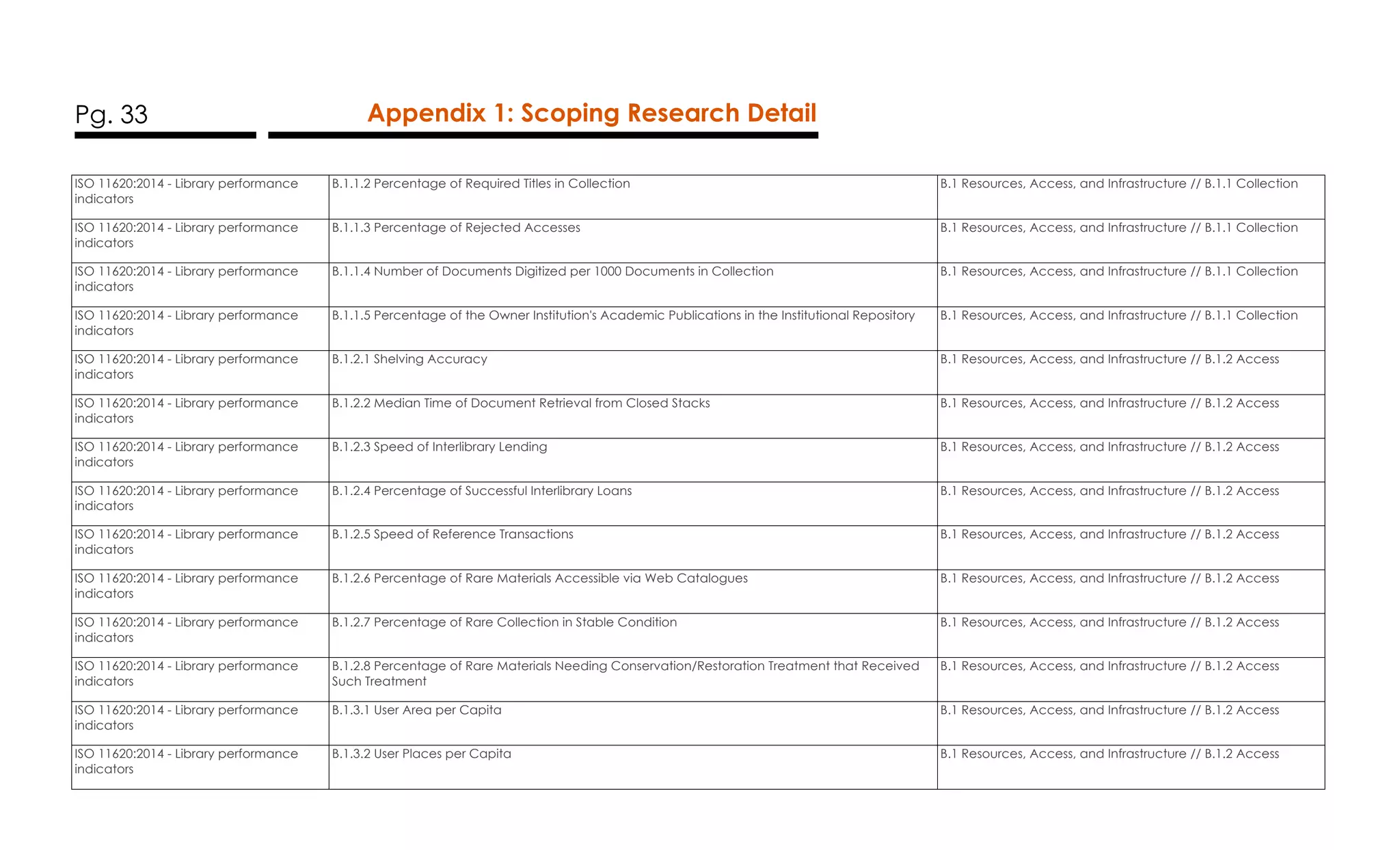
Pg. 33 Appendix 1: Scoping Research Detail
ISO 11620:2014 - Library performance
indicators
B.1.1.2 Percentage of Required Titles in Collection B.1 Resources, Access, and Infrastructure // B.1.1 Collection
ISO 11620:2014 - Library performance
indicators
B.1.1.3 Percentage of Rejected Accesses B.1 Resources, Access, and Infrastructure // B.1.1 Collection
ISO 11620:2014 - Library performance
indicators
B.1.1.4 Number of Documents Digitized per 1000 Documents in Collection B.1 Resources, Access, and Infrastructure // B.1.1 Collection
ISO 11620:2014 - Library performance
indicators
B.1.1.5 Percentage of the Owner Institution's Academic Publications in the Institutional Repository B.1 Resources, Access, and Infrastructure // B.1.1 Collection
ISO 11620:2014 - Library performance
indicators
B.1.2.1 Shelving Accuracy B.1 Resources, Access, and Infrastructure // B.1.2 Access
ISO 11620:2014 - Library performance
indicators
B.1.2.2 Median Time of Document Retrieval from Closed Stacks B.1 Resources, Access, and Infrastructure // B.1.2 Access
ISO 11620:2014 - Library performance
indicators
B.1.2.3 Speed of Interlibrary Lending B.1 Resources, Access, and Infrastructure // B.1.2 Access
ISO 11620:2014 - Library performance
indicators
B.1.2.4 Percentage of Successful Interlibrary Loans B.1 Resources, Access, and Infrastructure // B.1.2 Access
ISO 11620:2014 - Library performance
indicators
B.1.2.5 Speed of Reference Transactions B.1 Resources, Access, and Infrastructure // B.1.2 Access
ISO 11620:2014 - Library performance
indicators
B.1.2.6 Percentage of Rare Materials Accessible via Web Catalogues B.1 Resources, Access, and Infrastructure // B.1.2 Access
ISO 11620:2014 - Library performance
indicators
B.1.2.7 Percentage of Rare Collection in Stable Condition B.1 Resources, Access, and Infrastructure // B.1.2 Access
ISO 11620:2014 - Library performance
indicators
B.1.2.8 Percentage of Rare Materials Needing Conservation/Restoration Treatment that Received
Such Treatment
B.1 Resources, Access, and Infrastructure // B.1.2 Access
ISO 11620:2014 - Library performance
indicators
B.1.3.1 User Area per Capita B.1 Resources, Access, and Infrastructure // B.1.2 Access
ISO 11620:2014 - Library performance
indicators
B.1.3.2 User Places per Capita B.1 Resources, Access, and Infrastructure // B.1.2 Access
Pg. 34 Appendix 1: Scoping Research Detail
ISO 11620:2014 - Library performance
indicators
B.1.3.3 Hours Open Compared to Demand B.1 Resources, Access, and Infrastructure // B.1.2 Access
ISO 11620:2014 - Library performance
indicators
B.1.3.4 Percentage of Storage Space Which Has an Appropriate Environment B.1 Resources, Access, and Infrastructure // B.1.2 Access
ISO 11620:2014 - Library performance
indicators
B.1.4.1 Staff per Capita B.1 Resources, Access, and Infrastructure // B.1.2 Access
ISO 11620:2014 - Library performance
indicators
B.2.1.1 Collection Turnover B.2 Use // B.2.1 Collection
ISO 11620:2014 - Library performance
indicators
B.2.1.2 Loans per Capita B.2 Use // B.2.1 Collection
ISO 11620:2014 - Library performance
indicators
B.2.1.3 Percentage of Stock Not Used B.2 Use // B.2.1 Collection
ISO 11620:2014 - Library performance
indicators
B.2.1.4 Number of Content Units Downloaded per Capita B.2 Use // B.2.1 Collection
ISO 11620:2014 - Library performance
indicators
B.2.1.5 Number of Downloads per Document Digitized B.2 Use // B.2.1 Collection
ISO 11620:2014 - Library performance
indicators
B.2.2.1 Library Visits per Capita B.2 Use // B.2.2 Access
ISO 11620:2014 - Library performance
indicators
B.2.2.2 Percentage of External Users B.2 Use // B.2.2 Access
ISO 11620:2014 - Library performance
indicators
B.2.2.3 Percentage of the Total Library Lending to External Users B.2 Use // B.2.2 Access
ISO 11620:2014 - Library performance
indicators
B.2.2.4 User Attendances at Library Events per Capita B.2 Use // B.2.2 Access
ISO 11620:2014 - Library performance
indicators
B.2.2.5 Number of User Attendances at Training Lessons per Capita B.2 Use // B.2.2 Access
ISO 11620:2014 - Library performance
indicators
B.2.3.1 User Places Occupancy Rate B.2 Use // B.2.3 Facilities
Pg. 35 Appendix 1: Scoping Research Detail
ISO 11620:2014 - Library performance
indicators
B.2.4.1 Percentage of the Target Population Reached B.2 Use // B.2.4 General
ISO 11620:2014 - Library performance
indicators
B.2.4.2 User Satisfaction B.2 Use // B.2.4 General
ISO 11620:2014 - Library performance
indicators
B.2.4.3 Willingness to Return B.2 Use // B.2.4 General
ISO 11620:2014 - Library performance
indicators
B.3.1.1 Cost per Collection Use B.3 Efficiency // B.3.1 Collection
ISO 11620:2014 - Library performance
indicators
B.3.1.2 Acquisition cost per Collection Use B.3 Efficiency // B.3.1 Collection
ISO 11620:2014 - Library performance
indicators
B.3.1.3 Cost per Download B.3 Efficiency // B.3.1 Collection
ISO 11620:2014 - Library performance
indicators
B.3.2.1 Median Time of Document Acquisition B.3 Efficiency // B.3.2 Access
ISO 11620:2014 - Library performance
indicators
B.3.2.2 Median Time of Document Processing B.3 Efficiency // B.3.2 Access
ISO 11620:2014 - Library performance
indicators
B.3.3.1 User Services Staff as a Percentage of Total Staff B.3 Efficiency // B.3.3 Staff
ISO 11620:2014 - Library performance
indicators
B.3.3.2 Correct Answer Fill Rate B.3 Efficiency // B.3.3 Staff
ISO 11620:2014 - Library performance
indicators
B.3.3.3 Ratio of Acquisition Expenditures to Staff Costs B.3 Efficiency // B.3.3 Staff
ISO 11620:2014 - Library performance
indicators
B.3.3.4 Employee Productivity in Media Processing B.3 Efficiency // B.3.3 Staff
ISO 11620:2014 - Library performance
indicators
B.3.3.5 Employee Productivity in Lending and Delivery Services B.3 Efficiency // B.3.3 Staff
ISO 11620:2014 - Library performance
indicators
B.3.3.6 Staff Costs per Title Catalogued B.3 Efficiency // B.3.3 Staff
Pg. 36 Appendix 1: Scoping Research Detail
ISO 11620:2014 - Library performance
indicators
B.3.4.1 Cost per User B.3 Efficiency // B.3.4 General
ISO 11620:2014 - Library performance
indicators
B.3.4.2 Cost per Library Visit B.3 Efficiency // B.3.4 General
ISO 11620:2014 - Library performance
indicators
B.4.1.1 Percentage of Expenditure on Information Provision Spent on the Electronic Collection B.4 Potentials and Development // B.4.1 Collection
ISO 11620:2014 - Library performance
indicators
B.4.2.1 Percentage of Library Staff Providing Electronic Services B.4 Potentials and Development // B.4.2 Staff
ISO 11620:2014 - Library performance
indicators
B.4.2.2 Number of Attendance Hours at Formal Training Lessons per Staff Member B.4 Potentials and Development // B.4.2 Staff
ISO 11620:2014 - Library performance
indicators
B.4.2.3 Percentage of Staff Time Spent in Training B.4 Potentials and Development // B.4.2 Staff
ISO 11620:2014 - Library performance
indicators
B.4.2.4 Percentage of Staff in Cooperative Partnerships and Projects B.4 Potentials and Development // B.4.2 Staff
ISO 11620:2014 - Library performance
indicators
B.4.3.1 Percentage of Library Means Received by Special Grant or Income Generated B.4 Potentials and Development // B.4.3 General
ISO 11620:2014 - Library performance
indicators
B.4.3.2 Percentage of Institutional Means allocated to the Library B.4 Potentials and Development // B.4.3 General
ISO 2789 (2006) - International library
statistics
IARU Indicators University
IARU Indicators Number of students Number of enrolled students at the beginning of the reporting
year
IARU Indicators Number of academic staff Full-time equivalent (FTE) academic staff at the beginning of
the reporting year
Pg. 37 Appendix 1: Scoping Research Detail
IARU Indicators Library
IARU Indicators Number of registered users of the library Registered users of the library who have at least one loan or
other services to their users` account data (i.e. interlibrary loan,
copies, etc.). "Library" means: the central organisational unit
for information access at the university (with central funds, staff
etc.)
IARU Indicators of which members of the university optional (only if the data is available)
IARU Indicators of which external users optional (only if the data is available)
IARU Indicators Number of opening hours per week Total number of regular opening hours per week (max:
27/4=168 hours)
IARU Indicators Number of user workplaces Total number of workplaces (chair+desk or standing
workplace) available in the library to users
IARU Indicators of which workplaces for indivual/quiet studying numer of workplaces dedicated to individual/quiet studying
IARU Indicators of which workplaces in areas for group work number of units for group work (irrespective of individual seats
and desks)
IARU Indicators other workplaces number of places in other areas (e.g. lounge areas etc.)
IARU Indicators Number of rare collections and archives number of units of rare collections and archives belonging to
the library
IARU Indicators Library Staff
IARU Indicators Number of FTE library staff during the reporting year/fiscal year The number of filled or temporarily vacant FTE staff positions at
the beginning of the reporting year/fiscal year that are paid
from funds under library control. Student assistant staff
included.
FTEs of part-time employees are computed by taking the total
number of hours worked per week by part-time employees
and dividing by the number of hours considered by the
reporting library to be a full-time work week. Data are reported
to two decimal places.
IARU Indicators Numer of FTE permanent staff during the reporting year/fiscal year optional (only if the data is available)
Pg. 38 Appendix 1: Scoping Research Detail
IARU Indicators Numer of FTE non-permanent staff during the reporting year/fiscal year optional (only if the data is available)
IARU Indicators Expenditures
IARU Indicators Total library expenditures (currency: USD, exchange rate as of 12/31/2014) The total of all funds (in USD) expended from the library budget
during the reporting year/fiscal year regardless of when the
funds may have been received, including salaries, analog and
digital resources (acquisitions and licensing, current serial
subscriptions, document delivery/interlibrary loan,
preservation, binding), other expenditures for information
resources, bibliographic utilities, expenditures for hardware
and software and all other operating expenditures. If
databases or electronic serials are financed within a
consortium or partially by central funding, only the library's own
expenditure should be counted.
If you do not wish to transfer the sum to USD with exchange
rate as of 12/31/2014 please provide the data in your local
currency and indicate. We will then transfer the sum to USD
with exchange rate as of 12/31/2014.
IARU Indicators of which total salaries staff Total salaries/wages for total FTE in USD
IARU Indicators of which expenditures for resources The total of all funds expended from the library budget during
the reporting year/fiscal year for all forms of resources (analog
and digital) in USD
IARU Indicators Other library expenditures Please only include funds expended from the library budget
and comment on the character of the main expenditures (e.g.
project costs, capital expenditure, furnishing and equipment,
staff training, IT)
IARU Indicators Information Resources
IARU Indicators Digital resources
IARU Indicators Licensed electronic journals Total number of licensed electronic journals (titles)
IARU Indicators Licensed e-books Total number of licensed e-books
IARU Indicators Licensed databases Total number of licensed databases
Pg. 39 Appendix 1: Scoping Research Detail
IARU Indicators Analog resources
IARU Indicators Books, serial backfiles and other paper materials Total number of books, serial backfiles and other paper
materials
IARU Indicators Audiovisual material Total number of audiovisual material by units
IARU Indicators Usage
IARU Indicators Total number of loans Total number of loans including interlibrary loans and
documents provided/lent to other libraries, renewals and initial
transactions included (excluding reserves)
IARU Indicators Digital information, services, databases, networks
IARU Indicators Number of accesses to licensed electronic journals Downloads or pageviews of electronic journals
IARU Indicators Number of accesses to e-books Downloads or pageviews of e-books
IARU Indicators Number of accesses to databases Pageviews or logins
IARU Indicators Services
IARU Indicators Number of trainings Number of trainings (information services) to groups, not to
individuals. Guided tours and presentations at conferences are
excluded.
IARU Indicators Number of virtual trainings Webinars and MOOCs
IARU Indicators Number of face-to-face trainings Face-to-face Traingings and workshops
IARU Indicators Attendance at trainings Total attendance at trainings
IARU Indicators Attendance at virtual trainings Attendance at webinars and MOOCs
IARU Indicators Attendance at face-to-face trainings Attendance at face-to-face trainings and workshops
IARU Indicators Digitisation Number of pages digitized by the library
IARU Indicators Number of pages digitized by the library Number of pages digitized by the library
IARU Indicators Number of pages digitized by a service provider or external partner Number of pages digitized by a service provider or external
Pg. 40 Appendix 1: Scoping Research Detail
partner
IMLS website IMLS Data Catalog (various data sets) https://data.imls.gov/?_ga=1.150154102.1923974197.145560000
6
3. Tools Inventory
A detailed tools inventory follows, indicating the most commonly available tools for business intelligence, data warehousing, library assessment, and data visualization in academic
research libraries.
Tools Supporting Data Analytics, Visualization & Warehousing
Open Proprietary Visualizations/
Dashboarding
Data
Warehousing
Tool Type Tool Name URL Description Notes
Y Y Analytics &
Reporting
Adaptive
Insight
http://www.adaptiveinsights.com/ "Forecasting, reporting, and analysis software for Finance
teams."
Y Y Analytics &
Visualization
Platform
Continuum
Analytics
https://www.continuum.io/
Y Y Y Analytics &
Visualization
Domo https://www.domo.com/industries/ed
ucation
Y Y Analytics &
Visualization
(library use)
Emory
University
Library Use
Dashboard
GitHub
Repository
https://github.com /emory-
libraries/libraryuse
Y Y Analytics &
Visualization
JasperSoft http://www.jaspersoft.com/business-
intelligence-solutions
Y Y Analytics &
Visualization
Kibana https://www.elastic.co/products/kiba
na
See: https://www.elastic.co/blog/kibana-
4-and-civic-hacking-investigating-
campaign-contributions
Pg. 41 Appendix 1: Scoping Research Detail
Y Y Analytics Pentaho http://www.pentaho.com/product/b
usiness-visualization-analytics
Y Y Analytics &
Visualization
Qlikview http://www.qlik.com Tableau competitor
Y Y Y Analytics &
Visualization
(public
libraries)
Savannah http://www.orangeboyinc.com/sava
nnah-overview
"Savannah houses a data warehouse, proprietary customer
segmentation, performance dashboards, target customer
communications and feedback, a powerful data mining and
analytics feature, and GIS mapping capabilities–all in a single
platform."
Introduced late Spring/Summer 2016.
Orange Boy focused on demographic
data.
Y Y Analytics &
Visualization
Platform
Socrata http://www.socrata.com Socrata is a company that provides cloud-based data
visualization and analysis tools for opening government data.
Originally called Blist, Socrata was founded in February 2007.
Socrata targets non-technical Internet users who want to view
and share government, healthcare, energy, education, or
environment data. Its products are issued under a proprietary,
closed, exclusive license.
Y Y Analytics &
Visualization
SpagoBI http://www.spagobi.org/homepage/
product/business-intelligence/
"SpagoBI is the only entirely Open Source Business Intelligence
suite. It covers all the analytical areas of Business Intelligence
projects, with innovative themes and engines. SpagoBI offers a
wide range of analytical tools"
Y Y Analytics &
Visualization
(library
website and
collections
data)
Springshare
LibAnalytics
http://www.springshare.com/libanalyt
ics/
Y Y Analytics &
Visualization
Tableau http://www.tableau.com/ See ARL videos:
https://www.youtube.com/playlist?list=PLaHPIIKtRXCIHA0f1wJ-
raajNS_tW4moi
Y Y Analytics &
Visualization
The R Project
for Statistical
Computing
https://www.r-project.org/ software environment for statistical computing and graphics. It
compiles and runs on a wide variety of UNIX platforms, Windows
and MacOS.
s. http://www.r-bloggers.com/r-in-
business-intelligence/
Y Y Data
visualization
BIRT http://www.eclipse.org/birt/ "An open source technology platform used to create data
visualizations and reports that can be embedded into rich
client and web applications"
Pg. 42 Appendix 1: Scoping Research Detail
Y Y Data
visualization
Chart.js http://www.chartjs.org/ "Chart.js is a tiny open source library that supports just six chart
types: line, bar, radar, polar, pie and doughnut. But the reason I
like it is that sometimes that’s all the charts one needs for a
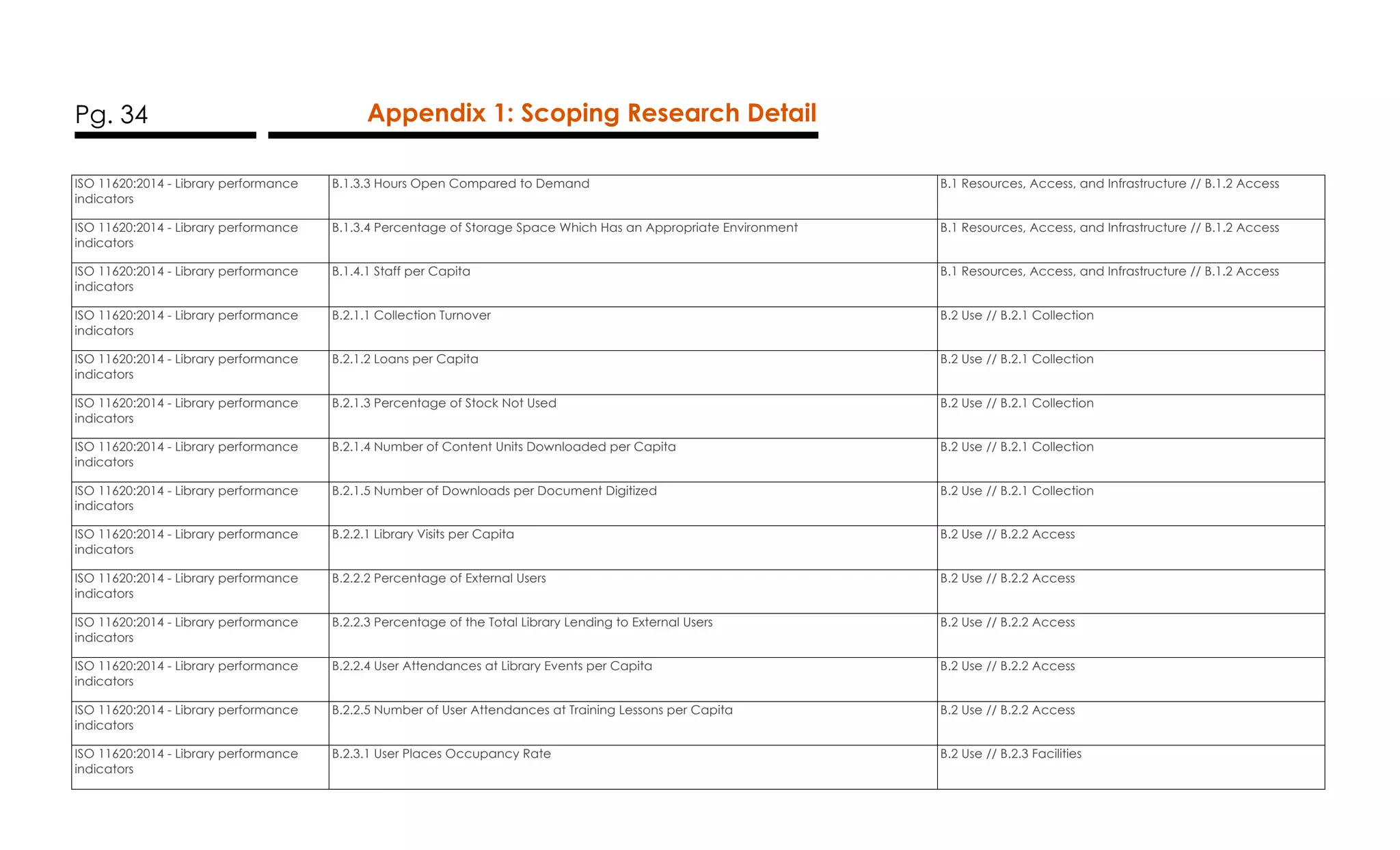
project. If the application is big and complex, then libraries like
Google Charts and FusionCharts makes sense, otherwise for
small hobby projects Chart.js is the perfect solution.
It uses HTML5 canvas element for rendering charts. All the charts
are responsive and use flat design. It is one of the most popular
open-source charting libraries to emerge recently. Check out
the documentation for live examples of all six chart types."
Y Y Data
visualization
D3 Plus http://d3plus.org/ "Data visualization made easy. A javascript library that extends
the popular D3.js to enable fast and beautiful visualizations."
Started in 2014. Visualization examples:
http://d3plus.org/examples/
Y Y Data
visualization
D3.js https://d3js.org/ "D3.js is a JavaScript library for manipulating documents based
on data. D3 helps you bring data to life using HTML, SVG, and
CSS. D3’s emphasis on web standards gives you the full
capabilities of modern browsers without tying yourself to a
proprietary framework, combining powerful visualization
components and a data-driven approach to DOM
manipulation. D3.js, short for ‘Data Driven Documents’, is the
first name that comes to mind when we think of a Data
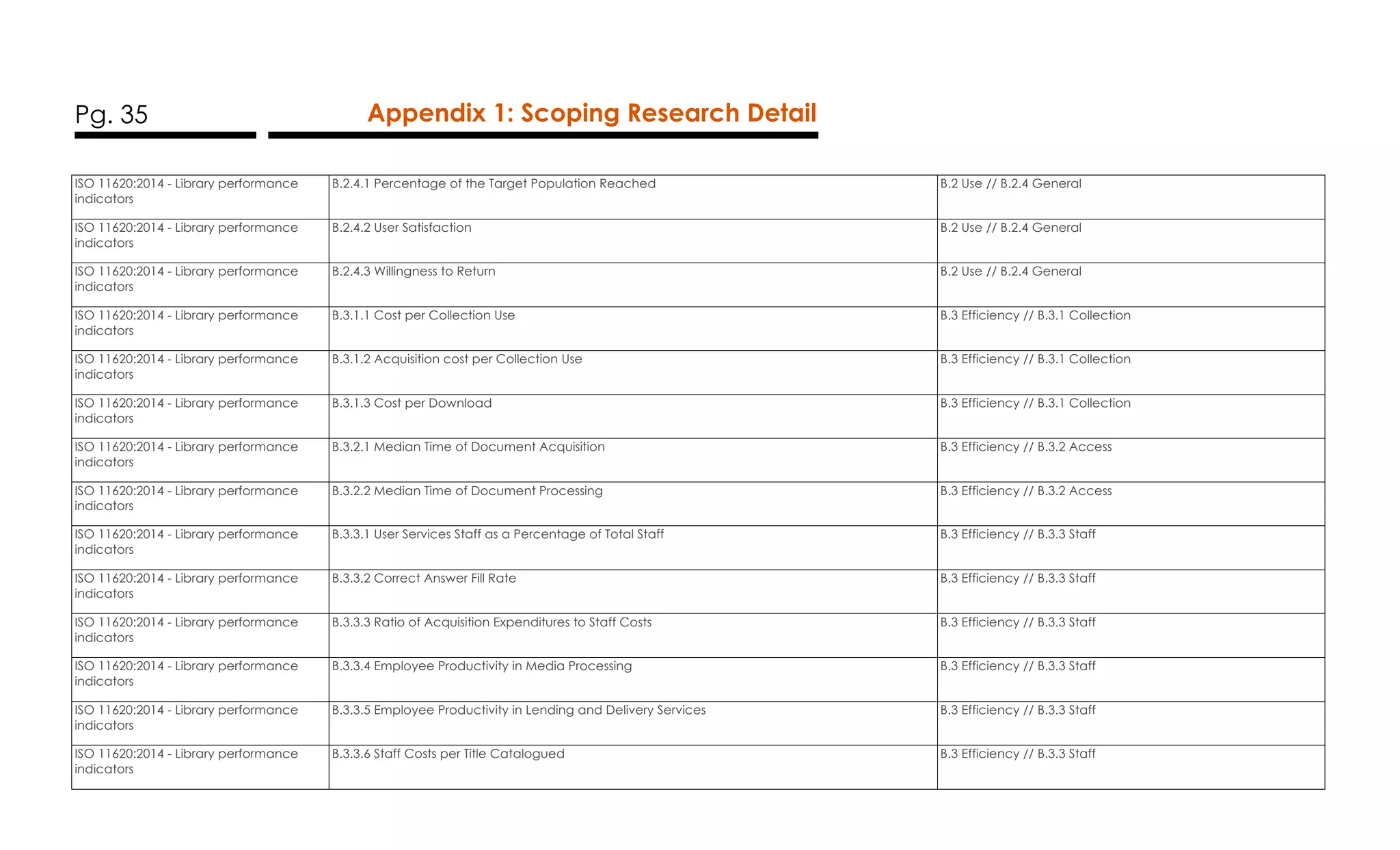
Visualization Software. It uses HTML, CSS, and SVG to render
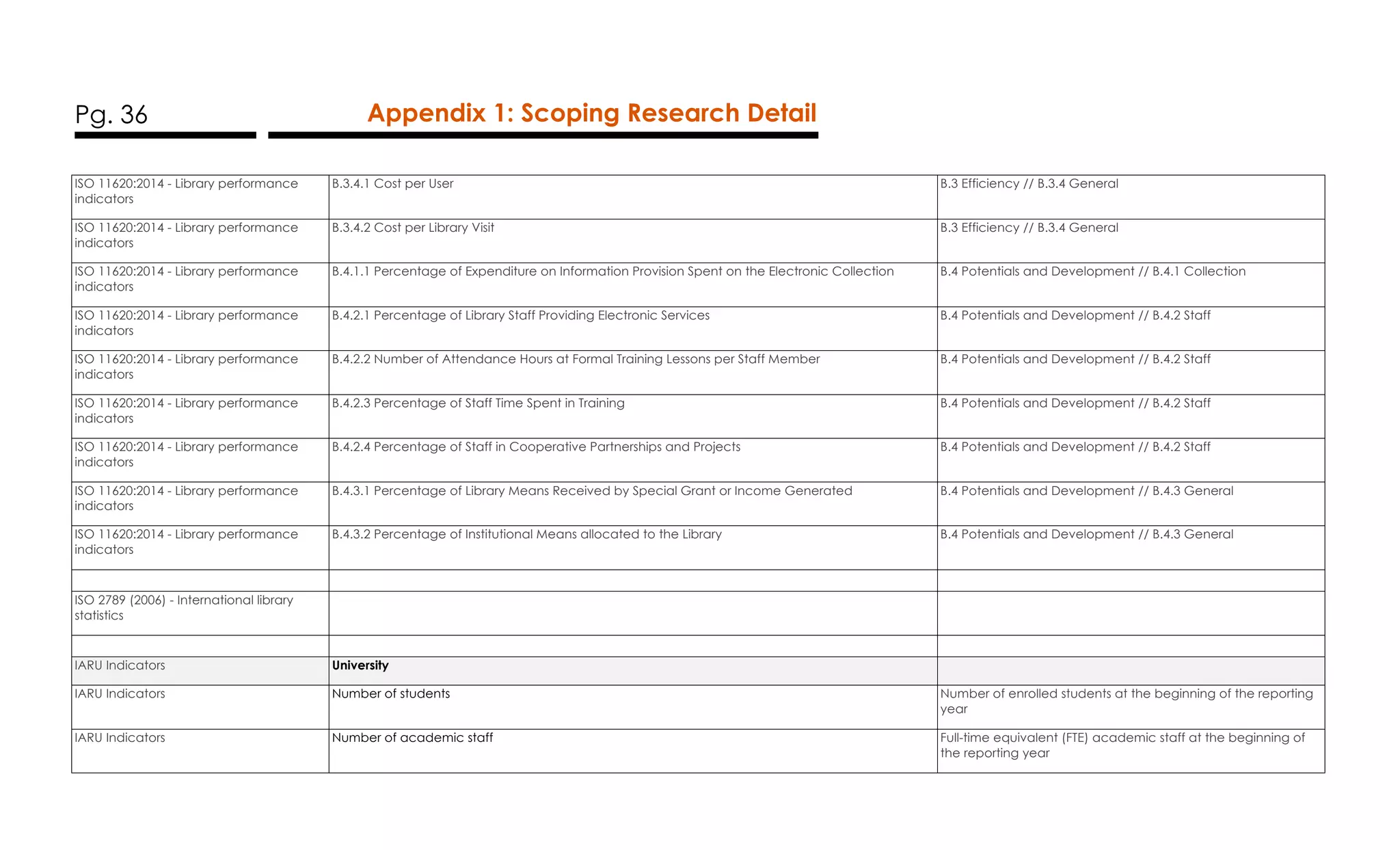
some amazing charts and diagrams. If you can imagine any
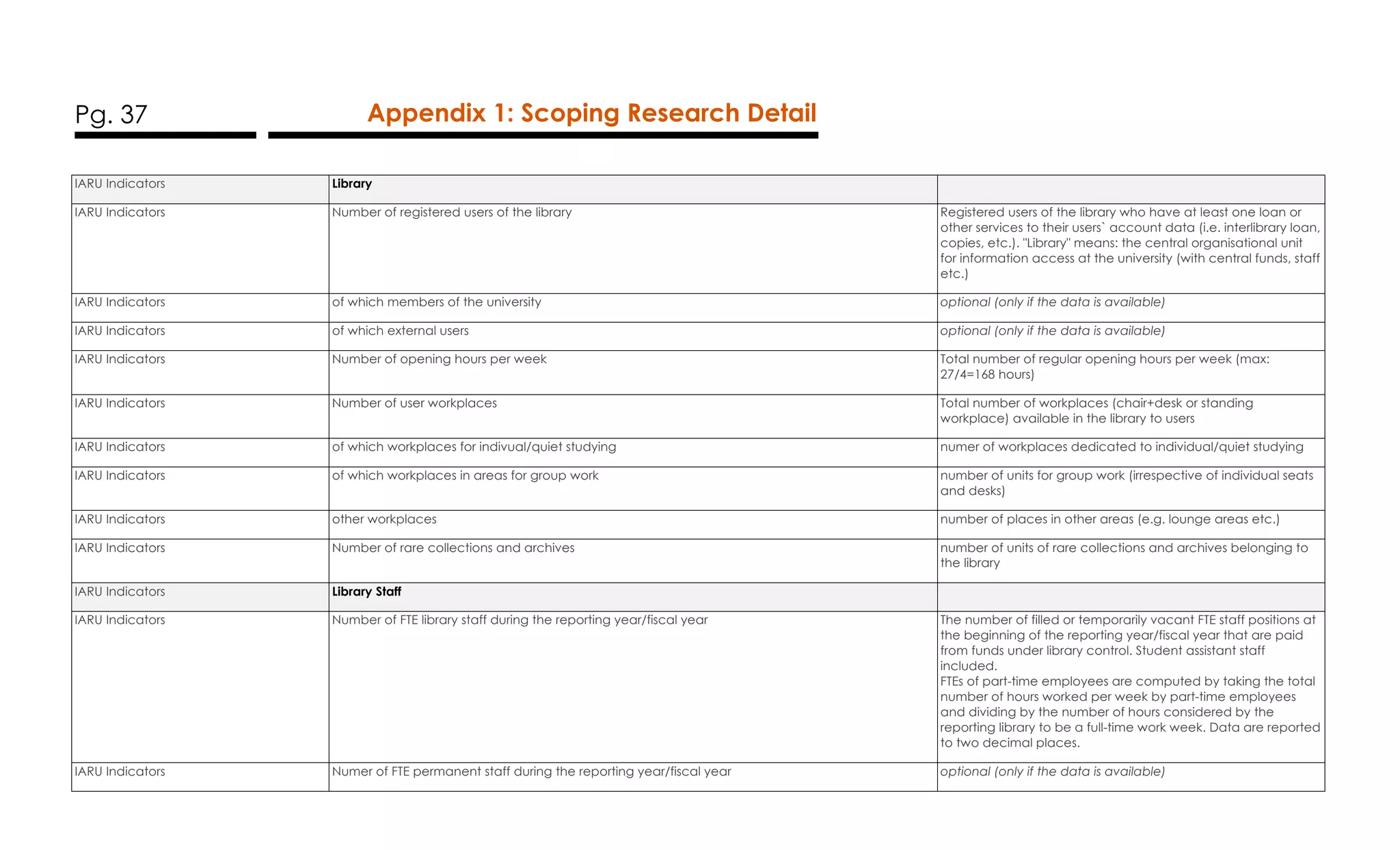
visualization, you can do it with D3. It is feature packed,
interactivity rich and extremely beautiful. Most of all it’s free and
open-source.
It doesn’t ship with pre-built charts out of the box, but has a
nice gallery which showcases what’s possible with D3. There are
two major concerns with D3.js: it has a steep learning curve and
it is compatible only with modern browsers (IE 9+). So pick it up
only when you have enough time in hand and are not
concerned about displaying your charts on older browsers"
Y Y Data
visualization
Datamartist http://www.datamartist.com/
Y Y Y Data
visualization
(basic)
Google Forms
/ Google
Charts
https://developers.google.com/chart
/
Y Y Data
visualization
Microsoft
Power BI
https://powerbi.microsoft.com/en-us/
Pg. 43 Appendix 1: Scoping Research Detail
Y Y Data
visualization
OpenI http://openi.org/ "plug-ins for Jasper and Pentaho"
Y Y Data
visualization
Plotly https://plot.ly/ Plotly only charges for developers and
chart creators. Chart and dashboard
viewers never have to pay for a licence,
or be locked out from a dashboard
because their company has ran out of
licenses.
Y Y Data
visualization
Raw http://raw.densitydesign.org "Raw defines itself as ‘the missing link between spreadsheets
and vector graphics’. It is built on top of D3.js and is extremely
well designed. It has such an intuitive interface that you’ll feel
like you’ve used it before. It is open-source and doesn’t require
any registration.
It has a library of 16 chart types to choose from and all the
processing is done in browser. So your data is safe. RAW is highly
customizable and extensible, and can even accept new
custom layouts."
Y Y Data
visualization
Shiny Apps http://www.shinyapps.io/
Y Y Data
visualization
Visualization
Toolkit (VTK)
http://www.vtk.org/ "The Visualization Toolkit (VTK) is an open-source, freely
available software system for 3D computer graphics, image
processing, and visualization. It consists of a C++ class library
and several interpreted interface layers including Tcl/Tk, Java,
and Python. VTK supports a wide variety of visualization
algorithms including scalar, vector, tensor, texture, and
volumetric methods, as well as advanced modeling techniques
such as implicit modeling, polygon reduction, mesh smoothing,
cutting, contouring, and Delaunay triangulation. VTK has an
extensive information visualization framework and a suite of 3D
interaction widgets. The toolkit supports parallel processing and
integrates with various databases on GUI toolkits such as Qt
and Tk. VTK is cross-platform and runs on Linux, Windows, Mac,
and Unix platforms.
VTK is part of Kitware’s collection of commercially supported
open-source platforms for software development."
Y Y Data
Warehouse
Amazon
Redshift
http://docs.aws.amazon.com/redshift
/latest/mgmt/welcome.html
Hosted solution
Pg. 44 Appendix 1: Scoping Research Detail
Y Y Data
Warehouse,
Analytics
Amazon Web
Services
https://aws.amazon.com/products/?
nc2=h_ql_ny_livestream_blu
Y Y Data
Warehouse
IBM Netezza http://www-
01.ibm.com/software/data/netezza/
Y Y Data
Warehouse
and BI
Learning
Locker
https://learninglocker.net/ "Learning Locker is an open source Learning Record Store (LRS);
a type of database designed to store learning activity
statements generated by xAPI (Tin Can) compliant learning
activities."
Y Y Data
Warehouse
and BI
MetriDoc "IT infrastructure that facilitates the collection, transport, and
use of library activity data. 'Lite Warehousing,' w/ some
reporting views, and some data capture interface"
Sponsored by the University of
Pennsylvania, and funded by the Institute
of Museum and Library Services, Provides
multi-tenant capabilities, as proven
through BorrowDirect data warehousing
for multiple institutions
Y Y Data
Warehouse
and BI
Pentaho http://wiki.pentaho.com/display/CO
M/Community+Wiki+Home
"A Comprehensive Data Integration and Business Analytics
Platform"
Y Y Data
Warehouse
and BI
Talend https://www.talend.com/resource/da
ta-warehouse-tools.html
"The market for data warehouse tools and other integration
technologies is shifting in favor of open source solutions. Talend
is at the forefront of this movement, providing progressive
businesses with open source data warehouse tools that deliver
as much or more quality and functionality as proprietary
solutions, while having substantially lower total cost of
ownership.
Talend offers a range of complementary data warehouse tools
spanning data integration, big data integration, data quality,
and master data management (MDM)."
Pg. 45 Appendix 1: Scoping Research Detail
Adjacent Tools
Open Proprietary Visualizations/D
ashboarding
Data
Warehousing
Tool Type Tool Name URL Description Notes
Y Analytics Cognos
Y Y Analytics &
Visualization
TalentLab https://talent-lab.com/ Focused on human resources market
Y Y Analytics
Consulting
Tessella http://tessella.com "We use data science to accelerate evidence-based decision
making, allowing businesses to improve profitability, reduce costs,
streamline operations, avoid errors and out-innovate the
competition."
Y Any data
source
reporting
SAP Crystal
Reports
http://www.crystalreports.com "Consolidate key metrics and information from multiple sources into
a single dashboard to monitor business performance with SAP®
Crystal Dashboard Design software. Dashboards with what-if analysis
and visualizations such as maps, charts, and gauges present critical
business key performance indicators (KPIs) with drillable, interactive
dashboard views that can be deployed within Microsoft Office
applications, through SAP Crystal Server, or via Flash, web
applications or mobile devices."
from Martha Kyrillidou
Y Y Balanced
Scorecard
reporting
software
Clearpoint
Strategy
https://www.clearpointstrategy.com/ Copyright 2014.
Y Big data
software
Apache
Hadoop
http://hadoop.apache.org/
Y Collection
manageme
nt platform
Alma http://www.exlibrisgroup.com/catego
ry/AlmaOverview
Y Collection
manageme
nt platform
EBSCO
Holdings and
Link
Managemen
t
https://www.ebscohost.com/discover
y/technology/holdings-and-link-
management
"a single administrative module to manage all your holdings;
electronic and print"
Y Collection
manageme
nt platform
Intota http://www.proquest.com/products-
services/intota.html
Intota combines industry-leading discovery, linking, collection
management and assessment in one system built on a
comprehensive knowledgebase.
Pg. 46 Appendix 1: Scoping Research Detail
Y Y Collection
Manageme
nt Tool / ILS
Data
OCLC
GreenGlass
http://www.oclc.org/support/training/
portfolios/library-
management/sustainable-
collections.en.html
ILS & Collection Data
Y Comparativ
e Research
University
Data Set /
Proprietary
Data
Analytics
Portal
Academic
Analytics LLC
http://academicanalytics.com/Public
/WhatWeDo
Mentioned in ACRL's 2010 "The Value
of Academic Libraries" Report
Y Content
Manageme
nt System
DKAN /
Nucivic
http://www.nucivic.com/ "a turnkey open data platform that makes it easy for public sector
institutions to publish data"
Platform: Drupal Primary language:
PHP Database: MySQL, MariaDB,
PostgreSQL, SQL Server or Oracle
Web server: Apache or Nginx
Operating system: Linux, Windows,
OSX or Unix GNU Public License,
version 2
Y Data
cleanup
Open Refine http://openrefine.org/ "OpenRefine (formerly Google Refine) is a powerful tool for working
with messy data: cleaning it; transforming it from one format into
another; and extending it with web services and external data.
Please note that since October 2nd, 2012, Google is not actively
supporting this project, which has now been rebranded to
OpenRefine. Project development, documentation and promotion
is now fully supported by volunteers. Find out more about the history
of OpenRefine and how you can help the community."
Y Data
indexing
and
transformati
on
Catmandu http://librecat.org/Catmandu/ "Catmandu is a command line tool to access and convert data
from your digital library, research services or any other open data
sets. The toolkit was originally developed as part of the LibreCat
project and attracts now an international development team with
many participating institutions."
Currently in use by Goettingen team.
Y Data mining SAS Enterprise
Miner
http://www.sas.com/en_us/software/
analytics/enterprise-miner.html
Y Data
mining and t
ext
analytics sof
SPSS Modeler http://www-
01.ibm.com/software/analytics/spss/p
roducts/modeler/
Pg. 47 Appendix 1: Scoping Research Detail
tware
Y Y Data
Warehouse
SAP Business
Warehouse
http://www.sap.com/pc/tech/data-
warehousing/software/netweaver-
business-warehouse/index.html
Y Digital
Preservation
software /
hardware
LibNova http://www.digitalpreservationsoftwar
e.com/digital-preservation-
solutions/libdata-digital-preservation-
storage/
Y Financial
Reporting
Raptor http://iam.cf.ac.uk/trac/RAPTOR/wiki/
Software/Overview
Raptor is a free to use, open source software suite generally
designed to enable accounting within event-based systems, and
specifically aimed at accounting within systems that handle
authentication events such as the Shibboleth IdP, OpenAthens LA,
and EZproxy. The academic IT services community is the user
community with the requirements that led to the development of
this software, but it should be more generally applicable.
Sponsored by Cardiff University. Log
file analysis for multiple content
types.
Y Google
Analytics
Dashboard
Getting
Found SEO
Cookbook
http://www.clir.org/pubs/reports/pub
165/pub165abst
Sponsoring organization is CLIR
Institutional
Assessment
Manageme
nt System
Academic
Effect
(formerly
WEAVEonline
)
http://academiceffect.com/ Mentioned in ACRL's 2010 "The Value
of Academic Libraries" Report
Institutional
Assessment
Manageme
nt System
eLumen http://elumen.info Mentioned in ACRL's 2010 "The Value
of Academic Libraries" Report
Institutional
Assessment
Manageme
nt System
Nuventive
TracDat
http://www.nuventive.com/products/
tracdat/
Mentioned in ACRL's 2010 "The Value
of Academic Libraries" Report
Institutional
Assessment
Manageme
nt System
Tk20 http://www.tk20.com/ Mentioned in ACRL's 2010 "The Value
of Academic Libraries" Report
Integrated
Advising &
AdvisorTrac See
http://www.nacada.ksu.edu/Resourc
Source: Megan Oakleaf
Pg. 48 Appendix 1: Scoping Research Detail
Planning /
Early Alert
Systems
es/Clearinghouse/View-Articles/Early-
alert-systems-and-resource-links.aspx
ht
Integrated
Advising &
Planning /
Early Alert
Systems
AvisoCoachi
ng
See
http://www.nacada.ksu.edu/Resourc
es/Clearinghouse/View-Articles/Early-
alert-systems-and-resource-links.aspx
Source: Megan Oakleaf
Integrated
Advising &
Planning /
Early Alert
Systems
Copley
Retention
See
http://www.nacada.ksu.edu/Resourc
es/Clearinghouse/View-Articles/Early-
alert-systems-and-resource-links.aspx
Source: Megan Oakleaf
Integrated
Advising &
Planning /
Early Alert
Systems
DropGuard See
http://www.nacada.ksu.edu/Resourc
es/Clearinghouse/View-Articles/Early-
alert-systems-and-resource-links.aspx
Source: Megan Oakleaf
Integrated
Advising &
Planning /
Early Alert
Systems
Early Alert
Retention
Software
See
http://www.nacada.ksu.edu/Resourc
es/Clearinghouse/View-Articles/Early-
alert-systems-and-resource-links.aspx
Source: Megan Oakleaf
Integrated
Advising &
Planning /
Early Alert
Systems
Ellucian
(Banner)
See
http://www.nacada.ksu.edu/Resourc
es/Clearinghouse/View-Articles/Early-
alert-systems-and-resource-links.aspx
Source: Megan Oakleaf
Integrated
Advising &
Planning /
Early Alert
Systems
EMAS
Retention Pro
See
http://www.nacada.ksu.edu/Resourc
es/Clearinghouse/View-Articles/Early-
alert-systems-and-resource-links.aspx
Source: Megan Oakleaf
Integrated
Advising &
Planning /
Early Alert
Systems
GradesFirst See
http://www.nacada.ksu.edu/Resourc
es/Clearinghouse/View-Articles/Early-
alert-systems-and-resource-links.aspx
Source: Megan Oakleaf
Pg. 49 Appendix 1: Scoping Research Detail
Y Integrated
Advising &
Planning /
Early Alert
Systems
Kuali Student
(open
source)
Source: Megan Oakleaf
Y Integrated
Advising &
Planning /
Early Alert
Systems
Open
Academic
Analytics
Initiative
(OAAI)
Source: Megan Oakleaf
Integrated
Advising &
Planning /
Early Alert
Systems
Pharos360 See
http://www.nacada.ksu.edu/Resourc
es/Clearinghouse/View-Articles/Early-
alert-systems-and-resource-links.aspx
Source: Megan Oakleaf
Integrated
Advising &
Planning /
Early Alert
Systems
Starfish Early
Alert System
See
http://www.nacada.ksu.edu/Resourc
es/Clearinghouse/View-Articles/Early-
alert-systems-and-resource-links.aspx
Source: Megan Oakleaf
Integrated
Advising &
Planning /
Early Alert
Systems
Student Early
Alert System
See
http://www.nacada.ksu.edu/Resourc
es/Clearinghouse/View-Articles/Early-
alert-systems-and-resource-links.aspx
Source: Megan Oakleaf
Y Integrated
Advising &
Planning /
Early Alert
Systems
Student
Success Plan
(open
source)
See
http://www.nacada.ksu.edu/Resourc
es/Clearinghouse/View-Articles/Early-
alert-systems-and-resource-links.aspx
Source: Megan Oakleaf
Y Library
services
platform
BlueCloud
Library
Services
Platform
http://www.sirsidynix.com/products/li
brary-services-platform
"BLUEcloud Library Services Platform (LSP) adds cloud-based
features to Horizon and Symphony. Built on Horizon and Symphony’s
efficient back end architecture and a growing array of web
services, BLUEcloud moves libraries into the future of web clients,
evidence-based acquisition, and native eResource management
without losing essential ILS features. Best of all, most BLUEcloud web
clients are included in your Horizon or Symphony maintenance
payments./// BLUEcloud web clients work anywhere, on any device
to give your library insightful analytics, efficient staff workflows, end-
Pg. 50 Appendix 1: Scoping Research Detail
to-end eResource integration, and more. // BLUEcloud Campus is an
open LSP made to serve the specific needs of your academic
library. By combining the top features of EBSCO and SirsiDynix with
products built for education "
Y Library
services
platform
TIND http://tind.io Sponsoring organization is CERN
Y Library
services
platform
Folio https://www.folio.org/platform/ Funded by EBSCO. Delivering in
2017/2018
Y Real-time
Search
Elastic Search https://www.elastic.co/products/elast
icsearch
Y Research
Data
Repository
Directory
RE3Data.org http://re3data.org
ROI
Calculators
ALA ROI in
(mostly
public)
libraries to
users
http://www.ala.org/research/libraries
matter/taxonomy/term/129
ROI
Calculators
Library
Research
Service ROI
Calculators
http://www.lrs.org/data-tools/public-
libraries/roi-calculators/
Y Space
Assessment
Suma http://www.lib.ncsu.edu/dli/projects/s
paceassesstool.
An opensource mobile space assessment platform Sponsored by NCSU libraries
Y SQL
Database
reporting &
visualization
Periscope
Data
https://www.periscopedata.com/#
Web-based
Data
Exploration
Interface
IPEDS Data
Center
http://nces.ed.gov/ipeds/datacenter
/
Sponsored by National Center for
Education Statistics., funded by the
Department of Education. multiple
exportable statistics data formats
Pg. 51 Appendix 1: Scoping Research Detail
Web-based
Data
Exploration
Interface for
ARL stats
Counting
Opinions /
LibPas /
LibStats
http://www.countingopinions.com/ IT infrastructure that Ingests and facilitates the use of data. Used by
ACRLmetrics. provides organizations with innovative,
comprehensive, cost-effective ways to capture, manage and
measure performance data, including open-ended customer
feedback, qualitative and quantitative data, trends, benchmarks,
outcomes and peer comparisons. Counting Opinions web-based
solutions:
Are delivered in real-time and provide organizations with valid,
immediate, 24x7x365 results.
Include powerful "click-only" reports that clearly identify actionable
opportunities for improvement.
Are fully hosted in a secure professionally managed facility, require
minimal or no IT involvement and work across all browsers and
platforms. /// Located in Toronto Canada, Counting Opinions has
been serving the library community since 2004.
Y Qualtrics http://www.qualtrics.com/higher-
education/
Pg. 52 Appendix 1: Scoping Research Detail
4. Requirements Document
A requirements document follows, outlining the functional and nonfunctional
requirements for a library data warehouse and dashboard toolkit.
Functional Requirements
Data Acquisition
System must cope with a mix of low frequency and high frequency sources (daily,
quarterly, annually), which should be updated based on the frequency of the updates
from the data sources
Manual (person-based) ingest: Users should be able to upload Excel documents for locally
gathered data OR be able to input data into a webform
Machine-based ingest: The ability to have data imports to be run at predetermined times,
or related to a business event. From at a minumum the following types of systems and
standards:
Library Management Systems (ExLibris, Innovative, OCLC etc.)
Z39.50, OAI, other exchange systems
eBook vendors and software
Human Resources (PeopleSoft, Hires, etc.)
Insitutional Repository (D-Space, Fedora, etc.)
Interlibrary Loan Software
Google Analytics (or other web analytics)
Social Media Analytics such as Twitter and Instagram
Financial Systems (Oracle, SAP, etc.)
Facilities Management and Estates Software (eg, Planon)
Digitization Management Software (eg., D-Work and Goobi)
Gatecount systems (Salto, Telepen, etc.)
Patron Interaction Recording (SUMA, LibAnalytics, etc.)
Ithaka survey
SFX
SUSHI and COUNTER
Media Monitoring (Meltwater, Vocus, etc.)
Special Collections Management Software (Aeon, etc.)
Pg. 53 Appendix 1: Scoping Research Detail
Print Management Software (PCAS/PCounter, etc.)
Sharepoint
Warehouse Management Software
It must be possible to easily (i.e. without requiring a major project) change the data input
and data transformation processes to meet any changes to the reporting requirements.
That is, the system must support a plugin-based architecture.
Data Cleaning / Normalisation
A set of standard processes that will clean and normalise data. These processes should be
simple enough for a non-programmer to run
Part of the data cleaning should include anonymisation. Users should be able to tell the
systems what data to anonymise.
The system should keep the raw/uncleaned data
Data Manipulation
The ability to view, BUT NOT update information using a custom form.
The ability to view information in a row and column format
The ability to change the data model, fields, or field names but not the entries of the data
Data Inquiry
There should be a basic UI for data inquiry that will return data in (non-visualised form). The
point of this UI would be, for example, to check on the data underlying the visualizations if
something were in doubt.
Simple ad-hoc inquiry for super-users: The ability to enter and execute a query retrieving
information, containing information having, simple sums, counts and averages, grouped
by specified values.
The ability to execute queries within specific constraints E.g. all reader visits between two
dates. This could be done using facets pre-defined facets
Information will be captured at the detail level, perhaps at a transaction level. Would be
useful to see transactional data so that the data can be verified (i.e. find outliers).
The ability to export data into other packages for further analysis in user-definable export
formats (JSON, Excel, XML, SPSS, R)
Data Storage
Versioning and version control
Authentication with different levels of permissions (users v. superusers)
Authentication systems should communicate with existing user directories
Performance Indicators and KPIs User Interface
A user interface with a selection of pre-installed Performance indicators and KPIs.
Users should be able to pick from a list of these PIs/KPIs for display on their dashboard
module
Pg. 54 Appendix 1: Scoping Research Detail
Users should be able to view, but not modify, the underlying formulae (that is, the
relationship between the data and the PI/KPI) with a simple action such as a click or
mouse hover
The ability to create 'local' PIs/KPIs (that is, ones that do not come pre-installed) that will
appear in the dashboard.
Dashboard UI
A tab-based user interface, where each tab contains a set of data visualizations (modules)
organised by library functional area
Within each functional area, the modules that visualize the data / formulas tied to the KPIs
Each dashboard should be pre-populated, but users should be able to de-select modules
from appearing
Users should be able to copy individual visualizations (for pasting into a word doc, for
example)
Standard 'reports' should be creatable and downloadable as pdfs (for sharing)
Non-Functional Requirements
Usability
The solution for inputting / gathering data should be able to be used by infrequent users
without error. The solution should also able to be used by users with minimal training.
Branding
The output from the solution will conform to the branding rules of the University and the
Bodleian Libraries
Performance
Minimum response time - quicker than opening Excel from a shared drive.
Information security
The solution should meet the requirements of the University Information Security policy.
Portability and Accessibility
The ability to use the BI tools from remote locations using VPN.
Bodleian Libraries’ Requirements (from Frankie Wilson)
Category Title Description
Data Inquiry Simple ad-hoc inquiry for
super-users
The ability to enter and execute a query
retrieving information, containing information
having, simple sums, counts and averages,
grouped by specified values.
Data Inquiry Simple ad-hoc inquiry for
users
The ability to enter and execute a query
retrieving information, containing information
Pg. 55 Appendix 1: Scoping Research Detail
having, simple sums, counts and averages,
grouped by specified values.
Data Inquiry Pre-calculated data The ability to have some data that is pre-
calculated, so as to improve the performance
of data queries.
Data Inquiry Prompted ad-hoc
inquires
The ability to execute queries that prompt the
user for constraints when run. E.g. all reader
visits between two dates.
Data Import Scheduled Data Imports The ability to have data imports to be run at
predetermined times, or related to a business
event. Some users would like flexibility in the
extract process so that the frequency of
import can be changed.
Data Inquiry External Sources of
Information
The ability to include information from outside
the Data Warehouse with the data from the
Data Warehouse. This could include
spreadsheets, files, etc.
Data Export Export information for
personal use
The ability to export data into other packages
for further analysis. Examples:
· Import into a spreadsheet
· Import into a personal database
· Reports to PDF
Data Inquiry Use Summary
Information
Information that is aggregated to pre-
determined levels.
Example:
Reader numbers by library by time.
Data Inquiry Use Detail Information Information will be captured at the detail
level, perhaps at a transaction level. Would
be useful to see transactional data so that the
data can be verified (i.e. find outliers).
Data
Manipulation
Custom forms The ability to view and update information
using a custom form.
Data
Manipulation
Spreadsheet view The ability to view information in a row and
column format
Data
Manipulation
Interactive updates The ability to change information in real time
Data
Manipulation
Data Warehouse Write
Back
The ability to change information in real time
and to have those changes audited i.e. who,
when and what.
Data Analysis Forecasting The ability to use the data for forecasting
purposes.
Data Analysis Budgeting The ability to use the data for budgeting
purposes.
Pg. 56 Appendix 1: Scoping Research Detail
Data Analysis Time Series Analysis The ability to perform a time series analysis on
the data
Data Analysis Business Modelling/What
if scenarios
The ability to undertake what if scenarios on
the data to reflect possible outcomes
Data Analysis Goal Seeking The ability to define a desired goal, and have
various factors evaluated to achieve that
goal.
Data Analysis Regression Analysis The ability to analyse how different variables
affect an outcome, and use that data to
predict outcomes for other data series.
Data Analysis Financial Functions The ability to use financial functions such as
IRR and NPV.
Data Analysis Statistical Functions The ability to use simple and advanced
statistical functions.
Data Analysis Segmentation The ability to define groups based on a
criteria, and then re-use that group for further
analysis.
Reporting Columnar Reports There will be report types that allow
information to be listed in columns with
column headings.
Reporting Cross tab or pivoted
Reports
There will be pivoted or cross tabular reports
type in the reposting tools.
Reporting Banded Reports There will be banded reports available in the
reporting tools.
Reporting Aggregation The reporting tool will have the ability to
create totals and sub-totals.
Reporting Complex Calculations The reporting tool will have the ability to
undertake complex calculations, for example
Percent of Total, Rolling Sums and Period
Comparisons.
Reporting Drill Up and Drill Down The reporting tool should have the ability to
view information at a specific level and be
able to drill up and down the various
hierarchies.
Reporting Mixed Text and Graphics The reporting tool must be able to mix text
and graphics when generating reports.
Reporting Cosmetic Control The reporting tool must be able to have
various text controls including different fonts,
bolding ,etc.
Reporting Exception Reporting The reporting tool must have the ability to
produce exception reports, for example:
· Book sales drop by 10%
· Visitor numbers increase by 50%
Reporting Report templates The reporting tool will support templates so
that report layouts and designs can be
Pg. 57 Appendix 1: Scoping Research Detail
reused.
Reporting Prompted Reports The reporting tool will allow reports to be
created that allow users to be prompted for
criteria.
Reporting Reporting Preferences The ability to provide custom reports and to
set preferences for content or constraints.
Graphics Chart Types The reporting tool will provide the following
sets of charts for incorporation within reports:
Pie, bar, stacked bar, line, high/low, radar,
area, histograms, combinations.
Graphics Multiple Scales The reporting tool will support the use of
multiple scales on graphs.
Graphics Split Scales The reporting tool will support the use of split
scales in graphs.
Graphics Median Line The reporting tool will allow the addition of a
median line to a graph.
Graphics Text The reporting tool will allow the placement of
text on graphs for annotation purposes.
Graphics Slide Shows The reporting tool will allow slide shows to be
created for presentation purposes.
Graphics Custom Drawing The reporting tool will have drawing functions
to allow custom objects to be added to
reports.
Graphics Maps The reporting tool will allow maps to be used
on reports.
Graphics Clip Art The reporting tool will have clip art to use on
reports.
Graphics Chart templates The reporting tool will have the ability to have
chart templates so that charts can be reused.
Graphics Automatic Updates When data is updated any reports/charts
using that data will automatically be
updated.
Automation Task Automation The ability to automate frequently run tasks.
Automation Complete/Advanced
Automation
The ability to fully automate a business
function requiring many steps
Automation Scheduled Automation The ability to have common tasks executed
at predetermined times or according to
Business Events
Portability and
Accessibility
Remote Access to Tools -
Mobile
The ability to use the BI tools from remote
locations using mobile devices
Portability and
Accessibility
Remote Access to tools –
VPN
The ability to use the BI tools from remote
locations using VPN.
Portability and
Accessibility
Internal Collaboration –
Email
The ability to share access to BI reports with
persons inside the library using email.
Pg. 58 Appendix 1: Scoping Research Detail
Portability and
Accessibility
Internal Collaboration –
Publish on a Portal
The ability to share access to BI reports with
persons inside the library by publishing to a
portal.
Portability and
Accessibility
External Collaboration The ability to send BI reports to persons outside
the library.
Look and feel Branding The output from the solution will conform to
the branding rules of the University and the
Bodleian Libraries
Usability Usability The solution for inputting / gathering data
should be able to be used by infrequent users
without error. The solution should also able to
be used by users with minimal training.
Usability Data input The process for inputting data should not
impose unnecessary or incorrect data
hierarchies onto those inputting data.
Performance Performance Volume of data
Performance Performance Minimum response time - quicker than
opening Excel from a shared drive.
Maintainability
and Portability
Maintainability It must be possible to easily (i.e. without
requiring a major project) change the data
input and data transformation processes to
meet any changes to the reporting
requirements.
Maintainability
and Portability
Portability The solution should be designed such that it
can be used as a template for use in other
University units with minimal rework.
Security Security The solution should meet the requirements of
the University Information Security policy.
Legal Data Protection As it is possible that the solution will hold
information that could identify an individual
the solution will have to meet the appropriate
legal requirements such as the DPA.
Data Updates Data Updates Data should be updated based on the
frequency of updates from the source data,
this could be anything from daily to annual.
Users No. of Users No. of Super Users – 2
No of users to input data - 50
No. of users to view reports – 50 to 100
Portability and
Accessibility
Remote Access to Tools -
Mobile
The ability to use the BI tools from remote
locations using mobile devices
Portability and
Accessibility
Remote Access to tools –
VPN
The ability to use the BI tools from remote
locations using VPN.
Pg. 59 Appendix 1: Scoping Research Detail
5. Interviewees
In addition to the needs identified (see Appendix 1.4) by core research team
participants at UCD, Oxford, and Göttingen, approximately 20 individuals at the
following institutions were interviewed in 9 sessions to validate and elaborate user
needs:
• Duke University
• University of Pennsylvania
• Yale University
• Charlotte-Mecklenberg Public Library
• Syracuse University iSchool
• Wollongong University Library, Australia
• Harvey Mudd College
• Jisc UK
Pg. 60 Appendix 1: Scoping Research Detail
6. Preliminary Dashboard User Interface Concept
Pg. 61 Appendix 2: Proposed Model Project Plan
Appendix 2: Proposed Model Project
Plan
1. Definitions
We define the toolkit as a set of documented standards, best practices, scripts,
and off-the-shelf and/or open source analytics modules to leverage existing data
sources, along with supporting infrastructures, together enabling libraries to
implement their own library assessment executive dashboard.
Within the context of this project, we define the Dashboard as:
A locally-deployable or fully-hosted (cloud-based) service that adheres to all of
the standards and best-practices defined by the toolkit (above), and provides a
standard (but customizable) set of visualizations of user data.
We define Data Warehousing Solution (again, within the context of this project)
as:
A means by which libraries can store, access, interact with, and visualize data
provisioned from multiple sources.
2. Proposal
To restate: what is proposed is a three-year project to create a robust and
community-supported toolkit that will enable users to implement their own library
executive assessment dashboard. While the team had considered
recommending the approach of designing and then developing a full-service,
hosted dashboard (not unlike OCLC’s GreenGlass collection assessment
product), we feel that the long rollout and complexity of this approach makes a
toolkit-centered approach a more reasonable and practical first effort.
By taking a toolkit-based approach, institutions would be able to take the most
appropriate implementation path for their situation and make use of institutional
tools as either recommended or locally prescribed. The approach would allow,
for example, an institution to focus on a data gathering and normalizing strategy
Pg. 62 Appendix 2: Proposed Model Project Plan
and then apply it to their data warehousing solution. One interviewee said, “Our
biggest issue is getting and keeping the data and getting it clean. Data is
scattered and it’s messy.” By starting with solutions for data normalization, that
project team can focus efforts where they are currently most needed locally.
This approach will also allow focus on the creation of a robust and community-
supported foundational framework of performance indicators and data sources.
The rollout of such a framework would be essential to both the adoption of the
toolkit and to the ability to compare and benchmark data across institutions.
Perhaps most importantly, the toolkit approach would also support early
adoption by libraries that have already put some work into their own assessment
tools but need solutions for gaps in their program. In turn, we would hope these
early adopters become champions of the toolkit and support others in the
community who are starting from scratch.
There are six core components of the proposed toolkit:
1. Data sources. A set of standardized, key data elements originating from
multiple platforms and systems. The elements contribute to an understanding
of library performance over time. Documentation will be compiled with
references to the data elements' originating systems, access protocols, and
instructions for how to work with the data. The standardization here allows for
cross-institution comparisons and benchmarking. Examples vary from gate
count data to reference desk statistics, authentication data, web analytics,
financial data, and physical space data (e.g., shelf space, rooms booked,
etc.). Instructions for “how to work with the data” will include guidance such
as how to get statistical data about collections out of the most commonly-
used library management systems, and how to export Google Analytics data
via API.
2. Data dictionary. Accepted definitions for all of the common data sources to
ensure that institutions are comparing items appropriately.
3. Data cleaning library. A library of instructions and operations (scripts,
commands) to clean, transform, and/or normalize key data sources.
4. Library assessment framework. The framework is a library of measurable
indicators of performance, each with an associated formula that explains the
Pg. 63 Appendix 2: Proposed Model Project Plan
relationship between the data and the indicator. Developing standards
around data sources should provide clear guidance on how the data can
contribute to key strategic and managerial questions facing libraries. In a
similar vein, prioritizing some data sources over others constitutes an implicit
recommendation to stop collecting data in certain areas. As an example of a
performance indicator, the project could establish a standard formula for
determining the cost of storing a book on a shelf. Local costs for staff,
materials, systems, climate control, etc. will vary across institutions, but the
formula should remain consistent. To take another example, to understand
the gap between interlibrary loan requests received by a library versus the
number of ILL requests it fulfills, the toolkit would supply the formula:
Ratio of requests received to requests sent out in interlibrary lending /
document supply = # requests received from other libraries / #requests
received from users for items from other libraries.
The proposed project would start with the ISO Library Performance Indicators
and fill in gaps identified by the community.
5. User interface. Having cleaned and/or normalized the data, the user
interface (UI) should provide a standard set of visualizations (i.e., a
dashboard) that map onto the performance indicators.
6. A data-warehousing solution. A means by which libraries can store, archive,
and preserve in a common way data originating from multiple sources. In
addition to the various proprietary data warehouses in use across educational
institutions (Oracle, IBM, etc.), the project team has identified at least three
potentially viable open options (MetriDoc, Pentaho, and Learning Locker).
And while not, per se, a component of the toolkit, an active and supportive User
Community would be crucial to the success and long term sustainability of the
work. Institutions will need support to be able to initiate participation; to add,
modify, and contribute to the tools and standards in ways that benefit them; and
contribute their modifications back to the community on a regular basis.
3. Expected Outcomes and Benefits
Ultimately, the aim of this project is to facilitate evidence-based decision-making
and management of library services, resources, and assets, using existing library
Pg. 64 Appendix 2: Proposed Model Project Plan
and institutional data sources. The library assessment executive dashboard toolkit
will collect and standardize the presentation of data from multiple sources, for
access, viewing, and comparing. The toolkit will provide a much-needed
centralized view into multiple data sources to support decision making related to
departmental budget allocations, personnel allocations, and space planning;
stewardship of existing library materials and procurement of new resources
(including collection development, purchase, and subscription/renewal
decisions); and more. By standardizing and centralizing these data, their
colocation can more readily provide meaningful contexts for analysis and
decision-making. Libraries should be able to use the resulting toolkit of standards,
best practices, scripts, and off-the-shelf and/or open source analytics modules to
leverage their own existing data sources and supporting infrastructures.
Phases 1-3 set the stage for a future shared service to support institutions’ data-
warehousing and data-sharing needs. Several nascent initiatives in the higher
education and research impact assessment space (e.g., UK Jisc’s HEIDI Plus, HEIDI
Lab, Library Labs, Learning Analytics, and National Research Information
Infrastructure initiatives), and in the library technology and services landscape
(e.g., Folio, funded by EBSCO and developed by Index Data; TIND, formerly
Envinio, and originally developed by CERN), will be more mature at the time
Phase 3 begins. At that point, we will be able to assess where and how the
dashboard and toolkit can further integrate with evolving systems and institutional
assessment initiatives, and better support libraries’ evolving workflows and
business intelligence needs.
4. Preliminary Staffing Plan
• (SPM) Strategic Project Manager
• A21 will serve as strategic project lead for this project, coordinating with
the Local Project Managers at participating pilot institutions
• Coordinates with other major initiatives and organizations, including
crucially finding the right ‘home’ for the project
• Submits project reports to funder(s)
• Researches business models and sustainability
Pg. 65 Appendix 2: Proposed Model Project Plan
• (LAE) Library Assessment Expert/Community Engagement Manager
• Designs the Framework and Data Dictionary
• Manages the engagement with the Library Assessment Community
• (LPM) Local Project Managers
• Day-to-day local project management/Coordination at each institution
• (DW) Local Data Wrangler
• Person responsible for gathering and organizing the disparate data sets
from each institution
• (D) Developers
• Software development
• Installation of the reference implementations at each institution
• Respond to testing and feedback by making improvements to initial
installations
• (TCEM) Technical Community Engagement Manager
• Engages with the technical community around the toolsets
• Manages the project GitHub account and ensures all code is well
documented and available when ready
5. Roadmap
As a result of the scoping work reported here, the project team has proposed a
roadmap for the project that divides the work into four distinct phases.
Phase 0. Establish Sponsorship, Project Governance, and Team
The project will require organizational infrastructure and support, procuring
funding sources, and a strategic project management team to support the
follow-on phases
Work Packages
WP0.1. Organizational Support
Deliverable: Creating a new organizational entity responsible for the support and
development of the toolkit, established under an appropriate umbrella
Pg. 66 Appendix 2: Proposed Model Project Plan
organization.
Effort Required: 1 x 0.1 Strategic Project Manager for 12 months
No one institution can (or should) take responsibility for the sustainability of the
project, so a consortium needs to be recruited or created to manage the work
and outputs of the community over the long term; a new managerial and
economic organization needs to be established. Modeled on the International
Image Interoperability Framework (IIIF) consortium, the organization would
manage the work to ensure efforts are not duplicated and identify the needs of
the community to feed back to the toolkit.
WP0.2. Project Management and Strategic Coordination with other Major
Initiatives
Deliverable: A project run on time and to budget, that is well coordinated with
initiatives and stakeholders in several countries.
Effort Required: 1 x 0.9 Strategic Project Manager for 36 months; 3 x .2 Local
Project Managers for 36 months
The Strategic Project Managers will be responsible for ensuring that all work
packages and deliverables are met, and that the project is run on time and on
budget. As this project is intended to result in a community-supported tool, the
strategic dissemination and coordination of work amongst several communities of
stakeholders will be essential.
Phase 1. Build and Test Reference Implementations
To keep the overhead of building something new in the first phase to a minimum,
we propose to assemble the toolkit using as many existing, common components
as possible. The focus of the first phase of work will be on building the standards
for the Library Assessment Framework, defining the data sources, and procedures
to clean and normalize the data, as these were the most immediate needs of the
community not currently being addressed through other projects. The main goal
of Phase 1 is to assemble and build out the components of the toolkit so that
Pg. 67 Appendix 2: Proposed Model Project Plan
each partner institution will have implemented their own library assessment
executive dashboard using the agreed Library Assessment Framework.
Work Packages
WP1. Library Assessment Framework
Deliverable: A fully populated version of the Library Assessment Framework (see
Appendix 1-1) that is freely available online
Effort Required: 0.5 Library Assessment Expert for 8 months
Performance Indicators and Data Formulae. Using the Framework template from
the scoping research (Appendix 1) and starting with the ISO Library Performance
Indicators, work will be done to document and compile mathematical formulas
comprised of Data Sources, that support the Key Performance Indicators (KPIs),
for example:
Ratio of requests received to requests sent out in interlibrary lending /
document supply = # requests received from other libraries / # requests
received from users for items from other libraries
This work is best done by the community of assessment librarians who have each
in some way already set such KPIs and supporting formulas in motion at their own
libraries. In this way, the work will be first about normalizing the Performance
Indicators, KPIs, and Formulae across institutions and then about filling in gaps
where they exist.
WP2. Data Dictionary
Deliverable: A freely-available, online data dictionary based on the data from
the pilot participating institutions.
Effort Required: 0.5 Library Assessment Expert for 3 months; 3 x 0.2 Data Wrangler
for 3 months
Starting with the data library assembled as part of the scoping research and
reported here, the data dictionary will contain a precise definition of each data
source to ensure consistent usage among institutions. Part of the process of
defining each data source will be to identify source systems where applicable
(that is, from which software or system does or can the data be discovered) and
Pg. 68 Appendix 2: Proposed Model Project Plan
to compile instructions for how to gather data manually (for example, how
libraries should conduct reading room head counts). It is essential that the data
dictionary takes into account existing worldwide standards for gathering library
statistics, such as SCONUL and ARL statistics.
WP3. Data Warehousing Requirements
Deliverable: A detailed requirements checklist that will help to determine the
appropriate data warehousing solution at each partner institution
Effort Required: 3 x 0.5 Developers for 4 months
For the data warehousing solution, a deeper and fairly technical investigation will
be needed to determine the appropriate solution overall and for participating
institutions in particular. Pentaho, MetriDoc, and Learning Locker have all been
used on library assessment projects, but additional analysis and planning would
be needed to be confident of fitting the needs of each institution. Starting from
the requirements document compiled during the scoping phase reported here,
the project software development team would review the current state of likely
data warehouse solutions (including, at a minimum, MetriDoc, Pentaho, and
Learning Locker) to make a recommendation for implementation at each
institution. Partners may make the same or a different choice based on local
infrastructure and needs.
WP4. Validation, Normalization, and Conversion of Data
Deliverable: Cleaned data packages and sources, ready for ingest into the
relevant data warehouse at each institution.
Effort Required: 3 x 0.2 Developers for 10 months; 3 x 0.2 Data Wranglers for 10
months.
Disparate data sources from each institution will need to be validated,
normalized, and converted according to an agreed upon set of standards and
practices. The work in this phase will eventually inform a set of community-based
standards and practices that will address one of the most pressing current issues
Pg. 69 Appendix 2: Proposed Model Project Plan
for assessment librarians (i.e., data quality).
WP5. Data Warehouse Implementations
Deliverable: Fully implemented and populated data warehouse solutions at each
of the collaborating institutions.
Effort Required: 3 x 0.4 Developers for 6 months
Based on the requirements set out in Work Package 3, each participating pilot
library would implement a data warehouse solution appropriate for for its needs.
Each library would likely have a different technical environments (concerning
library management systems, financial systems, and business intelligence systems,
for example) and reporting obligations to standards bodies (e.g., ARL, SCONUL,
etc.). This will lead to variations in the implementations at each institution, which
will provide excellent data about scalability and applicability of the toolkit across
multiple environments.
WP6. Dashboard Implementations
Deliverable: A set of usable Library Assessment Dashboards based on the Library
Assessment Framework, in use at each collaborating institution
Effort Required: 3 x 0.4 Developers for 6 months
We are not creating new software in the first phase of this project; rather, these
dashboards will make use of the most commonly used visualization tools. Our
research indicated that Tableau is the most commonly used in libraries (despite its
expense). Tableau is not ideal as it is both proprietary and expensive, but it is well-
known and currently in-use by a number of libraries, particularly by libraries likely
to be early adopters of the toolkit. We are also interested in exploring the use of
Google Charts, which may be a viable open (although still proprietary) option. As
with the data warehouse implementations, the potential for variation across
institutions through the reference implementations will inform the overall
scalability of the toolkit by allowing for the documentation of different options.
This work will begin with a detailed requirements-gathering exercise and the
dashboards will be designed around the Library Assessment Framework.
Pg. 70 Appendix 2: Proposed Model Project Plan
WP7. Test the Data Warehouse and Dashboard Implementations to Assess
Scalability
Deliverable: A detailed testing report on the reference implementations outlining
where they can be improved
Effort Required: 3 x 1.0 Developers for 1 month; 3 x 0.2 Local Project Managers for
1 month
By hosting the reference implementations at multiple institutions we hope to
maximize the identification of both scale and localization issues. This work
package will perform robust tests on each of the reference implementations and
identify for community attention gaps and needs for feedback.
Phase 2. Share: Documentation and Packaging of the Toolkit for the Community
The reference implementations in Phase 1 will result in documentation about the
process and outcomes at each institution. This phase of work will focus on
packaging and publication of that documentation to form the beginnings of the
toolkit community. In that way, this phase represents the point of the toolkit ‘going
live’ and the scaling of efforts to build a community.
Work Packages
WP8. Toolkit Website and Outreach Platform
Deliverable: A single site that documents and links together all the pieces of the
toolkit
Effort Required: 1 x .5 Technical Community Engagement Manager for 4 months; 1
x .5 Library Assessment Expert for 4 months
This is the work of assembling the toolkit through the creation of an open website
that will assemble in one place all of the related tools, standards, and community
activities. Each of the components of the toolkit will be defined and documented
in detail on the site, beginning with the documentation from the reference
implementations to guide users to their own eventual implementations. The site
Pg. 71 Appendix 2: Proposed Model Project Plan
will make use of existing tools for managing version control such as GitHub and
also embed community and outreach activities.
WP9. Outreach and Community-building
Deliverables: An engaged user-community with evidence of participation from
institutions outside the main partners
Effort Required: 1 x .5 Technical Community Engagement Manager for 20 months;
1 Library Assessment Expert for 22 months
The key to scaling and sustaining the toolkit will be the development of a strong
and active user community. The goal of the community-building activities is to
get enough buy-in and investment from users to that they will contribute back to
the community. This could be via direct contributions (that is, downloading
something, modifying it, and contributing it back) or through deploying the toolkit
and reporting back to the community on their experiences. There will be two
facets of the user community -- one around technical solutions and another
around the performance indicator framework. For the technical community,
some of the activity will be centered in and around GitHub. For the non-technical
community a suitable platform will be chosen. Both will be accessed through the
main toolkit website.
WP10. Data Warehouse Case Studies
Deliverable: A detailed case study of each of the data warehouse
implementations
Effort Required: 1 x .5 Technical Community Engagement Manager for 2 months
Through experience with the reference implementations we will create a set of
case studies that document the installations for each of the partner institutions.
This will include details of any plugins designed for optional data warehousing
solutions to allow for connections with commercially available university
enterprise systems (Oracle, SAP, Kuali, etc.). This work will include examples of
how different libraries have implemented data warehousing solutions and the key
considerations.
Pg. 72 Appendix 2: Proposed Model Project Plan
WP11. Data Source Case Studies
Deliverable: Based on the reference implementations, a freely available, online
set of instructions for making use of existing data sources,
Effort Required: 1 x .5 Technical Community Engagement Manager for 2 months; 3
x .2 Data Wranglers for 2 months
Beginning with the data inventory compiled during the scoping research, access
to and use of each data source will be documented. The instructions for “how to
work with” the data will include, for example, how to get statistical data about
collections out of the library management systems used by each partner and
how to export Google Analytics data via API. These case studies will serve to
“seed” the toolkit site; the expectation is that these instructions will be updated
and supported by the broader community as new sources of data arise. This work
package will also include assembling a list of computer program commands to
clean/transform /normalize key data sources that participants can contribute to
and borrow from. As with other facets of the toolkit, the work in this phase is to
seed the toolkit’s library as thoroughly as possible and then to encourage other
users to contribute.
WP12. Dashboard Case Studies
Deliverable: A freely available, online documentation of how dashboards were
created in the reference implementations
Effort Required: 1 x .5 Library Assessment Expert for 2 months; 3 x .2 Developers for
2 months
The implementations of dashboards at each of the partner institutions will be
documented in detail and provided to the community. As part of this work, the
suitability of Tableau will be evaluated with the intention of eventually identifying
or creating a set of dashboard modules based on an open codebase such as
D3.
Pg. 73 Appendix 2: Proposed Model Project Plan
Phase 3. Scale and Sustain the Toolkit and Community
This phase will focus on improving and refining the toolkit based on the lessons
learned from the reference implementations; executing a more robust outreach
and dissemination plan; exploring benchmarking, comparing, combining, and
publishing data; and investigating new economic and business models for the
toolkit.
Work Packages
WP14. Toolkit Refinement
Deliverables: Refinement of the initial installations should result in a version 2.0 of
each of the reference implementations
Effort Required: 3 x .2 Developers for 3 months; 1 x .5 Technical Community
Engagement Manager for 2 months; 1 x .5 Library Assessment Expert for 2 months
Installations will be iterated where needed based on the feedback from the
reference implementations and early adopters, fixing gaps and bugs and making
overall improvements in the toolkits. These refinements will be documented on
the website and should therefore provide examples of how changes and
improvements can be reported back into the community.
WP15. Toolkit Dissemination
Deliverable: Outreach and dissemination plan executed over the course of year
3
Effort Required: 1 x .1 Strategic Project Manager for 6 months; 1 x .1 Technical
Community Engagement Manager for 6 months; 1 x .1 Library Assessment Expert
for 6 months
With documentation and publication of the toolkit website, efforts will focus on
disseminating the toolkit amongst a wider user group. Activities will include
attendance and presentation at conferences, publication in professional journals,
as well as an extensive social media and online campaign.
Pg. 74 Appendix 2: Proposed Model Project Plan
WP16: Data Sharing and Benchmarking Research
Deliverable: An international roundtable focused on publishing and sharing library
assessment data amongst institutions
Effort Required: 1 x .1 Strategic Project Manager for 6 months; 1 x .1 Library
Assessment Expert for 6 months
For users interviewed in the course of the scoping research, benchmarking and
comparing data across institutions was a high priority. Phases 1 and 2 of this
project will have taken this into consideration in implementing the infrastructure of
the toolkit. This work in Phase 3 will focus on bringing the community together to
begin the social and political process of establishing codes of conduct for data
publication as well as common benchmarks.
WP17. Scaling and Business Model Research
Deliverables: A white paper investigating of a fully-hosted/cloud-based
implementation
Effort Required: 1 x .2 Strategic Project Manager for 4 months
In the final months of the project, the economic model of the toolkit will be
reviewed for sustainability. Options will be considered such as turning the toolkit
into a fully cloud hosted, login-based service managed by a non-profit (cf.
OCLC’s GreenGlass tool).
WP18. Coordination/Integration with Institution-Level Analytics
Deliverable: A white paper investigating the expansion of the Library Assessment
Framework to include more nuanced measures such as ROI, impact, and learning
and research analytics
Effort Required: 1 x .1 Strategic Project Manager for 6 months; 1 x .1 Library
Assessment Expert for 6 months
Pg. 75 Appendix 2: Proposed Model Project Plan
As library assessment activities mature, libraries will be increasingly asked to
address how they add value to research and learning activities. The toolkit will
need to grow to accommodate these new metrics. Some work is already
underway in this area (notably the Jisc Learning Analytics Project and the
Wollongong Library Cube) and the project will take advantage of existing work.
Some of the expanded metrics we expect to address include:
• Impact of the library on teaching/learning
• Is there a correlation between students’ academic success, and skill with
information resources?
• Impact of library on research and publications
• Does involvement of research librarians improve the success of research
outputs or publications?
• What is the return on investment for purchased/licensed content? Does it
differ from print content?
Pg. 76 Appendix 2: Proposed Model Project Plan
6. Sustainability Plan
Establishing, building, and supporting a robust and committed user community
will be central to the sustainability and growth of the toolkit. For this reason, each
of the three project phases has a work package dedicated to building or
growing the community. We expect there to be two branches to this toolkit
Community. The first will focus on assessment measures and performance
indicators. We expect this community to be the one to “own” the Library
Assessment Framework -- that is, to modify, update, and support it as needed. A
second branch of the community will be centered on the technology and tools
within the toolkit. We would expect this part of the community to help make
contributions to data warehousing and user interface solutions, not only by
entering into discussions and identification of existing open software but by
contributing to the development of plugins, APIs, and updates to the code.
We recognize that the use of open software within the toolkit does not mean that
the software is entirely free of costs. Open source software must be sustained,
refreshed, and updated like any other software and someone has to bear that
cost. Participation in an open software project can be very difficult for institutions
with few software development resources to justify. For all of these reasons, we
are looking to the IIIF Consortium as a model for the toolkit’s community. In Phase
1, we hope to identify the early adopters and likely contributors to the toolkit’s
communities. This phase of work will also provide a sense of where the community
needs the most support. In Phase 2, we hope that the early adopter will commit
resources to the formation of a formalized consortium to provide both steering
and sustainability to the toolkit community. As with the IIIF, we expect the
Consortium will provide ongoing oversight for the development of standards and
technologies and help manage the growth of the community. The development
of a formalized community will serve to efficiently distribute responsibilities across
multiple institutions, preventing the burden of sustainability falling on any single
library organization.
Pg. 77 Appendix 2: Proposed Model Project Plan
7. Intellectual Property
In order to maximize the benefit for the wider community, all components of the
toolkit will be made available under open licenses. For software, we currently
favor an MIT License (http://www.opensource.org/licenses/mit-license.php)
generated under the auspices of the Open Source Initiative. The software will be
made available on GitHub (https://github.com/). The other intellectual property
will remain the property of the contributors, who will be encouraged to make
these materials available for wide use and re-use under a CC license.
8. Preliminary Budget
The preliminary budget does not yet reflect any computer hardware costs, or
meeting, outreach and travel costs for the community engagement component
of project.
# Allocation Mos
Person-
mos.
Strategic Project Manager (SPM)
WP0. Project Management 1 0.9 36 32.4
WP13. Organizational Support 1 0.1 12 1.2
WP15. Toolkit Dissemination 1 0.1 6 0.6
WP16: Data Sharing and Benchmarking Research 1 0.1 6 0.6
WP17. Scaling and Business Model Research 1 0.2 4 0.8
WP18. Coordination/Integration with Institution-Level
Analytics
1 0.1 6 0.6
TOTAL Person Months 36.2
Local Project Managers (LPMs)
WP0. Project Management 3 0.2 36 21.6
WP7. Test Data Warehouse & Dashboard
Implementations to Ensure Scalability
3 0.2 1 0.6
TOTAL Person Months 22.2
Library Assessment Expert & Community Engagement
Mgr. (LAE)
WP1. Library Assessment Framework 1 0.5 8 4
WP2. Data Dictionary 1 0.5 3 1.5
WP4. Validation, Normalization, and Conversion of Data 1 0.2 10 2
WP8. Toolkit Website and Outreach Platform 1 0.5 4 2
WP9. Outreach and Community-building 1 1 22 22
Pg. 78 Appendix 2: Proposed Model Project Plan
WP12. Dashboard Case Studies 1 0.5 2 1
WP14. Toolkit Refinement 1 0.5 2 1
WP15. Toolkit Dissemination 1 0.1 6 0.6
WP16: Data Sharing and Benchmarking Research 1 0.1 6 0.6
WP18. Coordination/Integration with Institution-Level
Analytics
1 0.1 6 0.6
TOTAL Person Months 35.3
Local Data Wranglers (DW)
WP2. Data Dictionary 3 0.2 3 1.8
WP4. Validation, Normalization, and Conversion of Data 3 0.2 10 6
WP11. Data Source Case Studies 3 0.2 2 1.2
TOTAL Person Months 9
Developers (D)
WP3. Data Warehousing Requirements 3 0.5 4 6
WP4. Validation, Normalization, and Conversion of Data 3 0.2 10 6
WP5. Data Warehouse Implementations at UCD,
Bodleian, Göttingen
3 0.4 6 7.2
WP6. Dashboard Implementations at UCD, Bodleian,
Göttingen.
3 0.4 6 7.2
WP7. Test Data Warehouse & Dashboard
Implementations to Ensure Scalability
3 1 1 3
WP12. Dashboard Case Studies 3 0.2 2 1.2
WP14. Toolkit Refinement 3 0.2 3 1.8
TOTAL Person Months 32.4
Technical Community Engagement Manager (TCEM)
WP8. Toolkit Website and Outreach Platform 1 0.5 4 2
WP9. Outreach and Community-building 1 0.5 20 10
WP10. Data Warehouse Case Studies 1 0.5 2 1
WP11. Data Source Case Studies 1 0.5 2 1
WP14. Toolkit Refinement 1 0.5 2 1
WP15. Toolkit Dissemination 1 0.1 6 0.6
TOTAL Person Months 15.6
Pg. 79 Appendix 2: Proposed Model Project Plan
9. Detailed Staffing Plan & Schedule
A detailed project cost & staffing plan and timeline follows.
Project Plan & Schedule, 2 years
Month
>
1	 2	 3	 4	 5	 6	 7	 8	 9	 10	 11	 12	 13	 14	 15	 16	 17	 18	 19	 20	 21	 22	 23	 24	 25	 26	 27	 28	 29	 30	 31	 32	 33	 34	 35	 36	
ACTIVITY #
Allocati
on
Mo
s.
person
month
s
WP0. Project Management and Coordination with other Major Initiatives
Strategic Project Manager (SPM) 1 1 36 36
Local Project Managers (LPMs) 3 0.2 36 21.6
Phase 1. Build and Test the Reference Implementations
WP1. Library Assessment Framework
Library Assessment Expert & Community Engagement Mgr. (LAE) 1 0.5 8 4
WP2. Data Dictionary
LAE 1 0.5 3 1.5
Data Wranglers (DW) 3 0.2 3 1.8
WP3. Data Warehousing Requirements
Developers (D) 3 0.5 4 6
WP4. Validation, Normalization, and Conversion of Data
Developers (D) 3 0.2 10 6
Data Wranglers (DW) 3 0.2 10 6
WP5. Data Warehouse Implementations at UCD, Bodleian, Gottingen
Developers (D) 3 0.4 6 7.2
Pg. 80 Appendix 2: Proposed Model Project Plan
WP6. Dashboard Implementations at UCD, Bodleian, Gottingen.
Developers (D) 3 0.4 6 7.2
WP7. Test the Data Warehouse and Dashboard Implementations to
ensure scalability
Developers (D) 3 1 1 3
Local Project Managers (LPMs) 3 0.2 1 0.6
Phase 2. Share: Documentation and Packaging of the Toolkit for the
Community
WP8. Toolkit Website and Outreach Platform
Technical Community Engagement Manager (TCEM) 1 0.5 4 2
Library Assessment Expert & Comm. Engagement Mgr (LAE) 1 0.5 4 2
WP9. Outreach and Community-building
Technical Community Engagement Manager (TCEM) 1 0.5 20 10
Library Assessment Expert & Comm. Engagement Mgr (LAE) 1 1 22 22
WP10. Data Warehouse Case Studies
Technical Community Engagement Manager (TCEM) 1 0.5 2 1
WP11. Data Source Case Studies
Data Wranglers (DW) 3 0.2 2 1.2
Technical Community Engagement Manager (TCEM) 1 0.5 2 1
WP12. Dashboard Case Studies
Library Assessment Expert & Comm. Engagement Mgr (LAE) 1 0.5 2 1
Developers (D) 3 0.2 2 1.2
WP13. Organizational Support
Strategic Project Manager (SPM) 1 0.1 12 1.2
Pg. 81 Appendix 2: Proposed Model Project Plan
Phase 3. Scale and Sustain the Toolkit and Community
WP14. Toolkit Refinement
Developers (D) 3 0.2 3 1.8
Technical Community Engagement Manager (TCEM) 1 0.5 2 1
Library Assessment Expert & Comm. Engagement Mgr (LAE) 1 0.5 2 1
WP15. Toolkit Dissemination
Strategic Project Manager (SPM) 1 0.1 6 0.6
Technical Community Engagement Manager (TCEM) 1 0.1 6 0.6
Library Assessment Expert & Comm. Engagement Mgr (LAE) 1 0.1 6 0.6
WP16: Data Sharing and Benchmarking Research
Strategic Project Manager (SPM) 1 0.1 6 0.6
Library Assessment Expert & Comm. Engagement Mgr (LAE) 1 0.1 6 0.6
WP17. Scaling and Business Model Research
Strategic Project Manager (SPM) 1 0.2 4 0.8
WP18. Coordination / Integration with Institution-Level Analytics
Strategic Project Manager (SPM) 1 0.1 6 0.8
Library Assessment Expert & Comm. Engagement Mgr (LAE) 1 0.1 6 0.8
Pg. 82 Appendix 2: Proposed Model Project Plan
Staffing Plan Detail
	
#	 Allocation	 Mos	 Person-mos. month	 1	 2	 3	 4	 5	 6	 7	 8	 9	 10	 11	 12	 13	 14	 15	 16	 17	 18	 19	 20	 21	 22	 23	 24	 25	 26	 27	 28	 29	 30	 31	 32	 33	 34	 35	 36	
Strategic	Project	Manager	(SPM)	
	 	 	 	 	 	 	 	 	 	 	 	 	 	 	 	 	 	 	 	 	 	 	 	 	 	 	 	 	 	 	 	 	 	 	 	 	 	 	 	 	
WP0.	Project	Management	 1 0.9 36 32.4
	 	 	 	 	 	 	 	 	 	 	 	 	 	 	 	 	 	 	 	 	 	 	 	 	 	 	 	 	 	 	 	 	 	 	 	 	
WP13.	Organizational	Support	 1 0.1 12 1.2
	 	 	 	 	 	 	 	 	 	 	 	 	 	 	 	 	 	 	 	 	 	 	 	 	 	 	 	 	 	 	 	 	 	 	 	 	
WP15.	Toolkit	Dissemination	 1 0.1 6 0.6
	 	 	 	 	 	 	 	 	 	 	 	 	 	 	 	 	 	 	 	 	 	 	 	 	 	 	 	 	 	 	 	 	 	 	 	 	
WP16:	Data	Sharing	and	Benchmarking	Research	 1 0.1 6 0.6
	 	 	 	 	 	 	 	 	 	 	 	 	 	 	 	 	 	 	 	 	 	 	 	 	 	 	 	 	 	 	 	 	 	 	 	 	
WP17.	Scaling	and	Business	Model	Research	 1 0.2 4 0.8
	 	 	 	 	 	 	 	 	 	 	 	 	 	 	 	 	 	 	 	 	 	 	 	 	 	 	 	 	 	 	 	 	 	 	 	 	
WP18.	Coordination	/	Integration	with	Institution-Level	Analytics	 1 0.1 6 0.6
	 	 	 	 	 	 	 	 	 	 	 	 	 	 	 	 	 	 	 	 	 	 	 	 	 	 	 	 	 	 	 	 	 	 	 	 	
TOTAL	Person	Months	
	 	 	
36.2
	 	 	 	 	 	 	 	 	 	 	 	 	 	 	 	 	 	 	 	 	 	 	 	 	 	 	 	 	 	 	 	 	 	 	 	 	
	 	 	 	 	 	 	 	 	 	 	 	 	 	 	 	 	 	 	 	 	 	 	 	 	 	 	 	 	 	 	 	 	 	 	 	 	 	 	 	 	 	
Local	Project	Managers	(LPMs)	
	 	 	 	 	 	 	 	 	 	 	 	 	 	 	 	 	 	 	 	 	 	 	 	 	 	 	 	 	 	 	 	 	 	 	 	 	 	 	 	 	
WP0.	Project	Management	 3 0.2 36 21.6
	 	 	 	 	 	 	 	 	 	 	 	 	 	 	 	 	 	 	 	 	 	 	 	 	 	 	 	 	 	 	 	 	 	 	 	 	
WP7.	Test	Data	Warehouse	&	Dashboard	Implementations	to	Ensure	Scalability	 3 0.2 1 0.6
	 	 	 	 	 	 	 	 	 	 	 	 	 	 	 	 	 	 	 	 	 	 	 	 	 	 	 	 	 	 	 	 	 	 	 	 	
TOTAL	Person	Months	
	 	 	
22.2
	 	 	 	 	 	 	 	 	 	 	 	 	 	 	 	 	 	 	 	 	 	 	 	 	 	 	 	 	 	 	 	 	 	 	 	 	
	 	 	 	 	 	 	 	 	 	 	 	 	 	 	 	 	 	 	 	 	 	 	 	 	 	 	 	 	 	 	 	 	 	 	 	 	 	 	 	 	 	
Library	Assessment	Expert	&	Community	Engagement	Mgr.	(LAE)	
	 	 	 	 	 	 	 	 	 	 	 	 	 	 	 	 	 	 	 	 	 	 	 	 	 	 	 	 	 	 	 	 	 	 	 	 	 	 	 	 	
WP1.	Library	Assessment	Framework	 1 0.5 8 4
	 	 	 	 	 	 	 	 	 	 	 	 	 	 	 	 	 	 	 	 	 	 	 	 	 	 	 	 	 	 	 	 	 	 	 	 	
WP2.	Data	Dictionary	 1 0.5 3 1.5
	 	 	 	 	 	 	 	 	 	 	 	 	 	 	 	 	 	 	 	 	 	 	 	 	 	 	 	 	 	 	 	 	 	 	 	 	
WP4.	Validation,	Normalization,	and	Conversion	of	Data	 1 0.2 10 2
	 	 	 	 	 	 	 	 	 	 	 	 	 	 	 	 	 	 	 	 	 	 	 	 	 	 	 	 	 	 	 	 	 	 	 	 	
WP8.	Toolkit	Website	and	Outreach	Platform	 1 0.5 4 2
	 	 	 	 	 	 	 	 	 	 	 	 	 	 	 	 	 	 	 	 	 	 	 	 	 	 	 	 	 	 	 	 	 	 	 	 	
WP9.	Outreach	and	Community-building	 1 1 22 22
	 	 	 	 	 	 	 	 	 	 	 	 	 	 	 	 	 	 	 	 	 	 	 	 	 	 	 	 	 	 	 	 	 	 	 	 	
WP12.	Dashboard	Case	Studies	 1 0.5 2 1
	 	 	 	 	 	 	 	 	 	 	 	 	 	 	 	 	 	 	 	 	 	 	 	 	 	 	 	 	 	 	 	 	 	 	 	 	
WP14.	Toolkit	Refinement	 1 0.5 2 1
	 	 	 	 	 	 	 	 	 	 	 	 	 	 	 	 	 	 	 	 	 	 	 	 	 	 	 	 	 	 	 	 	 	 	 	 	
WP15.	Toolkit	Dissemination	 1 0.1 6 0.6
	 	 	 	 	 	 	 	 	 	 	 	 	 	 	 	 	 	 	 	 	 	 	 	 	 	 	 	 	 	 	 	 	 	 	 	 	
WP16:	Data	Sharing	and	Benchmarking	Research	 1 0.1 6 0.6
	 	 	 	 	 	 	 	 	 	 	 	 	 	 	 	 	 	 	 	 	 	 	 	 	 	 	 	 	 	 	 	 	 	 	 	 	
WP18.	Coordination	/	Integration	with	Institution-Level	Analytics	 1 0.1 6 0.6
	 	 	 	 	 	 	 	 	 	 	 	 	 	 	 	 	 	 	 	 	 	 	 	 	 	 	 	 	 	 	 	 	 	 	 	 	
TOTAL	Person	Months	
	 	 	
35.3
Pg. 83 Appendix 2: Proposed Model Project Plan
Local	Data	Wranglers	(DW)	
	 	 	 	 	 	 	 	 	 	 	 	 	 	 	 	 	 	 	 	 	 	 	 	 	 	 	 	 	 	 	 	 	 	 	 	 	 	 	 	 	
WP2.	Data	Dictionary	 3 0.2 3 1.8
	 	 	 	 	 	 	 	 	 	 	 	 	 	 	 	 	 	 	 	 	 	 	 	 	 	 	 	 	 	 	 	 	 	 	 	 	
WP4.	Validation,	Normalization,	and	Conversion	of	Data	 3 0.2 10 6
	 	 	 	 	 	 	 	 	 	 	 	 	 	 	 	 	 	 	 	 	 	 	 	 	 	 	 	 	 	 	 	 	 	 	 	 	
WP11.	Data	Source	Case	Studies	 3 0.2 2 1.2
	 	 	 	 	 	 	 	 	 	 	 	 	 	 	 	 	 	 	 	 	 	 	 	 	 	 	 	 	 	 	 	 	 	 	 	 	
TOTAL	Person	Months	
	 	 	
9
	 	 	 	 	 	 	 	 	 	 	 	 	 	 	 	 	 	 	 	 	 	 	 	 	 	 	 	 	 	 	 	 	 	 	 	 	
	 	 	 	 	 	 	 	 	 	 	 	 	 	 	 	 	 	 	 	 	 	 	 	 	 	 	 	 	 	 	 	 	 	 	 	 	 	 	 	 	 	
Developers	(D)	
	 	 	 	 	 	 	 	 	 	 	 	 	 	 	 	 	 	 	 	 	 	 	 	 	 	 	 	 	 	 	 	 	 	 	 	 	 	 	 	 	
WP3.	Data	Warehousing	Requirements	 3 0.5 4 6
	 	 	 	 	 	 	 	 	 	 	 	 	 	 	 	 	 	 	 	 	 	 	 	 	 	 	 	 	 	 	 	 	 	 	 	 	
WP4.	Validation,	Normalization,	and	Conversion	of	Data	 3 0.2 10 6
	 	 	 	 	 	 	 	 	 	 	 	 	 	 	 	 	 	 	 	 	 	 	 	 	 	 	 	 	 	 	 	 	 	 	 	 	
WP5.	Data	Warehouse	Implementations	at	UCD,	Bodleian,	Gottingen	 3 0.4 6 7.2
	 	 	 	 	 	 	 	 	 	 	 	 	 	 	 	 	 	 	 	 	 	 	 	 	 	 	 	 	 	 	 	 	 	 	 	 	
WP6.	Dashboard	Implementations	at	UCD,	Bodleian,	Gottingen.	 3 0.4 6 7.2
	 	 	 	 	 	 	 	 	 	 	 	 	 	 	 	 	 	 	 	 	 	 	 	 	 	 	 	 	 	 	 	 	 	 	 	 	
WP7.	Test	Data	Warehouse	&	Dashboard	Implementations	to	Ensure	Scalability	 3 1 1 3
	 	 	 	 	 	 	 	 	 	 	 	 	 	 	 	 	 	 	 	 	 	 	 	 	 	 	 	 	 	 	 	 	 	 	 	 	
WP12.	Dashboard	Case	Studies	 3 0.2 2 1.2
	 	 	 	 	 	 	 	 	 	 	 	 	 	 	 	 	 	 	 	 	 	 	 	 	 	 	 	 	 	 	 	 	 	 	 	 	
WP14.	Toolkit	Refinement	 3 0.2 3 1.8
	 	 	 	 	 	 	 	 	 	 	 	 	 	 	 	 	 	 	 	 	 	 	 	 	 	 	 	 	 	 	 	 	 	 	 	 	
TOTAL	Person	Months	
	 	 	
32.4
	 	 	 	 	 	 	 	 	 	 	 	 	 	 	 	 	 	 	 	 	 	 	 	 	 	 	 	 	 	 	 	 	 	 	 	 	
	 	 	 	 	 	 	 	 	 	 	 	 	 	 	 	 	 	 	 	 	 	 	 	 	 	 	 	 	 	 	 	 	 	 	 	 	 	 	 	 	 	Technical	Community	Engagement	Manager	(TCEM)	
	 	 	 	 	 	 	 	 	 	 	 	 	 	 	 	 	 	 	 	 	 	 	 	 	 	 	 	 	 	 	 	 	 	 	 	 	 	 	 	 	
WP8.	Toolkit	Website	and	Outreach	Platform	 1 0.5 4 2
	 	 	 	 	 	 	 	 	 	 	 	 	 	 	 	 	 	 	 	 	 	 	 	 	 	 	 	 	 	 	 	 	 	 	 	 	
WP9.	Outreach	and	Community-building	 1 0.5 20 10
	 	 	 	 	 	 	 	 	 	 	 	 	 	 	 	 	 	 	 	 	 	 	 	 	 	 	 	 	 	 	 	 	 	 	 	 	
WP10.	Data	Warehouse	Case	Studies	 1 0.5 2 1
	 	 	 	 	 	 	 	 	 	 	 	 	 	 	 	 	 	 	 	 	 	 	 	 	 	 	 	 	 	 	 	 	 	 	 	 	
WP11.	Data	Source	Case	Studies	 1 0.5 2 1
	 	 	 	 	 	 	 	 	 	 	 	 	 	 	 	 	 	 	 	 	 	 	 	 	 	 	 	 	 	 	 	 	 	 	 	 	
WP14.	Toolkit	Refinement	 1 0.5 2 1
	 	 	 	 	 	 	 	 	 	 	 	 	 	 	 	 	 	 	 	 	 	 	 	 	 	 	 	 	 	 	 	 	 	 	 	 	
WP15.	Toolkit	Dissemination	 1 0.1 6 0.6
	 	 	 	 	 	 	 	 	 	 	 	 	 	 	 	 	 	 	 	 	 	 	 	 	 	 	 	 	 	 	 	 	 	 	 	 	
TOTAL	Person	Months	
	 	 	
15.6
Pg. 84 Contact
Contact
Prepared by Athenaeum21 Consulting
www.athenaeum21.com

Library Assessment Toolkit & Dashboard Scoping Research Final Report and Path Forward

  • 1.
    Library Assessment Toolkit& Dashboard Scoping Research Final Report and Path Forward OCTOBER 2016 Research funded by the Andrew W. Mellon Foundation Project Collaborators: University of California, Davis, USA Bodleian Libraries, University of Oxford, UK Staats und Universitätsbibliothek, Göttingen, Germany Prepared by Athenaeum21 Consulting www.athenaeum21.com
  • 2.
    Table of Contents Contents Summary_________________________________________________________________________ 1 Review of Work Completed _______________________________________________________ 3 Conclusion and Future Plans_______________________________________________________ 7 Appendix 1: Scoping Research Detail _____________________________________________ 10 Appendix 2: Proposed Model Project Plan_________________________________________ 61 Contact_________________________________________________________________________ 84 Research Team MacKenzie Smith Principal Investigator & University Librarian, University of California, Davis (UCD) William F. Garrity Co-Principal Investigator & Deputy University Librarian, UCD Megan Hurst Research Lead, Athenaeum21 Consulting, US Christine Madsen Report Lead, Athenaeum21 Consulting, UK Frankie Wilson Consulting Assessment Expert & Head of Assessment, Bodleian Libraries Wolfram Horstmann Director, Staats und Universitätsbibliothek (SUB), Göttingen, Germany Mustafa Dogan Consulting Technical Expert & Research Lead, SUB Christian Mahnke Technical Research, SUB Peter Brantley Technical Research, UCD Silke Glitsch, Data & Framework Research, SUB Kerstin Helmkamp Data & Framework Research, SUB
  • 3.
    Pg. 01 Summary Summary Researchto scope a Library Assessment Toolkit and Dashboard, conducted between January and June 2016, suggests that the majority of library managers approach assessment and evaluation in an ad hoc and reactive manner as questions arise. Managers spend valuable time manually collecting, cleaning, and normalizing data from diverse systems, and then perform one-time or static interpretations. The library managers that we interviewed during our research felt that the availability of a toolkit and dashboard could free them to probe and interpret more data, think more strategically, and develop more meaningful questions about measuring and evaluating library performance. While the scoping research focused on the performance of research libraries, the proposed toolkit and dashboard framework could be adopted and customized by any type of library, including smaller college and university libraries, community college libraries, and public libraries. Institutionalizing the project through sponsorship by an appropriate body or syndicate of libraries would help assure its extensibility nationally and internationally. Based on our research and interviews, the proposed toolkit would require the following elements: • Key library performance indicators and supporting data formulae • Library data inventory • Library data dictionary • Data normalization script library • Customizable web browser-based dashboard with data visualization modules of key library performance indicators • Recommendations and case studies for open data warehousing solutions • Establishment of a membership consortium and online community to enable the adoption and support long-term sustainability of the toolkit and dashboard The proposed toolkit and dashboard would build upon multiple important library assessment efforts internationally, including ARL’s various assessment activities, JISC and the Higher Education Statistical Association’s HEIDI plus initiatives (which includes the former LAMP project), Wollongong’s Library Cube, the Public Library Association’s Outcome Measures, ISO standard 11620:2014 of Library The proposed toolkit and dashboard would build upon multiple important library assessment efforts internationally
  • 4.
    Pg. 02 Summary PerformanceIndicators, and proprietary library collection assessment tools, such as SpringShare’s LibAnalytics, OCLC’s GreenGlass, and Orange Boy’s demographic analytics dashboard, Savannah. The proposed project diverges from these important efforts, however, in that it would provide an “end-to-end,” comprehensive framework that connects library key performance indicators with the full range of library data sources -- from operational and financial data to collection management data. The proposed project incorporates recommendations and tools for the technical support of data aggregation and normalization, efforts that are currently significant obstacles to libraries’ assessment efforts. All of these elements will be needed if library managers are to be able to access and visualize current and historical library data in meaningful ways in support of quicker and better decisions concerning resources and services. The parties involved in the scoping research -- University of California, Davis; University of Oxford; Göttingen State and University Library; and Athenaeum21 -- estimate that three years would be needed to develop a full-blown toolkit and dashboard as described. Establishing an open, online community and membership consortium would be key to the adoption and sustainability of the toolkit and dashboard. Likewise, an immediate first step towards the development of the toolkit and dashboard would be technical assessment of the feasibility and costs associated with open data warehousing solutions. To advance this work, UC Davis and the project partners are in discussions with the members of Association of Research Libraries’ Assessment Committee about developing the metrics framework and a community of institutions that could form the initial Dashboard community of users. With those elements of the overall work in place, the technology element to build the toolkit and dashboard can be more precisely scoped and costed. We will monitor the market in the interim to ensure that the technology development can advance quickly at that time. Establishing an open, online community and membership consortium would be key to the adoption and sustainability of the toolkit and dashboard
  • 5.
    Pg. 03 Reviewof Work Completed Review of Work Completed From January to June 2016, UC Davis and Athenaeum21, with collaborators at Göttingen and the Bodleian, engaged in scoping research to determine the nature and feasibility of a “library assessment dashboard toolkit.” The specific purpose of the project was to scope the resources needed to design and build the toolkit and dashboard. Outcomes of this scoping research included • A draft framework for mapping relationships among data sources, metrics, strategic and managerial questions, and service areas in libraries (Appendix 1.1) • A detailed data inventory elaborating the common data sources available to libraries and the disparities among data sources across institutions (Appendix 1.2) • A tools inventory summarizing the most commonly available tools for business intelligence, data warehousing, library assessment, and data visualization in academic research libraries (Appendix 1.3) • A requirements document, outlining user needs for a library data warehouse and dashboard toolkit (Appendix 1.4) • User needs interviews, investigating potential typical users and their immediate and future needs (Appendix 1.5). • A preliminary concept for the user interface of the dashboard based on the draft framework (Appendix 1.6) • A detailed project implementation plan including timeline, resource estimates for implementation of a dashboard and toolkit (Appendix 2). In addition to a review of current and recent projects and initiatives at research libraries addressing the challenge of library assessment, the scoping team conducted interviews with fourteen research library leaders and/or assessment librarians at a number of pioneering institutions (including Yale, Duke, Penn, Wollongong, Jisc) in order to assess • Current status of or plans for assessment at their organization • Key management and strategic questions that library managers and executives want to be able to answer The project team found that not only is there need for the development of a toolkit and dashboard, the general approach represented by a toolkit and the general approach represented by a toolkit and dashboard resonated with the community
  • 6.
    Pg. 04 Reviewof Work Completed dashboard resonated with the community. Notably, it was clear from both the interviews and queries to relevant listservs that • Library managers and leaders agree on the need for a set of assessment tools and standards, ideally including capability to share and compare data across institutions • In some cases, current needs are partially met by ad hoc sets of existing tools, sometimes via the library itself and at other times via access to institution-wide business intelligence (BI) tools • Access to tools and standards is inconsistent among libraries, with a number of libraries having access to Tableau for visualizing data, but few having access to a data warehousing solution and even fewer having the resources to assemble the necessary components that would allow them to make use of their data effectively and consistently • Even in cases where libraries have access to institution-wide BI solutions, these solutions may not be apt for their specific needs and often need to be customized • The majority of assessment librarians’ time is currently spent reacting to ad hoc, unanticipated requests, and manually normalizing and transforming the needed data. It was apparent from the interviews that libraries are striving for a systematic and regular approach to assessment data, but such an approach is not on the immediate horizon. As one interviewee said, “The holy grail for me is: 1) Present plan, 2) report on cost, 3) identify outcomes.” The reality, however, is that most assessment activities are reactive: “Everything we’re doing now is done on a question/answer basis” • Many groups (such as LAMP in the UK, ISO standards for Library Performance Indicators, the University of Pennsylvania's MetriDoc data warehousing solution) have made significant efforts addressing aspects of end-to-end library assessment solutions or frameworks, but these solutions have not seen widespread adoption within the library community, and each solution offers just one facet of what could be a comprehensive, systematic solution for libraries • The most sophisticated efforts that we encountered in the domain of aggregating and presenting data to assess library performance (namely, the Charlotte-Mecklenberg Public Library in North Carolina and the Jisc/HESA HEIDI Plus project in the UK) emerged out of library response to funding and budget cuts, or from reporting mandates tied to government legislation …most assessment activities are reactive: “Everything we’re doing now is done on a question/ answer basis”
  • 7.
    Pg. 05 Reviewof Work Completed The current state of the use of assessment tools at research libraries around the world is inconsistent; our findings indicated that the need and desire for a standard toolkit is both common and urgent. As one interviewee said, “I think we will always have more complex, deep questions than a dashboard like this would answer, but having the dashboard would enable us to spend less time on getting answers to basic questions, and spend more time on the complex, deep questions.” Our research and interviews also suggested that library leaders are looking for answers to many of the same questions. The most common questions were the following (in the words of the interview respondents): • Usage/Impact • Who is not using the Library – is there a pattern in time or across demographics? • Conversely, who is using the library, and what are the usage patterns? • How effective are our promotional activities? • Are the right demographic groups using the right resources? • How does Library usage benefit clients? • Collections • Are we buying the right resources? • Are the resources we are buying being used? • What is the overall cost per use of digital versus print materials? • How many reproduction requests are we getting? • Are we getting ILL requests for items we already own? Is it because items are not being found via our systems, or because they are not available? If they are not available, are there ways we can make items more quickly available? • When does it make sense to lease or borrow, versus purchase? • How does time-sensitivity of fulfillment of requested item factor into the equation? • Work Rate and Project Management • How quickly is our backlog growing? • How long did a specific project take and what was the breakdown of resources (costs for hardware, software, staff resources)? • What is work volume by time of day, day of the week, and time during academic term across multiple work areas/functions (e.g., circulation, technical services, reference desk, research consultations, and instructional sessions) “…having the dashboard would enable us to spend less time on getting answers to basic questions, and spend more time on the complex, deep questions.”
  • 8.
    Pg. 06 Reviewof Work Completed • Staff time and cost per project • Physical Space • How is our physical space being used, by whom and when? • How many people are in our reading room(s) on average? • How frequently are our on-site print collections being used? • Does frequency of use justify in-library location, or should certain print items be stored off-site? • Financial • How are we spending our budget? What is the allocation, for example, between application developers and purchased discovery services? The commonality of the questions, in conjunction with the desire to compare data across institutions, indicate that some effort may profitably be put to developing and defining a framework of performance indicators and defined data sources. With the right set of questions, identified and largely agreed to by a community of users, the framework should provide an overall picture of activities in a library sufficient to make many decisions about resource allocation. In the longer term, providing such a foundation will also enable libraries to more effectively demonstrate their contribution towards their parent institutions’ teaching, learning, and research missions. Other important findings of this scoping research include an understanding of how to prioritize access to “live data.” That is, how important is it to update data on a live basis -- say, hourly or daily? What is the preferred frequency to update data? The project team found that for the interviewed library managers and executives, real-time live data is not currently a high priority. While dashboards often focus on live operational data, it was clear that in most cases quarterly updates would be fine and, in some cases, annual updates are sufficient. This preference will have the effect of lowering the costs of building and maintaining the toolkit as it will not need to account for live connections to all data sources. We anticipate, however, based on the responses of the more sophisticated assessment efforts (chiefly, in our research, Charlotte- Mecklenberg Public Library), that as quarterly and monthly data are normalized and utilized in a dashboard, the demand will likely increase for live data as new questions emerge.
  • 9.
    Pg. 07 Conclusionand Future Plans Conclusion and Future Plans All of the evidence gathered in the scoping research points to a clear need in the academic library community for a kit of standards and tools that would facilitate analysis, sharing, and comparing (benchmarking) data across institutions. Another outcome of this scoping research is a proposed model plan for a three-year project to develop the dashboard and toolkit and deploy them across the academic library community. Appendix 2 describes in detail this model project plan comprising a cooperative among multiple pilot implementing libraries and a strategic and implementation lead able to work across institutions. We estimate that such an approach to the effort would break out into the following elements: • Framework, Data Model, and UI Dashboard • Technical Infrastructure • Project Management/Collaboration • Community Engagement/Sustainability Our scoping research described the conceptual underpinnings, technical elements, and a relatively detailed plan that would be required to develop a common library assessment toolkit and dashboard. There is need for such a framework and supporting infrastructure, according to our research, but limited capacity and expertise to develop them at the individual institutional level. A long-term goal and important extension of local practice supported by a common library assessment toolkit and dashboard is infrastructure for institutions to share and benchmark data with one another. An established, credible organization that can or already does manage the collection and sharing of data across individual institutions would be ideally situated to sponsor the development of the toolkit, dashboard, supporting technical infrastructure, and user community. Ideal entities would include mission-based, not-for-profit organizations with established credibility in the library assessment community, a focus on the success of research libraries, and capability of innovating, taking risks, and leveraging technology. Our research has uncovered that the possible technical approaches to collecting, hosting, and managing data sources are varied and divergent,
  • 10.
    Pg. 08 Conclusionand Future Plans particularly in light of cloud-based solutions to managing data that provide alternatives to more traditional data warehousing approaches. Initiatives in institutions of higher education in the US and Europe that are in early stages of development may reveal advantages and disadvantages of various potential technical approaches within the next six to eighteen months. Deeper research into the emerging approaches is needed before more precise development time and cost estimates can be made for the technical infrastructural components of the dashboard. However, work towards fully developing the framework and data dictionary, with real library data sources, can be undertaken in the near-term by individual institutions and/or sponsoring organizations. We are in conversations with the Association of Research Libraries and its Assessment Committee about the project, and are staying abreast of technology and organizational developments at JISC and HESA in the UK, the University of Pennsylvania (for the MetriDoc platform), the new Open Library Foundation’s Folio system, and other initiatives. We expect the technology landscape and potential partnerships and sponsorships to solidify over the next year or so. It was clear from our research that the responsibility for the long-term sustainability of the shared framework and/or software should not fall on a single institution. Therefore partnership with a membership organization or a network of membership organizations is being considered as a logical home for a new library assessment metrics framework and dashboard. That framework will, in turn, allow us to finalize the scope and cost of the toolkit and dashboard platform that libraries will need to collect, monitor, and use the metrics for more effective management. With the technology landscape in this area evolving so rapidly, beginning software developing before a widely agreed upon set of metrics are adopted would be premature. So we will defer developing a full grant proposal until the framework development is complete and the technology landscape can be reassessed over the next year. The appendices below provide detailed explanation of the project scope and deliverables, as well as a project plan. While we are deferring the project described below, the work on the Library Assessment Dashboard Framework can continue through community collaboration and we remain confident that
  • 11.
    Pg. 09 Conclusionand Future Plans the project we planned will be ready to commence in a year, with only modest updates to the plan. We would like to thank the Mellon Foundation for making this work possible, and for their ongoing support for scholarly communications and higher education research.
  • 12.
    Pg. 10 Appendix1: Scoping Research Detail Appendix 1: Scoping Research Detail 1. Library Assessment Dashboard Draft Framework All elements of this conceptual framework will be represented by modules in the library assessment dashboard user interface. Examples of Strategic, Managerial, and Operational key performance indicators are provided below. Each of these examples will be represented in the library assessment dashboard user interface as a chart or graph, or as a series of charts or graphs, as in the visual mockup in Appendix 1.6. Key Performance Indicators (KPIs) will initially be based on the ISO11620:2014 Library Performance Indicators standard, and on indicators utilized by the partnering institutions. The KPIs listed below that are preceded by numbers (e.g. “B.2.2.2 Percentage of External Users”) are ISO11620:2014 standards. Service Area Strategic KPI Examples Key Managerial KPI Examples Key Operational KPI Examples Users and Space B.2.2.2 Percentage of External Users; B.2.2.3 Percentage of the Total Library Lending to External Users B.1.3.3 Hours Open Compared to Demand; B.1.3.4 Percentage of Storage Space Which Has an Appropriate Environment Percentage of shelf space utilized Collections Percentage of Collection in digital format B.2.1.1 Collection Turnover; B.1.2.6 Percentage of Rare Materials Accessible via Web Catalogues; See ‘Work Rate’ Service Area Library Use B.2.1.2 Loans per Capita; B.2.1.3 Percentage of Stock Not Used B.3.1.3 Cost per Download B.2.3.1 User Places Occupancy Rate; B.2.1.4 Number of Content Units Downloaded per Capita; B.1.1.3 Percentage of Rejected Accesses; B.2.2.5 Number of User Attendances at Training Lessons per Capita Financial B.4.3.2 Percentage of Institutional Means allocated to the Library; B.3.3.6 Staff Costs per Title Catalogued B.3.1.3 Cost per Download
  • 13.
    Pg. 11 Appendix1: Scoping Research Detail B.3.3.1 User Services Staff as a Percentage of Total Staff; B.3.3.3 Ratio of Acquisition Expenditures to Staff Costs Work Rate See ‘Financial’ Service Area B.3.3.5 Employee Productivity in Lending and Delivery Services; B.4.2.1 Percentage of Library Staff Providing Electronic Services; B.4.2.4 Percentage of Staff in Cooperative Partnerships and Projects B.1.2.1 Shelving Accuracy; B.1.2.2 Median Time of Document Retrieval from Closed Stacks; B.1.2.3 Speed of Interlibrary Lending Public Engagement Exhibition Attendance Alumni gifts No of visitors to websites (# website sessions) Average length of visit to webpage - dwell time Satisfaction B.2.4.2 User Satisfaction; B.2.4.3 Willingness to Return B.2.4.2 User Satisfaction; B.2.4.3 Willingness to Return B.2.4.2 User Satisfaction; B.2.4.3 Willingness to Return
  • 14.
    Pg. 12 Appendix1: Scoping Research Detail 2. Data Inventory A detailed data inventory follows, elaborating the common data sources available to libraries and illustrating the disparities among data sources across institutions Readers and Space Category Level of data Data related ISO 11620 Library Performance Indicator Source system (UCD) Source system (Oxford) Source system (Gott) Frequency of collection University context Management Number of academic staff (FTE) B.1.4.1 Staff per Capita; B.2.4.1 Percentage of the Target Population Reached; B.2.2.4 User Attendances at Library Events per Capita Budget & Institutional Analysis (http://budget.ucdavis.edu/data- reports/documents/campus- population/ptotlpop_ycurr.pdf ) HESA return Annually University context Management Number of other University staff (FTE) B.1.4.1 Staff per Capita; B.2.4.1 Percentage of the Target Population Reached; B.2.2.4 User Attendances at Library Events per Capita Budget & Institutional Analysis (http://budget.ucdavis.edu/data- reports/documents/campus- population/ptotlpop_ycurr.pdf ) HESA return Annually University context Management Number of students (FTE) B.1.4.1 Staff per Capita; B.2.4.1 Percentage of the Target Population Reached; B.2.2.4 User Attendances at Library Events per Capita Budget and Institutional Analysis ( http://budget.ucdavis.edu/data- reports/enrollment-reports.html ) HESA return Annually Reader/Pat ron/User Numbers Strategic Number of University readers B.1.4.1 Staff per Capita; B.2.4.1 Percentage of the Target Population Reached; B.2.2.4 User Attendances at Library Events per Capita Campus data: graduate & undergraduate students enrollments and other data (http://budget.ucdavis.edu/data- reports/enrollment-reports.html) calculation Reader/Pat ron/User Numbers Strategic Number of external readers B.2.2.2 Percentage of External Users; B.2.2.3 Percentage of the Total Library Lending to External Users Library card database Census last weekday of teaching year Reader/Pat ron/User Numbers Strategic Registered active users B.1.4.1 Staff per Capita; B.2.4.1 Percentage of the Target Population Reached; B.2.2.4 User Attendances at Library Events per Capita Yes Annual Library space Strategic Number of libraries Library Homepage (https://www.lib.ucdavis.edu/ ) Planon Annual Library space Strategic Number of other areas managed by the library B.1.3.1 User Area per Capita Planon Annual
  • 15.
    Pg. 13 Appendix1: Scoping Research Detail Library space Strategic Net Internal Floor Area B.1.3.1 User Area per Capita Campus & Space Planning (account required - url: http://crm.ucdavis.edu/space-resource- management/annual-report-and- database-downloads.html ) Planon Annual Library space Strategic Gross Internal Floor Area B.1.3.1 User Area per Capita Campus & Space Planning (account required - url: http://crm.ucdavis.edu/space-resource- management/annual-report-and- database-downloads.html ) Planon Annual Physical Library provision Strategic Number of reader seats B.1.3.2 User Places per Capita Manual Count Annual Physical Library provision Management Number of reader workstations B.1.3.2 User Places per Capita Manual Count Annual Physical Library provision Management Number of reader seats at AV equipment B.1.3.2 User Places per Capita Manual Count Annual Physical Library provision Management Opening hours by library B.1.3.3 Hours Open Compared to Demand UCD Library Hours page (https://www.lib.ucdavis.edu/ul/about/ho urs/) Website Yes Annual Physical Library provision Strategic Number of libraries open 24/7 B.1.3.3 Hours Open Compared to Demand UCD Library Hours page (https://www.lib.ucdavis.edu/ul/about/ho urs/) Website Annual Physical Library provision Strategic Number of regular opening hours per week in the main library B.1.3.3 Hours Open Compared to Demand UCD Library Hours page (https://www.lib.ucdavis.edu/ul/about/ho urs/) Website Yes Annual Physical Library provision Operational Utilized shelf space B.1.3.4 Percentage of Storage Space Which Has an Appropriate Environment Yes Manual count Annual Physical Library provision Operational Open shelf space
  • 16.
    Pg. 14 Appendix1: Scoping Research Detail Collection Size Category Level of data Data related ISO 11620 Library Performance Indicator Source system (UCD) Source system (Oxford) Source system (Gott) Frequency of collection Print stock Strategic Total catalogued print stock UC Libraries' statistics - url: http://libraries.universityofcalifornia.edu/about/facts- and-figures; ARL-url: https://www.arlstatistics.org/dashboard; ACRL- url: https://acrl.countingopinions.com/main.php; and Internal Library documents ALEPH Annual Print stock Management Extent of print collection for each physical library UC Libraries' statistics - url: http://libraries.universityofcalifornia.edu/about/facts- and-figures; ARL-url: https://www.arlstatistics.org/dashboard; ACRL- url: https://acrl.countingopinions.com/main.php; and Internal Library documents ALEPH Annual Print stock Management Number of additions to catalogued stock B.2.1.1 Collection Turnover UC Libraries' statistics - url: http://libraries.universityofcalifornia.edu/about/facts- and-figures; ARL-url: https://www.arlstatistics.org/dashboard; ACRL- url: https://acrl.countingopinions.com/main.php; and Internal Library documents ALEPH Annual Print stock Management Number of additions to catalogued stock for each physical library B.2.1.1 Collection Turnover UC Libraries' statistics - url: http://libraries.universityofcalifornia.edu/about/facts- and-figures; ARL-url: https://www.arlstatistics.org/dashboard; ACRL- url: https://acrl.countingopinions.com/main.php; and Internal Library documents ALEPH Annual Print stock Management Number of withdrawls to catalogued stock for each physical library B.2.1.1 Collection Turnover UC Libraries' statistics - url: http://libraries.universityofcalifornia.edu/about/facts- and-figures; ARL-url: https://www.arlstatistics.org/dashboard; ACRL- url: https://acrl.countingopinions.com/main.php; and Internal Library documents ALEPH Annual Legal Deposit Management Number of print Legal Deposit books received UC Libraries' statistics - url: http://libraries.universityofcalifornia.edu/about/facts- and-figures; ARL-url: https://www.arlstatistics.org/dashboard; ACRL- url: https://acrl.countingopinions.com/main.php; and Internal Library documents ALEPH
  • 17.
    Pg. 15 Appendix1: Scoping Research Detail Special Collections Management Meters of archives and manuscripts received B.1.2.6 Percentage of Rare Materials Accessible via Web Catalogues; B.1.2.7 Percentage of Rare Collection in Stable Condition UC Libraries' statistics - url: http://libraries.universityofcalifornia.edu/about/facts- and-figures; ARL-url: https://www.arlstatistics.org/dashboard; ACRL- url: https://acrl.countingopinions.com/main.php; and Internal Library documents Custom database Annual Special Collections Strategic Total meters of archives and manuscripts UC Libraries' statistics - url: http://libraries.universityofcalifornia.edu/about/facts- and-figures; ARL-url: https://www.arlstatistics.org/dashboard; ACRL- url: https://acrl.countingopinions.com/main.php; and Internal Library documents Calculated Annual Ebooks Strategic Total number of electronic books UC Libraries' statistics - url: http://libraries.universityofcalifornia.edu/about/facts- and-figures; ARL-url: https://www.arlstatistics.org/dashboard; ACRL- url: https://acrl.countingopinions.com/main.php; and Internal Library documents Excel Annual Ebooks Management Number of ebooks purchased this year UC Libraries' statistics - url: http://libraries.universityofcalifornia.edu/about/facts- and-figures; ARL-url: https://www.arlstatistics.org/dashboard; ACRL- url: https://acrl.countingopinions.com/main.php; and Internal Library documents Excel Annual Legal Deposit Management Electronic legal deposit books ALPEH, SFX, Marcit + other data Weekly Journals Management Number of current serial titles in print only UC Libraries' statistics - url: http://libraries.universityofcalifornia.edu/about/facts- and-figures; ARL-url: https://www.arlstatistics.org/dashboard; ACRL- url: https://acrl.countingopinions.com/main.php; and Internal Library documents ALPEH, SFX, Marcit + other data Weekly Journals Strategic Number of current serial titles available electronically UC Libraries' statistics - url: http://libraries.universityofcalifornia.edu/about/facts- and-figures; ARL-url: https://www.arlstatistics.org/dashboard; ACRL- url: https://acrl.countingopinions.com/main.php; and Internal Library documents ALPEH, SFX, Marcit + other data Weekly Journals Strategic Total number of serial titles UC Libraries' statistics - url: http://libraries.universityofcalifornia.edu/about/facts- ALPEH, SFX, Marcit + other data Weekly
  • 18.
    Pg. 16 Appendix1: Scoping Research Detail and-figures; ARL-url: https://www.arlstatistics.org/dashboard; ACRL- url: https://acrl.countingopinions.com/main.php; and Internal Library documents Legal deposit Management Number of Legal Deposit print serial titles received ALPEH, SFX, Marcit + other data Weekly Legal deposit Management Number of Legal Deposit electronic serial titles received ALPEH, SFX, Marcit + other data Weekly Databases Management Number of databases purchased but not this year Excel Annual Databases Management Number of databases purchased this year UC Libraries' statistics - url: http://libraries.universityofcalifornia.edu/about/facts- and-figures; ARL-url: https://www.arlstatistics.org/dashboard; ACRL- url: https://acrl.countingopinions.com/main.php; and Internal Library documents Excel Annual Databases Management Number of free databases made available via Library platforms Ex Libris database Annual Databases Strategic Total number of databases available UC Libraries' statistics - url: http://libraries.universityofcalifornia.edu/about/facts- and-figures; ARL-url: https://www.arlstatistics.org/dashboard; ACRL- url: https://acrl.countingopinions.com/main.php; and Internal Library documents calculated Annual Repository Strategic Number of complete works (Total) Yes Custom database Monthly Repository Management Number of bib records (total) UC Libraries' statistics - url: http://libraries.universityofcalifornia.edu/about/facts- and-figures; ARL-url: https://www.arlstatistics.org/dashboard; ACRL- url: Custom database Monthly
  • 19.
    Pg. 17 Appendix1: Scoping Research Detail https://acrl.countingopinions.com/main.php; and Internal Library documents Repository Management Number of complete works (added) Yes Custom database Monthly Repository Management Number of bib records (added) UC Libraries' statistics - url: http://libraries.universityofcalifornia.edu/about/facts- and-figures; ARL-url: https://www.arlstatistics.org/dashboard; ACRL- url: https://acrl.countingopinions.com/main.php; and Internal Library documents Custom database Monthly Digitization Management Digital Assets added to collection B.1.1.4 Number of Documents Digitized per 1000 Documents in Collection UC Libraries' statistics - url: http://libraries.universityofcalifornia.edu/about/facts- and-figures; ARL-url: https://www.arlstatistics.org/dashboard; ACRL- url: https://acrl.countingopinions.com/main.php; and Internal Library documents Goobi + HFS Yes Annual Digitization Strategic Digital assets (total) B.1.1.4 Number of Documents Digitized per 1000 Documents in Collection UC Libraries' statistics - url: http://libraries.universityofcalifornia.edu/about/facts- and-figures; ARL-url: https://www.arlstatistics.org/dashboard; ACRL- url: https://acrl.countingopinions.com/main.php; and Internal Library documents digital.bodleian Yes Annual Library use Category Level of data Data related ISO 11620 Library Performance Indicator Source system (UCD) Source system (Oxford) Source system (Gott) Frequency of collection Physical Library use Strategic Reader visits total B.2.2.1 Library Visits per Capita ARL-url: https://www.arlstatistics.org/dashboard; Telepen; Salto; manual Yes Continuous Physical Library use Management Reader visits by library B.2.2.1 Library Visits per Capita ARL-url: https://www.arlstatistics.org/dashboard; Telepen; Salto; manual Yes Continuous Physical Library use Management Reader visits unique visitors B.2.2.1 Library Visits per Capita Telepen; Salto Continuous Physical Library use Management Occupancy B.2.3.1 User Places Occupancy Rate Manual count Census 12 days per year (twice per day) Physical Management Use of carrels B.2.3.1 User Places Occupancy Rate Yes Annual
  • 20.
    Pg. 18 Appendix1: Scoping Research Detail Library use Circulation Strategic Circulation of physical stock (total) B.2.1.2 Loans per Capita; B.2.1.3 Percentage of Stock Not Used Aleph; Access Database - Refile data print resources that are Library Use Only (LUO); UC Libraries' statistics - url: http://libraries.universityofcalifornia.edu/about/facts- and-figures; ARL-url: https://www.arlstatistics.org/dashboard; ACRL- url: https://acrl.countingopinions.com/main.php Aleph + manual count + Aeon Yes Annual Circulation Management Circulation of physical stock for each physical library B.2.1.2 Loans per Capita; B.2.1.3 Percentage of Stock Not Used Aleph; Access Database - Refile data print resources that are Library Use Only (LUO); UC Libraries' statistics - url: http://libraries.universityofcalifornia.edu/about/facts- and-figures; ARL-url: https://www.arlstatistics.org/dashboard; ACRL- url: https://acrl.countingopinions.com/main.php Aleph + manual count + Aeon Yes Annual Circulation Management Number of reservations Yes Yes Annual Resource discovery Strategic Number of OPAC searches Aleph Pica / DBS Pixel Annual Resource discovery Strategic Database searches (COUNTER DB1) CDL, Collection Development & Management Licensed Resources Team (http://www.cdlib.org/services/collections/usage_sta ts/) SUSHI/JUSP Yes Bodleian - Quarterly; UCD - monthly, yearly. Can be determined by user. Digital library use Strategic Full-text article requests from journals (COUNTER JR1 B.2.1.4 Number of Content Units Downloaded per Capita; B.1.1.3 Percentage of Rejected Accesses; B.3.1.3 Cost per Download CDL, Collection Development & Management Licensed Resources Team (http://www.cdlib.org/services/collections/usage_sta ts/) SUSHI/JUSP Yes Bodleian - Quarterly; UCD - monthly, yearly. Can be determined by user. Digital library use Strategic Section requests for electronic books (COUNTER BR2 B.2.1.4 Number of Content Units Downloaded per Capita; B.1.1.3 Percentage of Rejected Accesses; B.3.1.3 Cost per Download CDL, Collection Development & Management Licensed Resources Team (http://www.cdlib.org/services/collections/usage_sta ts/) SUSHI/JUSP Yes Bodleian - Quarterly; UCD - monthly, yearly. Can
  • 21.
    Pg. 19 Appendix1: Scoping Research Detail be determined by user. Digital library use Strategic Accesses to digitized images Google Analytics Yes Continuous PCAS Management Number of photocopies yes Pcounter Yes Annual PCAS Management Number of scans yes Pcounter Yes Annual PCAS Management Number of print outs yes Pcounter Yes Annual ILL Management Number of ILLs requested by our readers B.2.1.2 Loans per Capita CDL Resource Sharing and campus ILL offices (http://www.cdlib.org/services/d2d/ill/ill_usage_statist ics.html ); ADS, ILL (UCD ILL usage statistics maintained by ILL department); UC Libraries' statistics - url: http://libraries.universityofcalifornia.edu/about/facts- and-figures; ARL-url: https://www.arlstatistics.org/dashboard; ACRL- url: https://acrl.countingopinions.com/main.php; and Internal Library documents Custom database MyBib Bodleian - Annual; UCD - daily, monthly, yearly, etc. Can be determined by user. Information skills Strategic Number of Info Skills courses B.2.2.4 User Attendances at Library Events per Capita UC Libraries' statistics - url: http://libraries.universityofcalifornia.edu/about/facts- and-figures; ARL-url: https://www.arlstatistics.org/dashboard; ACRL- url: https://acrl.countingopinions.com/main.php; and Internal Library documents Excel Yes Termly Information skills Strategic Number of Info Skills course attendees B.2.2.5 Number of User Attendances at Training Lessons per Capita Yes Excel Yes Termly Information skills Management Number of Info Skills courses by subject / library Yes Excel Termly Information skills Management Number of Info Skills course attendees by subject / library B.2.2.5 Number of User Attendances at Training Lessons per Capita Yes Excel Termly Enquiries Strategic Count of all enquiries received Yes Manual Yes Sample 1 week per year / 2 weeks per
  • 22.
    Pg. 20 Appendix1: Scoping Research Detail year Enquiries Management Count of all enquiries received, by type and requestor for each library Yes Manual Yes Sample 1 week per year / 2 weeks per year Enquiries Management Scholarly communication advice (OA, Copyright etc) Yes Manual Repository use Strategic Number of accesses to full text items in repository (total) B.2.1.5 Number of Downloads per Document Digitized; B.2.1.4 Number of Content Units Downloaded per Capita; B.1.1.3 Percentage of Rejected Accesses; B.3.1.3 Cost per Download Custom database (SQL) Monthly Repository use Management Number of accesses to bib records in repository (total) Custom database (SQL) Monthly Repository use Management Number of accesses to full text items in repository (new) B.2.1.5 Number of Downloads per Document Digitized; B.2.1.4 Number of Content Units Downloaded per Capita; B.1.1.3 Percentage of Rejected Accesses; B.3.1.3 Cost per Download Custom database (SQL) Monthly Repository use Management Number of accesses to bib records in repository (new) Custom database (SQL) Monthly Repository use Management / Strategic Number of accesses to items digitized against specific project Custom database (SQL) Monthly Financial Category Level of data Data related ISO 11620 Library Performance Indicator Source system (UCD) Source system (Oxford) Source system (Gott) Frequency of collection
  • 23.
    Pg. 21 Appendix1: Scoping Research Detail University context Strategic University expenditure B.4.3.2 Percentage of Institutional Means allocated to the Library Camput budget information: UCD Financial Report - http://cfo.ucdavis.edu/documents/publications/fina ncial-report-2014-15-web.pdf and UCD Overview - http://budget.ucdavis.edu/factsheet/current_base_ budget_overview.pdf Website Annual Library space Strategic Space charge Yes SAP, FI Annual Admissions (external) Strategic Admissions for academic year http://budget.ucdavis.edu/data-reports/enrollment- reports.html Custom Card Database Website Annual Income Strategic Income from PCAS B.4.3.1 Percentage of Library Means Received by Special Grant or Income Generated Calculated SAP, FI Income Strategic Income from ILL B.4.3.1 Percentage of Library Means Received by Special Grant or Income Generated SAP, FI Enterprises Management Number of book titles published Yes Excel Enterprises Management Published titles - books sold Excel Excel Enterprises Management Shop sales B.4.3.1 Percentage of Library Means Received by Special Grant or Income Generated K3 retail systems SAP, FI Annual Enterprises Management Number of visitors taking guided tours EPOS, Calendar, Online store Excel Daily Enterprises Management Number of visitors taking audio tours EPOS, Calendar, Online store Excel Daily Enterprises Management Number of visitors to the Divinity School EPOS, Calendar, Online store Excel Daily Enterprises Management Total number of tour visitors EPOS, Calendar, Online store Excel Daily
  • 24.
    Pg. 22 Appendix1: Scoping Research Detail Income from Enterprises Strategic B.4.3.1 Percentage of Library Means Received by Special Grant or Income Generated SAP, FI Staff Strategic Professional posts (FTE) (excl trading & projects) Yes CORE SAP, HR Staff Strategic Other library posts (FTE) (excl trading & projects) Yes CORE SAP, HR Staff Strategic Total Trading posts (FTE) Yes CORE SAP, HR Staff Strategic Total externally funded project posts (FTE) Yes CORE SAP, HR Staff Strategic Total library/information posts (FTE) Yes CORE SAP, HR Staff Strategic Professional posts (£) (excl trading & projects) Yes Oracle Financials not available Staff Strategic Other library posts (£) (excl trading & projects) Yes Oracle Financials not available Staff Strategic Total Trading posts (£) Yes Oracle Financials SAP, FI Staff Strategic Total externally funded project posts (£) Yes Oracle Financials SAP, FI Staff Strategic Total library/information posts (£) Yes Oracle Financials SAP, FI Expenditure Management Expenditure on Books inc. special collections B.3.1.2 Acquisition Cost per Collection Use Yes Oracle Financials ACQ Expenditure Management Expenditure on Print serials B.3.1.2 Acquisition Cost per Collection Use Yes Oracle Financials ACQ Expenditure Management Expenditure on Electronic serials B.3.1.2 Acquisition Cost per Collection Use Yes Oracle Financials ACQ Expenditure Management Expenditure on e-Books B.3.1.2 Acquisition Cost per Collection Use Yes Oracle Financials ACQ
  • 25.
    Pg. 23 Appendix1: Scoping Research Detail Expenditure Management Expenditure on e-Book databases B.3.1.2 Acquisition Cost per Collection Use Yes Oracle Financials ACQ Expenditure Management Expenditure on Other databases B.3.1.2 Acquisition Cost per Collection Use Yes Oracle Financials ACQ Expenditure Management Expenditure on Binding, preservation and repairs Yes Oracle Financials ACQ Expenditure Management Expenditure on Non-book and other library materials, not included elsewhere Yes Oracle Financials ACQ Expenditure Strategic Expenditure on Total Information Provision and Access Expenditure Yes Oracle Financials ACQ Expenditure Strategic Expenditure on APCs if this is part of the Library budget Oracle Financials ACQ Expenditure Strategic Total expenditure on digital resources B.4.1.1 Percentage of Expenditure on Information Provision Spent on the Electronic Collection Yes Oracle Financials ACQ Expenditure Strategic Total expenditure of print resources Yes Oracle Financials ACQ Expenditure Strategic Total Equipment Expenditure Yes Oracle Financials SAP, FI Expenditure Strategic Total expenditure on buildings & utilities Oracle Financials SAP, FI Expenditure Strategic Total other operational expenditure Yes Oracle Financials SAP, FI Expenditure Strategic Total gross library expenditure Yes Oracle Financials SAP, FI Income Strategic Income - Block grant B.4.3.1 Percentage of Library Means Received by Special Grant or Income Yes Oracle Financials SAP, FI
  • 26.
    Pg. 24 Appendix1: Scoping Research Detail Generated Income Strategic Other income - total internal B.4.3.1 Percentage of Library Means Received by Special Grant or Income Generated Yes Oracle Financials SAP, FI Income Management Income from Fines for overdue loans, and reparation for lost items etc. B.4.3.1 Percentage of Library Means Received by Special Grant or Income Generated Yes Oracle Financials SAP, FI Income Strategic Other income - total external B.4.3.1 Percentage of Library Means Received by Special Grant or Income Generated Yes Oracle Financials SAP, FI Income Strategic Research grants B.4.3.1 Percentage of Library Means Received by Special Grant or Income Generated Yes Oracle Financials not applicable Income Strategic Income received for projects B.4.3.1 Percentage of Library Means Received by Special Grant or Income Generated Yes Oracle Financials SAP, FI Income Strategic Actual annual income received from donations and bequests B.4.3.1 Percentage of Library Means Received by Special Grant or Income Generated Yes Oracle Financials not applicable Income Strategic Any other income from external sources B.4.3.1 Percentage of Library Means Received by Special Grant or Income Generated Yes Oracle Financials SAP, FI Income Strategic Total income Yes Oracle Financials SAP, FI Eresources Operational E-resource publication, subscription, licence and management info Yes Knowledgebase+ ACQ Eresources Operational Expenditure on eresources by subject / librarian / faculty Oracle Financials + ALPEH ACQ Monthly
  • 27.
    Pg. 25 Appendix1: Scoping Research Detail Expenditure Management Cost per Collection Use B.3.1.1 Cost per Collection Use Expenditure Management Cost per Download B.3.1.3 Cost per Download Expenditure Management Cost per User B.3.4.1 Cost per User Expenditure Management Cost per Library Visit B.3.4.2 Cost per Library Visit Expenditure Management Staff Costs per Title Catalogued B.3.3.6 Staff Costs per Title Catalogued Expenditure Management User Services Staff as a Percentage of Total Staff B.3.3.1 User Services Staff as a Percentage of Total Staff Expenditure Management Ratio of Acquisition Expenditures to Staff Costs B.3.3.3 Ratio of Acquisition Expenditures to Staff Costs Public Engagement Category Level of data Data related ISO 11620 Library Performance Indicator Source system (UCD) Source system (Oxford) Source system (Gott) Frequency of collection Exhibition Management Special Collection items loaned for exhibition elsewhere Excel Annual Exhibition Strategic Special Collection items displayed at Bodleian Libraries yes Excel Annual Exhibition Strategic Visitors to exhibitions (total) Countwise Daily Exhibition Management Visitors to exhibitions (per exhibition) Countwise Daily Digitization Management # images taken in the studio made available to the public via Bodleian hosted service Digital.Bodleian Annual Digitization Management # images taken in the studio made available to the public hosted elsewhere Annual Digitization Strategic Total number of images of calculated Annual
  • 28.
    Pg. 26 Appendix1: Scoping Research Detail treasures available to the public Social Media Strategic Mentions on social media calculated Annual Social Media Management Twitter impressions Twitter Monthly Social Media Management Twitter engagements (people clicking, re- tweeting, favouriting) Twitter Monthly Social Media Management YouTube minutes watched Youtube Monthly Social Media Management Visitors to blogs GoogleAnalytics Monthly Social Media Management Impressions on Pinterest Pinterest Monthly Social Media Management Number of times users engaged with our content on Facebook Facebook Monthly Social Media Management facebook impressions Facebook Monthly Social Media Management Instagram followers Instagram Monthly Social Media Management Instagram likes Instagram Monthly Website Strategic No of visitors to websites (# website sessions) GoogleAnalytics Yes Continuous Website Management Average length of visit to webpage - dwell time GoogleAnalytics Continuous Media Management Mentions in UK newspapers / print and online media (excl social media) Meltwater and vocus Weekly Media Management Mentions in international (non-UK) newspapers, print and online media (excl social media) IPCB Weekly Ebooks Strategic Number of books available via GoogleBooks
  • 29.
    Pg. 27 Appendix1: Scoping Research Detail Work Rate Category Level of data Data related ISO 11620 Library Performance Indicator Source system (UDC) Source system (Oxford) Source system (Gott) Frequency of collection ILL Operational Number of Inter-library loans satisfied B.1.2.4 Percentage of Successful Interlibrary Loans Yes Custom database ILL Operational Number of items requested by other libraries B.1.2.4 Percentage of Successful Interlibrary Loans Yes ILL Operational Number of items supplied to other libraries B.1.2.4 Percentage of Successful Interlibrary Loans Yes Scan & Deliver Operational Total number of scan & deliver requests yes SOLO Annual Scan & Deliver Operational % completed scan & deliver requests SOLO Annual Circulation Operational Number of items re- shelved yes Conservatio n Operational Items treated in conservation workshop B.1.2.8 Percentage of Rare Materials Needing Conservation/Restoration Treatment that Received Such Treatment Yes Excel Monthly Digitization Operational Throughput of digitization studio Yes ARACU Operational Number of print disabled students supported by ARACU ARACU Operational Number of pages produced in alternative formats yes Excel Daily ARACU Operational Number of items located in accessible format Excel Daily Communica tions Operational Number of PR campaigns Excel Annual Communica tions Operational Number of pieces of graphic design work undertaken Excel Annual HR Operational Number of recruitment campaigns run CORE Annual Enterprises Operational Items added to Electronic Enlightenment database GoogleAnalytics Annual Cataloguing Operational Number of items Excel Daily
  • 30.
    Pg. 28 Appendix1: Scoping Research Detail catalogued HR Management Staff development courses run Yes CORE Annual HR Management Staff development course attendees B.4.2.3 Percentage of Staff Time Spent in Training; B.4.2.2 Number of Attendance Hours at Formal Training Lessons per Staff Member Yes CORE Annual HR Management Staff development course participants B.4.2.3 Percentage of Staff Time Spent in Training; B.4.2.2 Number of Attendance Hours at Formal Training Lessons per Staff Member Yes CORE Annual Storage & Logistics Operational Items ingested into Book Storage Facility Yes BSFIS (warehouse management system Annual Collection developme nt Operational Scoping and selection, by category / criteria Yes Acquisitions Operational Processing Yes Acquisitions Operational Checkin Yes Acquisitions Operational Claiming Acquisitions Operational licensing Yes Cataloguing Operational Origional cataloguing by format / source / standard Yes Cataloguing Operational Copy cataloguing Cataloguing Operational Authority control Cataloguing Operational Data loading and processing Harvest, OCLC Cataloguing Operational e-resources loading and maintainance SFX, GIS, DAMS Cataloguing Operational Standards setting Yes IT Operational Software / systems upgrades, enhancements and bugs fixed Yes Operational Shelving Accuracy B.1.2.1 Shelving Accuracy Operational Median Time of Document Retrieval from Closed B.1.2.2 Median Time of Document Retrieval from Closed Stacks
  • 31.
    Pg. 29 Appendix1: Scoping Research Detail Stacks ILL Operational Speed of Interlibrary Lending B.1.2.3 Speed of Interlibrary Lending Reference Operational Speed of Reference Transactions B.1.2.5 Speed of Reference Transactions Operational Median Time of Document Acquisition B.3.2.1 Median Time of Document Acquisition Operational Median Time of Document Processing B.3.2.2 Median Time of Document Processing Operational Correct Answer Fill Rate B.3.3.2 Correct Answer Fill Rate Management Employee Productivity in Media Processing B.3.3.4 Employee Productivity in Media Processing Management Employee Productivity in Lending and Delivery Services B.3.3.5 Employee Productivity in Lending and Delivery Services Management Percentage of Library Staff Providing Electronic Services B.4.2.1 Percentage of Library Staff Providing Electronic Services Management Percentage of Staff in Cooperative Partnerships and Projects B.4.2.4 Percentage of Staff in Cooperative Partnerships and Projects Satisfaction Category Level of data Data related ISO 11620 Library Performance Indicator Source system (UCD) Source system (Oxford) Source system (Gott) Frequency of collection User satisfaction Strategic National Student Survey score on library question (Q16) B.2.4.2 User Satisfaction; B.2.4.3 Willingness to Return NSS results excel sheet Annual User satisfaction Strategic Ithaka Faculty Survey B.2.4.2 User Satisfaction; B.2.4.3 Willingness to Return Ithaka survey results Employee satisfaction Strategic Employee survey User satisfaction Strategic Qualtrics surveys B.2.4.2 User Satisfaction; B.2.4.3 Willingness to Return
  • 32.
    Pg. 30 Appendix1: Scoping Research Detail Parent Institution Category Level of data Data related ISO 11620 Library Performance Indicator Source system (UCD) Source system (Oxford) Source system (Gott) Frequency of collection Notes Faculty Success Strategic Tenure/promotion judgments ARL-ASSESS and LIBER Listserv query response Faculty Success Strategic Faculty Publications B.1.1.5 Percentage of the Owner Institution's Academic Publications in the Institutional Repository Faculty Success Strategic Faculty Research Productivity ARL-ASSESS and LIBER Listserv query response Faculty Success Strategic Faculty Grants ARL-ASSESS and LIBER Listserv query response Institution Success Strategic Student Enrollment ARL-ASSESS and LIBER Listserv query response Institution Success Strategic Recruitment of prospective students ARL-ASSESS and LIBER Listserv query response Institution Success Strategic Matriculation of admitted students ARL-ASSESS and LIBER Listserv query response Institution Success Strategic Faculty recruitment ARL-ASSESS and LIBER Listserv query response Institution Success Strategic Institutional rankings ARL-ASSESS and LIBER Listserv query response Institution Success Strategic Institutional Reputation & Prestige ARL-ASSESS and LIBER Listserv query response Institution Success Strategic Alumni donations Research Success Strategic Number of publications, number of patents, value of technology transfer ARL-ASSESS and LIBER Listserv query response Research Success Strategic Number of grant proposals (funded or unfunded) ARL-ASSESS and LIBER Listserv query response Research Success Strategic Value of grants funded ARL-ASSESS and LIBER Listserv query response Student Success Strategic Fall-to-fall retention ARL-ASSESS and LIBER Listserv query response Student Success Strategic Graduation rates ARL-ASSESS and LIBER Listserv query response Student Success Strategic Student Retention & Graduation ARL-ASSESS and LIBER Listserv query response
  • 33.
    Pg. 31 Appendix1: Scoping Research Detail Student Success Strategic Internship success ARL-ASSESS and LIBER Listserv query response Student Success Strategic Job placement ARL-ASSESS and LIBER Listserv query response Student Success Strategic Job salaries ARL-ASSESS and LIBER Listserv query response Student Success Strategic Professional/graduate school acceptance ARL-ASSESS and LIBER Listserv query response Student Success Strategic Marketable skills ARL-ASSESS and LIBER Listserv query response Student Success Strategic Student Success ARL-ASSESS and LIBER Listserv query response Student Success Strategic GPA ARL-ASSESS and LIBER Listserv query response Student Success Strategic Professional/educational test scores ARL-ASSESS and LIBER Listserv query response Student Success Strategic Student Achievement ARL-ASSESS and LIBER Listserv query response Student Success Strategic Learning assessments ARL-ASSESS and LIBER Listserv query response Student Success Strategic Student Learning ARL-ASSESS and LIBER Listserv query response Student Success Strategic Senior/alumni studies ARL-ASSESS and LIBER Listserv query response Teaching Support Management Integration of library resources and services into course syllabi, websites, B.1.1.2 Percentage of Required Titles in Collection; B1.1.1 Required Titles Availability ARL-ASSESS and LIBER Listserv query response Teaching Support Management lectures, labs, texts, reserve readings, etc. B.1.1.2 Percentage of Required Titles in Collection; B1.1.1 Required Titles Availability ARL-ASSESS and LIBER Listserv query response Teaching Support Management Faculty/librarian collaborations; cooperative curriculum, assignment, or ARL-ASSESS and LIBER Listserv query response
  • 34.
    Pg. 32 Appendix1: Scoping Research Detail Other Sources Source of Input Data Source or Indicator Description 1 CDL (California Digital Library) HathiTrust CDL (California Digital Library) DASH CDL (California Digital Library) DMP Tool CDL (California Digital Library) eScholarship CDL (California Digital Library) EZID CDL (California Digital Library) Mass Digitization: Google CDL (California Digital Library) Mass Digitization: Internet Archive CDL (California Digital Library) Melvyl CDL (California Digital Library) Merritt CDL (California Digital Library) OAC/Calisphere CDL (California Digital Library) Request CDL (California Digital Library) UC Shared Print CDL (California Digital Library) UC eLinks CDL (California Digital Library) UCLDC-Access CDL (California Digital Library) UCLDC-DAMS CDL (California Digital Library) Web Archiving Service CDL (California Digital Library) WEST ISO 11620:2014 - Library performance indicators B1.1.1 Required Titles Availability B.1 Resources, Access, and Infrastructure // B.1.1 Collection
  • 35.
    Pg. 33 Appendix1: Scoping Research Detail ISO 11620:2014 - Library performance indicators B.1.1.2 Percentage of Required Titles in Collection B.1 Resources, Access, and Infrastructure // B.1.1 Collection ISO 11620:2014 - Library performance indicators B.1.1.3 Percentage of Rejected Accesses B.1 Resources, Access, and Infrastructure // B.1.1 Collection ISO 11620:2014 - Library performance indicators B.1.1.4 Number of Documents Digitized per 1000 Documents in Collection B.1 Resources, Access, and Infrastructure // B.1.1 Collection ISO 11620:2014 - Library performance indicators B.1.1.5 Percentage of the Owner Institution's Academic Publications in the Institutional Repository B.1 Resources, Access, and Infrastructure // B.1.1 Collection ISO 11620:2014 - Library performance indicators B.1.2.1 Shelving Accuracy B.1 Resources, Access, and Infrastructure // B.1.2 Access ISO 11620:2014 - Library performance indicators B.1.2.2 Median Time of Document Retrieval from Closed Stacks B.1 Resources, Access, and Infrastructure // B.1.2 Access ISO 11620:2014 - Library performance indicators B.1.2.3 Speed of Interlibrary Lending B.1 Resources, Access, and Infrastructure // B.1.2 Access ISO 11620:2014 - Library performance indicators B.1.2.4 Percentage of Successful Interlibrary Loans B.1 Resources, Access, and Infrastructure // B.1.2 Access ISO 11620:2014 - Library performance indicators B.1.2.5 Speed of Reference Transactions B.1 Resources, Access, and Infrastructure // B.1.2 Access ISO 11620:2014 - Library performance indicators B.1.2.6 Percentage of Rare Materials Accessible via Web Catalogues B.1 Resources, Access, and Infrastructure // B.1.2 Access ISO 11620:2014 - Library performance indicators B.1.2.7 Percentage of Rare Collection in Stable Condition B.1 Resources, Access, and Infrastructure // B.1.2 Access ISO 11620:2014 - Library performance indicators B.1.2.8 Percentage of Rare Materials Needing Conservation/Restoration Treatment that Received Such Treatment B.1 Resources, Access, and Infrastructure // B.1.2 Access ISO 11620:2014 - Library performance indicators B.1.3.1 User Area per Capita B.1 Resources, Access, and Infrastructure // B.1.2 Access ISO 11620:2014 - Library performance indicators B.1.3.2 User Places per Capita B.1 Resources, Access, and Infrastructure // B.1.2 Access
  • 36.
    Pg. 34 Appendix1: Scoping Research Detail ISO 11620:2014 - Library performance indicators B.1.3.3 Hours Open Compared to Demand B.1 Resources, Access, and Infrastructure // B.1.2 Access ISO 11620:2014 - Library performance indicators B.1.3.4 Percentage of Storage Space Which Has an Appropriate Environment B.1 Resources, Access, and Infrastructure // B.1.2 Access ISO 11620:2014 - Library performance indicators B.1.4.1 Staff per Capita B.1 Resources, Access, and Infrastructure // B.1.2 Access ISO 11620:2014 - Library performance indicators B.2.1.1 Collection Turnover B.2 Use // B.2.1 Collection ISO 11620:2014 - Library performance indicators B.2.1.2 Loans per Capita B.2 Use // B.2.1 Collection ISO 11620:2014 - Library performance indicators B.2.1.3 Percentage of Stock Not Used B.2 Use // B.2.1 Collection ISO 11620:2014 - Library performance indicators B.2.1.4 Number of Content Units Downloaded per Capita B.2 Use // B.2.1 Collection ISO 11620:2014 - Library performance indicators B.2.1.5 Number of Downloads per Document Digitized B.2 Use // B.2.1 Collection ISO 11620:2014 - Library performance indicators B.2.2.1 Library Visits per Capita B.2 Use // B.2.2 Access ISO 11620:2014 - Library performance indicators B.2.2.2 Percentage of External Users B.2 Use // B.2.2 Access ISO 11620:2014 - Library performance indicators B.2.2.3 Percentage of the Total Library Lending to External Users B.2 Use // B.2.2 Access ISO 11620:2014 - Library performance indicators B.2.2.4 User Attendances at Library Events per Capita B.2 Use // B.2.2 Access ISO 11620:2014 - Library performance indicators B.2.2.5 Number of User Attendances at Training Lessons per Capita B.2 Use // B.2.2 Access ISO 11620:2014 - Library performance indicators B.2.3.1 User Places Occupancy Rate B.2 Use // B.2.3 Facilities
  • 37.
    Pg. 35 Appendix1: Scoping Research Detail ISO 11620:2014 - Library performance indicators B.2.4.1 Percentage of the Target Population Reached B.2 Use // B.2.4 General ISO 11620:2014 - Library performance indicators B.2.4.2 User Satisfaction B.2 Use // B.2.4 General ISO 11620:2014 - Library performance indicators B.2.4.3 Willingness to Return B.2 Use // B.2.4 General ISO 11620:2014 - Library performance indicators B.3.1.1 Cost per Collection Use B.3 Efficiency // B.3.1 Collection ISO 11620:2014 - Library performance indicators B.3.1.2 Acquisition cost per Collection Use B.3 Efficiency // B.3.1 Collection ISO 11620:2014 - Library performance indicators B.3.1.3 Cost per Download B.3 Efficiency // B.3.1 Collection ISO 11620:2014 - Library performance indicators B.3.2.1 Median Time of Document Acquisition B.3 Efficiency // B.3.2 Access ISO 11620:2014 - Library performance indicators B.3.2.2 Median Time of Document Processing B.3 Efficiency // B.3.2 Access ISO 11620:2014 - Library performance indicators B.3.3.1 User Services Staff as a Percentage of Total Staff B.3 Efficiency // B.3.3 Staff ISO 11620:2014 - Library performance indicators B.3.3.2 Correct Answer Fill Rate B.3 Efficiency // B.3.3 Staff ISO 11620:2014 - Library performance indicators B.3.3.3 Ratio of Acquisition Expenditures to Staff Costs B.3 Efficiency // B.3.3 Staff ISO 11620:2014 - Library performance indicators B.3.3.4 Employee Productivity in Media Processing B.3 Efficiency // B.3.3 Staff ISO 11620:2014 - Library performance indicators B.3.3.5 Employee Productivity in Lending and Delivery Services B.3 Efficiency // B.3.3 Staff ISO 11620:2014 - Library performance indicators B.3.3.6 Staff Costs per Title Catalogued B.3 Efficiency // B.3.3 Staff
  • 38.
    Pg. 36 Appendix1: Scoping Research Detail ISO 11620:2014 - Library performance indicators B.3.4.1 Cost per User B.3 Efficiency // B.3.4 General ISO 11620:2014 - Library performance indicators B.3.4.2 Cost per Library Visit B.3 Efficiency // B.3.4 General ISO 11620:2014 - Library performance indicators B.4.1.1 Percentage of Expenditure on Information Provision Spent on the Electronic Collection B.4 Potentials and Development // B.4.1 Collection ISO 11620:2014 - Library performance indicators B.4.2.1 Percentage of Library Staff Providing Electronic Services B.4 Potentials and Development // B.4.2 Staff ISO 11620:2014 - Library performance indicators B.4.2.2 Number of Attendance Hours at Formal Training Lessons per Staff Member B.4 Potentials and Development // B.4.2 Staff ISO 11620:2014 - Library performance indicators B.4.2.3 Percentage of Staff Time Spent in Training B.4 Potentials and Development // B.4.2 Staff ISO 11620:2014 - Library performance indicators B.4.2.4 Percentage of Staff in Cooperative Partnerships and Projects B.4 Potentials and Development // B.4.2 Staff ISO 11620:2014 - Library performance indicators B.4.3.1 Percentage of Library Means Received by Special Grant or Income Generated B.4 Potentials and Development // B.4.3 General ISO 11620:2014 - Library performance indicators B.4.3.2 Percentage of Institutional Means allocated to the Library B.4 Potentials and Development // B.4.3 General ISO 2789 (2006) - International library statistics IARU Indicators University IARU Indicators Number of students Number of enrolled students at the beginning of the reporting year IARU Indicators Number of academic staff Full-time equivalent (FTE) academic staff at the beginning of the reporting year
  • 39.
    Pg. 37 Appendix1: Scoping Research Detail IARU Indicators Library IARU Indicators Number of registered users of the library Registered users of the library who have at least one loan or other services to their users` account data (i.e. interlibrary loan, copies, etc.). "Library" means: the central organisational unit for information access at the university (with central funds, staff etc.) IARU Indicators of which members of the university optional (only if the data is available) IARU Indicators of which external users optional (only if the data is available) IARU Indicators Number of opening hours per week Total number of regular opening hours per week (max: 27/4=168 hours) IARU Indicators Number of user workplaces Total number of workplaces (chair+desk or standing workplace) available in the library to users IARU Indicators of which workplaces for indivual/quiet studying numer of workplaces dedicated to individual/quiet studying IARU Indicators of which workplaces in areas for group work number of units for group work (irrespective of individual seats and desks) IARU Indicators other workplaces number of places in other areas (e.g. lounge areas etc.) IARU Indicators Number of rare collections and archives number of units of rare collections and archives belonging to the library IARU Indicators Library Staff IARU Indicators Number of FTE library staff during the reporting year/fiscal year The number of filled or temporarily vacant FTE staff positions at the beginning of the reporting year/fiscal year that are paid from funds under library control. Student assistant staff included. FTEs of part-time employees are computed by taking the total number of hours worked per week by part-time employees and dividing by the number of hours considered by the reporting library to be a full-time work week. Data are reported to two decimal places. IARU Indicators Numer of FTE permanent staff during the reporting year/fiscal year optional (only if the data is available)
  • 40.
    Pg. 38 Appendix1: Scoping Research Detail IARU Indicators Numer of FTE non-permanent staff during the reporting year/fiscal year optional (only if the data is available) IARU Indicators Expenditures IARU Indicators Total library expenditures (currency: USD, exchange rate as of 12/31/2014) The total of all funds (in USD) expended from the library budget during the reporting year/fiscal year regardless of when the funds may have been received, including salaries, analog and digital resources (acquisitions and licensing, current serial subscriptions, document delivery/interlibrary loan, preservation, binding), other expenditures for information resources, bibliographic utilities, expenditures for hardware and software and all other operating expenditures. If databases or electronic serials are financed within a consortium or partially by central funding, only the library's own expenditure should be counted. If you do not wish to transfer the sum to USD with exchange rate as of 12/31/2014 please provide the data in your local currency and indicate. We will then transfer the sum to USD with exchange rate as of 12/31/2014. IARU Indicators of which total salaries staff Total salaries/wages for total FTE in USD IARU Indicators of which expenditures for resources The total of all funds expended from the library budget during the reporting year/fiscal year for all forms of resources (analog and digital) in USD IARU Indicators Other library expenditures Please only include funds expended from the library budget and comment on the character of the main expenditures (e.g. project costs, capital expenditure, furnishing and equipment, staff training, IT) IARU Indicators Information Resources IARU Indicators Digital resources IARU Indicators Licensed electronic journals Total number of licensed electronic journals (titles) IARU Indicators Licensed e-books Total number of licensed e-books IARU Indicators Licensed databases Total number of licensed databases
  • 41.
    Pg. 39 Appendix1: Scoping Research Detail IARU Indicators Analog resources IARU Indicators Books, serial backfiles and other paper materials Total number of books, serial backfiles and other paper materials IARU Indicators Audiovisual material Total number of audiovisual material by units IARU Indicators Usage IARU Indicators Total number of loans Total number of loans including interlibrary loans and documents provided/lent to other libraries, renewals and initial transactions included (excluding reserves) IARU Indicators Digital information, services, databases, networks IARU Indicators Number of accesses to licensed electronic journals Downloads or pageviews of electronic journals IARU Indicators Number of accesses to e-books Downloads or pageviews of e-books IARU Indicators Number of accesses to databases Pageviews or logins IARU Indicators Services IARU Indicators Number of trainings Number of trainings (information services) to groups, not to individuals. Guided tours and presentations at conferences are excluded. IARU Indicators Number of virtual trainings Webinars and MOOCs IARU Indicators Number of face-to-face trainings Face-to-face Traingings and workshops IARU Indicators Attendance at trainings Total attendance at trainings IARU Indicators Attendance at virtual trainings Attendance at webinars and MOOCs IARU Indicators Attendance at face-to-face trainings Attendance at face-to-face trainings and workshops IARU Indicators Digitisation Number of pages digitized by the library IARU Indicators Number of pages digitized by the library Number of pages digitized by the library IARU Indicators Number of pages digitized by a service provider or external partner Number of pages digitized by a service provider or external
  • 42.
    Pg. 40 Appendix1: Scoping Research Detail partner IMLS website IMLS Data Catalog (various data sets) https://data.imls.gov/?_ga=1.150154102.1923974197.145560000 6 3. Tools Inventory A detailed tools inventory follows, indicating the most commonly available tools for business intelligence, data warehousing, library assessment, and data visualization in academic research libraries. Tools Supporting Data Analytics, Visualization & Warehousing Open Proprietary Visualizations/ Dashboarding Data Warehousing Tool Type Tool Name URL Description Notes Y Y Analytics & Reporting Adaptive Insight http://www.adaptiveinsights.com/ "Forecasting, reporting, and analysis software for Finance teams." Y Y Analytics & Visualization Platform Continuum Analytics https://www.continuum.io/ Y Y Y Analytics & Visualization Domo https://www.domo.com/industries/ed ucation Y Y Analytics & Visualization (library use) Emory University Library Use Dashboard GitHub Repository https://github.com /emory- libraries/libraryuse Y Y Analytics & Visualization JasperSoft http://www.jaspersoft.com/business- intelligence-solutions Y Y Analytics & Visualization Kibana https://www.elastic.co/products/kiba na See: https://www.elastic.co/blog/kibana- 4-and-civic-hacking-investigating- campaign-contributions
  • 43.
    Pg. 41 Appendix1: Scoping Research Detail Y Y Analytics Pentaho http://www.pentaho.com/product/b usiness-visualization-analytics Y Y Analytics & Visualization Qlikview http://www.qlik.com Tableau competitor Y Y Y Analytics & Visualization (public libraries) Savannah http://www.orangeboyinc.com/sava nnah-overview "Savannah houses a data warehouse, proprietary customer segmentation, performance dashboards, target customer communications and feedback, a powerful data mining and analytics feature, and GIS mapping capabilities–all in a single platform." Introduced late Spring/Summer 2016. Orange Boy focused on demographic data. Y Y Analytics & Visualization Platform Socrata http://www.socrata.com Socrata is a company that provides cloud-based data visualization and analysis tools for opening government data. Originally called Blist, Socrata was founded in February 2007. Socrata targets non-technical Internet users who want to view and share government, healthcare, energy, education, or environment data. Its products are issued under a proprietary, closed, exclusive license. Y Y Analytics & Visualization SpagoBI http://www.spagobi.org/homepage/ product/business-intelligence/ "SpagoBI is the only entirely Open Source Business Intelligence suite. It covers all the analytical areas of Business Intelligence projects, with innovative themes and engines. SpagoBI offers a wide range of analytical tools" Y Y Analytics & Visualization (library website and collections data) Springshare LibAnalytics http://www.springshare.com/libanalyt ics/ Y Y Analytics & Visualization Tableau http://www.tableau.com/ See ARL videos: https://www.youtube.com/playlist?list=PLaHPIIKtRXCIHA0f1wJ- raajNS_tW4moi Y Y Analytics & Visualization The R Project for Statistical Computing https://www.r-project.org/ software environment for statistical computing and graphics. It compiles and runs on a wide variety of UNIX platforms, Windows and MacOS. s. http://www.r-bloggers.com/r-in- business-intelligence/ Y Y Data visualization BIRT http://www.eclipse.org/birt/ "An open source technology platform used to create data visualizations and reports that can be embedded into rich client and web applications"
  • 44.
    Pg. 42 Appendix1: Scoping Research Detail Y Y Data visualization Chart.js http://www.chartjs.org/ "Chart.js is a tiny open source library that supports just six chart types: line, bar, radar, polar, pie and doughnut. But the reason I like it is that sometimes that’s all the charts one needs for a project. If the application is big and complex, then libraries like Google Charts and FusionCharts makes sense, otherwise for small hobby projects Chart.js is the perfect solution. It uses HTML5 canvas element for rendering charts. All the charts are responsive and use flat design. It is one of the most popular open-source charting libraries to emerge recently. Check out the documentation for live examples of all six chart types." Y Y Data visualization D3 Plus http://d3plus.org/ "Data visualization made easy. A javascript library that extends the popular D3.js to enable fast and beautiful visualizations." Started in 2014. Visualization examples: http://d3plus.org/examples/ Y Y Data visualization D3.js https://d3js.org/ "D3.js is a JavaScript library for manipulating documents based on data. D3 helps you bring data to life using HTML, SVG, and CSS. D3’s emphasis on web standards gives you the full capabilities of modern browsers without tying yourself to a proprietary framework, combining powerful visualization components and a data-driven approach to DOM manipulation. D3.js, short for ‘Data Driven Documents’, is the first name that comes to mind when we think of a Data Visualization Software. It uses HTML, CSS, and SVG to render some amazing charts and diagrams. If you can imagine any visualization, you can do it with D3. It is feature packed, interactivity rich and extremely beautiful. Most of all it’s free and open-source. It doesn’t ship with pre-built charts out of the box, but has a nice gallery which showcases what’s possible with D3. There are two major concerns with D3.js: it has a steep learning curve and it is compatible only with modern browsers (IE 9+). So pick it up only when you have enough time in hand and are not concerned about displaying your charts on older browsers" Y Y Data visualization Datamartist http://www.datamartist.com/ Y Y Y Data visualization (basic) Google Forms / Google Charts https://developers.google.com/chart / Y Y Data visualization Microsoft Power BI https://powerbi.microsoft.com/en-us/
  • 45.
    Pg. 43 Appendix1: Scoping Research Detail Y Y Data visualization OpenI http://openi.org/ "plug-ins for Jasper and Pentaho" Y Y Data visualization Plotly https://plot.ly/ Plotly only charges for developers and chart creators. Chart and dashboard viewers never have to pay for a licence, or be locked out from a dashboard because their company has ran out of licenses. Y Y Data visualization Raw http://raw.densitydesign.org "Raw defines itself as ‘the missing link between spreadsheets and vector graphics’. It is built on top of D3.js and is extremely well designed. It has such an intuitive interface that you’ll feel like you’ve used it before. It is open-source and doesn’t require any registration. It has a library of 16 chart types to choose from and all the processing is done in browser. So your data is safe. RAW is highly customizable and extensible, and can even accept new custom layouts." Y Y Data visualization Shiny Apps http://www.shinyapps.io/ Y Y Data visualization Visualization Toolkit (VTK) http://www.vtk.org/ "The Visualization Toolkit (VTK) is an open-source, freely available software system for 3D computer graphics, image processing, and visualization. It consists of a C++ class library and several interpreted interface layers including Tcl/Tk, Java, and Python. VTK supports a wide variety of visualization algorithms including scalar, vector, tensor, texture, and volumetric methods, as well as advanced modeling techniques such as implicit modeling, polygon reduction, mesh smoothing, cutting, contouring, and Delaunay triangulation. VTK has an extensive information visualization framework and a suite of 3D interaction widgets. The toolkit supports parallel processing and integrates with various databases on GUI toolkits such as Qt and Tk. VTK is cross-platform and runs on Linux, Windows, Mac, and Unix platforms. VTK is part of Kitware’s collection of commercially supported open-source platforms for software development." Y Y Data Warehouse Amazon Redshift http://docs.aws.amazon.com/redshift /latest/mgmt/welcome.html Hosted solution
  • 46.
    Pg. 44 Appendix1: Scoping Research Detail Y Y Data Warehouse, Analytics Amazon Web Services https://aws.amazon.com/products/? nc2=h_ql_ny_livestream_blu Y Y Data Warehouse IBM Netezza http://www- 01.ibm.com/software/data/netezza/ Y Y Data Warehouse and BI Learning Locker https://learninglocker.net/ "Learning Locker is an open source Learning Record Store (LRS); a type of database designed to store learning activity statements generated by xAPI (Tin Can) compliant learning activities." Y Y Data Warehouse and BI MetriDoc "IT infrastructure that facilitates the collection, transport, and use of library activity data. 'Lite Warehousing,' w/ some reporting views, and some data capture interface" Sponsored by the University of Pennsylvania, and funded by the Institute of Museum and Library Services, Provides multi-tenant capabilities, as proven through BorrowDirect data warehousing for multiple institutions Y Y Data Warehouse and BI Pentaho http://wiki.pentaho.com/display/CO M/Community+Wiki+Home "A Comprehensive Data Integration and Business Analytics Platform" Y Y Data Warehouse and BI Talend https://www.talend.com/resource/da ta-warehouse-tools.html "The market for data warehouse tools and other integration technologies is shifting in favor of open source solutions. Talend is at the forefront of this movement, providing progressive businesses with open source data warehouse tools that deliver as much or more quality and functionality as proprietary solutions, while having substantially lower total cost of ownership. Talend offers a range of complementary data warehouse tools spanning data integration, big data integration, data quality, and master data management (MDM)."
  • 47.
    Pg. 45 Appendix1: Scoping Research Detail Adjacent Tools Open Proprietary Visualizations/D ashboarding Data Warehousing Tool Type Tool Name URL Description Notes Y Analytics Cognos Y Y Analytics & Visualization TalentLab https://talent-lab.com/ Focused on human resources market Y Y Analytics Consulting Tessella http://tessella.com "We use data science to accelerate evidence-based decision making, allowing businesses to improve profitability, reduce costs, streamline operations, avoid errors and out-innovate the competition." Y Any data source reporting SAP Crystal Reports http://www.crystalreports.com "Consolidate key metrics and information from multiple sources into a single dashboard to monitor business performance with SAP® Crystal Dashboard Design software. Dashboards with what-if analysis and visualizations such as maps, charts, and gauges present critical business key performance indicators (KPIs) with drillable, interactive dashboard views that can be deployed within Microsoft Office applications, through SAP Crystal Server, or via Flash, web applications or mobile devices." from Martha Kyrillidou Y Y Balanced Scorecard reporting software Clearpoint Strategy https://www.clearpointstrategy.com/ Copyright 2014. Y Big data software Apache Hadoop http://hadoop.apache.org/ Y Collection manageme nt platform Alma http://www.exlibrisgroup.com/catego ry/AlmaOverview Y Collection manageme nt platform EBSCO Holdings and Link Managemen t https://www.ebscohost.com/discover y/technology/holdings-and-link- management "a single administrative module to manage all your holdings; electronic and print" Y Collection manageme nt platform Intota http://www.proquest.com/products- services/intota.html Intota combines industry-leading discovery, linking, collection management and assessment in one system built on a comprehensive knowledgebase.
  • 48.
    Pg. 46 Appendix1: Scoping Research Detail Y Y Collection Manageme nt Tool / ILS Data OCLC GreenGlass http://www.oclc.org/support/training/ portfolios/library- management/sustainable- collections.en.html ILS & Collection Data Y Comparativ e Research University Data Set / Proprietary Data Analytics Portal Academic Analytics LLC http://academicanalytics.com/Public /WhatWeDo Mentioned in ACRL's 2010 "The Value of Academic Libraries" Report Y Content Manageme nt System DKAN / Nucivic http://www.nucivic.com/ "a turnkey open data platform that makes it easy for public sector institutions to publish data" Platform: Drupal Primary language: PHP Database: MySQL, MariaDB, PostgreSQL, SQL Server or Oracle Web server: Apache or Nginx Operating system: Linux, Windows, OSX or Unix GNU Public License, version 2 Y Data cleanup Open Refine http://openrefine.org/ "OpenRefine (formerly Google Refine) is a powerful tool for working with messy data: cleaning it; transforming it from one format into another; and extending it with web services and external data. Please note that since October 2nd, 2012, Google is not actively supporting this project, which has now been rebranded to OpenRefine. Project development, documentation and promotion is now fully supported by volunteers. Find out more about the history of OpenRefine and how you can help the community." Y Data indexing and transformati on Catmandu http://librecat.org/Catmandu/ "Catmandu is a command line tool to access and convert data from your digital library, research services or any other open data sets. The toolkit was originally developed as part of the LibreCat project and attracts now an international development team with many participating institutions." Currently in use by Goettingen team. Y Data mining SAS Enterprise Miner http://www.sas.com/en_us/software/ analytics/enterprise-miner.html Y Data mining and t ext analytics sof SPSS Modeler http://www- 01.ibm.com/software/analytics/spss/p roducts/modeler/
  • 49.
    Pg. 47 Appendix1: Scoping Research Detail tware Y Y Data Warehouse SAP Business Warehouse http://www.sap.com/pc/tech/data- warehousing/software/netweaver- business-warehouse/index.html Y Digital Preservation software / hardware LibNova http://www.digitalpreservationsoftwar e.com/digital-preservation- solutions/libdata-digital-preservation- storage/ Y Financial Reporting Raptor http://iam.cf.ac.uk/trac/RAPTOR/wiki/ Software/Overview Raptor is a free to use, open source software suite generally designed to enable accounting within event-based systems, and specifically aimed at accounting within systems that handle authentication events such as the Shibboleth IdP, OpenAthens LA, and EZproxy. The academic IT services community is the user community with the requirements that led to the development of this software, but it should be more generally applicable. Sponsored by Cardiff University. Log file analysis for multiple content types. Y Google Analytics Dashboard Getting Found SEO Cookbook http://www.clir.org/pubs/reports/pub 165/pub165abst Sponsoring organization is CLIR Institutional Assessment Manageme nt System Academic Effect (formerly WEAVEonline ) http://academiceffect.com/ Mentioned in ACRL's 2010 "The Value of Academic Libraries" Report Institutional Assessment Manageme nt System eLumen http://elumen.info Mentioned in ACRL's 2010 "The Value of Academic Libraries" Report Institutional Assessment Manageme nt System Nuventive TracDat http://www.nuventive.com/products/ tracdat/ Mentioned in ACRL's 2010 "The Value of Academic Libraries" Report Institutional Assessment Manageme nt System Tk20 http://www.tk20.com/ Mentioned in ACRL's 2010 "The Value of Academic Libraries" Report Integrated Advising & AdvisorTrac See http://www.nacada.ksu.edu/Resourc Source: Megan Oakleaf
  • 50.
    Pg. 48 Appendix1: Scoping Research Detail Planning / Early Alert Systems es/Clearinghouse/View-Articles/Early- alert-systems-and-resource-links.aspx ht Integrated Advising & Planning / Early Alert Systems AvisoCoachi ng See http://www.nacada.ksu.edu/Resourc es/Clearinghouse/View-Articles/Early- alert-systems-and-resource-links.aspx Source: Megan Oakleaf Integrated Advising & Planning / Early Alert Systems Copley Retention See http://www.nacada.ksu.edu/Resourc es/Clearinghouse/View-Articles/Early- alert-systems-and-resource-links.aspx Source: Megan Oakleaf Integrated Advising & Planning / Early Alert Systems DropGuard See http://www.nacada.ksu.edu/Resourc es/Clearinghouse/View-Articles/Early- alert-systems-and-resource-links.aspx Source: Megan Oakleaf Integrated Advising & Planning / Early Alert Systems Early Alert Retention Software See http://www.nacada.ksu.edu/Resourc es/Clearinghouse/View-Articles/Early- alert-systems-and-resource-links.aspx Source: Megan Oakleaf Integrated Advising & Planning / Early Alert Systems Ellucian (Banner) See http://www.nacada.ksu.edu/Resourc es/Clearinghouse/View-Articles/Early- alert-systems-and-resource-links.aspx Source: Megan Oakleaf Integrated Advising & Planning / Early Alert Systems EMAS Retention Pro See http://www.nacada.ksu.edu/Resourc es/Clearinghouse/View-Articles/Early- alert-systems-and-resource-links.aspx Source: Megan Oakleaf Integrated Advising & Planning / Early Alert Systems GradesFirst See http://www.nacada.ksu.edu/Resourc es/Clearinghouse/View-Articles/Early- alert-systems-and-resource-links.aspx Source: Megan Oakleaf
  • 51.
    Pg. 49 Appendix1: Scoping Research Detail Y Integrated Advising & Planning / Early Alert Systems Kuali Student (open source) Source: Megan Oakleaf Y Integrated Advising & Planning / Early Alert Systems Open Academic Analytics Initiative (OAAI) Source: Megan Oakleaf Integrated Advising & Planning / Early Alert Systems Pharos360 See http://www.nacada.ksu.edu/Resourc es/Clearinghouse/View-Articles/Early- alert-systems-and-resource-links.aspx Source: Megan Oakleaf Integrated Advising & Planning / Early Alert Systems Starfish Early Alert System See http://www.nacada.ksu.edu/Resourc es/Clearinghouse/View-Articles/Early- alert-systems-and-resource-links.aspx Source: Megan Oakleaf Integrated Advising & Planning / Early Alert Systems Student Early Alert System See http://www.nacada.ksu.edu/Resourc es/Clearinghouse/View-Articles/Early- alert-systems-and-resource-links.aspx Source: Megan Oakleaf Y Integrated Advising & Planning / Early Alert Systems Student Success Plan (open source) See http://www.nacada.ksu.edu/Resourc es/Clearinghouse/View-Articles/Early- alert-systems-and-resource-links.aspx Source: Megan Oakleaf Y Library services platform BlueCloud Library Services Platform http://www.sirsidynix.com/products/li brary-services-platform "BLUEcloud Library Services Platform (LSP) adds cloud-based features to Horizon and Symphony. Built on Horizon and Symphony’s efficient back end architecture and a growing array of web services, BLUEcloud moves libraries into the future of web clients, evidence-based acquisition, and native eResource management without losing essential ILS features. Best of all, most BLUEcloud web clients are included in your Horizon or Symphony maintenance payments./// BLUEcloud web clients work anywhere, on any device to give your library insightful analytics, efficient staff workflows, end-
  • 52.
    Pg. 50 Appendix1: Scoping Research Detail to-end eResource integration, and more. // BLUEcloud Campus is an open LSP made to serve the specific needs of your academic library. By combining the top features of EBSCO and SirsiDynix with products built for education " Y Library services platform TIND http://tind.io Sponsoring organization is CERN Y Library services platform Folio https://www.folio.org/platform/ Funded by EBSCO. Delivering in 2017/2018 Y Real-time Search Elastic Search https://www.elastic.co/products/elast icsearch Y Research Data Repository Directory RE3Data.org http://re3data.org ROI Calculators ALA ROI in (mostly public) libraries to users http://www.ala.org/research/libraries matter/taxonomy/term/129 ROI Calculators Library Research Service ROI Calculators http://www.lrs.org/data-tools/public- libraries/roi-calculators/ Y Space Assessment Suma http://www.lib.ncsu.edu/dli/projects/s paceassesstool. An opensource mobile space assessment platform Sponsored by NCSU libraries Y SQL Database reporting & visualization Periscope Data https://www.periscopedata.com/# Web-based Data Exploration Interface IPEDS Data Center http://nces.ed.gov/ipeds/datacenter / Sponsored by National Center for Education Statistics., funded by the Department of Education. multiple exportable statistics data formats
  • 53.
    Pg. 51 Appendix1: Scoping Research Detail Web-based Data Exploration Interface for ARL stats Counting Opinions / LibPas / LibStats http://www.countingopinions.com/ IT infrastructure that Ingests and facilitates the use of data. Used by ACRLmetrics. provides organizations with innovative, comprehensive, cost-effective ways to capture, manage and measure performance data, including open-ended customer feedback, qualitative and quantitative data, trends, benchmarks, outcomes and peer comparisons. Counting Opinions web-based solutions: Are delivered in real-time and provide organizations with valid, immediate, 24x7x365 results. Include powerful "click-only" reports that clearly identify actionable opportunities for improvement. Are fully hosted in a secure professionally managed facility, require minimal or no IT involvement and work across all browsers and platforms. /// Located in Toronto Canada, Counting Opinions has been serving the library community since 2004. Y Qualtrics http://www.qualtrics.com/higher- education/
  • 54.
    Pg. 52 Appendix1: Scoping Research Detail 4. Requirements Document A requirements document follows, outlining the functional and nonfunctional requirements for a library data warehouse and dashboard toolkit. Functional Requirements Data Acquisition System must cope with a mix of low frequency and high frequency sources (daily, quarterly, annually), which should be updated based on the frequency of the updates from the data sources Manual (person-based) ingest: Users should be able to upload Excel documents for locally gathered data OR be able to input data into a webform Machine-based ingest: The ability to have data imports to be run at predetermined times, or related to a business event. From at a minumum the following types of systems and standards: Library Management Systems (ExLibris, Innovative, OCLC etc.) Z39.50, OAI, other exchange systems eBook vendors and software Human Resources (PeopleSoft, Hires, etc.) Insitutional Repository (D-Space, Fedora, etc.) Interlibrary Loan Software Google Analytics (or other web analytics) Social Media Analytics such as Twitter and Instagram Financial Systems (Oracle, SAP, etc.) Facilities Management and Estates Software (eg, Planon) Digitization Management Software (eg., D-Work and Goobi) Gatecount systems (Salto, Telepen, etc.) Patron Interaction Recording (SUMA, LibAnalytics, etc.) Ithaka survey SFX SUSHI and COUNTER Media Monitoring (Meltwater, Vocus, etc.) Special Collections Management Software (Aeon, etc.)
  • 55.
    Pg. 53 Appendix1: Scoping Research Detail Print Management Software (PCAS/PCounter, etc.) Sharepoint Warehouse Management Software It must be possible to easily (i.e. without requiring a major project) change the data input and data transformation processes to meet any changes to the reporting requirements. That is, the system must support a plugin-based architecture. Data Cleaning / Normalisation A set of standard processes that will clean and normalise data. These processes should be simple enough for a non-programmer to run Part of the data cleaning should include anonymisation. Users should be able to tell the systems what data to anonymise. The system should keep the raw/uncleaned data Data Manipulation The ability to view, BUT NOT update information using a custom form. The ability to view information in a row and column format The ability to change the data model, fields, or field names but not the entries of the data Data Inquiry There should be a basic UI for data inquiry that will return data in (non-visualised form). The point of this UI would be, for example, to check on the data underlying the visualizations if something were in doubt. Simple ad-hoc inquiry for super-users: The ability to enter and execute a query retrieving information, containing information having, simple sums, counts and averages, grouped by specified values. The ability to execute queries within specific constraints E.g. all reader visits between two dates. This could be done using facets pre-defined facets Information will be captured at the detail level, perhaps at a transaction level. Would be useful to see transactional data so that the data can be verified (i.e. find outliers). The ability to export data into other packages for further analysis in user-definable export formats (JSON, Excel, XML, SPSS, R) Data Storage Versioning and version control Authentication with different levels of permissions (users v. superusers) Authentication systems should communicate with existing user directories Performance Indicators and KPIs User Interface A user interface with a selection of pre-installed Performance indicators and KPIs. Users should be able to pick from a list of these PIs/KPIs for display on their dashboard module
  • 56.
    Pg. 54 Appendix1: Scoping Research Detail Users should be able to view, but not modify, the underlying formulae (that is, the relationship between the data and the PI/KPI) with a simple action such as a click or mouse hover The ability to create 'local' PIs/KPIs (that is, ones that do not come pre-installed) that will appear in the dashboard. Dashboard UI A tab-based user interface, where each tab contains a set of data visualizations (modules) organised by library functional area Within each functional area, the modules that visualize the data / formulas tied to the KPIs Each dashboard should be pre-populated, but users should be able to de-select modules from appearing Users should be able to copy individual visualizations (for pasting into a word doc, for example) Standard 'reports' should be creatable and downloadable as pdfs (for sharing) Non-Functional Requirements Usability The solution for inputting / gathering data should be able to be used by infrequent users without error. The solution should also able to be used by users with minimal training. Branding The output from the solution will conform to the branding rules of the University and the Bodleian Libraries Performance Minimum response time - quicker than opening Excel from a shared drive. Information security The solution should meet the requirements of the University Information Security policy. Portability and Accessibility The ability to use the BI tools from remote locations using VPN. Bodleian Libraries’ Requirements (from Frankie Wilson) Category Title Description Data Inquiry Simple ad-hoc inquiry for super-users The ability to enter and execute a query retrieving information, containing information having, simple sums, counts and averages, grouped by specified values. Data Inquiry Simple ad-hoc inquiry for users The ability to enter and execute a query retrieving information, containing information
  • 57.
    Pg. 55 Appendix1: Scoping Research Detail having, simple sums, counts and averages, grouped by specified values. Data Inquiry Pre-calculated data The ability to have some data that is pre- calculated, so as to improve the performance of data queries. Data Inquiry Prompted ad-hoc inquires The ability to execute queries that prompt the user for constraints when run. E.g. all reader visits between two dates. Data Import Scheduled Data Imports The ability to have data imports to be run at predetermined times, or related to a business event. Some users would like flexibility in the extract process so that the frequency of import can be changed. Data Inquiry External Sources of Information The ability to include information from outside the Data Warehouse with the data from the Data Warehouse. This could include spreadsheets, files, etc. Data Export Export information for personal use The ability to export data into other packages for further analysis. Examples: · Import into a spreadsheet · Import into a personal database · Reports to PDF Data Inquiry Use Summary Information Information that is aggregated to pre- determined levels. Example: Reader numbers by library by time. Data Inquiry Use Detail Information Information will be captured at the detail level, perhaps at a transaction level. Would be useful to see transactional data so that the data can be verified (i.e. find outliers). Data Manipulation Custom forms The ability to view and update information using a custom form. Data Manipulation Spreadsheet view The ability to view information in a row and column format Data Manipulation Interactive updates The ability to change information in real time Data Manipulation Data Warehouse Write Back The ability to change information in real time and to have those changes audited i.e. who, when and what. Data Analysis Forecasting The ability to use the data for forecasting purposes. Data Analysis Budgeting The ability to use the data for budgeting purposes.
  • 58.
    Pg. 56 Appendix1: Scoping Research Detail Data Analysis Time Series Analysis The ability to perform a time series analysis on the data Data Analysis Business Modelling/What if scenarios The ability to undertake what if scenarios on the data to reflect possible outcomes Data Analysis Goal Seeking The ability to define a desired goal, and have various factors evaluated to achieve that goal. Data Analysis Regression Analysis The ability to analyse how different variables affect an outcome, and use that data to predict outcomes for other data series. Data Analysis Financial Functions The ability to use financial functions such as IRR and NPV. Data Analysis Statistical Functions The ability to use simple and advanced statistical functions. Data Analysis Segmentation The ability to define groups based on a criteria, and then re-use that group for further analysis. Reporting Columnar Reports There will be report types that allow information to be listed in columns with column headings. Reporting Cross tab or pivoted Reports There will be pivoted or cross tabular reports type in the reposting tools. Reporting Banded Reports There will be banded reports available in the reporting tools. Reporting Aggregation The reporting tool will have the ability to create totals and sub-totals. Reporting Complex Calculations The reporting tool will have the ability to undertake complex calculations, for example Percent of Total, Rolling Sums and Period Comparisons. Reporting Drill Up and Drill Down The reporting tool should have the ability to view information at a specific level and be able to drill up and down the various hierarchies. Reporting Mixed Text and Graphics The reporting tool must be able to mix text and graphics when generating reports. Reporting Cosmetic Control The reporting tool must be able to have various text controls including different fonts, bolding ,etc. Reporting Exception Reporting The reporting tool must have the ability to produce exception reports, for example: · Book sales drop by 10% · Visitor numbers increase by 50% Reporting Report templates The reporting tool will support templates so that report layouts and designs can be
  • 59.
    Pg. 57 Appendix1: Scoping Research Detail reused. Reporting Prompted Reports The reporting tool will allow reports to be created that allow users to be prompted for criteria. Reporting Reporting Preferences The ability to provide custom reports and to set preferences for content or constraints. Graphics Chart Types The reporting tool will provide the following sets of charts for incorporation within reports: Pie, bar, stacked bar, line, high/low, radar, area, histograms, combinations. Graphics Multiple Scales The reporting tool will support the use of multiple scales on graphs. Graphics Split Scales The reporting tool will support the use of split scales in graphs. Graphics Median Line The reporting tool will allow the addition of a median line to a graph. Graphics Text The reporting tool will allow the placement of text on graphs for annotation purposes. Graphics Slide Shows The reporting tool will allow slide shows to be created for presentation purposes. Graphics Custom Drawing The reporting tool will have drawing functions to allow custom objects to be added to reports. Graphics Maps The reporting tool will allow maps to be used on reports. Graphics Clip Art The reporting tool will have clip art to use on reports. Graphics Chart templates The reporting tool will have the ability to have chart templates so that charts can be reused. Graphics Automatic Updates When data is updated any reports/charts using that data will automatically be updated. Automation Task Automation The ability to automate frequently run tasks. Automation Complete/Advanced Automation The ability to fully automate a business function requiring many steps Automation Scheduled Automation The ability to have common tasks executed at predetermined times or according to Business Events Portability and Accessibility Remote Access to Tools - Mobile The ability to use the BI tools from remote locations using mobile devices Portability and Accessibility Remote Access to tools – VPN The ability to use the BI tools from remote locations using VPN. Portability and Accessibility Internal Collaboration – Email The ability to share access to BI reports with persons inside the library using email.
  • 60.
    Pg. 58 Appendix1: Scoping Research Detail Portability and Accessibility Internal Collaboration – Publish on a Portal The ability to share access to BI reports with persons inside the library by publishing to a portal. Portability and Accessibility External Collaboration The ability to send BI reports to persons outside the library. Look and feel Branding The output from the solution will conform to the branding rules of the University and the Bodleian Libraries Usability Usability The solution for inputting / gathering data should be able to be used by infrequent users without error. The solution should also able to be used by users with minimal training. Usability Data input The process for inputting data should not impose unnecessary or incorrect data hierarchies onto those inputting data. Performance Performance Volume of data Performance Performance Minimum response time - quicker than opening Excel from a shared drive. Maintainability and Portability Maintainability It must be possible to easily (i.e. without requiring a major project) change the data input and data transformation processes to meet any changes to the reporting requirements. Maintainability and Portability Portability The solution should be designed such that it can be used as a template for use in other University units with minimal rework. Security Security The solution should meet the requirements of the University Information Security policy. Legal Data Protection As it is possible that the solution will hold information that could identify an individual the solution will have to meet the appropriate legal requirements such as the DPA. Data Updates Data Updates Data should be updated based on the frequency of updates from the source data, this could be anything from daily to annual. Users No. of Users No. of Super Users – 2 No of users to input data - 50 No. of users to view reports – 50 to 100 Portability and Accessibility Remote Access to Tools - Mobile The ability to use the BI tools from remote locations using mobile devices Portability and Accessibility Remote Access to tools – VPN The ability to use the BI tools from remote locations using VPN.
  • 61.
    Pg. 59 Appendix1: Scoping Research Detail 5. Interviewees In addition to the needs identified (see Appendix 1.4) by core research team participants at UCD, Oxford, and Göttingen, approximately 20 individuals at the following institutions were interviewed in 9 sessions to validate and elaborate user needs: • Duke University • University of Pennsylvania • Yale University • Charlotte-Mecklenberg Public Library • Syracuse University iSchool • Wollongong University Library, Australia • Harvey Mudd College • Jisc UK
  • 62.
    Pg. 60 Appendix1: Scoping Research Detail 6. Preliminary Dashboard User Interface Concept
  • 63.
    Pg. 61 Appendix2: Proposed Model Project Plan Appendix 2: Proposed Model Project Plan 1. Definitions We define the toolkit as a set of documented standards, best practices, scripts, and off-the-shelf and/or open source analytics modules to leverage existing data sources, along with supporting infrastructures, together enabling libraries to implement their own library assessment executive dashboard. Within the context of this project, we define the Dashboard as: A locally-deployable or fully-hosted (cloud-based) service that adheres to all of the standards and best-practices defined by the toolkit (above), and provides a standard (but customizable) set of visualizations of user data. We define Data Warehousing Solution (again, within the context of this project) as: A means by which libraries can store, access, interact with, and visualize data provisioned from multiple sources. 2. Proposal To restate: what is proposed is a three-year project to create a robust and community-supported toolkit that will enable users to implement their own library executive assessment dashboard. While the team had considered recommending the approach of designing and then developing a full-service, hosted dashboard (not unlike OCLC’s GreenGlass collection assessment product), we feel that the long rollout and complexity of this approach makes a toolkit-centered approach a more reasonable and practical first effort. By taking a toolkit-based approach, institutions would be able to take the most appropriate implementation path for their situation and make use of institutional tools as either recommended or locally prescribed. The approach would allow, for example, an institution to focus on a data gathering and normalizing strategy
  • 64.
    Pg. 62 Appendix2: Proposed Model Project Plan and then apply it to their data warehousing solution. One interviewee said, “Our biggest issue is getting and keeping the data and getting it clean. Data is scattered and it’s messy.” By starting with solutions for data normalization, that project team can focus efforts where they are currently most needed locally. This approach will also allow focus on the creation of a robust and community- supported foundational framework of performance indicators and data sources. The rollout of such a framework would be essential to both the adoption of the toolkit and to the ability to compare and benchmark data across institutions. Perhaps most importantly, the toolkit approach would also support early adoption by libraries that have already put some work into their own assessment tools but need solutions for gaps in their program. In turn, we would hope these early adopters become champions of the toolkit and support others in the community who are starting from scratch. There are six core components of the proposed toolkit: 1. Data sources. A set of standardized, key data elements originating from multiple platforms and systems. The elements contribute to an understanding of library performance over time. Documentation will be compiled with references to the data elements' originating systems, access protocols, and instructions for how to work with the data. The standardization here allows for cross-institution comparisons and benchmarking. Examples vary from gate count data to reference desk statistics, authentication data, web analytics, financial data, and physical space data (e.g., shelf space, rooms booked, etc.). Instructions for “how to work with the data” will include guidance such as how to get statistical data about collections out of the most commonly- used library management systems, and how to export Google Analytics data via API. 2. Data dictionary. Accepted definitions for all of the common data sources to ensure that institutions are comparing items appropriately. 3. Data cleaning library. A library of instructions and operations (scripts, commands) to clean, transform, and/or normalize key data sources. 4. Library assessment framework. The framework is a library of measurable indicators of performance, each with an associated formula that explains the
  • 65.
    Pg. 63 Appendix2: Proposed Model Project Plan relationship between the data and the indicator. Developing standards around data sources should provide clear guidance on how the data can contribute to key strategic and managerial questions facing libraries. In a similar vein, prioritizing some data sources over others constitutes an implicit recommendation to stop collecting data in certain areas. As an example of a performance indicator, the project could establish a standard formula for determining the cost of storing a book on a shelf. Local costs for staff, materials, systems, climate control, etc. will vary across institutions, but the formula should remain consistent. To take another example, to understand the gap between interlibrary loan requests received by a library versus the number of ILL requests it fulfills, the toolkit would supply the formula: Ratio of requests received to requests sent out in interlibrary lending / document supply = # requests received from other libraries / #requests received from users for items from other libraries. The proposed project would start with the ISO Library Performance Indicators and fill in gaps identified by the community. 5. User interface. Having cleaned and/or normalized the data, the user interface (UI) should provide a standard set of visualizations (i.e., a dashboard) that map onto the performance indicators. 6. A data-warehousing solution. A means by which libraries can store, archive, and preserve in a common way data originating from multiple sources. In addition to the various proprietary data warehouses in use across educational institutions (Oracle, IBM, etc.), the project team has identified at least three potentially viable open options (MetriDoc, Pentaho, and Learning Locker). And while not, per se, a component of the toolkit, an active and supportive User Community would be crucial to the success and long term sustainability of the work. Institutions will need support to be able to initiate participation; to add, modify, and contribute to the tools and standards in ways that benefit them; and contribute their modifications back to the community on a regular basis. 3. Expected Outcomes and Benefits Ultimately, the aim of this project is to facilitate evidence-based decision-making and management of library services, resources, and assets, using existing library
  • 66.
    Pg. 64 Appendix2: Proposed Model Project Plan and institutional data sources. The library assessment executive dashboard toolkit will collect and standardize the presentation of data from multiple sources, for access, viewing, and comparing. The toolkit will provide a much-needed centralized view into multiple data sources to support decision making related to departmental budget allocations, personnel allocations, and space planning; stewardship of existing library materials and procurement of new resources (including collection development, purchase, and subscription/renewal decisions); and more. By standardizing and centralizing these data, their colocation can more readily provide meaningful contexts for analysis and decision-making. Libraries should be able to use the resulting toolkit of standards, best practices, scripts, and off-the-shelf and/or open source analytics modules to leverage their own existing data sources and supporting infrastructures. Phases 1-3 set the stage for a future shared service to support institutions’ data- warehousing and data-sharing needs. Several nascent initiatives in the higher education and research impact assessment space (e.g., UK Jisc’s HEIDI Plus, HEIDI Lab, Library Labs, Learning Analytics, and National Research Information Infrastructure initiatives), and in the library technology and services landscape (e.g., Folio, funded by EBSCO and developed by Index Data; TIND, formerly Envinio, and originally developed by CERN), will be more mature at the time Phase 3 begins. At that point, we will be able to assess where and how the dashboard and toolkit can further integrate with evolving systems and institutional assessment initiatives, and better support libraries’ evolving workflows and business intelligence needs. 4. Preliminary Staffing Plan • (SPM) Strategic Project Manager • A21 will serve as strategic project lead for this project, coordinating with the Local Project Managers at participating pilot institutions • Coordinates with other major initiatives and organizations, including crucially finding the right ‘home’ for the project • Submits project reports to funder(s) • Researches business models and sustainability
  • 67.
    Pg. 65 Appendix2: Proposed Model Project Plan • (LAE) Library Assessment Expert/Community Engagement Manager • Designs the Framework and Data Dictionary • Manages the engagement with the Library Assessment Community • (LPM) Local Project Managers • Day-to-day local project management/Coordination at each institution • (DW) Local Data Wrangler • Person responsible for gathering and organizing the disparate data sets from each institution • (D) Developers • Software development • Installation of the reference implementations at each institution • Respond to testing and feedback by making improvements to initial installations • (TCEM) Technical Community Engagement Manager • Engages with the technical community around the toolsets • Manages the project GitHub account and ensures all code is well documented and available when ready 5. Roadmap As a result of the scoping work reported here, the project team has proposed a roadmap for the project that divides the work into four distinct phases. Phase 0. Establish Sponsorship, Project Governance, and Team The project will require organizational infrastructure and support, procuring funding sources, and a strategic project management team to support the follow-on phases Work Packages WP0.1. Organizational Support Deliverable: Creating a new organizational entity responsible for the support and development of the toolkit, established under an appropriate umbrella
  • 68.
    Pg. 66 Appendix2: Proposed Model Project Plan organization. Effort Required: 1 x 0.1 Strategic Project Manager for 12 months No one institution can (or should) take responsibility for the sustainability of the project, so a consortium needs to be recruited or created to manage the work and outputs of the community over the long term; a new managerial and economic organization needs to be established. Modeled on the International Image Interoperability Framework (IIIF) consortium, the organization would manage the work to ensure efforts are not duplicated and identify the needs of the community to feed back to the toolkit. WP0.2. Project Management and Strategic Coordination with other Major Initiatives Deliverable: A project run on time and to budget, that is well coordinated with initiatives and stakeholders in several countries. Effort Required: 1 x 0.9 Strategic Project Manager for 36 months; 3 x .2 Local Project Managers for 36 months The Strategic Project Managers will be responsible for ensuring that all work packages and deliverables are met, and that the project is run on time and on budget. As this project is intended to result in a community-supported tool, the strategic dissemination and coordination of work amongst several communities of stakeholders will be essential. Phase 1. Build and Test Reference Implementations To keep the overhead of building something new in the first phase to a minimum, we propose to assemble the toolkit using as many existing, common components as possible. The focus of the first phase of work will be on building the standards for the Library Assessment Framework, defining the data sources, and procedures to clean and normalize the data, as these were the most immediate needs of the community not currently being addressed through other projects. The main goal of Phase 1 is to assemble and build out the components of the toolkit so that
  • 69.
    Pg. 67 Appendix2: Proposed Model Project Plan each partner institution will have implemented their own library assessment executive dashboard using the agreed Library Assessment Framework. Work Packages WP1. Library Assessment Framework Deliverable: A fully populated version of the Library Assessment Framework (see Appendix 1-1) that is freely available online Effort Required: 0.5 Library Assessment Expert for 8 months Performance Indicators and Data Formulae. Using the Framework template from the scoping research (Appendix 1) and starting with the ISO Library Performance Indicators, work will be done to document and compile mathematical formulas comprised of Data Sources, that support the Key Performance Indicators (KPIs), for example: Ratio of requests received to requests sent out in interlibrary lending / document supply = # requests received from other libraries / # requests received from users for items from other libraries This work is best done by the community of assessment librarians who have each in some way already set such KPIs and supporting formulas in motion at their own libraries. In this way, the work will be first about normalizing the Performance Indicators, KPIs, and Formulae across institutions and then about filling in gaps where they exist. WP2. Data Dictionary Deliverable: A freely-available, online data dictionary based on the data from the pilot participating institutions. Effort Required: 0.5 Library Assessment Expert for 3 months; 3 x 0.2 Data Wrangler for 3 months Starting with the data library assembled as part of the scoping research and reported here, the data dictionary will contain a precise definition of each data source to ensure consistent usage among institutions. Part of the process of defining each data source will be to identify source systems where applicable (that is, from which software or system does or can the data be discovered) and
  • 70.
    Pg. 68 Appendix2: Proposed Model Project Plan to compile instructions for how to gather data manually (for example, how libraries should conduct reading room head counts). It is essential that the data dictionary takes into account existing worldwide standards for gathering library statistics, such as SCONUL and ARL statistics. WP3. Data Warehousing Requirements Deliverable: A detailed requirements checklist that will help to determine the appropriate data warehousing solution at each partner institution Effort Required: 3 x 0.5 Developers for 4 months For the data warehousing solution, a deeper and fairly technical investigation will be needed to determine the appropriate solution overall and for participating institutions in particular. Pentaho, MetriDoc, and Learning Locker have all been used on library assessment projects, but additional analysis and planning would be needed to be confident of fitting the needs of each institution. Starting from the requirements document compiled during the scoping phase reported here, the project software development team would review the current state of likely data warehouse solutions (including, at a minimum, MetriDoc, Pentaho, and Learning Locker) to make a recommendation for implementation at each institution. Partners may make the same or a different choice based on local infrastructure and needs. WP4. Validation, Normalization, and Conversion of Data Deliverable: Cleaned data packages and sources, ready for ingest into the relevant data warehouse at each institution. Effort Required: 3 x 0.2 Developers for 10 months; 3 x 0.2 Data Wranglers for 10 months. Disparate data sources from each institution will need to be validated, normalized, and converted according to an agreed upon set of standards and practices. The work in this phase will eventually inform a set of community-based standards and practices that will address one of the most pressing current issues
  • 71.
    Pg. 69 Appendix2: Proposed Model Project Plan for assessment librarians (i.e., data quality). WP5. Data Warehouse Implementations Deliverable: Fully implemented and populated data warehouse solutions at each of the collaborating institutions. Effort Required: 3 x 0.4 Developers for 6 months Based on the requirements set out in Work Package 3, each participating pilot library would implement a data warehouse solution appropriate for for its needs. Each library would likely have a different technical environments (concerning library management systems, financial systems, and business intelligence systems, for example) and reporting obligations to standards bodies (e.g., ARL, SCONUL, etc.). This will lead to variations in the implementations at each institution, which will provide excellent data about scalability and applicability of the toolkit across multiple environments. WP6. Dashboard Implementations Deliverable: A set of usable Library Assessment Dashboards based on the Library Assessment Framework, in use at each collaborating institution Effort Required: 3 x 0.4 Developers for 6 months We are not creating new software in the first phase of this project; rather, these dashboards will make use of the most commonly used visualization tools. Our research indicated that Tableau is the most commonly used in libraries (despite its expense). Tableau is not ideal as it is both proprietary and expensive, but it is well- known and currently in-use by a number of libraries, particularly by libraries likely to be early adopters of the toolkit. We are also interested in exploring the use of Google Charts, which may be a viable open (although still proprietary) option. As with the data warehouse implementations, the potential for variation across institutions through the reference implementations will inform the overall scalability of the toolkit by allowing for the documentation of different options. This work will begin with a detailed requirements-gathering exercise and the dashboards will be designed around the Library Assessment Framework.
  • 72.
    Pg. 70 Appendix2: Proposed Model Project Plan WP7. Test the Data Warehouse and Dashboard Implementations to Assess Scalability Deliverable: A detailed testing report on the reference implementations outlining where they can be improved Effort Required: 3 x 1.0 Developers for 1 month; 3 x 0.2 Local Project Managers for 1 month By hosting the reference implementations at multiple institutions we hope to maximize the identification of both scale and localization issues. This work package will perform robust tests on each of the reference implementations and identify for community attention gaps and needs for feedback. Phase 2. Share: Documentation and Packaging of the Toolkit for the Community The reference implementations in Phase 1 will result in documentation about the process and outcomes at each institution. This phase of work will focus on packaging and publication of that documentation to form the beginnings of the toolkit community. In that way, this phase represents the point of the toolkit ‘going live’ and the scaling of efforts to build a community. Work Packages WP8. Toolkit Website and Outreach Platform Deliverable: A single site that documents and links together all the pieces of the toolkit Effort Required: 1 x .5 Technical Community Engagement Manager for 4 months; 1 x .5 Library Assessment Expert for 4 months This is the work of assembling the toolkit through the creation of an open website that will assemble in one place all of the related tools, standards, and community activities. Each of the components of the toolkit will be defined and documented in detail on the site, beginning with the documentation from the reference implementations to guide users to their own eventual implementations. The site
  • 73.
    Pg. 71 Appendix2: Proposed Model Project Plan will make use of existing tools for managing version control such as GitHub and also embed community and outreach activities. WP9. Outreach and Community-building Deliverables: An engaged user-community with evidence of participation from institutions outside the main partners Effort Required: 1 x .5 Technical Community Engagement Manager for 20 months; 1 Library Assessment Expert for 22 months The key to scaling and sustaining the toolkit will be the development of a strong and active user community. The goal of the community-building activities is to get enough buy-in and investment from users to that they will contribute back to the community. This could be via direct contributions (that is, downloading something, modifying it, and contributing it back) or through deploying the toolkit and reporting back to the community on their experiences. There will be two facets of the user community -- one around technical solutions and another around the performance indicator framework. For the technical community, some of the activity will be centered in and around GitHub. For the non-technical community a suitable platform will be chosen. Both will be accessed through the main toolkit website. WP10. Data Warehouse Case Studies Deliverable: A detailed case study of each of the data warehouse implementations Effort Required: 1 x .5 Technical Community Engagement Manager for 2 months Through experience with the reference implementations we will create a set of case studies that document the installations for each of the partner institutions. This will include details of any plugins designed for optional data warehousing solutions to allow for connections with commercially available university enterprise systems (Oracle, SAP, Kuali, etc.). This work will include examples of how different libraries have implemented data warehousing solutions and the key considerations.
  • 74.
    Pg. 72 Appendix2: Proposed Model Project Plan WP11. Data Source Case Studies Deliverable: Based on the reference implementations, a freely available, online set of instructions for making use of existing data sources, Effort Required: 1 x .5 Technical Community Engagement Manager for 2 months; 3 x .2 Data Wranglers for 2 months Beginning with the data inventory compiled during the scoping research, access to and use of each data source will be documented. The instructions for “how to work with” the data will include, for example, how to get statistical data about collections out of the library management systems used by each partner and how to export Google Analytics data via API. These case studies will serve to “seed” the toolkit site; the expectation is that these instructions will be updated and supported by the broader community as new sources of data arise. This work package will also include assembling a list of computer program commands to clean/transform /normalize key data sources that participants can contribute to and borrow from. As with other facets of the toolkit, the work in this phase is to seed the toolkit’s library as thoroughly as possible and then to encourage other users to contribute. WP12. Dashboard Case Studies Deliverable: A freely available, online documentation of how dashboards were created in the reference implementations Effort Required: 1 x .5 Library Assessment Expert for 2 months; 3 x .2 Developers for 2 months The implementations of dashboards at each of the partner institutions will be documented in detail and provided to the community. As part of this work, the suitability of Tableau will be evaluated with the intention of eventually identifying or creating a set of dashboard modules based on an open codebase such as D3.
  • 75.
    Pg. 73 Appendix2: Proposed Model Project Plan Phase 3. Scale and Sustain the Toolkit and Community This phase will focus on improving and refining the toolkit based on the lessons learned from the reference implementations; executing a more robust outreach and dissemination plan; exploring benchmarking, comparing, combining, and publishing data; and investigating new economic and business models for the toolkit. Work Packages WP14. Toolkit Refinement Deliverables: Refinement of the initial installations should result in a version 2.0 of each of the reference implementations Effort Required: 3 x .2 Developers for 3 months; 1 x .5 Technical Community Engagement Manager for 2 months; 1 x .5 Library Assessment Expert for 2 months Installations will be iterated where needed based on the feedback from the reference implementations and early adopters, fixing gaps and bugs and making overall improvements in the toolkits. These refinements will be documented on the website and should therefore provide examples of how changes and improvements can be reported back into the community. WP15. Toolkit Dissemination Deliverable: Outreach and dissemination plan executed over the course of year 3 Effort Required: 1 x .1 Strategic Project Manager for 6 months; 1 x .1 Technical Community Engagement Manager for 6 months; 1 x .1 Library Assessment Expert for 6 months With documentation and publication of the toolkit website, efforts will focus on disseminating the toolkit amongst a wider user group. Activities will include attendance and presentation at conferences, publication in professional journals, as well as an extensive social media and online campaign.
  • 76.
    Pg. 74 Appendix2: Proposed Model Project Plan WP16: Data Sharing and Benchmarking Research Deliverable: An international roundtable focused on publishing and sharing library assessment data amongst institutions Effort Required: 1 x .1 Strategic Project Manager for 6 months; 1 x .1 Library Assessment Expert for 6 months For users interviewed in the course of the scoping research, benchmarking and comparing data across institutions was a high priority. Phases 1 and 2 of this project will have taken this into consideration in implementing the infrastructure of the toolkit. This work in Phase 3 will focus on bringing the community together to begin the social and political process of establishing codes of conduct for data publication as well as common benchmarks. WP17. Scaling and Business Model Research Deliverables: A white paper investigating of a fully-hosted/cloud-based implementation Effort Required: 1 x .2 Strategic Project Manager for 4 months In the final months of the project, the economic model of the toolkit will be reviewed for sustainability. Options will be considered such as turning the toolkit into a fully cloud hosted, login-based service managed by a non-profit (cf. OCLC’s GreenGlass tool). WP18. Coordination/Integration with Institution-Level Analytics Deliverable: A white paper investigating the expansion of the Library Assessment Framework to include more nuanced measures such as ROI, impact, and learning and research analytics Effort Required: 1 x .1 Strategic Project Manager for 6 months; 1 x .1 Library Assessment Expert for 6 months
  • 77.
    Pg. 75 Appendix2: Proposed Model Project Plan As library assessment activities mature, libraries will be increasingly asked to address how they add value to research and learning activities. The toolkit will need to grow to accommodate these new metrics. Some work is already underway in this area (notably the Jisc Learning Analytics Project and the Wollongong Library Cube) and the project will take advantage of existing work. Some of the expanded metrics we expect to address include: • Impact of the library on teaching/learning • Is there a correlation between students’ academic success, and skill with information resources? • Impact of library on research and publications • Does involvement of research librarians improve the success of research outputs or publications? • What is the return on investment for purchased/licensed content? Does it differ from print content?
  • 78.
    Pg. 76 Appendix2: Proposed Model Project Plan 6. Sustainability Plan Establishing, building, and supporting a robust and committed user community will be central to the sustainability and growth of the toolkit. For this reason, each of the three project phases has a work package dedicated to building or growing the community. We expect there to be two branches to this toolkit Community. The first will focus on assessment measures and performance indicators. We expect this community to be the one to “own” the Library Assessment Framework -- that is, to modify, update, and support it as needed. A second branch of the community will be centered on the technology and tools within the toolkit. We would expect this part of the community to help make contributions to data warehousing and user interface solutions, not only by entering into discussions and identification of existing open software but by contributing to the development of plugins, APIs, and updates to the code. We recognize that the use of open software within the toolkit does not mean that the software is entirely free of costs. Open source software must be sustained, refreshed, and updated like any other software and someone has to bear that cost. Participation in an open software project can be very difficult for institutions with few software development resources to justify. For all of these reasons, we are looking to the IIIF Consortium as a model for the toolkit’s community. In Phase 1, we hope to identify the early adopters and likely contributors to the toolkit’s communities. This phase of work will also provide a sense of where the community needs the most support. In Phase 2, we hope that the early adopter will commit resources to the formation of a formalized consortium to provide both steering and sustainability to the toolkit community. As with the IIIF, we expect the Consortium will provide ongoing oversight for the development of standards and technologies and help manage the growth of the community. The development of a formalized community will serve to efficiently distribute responsibilities across multiple institutions, preventing the burden of sustainability falling on any single library organization.
  • 79.
    Pg. 77 Appendix2: Proposed Model Project Plan 7. Intellectual Property In order to maximize the benefit for the wider community, all components of the toolkit will be made available under open licenses. For software, we currently favor an MIT License (http://www.opensource.org/licenses/mit-license.php) generated under the auspices of the Open Source Initiative. The software will be made available on GitHub (https://github.com/). The other intellectual property will remain the property of the contributors, who will be encouraged to make these materials available for wide use and re-use under a CC license. 8. Preliminary Budget The preliminary budget does not yet reflect any computer hardware costs, or meeting, outreach and travel costs for the community engagement component of project. # Allocation Mos Person- mos. Strategic Project Manager (SPM) WP0. Project Management 1 0.9 36 32.4 WP13. Organizational Support 1 0.1 12 1.2 WP15. Toolkit Dissemination 1 0.1 6 0.6 WP16: Data Sharing and Benchmarking Research 1 0.1 6 0.6 WP17. Scaling and Business Model Research 1 0.2 4 0.8 WP18. Coordination/Integration with Institution-Level Analytics 1 0.1 6 0.6 TOTAL Person Months 36.2 Local Project Managers (LPMs) WP0. Project Management 3 0.2 36 21.6 WP7. Test Data Warehouse & Dashboard Implementations to Ensure Scalability 3 0.2 1 0.6 TOTAL Person Months 22.2 Library Assessment Expert & Community Engagement Mgr. (LAE) WP1. Library Assessment Framework 1 0.5 8 4 WP2. Data Dictionary 1 0.5 3 1.5 WP4. Validation, Normalization, and Conversion of Data 1 0.2 10 2 WP8. Toolkit Website and Outreach Platform 1 0.5 4 2 WP9. Outreach and Community-building 1 1 22 22
  • 80.
    Pg. 78 Appendix2: Proposed Model Project Plan WP12. Dashboard Case Studies 1 0.5 2 1 WP14. Toolkit Refinement 1 0.5 2 1 WP15. Toolkit Dissemination 1 0.1 6 0.6 WP16: Data Sharing and Benchmarking Research 1 0.1 6 0.6 WP18. Coordination/Integration with Institution-Level Analytics 1 0.1 6 0.6 TOTAL Person Months 35.3 Local Data Wranglers (DW) WP2. Data Dictionary 3 0.2 3 1.8 WP4. Validation, Normalization, and Conversion of Data 3 0.2 10 6 WP11. Data Source Case Studies 3 0.2 2 1.2 TOTAL Person Months 9 Developers (D) WP3. Data Warehousing Requirements 3 0.5 4 6 WP4. Validation, Normalization, and Conversion of Data 3 0.2 10 6 WP5. Data Warehouse Implementations at UCD, Bodleian, Göttingen 3 0.4 6 7.2 WP6. Dashboard Implementations at UCD, Bodleian, Göttingen. 3 0.4 6 7.2 WP7. Test Data Warehouse & Dashboard Implementations to Ensure Scalability 3 1 1 3 WP12. Dashboard Case Studies 3 0.2 2 1.2 WP14. Toolkit Refinement 3 0.2 3 1.8 TOTAL Person Months 32.4 Technical Community Engagement Manager (TCEM) WP8. Toolkit Website and Outreach Platform 1 0.5 4 2 WP9. Outreach and Community-building 1 0.5 20 10 WP10. Data Warehouse Case Studies 1 0.5 2 1 WP11. Data Source Case Studies 1 0.5 2 1 WP14. Toolkit Refinement 1 0.5 2 1 WP15. Toolkit Dissemination 1 0.1 6 0.6 TOTAL Person Months 15.6
  • 81.
    Pg. 79 Appendix2: Proposed Model Project Plan 9. Detailed Staffing Plan & Schedule A detailed project cost & staffing plan and timeline follows. Project Plan & Schedule, 2 years Month > 1 2 3 4 5 6 7 8 9 10 11 12 13 14 15 16 17 18 19 20 21 22 23 24 25 26 27 28 29 30 31 32 33 34 35 36 ACTIVITY # Allocati on Mo s. person month s WP0. Project Management and Coordination with other Major Initiatives Strategic Project Manager (SPM) 1 1 36 36 Local Project Managers (LPMs) 3 0.2 36 21.6 Phase 1. Build and Test the Reference Implementations WP1. Library Assessment Framework Library Assessment Expert & Community Engagement Mgr. (LAE) 1 0.5 8 4 WP2. Data Dictionary LAE 1 0.5 3 1.5 Data Wranglers (DW) 3 0.2 3 1.8 WP3. Data Warehousing Requirements Developers (D) 3 0.5 4 6 WP4. Validation, Normalization, and Conversion of Data Developers (D) 3 0.2 10 6 Data Wranglers (DW) 3 0.2 10 6 WP5. Data Warehouse Implementations at UCD, Bodleian, Gottingen Developers (D) 3 0.4 6 7.2
  • 82.
    Pg. 80 Appendix2: Proposed Model Project Plan WP6. Dashboard Implementations at UCD, Bodleian, Gottingen. Developers (D) 3 0.4 6 7.2 WP7. Test the Data Warehouse and Dashboard Implementations to ensure scalability Developers (D) 3 1 1 3 Local Project Managers (LPMs) 3 0.2 1 0.6 Phase 2. Share: Documentation and Packaging of the Toolkit for the Community WP8. Toolkit Website and Outreach Platform Technical Community Engagement Manager (TCEM) 1 0.5 4 2 Library Assessment Expert & Comm. Engagement Mgr (LAE) 1 0.5 4 2 WP9. Outreach and Community-building Technical Community Engagement Manager (TCEM) 1 0.5 20 10 Library Assessment Expert & Comm. Engagement Mgr (LAE) 1 1 22 22 WP10. Data Warehouse Case Studies Technical Community Engagement Manager (TCEM) 1 0.5 2 1 WP11. Data Source Case Studies Data Wranglers (DW) 3 0.2 2 1.2 Technical Community Engagement Manager (TCEM) 1 0.5 2 1 WP12. Dashboard Case Studies Library Assessment Expert & Comm. Engagement Mgr (LAE) 1 0.5 2 1 Developers (D) 3 0.2 2 1.2 WP13. Organizational Support Strategic Project Manager (SPM) 1 0.1 12 1.2
  • 83.
    Pg. 81 Appendix2: Proposed Model Project Plan Phase 3. Scale and Sustain the Toolkit and Community WP14. Toolkit Refinement Developers (D) 3 0.2 3 1.8 Technical Community Engagement Manager (TCEM) 1 0.5 2 1 Library Assessment Expert & Comm. Engagement Mgr (LAE) 1 0.5 2 1 WP15. Toolkit Dissemination Strategic Project Manager (SPM) 1 0.1 6 0.6 Technical Community Engagement Manager (TCEM) 1 0.1 6 0.6 Library Assessment Expert & Comm. Engagement Mgr (LAE) 1 0.1 6 0.6 WP16: Data Sharing and Benchmarking Research Strategic Project Manager (SPM) 1 0.1 6 0.6 Library Assessment Expert & Comm. Engagement Mgr (LAE) 1 0.1 6 0.6 WP17. Scaling and Business Model Research Strategic Project Manager (SPM) 1 0.2 4 0.8 WP18. Coordination / Integration with Institution-Level Analytics Strategic Project Manager (SPM) 1 0.1 6 0.8 Library Assessment Expert & Comm. Engagement Mgr (LAE) 1 0.1 6 0.8
  • 84.
    Pg. 82 Appendix2: Proposed Model Project Plan Staffing Plan Detail # Allocation Mos Person-mos. month 1 2 3 4 5 6 7 8 9 10 11 12 13 14 15 16 17 18 19 20 21 22 23 24 25 26 27 28 29 30 31 32 33 34 35 36 Strategic Project Manager (SPM) WP0. Project Management 1 0.9 36 32.4 WP13. Organizational Support 1 0.1 12 1.2 WP15. Toolkit Dissemination 1 0.1 6 0.6 WP16: Data Sharing and Benchmarking Research 1 0.1 6 0.6 WP17. Scaling and Business Model Research 1 0.2 4 0.8 WP18. Coordination / Integration with Institution-Level Analytics 1 0.1 6 0.6 TOTAL Person Months 36.2 Local Project Managers (LPMs) WP0. Project Management 3 0.2 36 21.6 WP7. Test Data Warehouse & Dashboard Implementations to Ensure Scalability 3 0.2 1 0.6 TOTAL Person Months 22.2 Library Assessment Expert & Community Engagement Mgr. (LAE) WP1. Library Assessment Framework 1 0.5 8 4 WP2. Data Dictionary 1 0.5 3 1.5 WP4. Validation, Normalization, and Conversion of Data 1 0.2 10 2 WP8. Toolkit Website and Outreach Platform 1 0.5 4 2 WP9. Outreach and Community-building 1 1 22 22 WP12. Dashboard Case Studies 1 0.5 2 1 WP14. Toolkit Refinement 1 0.5 2 1 WP15. Toolkit Dissemination 1 0.1 6 0.6 WP16: Data Sharing and Benchmarking Research 1 0.1 6 0.6 WP18. Coordination / Integration with Institution-Level Analytics 1 0.1 6 0.6 TOTAL Person Months 35.3
  • 85.
    Pg. 83 Appendix2: Proposed Model Project Plan Local Data Wranglers (DW) WP2. Data Dictionary 3 0.2 3 1.8 WP4. Validation, Normalization, and Conversion of Data 3 0.2 10 6 WP11. Data Source Case Studies 3 0.2 2 1.2 TOTAL Person Months 9 Developers (D) WP3. Data Warehousing Requirements 3 0.5 4 6 WP4. Validation, Normalization, and Conversion of Data 3 0.2 10 6 WP5. Data Warehouse Implementations at UCD, Bodleian, Gottingen 3 0.4 6 7.2 WP6. Dashboard Implementations at UCD, Bodleian, Gottingen. 3 0.4 6 7.2 WP7. Test Data Warehouse & Dashboard Implementations to Ensure Scalability 3 1 1 3 WP12. Dashboard Case Studies 3 0.2 2 1.2 WP14. Toolkit Refinement 3 0.2 3 1.8 TOTAL Person Months 32.4 Technical Community Engagement Manager (TCEM) WP8. Toolkit Website and Outreach Platform 1 0.5 4 2 WP9. Outreach and Community-building 1 0.5 20 10 WP10. Data Warehouse Case Studies 1 0.5 2 1 WP11. Data Source Case Studies 1 0.5 2 1 WP14. Toolkit Refinement 1 0.5 2 1 WP15. Toolkit Dissemination 1 0.1 6 0.6 TOTAL Person Months 15.6
  • 86.
    Pg. 84 Contact Contact Preparedby Athenaeum21 Consulting www.athenaeum21.com