JURI 575 Quiz Brady Violations
https://www.homeworksimple.com/downloads/juri-575-quiz-brady-violations/
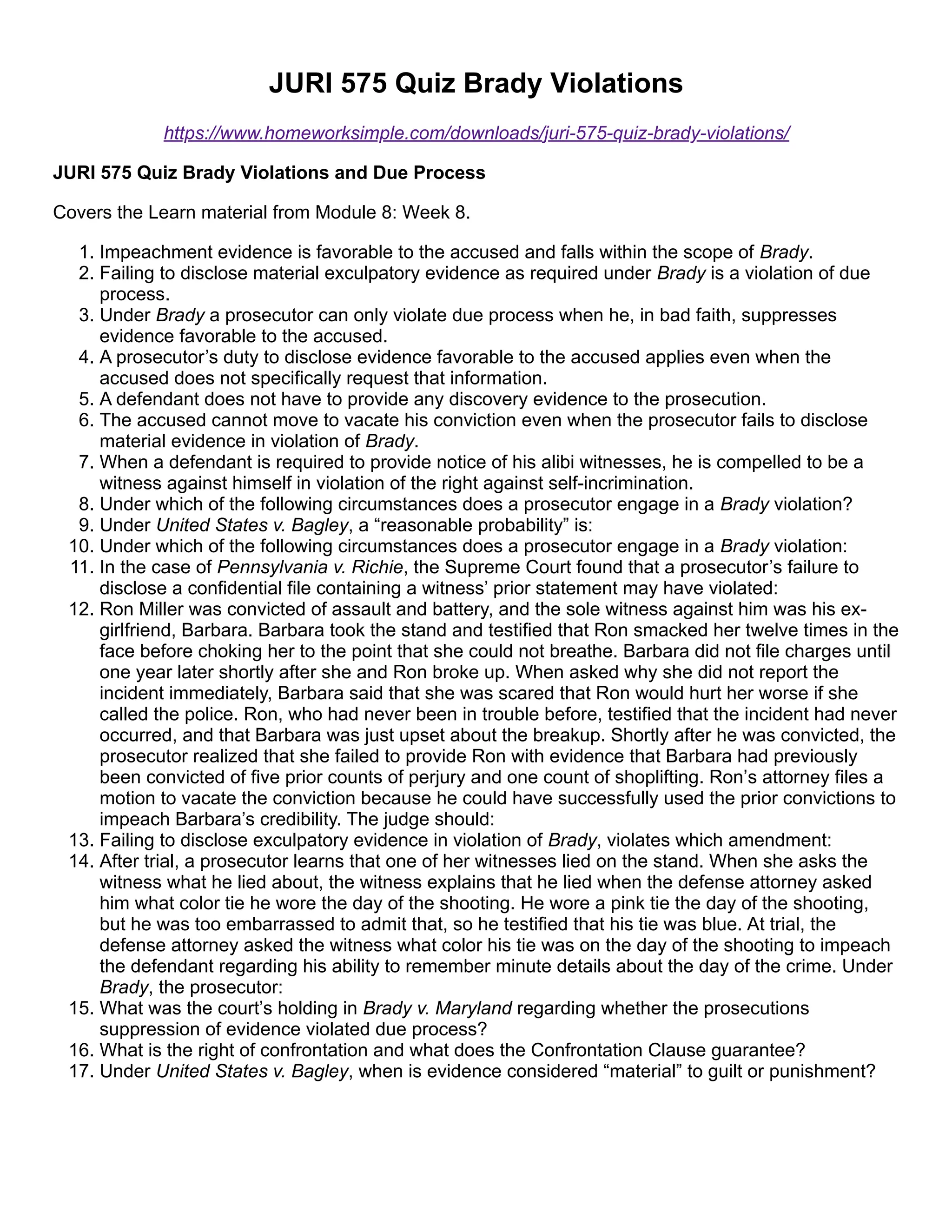
JURI 575 Quiz Brady Violations and Due Process
Covers the Learn material from Module 8: Week 8.
1. Impeachment evidence is favorable to the accused and falls within the scope of Brady.
2. Failing to disclose material exculpatory evidence as required under Brady is a violation of due
process.
3. Under Brady a prosecutor can only violate due process when he, in bad faith, suppresses
evidence favorable to the accused.
4. A prosecutor’s duty to disclose evidence favorable to the accused applies even when the
accused does not specifically request that information.
5. A defendant does not have to provide any discovery evidence to the prosecution.
6. The accused cannot move to vacate his conviction even when the prosecutor fails to disclose
material evidence in violation of Brady.
7. When a defendant is required to provide notice of his alibi witnesses, he is compelled to be a
witness against himself in violation of the right against self-incrimination.
8. Under which of the following circumstances does a prosecutor engage in a Brady violation?
9. Under United States v. Bagley, a “reasonable probability” is:
10. Under which of the following circumstances does a prosecutor engage in a Brady violation:
11. In the case of Pennsylvania v. Richie, the Supreme Court found that a prosecutor’s failure to
disclose a confidential file containing a witness’ prior statement may have violated:
12. Ron Miller was convicted of assault and battery, and the sole witness against him was his ex-
girlfriend, Barbara. Barbara took the stand and testified that Ron smacked her twelve times in the
face before choking her to the point that she could not breathe. Barbara did not file charges until
one year later shortly after she and Ron broke up. When asked why she did not report the
incident immediately, Barbara said that she was scared that Ron would hurt her worse if she
called the police. Ron, who had never been in trouble before, testified that the incident had never
occurred, and that Barbara was just upset about the breakup. Shortly after he was convicted, the
prosecutor realized that she failed to provide Ron with evidence that Barbara had previously
been convicted of five prior counts of perjury and one count of shoplifting. Ron’s attorney files a
motion to vacate the conviction because he could have successfully used the prior convictions to
impeach Barbara’s credibility. The judge should:
13. Failing to disclose exculpatory evidence in violation of Brady, violates which amendment:
14. After trial, a prosecutor learns that one of her witnesses lied on the stand. When she asks the
witness what he lied about, the witness explains that he lied when the defense attorney asked
him what color tie he wore the day of the shooting. He wore a pink tie the day of the shooting,
but he was too embarrassed to admit that, so he testified that his tie was blue. At trial, the
defense attorney asked the witness what color his tie was on the day of the shooting to impeach
the defendant regarding his ability to remember minute details about the day of the crime. Under
Brady, the prosecutor:
15. What was the court’s holding in Brady v. Maryland regarding whether the prosecutions
suppression of evidence violated due process?
16. What is the right of confrontation and what does the Confrontation Clause guarantee?
17. Under United States v. Bagley, when is evidence considered “material” to guilt or punishment?
JURI 575 Quiz Miranda
https://www.homeworksimple.com/downloads/juri-575-quiz-miranda/
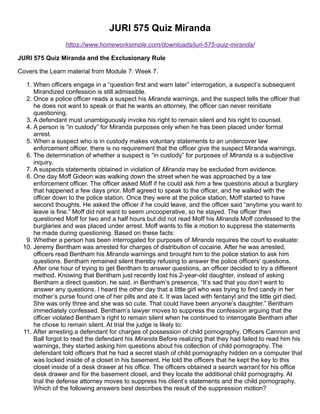
JURI 575 Quiz Miranda and the Exclusionary Rule
Covers the Learn material from Module 7: Week 7.
1. When officers engage in a “question first and warn later” interrogation, a suspect’s subsequent
Mirandized confession is still admissible.
2. Once a police officer reads a suspect his Miranda warnings, and the suspect tells the officer that
he does not want to speak or that he wants an attorney, the officer can never reinitiate
questioning.
3. A defendant must unambiguously invoke his right to remain silent and his right to counsel.
4. A person is “in custody” for Miranda purposes only when he has been placed under formal
arrest.
5. When a suspect who is in custody makes voluntary statements to an undercover law
enforcement officer, there is no requirement that the officer give the suspect Miranda warnings.
6. The determination of whether a suspect is “in custody” for purposes of Miranda is a subjective
inquiry.
7. A suspects statements obtained in violation of Miranda may be excluded from evidence.
8. One day Moff Gideon was walking down the street when he was approached by a law
enforcement officer. The officer asked Moff if he could ask him a few questions about a burglary
that happened a few days prior. Moff agreed to speak to the officer, and he walked with the
officer down to the police station. Once they were at the police station, Moff started to have
second thoughts. He asked the officer if he could leave, and the officer said “anytime you want to
leave is fine.” Moff did not want to seem uncooperative, so he stayed. The officer then
questioned Moff for two and a half hours but did not read Moff his Miranda Moff confessed to the
burglaries and was placed under arrest. Moff wants to file a motion to suppress the statements
he made during questioning. Based on these facts:
9. Whether a person has been interrogated for purposes of Miranda requires the court to evaluate:
10. Jeremy Bentham was arrested for charges of distribution of cocaine. After he was arrested,
officers read Bentham his Miranda warnings and brought him to the police station to ask him
questions. Bentham remained silent thereby refusing to answer the police officers’ questions.
After one hour of trying to get Bentham to answer questions, an officer decided to try a different
method. Knowing that Bentham just recently lost his 2-year-old daughter, instead of asking
Bentham a direct question, he said, in Bentham’s presence, “It’s sad that you don’t want to
answer any questions. I heard the other day that a little girl who was trying to find candy in her
mother’s purse found one of her pills and ate it. It was laced with fentanyl and the little girl died.
She was only three and she was so cute. That could have been anyone’s daughter.” Bentham
immediately confessed. Bentham’s lawyer moves to suppress the confession arguing that the
officer violated Bentham’s right to remain silent when he continued to interrogate Bentham after
he chose to remain silent. At trial the judge is likely to:
11. After arresting a defendant for charges of possession of child pornography, Officers Cannon and
Ball forgot to read the defendant his Miranda Before realizing that they had failed to read him his
warnings, they started asking him questions about his collection of child pornography. The
defendant told officers that he had a secret stash of child pornography hidden on a computer that
was locked inside of a closet in his basement. He told the officers that he kept the key to this
closet inside of a desk drawer at his office. The officers obtained a search warrant for his office
desk drawer and for the basement closet, and they locate the additional child pornography. At
trial the defense attorney moves to suppress his client’s statements and the child pornography.
Which of the following answers best describes the result of the suppression motion?
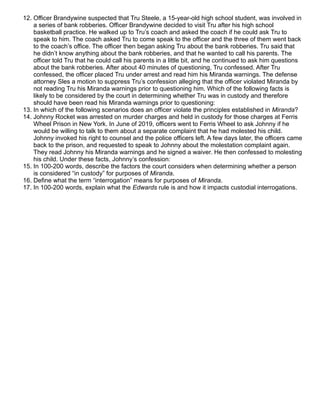
12. Officer Brandywine suspected that Tru Steele, a 15-year-old high school student, was involved in
a series of bank robberies. Officer Brandywine decided to visit Tru after his high school
basketball practice. He walked up to Tru’s coach and asked the coach if he could ask Tru to
speak to him. The coach asked Tru to come speak to the officer and the three of them went back
to the coach’s office. The officer then began asking Tru about the bank robberies. Tru said that
he didn’t know anything about the bank robberies, and that he wanted to call his parents. The
officer told Tru that he could call his parents in a little bit, and he continued to ask him questions
about the bank robberies. After about 40 minutes of questioning, Tru confessed. After Tru
confessed, the officer placed Tru under arrest and read him his Miranda warnings. The defense
attorney Sles a motion to suppress Tru’s confession alleging that the officer violated Miranda by
not reading Tru his Miranda warnings prior to questioning him. Which of the following facts is
likely to be considered by the court in determining whether Tru was in custody and therefore
should have been read his Miranda warnings prior to questioning:
13. In which of the following scenarios does an officer violate the principles established in Miranda?
14. Johnny Rocket was arrested on murder charges and held in custody for those charges at Ferris
Wheel Prison in New York. In June of 2019, officers went to Ferris Wheel to ask Johnny if he
would be willing to talk to them about a separate complaint that he had molested his child.
Johnny invoked his right to counsel and the police officers left. A few days later, the officers came
back to the prison, and requested to speak to Johnny about the molestation complaint again.
They read Johnny his Miranda warnings and he signed a waiver. He then confessed to molesting
his child. Under these facts, Johnny’s confession:
15. In 100-200 words, describe the factors the court considers when determining whether a person
is considered “in custody” for purposes of Miranda.
16. Define what the term “interrogation” means for purposes of Miranda.
17. In 100-200 words, explain what the Edwards rule is and how it impacts custodial interrogations.
JURI 575 Quiz Probable Cause
https://www.homeworksimple.com/downloads/juri-575-quiz-probable-cause/
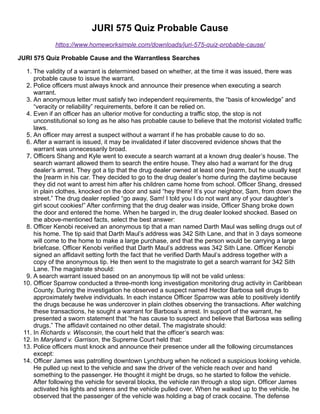
JURI 575 Quiz Probable Cause and the Warrantless Searches
1. The validity of a warrant is determined based on whether, at the time it was issued, there was
probable cause to issue the warrant.
2. Police officers must always knock and announce their presence when executing a search
warrant.
3. An anonymous letter must satisfy two independent requirements, the “basis of knowledge” and
“veracity or reliability” requirements, before it can be relied on.
4. Even if an officer has an ulterior motive for conducting a traffic stop, the stop is not
unconstitutional so long as he also has probable cause to believe that the motorist violated traffic
laws.
5. An officer may arrest a suspect without a warrant if he has probable cause to do so.
6. After a warrant is issued, it may be invalidated if later discovered evidence shows that the
warrant was unnecessarily broad.
7. Officers Shang and Kyle went to execute a search warrant at a known drug dealer’s house. The
search warrant allowed them to search the entire house. They also had a warrant for the drug
dealer’s arrest. They got a tip that the drug dealer owned at least one [rearm, but he usually kept
the [rearm in his car. They decided to go to the drug dealer’s home during the daytime because
they did not want to arrest him after his children came home from school. Officer Shang, dressed
in plain clothes, knocked on the door and said “hey there! It’s your neighbor, Sam, from down the
street.” The drug dealer replied “go away, Sam! I told you I do not want any of your daughter’s
girl scout cookies!” After confirming that the drug dealer was inside, Officer Shang broke down
the door and entered the home. When he barged in, the drug dealer looked shocked. Based on
the above-mentioned facts, select the best answer:
8. Officer Kenobi received an anonymous tip that a man named Darth Maul was selling drugs out of
his home. The tip said that Darth Maul’s address was 342 Sith Lane, and that in 3 days someone
will come to the home to make a large purchase, and that the person would be carrying a large
briefcase. Officer Kenobi verified that Darth Maul’s address was 342 Sith Lane. Officer Kenobi
signed an affidavit setting forth the fact that he verified Darth Maul’s address together with a
copy of the anonymous tip. He then went to the magistrate to get a search warrant for 342 Sith
Lane. The magistrate should:
9. A search warrant issued based on an anonymous tip will not be valid unless:
10. Officer Sparrow conducted a three-month long investigation monitoring drug activity in Caribbean
County. During the investigation he observed a suspect named Hector Barbosa sell drugs to
approximately twelve individuals. In each instance Officer Sparrow was able to positively identify
the drugs because he was undercover in plain clothes observing the transactions. After watching
these transactions, he sought a warrant for Barbosa’s arrest. In support of the warrant, he
presented a sworn statement that “he has cause to suspect and believe that Barbosa was selling
drugs.” The affidavit contained no other detail. The magistrate should:
11. In Richards v. Wisconsin, the court held that the officer’s search was:
12. In Maryland v. Garrison, the Supreme Court held that:
13. Police officers must knock and announce their presence under all the following circumstances
except:
14. Officer James was patrolling downtown Lynchburg when he noticed a suspicious looking vehicle.
He pulled up next to the vehicle and saw the driver of the vehicle reach over and hand
something to the passenger. He thought it might be drugs, so he started to follow the vehicle.
After following the vehicle for several blocks, the vehicle ran through a stop sign. Officer James
activated his lights and sirens and the vehicle pulled over. When he walked up to the vehicle, he
observed that the passenger of the vehicle was holding a bag of crack cocaine. The defense
attorney has [led a motion to suppress arguing that the officer’s stop was not valid because the
stop was pretextual. The defense attorney:
15. In 100-200 words, explain why the court in Maryland v. Garrison found that the warrant was
valid.
16. In 100-200 words, describe the purpose behind requiring a warrant to “particularly describe the
place to be searched and the persons or things to be seized.”
17. In 100-200 words, describe how a court determines whether there is “probable cause” to issue a
warrant based on an anonymous tip as discussed in Illinois v. Gates.
JURI 575 Quiz 1 Introduction
https://www.homeworksimple.com/downloads/juri-575-quiz-1-introduction/
JURI 575 Quiz Introduction to Criminal Justice Process
1. What percentage of cases end up going to trial?
2. Which of the following actors in the criminal justice system possesses ultimate authority over the
decision to charge a defendant with a particular crime?
3. Which group in the criminal justice system is the largest, has the most diverse range of functions,
and has the most complex organizational structure?
4. Which of the following actors in the criminal justice process screens the prosecutor’s charging
decision?
5. Each of the following typically happens at the defendant’s first appearance before the magistrate
except:
6. After a formal arrest has been made, the arrestee usually goes through which of the following:
7. Which of the following are reasons why a prosecutor may choose not to charge a defendant with
a crime?
8. Which type of judge is typically responsible for issuing arrest and search warrants?
9. Which of the following actors in the criminal justice system is typically responsible for making
initial bail determinations?
10. Which of the following actors in the criminal justice system may grant relief to a state defendant
post-conviction?
11. True or False: State-funded (court-appointed) counsel represent a vast majority of felony
defendants in criminal prosecutions.
12. True or False: Prosecutors have direct regulatory authority over police agencies operating within
their county.
13. True or False: Instead of conducting a full custody arrest, police officers will frequently issue a
“summons” or “appearance ticket” for suspects charged with felonies.
14. True or False: A suspect can be arrested before the suspect has been formally charged with a
crime.
15. True or False: An appeal is the last and final step that a defendant can use to challenge his
conviction.
16. True or False: A magistrate must review all warrantless arrests and make a separate
determination that the officer had probable cause.
17. True or False: Once charged with a crime, a defendant must be brought before the magistrate
within 24 or 48 hours.
18. True or False: Magistrate Courts have jurisdiction to try both misdemeanor and felony cases.
19. True or False: State supreme courts are commonly described as “our most important source” of
criminal procedure law.
20. True or False: Most criminal prosecutions take place at the state level.
21. List the special features that differentiate a criminal trial from a civil trial.
22. In 100-150 words, describe the difference between “reactive investigations” and “proactive
investigations.”
WRSP 101 Foundational Studies Quiz
https://www.homeworksimple.com/downloads/wrsp-101-foundational-studies-quiz/
WRSP 101 Quiz Foundational Studies of Worship
Covers the Learn material from Module 1: Week 1 — Module 2: Week 2.
1. In our lesson on brokenness we learn that to be broken in spirit means you see God is all that
YOU
2. Peter, in Matthew 14:22-32, was broken by his , , and
3. The “Great Commission” passage of Scripture is found in:
4. The short definition of the word, “worship” is . . .
5. We discussed the strengths and weaknesses of 6 hypothetical churches. What were the three
things common to every church discussed?
6. According to the text, the five reasons why we study worship are:
7. If I am going to be a honest worshiper, I must first . . .
8. To “Sing a new song” to the Lord means that:
9. How did the disciples respond when Jesus entered the boat, calmed the sea, brought peace to
their world and reassured them of His presence? (Matthew 14:22-32)
10. Seeing and recognizing Jesus as Sovereign God leads to Worship.
11. The word “Worship” means:
12. According to Oswald Chambers, “Many today are spending and being spent in work for Jesus
Christ, but they do not with Him.”
13. We learned in our lesson on brokenness that Jesus is still in the business.
14. In our lesson on brokenness, we learn that Peter was broken by HIS own __________ pride.
(Matthew 14:22-32)
15. In giving to the Lord (Psalm 96:7-8), our actions of love ought to include giving God His
_________, our __________ and an ___________.
16. We learned in our lesson on brokenness that there is ALWAYS a process and path to for the
broken that trust in Jesus.
17. According to our study in John 4 and Matthew 28, who wants our worship?
18. In our lesson on brokenness we learn that to be broken of self means you see God is all that
YOU
19. What was Jesus’ attitude toward the doubters in our text? Jesus shared with them, _________
and _________ alike, the Word of God, the Word, the Great Commission.
20. The short definition of the word, “praise” is . . .
21. What was Jesus’ response to those that worshipped in Matthew 28? He promised His
______________ and His _______________ to go into all the Earth!
22. The key passage about proclaiming the Word of the Lord in our text is:
23. To experience honest worship that is dynamic and delightful, I must . . .
24. In our lesson on brokenness, we learn that there is ALWAYS a broken.
25. God is more interested in us than in our commitment to form, tradition, a particular style of
worship music, or established ecclesiastical norms.
WRSP 101 Quiz History of Worship
https://www.homeworksimple.com/downloads/wrsp-101-quiz-history-of-worship/
WRSP 101 Quiz History of Worship
Covers the Learn material from Module 5: Week 5 — Module 6: Week 6.
1. John Calvin felt that music was to be sophisticated and offered by trained vocalists and
instrumentalists. The role of the congregation was to be spectators.
2. All of the following were part of “The First Great Awakening” or “Great Hymns Revival” EXCEPT:
3. “The Lord Is My Banner” is:
4. In the New Testament church there is clear evidence of the styles of music and musical practices
besides those that were in practice within the walls of the Jewish synagogue.
5. “God Almighty” is:
6. The Roman Catholic clergy (prior to the Reformation) saw all congregants as channels through
which divine grace was transmitted.
7. “The Lord Who Heals” is:
8. William Seymour was a key leader in the ____________________ Revival that had over a 90-
year impact upon the way people worshiped in that day and paved the way for what is known
today as Charismatic (or Pentecostal) worship.
9. God Himself has no less than 12 Hebrew names that identify His character and purpose. “God
the Mighty Creator” is:
10. The New Testament focuses on music as a facilitator for communicating a vital, personal
relationship with Jesus Christ.
11. “Jehovah-Lord” is:
12. “The Lord Is My Peace” is:
13. “The Lord, Our Provider” is:
14. Which of the following was NOT an influence upon evangelical gospel music of the mid 1930s to
1970?
15. The Protestant Reformation, began when _______________________ published his “95
Theses.”
16. “The Lord Is There” is:
17. The “altar call” was a worship innovation of the third Great Awakening and was attributed to:
18. The evangelist, Billy Sunday, partnered with musician, ____________________ in 1909 and
ministered in large evangelistic campaigns across the United States.
19. “The Lord, Our Righteousness” is:
20. The two basic forms of music and worship expression that flowed out from the Reformation
include:
21. The evangelistic team most influential in bringing about change in music and worship during the
late nineteenth century was Dwight L. Moody and Ira Sankey.
22. The Pre-Reformation clergyman best known for his belief that the Bible should be available to all
people and in a language they could understand, not just Latin, was:
23. “The God Who Sees Me” is:
24. Perhaps the most important innovation of the Pre-Reformation period was the invention of the
printing press by
25. The Great Awakenings were characterized by a renewed commitment to personal evangelism,
concern for neighbors and friends, passion for world-evangelism, and a sense of urgency to tell
others about Christ.
EXSC 525 Quiz 1
https://www.homeworksimple.com/downloads/exsc-525-quiz-1/
EXSC 525 Quiz Introduction to Research Methods
Covers the Learn material from Module 1: Week 1.
1. Another term that describes the unscientific method of tenacity is
2. Special language that is regularly used in a particular eld but which may not be meaningful to
people outside the eld is called
3. The abstract of a study should
4. A researcher conducts a study on the effectiveness of computer- assisted instruction (CAI) by
comparing classes that use this method with classes that do not. The researcher expects the
CAI classes to show higher gains in achievement. This expectation is
5. A good beginning point in a literature search for the student with a very limited knowledge about
a topic is
6. The generalizability of the results pertains to what kind of validity?
7. Which of the following statements is true concerning ERIC?
8. The inductive and deductive processes are important in
9. The primary sources of a literature review are
10. The only type of research that can manipulate treatments and establish a cause and effect is
11. Which of the following is not an important purpose for reviewing the literature?
12. The term coined by Kuhn to denote the scientific approach that is used widely in the natural
sciences is
13. Which of the following is not a common error in the review of literature sections of theses?
14. References to books should include
15. With regard to capitalization only in APA style, which of these references is/are correct?
16. The extent to which the results of a study can be attributed to the treatments used in the study is
the definition of what kind of validity?
17. In the example in chapter 1 of the experiment that compared aerobic dance with jogging, what
was the dependent variable?
18. References to journal articles should include
19. Compared to applied research, basic research
20. When we say that research is empirical, we mean that the researcher
21. Explain the steps in the scientific method of problem solving. Briey discuss at least two important
assumptions that underlie the scientific method (10pts).
22. Briey discuss at least five benefits of taking a research methods course early in the graduate
program (10pts).
GOVT 496 Final Paper
https://www.homeworksimple.com/downloads/govt-496-final-paper/
GOVT 496 Final Paper Assignment
Each Student will submit a 3- to 4-page, research-based paper in current APA–7 style format that
addresses:
1) What the Student thinks is the greatest emerging U.S. National Security challenge;
2) Which of the four ‘C’s (i.e., Competition, Crisis, Conflict, Change) the Student thinks the U.S. should
use as its approach to the challenge; and,
3) What the Student thinks the D.I.M.E. (i.e., Diplomatic, Information, Military, Economic) options are
feasible for a U.S. response to the challenge.
The paper must include at least (4) cited references in addition to the course textbook and the Bible.
Length does not include the Title Page or the References Page, both of which are required for
complete, fully-developed responses. (CLOs: A, B, C, D, E, F, G, H, I)
GOVT 496 Table Top Military Intelligence
https://www.homeworksimple.com/downloads/govt-496-table-top-military-intelligence/
GOVT 496 Table Top Exercises TTX Military Options, Information/Intelligence Options
Part II: Each Student will submit two scenario-driven point papers. Each Student will submit a single-
page point paper on Military options and a separate single-page point paper on
Information/Intelligence options. Each point paper will be no more than one page in length.
Length does not include the Title Page or the References Page, both of which are required for
complete, fully-developed responses.
GOVT 496 Table Top Exercise Diplomatic
https://www.homeworksimple.com/downloads/govt-496-table-top-exercise-diplomatic/
GOVT 496 Table Top Exercise Diplomatic and Economic Options
Part I: Each Student will submit two scenario-driven point papers. Each Student will submit a single-
page point paper on Diplomatic options and a separate single-page point paper on Economic options.
Each point paper will be no more than one page in length. Length does not include the Title Page or
the References Page, both of which are required for complete, fully-developed responses.
AVIA 444 Accidents Security Quiz
https://www.homeworksimple.com/downloads/avia-444-accidents-security-quiz/
AVIA 444 Quiz Accidents Security
Covers the Learn material from Module 1: Week 1 — Module 7: Week 7.
1. Which of these statements is correct?
2. Which have the right to be included in an aviation accident investigation?
3. Before 9/11, what was the common strategy taught to pilot to deal with hijackers?
4. It is recommended that charter flight operations take which of the following recommendations
into account to ensure they do not get caught up in drug smuggling.
5. According to aviation accident statistics:
6. Profiling in aviation screening
7. As a reaction to 9/11, what is the new common strategy for hijackings?
8. Which statement is correct in regard to aviation accidents?
9. Which of the following is NOT an approach to AIA development worldwide?
10. Which of these is an aviation technology not designed to support accident investigations?
EDLC 632 Oral Language Quiz
https://www.homeworksimple.com/downloads/edlc-632-oral-language-quiz/
EDLC 632 Quiz Oral Language: Listening and Talking
Covers the Learn material from Module 3: Week 3.
1. A fifth-grade class listened to several radio commercials for video games and then discussed the
concept of truth in advertising. These students were engaged in:
2. When implementing an interactive read-aloud, it is most important to:
3. As the students entered the auditorium for a social studies presentation, their teacher reminded
them to take notes to prepare for a test on the subject. During the presentation, these students
were engaged in:
4. Fifth-grade teacher Joe Gillespie enjoyed the novel Hoot, which tells the story of a boy dealing
with ecological issues in Florida. When he read Hoot aloud to his students in Alaska, however,
they had difficulty understanding the novel. The Alaskan students most likely had difficulty
understanding the story because:
5. When she asked students to summarize information from a science presentation, fourth grade
teacher Gloria McCall wrote their comments on the whiteboard. Of the following, the best
instructional reason for writing notes on the whiteboard is to:
6. Because students need to know whether they’re listening successfully and whether a listening
strategy is working, teachers should introduce and model the strategy of:
7. Of the following, the best way to promote higher level thinking is to:
8. Teachers should read aloud:
9. Because he wanted to follow the Common Core guidelines, fourth grade teacher Mike Marker
required students to develop oral presentations. The teacher did not give guidelines and did not
help with the assignment. The principal correctly reminded the teacher that to follow the
Common Core, teachers should:
10. Harry, a fan of The Diary of a Wimpy Kid books, purchased audio versions of the novels and
listened to the stories during his family’s vacation. When he listened to the novels, Harry was
engaged in:
EDLC 632 Written Language Quiz
https://www.homeworksimple.com/downloads/edlc-632-written-language-quiz/
EDLC 632 Quiz Written Language: Reading and Writing
Covers the Learn material from Module 4: Week 4.
1. The fourth grade teacher developed a reading list for her students that contained only
informational texts. Other teachers correctly reminded her that the Common Core State
Standards require students to read:
2. Capable readers:
3. After Colin, a fifth-grade student, read the story of Jack and the Beanstalk, he pretended that he
was the giant and wrote a new ending from the giant’s point of view. This activity helped the
student understand the writing trait referred to as:
4. When the teacher encouraged his students to write about their trip to a museum, the students
began rehearsal activities. These students were in the stage of the writing process known as:
5. The goal of both the reading process and the writing process is:
6. Effective teachers encourage students to edit their own work. Students usually find the most
success with editing when they:
7. When the teacher helped her students correct errors in capitalization, punctuation, and spelling,
she was focusing upon:
8. Before students begin to work in revising groups, teachers should:
9. The most appropriate time for a teacher to give feedback and offer suggestions on a student’s
writing is during the:
10. When a parent asked what steps she could take to improve her daughter’s writing, the teacher
correctly suggested that writing usually improves when students:
EDUC 673 Technology Resource Chart
https://www.homeworksimple.com/downloads/educ-673-technology-resource-chart/
EDUC 673 Technology Resource Chart Assignment
The candidate will research different online instructional tools to engage students in various topics.
The candidate will locate virtual field trips, simulations, and videos that assist in inquiry-based learning
and higher-level thinking skills. The candidate will complete the provided template and reflect on the
assignment.
EDUC 642 Article Critique
https://www.homeworksimple.com/downloads/educ-642-article-critique/
EDUC 642 Article Critique 1 Instructional Leadership and Student Achievement: School Leaders’
Perspectives
EDUC 642 Article Critique 2 Instructional Supervision and the COVID-19 Pandemic: Perspectives
From Principals
The candidate will review 2 professional journal articles in the field of educational leadership. Each
review must be no more than 3 pages, not including the reference page and title page, and must be
written in current APA format. The review will include a section for the candidate to write their reflection
of the article.
EDUC 642 Case Study 1,2
https://www.homeworksimple.com/downloads/educ-642-case-study-12/
EDUC 642 Case Study 1 Resolution of Conflict Between Faculty
EDUC 642 Case Study 2 Evaluation of Data for Teacher Evaluation
The candidate will present 2 Case Studies based on provided scenarios during this course. Each Case
Study must be 2–3 pages in length, double-spaced, and submitted as a Word document in APA
format. The Case Study should include a title page and a reference page in APA format.
EDUC 642 Powerpoint Presentation
https://www.homeworksimple.com/downloads/educ-642-powerpoint-presentation/
Includes:
EDUC 642 Powerpoint 1 Improving Student Achievement
EDUC 642 Powerpoint 2 Improving Student Behavior
The candidate will complete 2 PowerPoint presentations, each with a 15-slide maximum. A reference
page is required with a minimum of 5 references in current APA format. The presentation should be
applicable to supervision and leadership and be reflective on best practices in staff professional
development.
EDUC 642 Observation Protocols Paper
https://www.homeworksimple.com/downloads/educ-642-observation-protocols-paper/
EDUC 642 Finding and Evaluating Observation Protocols
It is important for aspiring administrators to understand that different school districts have different
expectations regarding both the frequency of observations and the areas that are observed and
evaluated. By finding samples of protocols (Classroom Observation Forms) from various states and
districts as well as private schools, you will begin to realize that policy and practice (instead of the
principal) usually dictate how observations/evaluations are conducted. For this assignment, locate 10
observation protocols (forms) utilizing the Internet. These protocols are sometimes called observation
checklists, observation forms, or evaluation forms. Your 10 selected protocols must represent a variety
of states, levels (elementary/middle/high), and subject areas and must include both publicandprivate
schools. (Please note: You will select one of the ten protocol forms to use in the Completing
Observation Cycle for a Teacher Assignment). No more than one protocol may be used from the same
website, school, and/or district.

Liberty Study Guide and Answers Homeworksimple.com_Part10.pdf

  • 1.
    JURI 575 QuizBrady Violations https://www.homeworksimple.com/downloads/juri-575-quiz-brady-violations/ JURI 575 Quiz Brady Violations and Due Process Covers the Learn material from Module 8: Week 8. 1. Impeachment evidence is favorable to the accused and falls within the scope of Brady. 2. Failing to disclose material exculpatory evidence as required under Brady is a violation of due process. 3. Under Brady a prosecutor can only violate due process when he, in bad faith, suppresses evidence favorable to the accused. 4. A prosecutor’s duty to disclose evidence favorable to the accused applies even when the accused does not specifically request that information. 5. A defendant does not have to provide any discovery evidence to the prosecution. 6. The accused cannot move to vacate his conviction even when the prosecutor fails to disclose material evidence in violation of Brady. 7. When a defendant is required to provide notice of his alibi witnesses, he is compelled to be a witness against himself in violation of the right against self-incrimination. 8. Under which of the following circumstances does a prosecutor engage in a Brady violation? 9. Under United States v. Bagley, a “reasonable probability” is: 10. Under which of the following circumstances does a prosecutor engage in a Brady violation: 11. In the case of Pennsylvania v. Richie, the Supreme Court found that a prosecutor’s failure to disclose a confidential file containing a witness’ prior statement may have violated: 12. Ron Miller was convicted of assault and battery, and the sole witness against him was his ex- girlfriend, Barbara. Barbara took the stand and testified that Ron smacked her twelve times in the face before choking her to the point that she could not breathe. Barbara did not file charges until one year later shortly after she and Ron broke up. When asked why she did not report the incident immediately, Barbara said that she was scared that Ron would hurt her worse if she called the police. Ron, who had never been in trouble before, testified that the incident had never occurred, and that Barbara was just upset about the breakup. Shortly after he was convicted, the prosecutor realized that she failed to provide Ron with evidence that Barbara had previously been convicted of five prior counts of perjury and one count of shoplifting. Ron’s attorney files a motion to vacate the conviction because he could have successfully used the prior convictions to impeach Barbara’s credibility. The judge should: 13. Failing to disclose exculpatory evidence in violation of Brady, violates which amendment: 14. After trial, a prosecutor learns that one of her witnesses lied on the stand. When she asks the witness what he lied about, the witness explains that he lied when the defense attorney asked him what color tie he wore the day of the shooting. He wore a pink tie the day of the shooting, but he was too embarrassed to admit that, so he testified that his tie was blue. At trial, the defense attorney asked the witness what color his tie was on the day of the shooting to impeach the defendant regarding his ability to remember minute details about the day of the crime. Under Brady, the prosecutor: 15. What was the court’s holding in Brady v. Maryland regarding whether the prosecutions suppression of evidence violated due process? 16. What is the right of confrontation and what does the Confrontation Clause guarantee? 17. Under United States v. Bagley, when is evidence considered “material” to guilt or punishment?
  • 2.
    JURI 575 QuizMiranda https://www.homeworksimple.com/downloads/juri-575-quiz-miranda/ JURI 575 Quiz Miranda and the Exclusionary Rule Covers the Learn material from Module 7: Week 7. 1. When officers engage in a “question first and warn later” interrogation, a suspect’s subsequent Mirandized confession is still admissible. 2. Once a police officer reads a suspect his Miranda warnings, and the suspect tells the officer that he does not want to speak or that he wants an attorney, the officer can never reinitiate questioning. 3. A defendant must unambiguously invoke his right to remain silent and his right to counsel. 4. A person is “in custody” for Miranda purposes only when he has been placed under formal arrest. 5. When a suspect who is in custody makes voluntary statements to an undercover law enforcement officer, there is no requirement that the officer give the suspect Miranda warnings. 6. The determination of whether a suspect is “in custody” for purposes of Miranda is a subjective inquiry. 7. A suspects statements obtained in violation of Miranda may be excluded from evidence. 8. One day Moff Gideon was walking down the street when he was approached by a law enforcement officer. The officer asked Moff if he could ask him a few questions about a burglary that happened a few days prior. Moff agreed to speak to the officer, and he walked with the officer down to the police station. Once they were at the police station, Moff started to have second thoughts. He asked the officer if he could leave, and the officer said “anytime you want to leave is fine.” Moff did not want to seem uncooperative, so he stayed. The officer then questioned Moff for two and a half hours but did not read Moff his Miranda Moff confessed to the burglaries and was placed under arrest. Moff wants to file a motion to suppress the statements he made during questioning. Based on these facts: 9. Whether a person has been interrogated for purposes of Miranda requires the court to evaluate: 10. Jeremy Bentham was arrested for charges of distribution of cocaine. After he was arrested, officers read Bentham his Miranda warnings and brought him to the police station to ask him questions. Bentham remained silent thereby refusing to answer the police officers’ questions. After one hour of trying to get Bentham to answer questions, an officer decided to try a different method. Knowing that Bentham just recently lost his 2-year-old daughter, instead of asking Bentham a direct question, he said, in Bentham’s presence, “It’s sad that you don’t want to answer any questions. I heard the other day that a little girl who was trying to find candy in her mother’s purse found one of her pills and ate it. It was laced with fentanyl and the little girl died. She was only three and she was so cute. That could have been anyone’s daughter.” Bentham immediately confessed. Bentham’s lawyer moves to suppress the confession arguing that the officer violated Bentham’s right to remain silent when he continued to interrogate Bentham after he chose to remain silent. At trial the judge is likely to: 11. After arresting a defendant for charges of possession of child pornography, Officers Cannon and Ball forgot to read the defendant his Miranda Before realizing that they had failed to read him his warnings, they started asking him questions about his collection of child pornography. The defendant told officers that he had a secret stash of child pornography hidden on a computer that was locked inside of a closet in his basement. He told the officers that he kept the key to this closet inside of a desk drawer at his office. The officers obtained a search warrant for his office desk drawer and for the basement closet, and they locate the additional child pornography. At trial the defense attorney moves to suppress his client’s statements and the child pornography. Which of the following answers best describes the result of the suppression motion?
  • 3.
    12. Officer Brandywinesuspected that Tru Steele, a 15-year-old high school student, was involved in a series of bank robberies. Officer Brandywine decided to visit Tru after his high school basketball practice. He walked up to Tru’s coach and asked the coach if he could ask Tru to speak to him. The coach asked Tru to come speak to the officer and the three of them went back to the coach’s office. The officer then began asking Tru about the bank robberies. Tru said that he didn’t know anything about the bank robberies, and that he wanted to call his parents. The officer told Tru that he could call his parents in a little bit, and he continued to ask him questions about the bank robberies. After about 40 minutes of questioning, Tru confessed. After Tru confessed, the officer placed Tru under arrest and read him his Miranda warnings. The defense attorney Sles a motion to suppress Tru’s confession alleging that the officer violated Miranda by not reading Tru his Miranda warnings prior to questioning him. Which of the following facts is likely to be considered by the court in determining whether Tru was in custody and therefore should have been read his Miranda warnings prior to questioning: 13. In which of the following scenarios does an officer violate the principles established in Miranda? 14. Johnny Rocket was arrested on murder charges and held in custody for those charges at Ferris Wheel Prison in New York. In June of 2019, officers went to Ferris Wheel to ask Johnny if he would be willing to talk to them about a separate complaint that he had molested his child. Johnny invoked his right to counsel and the police officers left. A few days later, the officers came back to the prison, and requested to speak to Johnny about the molestation complaint again. They read Johnny his Miranda warnings and he signed a waiver. He then confessed to molesting his child. Under these facts, Johnny’s confession: 15. In 100-200 words, describe the factors the court considers when determining whether a person is considered “in custody” for purposes of Miranda. 16. Define what the term “interrogation” means for purposes of Miranda. 17. In 100-200 words, explain what the Edwards rule is and how it impacts custodial interrogations.
  • 4.
    JURI 575 QuizProbable Cause https://www.homeworksimple.com/downloads/juri-575-quiz-probable-cause/ JURI 575 Quiz Probable Cause and the Warrantless Searches 1. The validity of a warrant is determined based on whether, at the time it was issued, there was probable cause to issue the warrant. 2. Police officers must always knock and announce their presence when executing a search warrant. 3. An anonymous letter must satisfy two independent requirements, the “basis of knowledge” and “veracity or reliability” requirements, before it can be relied on. 4. Even if an officer has an ulterior motive for conducting a traffic stop, the stop is not unconstitutional so long as he also has probable cause to believe that the motorist violated traffic laws. 5. An officer may arrest a suspect without a warrant if he has probable cause to do so. 6. After a warrant is issued, it may be invalidated if later discovered evidence shows that the warrant was unnecessarily broad. 7. Officers Shang and Kyle went to execute a search warrant at a known drug dealer’s house. The search warrant allowed them to search the entire house. They also had a warrant for the drug dealer’s arrest. They got a tip that the drug dealer owned at least one [rearm, but he usually kept the [rearm in his car. They decided to go to the drug dealer’s home during the daytime because they did not want to arrest him after his children came home from school. Officer Shang, dressed in plain clothes, knocked on the door and said “hey there! It’s your neighbor, Sam, from down the street.” The drug dealer replied “go away, Sam! I told you I do not want any of your daughter’s girl scout cookies!” After confirming that the drug dealer was inside, Officer Shang broke down the door and entered the home. When he barged in, the drug dealer looked shocked. Based on the above-mentioned facts, select the best answer: 8. Officer Kenobi received an anonymous tip that a man named Darth Maul was selling drugs out of his home. The tip said that Darth Maul’s address was 342 Sith Lane, and that in 3 days someone will come to the home to make a large purchase, and that the person would be carrying a large briefcase. Officer Kenobi verified that Darth Maul’s address was 342 Sith Lane. Officer Kenobi signed an affidavit setting forth the fact that he verified Darth Maul’s address together with a copy of the anonymous tip. He then went to the magistrate to get a search warrant for 342 Sith Lane. The magistrate should: 9. A search warrant issued based on an anonymous tip will not be valid unless: 10. Officer Sparrow conducted a three-month long investigation monitoring drug activity in Caribbean County. During the investigation he observed a suspect named Hector Barbosa sell drugs to approximately twelve individuals. In each instance Officer Sparrow was able to positively identify the drugs because he was undercover in plain clothes observing the transactions. After watching these transactions, he sought a warrant for Barbosa’s arrest. In support of the warrant, he presented a sworn statement that “he has cause to suspect and believe that Barbosa was selling drugs.” The affidavit contained no other detail. The magistrate should: 11. In Richards v. Wisconsin, the court held that the officer’s search was: 12. In Maryland v. Garrison, the Supreme Court held that: 13. Police officers must knock and announce their presence under all the following circumstances except: 14. Officer James was patrolling downtown Lynchburg when he noticed a suspicious looking vehicle. He pulled up next to the vehicle and saw the driver of the vehicle reach over and hand something to the passenger. He thought it might be drugs, so he started to follow the vehicle. After following the vehicle for several blocks, the vehicle ran through a stop sign. Officer James activated his lights and sirens and the vehicle pulled over. When he walked up to the vehicle, he observed that the passenger of the vehicle was holding a bag of crack cocaine. The defense
  • 5.
    attorney has [leda motion to suppress arguing that the officer’s stop was not valid because the stop was pretextual. The defense attorney: 15. In 100-200 words, explain why the court in Maryland v. Garrison found that the warrant was valid. 16. In 100-200 words, describe the purpose behind requiring a warrant to “particularly describe the place to be searched and the persons or things to be seized.” 17. In 100-200 words, describe how a court determines whether there is “probable cause” to issue a warrant based on an anonymous tip as discussed in Illinois v. Gates.
  • 6.
    JURI 575 Quiz1 Introduction https://www.homeworksimple.com/downloads/juri-575-quiz-1-introduction/ JURI 575 Quiz Introduction to Criminal Justice Process 1. What percentage of cases end up going to trial? 2. Which of the following actors in the criminal justice system possesses ultimate authority over the decision to charge a defendant with a particular crime? 3. Which group in the criminal justice system is the largest, has the most diverse range of functions, and has the most complex organizational structure? 4. Which of the following actors in the criminal justice process screens the prosecutor’s charging decision? 5. Each of the following typically happens at the defendant’s first appearance before the magistrate except: 6. After a formal arrest has been made, the arrestee usually goes through which of the following: 7. Which of the following are reasons why a prosecutor may choose not to charge a defendant with a crime? 8. Which type of judge is typically responsible for issuing arrest and search warrants? 9. Which of the following actors in the criminal justice system is typically responsible for making initial bail determinations? 10. Which of the following actors in the criminal justice system may grant relief to a state defendant post-conviction? 11. True or False: State-funded (court-appointed) counsel represent a vast majority of felony defendants in criminal prosecutions. 12. True or False: Prosecutors have direct regulatory authority over police agencies operating within their county. 13. True or False: Instead of conducting a full custody arrest, police officers will frequently issue a “summons” or “appearance ticket” for suspects charged with felonies. 14. True or False: A suspect can be arrested before the suspect has been formally charged with a crime. 15. True or False: An appeal is the last and final step that a defendant can use to challenge his conviction. 16. True or False: A magistrate must review all warrantless arrests and make a separate determination that the officer had probable cause. 17. True or False: Once charged with a crime, a defendant must be brought before the magistrate within 24 or 48 hours. 18. True or False: Magistrate Courts have jurisdiction to try both misdemeanor and felony cases. 19. True or False: State supreme courts are commonly described as “our most important source” of criminal procedure law. 20. True or False: Most criminal prosecutions take place at the state level. 21. List the special features that differentiate a criminal trial from a civil trial. 22. In 100-150 words, describe the difference between “reactive investigations” and “proactive investigations.”
  • 7.
    WRSP 101 FoundationalStudies Quiz https://www.homeworksimple.com/downloads/wrsp-101-foundational-studies-quiz/ WRSP 101 Quiz Foundational Studies of Worship Covers the Learn material from Module 1: Week 1 — Module 2: Week 2. 1. In our lesson on brokenness we learn that to be broken in spirit means you see God is all that YOU 2. Peter, in Matthew 14:22-32, was broken by his , , and 3. The “Great Commission” passage of Scripture is found in: 4. The short definition of the word, “worship” is . . . 5. We discussed the strengths and weaknesses of 6 hypothetical churches. What were the three things common to every church discussed? 6. According to the text, the five reasons why we study worship are: 7. If I am going to be a honest worshiper, I must first . . . 8. To “Sing a new song” to the Lord means that: 9. How did the disciples respond when Jesus entered the boat, calmed the sea, brought peace to their world and reassured them of His presence? (Matthew 14:22-32) 10. Seeing and recognizing Jesus as Sovereign God leads to Worship. 11. The word “Worship” means: 12. According to Oswald Chambers, “Many today are spending and being spent in work for Jesus Christ, but they do not with Him.” 13. We learned in our lesson on brokenness that Jesus is still in the business. 14. In our lesson on brokenness, we learn that Peter was broken by HIS own __________ pride. (Matthew 14:22-32) 15. In giving to the Lord (Psalm 96:7-8), our actions of love ought to include giving God His _________, our __________ and an ___________. 16. We learned in our lesson on brokenness that there is ALWAYS a process and path to for the broken that trust in Jesus. 17. According to our study in John 4 and Matthew 28, who wants our worship? 18. In our lesson on brokenness we learn that to be broken of self means you see God is all that YOU 19. What was Jesus’ attitude toward the doubters in our text? Jesus shared with them, _________ and _________ alike, the Word of God, the Word, the Great Commission. 20. The short definition of the word, “praise” is . . . 21. What was Jesus’ response to those that worshipped in Matthew 28? He promised His ______________ and His _______________ to go into all the Earth! 22. The key passage about proclaiming the Word of the Lord in our text is: 23. To experience honest worship that is dynamic and delightful, I must . . . 24. In our lesson on brokenness, we learn that there is ALWAYS a broken. 25. God is more interested in us than in our commitment to form, tradition, a particular style of worship music, or established ecclesiastical norms.
  • 8.
    WRSP 101 QuizHistory of Worship https://www.homeworksimple.com/downloads/wrsp-101-quiz-history-of-worship/ WRSP 101 Quiz History of Worship Covers the Learn material from Module 5: Week 5 — Module 6: Week 6. 1. John Calvin felt that music was to be sophisticated and offered by trained vocalists and instrumentalists. The role of the congregation was to be spectators. 2. All of the following were part of “The First Great Awakening” or “Great Hymns Revival” EXCEPT: 3. “The Lord Is My Banner” is: 4. In the New Testament church there is clear evidence of the styles of music and musical practices besides those that were in practice within the walls of the Jewish synagogue. 5. “God Almighty” is: 6. The Roman Catholic clergy (prior to the Reformation) saw all congregants as channels through which divine grace was transmitted. 7. “The Lord Who Heals” is: 8. William Seymour was a key leader in the ____________________ Revival that had over a 90- year impact upon the way people worshiped in that day and paved the way for what is known today as Charismatic (or Pentecostal) worship. 9. God Himself has no less than 12 Hebrew names that identify His character and purpose. “God the Mighty Creator” is: 10. The New Testament focuses on music as a facilitator for communicating a vital, personal relationship with Jesus Christ. 11. “Jehovah-Lord” is: 12. “The Lord Is My Peace” is: 13. “The Lord, Our Provider” is: 14. Which of the following was NOT an influence upon evangelical gospel music of the mid 1930s to 1970? 15. The Protestant Reformation, began when _______________________ published his “95 Theses.” 16. “The Lord Is There” is: 17. The “altar call” was a worship innovation of the third Great Awakening and was attributed to: 18. The evangelist, Billy Sunday, partnered with musician, ____________________ in 1909 and ministered in large evangelistic campaigns across the United States. 19. “The Lord, Our Righteousness” is: 20. The two basic forms of music and worship expression that flowed out from the Reformation include: 21. The evangelistic team most influential in bringing about change in music and worship during the late nineteenth century was Dwight L. Moody and Ira Sankey. 22. The Pre-Reformation clergyman best known for his belief that the Bible should be available to all people and in a language they could understand, not just Latin, was: 23. “The God Who Sees Me” is: 24. Perhaps the most important innovation of the Pre-Reformation period was the invention of the printing press by 25. The Great Awakenings were characterized by a renewed commitment to personal evangelism, concern for neighbors and friends, passion for world-evangelism, and a sense of urgency to tell others about Christ.
  • 9.
    EXSC 525 Quiz1 https://www.homeworksimple.com/downloads/exsc-525-quiz-1/ EXSC 525 Quiz Introduction to Research Methods Covers the Learn material from Module 1: Week 1. 1. Another term that describes the unscientific method of tenacity is 2. Special language that is regularly used in a particular eld but which may not be meaningful to people outside the eld is called 3. The abstract of a study should 4. A researcher conducts a study on the effectiveness of computer- assisted instruction (CAI) by comparing classes that use this method with classes that do not. The researcher expects the CAI classes to show higher gains in achievement. This expectation is 5. A good beginning point in a literature search for the student with a very limited knowledge about a topic is 6. The generalizability of the results pertains to what kind of validity? 7. Which of the following statements is true concerning ERIC? 8. The inductive and deductive processes are important in 9. The primary sources of a literature review are 10. The only type of research that can manipulate treatments and establish a cause and effect is 11. Which of the following is not an important purpose for reviewing the literature? 12. The term coined by Kuhn to denote the scientific approach that is used widely in the natural sciences is 13. Which of the following is not a common error in the review of literature sections of theses? 14. References to books should include 15. With regard to capitalization only in APA style, which of these references is/are correct? 16. The extent to which the results of a study can be attributed to the treatments used in the study is the definition of what kind of validity? 17. In the example in chapter 1 of the experiment that compared aerobic dance with jogging, what was the dependent variable? 18. References to journal articles should include 19. Compared to applied research, basic research 20. When we say that research is empirical, we mean that the researcher 21. Explain the steps in the scientific method of problem solving. Briey discuss at least two important assumptions that underlie the scientific method (10pts). 22. Briey discuss at least five benefits of taking a research methods course early in the graduate program (10pts).
  • 10.
    GOVT 496 FinalPaper https://www.homeworksimple.com/downloads/govt-496-final-paper/ GOVT 496 Final Paper Assignment Each Student will submit a 3- to 4-page, research-based paper in current APA–7 style format that addresses: 1) What the Student thinks is the greatest emerging U.S. National Security challenge; 2) Which of the four ‘C’s (i.e., Competition, Crisis, Conflict, Change) the Student thinks the U.S. should use as its approach to the challenge; and, 3) What the Student thinks the D.I.M.E. (i.e., Diplomatic, Information, Military, Economic) options are feasible for a U.S. response to the challenge. The paper must include at least (4) cited references in addition to the course textbook and the Bible. Length does not include the Title Page or the References Page, both of which are required for complete, fully-developed responses. (CLOs: A, B, C, D, E, F, G, H, I)
  • 11.
    GOVT 496 TableTop Military Intelligence https://www.homeworksimple.com/downloads/govt-496-table-top-military-intelligence/ GOVT 496 Table Top Exercises TTX Military Options, Information/Intelligence Options Part II: Each Student will submit two scenario-driven point papers. Each Student will submit a single- page point paper on Military options and a separate single-page point paper on Information/Intelligence options. Each point paper will be no more than one page in length. Length does not include the Title Page or the References Page, both of which are required for complete, fully-developed responses.
  • 12.
    GOVT 496 TableTop Exercise Diplomatic https://www.homeworksimple.com/downloads/govt-496-table-top-exercise-diplomatic/ GOVT 496 Table Top Exercise Diplomatic and Economic Options Part I: Each Student will submit two scenario-driven point papers. Each Student will submit a single- page point paper on Diplomatic options and a separate single-page point paper on Economic options. Each point paper will be no more than one page in length. Length does not include the Title Page or the References Page, both of which are required for complete, fully-developed responses.
  • 13.
    AVIA 444 AccidentsSecurity Quiz https://www.homeworksimple.com/downloads/avia-444-accidents-security-quiz/ AVIA 444 Quiz Accidents Security Covers the Learn material from Module 1: Week 1 — Module 7: Week 7. 1. Which of these statements is correct? 2. Which have the right to be included in an aviation accident investigation? 3. Before 9/11, what was the common strategy taught to pilot to deal with hijackers? 4. It is recommended that charter flight operations take which of the following recommendations into account to ensure they do not get caught up in drug smuggling. 5. According to aviation accident statistics: 6. Profiling in aviation screening 7. As a reaction to 9/11, what is the new common strategy for hijackings? 8. Which statement is correct in regard to aviation accidents? 9. Which of the following is NOT an approach to AIA development worldwide? 10. Which of these is an aviation technology not designed to support accident investigations?
  • 14.
    EDLC 632 OralLanguage Quiz https://www.homeworksimple.com/downloads/edlc-632-oral-language-quiz/ EDLC 632 Quiz Oral Language: Listening and Talking Covers the Learn material from Module 3: Week 3. 1. A fifth-grade class listened to several radio commercials for video games and then discussed the concept of truth in advertising. These students were engaged in: 2. When implementing an interactive read-aloud, it is most important to: 3. As the students entered the auditorium for a social studies presentation, their teacher reminded them to take notes to prepare for a test on the subject. During the presentation, these students were engaged in: 4. Fifth-grade teacher Joe Gillespie enjoyed the novel Hoot, which tells the story of a boy dealing with ecological issues in Florida. When he read Hoot aloud to his students in Alaska, however, they had difficulty understanding the novel. The Alaskan students most likely had difficulty understanding the story because: 5. When she asked students to summarize information from a science presentation, fourth grade teacher Gloria McCall wrote their comments on the whiteboard. Of the following, the best instructional reason for writing notes on the whiteboard is to: 6. Because students need to know whether they’re listening successfully and whether a listening strategy is working, teachers should introduce and model the strategy of: 7. Of the following, the best way to promote higher level thinking is to: 8. Teachers should read aloud: 9. Because he wanted to follow the Common Core guidelines, fourth grade teacher Mike Marker required students to develop oral presentations. The teacher did not give guidelines and did not help with the assignment. The principal correctly reminded the teacher that to follow the Common Core, teachers should: 10. Harry, a fan of The Diary of a Wimpy Kid books, purchased audio versions of the novels and listened to the stories during his family’s vacation. When he listened to the novels, Harry was engaged in:
  • 15.
    EDLC 632 WrittenLanguage Quiz https://www.homeworksimple.com/downloads/edlc-632-written-language-quiz/ EDLC 632 Quiz Written Language: Reading and Writing Covers the Learn material from Module 4: Week 4. 1. The fourth grade teacher developed a reading list for her students that contained only informational texts. Other teachers correctly reminded her that the Common Core State Standards require students to read: 2. Capable readers: 3. After Colin, a fifth-grade student, read the story of Jack and the Beanstalk, he pretended that he was the giant and wrote a new ending from the giant’s point of view. This activity helped the student understand the writing trait referred to as: 4. When the teacher encouraged his students to write about their trip to a museum, the students began rehearsal activities. These students were in the stage of the writing process known as: 5. The goal of both the reading process and the writing process is: 6. Effective teachers encourage students to edit their own work. Students usually find the most success with editing when they: 7. When the teacher helped her students correct errors in capitalization, punctuation, and spelling, she was focusing upon: 8. Before students begin to work in revising groups, teachers should: 9. The most appropriate time for a teacher to give feedback and offer suggestions on a student’s writing is during the: 10. When a parent asked what steps she could take to improve her daughter’s writing, the teacher correctly suggested that writing usually improves when students:
  • 16.
    EDUC 673 TechnologyResource Chart https://www.homeworksimple.com/downloads/educ-673-technology-resource-chart/ EDUC 673 Technology Resource Chart Assignment The candidate will research different online instructional tools to engage students in various topics. The candidate will locate virtual field trips, simulations, and videos that assist in inquiry-based learning and higher-level thinking skills. The candidate will complete the provided template and reflect on the assignment.
  • 17.
    EDUC 642 ArticleCritique https://www.homeworksimple.com/downloads/educ-642-article-critique/ EDUC 642 Article Critique 1 Instructional Leadership and Student Achievement: School Leaders’ Perspectives EDUC 642 Article Critique 2 Instructional Supervision and the COVID-19 Pandemic: Perspectives From Principals The candidate will review 2 professional journal articles in the field of educational leadership. Each review must be no more than 3 pages, not including the reference page and title page, and must be written in current APA format. The review will include a section for the candidate to write their reflection of the article.
  • 18.
    EDUC 642 CaseStudy 1,2 https://www.homeworksimple.com/downloads/educ-642-case-study-12/ EDUC 642 Case Study 1 Resolution of Conflict Between Faculty EDUC 642 Case Study 2 Evaluation of Data for Teacher Evaluation The candidate will present 2 Case Studies based on provided scenarios during this course. Each Case Study must be 2–3 pages in length, double-spaced, and submitted as a Word document in APA format. The Case Study should include a title page and a reference page in APA format.
  • 19.
    EDUC 642 PowerpointPresentation https://www.homeworksimple.com/downloads/educ-642-powerpoint-presentation/ Includes: EDUC 642 Powerpoint 1 Improving Student Achievement EDUC 642 Powerpoint 2 Improving Student Behavior The candidate will complete 2 PowerPoint presentations, each with a 15-slide maximum. A reference page is required with a minimum of 5 references in current APA format. The presentation should be applicable to supervision and leadership and be reflective on best practices in staff professional development.
  • 20.
    EDUC 642 ObservationProtocols Paper https://www.homeworksimple.com/downloads/educ-642-observation-protocols-paper/ EDUC 642 Finding and Evaluating Observation Protocols It is important for aspiring administrators to understand that different school districts have different expectations regarding both the frequency of observations and the areas that are observed and evaluated. By finding samples of protocols (Classroom Observation Forms) from various states and districts as well as private schools, you will begin to realize that policy and practice (instead of the principal) usually dictate how observations/evaluations are conducted. For this assignment, locate 10 observation protocols (forms) utilizing the Internet. These protocols are sometimes called observation checklists, observation forms, or evaluation forms. Your 10 selected protocols must represent a variety of states, levels (elementary/middle/high), and subject areas and must include both publicandprivate schools. (Please note: You will select one of the ten protocol forms to use in the Completing Observation Cycle for a Teacher Assignment). No more than one protocol may be used from the same website, school, and/or district.