“There is nothing new in the world
except the history you do not know.”
-Harry S. Truman
Former President, USA
2
Liberation War of Bangladesh: From
the Perspective of Hamoodur
Rahman Commission Report
Outline of the Presentation
• Background of the Liberation War of 1971
• Hamoodur Rahman Commission Report
• Genocide of 25 March 1971
• Intellectual Killings of 14 December 1971
• War crimes of Pakistan Army in 1971
• Role of Lt Gen Tikka Khan
• Role of Lt Gen AAK Niyazi
• Overall Analysis of the Hamoodur Rahman Commission Report
4
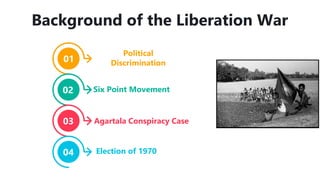
Background of the Liberation War
Political
Discrimination
Six Point Movement
Agartala Conspiracy Case
Election of 1970
01
02
03
04
6
7
Hamoodur Rahman Commission Report
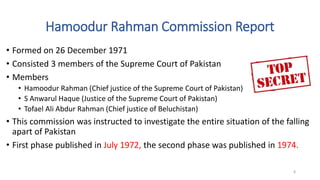
• Formed on 26 December 1971
• Consisted 3 members of the Supreme Court of Pakistan
• Members
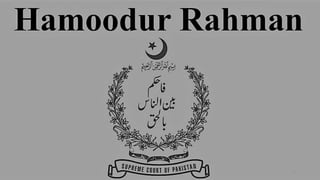
• Hamoodur Rahman (Chief justice of the Supreme Court of Pakistan)
• S Anwarul Haque (Justice of the Supreme Court of Pakistan)
• Tofael Ali Abdur Rahman (Chief justice of Beluchistan)
• This commission was instructed to investigate the entire situation of the falling
apart of Pakistan
• First phase published in July 1972, the second phase was published in 1974.
8
Hamoodur Rahman Commission Report
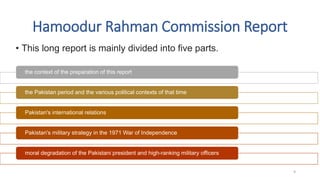
• This long report is mainly divided into five parts.
the context of the preparation of this report
the Pakistan period and the various political contexts of that time
Pakistan's international relations
Pakistan's military strategy in the 1971 War of Independence
moral degradation of the Pakistani president and high-ranking military officers
9
• The first meeting of the Commission was held on January 17, 1972 in
the city of Rawalpindi, Pakistan. On the first day there were about
three hundred witnesses. However, from the beginning, this
commission was mandated to preserve important state documents.
• The Hamoodur Rahman Commission was directed to submit its report
within 90 days of the commencement of its work. But in the end, the
task of interviewing about 213 people, screening and selection was
completed in six and a half months.
10
About the
Genocide
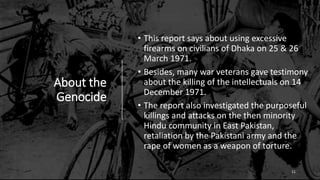
• This report says about using excessive
firearms on civilians of Dhaka on 25 & 26
March 1971.
• Besides, many war veterans gave testimony
about the killing of the intellectuals on 14
December 1971.
• The report also investigated the purposeful
killings and attacks on the then minority
Hindu community in East Pakistan,
retaliation by the Pakistani army and the
rape of women as a weapon of torture.
11
War crimes of
Pakistan Army in
1971
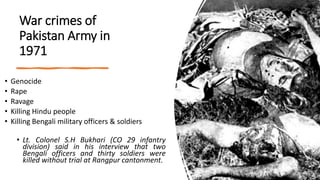
• Genocide
• Rape
• Ravage
• Killing Hindu people
• Killing Bengali military officers & soldiers
• Lt. Colonel S.H Bukhari (CO 29 infantry
division) said in his interview that two
Bengali officers and thirty soldiers were
killed without trial at Rangpur cantonment.
12
Intellectual Killings of 14 December 1971
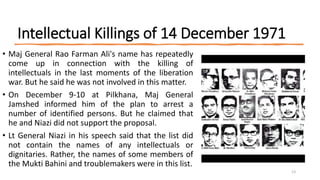
• Maj General Rao Farman Ali's name has repeatedly
come up in connection with the killing of
intellectuals in the last moments of the liberation
war. But he said he was not involved in this matter.
• On December 9-10 at Pilkhana, Maj General
Jamshed informed him of the plan to arrest a
number of identified persons. But he claimed that
he and Niazi did not support the proposal.
• Lt General Niazi in his speech said that the list did
not contain the names of any intellectuals or
dignitaries. Rather, the names of some members of
the Mukti Bahini and troublemakers were in this list.
13
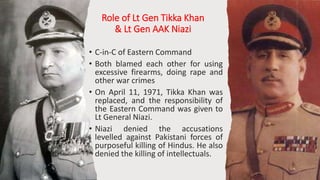
Role of Lt Gen Tikka Khan
& Lt Gen AAK Niazi
• C-in-C of Eastern Command
• Both blamed each other for using
excessive firearms, doing rape and
other war crimes
• On April 11, 1971, Tikka Khan was
replaced, and the responsibility of
the Eastern Command was given to
Lt General Niazi.
• Niazi denied the accusations
levelled against Pakistani forces of
purposeful killing of Hindus. He also
denied the killing of intellectuals.
14
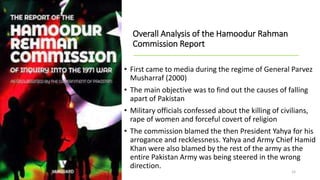
Overall Analysis of the Hamoodur Rahman
Commission Report
• First came to media during the regime of General Parvez
Musharraf (2000)
• The main objective was to find out the causes of falling
apart of Pakistan
• Military officials confessed about the killing of civilians,
rape of women and forceful covert of religion
• The commission blamed the then President Yahya for his
arrogance and recklessness. Yahya and Army Chief Hamid
Khan were also blamed by the rest of the army as the
entire Pakistan Army was being steered in the wrong
direction.
15
"Pakistani forces were so degraded in the war that
even Napoleon himself rose from the grave and
took the helm, the Pakistani forces could not fight."
-Lt Gen Jagjit Singh Aurora (1993)
C-in-C, Eastern Command
16
Reference
• হাসান, হ
ু মায়ুন (২০১১), হামুদুর রহমান কমমশন মরপ ার্ট (বাাংলাপদশ
অাংশ), বাাঁধন াবমলপকশন্স
17
THANK YOU
18
ANY QUESTIONS?
19

Liberation War.pptx

  • 2.
    “There is nothingnew in the world except the history you do not know.” -Harry S. Truman Former President, USA 2
  • 3.
    Liberation War ofBangladesh: From the Perspective of Hamoodur Rahman Commission Report
  • 4.
    Outline of thePresentation • Background of the Liberation War of 1971 • Hamoodur Rahman Commission Report • Genocide of 25 March 1971 • Intellectual Killings of 14 December 1971 • War crimes of Pakistan Army in 1971 • Role of Lt Gen Tikka Khan • Role of Lt Gen AAK Niyazi • Overall Analysis of the Hamoodur Rahman Commission Report 4
  • 5.
    Background of theLiberation War Political Discrimination Six Point Movement Agartala Conspiracy Case Election of 1970 01 02 03 04
  • 6.
  • 7.
  • 8.
    Hamoodur Rahman CommissionReport • Formed on 26 December 1971 • Consisted 3 members of the Supreme Court of Pakistan • Members • Hamoodur Rahman (Chief justice of the Supreme Court of Pakistan) • S Anwarul Haque (Justice of the Supreme Court of Pakistan) • Tofael Ali Abdur Rahman (Chief justice of Beluchistan) • This commission was instructed to investigate the entire situation of the falling apart of Pakistan • First phase published in July 1972, the second phase was published in 1974. 8
  • 9.
    Hamoodur Rahman CommissionReport • This long report is mainly divided into five parts. the context of the preparation of this report the Pakistan period and the various political contexts of that time Pakistan's international relations Pakistan's military strategy in the 1971 War of Independence moral degradation of the Pakistani president and high-ranking military officers 9
  • 10.
    • The firstmeeting of the Commission was held on January 17, 1972 in the city of Rawalpindi, Pakistan. On the first day there were about three hundred witnesses. However, from the beginning, this commission was mandated to preserve important state documents. • The Hamoodur Rahman Commission was directed to submit its report within 90 days of the commencement of its work. But in the end, the task of interviewing about 213 people, screening and selection was completed in six and a half months. 10
  • 11.
    About the Genocide • Thisreport says about using excessive firearms on civilians of Dhaka on 25 & 26 March 1971. • Besides, many war veterans gave testimony about the killing of the intellectuals on 14 December 1971. • The report also investigated the purposeful killings and attacks on the then minority Hindu community in East Pakistan, retaliation by the Pakistani army and the rape of women as a weapon of torture. 11
  • 12.
    War crimes of PakistanArmy in 1971 • Genocide • Rape • Ravage • Killing Hindu people • Killing Bengali military officers & soldiers • Lt. Colonel S.H Bukhari (CO 29 infantry division) said in his interview that two Bengali officers and thirty soldiers were killed without trial at Rangpur cantonment. 12
  • 13.
    Intellectual Killings of14 December 1971 • Maj General Rao Farman Ali's name has repeatedly come up in connection with the killing of intellectuals in the last moments of the liberation war. But he said he was not involved in this matter. • On December 9-10 at Pilkhana, Maj General Jamshed informed him of the plan to arrest a number of identified persons. But he claimed that he and Niazi did not support the proposal. • Lt General Niazi in his speech said that the list did not contain the names of any intellectuals or dignitaries. Rather, the names of some members of the Mukti Bahini and troublemakers were in this list. 13
  • 14.
    Role of LtGen Tikka Khan & Lt Gen AAK Niazi • C-in-C of Eastern Command • Both blamed each other for using excessive firearms, doing rape and other war crimes • On April 11, 1971, Tikka Khan was replaced, and the responsibility of the Eastern Command was given to Lt General Niazi. • Niazi denied the accusations levelled against Pakistani forces of purposeful killing of Hindus. He also denied the killing of intellectuals. 14
  • 15.
    Overall Analysis ofthe Hamoodur Rahman Commission Report • First came to media during the regime of General Parvez Musharraf (2000) • The main objective was to find out the causes of falling apart of Pakistan • Military officials confessed about the killing of civilians, rape of women and forceful covert of religion • The commission blamed the then President Yahya for his arrogance and recklessness. Yahya and Army Chief Hamid Khan were also blamed by the rest of the army as the entire Pakistan Army was being steered in the wrong direction. 15
  • 16.
    "Pakistani forces wereso degraded in the war that even Napoleon himself rose from the grave and took the helm, the Pakistani forces could not fight." -Lt Gen Jagjit Singh Aurora (1993) C-in-C, Eastern Command 16
  • 17.
    Reference • হাসান, হ ুমায়ুন (২০১১), হামুদুর রহমান কমমশন মরপ ার্ট (বাাংলাপদশ অাংশ), বাাঁধন াবমলপকশন্স 17
  • 18.
  • 19.