LEVERS
K I N E S I O LO G Y P R A C T I C A L
M O S TA FA E L WA N
MACHINES:
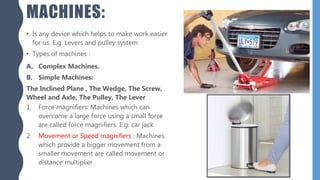
• Is any device which helps to make work easier
for us.
• Types of machines :
A. Complex Machines: Computer , Cars ,…etc
B. Simple Machines:
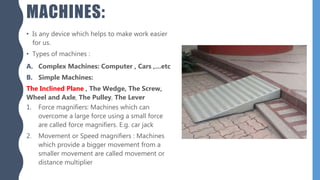
The Inclined Plane , The Wedge, The Screw,
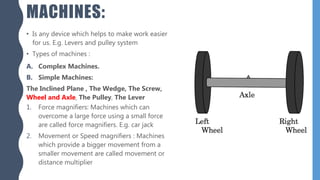
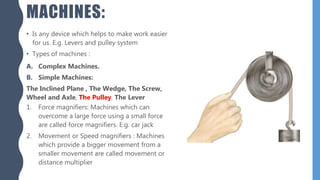
Wheel and Axle, The Pulley, The Lever
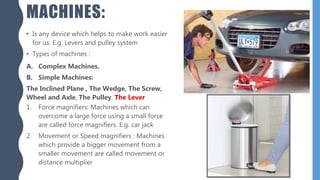
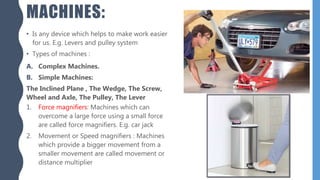
1. Force magnifiers: Machines which can
overcome a large force using a small force
are called force magnifiers. E.g. car jack
2. Movement or Speed magnifiers : Machines
which provide a bigger movement from a
smaller movement are called movement or
distance multiplier
MACHINES:
• Is any device which helps to make work easier
for us.
• Types of machines :
A. Complex Machines: Computer , Cars ,…etc
B. Simple Machines:
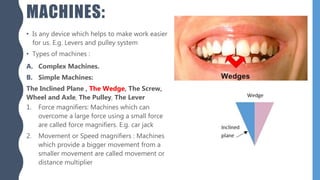
The Inclined Plane , The Wedge, The Screw,
Wheel and Axle, The Pulley, The Lever
1. Force magnifiers: Machines which can
overcome a large force using a small force
are called force magnifiers. E.g. car jack
2. Movement or Speed magnifiers : Machines
which provide a bigger movement from a
smaller movement are called movement or
distance multiplier
MACHINES:
• Is any device which helps to make work easier
for us. E.g. Levers and pulley system
• Types of machines :
A. Complex Machines.
B. Simple Machines:
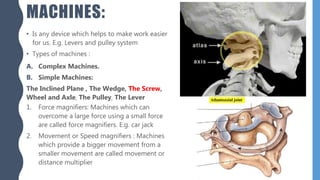
The Inclined Plane , The Wedge, The Screw,
Wheel and Axle, The Pulley, The Lever
1. Force magnifiers: Machines which can
overcome a large force using a small force
are called force magnifiers. E.g. car jack
2. Movement or Speed magnifiers : Machines
which provide a bigger movement from a
smaller movement are called movement or
distance multiplier
MACHINES:
• Is any device which helps to make work easier
for us. E.g. Levers and pulley system
• Types of machines :
A. Complex Machines.
B. Simple Machines:
The Inclined Plane , The Wedge, The Screw,
Wheel and Axle, The Pulley, The Lever
1. Force magnifiers: Machines which can
overcome a large force using a small force
are called force magnifiers. E.g. car jack
2. Movement or Speed magnifiers : Machines
which provide a bigger movement from a
smaller movement are called movement or
distance multiplier
MACHINES:
• Is any device which helps to make work easier
for us. E.g. Levers and pulley system
• Types of machines :
A. Complex Machines.
B. Simple Machines:
The Inclined Plane , The Wedge, The Screw,
Wheel and Axle, The Pulley, The Lever
1. Force magnifiers: Machines which can
overcome a large force using a small force
are called force magnifiers. E.g. car jack
2. Movement or Speed magnifiers : Machines
which provide a bigger movement from a
smaller movement are called movement or
distance multiplier
MACHINES:
• Is any device which helps to make work easier
for us. E.g. Levers and pulley system
• Types of machines :
A. Complex Machines.
B. Simple Machines:
The Inclined Plane , The Wedge, The Screw,
Wheel and Axle, The Pulley, The Lever
1. Force magnifiers: Machines which can
overcome a large force using a small force
are called force magnifiers. E.g. car jack
2. Movement or Speed magnifiers : Machines
which provide a bigger movement from a
smaller movement are called movement or
distance multiplier
• Is any device which helps to make work easier
for us. E.g. Levers and pulley system
• Types of machines :
A. Complex Machines.
B. Simple Machines:
The Inclined Plane , The Wedge, The Screw,
Wheel and Axle, The Pulley, The Lever
1. Force magnifiers: Machines which can
overcome a large force using a small force
are called force magnifiers. E.g. car jack
2. Movement or Speed magnifiers : Machines
which provide a bigger movement from a
smaller movement are called movement or
distance multiplier
MACHINES:
• Is any device which helps to make work easier
for us. E.g. Levers and pulley system
• Types of machines :
A. Complex Machines.
B. Simple Machines:
The Inclined Plane , The Wedge, The Screw,
Wheel and Axle, The Pulley, The Lever
1. Force magnifiers: Machines which can
overcome a large force using a small force
are called force magnifiers. E.g. car jack
2. Movement or Speed magnifiers : Machines
which provide a bigger movement from a
smaller movement are called movement or
distance multiplier
MACHINES:
• Is any device which helps to make work easier
for us. E.g. Levers and pulley system
• Types of machines :
A. Complex Machines.
B. Simple Machines:
The Inclined Plane , The Wedge, The Screw,
Wheel and Axle, The Pulley, The Lever
1. Force magnifiers: Machines which can
overcome a large force using a small force
are called force magnifiers. E.g. car jack
2. Movement or Speed magnifiers : Machines
which provide a bigger movement from a
smaller movement are called movement or
distance multiplier
MACHINES:
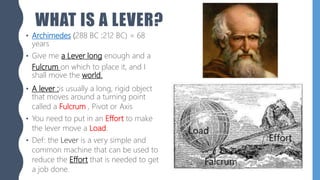
WHAT IS A LEVER?
• Archimedes (288 BC :212 BC) = 68
years
• Give me a Lever long enough and a
Fulcrum on which to place it, and I
shall move the world.
• A lever :is usually a long, rigid object
that moves around a turning point
called a Fulcrum , Pivot or Axis
• You need to put in an Effort to make
the lever move a Load.
• Def: the Lever is a very simple and
common machine that can be used to
reduce the Effort that is needed to get
a job done.
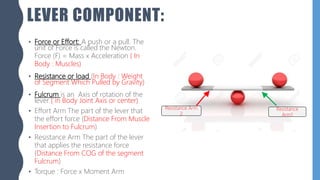
LEVER COMPONENT:
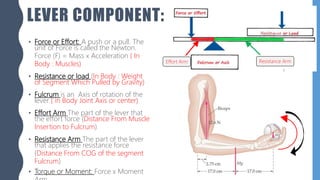
• Force or Effort: A push or a pull. The
unit of Force is called the Newton.
Force (F) = Mass x Acceleration ( In
Body : Muscles)
• Resistance or load (In Body : Weight
of Segment Which Pulled by Gravity)
• Fulcrum is an Axis of rotation of the
lever ( in Body Joint Axis or center)
• Effort Arm The part of the lever that
the effort force (Distance From Muscle
Insertion to Fulcrum)
• Resistance Arm The part of the lever
that applies the resistance force
(Distance From COG of the segment
Fulcrum)
• Torque or Moment: Force x Moment
Effort Arm Resistance Arm
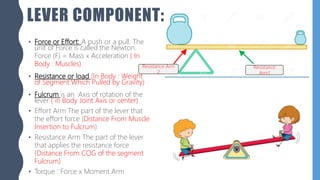
LEVER COMPONENT:
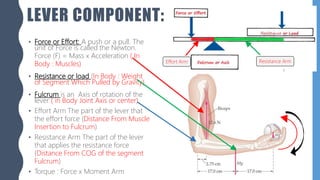
• Force or Effort: A push or a pull. The
unit of Force is called the Newton.
Force (F) = Mass x Acceleration ( In
Body : Muscles)
• Resistance or load (In Body : Weight
of Segment Which Pulled by Gravity)
• Fulcrum is an Axis of rotation of the
lever ( in Body Joint Axis or center)
• Effort Arm The part of the lever that
the effort force (Distance From Muscle
Insertion to Fulcrum)
• Resistance Arm The part of the lever
that applies the resistance force
(Distance From COG of the segment
Fulcrum)
• Torque : Force x Moment Arm
Effort Arm Resistance Arm
LEVER COMPONENT:
• Force or Effort: A push or a pull. The
unit of Force is called the Newton.
Force (F) = Mass x Acceleration ( In
Body : Muscles)
• Resistance or load (In Body : Weight
of Segment Which Pulled by Gravity)
• Fulcrum is an Axis of rotation of the
lever ( in Body Joint Axis or center)
• Effort Arm The part of the lever that
the effort force (Distance From Muscle
Insertion to Fulcrum)
• Resistance Arm The part of the lever
that applies the resistance force
(Distance From COG of the segment
Fulcrum)
• Torque : Force x Moment Arm
Resistance
Arm1
Resistance Arm
2
LEVER COMPONENT:
• Force or Effort: A push or a pull. The
unit of Force is called the Newton.
Force (F) = Mass x Acceleration ( In
Body : Muscles)
• Resistance or load (In Body : Weight
of Segment Which Pulled by Gravity)
• Fulcrum is an Axis of rotation of the
lever ( in Body Joint Axis or center)
• Effort Arm The part of the lever that
the effort force (Distance From Muscle
Insertion to Fulcrum)
• Resistance Arm The part of the lever
that applies the resistance force
(Distance From COG of the segment
Fulcrum)
• Torque : Force x Moment Arm
Resistance
Arm1
Resistance Arm
2
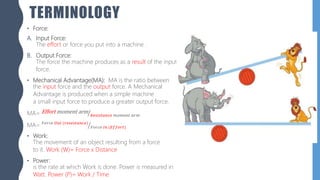
TERMINOLOGY
• Force:
A. Input Force:
The effort or force you put into a machine .
B. Output Force:
The force the machine produces as a result of the input
force.
• Mechanical Advantage(MA): MA is the ratio between
the input force and the output force. A Mechanical
Advantage is produced when a simple machine
a small input force to produce a greater output force.
MA= Effort moment arm
𝑅𝑒𝑠𝑖𝑠𝑡𝑎𝑛𝑐𝑒 𝑚𝑜𝑚𝑒𝑛𝑡 𝑎𝑟𝑚
MA= 𝐹𝑜𝑟𝑐𝑒 𝑂𝑢𝑡 (𝑟𝑒𝑠𝑒𝑠𝑡𝑎𝑛𝑐𝑒)
𝐹𝑜𝑟𝑐𝑒 𝐼𝑛 (𝐸𝑓𝑓𝑜𝑟𝑡)
• Work:
The movement of an object resulting from a force
to it. Work (W)= Force x Distance
• Power:
is the rate at which Work is done. Power is measured in
Watt. Power (P)= Work / Time
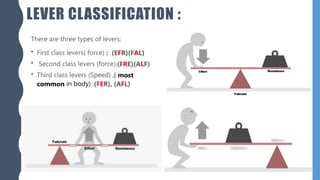
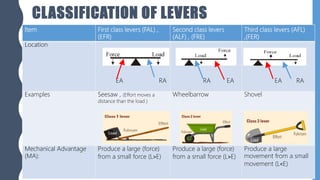
LEVER CLASSIFICATION :
There are three types of levers:
• First class levers( force) : (EFR)(FAL)
• Second class levers (force):(FRE)(ALF)
• Third class levers (Speed) ,( most
common in body) :(FER), (AFL)
CLASSIFICATION OF LEVERS
Item First class levers (FAL) ,
(EFR)
Second class levers
(ALF) , (FRE)
Third class levers (AFL)
,(FER)
Location
EA RA RA EA EA RA
Examples Seesaw , (Effort moves a
distance than the load )
Wheelbarrow Shovel
Mechanical Advantage
(MA):
Produce a large (force)
from a small force (L>E)
Produce a large (force)
from a small force (L>E)
Produce a large
movement from a small
movement (L<E)
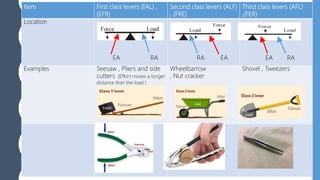
Item First class levers (FAL) ,
(EFR)
Second class levers (ALF)
, (FRE)
Third class levers (AFL)
,(FER)
Location
EA RA RA EA EA RA
Examples Seesaw , Pliers and side
cutters (Effort moves a longer
distance than the load )
Wheelbarrow
, Nut cracker
Shovel , Tweezers
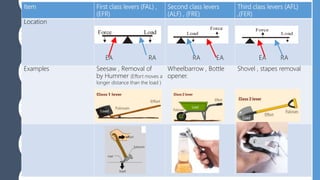
Item First class levers (FAL) ,
(EFR)
Second class levers
(ALF) , (FRE)
Third class levers (AFL)
,(FER)
Location
EA RA RA EA EA RA
Examples Seesaw , Removal of
by Hummer (Effort moves a
longer distance than the load )
Wheelbarrow , Bottle
opener.
Shovel , stapes removal
Item First class levers (FAL) ,
(EFR)
Second class levers
(ALF) , (FRE)
Third class levers (AFL)
,(FER)
Location
EA RA RA EA EA RA
Examples Seesaw , Scissors (Effort
moves a longer distance than
the load )
Wheelbarrow , paper
cutter
Shovel , fishing rod
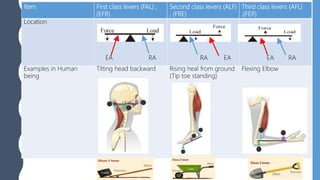
Item First class levers (FAL) ,
(EFR)
Second class levers (ALF)
, (FRE)
Third class levers (AFL)
,(FER)
Location
EA RA RA EA EA RA
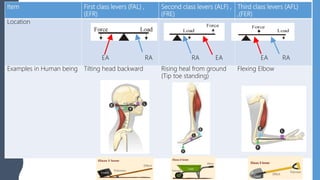
Examples in Human
being
Tilting head backward Rising heal from ground
(Tip toe standing)
Flexing Elbow
Item First class levers (FAL) ,
(EFR)
Second class levers (ALF) ,
(FRE)
Third class levers (AFL)
,(FER)
Location
EA RA RA EA EA RA
Examples in Human being Tilting head backward Rising heal from ground
(Tip toe standing)
Flexing Elbow
Item First class levers (FAL) ,
(EFR)
Second class levers
(ALF) , (FRE)
Third class levers (AFL)
,(FER)
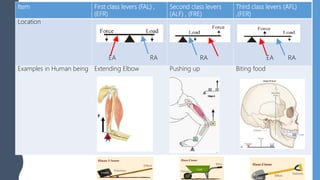
Location
EA RA RA EA RA
Examples in Human being Extending Elbow Pushing up Biting food
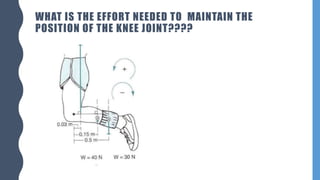
WHAT IS THE EFFORT NEEDED TO MAINTAIN THE
POSITION OF THE KNEE JOINT????
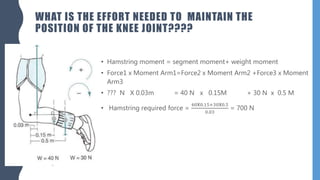
WHAT IS THE EFFORT NEEDED TO MAINTAIN THE
POSITION OF THE KNEE JOINT????
• Hamstring moment = segment moment+ weight moment
• Force1 x Moment Arm1=Force2 x Moment Arm2 +Force3 x Moment
Arm3
• ??? N X 0.03m = 40 N x 0.15M + 30 N x 0.5 M
• Hamstring required force =
40x0.15+30x0.5
0.03
= 700 N
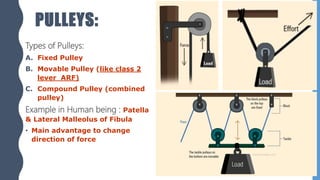
PULLEYS:
Types of Pulleys:
A. Fixed Pulley
B. Movable Pulley (like class 2
lever ARF)
C. Compound Pulley (combined
pulley)
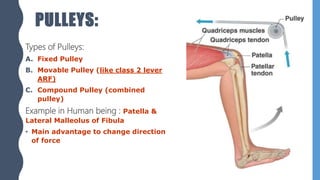
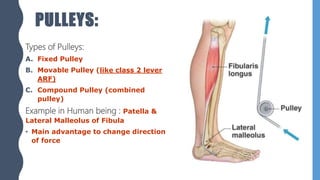
Example in Human being : Patella
& Lateral Malleolus of Fibula
• Main advantage to change
direction of force
PULLEYS:
Types of Pulleys:
A. Fixed Pulley
B. Movable Pulley (like class 2 lever
ARF)
C. Compound Pulley (combined
pulley)
Example in Human being : Patella &
Lateral Malleolus of Fibula
• Main advantage to change direction
of force
PULLEYS:
Types of Pulleys:
A. Fixed Pulley
B. Movable Pulley (like class 2 lever
ARF)
C. Compound Pulley (combined
pulley)
Example in Human being : Patella &
Lateral Malleolus of Fibula
• Main advantage to change direction
of force
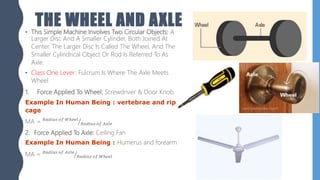
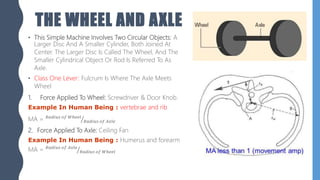
THE WHEEL AND AXLE
• This Simple Machine Involves Two Circular Objects: A
Larger Disc And A Smaller Cylinder, Both Joined At
Center. The Larger Disc Is Called The Wheel, And The
Smaller Cylindrical Object Or Rod Is Referred To As
Axle.
• Class One Lever: Fulcrum Is Where The Axle Meets
Wheel
1. Force Applied To Wheel: Screwdriver & Door Knob.
Example In Human Being : vertebrae and rip
cage
MA = 𝑅𝑎𝑑𝑖𝑢𝑠 𝑜𝑓 𝑊ℎ𝑒𝑒𝑙
𝑅𝑎𝑑𝑖𝑢𝑠 𝑜𝑓 𝐴𝑥𝑙𝑒
2. Force Applied To Axle: Ceiling Fan
Example In Human Being : Humerus and forearm
MA = 𝑅𝑎𝑑𝑖𝑢𝑠 𝑜𝑓 𝐴𝑥𝑙𝑒
𝑅𝑎𝑑𝑖𝑢𝑠 𝑜𝑓 𝑊ℎ𝑒𝑒𝑙
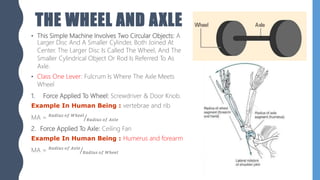
THE WHEEL AND AXLE
• This Simple Machine Involves Two Circular Objects: A
Larger Disc And A Smaller Cylinder, Both Joined At
Center. The Larger Disc Is Called The Wheel, And The
Smaller Cylindrical Object Or Rod Is Referred To As
Axle.
• Class One Lever: Fulcrum Is Where The Axle Meets
Wheel
1. Force Applied To Wheel: Screwdriver & Door Knob.
Example In Human Being : vertebrae and rib
MA = 𝑅𝑎𝑑𝑖𝑢𝑠 𝑜𝑓 𝑊ℎ𝑒𝑒𝑙
𝑅𝑎𝑑𝑖𝑢𝑠 𝑜𝑓 𝐴𝑥𝑙𝑒
2. Force Applied To Axle: Ceiling Fan
Example In Human Being : Humerus and forearm
MA = 𝑅𝑎𝑑𝑖𝑢𝑠 𝑜𝑓 𝐴𝑥𝑙𝑒
𝑅𝑎𝑑𝑖𝑢𝑠 𝑜𝑓 𝑊ℎ𝑒𝑒𝑙
THE WHEEL AND AXLE
• This Simple Machine Involves Two Circular Objects: A
Larger Disc And A Smaller Cylinder, Both Joined At
Center. The Larger Disc Is Called The Wheel, And The
Smaller Cylindrical Object Or Rod Is Referred To As
Axle.
• Class One Lever: Fulcrum Is Where The Axle Meets
Wheel
1. Force Applied To Wheel: Screwdriver & Door Knob.
Example In Human Being : vertebrae and rib
MA = 𝑅𝑎𝑑𝑖𝑢𝑠 𝑜𝑓 𝑊ℎ𝑒𝑒𝑙
𝑅𝑎𝑑𝑖𝑢𝑠 𝑜𝑓 𝐴𝑥𝑙𝑒
2. Force Applied To Axle: Ceiling Fan
Example In Human Being : Humerus and forearm
MA = 𝑅𝑎𝑑𝑖𝑢𝑠 𝑜𝑓 𝐴𝑥𝑙𝑒
𝑅𝑎𝑑𝑖𝑢𝑠 𝑜𝑓 𝑊ℎ𝑒𝑒𝑙
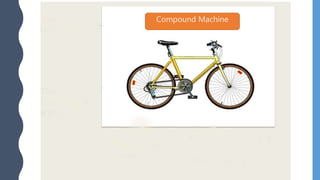
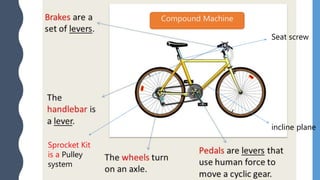
Compound Machine
Sprocket Kit
is a Pulley
system
incline plane
Seat screw
Compound Machine

Levers

  • 1.
    LEVERS K I NE S I O LO G Y P R A C T I C A L M O S TA FA E L WA N
  • 2.
    MACHINES: • Is anydevice which helps to make work easier for us. • Types of machines : A. Complex Machines: Computer , Cars ,…etc B. Simple Machines: The Inclined Plane , The Wedge, The Screw, Wheel and Axle, The Pulley, The Lever 1. Force magnifiers: Machines which can overcome a large force using a small force are called force magnifiers. E.g. car jack 2. Movement or Speed magnifiers : Machines which provide a bigger movement from a smaller movement are called movement or distance multiplier
  • 3.
    MACHINES: • Is anydevice which helps to make work easier for us. • Types of machines : A. Complex Machines: Computer , Cars ,…etc B. Simple Machines: The Inclined Plane , The Wedge, The Screw, Wheel and Axle, The Pulley, The Lever 1. Force magnifiers: Machines which can overcome a large force using a small force are called force magnifiers. E.g. car jack 2. Movement or Speed magnifiers : Machines which provide a bigger movement from a smaller movement are called movement or distance multiplier
  • 4.
    MACHINES: • Is anydevice which helps to make work easier for us. E.g. Levers and pulley system • Types of machines : A. Complex Machines. B. Simple Machines: The Inclined Plane , The Wedge, The Screw, Wheel and Axle, The Pulley, The Lever 1. Force magnifiers: Machines which can overcome a large force using a small force are called force magnifiers. E.g. car jack 2. Movement or Speed magnifiers : Machines which provide a bigger movement from a smaller movement are called movement or distance multiplier
  • 5.
    MACHINES: • Is anydevice which helps to make work easier for us. E.g. Levers and pulley system • Types of machines : A. Complex Machines. B. Simple Machines: The Inclined Plane , The Wedge, The Screw, Wheel and Axle, The Pulley, The Lever 1. Force magnifiers: Machines which can overcome a large force using a small force are called force magnifiers. E.g. car jack 2. Movement or Speed magnifiers : Machines which provide a bigger movement from a smaller movement are called movement or distance multiplier
  • 6.
    MACHINES: • Is anydevice which helps to make work easier for us. E.g. Levers and pulley system • Types of machines : A. Complex Machines. B. Simple Machines: The Inclined Plane , The Wedge, The Screw, Wheel and Axle, The Pulley, The Lever 1. Force magnifiers: Machines which can overcome a large force using a small force are called force magnifiers. E.g. car jack 2. Movement or Speed magnifiers : Machines which provide a bigger movement from a smaller movement are called movement or distance multiplier
  • 7.
    MACHINES: • Is anydevice which helps to make work easier for us. E.g. Levers and pulley system • Types of machines : A. Complex Machines. B. Simple Machines: The Inclined Plane , The Wedge, The Screw, Wheel and Axle, The Pulley, The Lever 1. Force magnifiers: Machines which can overcome a large force using a small force are called force magnifiers. E.g. car jack 2. Movement or Speed magnifiers : Machines which provide a bigger movement from a smaller movement are called movement or distance multiplier
  • 8.
    • Is anydevice which helps to make work easier for us. E.g. Levers and pulley system • Types of machines : A. Complex Machines. B. Simple Machines: The Inclined Plane , The Wedge, The Screw, Wheel and Axle, The Pulley, The Lever 1. Force magnifiers: Machines which can overcome a large force using a small force are called force magnifiers. E.g. car jack 2. Movement or Speed magnifiers : Machines which provide a bigger movement from a smaller movement are called movement or distance multiplier MACHINES:
  • 9.
    • Is anydevice which helps to make work easier for us. E.g. Levers and pulley system • Types of machines : A. Complex Machines. B. Simple Machines: The Inclined Plane , The Wedge, The Screw, Wheel and Axle, The Pulley, The Lever 1. Force magnifiers: Machines which can overcome a large force using a small force are called force magnifiers. E.g. car jack 2. Movement or Speed magnifiers : Machines which provide a bigger movement from a smaller movement are called movement or distance multiplier MACHINES:
  • 10.
    • Is anydevice which helps to make work easier for us. E.g. Levers and pulley system • Types of machines : A. Complex Machines. B. Simple Machines: The Inclined Plane , The Wedge, The Screw, Wheel and Axle, The Pulley, The Lever 1. Force magnifiers: Machines which can overcome a large force using a small force are called force magnifiers. E.g. car jack 2. Movement or Speed magnifiers : Machines which provide a bigger movement from a smaller movement are called movement or distance multiplier MACHINES:
  • 11.
    WHAT IS ALEVER? • Archimedes (288 BC :212 BC) = 68 years • Give me a Lever long enough and a Fulcrum on which to place it, and I shall move the world. • A lever :is usually a long, rigid object that moves around a turning point called a Fulcrum , Pivot or Axis • You need to put in an Effort to make the lever move a Load. • Def: the Lever is a very simple and common machine that can be used to reduce the Effort that is needed to get a job done.
  • 12.
    LEVER COMPONENT: • Forceor Effort: A push or a pull. The unit of Force is called the Newton. Force (F) = Mass x Acceleration ( In Body : Muscles) • Resistance or load (In Body : Weight of Segment Which Pulled by Gravity) • Fulcrum is an Axis of rotation of the lever ( in Body Joint Axis or center) • Effort Arm The part of the lever that the effort force (Distance From Muscle Insertion to Fulcrum) • Resistance Arm The part of the lever that applies the resistance force (Distance From COG of the segment Fulcrum) • Torque or Moment: Force x Moment Effort Arm Resistance Arm
  • 13.
    LEVER COMPONENT: • Forceor Effort: A push or a pull. The unit of Force is called the Newton. Force (F) = Mass x Acceleration ( In Body : Muscles) • Resistance or load (In Body : Weight of Segment Which Pulled by Gravity) • Fulcrum is an Axis of rotation of the lever ( in Body Joint Axis or center) • Effort Arm The part of the lever that the effort force (Distance From Muscle Insertion to Fulcrum) • Resistance Arm The part of the lever that applies the resistance force (Distance From COG of the segment Fulcrum) • Torque : Force x Moment Arm Effort Arm Resistance Arm
  • 14.
    LEVER COMPONENT: • Forceor Effort: A push or a pull. The unit of Force is called the Newton. Force (F) = Mass x Acceleration ( In Body : Muscles) • Resistance or load (In Body : Weight of Segment Which Pulled by Gravity) • Fulcrum is an Axis of rotation of the lever ( in Body Joint Axis or center) • Effort Arm The part of the lever that the effort force (Distance From Muscle Insertion to Fulcrum) • Resistance Arm The part of the lever that applies the resistance force (Distance From COG of the segment Fulcrum) • Torque : Force x Moment Arm Resistance Arm1 Resistance Arm 2
  • 15.
    LEVER COMPONENT: • Forceor Effort: A push or a pull. The unit of Force is called the Newton. Force (F) = Mass x Acceleration ( In Body : Muscles) • Resistance or load (In Body : Weight of Segment Which Pulled by Gravity) • Fulcrum is an Axis of rotation of the lever ( in Body Joint Axis or center) • Effort Arm The part of the lever that the effort force (Distance From Muscle Insertion to Fulcrum) • Resistance Arm The part of the lever that applies the resistance force (Distance From COG of the segment Fulcrum) • Torque : Force x Moment Arm Resistance Arm1 Resistance Arm 2
  • 16.
    TERMINOLOGY • Force: A. InputForce: The effort or force you put into a machine . B. Output Force: The force the machine produces as a result of the input force. • Mechanical Advantage(MA): MA is the ratio between the input force and the output force. A Mechanical Advantage is produced when a simple machine a small input force to produce a greater output force. MA= Effort moment arm 𝑅𝑒𝑠𝑖𝑠𝑡𝑎𝑛𝑐𝑒 𝑚𝑜𝑚𝑒𝑛𝑡 𝑎𝑟𝑚 MA= 𝐹𝑜𝑟𝑐𝑒 𝑂𝑢𝑡 (𝑟𝑒𝑠𝑒𝑠𝑡𝑎𝑛𝑐𝑒) 𝐹𝑜𝑟𝑐𝑒 𝐼𝑛 (𝐸𝑓𝑓𝑜𝑟𝑡) • Work: The movement of an object resulting from a force to it. Work (W)= Force x Distance • Power: is the rate at which Work is done. Power is measured in Watt. Power (P)= Work / Time
  • 17.
    LEVER CLASSIFICATION : Thereare three types of levers: • First class levers( force) : (EFR)(FAL) • Second class levers (force):(FRE)(ALF) • Third class levers (Speed) ,( most common in body) :(FER), (AFL)
  • 18.
    CLASSIFICATION OF LEVERS ItemFirst class levers (FAL) , (EFR) Second class levers (ALF) , (FRE) Third class levers (AFL) ,(FER) Location EA RA RA EA EA RA Examples Seesaw , (Effort moves a distance than the load ) Wheelbarrow Shovel Mechanical Advantage (MA): Produce a large (force) from a small force (L>E) Produce a large (force) from a small force (L>E) Produce a large movement from a small movement (L<E)
  • 19.
    Item First classlevers (FAL) , (EFR) Second class levers (ALF) , (FRE) Third class levers (AFL) ,(FER) Location EA RA RA EA EA RA Examples Seesaw , Pliers and side cutters (Effort moves a longer distance than the load ) Wheelbarrow , Nut cracker Shovel , Tweezers
  • 20.
    Item First classlevers (FAL) , (EFR) Second class levers (ALF) , (FRE) Third class levers (AFL) ,(FER) Location EA RA RA EA EA RA Examples Seesaw , Removal of by Hummer (Effort moves a longer distance than the load ) Wheelbarrow , Bottle opener. Shovel , stapes removal
  • 21.
    Item First classlevers (FAL) , (EFR) Second class levers (ALF) , (FRE) Third class levers (AFL) ,(FER) Location EA RA RA EA EA RA Examples Seesaw , Scissors (Effort moves a longer distance than the load ) Wheelbarrow , paper cutter Shovel , fishing rod
  • 22.
    Item First classlevers (FAL) , (EFR) Second class levers (ALF) , (FRE) Third class levers (AFL) ,(FER) Location EA RA RA EA EA RA Examples in Human being Tilting head backward Rising heal from ground (Tip toe standing) Flexing Elbow
  • 23.
    Item First classlevers (FAL) , (EFR) Second class levers (ALF) , (FRE) Third class levers (AFL) ,(FER) Location EA RA RA EA EA RA Examples in Human being Tilting head backward Rising heal from ground (Tip toe standing) Flexing Elbow
  • 24.
    Item First classlevers (FAL) , (EFR) Second class levers (ALF) , (FRE) Third class levers (AFL) ,(FER) Location EA RA RA EA RA Examples in Human being Extending Elbow Pushing up Biting food
  • 25.
    WHAT IS THEEFFORT NEEDED TO MAINTAIN THE POSITION OF THE KNEE JOINT????
  • 26.
    WHAT IS THEEFFORT NEEDED TO MAINTAIN THE POSITION OF THE KNEE JOINT???? • Hamstring moment = segment moment+ weight moment • Force1 x Moment Arm1=Force2 x Moment Arm2 +Force3 x Moment Arm3 • ??? N X 0.03m = 40 N x 0.15M + 30 N x 0.5 M • Hamstring required force = 40x0.15+30x0.5 0.03 = 700 N
  • 27.
    PULLEYS: Types of Pulleys: A.Fixed Pulley B. Movable Pulley (like class 2 lever ARF) C. Compound Pulley (combined pulley) Example in Human being : Patella & Lateral Malleolus of Fibula • Main advantage to change direction of force
  • 28.
    PULLEYS: Types of Pulleys: A.Fixed Pulley B. Movable Pulley (like class 2 lever ARF) C. Compound Pulley (combined pulley) Example in Human being : Patella & Lateral Malleolus of Fibula • Main advantage to change direction of force
  • 29.
    PULLEYS: Types of Pulleys: A.Fixed Pulley B. Movable Pulley (like class 2 lever ARF) C. Compound Pulley (combined pulley) Example in Human being : Patella & Lateral Malleolus of Fibula • Main advantage to change direction of force
  • 30.
    THE WHEEL ANDAXLE • This Simple Machine Involves Two Circular Objects: A Larger Disc And A Smaller Cylinder, Both Joined At Center. The Larger Disc Is Called The Wheel, And The Smaller Cylindrical Object Or Rod Is Referred To As Axle. • Class One Lever: Fulcrum Is Where The Axle Meets Wheel 1. Force Applied To Wheel: Screwdriver & Door Knob. Example In Human Being : vertebrae and rip cage MA = 𝑅𝑎𝑑𝑖𝑢𝑠 𝑜𝑓 𝑊ℎ𝑒𝑒𝑙 𝑅𝑎𝑑𝑖𝑢𝑠 𝑜𝑓 𝐴𝑥𝑙𝑒 2. Force Applied To Axle: Ceiling Fan Example In Human Being : Humerus and forearm MA = 𝑅𝑎𝑑𝑖𝑢𝑠 𝑜𝑓 𝐴𝑥𝑙𝑒 𝑅𝑎𝑑𝑖𝑢𝑠 𝑜𝑓 𝑊ℎ𝑒𝑒𝑙
  • 31.
    THE WHEEL ANDAXLE • This Simple Machine Involves Two Circular Objects: A Larger Disc And A Smaller Cylinder, Both Joined At Center. The Larger Disc Is Called The Wheel, And The Smaller Cylindrical Object Or Rod Is Referred To As Axle. • Class One Lever: Fulcrum Is Where The Axle Meets Wheel 1. Force Applied To Wheel: Screwdriver & Door Knob. Example In Human Being : vertebrae and rib MA = 𝑅𝑎𝑑𝑖𝑢𝑠 𝑜𝑓 𝑊ℎ𝑒𝑒𝑙 𝑅𝑎𝑑𝑖𝑢𝑠 𝑜𝑓 𝐴𝑥𝑙𝑒 2. Force Applied To Axle: Ceiling Fan Example In Human Being : Humerus and forearm MA = 𝑅𝑎𝑑𝑖𝑢𝑠 𝑜𝑓 𝐴𝑥𝑙𝑒 𝑅𝑎𝑑𝑖𝑢𝑠 𝑜𝑓 𝑊ℎ𝑒𝑒𝑙
  • 32.
    THE WHEEL ANDAXLE • This Simple Machine Involves Two Circular Objects: A Larger Disc And A Smaller Cylinder, Both Joined At Center. The Larger Disc Is Called The Wheel, And The Smaller Cylindrical Object Or Rod Is Referred To As Axle. • Class One Lever: Fulcrum Is Where The Axle Meets Wheel 1. Force Applied To Wheel: Screwdriver & Door Knob. Example In Human Being : vertebrae and rib MA = 𝑅𝑎𝑑𝑖𝑢𝑠 𝑜𝑓 𝑊ℎ𝑒𝑒𝑙 𝑅𝑎𝑑𝑖𝑢𝑠 𝑜𝑓 𝐴𝑥𝑙𝑒 2. Force Applied To Axle: Ceiling Fan Example In Human Being : Humerus and forearm MA = 𝑅𝑎𝑑𝑖𝑢𝑠 𝑜𝑓 𝐴𝑥𝑙𝑒 𝑅𝑎𝑑𝑖𝑢𝑠 𝑜𝑓 𝑊ℎ𝑒𝑒𝑙
  • 33.
  • 34.
    Sprocket Kit is aPulley system incline plane Seat screw Compound Machine

Editor's Notes

  • #3 Features of a simple machine They do not use electricity They have one or fewer moving parts They give us mechanical advantage Even though they make work easier for us, they still need input (force or effort) from a person. They make tough jobs easier by changing the force, direction or speed of a movement
  • #4 Features of a simple machine They do not use electricity They have one or fewer moving parts They give us mechanical advantage Even though they make work easier for us, they still need input (force or effort) from a person. They make tough jobs easier by changing the force, direction or speed of a movement
  • #5 Features of a simple machine They do not use electricity They have one or fewer moving parts They give us mechanical advantage Even though they make work easier for us, they still need input (force or effort) from a person. They make tough jobs easier by changing the force, direction or speed of a movement
  • #6 Features of a simple machine They do not use electricity They have one or fewer moving parts They give us mechanical advantage Even though they make work easier for us, they still need input (force or effort) from a person. They make tough jobs easier by changing the force, direction or speed of a movement
  • #7 Features of a simple machine They do not use electricity They have one or fewer moving parts They give us mechanical advantage Even though they make work easier for us, they still need input (force or effort) from a person. They make tough jobs easier by changing the force, direction or speed of a movement
  • #8 Features of a simple machine They do not use electricity They have one or fewer moving parts They give us mechanical advantage Even though they make work easier for us, they still need input (force or effort) from a person. They make tough jobs easier by changing the force, direction or speed of a movement
  • #9 Features of a simple machine They do not use electricity They have one or fewer moving parts They give us mechanical advantage Even though they make work easier for us, they still need input (force or effort) from a person. They make tough jobs easier by changing the force, direction or speed of a movement
  • #10 Features of a simple machine They do not use electricity They have one or fewer moving parts They give us mechanical advantage Even though they make work easier for us, they still need input (force or effort) from a person. They make tough jobs easier by changing the force, direction or speed of a movement
  • #11 Features of a simple machine They do not use electricity They have one or fewer moving parts They give us mechanical advantage Even though they make work easier for us, they still need input (force or effort) from a person. They make tough jobs easier by changing the force, direction or speed of a movement