LETS GO
jayas@cisco.com
IT
STARTED
WITH
A
SPARK!
Should we build a service in GO?
EXPLORATIONS
➤ GO /Golang : Programming
Language from Google
➤ Very small language footprint
➤ No multitude of options to
accomplish a task.
➤ Easy to learn, Quick to build stuff.
➤ Tuned for concurrent tasks, multi
core systems, does memory
management too!
➤ Small memory footprint
(compared to Java/Scala)
➤ Availability of packages for most
needs, open source tools / systems
“In the Python version, our best shot at making use of all available cores is to run each
publisher and subscriber routine in a separate Python interpreter, each running on a
single OS process.
Go’s goroutines paint an entirely different picture. With only a single pub-sub client,
we’re able to consume all available CPU cores using a single OS process - Go manages
all of the parallelism for you.
-A tale of two queues: http://blog.jupo.org/2013/02/23/a-tale-of-two-queues/
GO 101
HELLO YOU!
➤ functions and data grouped in
packages
➤ One main package and one
main function
➤ import packages
➤ no semi colons
➤ var declaration
➤ inferred type
➤ quick definition
➤ basic data types
➤ Arrays/slices, map, channel
DO MORE AT SAME TIME
➤ functions can return multiple
values, last one is always an error
➤ if with no braces, no semi colons,
less to type
➤ neither pure functional nor object
oriented
➤ Anonymous functions/ functions
as values
➤ go routines - do stuff in parallel
➤ defer function - similar to
destructors
➤ panic and recoverWhat is Pr?
“No classes and inheritance, still we can get stuff done with types and functions
associated with the type.
Duck typing / Structural typing lets data structures makes data structures and
functions more useful and behaviour driven
No threads /mutexes/semaphores still we can have concurrent processing and co-
ordintation among multiple concurrent processing routines.
I MISS MY CLASSES
➤ struct - a custom type that contains
other types (custom / basic)
➤ Any struct member name that starts
with Uppercase letter is public
➤ Any function which specifies a struct as
a receiver of the function call, is similar
to methods of the struct
➤ Note the difference in specifying the
receiver - pass by value/ref
➤ interface - declares the expected
behaviour
➤ No one implements the interface
➤ Any type that has the behaviour
mentioned in the interface
automatically is of the same ‘type’ as
that of the interface.
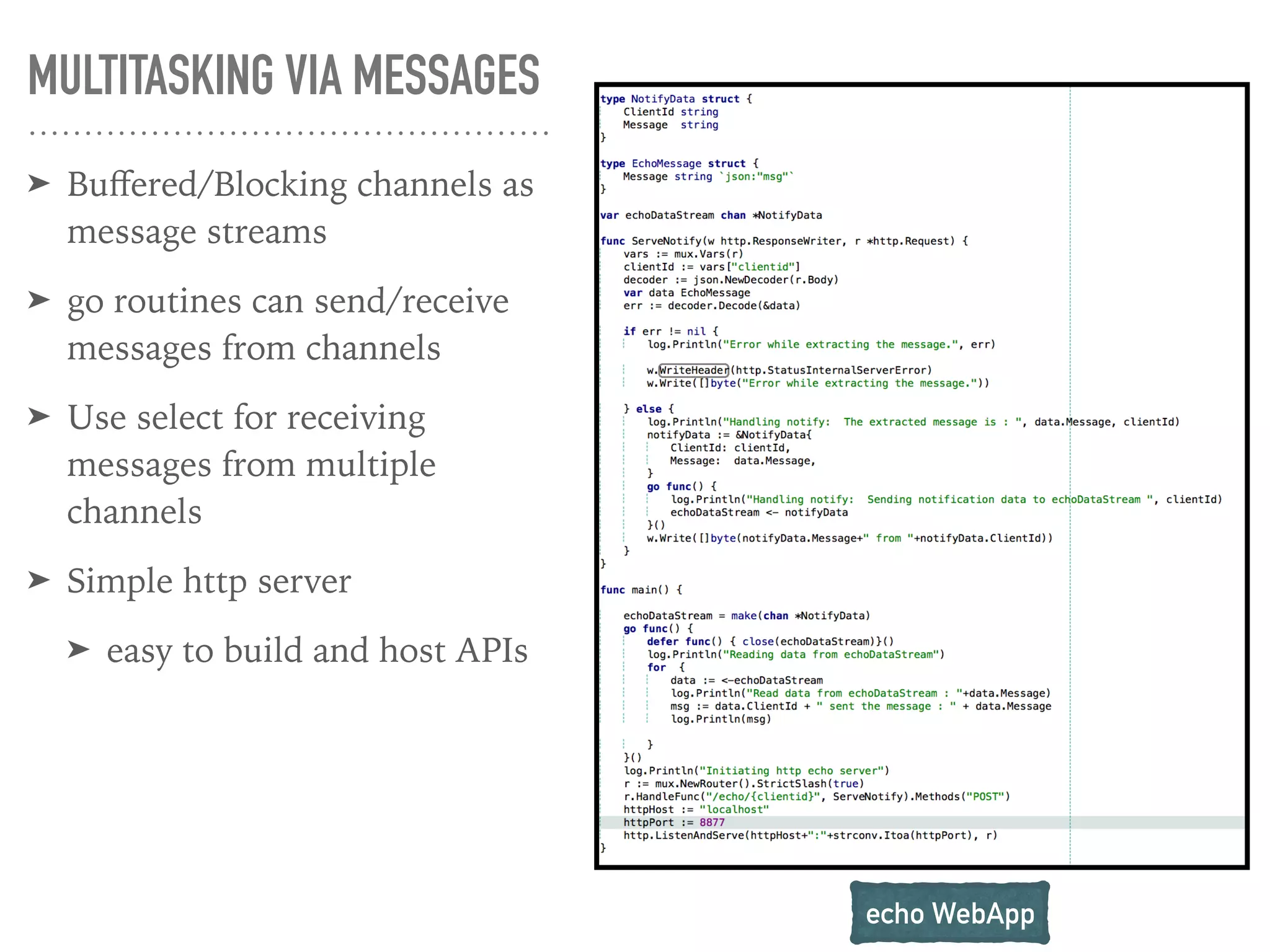
MULTITASKING VIA MESSAGES
➤ Buffered/Blocking channels as
message streams
➤ go routines can send/receive
messages from channels
➤ Use select for receiving
messages from multiple
channels
➤ Simple http server
➤ easy to build and host APIs
echo WebApp
WHAT GOT BUILT
GONOTIFY - NOTIFICATION SERVICE
Chat
Services
gonotify*
App
Receive over Websocket
Initiate Chat
NotifyAPIForWebSocket
Time Taken (Including learning Go from Scratch) : 7 days
Redis
GOCHECK - PR CHECKER
Time Taken (Including Refreshing Go) : 4 hours
➤ Uses github APIs to pull all
PRs
➤ Validates PR age and
description
➤ Add comments to PR if agent
is more than the threshold
and length of description is
less than the threshold
➤ Cross compiled to run in
Linux box
REFERENCES
Chapter 1 will give head start
Refer further chapters on need basis
Available in Safari Books online
http://devslovebacon.com/conferences/bacon-2013/talks/why-node-and-scala-will-dry-
up-go-will-drink-their-milkshake
https://golang.org
Thank You!

Let's Go

  • 1.
  • 2.
  • 3.
    EXPLORATIONS ➤ GO /Golang: Programming Language from Google ➤ Very small language footprint ➤ No multitude of options to accomplish a task. ➤ Easy to learn, Quick to build stuff. ➤ Tuned for concurrent tasks, multi core systems, does memory management too! ➤ Small memory footprint (compared to Java/Scala) ➤ Availability of packages for most needs, open source tools / systems
  • 4.
    “In the Pythonversion, our best shot at making use of all available cores is to run each publisher and subscriber routine in a separate Python interpreter, each running on a single OS process. Go’s goroutines paint an entirely different picture. With only a single pub-sub client, we’re able to consume all available CPU cores using a single OS process - Go manages all of the parallelism for you. -A tale of two queues: http://blog.jupo.org/2013/02/23/a-tale-of-two-queues/
  • 5.
  • 6.
    HELLO YOU! ➤ functionsand data grouped in packages ➤ One main package and one main function ➤ import packages ➤ no semi colons ➤ var declaration ➤ inferred type ➤ quick definition ➤ basic data types ➤ Arrays/slices, map, channel
  • 7.
    DO MORE ATSAME TIME ➤ functions can return multiple values, last one is always an error ➤ if with no braces, no semi colons, less to type ➤ neither pure functional nor object oriented ➤ Anonymous functions/ functions as values ➤ go routines - do stuff in parallel ➤ defer function - similar to destructors ➤ panic and recoverWhat is Pr?
  • 8.
    “No classes andinheritance, still we can get stuff done with types and functions associated with the type. Duck typing / Structural typing lets data structures makes data structures and functions more useful and behaviour driven No threads /mutexes/semaphores still we can have concurrent processing and co- ordintation among multiple concurrent processing routines.
  • 9.
    I MISS MYCLASSES ➤ struct - a custom type that contains other types (custom / basic) ➤ Any struct member name that starts with Uppercase letter is public ➤ Any function which specifies a struct as a receiver of the function call, is similar to methods of the struct ➤ Note the difference in specifying the receiver - pass by value/ref ➤ interface - declares the expected behaviour ➤ No one implements the interface ➤ Any type that has the behaviour mentioned in the interface automatically is of the same ‘type’ as that of the interface.
  • 10.
    MULTITASKING VIA MESSAGES ➤Buffered/Blocking channels as message streams ➤ go routines can send/receive messages from channels ➤ Use select for receiving messages from multiple channels ➤ Simple http server ➤ easy to build and host APIs echo WebApp
  • 11.
  • 12.
    GONOTIFY - NOTIFICATIONSERVICE Chat Services gonotify* App Receive over Websocket Initiate Chat NotifyAPIForWebSocket Time Taken (Including learning Go from Scratch) : 7 days Redis
  • 13.
    GOCHECK - PRCHECKER Time Taken (Including Refreshing Go) : 4 hours ➤ Uses github APIs to pull all PRs ➤ Validates PR age and description ➤ Add comments to PR if agent is more than the threshold and length of description is less than the threshold ➤ Cross compiled to run in Linux box
  • 14.
    REFERENCES Chapter 1 willgive head start Refer further chapters on need basis Available in Safari Books online http://devslovebacon.com/conferences/bacon-2013/talks/why-node-and-scala-will-dry- up-go-will-drink-their-milkshake https://golang.org
  • 15.