Department of Teacher Education
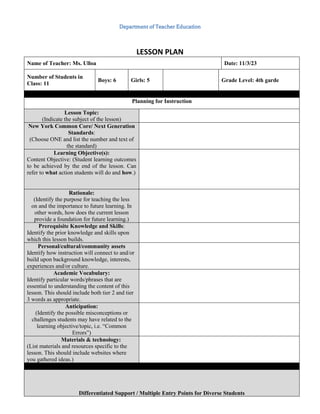
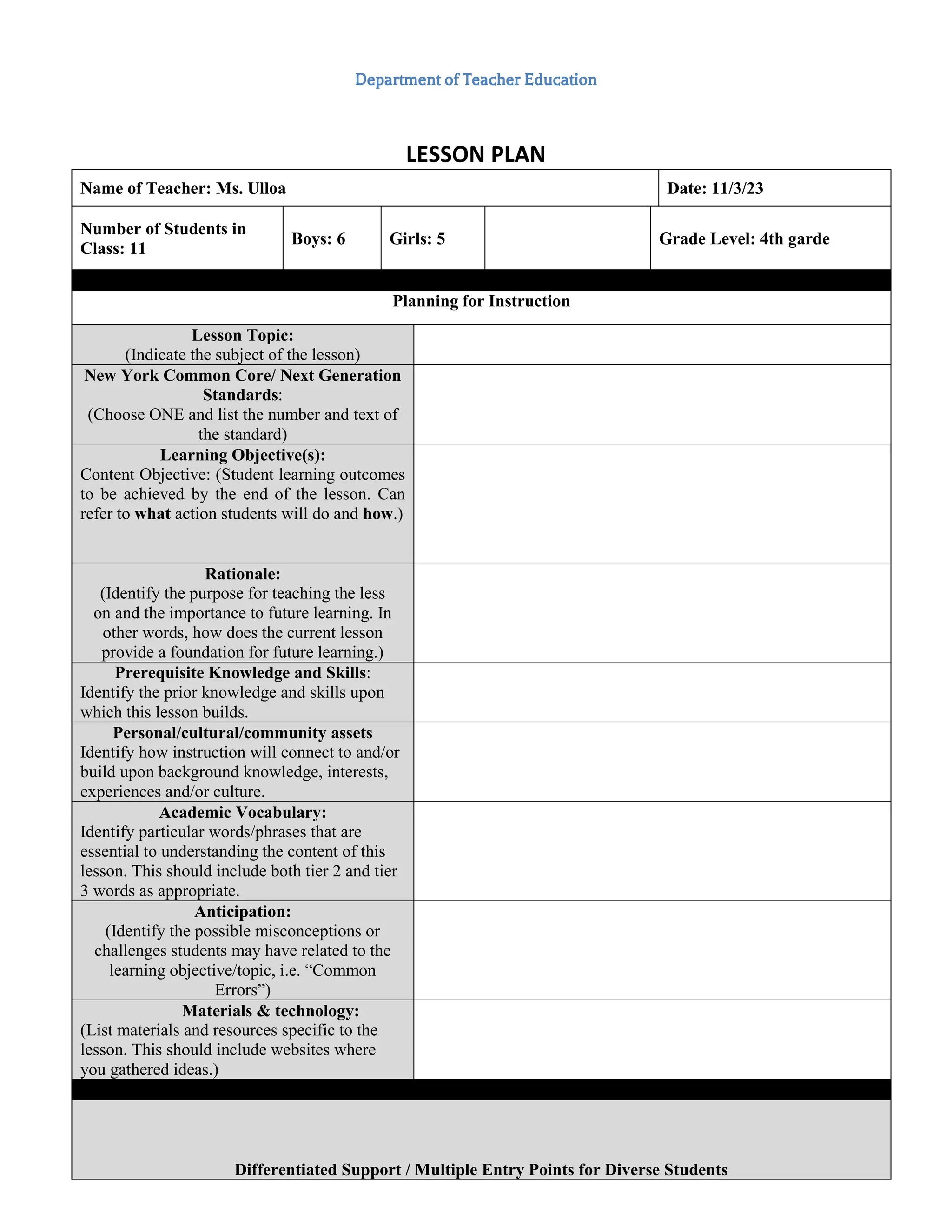
LESSON PLAN
Name of Teacher: Ms. Ulloa Date: 11/3/23
Number of Students in
Class: 11
Boys: 6 Girls: 5 Grade Level: 4th garde
Planning for Instruction
Lesson Topic:
(Indicate the subject of the lesson)
New York Common Core/ Next Generation
Standards:
(Choose ONE and list the number and text of
the standard)
Learning Objective(s):
Content Objective: (Student learning outcomes
to be achieved by the end of the lesson. Can
refer to what action students will do and how.)
Rationale:
(Identify the purpose for teaching the less
on and the importance to future learning. In
other words, how does the current lesson
provide a foundation for future learning.)
Prerequisite Knowledge and Skills:
Identify the prior knowledge and skills upon
which this lesson builds.
Personal/cultural/community assets
Identify how instruction will connect to and/or
build upon background knowledge, interests,
experiences and/or culture.
Academic Vocabulary:
Identify particular words/phrases that are
essential to understanding the content of this
lesson. This should include both tier 2 and tier
3 words as appropriate.
Anticipation:
(Identify the possible misconceptions or
challenges students may have related to the
learning objective/topic, i.e. “Common
Errors”)
Materials & technology:
(List materials and resources specific to the
lesson. This should include websites where
you gathered ideas.)
Differentiated Support / Multiple Entry Points for Diverse Students
Department of Teacher Education
Complete the chart below to summarize required or needed supports, accommodations, or modifications for your
students that will differentiate your instruction in this lesson. As needed, consult with your cooperating teacher to
complete the chart.
Special Subgroups of Diverse
Learners
Supports, Accommodations, Modifications
❒ Students with Interrupted Formal
Education (SIFE)
❒ Students with Disabilities or with IEPs or
504
❒ Gifted needing greater support or
challenge
❒ Students with gaps in academic knowledge
❒ Students in need of behavior support
Assessment Evidence:
(Describe how activities or assignments will provide you feedback on how you are monitoring student learning)
Formative Assessments:
(Conducted during the lesson and can include
student questions and responses. This also
includes teacher observations of student
engagement and assigned tasks.)
Development of Lesson Teacher will do check-in for comprehension and proficiency
Motivation: (5 minutes)
(This should “hook” students to follow the
lesson. The activity should elicit prior
knowledge and experiences. It is not the
beginning of the lesson content).
Mini-lesson (10 minutes):
(Opportunity for teachers to introduce and
model the new skill, concept or approach in a
very intentional and concise manner. Students
learn by observing and demonstrating
engagement during this instructional strategy.
Opportunity for guided practice should be
integrated into the mini-lesson. Include 3-5
guiding questions. )
Independent Work Time (10 minutes):
(Designed learning activity that is directly
related to the lesson objective. Students can
work in pairs, small groups, or independently.
Closure (5 minutes):
(Explain how you will recap the learning that
will happen in the lesson, i.e. key questions,
checking for understanding, etc.)
Follow Up
Department of Teacher Education
(Select an assignment to enhance further
learning. May include review, homework,
enrichment, remediation, etc.)

_Lesson Plan Template (1) (1).docx

  • 1.
    Department of TeacherEducation LESSON PLAN Name of Teacher: Ms. Ulloa Date: 11/3/23 Number of Students in Class: 11 Boys: 6 Girls: 5 Grade Level: 4th garde Planning for Instruction Lesson Topic: (Indicate the subject of the lesson) New York Common Core/ Next Generation Standards: (Choose ONE and list the number and text of the standard) Learning Objective(s): Content Objective: (Student learning outcomes to be achieved by the end of the lesson. Can refer to what action students will do and how.) Rationale: (Identify the purpose for teaching the less on and the importance to future learning. In other words, how does the current lesson provide a foundation for future learning.) Prerequisite Knowledge and Skills: Identify the prior knowledge and skills upon which this lesson builds. Personal/cultural/community assets Identify how instruction will connect to and/or build upon background knowledge, interests, experiences and/or culture. Academic Vocabulary: Identify particular words/phrases that are essential to understanding the content of this lesson. This should include both tier 2 and tier 3 words as appropriate. Anticipation: (Identify the possible misconceptions or challenges students may have related to the learning objective/topic, i.e. “Common Errors”) Materials & technology: (List materials and resources specific to the lesson. This should include websites where you gathered ideas.) Differentiated Support / Multiple Entry Points for Diverse Students
  • 2.
    Department of TeacherEducation Complete the chart below to summarize required or needed supports, accommodations, or modifications for your students that will differentiate your instruction in this lesson. As needed, consult with your cooperating teacher to complete the chart. Special Subgroups of Diverse Learners Supports, Accommodations, Modifications ❒ Students with Interrupted Formal Education (SIFE) ❒ Students with Disabilities or with IEPs or 504 ❒ Gifted needing greater support or challenge ❒ Students with gaps in academic knowledge ❒ Students in need of behavior support Assessment Evidence: (Describe how activities or assignments will provide you feedback on how you are monitoring student learning) Formative Assessments: (Conducted during the lesson and can include student questions and responses. This also includes teacher observations of student engagement and assigned tasks.) Development of Lesson Teacher will do check-in for comprehension and proficiency Motivation: (5 minutes) (This should “hook” students to follow the lesson. The activity should elicit prior knowledge and experiences. It is not the beginning of the lesson content). Mini-lesson (10 minutes): (Opportunity for teachers to introduce and model the new skill, concept or approach in a very intentional and concise manner. Students learn by observing and demonstrating engagement during this instructional strategy. Opportunity for guided practice should be integrated into the mini-lesson. Include 3-5 guiding questions. ) Independent Work Time (10 minutes): (Designed learning activity that is directly related to the lesson objective. Students can work in pairs, small groups, or independently. Closure (5 minutes): (Explain how you will recap the learning that will happen in the lesson, i.e. key questions, checking for understanding, etc.) Follow Up
  • 3.
    Department of TeacherEducation (Select an assignment to enhance further learning. May include review, homework, enrichment, remediation, etc.)