INTRODUCTION
Evaluation represent the final stage of working with
teaching and learning resources. The purpose of
evaluation is to evaluate the effectiveness of a
particular teaching and learning resource in
attaining the goals and objectives of teaching; in
other words, its contribution to the process of
understanding, linking and interpreting, developing
desirable skills and adopting certain values of
students.
Teaching and learning resource
selection are important aspect of
teaching and learning activities,
which can largely decide what
how teachers can teach and
students learn (Shi, 2014)
Proper instruction in any subject
discipline may bring students in contact
with ideas, beliefs, values, and practices
other than those their backgrounds may
have led them to accept. Each item is
judged on its merits as an entire piece,
not by proportions or out-of-context
selection(Guthrie et al., 2017)
The following are the general criteria
proposed by Guthrie et. al (2017) used in
selecting and evaluating instructional
materials and will support multiple means
of representation:
• aligned to the curriculum and the
objectives of the instructional
program;
• appropriate for recommended
age/grade levels;
• accurate in terms of content;
• reflective of the plurastic in nature;
• represengtstive of differing
viewpoints;
• appropriate format for the subject
matter;
• recent copyright date as appropriate
to the subject;
• acceptable literary style and technical
quality;
• cost effective in terms of use.
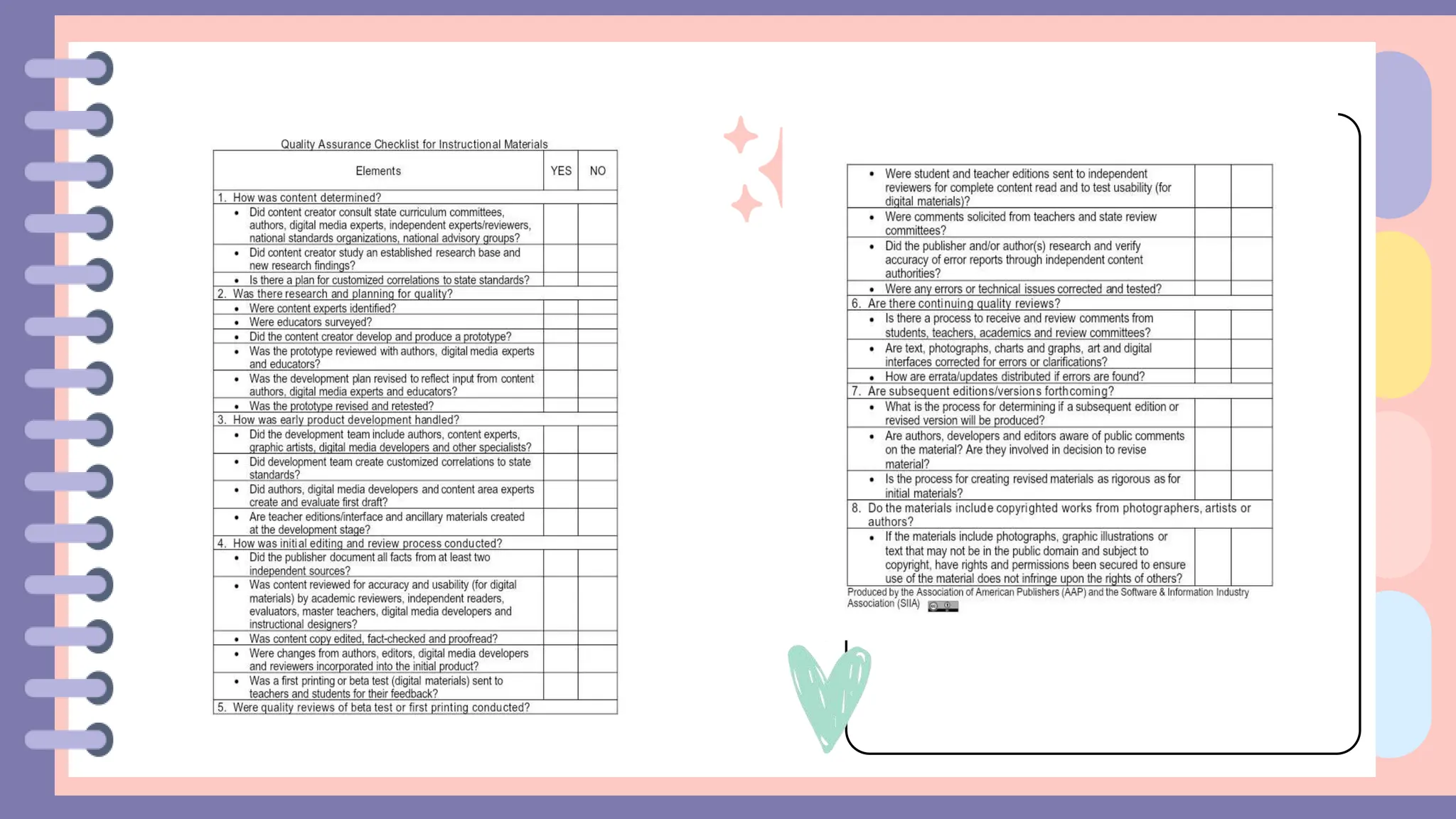
Criteria’s for evaluating
instructional materials is
very important to make
teaching effective and
meaningful, below are
examples of rating scale
and checklist rubric
respectively for selecting
appropriate teaching and
learning resources.
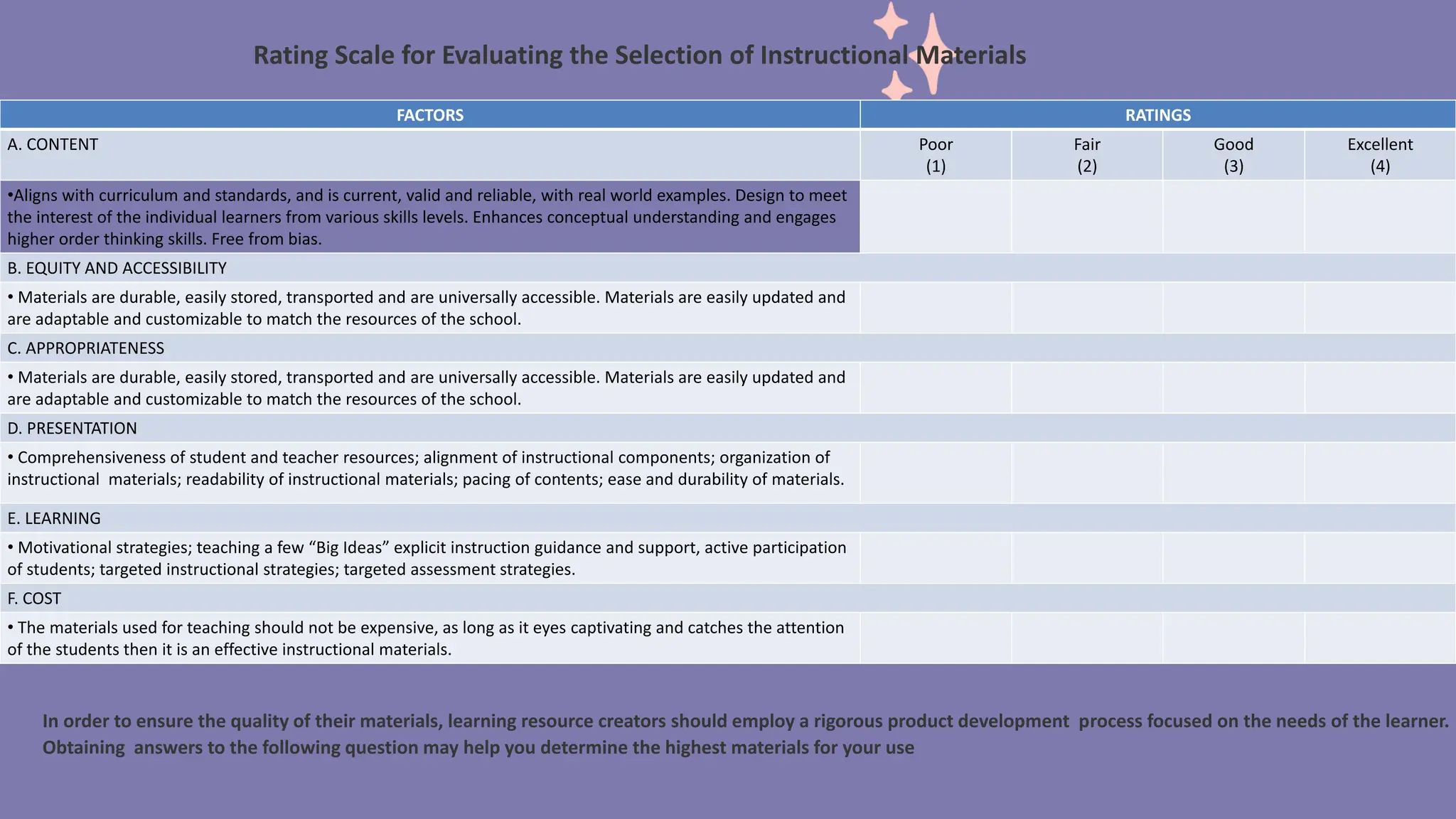
Rating Scale for Evaluating the Selection of Instructional Materials
In order to ensure the quality of their materials, learning resource creators should employ a rigorous product development process focused on the needs of the learner.
Obtaining answers to the following question may help you determine the highest materials for your use
FACTORS RATINGS
A. CONTENT Poor
(1)
Fair
(2)
Good
(3)
Excellent
(4)
•Aligns with curriculum and standards, and is current, valid and reliable, with real world examples. Design to meet
the interest of the individual learners from various skills levels. Enhances conceptual understanding and engages
higher order thinking skills. Free from bias.
B. EQUITY AND ACCESSIBILITY
• Materials are durable, easily stored, transported and are universally accessible. Materials are easily updated and
are adaptable and customizable to match the resources of the school.
C. APPROPRIATENESS
• Materials are durable, easily stored, transported and are universally accessible. Materials are easily updated and
are adaptable and customizable to match the resources of the school.
D. PRESENTATION
• Comprehensiveness of student and teacher resources; alignment of instructional components; organization of
instructional materials; readability of instructional materials; pacing of contents; ease and durability of materials.
E. LEARNING
• Motivational strategies; teaching a few “Big Ideas” explicit instruction guidance and support, active participation
of students; targeted instructional strategies; targeted assessment strategies.
F. COST
• The materials used for teaching should not be expensive, as long as it eyes captivating and catches the attention
of the students then it is an effective instructional materials.
Lesson 3: Assessment Tools for Selecting

Lesson 3: Assessment Tools for Selecting

  • 2.
    INTRODUCTION Evaluation represent thefinal stage of working with teaching and learning resources. The purpose of evaluation is to evaluate the effectiveness of a particular teaching and learning resource in attaining the goals and objectives of teaching; in other words, its contribution to the process of understanding, linking and interpreting, developing desirable skills and adopting certain values of students.
  • 3.
    Teaching and learningresource selection are important aspect of teaching and learning activities, which can largely decide what how teachers can teach and students learn (Shi, 2014)
  • 4.
    Proper instruction inany subject discipline may bring students in contact with ideas, beliefs, values, and practices other than those their backgrounds may have led them to accept. Each item is judged on its merits as an entire piece, not by proportions or out-of-context selection(Guthrie et al., 2017)
  • 5.
    The following arethe general criteria proposed by Guthrie et. al (2017) used in selecting and evaluating instructional materials and will support multiple means of representation: • aligned to the curriculum and the objectives of the instructional program; • appropriate for recommended age/grade levels; • accurate in terms of content;
  • 6.
    • reflective ofthe plurastic in nature; • represengtstive of differing viewpoints; • appropriate format for the subject matter; • recent copyright date as appropriate to the subject; • acceptable literary style and technical quality; • cost effective in terms of use.
  • 7.
    Criteria’s for evaluating instructionalmaterials is very important to make teaching effective and meaningful, below are examples of rating scale and checklist rubric respectively for selecting appropriate teaching and learning resources.
  • 8.
    Rating Scale forEvaluating the Selection of Instructional Materials In order to ensure the quality of their materials, learning resource creators should employ a rigorous product development process focused on the needs of the learner. Obtaining answers to the following question may help you determine the highest materials for your use FACTORS RATINGS A. CONTENT Poor (1) Fair (2) Good (3) Excellent (4) •Aligns with curriculum and standards, and is current, valid and reliable, with real world examples. Design to meet the interest of the individual learners from various skills levels. Enhances conceptual understanding and engages higher order thinking skills. Free from bias. B. EQUITY AND ACCESSIBILITY • Materials are durable, easily stored, transported and are universally accessible. Materials are easily updated and are adaptable and customizable to match the resources of the school. C. APPROPRIATENESS • Materials are durable, easily stored, transported and are universally accessible. Materials are easily updated and are adaptable and customizable to match the resources of the school. D. PRESENTATION • Comprehensiveness of student and teacher resources; alignment of instructional components; organization of instructional materials; readability of instructional materials; pacing of contents; ease and durability of materials. E. LEARNING • Motivational strategies; teaching a few “Big Ideas” explicit instruction guidance and support, active participation of students; targeted instructional strategies; targeted assessment strategies. F. COST • The materials used for teaching should not be expensive, as long as it eyes captivating and catches the attention of the students then it is an effective instructional materials.