PRACTICAL
RESEARCH
2
QUANTITATIVE RESEARCH
MURIEL GRACE G. VIERNEZA
November 2019
QUANTITATIVE
RESEARCH
Strengths and Weaknesses
1. What are the strengths and
weaknesses of quantitative research?
2. What is the importance of quantitative
research (across fields)?
QUANTITATIVE
RESEARCH
Instructions: Draw a tree. Imagine the tree
bearing good fruits and defective fruits. On the
left-side branches of the tree, write the
strengths of a quantitative research? On the
right side, write the weakness of a quantitative
research?
ATREEWITHGOODANDDEFECTIVE
FRUITS
STRENGTHS AND WEAKNESSES
of
QUANTITATIVE
RESEARCH
Madrigal and McClain (2012), Quantitative
Research strengths are:
 lies on making available descriptive data
 e.g. picture of a community situation
affected by peace conflicts
 provide data that can be communicated in
numeric form
Quantitative Research
Madrigal and McClain (2012), Quantitative
Research strengths are:
 can use statistical test in making declarations
about a certain data:
-preference trends; differences between
groups; demographics
Quantitative Research
Madrigal and McClain (2012), Quantitative
Research weaknesses are:
 difficulty in interpretation (not valid and not
reliable)
 “data deficiency” as a result of weak
interpretation can “lead to critical errors in the
design”
Quantitative Research
Madrigal and McClain (2012), Quantitative
Research weaknesses are:
 “only those with a firm grasp on how the data
would be used & interpreted should conduct
such a study”
 overreliance on the P-value
 Statistical significance – communicates to the researcher
if the results are varied
 Effect size – expresses how much the results carry
some weight (or if they make a difference)
Quantitative Research
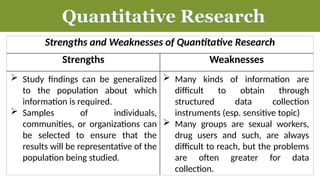
Strengths and Weaknesses of Quantitative Research
Strengths Weaknesses
 Many kinds of information are
difficult to obtain through
structured data collection
instruments (esp. sensitive topic)
 Many groups are sexual workers,
drug users and such, are always
difficult to reach, but the problems
are often greater for data
collection.
Quantitative Research
 Study findings can be generalized
to the population about which
information is required.
 Samples of individuals,
communities, or organizations can
be selected to ensure that the
results will be representative of the
population being studied.
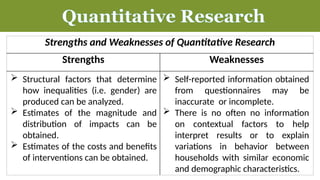
Strengths and Weaknesses of Quantitative Research
Strengths Weaknesses
 Self-reported information obtained
from questionnaires may be
inaccurate or incomplete.
 There is no often no information
on contextual factors to help
interpret results or to explain
variations in behavior between
households with similar economic
and demographic characteristics.
Quantitative Research
 Structural factors that determine
how inequalities (i.e. gender) are
produced can be analyzed.
 Estimates of the magnitude and
distribution of impacts can be
obtained.
 Estimates of the costs and benefits
of interventions can be obtained.
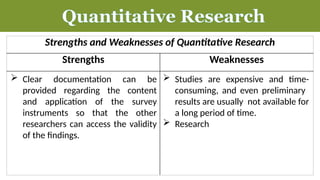
Strengths and Weaknesses of Quantitative Research
Strengths Weaknesses
 Studies are expensive and time-
consuming, and even preliminary
results are usually not available for
a long period of time.
 Research
Quantitative Research
 Clear documentation can be
provided regarding the content
and application of the survey
instruments so that the other
researchers can access the validity
of the findings.
Quantitative Research
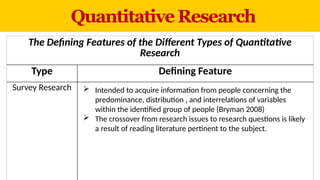
The Defining Features of the Different Types of Quantitative
Research
Type Defining Feature
Survey Research  Intended to acquire information from people concerning the
predominance, distribution , and interrelations of variables
within the identified group of people (Bryman 2008)
 The crossover from research issues to research questions is likely
a result of reading literature pertinent to the subject.
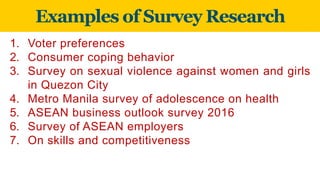
Examples of Survey Research
1. Voter preferences
2. Consumer coping behavior
3. Survey on sexual violence against women and girls
in Quezon City
4. Metro Manila survey of adolescence on health
5. ASEAN business outlook survey 2016
6. Survey of ASEAN employers
7. On skills and competitiveness
Quantitative Research
The Defining Features of the Different Types of Quantitative
Research
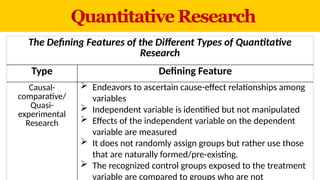
Type Defining Feature
Causal-
comparative/
Quasi-
experimental
Research
 Endeavors to ascertain cause-effect relationships among
variables
 Independent variable is identified but not manipulated
 Effects of the independent variable on the dependent
variable are measured
 It does not randomly assign groups but rather use those
that are naturally formed/pre-existing.
 The recognized control groups exposed to the treatment
variable are compared to groups who are not
Examples of Quasi-experimental Research
1. the effect of studying in Catholic schools on the
moral value system of those who graduate from
these schools
2. the effect of good family upbringing to good
performance in class
3. the effect of belonging to a Christian Living
organization on a student’s religiosity
4. the effect of gender of exercising regularly to body
fitness
5. the effect of gender on college course choices
Quantitative Research
The Defining Features of the Different Types of Quantitative Research
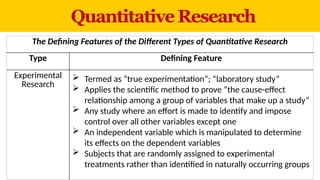
Type Defining Feature
Experimental
Research
 Termed as “true experimentation”; “laboratory study”
 Applies the scientific method to prove “the cause-effect
relationship among a group of variables that make up a study”
 Any study where an effort is made to identify and impose
control over all other variables except one
 An independent variable which is manipulated to determine
its effects on the dependent variables
 Subjects that are randomly assigned to experimental
treatments rather than identified in naturally occurring groups
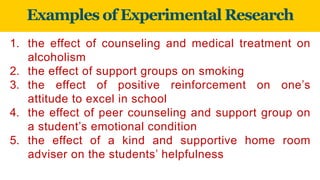
Examples of Experimental Research
1. the effect of counseling and medical treatment on
alcoholism
2. the effect of support groups on smoking
3. the effect of positive reinforcement on one’s
attitude to excel in school
4. the effect of peer counseling and support group on
a student’s emotional condition
5. the effect of a kind and supportive home room
adviser on the students’ helpfulness
EN
D

Lesson #2_Types of Quantitative Research.pptx

  • 1.
  • 2.
  • 3.
    1. What arethe strengths and weaknesses of quantitative research? 2. What is the importance of quantitative research (across fields)? QUANTITATIVE RESEARCH
  • 4.
    Instructions: Draw atree. Imagine the tree bearing good fruits and defective fruits. On the left-side branches of the tree, write the strengths of a quantitative research? On the right side, write the weakness of a quantitative research? ATREEWITHGOODANDDEFECTIVE FRUITS
  • 5.
  • 6.
    Madrigal and McClain(2012), Quantitative Research strengths are:  lies on making available descriptive data  e.g. picture of a community situation affected by peace conflicts  provide data that can be communicated in numeric form Quantitative Research
  • 7.
    Madrigal and McClain(2012), Quantitative Research strengths are:  can use statistical test in making declarations about a certain data: -preference trends; differences between groups; demographics Quantitative Research
  • 8.
    Madrigal and McClain(2012), Quantitative Research weaknesses are:  difficulty in interpretation (not valid and not reliable)  “data deficiency” as a result of weak interpretation can “lead to critical errors in the design” Quantitative Research
  • 9.
    Madrigal and McClain(2012), Quantitative Research weaknesses are:  “only those with a firm grasp on how the data would be used & interpreted should conduct such a study”  overreliance on the P-value  Statistical significance – communicates to the researcher if the results are varied  Effect size – expresses how much the results carry some weight (or if they make a difference) Quantitative Research
  • 10.
    Strengths and Weaknessesof Quantitative Research Strengths Weaknesses  Many kinds of information are difficult to obtain through structured data collection instruments (esp. sensitive topic)  Many groups are sexual workers, drug users and such, are always difficult to reach, but the problems are often greater for data collection. Quantitative Research  Study findings can be generalized to the population about which information is required.  Samples of individuals, communities, or organizations can be selected to ensure that the results will be representative of the population being studied.
  • 11.
    Strengths and Weaknessesof Quantitative Research Strengths Weaknesses  Self-reported information obtained from questionnaires may be inaccurate or incomplete.  There is no often no information on contextual factors to help interpret results or to explain variations in behavior between households with similar economic and demographic characteristics. Quantitative Research  Structural factors that determine how inequalities (i.e. gender) are produced can be analyzed.  Estimates of the magnitude and distribution of impacts can be obtained.  Estimates of the costs and benefits of interventions can be obtained.
  • 12.
    Strengths and Weaknessesof Quantitative Research Strengths Weaknesses  Studies are expensive and time- consuming, and even preliminary results are usually not available for a long period of time.  Research Quantitative Research  Clear documentation can be provided regarding the content and application of the survey instruments so that the other researchers can access the validity of the findings.
  • 13.
    Quantitative Research The DefiningFeatures of the Different Types of Quantitative Research Type Defining Feature Survey Research  Intended to acquire information from people concerning the predominance, distribution , and interrelations of variables within the identified group of people (Bryman 2008)  The crossover from research issues to research questions is likely a result of reading literature pertinent to the subject.
  • 14.
    Examples of SurveyResearch 1. Voter preferences 2. Consumer coping behavior 3. Survey on sexual violence against women and girls in Quezon City 4. Metro Manila survey of adolescence on health 5. ASEAN business outlook survey 2016 6. Survey of ASEAN employers 7. On skills and competitiveness
  • 15.
    Quantitative Research The DefiningFeatures of the Different Types of Quantitative Research Type Defining Feature Causal- comparative/ Quasi- experimental Research  Endeavors to ascertain cause-effect relationships among variables  Independent variable is identified but not manipulated  Effects of the independent variable on the dependent variable are measured  It does not randomly assign groups but rather use those that are naturally formed/pre-existing.  The recognized control groups exposed to the treatment variable are compared to groups who are not
  • 16.
    Examples of Quasi-experimentalResearch 1. the effect of studying in Catholic schools on the moral value system of those who graduate from these schools 2. the effect of good family upbringing to good performance in class 3. the effect of belonging to a Christian Living organization on a student’s religiosity 4. the effect of gender of exercising regularly to body fitness 5. the effect of gender on college course choices
  • 17.
    Quantitative Research The DefiningFeatures of the Different Types of Quantitative Research Type Defining Feature Experimental Research  Termed as “true experimentation”; “laboratory study”  Applies the scientific method to prove “the cause-effect relationship among a group of variables that make up a study”  Any study where an effort is made to identify and impose control over all other variables except one  An independent variable which is manipulated to determine its effects on the dependent variables  Subjects that are randomly assigned to experimental treatments rather than identified in naturally occurring groups
  • 18.
    Examples of ExperimentalResearch 1. the effect of counseling and medical treatment on alcoholism 2. the effect of support groups on smoking 3. the effect of positive reinforcement on one’s attitude to excel in school 4. the effect of peer counseling and support group on a student’s emotional condition 5. the effect of a kind and supportive home room adviser on the students’ helpfulness
  • 19.

Editor's Notes

  • #7 Descriptive statistics (mean, median, SD) Even Inferential Statistics (t-test; ANOVAs; multiple regressions)
  • #13 Done to gather evidence on people’s knowledge, opinions, attitudes, and values on various issues and concerns Research instruments: structured interview schedule/self-completion questionnaires