Presenter logo
Here
Common Business/Legal
Operating Pitfalls
Non-Competition Agreements
• Restrains Ex-Employee From Competing With You, Not Just
From Using Your Trade Secrets and/or Confidential
Information
– Competition Is Restrained In A Defined Geographic Area
– Competition Is Restrained For A Defined Time Period
• Also Appropriate In Certain Relationships With Suppliers
Where Work Involves Providing Confidential Information to
Supplier To Manufacture Your Product For You
Enforceability Of
Non-Competition Agreements
• Otherwise Enforceable Agreement (“OEA”)
• Non-Compete Covenant (“NCC”)
• OEA Is “Ancillary” TO NCC
• Proof That Employer Actually Provided TS/CI To Employee
• NCC Has Restraints That Are Reasonable
• Where Employee Is A Physician, Additional Clauses Must Be
Contained in The Agreement
Covenants Similar To Non-Competes
• Non-Solicitation Covenant
(Customers / Prospective Customers / Projects)
• Non-Recruitment Covenant
(Hiring Away Other Employees)
• Non-Disclosure Covenant
(Written Version of “Automatic” Protections)
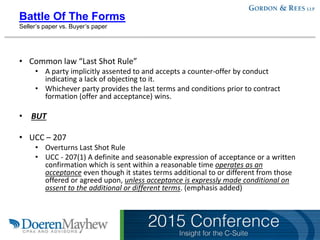
Battle Of The Forms
Seller’s paper vs. Buyer’s paper
• Common law “Last Shot Rule”
• A party implicitly assented to and accepts a counter-offer by conduct
indicating a lack of objecting to it.
• Whichever party provides the last terms and conditions prior to contract
formation (offer and acceptance) wins.
• BUT
• UCC – 207
• Overturns Last Shot Rule
• UCC - 207(1) A definite and seasonable expression of acceptance or a written
confirmation which is sent within a reasonable time operates as an
acceptance even though it states terms additional to or different from those
offered or agreed upon, unless acceptance is expressly made conditional on
assent to the additional or different terms. (emphasis added)
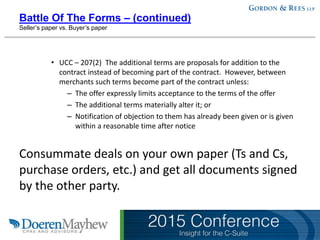
Battle Of The Forms – (continued)
Seller’s paper vs. Buyer’s paper
• UCC – 207(2) The additional terms are proposals for addition to the
contract instead of becoming part of the contract. However, between
merchants such terms become part of the contract unless:
– The offer expressly limits acceptance to the terms of the offer
– The additional terms materially alter it; or
– Notification of objection to them has already been given or is given
within a reasonable time after notice
Consummate deals on your own paper (Ts and Cs,
purchase orders, etc.) and get all documents signed
by the other party.
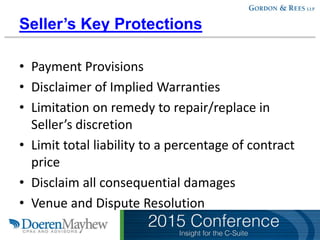
Seller’s Key Protections
• Payment Provisions
• Disclaimer of Implied Warranties
• Limitation on remedy to repair/replace in
Seller’s discretion
• Limit total liability to a percentage of contract
price
• Disclaim all consequential damages
• Venue and Dispute Resolution
Top Five Tips for Avoiding
Employment Claims in 2015
Common Pitfalls and Best Practices
1. Don’t Misclassify Non-Exempt Employees as Exempt (Fair
Labor Standards Act)
– A salaried employee is NOT necessarily exempt from
overtime pay requirements
2. Don’t Misclassify Employees as Independent Contractors
– You could be assessed the amount of the FICA and
unemployment taxes that should have been paid, plus
interest and penalties, by the IRS
3. Take Caution in Using Social Media to Make Hiring and
Firing Decisions
Common Pitfalls and Best Practices – (continued)
4. Implement Proper and Legal Use of
Screening Tools (i.e. criminal background
checks)
5. Review and Update (and Implement!) Your
Employee Handbook

Legal

  • 1.
  • 2.
    Non-Competition Agreements • RestrainsEx-Employee From Competing With You, Not Just From Using Your Trade Secrets and/or Confidential Information – Competition Is Restrained In A Defined Geographic Area – Competition Is Restrained For A Defined Time Period • Also Appropriate In Certain Relationships With Suppliers Where Work Involves Providing Confidential Information to Supplier To Manufacture Your Product For You
  • 3.
    Enforceability Of Non-Competition Agreements •Otherwise Enforceable Agreement (“OEA”) • Non-Compete Covenant (“NCC”) • OEA Is “Ancillary” TO NCC • Proof That Employer Actually Provided TS/CI To Employee • NCC Has Restraints That Are Reasonable • Where Employee Is A Physician, Additional Clauses Must Be Contained in The Agreement
  • 4.
    Covenants Similar ToNon-Competes • Non-Solicitation Covenant (Customers / Prospective Customers / Projects) • Non-Recruitment Covenant (Hiring Away Other Employees) • Non-Disclosure Covenant (Written Version of “Automatic” Protections)
  • 5.
    Battle Of TheForms Seller’s paper vs. Buyer’s paper • Common law “Last Shot Rule” • A party implicitly assented to and accepts a counter-offer by conduct indicating a lack of objecting to it. • Whichever party provides the last terms and conditions prior to contract formation (offer and acceptance) wins. • BUT • UCC – 207 • Overturns Last Shot Rule • UCC - 207(1) A definite and seasonable expression of acceptance or a written confirmation which is sent within a reasonable time operates as an acceptance even though it states terms additional to or different from those offered or agreed upon, unless acceptance is expressly made conditional on assent to the additional or different terms. (emphasis added)
  • 6.
    Battle Of TheForms – (continued) Seller’s paper vs. Buyer’s paper • UCC – 207(2) The additional terms are proposals for addition to the contract instead of becoming part of the contract. However, between merchants such terms become part of the contract unless: – The offer expressly limits acceptance to the terms of the offer – The additional terms materially alter it; or – Notification of objection to them has already been given or is given within a reasonable time after notice Consummate deals on your own paper (Ts and Cs, purchase orders, etc.) and get all documents signed by the other party.
  • 7.
    Seller’s Key Protections •Payment Provisions • Disclaimer of Implied Warranties • Limitation on remedy to repair/replace in Seller’s discretion • Limit total liability to a percentage of contract price • Disclaim all consequential damages • Venue and Dispute Resolution
  • 8.
    Top Five Tipsfor Avoiding Employment Claims in 2015
  • 9.
    Common Pitfalls andBest Practices 1. Don’t Misclassify Non-Exempt Employees as Exempt (Fair Labor Standards Act) – A salaried employee is NOT necessarily exempt from overtime pay requirements 2. Don’t Misclassify Employees as Independent Contractors – You could be assessed the amount of the FICA and unemployment taxes that should have been paid, plus interest and penalties, by the IRS 3. Take Caution in Using Social Media to Make Hiring and Firing Decisions
  • 10.
    Common Pitfalls andBest Practices – (continued) 4. Implement Proper and Legal Use of Screening Tools (i.e. criminal background checks) 5. Review and Update (and Implement!) Your Employee Handbook