Lecture 1:
Algorithms and Pseudocode
Objectives
 Algorithms
 Flowcharts
 Types of Algorithms:
 Searching (Linear, Binary)
 Sorting (Bubble, Insertion)
 Optimization (Greedy, Whale Optimization
Algorithms (WOA))
 Recursive
 Big-O Notation
Algorithm
 An algorithm is a finite sequence of precise instructions for
performing a computation or for solving a problem.
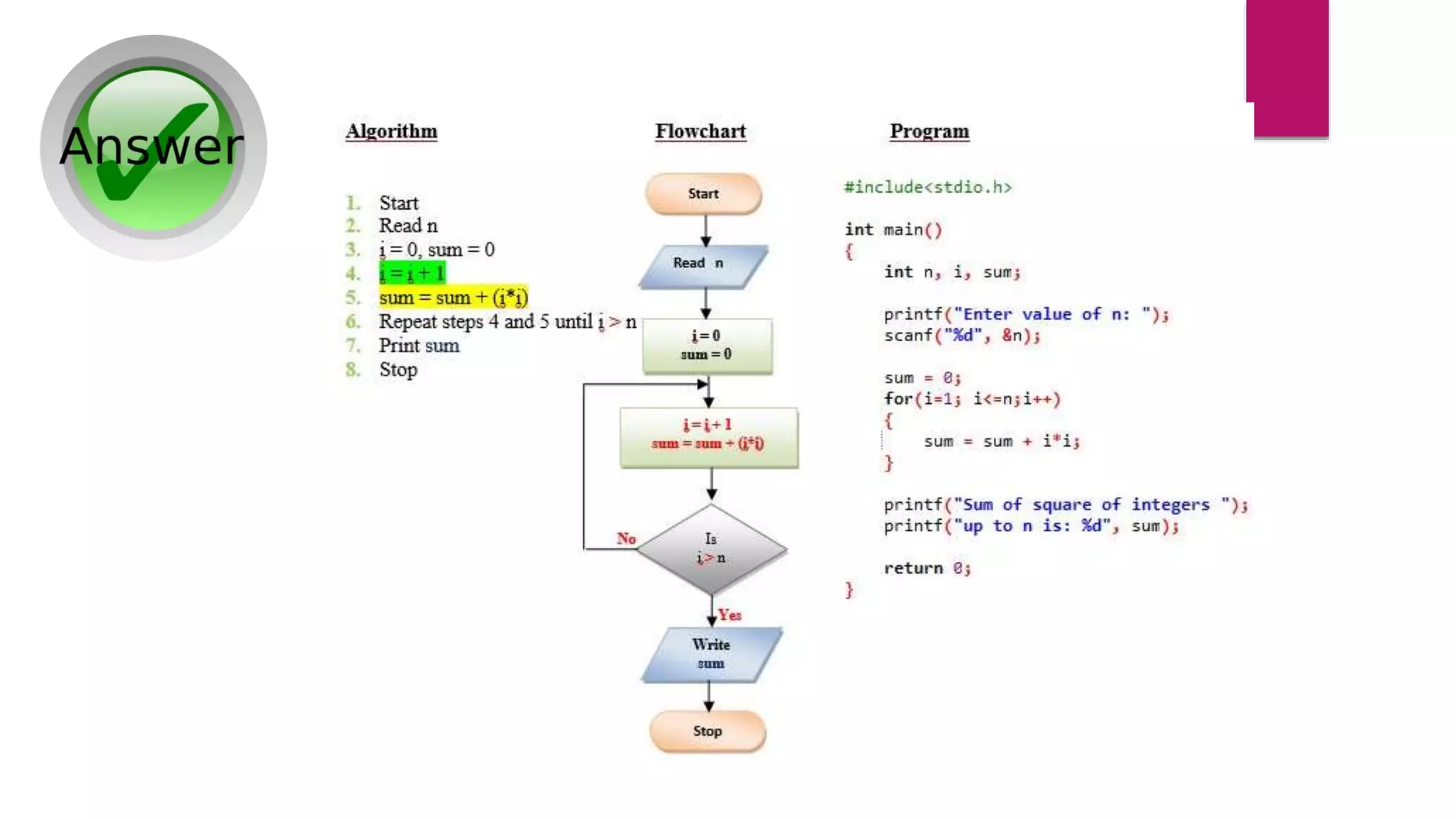
https://app.diagrams.net/
https://www.lucidchart.com/pages/what-is-a-flowchart-tutorial
Flowchart
A flowchart is a diagram that depicts a process, system or computer algorithm. They are
widely used in multiple fields to document, study, plan, improve and communicate often
complex processes in clear, easy-to-understand diagrams.
Flowcharts can:
 Demonstrate the way code is organized.
 Visualize the execution of code within a program.
 Show the structure of a website or application.
 Understand how users navigate a website or
program.
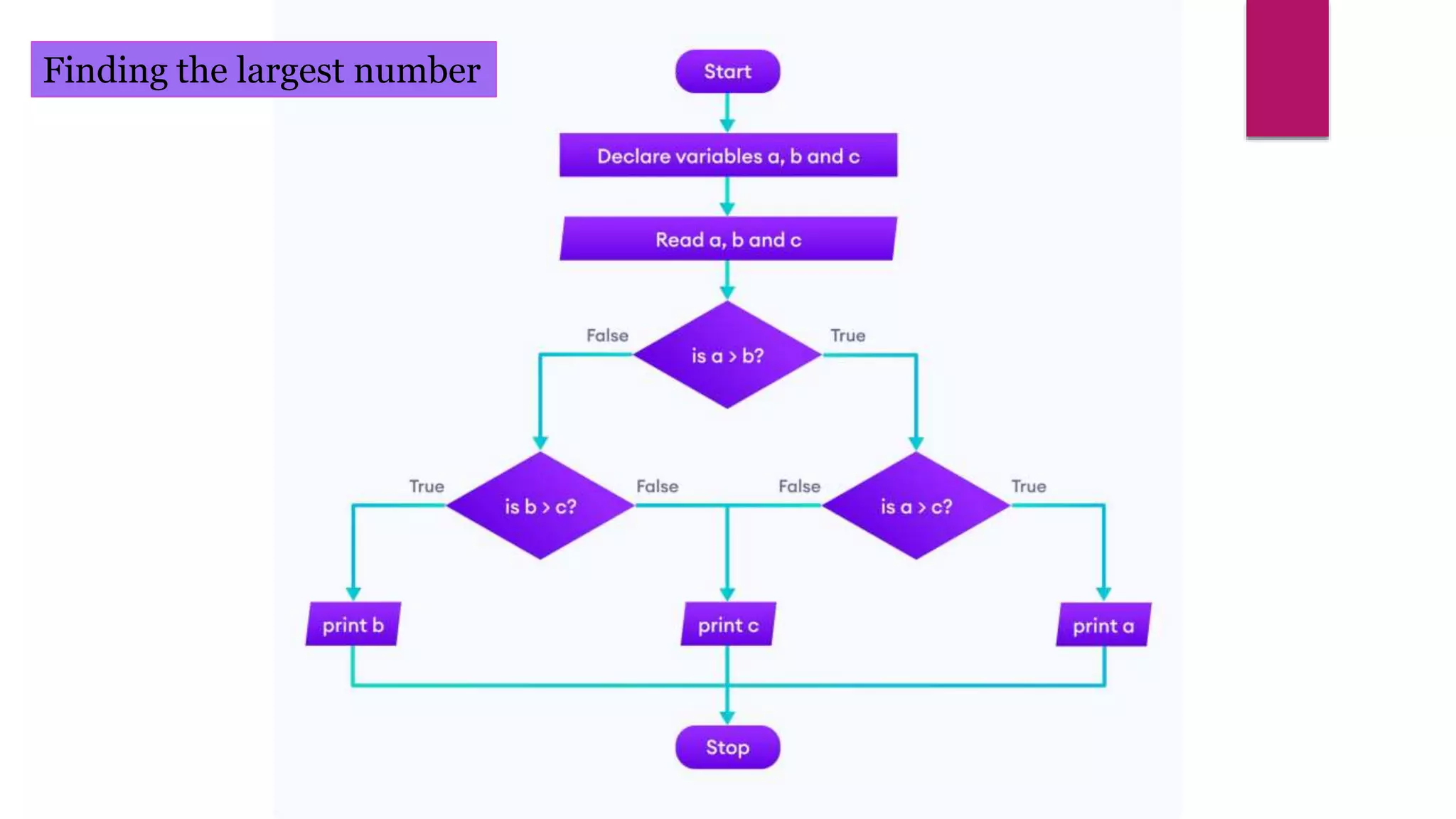
Finding the largest number
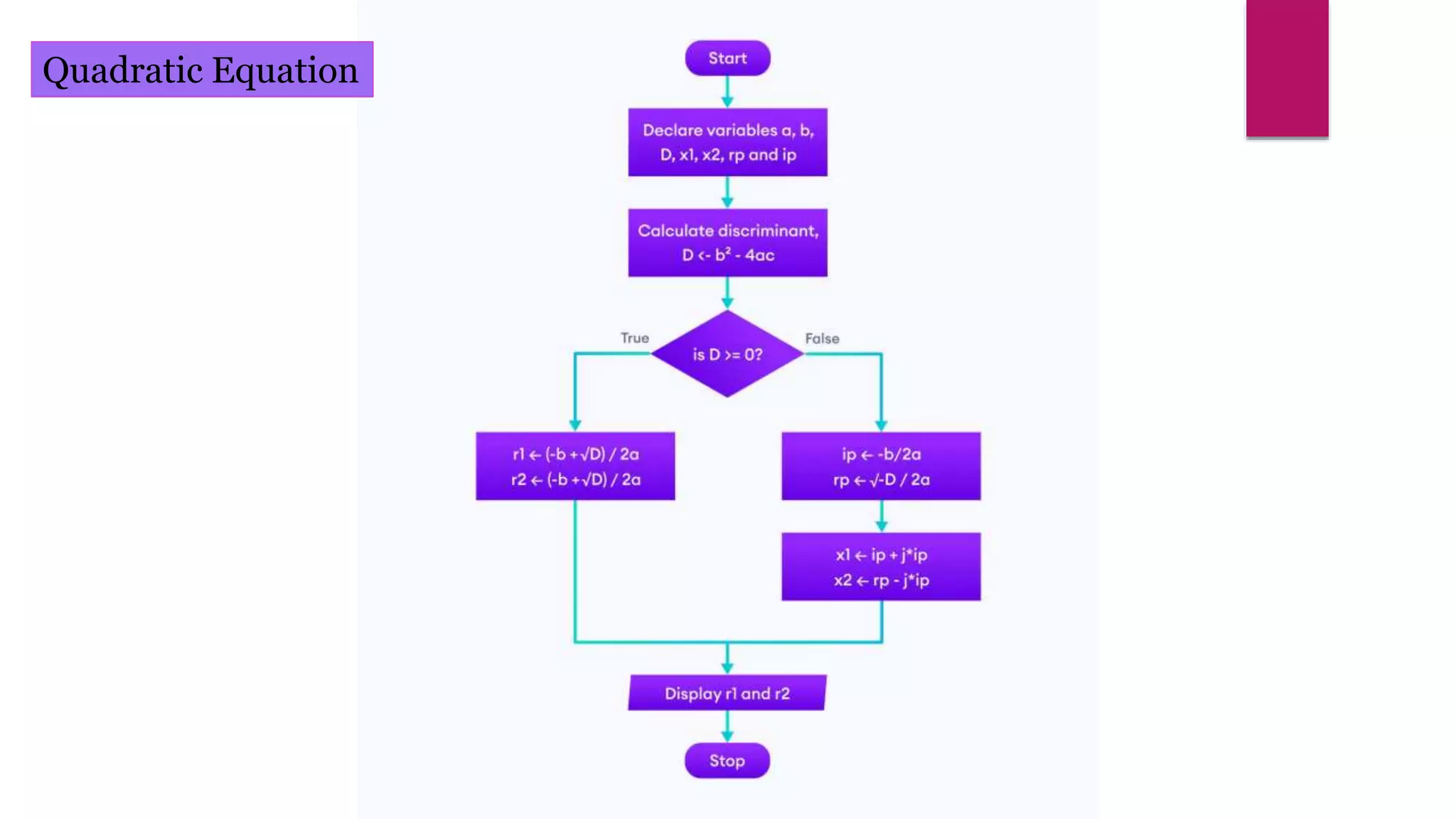
Quadratic Equation
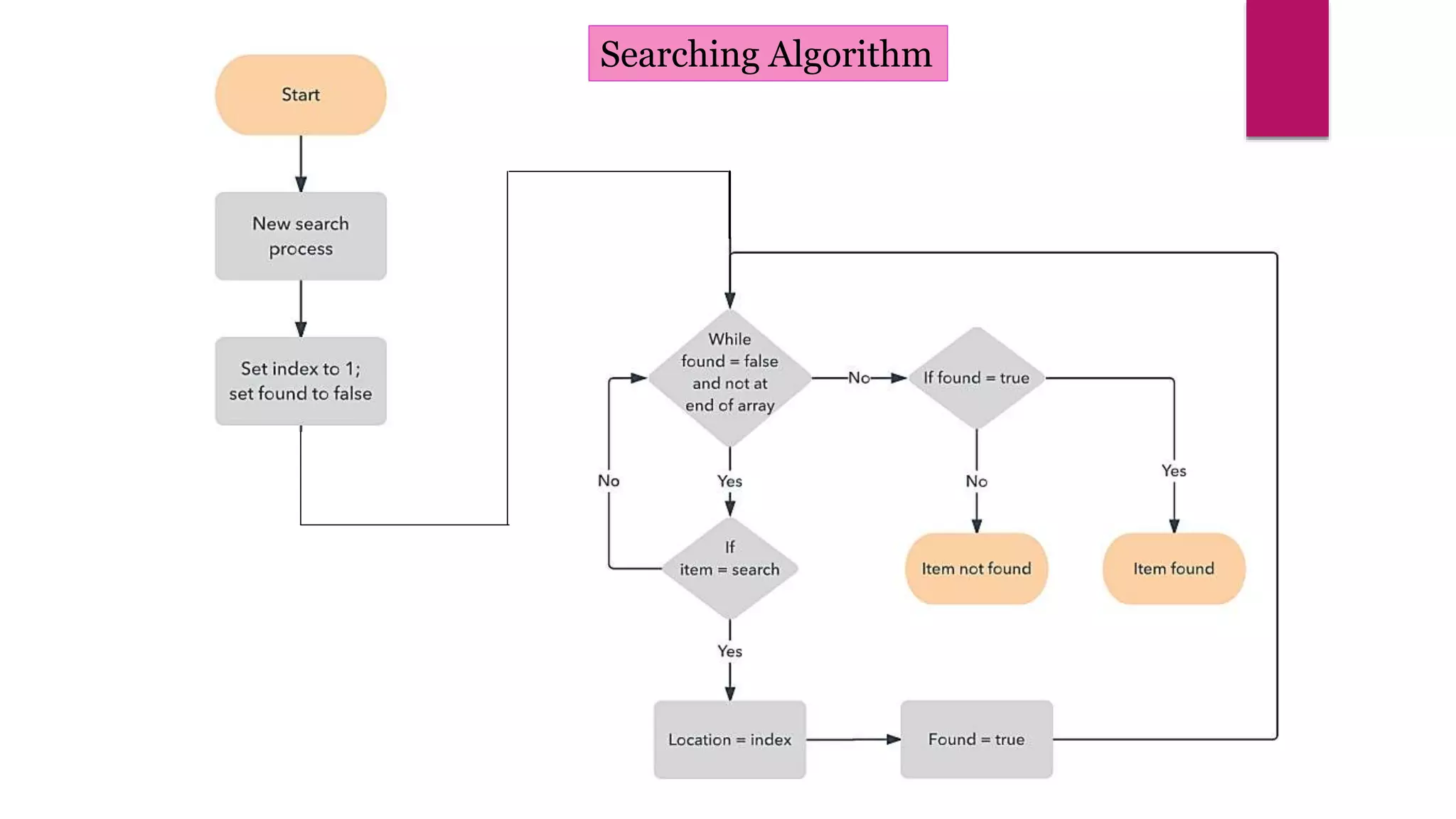
Searching Algorithm
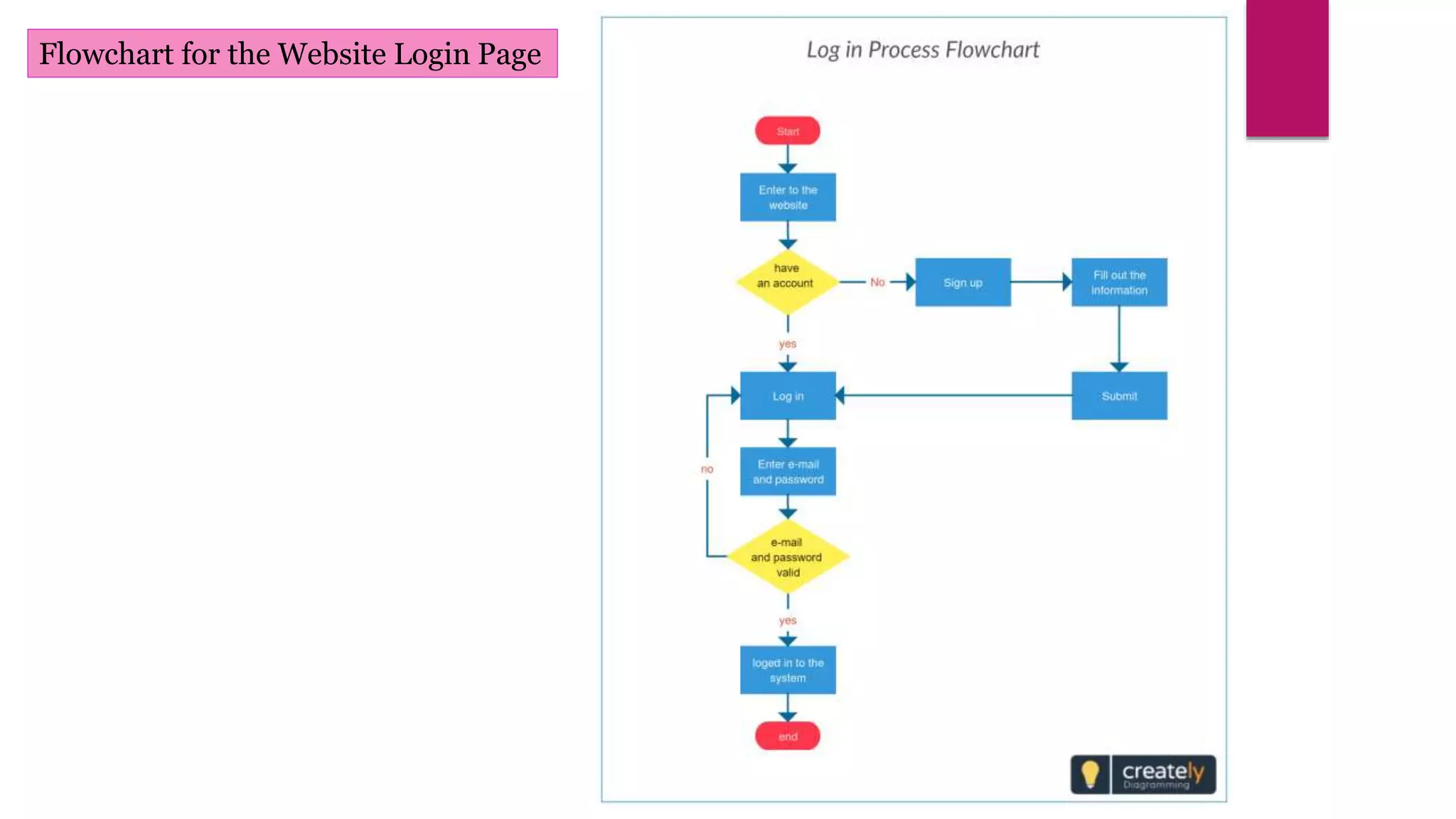
Flowchart for the Website Login Page
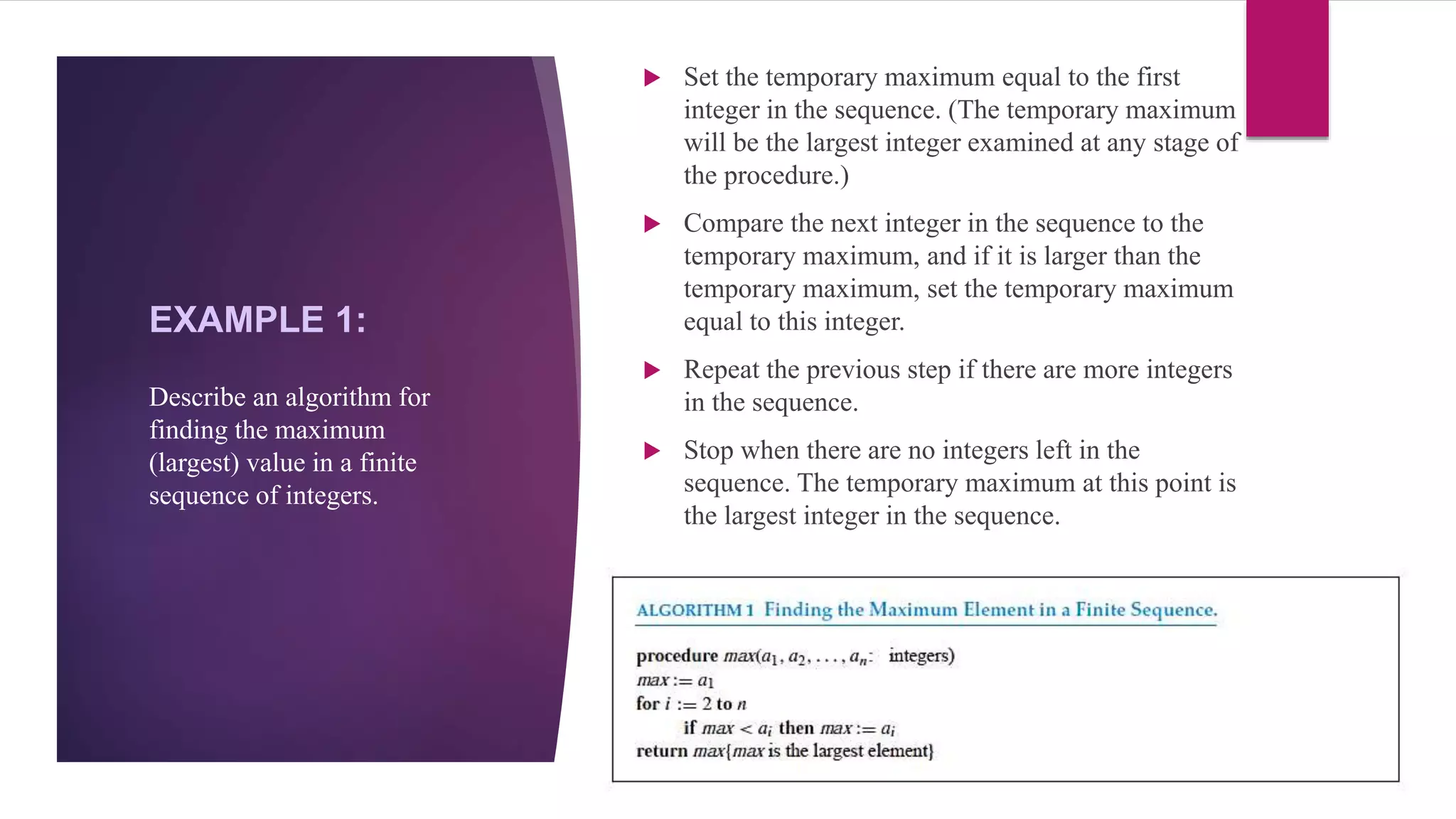
EXAMPLE 1:
 Set the temporary maximum equal to the first
integer in the sequence. (The temporary maximum
will be the largest integer examined at any stage of
the procedure.)
 Compare the next integer in the sequence to the
temporary maximum, and if it is larger than the
temporary maximum, set the temporary maximum
equal to this integer.
 Repeat the previous step if there are more integers
in the sequence.
 Stop when there are no integers left in the
sequence. The temporary maximum at this point is
the largest integer in the sequence.
Describe an algorithm for
finding the maximum
(largest) value in a finite
sequence of integers.
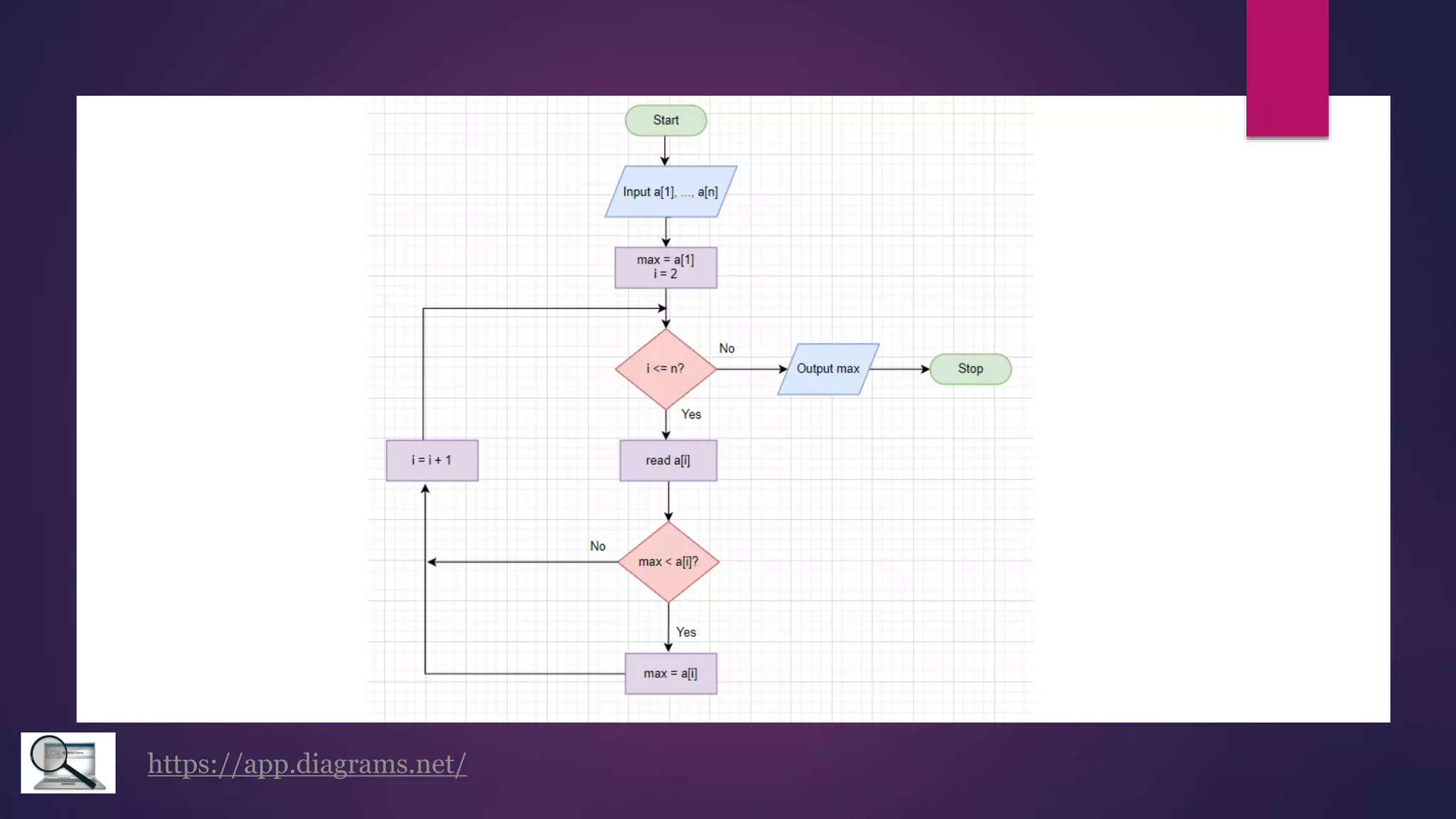
https://app.diagrams.net/
Input: 𝑎𝑟𝑟[ ] = {10, 324, 45, 90,9808}; 𝑂𝑢𝑡𝑝𝑢𝑡: 9808
Input : 𝑎𝑟𝑟[ ] = {20, 10, 100, 20, 4}; 𝑂𝑢𝑡𝑝𝑢𝑡 ∶ 100
Go through each step of the given algorithm to find the max value in
array (show every step).
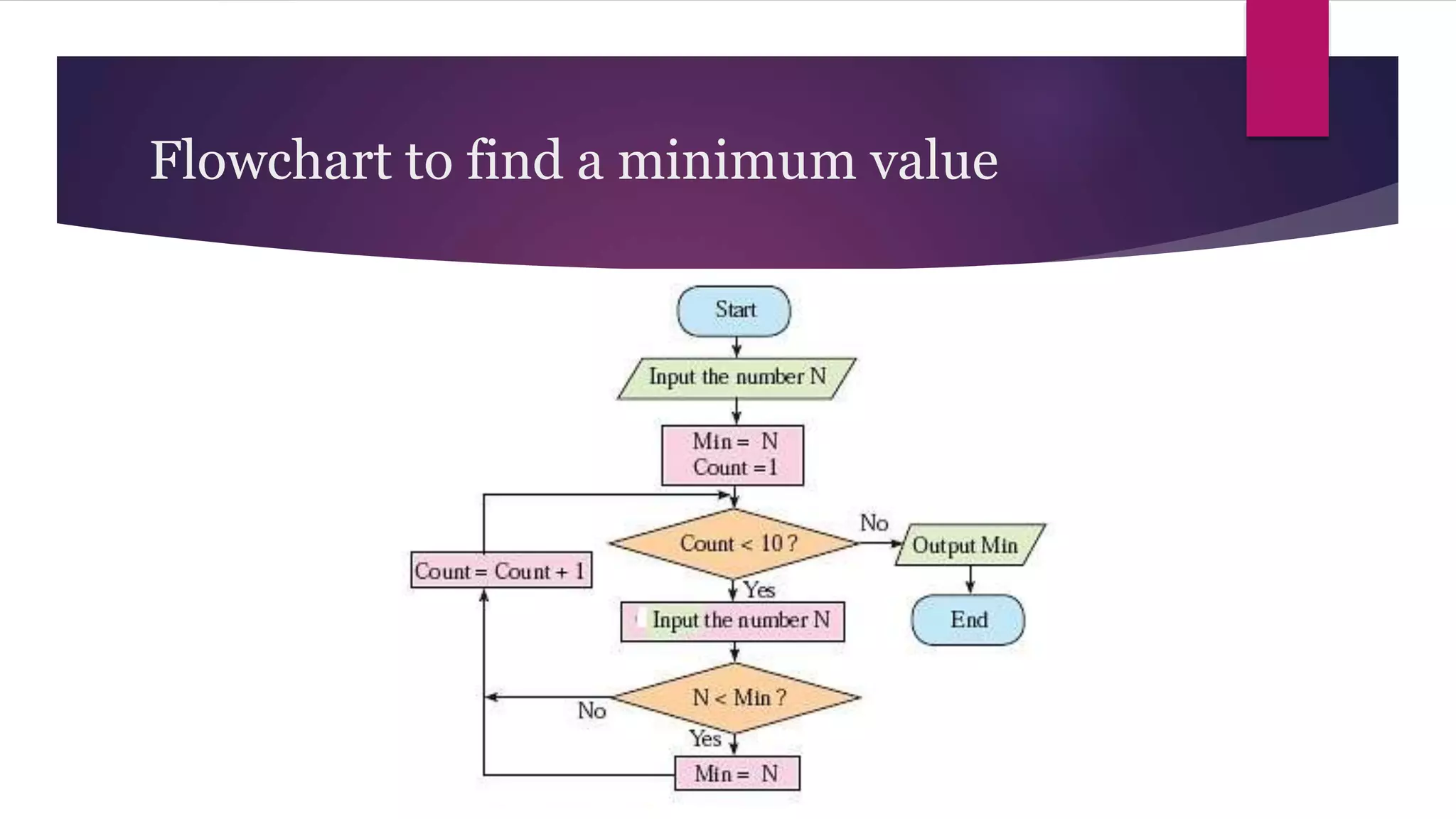
Flowchart to find a minimum value
Create a flowchart, where you
have to build a program: sum of
n natural numbers.
Pseudocode (Appendix 3)
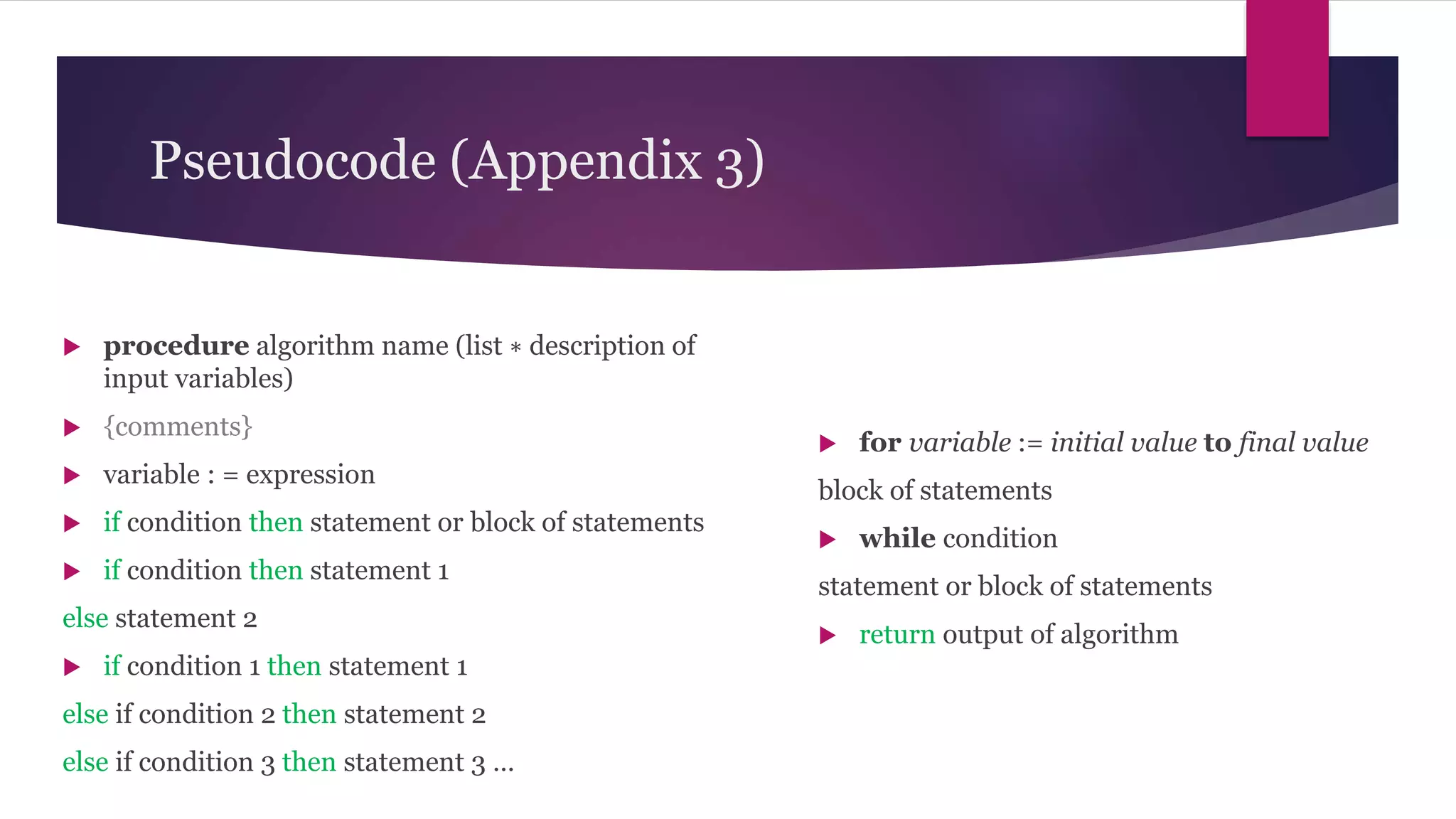
 procedure algorithm name (list ∗ description of
input variables)
 {comments}
 variable : = expression
 if condition then statement or block of statements
 if condition then statement 1
else statement 2
 if condition 1 then statement 1
else if condition 2 then statement 2
else if condition 3 then statement 3 …
 for variable := initial value to final value
block of statements
 while condition
statement or block of statements
 return output of algorithm
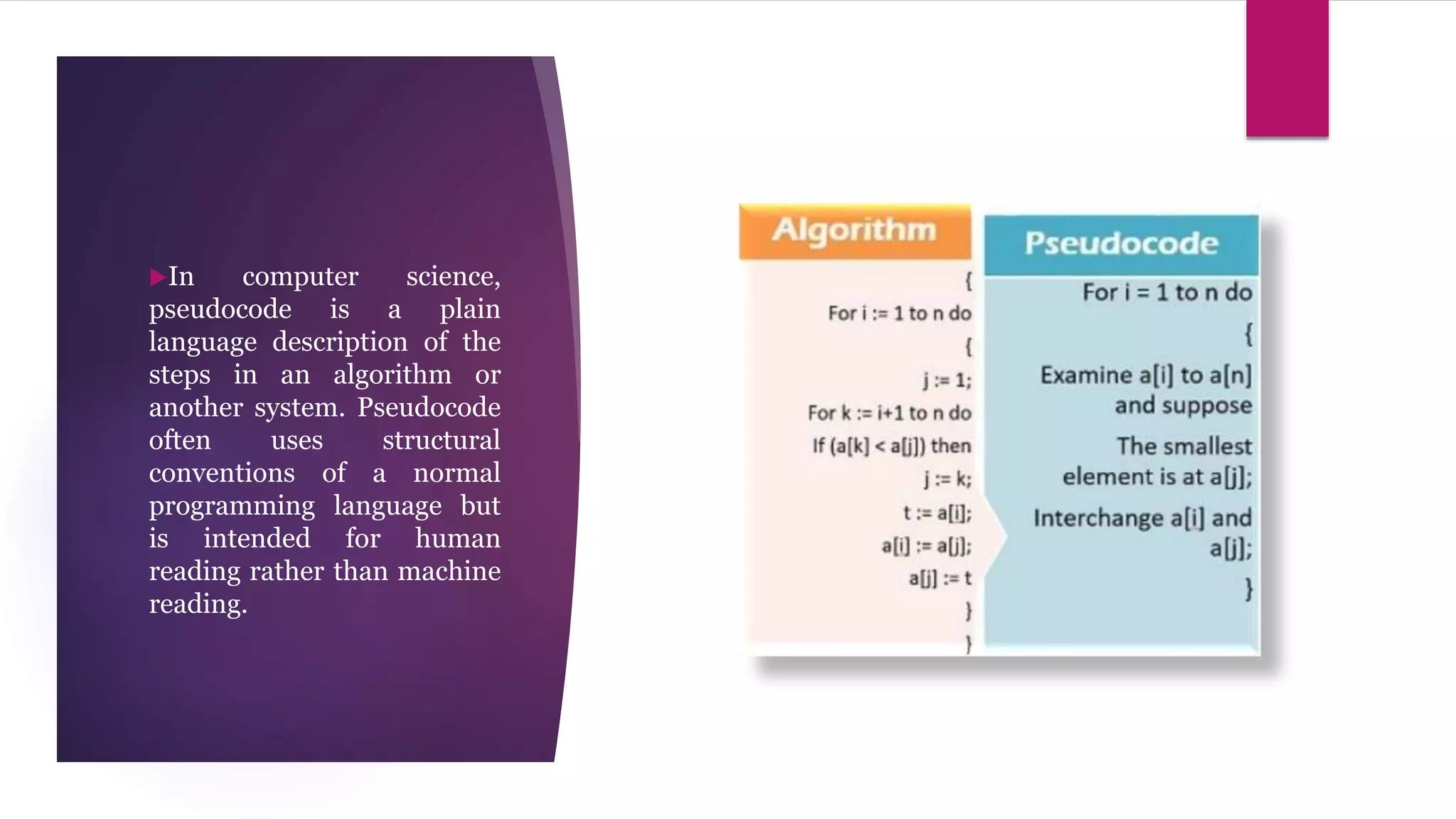
In computer science,
pseudocode is a plain
language description of the
steps in an algorithm or
another system. Pseudocode
often uses structural
conventions of a normal
programming language but
is intended for human
reading rather than machine
reading.
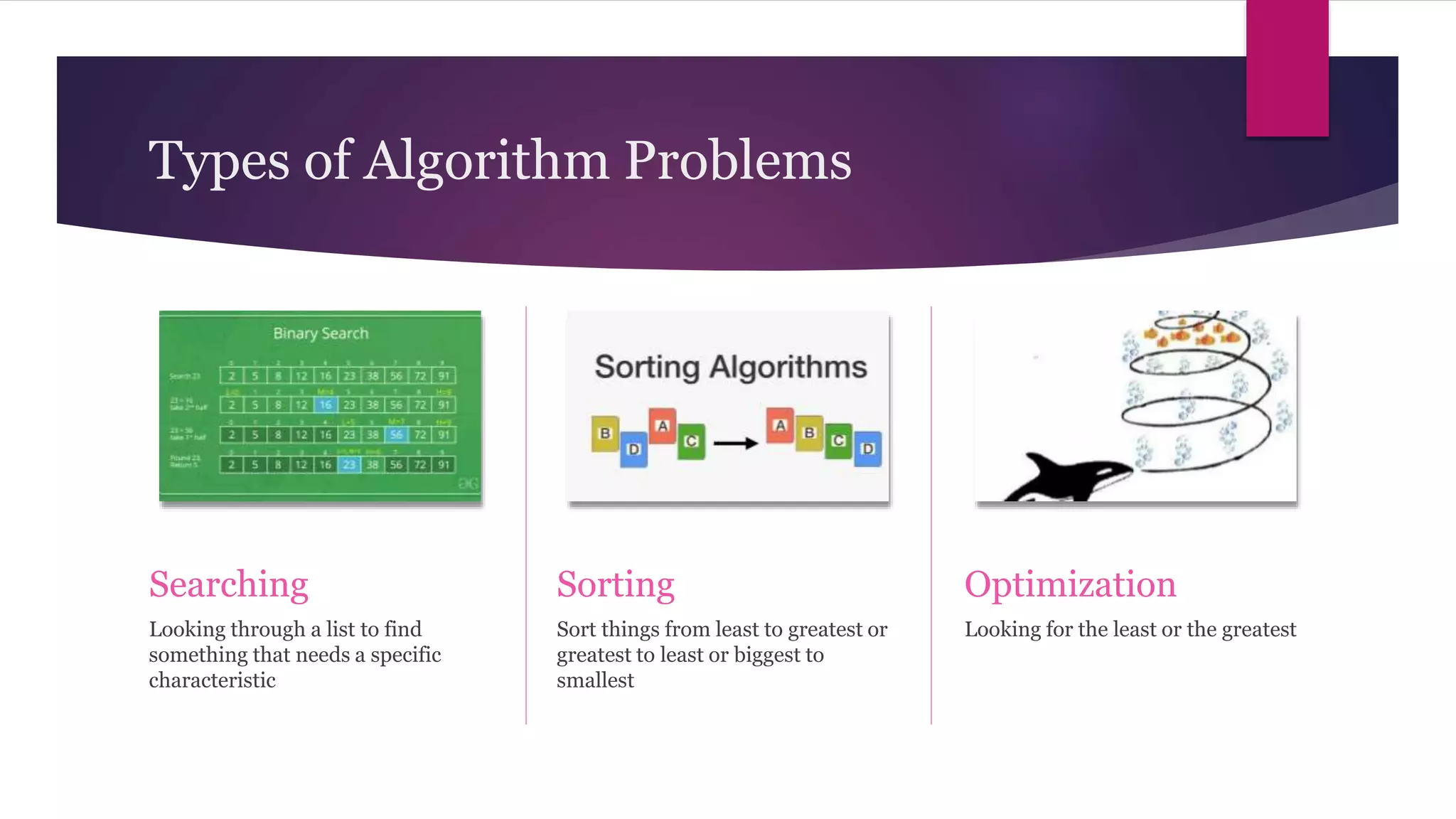
Types of Algorithm Problems
Searching
Looking through a list to find
something that needs a specific
characteristic
Sorting
Sort things from least to greatest or
greatest to least or biggest to
smallest
Optimization
Looking for the least or the greatest
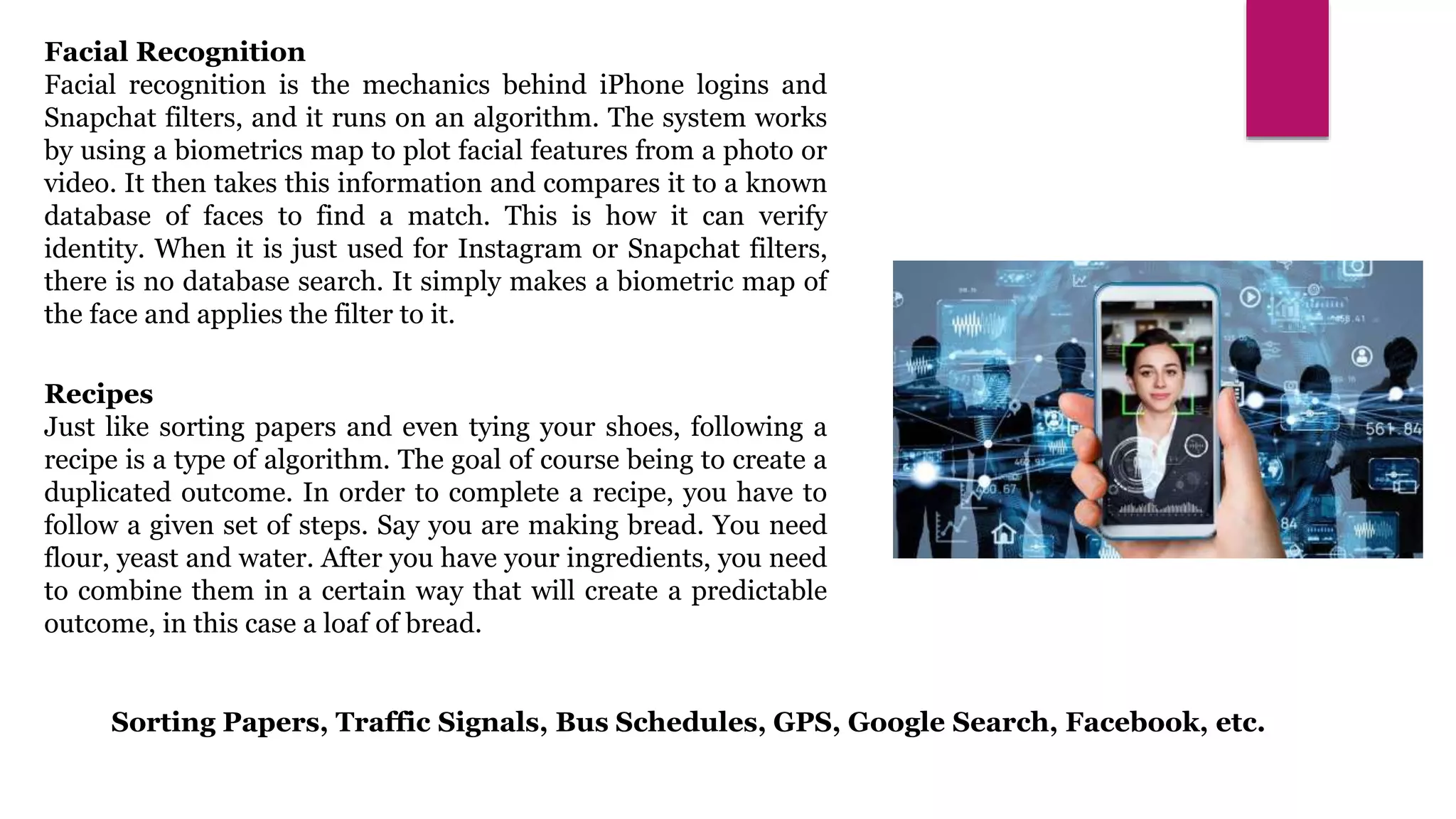
Facial Recognition
Facial recognition is the mechanics behind iPhone logins and
Snapchat filters, and it runs on an algorithm. The system works
by using a biometrics map to plot facial features from a photo or
video. It then takes this information and compares it to a known
database of faces to find a match. This is how it can verify
identity. When it is just used for Instagram or Snapchat filters,
there is no database search. It simply makes a biometric map of
the face and applies the filter to it.
Recipes
Just like sorting papers and even tying your shoes, following a
recipe is a type of algorithm. The goal of course being to create a
duplicated outcome. In order to complete a recipe, you have to
follow a given set of steps. Say you are making bread. You need
flour, yeast and water. After you have your ingredients, you need
to combine them in a certain way that will create a predictable
outcome, in this case a loaf of bread.
Sorting Papers, Traffic Signals, Bus Schedules, GPS, Google Search, Facebook, etc.
Searching Algorithms
The goal is to locate an element 𝑥 in
the list of distinct elements or
determine that it is not in the list.
The solution is the location of the
term that equals 𝑥 or 0 if 𝑥 is not in
the list.
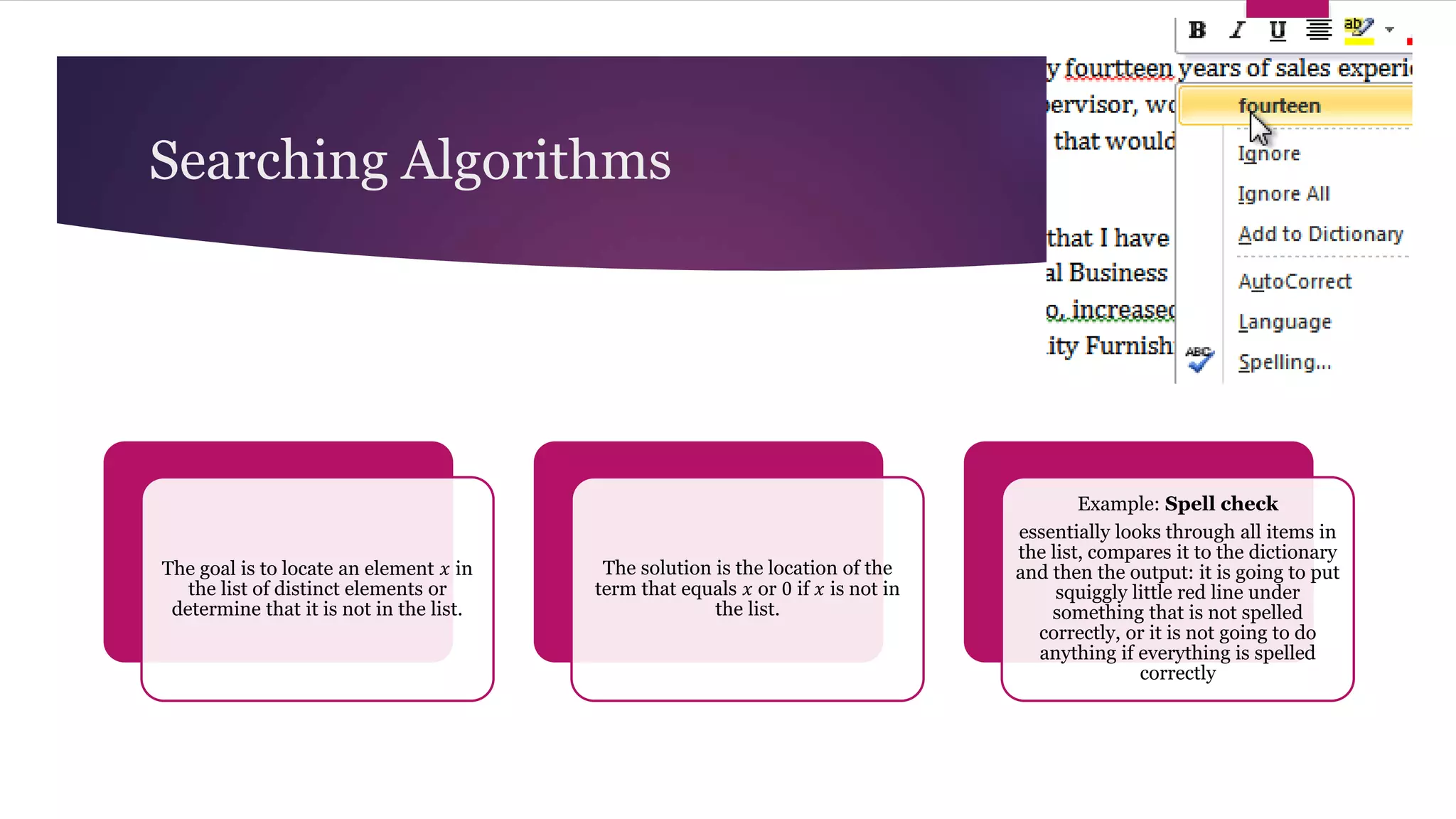
Example: Spell check
essentially looks through all items in
the list, compares it to the dictionary
and then the output: it is going to put
squiggly little red line under
something that is not spelled
correctly, or it is not going to do
anything if everything is spelled
correctly
Linear Search
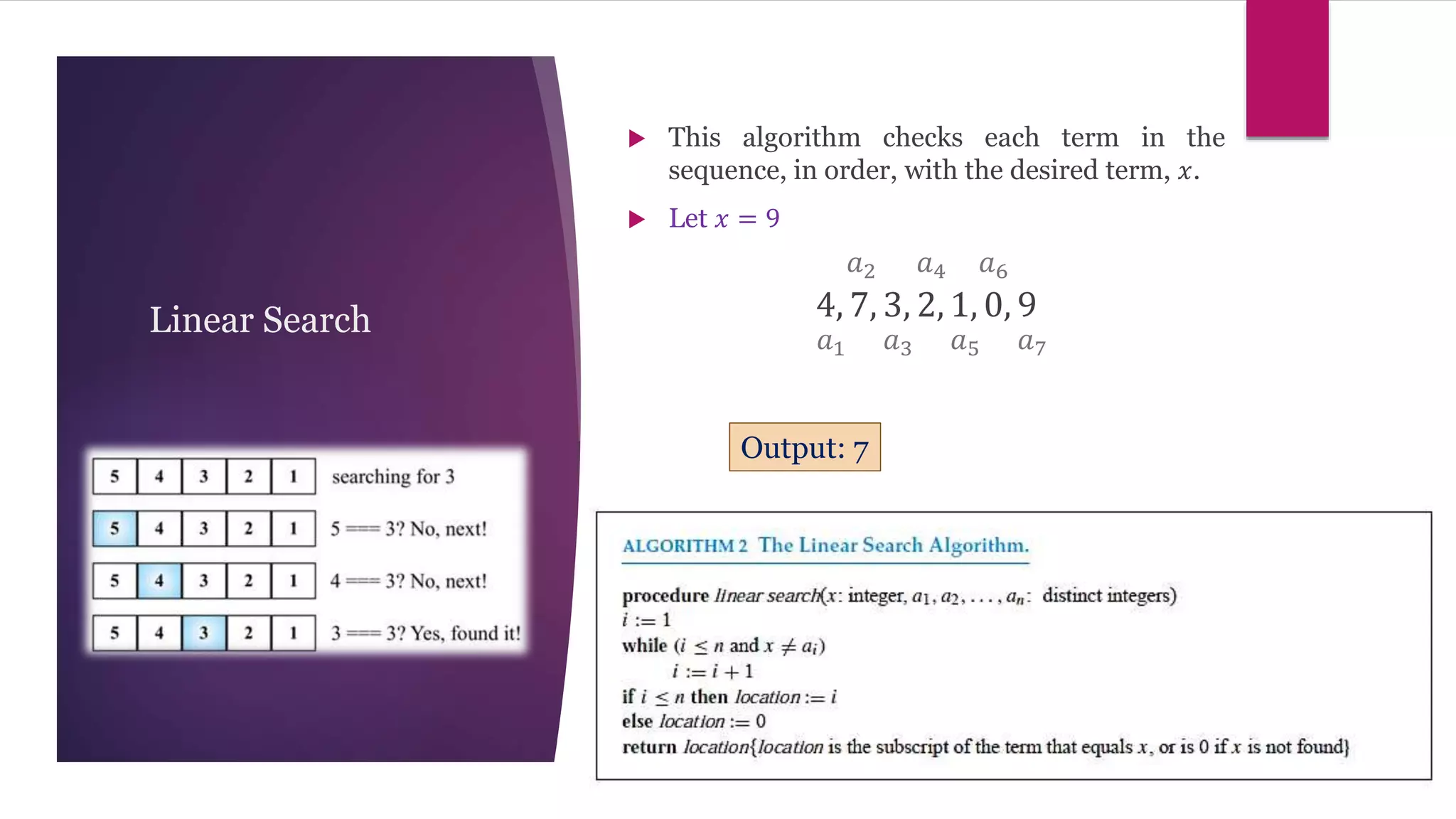
 This algorithm checks each term in the
sequence, in order, with the desired term, 𝑥.
 Let 𝑥 = 9
4, 7, 3, 2, 1, 0, 9
𝑎1
𝑎2
𝑎3
𝑎4
𝑎5 𝑎7
𝑎6
Output: 7
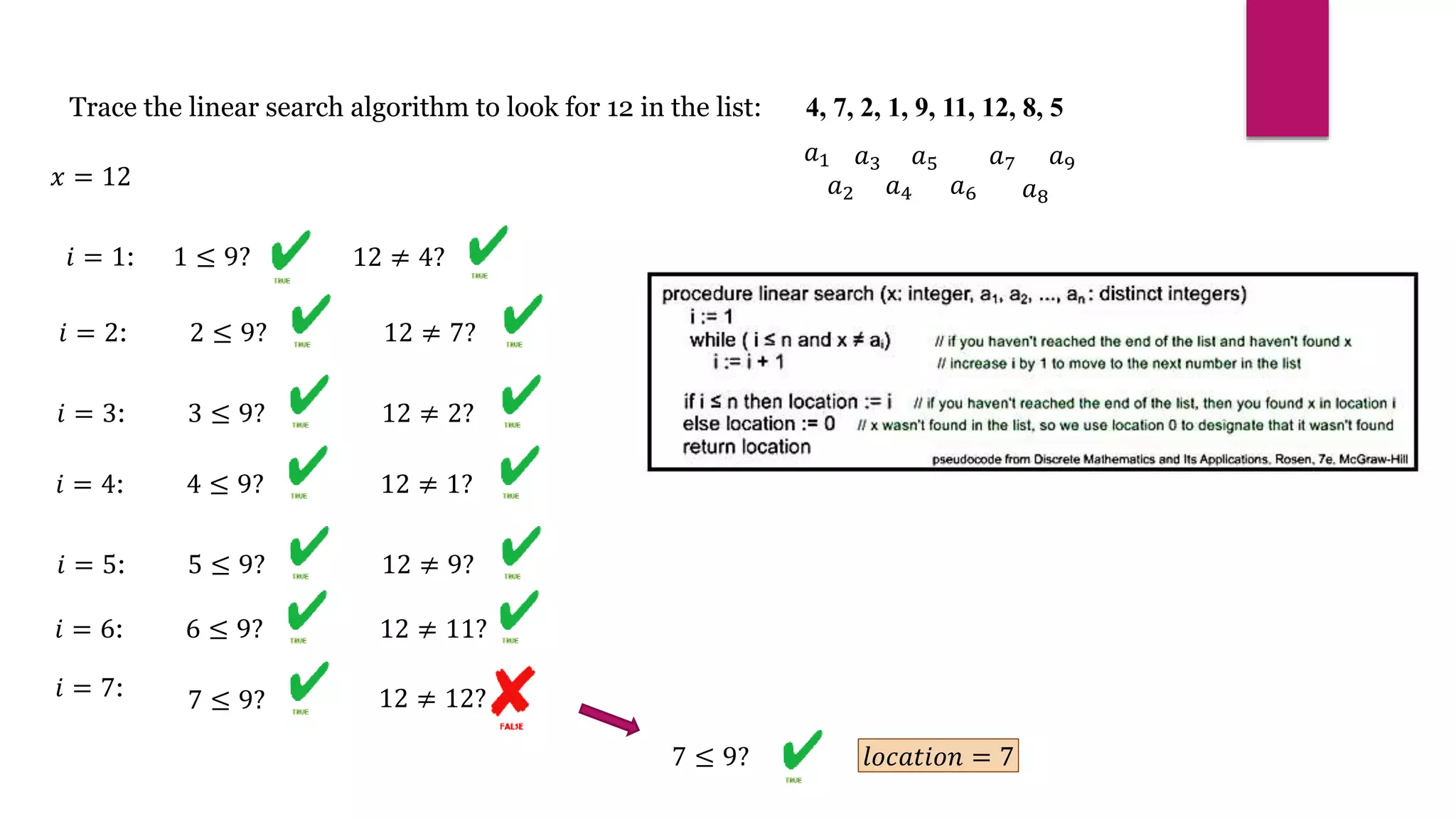
Trace the linear search algorithm to look for 12 in the list: 4, 7, 2, 1, 9, 11, 12, 8, 5
𝑥 = 12
𝑎1 𝑎3
𝑎4
𝑎5
𝑎6
𝑎7
𝑎8
𝑎2
𝑎9
𝑖 = 1: 1 ≤ 9? 12 ≠ 4?
𝑖 = 2: 2 ≤ 9? 12 ≠ 7?
𝑖 = 3: 3 ≤ 9? 12 ≠ 2?
𝑖 = 4: 4 ≤ 9? 12 ≠ 1?
𝑖 = 5: 5 ≤ 9? 12 ≠ 9?
𝑖 = 6: 6 ≤ 9? 12 ≠ 11?
𝑖 = 7: 7 ≤ 9? 12 ≠ 12?
7 ≤ 9? 𝑙𝑜𝑐𝑎𝑡𝑖𝑜𝑛 = 7
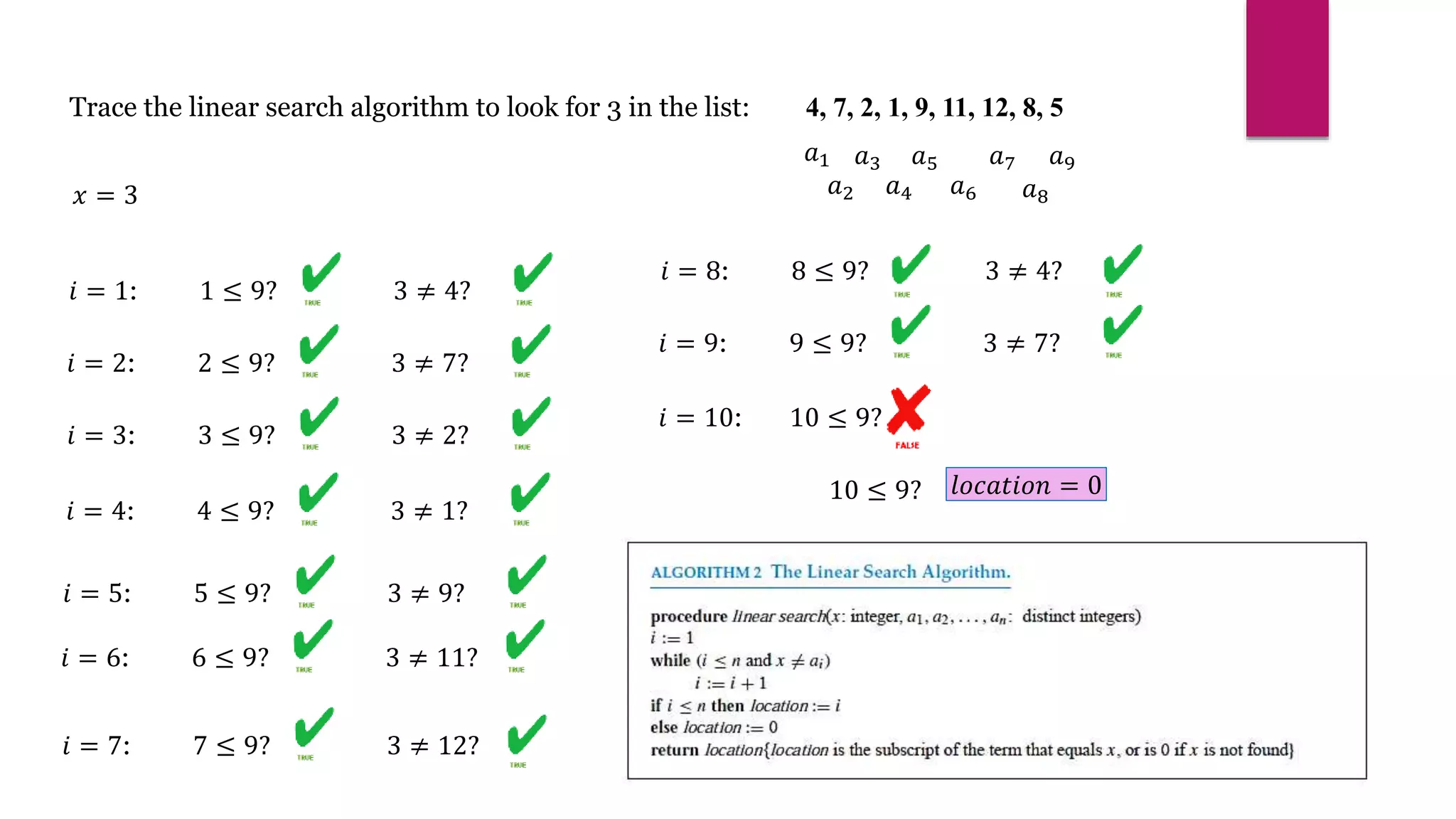
Trace the linear search algorithm to look for 3 in the list: 4, 7, 2, 1, 9, 11, 12, 8, 5
𝑥 = 3
𝑎1 𝑎3
𝑎4
𝑎5
𝑎6
𝑎7
𝑎8
𝑎2
𝑎9
𝑖 = 1: 1 ≤ 9? 3 ≠ 4?
𝑖 = 2: 2 ≤ 9? 3 ≠ 7?
𝑖 = 3: 3 ≤ 9? 3 ≠ 2?
𝑖 = 4: 4 ≤ 9? 3 ≠ 1?
𝑖 = 5: 5 ≤ 9? 3 ≠ 9?
𝑖 = 6: 6 ≤ 9? 3 ≠ 11?
𝑖 = 7: 7 ≤ 9? 3 ≠ 12?
𝑖 = 8: 8 ≤ 9? 3 ≠ 4?
𝑖 = 9: 9 ≤ 9? 3 ≠ 7?
𝑖 = 10: 10 ≤ 9?
10 ≤ 9? 𝑙𝑜𝑐𝑎𝑡𝑖𝑜𝑛 = 0
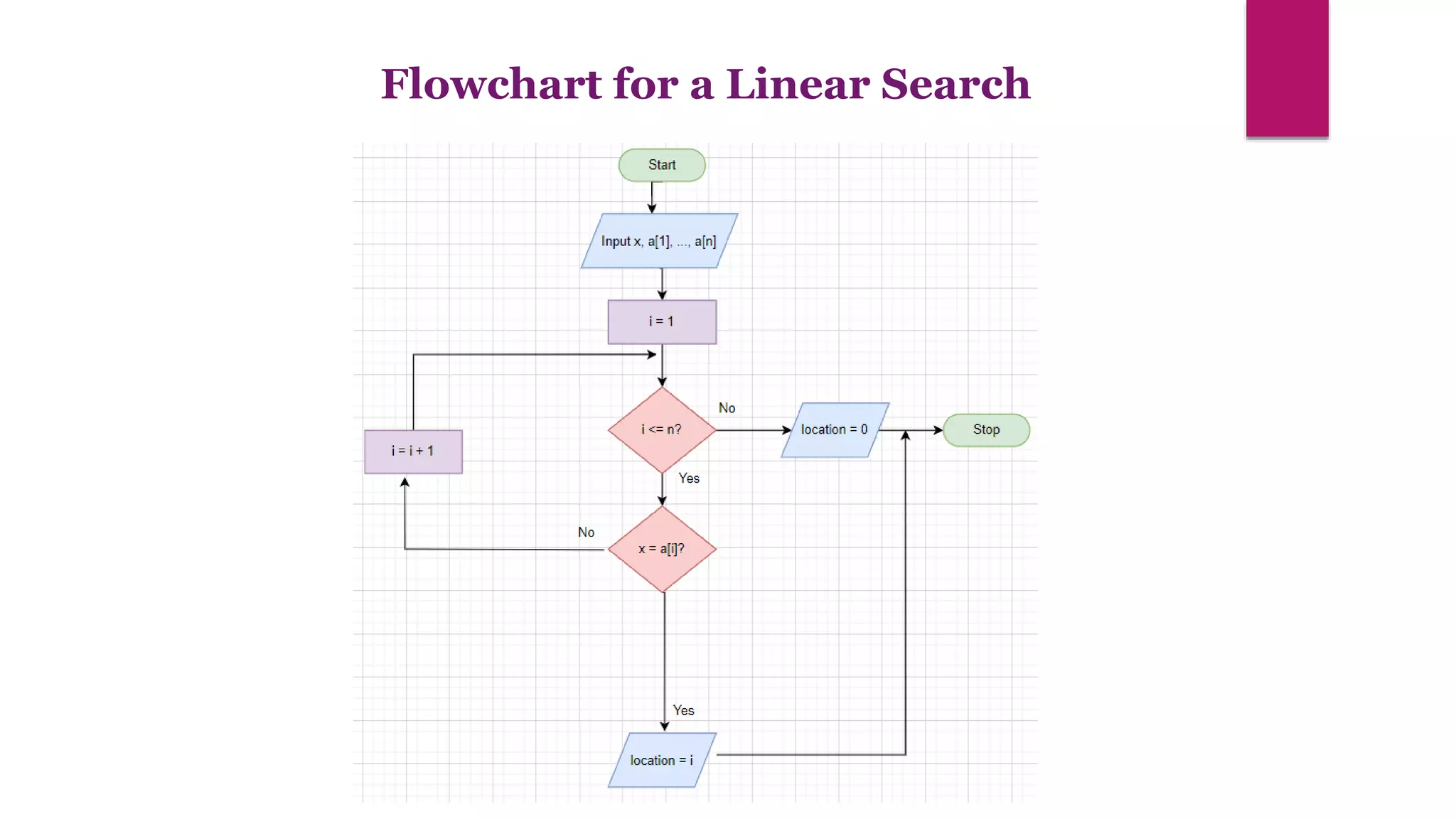
Flowchart for a Linear Search
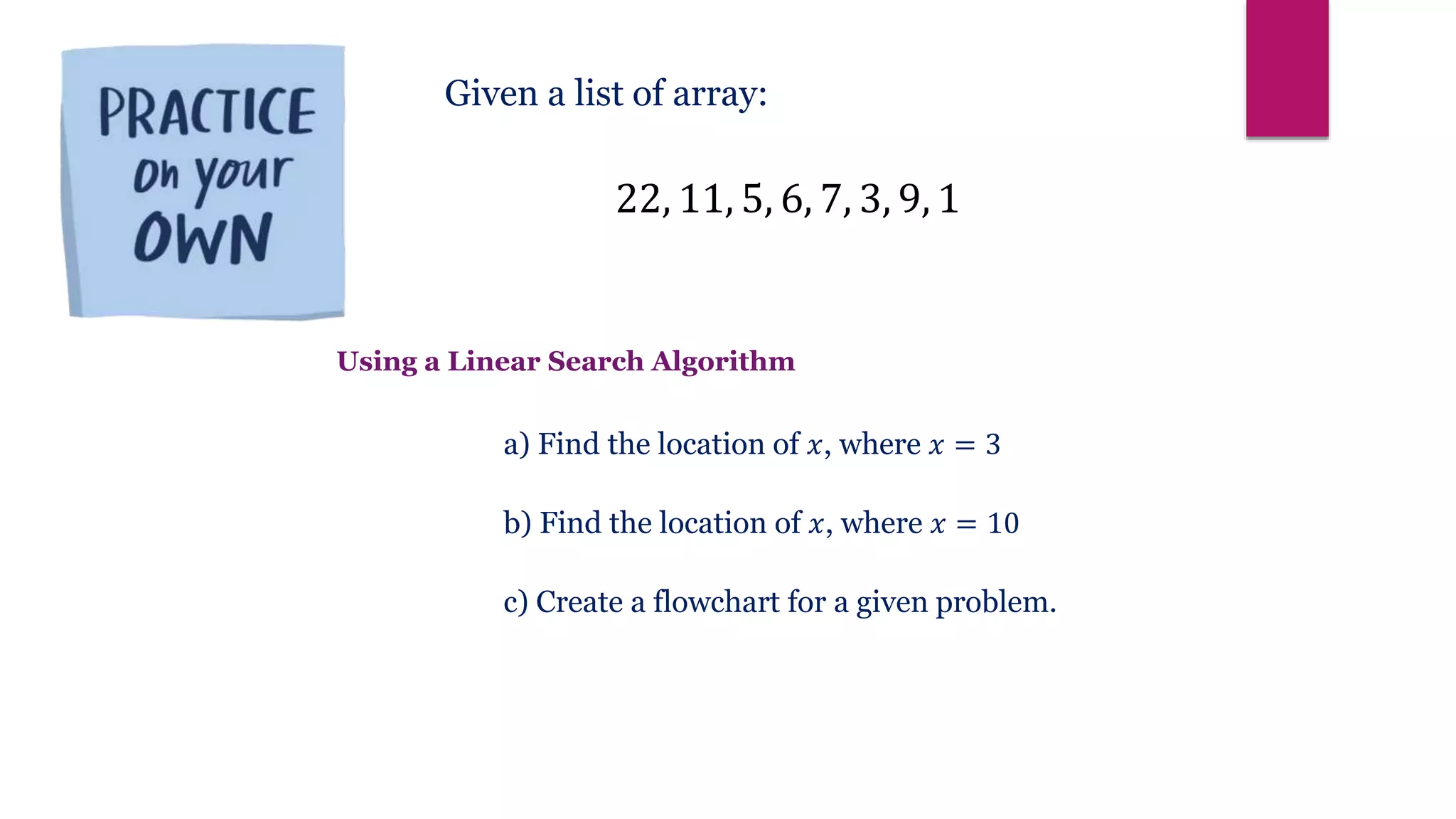
22, 11, 5, 6, 7, 3, 9, 1
Given a list of array:
a) Find the location of 𝑥, where 𝑥 = 3
b) Find the location of 𝑥, where 𝑥 = 10
c) Create a flowchart for a given problem.
Using a Linear Search Algorithm
Binary Search
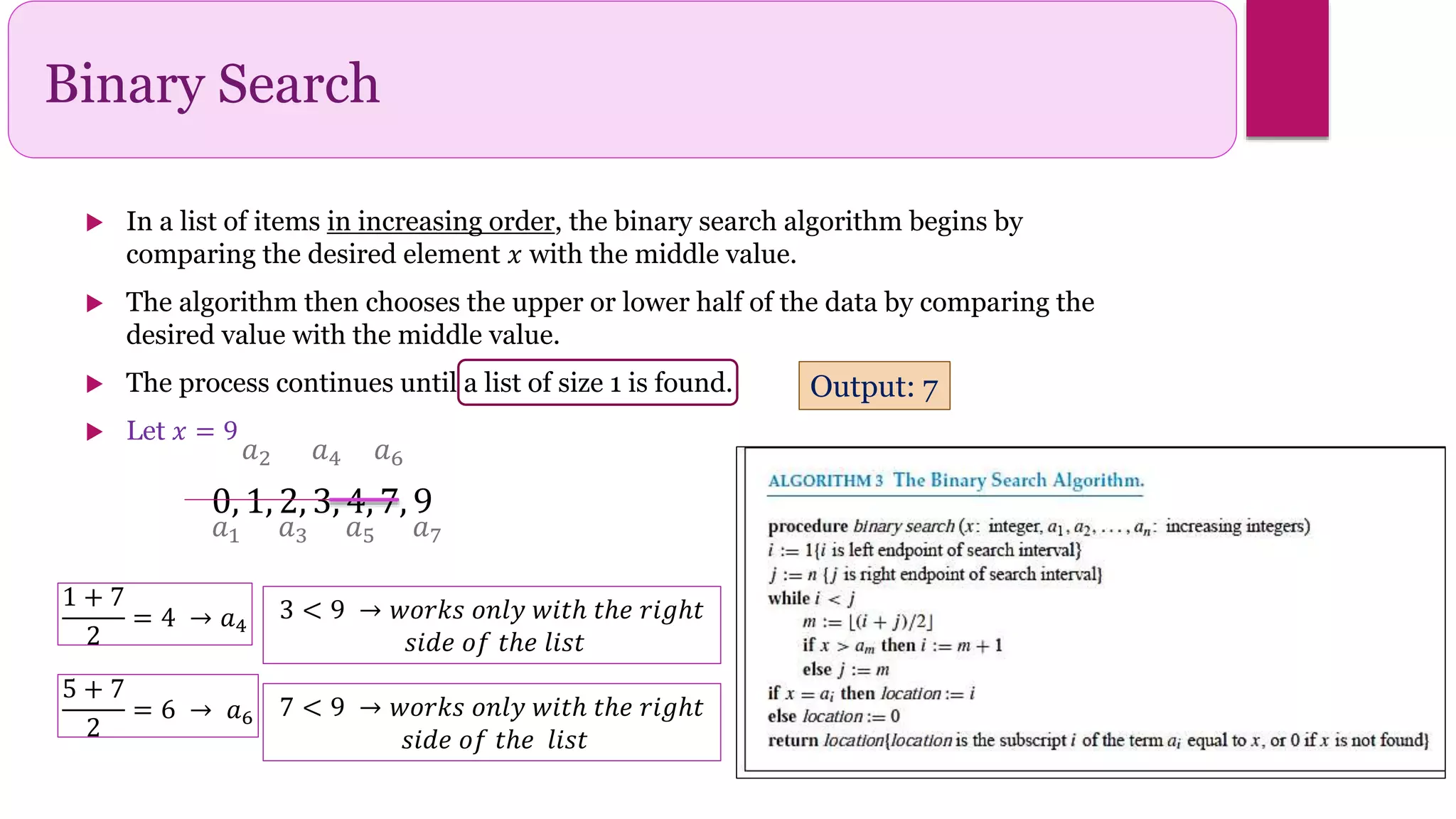
 In a list of items in increasing order, the binary search algorithm begins by
comparing the desired element 𝑥 with the middle value.
 The algorithm then chooses the upper or lower half of the data by comparing the
desired value with the middle value.
 The process continues until a list of size 1 is found.
 Let 𝑥 = 9
𝑎1
𝑎2
𝑎3
𝑎4
𝑎5 𝑎7
𝑎6
0, 1, 2, 3, 4, 7, 9
Output: 7
1 + 7
2
= 4 → 𝑎4
3 < 9 → 𝑤𝑜𝑟𝑘𝑠 𝑜𝑛𝑙𝑦 𝑤𝑖𝑡ℎ 𝑡ℎ𝑒 𝑟𝑖𝑔ℎ𝑡
𝑠𝑖𝑑𝑒 𝑜𝑓 𝑡ℎ𝑒 𝑙𝑖𝑠𝑡
5 + 7
2
= 6 → 𝑎6 7 < 9 → 𝑤𝑜𝑟𝑘𝑠 𝑜𝑛𝑙𝑦 𝑤𝑖𝑡ℎ 𝑡ℎ𝑒 𝑟𝑖𝑔ℎ𝑡
𝑠𝑖𝑑𝑒 𝑜𝑓 𝑡ℎ𝑒 𝑙𝑖𝑠𝑡
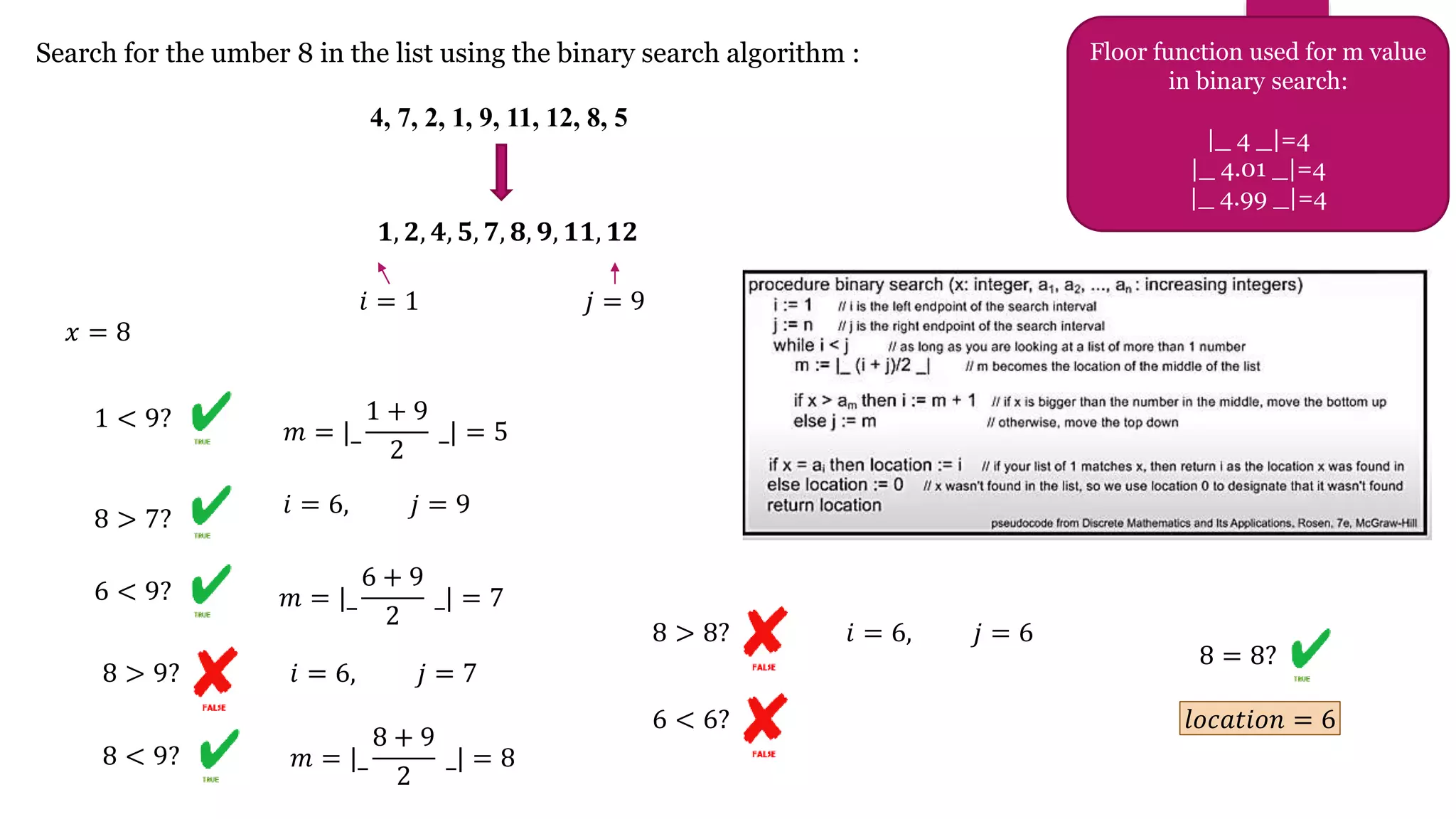
Search for the umber 8 in the list using the binary search algorithm :
4, 7, 2, 1, 9, 11, 12, 8, 5
Floor function used for m value
in binary search:
|_ 4 _|=4
|_ 4.01 _|=4
|_ 4.99 _|=4
𝟏, 𝟐, 𝟒, 𝟓, 𝟕, 𝟖, 𝟗, 𝟏𝟏, 𝟏𝟐
𝑗 = 9
𝑖 = 1
𝑥 = 8
1 < 9? 𝑚 = |_
1 + 9
2
_| = 5
8 > 7?
𝑖 = 6, 𝑗 = 9
𝑚 = |_
6 + 9
2
_| = 7
6 < 9?
8 > 9? 𝑖 = 6, 𝑗 = 7
8 < 9? 𝑚 = |_
8 + 9
2
_| = 8
8 > 8? 𝑖 = 6, 𝑗 = 6
6 < 6?
8 = 8?
𝑙𝑜𝑐𝑎𝑡𝑖𝑜𝑛 = 6
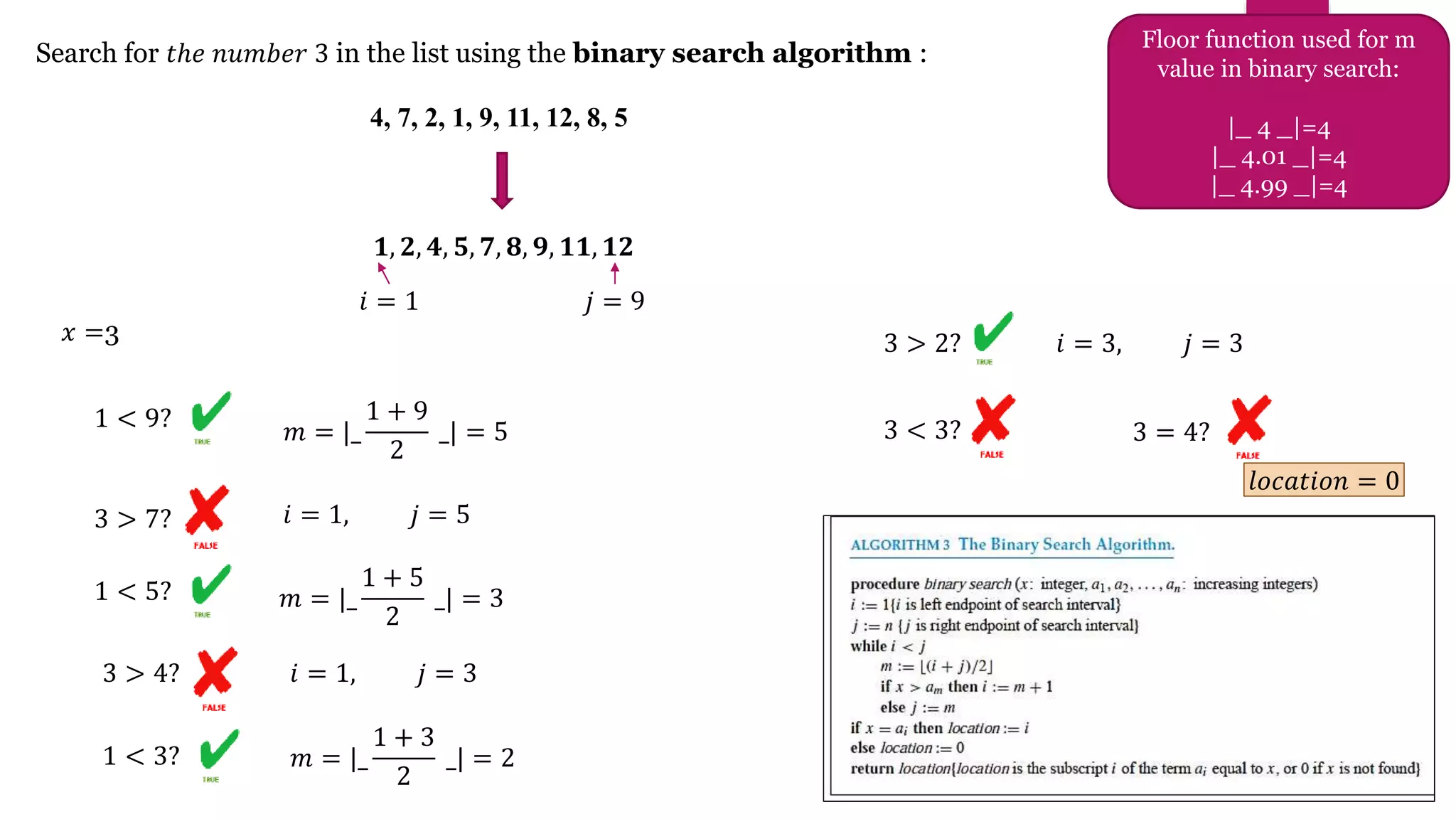
Search for 𝑡ℎ𝑒 𝑛𝑢𝑚𝑏𝑒𝑟 3 in the list using the binary search algorithm :
4, 7, 2, 1, 9, 11, 12, 8, 5
Floor function used for m
value in binary search:
|_ 4 _|=4
|_ 4.01 _|=4
|_ 4.99 _|=4
𝟏, 𝟐, 𝟒, 𝟓, 𝟕, 𝟖, 𝟗, 𝟏𝟏, 𝟏𝟐
𝑗 = 9
𝑖 = 1
𝑥 =3
1 < 9? 𝑚 = |_
1 + 9
2
_| = 5
3 > 7? 𝑖 = 1, 𝑗 = 5
𝑚 = |_
1 + 5
2
_| = 3
1 < 5?
3 > 4? 𝑖 = 1, 𝑗 = 3
1 < 3? 𝑚 = |_
1 + 3
2
_| = 2
3 > 2? 𝑖 = 3, 𝑗 = 3
3 < 3? 3 = 4?
𝑙𝑜𝑐𝑎𝑡𝑖𝑜𝑛 = 0
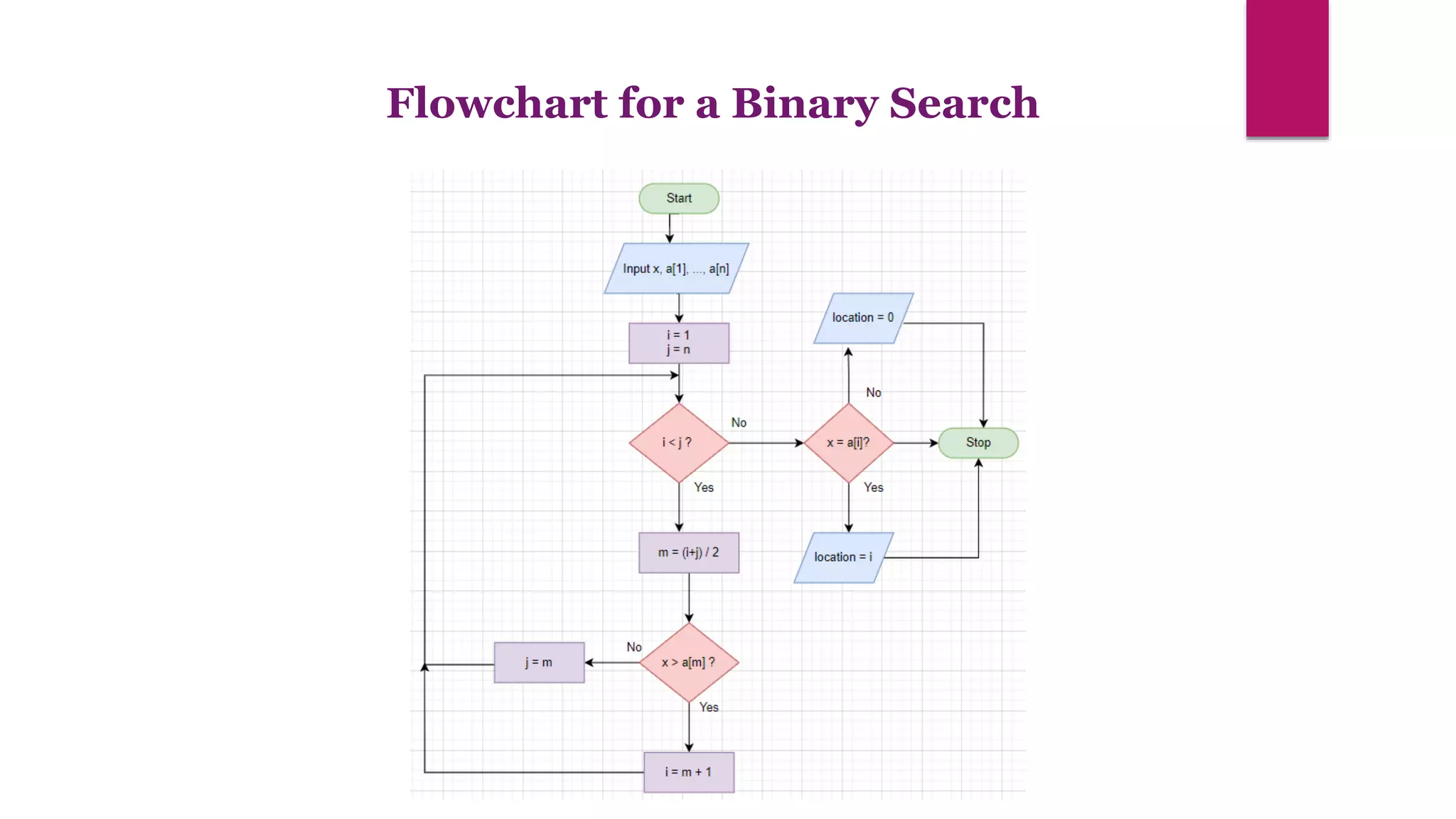
Flowchart for a Binary Search
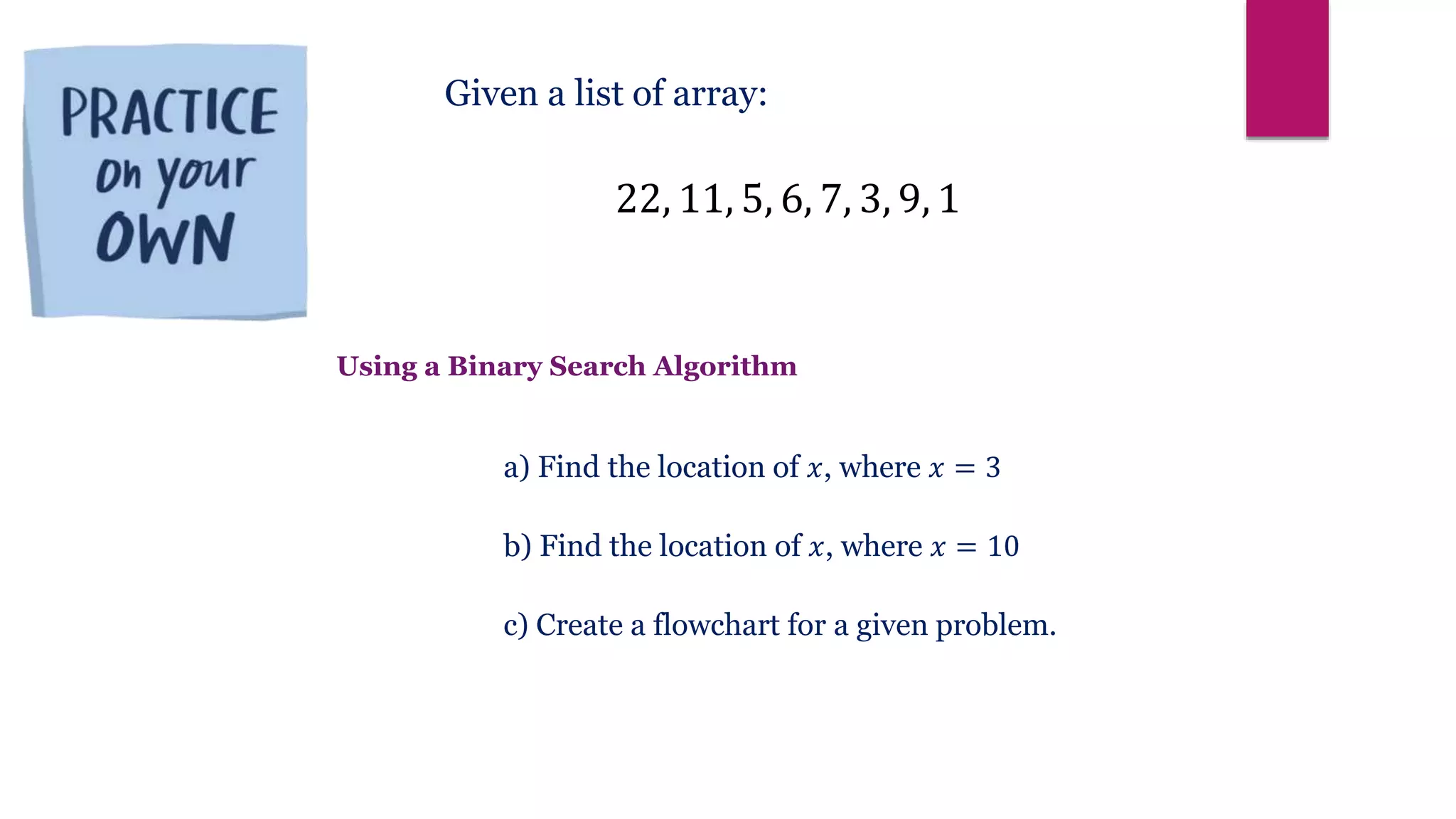
22, 11, 5, 6, 7, 3, 9, 1
Given a list of array:
a) Find the location of 𝑥, where 𝑥 = 3
b) Find the location of 𝑥, where 𝑥 = 10
c) Create a flowchart for a given problem.
Using a Binary Search Algorithm
More Practice
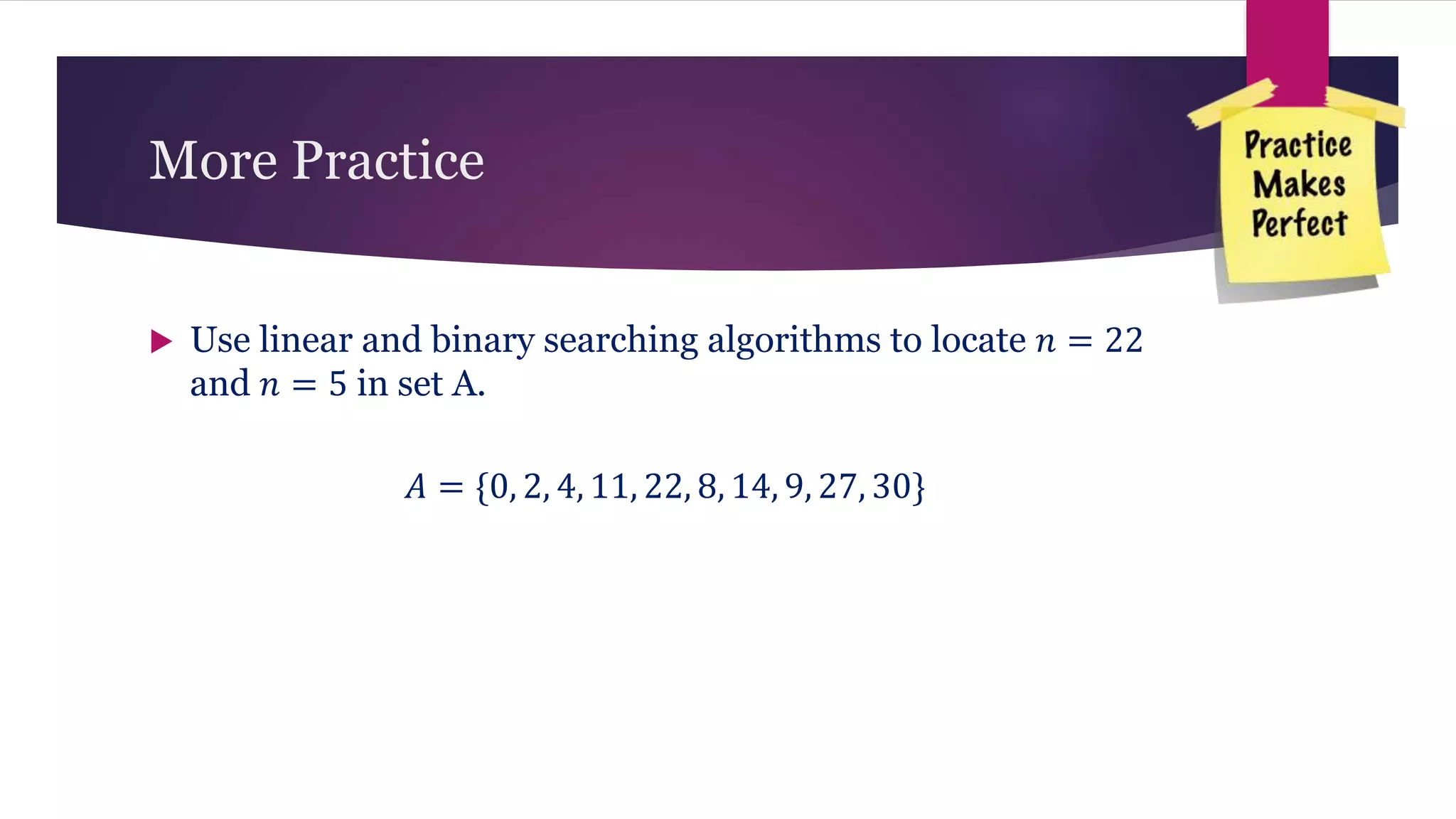
 Use linear and binary searching algorithms to locate 𝑛 = 22
and 𝑛 = 5 in set A.
𝐴 = {0, 2, 4, 11, 22, 8, 14, 9, 27, 30}
Sorting Algorithms
An algorithm that sorts the
elements of a list into
increasing order (numerical,
alphabetical, etc.)
 Used often for large databases like sorting
customer or part numbers, prices, etc.
 Phone directories (by last name)
 Over 100 sorting algorithms have been
devised
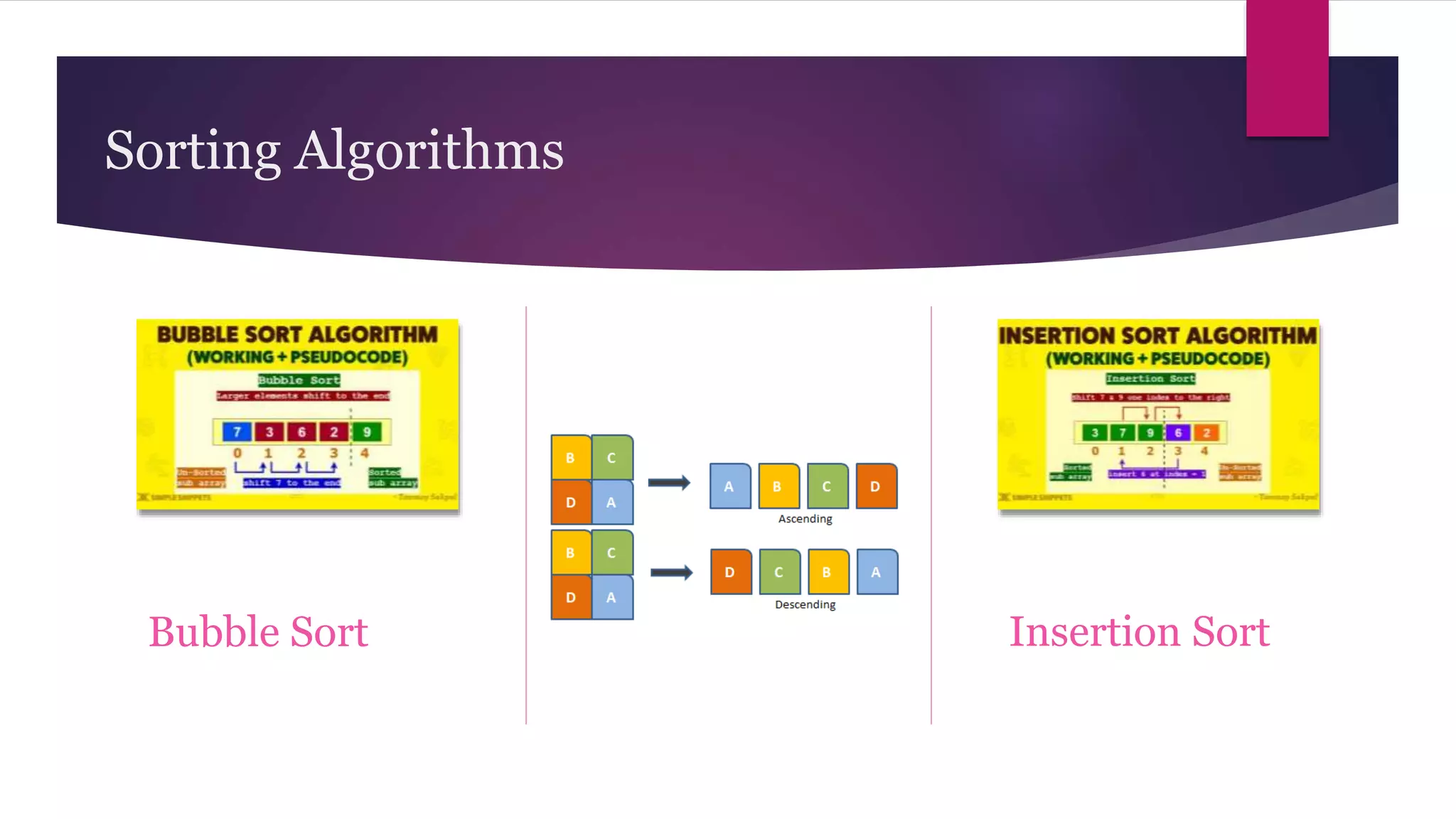
Sorting Algorithms
Bubble Sort Insertion Sort
Bubble Sort Algorithm
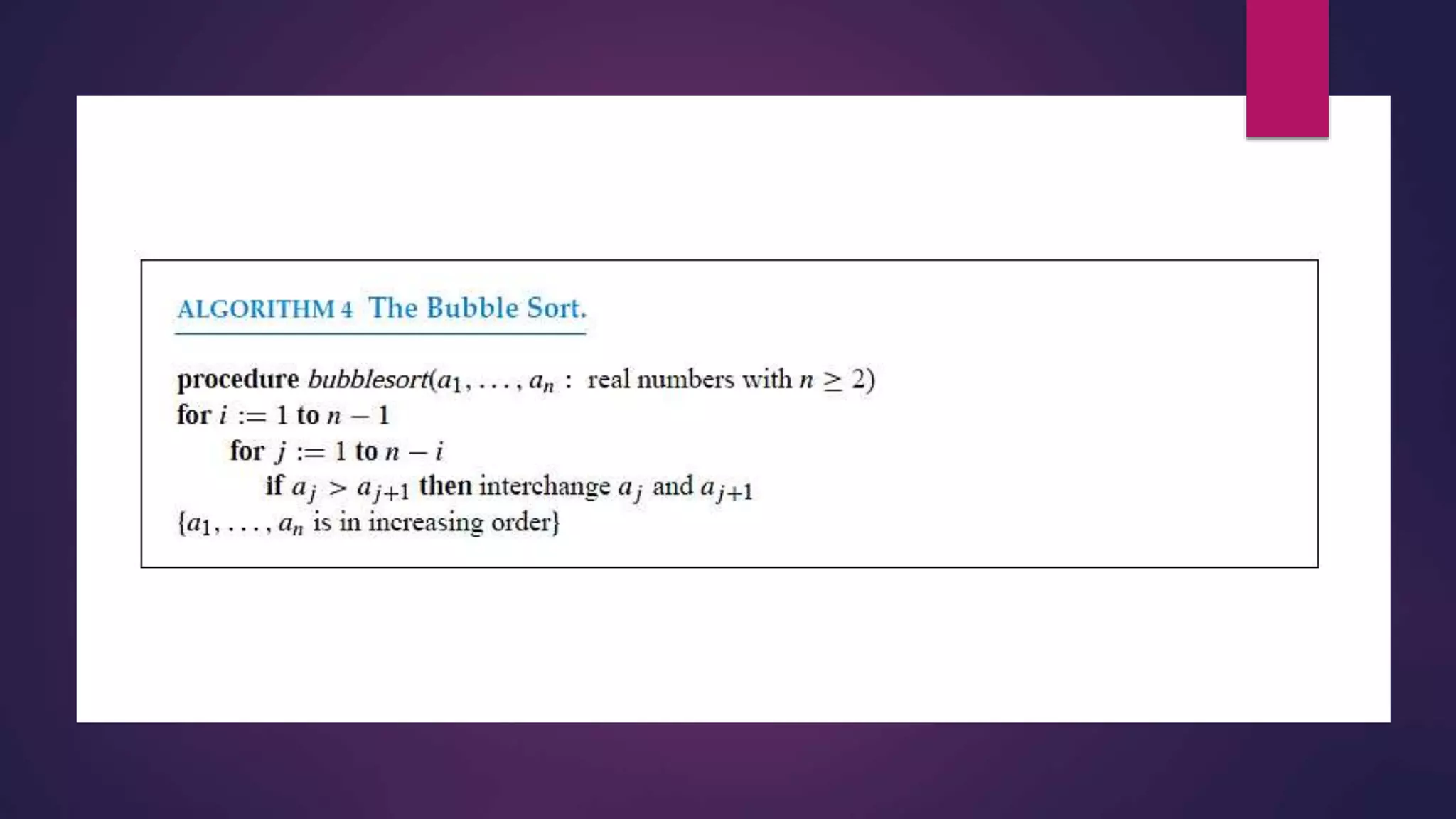
An example of a computer algorithm is bubble sort. This is a simple algorithm used for taking a list of
jumbled up numbers and putting them into the correct order. The algorithm runs as follows:
 Look at the first number in the list.
 Compare the current number with the next number.
 Is the next number smaller than the current number? If so, swap the two numbers around. If not,
do not swap.
 Move to the next number along in the list and make this the current number.
 Repeat from step 2 until the last number in the list has been reached.
 If any numbers were swapped, repeat again from step 1.
 If the end of the list is reached without any swaps being made, then the list is ordered, and the
algorithm can stop.
Bubble Sort Algorithm
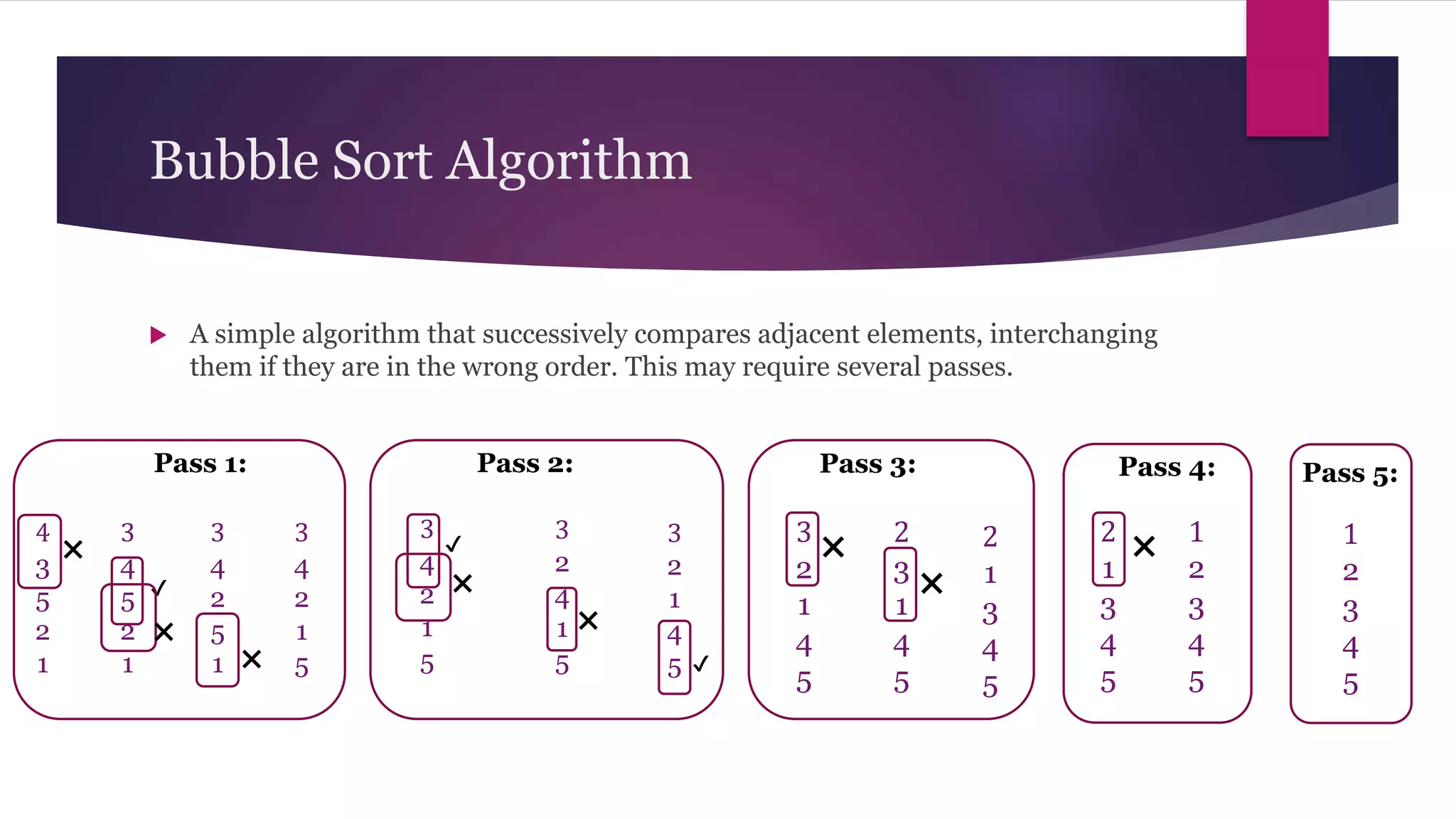
 A simple algorithm that successively compares adjacent elements, interchanging
them if they are in the wrong order. This may require several passes.
4
3
5
2
1
Pass 1:
3
4
5
2
1
✔
❌
❌
Pass 2:
3
4
2
5
1 ❌
3
4
2
1
5
Pass 3:
3
4
2
1
5
✔
❌
3
2
4
1
5
❌
3
2
1
4
5 ✔
3
2
1
4
5
❌
2
3
1
4
5
2
1
3
4
5
Pass 4:
2
1
3
4
5
1
2
3
4
5
❌
❌
Pass 5:
1
2
3
4
5
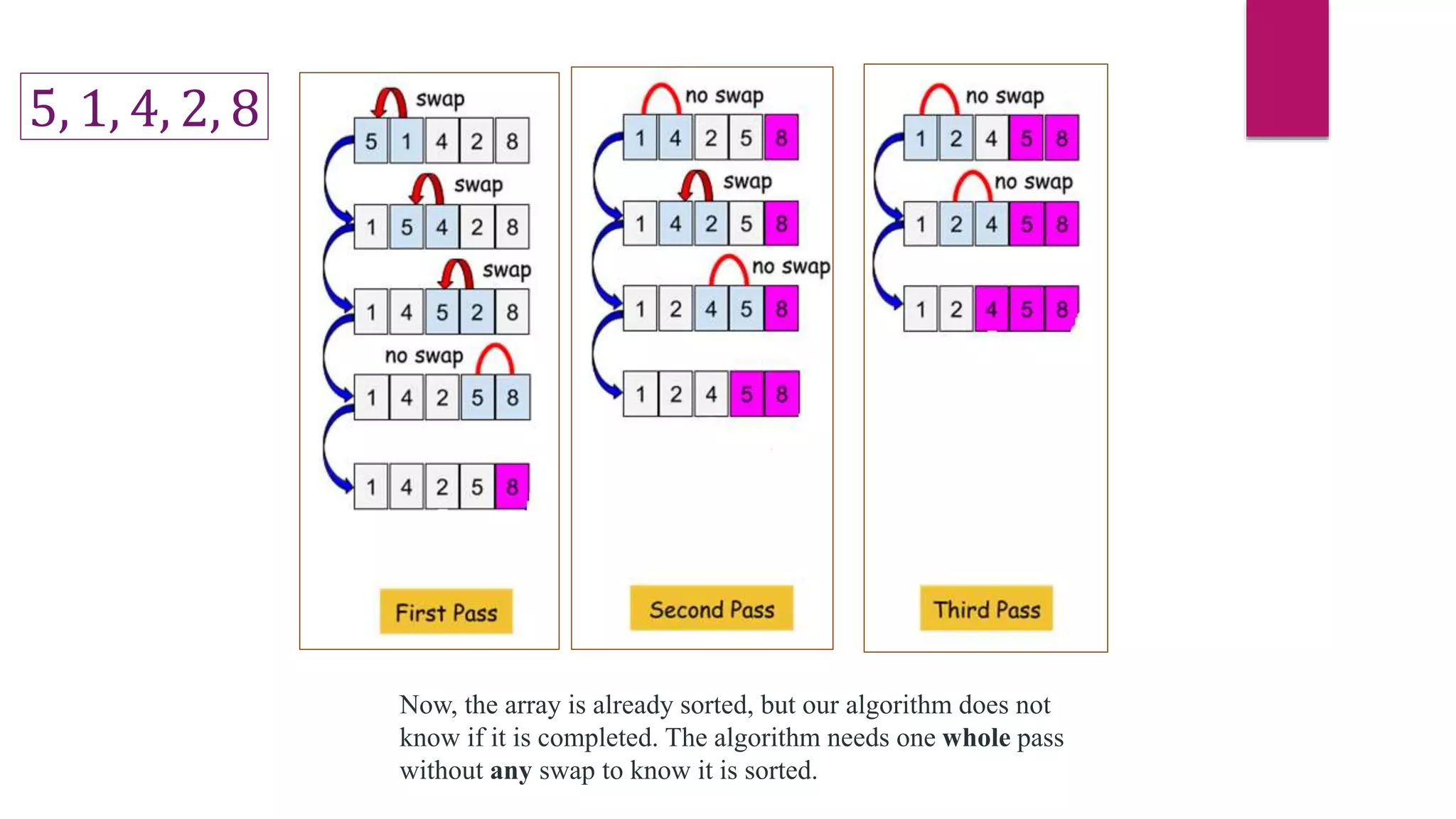
5, 1, 4, 2, 8
Now, the array is already sorted, but our algorithm does not
know if it is completed. The algorithm needs one whole pass
without any swap to know it is sorted.
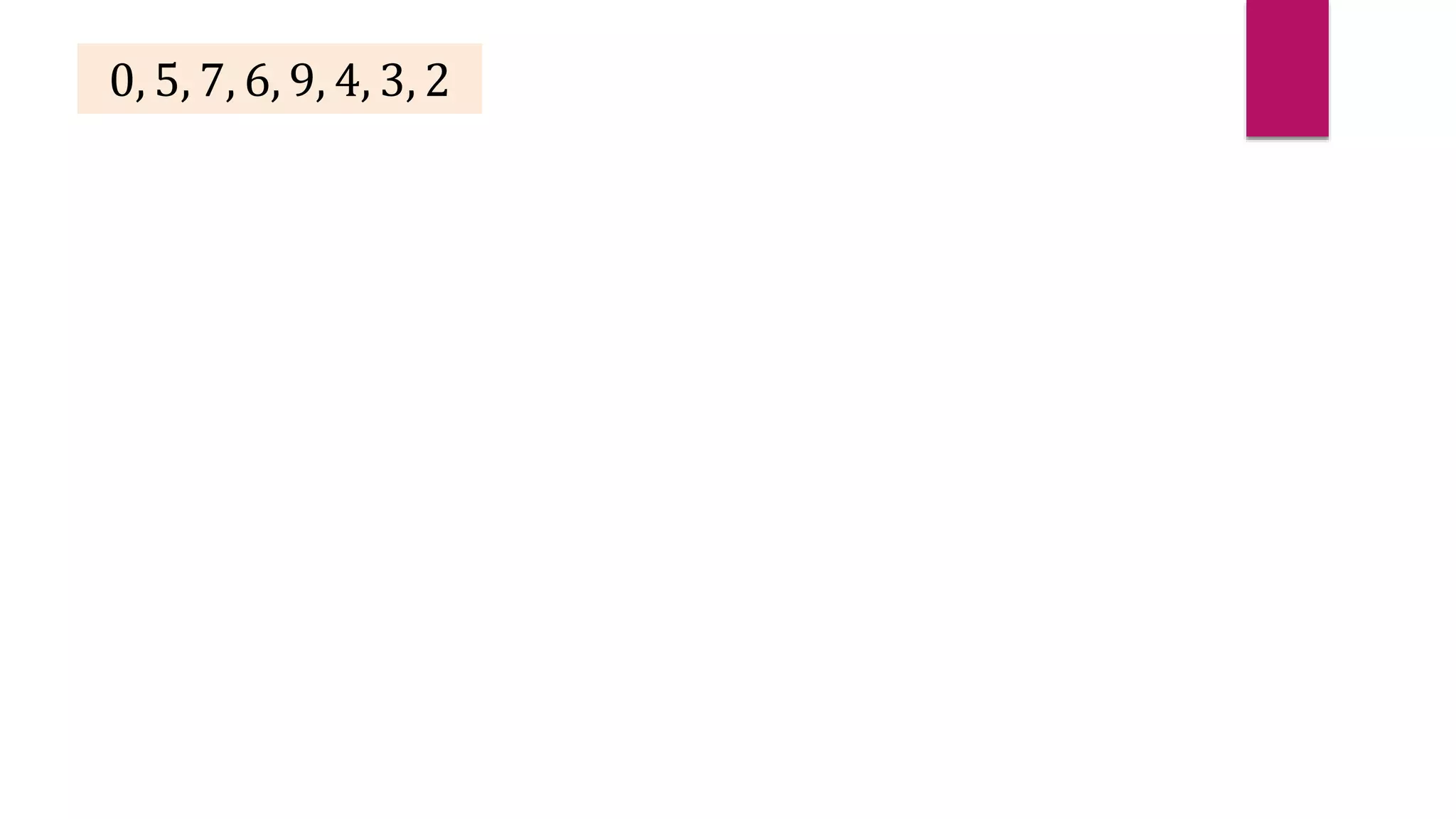
0, 5, 7, 6, 9, 4, 3, 2
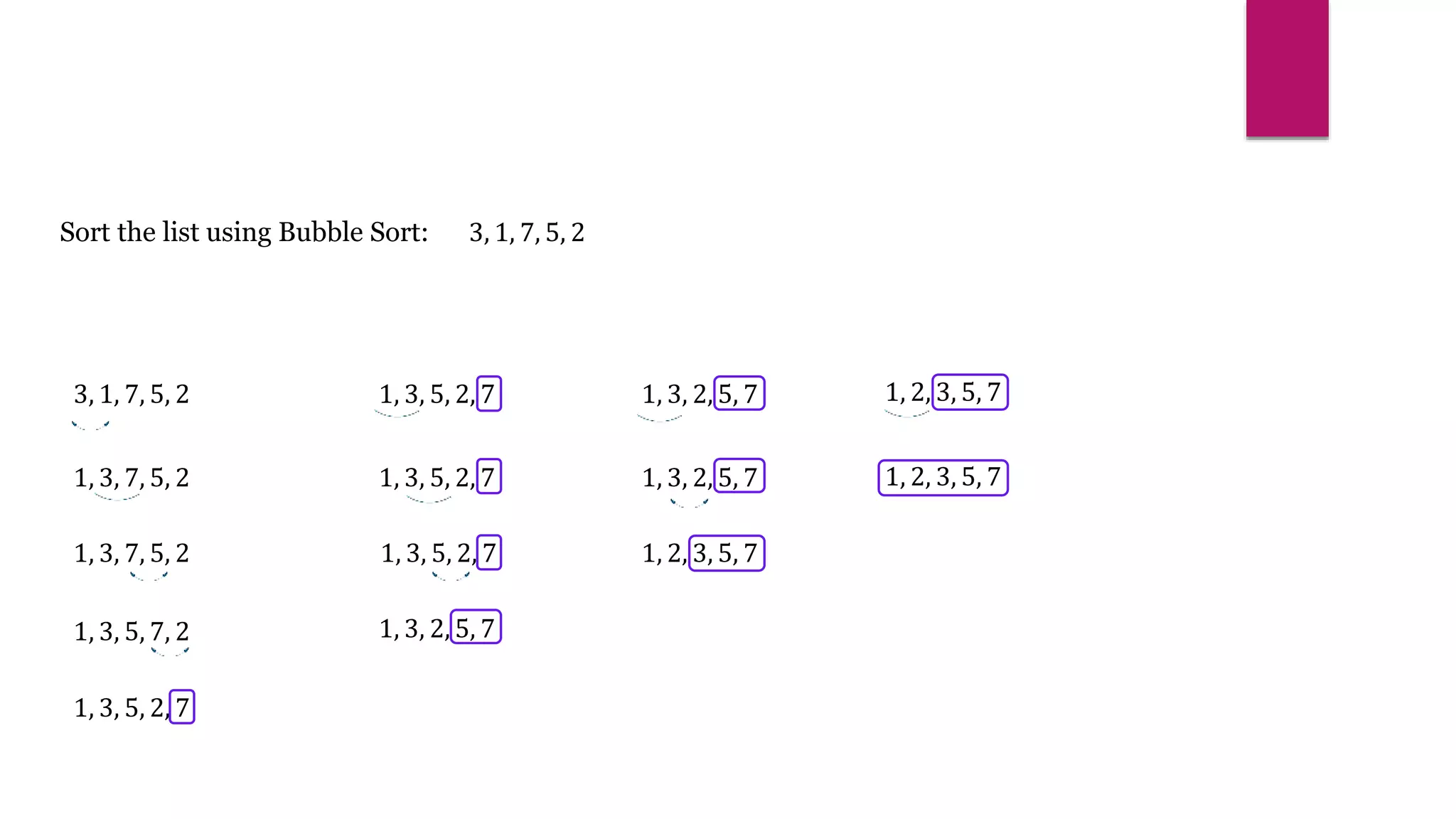
Sort the list using Bubble Sort: 3, 1, 7, 5, 2
3, 1, 7, 5, 2
1, 3, 7, 5, 2
1, 3, 7, 5, 2
1, 3, 5, 7, 2
1, 3, 5, 2, 7
1, 3, 5, 2, 7
1, 3, 5, 2, 7
1, 3, 5, 2, 7
1, 3, 2, 5, 7
1, 3, 2, 5, 7
1, 3, 2, 5, 7
1, 2, 3, 5, 7
1, 2, 3, 5, 7
1, 2, 3, 5, 7
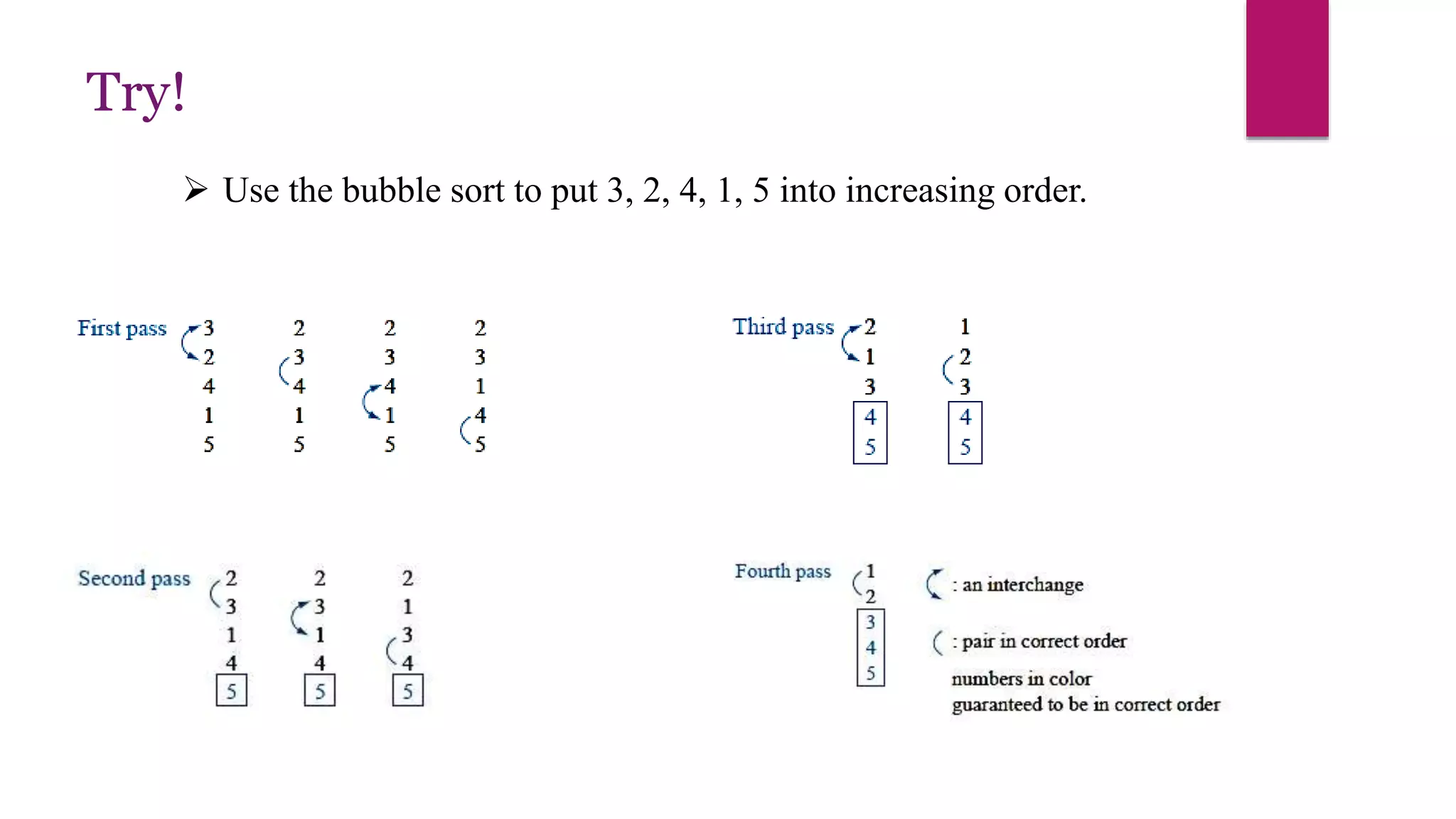
 Use the bubble sort to put 3, 2, 4, 1, 5 into increasing order.
Try!
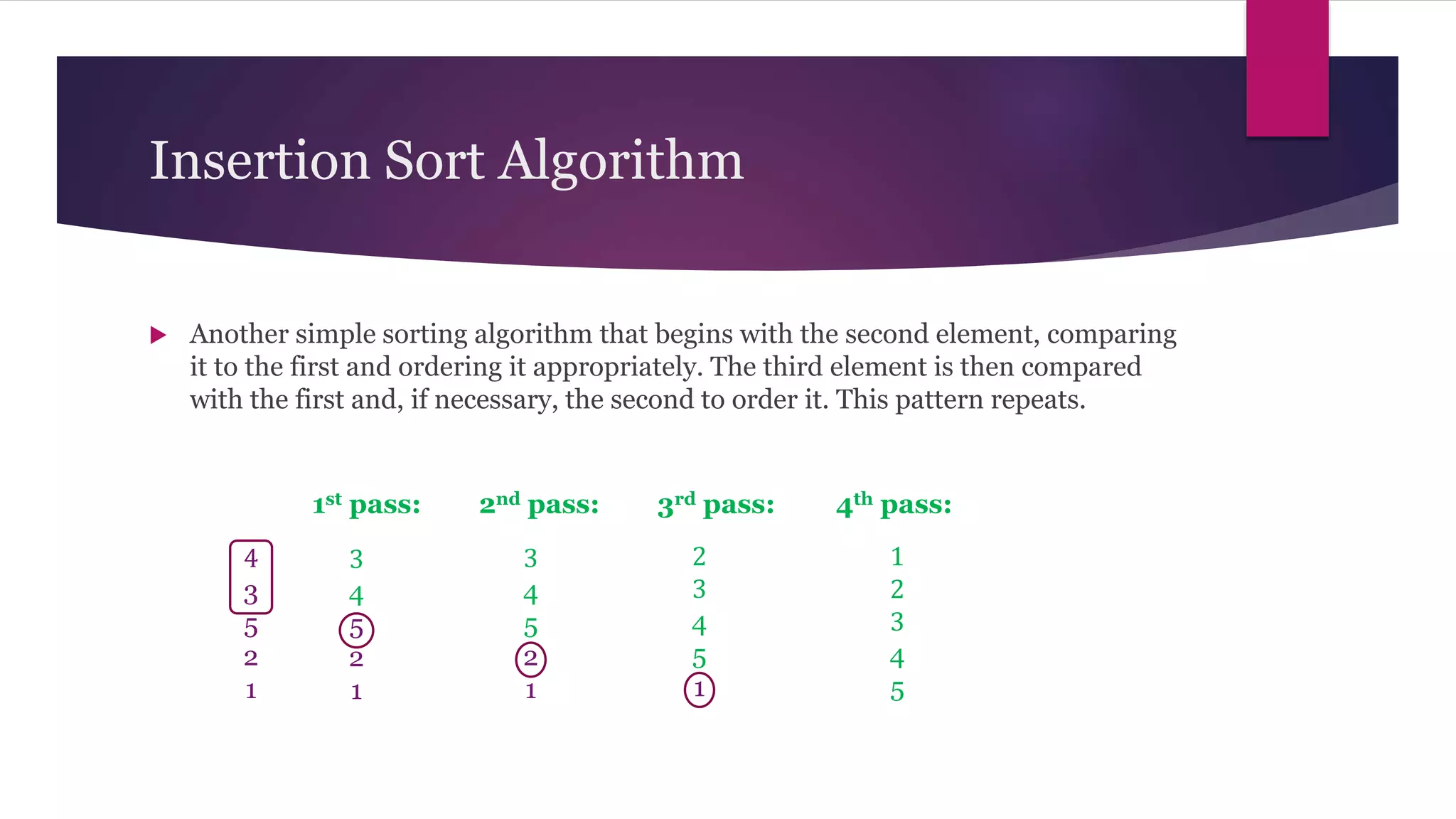
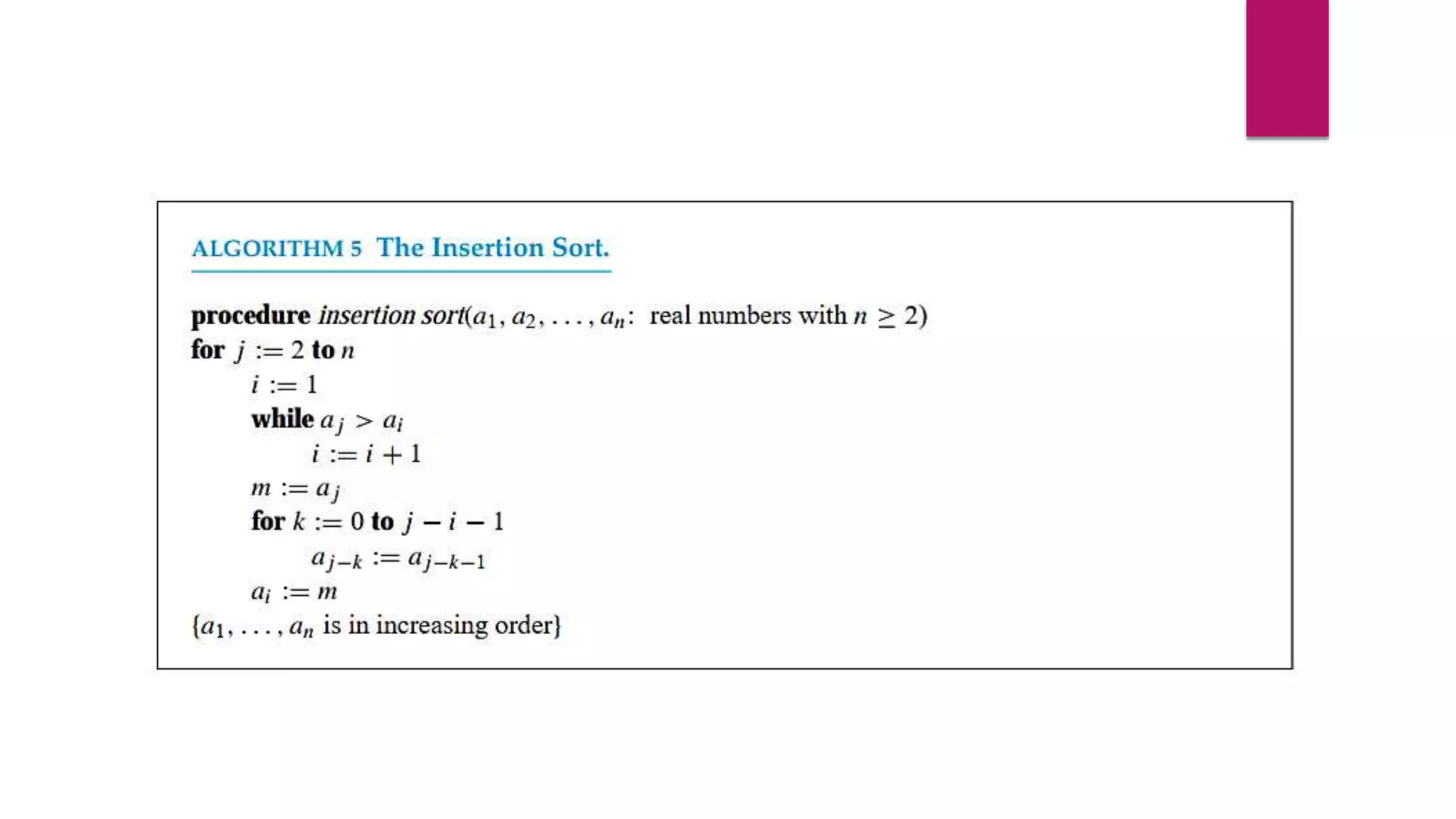
Insertion Sort Algorithm
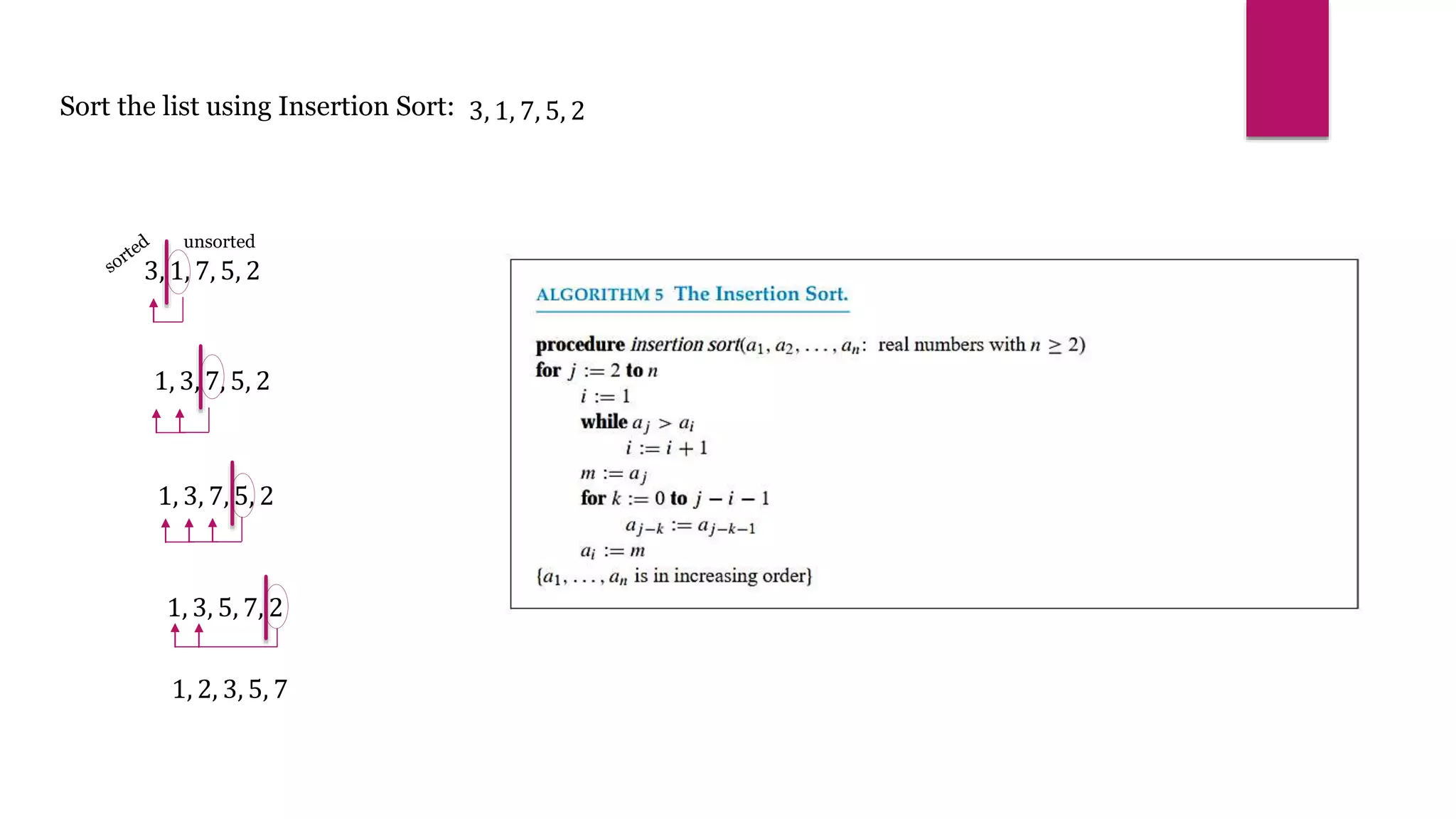
 Another simple sorting algorithm that begins with the second element, comparing
it to the first and ordering it appropriately. The third element is then compared
with the first and, if necessary, the second to order it. This pattern repeats.
4
3
5
2
1
1st pass:
3
4
5
2
1
2nd pass:
3
4
5
2
1
3rd pass:
2
3
4
5
1
4th pass:
1
2
3
4
5
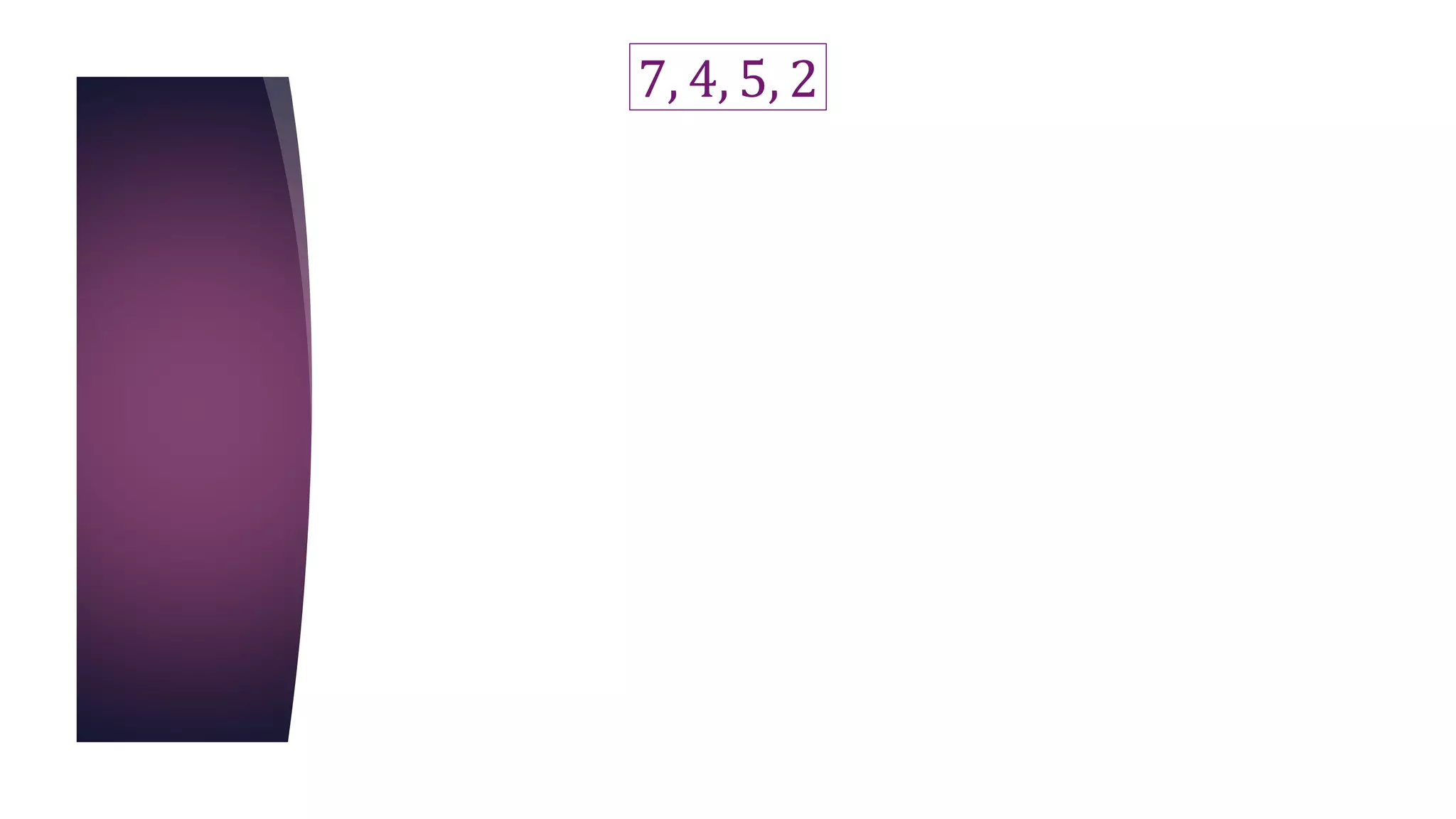
7, 4, 5, 2
Sort the list using Insertion Sort: 3, 1, 7, 5, 2
3, 1, 7, 5, 2
unsorted
1, 3, 7, 5, 2
1, 3, 7, 5, 2
1, 3, 5, 7, 2
1, 2, 3, 5, 7
Practice
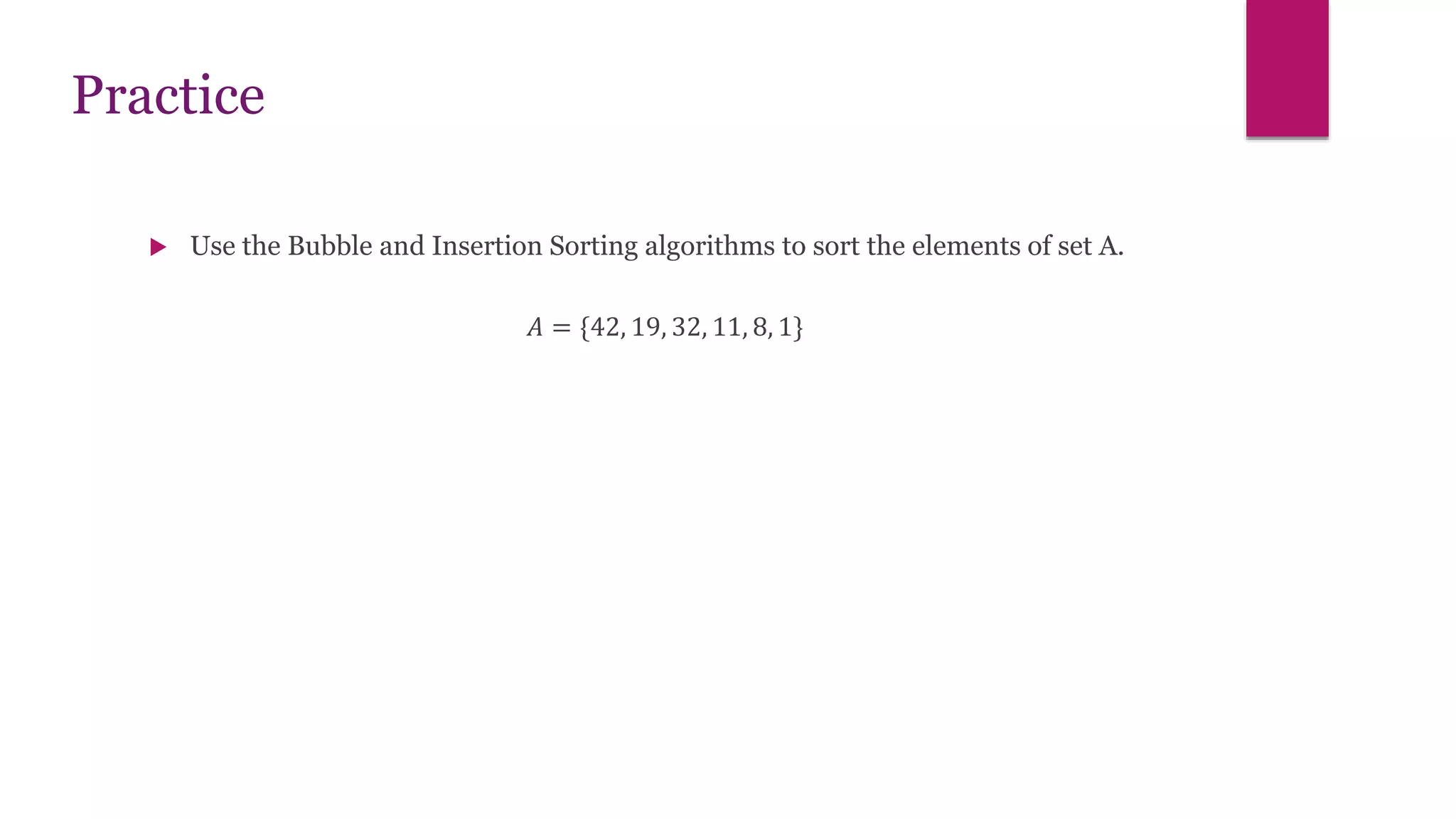
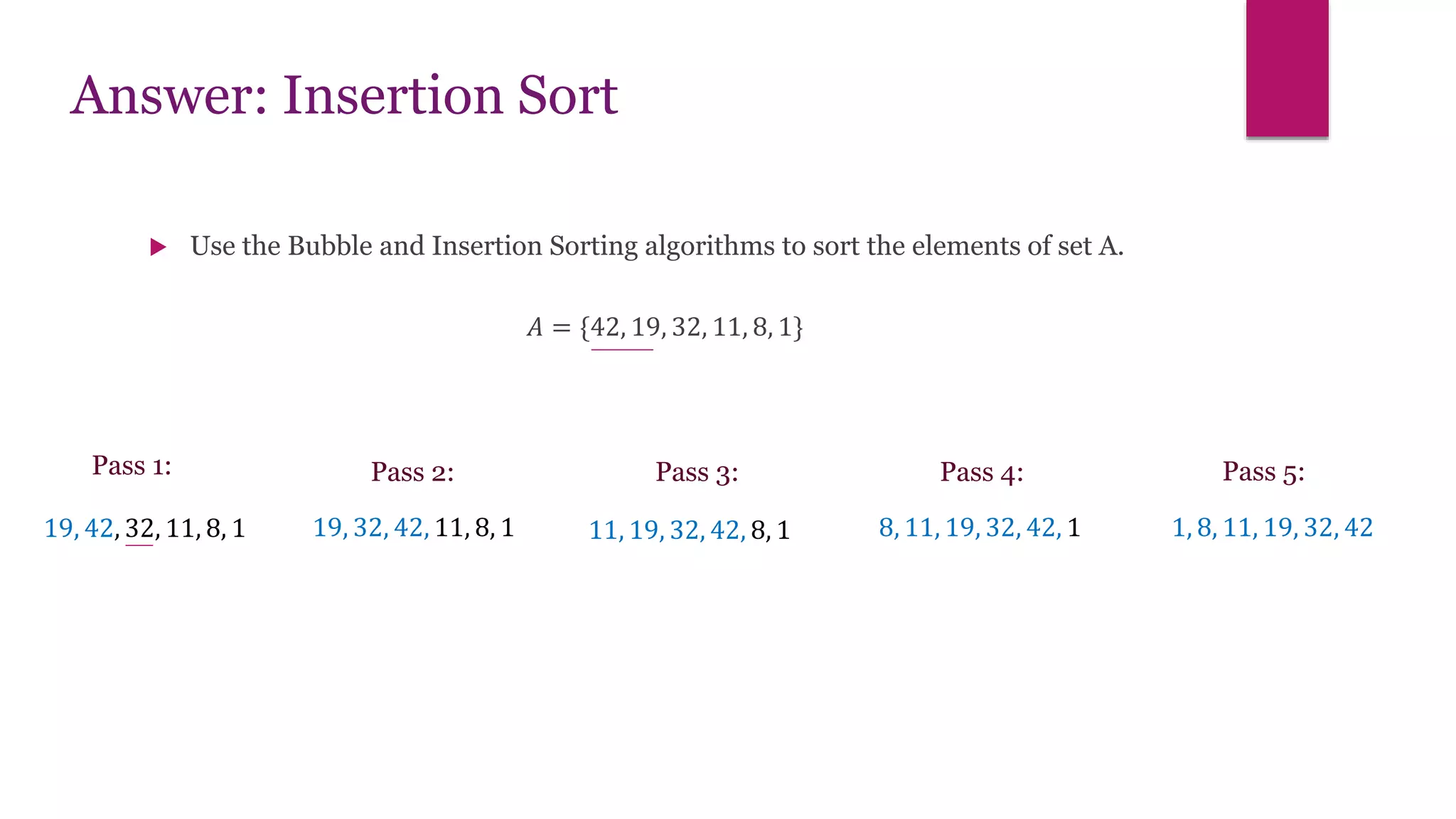
 Use the Bubble and Insertion Sorting algorithms to sort the elements of set A.
𝐴 = {42, 19, 32, 11, 8, 1}
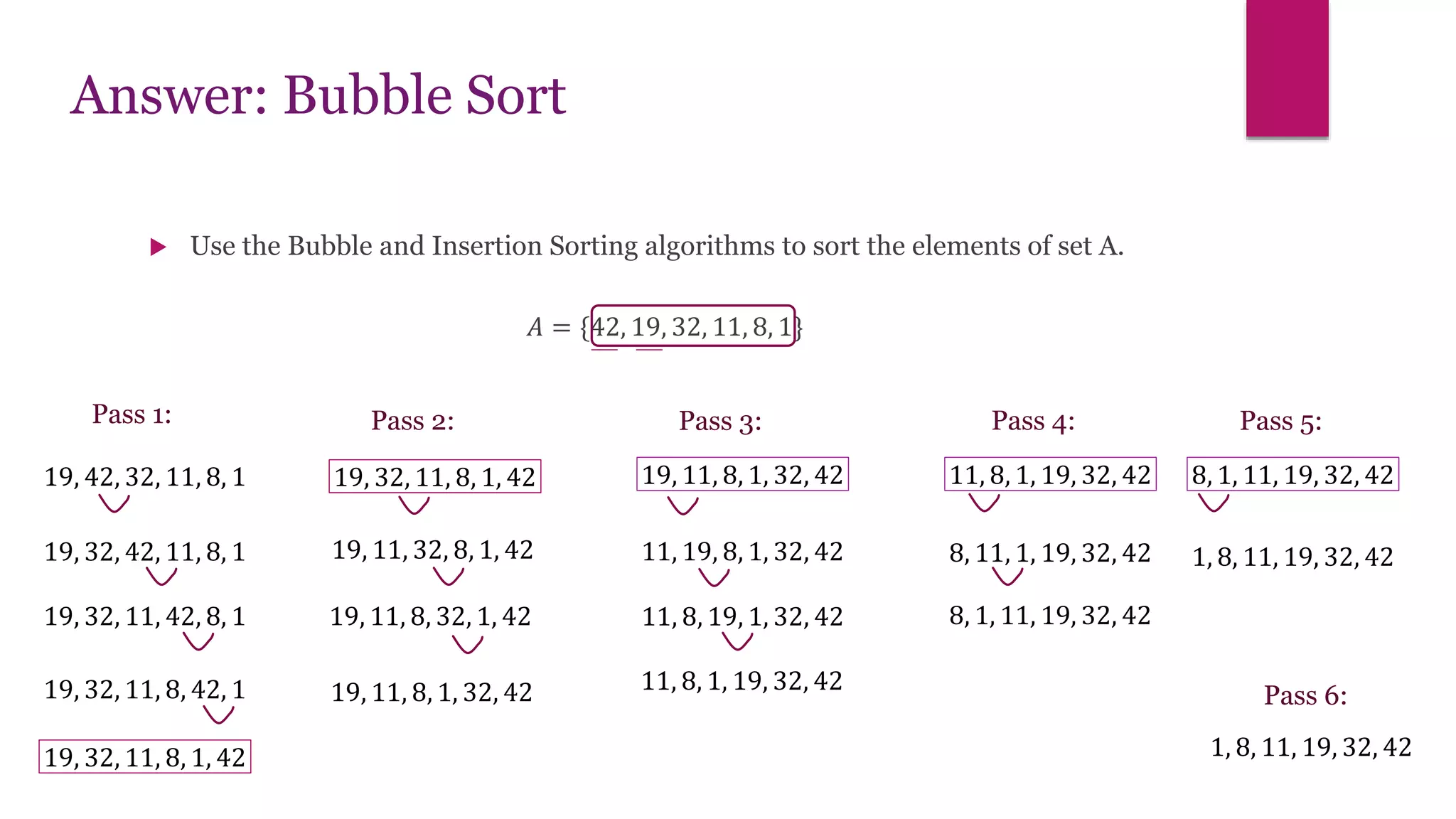
Answer: Bubble Sort
 Use the Bubble and Insertion Sorting algorithms to sort the elements of set A.
𝐴 = {42, 19, 32, 11, 8, 1}
Pass 1:
19, 42, 32, 11, 8, 1
19, 32, 42, 11, 8, 1
19, 32, 11, 42, 8, 1
19, 32, 11, 8, 42, 1
19, 32, 11, 8, 1, 42
Pass 2:
19, 32, 11, 8, 1, 42
19, 11, 32, 8, 1, 42
19, 11, 8, 32, 1, 42
19, 11, 8, 1, 32, 42
19, 11, 8, 1, 32, 42
11, 19, 8, 1, 32, 42
11, 8, 19, 1, 32, 42
11, 8, 1, 19, 32, 42
11, 8, 1, 19, 32, 42
8, 11, 1, 19, 32, 42
8, 1, 11, 19, 32, 42
8, 1, 11, 19, 32, 42
1, 8, 11, 19, 32, 42
Pass 3: Pass 5:
Pass 4:
Pass 6:
1, 8, 11, 19, 32, 42
Answer: Insertion Sort
 Use the Bubble and Insertion Sorting algorithms to sort the elements of set A.
𝐴 = {42, 19, 32, 11, 8, 1}
Pass 1:
19, 42, 32, 11, 8, 1
Pass 2:
1, 8, 11, 19, 32, 42
Pass 3: Pass 5:
Pass 4:
19, 32, 42, 11, 8, 1 11, 19, 32, 42, 8, 1 8, 11, 19, 32, 42, 1
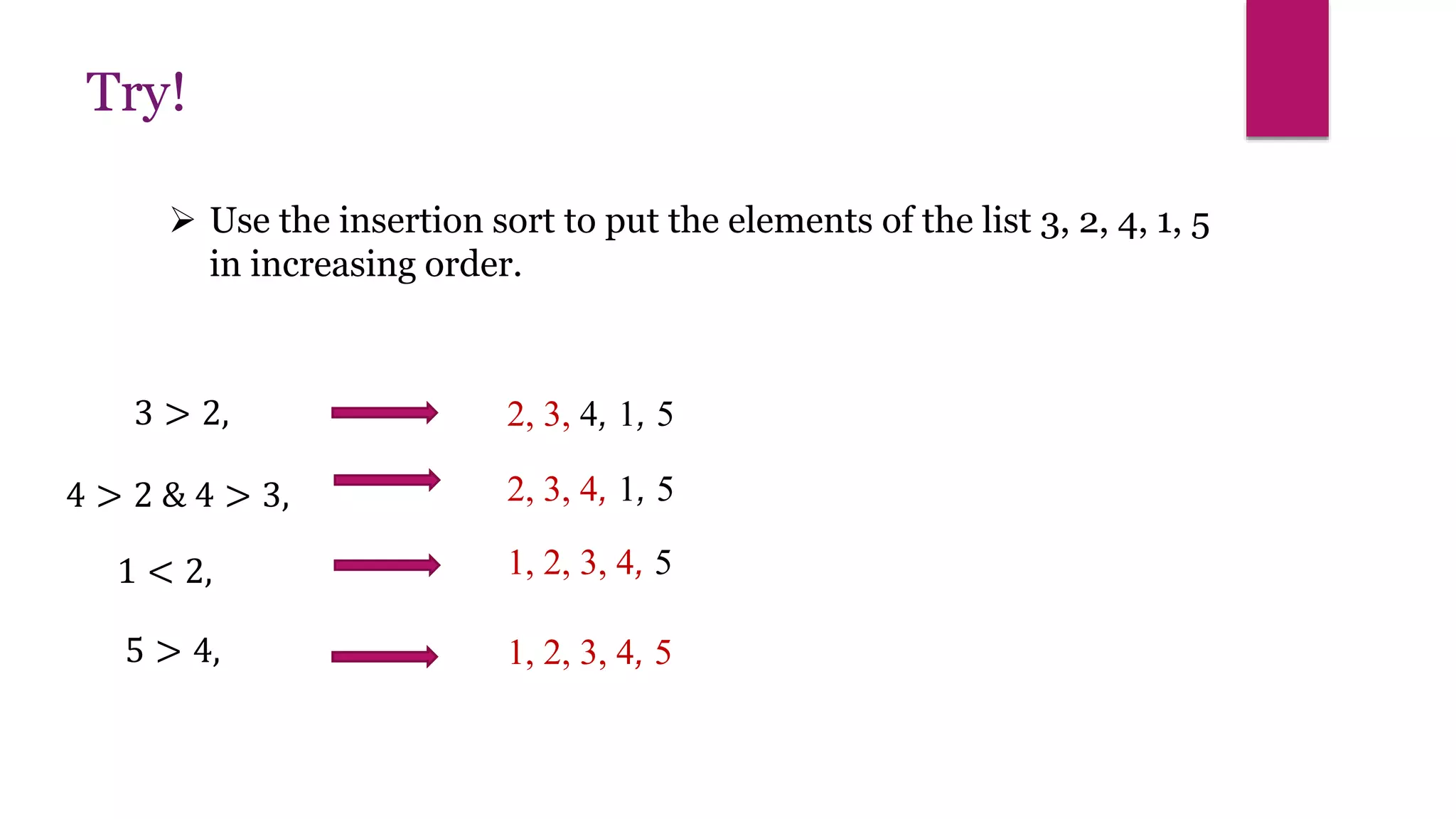
 Use the insertion sort to put the elements of the list 3, 2, 4, 1, 5
in increasing order.
Try!
3 > 2, 2, 3, 4, 1, 5
4 > 2 & 4 > 3, 2, 3, 4, 1, 5
1 < 2, 1, 2, 3, 4, 5
5 > 4, 1, 2, 3, 4, 5
Optimization Algorithms: Greedy Algorithms
 These algorithms makes the “best” choice at each step. We must specify what that
“best” choice is.
 Finding shortest path between two points
 Connect network using least amount of fiber-optic cable
 Scheduling
 There are perhaps hundreds of popular optimization
algorithms
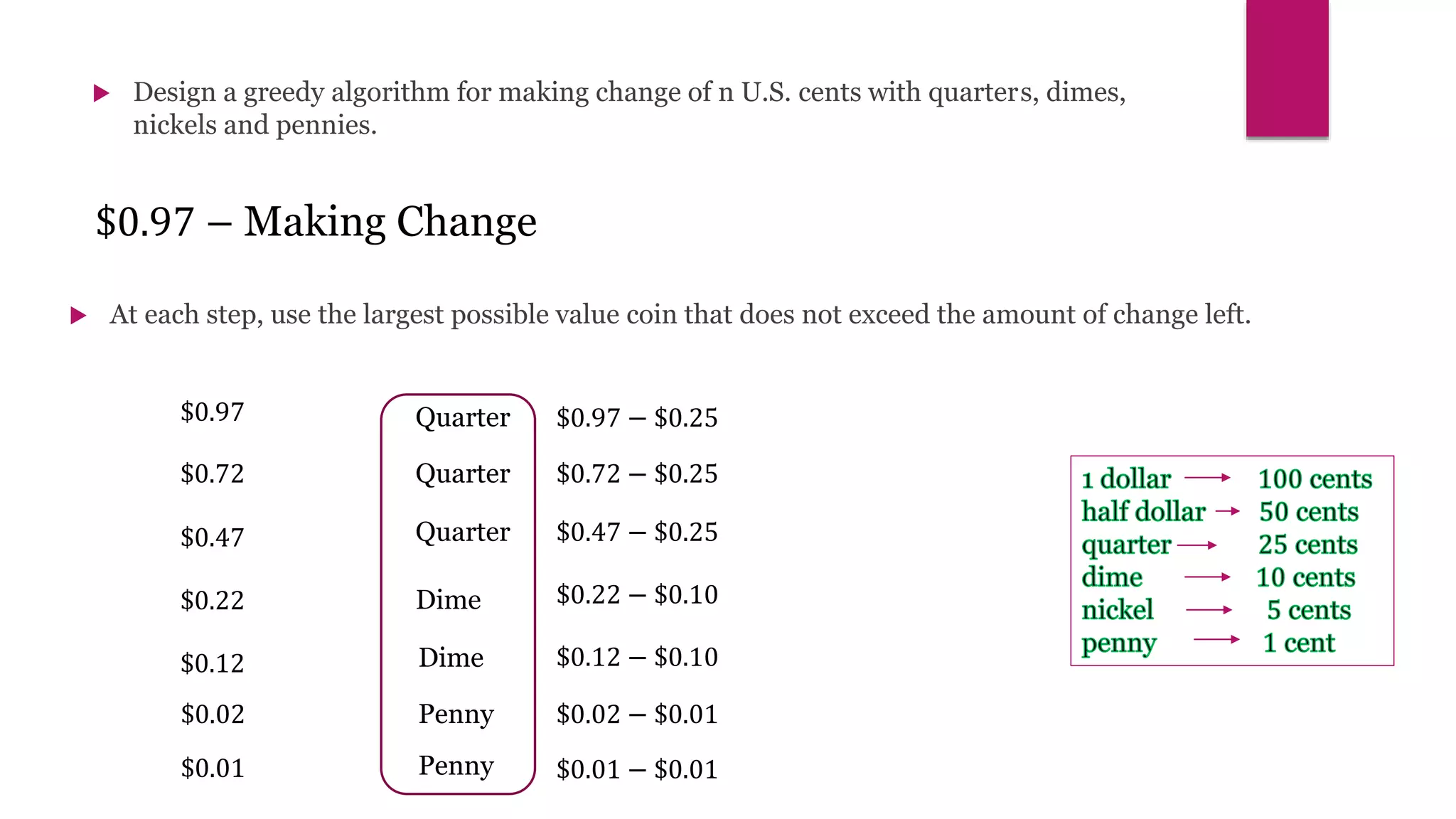
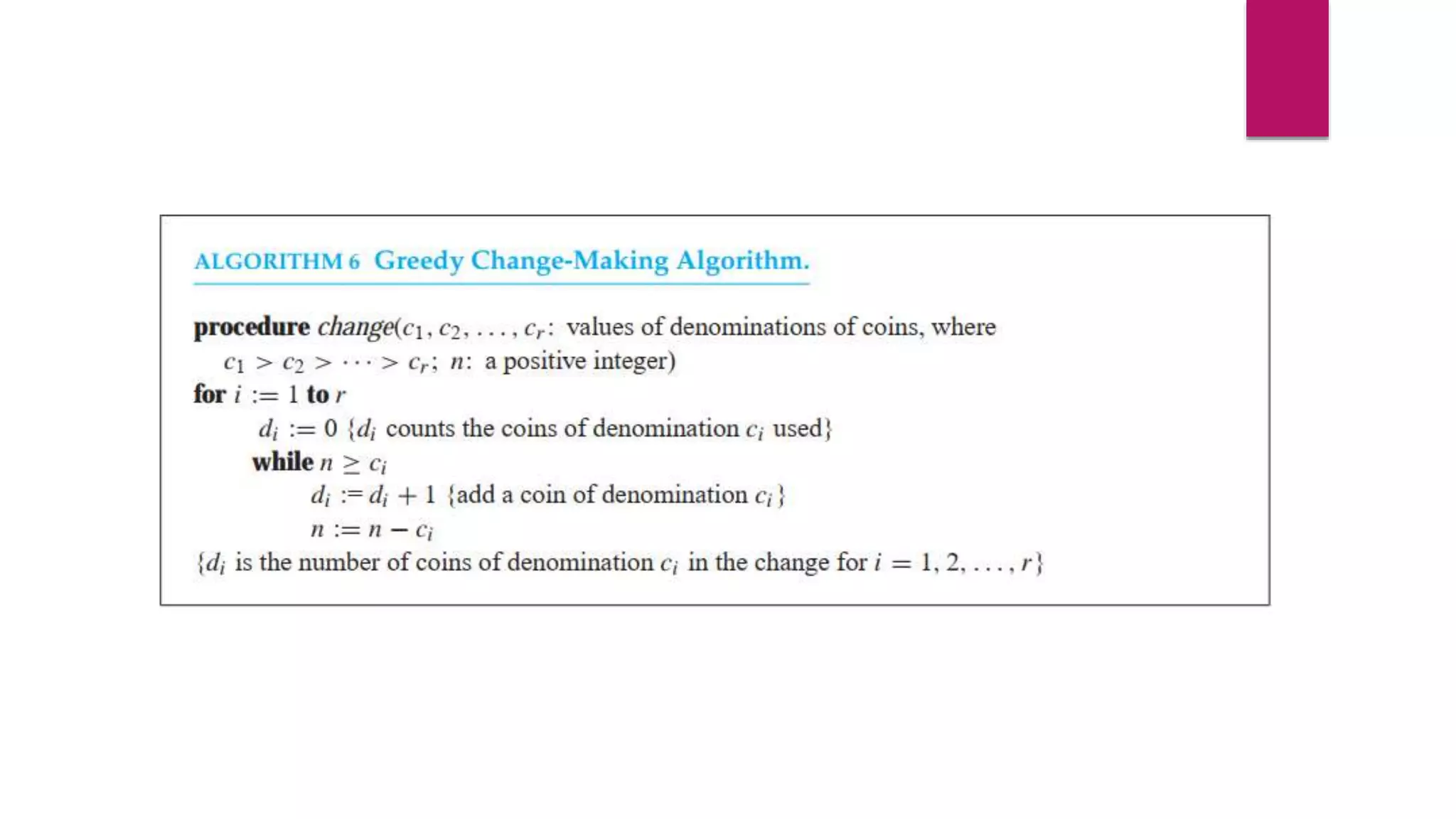
 Design a greedy algorithm for making change of n U.S. cents with quarters, dimes,
nickels and pennies.
$0.97 – Making Change
 At each step, use the largest possible value coin that does not exceed the amount of change left.
$0.97 Quarter
$0.72
$0.97 − $0.25
Quarter $0.72 − $0.25
$0.47 Quarter $0.47 − $0.25
$0.22 Dime $0.22 − $0.10
$0.12 Dime $0.12 − $0.10
$0.02 Penny $0.02 − $0.01
$0.01 Penny $0.01 − $0.01
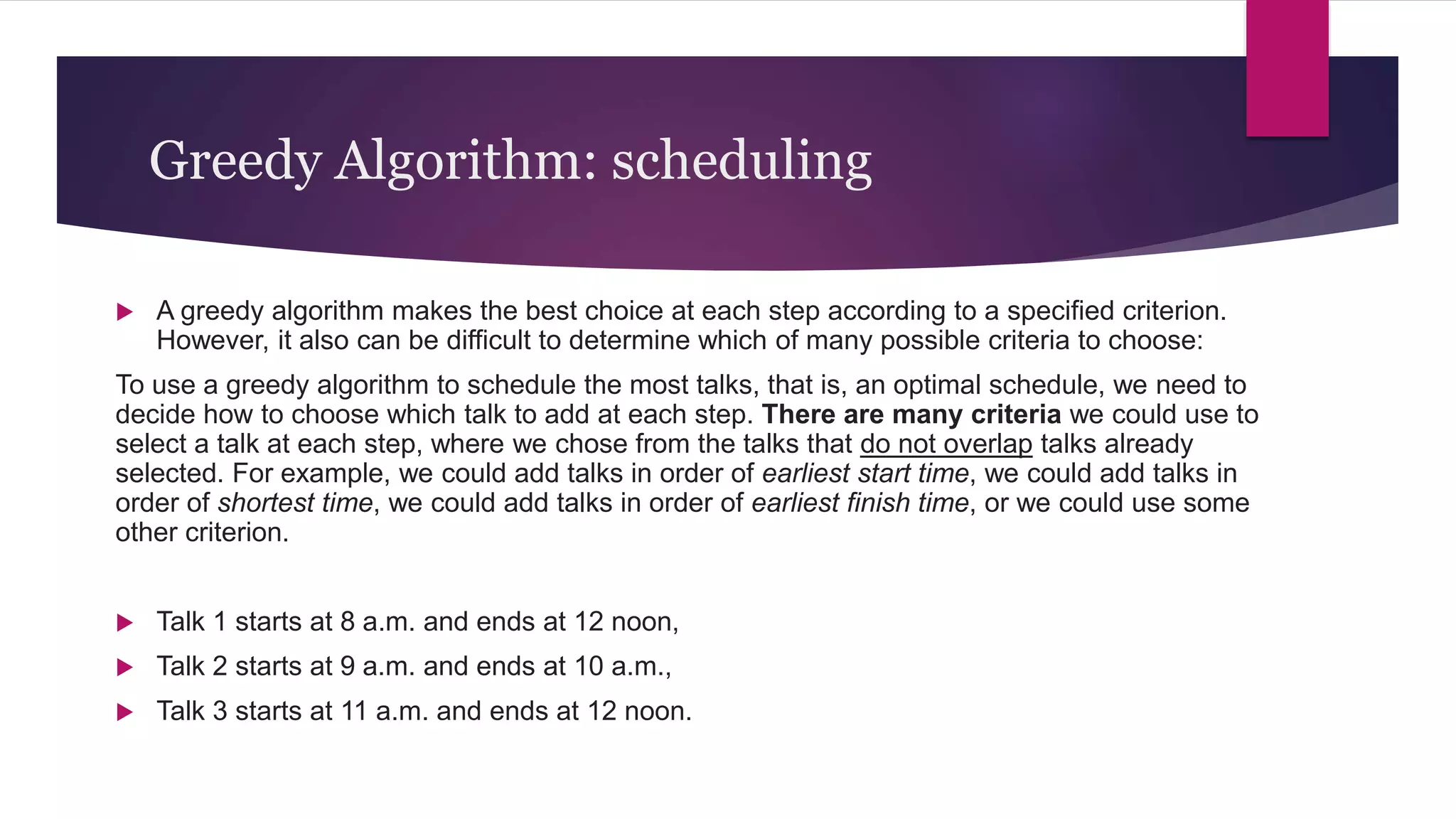
Greedy Algorithm: scheduling
 A greedy algorithm makes the best choice at each step according to a specified criterion.
However, it also can be difficult to determine which of many possible criteria to choose:
To use a greedy algorithm to schedule the most talks, that is, an optimal schedule, we need to
decide how to choose which talk to add at each step. There are many criteria we could use to
select a talk at each step, where we chose from the talks that do not overlap talks already
selected. For example, we could add talks in order of earliest start time, we could add talks in
order of shortest time, we could add talks in order of earliest finish time, or we could use some
other criterion.
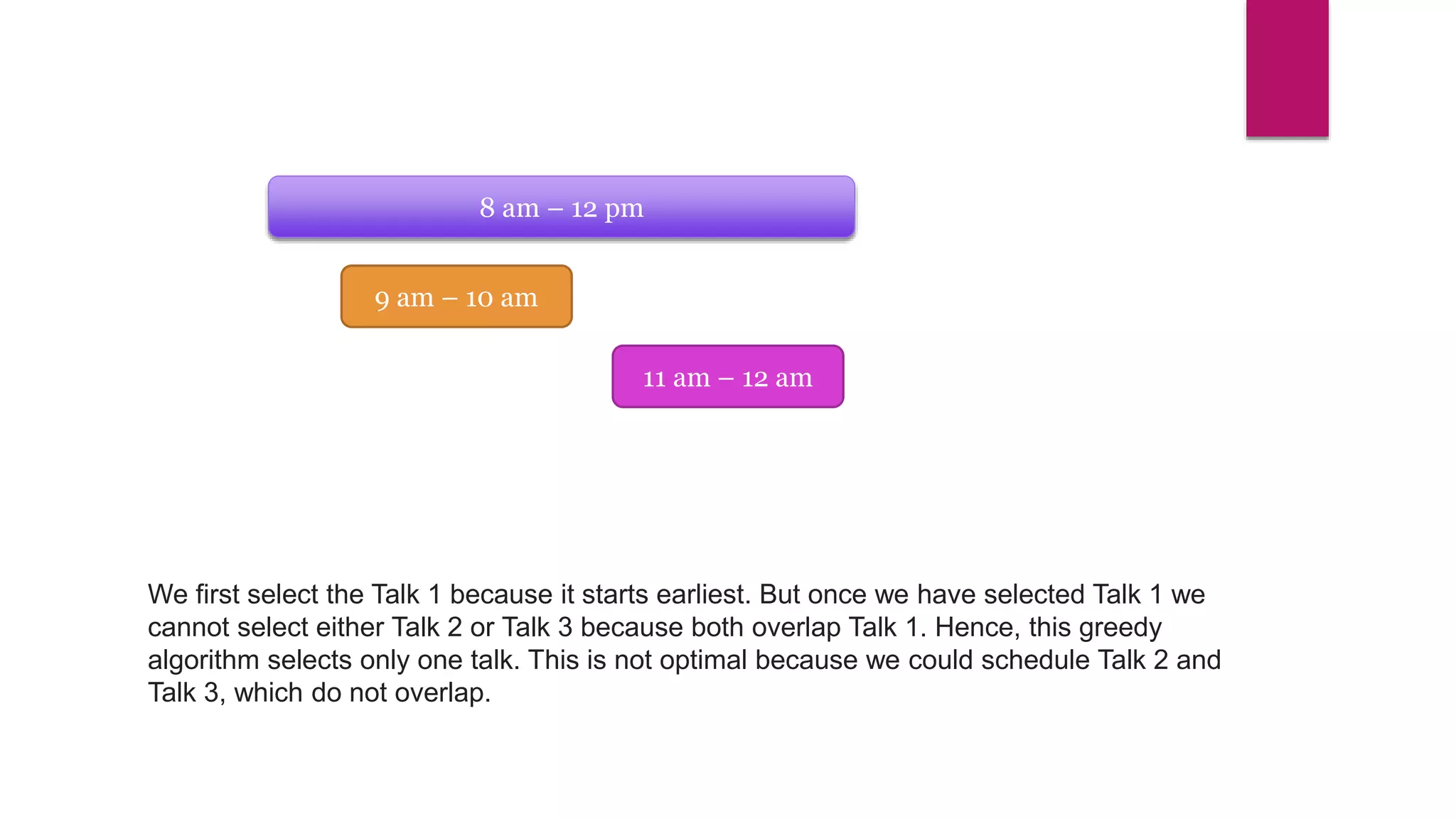
 Talk 1 starts at 8 a.m. and ends at 12 noon,
 Talk 2 starts at 9 a.m. and ends at 10 a.m.,
 Talk 3 starts at 11 a.m. and ends at 12 noon.
8 am – 12 pm
9 am – 10 am
11 am – 12 am
We first select the Talk 1 because it starts earliest. But once we have selected Talk 1 we
cannot select either Talk 2 or Talk 3 because both overlap Talk 1. Hence, this greedy
algorithm selects only one talk. This is not optimal because we could schedule Talk 2 and
Talk 3, which do not overlap.
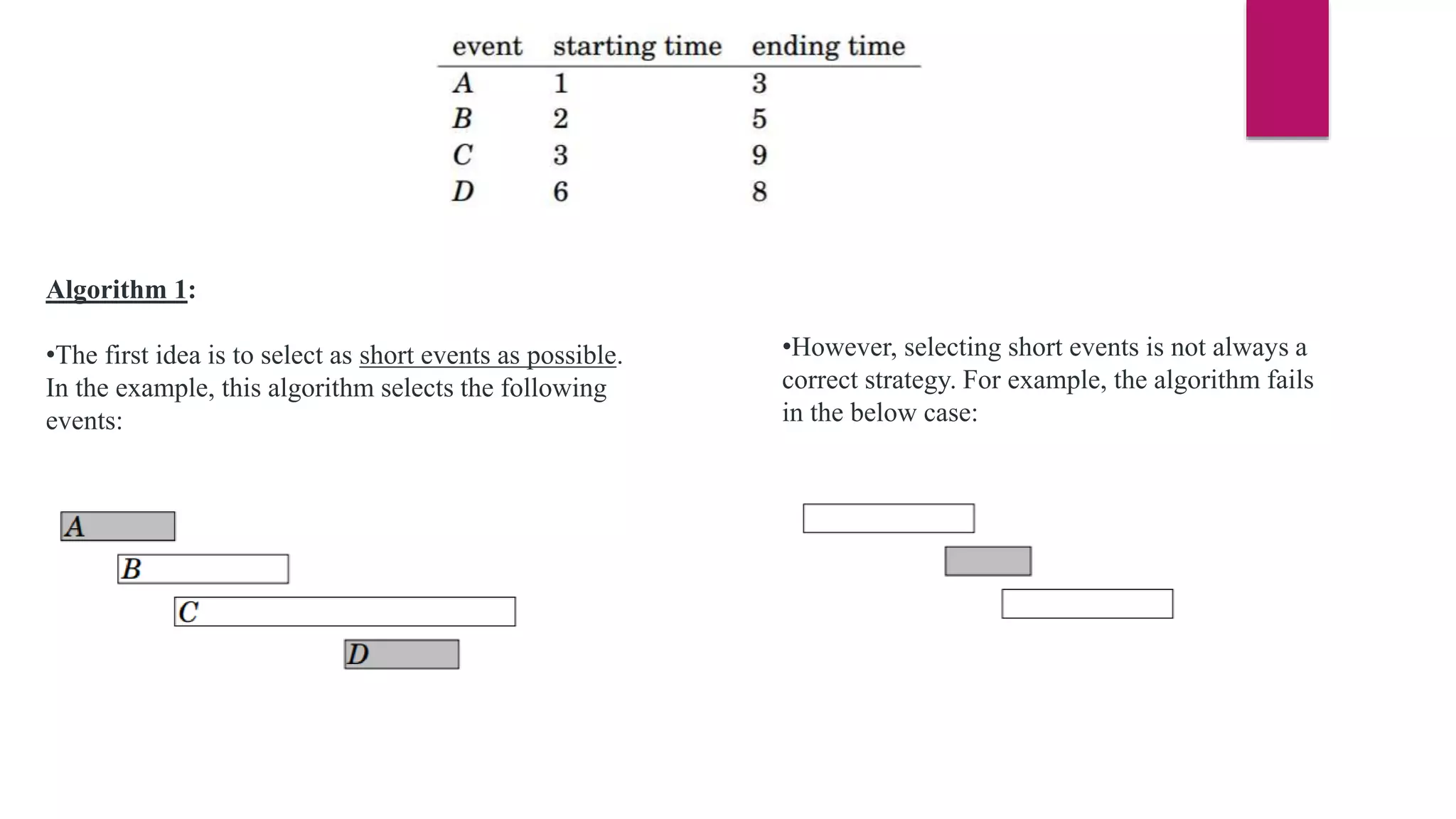
Algorithm 1:
•The first idea is to select as short events as possible.
In the example, this algorithm selects the following
events:
•However, selecting short events is not always a
correct strategy. For example, the algorithm fails
in the below case:
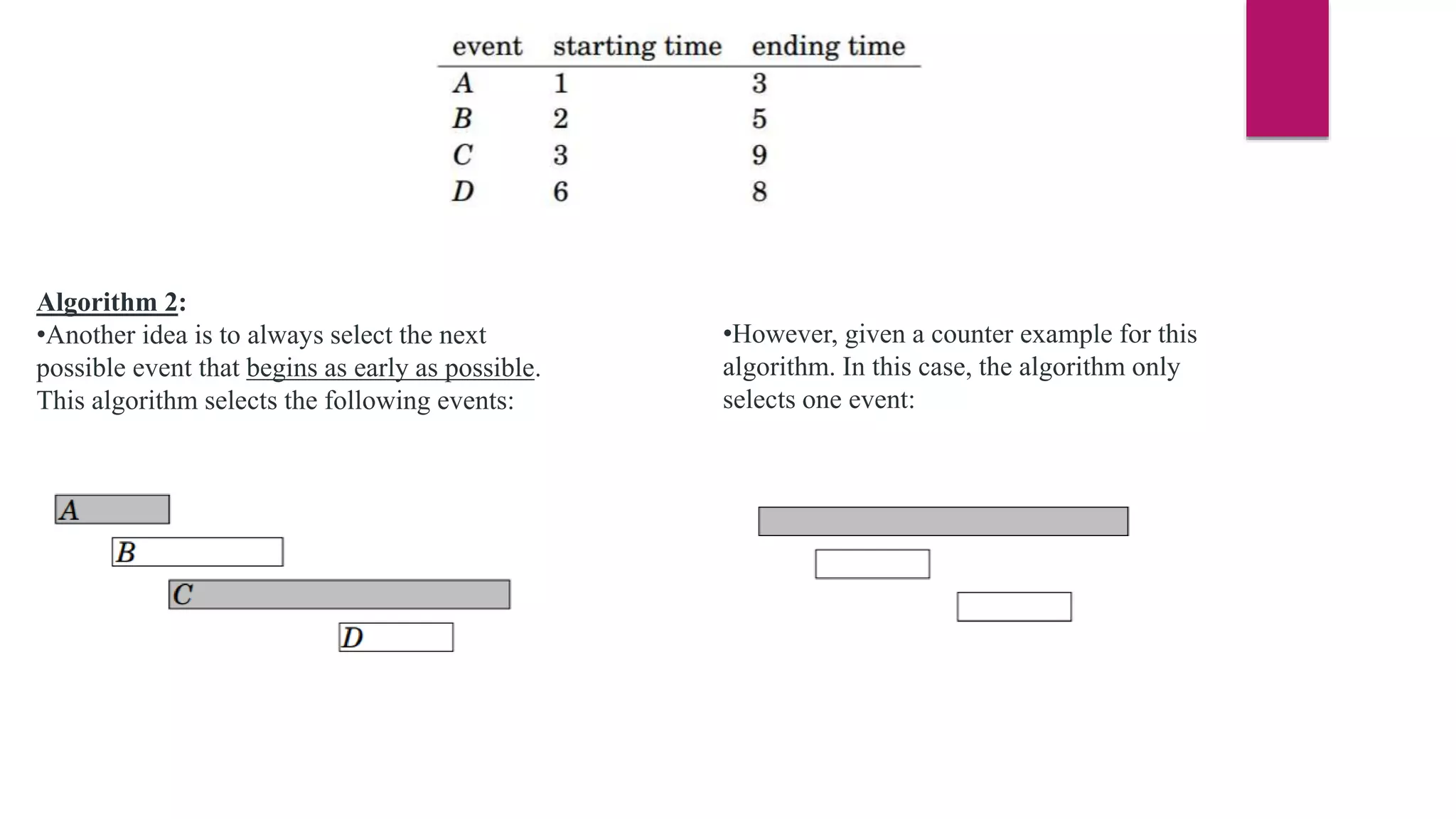
Algorithm 2:
•Another idea is to always select the next
possible event that begins as early as possible.
This algorithm selects the following events:
•However, given a counter example for this
algorithm. In this case, the algorithm only
selects one event:
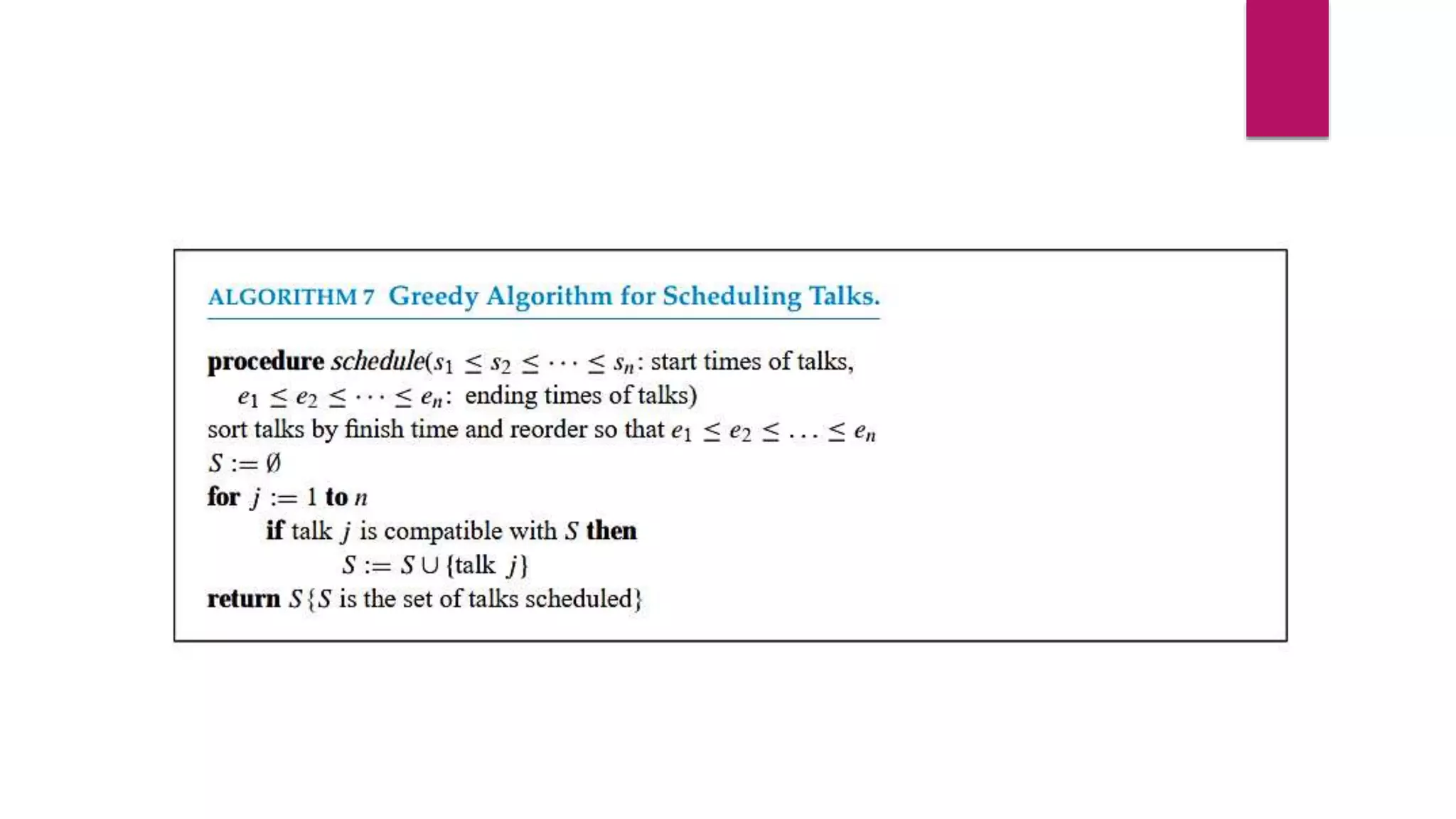
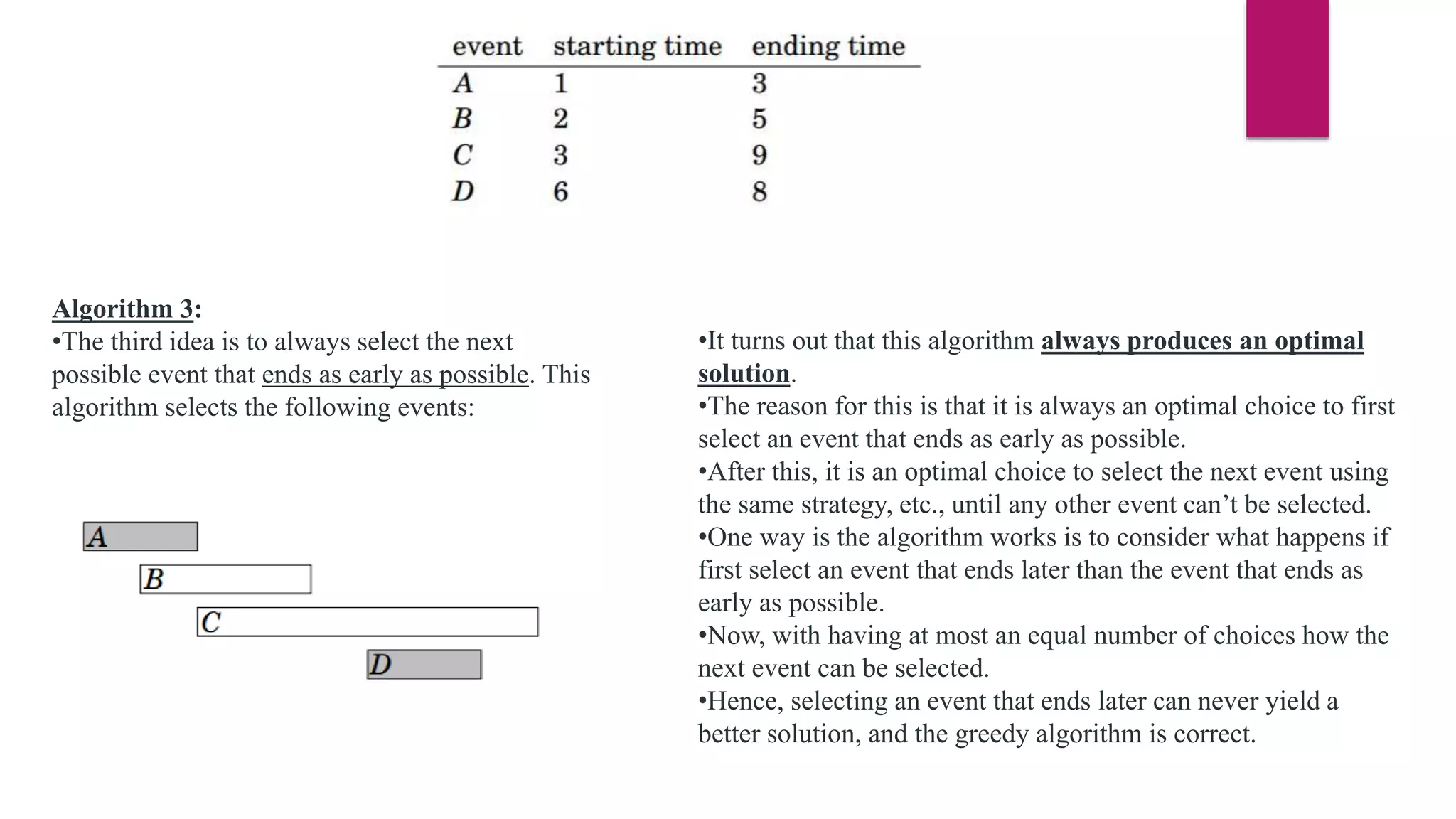
Algorithm 3:
•The third idea is to always select the next
possible event that ends as early as possible. This
algorithm selects the following events:
•It turns out that this algorithm always produces an optimal
solution.
•The reason for this is that it is always an optimal choice to first
select an event that ends as early as possible.
•After this, it is an optimal choice to select the next event using
the same strategy, etc., until any other event can’t be selected.
•One way is the algorithm works is to consider what happens if
first select an event that ends later than the event that ends as
early as possible.
•Now, with having at most an equal number of choices how the
next event can be selected.
•Hence, selecting an event that ends later can never yield a
better solution, and the greedy algorithm is correct.
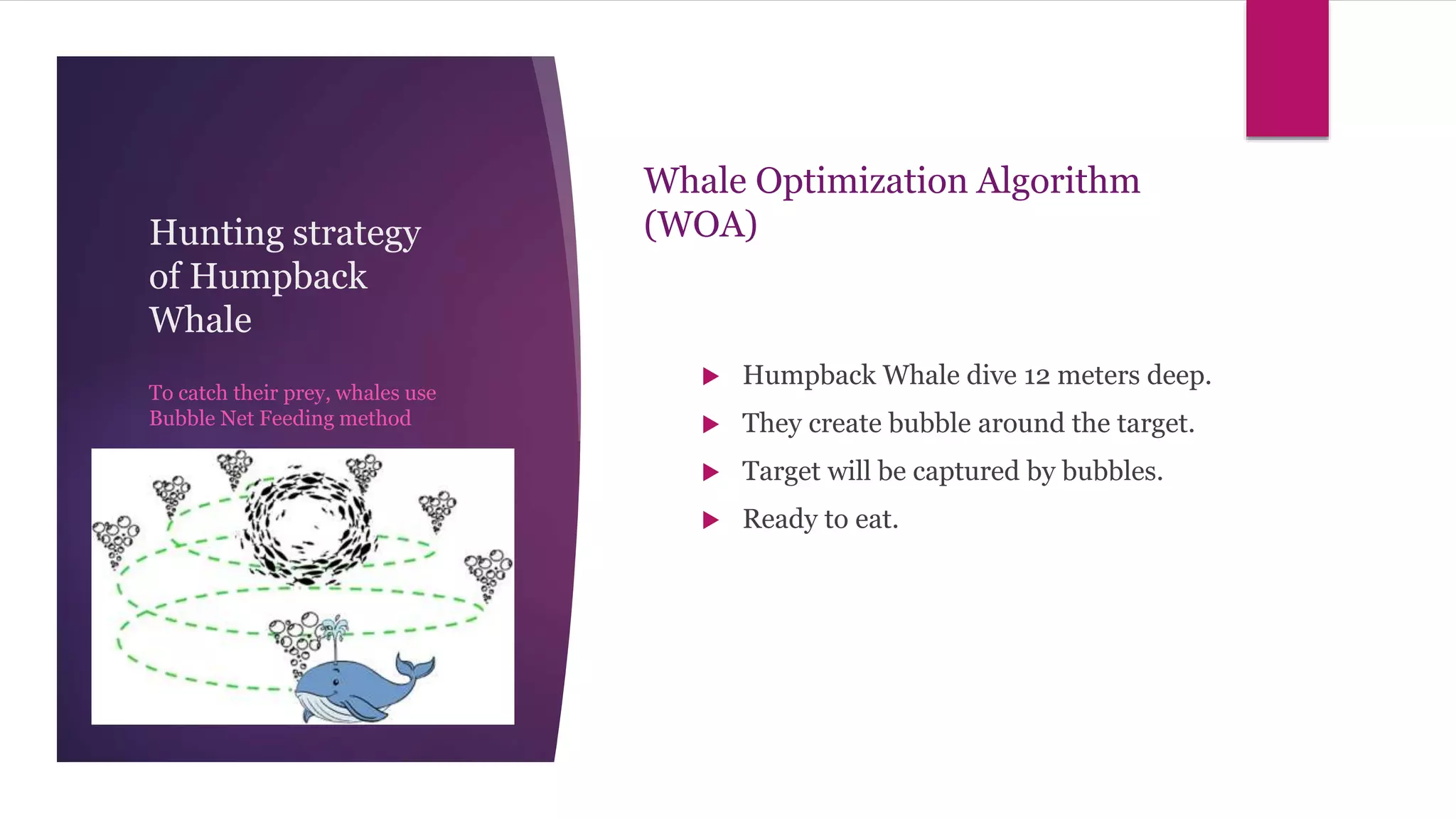
Hunting strategy
of Humpback
Whale
 Humpback Whale dive 12 meters deep.
 They create bubble around the target.
 Target will be captured by bubbles.
 Ready to eat.
To catch their prey, whales use
Bubble Net Feeding method
Whale Optimization Algorithm
(WOA)
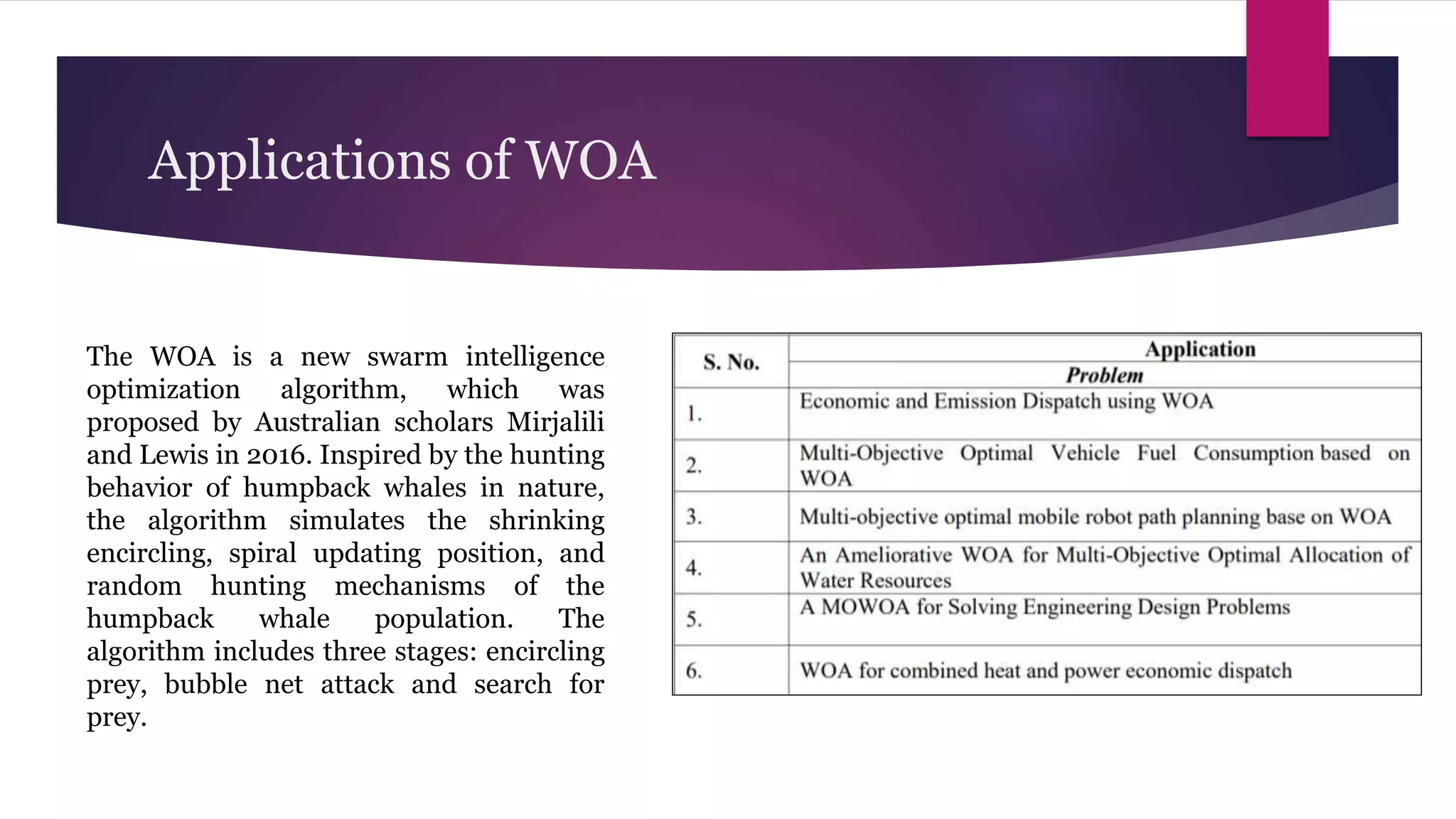
Applications of WOA
The WOA is a new swarm intelligence
optimization algorithm, which was
proposed by Australian scholars Mirjalili
and Lewis in 2016. Inspired by the hunting
behavior of humpback whales in nature,
the algorithm simulates the shrinking
encircling, spiral updating position, and
random hunting mechanisms of the
humpback whale population. The
algorithm includes three stages: encircling
prey, bubble net attack and search for
prey.
Humpback Whale: Hunting Technique
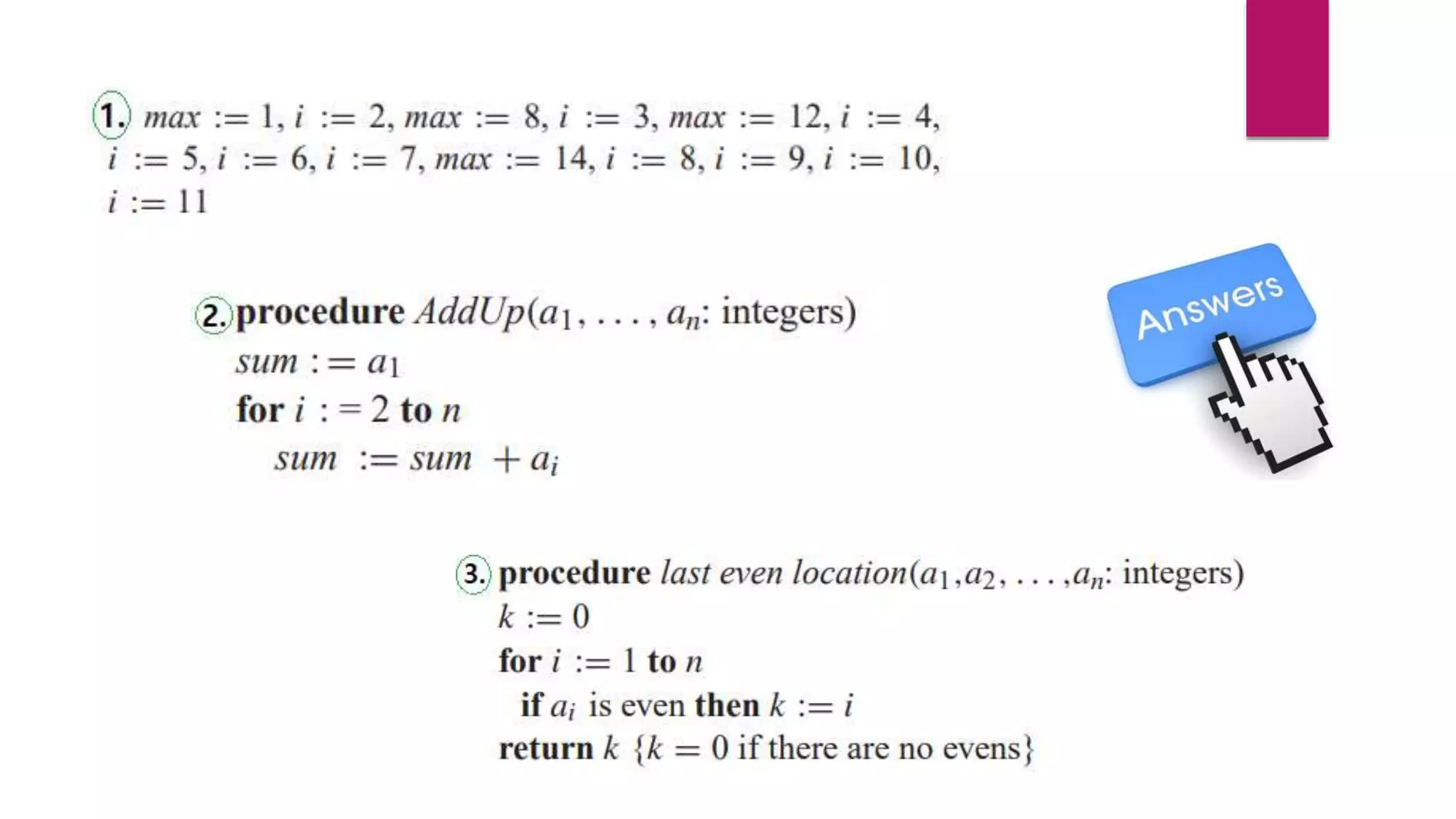
1. List all the steps used by Algorithm 1 (procedure max) to find the maximum of the list: 1, 8, 12, 9,
11, 2, 14, 5, 10, 4.
3. Describe an algorithm that takes as input a list of n integers and finds the location of the last even
integer in the list or returns 0 if there are no even integers in the list.
2. Devise an algorithm that finds the sum of all the integers in a list.
Practice
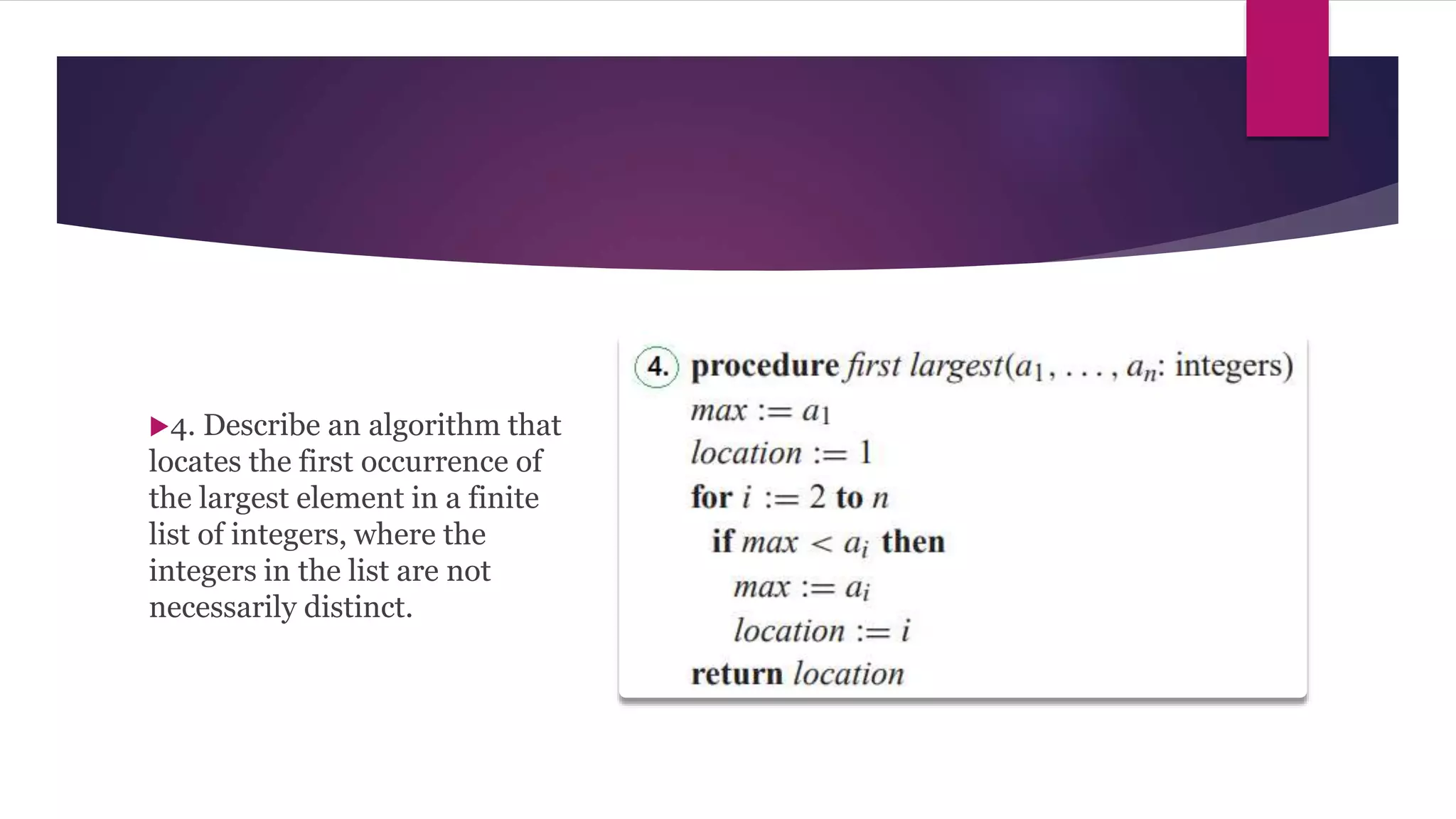
4. Describe an algorithm that
locates the first occurrence of
the largest element in a finite
list of integers, where the
integers in the list are not
necessarily distinct.
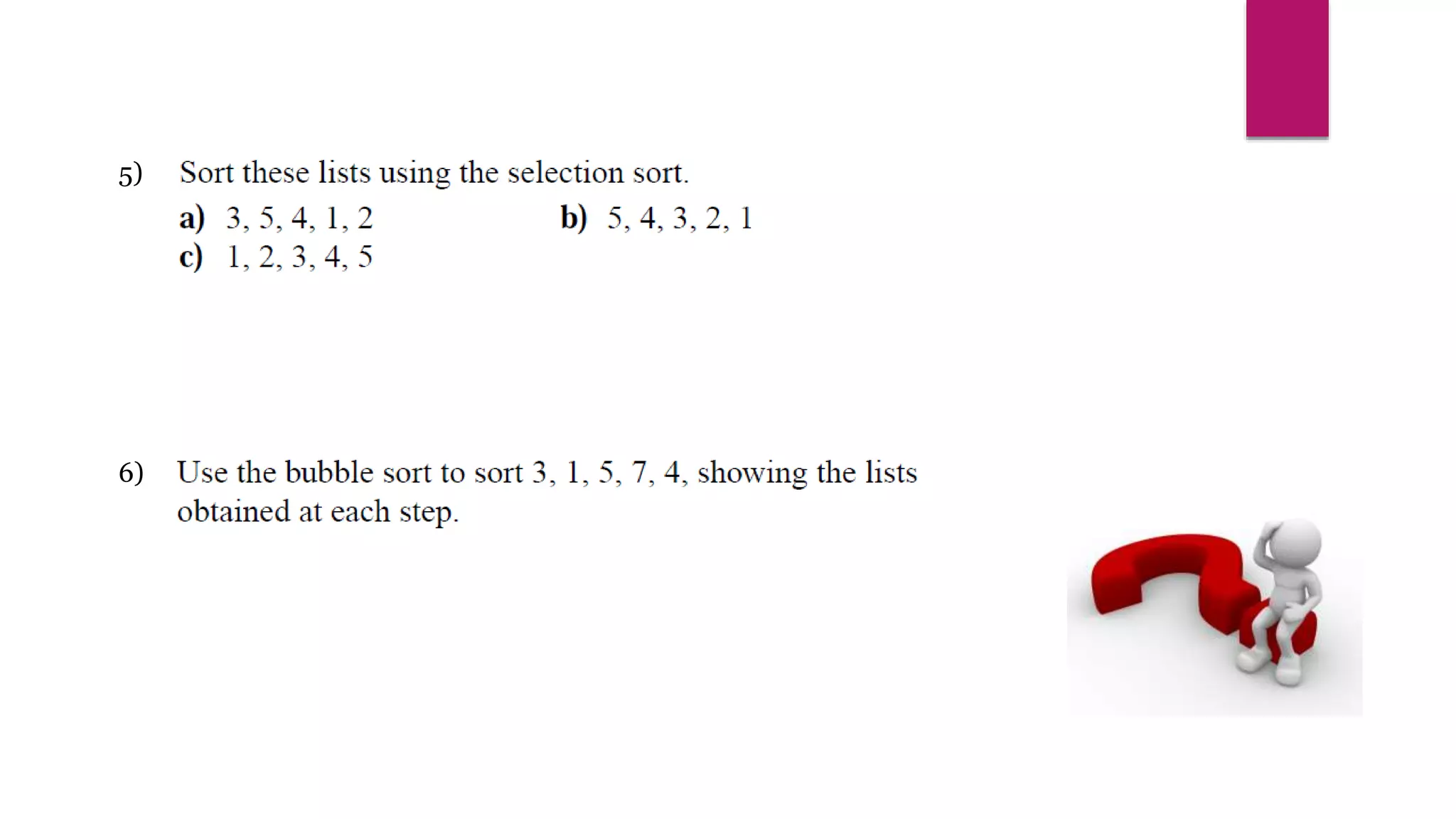
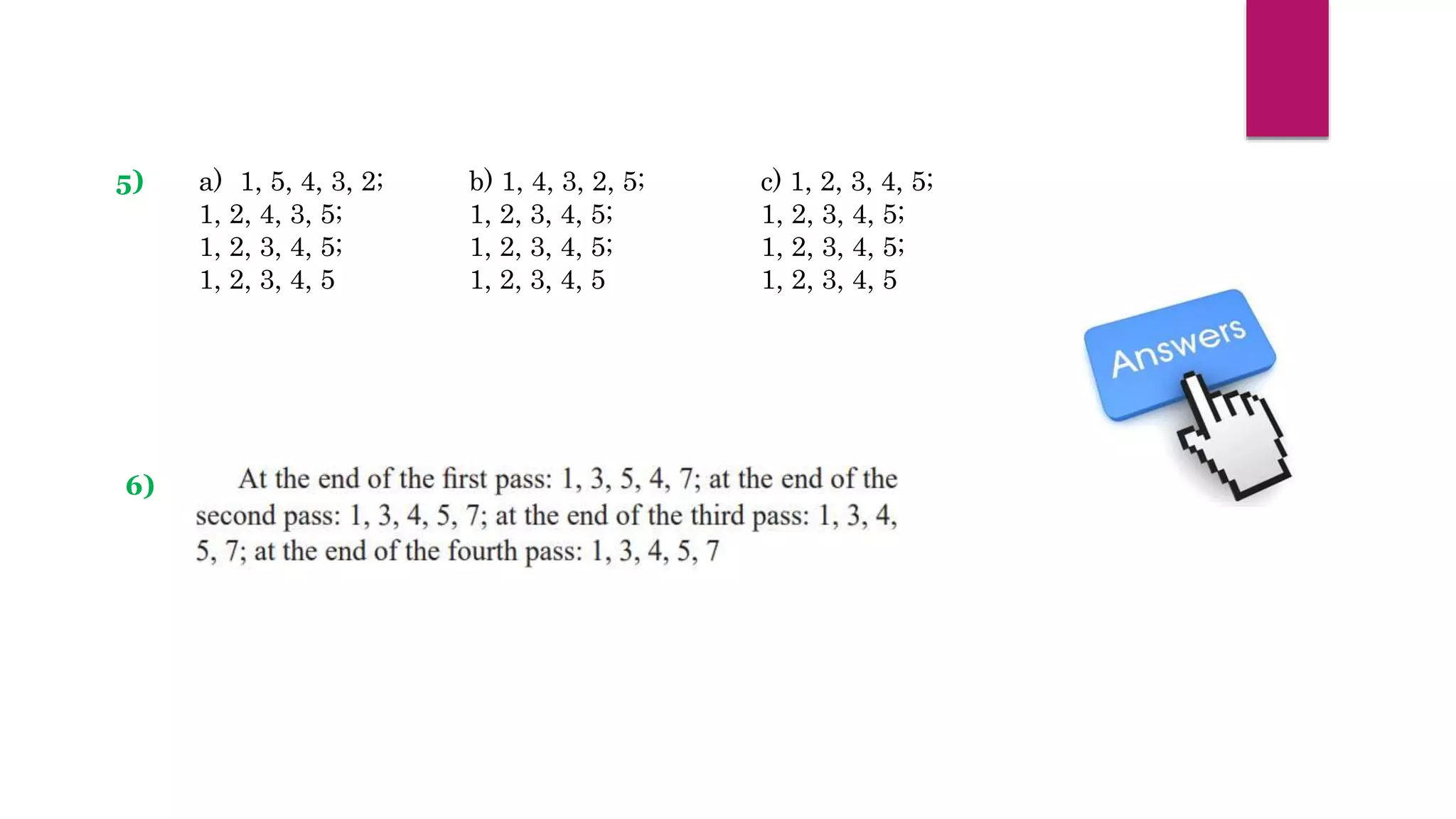
5)
6)
a) 1, 5, 4, 3, 2;
1, 2, 4, 3, 5;
1, 2, 3, 4, 5;
1, 2, 3, 4, 5
b) 1, 4, 3, 2, 5;
1, 2, 3, 4, 5;
1, 2, 3, 4, 5;
1, 2, 3, 4, 5
c) 1, 2, 3, 4, 5;
1, 2, 3, 4, 5;
1, 2, 3, 4, 5;
1, 2, 3, 4, 5
6)
5)
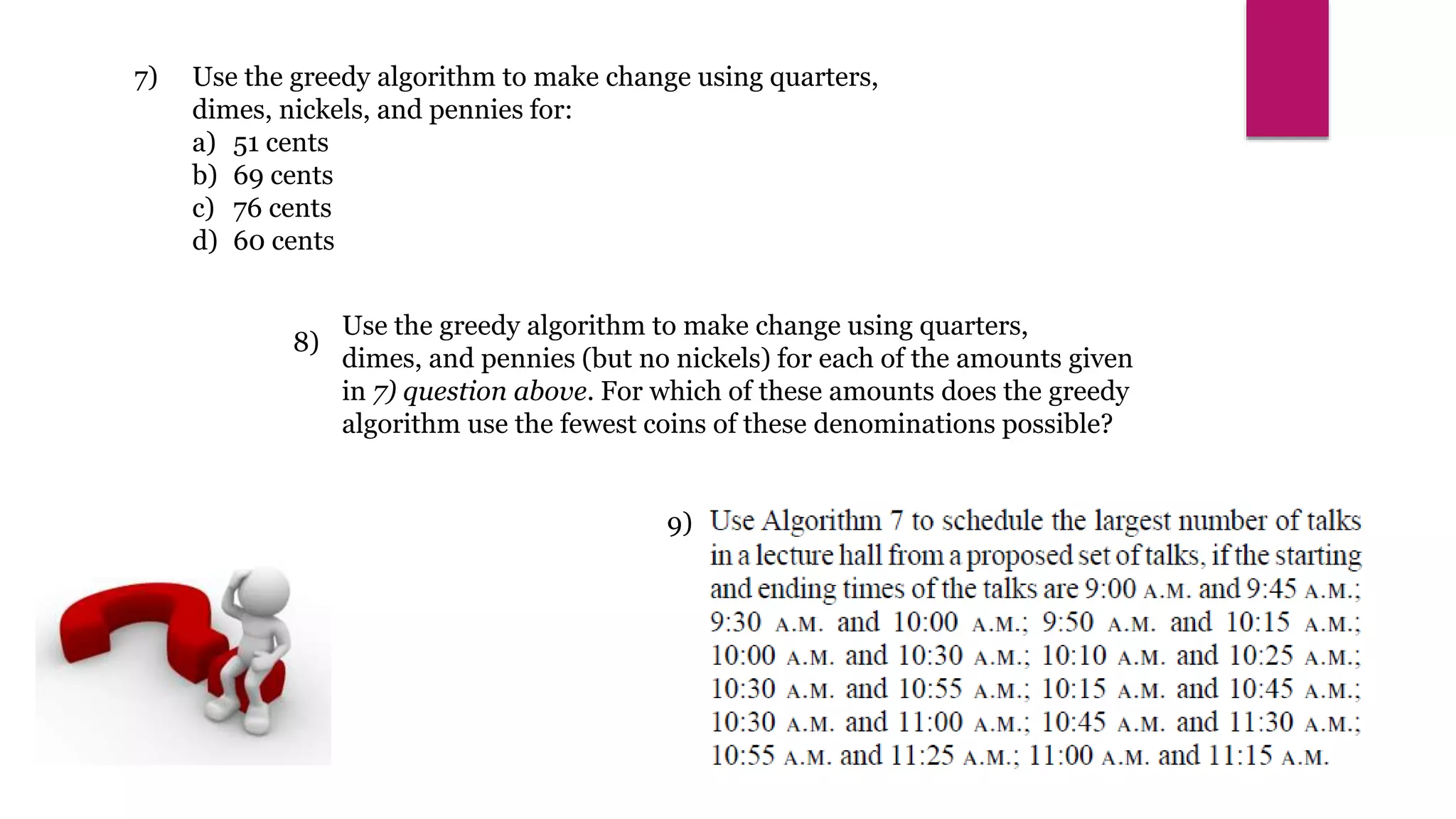
7)
8)
9)
Use the greedy algorithm to make change using quarters,
dimes, and pennies (but no nickels) for each of the amounts given
in 7) question above. For which of these amounts does the greedy
algorithm use the fewest coins of these denominations possible?
Use the greedy algorithm to make change using quarters,
dimes, nickels, and pennies for:
a) 51 cents
b) 69 cents
c) 76 cents
d) 60 cents
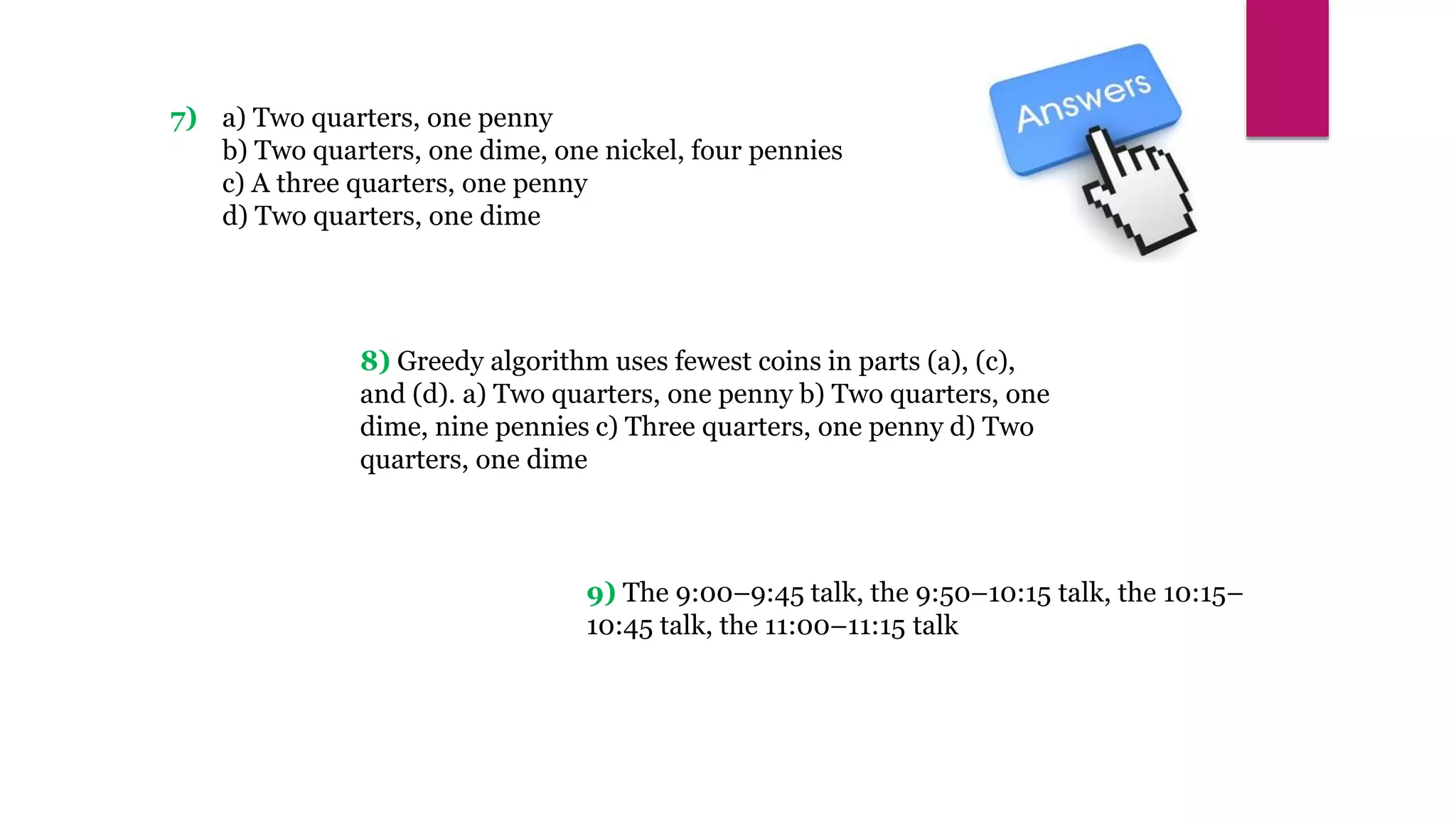
8) Greedy algorithm uses fewest coins in parts (a), (c),
and (d). a) Two quarters, one penny b) Two quarters, one
dime, nine pennies c) Three quarters, one penny d) Two
quarters, one dime
7) a) Two quarters, one penny
b) Two quarters, one dime, one nickel, four pennies
c) A three quarters, one penny
d) Two quarters, one dime
9) The 9:00–9:45 talk, the 9:50–10:15 talk, the 10:15–
10:45 talk, the 11:00–11:15 talk
https://machinelearningmastery.com/tour-of-optimization-algorithms/
https://algorithmsbook.com/optimization/files/optimization.pdf
Links for additional and detailed
information about Optimization
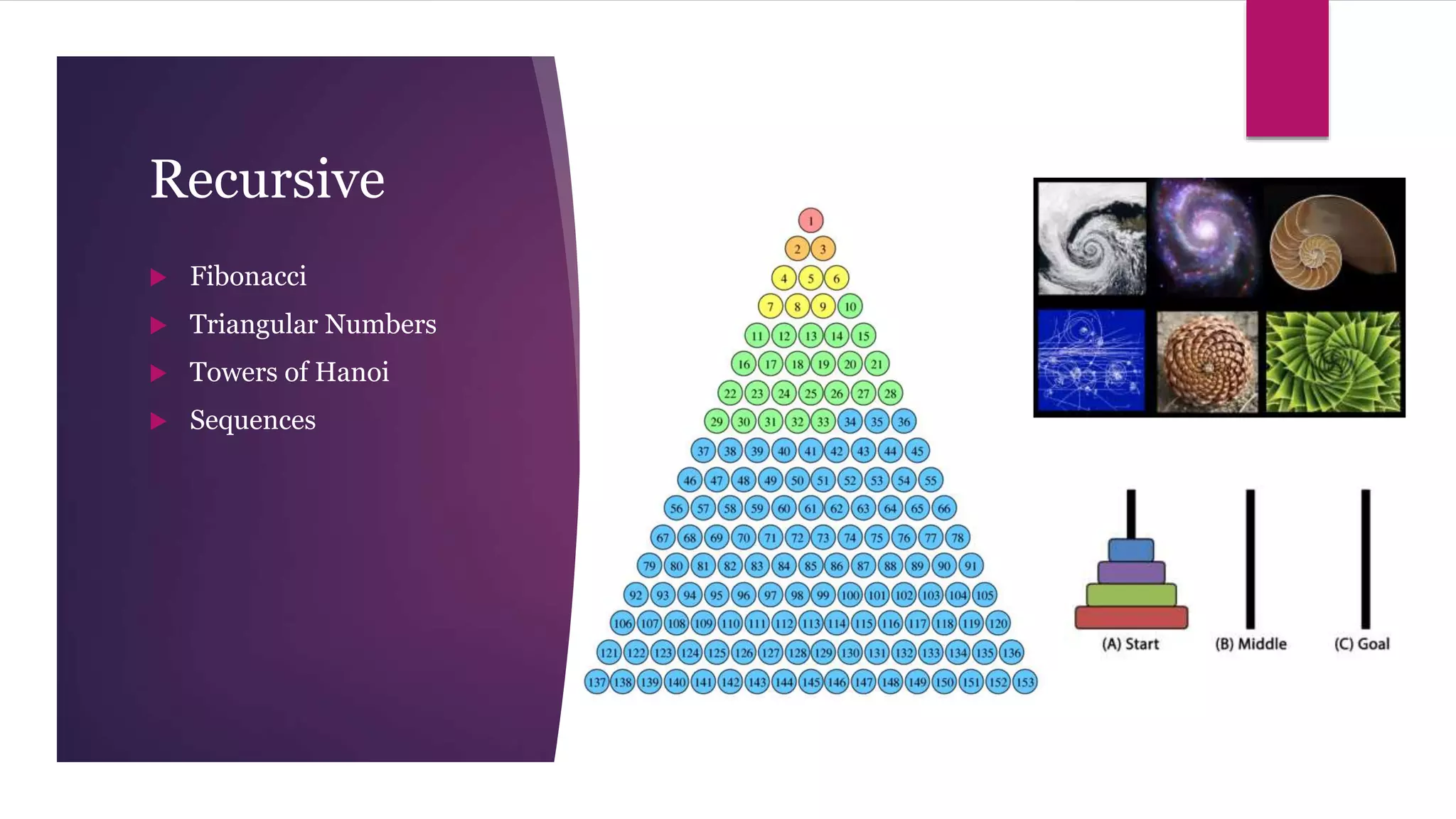
Recursive
 Fibonacci
 Triangular Numbers
 Towers of Hanoi
 Sequences
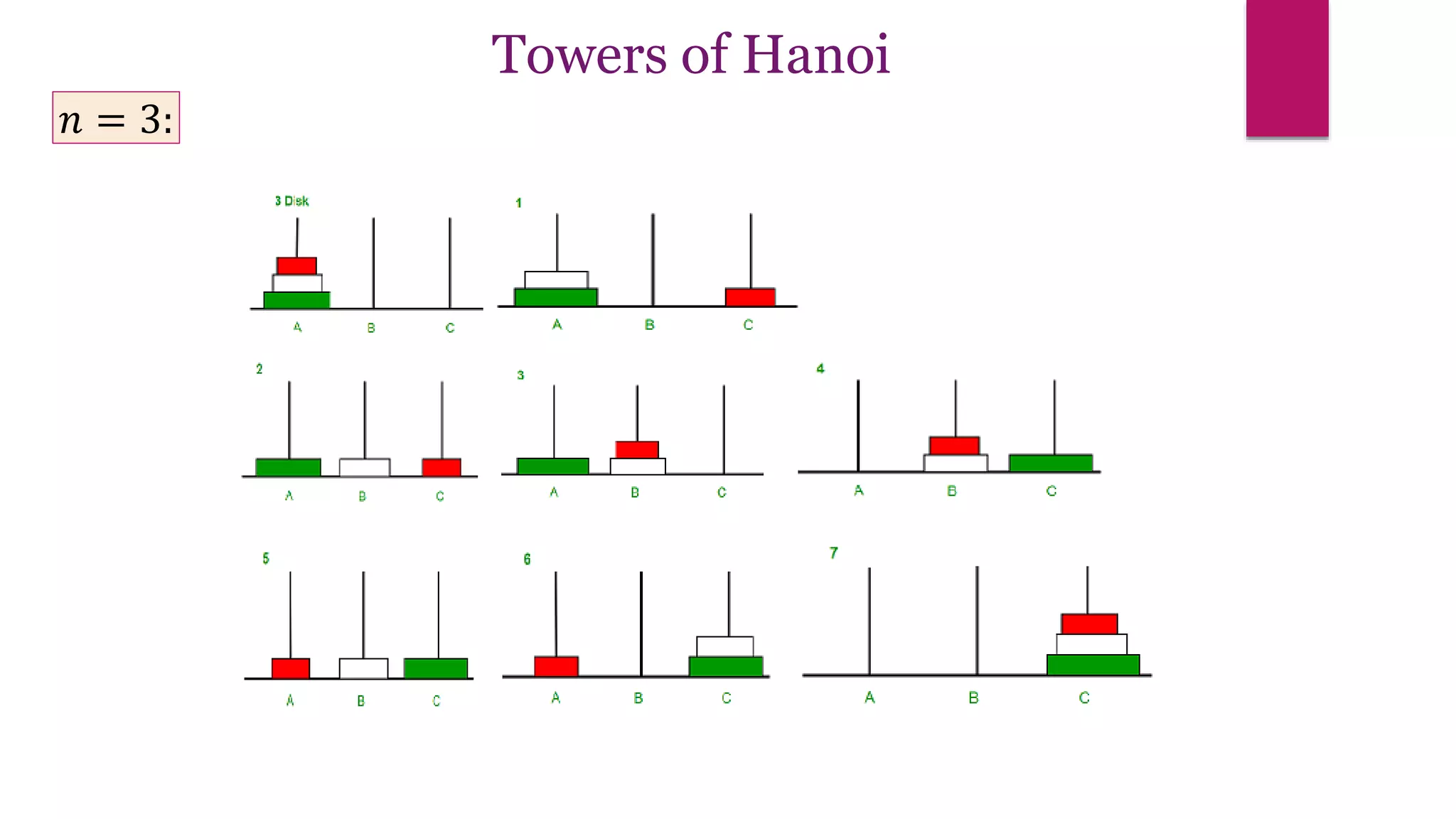
𝑛 = 3:
Towers of Hanoi
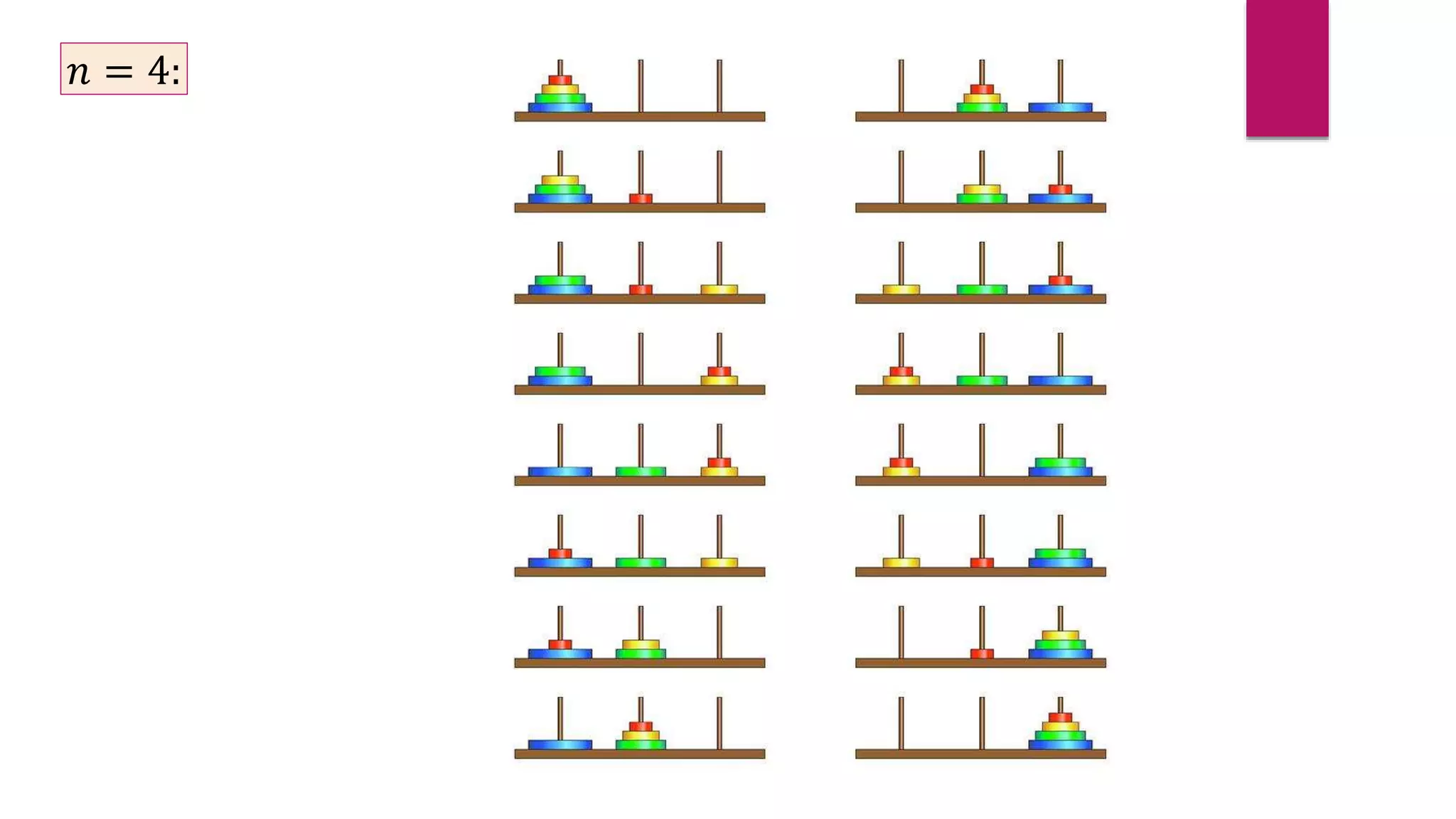
𝑛 = 4:
Towers of Hanoi
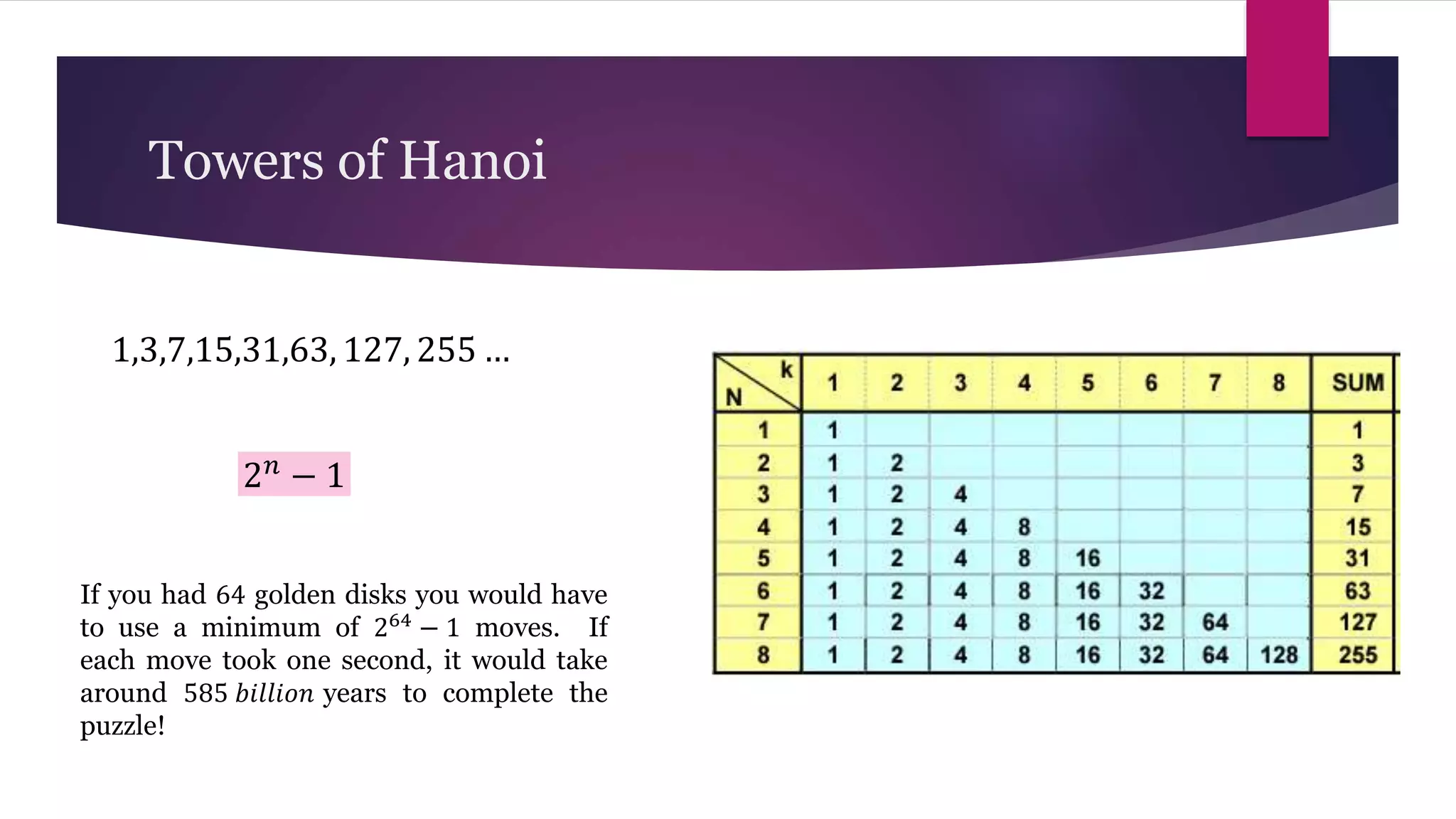
1,3,7,15,31,63, 127, 255 …
2𝑛 − 1
If you had 64 golden disks you would have
to use a minimum of 264 − 1 moves. If
each move took one second, it would take
around 585 𝑏𝑖𝑙𝑙𝑖𝑜𝑛 years to complete the
puzzle!
Towers of Hanoi animations
https://www.mathsisfun.com/games/towerofhanoi.html
Play and make sure you get minimum moves for certain number of discs:
http://towersofhanoi.info/Animate.aspx
You can check your solutions comparing with this one:
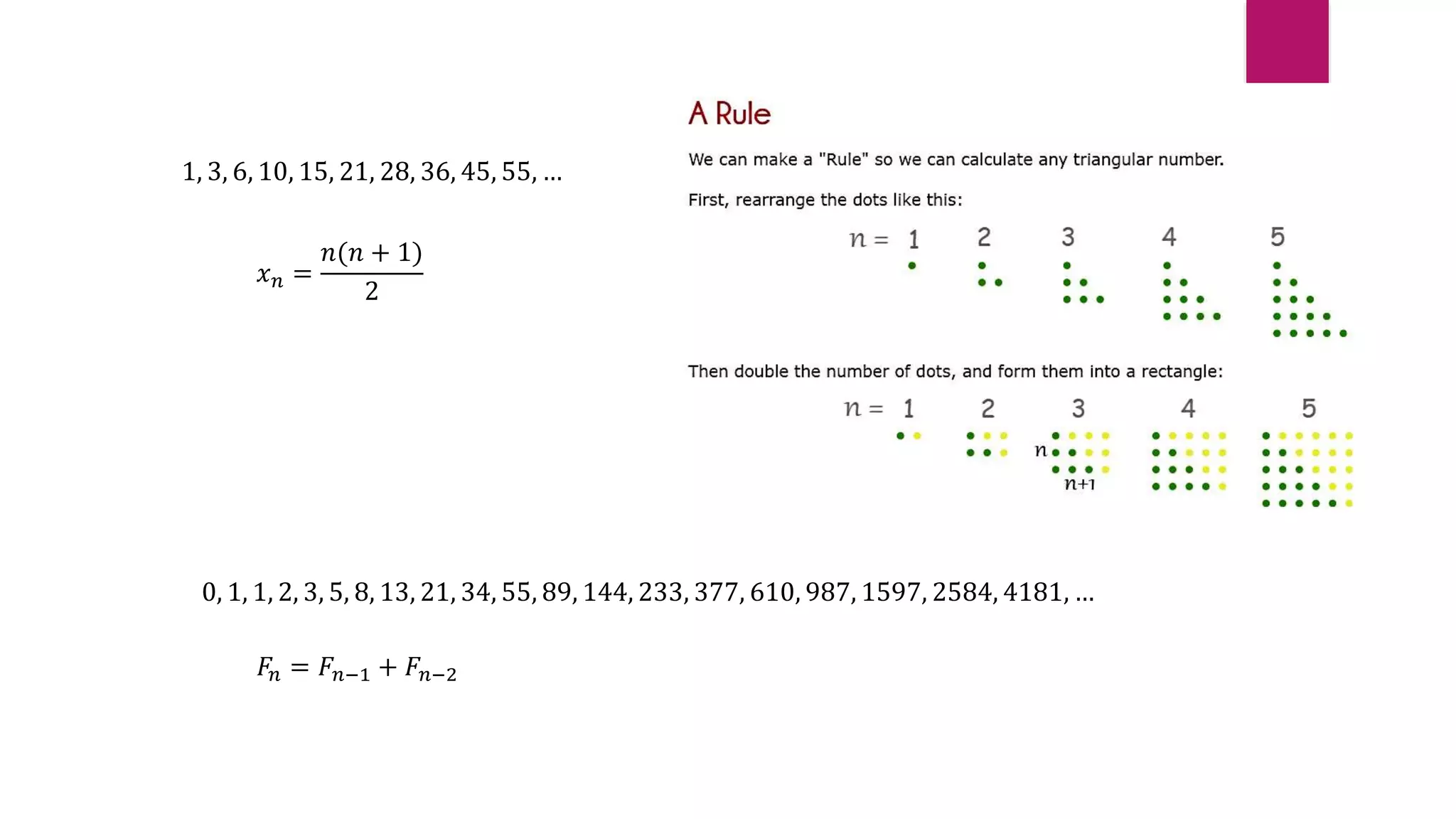
1, 3, 6, 10, 15, 21, 28, 36, 45, 55, …
𝑥𝑛 =
𝑛(𝑛 + 1)
2
0, 1, 1, 2, 3, 5, 8, 13, 21, 34, 55, 89, 144, 233, 377, 610, 987, 1597, 2584, 4181, …
𝐹𝑛 = 𝐹𝑛−1 + 𝐹𝑛−2
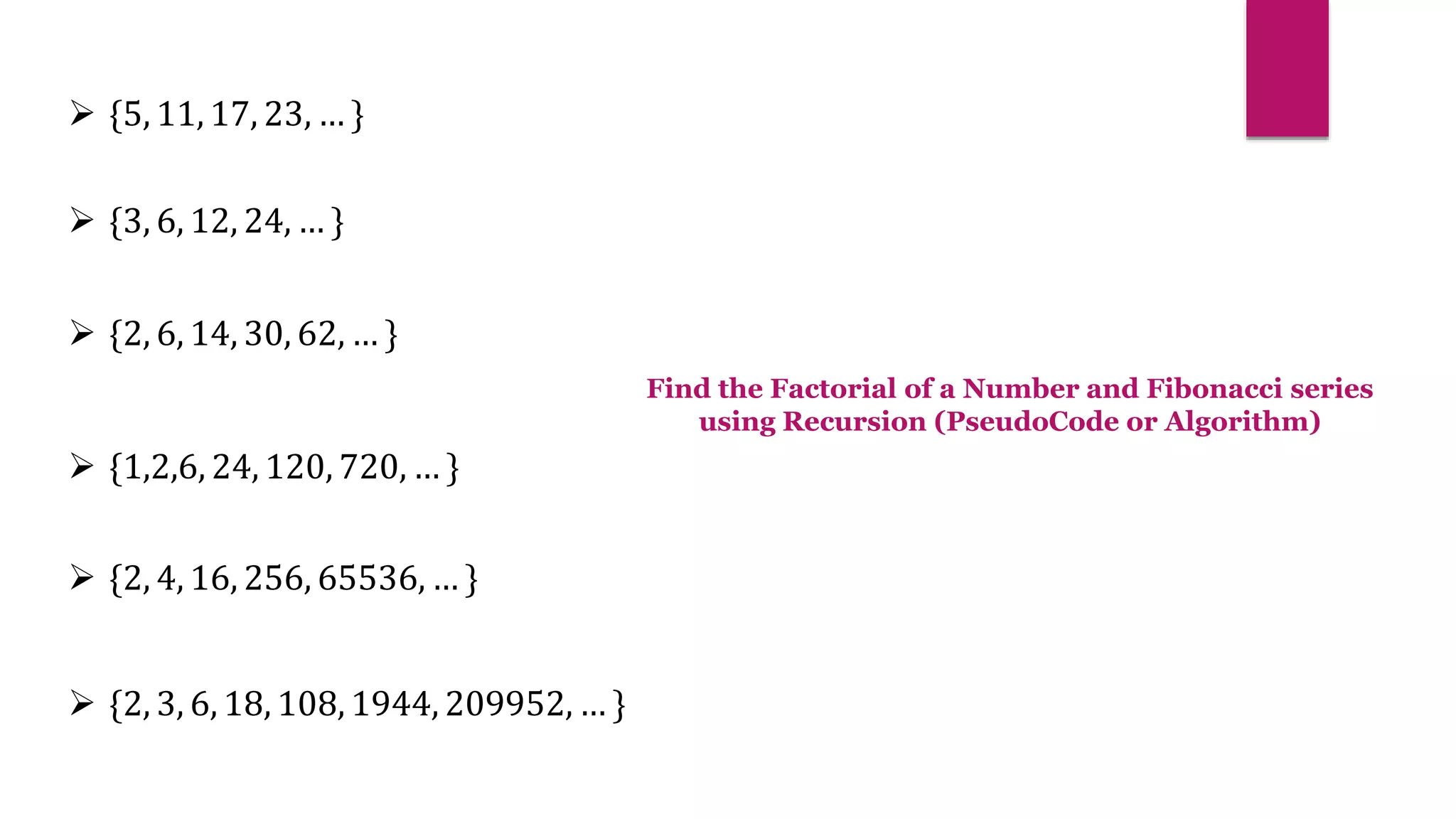
 {3, 6, 12, 24, … }
 {2, 6, 14, 30, 62, … }
 {1,2,6, 24, 120, 720, … }
 {2, 4, 16, 256, 65536, … }
 {2, 3, 6, 18, 108, 1944, 209952, … }
 {5, 11, 17, 23, … }
Find the Factorial of a Number and Fibonacci series
using Recursion (PseudoCode or Algorithm)
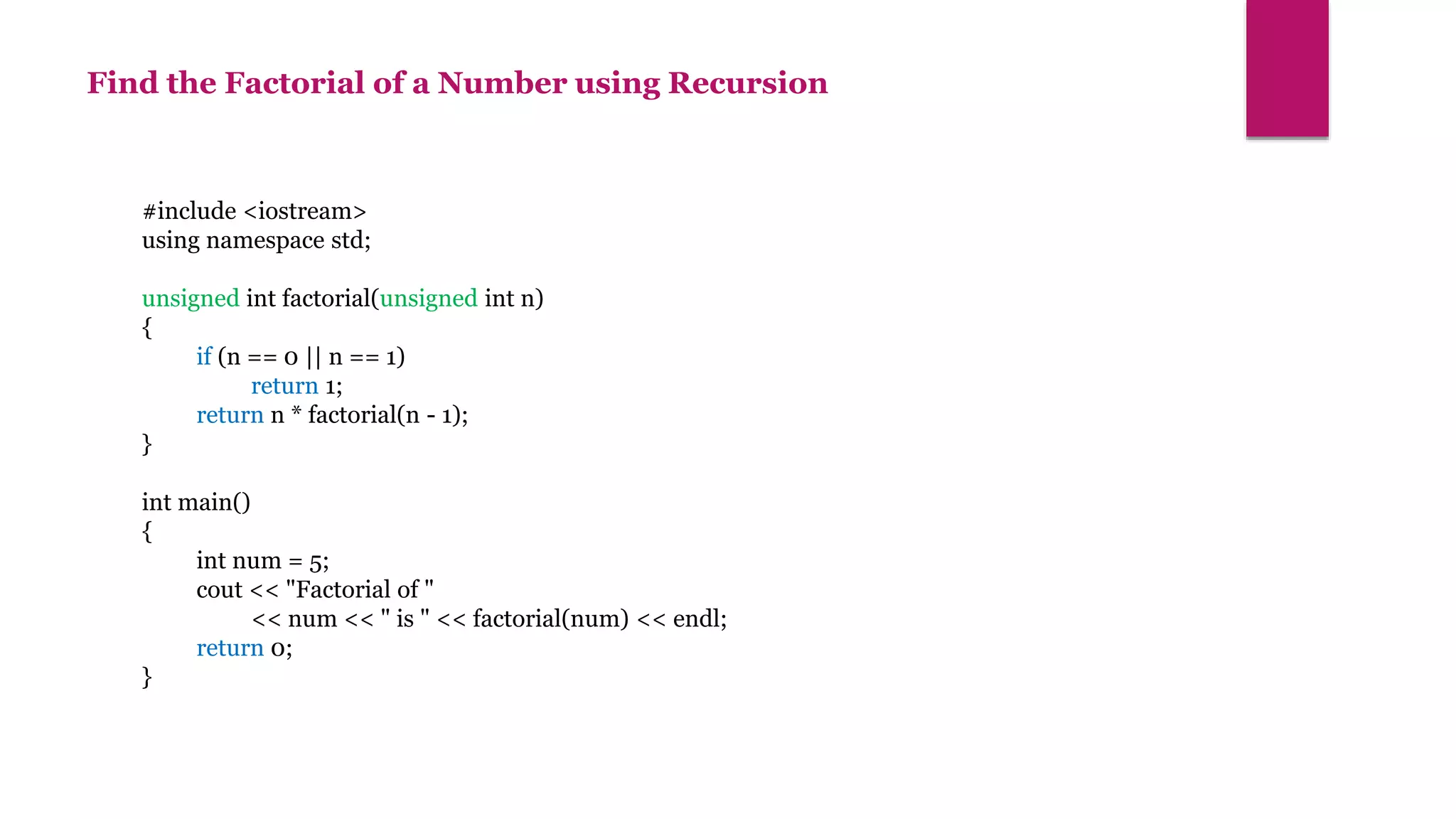
Find the Factorial of a Number using Recursion
#include <iostream>
using namespace std;
unsigned int factorial(unsigned int n)
{
if (n == 0 || n == 1)
return 1;
return n * factorial(n - 1);
}
int main()
{
int num = 5;
cout << "Factorial of "
<< num << " is " << factorial(num) << endl;
return 0;
}
// Fibonacci Series using Recursion
#include <iostream>
using namespace std;
int fib(int n)
{
if (n <= 1)
return n;
return fib(n - 1) + fib(n - 2);
}
int main()
{
int n = 9;
cout << fib(n);
return 0;
}
#include<iostream>
using namespace std;
class GFG{
public:
int fib(int n)
{
int f[n + 2];
int i;
f[0] = 0;
f[1] = 1;
for(i = 2; i <= n; i++)
{
f[i] = f[i - 1] + f[i - 2];
}
return f[n];
}
};
int main ()
{
GFG g;
int n = 4;
cout << g.fib(n);
return 0;
}
// Fibonacci Series using Space Optimized Method
#include<bits/stdc++.h>
using namespace std;
int fib(int n)
{
int a = 0, b = 1, c, i;
if( n == 0)
return a;
for(i = 2; i <= n; i++)
{
c = a + b;
a = b;
b = c;
}
return b;
}
int main()
{
int n = 9;
cout << fib(n);
return 0;
}
Big-O Notation
Big-O Notation
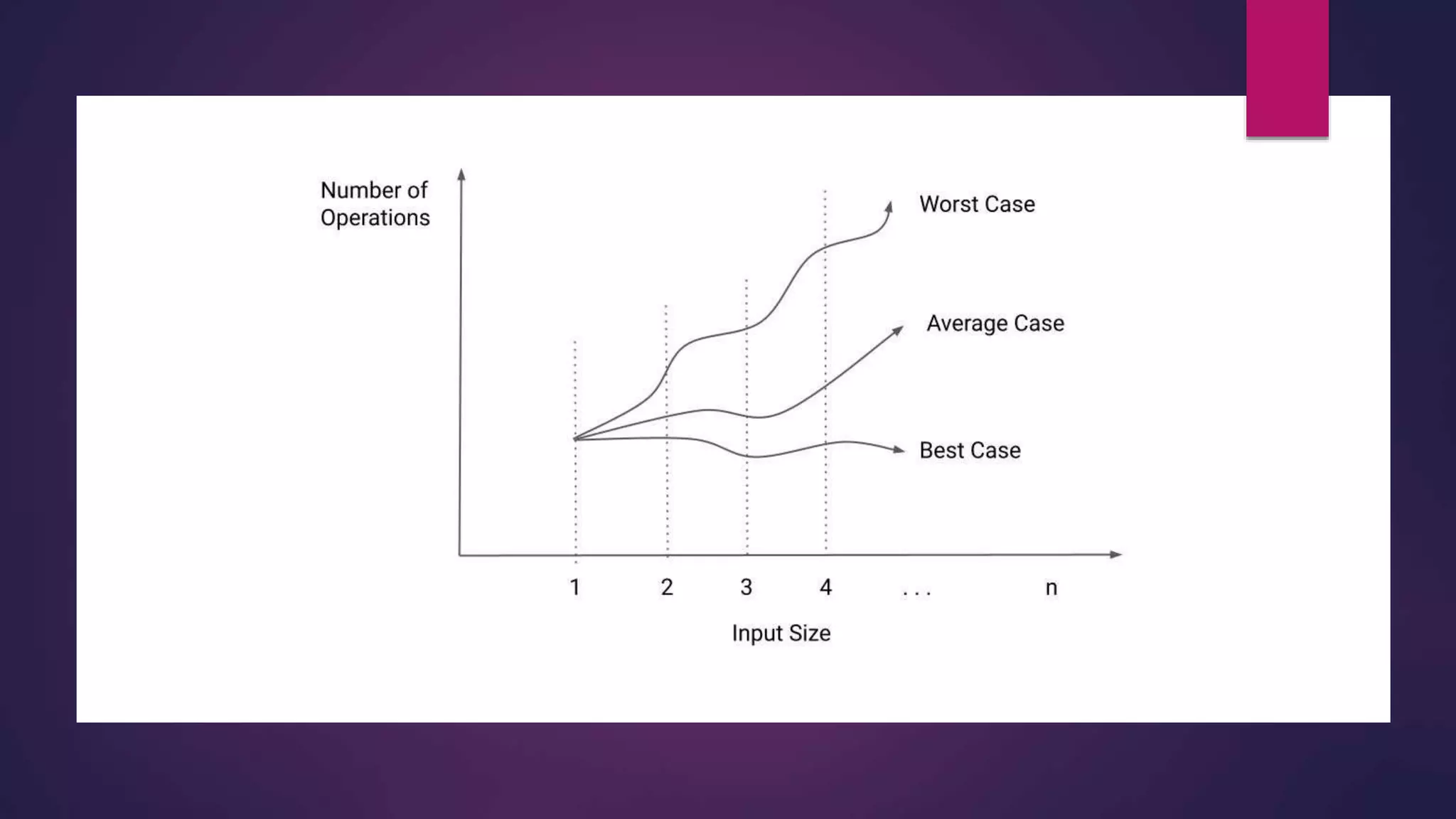
In the time complexity analysis, we define the time as a function of the problem size
and try to estimate the growth of the execution time with the growth in problem size.
Time Complexity
The space require by the program to save input data and results in memory (RAM).
Memory Space
Big-O Notation
Big O notation (with a capital letter O, not a zero), also called Landau’s symbol, is a
symbolism used in complexity theory, computer science, and mathematics to describe the
basic behavior of functions. Basically, it tells you how fast a function grows or declines.
Landau’s symbol comes from the name of the German mathematician Edmund Landau
who invented the notation.
The letter O is used because the rate of growth of a function is also called its order.
History
Big-O Notation
 Efficiency of an Algorithm.
 Time Factor of an Algorithm.
 Space Complexity of an Algorithm.
It is represented by 𝑂(𝑛), where 𝑛 is the number of operations.
It Describes:
Big-O Notation
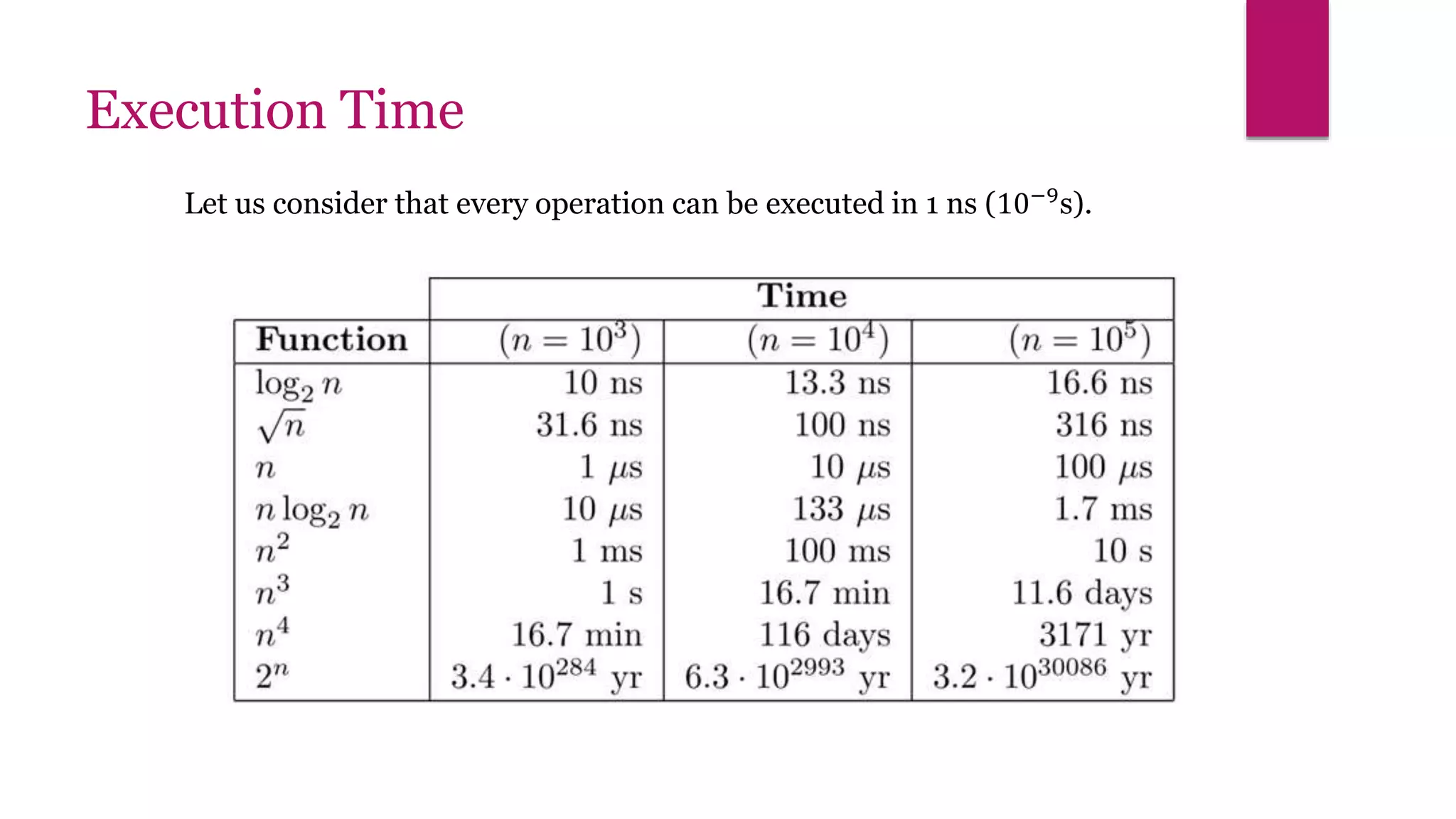
Let us consider that every operation can be executed in 1 ns (10−9s).
Execution Time
Big-O Notation
 https://www.youtube.com/watch?v=__vX2sjlpXU
Big-O Notation
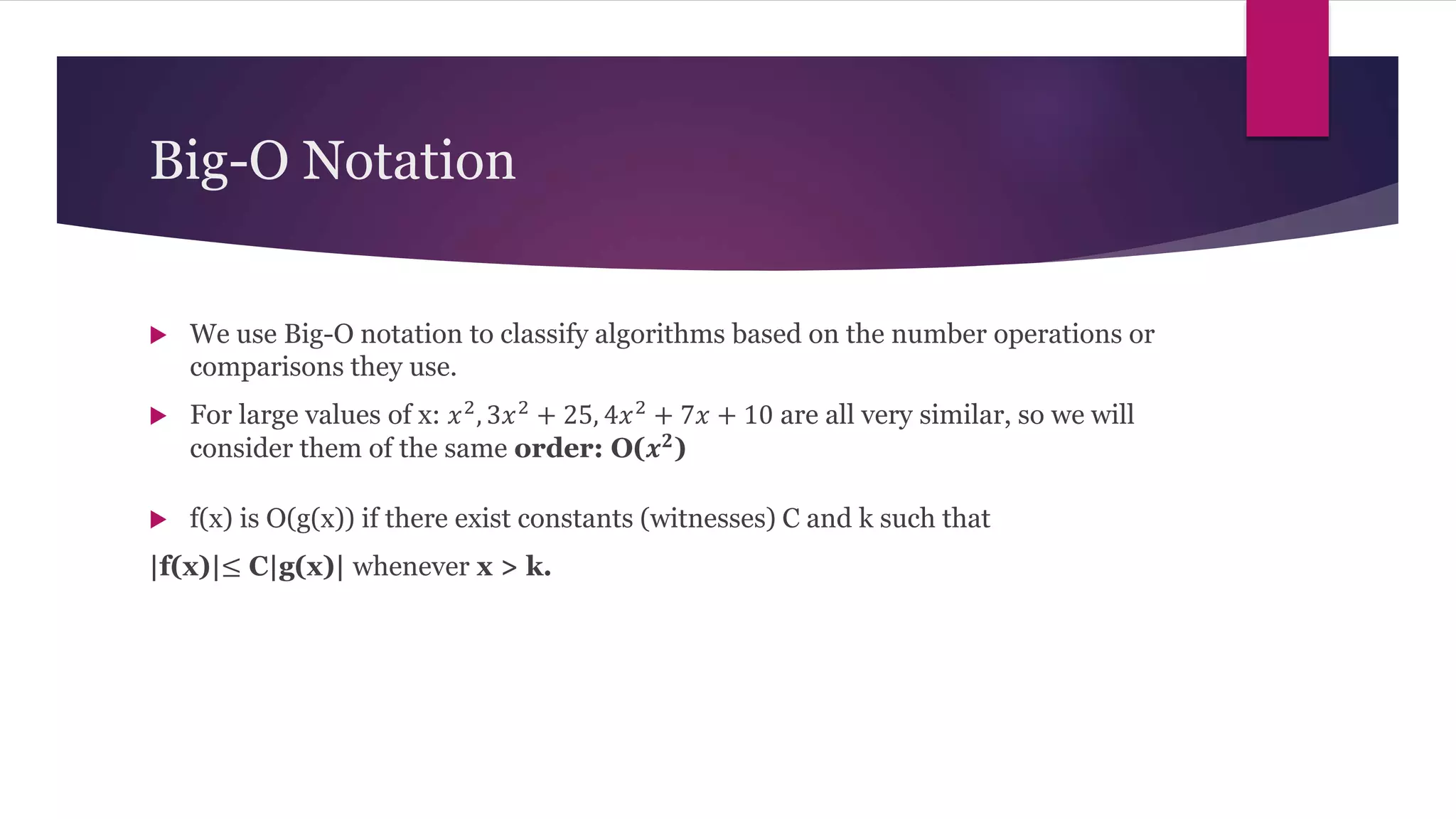
 We use Big-O notation to classify algorithms based on the number operations or
comparisons they use.
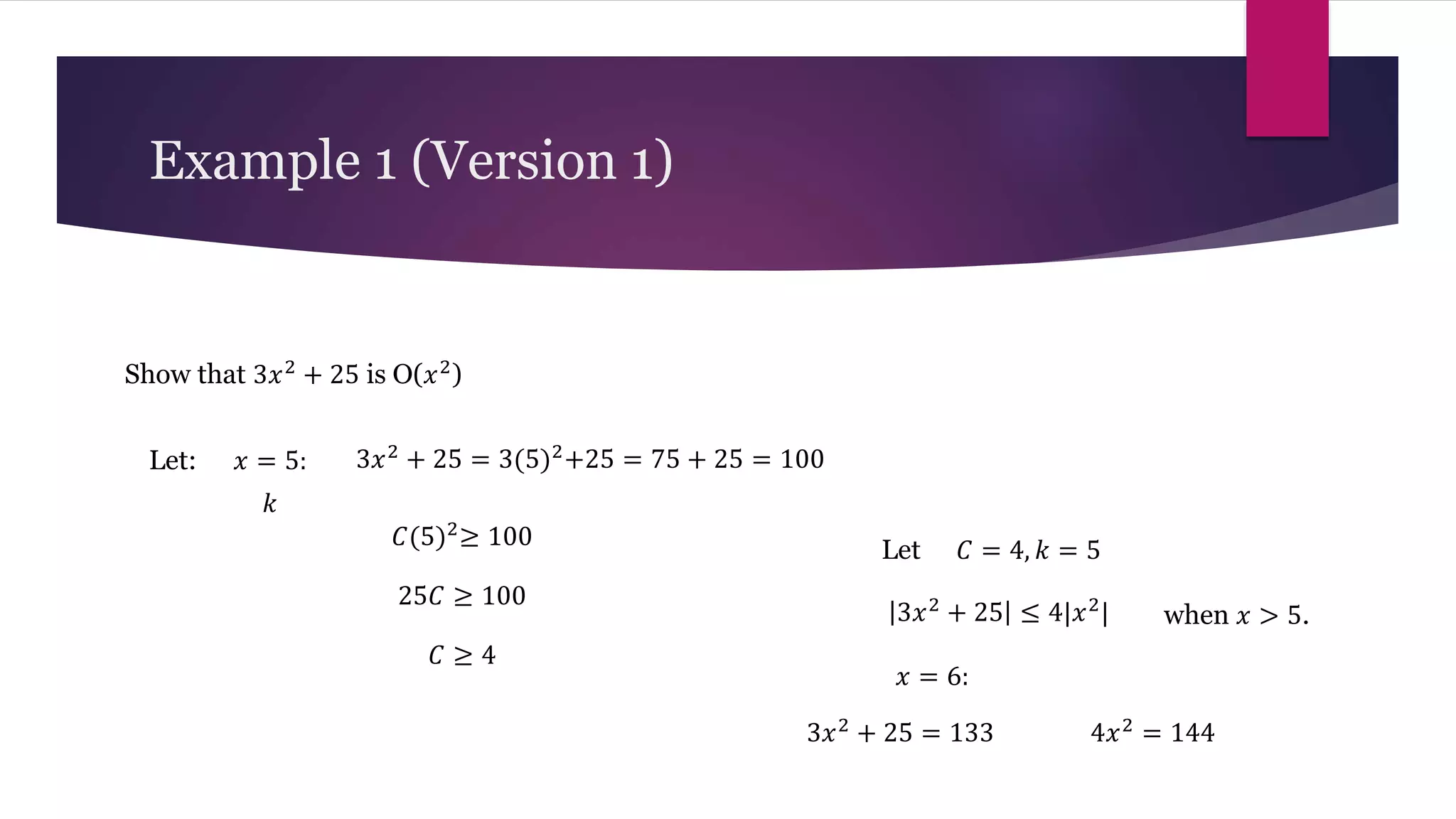
 For large values of x: 𝑥2, 3𝑥2 + 25, 4𝑥2 + 7𝑥 + 10 are all very similar, so we will
consider them of the same order: O(𝒙𝟐)
 f(x) is O(g(x)) if there exist constants (witnesses) C and k such that
|f(x)|≤ C|g(x)| whenever x > k.
Example 1 (Version 1)
Show that 3𝑥2 + 25 is O(𝑥2)
𝑥 = 5:
Let: 3𝑥2 + 25 = 3(5)2+25 = 75 + 25 = 100
𝐶(5)2≥ 100
25𝐶 ≥ 100
𝐶 ≥ 4
𝑘
Let 𝐶 = 4, 𝑘 = 5
3𝑥2 + 25 ≤ 4|𝑥2| when 𝑥 > 5.
𝑥 = 6:
3𝑥2
+ 25 = 133 4𝑥2
= 144
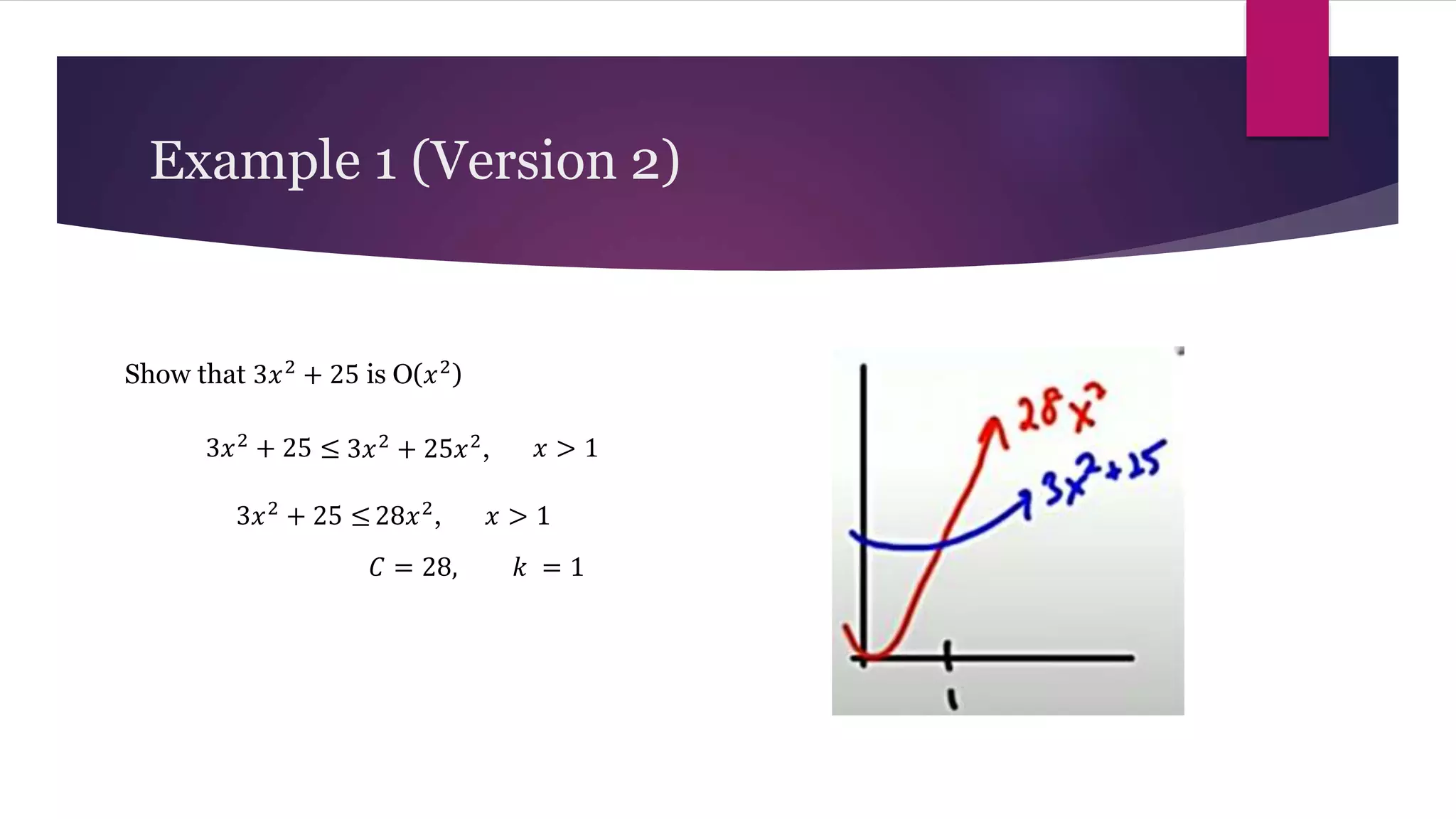
Example 1 (Version 2)
Show that 3𝑥2 + 25 is O(𝑥2)
3𝑥2
+ 25𝑥2
,
3𝑥2 + 25 ≤ 𝑥 > 1
28𝑥2
,
3𝑥2
+ 25 ≤ 𝑥 > 1
𝐶 = 28, 𝑘 = 1
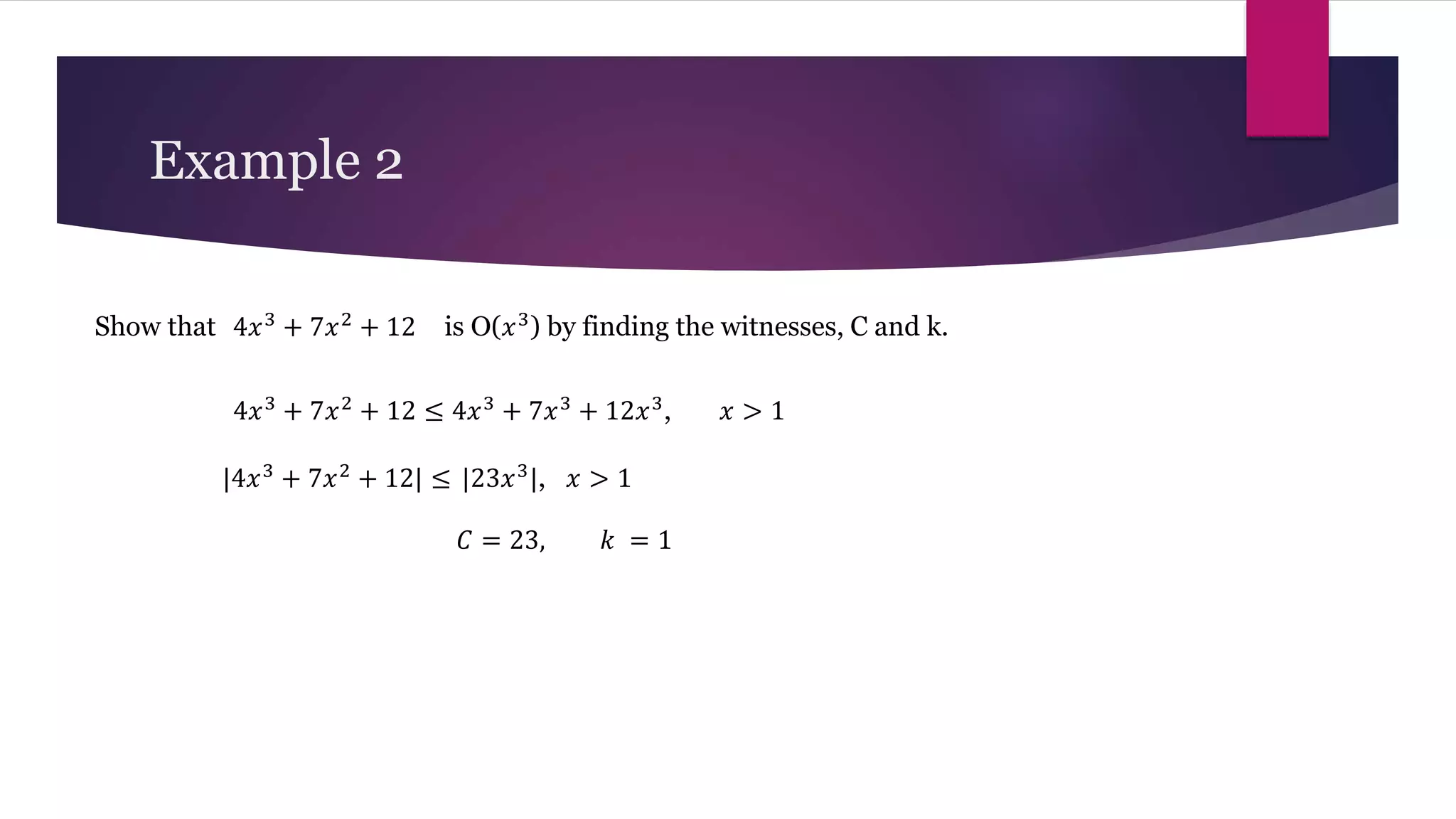
Example 2
4𝑥3
+ 7𝑥2
+ 12
Show that is O(𝑥3) by finding the witnesses, C and k.
4𝑥3
+ 7𝑥2
+ 12 ≤ 4𝑥3
+ 7𝑥3
+ 12𝑥3
, 𝑥 > 1
|4𝑥3
+ 7𝑥2
+ 12| ≤ |23𝑥3
|, 𝑥 > 1
𝐶 = 23, 𝑘 = 1
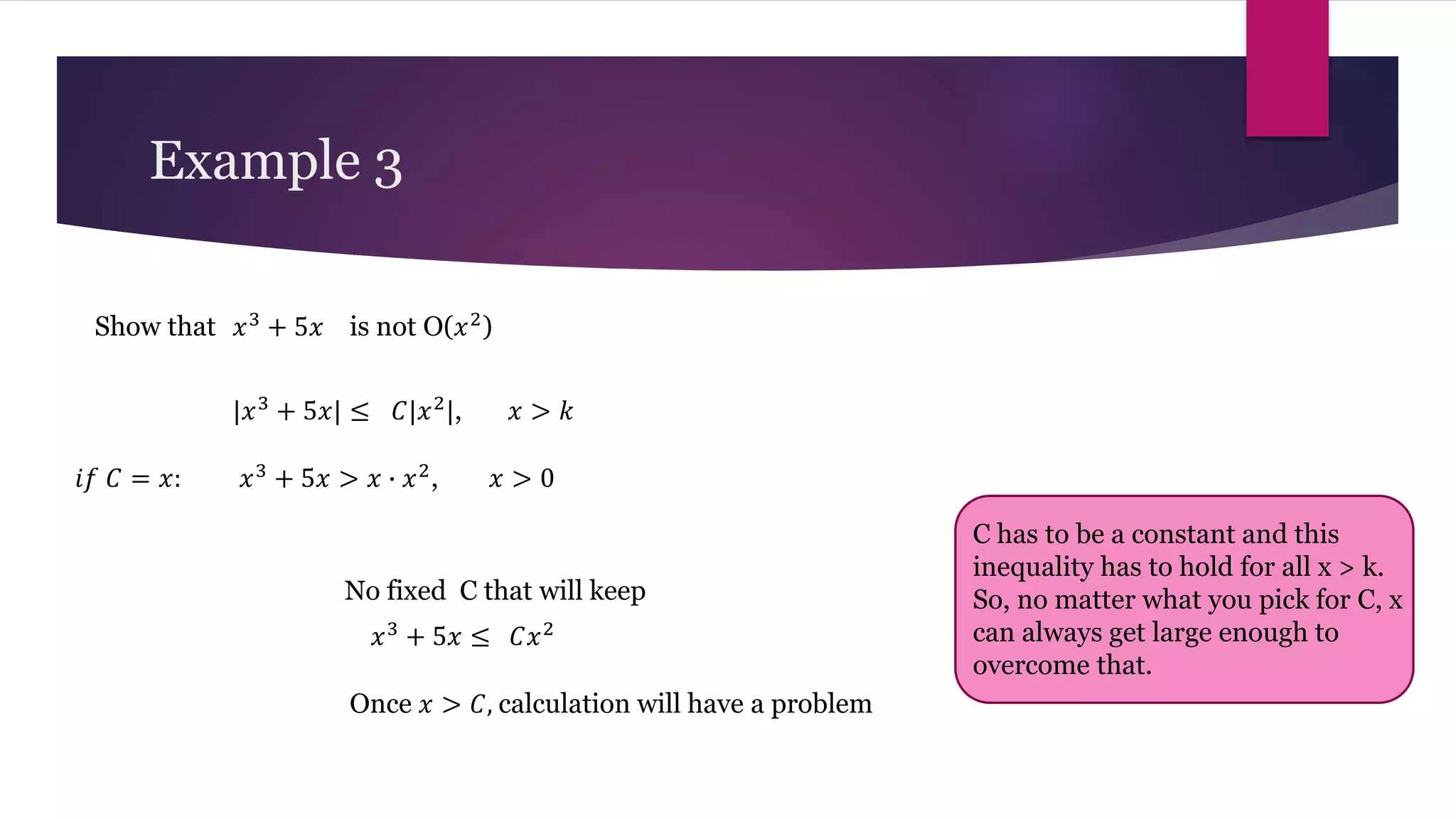
Example 3
𝑥3
+ 5𝑥
Show that is not O(𝑥2)
|𝑥3
+ 5𝑥| ≤ 𝐶|𝑥2
|, 𝑥 > 𝑘
𝑥3
+ 5𝑥 > 𝑥 ∙ 𝑥2
, 𝑥 > 0
𝑖𝑓 𝐶 = 𝑥:
No fixed C that will keep
𝑥3
+ 5𝑥 ≤ 𝐶𝑥2
Once 𝑥 > 𝐶, calculation will have a problem
C has to be a constant and this
inequality has to hold for all x > k.
So, no matter what you pick for C, x
can always get large enough to
overcome that.
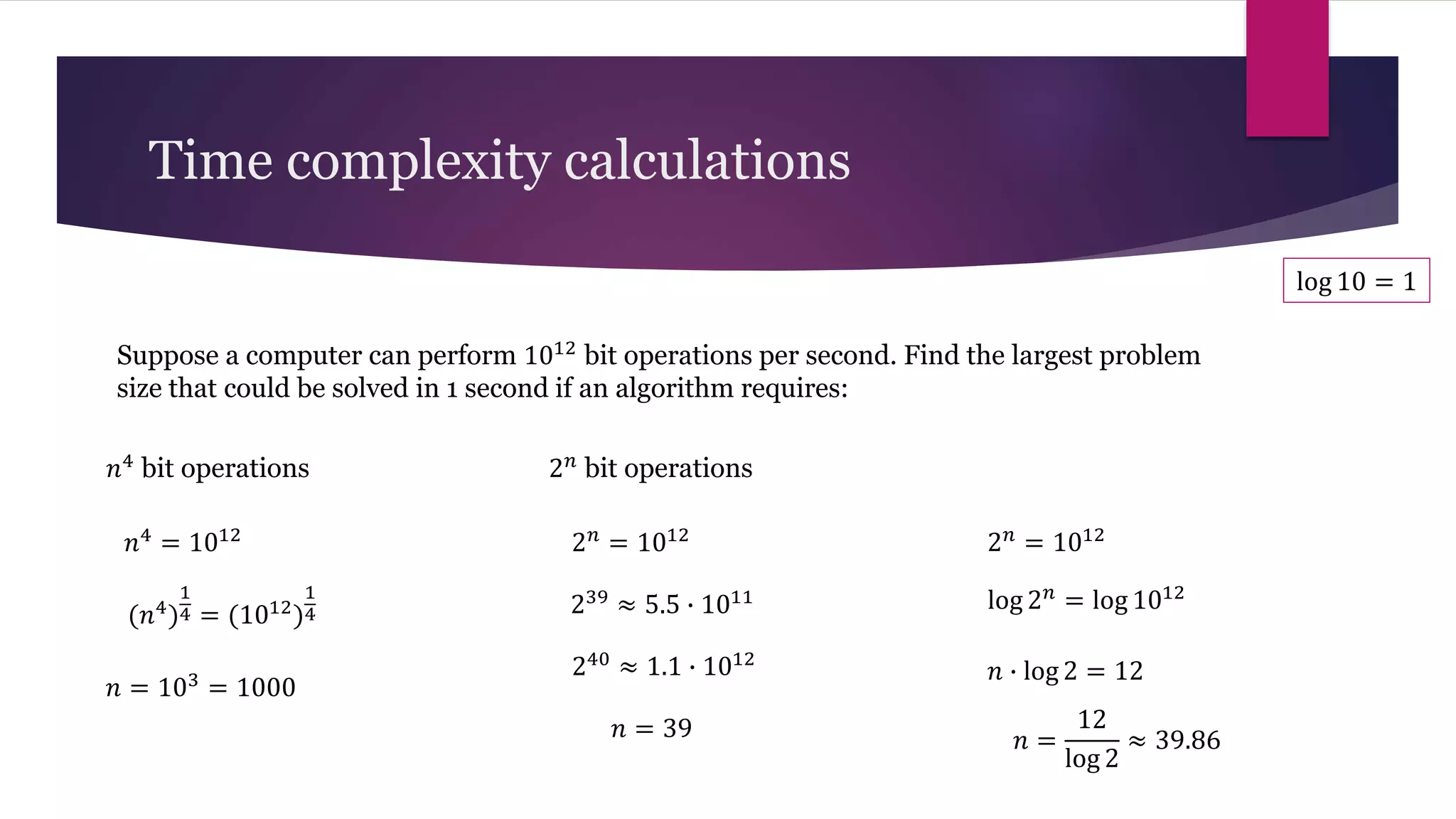
Suppose a computer can perform 1012 bit operations per second. Find the largest problem
size that could be solved in 1 second if an algorithm requires:
Time complexity calculations
𝑛4 bit operations 2𝑛 bit operations
𝑛4
= 1012
(𝑛4
)
1
4 = (1012
)
1
4
𝑛 = 103
= 1000
2𝑛
= 1012
239
≈ 5.5 ∙ 1011
240 ≈ 1.1 ∙ 1012
𝑛 = 39
2𝑛
= 1012
log 2𝑛 = log 1012
𝑛 ∙ log 2 = 12
log 10 = 1
𝑛 =
12
log 2
≈ 39.86
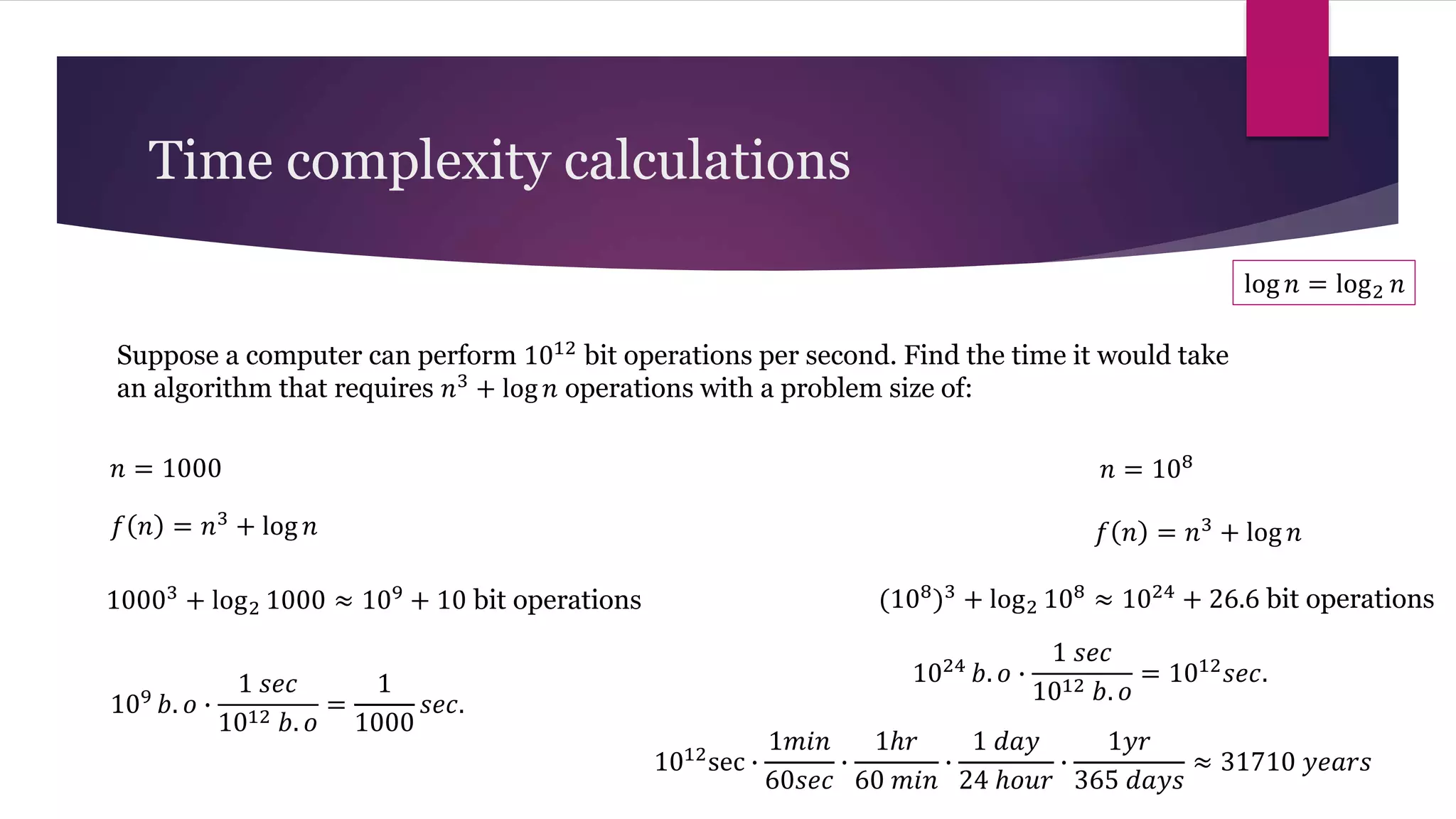
Suppose a computer can perform 1012 bit operations per second. Find the time it would take
an algorithm that requires 𝑛3
+ log 𝑛 operations with a problem size of:
Time complexity calculations
𝑛 = 1000 𝑛 = 108
log 𝑛 = log2 𝑛
𝑓 𝑛 = 𝑛3
+ log 𝑛
10003 + log2 1000 ≈ 109 + 10 bit operations
109 𝑏. 𝑜 ∙
1 𝑠𝑒𝑐
1012 𝑏. 𝑜
=
1
1000
𝑠𝑒𝑐.
𝑓 𝑛 = 𝑛3
+ log 𝑛
(108)3 + log2 108 ≈ 1024 + 26.6 bit operations
1024 𝑏. 𝑜 ∙
1 𝑠𝑒𝑐
1012 𝑏. 𝑜
= 1012𝑠𝑒𝑐.
1012sec ∙
1𝑚𝑖𝑛
60𝑠𝑒𝑐
∙
1ℎ𝑟
60 𝑚𝑖𝑛
∙
1 𝑑𝑎𝑦
24 ℎ𝑜𝑢𝑟
∙
1𝑦𝑟
365 𝑑𝑎𝑦𝑠
≈ 31710 𝑦𝑒𝑎𝑟𝑠
References
Discrete Mathematics explained in Kurdish:
 https://www.youtube.com/watch?v=A4dq1r
VwcF4&list=PLxIvc-
MGOs6gZlMVYOOEtUHJmfUquCjwz&index
=17
Discrete Mathematics and its Applications by
Kenneth H.Rosen, Chapter 3, page 191:
 https://www.houstonisd.org/cms/lib2/TX01
001591/Centricity/Domain/26781/Discrete
Mathematics.pdf
https://www.enjoyalgorithms.com/blog/time
-complexity-analysis-in-data-structure-and-
algorithms

Lecture-1-Algorithms.pptx

  • 1.
  • 2.
    Objectives  Algorithms  Flowcharts Types of Algorithms:  Searching (Linear, Binary)  Sorting (Bubble, Insertion)  Optimization (Greedy, Whale Optimization Algorithms (WOA))  Recursive  Big-O Notation
  • 3.
    Algorithm  An algorithmis a finite sequence of precise instructions for performing a computation or for solving a problem.
  • 4.
    https://app.diagrams.net/ https://www.lucidchart.com/pages/what-is-a-flowchart-tutorial Flowchart A flowchart isa diagram that depicts a process, system or computer algorithm. They are widely used in multiple fields to document, study, plan, improve and communicate often complex processes in clear, easy-to-understand diagrams.
  • 5.
    Flowcharts can:  Demonstratethe way code is organized.  Visualize the execution of code within a program.  Show the structure of a website or application.  Understand how users navigate a website or program.
  • 7.
  • 8.
  • 9.
  • 10.
    Flowchart for theWebsite Login Page
  • 11.
    EXAMPLE 1:  Setthe temporary maximum equal to the first integer in the sequence. (The temporary maximum will be the largest integer examined at any stage of the procedure.)  Compare the next integer in the sequence to the temporary maximum, and if it is larger than the temporary maximum, set the temporary maximum equal to this integer.  Repeat the previous step if there are more integers in the sequence.  Stop when there are no integers left in the sequence. The temporary maximum at this point is the largest integer in the sequence. Describe an algorithm for finding the maximum (largest) value in a finite sequence of integers.
  • 12.
  • 13.
    Input: 𝑎𝑟𝑟[ ]= {10, 324, 45, 90,9808}; 𝑂𝑢𝑡𝑝𝑢𝑡: 9808 Input : 𝑎𝑟𝑟[ ] = {20, 10, 100, 20, 4}; 𝑂𝑢𝑡𝑝𝑢𝑡 ∶ 100 Go through each step of the given algorithm to find the max value in array (show every step).
  • 14.
    Flowchart to finda minimum value
  • 15.
    Create a flowchart,where you have to build a program: sum of n natural numbers.
  • 17.
    Pseudocode (Appendix 3) procedure algorithm name (list ∗ description of input variables)  {comments}  variable : = expression  if condition then statement or block of statements  if condition then statement 1 else statement 2  if condition 1 then statement 1 else if condition 2 then statement 2 else if condition 3 then statement 3 …  for variable := initial value to final value block of statements  while condition statement or block of statements  return output of algorithm
  • 18.
    In computer science, pseudocodeis a plain language description of the steps in an algorithm or another system. Pseudocode often uses structural conventions of a normal programming language but is intended for human reading rather than machine reading.
  • 19.
    Types of AlgorithmProblems Searching Looking through a list to find something that needs a specific characteristic Sorting Sort things from least to greatest or greatest to least or biggest to smallest Optimization Looking for the least or the greatest
  • 20.
    Facial Recognition Facial recognitionis the mechanics behind iPhone logins and Snapchat filters, and it runs on an algorithm. The system works by using a biometrics map to plot facial features from a photo or video. It then takes this information and compares it to a known database of faces to find a match. This is how it can verify identity. When it is just used for Instagram or Snapchat filters, there is no database search. It simply makes a biometric map of the face and applies the filter to it. Recipes Just like sorting papers and even tying your shoes, following a recipe is a type of algorithm. The goal of course being to create a duplicated outcome. In order to complete a recipe, you have to follow a given set of steps. Say you are making bread. You need flour, yeast and water. After you have your ingredients, you need to combine them in a certain way that will create a predictable outcome, in this case a loaf of bread. Sorting Papers, Traffic Signals, Bus Schedules, GPS, Google Search, Facebook, etc.
  • 21.
    Searching Algorithms The goalis to locate an element 𝑥 in the list of distinct elements or determine that it is not in the list. The solution is the location of the term that equals 𝑥 or 0 if 𝑥 is not in the list. Example: Spell check essentially looks through all items in the list, compares it to the dictionary and then the output: it is going to put squiggly little red line under something that is not spelled correctly, or it is not going to do anything if everything is spelled correctly
  • 22.
    Linear Search  Thisalgorithm checks each term in the sequence, in order, with the desired term, 𝑥.  Let 𝑥 = 9 4, 7, 3, 2, 1, 0, 9 𝑎1 𝑎2 𝑎3 𝑎4 𝑎5 𝑎7 𝑎6 Output: 7
  • 23.
    Trace the linearsearch algorithm to look for 12 in the list: 4, 7, 2, 1, 9, 11, 12, 8, 5 𝑥 = 12 𝑎1 𝑎3 𝑎4 𝑎5 𝑎6 𝑎7 𝑎8 𝑎2 𝑎9 𝑖 = 1: 1 ≤ 9? 12 ≠ 4? 𝑖 = 2: 2 ≤ 9? 12 ≠ 7? 𝑖 = 3: 3 ≤ 9? 12 ≠ 2? 𝑖 = 4: 4 ≤ 9? 12 ≠ 1? 𝑖 = 5: 5 ≤ 9? 12 ≠ 9? 𝑖 = 6: 6 ≤ 9? 12 ≠ 11? 𝑖 = 7: 7 ≤ 9? 12 ≠ 12? 7 ≤ 9? 𝑙𝑜𝑐𝑎𝑡𝑖𝑜𝑛 = 7
  • 24.
    Trace the linearsearch algorithm to look for 3 in the list: 4, 7, 2, 1, 9, 11, 12, 8, 5 𝑥 = 3 𝑎1 𝑎3 𝑎4 𝑎5 𝑎6 𝑎7 𝑎8 𝑎2 𝑎9 𝑖 = 1: 1 ≤ 9? 3 ≠ 4? 𝑖 = 2: 2 ≤ 9? 3 ≠ 7? 𝑖 = 3: 3 ≤ 9? 3 ≠ 2? 𝑖 = 4: 4 ≤ 9? 3 ≠ 1? 𝑖 = 5: 5 ≤ 9? 3 ≠ 9? 𝑖 = 6: 6 ≤ 9? 3 ≠ 11? 𝑖 = 7: 7 ≤ 9? 3 ≠ 12? 𝑖 = 8: 8 ≤ 9? 3 ≠ 4? 𝑖 = 9: 9 ≤ 9? 3 ≠ 7? 𝑖 = 10: 10 ≤ 9? 10 ≤ 9? 𝑙𝑜𝑐𝑎𝑡𝑖𝑜𝑛 = 0
  • 25.
    Flowchart for aLinear Search
  • 26.
    22, 11, 5,6, 7, 3, 9, 1 Given a list of array: a) Find the location of 𝑥, where 𝑥 = 3 b) Find the location of 𝑥, where 𝑥 = 10 c) Create a flowchart for a given problem. Using a Linear Search Algorithm
  • 27.
    Binary Search  Ina list of items in increasing order, the binary search algorithm begins by comparing the desired element 𝑥 with the middle value.  The algorithm then chooses the upper or lower half of the data by comparing the desired value with the middle value.  The process continues until a list of size 1 is found.  Let 𝑥 = 9 𝑎1 𝑎2 𝑎3 𝑎4 𝑎5 𝑎7 𝑎6 0, 1, 2, 3, 4, 7, 9 Output: 7 1 + 7 2 = 4 → 𝑎4 3 < 9 → 𝑤𝑜𝑟𝑘𝑠 𝑜𝑛𝑙𝑦 𝑤𝑖𝑡ℎ 𝑡ℎ𝑒 𝑟𝑖𝑔ℎ𝑡 𝑠𝑖𝑑𝑒 𝑜𝑓 𝑡ℎ𝑒 𝑙𝑖𝑠𝑡 5 + 7 2 = 6 → 𝑎6 7 < 9 → 𝑤𝑜𝑟𝑘𝑠 𝑜𝑛𝑙𝑦 𝑤𝑖𝑡ℎ 𝑡ℎ𝑒 𝑟𝑖𝑔ℎ𝑡 𝑠𝑖𝑑𝑒 𝑜𝑓 𝑡ℎ𝑒 𝑙𝑖𝑠𝑡
  • 28.
    Search for theumber 8 in the list using the binary search algorithm : 4, 7, 2, 1, 9, 11, 12, 8, 5 Floor function used for m value in binary search: |_ 4 _|=4 |_ 4.01 _|=4 |_ 4.99 _|=4 𝟏, 𝟐, 𝟒, 𝟓, 𝟕, 𝟖, 𝟗, 𝟏𝟏, 𝟏𝟐 𝑗 = 9 𝑖 = 1 𝑥 = 8 1 < 9? 𝑚 = |_ 1 + 9 2 _| = 5 8 > 7? 𝑖 = 6, 𝑗 = 9 𝑚 = |_ 6 + 9 2 _| = 7 6 < 9? 8 > 9? 𝑖 = 6, 𝑗 = 7 8 < 9? 𝑚 = |_ 8 + 9 2 _| = 8 8 > 8? 𝑖 = 6, 𝑗 = 6 6 < 6? 8 = 8? 𝑙𝑜𝑐𝑎𝑡𝑖𝑜𝑛 = 6
  • 29.
    Search for 𝑡ℎ𝑒𝑛𝑢𝑚𝑏𝑒𝑟 3 in the list using the binary search algorithm : 4, 7, 2, 1, 9, 11, 12, 8, 5 Floor function used for m value in binary search: |_ 4 _|=4 |_ 4.01 _|=4 |_ 4.99 _|=4 𝟏, 𝟐, 𝟒, 𝟓, 𝟕, 𝟖, 𝟗, 𝟏𝟏, 𝟏𝟐 𝑗 = 9 𝑖 = 1 𝑥 =3 1 < 9? 𝑚 = |_ 1 + 9 2 _| = 5 3 > 7? 𝑖 = 1, 𝑗 = 5 𝑚 = |_ 1 + 5 2 _| = 3 1 < 5? 3 > 4? 𝑖 = 1, 𝑗 = 3 1 < 3? 𝑚 = |_ 1 + 3 2 _| = 2 3 > 2? 𝑖 = 3, 𝑗 = 3 3 < 3? 3 = 4? 𝑙𝑜𝑐𝑎𝑡𝑖𝑜𝑛 = 0
  • 30.
    Flowchart for aBinary Search
  • 31.
    22, 11, 5,6, 7, 3, 9, 1 Given a list of array: a) Find the location of 𝑥, where 𝑥 = 3 b) Find the location of 𝑥, where 𝑥 = 10 c) Create a flowchart for a given problem. Using a Binary Search Algorithm
  • 32.
    More Practice  Uselinear and binary searching algorithms to locate 𝑛 = 22 and 𝑛 = 5 in set A. 𝐴 = {0, 2, 4, 11, 22, 8, 14, 9, 27, 30}
  • 33.
    Sorting Algorithms An algorithmthat sorts the elements of a list into increasing order (numerical, alphabetical, etc.)  Used often for large databases like sorting customer or part numbers, prices, etc.  Phone directories (by last name)  Over 100 sorting algorithms have been devised
  • 34.
  • 35.
    Bubble Sort Algorithm Anexample of a computer algorithm is bubble sort. This is a simple algorithm used for taking a list of jumbled up numbers and putting them into the correct order. The algorithm runs as follows:  Look at the first number in the list.  Compare the current number with the next number.  Is the next number smaller than the current number? If so, swap the two numbers around. If not, do not swap.  Move to the next number along in the list and make this the current number.  Repeat from step 2 until the last number in the list has been reached.  If any numbers were swapped, repeat again from step 1.  If the end of the list is reached without any swaps being made, then the list is ordered, and the algorithm can stop.
  • 36.
    Bubble Sort Algorithm A simple algorithm that successively compares adjacent elements, interchanging them if they are in the wrong order. This may require several passes. 4 3 5 2 1 Pass 1: 3 4 5 2 1 ✔ ❌ ❌ Pass 2: 3 4 2 5 1 ❌ 3 4 2 1 5 Pass 3: 3 4 2 1 5 ✔ ❌ 3 2 4 1 5 ❌ 3 2 1 4 5 ✔ 3 2 1 4 5 ❌ 2 3 1 4 5 2 1 3 4 5 Pass 4: 2 1 3 4 5 1 2 3 4 5 ❌ ❌ Pass 5: 1 2 3 4 5
  • 37.
    5, 1, 4,2, 8 Now, the array is already sorted, but our algorithm does not know if it is completed. The algorithm needs one whole pass without any swap to know it is sorted.
  • 39.
    0, 5, 7,6, 9, 4, 3, 2
  • 40.
    Sort the listusing Bubble Sort: 3, 1, 7, 5, 2 3, 1, 7, 5, 2 1, 3, 7, 5, 2 1, 3, 7, 5, 2 1, 3, 5, 7, 2 1, 3, 5, 2, 7 1, 3, 5, 2, 7 1, 3, 5, 2, 7 1, 3, 5, 2, 7 1, 3, 2, 5, 7 1, 3, 2, 5, 7 1, 3, 2, 5, 7 1, 2, 3, 5, 7 1, 2, 3, 5, 7 1, 2, 3, 5, 7
  • 41.
     Use thebubble sort to put 3, 2, 4, 1, 5 into increasing order. Try!
  • 42.
    Insertion Sort Algorithm Another simple sorting algorithm that begins with the second element, comparing it to the first and ordering it appropriately. The third element is then compared with the first and, if necessary, the second to order it. This pattern repeats. 4 3 5 2 1 1st pass: 3 4 5 2 1 2nd pass: 3 4 5 2 1 3rd pass: 2 3 4 5 1 4th pass: 1 2 3 4 5
  • 43.
  • 45.
    Sort the listusing Insertion Sort: 3, 1, 7, 5, 2 3, 1, 7, 5, 2 unsorted 1, 3, 7, 5, 2 1, 3, 7, 5, 2 1, 3, 5, 7, 2 1, 2, 3, 5, 7
  • 46.
    Practice  Use theBubble and Insertion Sorting algorithms to sort the elements of set A. 𝐴 = {42, 19, 32, 11, 8, 1}
  • 47.
    Answer: Bubble Sort Use the Bubble and Insertion Sorting algorithms to sort the elements of set A. 𝐴 = {42, 19, 32, 11, 8, 1} Pass 1: 19, 42, 32, 11, 8, 1 19, 32, 42, 11, 8, 1 19, 32, 11, 42, 8, 1 19, 32, 11, 8, 42, 1 19, 32, 11, 8, 1, 42 Pass 2: 19, 32, 11, 8, 1, 42 19, 11, 32, 8, 1, 42 19, 11, 8, 32, 1, 42 19, 11, 8, 1, 32, 42 19, 11, 8, 1, 32, 42 11, 19, 8, 1, 32, 42 11, 8, 19, 1, 32, 42 11, 8, 1, 19, 32, 42 11, 8, 1, 19, 32, 42 8, 11, 1, 19, 32, 42 8, 1, 11, 19, 32, 42 8, 1, 11, 19, 32, 42 1, 8, 11, 19, 32, 42 Pass 3: Pass 5: Pass 4: Pass 6: 1, 8, 11, 19, 32, 42
  • 48.
    Answer: Insertion Sort Use the Bubble and Insertion Sorting algorithms to sort the elements of set A. 𝐴 = {42, 19, 32, 11, 8, 1} Pass 1: 19, 42, 32, 11, 8, 1 Pass 2: 1, 8, 11, 19, 32, 42 Pass 3: Pass 5: Pass 4: 19, 32, 42, 11, 8, 1 11, 19, 32, 42, 8, 1 8, 11, 19, 32, 42, 1
  • 49.
     Use theinsertion sort to put the elements of the list 3, 2, 4, 1, 5 in increasing order. Try! 3 > 2, 2, 3, 4, 1, 5 4 > 2 & 4 > 3, 2, 3, 4, 1, 5 1 < 2, 1, 2, 3, 4, 5 5 > 4, 1, 2, 3, 4, 5
  • 50.
    Optimization Algorithms: GreedyAlgorithms  These algorithms makes the “best” choice at each step. We must specify what that “best” choice is.  Finding shortest path between two points  Connect network using least amount of fiber-optic cable  Scheduling  There are perhaps hundreds of popular optimization algorithms
  • 51.
     Design agreedy algorithm for making change of n U.S. cents with quarters, dimes, nickels and pennies. $0.97 – Making Change  At each step, use the largest possible value coin that does not exceed the amount of change left. $0.97 Quarter $0.72 $0.97 − $0.25 Quarter $0.72 − $0.25 $0.47 Quarter $0.47 − $0.25 $0.22 Dime $0.22 − $0.10 $0.12 Dime $0.12 − $0.10 $0.02 Penny $0.02 − $0.01 $0.01 Penny $0.01 − $0.01
  • 53.
    Greedy Algorithm: scheduling A greedy algorithm makes the best choice at each step according to a specified criterion. However, it also can be difficult to determine which of many possible criteria to choose: To use a greedy algorithm to schedule the most talks, that is, an optimal schedule, we need to decide how to choose which talk to add at each step. There are many criteria we could use to select a talk at each step, where we chose from the talks that do not overlap talks already selected. For example, we could add talks in order of earliest start time, we could add talks in order of shortest time, we could add talks in order of earliest finish time, or we could use some other criterion.  Talk 1 starts at 8 a.m. and ends at 12 noon,  Talk 2 starts at 9 a.m. and ends at 10 a.m.,  Talk 3 starts at 11 a.m. and ends at 12 noon.
  • 54.
    8 am –12 pm 9 am – 10 am 11 am – 12 am We first select the Talk 1 because it starts earliest. But once we have selected Talk 1 we cannot select either Talk 2 or Talk 3 because both overlap Talk 1. Hence, this greedy algorithm selects only one talk. This is not optimal because we could schedule Talk 2 and Talk 3, which do not overlap.
  • 56.
    Algorithm 1: •The firstidea is to select as short events as possible. In the example, this algorithm selects the following events: •However, selecting short events is not always a correct strategy. For example, the algorithm fails in the below case:
  • 57.
    Algorithm 2: •Another ideais to always select the next possible event that begins as early as possible. This algorithm selects the following events: •However, given a counter example for this algorithm. In this case, the algorithm only selects one event:
  • 58.
    Algorithm 3: •The thirdidea is to always select the next possible event that ends as early as possible. This algorithm selects the following events: •It turns out that this algorithm always produces an optimal solution. •The reason for this is that it is always an optimal choice to first select an event that ends as early as possible. •After this, it is an optimal choice to select the next event using the same strategy, etc., until any other event can’t be selected. •One way is the algorithm works is to consider what happens if first select an event that ends later than the event that ends as early as possible. •Now, with having at most an equal number of choices how the next event can be selected. •Hence, selecting an event that ends later can never yield a better solution, and the greedy algorithm is correct.
  • 59.
    Hunting strategy of Humpback Whale Humpback Whale dive 12 meters deep.  They create bubble around the target.  Target will be captured by bubbles.  Ready to eat. To catch their prey, whales use Bubble Net Feeding method Whale Optimization Algorithm (WOA)
  • 60.
    Applications of WOA TheWOA is a new swarm intelligence optimization algorithm, which was proposed by Australian scholars Mirjalili and Lewis in 2016. Inspired by the hunting behavior of humpback whales in nature, the algorithm simulates the shrinking encircling, spiral updating position, and random hunting mechanisms of the humpback whale population. The algorithm includes three stages: encircling prey, bubble net attack and search for prey.
  • 61.
  • 63.
    1. List allthe steps used by Algorithm 1 (procedure max) to find the maximum of the list: 1, 8, 12, 9, 11, 2, 14, 5, 10, 4. 3. Describe an algorithm that takes as input a list of n integers and finds the location of the last even integer in the list or returns 0 if there are no even integers in the list. 2. Devise an algorithm that finds the sum of all the integers in a list. Practice
  • 65.
    4. Describe analgorithm that locates the first occurrence of the largest element in a finite list of integers, where the integers in the list are not necessarily distinct.
  • 66.
  • 67.
    a) 1, 5,4, 3, 2; 1, 2, 4, 3, 5; 1, 2, 3, 4, 5; 1, 2, 3, 4, 5 b) 1, 4, 3, 2, 5; 1, 2, 3, 4, 5; 1, 2, 3, 4, 5; 1, 2, 3, 4, 5 c) 1, 2, 3, 4, 5; 1, 2, 3, 4, 5; 1, 2, 3, 4, 5; 1, 2, 3, 4, 5 6) 5)
  • 68.
    7) 8) 9) Use the greedyalgorithm to make change using quarters, dimes, and pennies (but no nickels) for each of the amounts given in 7) question above. For which of these amounts does the greedy algorithm use the fewest coins of these denominations possible? Use the greedy algorithm to make change using quarters, dimes, nickels, and pennies for: a) 51 cents b) 69 cents c) 76 cents d) 60 cents
  • 69.
    8) Greedy algorithmuses fewest coins in parts (a), (c), and (d). a) Two quarters, one penny b) Two quarters, one dime, nine pennies c) Three quarters, one penny d) Two quarters, one dime 7) a) Two quarters, one penny b) Two quarters, one dime, one nickel, four pennies c) A three quarters, one penny d) Two quarters, one dime 9) The 9:00–9:45 talk, the 9:50–10:15 talk, the 10:15– 10:45 talk, the 11:00–11:15 talk
  • 70.
  • 71.
    Recursive  Fibonacci  TriangularNumbers  Towers of Hanoi  Sequences
  • 72.
  • 73.
  • 74.
    Towers of Hanoi 1,3,7,15,31,63,127, 255 … 2𝑛 − 1 If you had 64 golden disks you would have to use a minimum of 264 − 1 moves. If each move took one second, it would take around 585 𝑏𝑖𝑙𝑙𝑖𝑜𝑛 years to complete the puzzle!
  • 75.
    Towers of Hanoianimations https://www.mathsisfun.com/games/towerofhanoi.html Play and make sure you get minimum moves for certain number of discs: http://towersofhanoi.info/Animate.aspx You can check your solutions comparing with this one:
  • 76.
    1, 3, 6,10, 15, 21, 28, 36, 45, 55, … 𝑥𝑛 = 𝑛(𝑛 + 1) 2 0, 1, 1, 2, 3, 5, 8, 13, 21, 34, 55, 89, 144, 233, 377, 610, 987, 1597, 2584, 4181, … 𝐹𝑛 = 𝐹𝑛−1 + 𝐹𝑛−2
  • 77.
     {3, 6,12, 24, … }  {2, 6, 14, 30, 62, … }  {1,2,6, 24, 120, 720, … }  {2, 4, 16, 256, 65536, … }  {2, 3, 6, 18, 108, 1944, 209952, … }  {5, 11, 17, 23, … } Find the Factorial of a Number and Fibonacci series using Recursion (PseudoCode or Algorithm)
  • 78.
    Find the Factorialof a Number using Recursion #include <iostream> using namespace std; unsigned int factorial(unsigned int n) { if (n == 0 || n == 1) return 1; return n * factorial(n - 1); } int main() { int num = 5; cout << "Factorial of " << num << " is " << factorial(num) << endl; return 0; }
  • 79.
    // Fibonacci Seriesusing Recursion #include <iostream> using namespace std; int fib(int n) { if (n <= 1) return n; return fib(n - 1) + fib(n - 2); } int main() { int n = 9; cout << fib(n); return 0; } #include<iostream> using namespace std; class GFG{ public: int fib(int n) { int f[n + 2]; int i; f[0] = 0; f[1] = 1; for(i = 2; i <= n; i++) { f[i] = f[i - 1] + f[i - 2]; } return f[n]; } }; int main () { GFG g; int n = 4; cout << g.fib(n); return 0; } // Fibonacci Series using Space Optimized Method #include<bits/stdc++.h> using namespace std; int fib(int n) { int a = 0, b = 1, c, i; if( n == 0) return a; for(i = 2; i <= n; i++) { c = a + b; a = b; b = c; } return b; } int main() { int n = 9; cout << fib(n); return 0; }
  • 80.
  • 81.
    Big-O Notation In thetime complexity analysis, we define the time as a function of the problem size and try to estimate the growth of the execution time with the growth in problem size. Time Complexity
  • 82.
    The space requireby the program to save input data and results in memory (RAM). Memory Space Big-O Notation
  • 83.
    Big O notation(with a capital letter O, not a zero), also called Landau’s symbol, is a symbolism used in complexity theory, computer science, and mathematics to describe the basic behavior of functions. Basically, it tells you how fast a function grows or declines. Landau’s symbol comes from the name of the German mathematician Edmund Landau who invented the notation. The letter O is used because the rate of growth of a function is also called its order. History Big-O Notation
  • 84.
     Efficiency ofan Algorithm.  Time Factor of an Algorithm.  Space Complexity of an Algorithm. It is represented by 𝑂(𝑛), where 𝑛 is the number of operations. It Describes: Big-O Notation
  • 86.
    Let us considerthat every operation can be executed in 1 ns (10−9s). Execution Time
  • 87.
  • 88.
    Big-O Notation  Weuse Big-O notation to classify algorithms based on the number operations or comparisons they use.  For large values of x: 𝑥2, 3𝑥2 + 25, 4𝑥2 + 7𝑥 + 10 are all very similar, so we will consider them of the same order: O(𝒙𝟐)  f(x) is O(g(x)) if there exist constants (witnesses) C and k such that |f(x)|≤ C|g(x)| whenever x > k.
  • 89.
    Example 1 (Version1) Show that 3𝑥2 + 25 is O(𝑥2) 𝑥 = 5: Let: 3𝑥2 + 25 = 3(5)2+25 = 75 + 25 = 100 𝐶(5)2≥ 100 25𝐶 ≥ 100 𝐶 ≥ 4 𝑘 Let 𝐶 = 4, 𝑘 = 5 3𝑥2 + 25 ≤ 4|𝑥2| when 𝑥 > 5. 𝑥 = 6: 3𝑥2 + 25 = 133 4𝑥2 = 144
  • 90.
    Example 1 (Version2) Show that 3𝑥2 + 25 is O(𝑥2) 3𝑥2 + 25𝑥2 , 3𝑥2 + 25 ≤ 𝑥 > 1 28𝑥2 , 3𝑥2 + 25 ≤ 𝑥 > 1 𝐶 = 28, 𝑘 = 1
  • 91.
    Example 2 4𝑥3 + 7𝑥2 +12 Show that is O(𝑥3) by finding the witnesses, C and k. 4𝑥3 + 7𝑥2 + 12 ≤ 4𝑥3 + 7𝑥3 + 12𝑥3 , 𝑥 > 1 |4𝑥3 + 7𝑥2 + 12| ≤ |23𝑥3 |, 𝑥 > 1 𝐶 = 23, 𝑘 = 1
  • 92.
    Example 3 𝑥3 + 5𝑥 Showthat is not O(𝑥2) |𝑥3 + 5𝑥| ≤ 𝐶|𝑥2 |, 𝑥 > 𝑘 𝑥3 + 5𝑥 > 𝑥 ∙ 𝑥2 , 𝑥 > 0 𝑖𝑓 𝐶 = 𝑥: No fixed C that will keep 𝑥3 + 5𝑥 ≤ 𝐶𝑥2 Once 𝑥 > 𝐶, calculation will have a problem C has to be a constant and this inequality has to hold for all x > k. So, no matter what you pick for C, x can always get large enough to overcome that.
  • 93.
    Suppose a computercan perform 1012 bit operations per second. Find the largest problem size that could be solved in 1 second if an algorithm requires: Time complexity calculations 𝑛4 bit operations 2𝑛 bit operations 𝑛4 = 1012 (𝑛4 ) 1 4 = (1012 ) 1 4 𝑛 = 103 = 1000 2𝑛 = 1012 239 ≈ 5.5 ∙ 1011 240 ≈ 1.1 ∙ 1012 𝑛 = 39 2𝑛 = 1012 log 2𝑛 = log 1012 𝑛 ∙ log 2 = 12 log 10 = 1 𝑛 = 12 log 2 ≈ 39.86
  • 94.
    Suppose a computercan perform 1012 bit operations per second. Find the time it would take an algorithm that requires 𝑛3 + log 𝑛 operations with a problem size of: Time complexity calculations 𝑛 = 1000 𝑛 = 108 log 𝑛 = log2 𝑛 𝑓 𝑛 = 𝑛3 + log 𝑛 10003 + log2 1000 ≈ 109 + 10 bit operations 109 𝑏. 𝑜 ∙ 1 𝑠𝑒𝑐 1012 𝑏. 𝑜 = 1 1000 𝑠𝑒𝑐. 𝑓 𝑛 = 𝑛3 + log 𝑛 (108)3 + log2 108 ≈ 1024 + 26.6 bit operations 1024 𝑏. 𝑜 ∙ 1 𝑠𝑒𝑐 1012 𝑏. 𝑜 = 1012𝑠𝑒𝑐. 1012sec ∙ 1𝑚𝑖𝑛 60𝑠𝑒𝑐 ∙ 1ℎ𝑟 60 𝑚𝑖𝑛 ∙ 1 𝑑𝑎𝑦 24 ℎ𝑜𝑢𝑟 ∙ 1𝑦𝑟 365 𝑑𝑎𝑦𝑠 ≈ 31710 𝑦𝑒𝑎𝑟𝑠
  • 97.
    References Discrete Mathematics explainedin Kurdish:  https://www.youtube.com/watch?v=A4dq1r VwcF4&list=PLxIvc- MGOs6gZlMVYOOEtUHJmfUquCjwz&index =17 Discrete Mathematics and its Applications by Kenneth H.Rosen, Chapter 3, page 191:  https://www.houstonisd.org/cms/lib2/TX01 001591/Centricity/Domain/26781/Discrete Mathematics.pdf https://www.enjoyalgorithms.com/blog/time -complexity-analysis-in-data-structure-and- algorithms

Editor's Notes

  • #12 Page: A-12, Appendix 3 – form of Pseudocode will be used to describe algorithms.
  • #23 7 means it is a value in seventh location
  • #37 Is not necessarily efficient, but it is effective Is slow sorting algorithm
  • #97 https://slideplayer.com/slide/14952628/