AVL TREES
• Wecan guarantee O(log2n) performance
for each search tree operation by ensuring
that the search tree height is always
O(log2n).
• Trees with a worst case height of O(log2n)
are called balanced trees.
• One of the popular balanced tree is AVL
tree, which was introduced by Adelson-
Velskii and Landis.
2.
AVL TREES
If Tis non empty binary tree with TL and TR
as its left and right sub tree, then T is an
AVL tree if and only if:
1. |hL-hR|<=1, where hL and hR are the
heights of TL and TR respectively.
2. TL and TR are AVL trees
Representation of AVLtrees
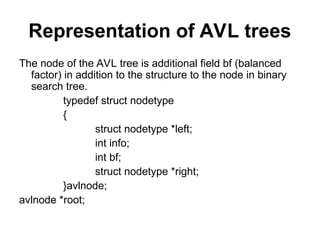
The node of the AVL tree is additional field bf (balanced
factor) in addition to the structure to the node in binary
search tree.
typedef struct nodetype
{
struct nodetype *left;
int info;
int bf;
struct nodetype *right;
}avlnode;
avlnode *root;
5.
AVL TREES
The valueof the field bf will be chosen as:
-1 if hL<hR
bf = 0 if hL=hR
+1 if hL>hR
6.
Operation on AVLTREES
• Insertion of a node: The new node is inserted
using the usual binary search tree insert
procedure i.e. comparing the key of the new
node with that in the root, and inserting new
node into left or right sub tree as appropriate.
• After insertion of new nodes two things can be
changed i.e.
– Balanced factor
– height
7.
AVL TREES
8
5 10
15
7
0
-1
0
0
-1
8
510
15
7
0
0
0
0
-1
9
0
Original AVL Tree
After inserting value 9
Neither the balance factor nor the height of the AVL tree is affected
8.
AVL TREES
8
5 10
7
+1
0
0
-1
8
510
15
7
0
-1
0
0
-1
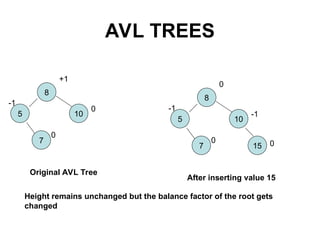
Original AVL Tree
After inserting value 15
Height remains unchanged but the balance factor of the root gets
changed
9.
AVL TREES
8
5 10
7
+1
0
0
0
8
510
7
+2
0
+1
-1
Original AVL Tree
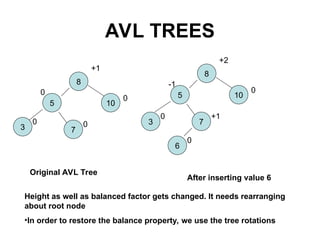
After inserting value 6
Height as well as balanced factor gets changed. It needs rearranging
about root node
•In order to restore the balance property, we use the tree rotations
3
0 3
0
6
0
10.
AVL TREES
35
20 60
45
-2
-1
0
060
35 65
70
45
0
-1
0
0
0
Total height 4 Total height 3
65
-1
70
0
20
0
Rotate left
Restoring balance by left rotation
11.
AVL TREES
35
30 50
25
+2
0
+1
+130
25 35
50
33
0
0
0
0
+1
Total height 4 Total height 3
33
0
10
0
10
0
Rotate right
Restoring balance by right rotation
12.
AVL TREES
35
20 50
10
+2
0
0
-1
35
2350
10
32
+2
0
0
0
+1
Total height 4
Rotate right
23
-1
32
0
20
+1
Rotate left
23
20 35
50
32
0
0
0
0
+1
10
0
Restoring balance by double rotation
13.
Threaded Binary trees
•On carefully examining the linked representation of a
binary tree T , we will find that approximately half of
the pointer fields contains NULL entries.
• The space occupied by these NULL entries can be
utilized to store some kind of valuable information.
• One way to utilize this space is that we can store
special pointer that points to nodes higher in the tree,
i.e. ancestors.
• These special pointer are called threads, and the
binary tree having such pointers is called a threaded
binary tree.
• In computer memory, an extra field, called tag or flag
is used to distinguish thread from a normal pointer.
14.
Threaded Binary trees
Thereare many ways to thread a binary tree:
• The right NULL pointer of each node can be replaced by a
thread to the successor of the node under in-order traversal
called a right thread, and the tree will called a right threaded
tree.
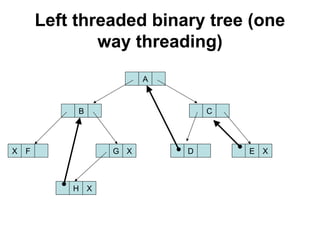
• The left NULL pointer of each node can be replaced by a thread
to the predecessor of the node under in-order traversal called a
left thread, and the tree will called a left threaded tree.
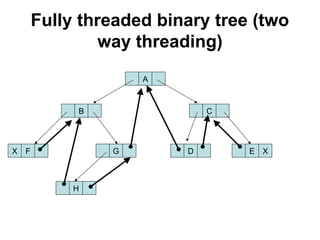
• Both left and right NULL pointers can be used to point to
predecessor and successor of that node respectively, under in-
order traversal. Such a tree is called a fully threaded tree.
• A threaded binary tree where only one thread is used is
known as one way threaded tree and where both thread are
used called two way threaded tree.
Representation of threaded
binarytree in memory
typedef struct nodetype
{
struct nodetype *left;
int info;
char thread;
struct nodetype *right;
}TBST;
TBST *root;
In this representation, we have used char field thread as a
tag. The character ‘0’ will used for normal right pointer
and character ‘1’ will be used for thread.