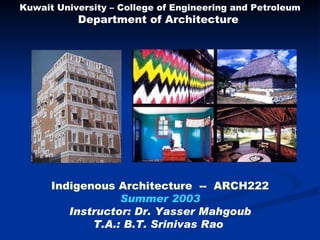
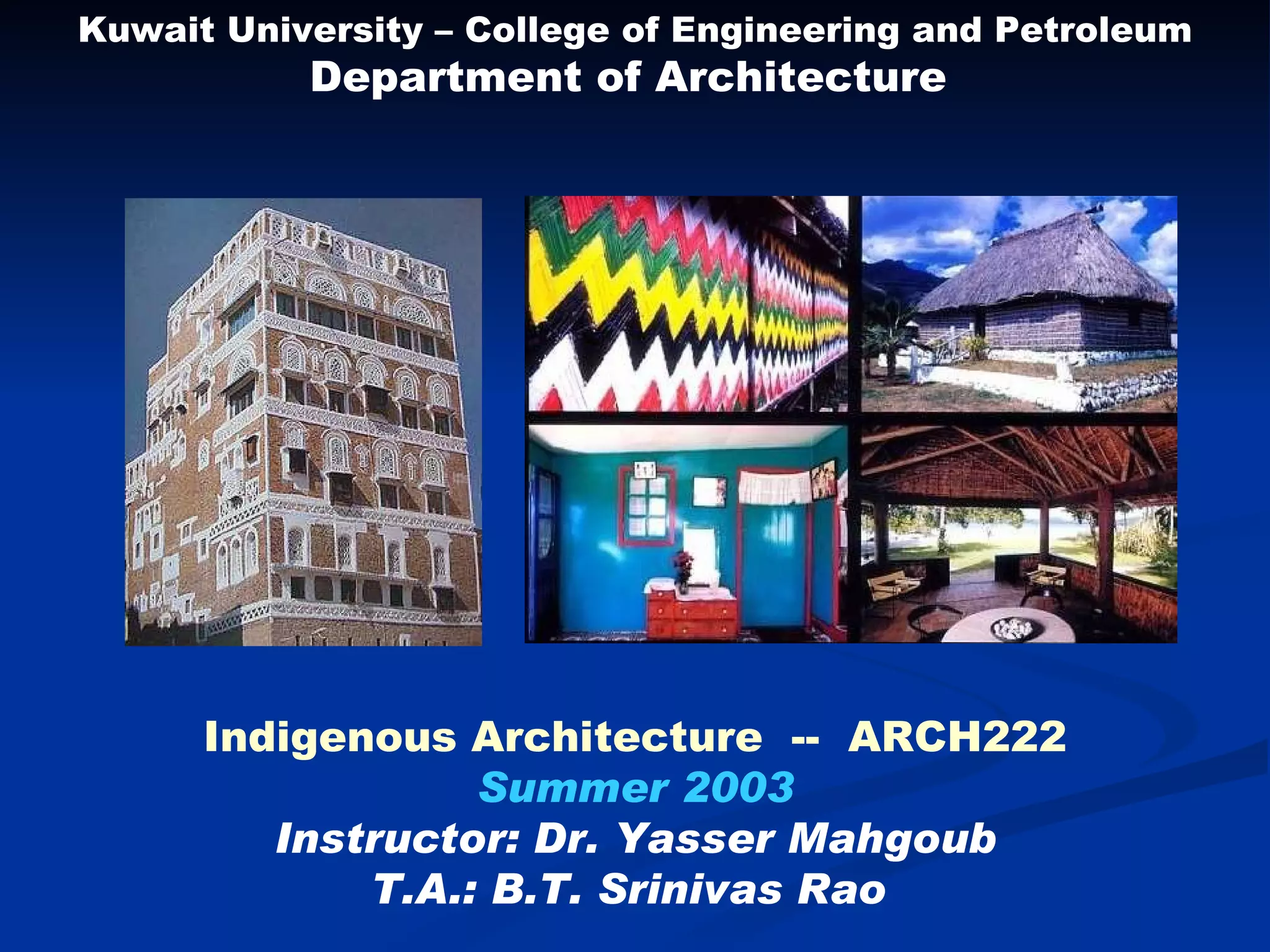
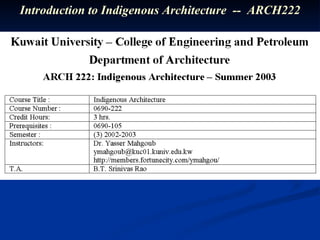
Kuwait University – College of Engineering and Petroleum Department of Architecture  Indigenous Architecture  --  ARCH222 Summer 2003 Instructor: Dr. Yasser Mahgoub T.A.: B.T. Srinivas Rao
Introduction to Indigenous Architecture  --  ARCH222
architecture \Ar"chi*tec`ture\  1. The art or science of building; especially, the art of building houses, churches, bridges, and other structures, for the purposes of civil life; -- often called civil architecture. 2. Construction, in a more general sense; frame or structure; workmanship. Source :  Webster's Revised Unabridged Dictionary, © 1996, 1998 MICRA, Inc. Introduction to Indigenous Architecture  --  ARCH222
Indigenous \In*dig"e*nous\,  1. Native; produced, growing, or living, naturally in a country or climate; not exotic; not imported.  2. Native; inherent; innate. Source :  Webster's Revised Unabridged Dictionary, © 1996, 1998 MICRA, Inc. Introduction to Indigenous Architecture  --  ARCH222
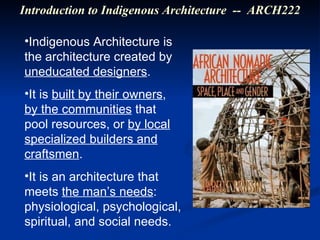
Indigenous Architecture is the architecture created by  uneducated designers . It is  built by their owners ,  by the communities  that pool resources, or  by local specialized builders and craftsmen . It is an architecture that meets  the man’s needs : physiological, psychological, spiritual, and social needs. Introduction to Indigenous Architecture  --  ARCH222
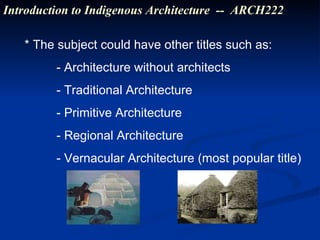
* The subject could have other titles such as: - Architecture without architects - Traditional Architecture - Primitive Architecture - Regional Architecture - Vernacular Architecture (most popular title) Introduction to Indigenous Architecture  --  ARCH222
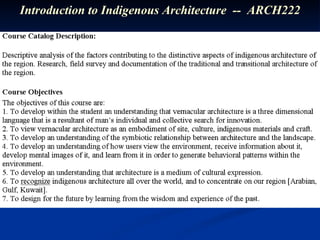
* The objective of this course is to be able to  recognize  this architecture all over the world, and to concentrate on our region [Arabian, Gulf, Kuwait].  * To  design  for the future by learning from the past (wisdom, experience). You will reduce many unnecessary errors, and be able to design sustainable buildings. Objectives
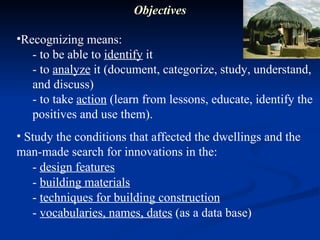
Recognizing means: - to be able to  identify  it - to  analyze  it (document, categorize, study, understand, and discuss) - to take  action  (learn from lessons, educate, identify the positives and use them). Study the conditions that affected the dwellings and the man-made search for innovations in the: -  design features -  building materials -  techniques for building construction -  vocabularies, names, dates  (as a data base) Objectives
(1) To develop within the student an  understanding  that vernacular is  a three dimensional language  that is a resultant of man’s individual and collective search for innovation. (2) To view vernacular architecture as an embodiment of  site, culture, indigenous materials and craft . (3) To develop an understanding of the symbiotic relationship between  architecture and the landscape . (4) To develop an understanding of  how users view the environment, receive information about it, develop mental images of it, and learn from it  in order to generate behavioral patterns within the environment. (5) To develop an understanding that architecture is a medium of  cultural expression . Temple University Objectives
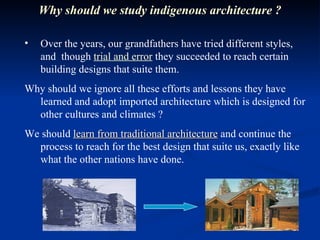
Over the years, our grandfathers have tried different styles, and  though  trial and error  they succeeded to reach certain building designs that suite them. Why should we ignore all these efforts and lessons they have learned and adopt imported architecture which is designed for other cultures and climates ?  We should  learn from traditional architecture  and continue the process to reach for the best design that suite us, exactly like what the other nations have done. Why should we study indigenous architecture ?
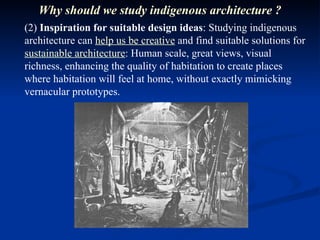
(2)  Inspiration for suitable design ideas : Studying indigenous architecture can  help us be creative  and find suitable solutions for  sustainable architecture : Human scale, great views, visual richness, enhancing the quality of habitation to create places where habitation will feel at home, without exactly mimicking vernacular prototypes. Why should we study indigenous architecture ?
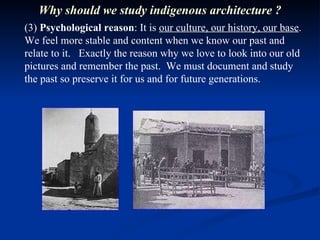
(3)  Psychological reason : It is  our culture, our history, our base . We feel more stable and content when we know our past and relate to it.  Exactly the reason why we love to look into our old pictures and remember the past.  We must document and study the past so preserve it for us and for future generations.  Why should we study indigenous architecture ?
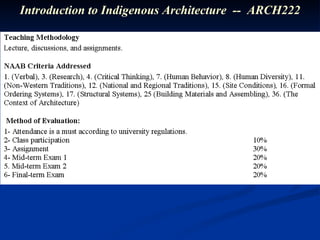
* Texts, Office Hours, Exams and grades, Attendance. Discussion of the Syllabus * Serious attendance and taking notes. Reading and understanding (requires 2 hours a day) Participation (questions, concepts, arguments) Good project (introduction, body, analysis, recommendations) * Learn from the past (always ask yourself: what can I learn from this experience to improve my design skills?) Purpose ? Why they did it that way? Design ? How they did it? Technique ? How they managed to solve the problem? Materials ? From where ? My expectations
*  Elevation:  (construction material, openings, ornaments, ratios, etc) *  Entrances:  (connection between outside to the inside, material, social status) *  Floor plans:  (distribution, sizes, segregation, etc.) *  Construction method:  (structures, connections, process, etc.) *  Climate control:  (wind catchers, openings, etc.) *  Cultural, environmental:  (economical, and political factors.) Pay attention to the following
End of Introduction

Lecture00 Introduction Ym

  • 1.
    Kuwait University –College of Engineering and Petroleum Department of Architecture Indigenous Architecture -- ARCH222 Summer 2003 Instructor: Dr. Yasser Mahgoub T.A.: B.T. Srinivas Rao
  • 2.
    Introduction to IndigenousArchitecture -- ARCH222
  • 3.
    Introduction to IndigenousArchitecture -- ARCH222
  • 4.
    Introduction to IndigenousArchitecture -- ARCH222
  • 5.
    architecture \Ar"chi*tec`ture\ 1. The art or science of building; especially, the art of building houses, churches, bridges, and other structures, for the purposes of civil life; -- often called civil architecture. 2. Construction, in a more general sense; frame or structure; workmanship. Source : Webster's Revised Unabridged Dictionary, © 1996, 1998 MICRA, Inc. Introduction to Indigenous Architecture -- ARCH222
  • 6.
    Indigenous \In*dig"e*nous\, 1. Native; produced, growing, or living, naturally in a country or climate; not exotic; not imported. 2. Native; inherent; innate. Source : Webster's Revised Unabridged Dictionary, © 1996, 1998 MICRA, Inc. Introduction to Indigenous Architecture -- ARCH222
  • 7.
    Indigenous Architecture isthe architecture created by uneducated designers . It is built by their owners , by the communities that pool resources, or by local specialized builders and craftsmen . It is an architecture that meets the man’s needs : physiological, psychological, spiritual, and social needs. Introduction to Indigenous Architecture -- ARCH222
  • 8.
    * The subjectcould have other titles such as: - Architecture without architects - Traditional Architecture - Primitive Architecture - Regional Architecture - Vernacular Architecture (most popular title) Introduction to Indigenous Architecture -- ARCH222
  • 9.
    * The objectiveof this course is to be able to recognize this architecture all over the world, and to concentrate on our region [Arabian, Gulf, Kuwait]. * To design for the future by learning from the past (wisdom, experience). You will reduce many unnecessary errors, and be able to design sustainable buildings. Objectives
  • 10.
    Recognizing means: -to be able to identify it - to analyze it (document, categorize, study, understand, and discuss) - to take action (learn from lessons, educate, identify the positives and use them). Study the conditions that affected the dwellings and the man-made search for innovations in the: - design features - building materials - techniques for building construction - vocabularies, names, dates (as a data base) Objectives
  • 11.
    (1) To developwithin the student an understanding that vernacular is a three dimensional language that is a resultant of man’s individual and collective search for innovation. (2) To view vernacular architecture as an embodiment of site, culture, indigenous materials and craft . (3) To develop an understanding of the symbiotic relationship between architecture and the landscape . (4) To develop an understanding of how users view the environment, receive information about it, develop mental images of it, and learn from it in order to generate behavioral patterns within the environment. (5) To develop an understanding that architecture is a medium of cultural expression . Temple University Objectives
  • 12.
    Over the years,our grandfathers have tried different styles, and though trial and error they succeeded to reach certain building designs that suite them. Why should we ignore all these efforts and lessons they have learned and adopt imported architecture which is designed for other cultures and climates ? We should learn from traditional architecture and continue the process to reach for the best design that suite us, exactly like what the other nations have done. Why should we study indigenous architecture ?
  • 13.
    (2) Inspirationfor suitable design ideas : Studying indigenous architecture can help us be creative and find suitable solutions for sustainable architecture : Human scale, great views, visual richness, enhancing the quality of habitation to create places where habitation will feel at home, without exactly mimicking vernacular prototypes. Why should we study indigenous architecture ?
  • 14.
    (3) Psychologicalreason : It is our culture, our history, our base . We feel more stable and content when we know our past and relate to it. Exactly the reason why we love to look into our old pictures and remember the past. We must document and study the past so preserve it for us and for future generations. Why should we study indigenous architecture ?
  • 15.
    * Texts, OfficeHours, Exams and grades, Attendance. Discussion of the Syllabus * Serious attendance and taking notes. Reading and understanding (requires 2 hours a day) Participation (questions, concepts, arguments) Good project (introduction, body, analysis, recommendations) * Learn from the past (always ask yourself: what can I learn from this experience to improve my design skills?) Purpose ? Why they did it that way? Design ? How they did it? Technique ? How they managed to solve the problem? Materials ? From where ? My expectations
  • 16.
    * Elevation: (construction material, openings, ornaments, ratios, etc) * Entrances: (connection between outside to the inside, material, social status) * Floor plans: (distribution, sizes, segregation, etc.) * Construction method: (structures, connections, process, etc.) * Climate control: (wind catchers, openings, etc.) * Cultural, environmental: (economical, and political factors.) Pay attention to the following
  • 17.