Object-Oriented Programming
(OOP)- Polymorphism
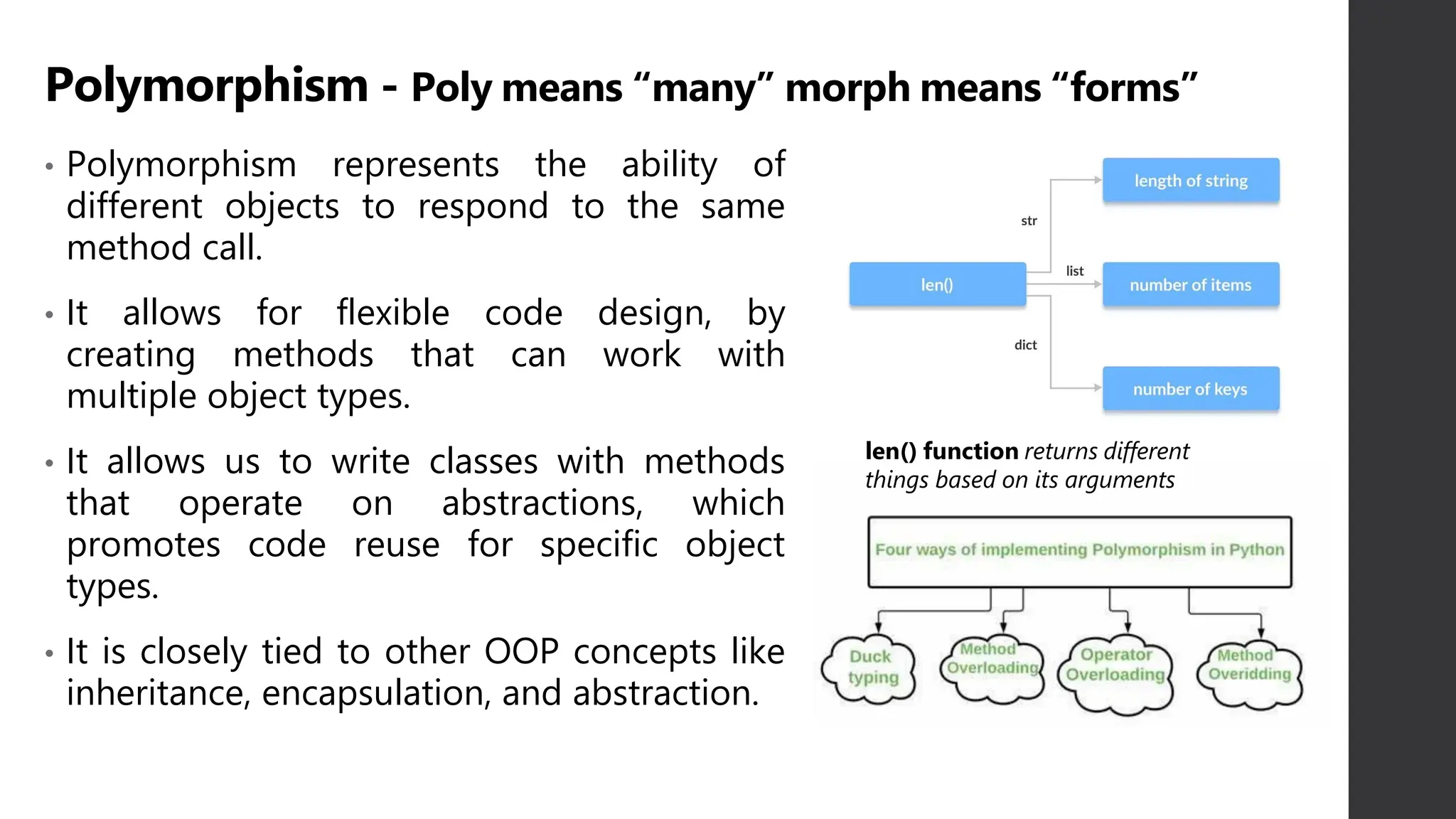
things based on its arguments
Polymorphism - Poly means “many” morph means “forms”
• Polymorphism represents the ability of
different objects to respond to the same
method call.
• It allows for flexible code design, by
creating methods that can work with
multiple object types.
• It allows us to write classes with methods
that operate on abstractions, which
promotes code reuse for specific object
types.
• It is closely tied to other OOP concepts like
inheritance, encapsulation, and abstraction.
len() function returns different
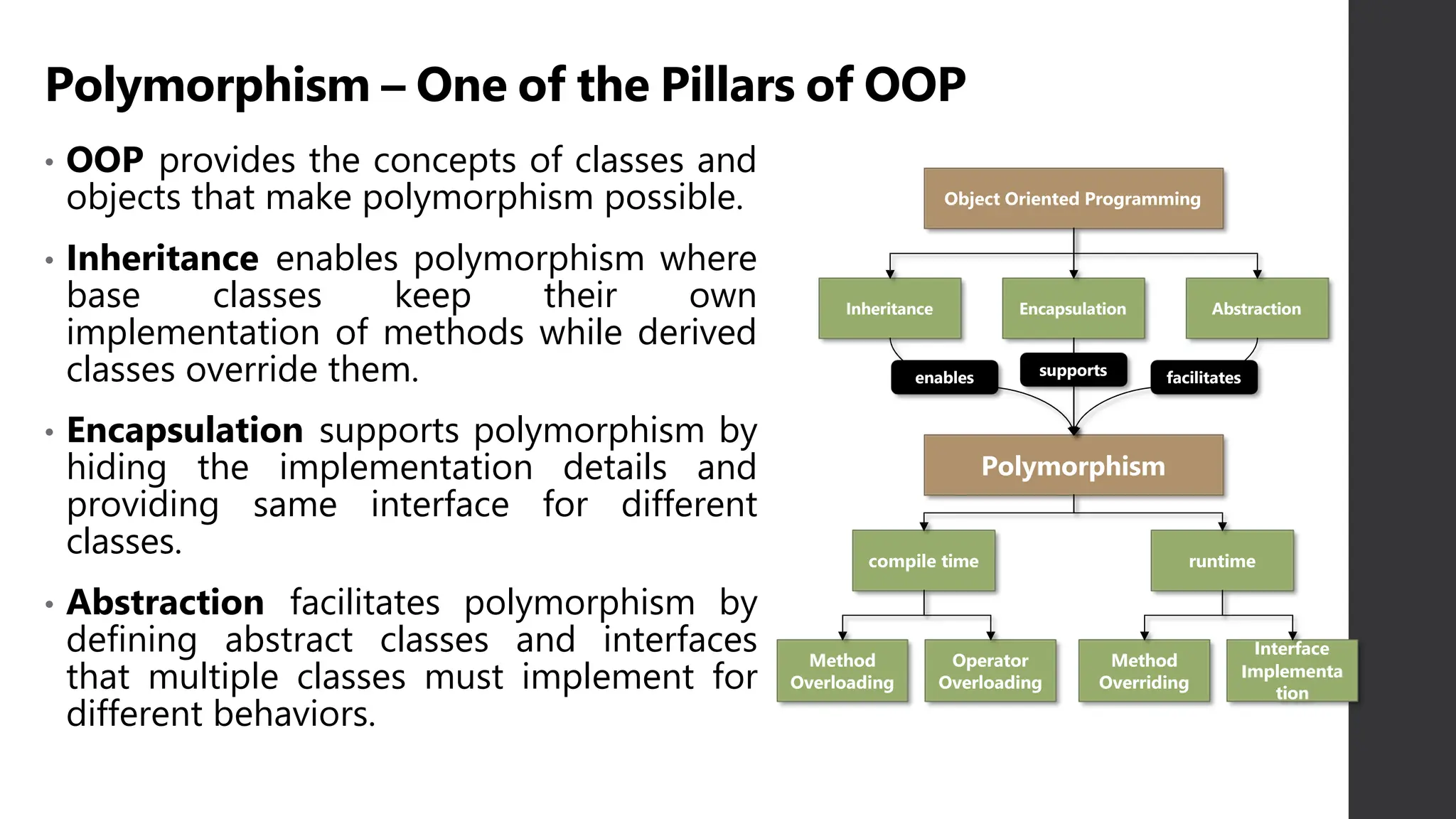
Polymorphism – One of the Pillars of OOP
• OOP provides the concepts of classes and
objects that make polymorphism possible.
• Inheritance enables polymorphism where
base classes keep their own
implementation of methods while derived
classes override them.
• Encapsulation supports polymorphism by
hiding the implementation details and
providing same interface for different
classes.
• Abstraction facilitates polymorphism by
defining abstract classes and interfaces
that multiple classes must implement for
different behaviors.
Object Oriented Programming
Inheritance Encapsulation Abstraction
enables supports facilitates
Polymorphism
compile time runtime
Method
Overloading
Operator
Overloading
Method
Overriding
Interface
Implementa
tion
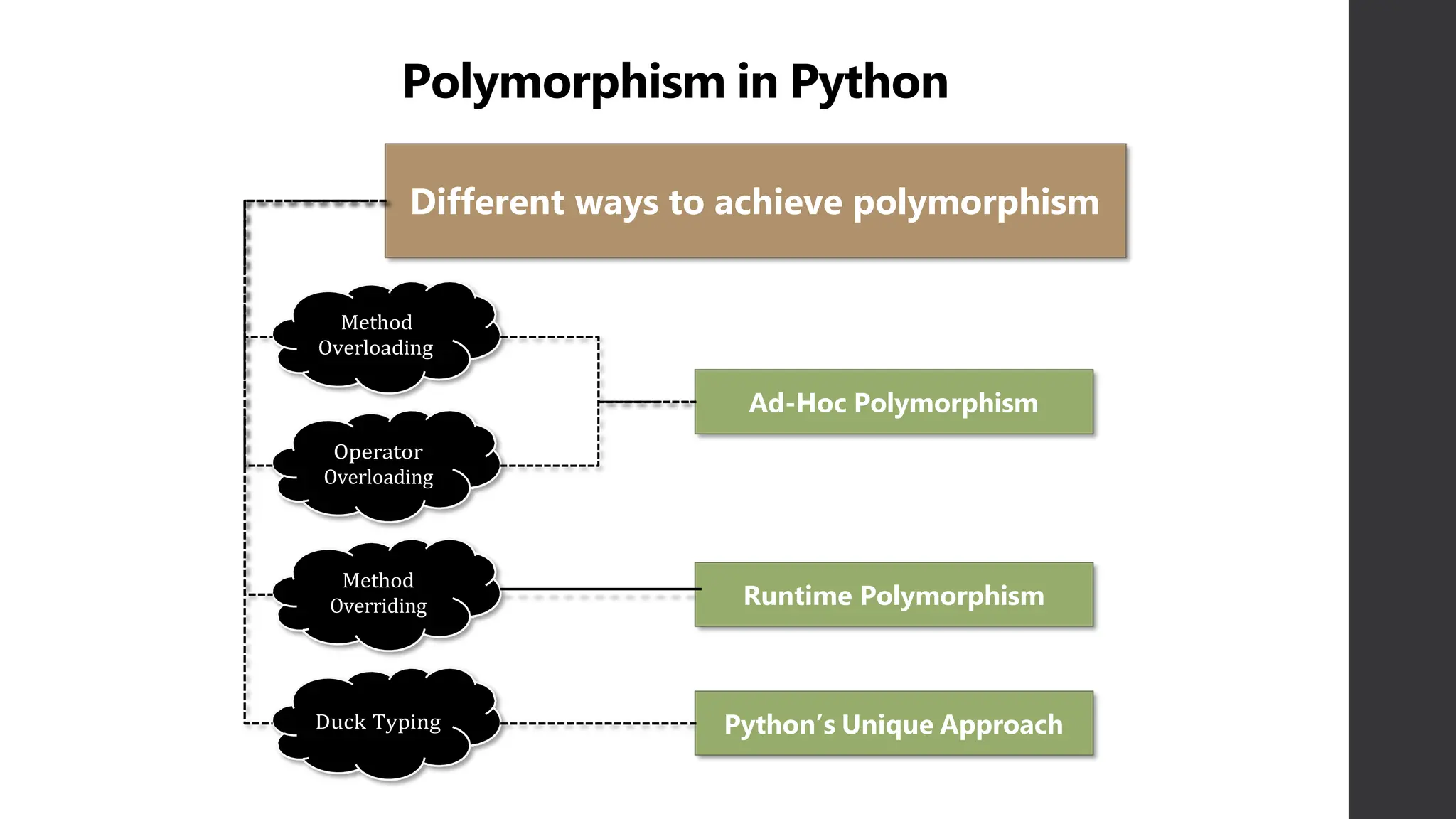
Different ways to achieve polymorphism
Ad-Hoc Polymorphism
Overloading
Overriding Runtime Polymorphism
Python’s Unique Approach
Polymorphism in Python
Types of Polymorphism in Python
Ad-hoc Polymorphism – Operator/function
overloading
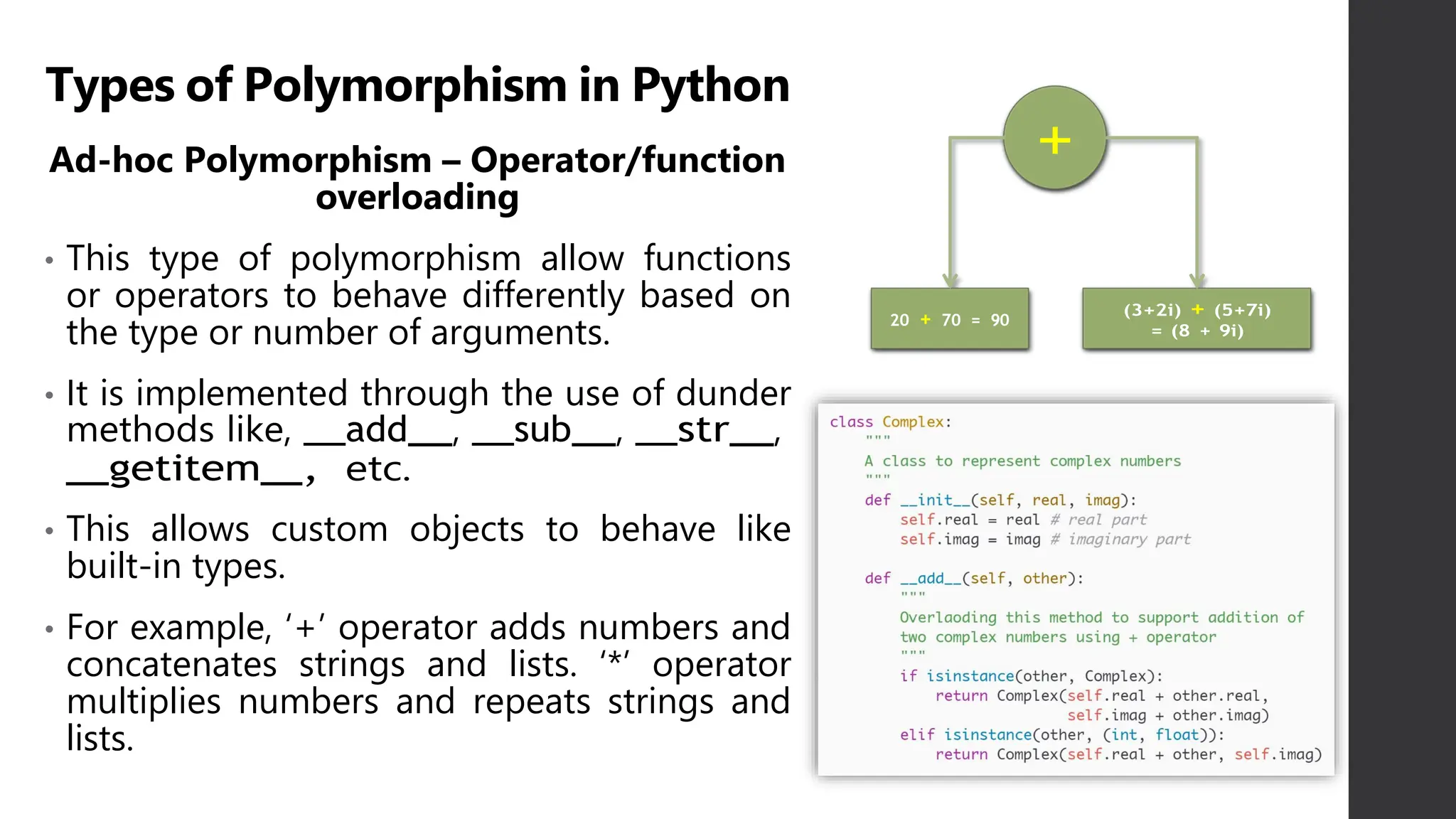
• This type of polymorphism allow functions
or operators to behave differently based on
the type or number of arguments.
• It is implemented through the use of dunder
methods like, add , sub , str ,
getitem , etc.
• This allows custom objects to behave like
built-in types.
• For example, ‘+’ operator adds numbers and
concatenates strings and lists. ‘*’ operator
multiplies numbers and repeats strings and
lists.
20 + 70 = 90
Types of Polymorphism in Python
Runtime Polymorphism – Subtype
Polymorphism
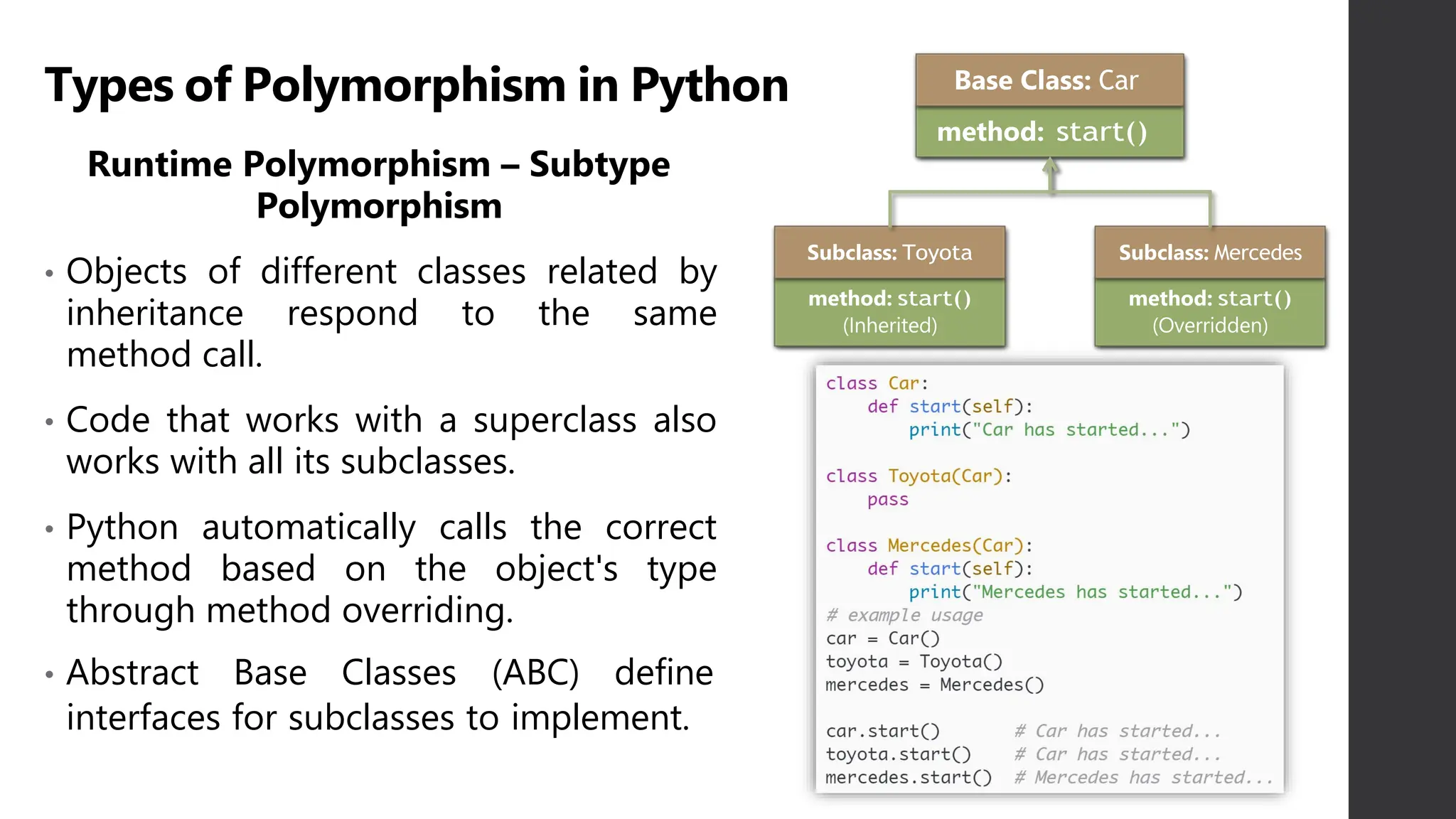
• Objects of different classes related by
inheritance respond to the same
method call.
• Code that works with a superclass also
works with all its subclasses.
• Python automatically calls the correct
method based on the object's type
through method overriding.
• Abstract Base Classes (ABC) define
interfaces for subclasses to implement.
Subclass:
method:
(Inherited)
Subclass: Mercedes
method:
(Overridden)
Base Class: Car
method:
Types of Polymorphism in Python
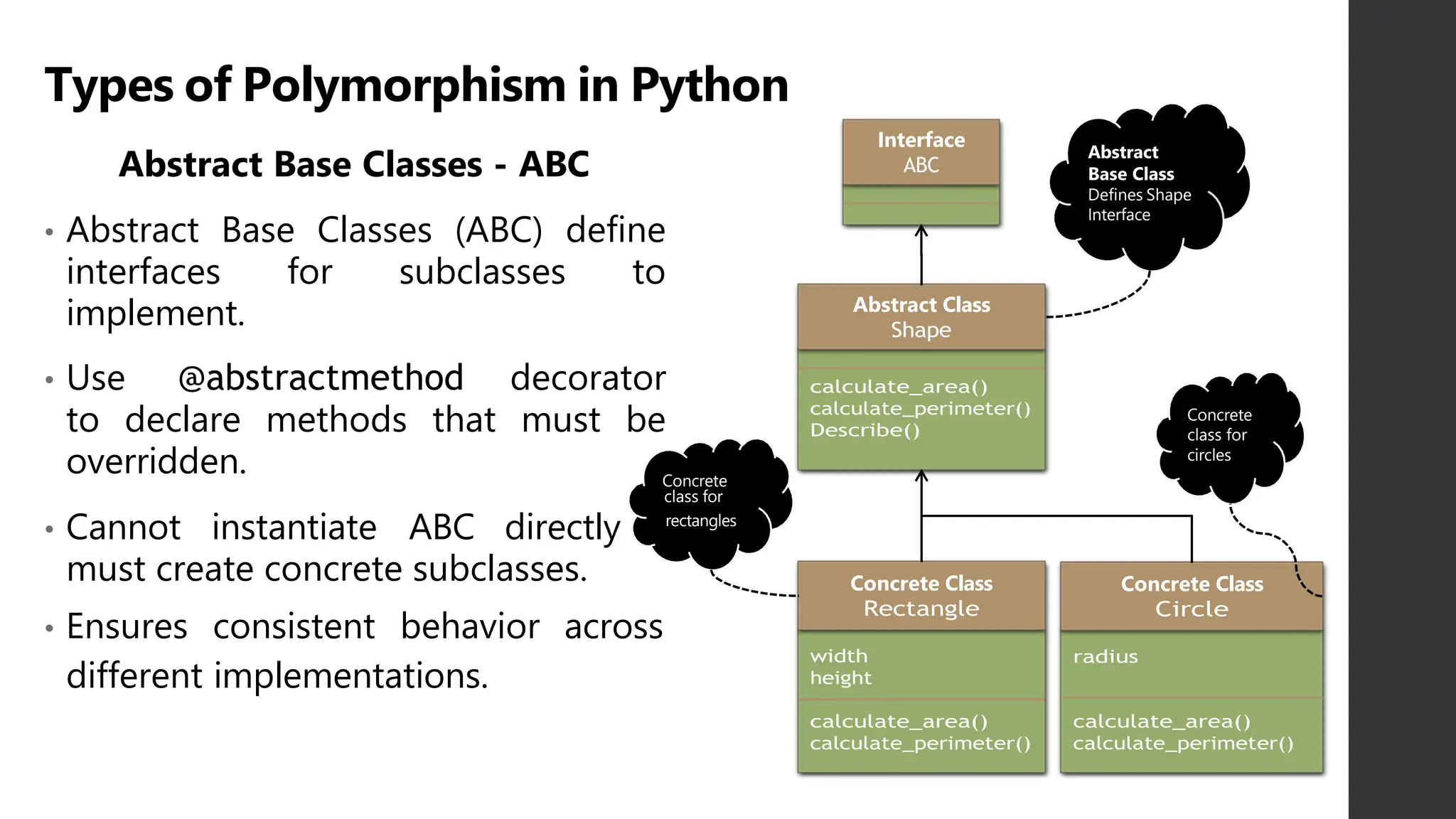
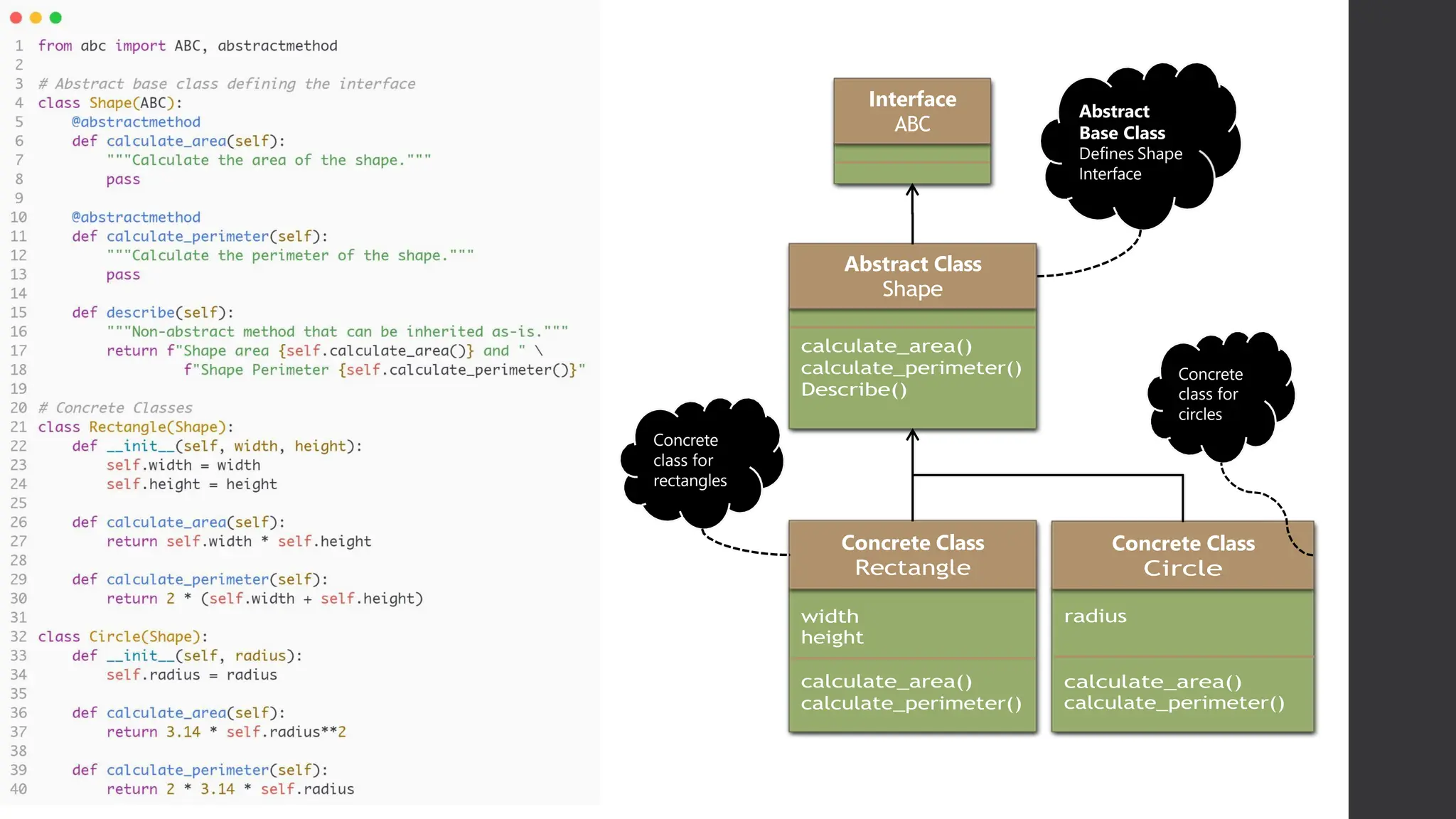
Abstract Base Classes - ABC
• Abstract Base Classes (ABC) define
interfaces for subclasses to
implement.
• Use @abstractmethod decorator
to declare methods that must be
overridden.
class for
• Cannot instantiate ABC directly -rectangles
must create concrete subclasses.
• Ensures consistent behavior across
Interface
ABC
Abstract Class
Shape
calculate_area()
calculate_perimeter()
Describe()
Concrete Class
Rectangle
Abstract
Base Class
Defines Shape
Interface
Concrete
class for
circles
Concrete Class
Circle
different implementations.
width
height
calculate_area()
calculate_perimeter()
radius
calculate_area()
calculate_perimeter()
Concrete
Interface
ABC
Abstract
Base Class
Defines Shape
Interface
Abstract Class
Concrete
class for
circles
Concrete
class for
rectangles
Concrete Class Concrete Class
Types of Polymorphism in Python
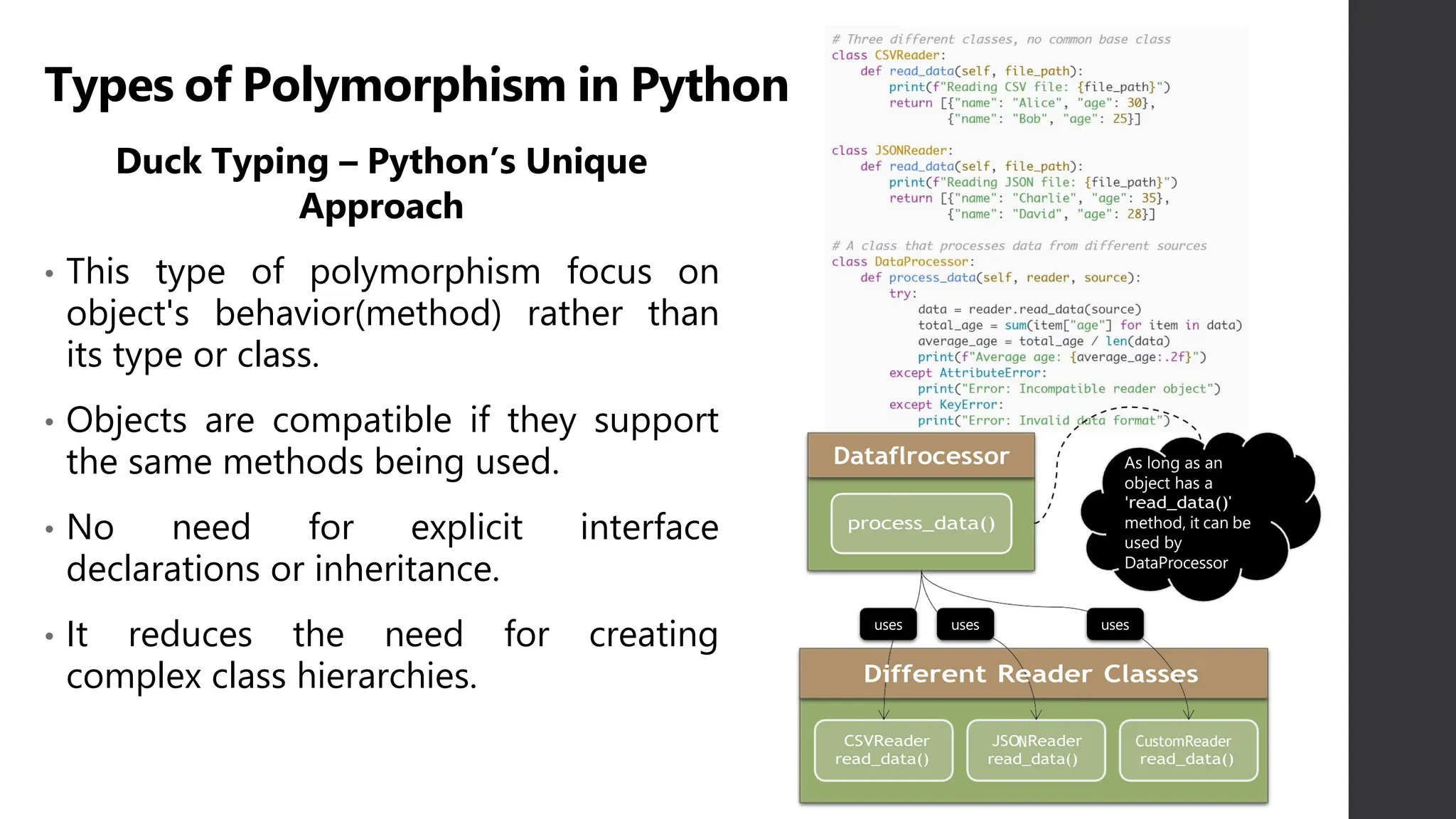
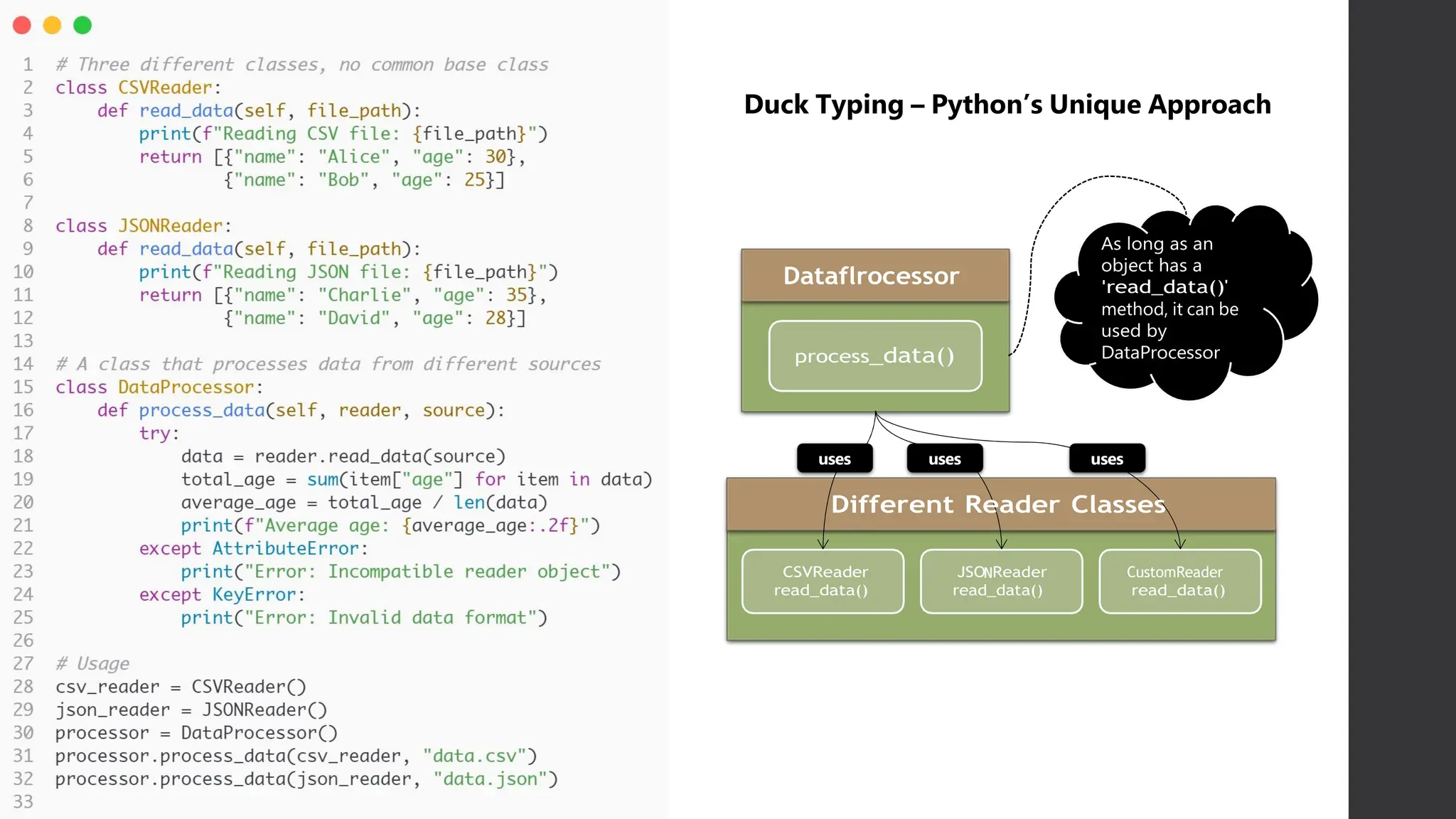
Duck Typing – Python’s Unique
Approach
• This type of polymorphism focus on
object's behavior(method) rather than
its type or class.
• Objects are compatible if they support
the same methods being used.
• No need for explicit interface
declarations or inheritance.
• It reduces the need for creating
complex class hierarchies.
As long as an
object has a
method, it can be
used by
DataProcessor
uses uses uses
CustomReader
method, it can be
uses uses uses
CustomReader
Duck Typing – Python’s Unique Approach

Lecture on Lecture on Python programming OP conceptsPolymorphism.pdf

  • 1.
  • 2.
    things based onits arguments Polymorphism - Poly means “many” morph means “forms” • Polymorphism represents the ability of different objects to respond to the same method call. • It allows for flexible code design, by creating methods that can work with multiple object types. • It allows us to write classes with methods that operate on abstractions, which promotes code reuse for specific object types. • It is closely tied to other OOP concepts like inheritance, encapsulation, and abstraction. len() function returns different
  • 3.
    Polymorphism – Oneof the Pillars of OOP • OOP provides the concepts of classes and objects that make polymorphism possible. • Inheritance enables polymorphism where base classes keep their own implementation of methods while derived classes override them. • Encapsulation supports polymorphism by hiding the implementation details and providing same interface for different classes. • Abstraction facilitates polymorphism by defining abstract classes and interfaces that multiple classes must implement for different behaviors. Object Oriented Programming Inheritance Encapsulation Abstraction enables supports facilitates Polymorphism compile time runtime Method Overloading Operator Overloading Method Overriding Interface Implementa tion
  • 4.
    Different ways toachieve polymorphism Ad-Hoc Polymorphism Overloading Overriding Runtime Polymorphism Python’s Unique Approach Polymorphism in Python
  • 5.
    Types of Polymorphismin Python Ad-hoc Polymorphism – Operator/function overloading • This type of polymorphism allow functions or operators to behave differently based on the type or number of arguments. • It is implemented through the use of dunder methods like, add , sub , str , getitem , etc. • This allows custom objects to behave like built-in types. • For example, ‘+’ operator adds numbers and concatenates strings and lists. ‘*’ operator multiplies numbers and repeats strings and lists. 20 + 70 = 90
  • 6.
    Types of Polymorphismin Python Runtime Polymorphism – Subtype Polymorphism • Objects of different classes related by inheritance respond to the same method call. • Code that works with a superclass also works with all its subclasses. • Python automatically calls the correct method based on the object's type through method overriding. • Abstract Base Classes (ABC) define interfaces for subclasses to implement. Subclass: method: (Inherited) Subclass: Mercedes method: (Overridden) Base Class: Car method:
  • 7.
    Types of Polymorphismin Python Abstract Base Classes - ABC • Abstract Base Classes (ABC) define interfaces for subclasses to implement. • Use @abstractmethod decorator to declare methods that must be overridden. class for • Cannot instantiate ABC directly -rectangles must create concrete subclasses. • Ensures consistent behavior across Interface ABC Abstract Class Shape calculate_area() calculate_perimeter() Describe() Concrete Class Rectangle Abstract Base Class Defines Shape Interface Concrete class for circles Concrete Class Circle different implementations. width height calculate_area() calculate_perimeter() radius calculate_area() calculate_perimeter() Concrete
  • 8.
    Interface ABC Abstract Base Class Defines Shape Interface AbstractClass Concrete class for circles Concrete class for rectangles Concrete Class Concrete Class
  • 9.
    Types of Polymorphismin Python Duck Typing – Python’s Unique Approach • This type of polymorphism focus on object's behavior(method) rather than its type or class. • Objects are compatible if they support the same methods being used. • No need for explicit interface declarations or inheritance. • It reduces the need for creating complex class hierarchies. As long as an object has a method, it can be used by DataProcessor uses uses uses CustomReader
  • 10.
    method, it canbe uses uses uses CustomReader Duck Typing – Python’s Unique Approach