Lecture 9: Packed bed reactor design
CHE 62104 Chemical Reaction Engineering
Dr. Firnaaz Ahamed
Firnaaz.ahamed@taylors.edu.my
1
What is a packed bed reactor?
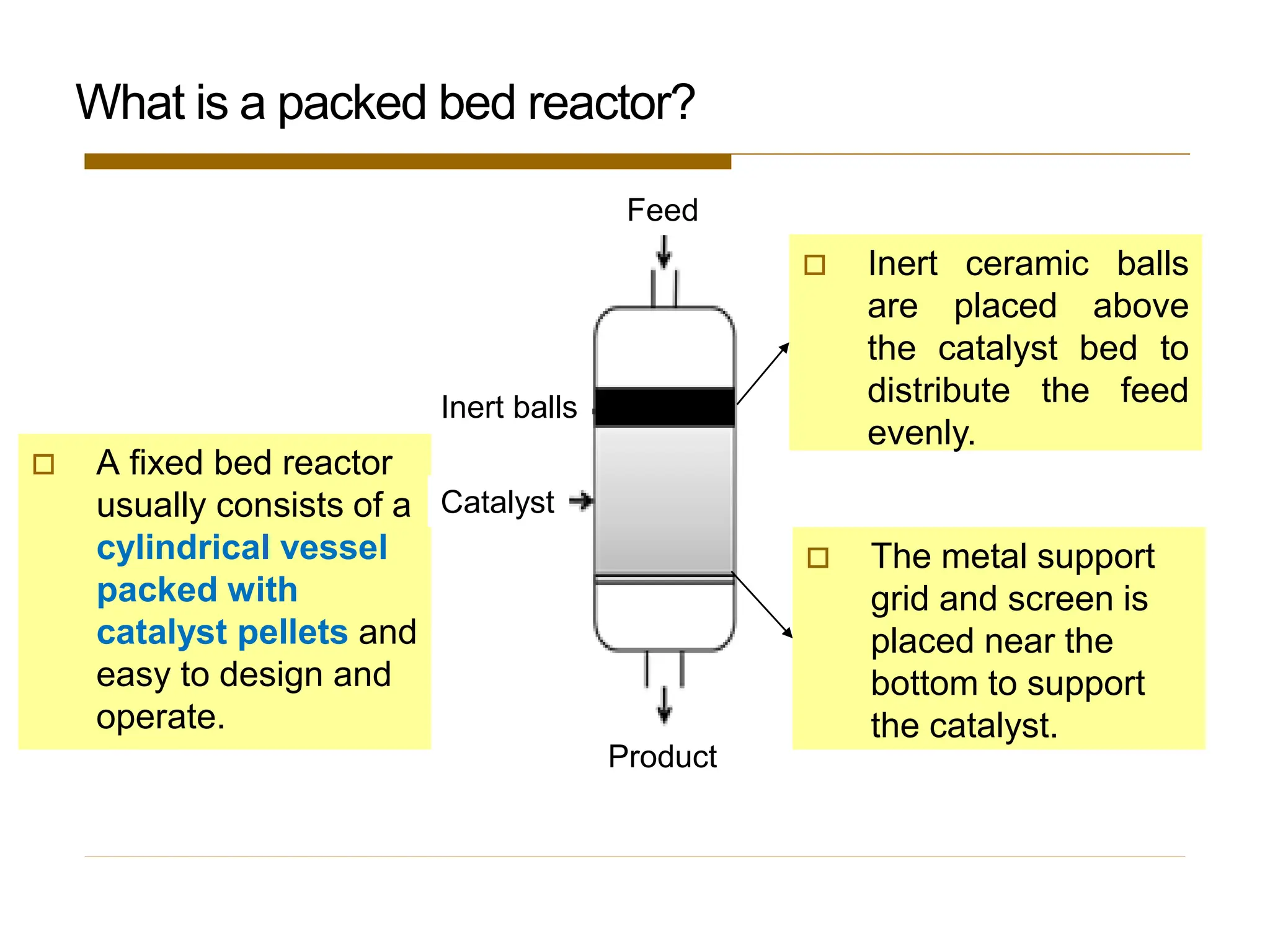
 A fixed bed reactor
usually consists of a
cylindrical vessel
packed with
catalyst pellets and
easy to design and
operate.
Catalyst
Inert balls
Feed
Product
 The metal support
grid and screen is
placed near the
bottom to support
the catalyst.
 Inert ceramic balls
are placed above
the catalyst bed to
distribute the feed
evenly.
Learning outcomes
At the end of the lesson, you should be able to :
 Design the packed bed reactor
◼ determine the weight of the catalyst
◼ determine pressure drop parameters
◼ determine conversion in the packed bed reactor
◼ study the effect of pressure drop on reaction rate
catalyst weight and conversion
3
Pros and cons of a packed bed reactor
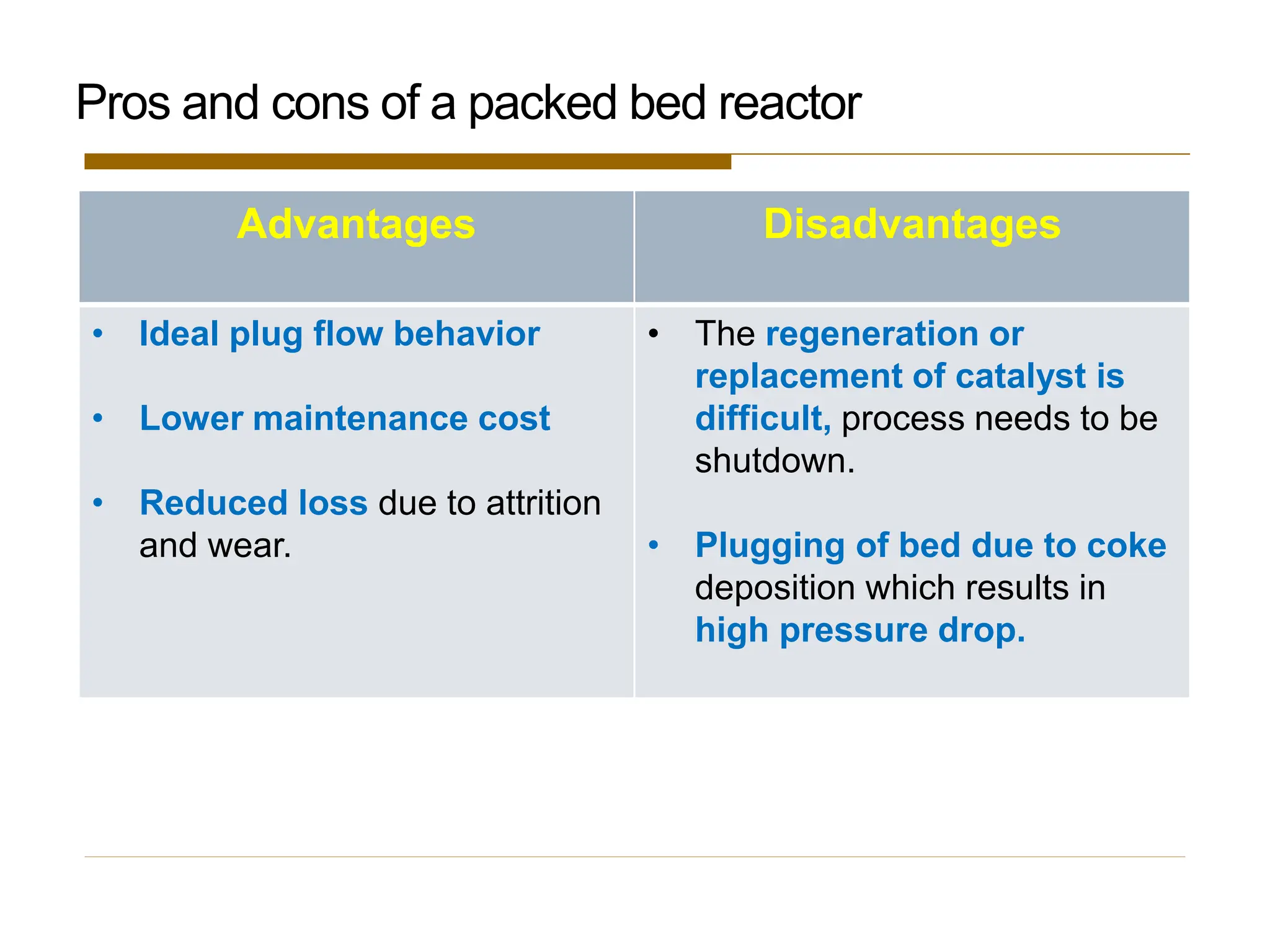
Advantages Disadvantages
• Ideal plug flow behavior
• Lower maintenance cost
• Reduced loss due to attrition
and wear.
• The regeneration or
replacement of catalyst is
difficult, process needs to be
shutdown.
• Plugging of bed due to coke
deposition which results in
high pressure drop.
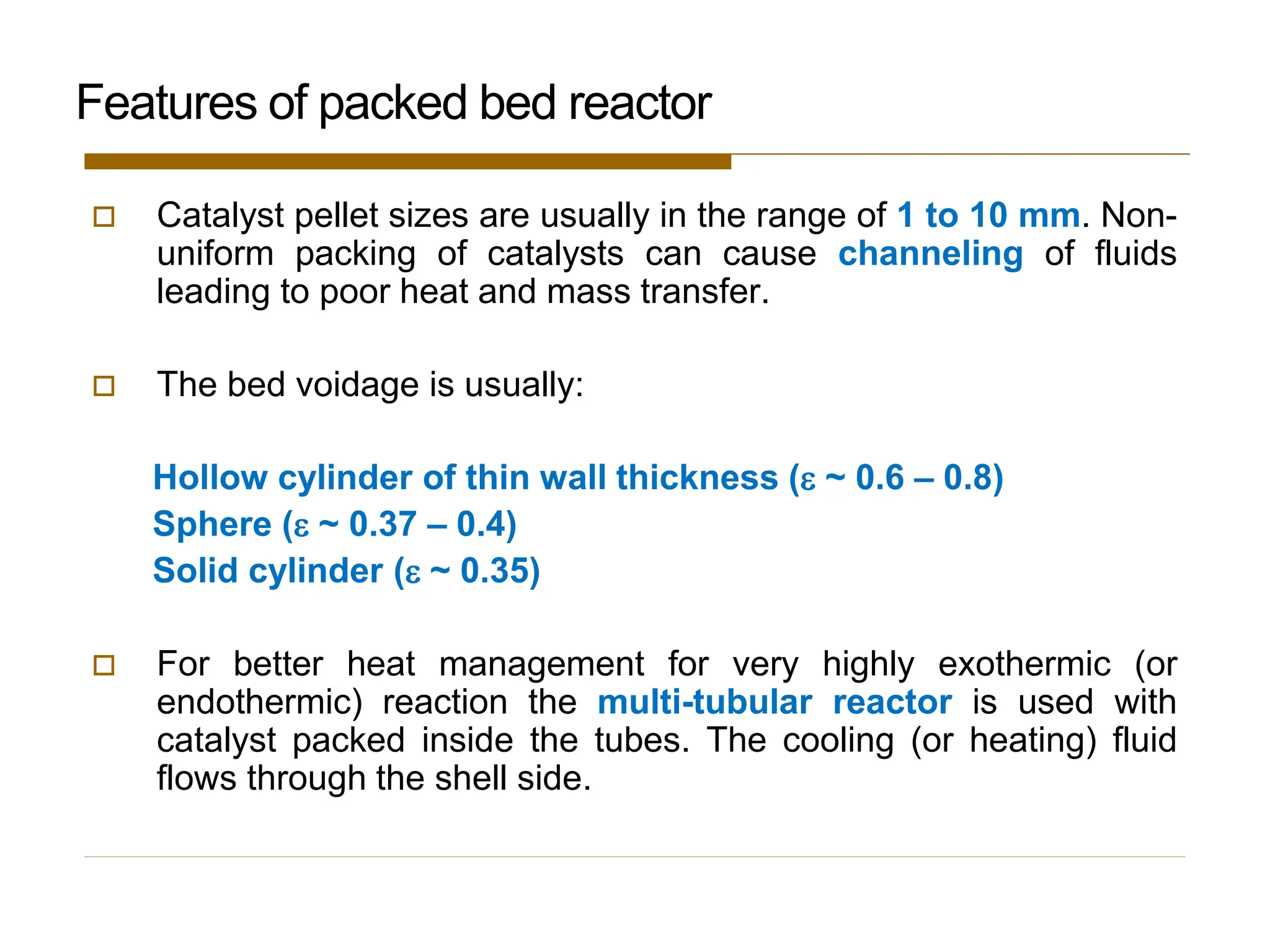
 Catalyst pellet sizes are usually in the range of 1 to 10 mm. Non-
uniform packing of catalysts can cause channeling of fluids
leading to poor heat and mass transfer.
 The bed voidage is usually:
Hollow cylinder of thin wall thickness ( ~ 0.6 – 0.8)
Sphere ( ~ 0.37 – 0.4)
Solid cylinder ( ~ 0.35)
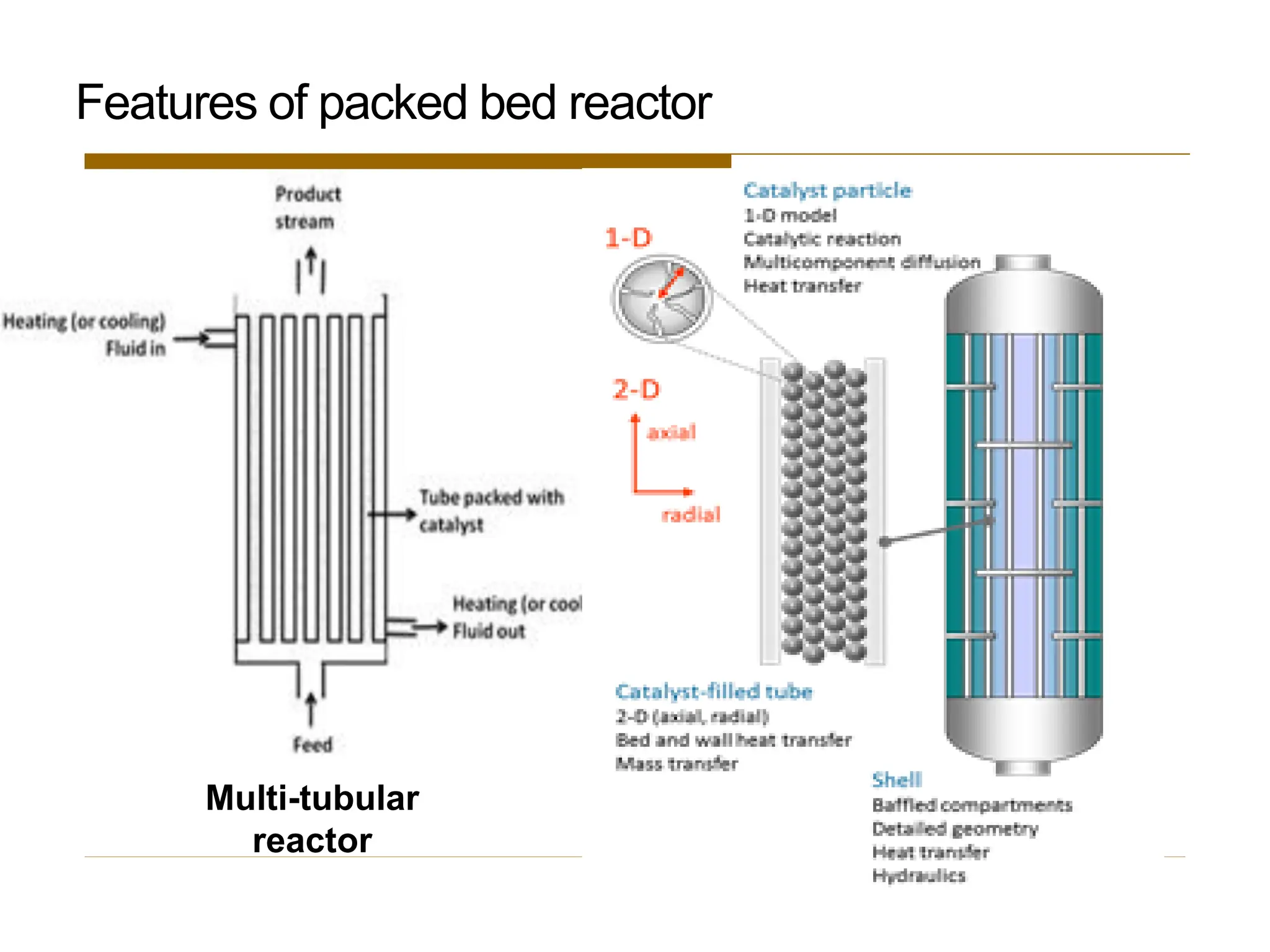
 For better heat management for very highly exothermic (or
endothermic) reaction the multi-tubular reactor is used with
catalyst packed inside the tubes. The cooling (or heating) fluid
flows through the shell side.
Features of packed bed reactor
Multi-tubular
reactor
Features of packed bed reactor
Governing equations for sizing a packed bed
reactor (PBR)
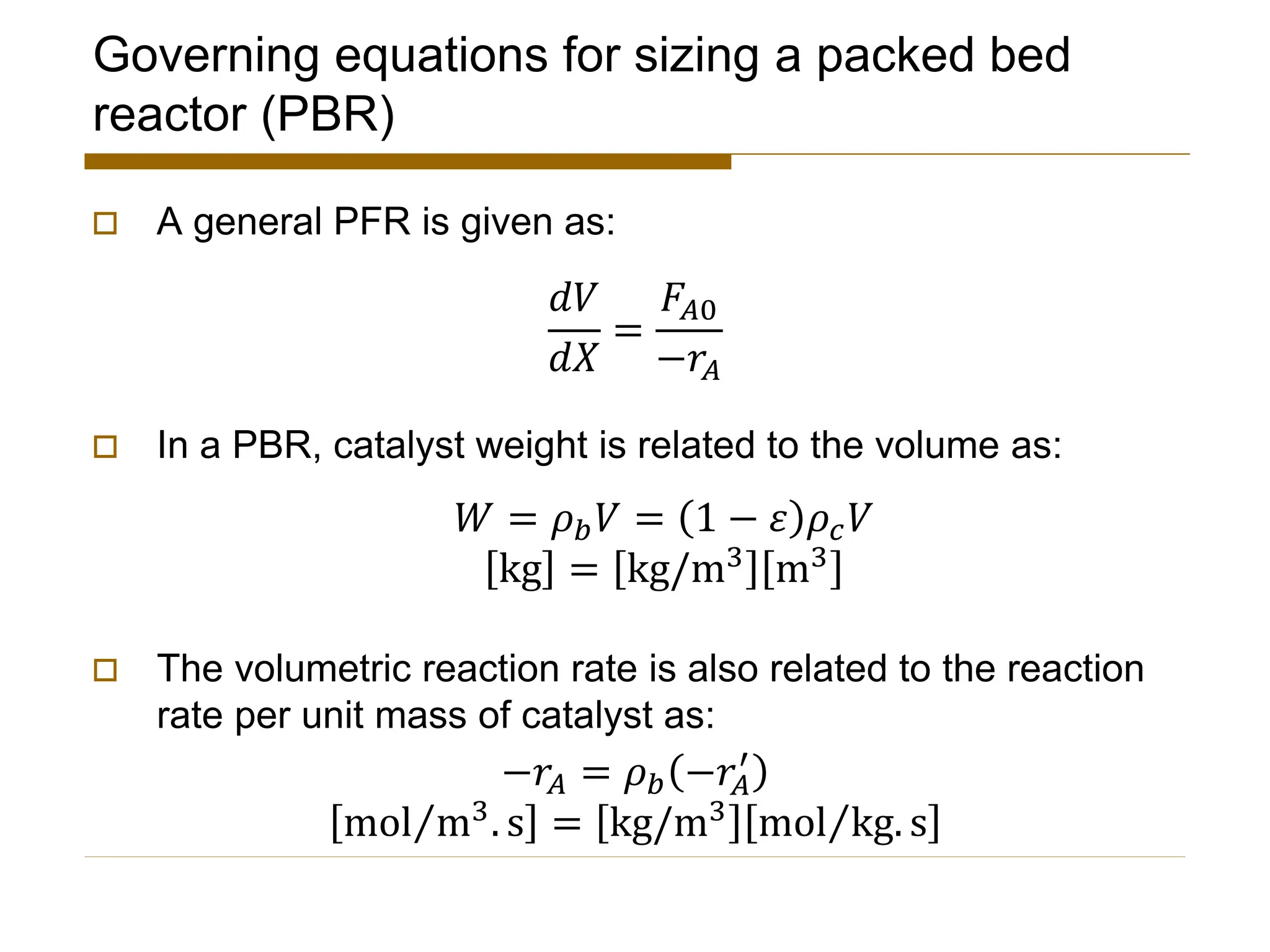
 A general PFR is given as:
 In a PBR, catalyst weight is related to the volume as:
 The volumetric reaction rate is also related to the reaction
rate per unit mass of catalyst as:
𝑑𝑉
𝑑𝑋
=
𝐹𝐴0
−𝑟𝐴
𝑊 = 𝜌𝑏𝑉 = 1 − 𝜀 𝜌𝑐𝑉
kg = kg/m3 m3
−𝑟𝐴 = 𝜌𝑏 −𝑟𝐴
′
Τ
mol m3. s = kg/m3 Τ
mol kg. s
Governing equations for sizing packed bed
reactor
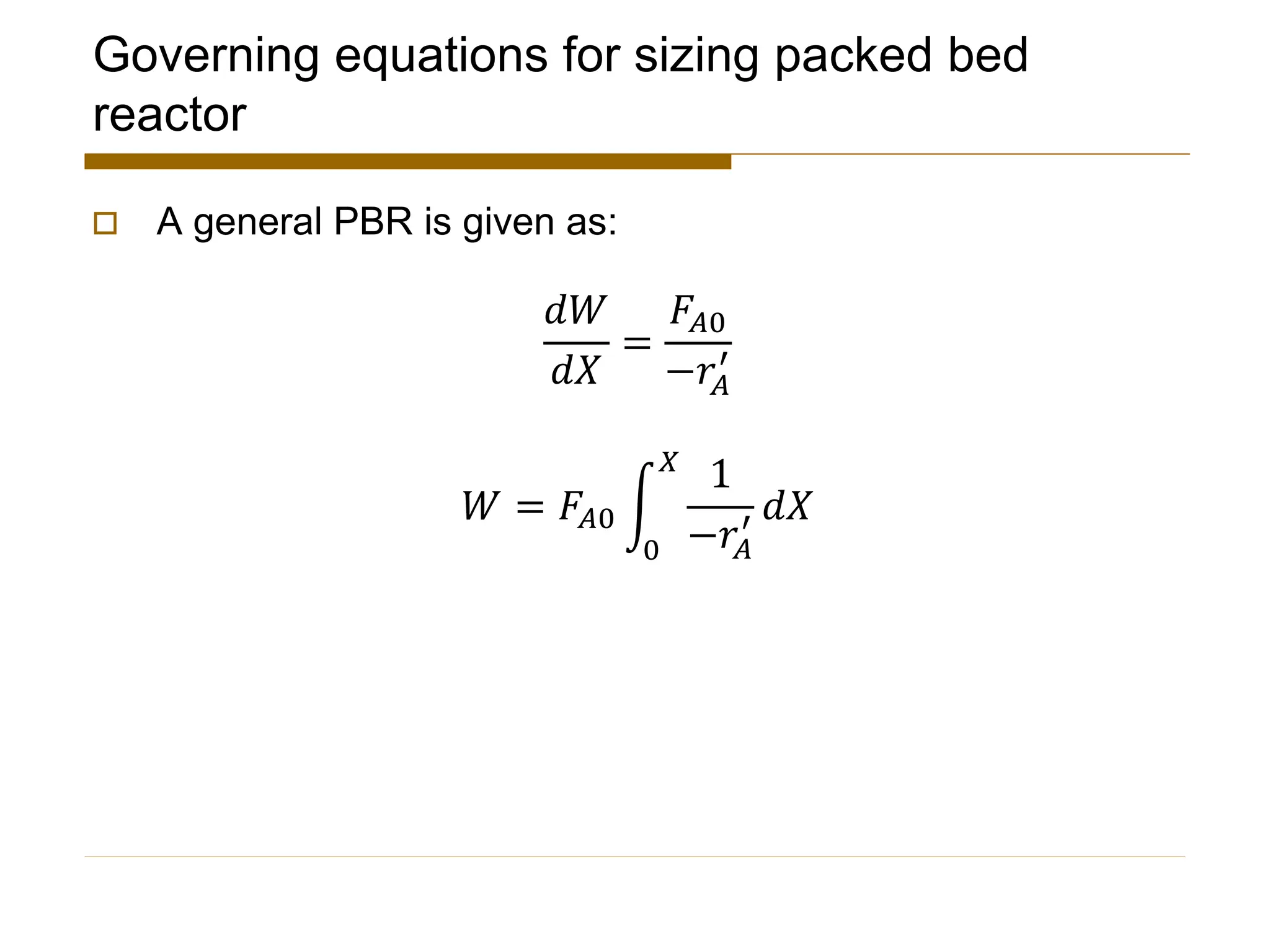
 A general PBR is given as:
𝑑𝑊
𝑑𝑋
=
𝐹𝐴0
−𝑟𝐴
′
𝑊 = 𝐹𝐴0 න
0
𝑋
1
−𝑟𝐴
′ 𝑑𝑋
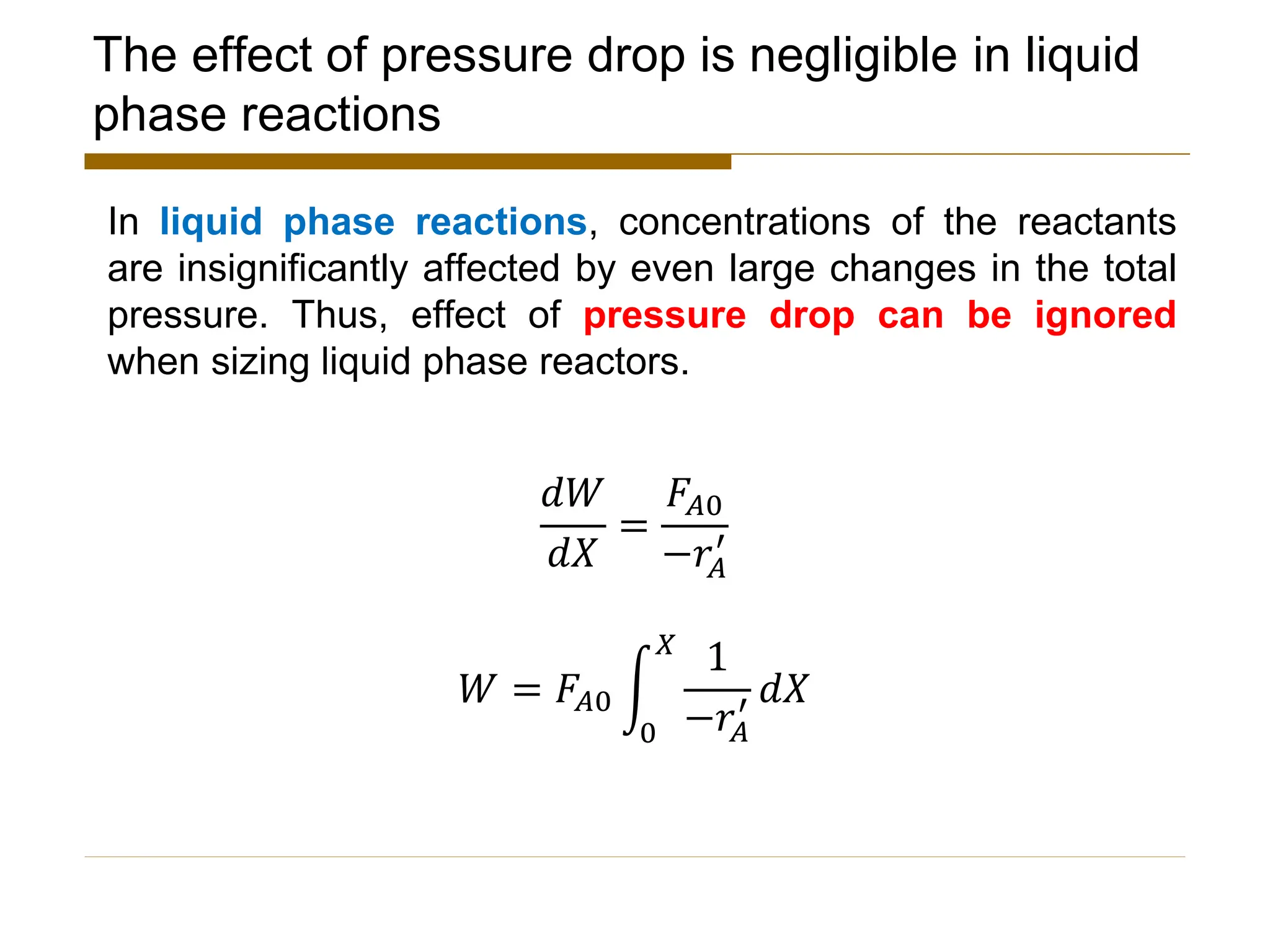
The effect of pressure drop is negligible in liquid
phase reactions
In liquid phase reactions, concentrations of the reactants
are insignificantly affected by even large changes in the total
pressure. Thus, effect of pressure drop can be ignored
when sizing liquid phase reactors.
𝑑𝑊
𝑑𝑋
=
𝐹𝐴0
−𝑟𝐴
′
𝑊 = 𝐹𝐴0 න
0
𝑋
1
−𝑟𝐴
′ 𝑑𝑋
Pressure drop must be considered for gas phase
reactions
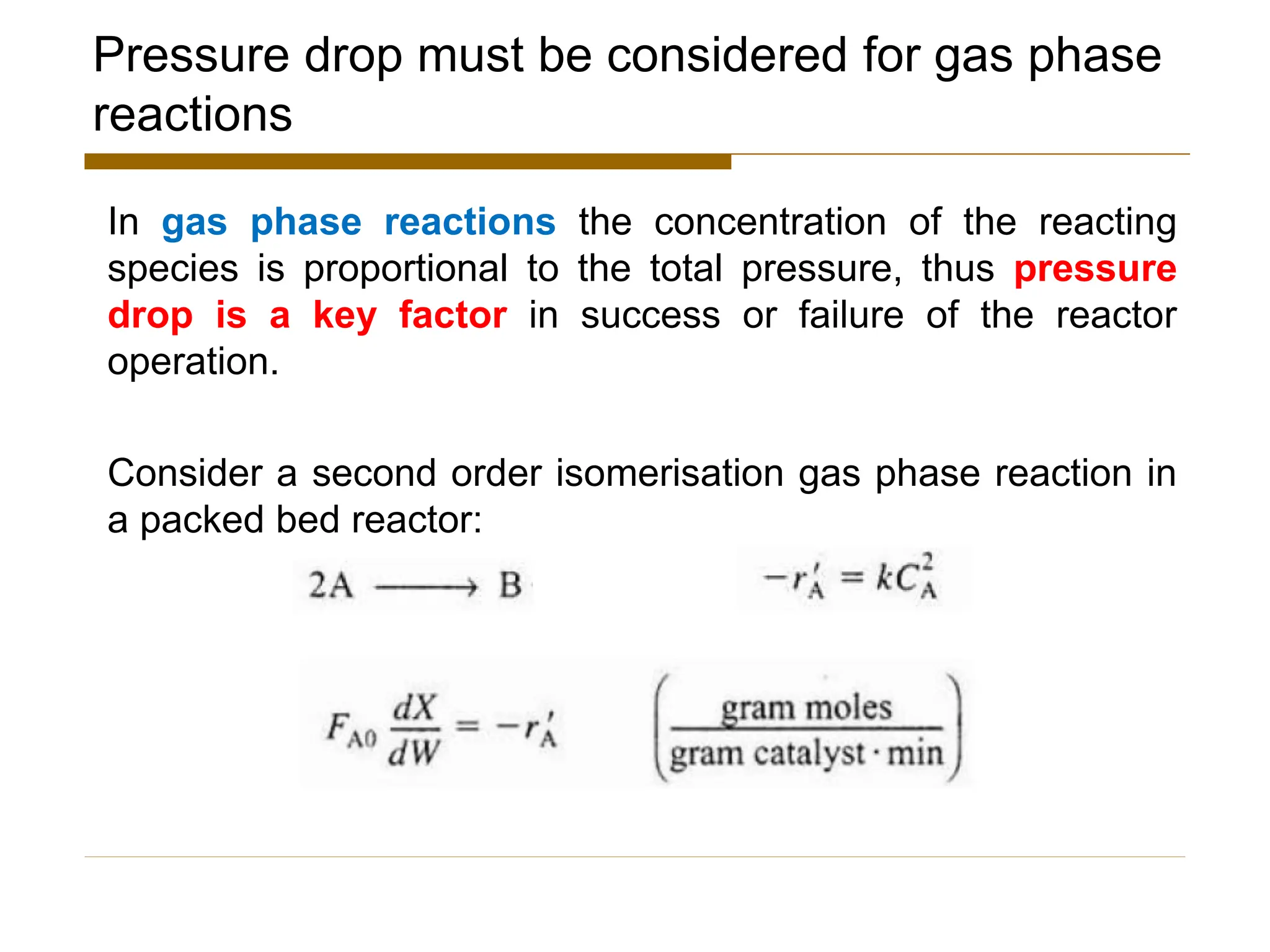
In gas phase reactions the concentration of the reacting
species is proportional to the total pressure, thus pressure
drop is a key factor in success or failure of the reactor
operation.
Consider a second order isomerisation gas phase reaction in
a packed bed reactor:
Pressure drop must be considered for gas phase
reactions
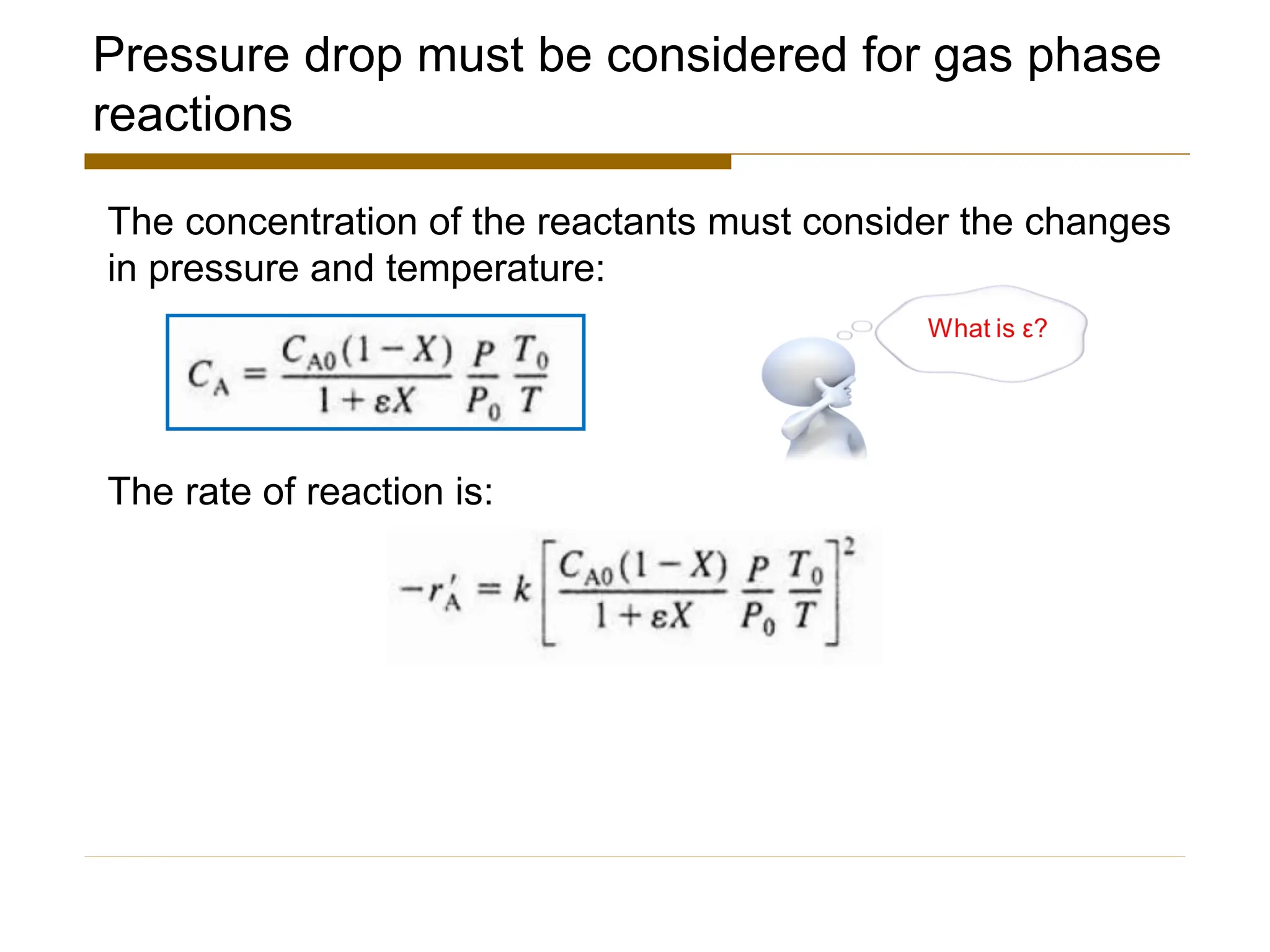
The concentration of the reactants must consider the changes
in pressure and temperature:
The rate of reaction is:
Pressure drop must be considered for gas phase
reactions
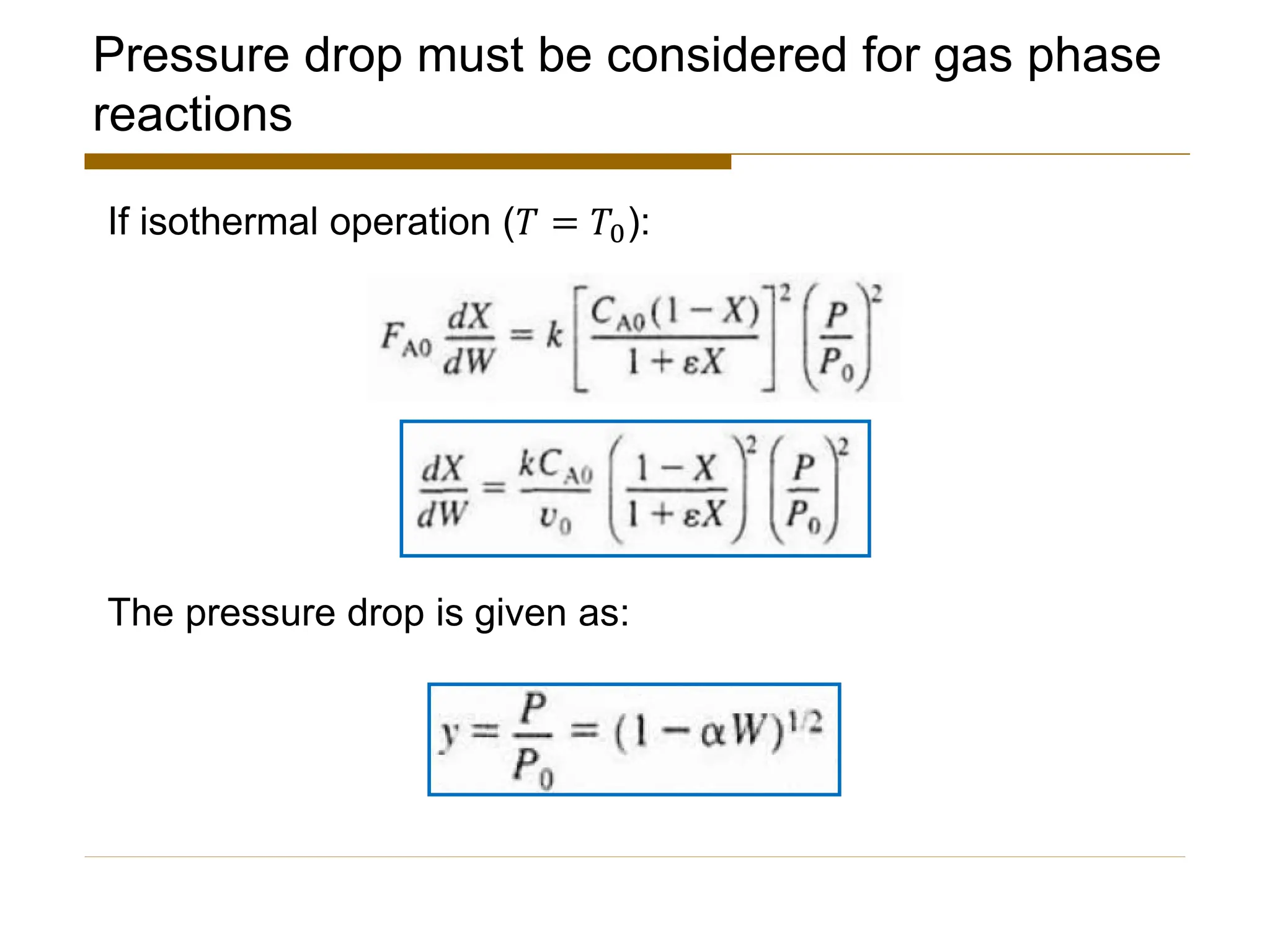
If isothermal operation (𝑇 = 𝑇0):
The pressure drop is given as:
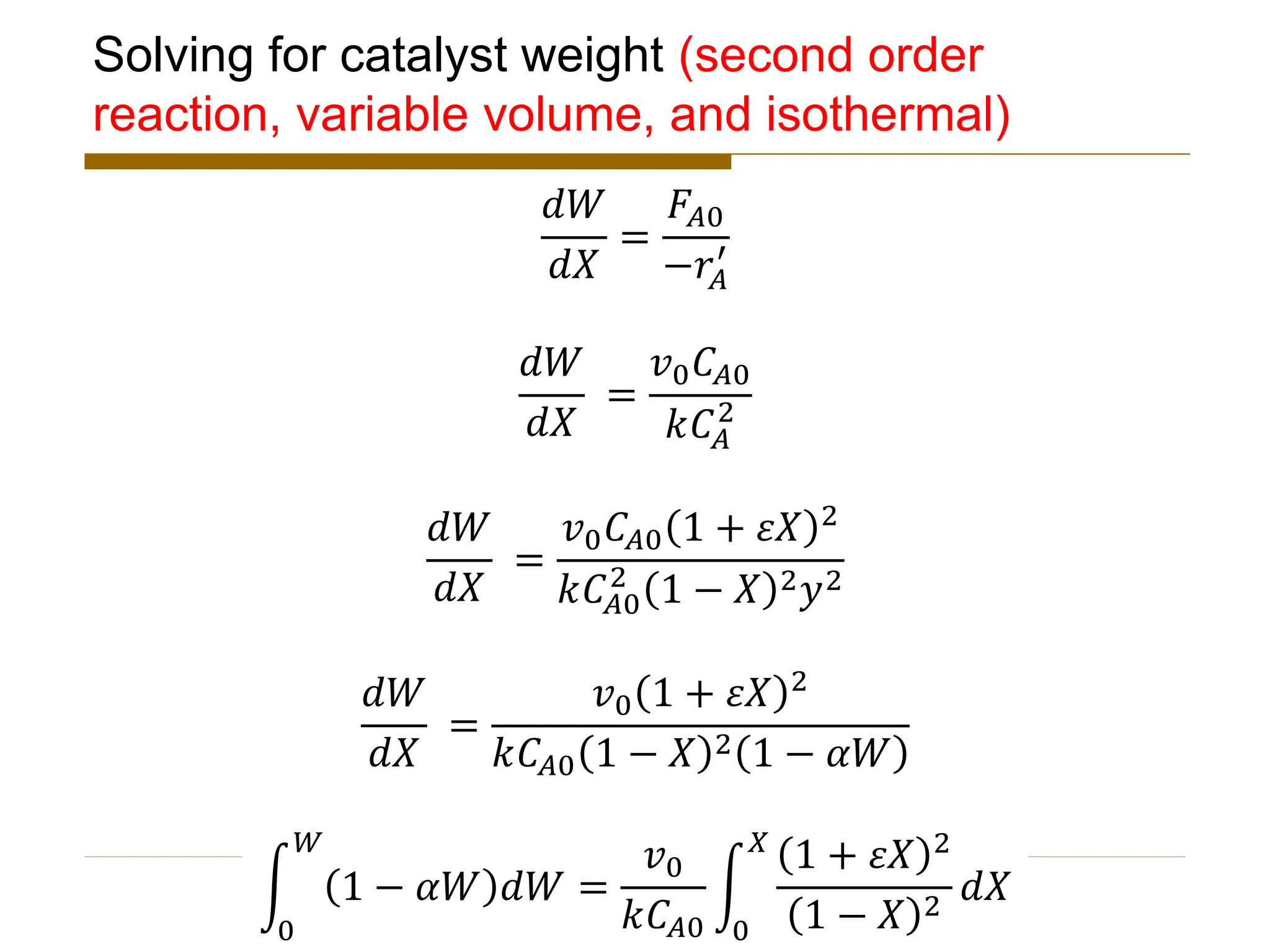
Solving for catalyst weight (second order
reaction, variable volume, and isothermal)
𝑑𝑊
𝑑𝑋
=
𝐹𝐴0
−𝑟𝐴
′
𝑑𝑊
𝑑𝑋
=
𝑣0𝐶𝐴0
𝑘𝐶𝐴
2
𝑑𝑊
𝑑𝑋
=
𝑣0𝐶𝐴0 1 + 𝜀𝑋 2
𝑘𝐶𝐴0
2
1 − 𝑋 2𝑦2
𝑑𝑊
𝑑𝑋
=
𝑣0 1 + 𝜀𝑋 2
𝑘𝐶𝐴0 1 − 𝑋 2 1 − 𝛼𝑊
න
0
𝑊
1 − 𝛼𝑊 𝑑𝑊 =
𝑣0
𝑘𝐶𝐴0
න
0
𝑋
1 + 𝜀𝑋 2
1 − 𝑋 2
𝑑𝑋
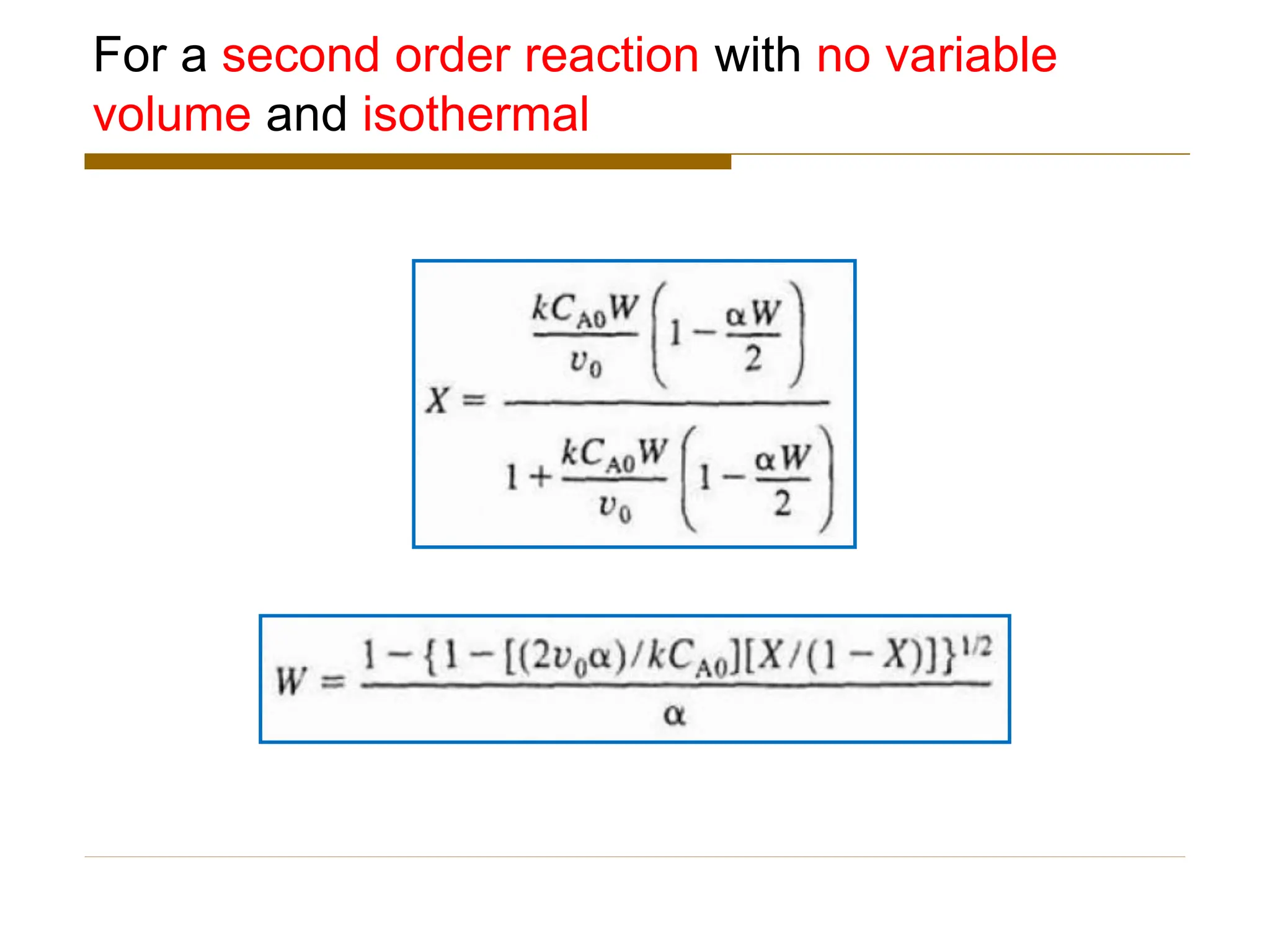
For a second order reaction with no variable
volume and isothermal
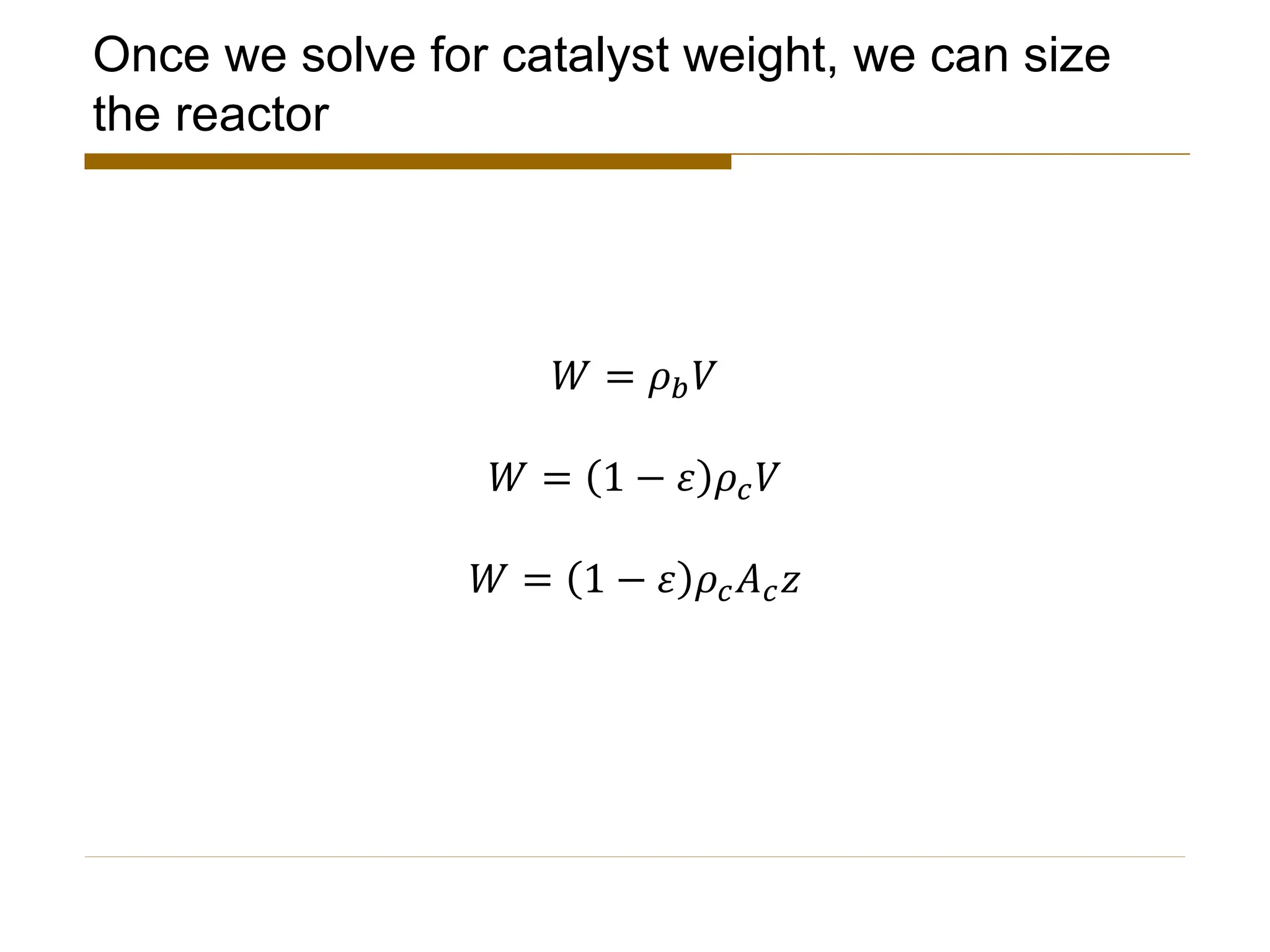
Once we solve for catalyst weight, we can size
the reactor
𝑊 = 𝜌𝑏𝑉
𝑊 = 1 − 𝜀 𝜌𝑐𝑉
𝑊 = 1 − 𝜀 𝜌𝑐𝐴𝑐𝑧
What if the reactor is
NOT operated isothermally
or
temperature changes CANNOT be neglected?
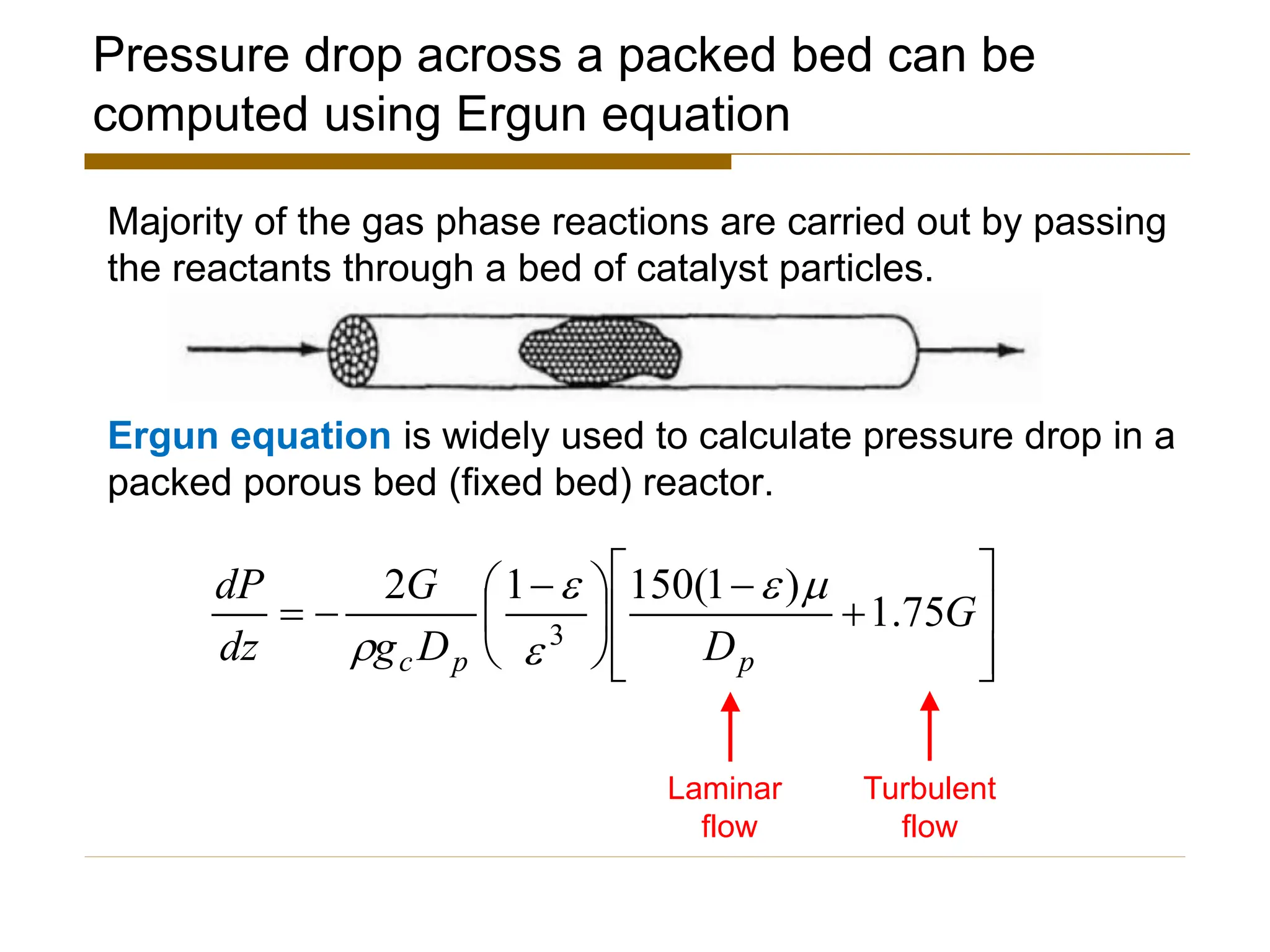
Pressure drop across a packed bed can be
computed using Ergun equation
Majority of the gas phase reactions are carried out by passing
the reactants through a bed of catalyst particles.
Ergun equation is widely used to calculate pressure drop in a
packed porous bed (fixed bed) reactor.








+
−





 −
−
= G
D
D
g
G
dz
dP
p
p
c
75
.
1
)
1
(
150
1
2
3





Laminar
flow
Turbulent
flow
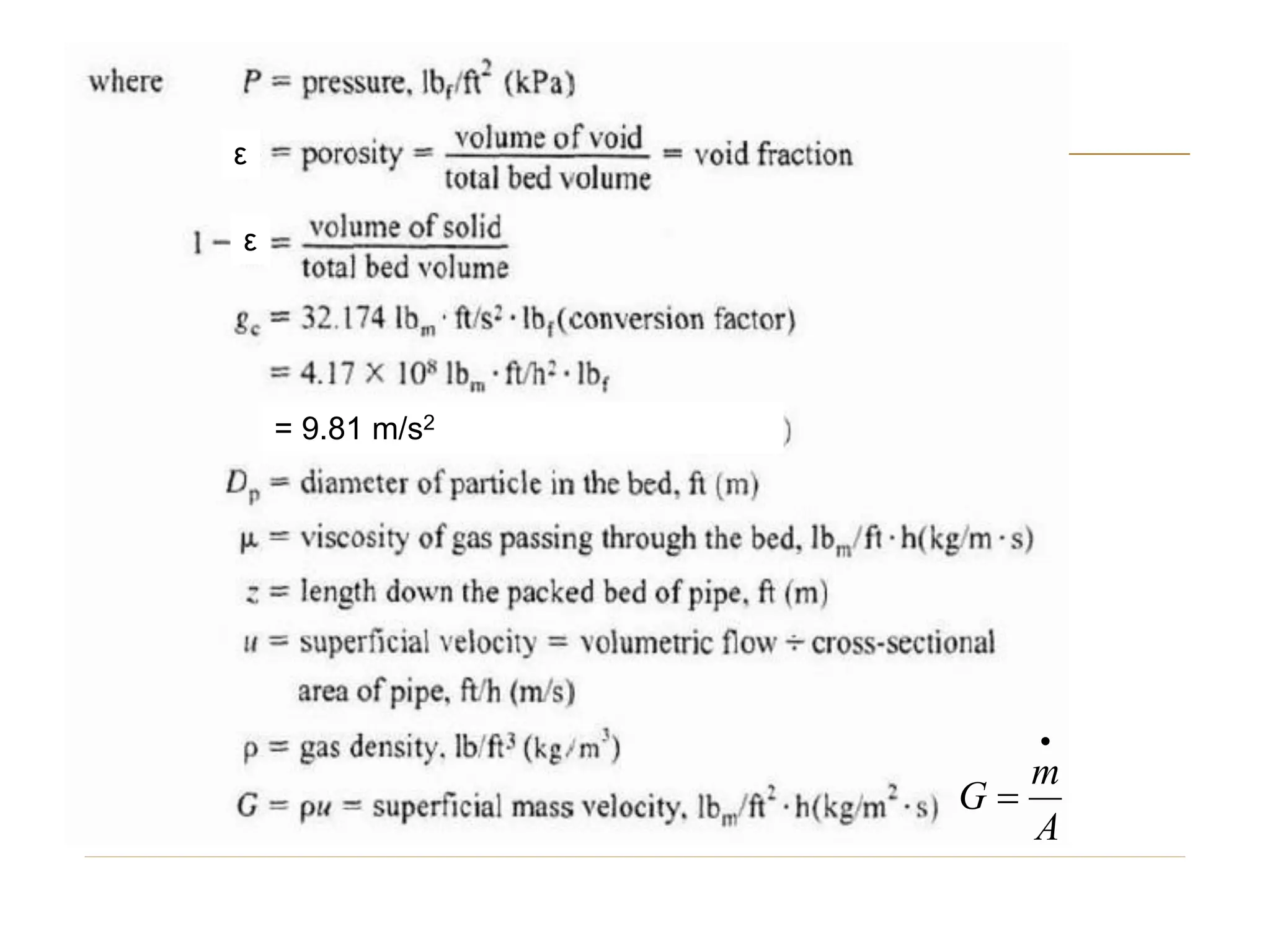
A
m
G
•
=
= 9.81 m/s2
ε
ε
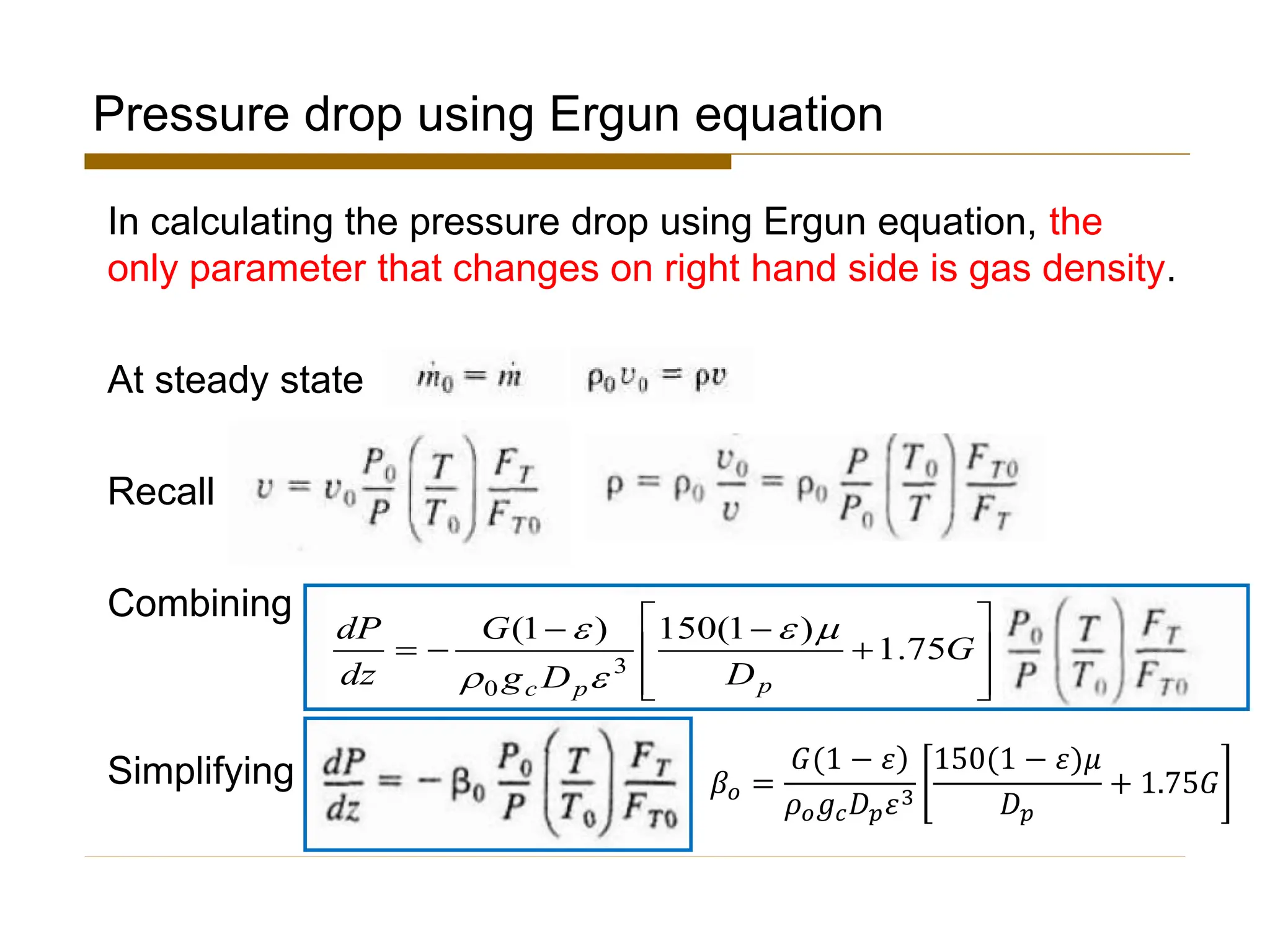
Pressure drop using Ergun equation
In calculating the pressure drop using Ergun equation, the
only parameter that changes on right hand side is gas density.
At steady state
Recall
Combining
Simplifying








+
−
−
−
= G
D
D
g
G
dz
dP
p
p
c
75
.
1
)
1
(
150
)
1
(
3
0





𝛽𝑜 =
ሻ
𝐺(1 − 𝜀
𝜌𝑜𝑔𝑐𝐷𝑝𝜀3
150(1 − 𝜀ሻ𝜇
𝐷𝑝
+ 1.75𝐺
Pressure drop using Ergun equation
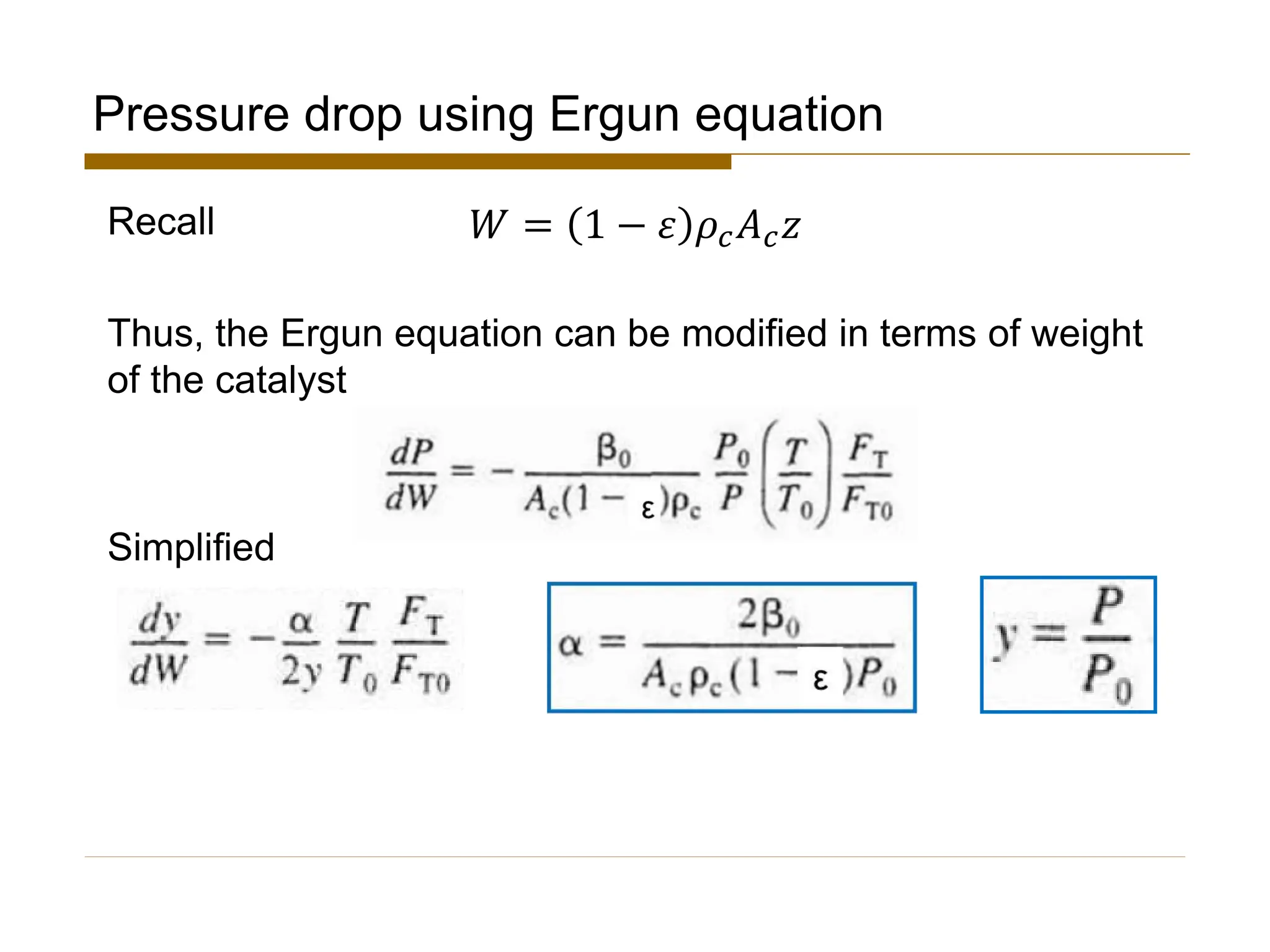
Recall
Thus, the Ergun equation can be modified in terms of weight
of the catalyst
Simplified
𝑊 = 1 − 𝜀 𝜌𝑐𝐴𝑐𝑧
Pressure drop using Ergun equation
Recall
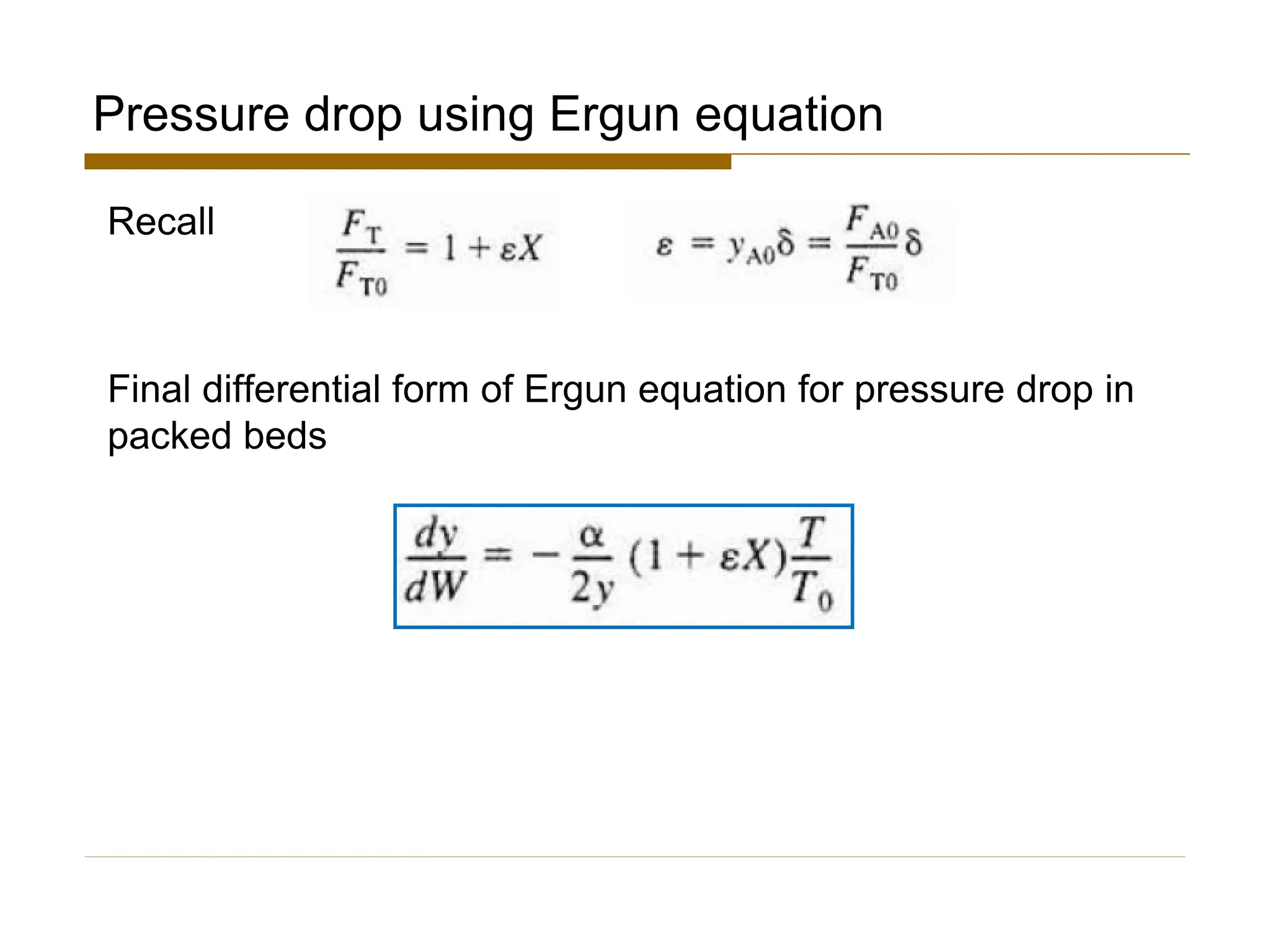
Final differential form of Ergun equation for pressure drop in
packed beds
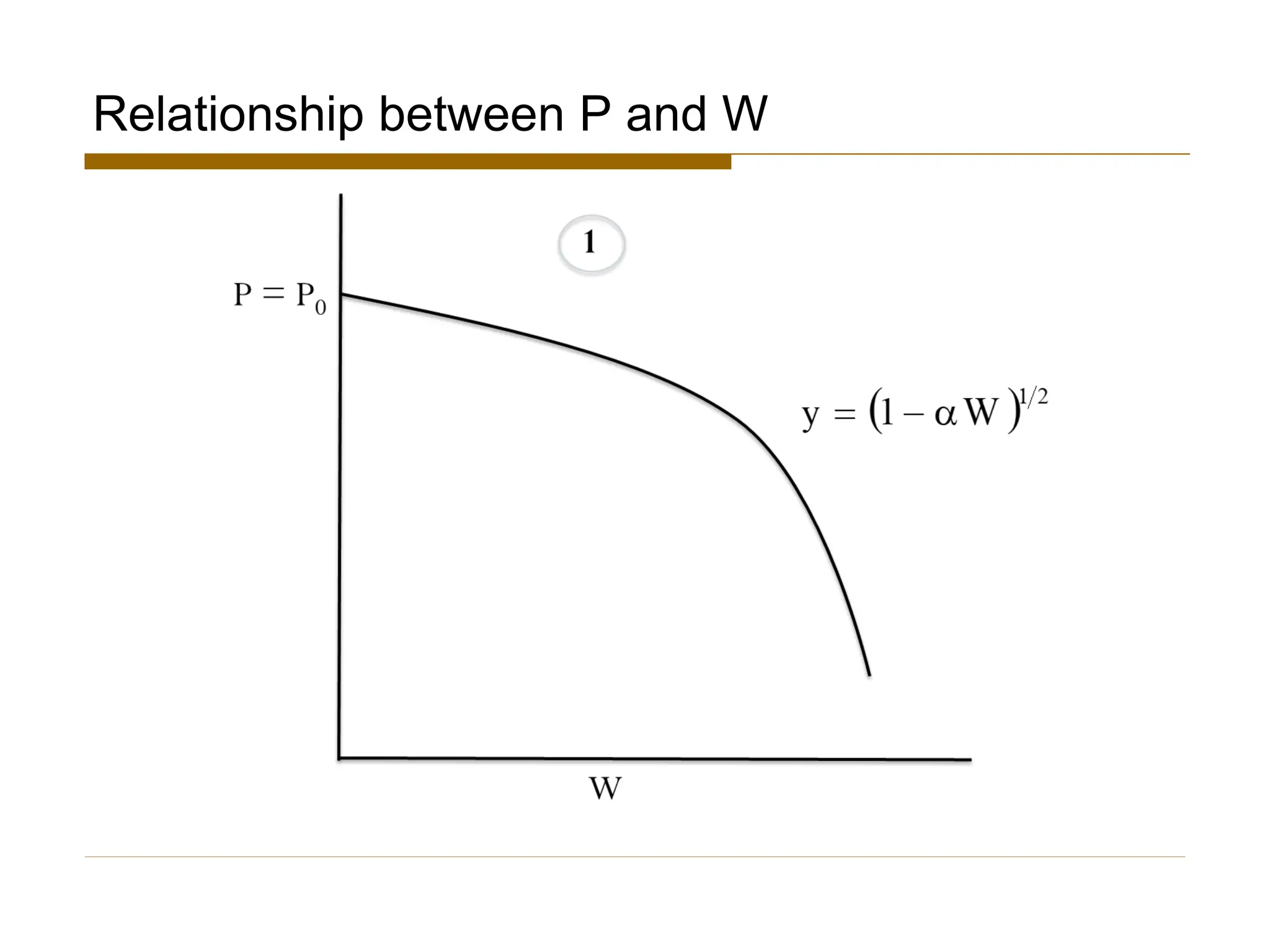
Relationship between P and W
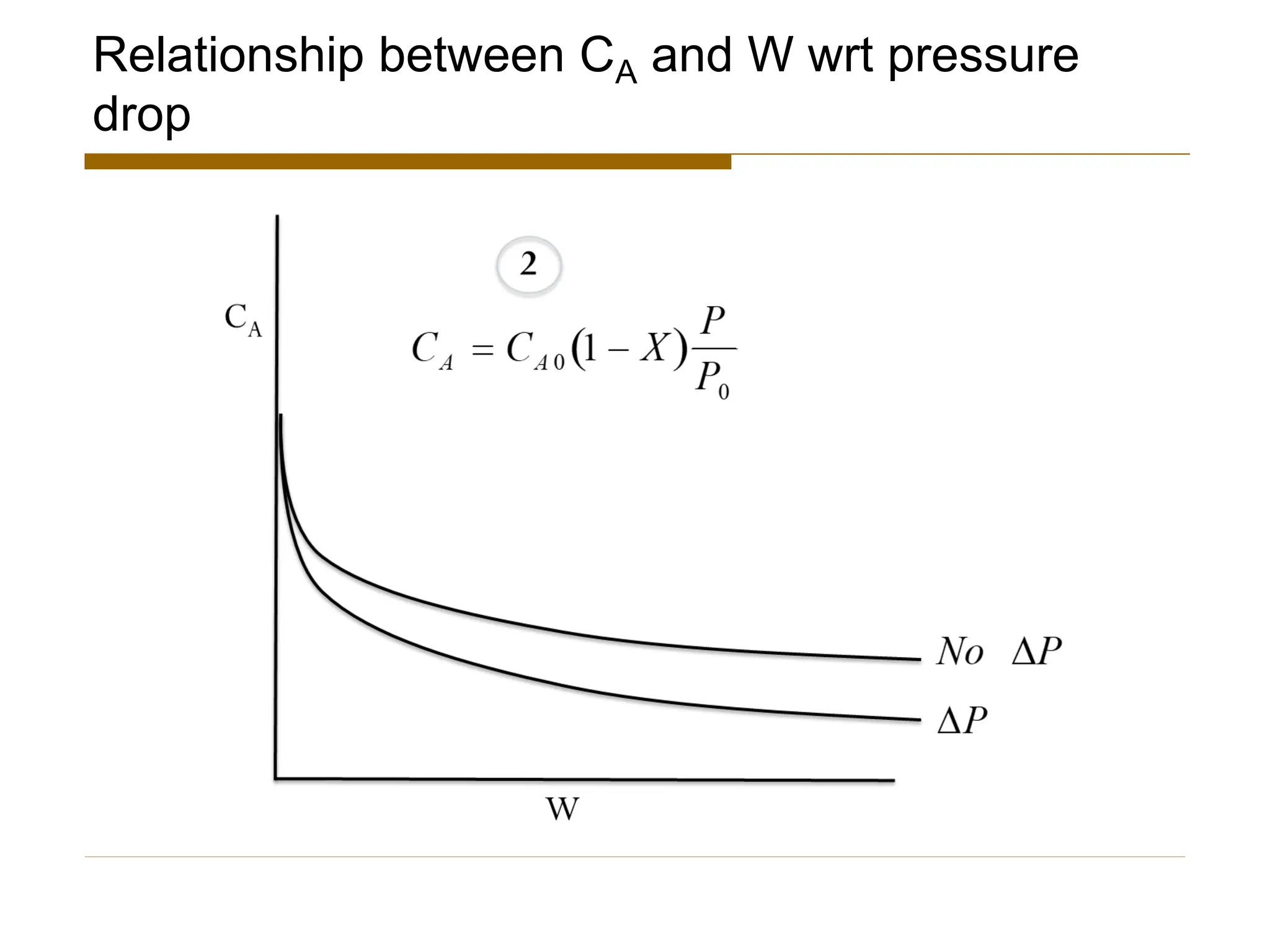
Relationship between CA and W wrt pressure
drop
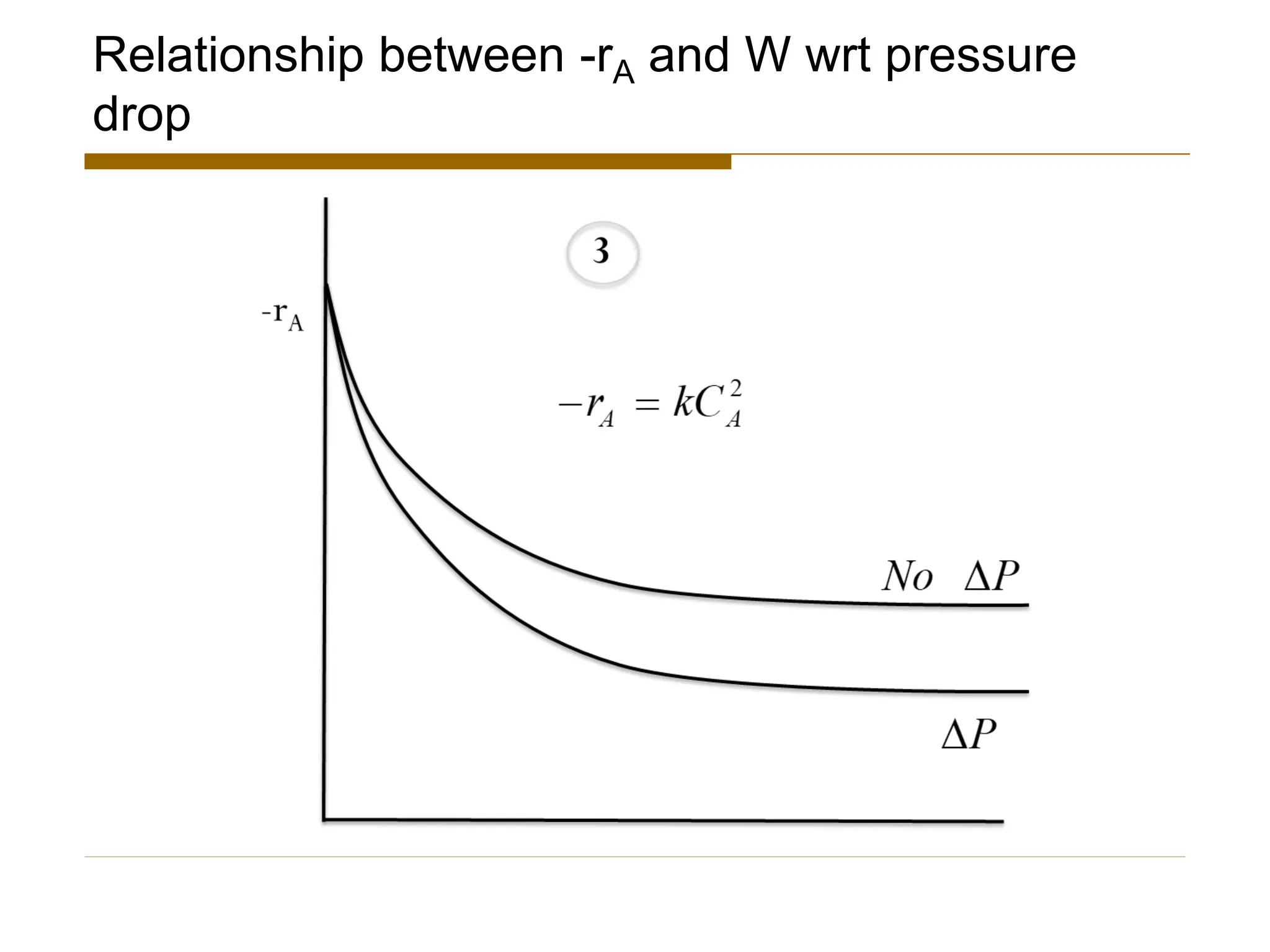
Relationship between -rA and W wrt pressure
drop
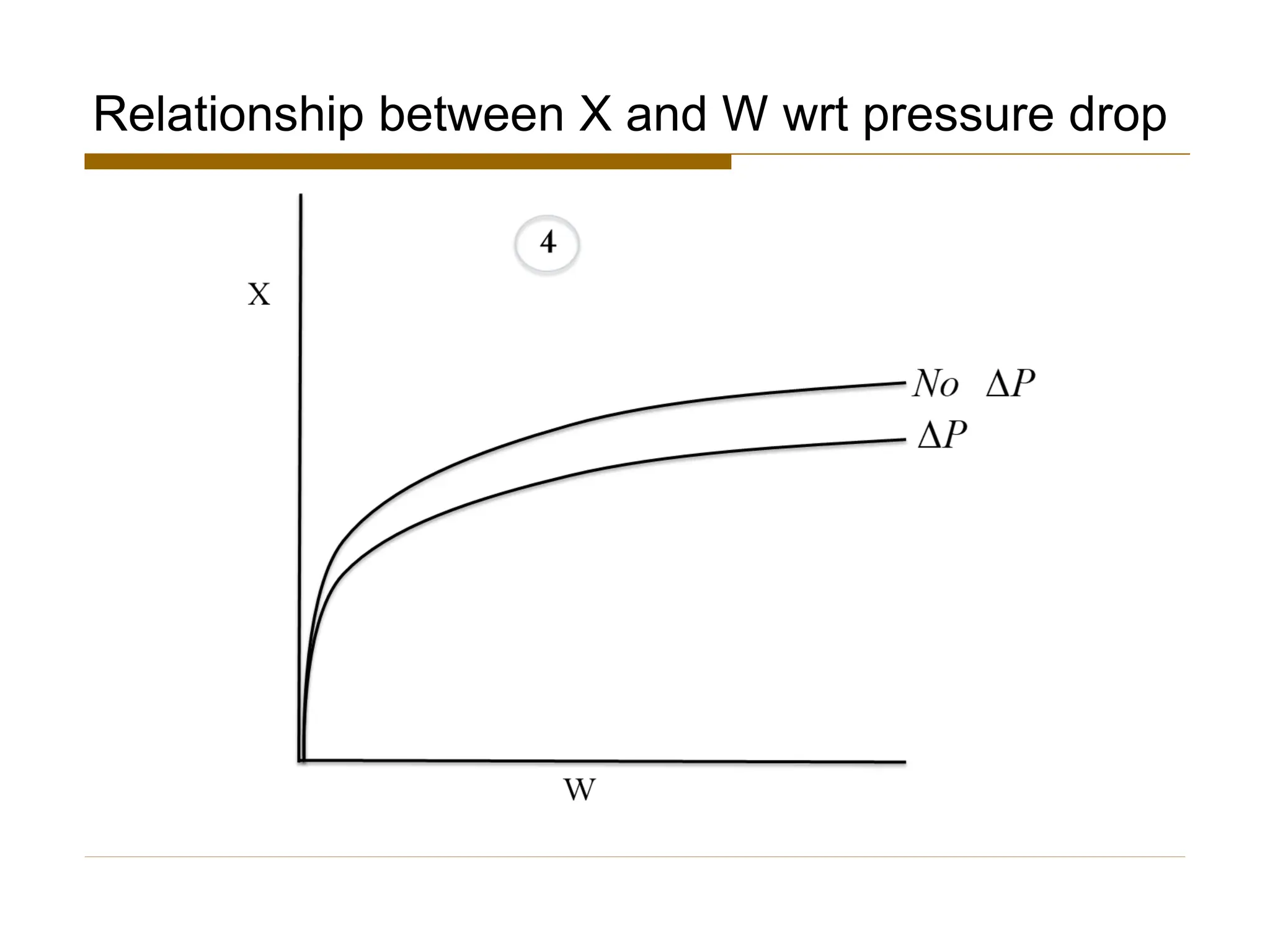
Relationship between X and W wrt pressure drop
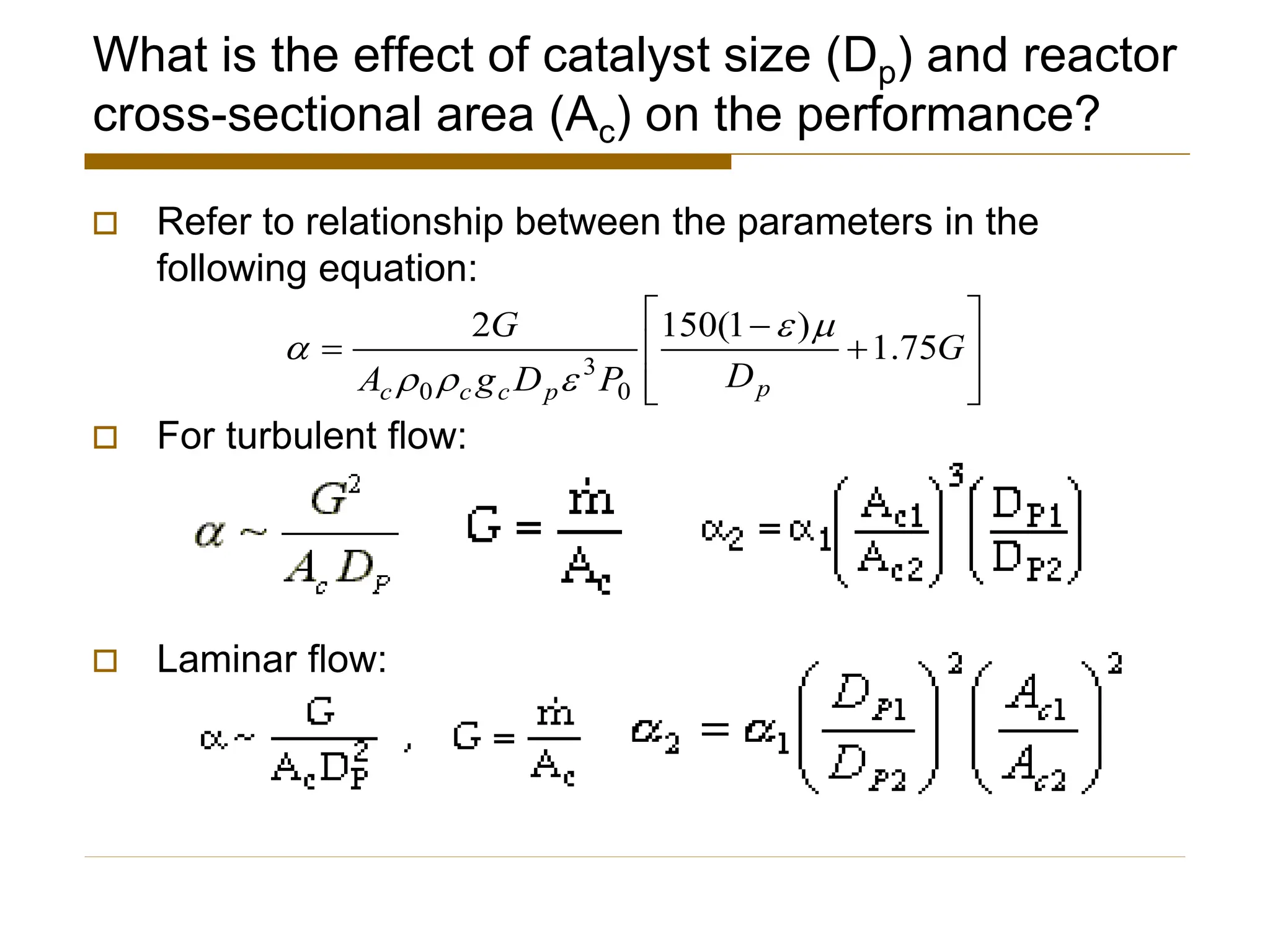
What is the effect of catalyst size (Dp) and reactor
cross-sectional area (Ac) on the performance?
 Refer to relationship between the parameters in the
following equation:
 For turbulent flow:
 Laminar flow:








+
−
= G
D
P
D
g
A
G
p
p
c
c
c
75
.
1
)
1
(
150
2
0
3
0






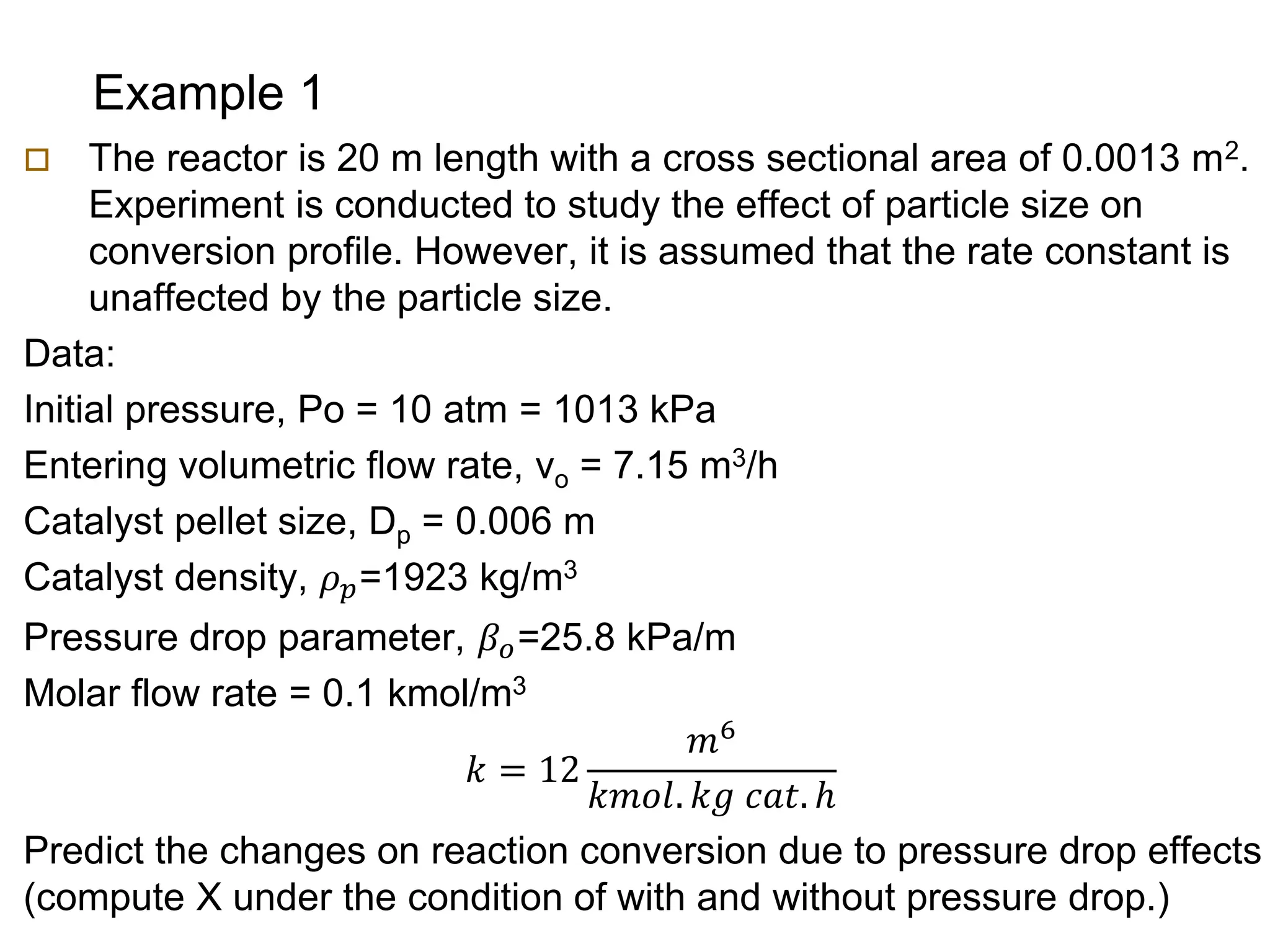
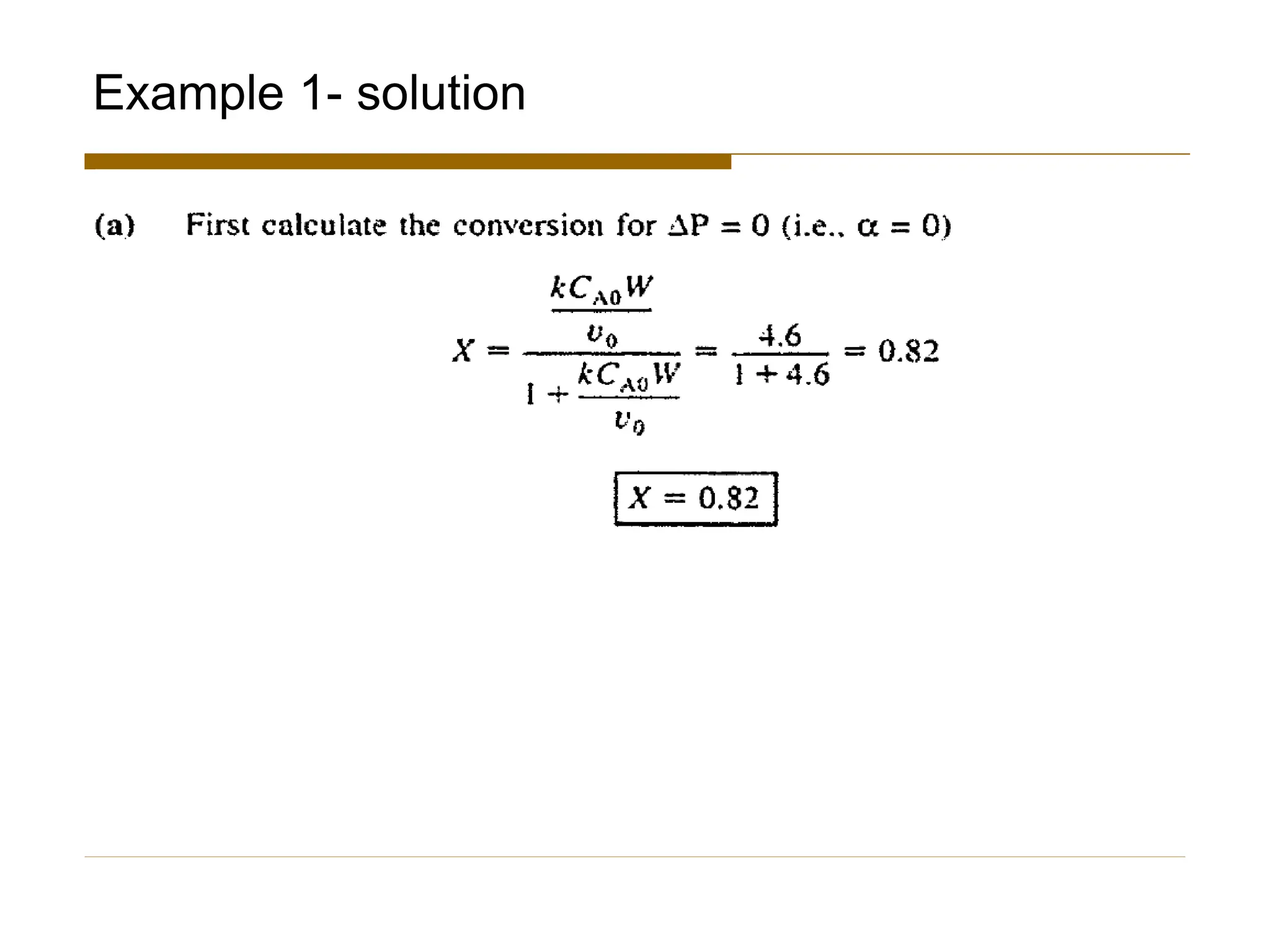
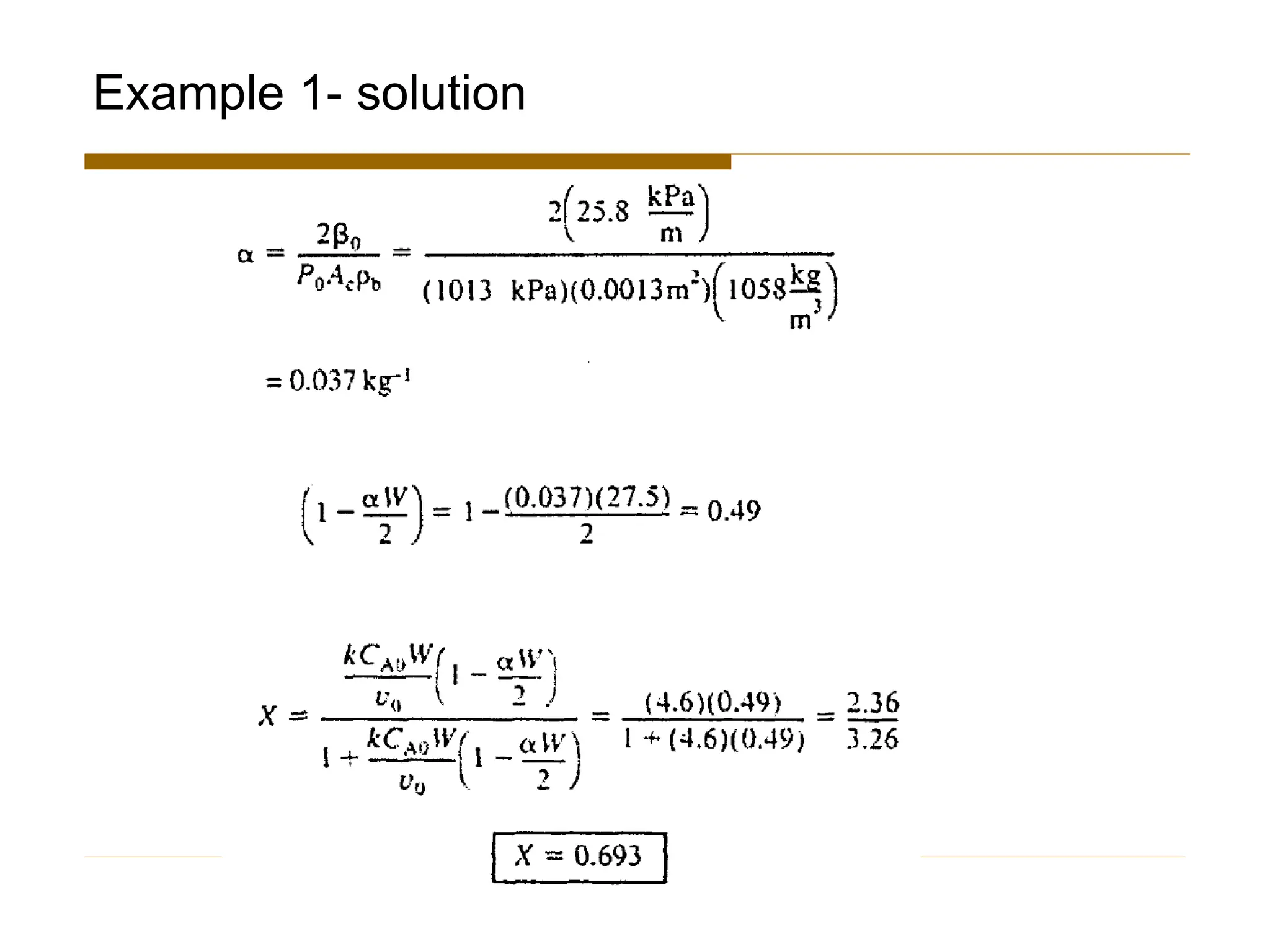
Example 1
 The reactor is 20 m length with a cross sectional area of 0.0013 m2.
Experiment is conducted to study the effect of particle size on
conversion profile. However, it is assumed that the rate constant is
unaffected by the particle size.
Data:
Initial pressure, Po = 10 atm = 1013 kPa
Entering volumetric flow rate, vo = 7.15 m3/h
Catalyst pellet size, Dp = 0.006 m
Catalyst density, 𝜌𝑝=1923 kg/m3
Pressure drop parameter, 𝛽𝑜=25.8 kPa/m
Molar flow rate = 0.1 kmol/m3
𝑘 = 12
𝑚6
𝑘𝑚𝑜𝑙. 𝑘𝑔 𝑐𝑎𝑡. ℎ
Predict the changes on reaction conversion due to pressure drop effects
(compute X under the condition of with and without pressure drop.)
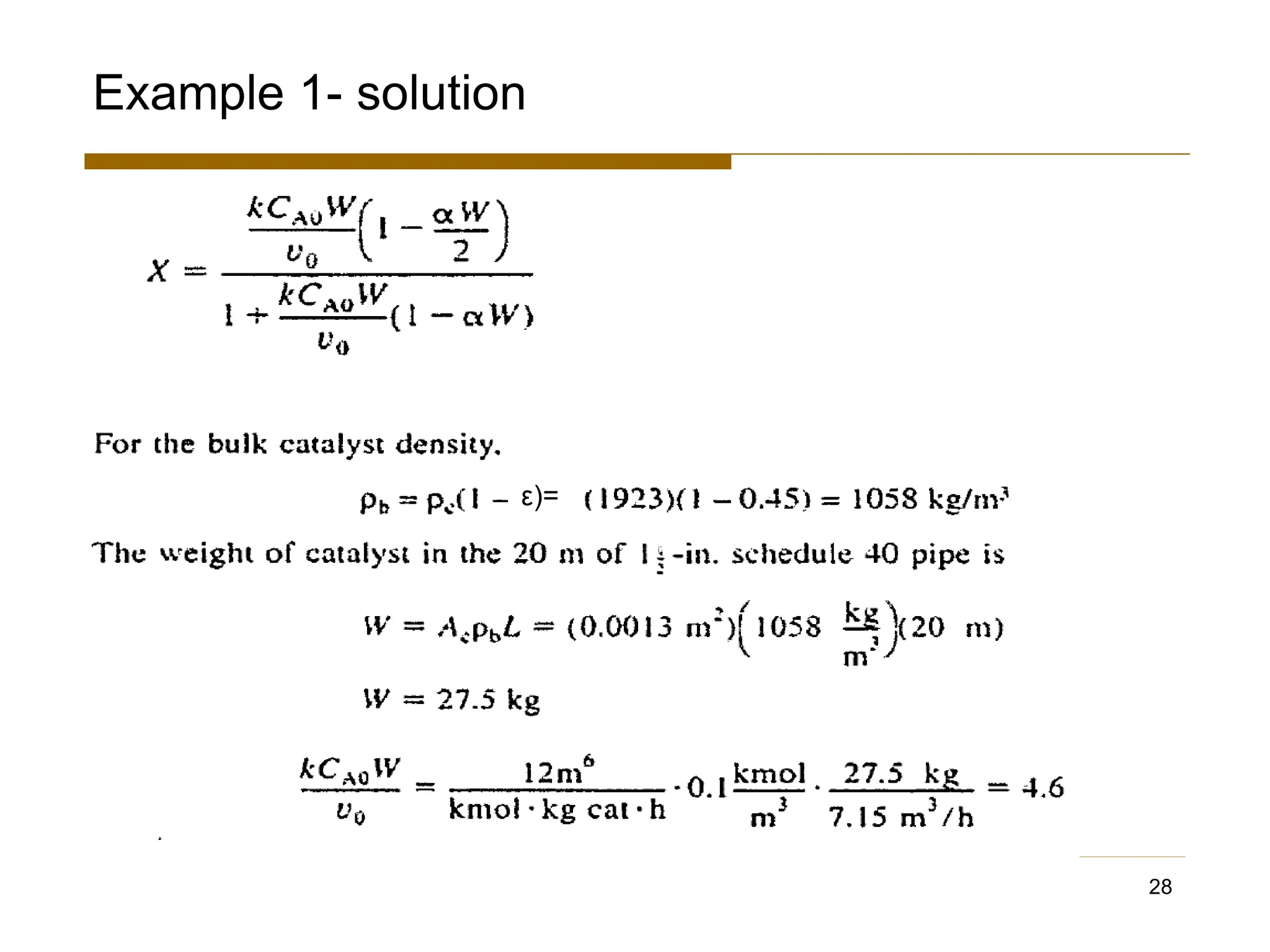
Example 1- solution
28
ε)=
Example 1- solution
Example 1- solution
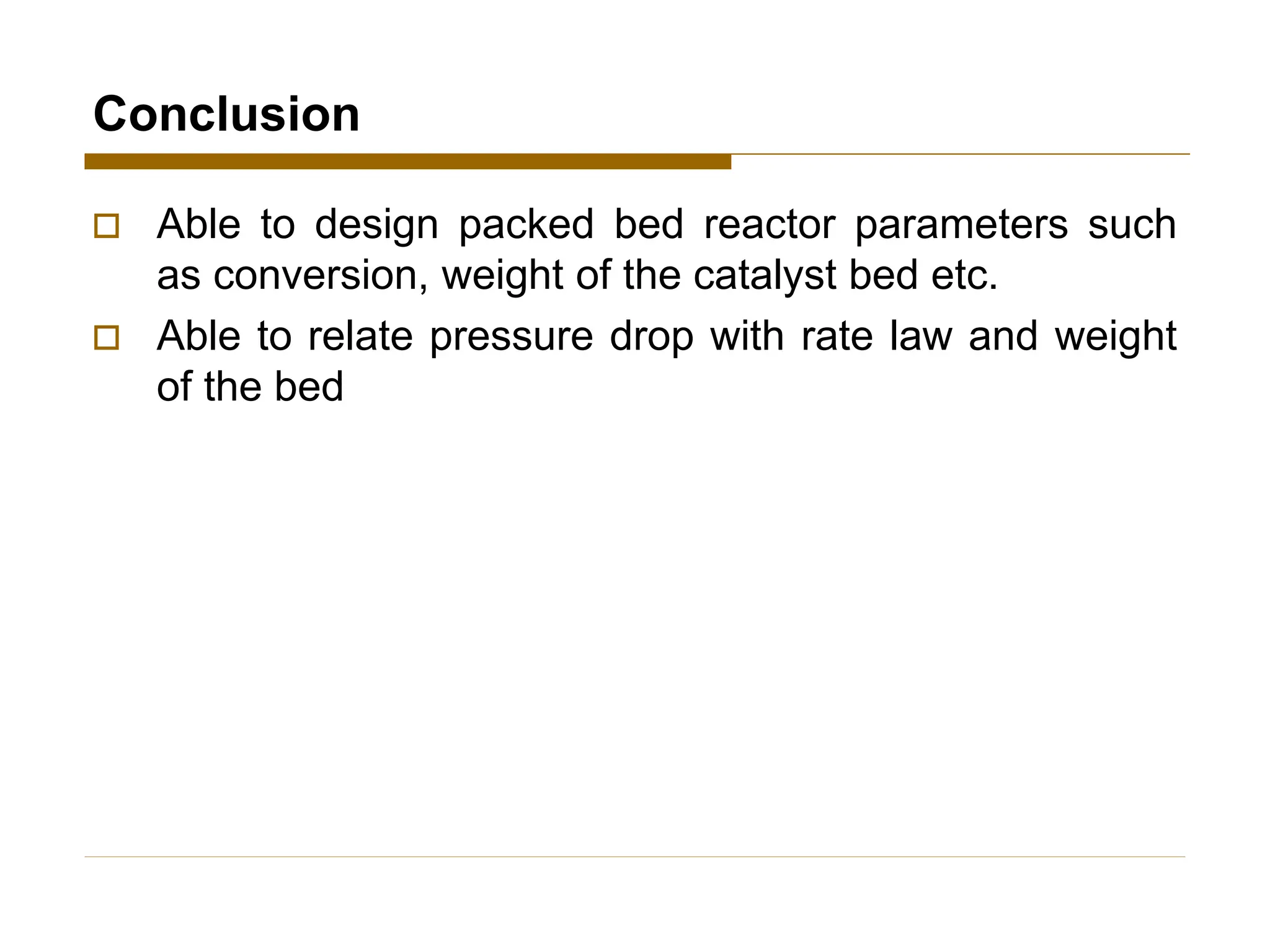
Conclusion
 Able to design packed bed reactor parameters such
as conversion, weight of the catalyst bed etc.
 Able to relate pressure drop with rate law and weight
of the bed

Lecture 9_Packed Bed Reactor Design_FIR.pdf

  • 1.
    Lecture 9: Packedbed reactor design CHE 62104 Chemical Reaction Engineering Dr. Firnaaz Ahamed Firnaaz.ahamed@taylors.edu.my 1
  • 2.
    What is apacked bed reactor?  A fixed bed reactor usually consists of a cylindrical vessel packed with catalyst pellets and easy to design and operate. Catalyst Inert balls Feed Product  The metal support grid and screen is placed near the bottom to support the catalyst.  Inert ceramic balls are placed above the catalyst bed to distribute the feed evenly.
  • 3.
    Learning outcomes At theend of the lesson, you should be able to :  Design the packed bed reactor ◼ determine the weight of the catalyst ◼ determine pressure drop parameters ◼ determine conversion in the packed bed reactor ◼ study the effect of pressure drop on reaction rate catalyst weight and conversion 3
  • 4.
    Pros and consof a packed bed reactor Advantages Disadvantages • Ideal plug flow behavior • Lower maintenance cost • Reduced loss due to attrition and wear. • The regeneration or replacement of catalyst is difficult, process needs to be shutdown. • Plugging of bed due to coke deposition which results in high pressure drop.
  • 5.
     Catalyst pelletsizes are usually in the range of 1 to 10 mm. Non- uniform packing of catalysts can cause channeling of fluids leading to poor heat and mass transfer.  The bed voidage is usually: Hollow cylinder of thin wall thickness ( ~ 0.6 – 0.8) Sphere ( ~ 0.37 – 0.4) Solid cylinder ( ~ 0.35)  For better heat management for very highly exothermic (or endothermic) reaction the multi-tubular reactor is used with catalyst packed inside the tubes. The cooling (or heating) fluid flows through the shell side. Features of packed bed reactor
  • 6.
  • 7.
    Governing equations forsizing a packed bed reactor (PBR)  A general PFR is given as:  In a PBR, catalyst weight is related to the volume as:  The volumetric reaction rate is also related to the reaction rate per unit mass of catalyst as: 𝑑𝑉 𝑑𝑋 = 𝐹𝐴0 −𝑟𝐴 𝑊 = 𝜌𝑏𝑉 = 1 − 𝜀 𝜌𝑐𝑉 kg = kg/m3 m3 −𝑟𝐴 = 𝜌𝑏 −𝑟𝐴 ′ Τ mol m3. s = kg/m3 Τ mol kg. s
  • 8.
    Governing equations forsizing packed bed reactor  A general PBR is given as: 𝑑𝑊 𝑑𝑋 = 𝐹𝐴0 −𝑟𝐴 ′ 𝑊 = 𝐹𝐴0 න 0 𝑋 1 −𝑟𝐴 ′ 𝑑𝑋
  • 9.
    The effect ofpressure drop is negligible in liquid phase reactions In liquid phase reactions, concentrations of the reactants are insignificantly affected by even large changes in the total pressure. Thus, effect of pressure drop can be ignored when sizing liquid phase reactors. 𝑑𝑊 𝑑𝑋 = 𝐹𝐴0 −𝑟𝐴 ′ 𝑊 = 𝐹𝐴0 න 0 𝑋 1 −𝑟𝐴 ′ 𝑑𝑋
  • 10.
    Pressure drop mustbe considered for gas phase reactions In gas phase reactions the concentration of the reacting species is proportional to the total pressure, thus pressure drop is a key factor in success or failure of the reactor operation. Consider a second order isomerisation gas phase reaction in a packed bed reactor:
  • 11.
    Pressure drop mustbe considered for gas phase reactions The concentration of the reactants must consider the changes in pressure and temperature: The rate of reaction is:
  • 12.
    Pressure drop mustbe considered for gas phase reactions If isothermal operation (𝑇 = 𝑇0): The pressure drop is given as:
  • 13.
    Solving for catalystweight (second order reaction, variable volume, and isothermal) 𝑑𝑊 𝑑𝑋 = 𝐹𝐴0 −𝑟𝐴 ′ 𝑑𝑊 𝑑𝑋 = 𝑣0𝐶𝐴0 𝑘𝐶𝐴 2 𝑑𝑊 𝑑𝑋 = 𝑣0𝐶𝐴0 1 + 𝜀𝑋 2 𝑘𝐶𝐴0 2 1 − 𝑋 2𝑦2 𝑑𝑊 𝑑𝑋 = 𝑣0 1 + 𝜀𝑋 2 𝑘𝐶𝐴0 1 − 𝑋 2 1 − 𝛼𝑊 න 0 𝑊 1 − 𝛼𝑊 𝑑𝑊 = 𝑣0 𝑘𝐶𝐴0 න 0 𝑋 1 + 𝜀𝑋 2 1 − 𝑋 2 𝑑𝑋
  • 14.
    For a secondorder reaction with no variable volume and isothermal
  • 15.
    Once we solvefor catalyst weight, we can size the reactor 𝑊 = 𝜌𝑏𝑉 𝑊 = 1 − 𝜀 𝜌𝑐𝑉 𝑊 = 1 − 𝜀 𝜌𝑐𝐴𝑐𝑧
  • 16.
    What if thereactor is NOT operated isothermally or temperature changes CANNOT be neglected?
  • 17.
    Pressure drop acrossa packed bed can be computed using Ergun equation Majority of the gas phase reactions are carried out by passing the reactants through a bed of catalyst particles. Ergun equation is widely used to calculate pressure drop in a packed porous bed (fixed bed) reactor.         + −       − − = G D D g G dz dP p p c 75 . 1 ) 1 ( 150 1 2 3      Laminar flow Turbulent flow
  • 18.
  • 19.
    Pressure drop usingErgun equation In calculating the pressure drop using Ergun equation, the only parameter that changes on right hand side is gas density. At steady state Recall Combining Simplifying         + − − − = G D D g G dz dP p p c 75 . 1 ) 1 ( 150 ) 1 ( 3 0      𝛽𝑜 = ሻ 𝐺(1 − 𝜀 𝜌𝑜𝑔𝑐𝐷𝑝𝜀3 150(1 − 𝜀ሻ𝜇 𝐷𝑝 + 1.75𝐺
  • 20.
    Pressure drop usingErgun equation Recall Thus, the Ergun equation can be modified in terms of weight of the catalyst Simplified 𝑊 = 1 − 𝜀 𝜌𝑐𝐴𝑐𝑧
  • 21.
    Pressure drop usingErgun equation Recall Final differential form of Ergun equation for pressure drop in packed beds
  • 22.
  • 23.
    Relationship between CAand W wrt pressure drop
  • 24.
    Relationship between -rAand W wrt pressure drop
  • 25.
    Relationship between Xand W wrt pressure drop
  • 26.
    What is theeffect of catalyst size (Dp) and reactor cross-sectional area (Ac) on the performance?  Refer to relationship between the parameters in the following equation:  For turbulent flow:  Laminar flow:         + − = G D P D g A G p p c c c 75 . 1 ) 1 ( 150 2 0 3 0      
  • 27.
    Example 1  Thereactor is 20 m length with a cross sectional area of 0.0013 m2. Experiment is conducted to study the effect of particle size on conversion profile. However, it is assumed that the rate constant is unaffected by the particle size. Data: Initial pressure, Po = 10 atm = 1013 kPa Entering volumetric flow rate, vo = 7.15 m3/h Catalyst pellet size, Dp = 0.006 m Catalyst density, 𝜌𝑝=1923 kg/m3 Pressure drop parameter, 𝛽𝑜=25.8 kPa/m Molar flow rate = 0.1 kmol/m3 𝑘 = 12 𝑚6 𝑘𝑚𝑜𝑙. 𝑘𝑔 𝑐𝑎𝑡. ℎ Predict the changes on reaction conversion due to pressure drop effects (compute X under the condition of with and without pressure drop.)
  • 28.
  • 29.
  • 30.
  • 31.
    Conclusion  Able todesign packed bed reactor parameters such as conversion, weight of the catalyst bed etc.  Able to relate pressure drop with rate law and weight of the bed