Games vs. searchproblems
• "Unpredictable" opponent specifying a
move for every possible opponent reply
4.
Games in AI
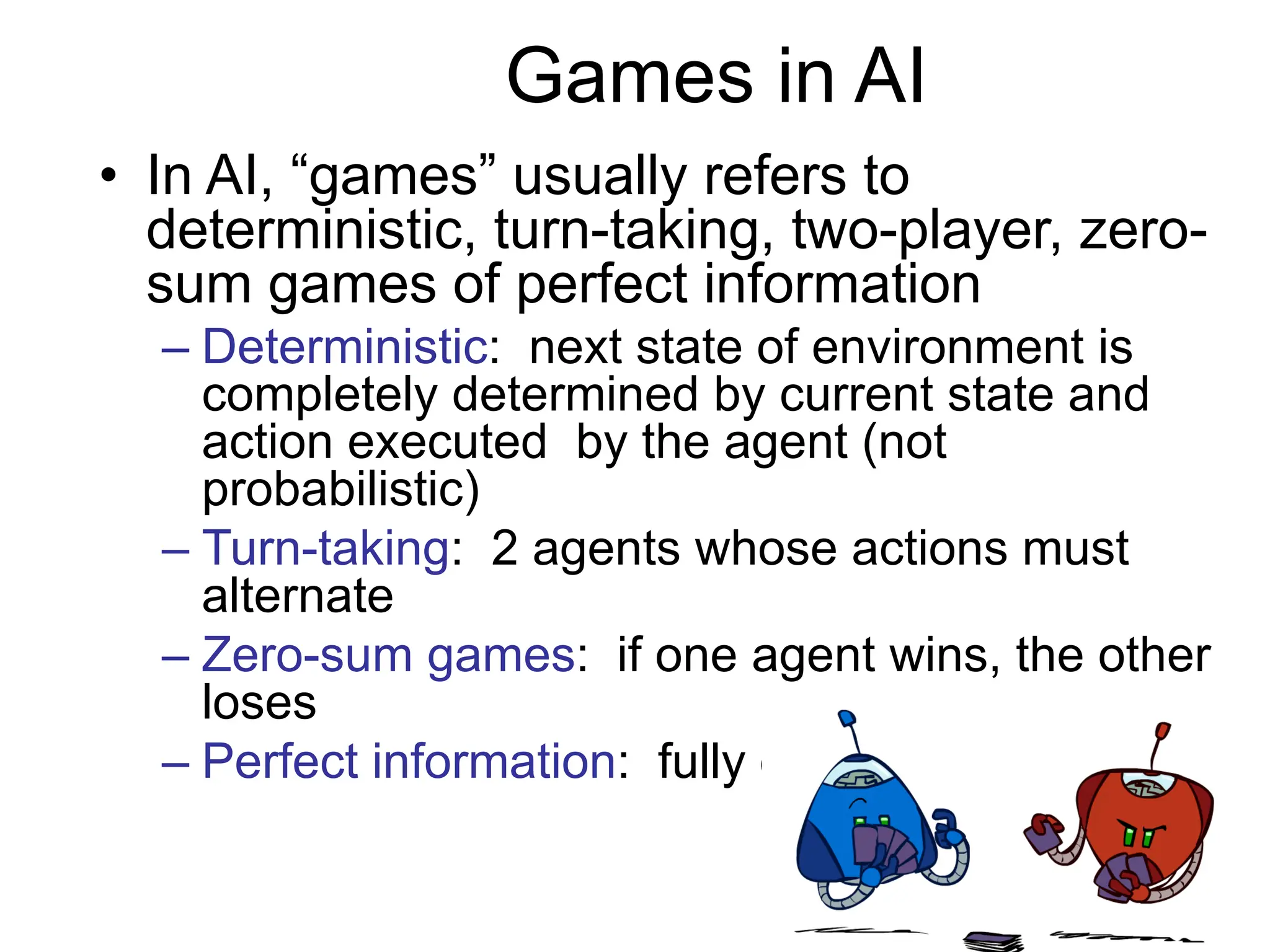
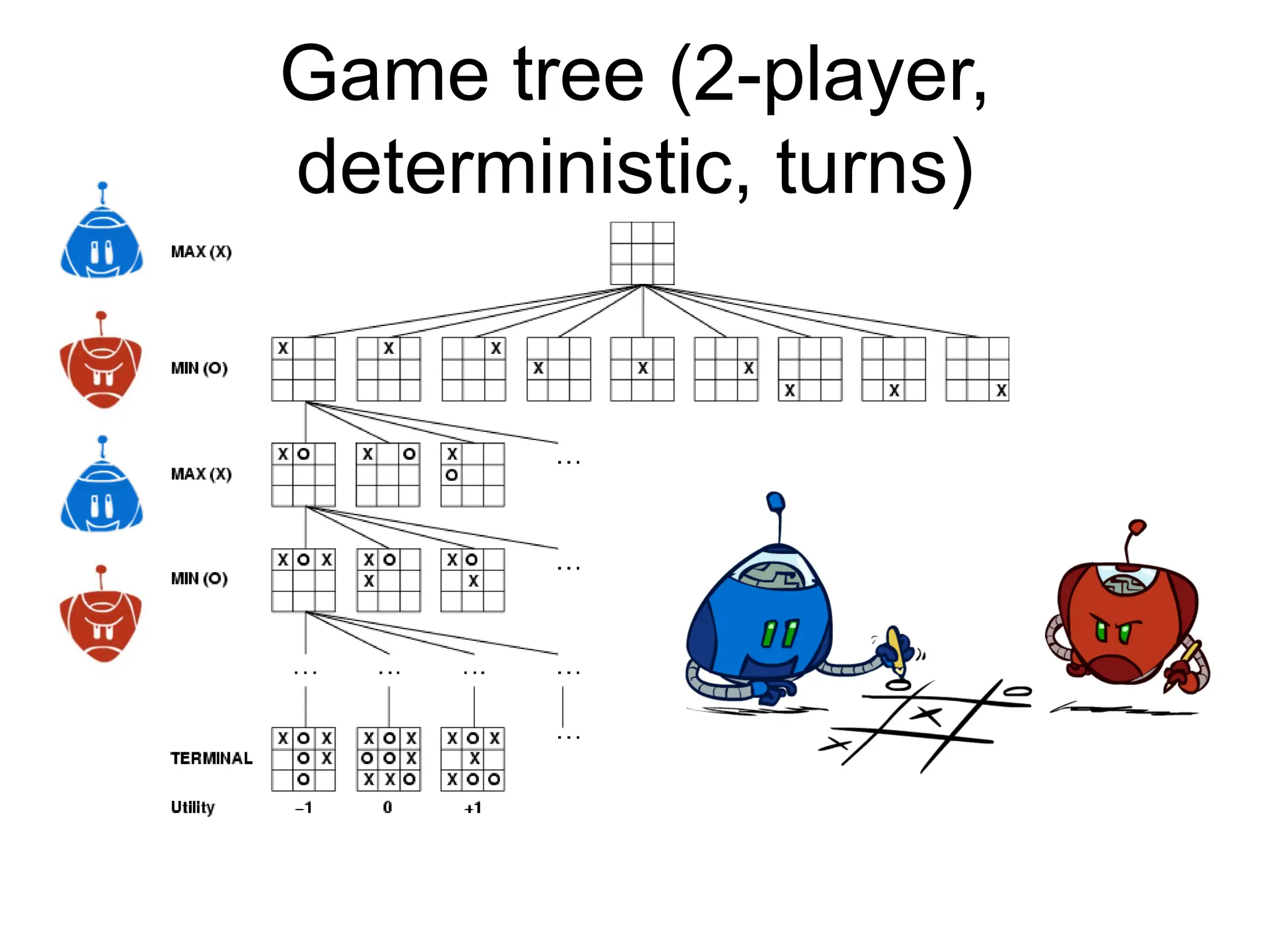
•In AI, “games” usually refers to
deterministic, turn-taking, two-player, zero-
sum games of perfect information
– Deterministic: next state of environment is
completely determined by current state and
action executed by the agent (not
probabilistic)
– Turn-taking: 2 agents whose actions must
alternate
– Zero-sum games: if one agent wins, the other
loses
– Perfect information: fully observable
5.
Games in AI
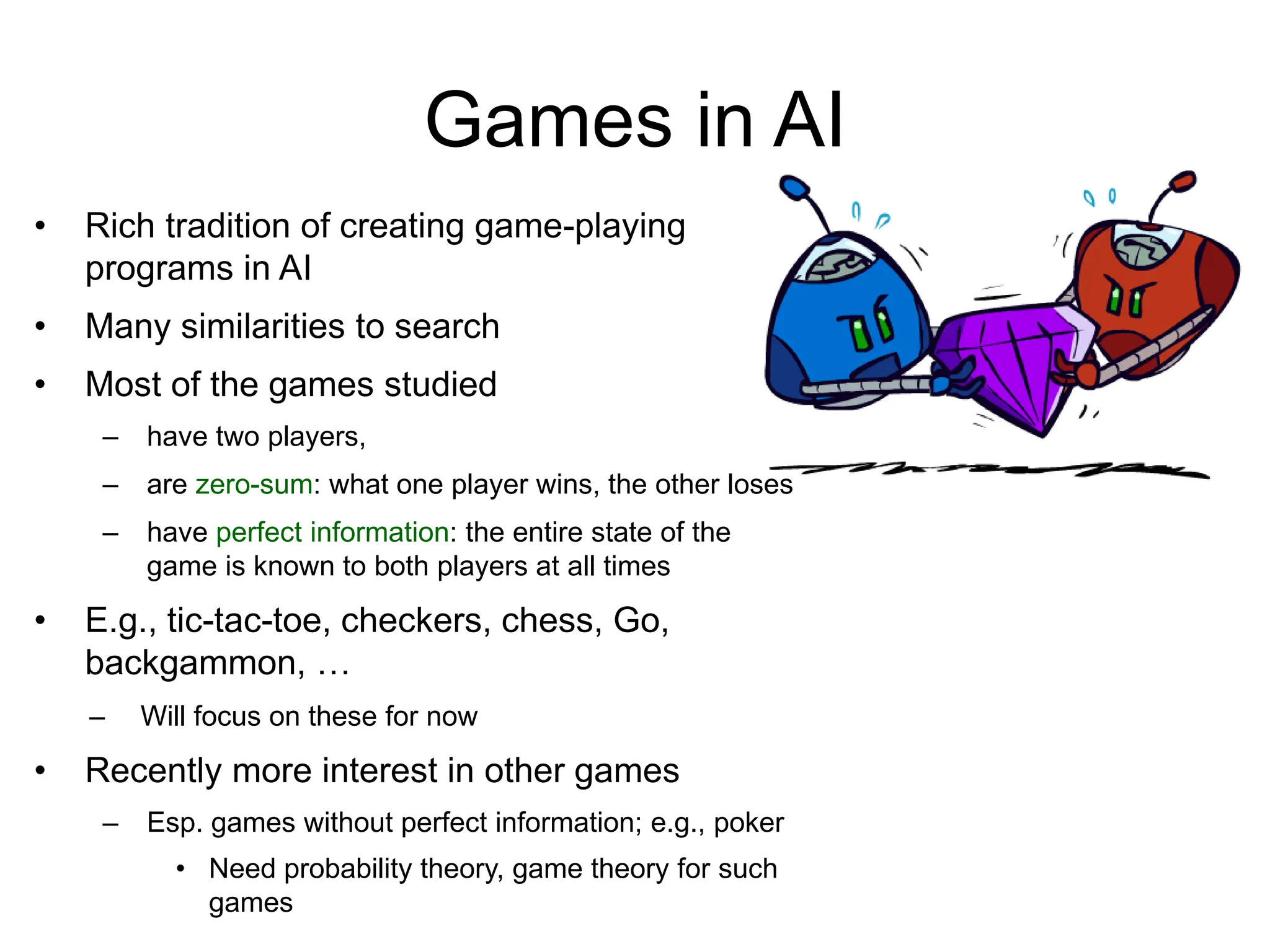
•Rich tradition of creating game-playing
programs in AI
• Many similarities to search
• Most of the games studied
– have two players,
– are zero-sum: what one player wins, the other loses
– have perfect information: the entire state of the
game is known to both players at all times
• E.g., tic-tac-toe, checkers, chess, Go,
backgammon, …
– Will focus on these for now
• Recently more interest in other games
– Esp. games without perfect information; e.g., poker
• Need probability theory, game theory for such
games
6.
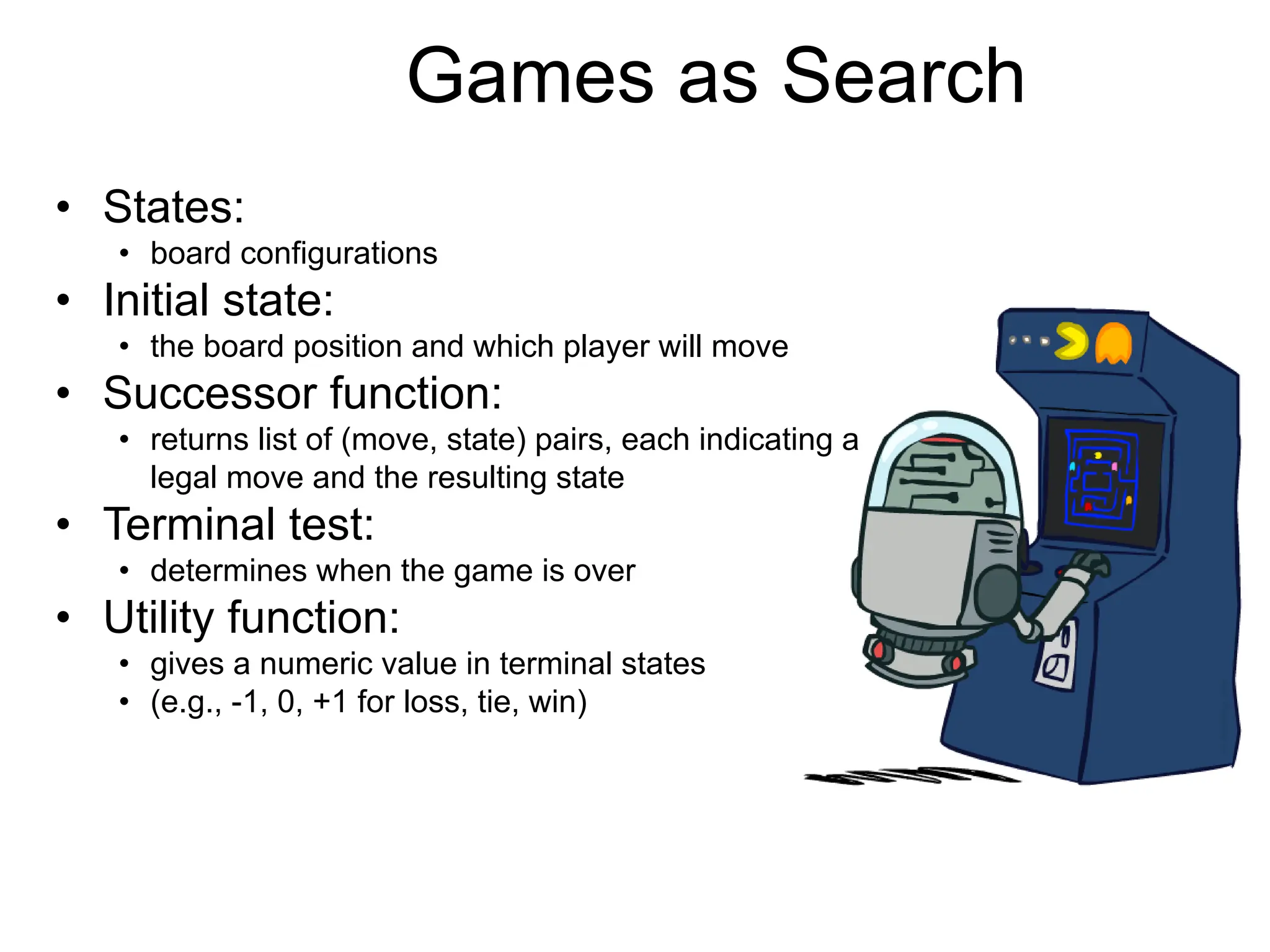
Games as Search
•States:
• board configurations
• Initial state:
• the board position and which player will move
• Successor function:
• returns list of (move, state) pairs, each indicating a
legal move and the resulting state
• Terminal test:
• determines when the game is over
• Utility function:
• gives a numeric value in terminal states
• (e.g., -1, 0, +1 for loss, tie, win)
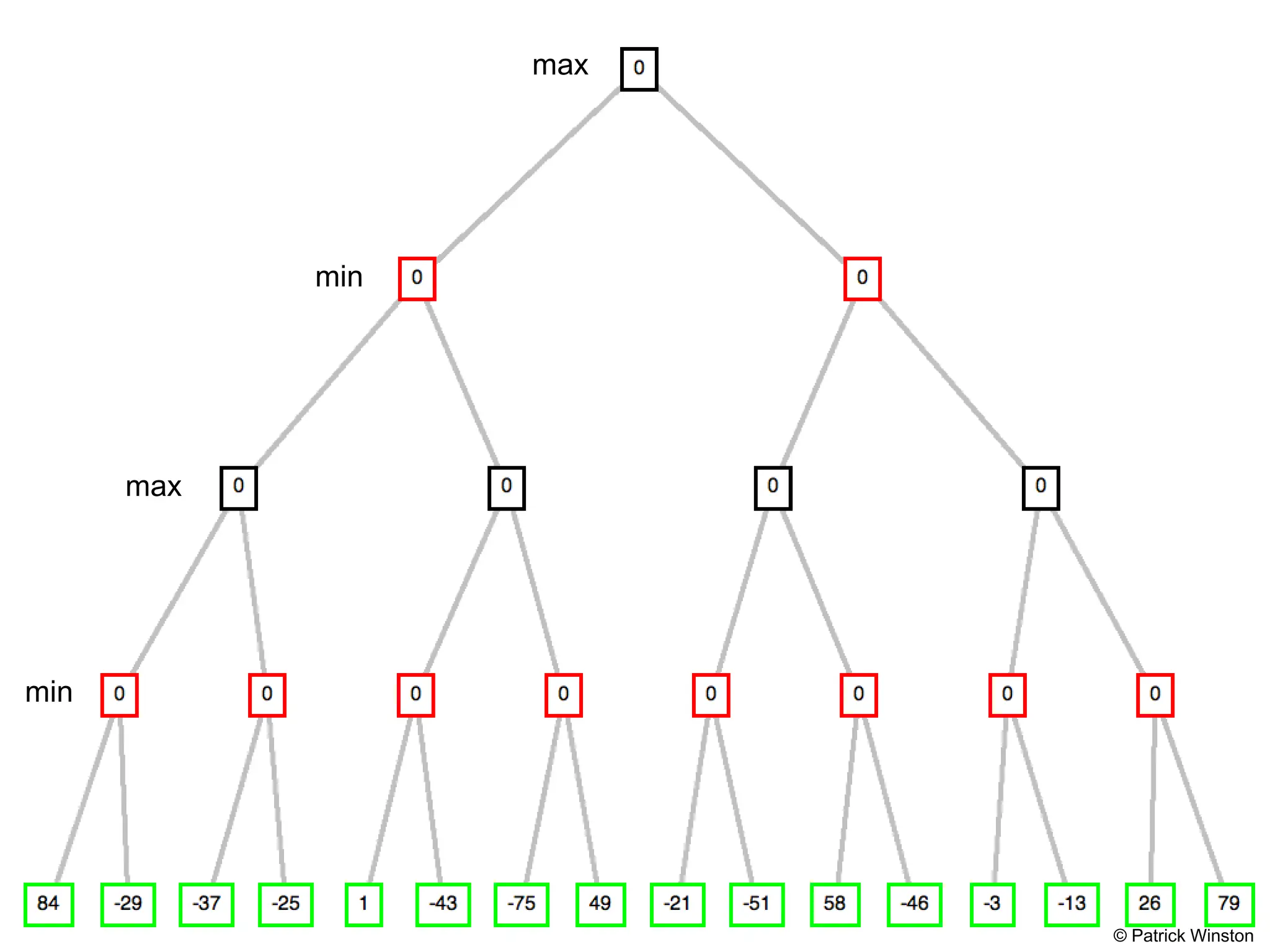
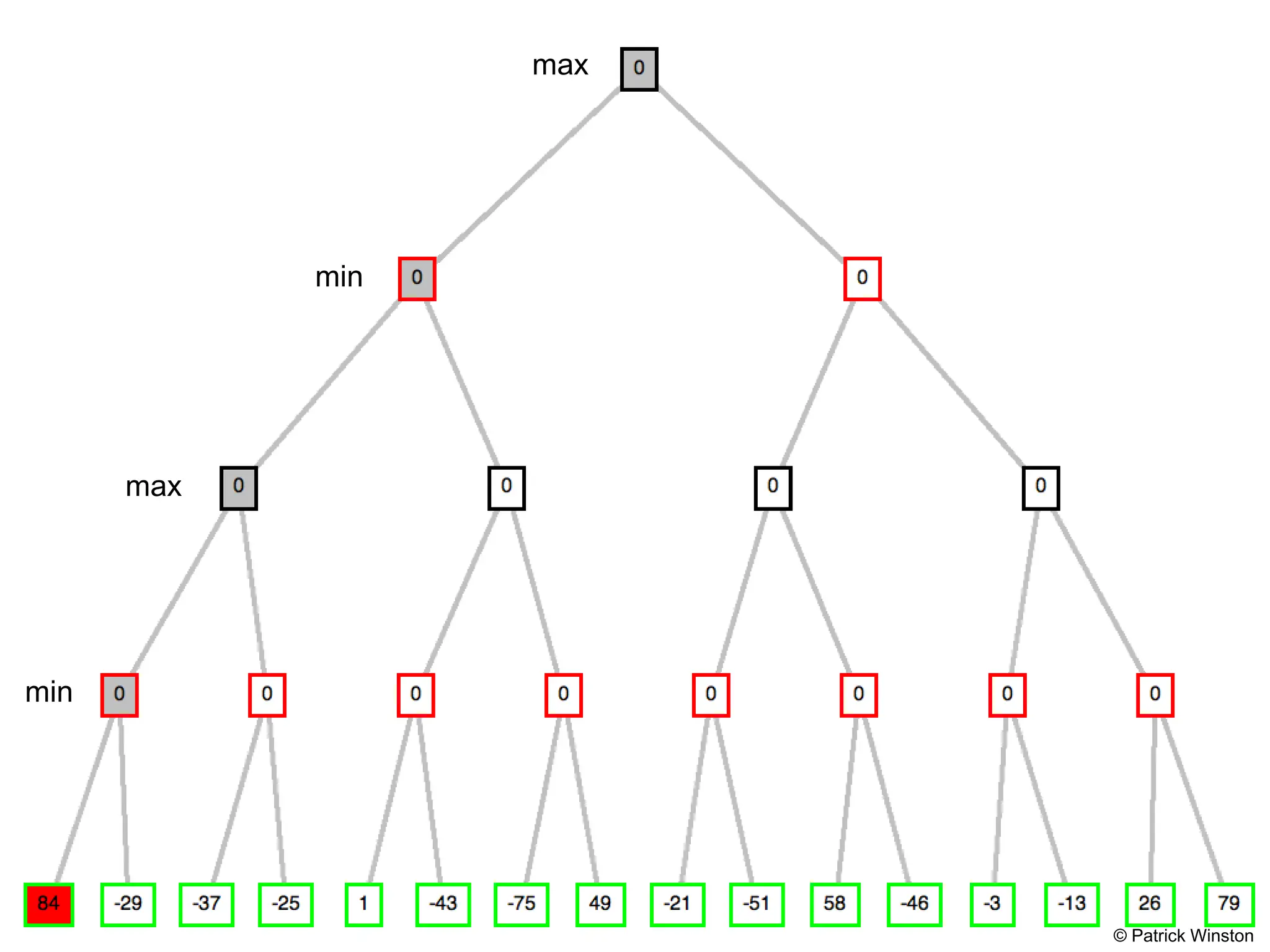
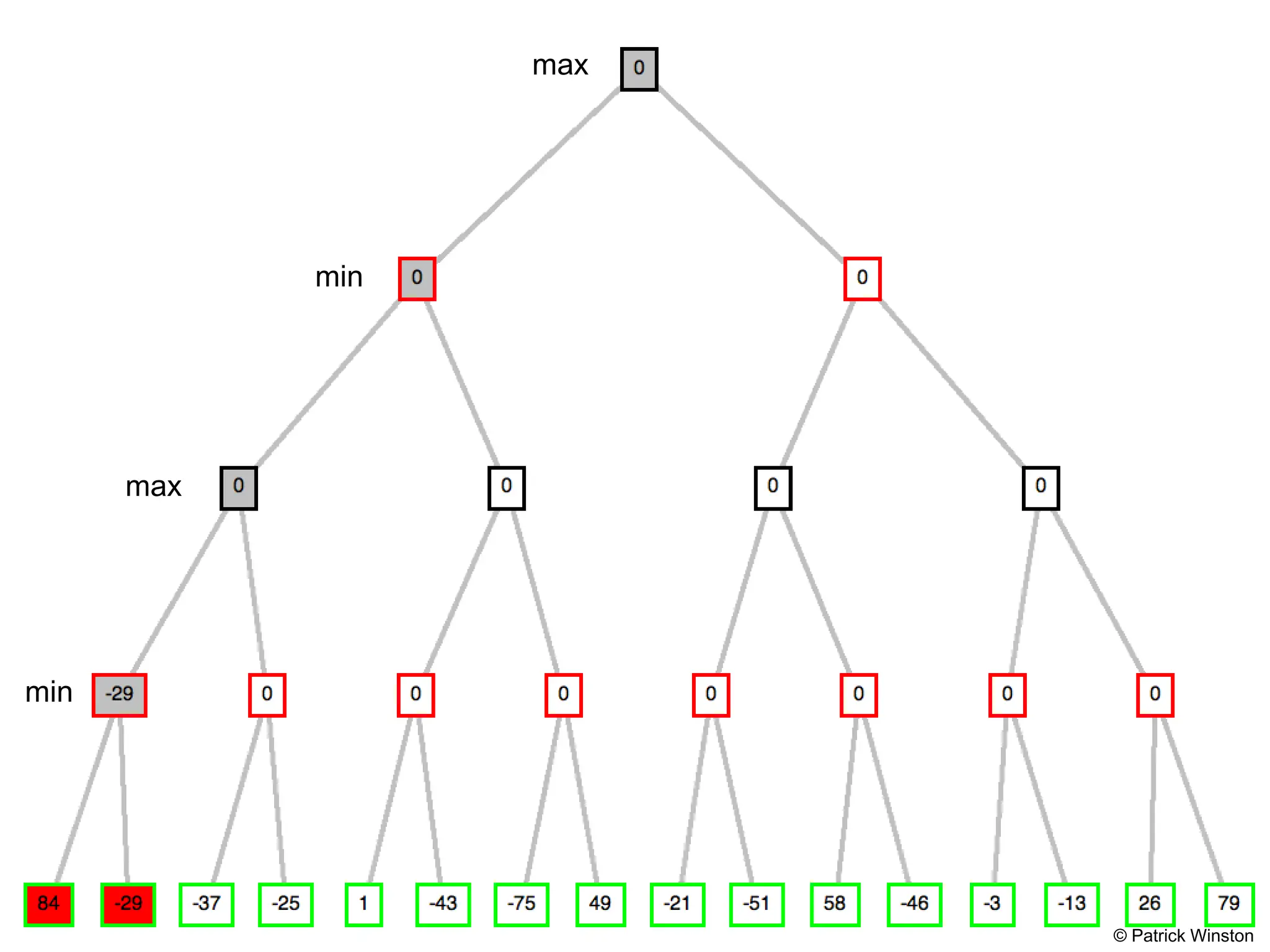
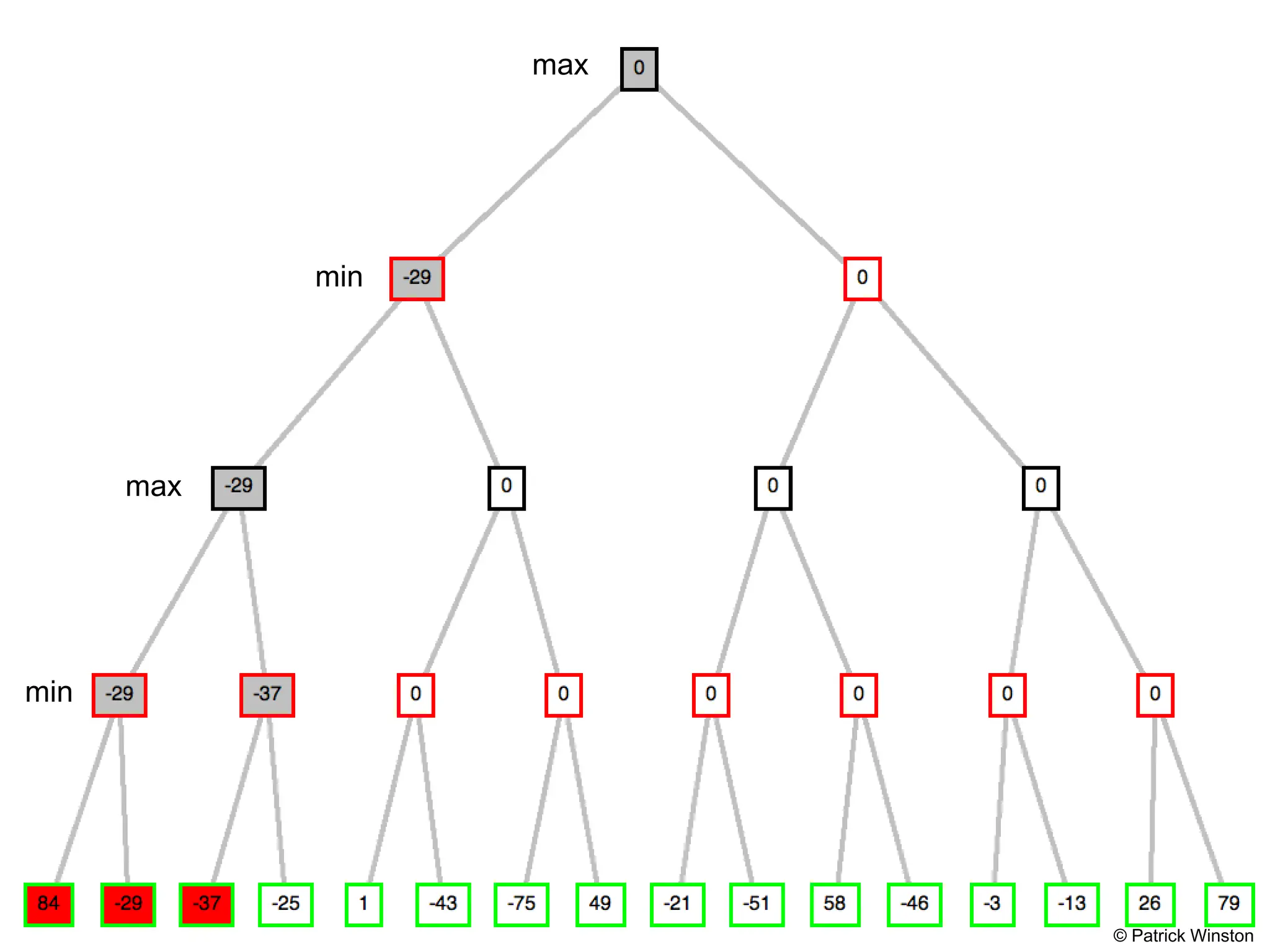
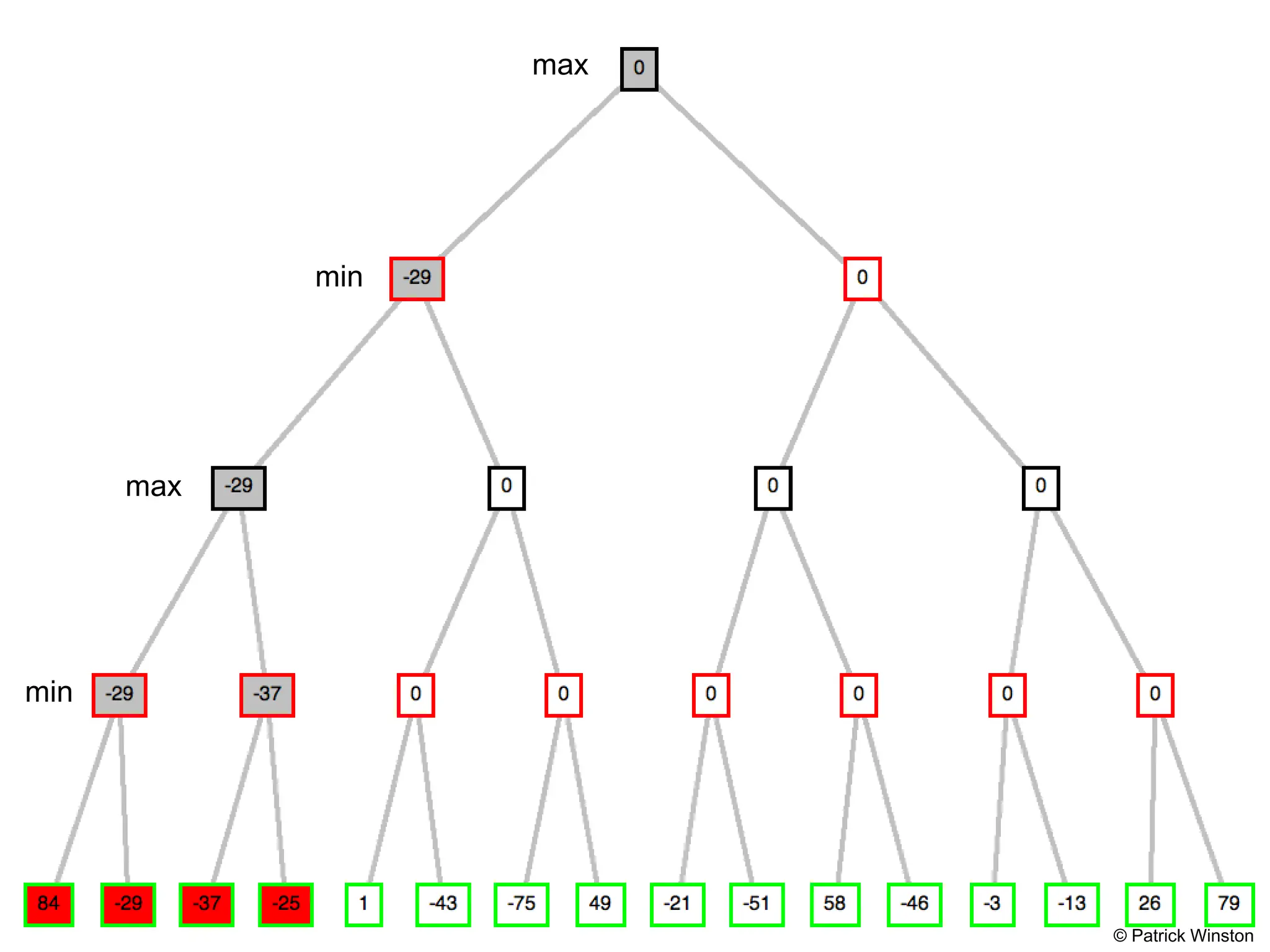
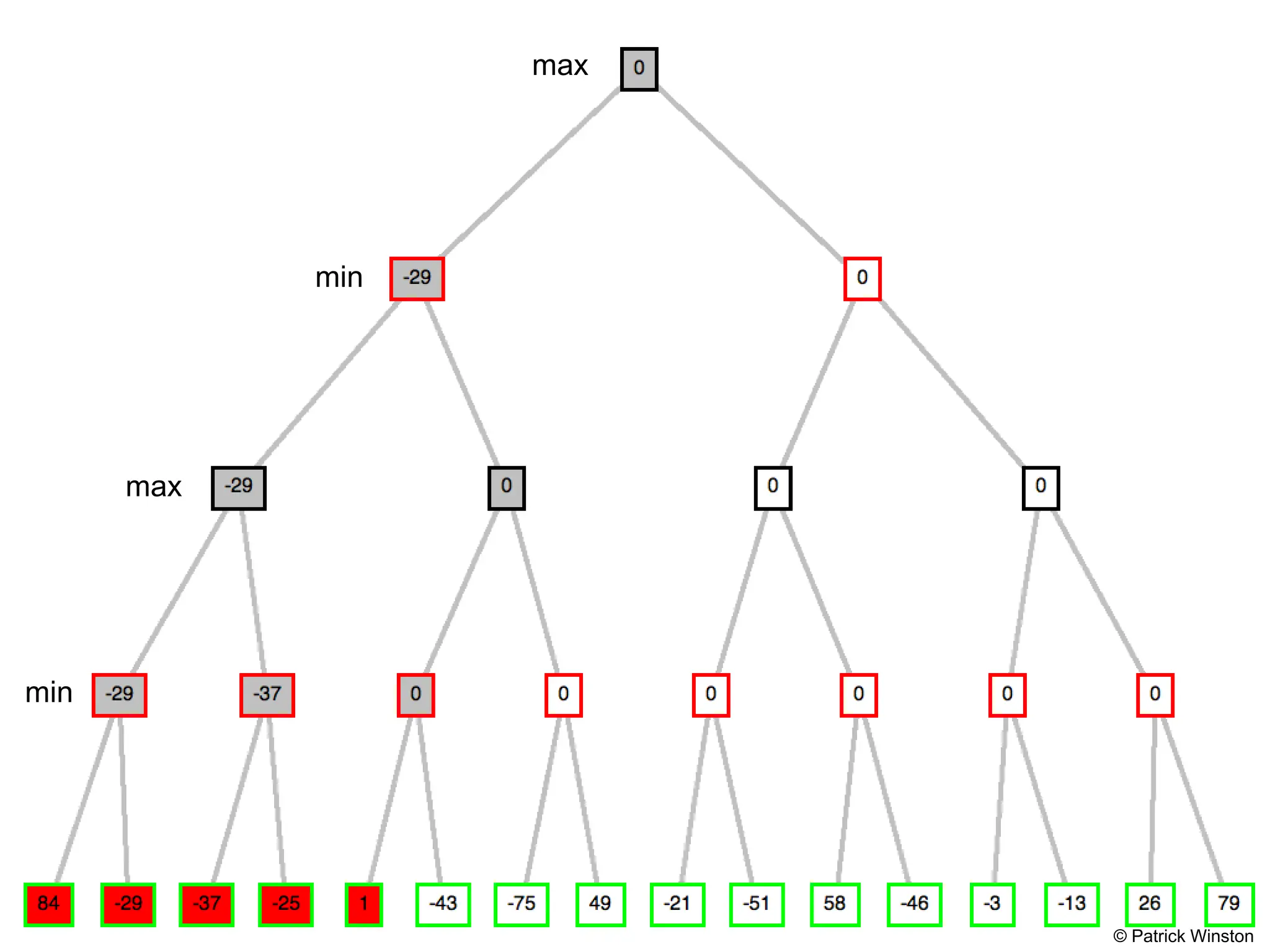
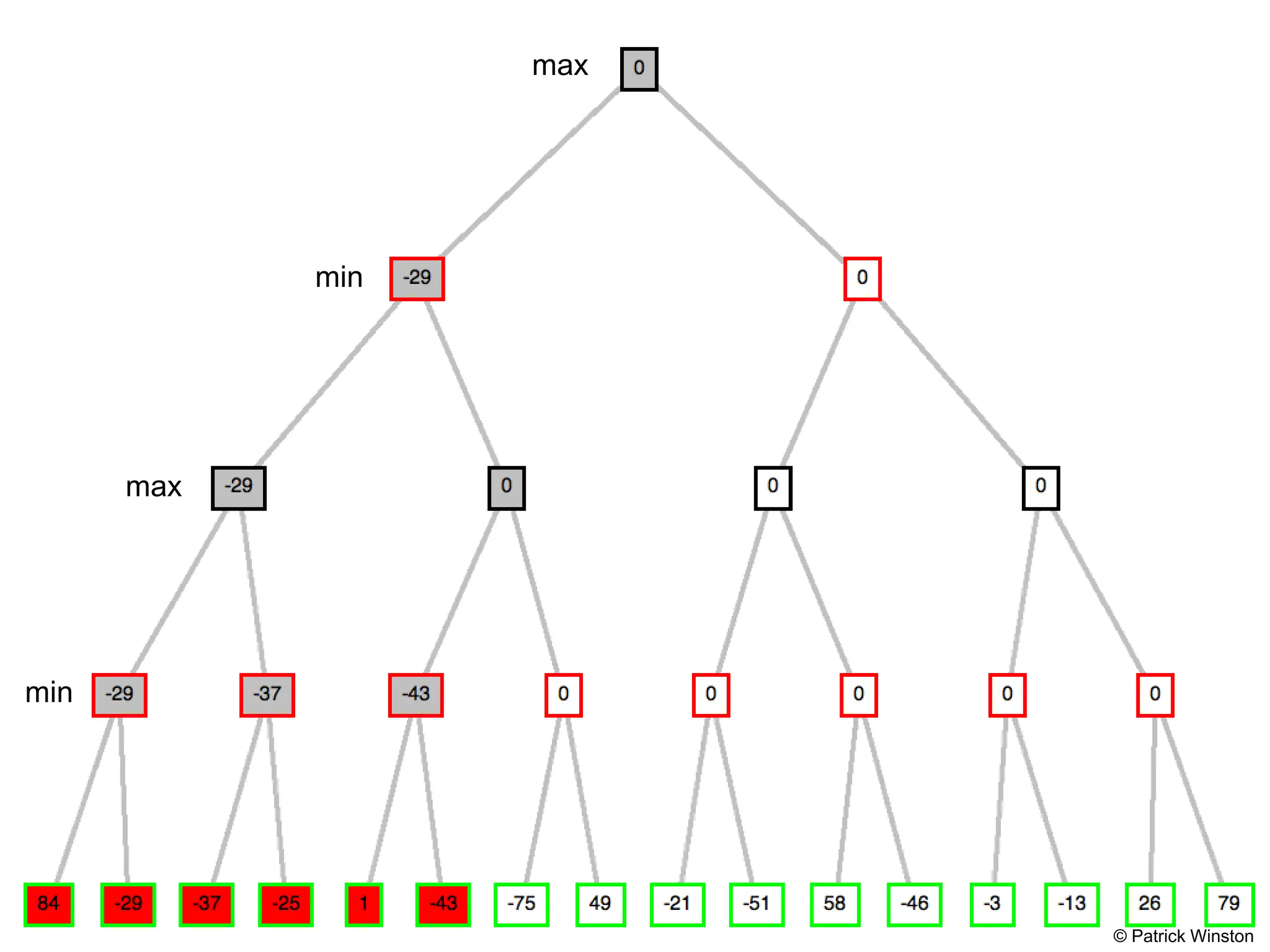
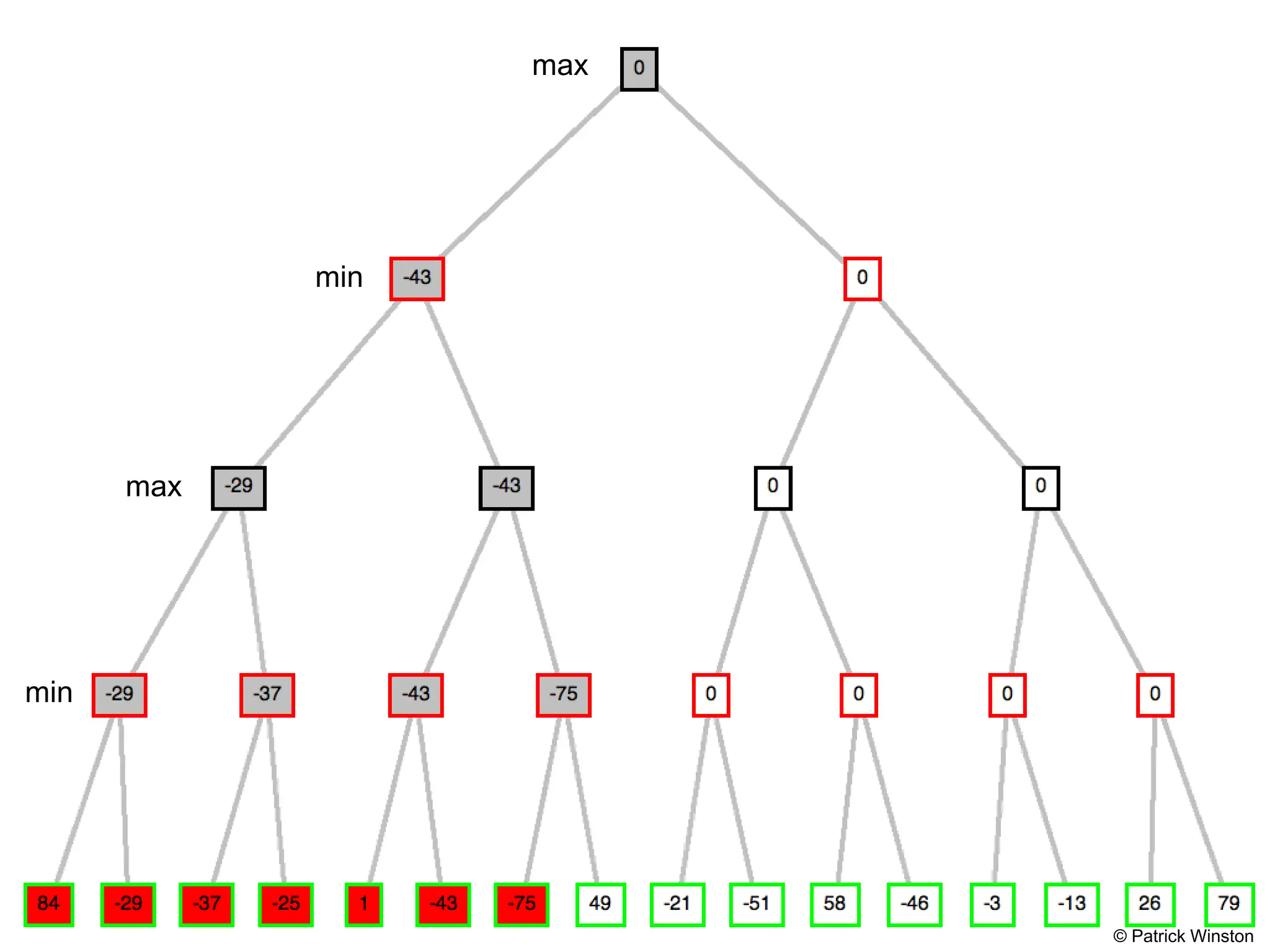
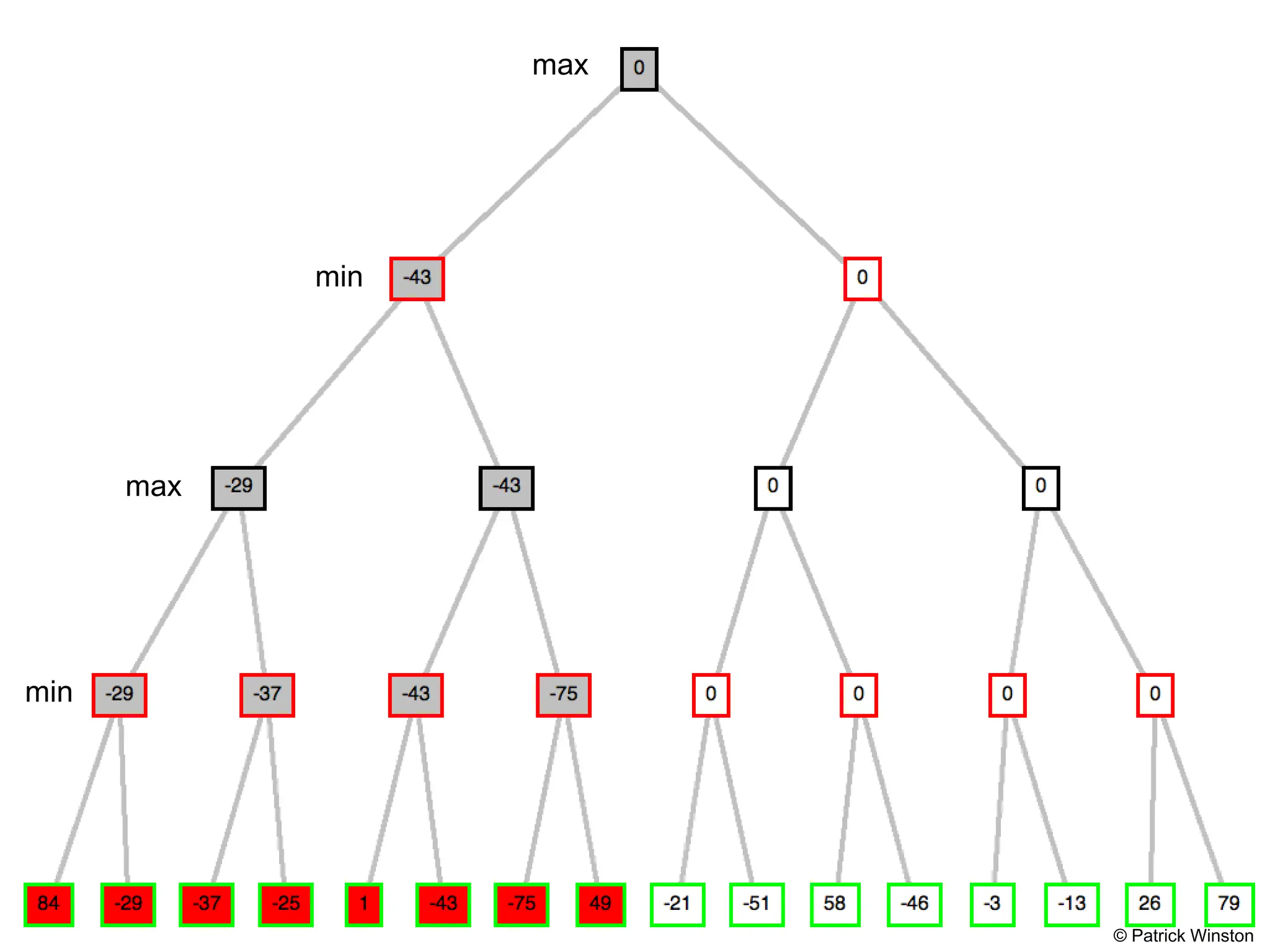
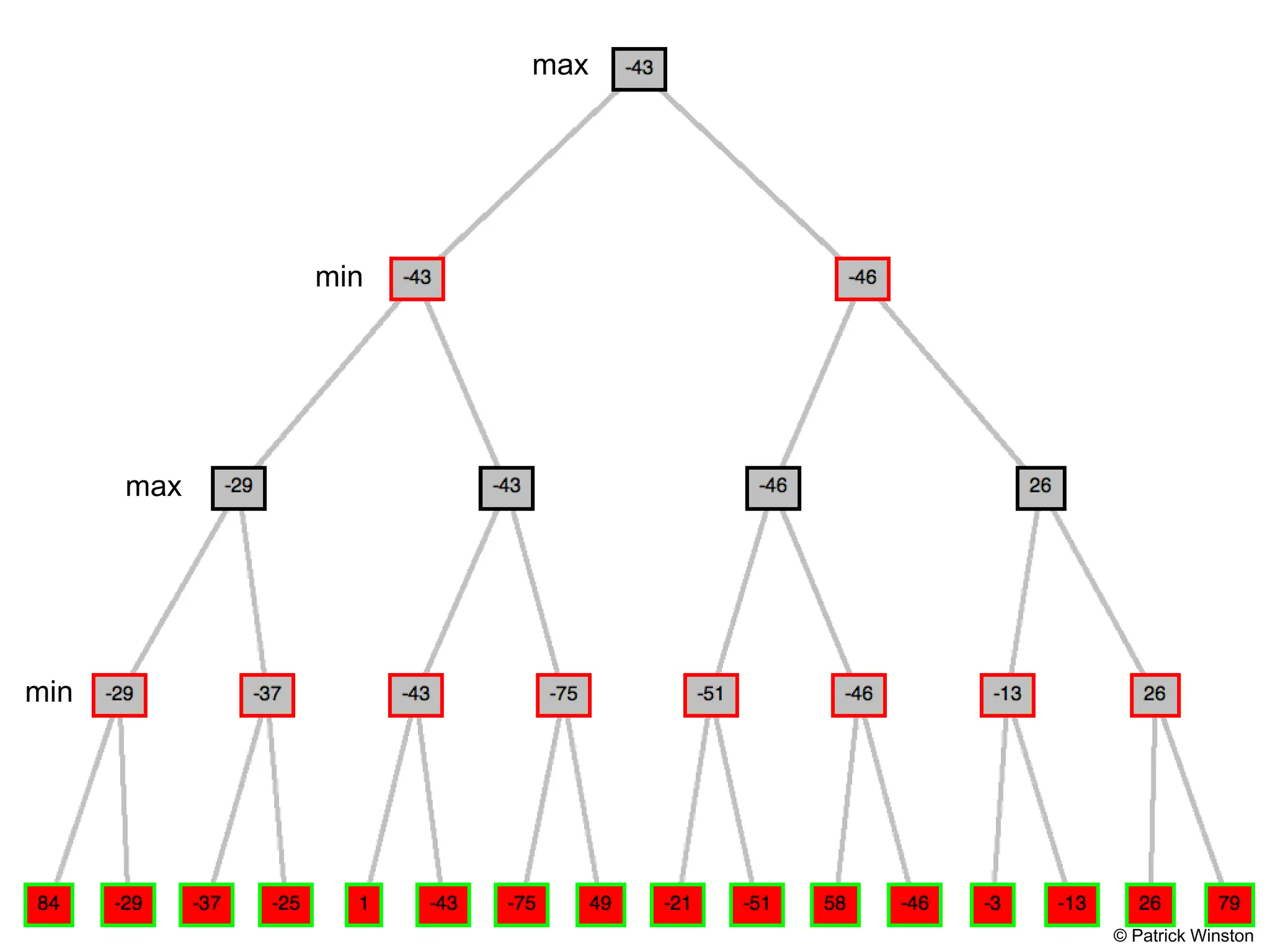
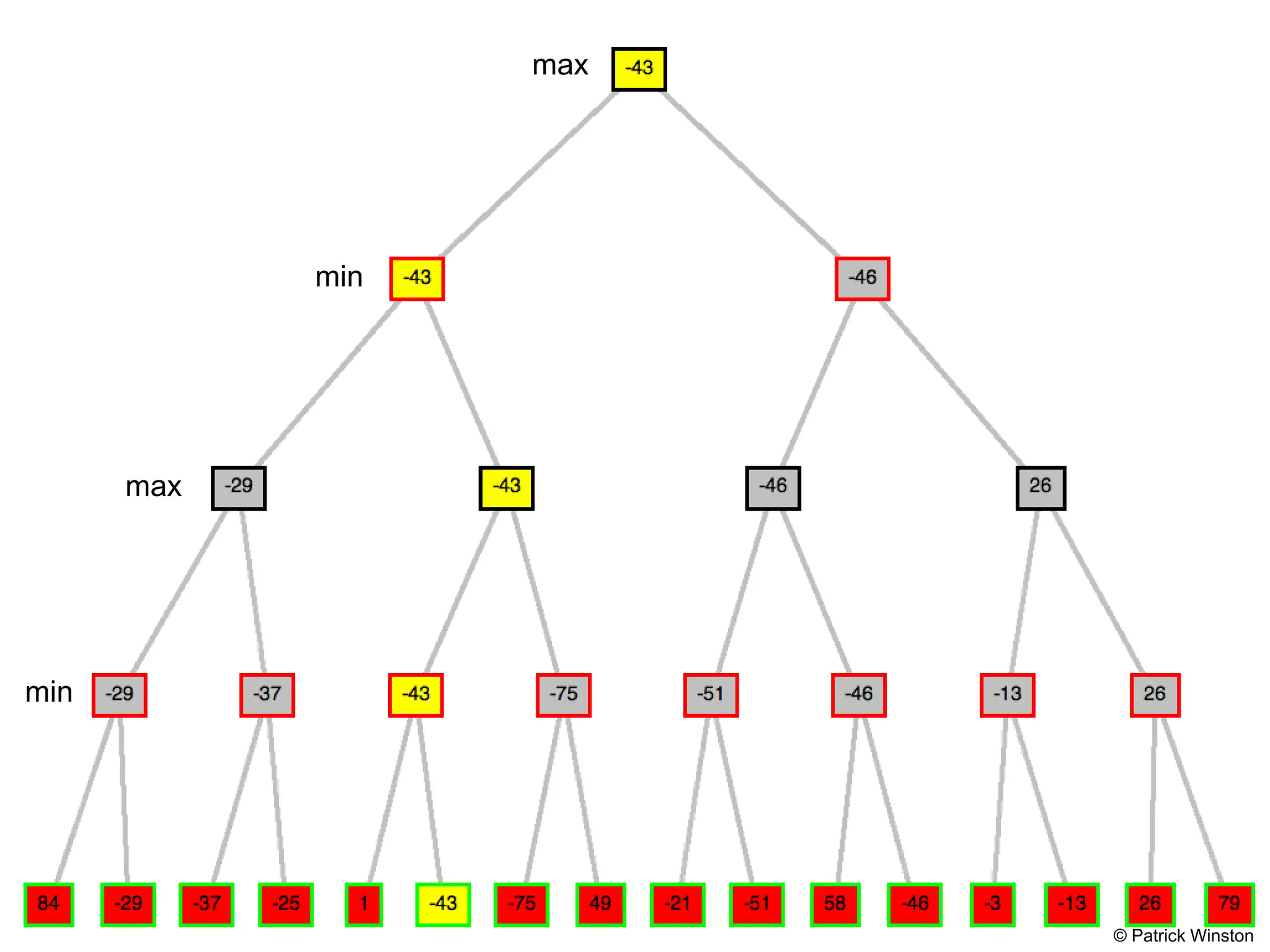
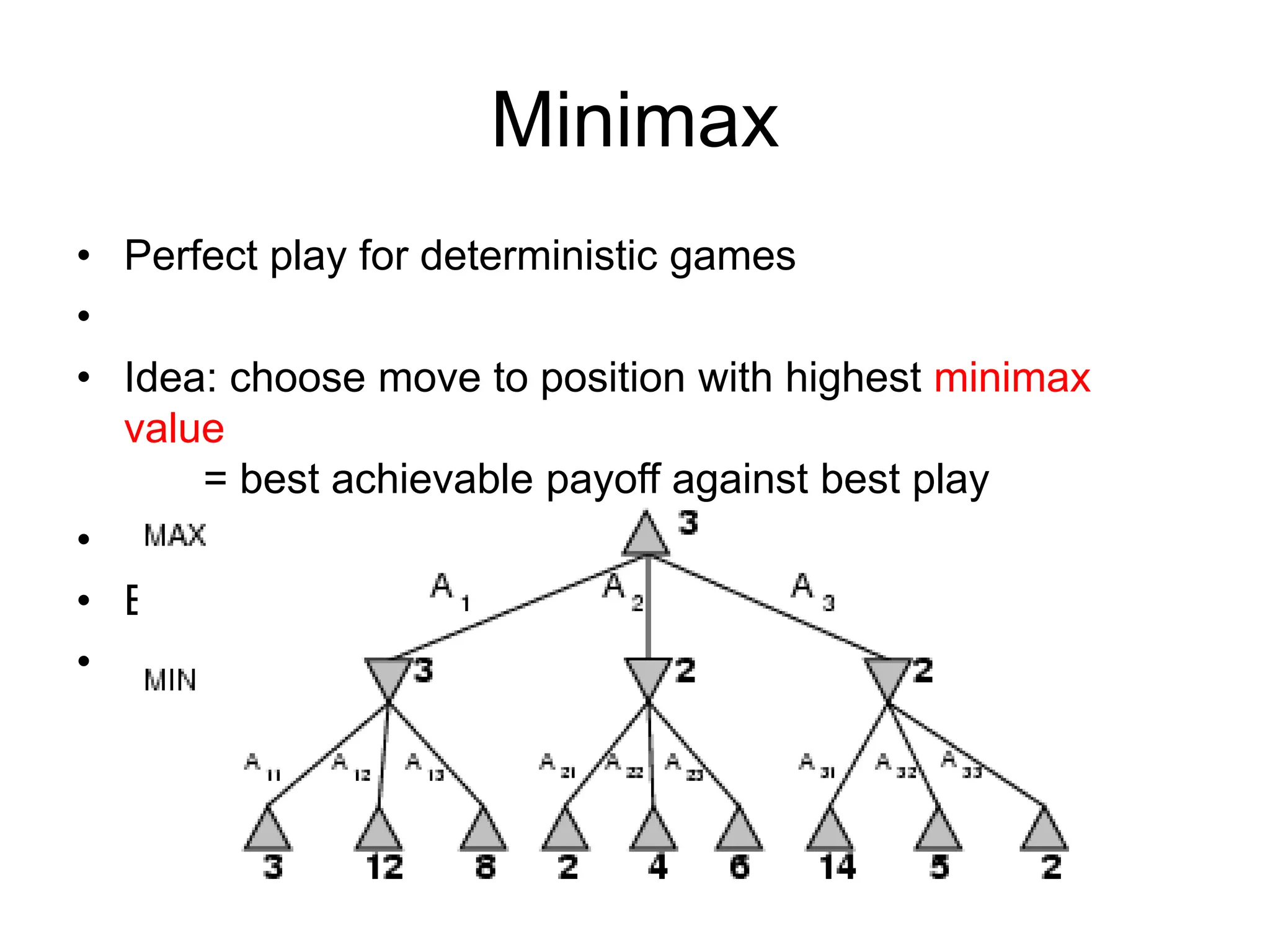
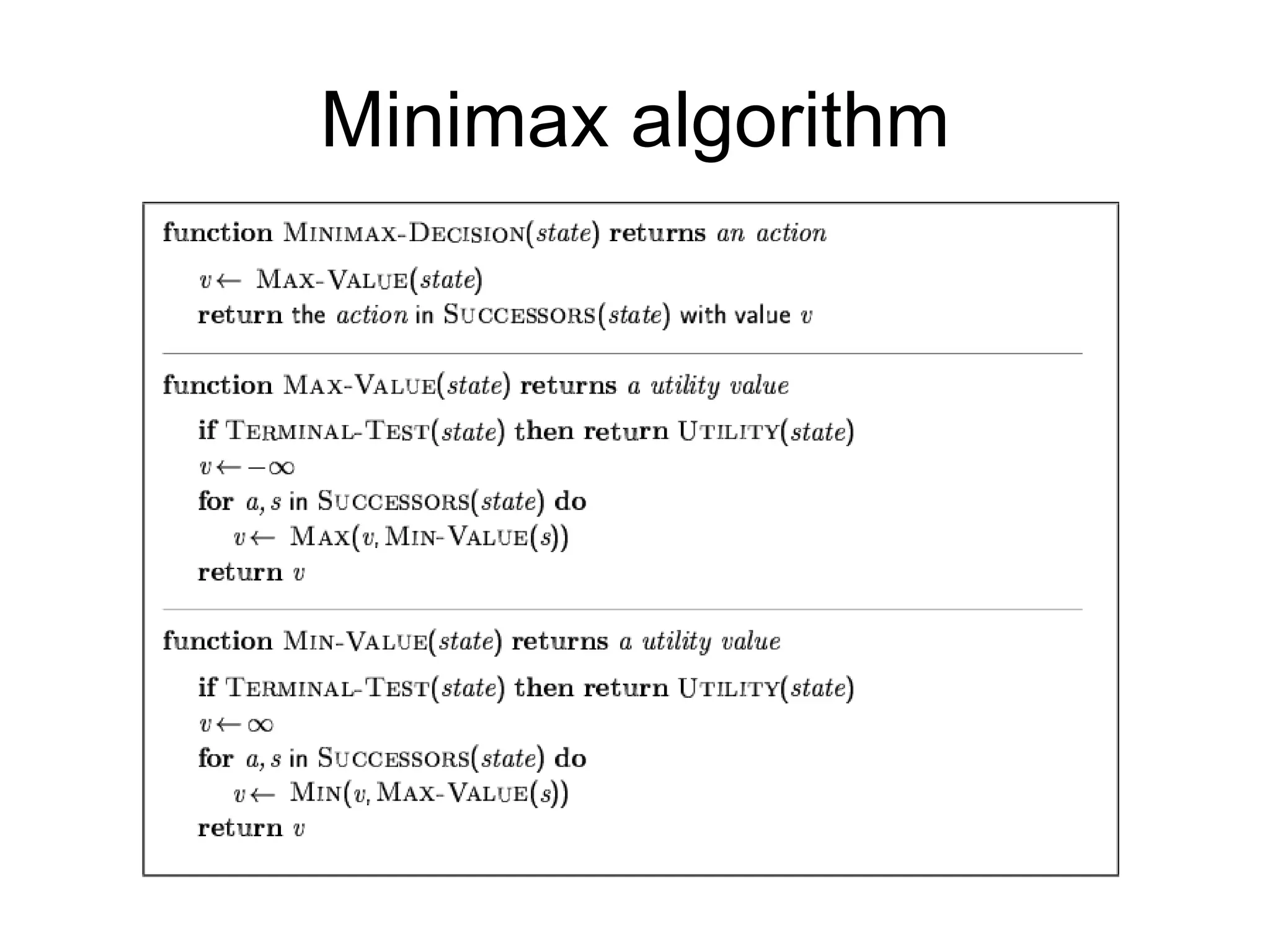
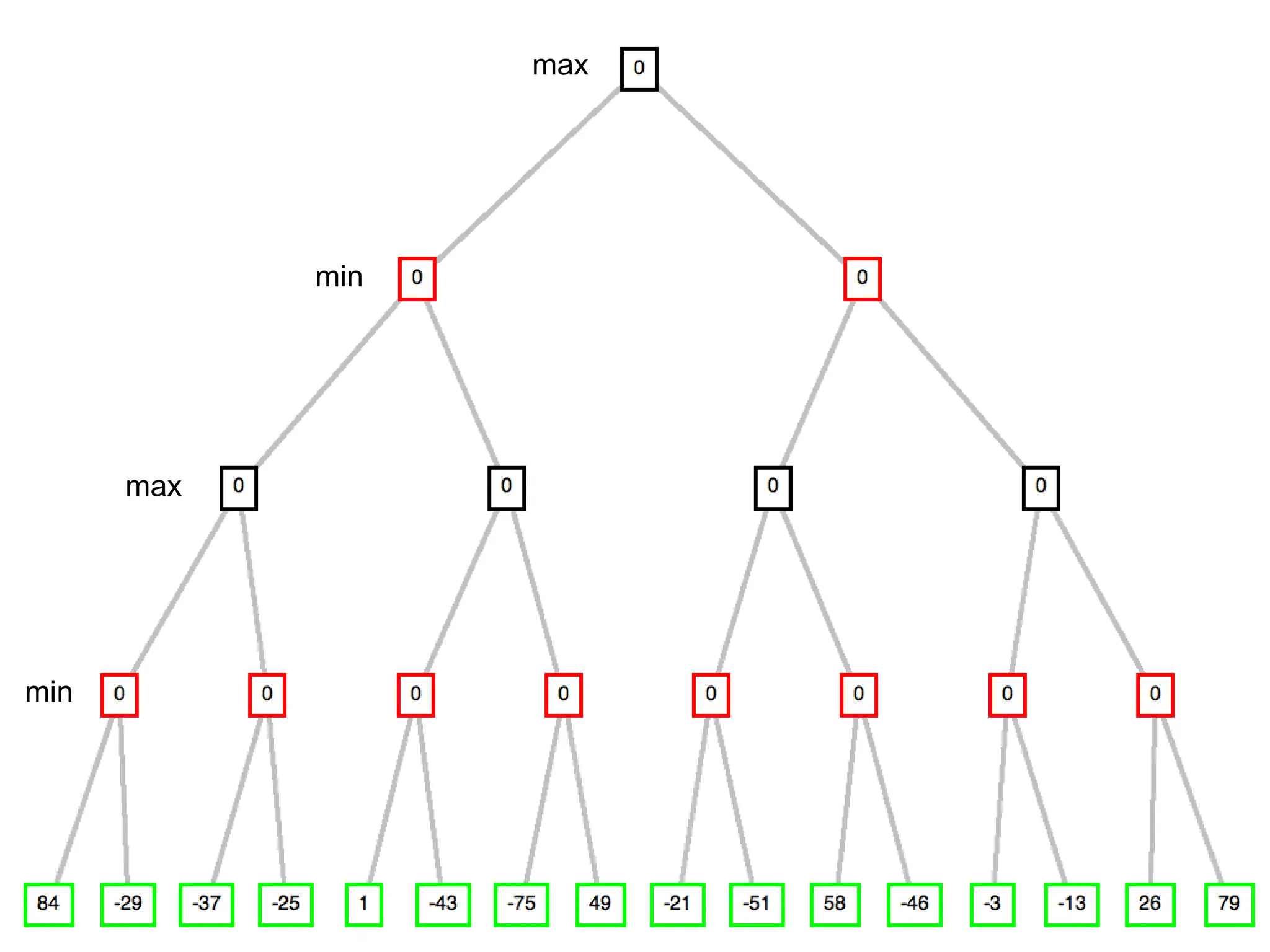
Minimax
• Perfect playfor deterministic games
•
• Idea: choose move to position with highest minimax
value
= best achievable payoff against best play
•
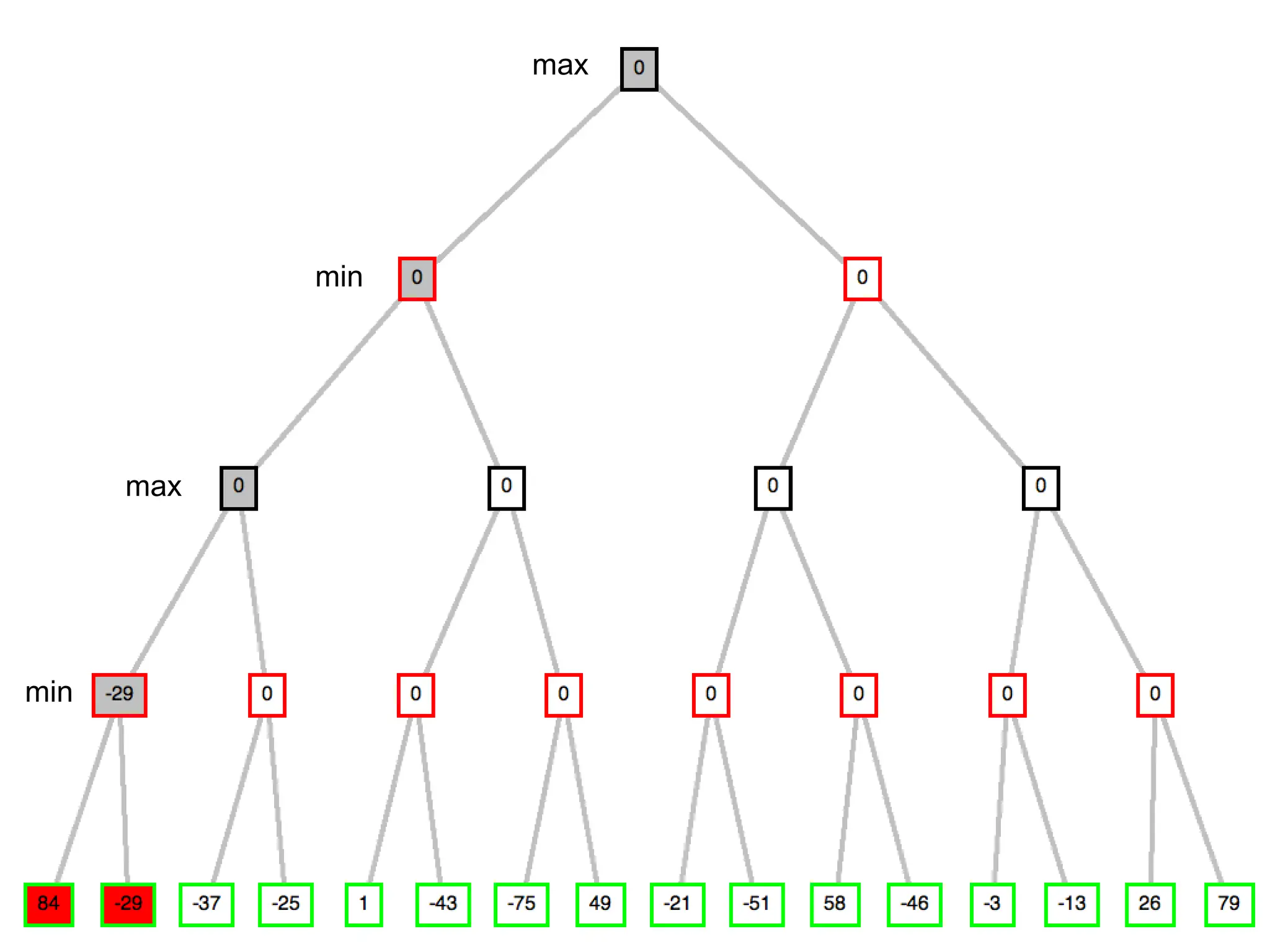
• E.g., 2-ply game:
•
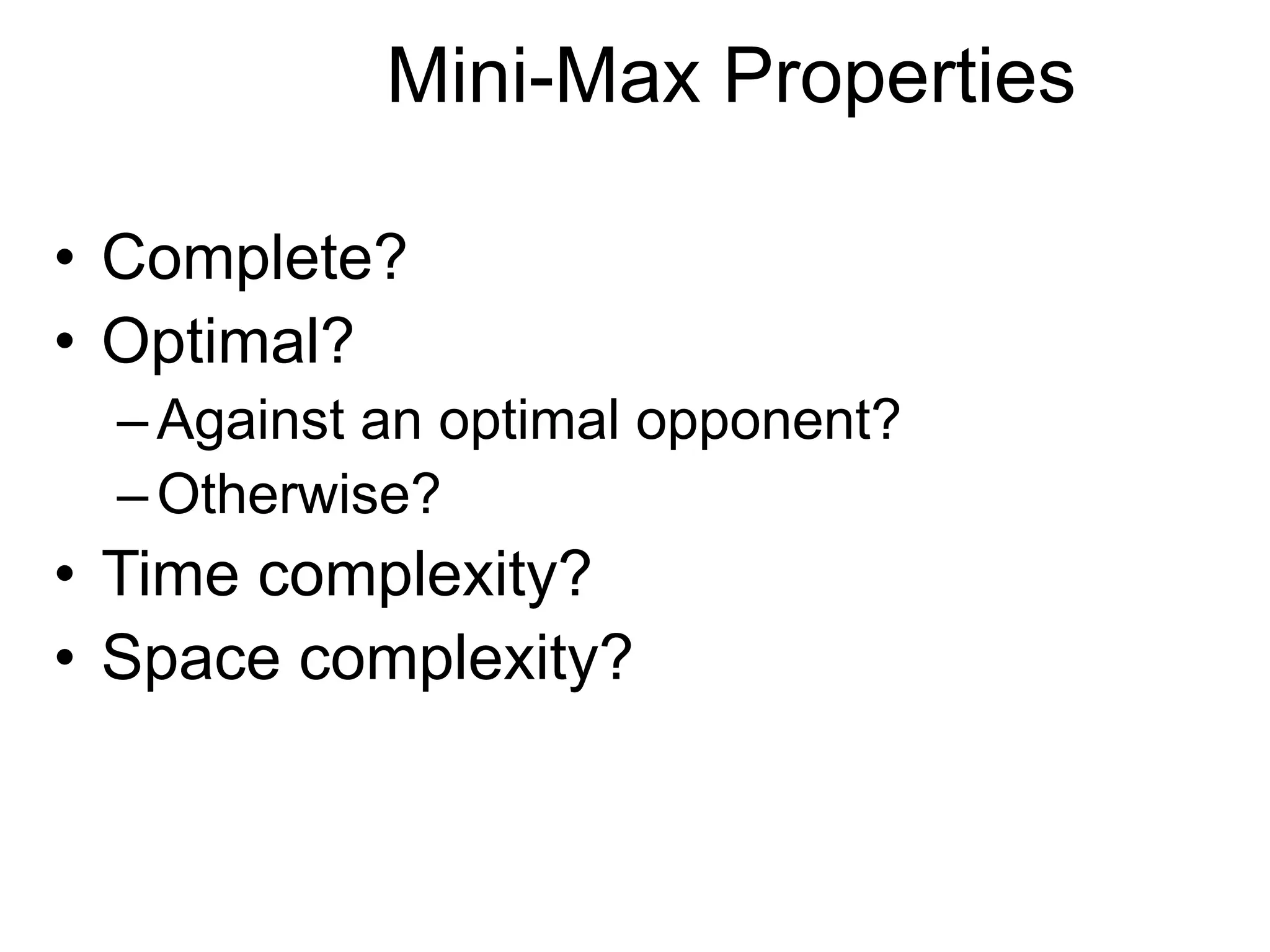
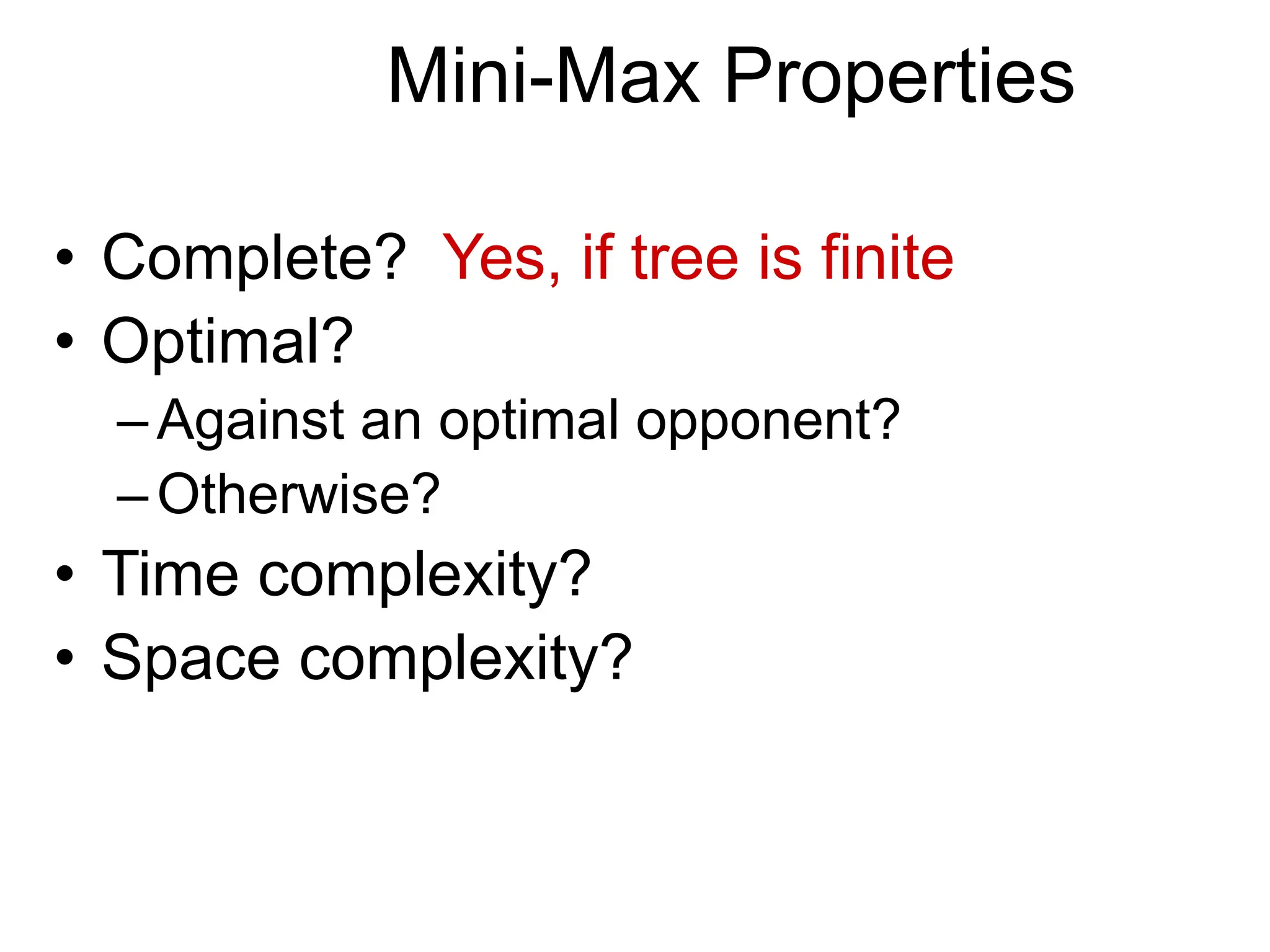
Mini-Max Properties
• Complete?Yes, if tree is finite
• Optimal?
–Against an optimal opponent?
–Otherwise?
• Time complexity?
• Space complexity?
22.
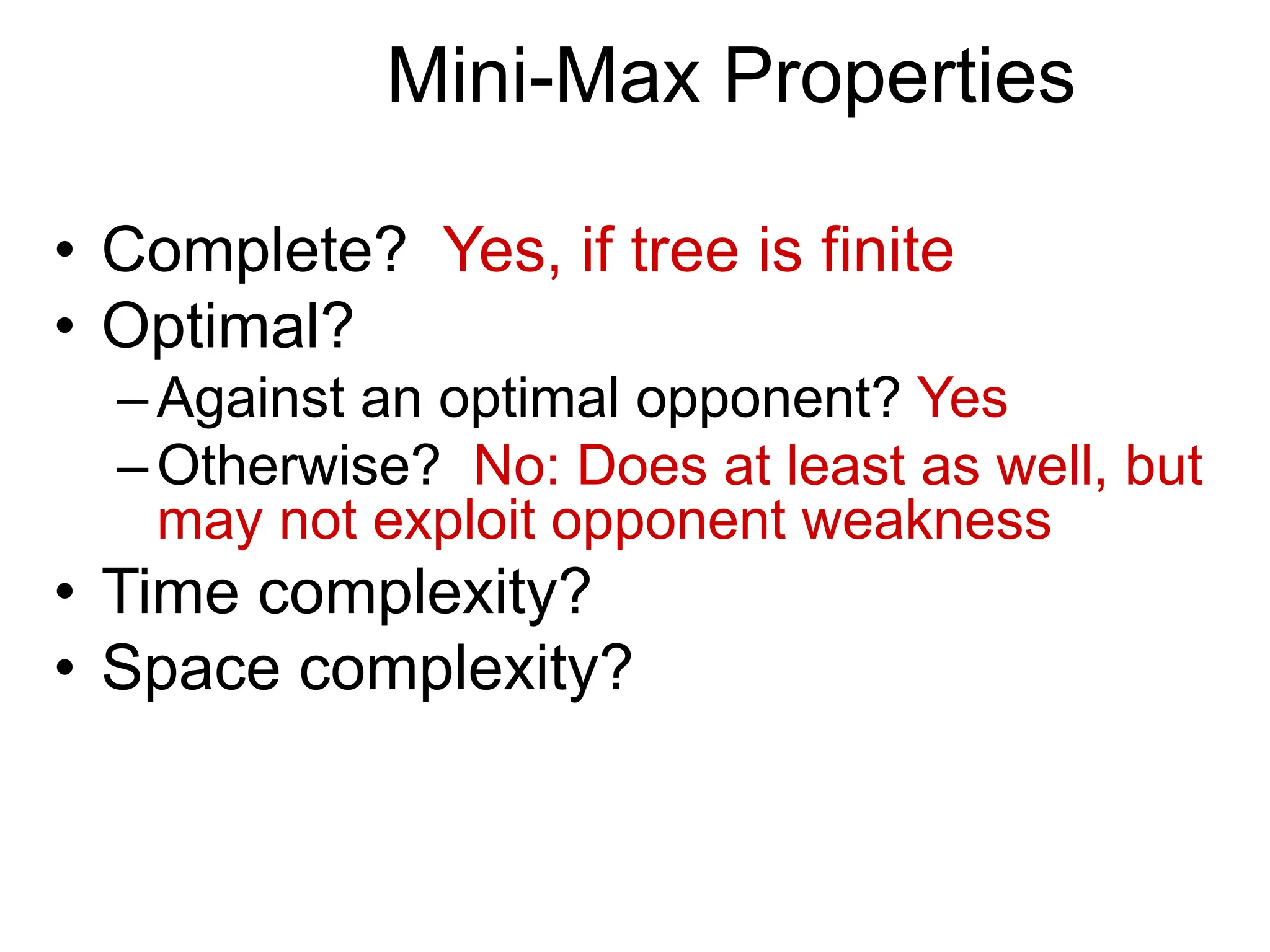
Mini-Max Properties
• Complete?Yes, if tree is finite
• Optimal?
–Against an optimal opponent? Yes
–Otherwise? No: Does at least as well, but
may not exploit opponent weakness
• Time complexity?
• Space complexity?
23.
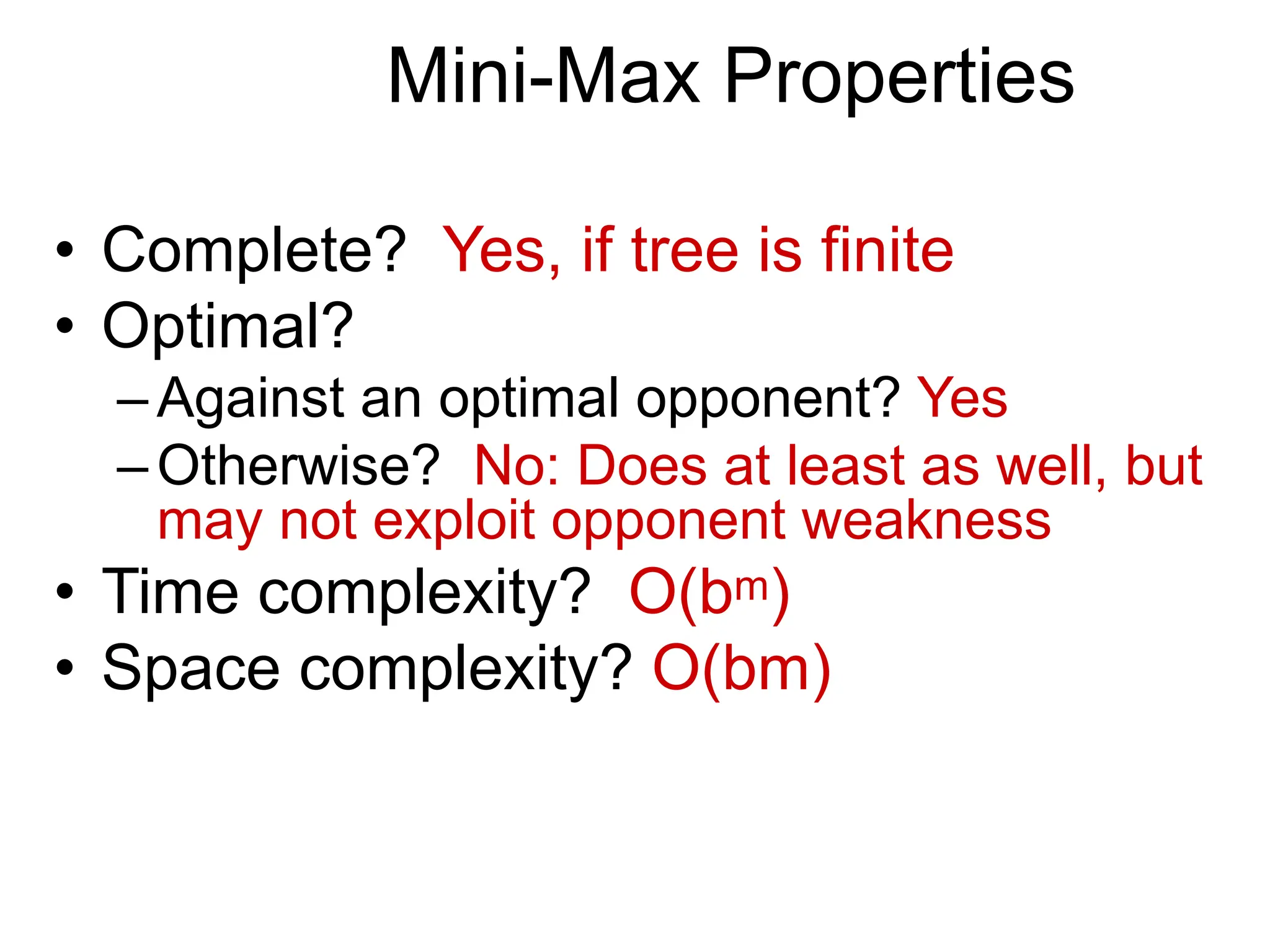
Mini-Max Properties
• Complete?Yes, if tree is finite
• Optimal?
–Against an optimal opponent? Yes
–Otherwise? No: Does at least as well, but
may not exploit opponent weakness
• Time complexity? O(bm)
• Space complexity? O(bm)
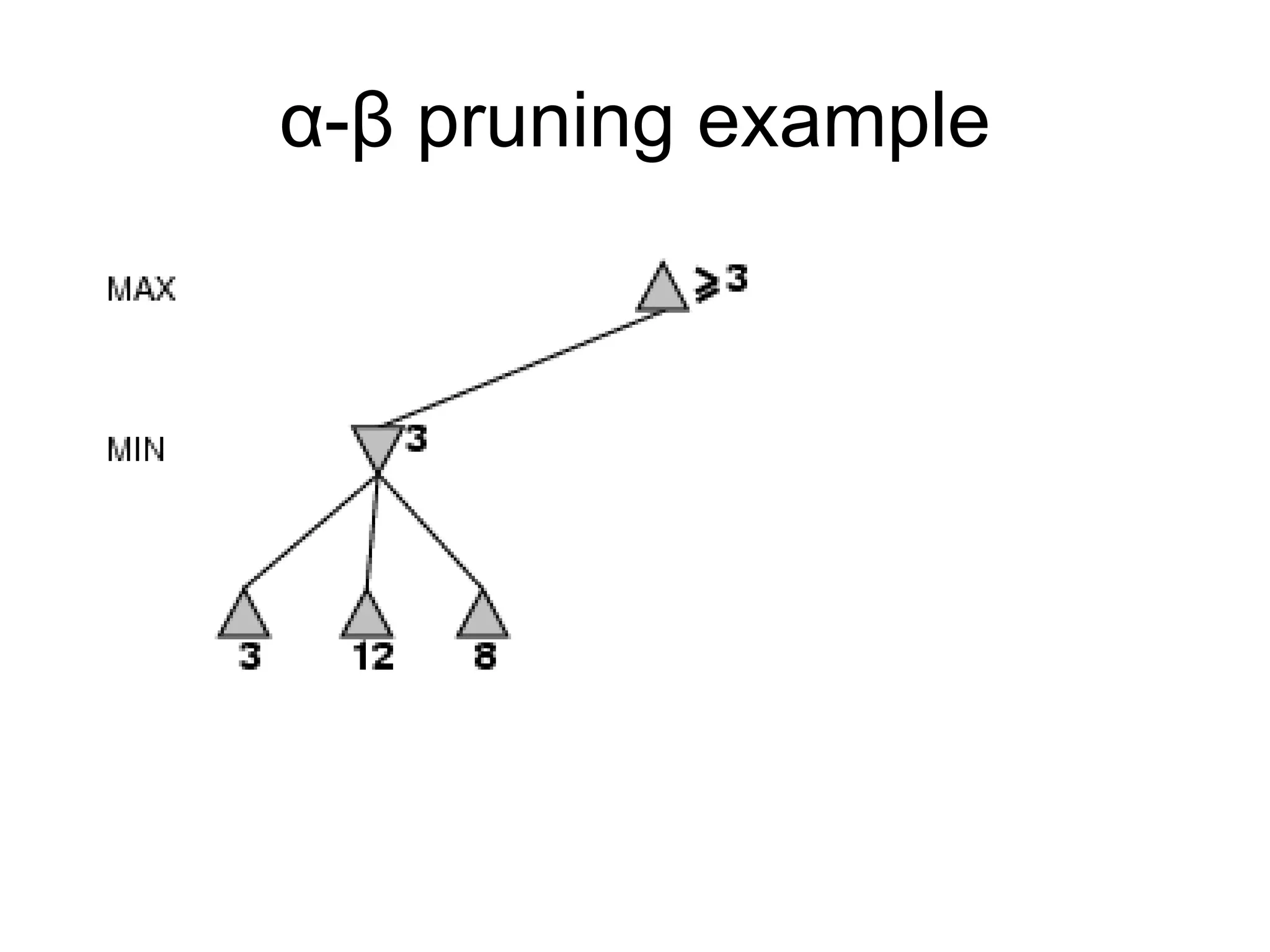
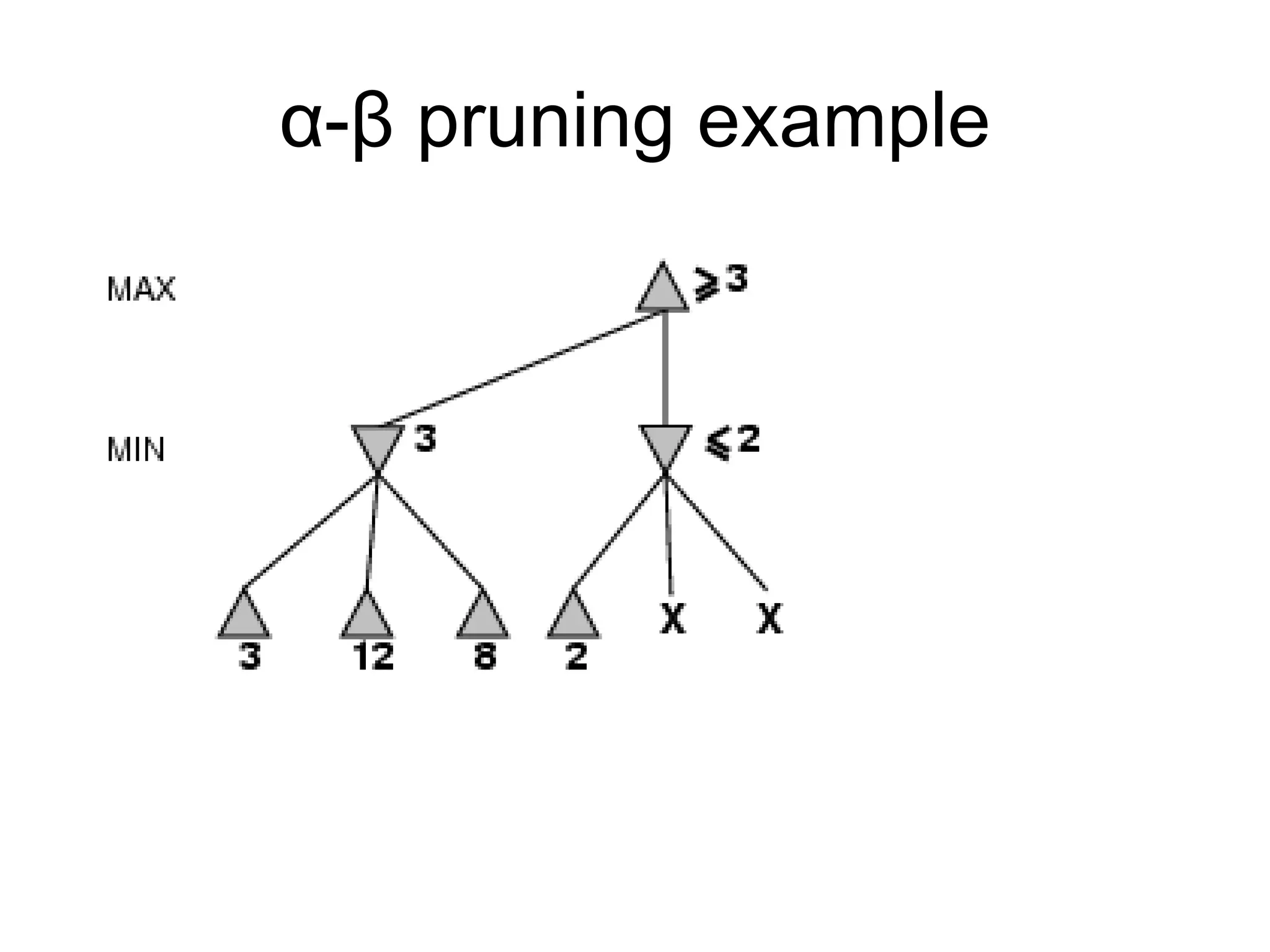
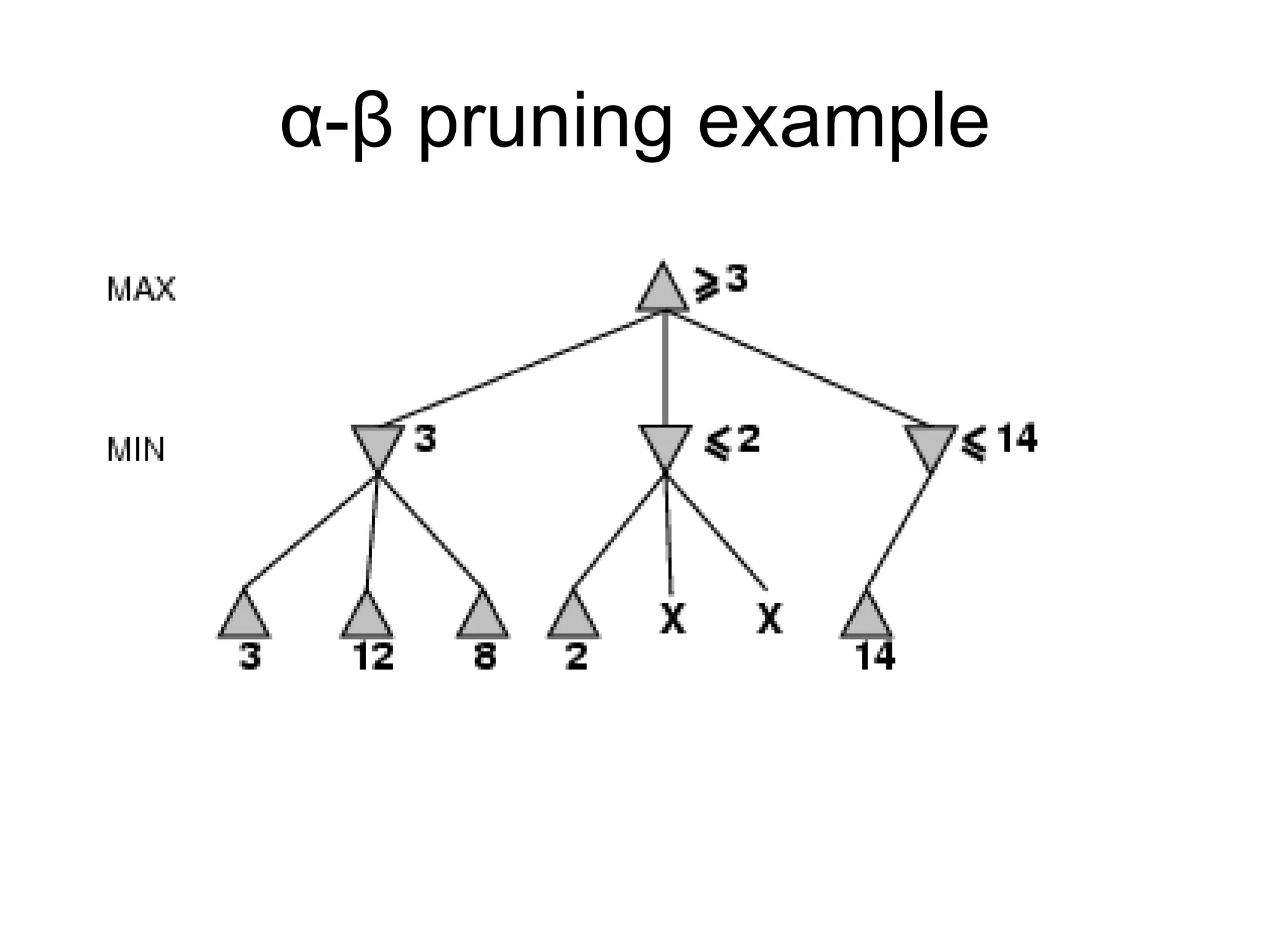
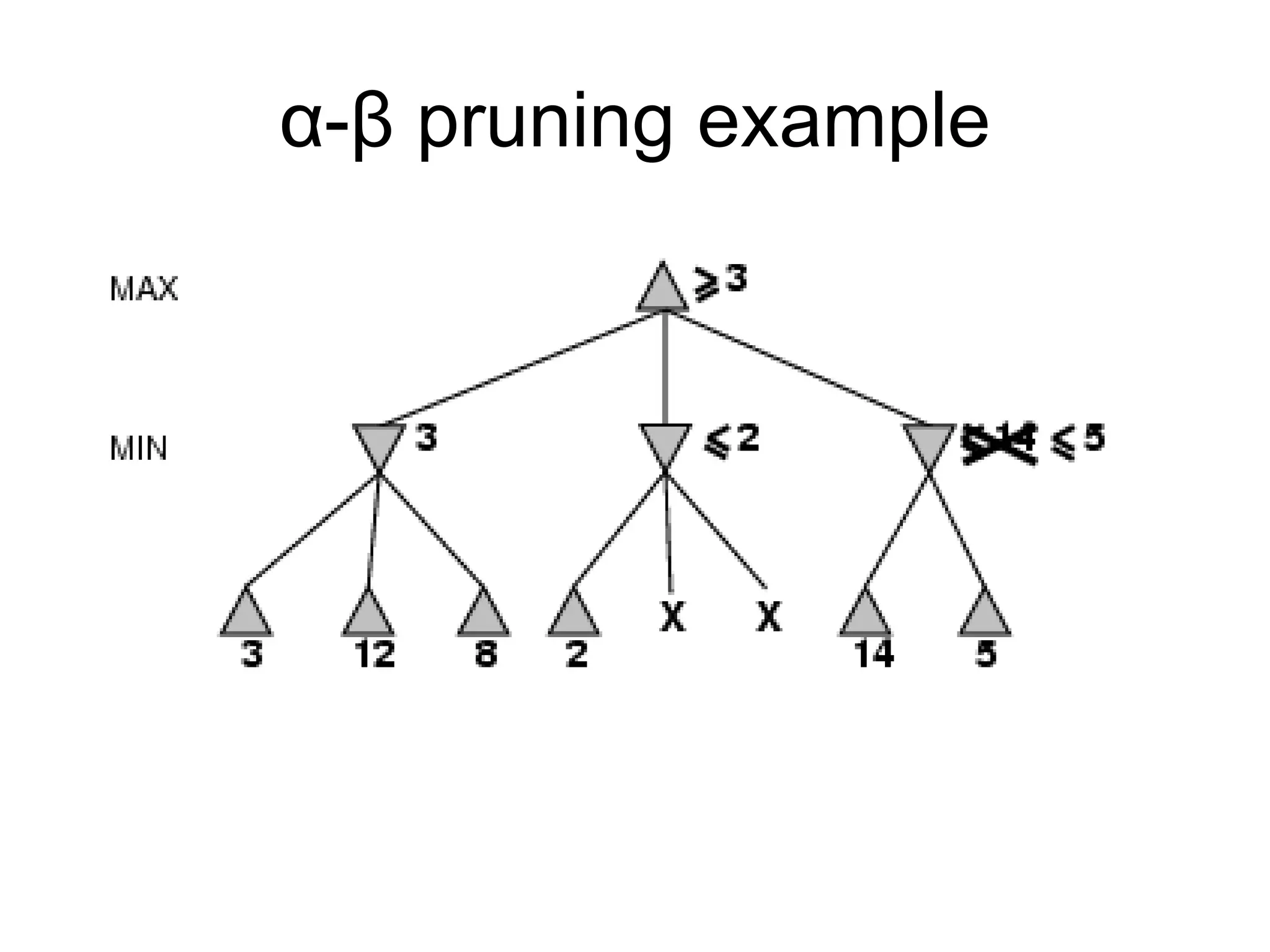
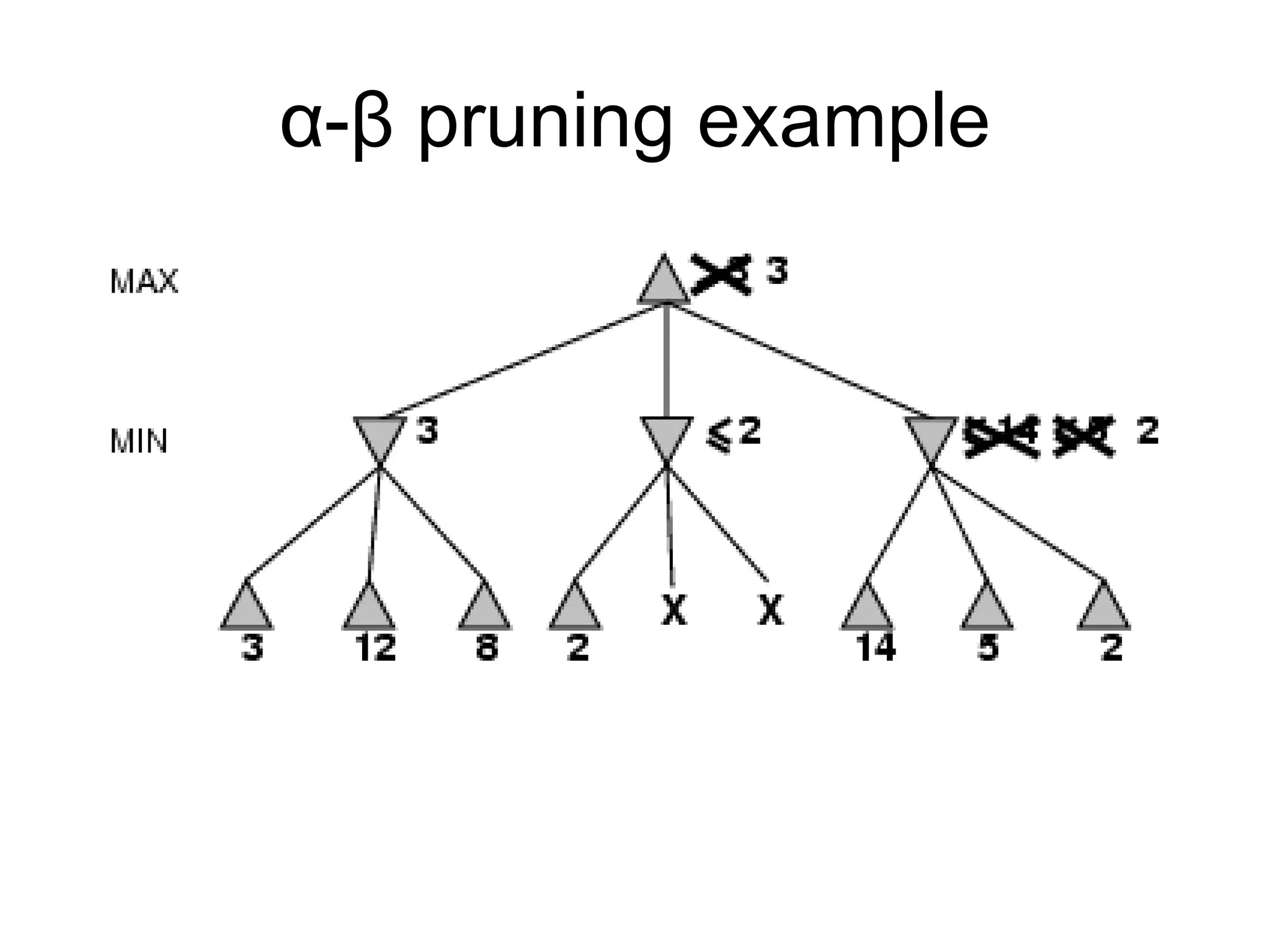
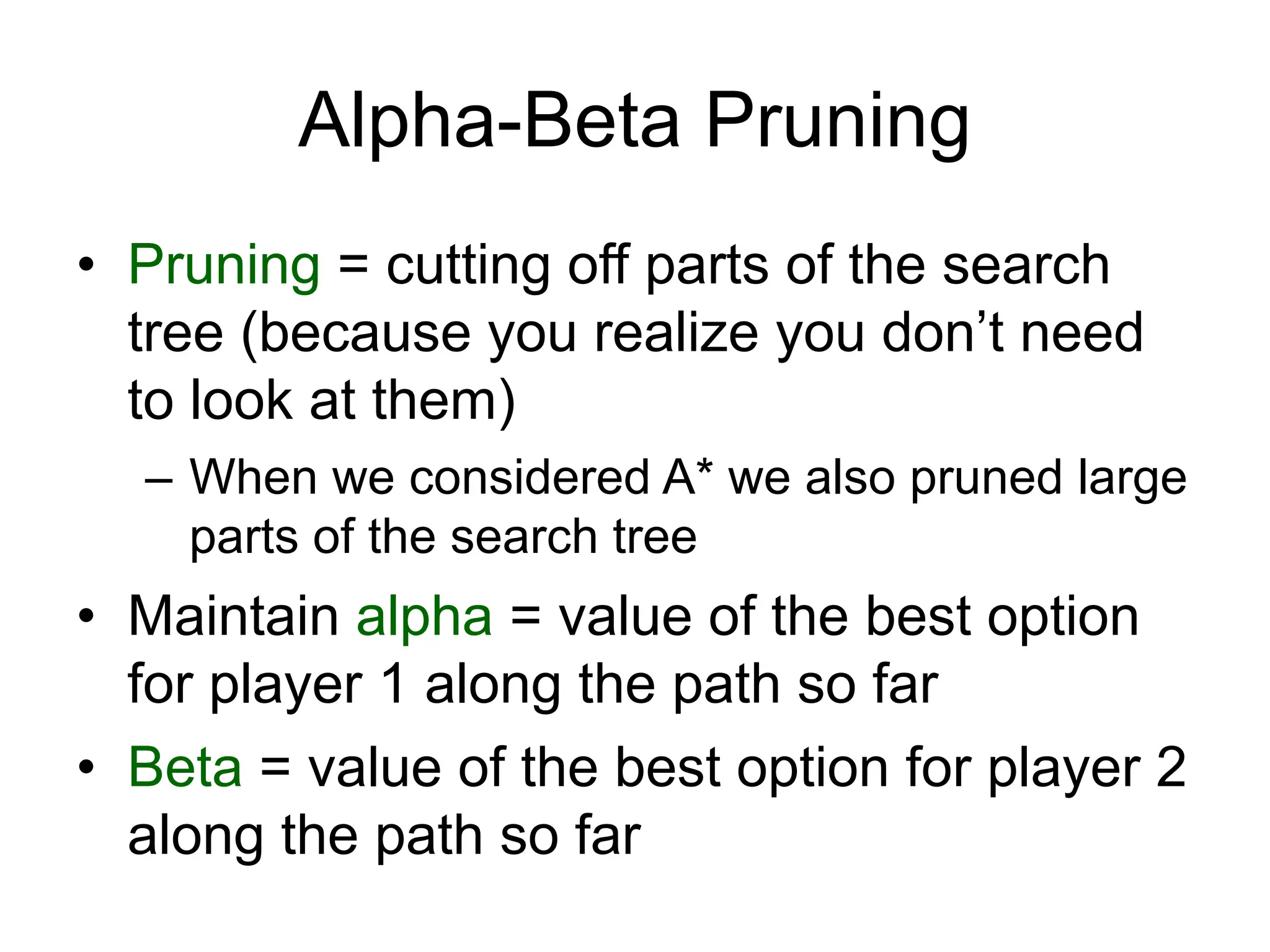
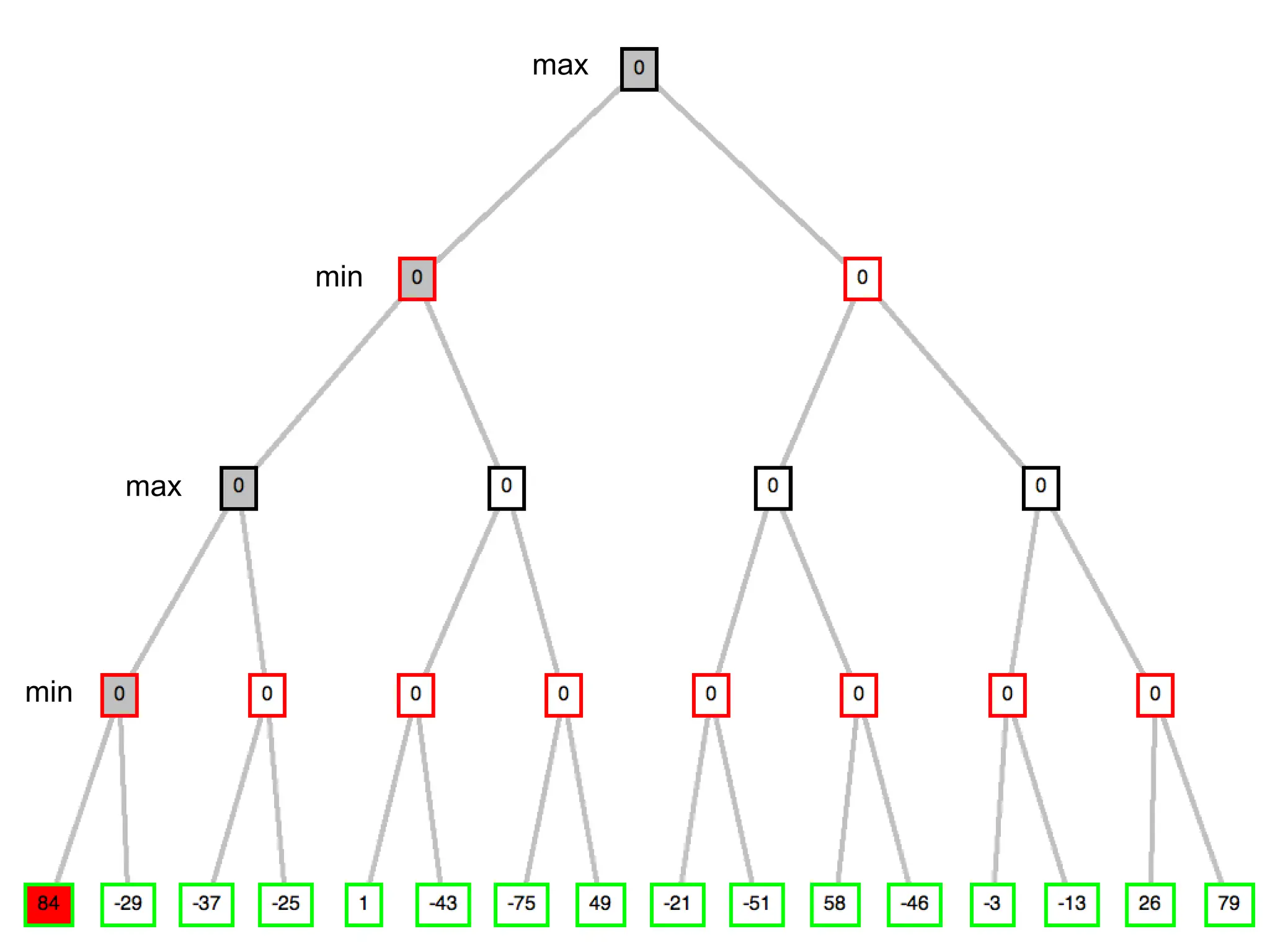
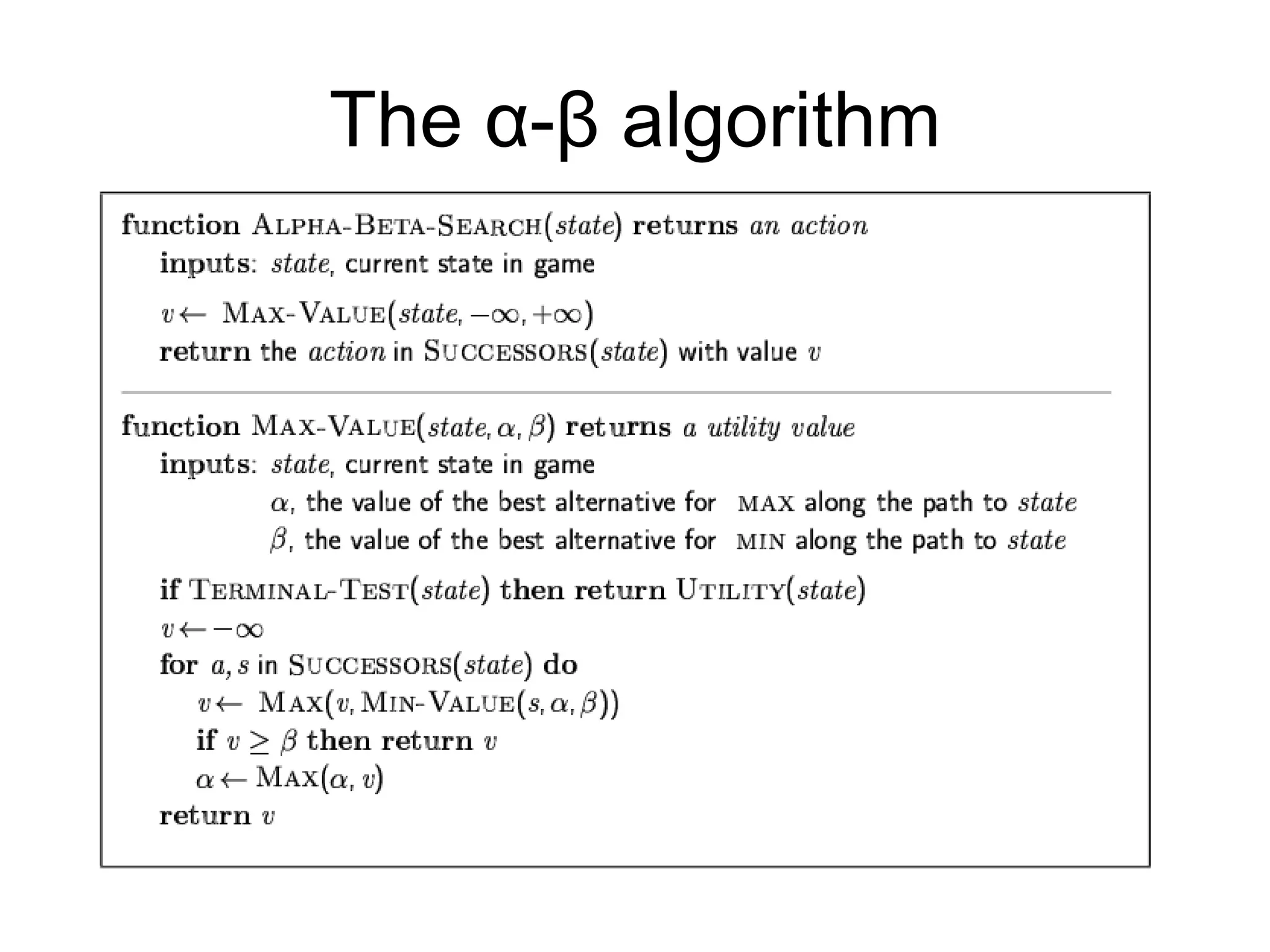
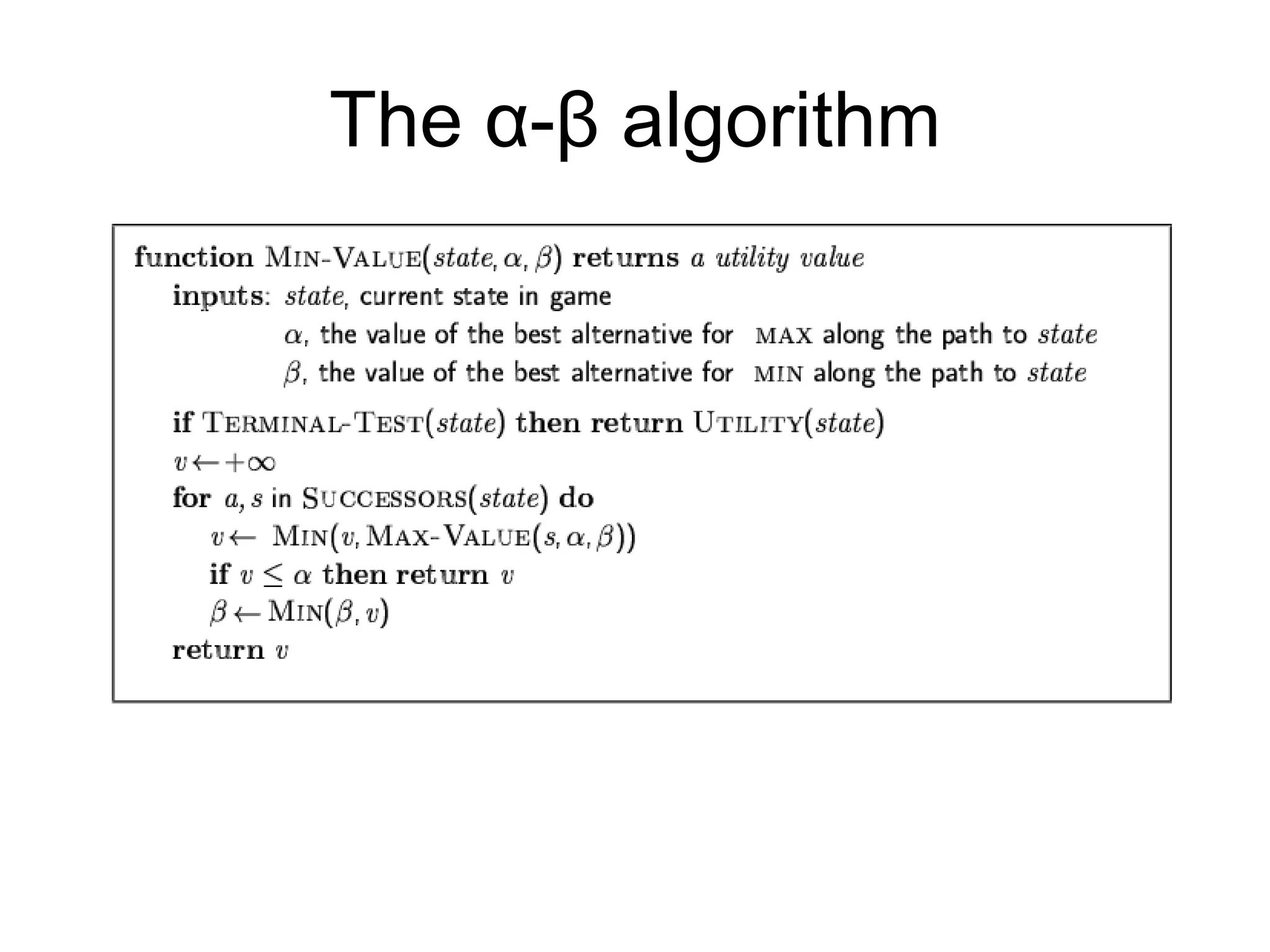
Alpha-Beta Pruning
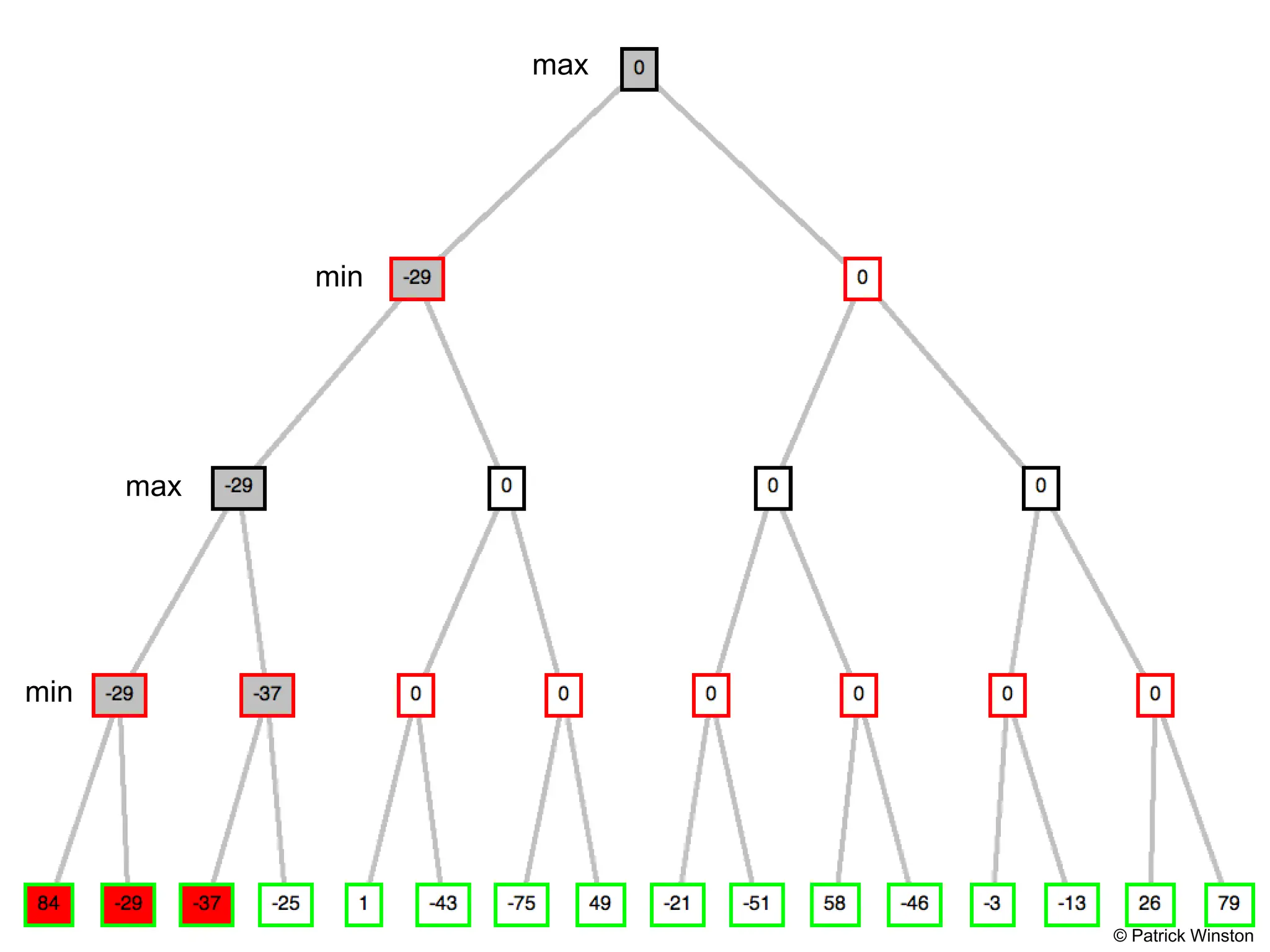
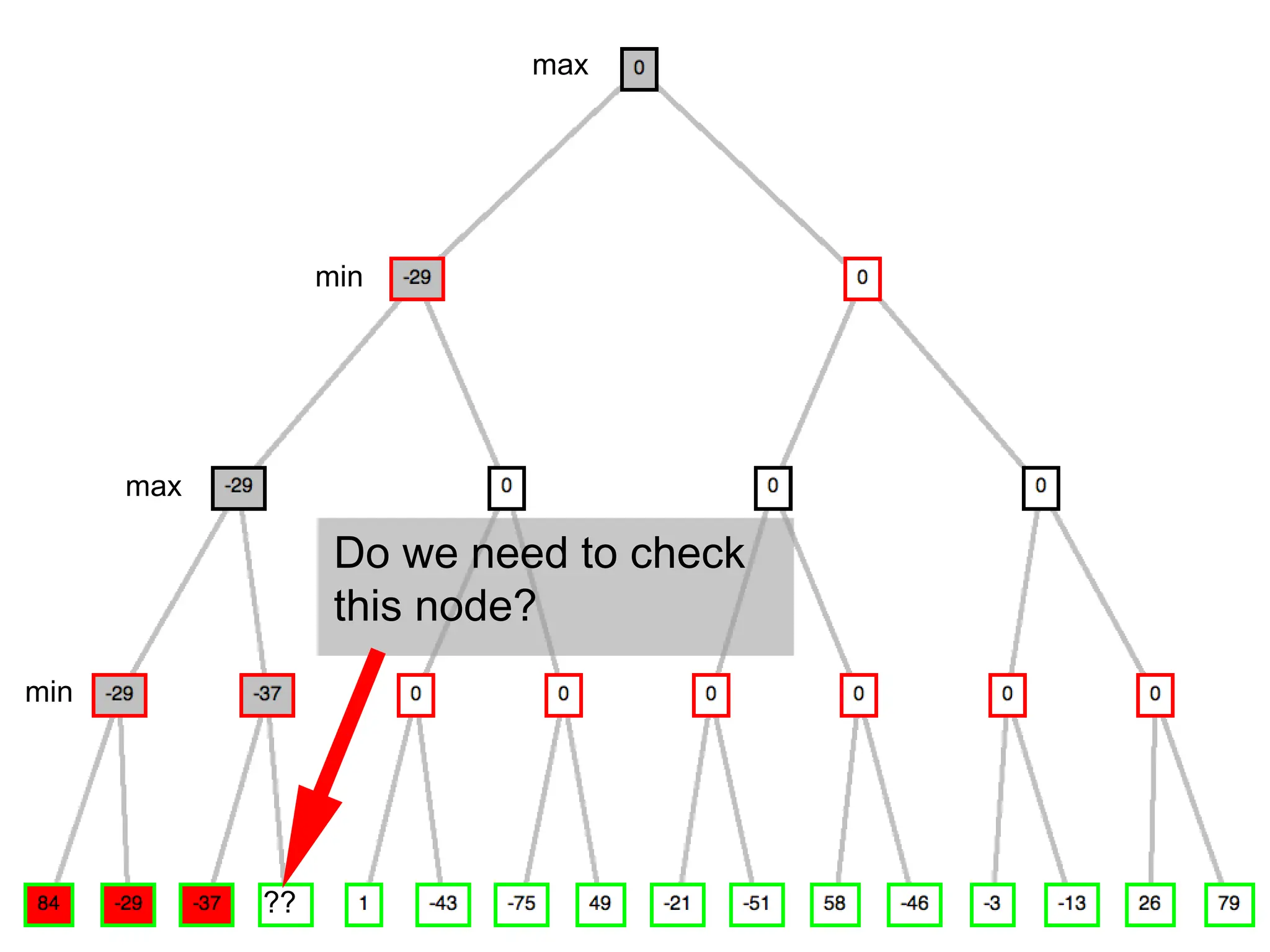
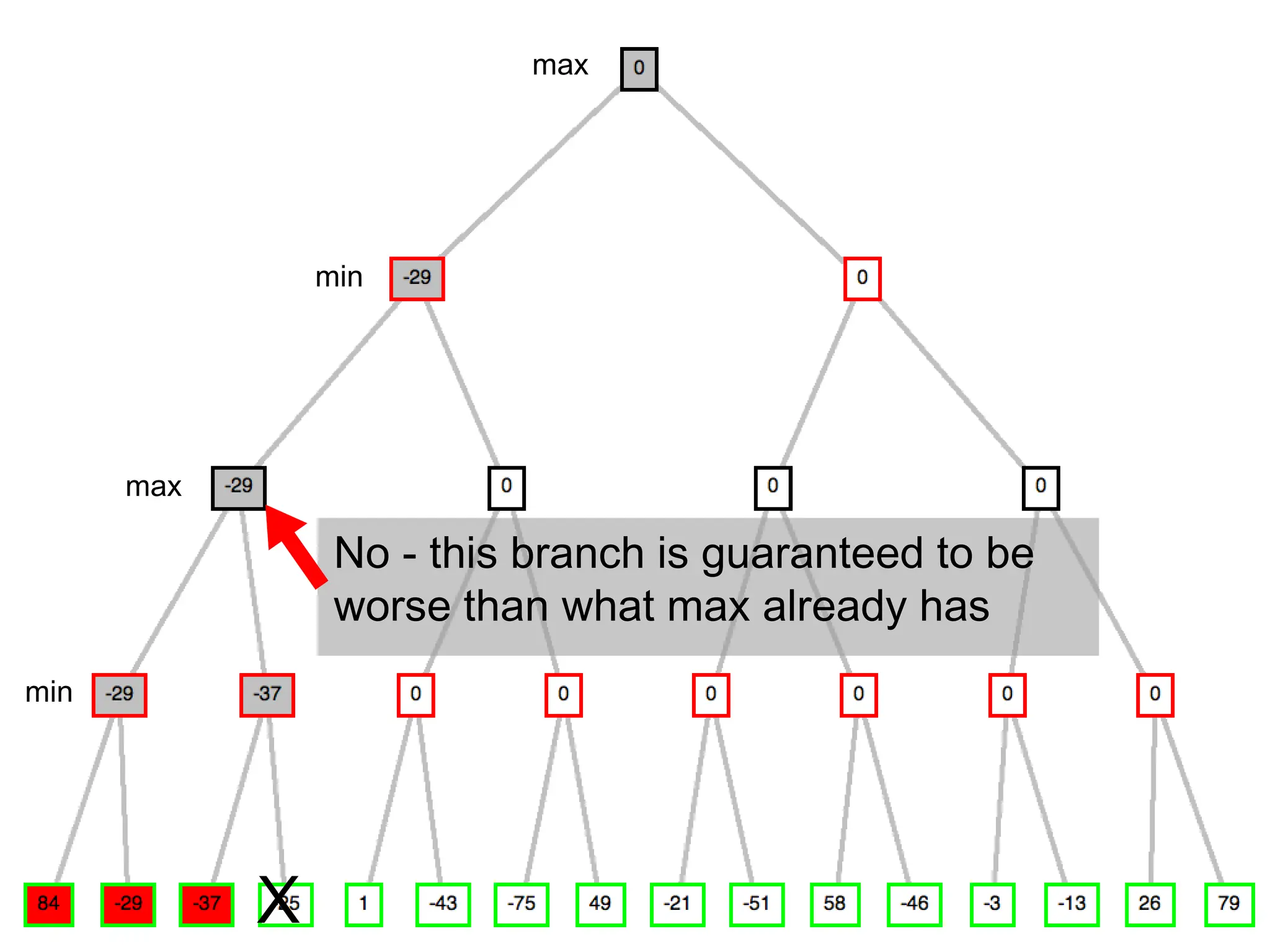
• Pruning= cutting off parts of the search
tree (because you realize you don’t need
to look at them)
– When we considered A* we also pruned large
parts of the search tree
• Maintain alpha = value of the best option
for player 1 along the path so far
• Beta = value of the best option for player 2
along the path so far
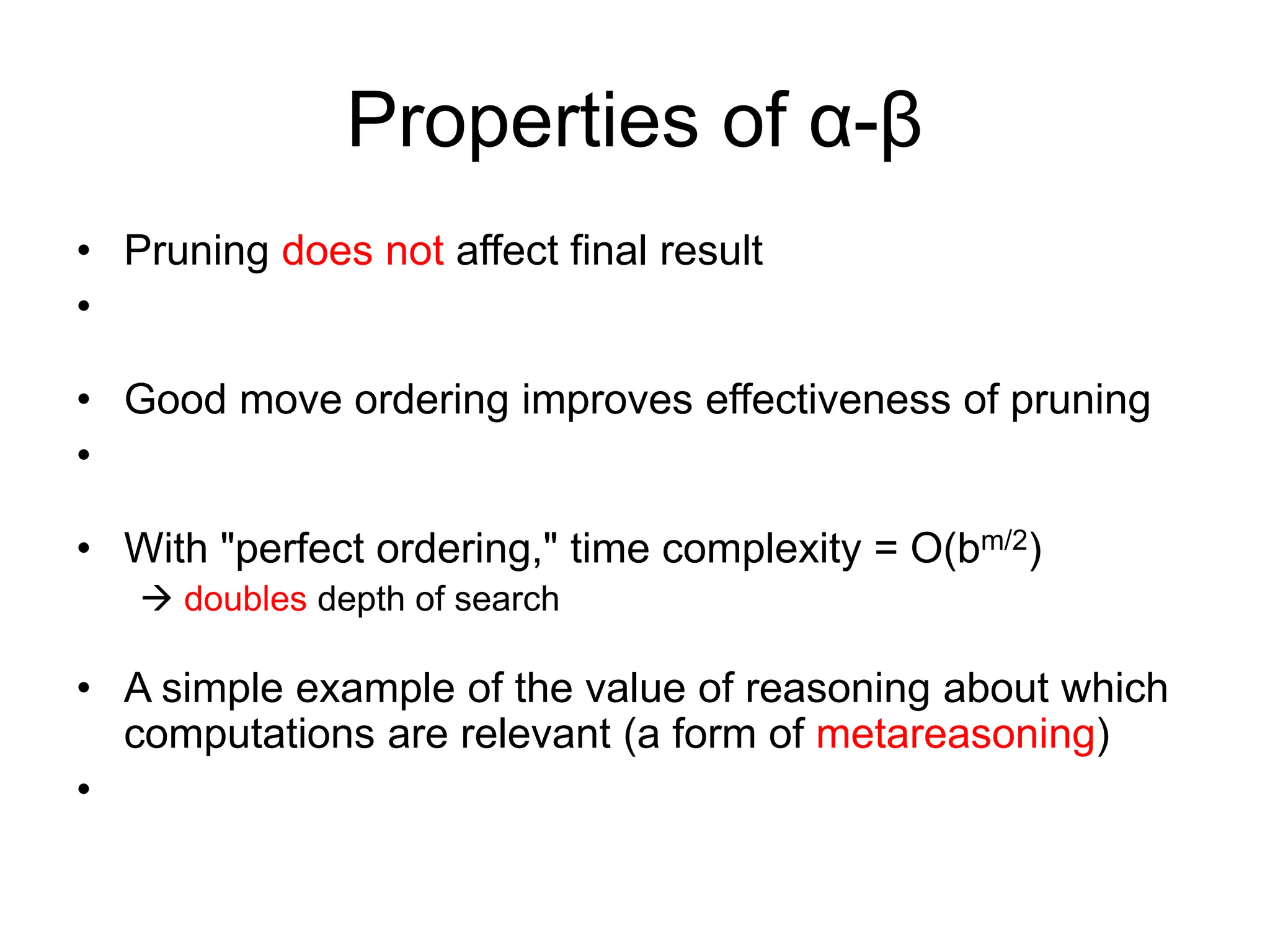
Properties of α-β
•Pruning does not affect final result
•
• Good move ordering improves effectiveness of pruning
•
• With "perfect ordering," time complexity = O(bm/2)
doubles depth of search
• A simple example of the value of reasoning about which
computations are relevant (a form of metareasoning)
•
38.
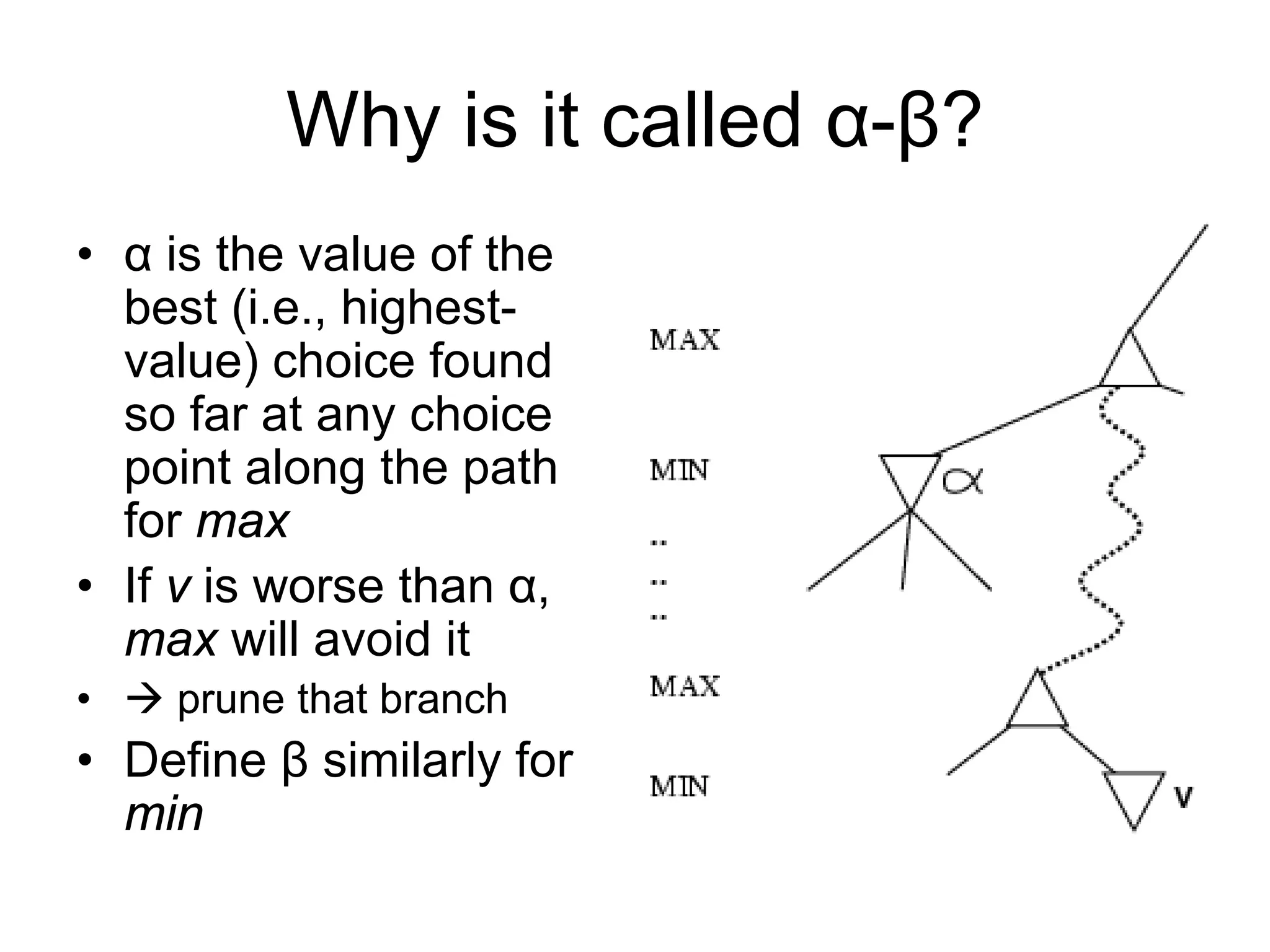
Why is itcalled α-β?
• α is the value of the
best (i.e., highest-
value) choice found
so far at any choice
point along the path
for max
• If v is worse than α,
max will avoid it
• prune that branch
• Define β similarly for
min
Summary
• Games arefun to work on!
• They illustrate several important points
about AI
• perfection is unattainable must
approximate
• good idea to think about what to think about


![[DSC Europe 25] Jon Dajci - Bridging TradFi and DeFi: Building the Future of ...](https://cdn.slidesharecdn.com/ss_thumbnails/fqmhfvlbqhkihjvqvhmu-7-251211083849-6af7e325-thumbnail.jpg?width=640&height=640&fit=bounds)
![[DSC Europe 25] Ivan Peric - Intelligence Swarm Logic and Techno-Functional M...](https://cdn.slidesharecdn.com/ss_thumbnails/7my7c97fsduiccadgavw-2-251212103249-5a03f7c6-thumbnail.jpg?width=640&height=640&fit=bounds)
![[DSC Europe 25] Behzad Hosseini - AI Agents in the Wild: Deploying Models tha...](https://cdn.slidesharecdn.com/ss_thumbnails/3qtejajvsjqrzwfept2c-10-251212103250-7f2b1068-thumbnail.jpg?width=640&height=640&fit=bounds)


![[DSC Europe 25] Uros Pesic - The Reality of AI in Marketing.pdf](https://cdn.slidesharecdn.com/ss_thumbnails/rtkodnmtycovsllvzsyn-9-251215095918-b0c6bfe3-thumbnail.jpg?width=640&height=640&fit=bounds)


![[DSC Europe 25] Dunja Adzic Jovanovic - AI and Cybersecurity: Defending Data ...](https://cdn.slidesharecdn.com/ss_thumbnails/o1zylpbhrtwnixxq2xj8-7-251211083048-185086f6-thumbnail.jpg?width=640&height=640&fit=bounds)
![[DSC Europe 25] Debmalya Biswas - Agentification: the art of transforming man...](https://cdn.slidesharecdn.com/ss_thumbnails/r5azlggvtqiaiiusrqdr-4-251212103249-5a12c89b-thumbnail.jpg?width=640&height=640&fit=bounds)