
Teaching English in the Philippines from a World Englishes paradigm Eden Regala Flores, Ph.D. Department of English and Applied Linguistics De La Salle University, Manila 20 May 2011, UST
Seven central questions related to the teaching of English
Whose language?  (the issue of English ownership)
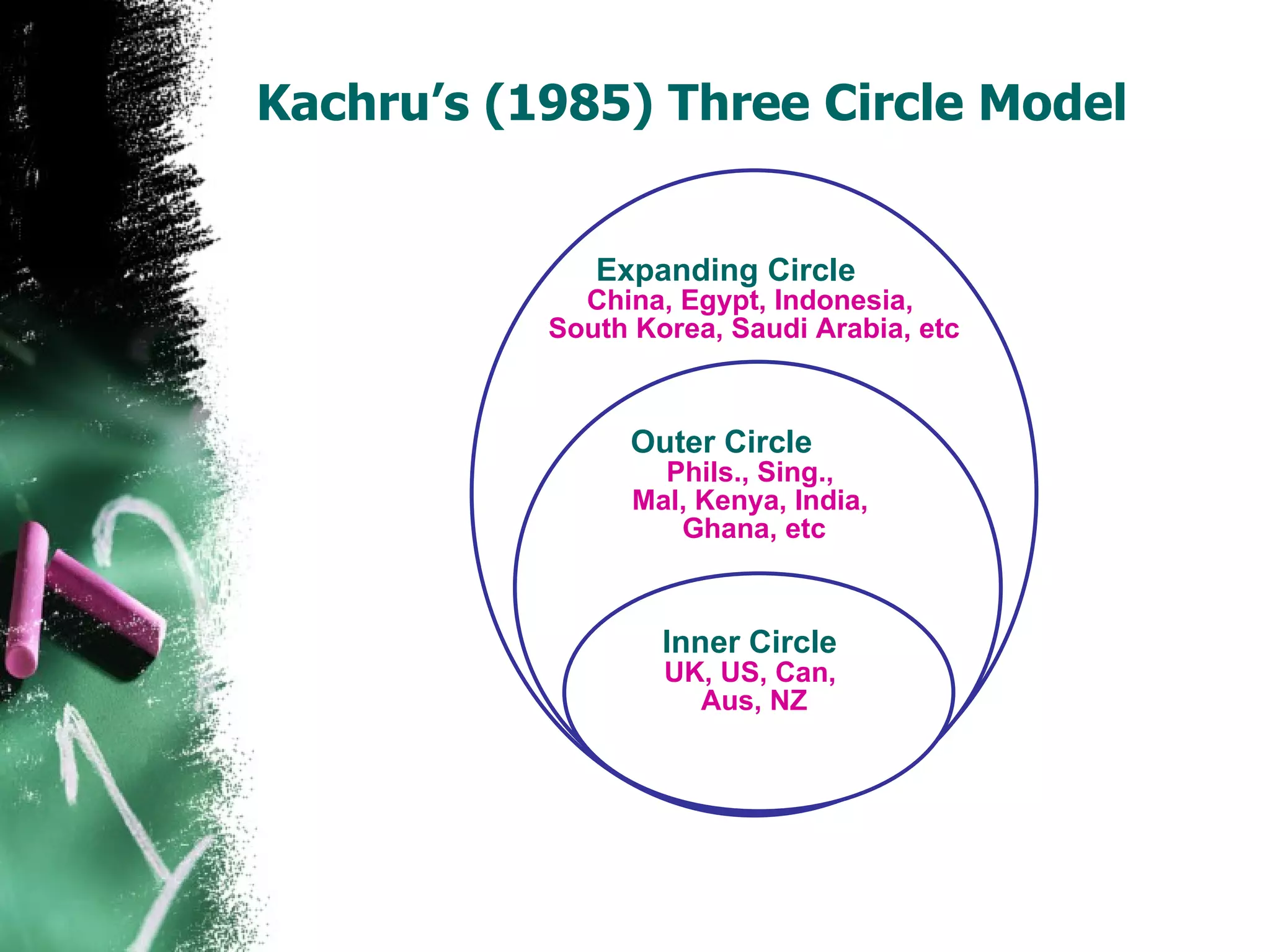
Kachru’s (1985) Three Circle Model Expanding Circle  China, Egypt, Indonesia,  South Korea, Saudi Arabia, etc Outer Circle  Phils., Sing.,  Mal, Kenya, India,  Ghana, etc Inner Circle  UK, US, Can,  Aus, NZ
2.  Which speakers?  (the privileging of native English norms)
3.  Which language?  (struggles inherent in selecting appropriate varieties of English for the classroom)
4.  Which standard?  (British, American, or Philippine English)
5.  Which approaches?  (CA, CBA, etc. approach)
6.  Which texts?  (use learner needs and local contexts to inform pedagogical practices)
7.  Who is the  learner?  (the voice of the learners themselves)
Bernardo (2007) on Filipino students’ motivation to learn  (710 respondents): 33.80% specific types of knowledge will be useful for future application; 23.66% knowledge will improve their socio-economic status; 15.77% learning is a stepping stone to realize  aspirations; and 9.01% learn for survival purposes
Thank you very much for listening.

Lecture 5 dr. eden flores

  • 1.
    Teaching English inthe Philippines from a World Englishes paradigm Eden Regala Flores, Ph.D. Department of English and Applied Linguistics De La Salle University, Manila 20 May 2011, UST
  • 2.
    Seven central questionsrelated to the teaching of English
  • 3.
    Whose language? (the issue of English ownership)
  • 4.
    Kachru’s (1985) ThreeCircle Model Expanding Circle China, Egypt, Indonesia, South Korea, Saudi Arabia, etc Outer Circle Phils., Sing., Mal, Kenya, India, Ghana, etc Inner Circle UK, US, Can, Aus, NZ
  • 5.
    2. Whichspeakers? (the privileging of native English norms)
  • 6.
    3. Whichlanguage? (struggles inherent in selecting appropriate varieties of English for the classroom)
  • 7.
    4. Whichstandard? (British, American, or Philippine English)
  • 8.
    5. Whichapproaches? (CA, CBA, etc. approach)
  • 9.
    6. Whichtexts? (use learner needs and local contexts to inform pedagogical practices)
  • 10.
    7. Whois the learner? (the voice of the learners themselves)
  • 11.
    Bernardo (2007) onFilipino students’ motivation to learn (710 respondents): 33.80% specific types of knowledge will be useful for future application; 23.66% knowledge will improve their socio-economic status; 15.77% learning is a stepping stone to realize aspirations; and 9.01% learn for survival purposes
  • 12.
    Thank you verymuch for listening.