FACTORS AFFECTING
LANGUAGE LEARNING
 STRATEGIES USAGE

 Norzahidah binti Mohd Salleh
           TESL
         A141362
1) AGE
 (Wong-Fillmore, 1979)
• A study of young children showed that cognitive and social
   strategies were very important.
Chesterfield and Chesterfield (1985)
• children developed receptive strategies (repetition and
   memorization) first.
• Then they developed strategies which allowed them to start
   and maintain interactions (e.g. attention getting and asking
   for clarification).
• Finally, they developed strategies for the identification and
   monitoring of grammatical errors.
Purdie and Oliver (1999)
• Most primary school children learn English by using
metacognitive strategies and social strategies ranked next in
importance.

Omally et al (1985a, 1985b)
• secondary school student were generally use cognitive
strategies and that metacognitive strategies were reported by
some more advanced learners.
Ramirez (1986)
• after identifying successful strategies employed by 105
learners of French at three levels of study (grade 8, grade 9-
10 and grade 10-11) concluded that successful learning
behaviours were dependent on the task, and that years of
study influenced LLS use
2) GENDER
 Politzer (1983)
• examined ninety undergraduate foreign language learners,
   found a “relatively minor” difference between male and
   female learners with females making a greater use of social
   interaction strategies.
Oxford and Nyikos (1989)
• females reported more frequent strategy use than males of
   formal practice strategies, general study strategies and
   conversational input elicitation strategies (e.g. asking to speak
   slowly, requesting pronunciation correction, and guessing
   what the speaker will say).
Tran’s (1988)
• study of immigrant Vietnamese aged from 40 to 92, in the USA
   revealed that males made greater use of strategies to learn and to
   improve their English language skills (e.g. taking English courses,
   practicing English with American friends and watching television or
   listening to the radio in English).

 Nyikos (1990)
• By studying the vocabulary recall of university level beginner
   learners of German using different combinations of colour and
   picture stimuli,
• Nyikos (1990), found that males were better when a visual-spatial
   stimulus of colour plus picture was used. However, females recalled
   more when colour was the mediator.
• Nyikos suggested that such strategies were the result of the
   socialisation of males and females and that such differences should
   be considered when the use of strategies was promoted in
   language learning.
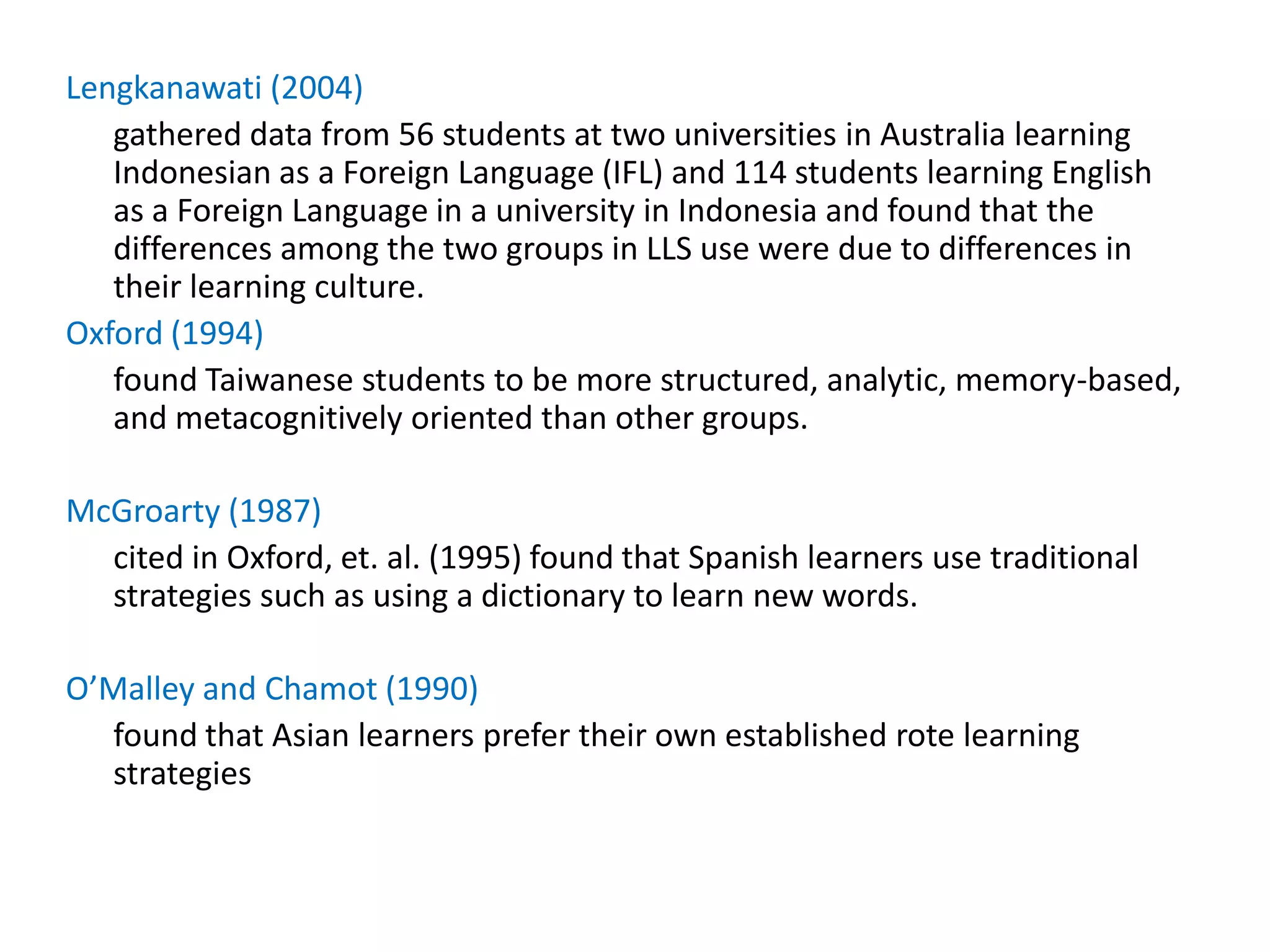
3) CULTURAL BACKGROUND
Bedell's (1993)
   study cited in Oxford, et. al. (1995) was that learners from various cultural
   backgrounds use certain types of strategies at different levels of
   frequency.

Politzer and McGroarty (1985)
    The study revealed that Asian students scored lower than the Hispanic
   learners on the scale of good language behaviours. The researchers
   concluded that such behaviours represent social interactions in which
   Asian learners are less likely to engage in than Hispanics.

Politzer and McGroarty (1985:113-114)
   claim that classroom behaviours such as asking the teacher, correcting
   classmates, volunteering answers and other social interaction behaviours
   such as asking for help and asking others to repeat are apparently more a
   part of the Western rather than the Asian repertoire.
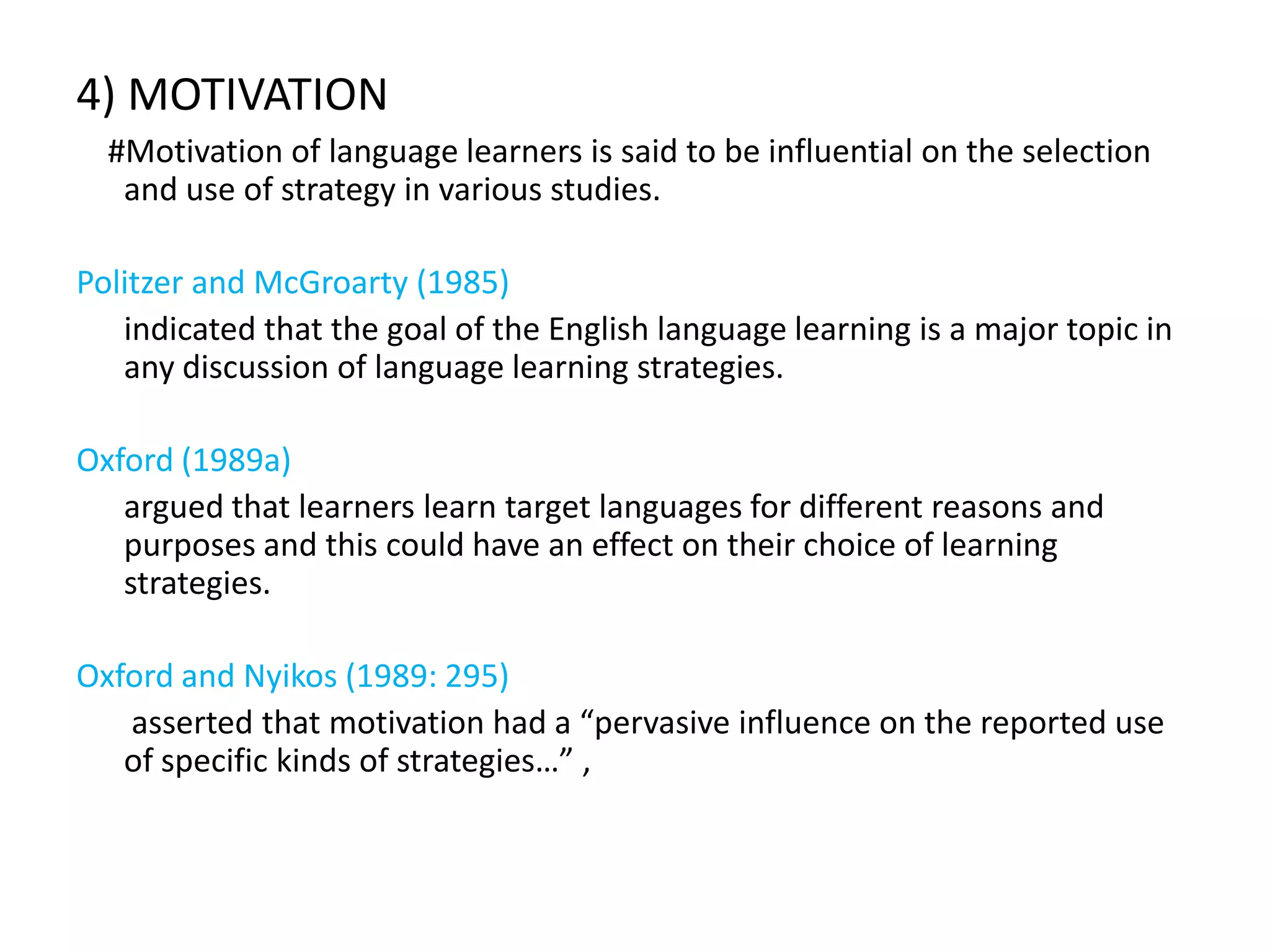
Lengkanawati (2004)
   gathered data from 56 students at two universities in Australia learning
   Indonesian as a Foreign Language (IFL) and 114 students learning English
   as a Foreign Language in a university in Indonesia and found that the
   differences among the two groups in LLS use were due to differences in
   their learning culture.
Oxford (1994)
   found Taiwanese students to be more structured, analytic, memory-based,
   and metacognitively oriented than other groups.

McGroarty (1987)
  cited in Oxford, et. al. (1995) found that Spanish learners use traditional
  strategies such as using a dictionary to learn new words.

O’Malley and Chamot (1990)
  found that Asian learners prefer their own established rote learning
  strategies
4) MOTIVATION
  #Motivation of language learners is said to be influential on the selection
   and use of strategy in various studies.

Politzer and McGroarty (1985)
   indicated that the goal of the English language learning is a major topic in
   any discussion of language learning strategies.
Oxford (1989a)
   argued that learners learn target languages for different reasons and
   purposes and this could have an effect on their choice of learning
   strategies.

Oxford and Nyikos (1989: 295)
   asserted that motivation had a “pervasive influence on the reported use
   of specific kinds of strategies…” ,
Nyikos and Oxford (1993)
• reporting on a study of university language learners in the
  USA who were taking a language as a requirement, reported
  that the students concentrating on obtaining good grades
  focused on formal,

• rule related processing strategies and academic study
  strategies, rather than on strategies which improve skills for
  authentic and communicative language use.
5) BACKGROUND OF PARENTS ACADEMICS
Slavin (1997)
• Parent that highly educated make physical and mental preparation to help
   the development of physiology and cognitive or their children.
• Parent with low education background raised their children without
   enough preparation and intellectual sources.

Mohd Nazali(1999) & Mohd Nazali and friends (1999)
• student with parent that highly educated used more language learning
  strategies outside classroom and in examination than other group.

Faizahani (2002)
• students with parenst that highly educated used more language learning
    strategies compare to students with low educated parents.
THANK YOU…

Factors affecting language learning strategies usage

  • 1.
    FACTORS AFFECTING LANGUAGE LEARNING STRATEGIES USAGE Norzahidah binti Mohd Salleh TESL A141362
  • 2.
    1) AGE (Wong-Fillmore,1979) • A study of young children showed that cognitive and social strategies were very important. Chesterfield and Chesterfield (1985) • children developed receptive strategies (repetition and memorization) first. • Then they developed strategies which allowed them to start and maintain interactions (e.g. attention getting and asking for clarification). • Finally, they developed strategies for the identification and monitoring of grammatical errors.
  • 3.
    Purdie and Oliver(1999) • Most primary school children learn English by using metacognitive strategies and social strategies ranked next in importance. Omally et al (1985a, 1985b) • secondary school student were generally use cognitive strategies and that metacognitive strategies were reported by some more advanced learners. Ramirez (1986) • after identifying successful strategies employed by 105 learners of French at three levels of study (grade 8, grade 9- 10 and grade 10-11) concluded that successful learning behaviours were dependent on the task, and that years of study influenced LLS use
  • 4.
    2) GENDER Politzer(1983) • examined ninety undergraduate foreign language learners, found a “relatively minor” difference between male and female learners with females making a greater use of social interaction strategies. Oxford and Nyikos (1989) • females reported more frequent strategy use than males of formal practice strategies, general study strategies and conversational input elicitation strategies (e.g. asking to speak slowly, requesting pronunciation correction, and guessing what the speaker will say).
  • 5.
    Tran’s (1988) • studyof immigrant Vietnamese aged from 40 to 92, in the USA revealed that males made greater use of strategies to learn and to improve their English language skills (e.g. taking English courses, practicing English with American friends and watching television or listening to the radio in English). Nyikos (1990) • By studying the vocabulary recall of university level beginner learners of German using different combinations of colour and picture stimuli, • Nyikos (1990), found that males were better when a visual-spatial stimulus of colour plus picture was used. However, females recalled more when colour was the mediator. • Nyikos suggested that such strategies were the result of the socialisation of males and females and that such differences should be considered when the use of strategies was promoted in language learning.
  • 6.
    3) CULTURAL BACKGROUND Bedell's(1993) study cited in Oxford, et. al. (1995) was that learners from various cultural backgrounds use certain types of strategies at different levels of frequency. Politzer and McGroarty (1985) The study revealed that Asian students scored lower than the Hispanic learners on the scale of good language behaviours. The researchers concluded that such behaviours represent social interactions in which Asian learners are less likely to engage in than Hispanics. Politzer and McGroarty (1985:113-114) claim that classroom behaviours such as asking the teacher, correcting classmates, volunteering answers and other social interaction behaviours such as asking for help and asking others to repeat are apparently more a part of the Western rather than the Asian repertoire.
  • 7.
    Lengkanawati (2004) gathered data from 56 students at two universities in Australia learning Indonesian as a Foreign Language (IFL) and 114 students learning English as a Foreign Language in a university in Indonesia and found that the differences among the two groups in LLS use were due to differences in their learning culture. Oxford (1994) found Taiwanese students to be more structured, analytic, memory-based, and metacognitively oriented than other groups. McGroarty (1987) cited in Oxford, et. al. (1995) found that Spanish learners use traditional strategies such as using a dictionary to learn new words. O’Malley and Chamot (1990) found that Asian learners prefer their own established rote learning strategies
  • 8.
    4) MOTIVATION #Motivation of language learners is said to be influential on the selection and use of strategy in various studies. Politzer and McGroarty (1985) indicated that the goal of the English language learning is a major topic in any discussion of language learning strategies. Oxford (1989a) argued that learners learn target languages for different reasons and purposes and this could have an effect on their choice of learning strategies. Oxford and Nyikos (1989: 295) asserted that motivation had a “pervasive influence on the reported use of specific kinds of strategies…” ,
  • 9.
    Nyikos and Oxford(1993) • reporting on a study of university language learners in the USA who were taking a language as a requirement, reported that the students concentrating on obtaining good grades focused on formal, • rule related processing strategies and academic study strategies, rather than on strategies which improve skills for authentic and communicative language use.
  • 10.
    5) BACKGROUND OFPARENTS ACADEMICS Slavin (1997) • Parent that highly educated make physical and mental preparation to help the development of physiology and cognitive or their children. • Parent with low education background raised their children without enough preparation and intellectual sources. Mohd Nazali(1999) & Mohd Nazali and friends (1999) • student with parent that highly educated used more language learning strategies outside classroom and in examination than other group. Faizahani (2002) • students with parenst that highly educated used more language learning strategies compare to students with low educated parents.
  • 11.