Lecture No 4
1
SOFTWARE REQUIREMENTS ENGINEERING
SOFTWARE PROCESS
Contents
 Process
 Software Processes
 Concept of Process Models
 Variations in Process Models
2
SOFTWARE PROCESS
 Process
 A process is an organized set of activities, which transform inputs
to outputs.
 We can use synonyms of process such as: procedure, methods,
course of action, etc.
 Processes are essential for dealing with complexity in real words.
 Processes document the steps in solving a certain problem
 They allow knowledge to be reused.
 They allow people to apply the process in their peculiar but
similar problems
3
SOFTWARE PROCESS
 Examples of Process
 An instruction manual for operating system a microwave oven
 An instruction manual for assembling a computer or its parts
 A procedure manual for operating a motor vehicle radio and CD
player
 A quality manual for software development.
 Such a manual describes the processes, which should be used to
assure the quality of the software.
4
SOFTWARE PROCESS
 Software Process
 Software engineering, as a discipline, has many processes
 These processes help in performing different software engineering
activities in an organized manner.
 Required creativity
 Provide interaction between a wide range of different people.
 Helps in engineering judgment. 5
SOFTWARE PROCESS
 Examples of Software Process
 Software engineering, development processes
 Requirement Engineering Process
 Design Process
 Quality Process
 Change management process
6
PROCESS MODELS
 A process model is a simplified description of a process presented
from a particular perspective
 There may be several different models of the same process
 No single model gives a complete understanding of the process
being modeled
 Variations in Process Models
 A process model is produced on the anticipated need for that
model. We may need.
 A model to help explain how process information has been
organized
 A model to help understand and improve a process
 A model to satisfy some quality management standard 7
TYPES OF PROCESS MODELS
 Coarse-grain activity models
 Fine-grain activity models
 Role-action models
 Entity Relation models
8
TYPES OF PROCESS MODELS
 Coarse-grain activity models
 This type of model provides an overall picture of the process.
 Describe the context of different activities in the process.
 It doesn’t document how to enact (implement) a process.
9
TYPES OF PROCESS MODELS
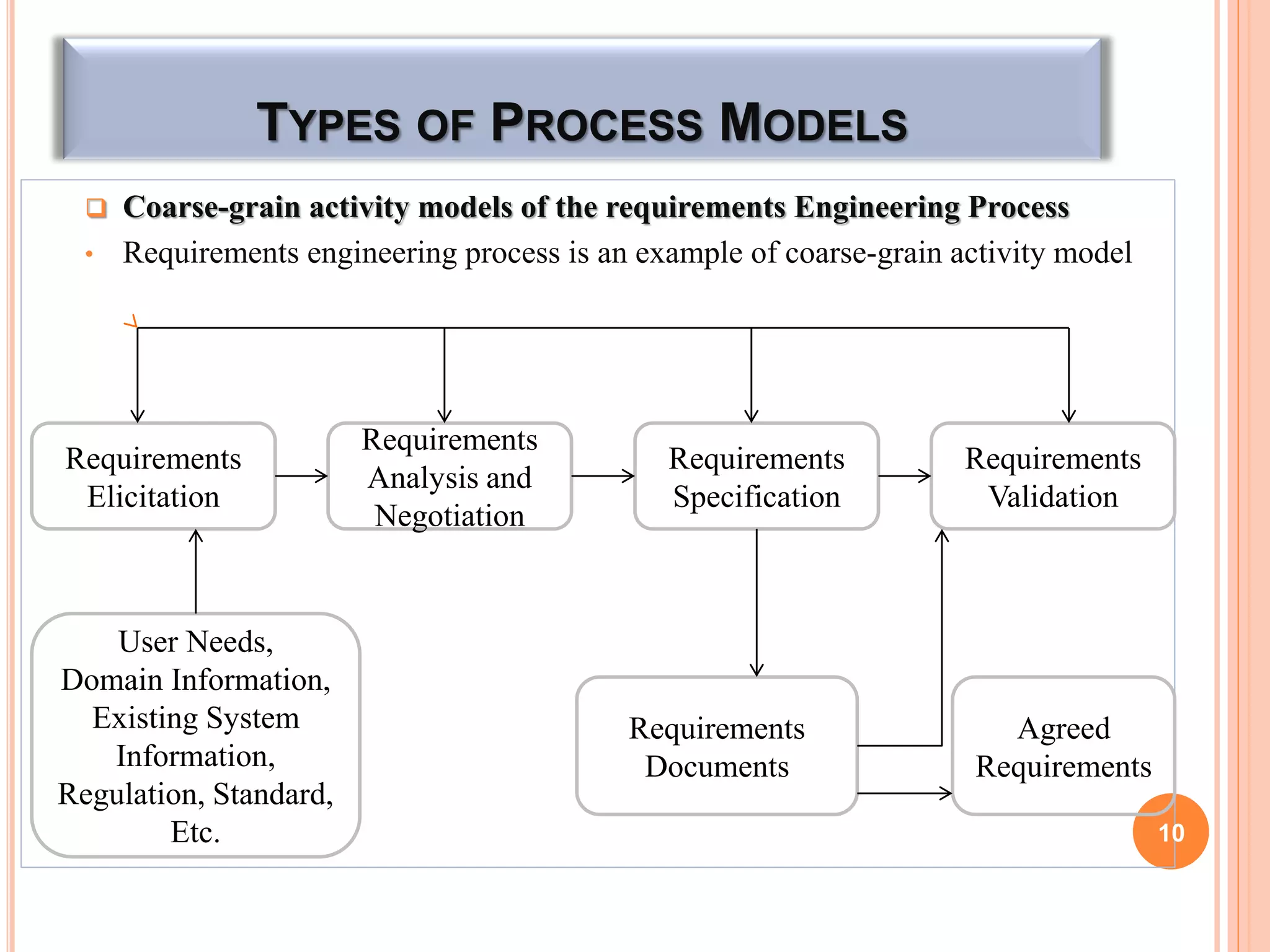
 Coarse-grain activity models of the requirements Engineering Process
• Requirements engineering process is an example of coarse-grain activity model
10
Requirements
Elicitation
Requirements
Analysis and
Negotiation
Requirements
Specification
Requirements
Validation
User Needs,
Domain Information,
Existing System
Information,
Regulation, Standard,
Etc.
Requirements
Documents
Agreed
Requirements
TYPES OF PROCESS MODELS
 Fine-grain Activity Models
 These are more detailed models of a specific process, which are
used for understanding and improving existing processes.
 Role-action Models
 These are models, which show the roles of different people
involved in the process and the action which they take.
 They are useful for process understanding and automation.
11
TYPES OF PROCESS MODELS
 Entity-relation Models
• The models show the process inputs, outputs, and intermediate
results and the relationships between them.
• (An entity can be a person, place things and etc.)
 They are useful in quality management systems.
12
REQUIREMENT ENGINEERING PROCESS
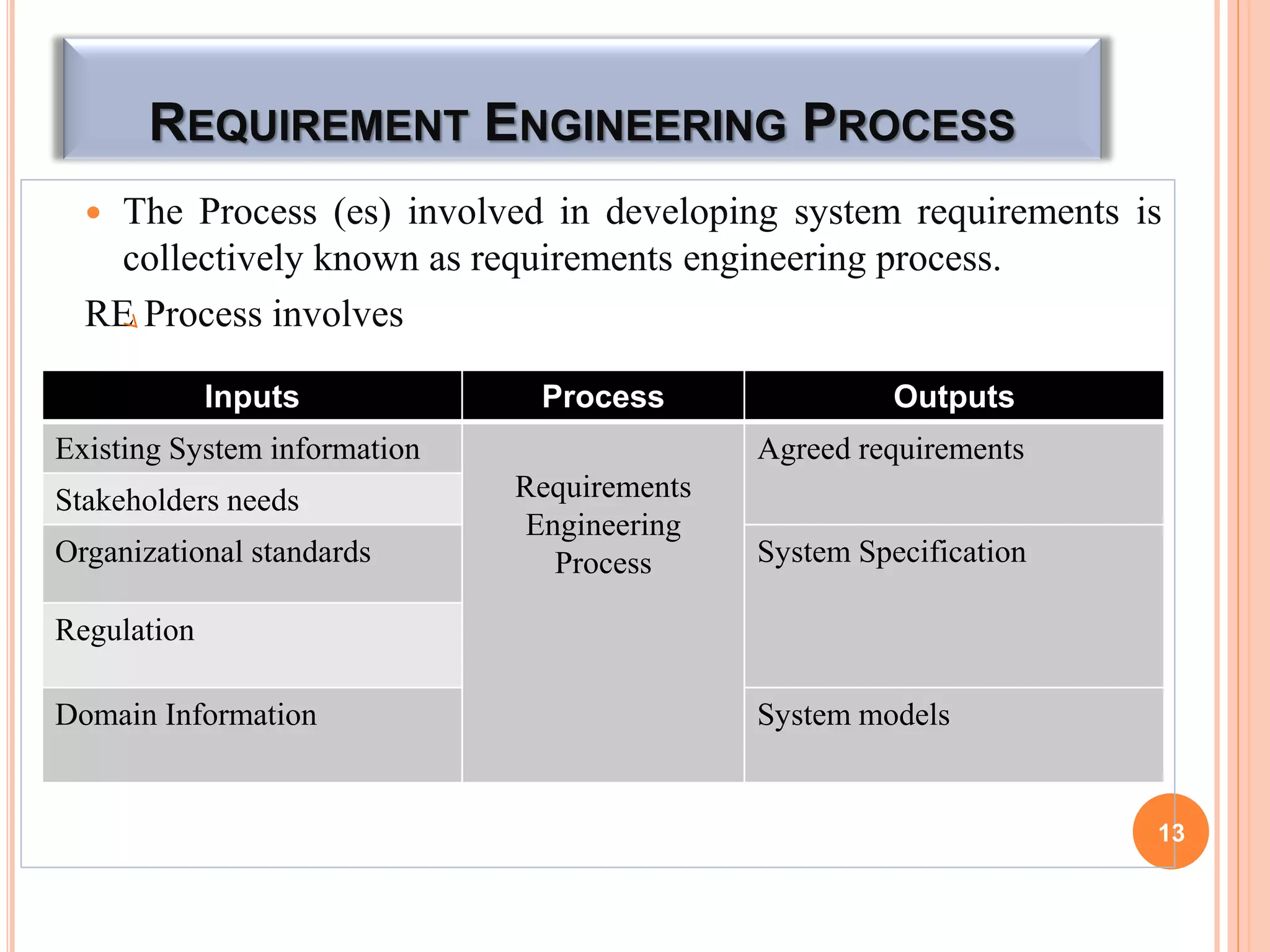
 The Process (es) involved in developing system requirements is
collectively known as requirements engineering process.
RE Process involves
13
Inputs Process Outputs
Existing System information
Requirements
Engineering
Process
Agreed requirements
Stakeholders needs
Organizational standards System Specification
Regulation
Domain Information System models
REQUIREMENT ENGINEERING PROCESS
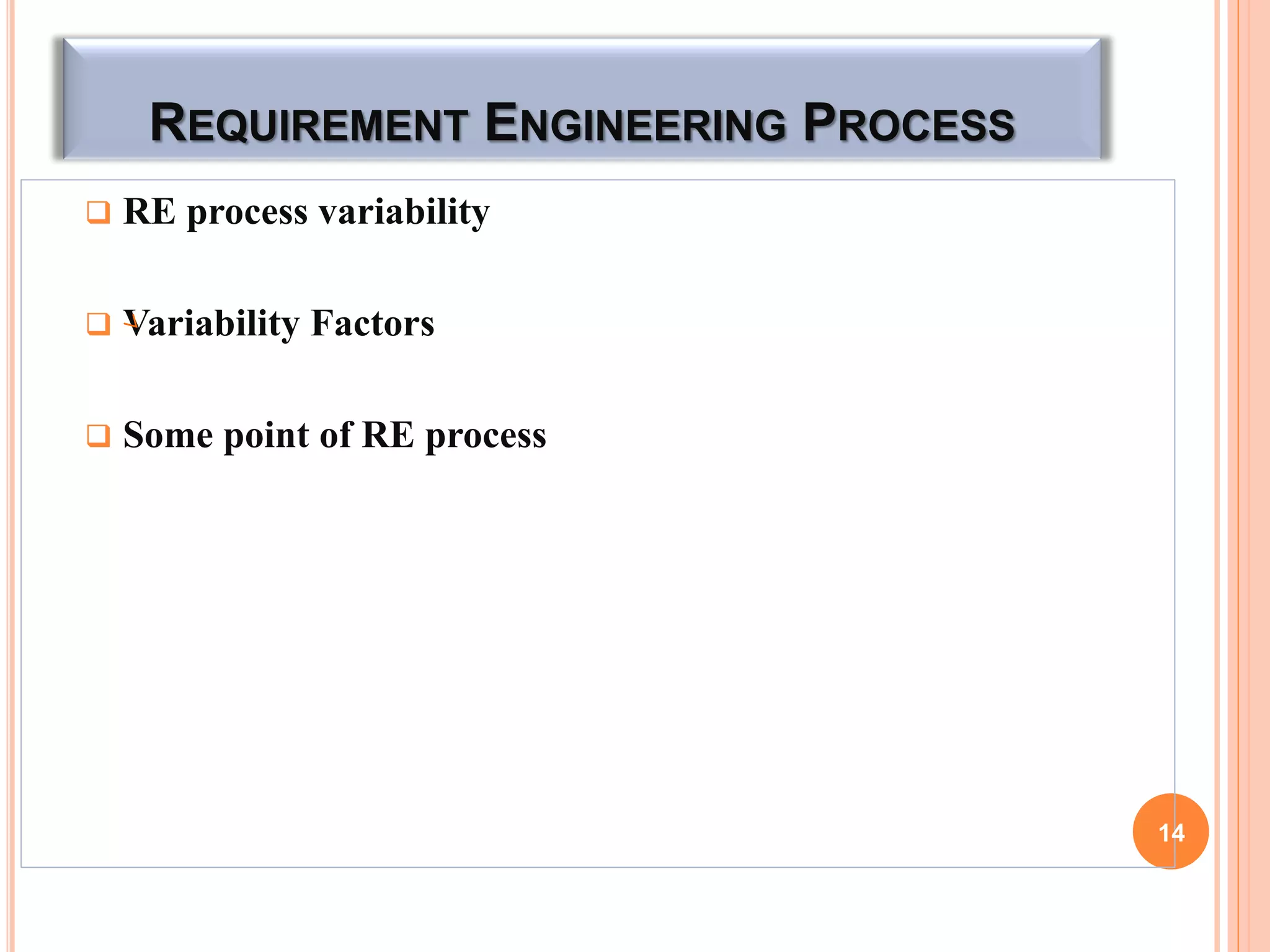
 RE process variability
 Variability Factors
 Some point of RE process
14
REQUIREMENT ENGINEERING PROCESS
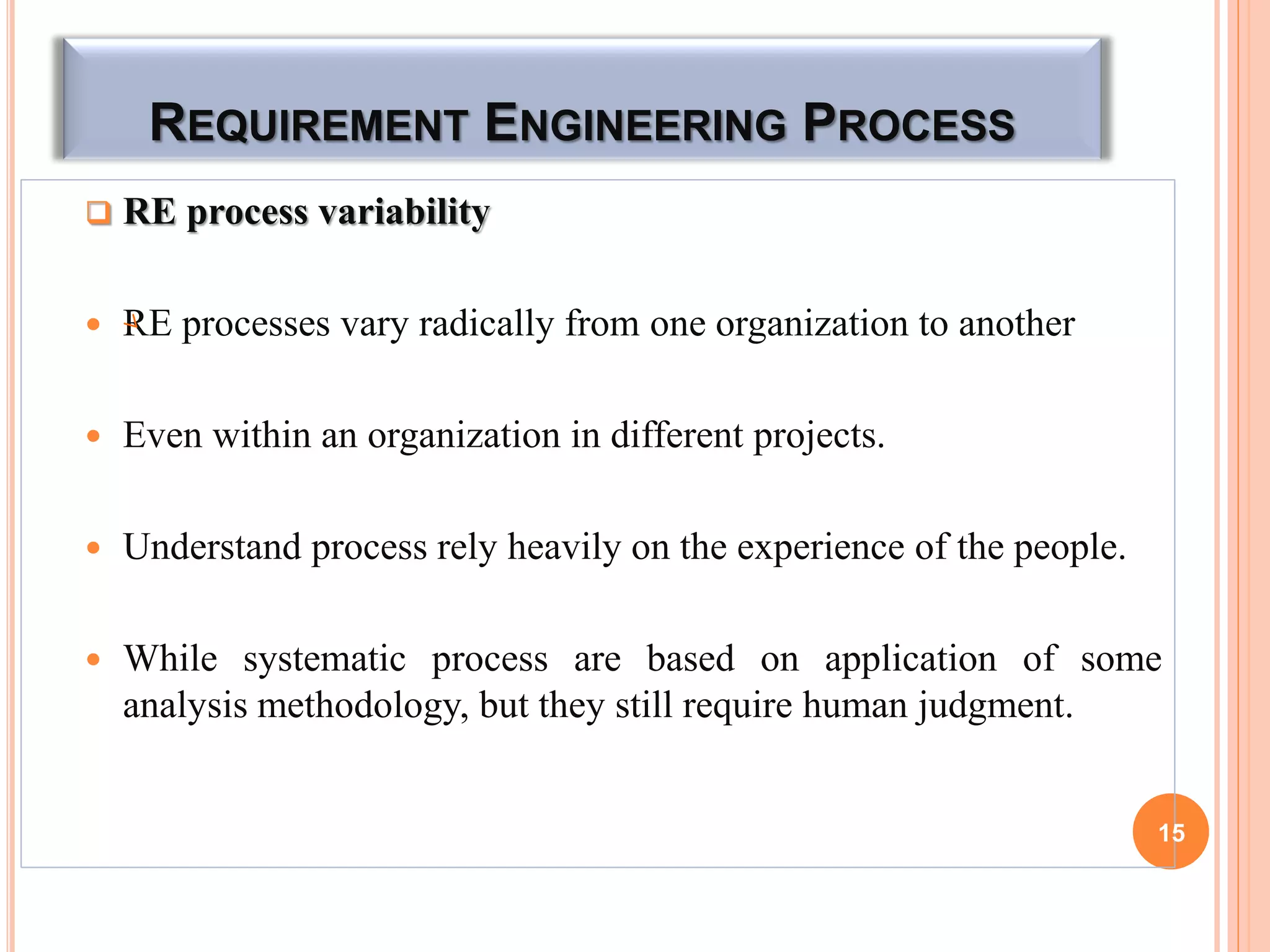
 RE process variability
 RE processes vary radically from one organization to another
 Even within an organization in different projects.
 Understand process rely heavily on the experience of the people.
 While systematic process are based on application of some
analysis methodology, but they still require human judgment.
15
REQUIREMENT ENGINEERING PROCESS
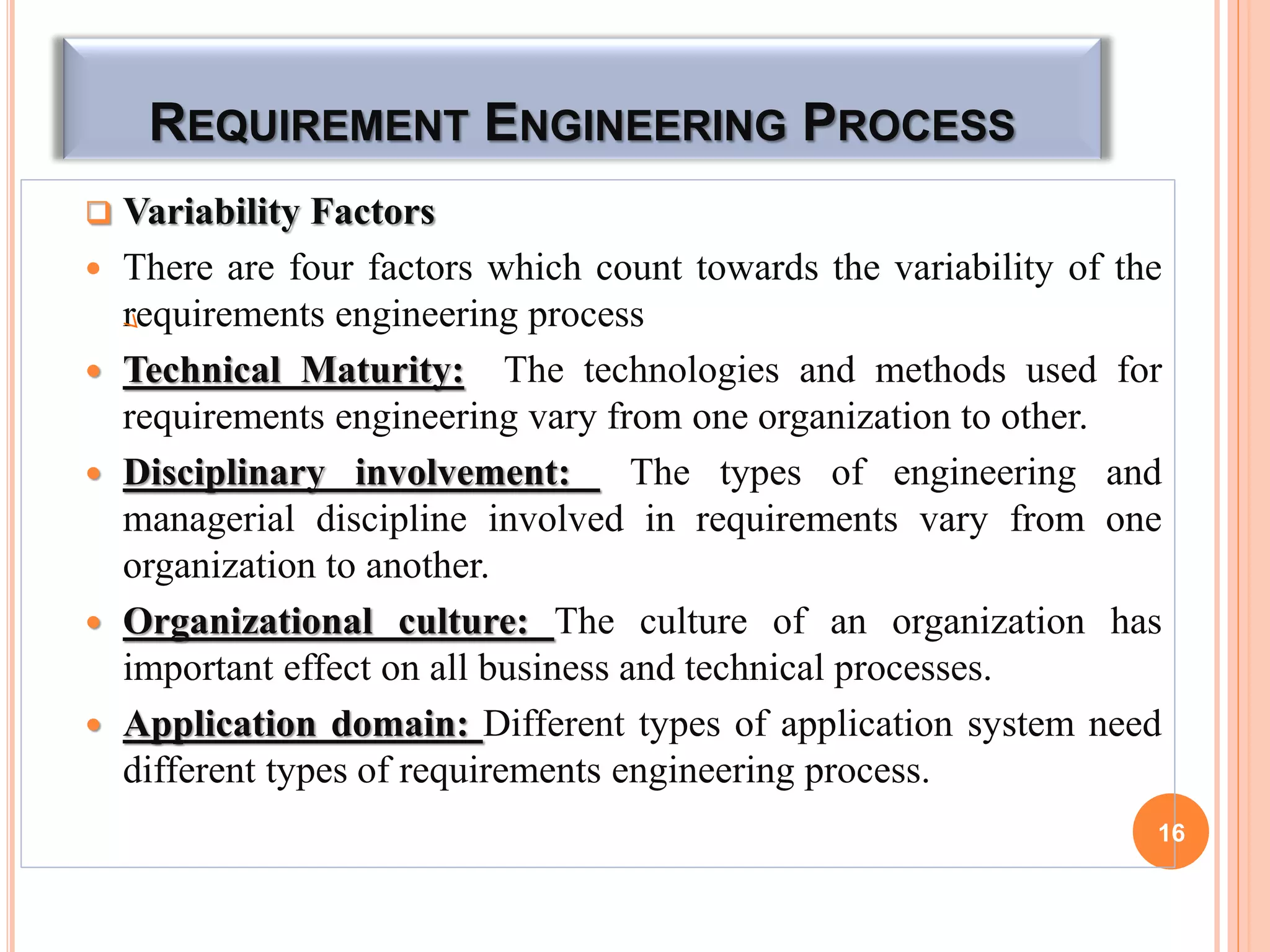
 Variability Factors
 There are four factors which count towards the variability of the
requirements engineering process
 Technical Maturity: The technologies and methods used for
requirements engineering vary from one organization to other.
 Disciplinary involvement: The types of engineering and
managerial discipline involved in requirements vary from one
organization to another.
 Organizational culture: The culture of an organization has
important effect on all business and technical processes.
 Application domain: Different types of application system need
different types of requirements engineering process.
16
REQUIREMENT ENGINEERING PROCESS
 RE Process
 An important point to remember is that “There is no ideal
requirements engineering process!”.
 Requirement engineering process has a formal starting and ending
point in the overall software development life cycle.
 Begins
• There is recognition that a problem exists and requires a solution.
• A new software idea arises
 Ends
• With a complete description of the external behavior of the
software to be built.
17
REQUIREMENT ENGINEERING PROCESS
 Main task of RE Process
 Problem Analysis
 Problem Description
_____________________________________________________
 Two Main Tasks of RE
 There are two main tasks which need to be performed in the
requirements engineering process.
1. Problem Analysis: Analysis of a software problem
2. Product Description: Complete specification of the desired
external behavior of the software system to be built. Also known as
functional description, functional requirement, or specifications.
18
REQUIREMENT ENGINEERING PROCESS
 Problem Analysis
is the first and foremost task of requirements engineering process. It
includes:
1. Brainstorming, interviewing, eliciting requirements
2. Identifying all possible constraints
3. Expansion of information
 Product description
Is another task of requirements engineering process. In this task we:
1. Make decisions to define the external behavior of the software
product
2. Organize ideas, resolve conflicting views, and eliminate
inconsistencies and ambiguities.
19
REQUIREMENT ENGINEERING PROCESS
 Who are actors?
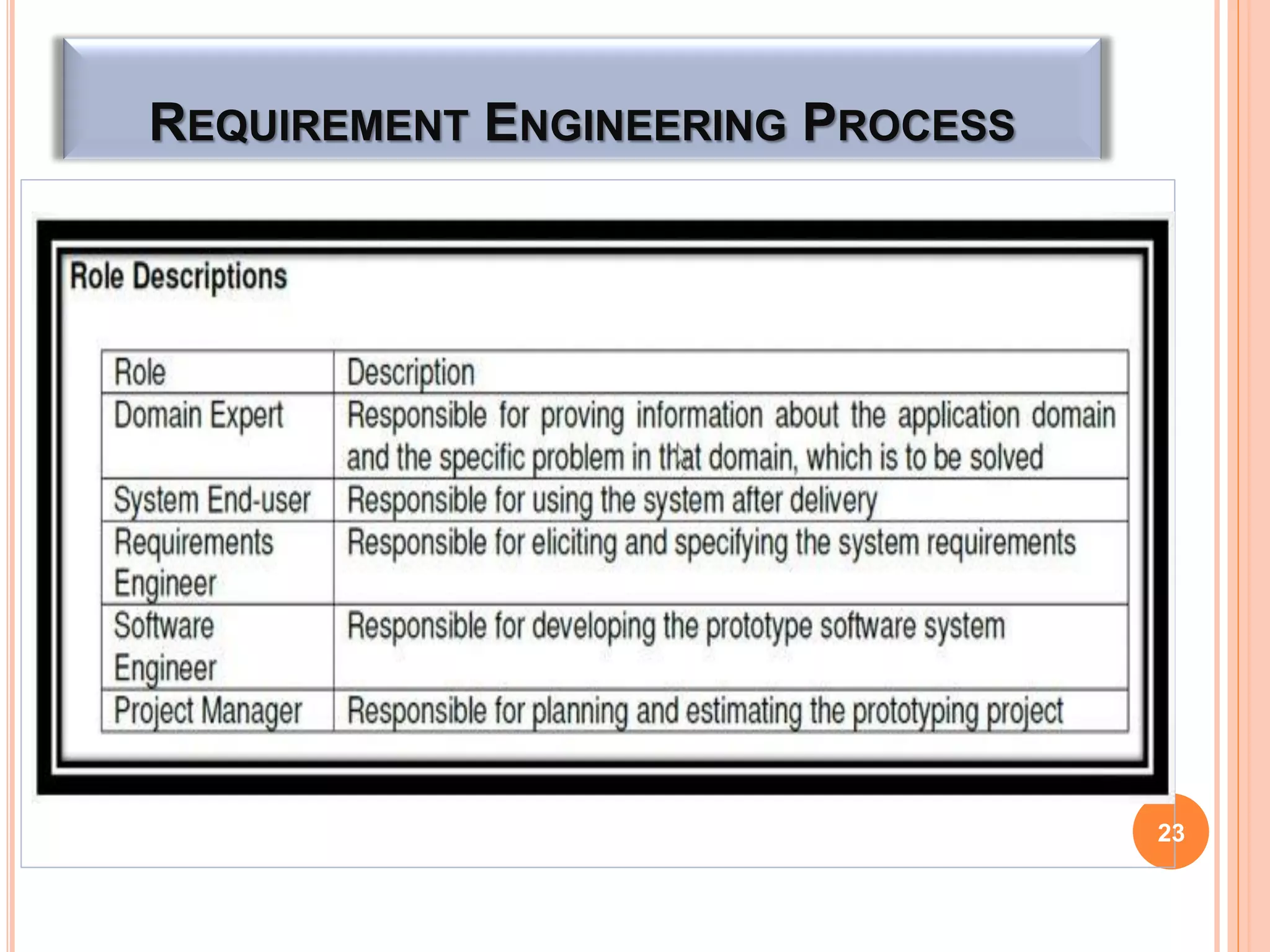
 Actors in a process are the people involved in the execution of that
process.
 Actors are normally identified by their roles rather than
individually, e.g. project manager, purchasing director, and system
engineer.
 Actors in the RE Process
• Requirement engineering involves people who are primarily
interested in the problem to be solved (end-user, etc.) as well as
people interested in the solution (system designers, etc.)
• Another group of people, such as health & safety regulators, and
maintenance engineers may be affected by the existance of the
system.
20
REQUIREMENT ENGINEERING PROCESS
 Actors in the RE Process count…
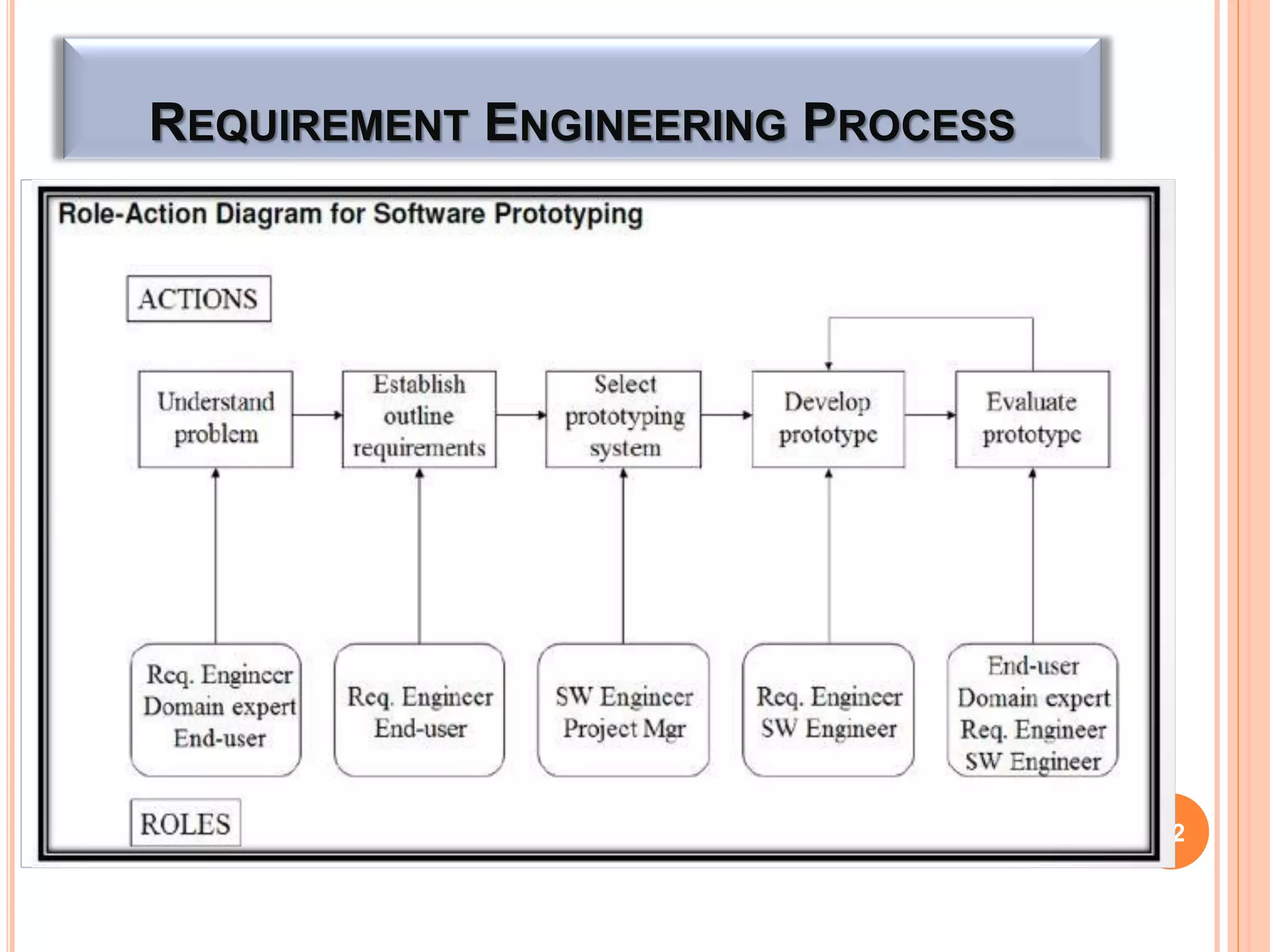
• Role-action diagrams are process models which show the actors
associated with different process activities.
• They document the needs of different people involved in the
process.
21
REQUIREMENT ENGINEERING PROCESS
22
REQUIREMENT ENGINEERING PROCESS
23

Lecture 4.pdf

  • 1.
    Lecture No 4 1 SOFTWAREREQUIREMENTS ENGINEERING
  • 2.
    SOFTWARE PROCESS Contents  Process Software Processes  Concept of Process Models  Variations in Process Models 2
  • 3.
    SOFTWARE PROCESS  Process A process is an organized set of activities, which transform inputs to outputs.  We can use synonyms of process such as: procedure, methods, course of action, etc.  Processes are essential for dealing with complexity in real words.  Processes document the steps in solving a certain problem  They allow knowledge to be reused.  They allow people to apply the process in their peculiar but similar problems 3
  • 4.
    SOFTWARE PROCESS  Examplesof Process  An instruction manual for operating system a microwave oven  An instruction manual for assembling a computer or its parts  A procedure manual for operating a motor vehicle radio and CD player  A quality manual for software development.  Such a manual describes the processes, which should be used to assure the quality of the software. 4
  • 5.
    SOFTWARE PROCESS  SoftwareProcess  Software engineering, as a discipline, has many processes  These processes help in performing different software engineering activities in an organized manner.  Required creativity  Provide interaction between a wide range of different people.  Helps in engineering judgment. 5
  • 6.
    SOFTWARE PROCESS  Examplesof Software Process  Software engineering, development processes  Requirement Engineering Process  Design Process  Quality Process  Change management process 6
  • 7.
    PROCESS MODELS  Aprocess model is a simplified description of a process presented from a particular perspective  There may be several different models of the same process  No single model gives a complete understanding of the process being modeled  Variations in Process Models  A process model is produced on the anticipated need for that model. We may need.  A model to help explain how process information has been organized  A model to help understand and improve a process  A model to satisfy some quality management standard 7
  • 8.
    TYPES OF PROCESSMODELS  Coarse-grain activity models  Fine-grain activity models  Role-action models  Entity Relation models 8
  • 9.
    TYPES OF PROCESSMODELS  Coarse-grain activity models  This type of model provides an overall picture of the process.  Describe the context of different activities in the process.  It doesn’t document how to enact (implement) a process. 9
  • 10.
    TYPES OF PROCESSMODELS  Coarse-grain activity models of the requirements Engineering Process • Requirements engineering process is an example of coarse-grain activity model 10 Requirements Elicitation Requirements Analysis and Negotiation Requirements Specification Requirements Validation User Needs, Domain Information, Existing System Information, Regulation, Standard, Etc. Requirements Documents Agreed Requirements
  • 11.
    TYPES OF PROCESSMODELS  Fine-grain Activity Models  These are more detailed models of a specific process, which are used for understanding and improving existing processes.  Role-action Models  These are models, which show the roles of different people involved in the process and the action which they take.  They are useful for process understanding and automation. 11
  • 12.
    TYPES OF PROCESSMODELS  Entity-relation Models • The models show the process inputs, outputs, and intermediate results and the relationships between them. • (An entity can be a person, place things and etc.)  They are useful in quality management systems. 12
  • 13.
    REQUIREMENT ENGINEERING PROCESS The Process (es) involved in developing system requirements is collectively known as requirements engineering process. RE Process involves 13 Inputs Process Outputs Existing System information Requirements Engineering Process Agreed requirements Stakeholders needs Organizational standards System Specification Regulation Domain Information System models
  • 14.
    REQUIREMENT ENGINEERING PROCESS RE process variability  Variability Factors  Some point of RE process 14
  • 15.
    REQUIREMENT ENGINEERING PROCESS RE process variability  RE processes vary radically from one organization to another  Even within an organization in different projects.  Understand process rely heavily on the experience of the people.  While systematic process are based on application of some analysis methodology, but they still require human judgment. 15
  • 16.
    REQUIREMENT ENGINEERING PROCESS Variability Factors  There are four factors which count towards the variability of the requirements engineering process  Technical Maturity: The technologies and methods used for requirements engineering vary from one organization to other.  Disciplinary involvement: The types of engineering and managerial discipline involved in requirements vary from one organization to another.  Organizational culture: The culture of an organization has important effect on all business and technical processes.  Application domain: Different types of application system need different types of requirements engineering process. 16
  • 17.
    REQUIREMENT ENGINEERING PROCESS RE Process  An important point to remember is that “There is no ideal requirements engineering process!”.  Requirement engineering process has a formal starting and ending point in the overall software development life cycle.  Begins • There is recognition that a problem exists and requires a solution. • A new software idea arises  Ends • With a complete description of the external behavior of the software to be built. 17
  • 18.
    REQUIREMENT ENGINEERING PROCESS Main task of RE Process  Problem Analysis  Problem Description _____________________________________________________  Two Main Tasks of RE  There are two main tasks which need to be performed in the requirements engineering process. 1. Problem Analysis: Analysis of a software problem 2. Product Description: Complete specification of the desired external behavior of the software system to be built. Also known as functional description, functional requirement, or specifications. 18
  • 19.
    REQUIREMENT ENGINEERING PROCESS Problem Analysis is the first and foremost task of requirements engineering process. It includes: 1. Brainstorming, interviewing, eliciting requirements 2. Identifying all possible constraints 3. Expansion of information  Product description Is another task of requirements engineering process. In this task we: 1. Make decisions to define the external behavior of the software product 2. Organize ideas, resolve conflicting views, and eliminate inconsistencies and ambiguities. 19
  • 20.
    REQUIREMENT ENGINEERING PROCESS Who are actors?  Actors in a process are the people involved in the execution of that process.  Actors are normally identified by their roles rather than individually, e.g. project manager, purchasing director, and system engineer.  Actors in the RE Process • Requirement engineering involves people who are primarily interested in the problem to be solved (end-user, etc.) as well as people interested in the solution (system designers, etc.) • Another group of people, such as health & safety regulators, and maintenance engineers may be affected by the existance of the system. 20
  • 21.
    REQUIREMENT ENGINEERING PROCESS Actors in the RE Process count… • Role-action diagrams are process models which show the actors associated with different process activities. • They document the needs of different people involved in the process. 21
  • 22.
  • 23.