THE CORE OF QUALITY HEALTH CARE EDUCATION 1
TOPIC: MANAGING PEOPLE & PHARMACY OPERATIONS
Presented by: G. Obure
DEPARTMENT
OF PHARMACY
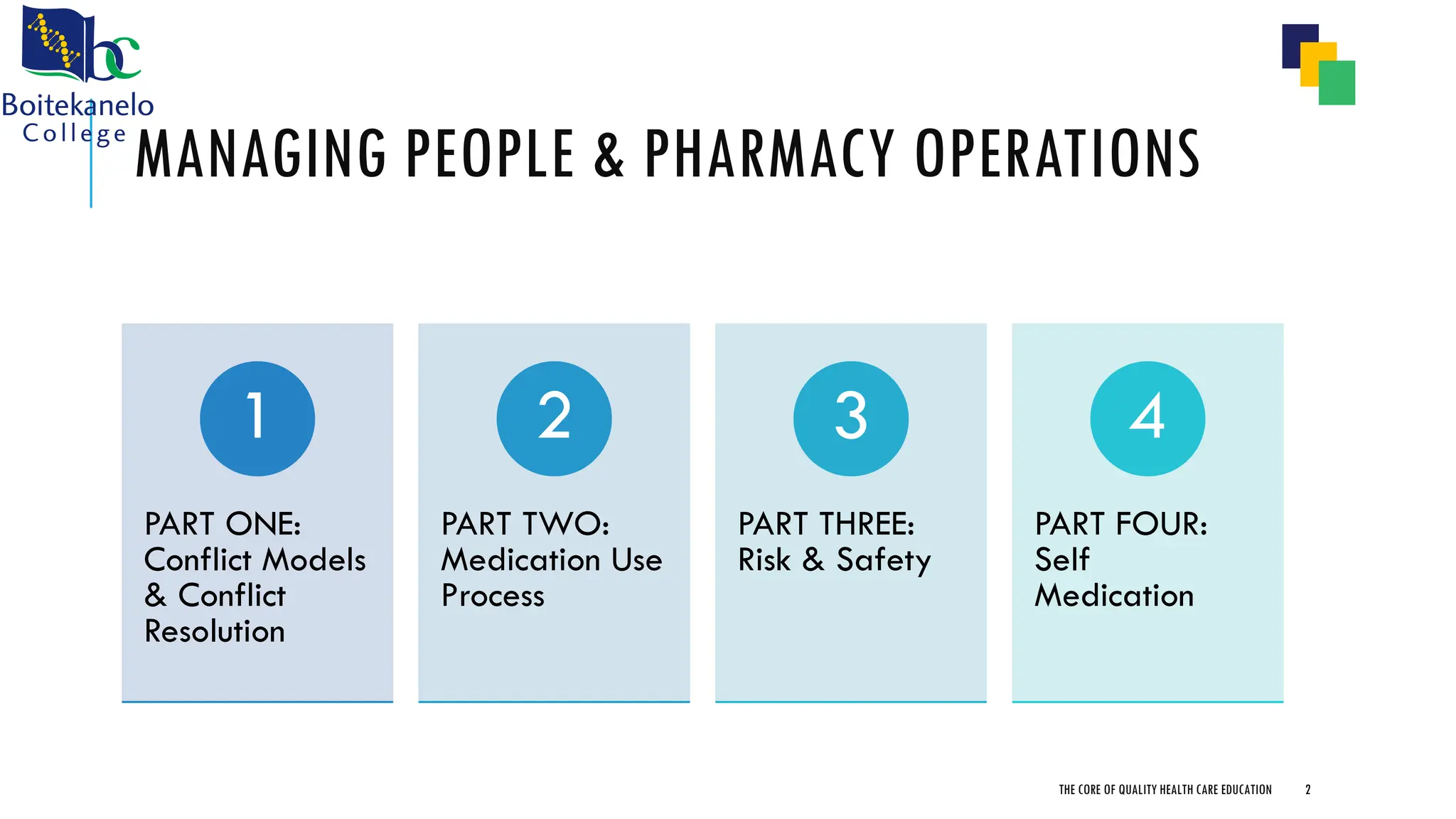
MANAGING PEOPLE & PHARMACY OPERATIONS
THE CORE OF QUALITY HEALTH CARE EDUCATION 2
PART ONE:
Conflict Models
& Conflict
Resolution
1
PART TWO:
Medication Use
Process
2
PART THREE:
Risk & Safety
3
PART FOUR:
Self
Medication
4
CONFLICT MODELS & CONFLICT RESOLUTION
(CONFLICT MANAGEMENT) PART ONE
THE CORE OF QUALITY HEALTH CARE EDUCATION 3
CONFLICT RESOLUTION:
HTTPS://WWW.YOUTUBE.COM/WATCH?V=KY5TWVZ5ZDU
THE CORE OF QUALITY HEALTH CARE EDUCATION 4
EXPECTED
LEARNING
OUTCOMES
1. Identify the types of conflict management
styles.
2. Define, analyze, and understand the key
practical and theoretical concepts of
managing and resolving conflicts.
3. Demonstrate the ability to think critically,
solve problems, and make decisions in
respect to Conflict Resolution
THE CORE OF QUALITY HEALTH CARE EDUCATION 5
WHAT IS A CONFLICT?
• Expressed struggle between at least 2 interdependent parties who
perceive incompatible goals, scarce resources, and interference from
the other party in achieving their goals (INTEREST?)
OR
• Process that begins when one party perceives that another party has
negatively affected or about to affect something that the first party
cares about.
Conflict Management:
“Opportunity to improve situations and strengthen relationships”
THE CORE OF QUALITY HEALTH CARE EDUCATION 6
COMMON REASONS WHY CONFLICT OCCURS AT WORK:
a. Different personalities or perspectives.
b. Unresolved problems from their past.
c. Feeling of competition with one another.
d. Poor communication skills.
e. Uncertainty about roles or responsibilities.
THE CORE OF QUALITY HEALTH CARE EDUCATION 7
CONFLICT MANAGEMENT
✓Conflicts are struggles that can
arise during an active
disagreement of opinions or
interests.
✓How do you navigate and
resolve them?
THE CORE OF QUALITY HEALTH CARE EDUCATION 8
CONFLICT RESOLUTION/NEGOTIATION
❑A way for the opposing parties to find a solution to their disagreement that
leaves everyone reasonably satisfied.
❑Person resolving conflict may be a neutral party or mediator while at other
times, they may be someone involved in the conflict who takes an outside
perspective to find a solution.
THE CORE OF QUALITY HEALTH CARE EDUCATION 9
KEY POINTS:
1. Conflict: A byproduct when there’s
human interaction, so responding
professionally requires conflict-
resolution strategies.
2. When a dispute arises, the best course
of action is to use negotiation to resolve
the problem.
3. The most common set of negotiation
strategies, known as the Thomas-
Kilmann model, identifies 5 different
approaches to resolution.
THE CORE OF QUALITY HEALTH CARE EDUCATION 10
CONFLICT MODELS
▪Various conflict models have been proposed in an attempt to explain the hows and
whys of conflict.
▪They identify a variety of personality types and behavior types as conflict
enablers and in some cases provide suggestions on how to deal with such behaviors in
a conflict situation.
▪The Thomas-Kilmann Conflict Mode Instrument defines 5 interpersonal behavior
modes that result from the combination of an individual’s level of assertiveness and
cooperativeness.
THE CORE OF QUALITY HEALTH CARE EDUCATION 11
TK MODEL OF CONFLICT RESOLUTION
▪Individuals demonstrating a low level of cooperativeness and a high level of
assertiveness are likely to behave in a competing mode, asserting their ideas at the
possible expense of others’ contributions.
▪Individuals who demonstrate a high level of cooperativeness and a low level of
assertiveness are likely to behave in an overly accommodating fashion, in other
words noncontributing yes-men.
▪Most productive of these 5 modes, collaborating mode, occurs with the ideal
balance of assertiveness and cooperativeness and is likely to more often result in
win-win interpersonal situations and novel solutions.
THE CORE OF QUALITY HEALTH CARE EDUCATION 12
THE CORE OF QUALITY HEALTH CARE EDUCATION 13
AVOIDING MODE
• Avoiding is when people just ignore or withdraw from the
conflict.
• Choose method when the discomfort of confrontation exceeds
the potential reward of resolution of the conflict.
(UANASSERVIVE, UNCOOPERATIVE)
• While this might seem easy to accommodate for the facilitator,
people aren’t really contributing anything of value to the
conversation and may be withholding worthwhile ideas.
When conflict is avoided, nothing is resolved.
THE CORE OF QUALITY HEALTH CARE EDUCATION 14
CONT…
▪People tend to avoid conflict when they don’t want to engage in it.
▪Avoiding allows them to ignore that there is a problem.
▪Application: When there is no clear solution, or a frustrated party needs time to
calm down before confrontation.
▪Requirements: Require more effort than merely facing the problem and can
cause friction between the disagreeing parties.
THE CORE OF QUALITY HEALTH CARE EDUCATION 15
COMPETING MODE(WIN-LOSE STRATEGY)
• Competing is used by people who go into a conflict planning to
win. They’re Assertive and Uncooperative.
• This method is characterized by the assumption that one side
wins and everyone else loses.
• Application: Those who insist on winning the dispute at all costs.
• Competing might work in sports or war, but it’s rarely a good
strategy for group problem solving
THE CORE OF QUALITY HEALTH CARE EDUCATION 16
PROS & CONS?
Pros
1) The winner is clear
2) Winners usually experience gains
Cons
1) Establishes the battleground for the next conflict
2) May cause worthy competitors to withdraw or
leave the organization
3) Doesn’t allow for collaborative problem-solving.
THE CORE OF QUALITY HEALTH CARE EDUCATION 17
ACCOMMODATING MODE (SMOOTHING)
• Accommodating is a strategy where one party gives in to the wishes
or demands of another.
• They’re being Unassertive but cooperative.
• This may appear to be a gracious way to give in when one figures out
s/he has been wrong about an argument.
• It’s less helpful when one party accommodates another merely to
preserve harmony or to avoid disruption.
• Like avoidance, it can result in unresolved issues.
• Too much accommodation can result in groups where the most assertive
parties commandeer the process and take control of most conversations.
THE CORE OF QUALITY HEALTH CARE EDUCATION 18
CONT…
▪One party acquiescing, giving the opposing party exactly what it needs to resolve
the problem.
▪Allow problem be resolved in the short-term while working toward a long-term
solution.
▪In some cases, accommodating can be an appropriate resolution to a conflict.
▪Example: . If your opinion on the matter is not very strong, it is often easier to comply.
THE CORE OF QUALITY HEALTH CARE EDUCATION 19
PROS & CONS?
Pros Curtails conflict situation
Enhances ego of the other
Cons Sometimes establishes a
precedence
Does not fully engage
participants
THE CORE OF QUALITY HEALTH CARE EDUCATION 20
***COLLABORATING MODE (WIN-WIN STRATEGY)
▪Collaborating is the method used when people are both assertive and
cooperative.
▪A group may learn to allow each participant to make a contribution with
the possibility of co-creating a shared solution that everyone can support.
▪Involves working with the other party to find a mutually agreeable
solution to a problem. It’s known as a win-win strategy.
▪Example: Marketing Director in a Pharmaceuticals distribution company
and Community Pharmacy may work together to negotiate contract
terms until both parties find it agreeable.
THE CORE OF QUALITY HEALTH CARE EDUCATION 21
PROS & CONS?
THE CORE OF QUALITY HEALTH CARE EDUCATION 22
Pros Everyone “wins”
Creates good feelings
Cons Hard to achieve since no one
knows how
Often confusing since players
can “win” something they didn’t
know they wanted
COMPROMISING MODE( RECONCILING/LOSE-LOSE
STRATEGY)
• Participants are partially/ Intermediate assertive and
cooperative.
• The concept is that everyone gives up a little bit of what they
want, and no one gets everything they want.
• The perception of the best outcome when working by compromise
is that which “splits the difference.”
• Compromise is perceived as being fair, even if no one is
particularly happy with the final outcome.
THE CORE OF QUALITY HEALTH CARE EDUCATION 23
CONT…
Seeks a mutual agreement to settle a dispute.
Both parties willingly forfeit some of their needs in the interest of reaching an agreement.
This can be a quick way to resolve a conflict without it becoming a bigger issue.
Can be used as a temporary method to avoid conflict until the parties involved can
implement a more permanent solution.
Appropriate to compromise when it would be impossible to make both sides completely
happy while still moving forward.
THE CORE OF QUALITY HEALTH CARE EDUCATION 24
PROS & CONS?
THE CORE OF QUALITY HEALTH CARE EDUCATION 25
• Shows good will
• Establishes friendship
• Can be used as a temporary method
Pros
• No one gets what they want
• May feel like a dead end
Cons
Note:
• The most productive of these 5 models is the
collaborating model with the ideal balance of
assertiveness and cooperativeness and is likely to
more often result in a win-win interpersonal
situations and novel solutions.
THE CORE OF QUALITY HEALTH CARE EDUCATION 26
HOW TO USE CONFLICT RESOLUTION IN THE WORKPLACE
Determine Determine each side's role in the solution.
Agree on Agree on a solution.
Let Let everyone have a say.
Meet on Meet on neutral ground.
Define Define the problem
Acknowledge Acknowledge the conflict
THE CORE OF QUALITY HEALTH CARE EDUCATION 27
BENEFITS OF CONFLICT RESOLUTION
i. Builds strong relationships.
ii. Maintains morale.
iii. Achieves goals.
iv. Reduces stress.
v. Provides insight (Opportunity to understand a
different point of view. The insights can make
you a more accepting person or help you
solve problems in new ways.)
vi. Improves retention. Employees thus retain the
skills and knowledge of their experienced
employees.
THE CORE OF QUALITY HEALTH CARE EDUCATION 28
SUMMARY
▪People should agree to disagree with the goal of a collaborative solution.
▪Conflict is necessary: BUT it becomes toxic when it leads to counterproductivity or
obstruction.
▪Although conflict can be the result of personality clashes, counterproductive conflict is
often a product of misconceptions regarding other’s feelings, attitudes, and intentions.
▪Human nature is such that people are different.
▪People think differently than others, and people feel and react differently than others.
THE CORE OF QUALITY HEALTH CARE EDUCATION 29
CASE SCENARIO
You are the pharmacist on duty at Community Pharmacy when a long-time customer,
Mr. XY, comes in to pick up his prescription refill. His prescription was out of refills
and although you left multiple messages, the prescriber has not returned your calls
with a refill authorization. You also left a telephone message for Mr. XY alerting him
of the situation. Mr. XY obviously does not check his voicemail and now he is in your
pharmacy and he is angry. He begins to yell and scream, saying you are the most
incompetent pharmacist he has ever dealt with and that he is going to report you to
the BHPC. Other customers and patients waiting for their medications are watching
the scene in horror.
How would you manage this conflict? What are the steps that could be taken to control
the situation and avoid making it worse and allow an acceptable outcome?
THE CORE OF QUALITY HEALTH CARE EDUCATION 30
REFERENCES
1. Stone D, Patton B, Heen S. Difficult Conversations: How to Discuss What Matters
Most. Penguin Books, New York, 2000.
2. Thomas KW, Kilmann RH. Thomas-Kilmann Conflict Mode Instrument. Available at
www.kilmanndiagnostics.com/overview-thomas-kilmann-conflict-mode-instrument-
tki.
3. https://www.youtube.com/watch?v=f3NmLUINP80
THE CORE OF QUALITY HEALTH CARE EDUCATION 31
Lecture 4_Managing People and Pharmacy Operations (Part I).pdf

Lecture 4_Managing People and Pharmacy Operations (Part I).pdf

  • 1.
    THE CORE OFQUALITY HEALTH CARE EDUCATION 1 TOPIC: MANAGING PEOPLE & PHARMACY OPERATIONS Presented by: G. Obure DEPARTMENT OF PHARMACY
  • 2.
    MANAGING PEOPLE &PHARMACY OPERATIONS THE CORE OF QUALITY HEALTH CARE EDUCATION 2 PART ONE: Conflict Models & Conflict Resolution 1 PART TWO: Medication Use Process 2 PART THREE: Risk & Safety 3 PART FOUR: Self Medication 4
  • 3.
    CONFLICT MODELS &CONFLICT RESOLUTION (CONFLICT MANAGEMENT) PART ONE THE CORE OF QUALITY HEALTH CARE EDUCATION 3
  • 4.
  • 5.
    EXPECTED LEARNING OUTCOMES 1. Identify thetypes of conflict management styles. 2. Define, analyze, and understand the key practical and theoretical concepts of managing and resolving conflicts. 3. Demonstrate the ability to think critically, solve problems, and make decisions in respect to Conflict Resolution THE CORE OF QUALITY HEALTH CARE EDUCATION 5
  • 6.
    WHAT IS ACONFLICT? • Expressed struggle between at least 2 interdependent parties who perceive incompatible goals, scarce resources, and interference from the other party in achieving their goals (INTEREST?) OR • Process that begins when one party perceives that another party has negatively affected or about to affect something that the first party cares about. Conflict Management: “Opportunity to improve situations and strengthen relationships” THE CORE OF QUALITY HEALTH CARE EDUCATION 6
  • 7.
    COMMON REASONS WHYCONFLICT OCCURS AT WORK: a. Different personalities or perspectives. b. Unresolved problems from their past. c. Feeling of competition with one another. d. Poor communication skills. e. Uncertainty about roles or responsibilities. THE CORE OF QUALITY HEALTH CARE EDUCATION 7
  • 8.
    CONFLICT MANAGEMENT ✓Conflicts arestruggles that can arise during an active disagreement of opinions or interests. ✓How do you navigate and resolve them? THE CORE OF QUALITY HEALTH CARE EDUCATION 8
  • 9.
    CONFLICT RESOLUTION/NEGOTIATION ❑A wayfor the opposing parties to find a solution to their disagreement that leaves everyone reasonably satisfied. ❑Person resolving conflict may be a neutral party or mediator while at other times, they may be someone involved in the conflict who takes an outside perspective to find a solution. THE CORE OF QUALITY HEALTH CARE EDUCATION 9
  • 10.
    KEY POINTS: 1. Conflict:A byproduct when there’s human interaction, so responding professionally requires conflict- resolution strategies. 2. When a dispute arises, the best course of action is to use negotiation to resolve the problem. 3. The most common set of negotiation strategies, known as the Thomas- Kilmann model, identifies 5 different approaches to resolution. THE CORE OF QUALITY HEALTH CARE EDUCATION 10
  • 11.
    CONFLICT MODELS ▪Various conflictmodels have been proposed in an attempt to explain the hows and whys of conflict. ▪They identify a variety of personality types and behavior types as conflict enablers and in some cases provide suggestions on how to deal with such behaviors in a conflict situation. ▪The Thomas-Kilmann Conflict Mode Instrument defines 5 interpersonal behavior modes that result from the combination of an individual’s level of assertiveness and cooperativeness. THE CORE OF QUALITY HEALTH CARE EDUCATION 11
  • 12.
    TK MODEL OFCONFLICT RESOLUTION ▪Individuals demonstrating a low level of cooperativeness and a high level of assertiveness are likely to behave in a competing mode, asserting their ideas at the possible expense of others’ contributions. ▪Individuals who demonstrate a high level of cooperativeness and a low level of assertiveness are likely to behave in an overly accommodating fashion, in other words noncontributing yes-men. ▪Most productive of these 5 modes, collaborating mode, occurs with the ideal balance of assertiveness and cooperativeness and is likely to more often result in win-win interpersonal situations and novel solutions. THE CORE OF QUALITY HEALTH CARE EDUCATION 12
  • 13.
    THE CORE OFQUALITY HEALTH CARE EDUCATION 13
  • 14.
    AVOIDING MODE • Avoidingis when people just ignore or withdraw from the conflict. • Choose method when the discomfort of confrontation exceeds the potential reward of resolution of the conflict. (UANASSERVIVE, UNCOOPERATIVE) • While this might seem easy to accommodate for the facilitator, people aren’t really contributing anything of value to the conversation and may be withholding worthwhile ideas. When conflict is avoided, nothing is resolved. THE CORE OF QUALITY HEALTH CARE EDUCATION 14
  • 15.
    CONT… ▪People tend toavoid conflict when they don’t want to engage in it. ▪Avoiding allows them to ignore that there is a problem. ▪Application: When there is no clear solution, or a frustrated party needs time to calm down before confrontation. ▪Requirements: Require more effort than merely facing the problem and can cause friction between the disagreeing parties. THE CORE OF QUALITY HEALTH CARE EDUCATION 15
  • 16.
    COMPETING MODE(WIN-LOSE STRATEGY) •Competing is used by people who go into a conflict planning to win. They’re Assertive and Uncooperative. • This method is characterized by the assumption that one side wins and everyone else loses. • Application: Those who insist on winning the dispute at all costs. • Competing might work in sports or war, but it’s rarely a good strategy for group problem solving THE CORE OF QUALITY HEALTH CARE EDUCATION 16
  • 17.
    PROS & CONS? Pros 1)The winner is clear 2) Winners usually experience gains Cons 1) Establishes the battleground for the next conflict 2) May cause worthy competitors to withdraw or leave the organization 3) Doesn’t allow for collaborative problem-solving. THE CORE OF QUALITY HEALTH CARE EDUCATION 17
  • 18.
    ACCOMMODATING MODE (SMOOTHING) •Accommodating is a strategy where one party gives in to the wishes or demands of another. • They’re being Unassertive but cooperative. • This may appear to be a gracious way to give in when one figures out s/he has been wrong about an argument. • It’s less helpful when one party accommodates another merely to preserve harmony or to avoid disruption. • Like avoidance, it can result in unresolved issues. • Too much accommodation can result in groups where the most assertive parties commandeer the process and take control of most conversations. THE CORE OF QUALITY HEALTH CARE EDUCATION 18
  • 19.
    CONT… ▪One party acquiescing,giving the opposing party exactly what it needs to resolve the problem. ▪Allow problem be resolved in the short-term while working toward a long-term solution. ▪In some cases, accommodating can be an appropriate resolution to a conflict. ▪Example: . If your opinion on the matter is not very strong, it is often easier to comply. THE CORE OF QUALITY HEALTH CARE EDUCATION 19
  • 20.
    PROS & CONS? ProsCurtails conflict situation Enhances ego of the other Cons Sometimes establishes a precedence Does not fully engage participants THE CORE OF QUALITY HEALTH CARE EDUCATION 20
  • 21.
    ***COLLABORATING MODE (WIN-WINSTRATEGY) ▪Collaborating is the method used when people are both assertive and cooperative. ▪A group may learn to allow each participant to make a contribution with the possibility of co-creating a shared solution that everyone can support. ▪Involves working with the other party to find a mutually agreeable solution to a problem. It’s known as a win-win strategy. ▪Example: Marketing Director in a Pharmaceuticals distribution company and Community Pharmacy may work together to negotiate contract terms until both parties find it agreeable. THE CORE OF QUALITY HEALTH CARE EDUCATION 21
  • 22.
    PROS & CONS? THECORE OF QUALITY HEALTH CARE EDUCATION 22 Pros Everyone “wins” Creates good feelings Cons Hard to achieve since no one knows how Often confusing since players can “win” something they didn’t know they wanted
  • 23.
    COMPROMISING MODE( RECONCILING/LOSE-LOSE STRATEGY) •Participants are partially/ Intermediate assertive and cooperative. • The concept is that everyone gives up a little bit of what they want, and no one gets everything they want. • The perception of the best outcome when working by compromise is that which “splits the difference.” • Compromise is perceived as being fair, even if no one is particularly happy with the final outcome. THE CORE OF QUALITY HEALTH CARE EDUCATION 23
  • 24.
    CONT… Seeks a mutualagreement to settle a dispute. Both parties willingly forfeit some of their needs in the interest of reaching an agreement. This can be a quick way to resolve a conflict without it becoming a bigger issue. Can be used as a temporary method to avoid conflict until the parties involved can implement a more permanent solution. Appropriate to compromise when it would be impossible to make both sides completely happy while still moving forward. THE CORE OF QUALITY HEALTH CARE EDUCATION 24
  • 25.
    PROS & CONS? THECORE OF QUALITY HEALTH CARE EDUCATION 25 • Shows good will • Establishes friendship • Can be used as a temporary method Pros • No one gets what they want • May feel like a dead end Cons
  • 26.
    Note: • The mostproductive of these 5 models is the collaborating model with the ideal balance of assertiveness and cooperativeness and is likely to more often result in a win-win interpersonal situations and novel solutions. THE CORE OF QUALITY HEALTH CARE EDUCATION 26
  • 27.
    HOW TO USECONFLICT RESOLUTION IN THE WORKPLACE Determine Determine each side's role in the solution. Agree on Agree on a solution. Let Let everyone have a say. Meet on Meet on neutral ground. Define Define the problem Acknowledge Acknowledge the conflict THE CORE OF QUALITY HEALTH CARE EDUCATION 27
  • 28.
    BENEFITS OF CONFLICTRESOLUTION i. Builds strong relationships. ii. Maintains morale. iii. Achieves goals. iv. Reduces stress. v. Provides insight (Opportunity to understand a different point of view. The insights can make you a more accepting person or help you solve problems in new ways.) vi. Improves retention. Employees thus retain the skills and knowledge of their experienced employees. THE CORE OF QUALITY HEALTH CARE EDUCATION 28
  • 29.
    SUMMARY ▪People should agreeto disagree with the goal of a collaborative solution. ▪Conflict is necessary: BUT it becomes toxic when it leads to counterproductivity or obstruction. ▪Although conflict can be the result of personality clashes, counterproductive conflict is often a product of misconceptions regarding other’s feelings, attitudes, and intentions. ▪Human nature is such that people are different. ▪People think differently than others, and people feel and react differently than others. THE CORE OF QUALITY HEALTH CARE EDUCATION 29
  • 30.
    CASE SCENARIO You arethe pharmacist on duty at Community Pharmacy when a long-time customer, Mr. XY, comes in to pick up his prescription refill. His prescription was out of refills and although you left multiple messages, the prescriber has not returned your calls with a refill authorization. You also left a telephone message for Mr. XY alerting him of the situation. Mr. XY obviously does not check his voicemail and now he is in your pharmacy and he is angry. He begins to yell and scream, saying you are the most incompetent pharmacist he has ever dealt with and that he is going to report you to the BHPC. Other customers and patients waiting for their medications are watching the scene in horror. How would you manage this conflict? What are the steps that could be taken to control the situation and avoid making it worse and allow an acceptable outcome? THE CORE OF QUALITY HEALTH CARE EDUCATION 30
  • 31.
    REFERENCES 1. Stone D,Patton B, Heen S. Difficult Conversations: How to Discuss What Matters Most. Penguin Books, New York, 2000. 2. Thomas KW, Kilmann RH. Thomas-Kilmann Conflict Mode Instrument. Available at www.kilmanndiagnostics.com/overview-thomas-kilmann-conflict-mode-instrument- tki. 3. https://www.youtube.com/watch?v=f3NmLUINP80 THE CORE OF QUALITY HEALTH CARE EDUCATION 31