MICROBIOLOGY 19BT203
UNIT I: Introduction to Microbiology: Topic-3
SPONTANEOUS GENERATION THEORY
Dr. M. Indira
Associate Professor
Dept of Biotechnology
Vignan’s Foundation for Science,
Technology and Research, A.P India
Objective
To overview the concept of
spontaneous generation theory
and biogenesis theory.
4/24/2023 2
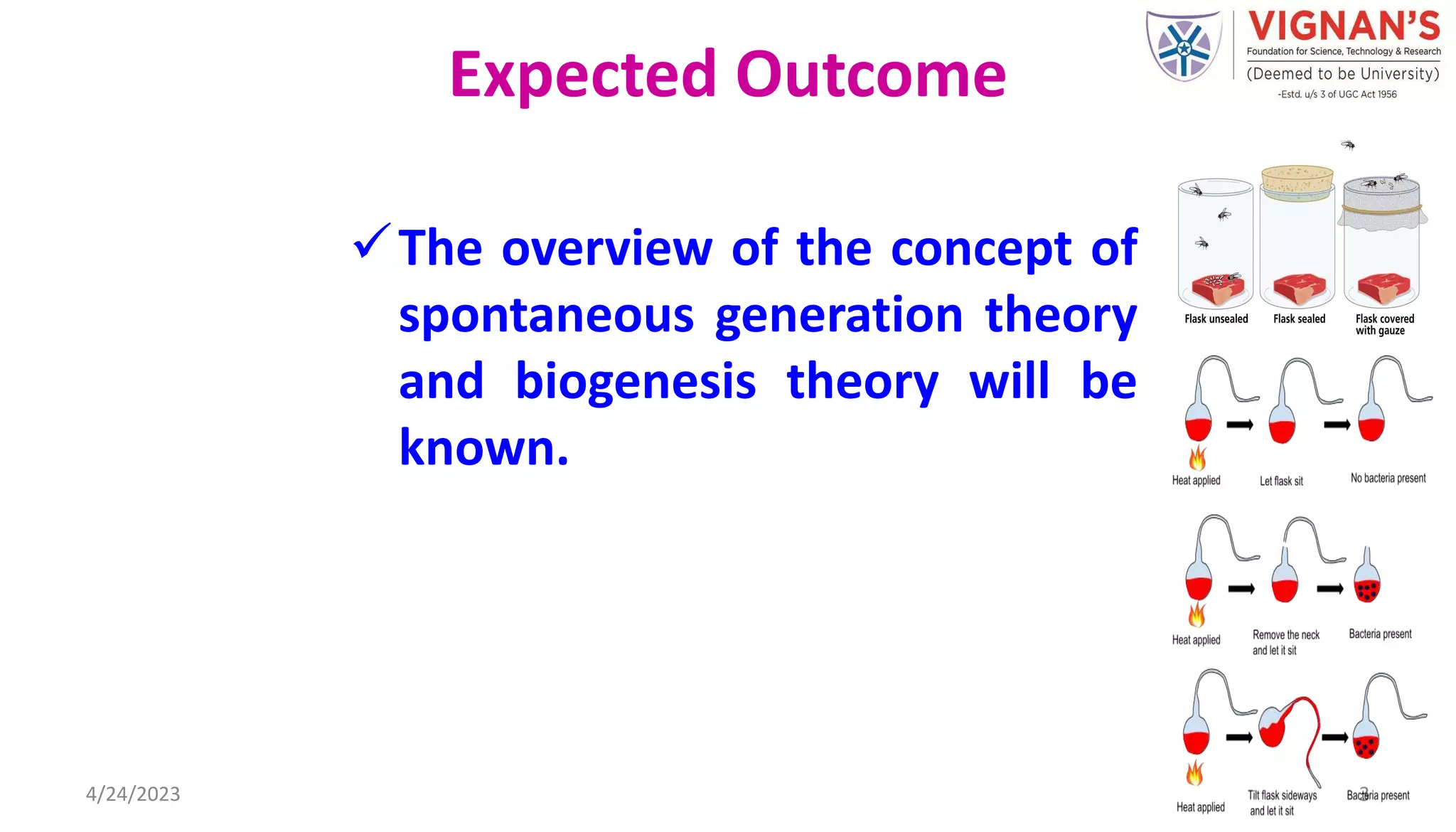
Expected Outcome
The overview of the concept of
spontaneous generation theory
and biogenesis theory will be
known.
4/24/2023 3
4/24/2023 4
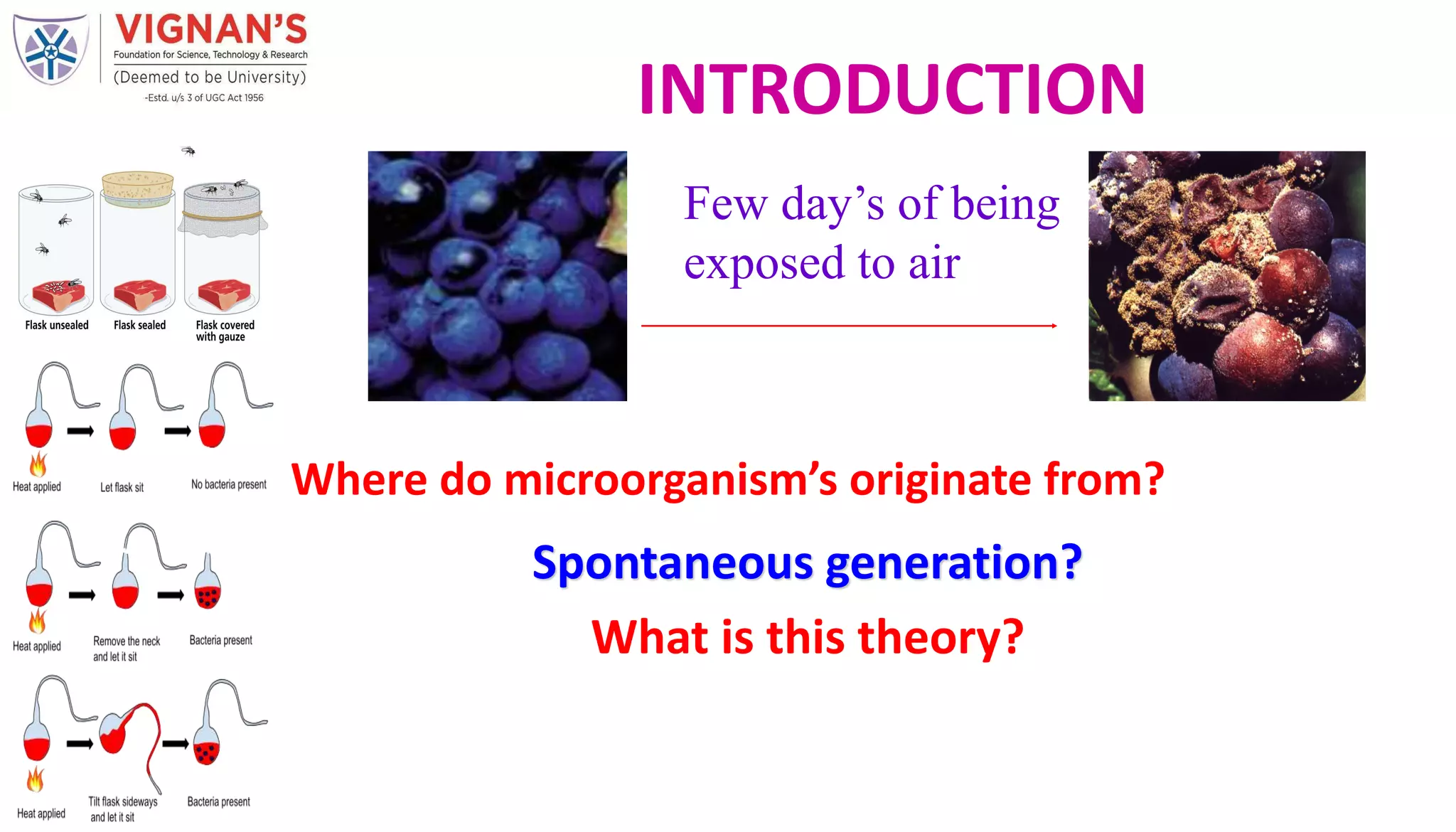
Where do microorganism’s originate from?
Spontaneous generation?
What is this theory?
Few day’s of being
exposed to air
INTRODUCTION
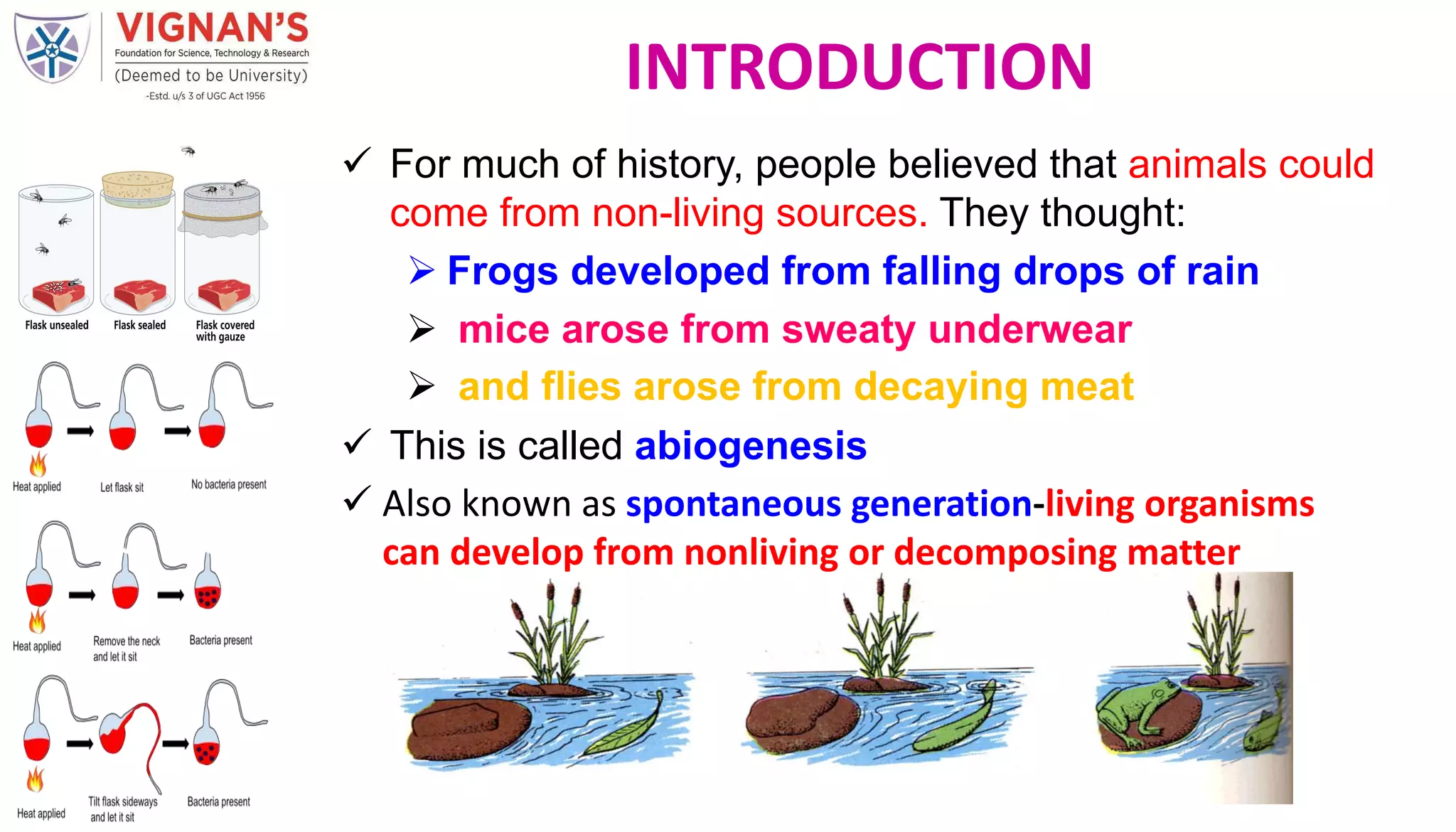
INTRODUCTION
 For much of history, people believed that animals could
come from non-living sources. They thought:
 Frogs developed from falling drops of rain
 mice arose from sweaty underwear
 and flies arose from decaying meat
 This is called abiogenesis
 Also known as spontaneous generation-living organisms
can develop from nonliving or decomposing matter
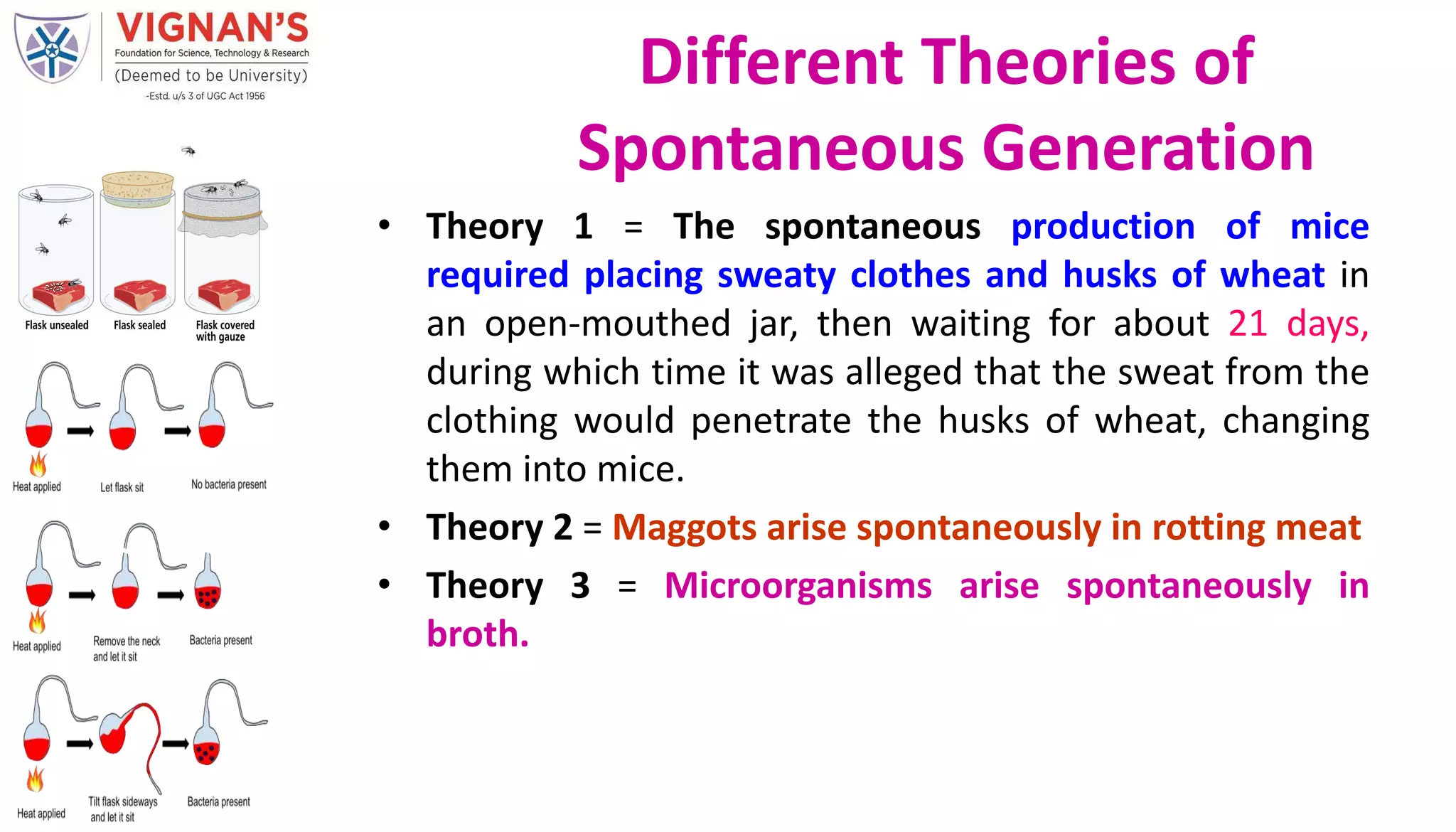
Different Theories of
Spontaneous Generation
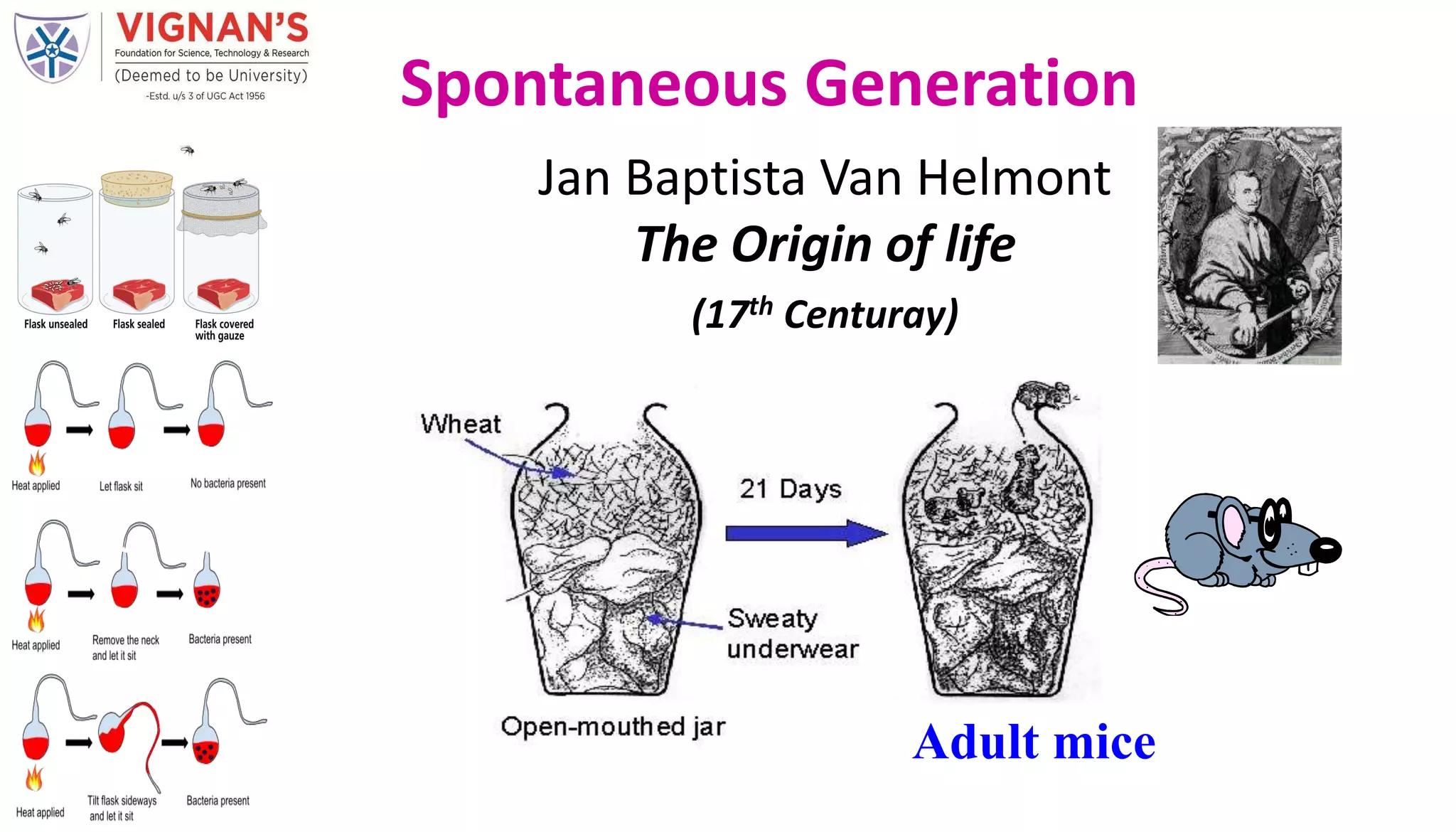
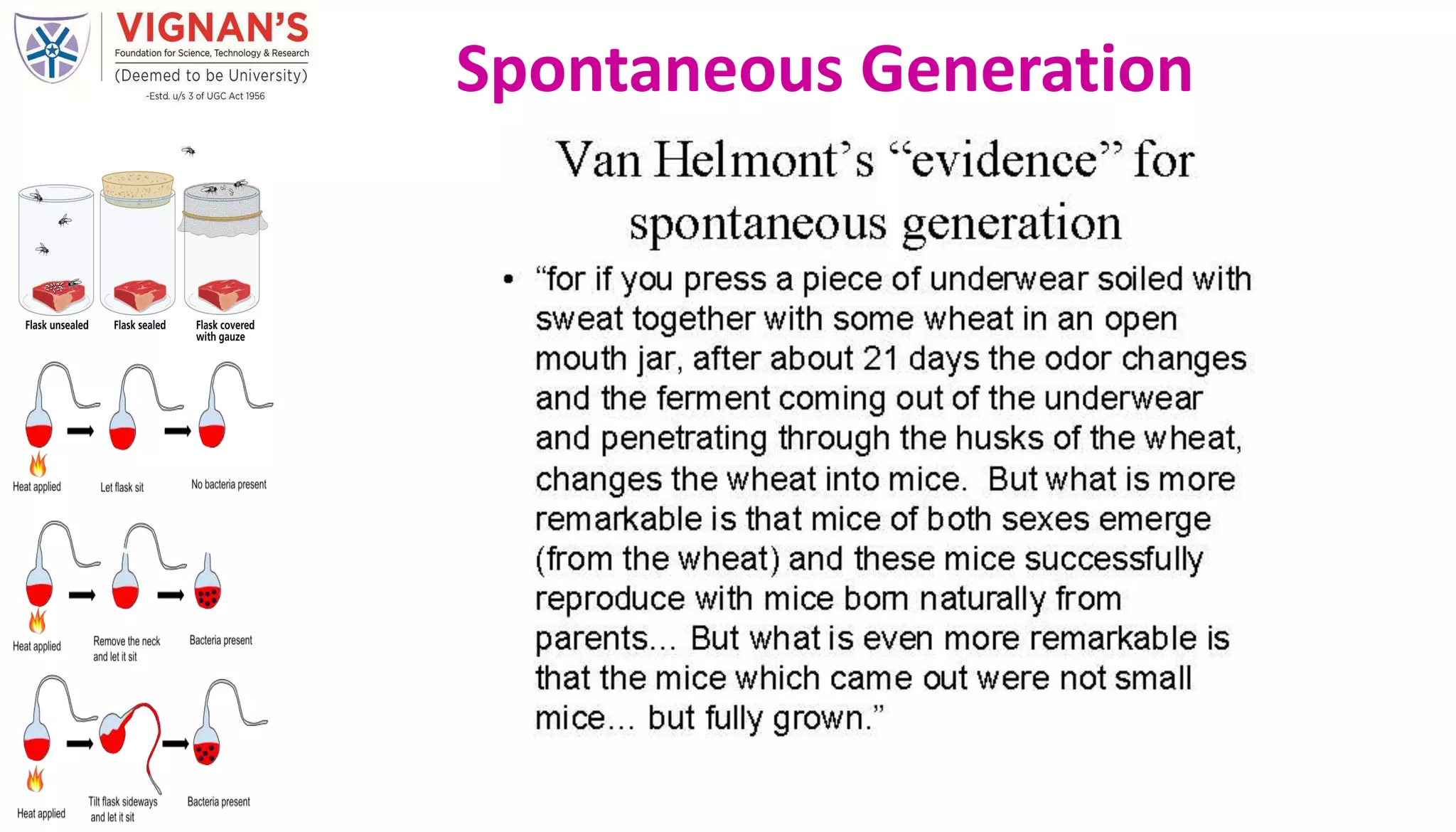
• Theory 1 = The spontaneous production of mice
required placing sweaty clothes and husks of wheat in
an open-mouthed jar, then waiting for about 21 days,
during which time it was alleged that the sweat from the
clothing would penetrate the husks of wheat, changing
them into mice.
• Theory 2 = Maggots arise spontaneously in rotting meat
• Theory 3 = Microorganisms arise spontaneously in
broth.
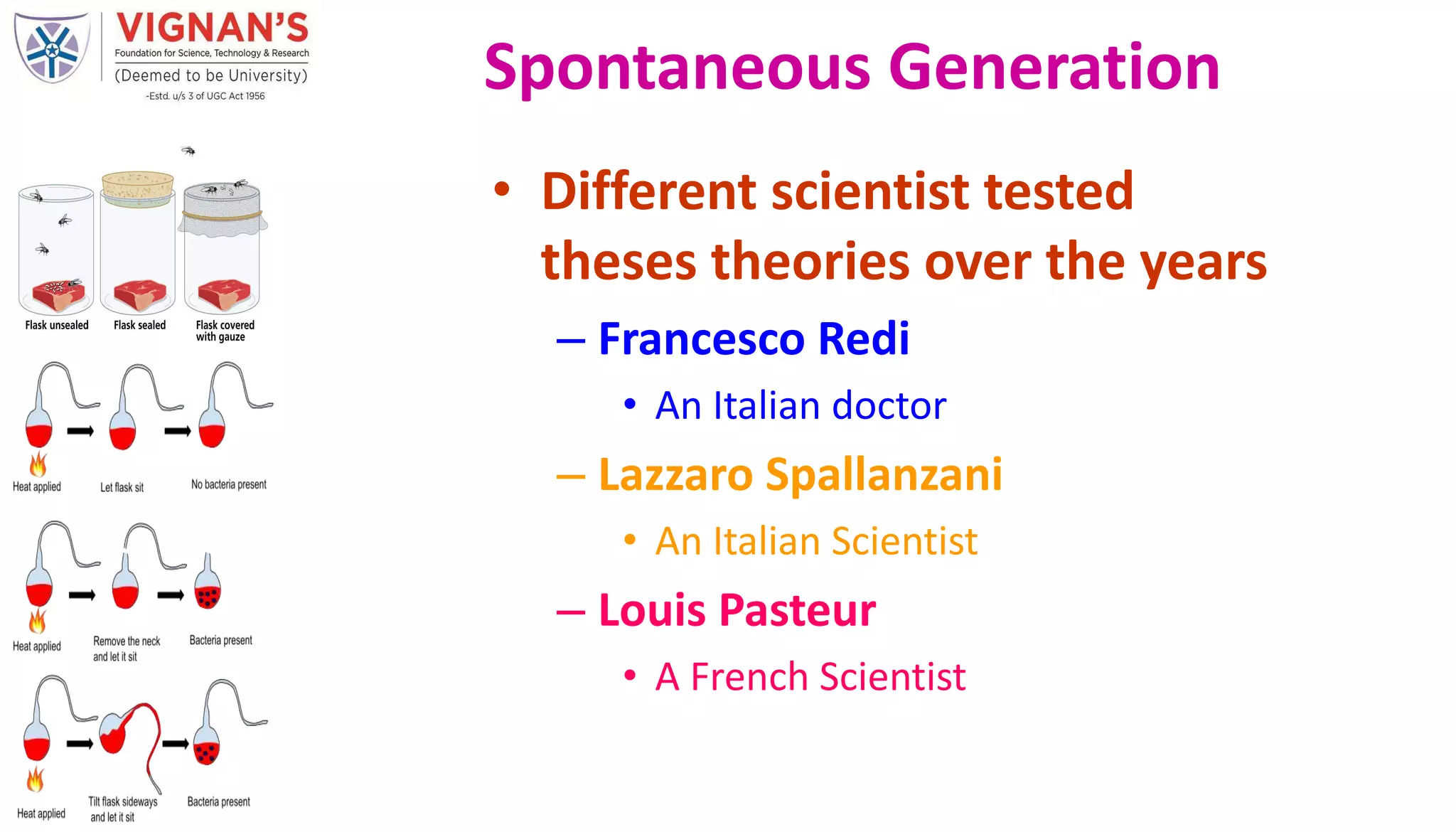
• Different scientist tested
theses theories over the years
– Francesco Redi
• An Italian doctor
– Lazzaro Spallanzani
• An Italian Scientist
– Louis Pasteur
• A French Scientist
Spontaneous Generation
Jan Baptista Van Helmont
The Origin of life
(17th Centuray)
Adult mice
1579-1644
Spontaneous Generation
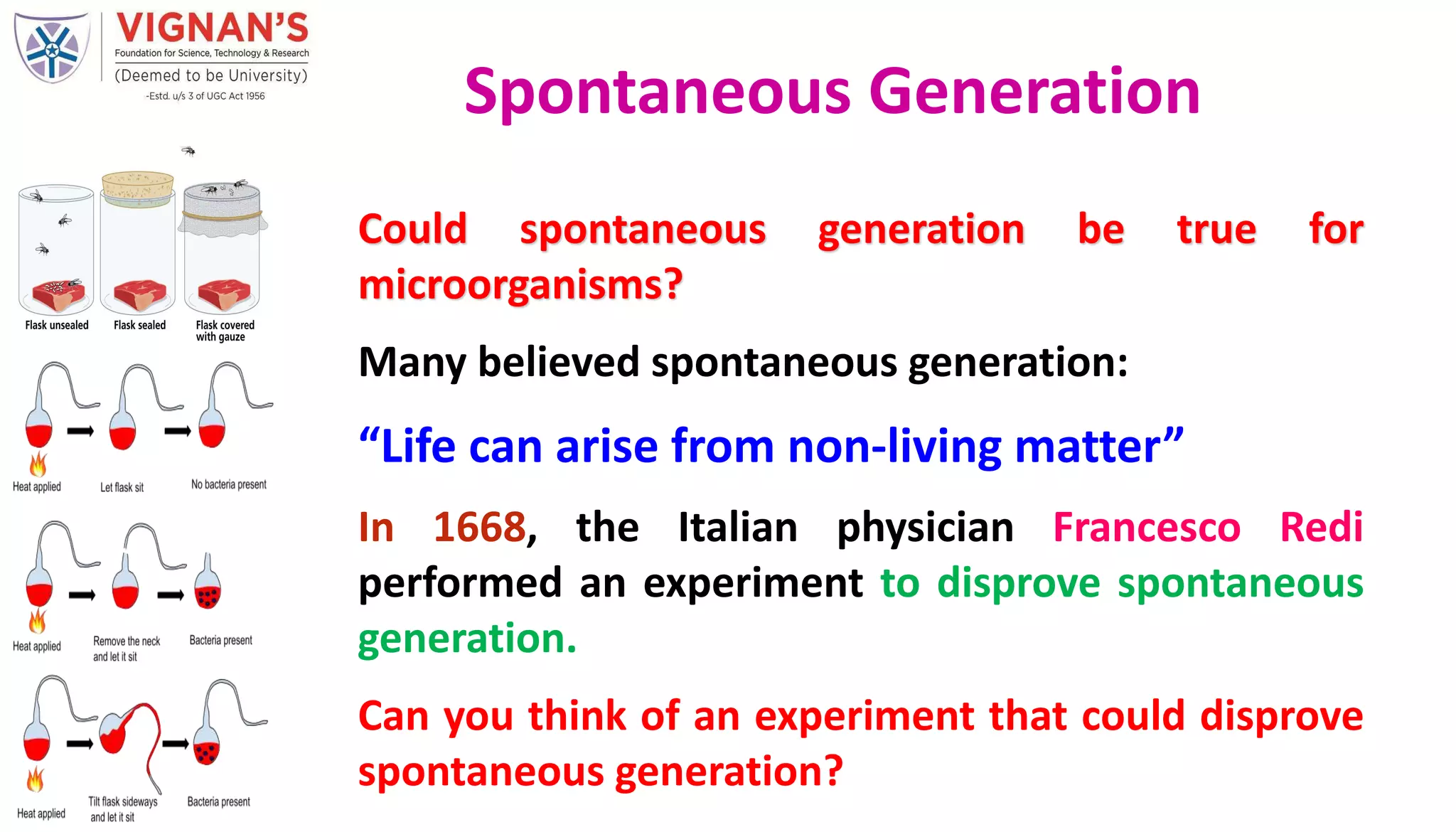
Could spontaneous generation be true for
microorganisms?
Many believed spontaneous generation:
“Life can arise from non-living matter”
In 1668, the Italian physician Francesco Redi
performed an experiment to disprove spontaneous
generation.
Can you think of an experiment that could disprove
spontaneous generation?
Spontaneous Generation
Spontaneous Generation- Redi’s Experiment
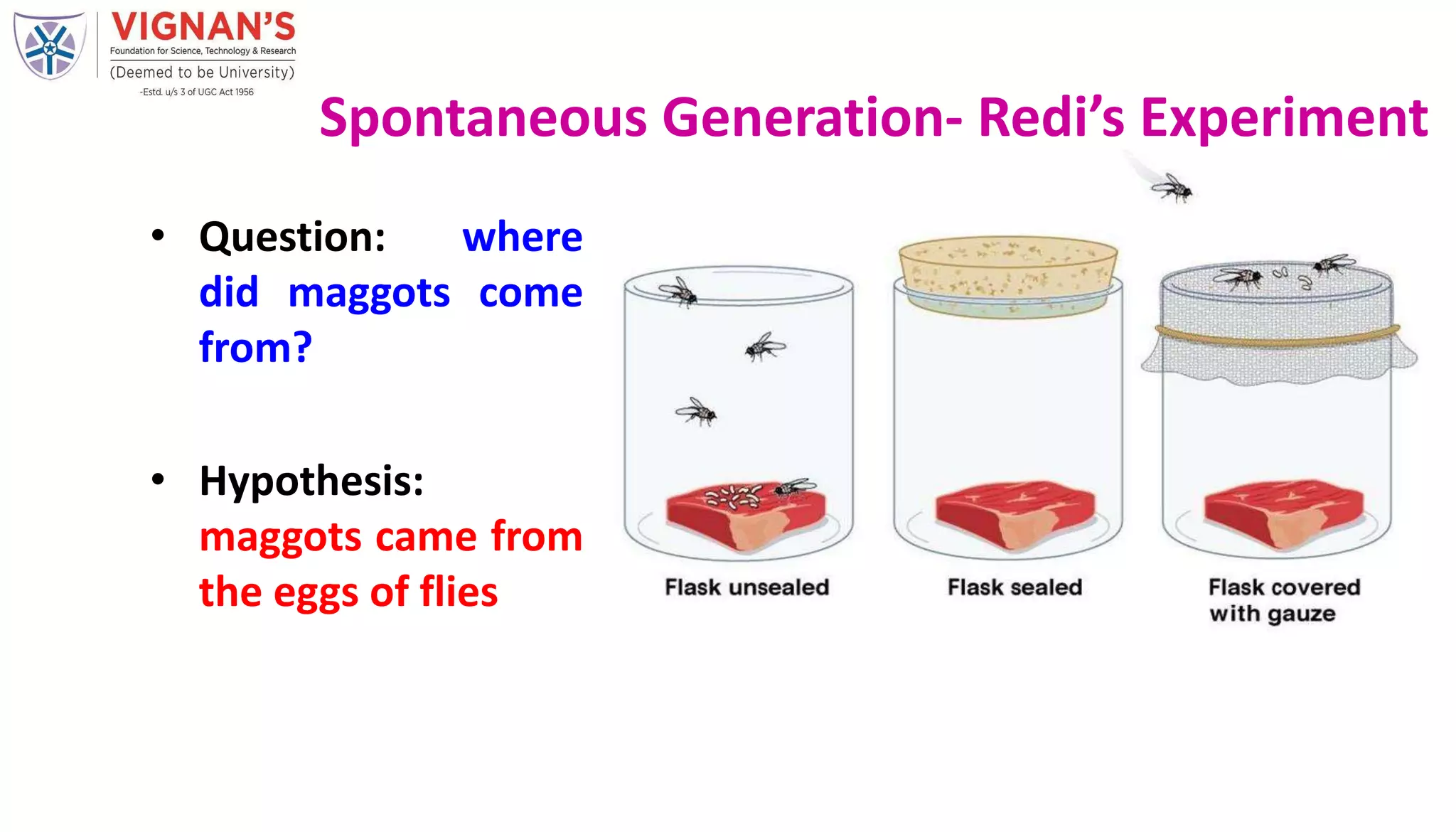
• Question: where
did maggots come
from?
• Hypothesis:
maggots came from
the eggs of flies
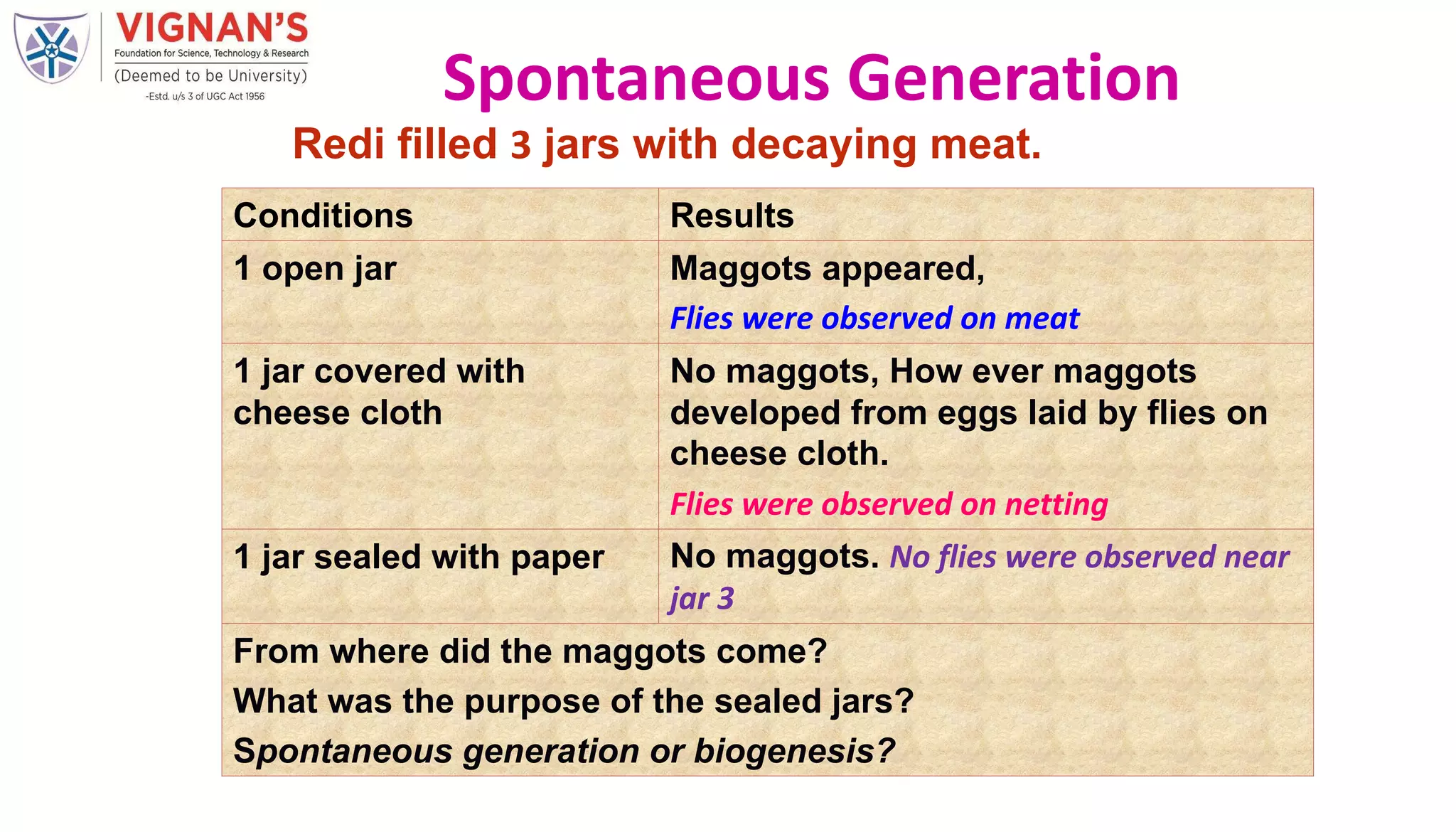
Conditions Results
1 open jar Maggots appeared,
Flies were observed on meat
1 jar covered with
cheese cloth
No maggots, How ever maggots
developed from eggs laid by flies on
cheese cloth.
Flies were observed on netting
1 jar sealed with paper No maggots. No flies were observed near
jar 3
From where did the maggots come?
What was the purpose of the sealed jars?
Spontaneous generation or biogenesis?
Redi filled 3 jars with decaying meat.
Spontaneous Generation
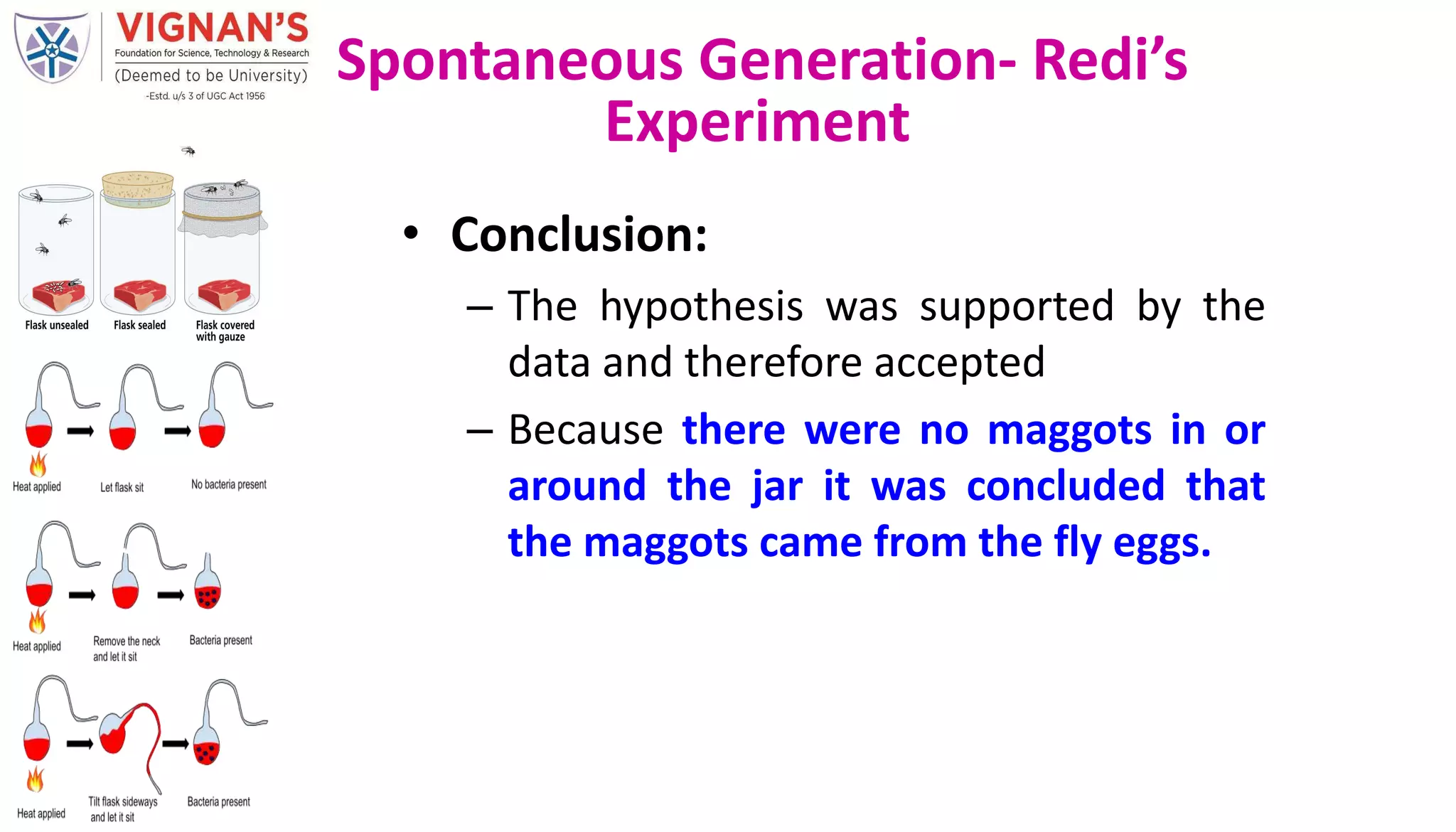
• Conclusion:
– The hypothesis was supported by the
data and therefore accepted
– Because there were no maggots in or
around the jar it was concluded that
the maggots came from the fly eggs.
Spontaneous Generation- Redi’s
Experiment
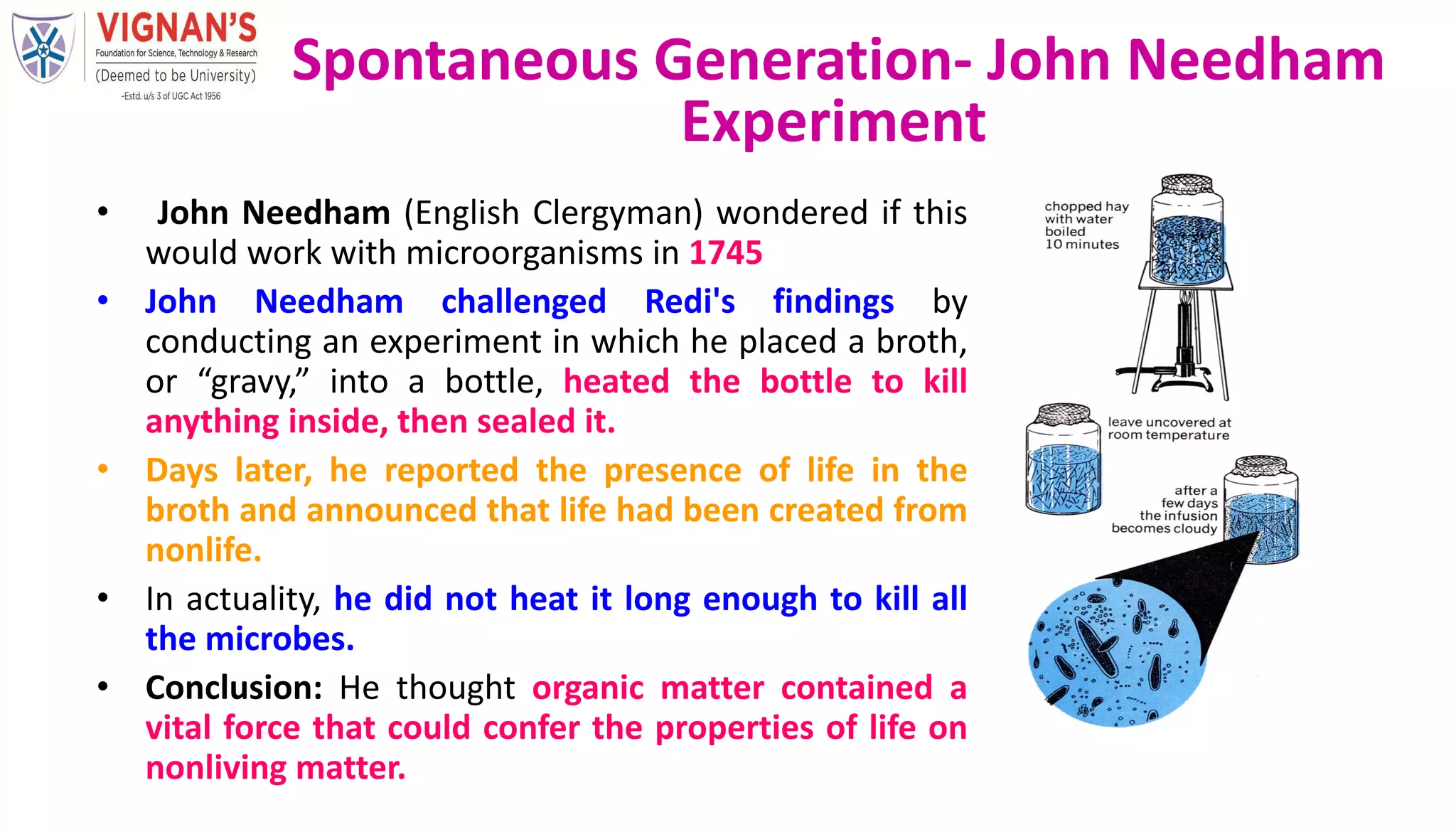
• John Needham (English Clergyman) wondered if this
would work with microorganisms in 1745
• John Needham challenged Redi's findings by
conducting an experiment in which he placed a broth,
or “gravy,” into a bottle, heated the bottle to kill
anything inside, then sealed it.
• Days later, he reported the presence of life in the
broth and announced that life had been created from
nonlife.
• In actuality, he did not heat it long enough to kill all
the microbes.
• Conclusion: He thought organic matter contained a
vital force that could confer the properties of life on
nonliving matter.
Spontaneous Generation- John Needham
Experiment
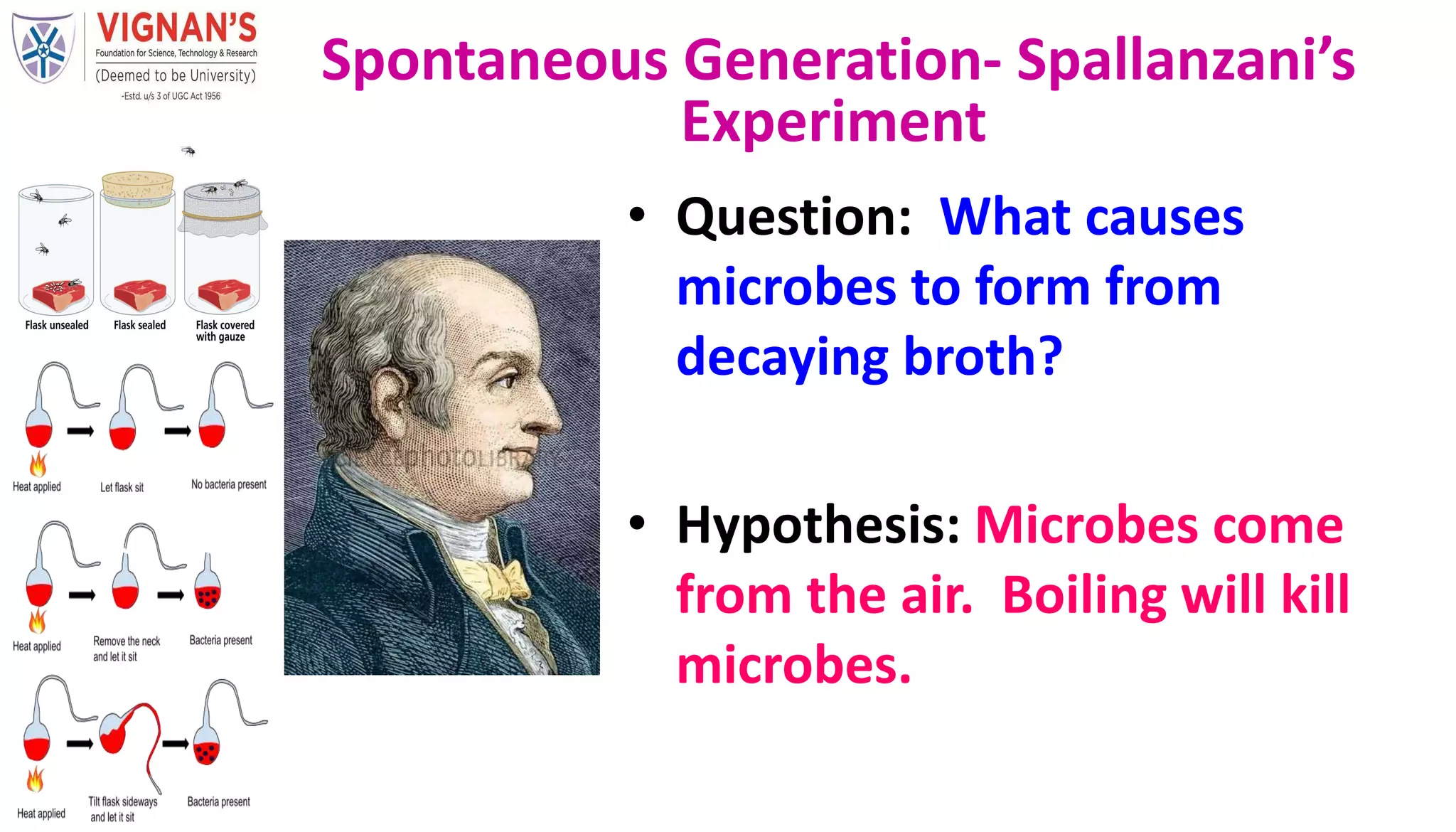
• Question: What causes
microbes to form from
decaying broth?
• Hypothesis: Microbes come
from the air. Boiling will kill
microbes.
Spontaneous Generation- Spallanzani’s
Experiment
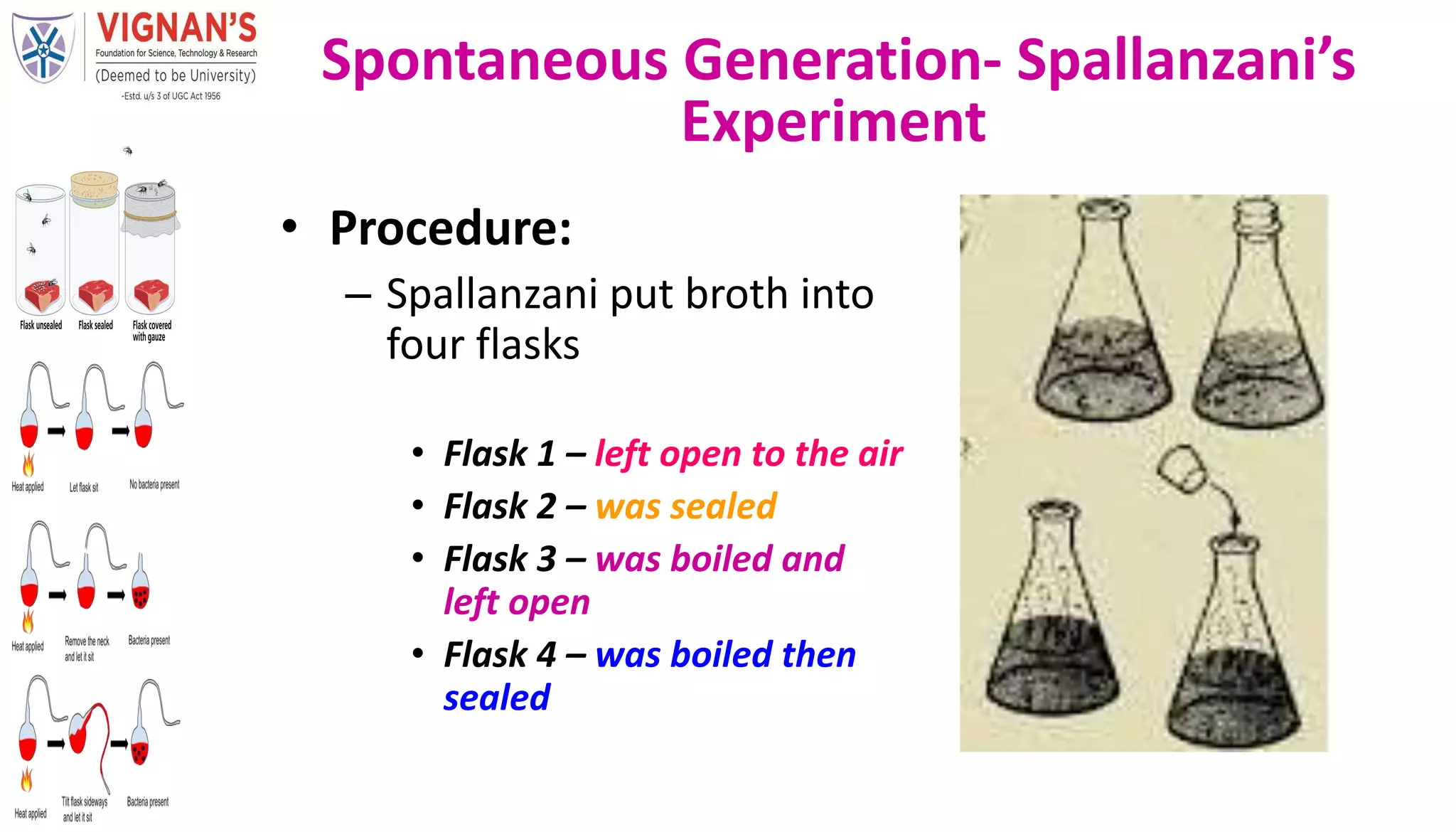
• Procedure:
– Spallanzani put broth into
four flasks
• Flask 1 – left open to the air
• Flask 2 – was sealed
• Flask 3 – was boiled and
left open
• Flask 4 – was boiled then
sealed
Spontaneous Generation- Spallanzani’s
Experiment
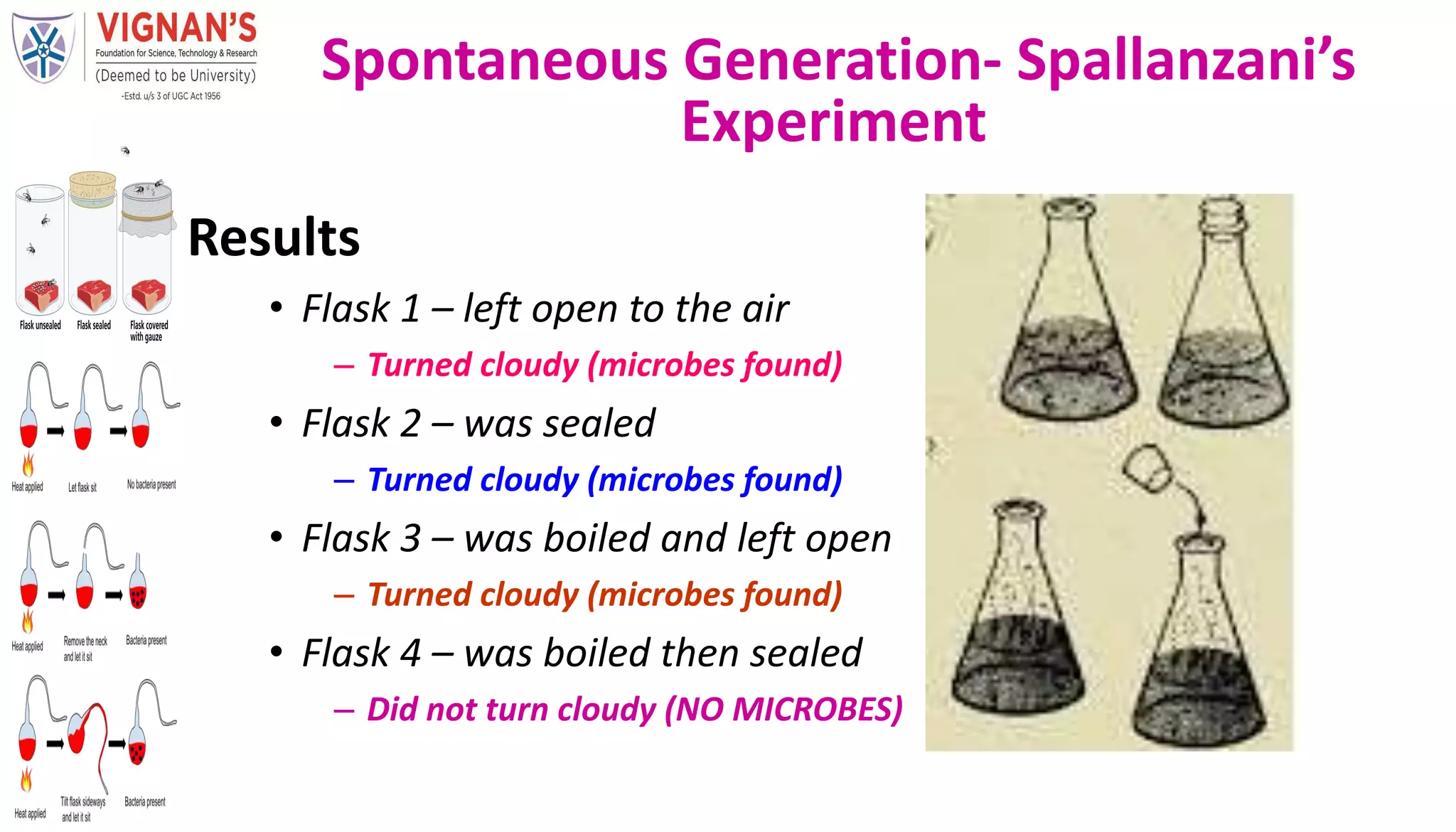
• Results
• Flask 1 – left open to the air
– Turned cloudy (microbes found)
• Flask 2 – was sealed
– Turned cloudy (microbes found)
• Flask 3 – was boiled and left open
– Turned cloudy (microbes found)
• Flask 4 – was boiled then sealed
– Did not turn cloudy (NO MICROBES)
Spontaneous Generation- Spallanzani’s
Experiment
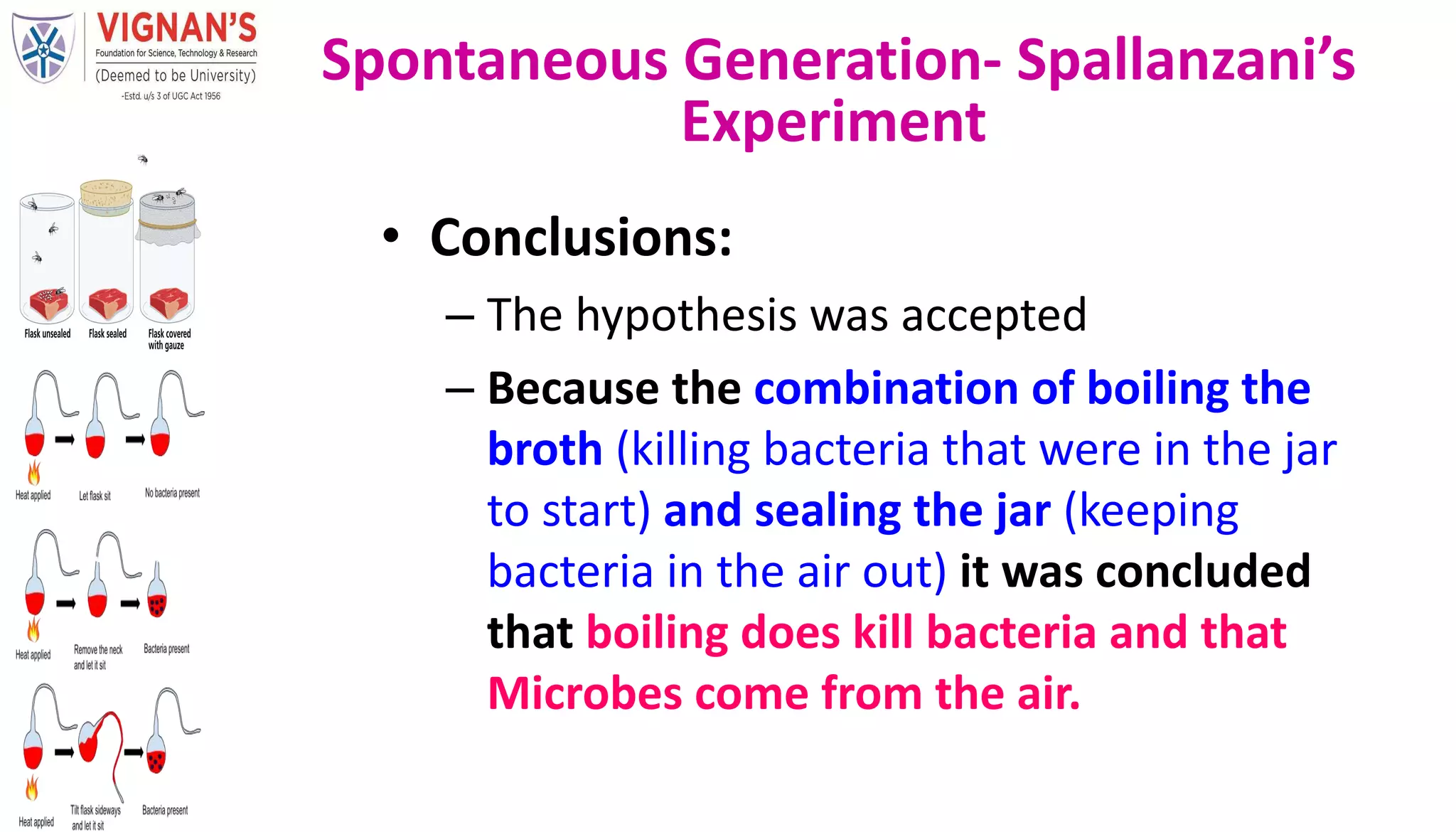
• Conclusions:
– The hypothesis was accepted
– Because the combination of boiling the
broth (killing bacteria that were in the jar
to start) and sealing the jar (keeping
bacteria in the air out) it was concluded
that boiling does kill bacteria and that
Microbes come from the air.
Spontaneous Generation- Spallanzani’s
Experiment
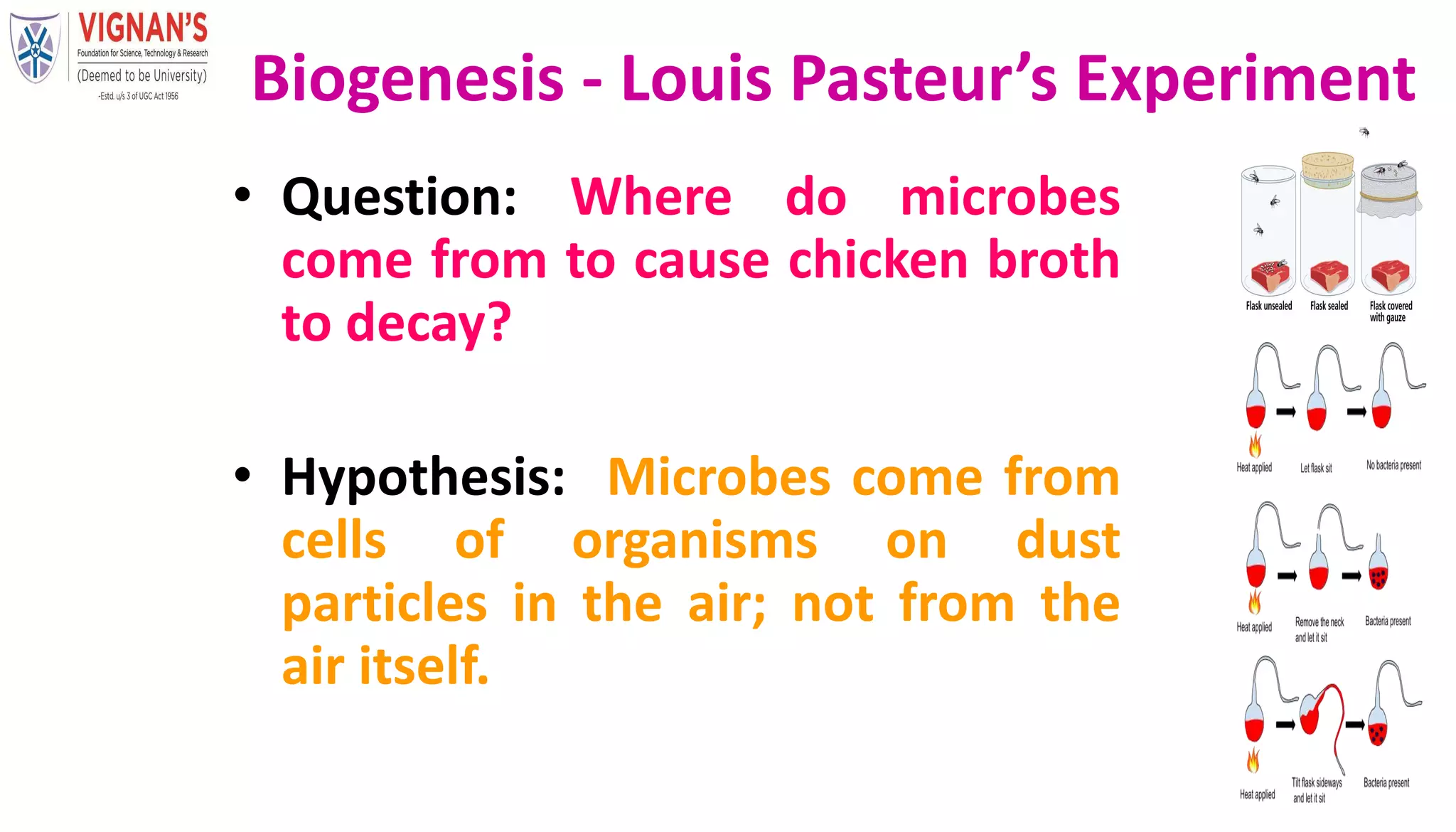
• Question: Where do microbes
come from to cause chicken broth
to decay?
• Hypothesis: Microbes come from
cells of organisms on dust
particles in the air; not from the
air itself.
Biogenesis - Louis Pasteur’s Experiment
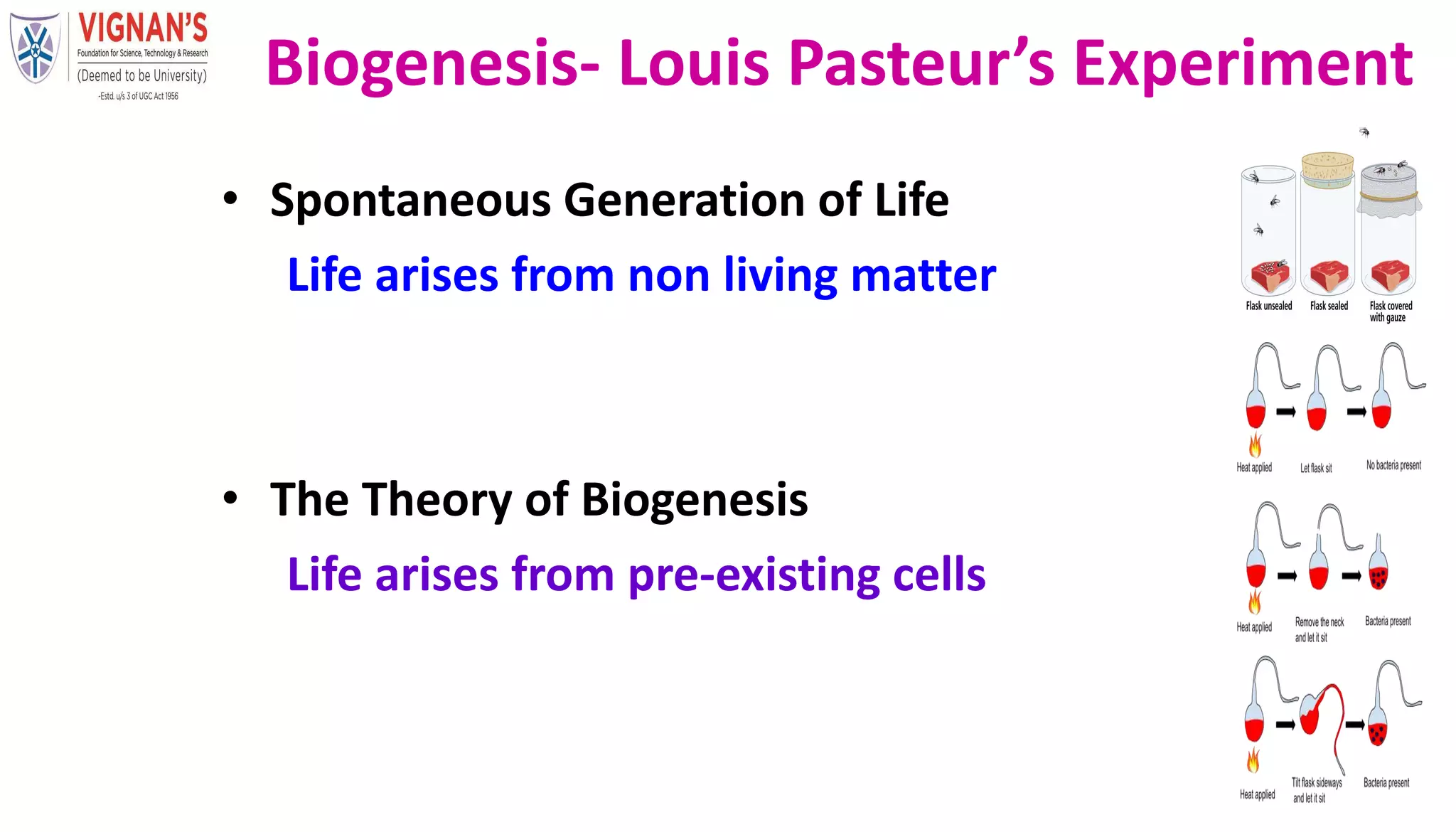
• Spontaneous Generation of Life
Life arises from non living matter
• The Theory of Biogenesis
Life arises from pre-existing cells
Biogenesis- Louis Pasteur’s Experiment
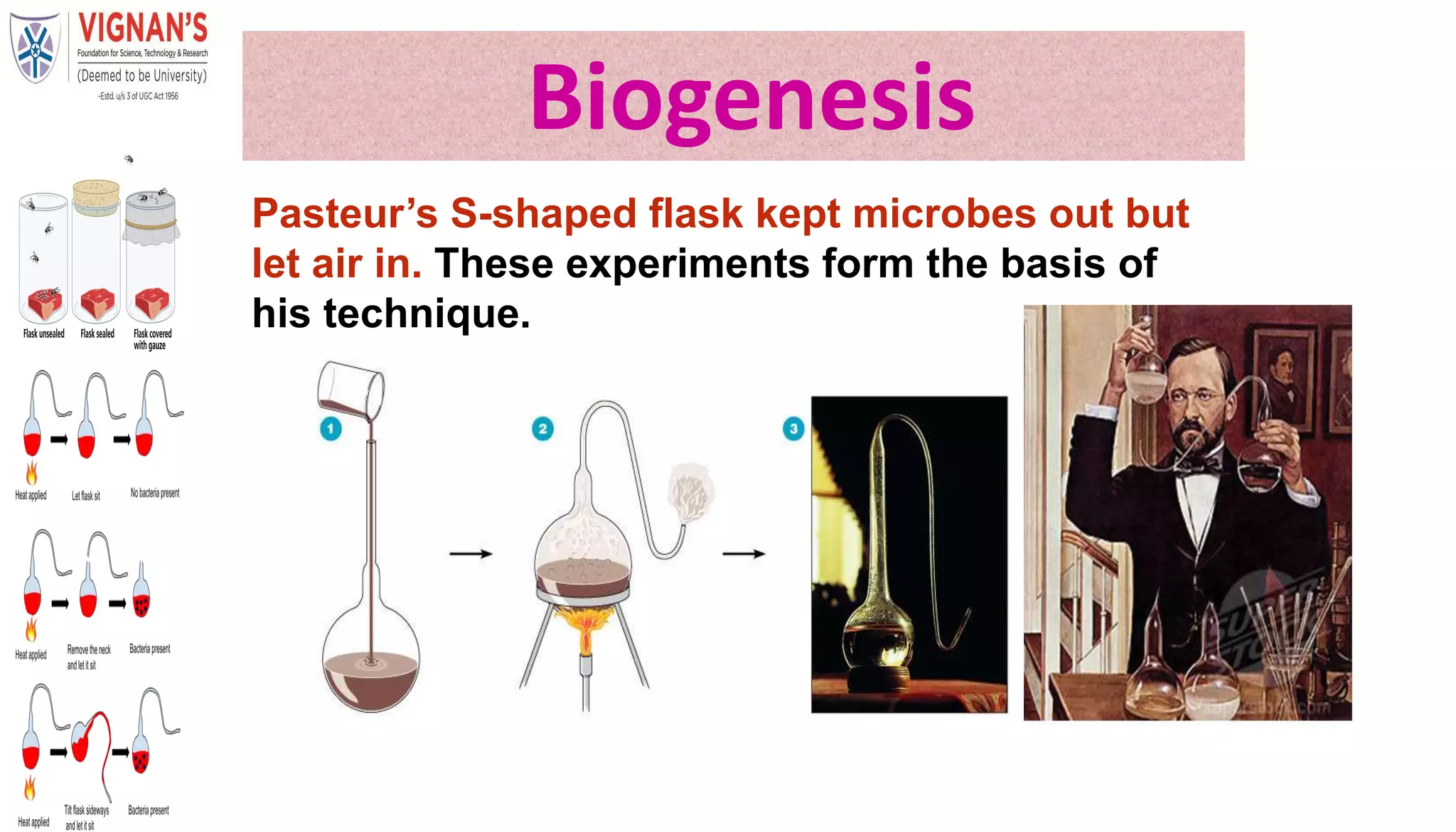
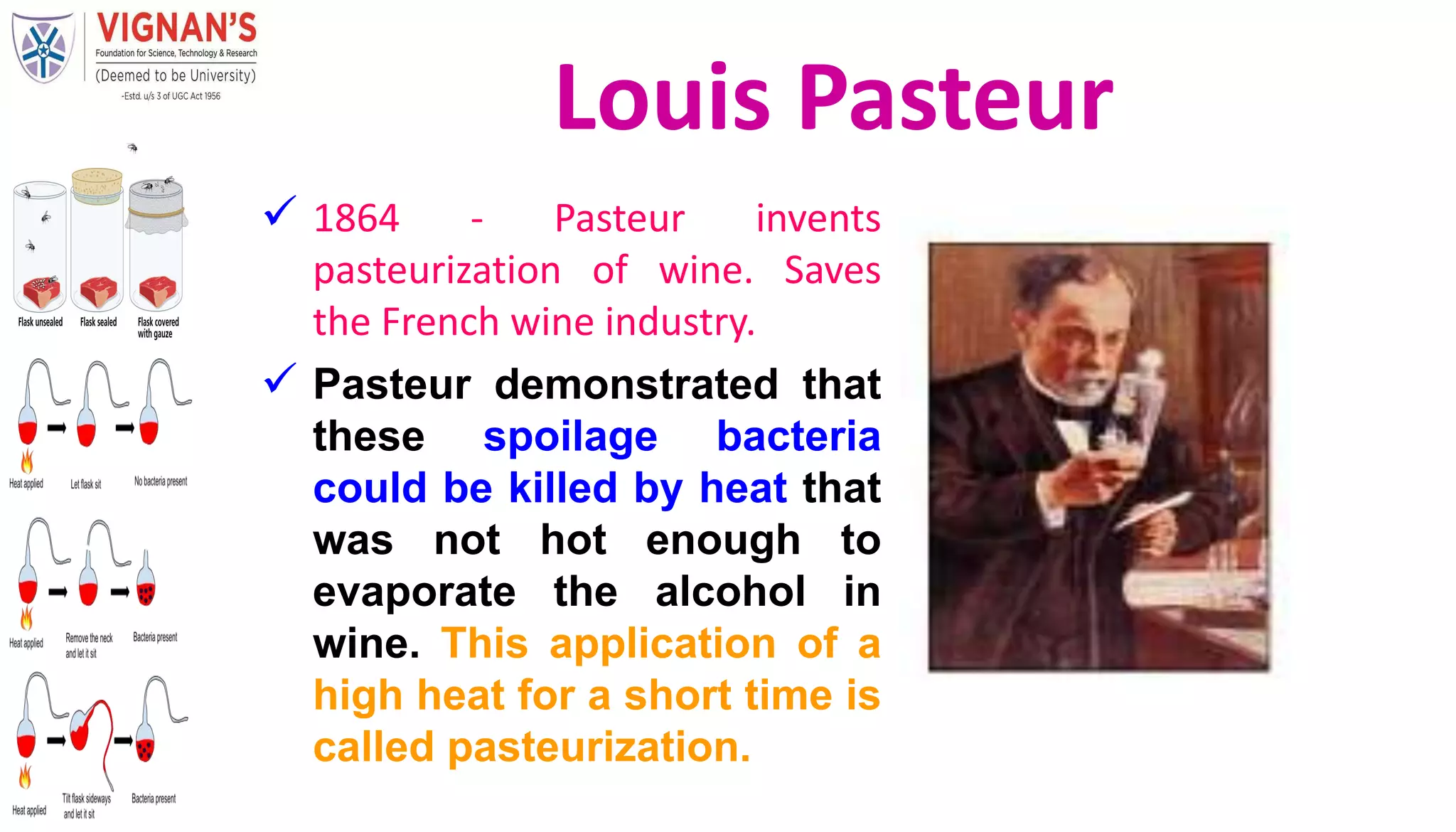
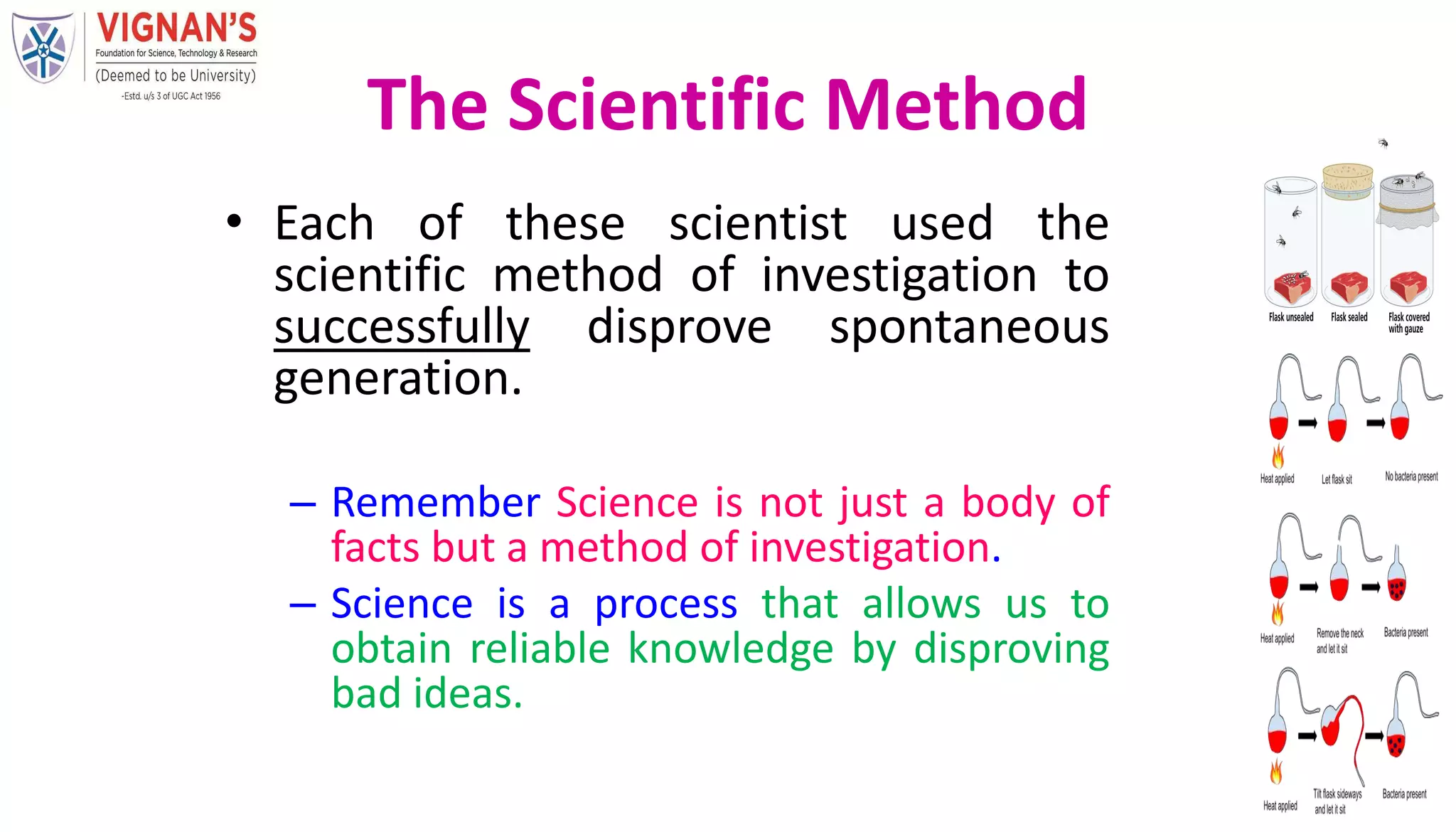
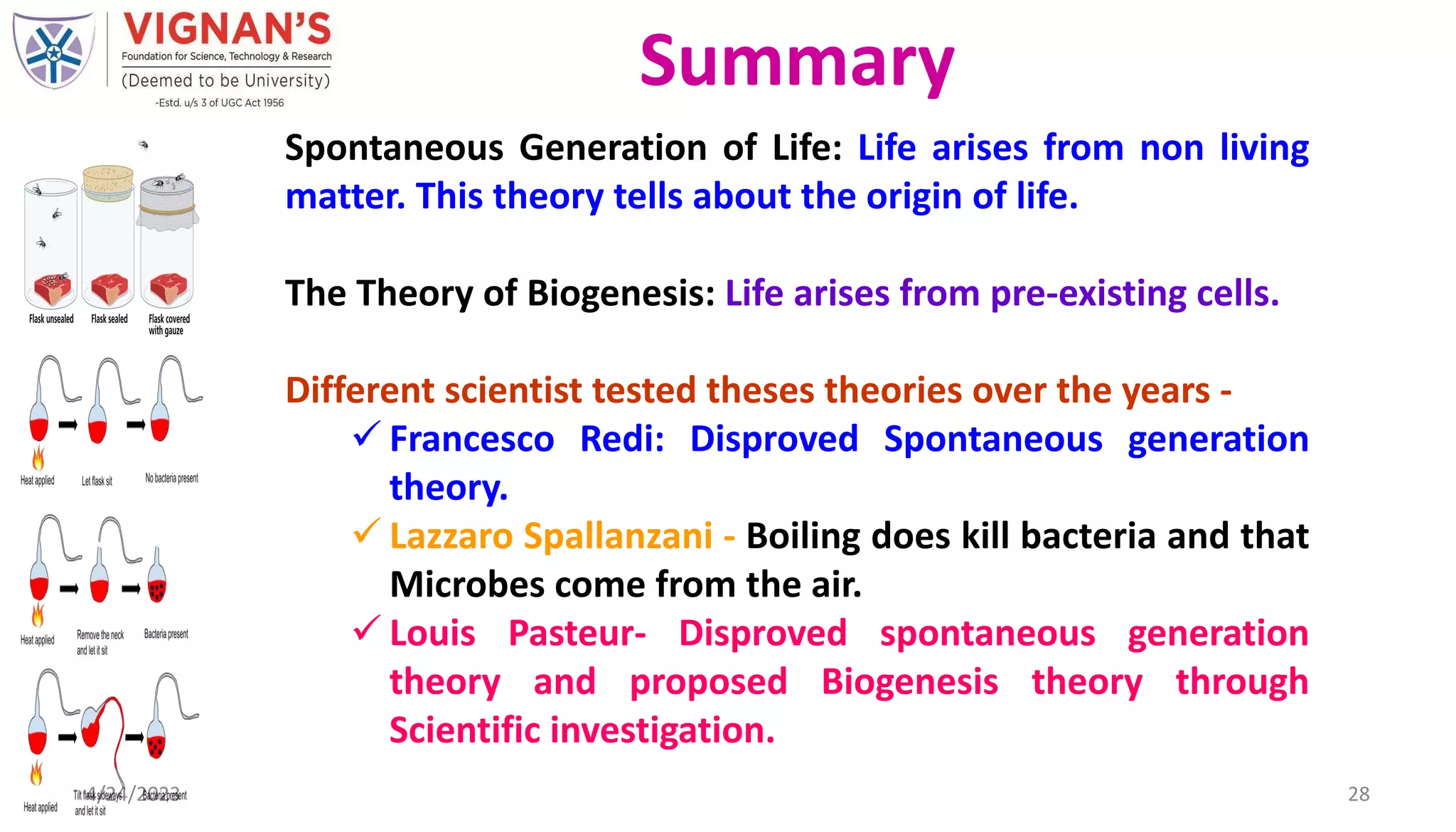
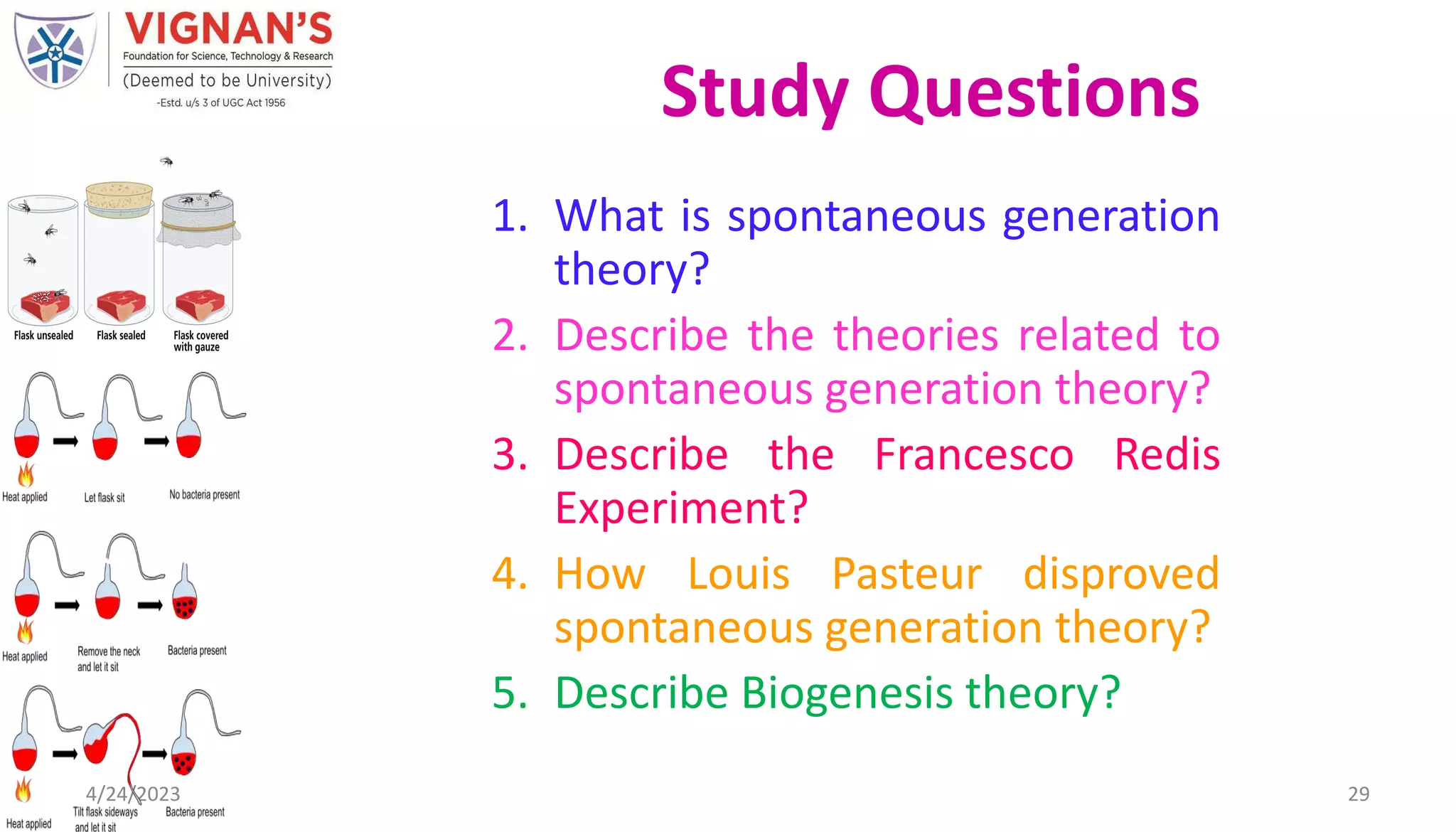
Pasteur’s S-shaped flask kept microbes out but
let air in. These experiments form the basis of
his technique.
Biogenesis
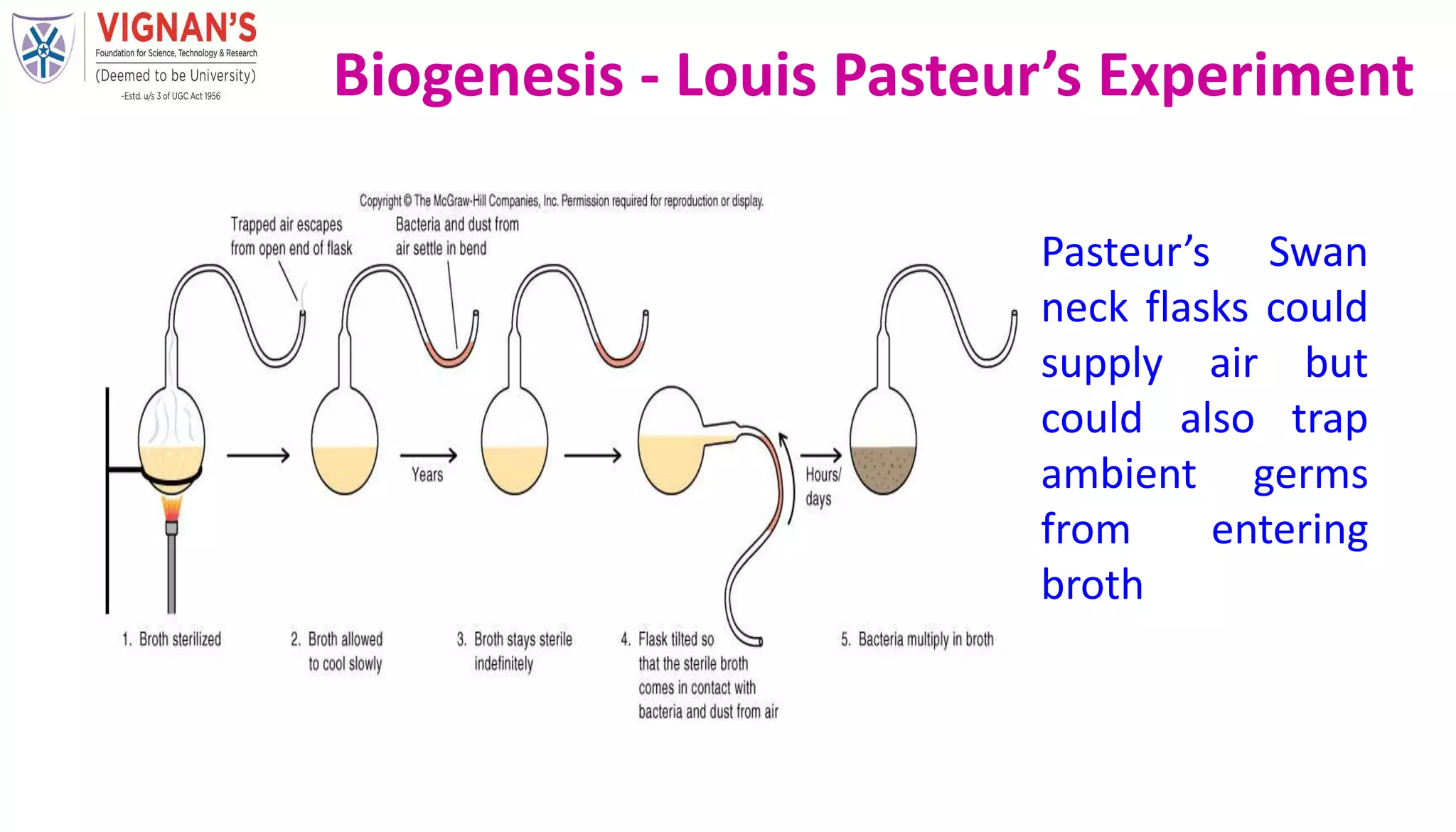
Pasteur’s Swan
neck flasks could
supply air but
could also trap
ambient germs
from entering
broth
Biogenesis - Louis Pasteur’s Experiment
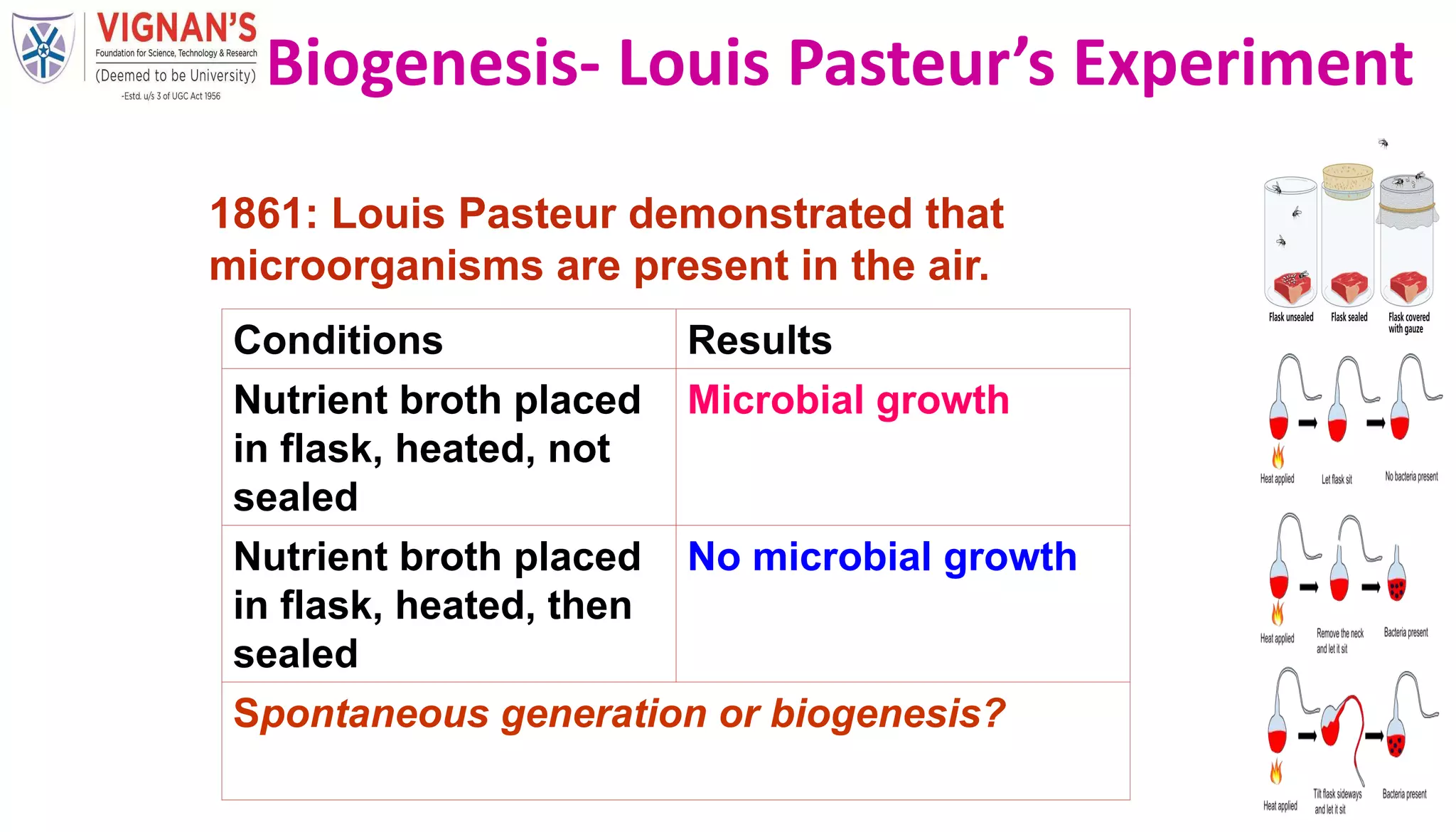
1861: Louis Pasteur demonstrated that
microorganisms are present in the air.
Conditions Results
Nutrient broth placed
in flask, heated, not
sealed
Microbial growth
Nutrient broth placed
in flask, heated, then
sealed
No microbial growth
Spontaneous generation or biogenesis?
Biogenesis- Louis Pasteur’s Experiment
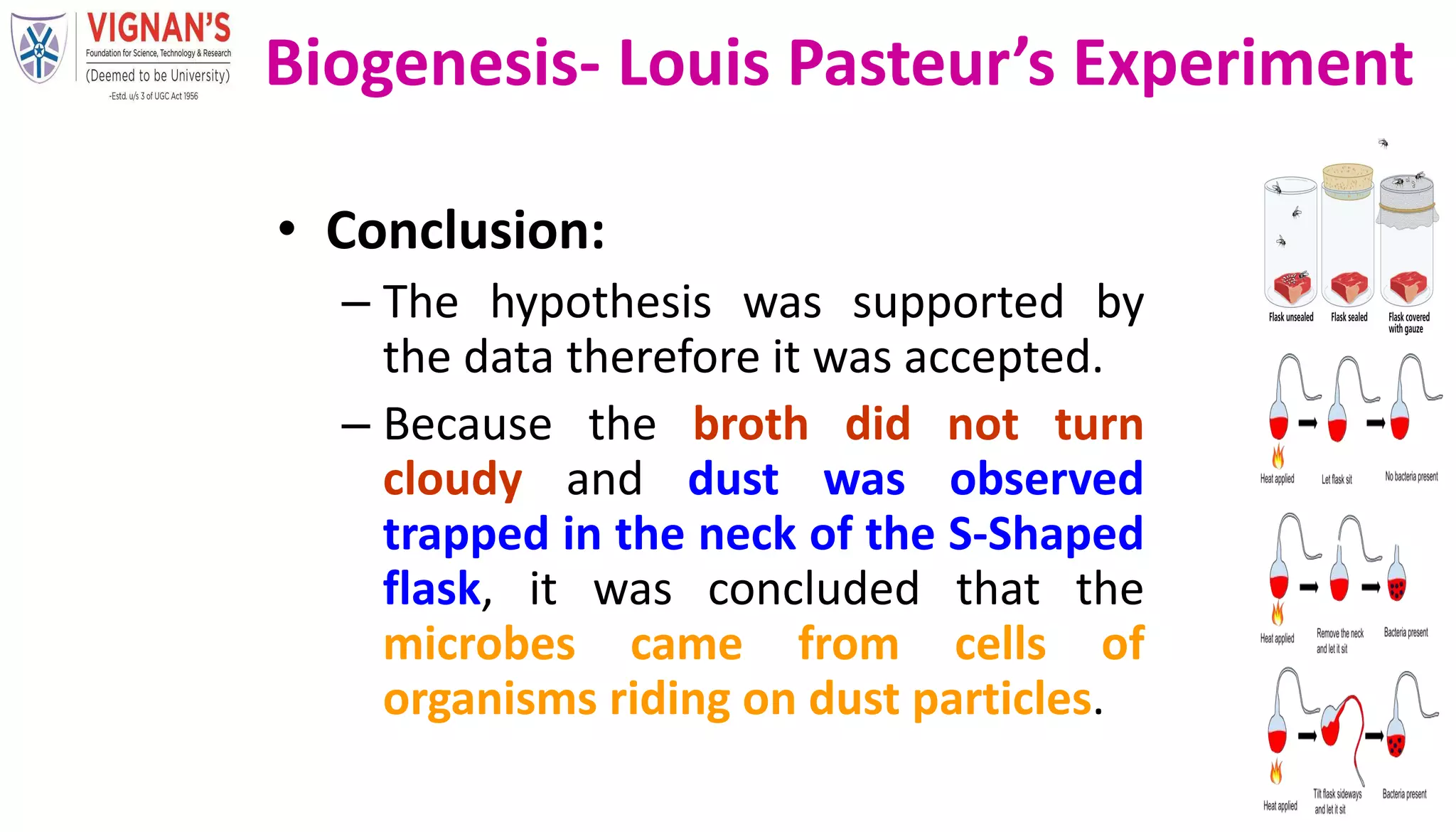
• Conclusion:
– The hypothesis was supported by
the data therefore it was accepted.
– Because the broth did not turn
cloudy and dust was observed
trapped in the neck of the S-Shaped
flask, it was concluded that the
microbes came from cells of
organisms riding on dust particles.
Biogenesis- Louis Pasteur’s Experiment
 1864 - Pasteur invents
pasteurization of wine. Saves
the French wine industry.
 Pasteur demonstrated that
these spoilage bacteria
could be killed by heat that
was not hot enough to
evaporate the alcohol in
wine. This application of a
high heat for a short time is
called pasteurization.
Louis Pasteur
The Scientific Method
• Each of these scientist used the
scientific method of investigation to
successfully disprove spontaneous
generation.
– Remember Science is not just a body of
facts but a method of investigation.
– Science is a process that allows us to
obtain reliable knowledge by disproving
bad ideas.
Summary
4/24/2023 28
Spontaneous Generation of Life: Life arises from non living
matter. This theory tells about the origin of life.
The Theory of Biogenesis: Life arises from pre-existing cells.
Different scientist tested theses theories over the years -
 Francesco Redi: Disproved Spontaneous generation
theory.
 Lazzaro Spallanzani - Boiling does kill bacteria and that
Microbes come from the air.
 Louis Pasteur- Disproved spontaneous generation
theory and proposed Biogenesis theory through
Scientific investigation.
Study Questions
1. What is spontaneous generation
theory?
2. Describe the theories related to
spontaneous generation theory?
3. Describe the Francesco Redis
Experiment?
4. How Louis Pasteur disproved
spontaneous generation theory?
5. Describe Biogenesis theory?
4/24/2023 29
• https://edspontaneousgeneration.weebly.com/redis-
experiment.html
• https://bio.libretexts.org/Bookshelves/Microbiology/Book%3A_Micr
obiology_(Boundless)/1%3A_Introduction_to_Microbiology/1.1%3A
_Introduction_to_Microbiology/1.1C%3A_Pasteur_and_Spontaneou
s_Generation
• https://courses.lumenlearning.com/microbiology/chapter/spontane
ous-generation/.
• https://slideplayer.com/slide/9880939/
• http://people.cst.cmich.edu/swans1bj/620%20Lect%2002.pdf.
• https://www.alpfmedical.info/causative-agent/the-origin-of-
microorganisms.html.
• https://microbenotes.com/louis-pasteur-and-his-contributions/.
4/24/2023 30
References
"We acknowledge the online
resources/public domain for
using the contents to
develop teaching material."
4/24/2023 31
Acknowledgement
THANK YOU ALL
Dr. M. Indira, Associate Professor
Department of Biotechnology
VFSTR (Deemed To be University)
Email: indu221007@gmail.com
32

LECTURE 3 SPONTANEOUS GENERATION THEORY.pptx

  • 1.
    MICROBIOLOGY 19BT203 UNIT I:Introduction to Microbiology: Topic-3 SPONTANEOUS GENERATION THEORY Dr. M. Indira Associate Professor Dept of Biotechnology Vignan’s Foundation for Science, Technology and Research, A.P India
  • 2.
    Objective To overview theconcept of spontaneous generation theory and biogenesis theory. 4/24/2023 2
  • 3.
    Expected Outcome The overviewof the concept of spontaneous generation theory and biogenesis theory will be known. 4/24/2023 3
  • 4.
  • 5.
    Where do microorganism’soriginate from? Spontaneous generation? What is this theory? Few day’s of being exposed to air INTRODUCTION
  • 6.
    INTRODUCTION  For muchof history, people believed that animals could come from non-living sources. They thought:  Frogs developed from falling drops of rain  mice arose from sweaty underwear  and flies arose from decaying meat  This is called abiogenesis  Also known as spontaneous generation-living organisms can develop from nonliving or decomposing matter
  • 7.
    Different Theories of SpontaneousGeneration • Theory 1 = The spontaneous production of mice required placing sweaty clothes and husks of wheat in an open-mouthed jar, then waiting for about 21 days, during which time it was alleged that the sweat from the clothing would penetrate the husks of wheat, changing them into mice. • Theory 2 = Maggots arise spontaneously in rotting meat • Theory 3 = Microorganisms arise spontaneously in broth.
  • 8.
    • Different scientisttested theses theories over the years – Francesco Redi • An Italian doctor – Lazzaro Spallanzani • An Italian Scientist – Louis Pasteur • A French Scientist Spontaneous Generation
  • 9.
    Jan Baptista VanHelmont The Origin of life (17th Centuray) Adult mice 1579-1644 Spontaneous Generation
  • 10.
  • 11.
    Could spontaneous generationbe true for microorganisms? Many believed spontaneous generation: “Life can arise from non-living matter” In 1668, the Italian physician Francesco Redi performed an experiment to disprove spontaneous generation. Can you think of an experiment that could disprove spontaneous generation? Spontaneous Generation
  • 12.
    Spontaneous Generation- Redi’sExperiment • Question: where did maggots come from? • Hypothesis: maggots came from the eggs of flies
  • 13.
    Conditions Results 1 openjar Maggots appeared, Flies were observed on meat 1 jar covered with cheese cloth No maggots, How ever maggots developed from eggs laid by flies on cheese cloth. Flies were observed on netting 1 jar sealed with paper No maggots. No flies were observed near jar 3 From where did the maggots come? What was the purpose of the sealed jars? Spontaneous generation or biogenesis? Redi filled 3 jars with decaying meat. Spontaneous Generation
  • 14.
    • Conclusion: – Thehypothesis was supported by the data and therefore accepted – Because there were no maggots in or around the jar it was concluded that the maggots came from the fly eggs. Spontaneous Generation- Redi’s Experiment
  • 15.
    • John Needham(English Clergyman) wondered if this would work with microorganisms in 1745 • John Needham challenged Redi's findings by conducting an experiment in which he placed a broth, or “gravy,” into a bottle, heated the bottle to kill anything inside, then sealed it. • Days later, he reported the presence of life in the broth and announced that life had been created from nonlife. • In actuality, he did not heat it long enough to kill all the microbes. • Conclusion: He thought organic matter contained a vital force that could confer the properties of life on nonliving matter. Spontaneous Generation- John Needham Experiment
  • 16.
    • Question: Whatcauses microbes to form from decaying broth? • Hypothesis: Microbes come from the air. Boiling will kill microbes. Spontaneous Generation- Spallanzani’s Experiment
  • 17.
    • Procedure: – Spallanzaniput broth into four flasks • Flask 1 – left open to the air • Flask 2 – was sealed • Flask 3 – was boiled and left open • Flask 4 – was boiled then sealed Spontaneous Generation- Spallanzani’s Experiment
  • 18.
    • Results • Flask1 – left open to the air – Turned cloudy (microbes found) • Flask 2 – was sealed – Turned cloudy (microbes found) • Flask 3 – was boiled and left open – Turned cloudy (microbes found) • Flask 4 – was boiled then sealed – Did not turn cloudy (NO MICROBES) Spontaneous Generation- Spallanzani’s Experiment
  • 19.
    • Conclusions: – Thehypothesis was accepted – Because the combination of boiling the broth (killing bacteria that were in the jar to start) and sealing the jar (keeping bacteria in the air out) it was concluded that boiling does kill bacteria and that Microbes come from the air. Spontaneous Generation- Spallanzani’s Experiment
  • 20.
    • Question: Wheredo microbes come from to cause chicken broth to decay? • Hypothesis: Microbes come from cells of organisms on dust particles in the air; not from the air itself. Biogenesis - Louis Pasteur’s Experiment
  • 21.
    • Spontaneous Generationof Life Life arises from non living matter • The Theory of Biogenesis Life arises from pre-existing cells Biogenesis- Louis Pasteur’s Experiment
  • 22.
    Pasteur’s S-shaped flaskkept microbes out but let air in. These experiments form the basis of his technique. Biogenesis
  • 23.
    Pasteur’s Swan neck flaskscould supply air but could also trap ambient germs from entering broth Biogenesis - Louis Pasteur’s Experiment
  • 24.
    1861: Louis Pasteurdemonstrated that microorganisms are present in the air. Conditions Results Nutrient broth placed in flask, heated, not sealed Microbial growth Nutrient broth placed in flask, heated, then sealed No microbial growth Spontaneous generation or biogenesis? Biogenesis- Louis Pasteur’s Experiment
  • 25.
    • Conclusion: – Thehypothesis was supported by the data therefore it was accepted. – Because the broth did not turn cloudy and dust was observed trapped in the neck of the S-Shaped flask, it was concluded that the microbes came from cells of organisms riding on dust particles. Biogenesis- Louis Pasteur’s Experiment
  • 26.
     1864 -Pasteur invents pasteurization of wine. Saves the French wine industry.  Pasteur demonstrated that these spoilage bacteria could be killed by heat that was not hot enough to evaporate the alcohol in wine. This application of a high heat for a short time is called pasteurization. Louis Pasteur
  • 27.
    The Scientific Method •Each of these scientist used the scientific method of investigation to successfully disprove spontaneous generation. – Remember Science is not just a body of facts but a method of investigation. – Science is a process that allows us to obtain reliable knowledge by disproving bad ideas.
  • 28.
    Summary 4/24/2023 28 Spontaneous Generationof Life: Life arises from non living matter. This theory tells about the origin of life. The Theory of Biogenesis: Life arises from pre-existing cells. Different scientist tested theses theories over the years -  Francesco Redi: Disproved Spontaneous generation theory.  Lazzaro Spallanzani - Boiling does kill bacteria and that Microbes come from the air.  Louis Pasteur- Disproved spontaneous generation theory and proposed Biogenesis theory through Scientific investigation.
  • 29.
    Study Questions 1. Whatis spontaneous generation theory? 2. Describe the theories related to spontaneous generation theory? 3. Describe the Francesco Redis Experiment? 4. How Louis Pasteur disproved spontaneous generation theory? 5. Describe Biogenesis theory? 4/24/2023 29
  • 30.
    • https://edspontaneousgeneration.weebly.com/redis- experiment.html • https://bio.libretexts.org/Bookshelves/Microbiology/Book%3A_Micr obiology_(Boundless)/1%3A_Introduction_to_Microbiology/1.1%3A _Introduction_to_Microbiology/1.1C%3A_Pasteur_and_Spontaneou s_Generation •https://courses.lumenlearning.com/microbiology/chapter/spontane ous-generation/. • https://slideplayer.com/slide/9880939/ • http://people.cst.cmich.edu/swans1bj/620%20Lect%2002.pdf. • https://www.alpfmedical.info/causative-agent/the-origin-of- microorganisms.html. • https://microbenotes.com/louis-pasteur-and-his-contributions/. 4/24/2023 30 References
  • 31.
    "We acknowledge theonline resources/public domain for using the contents to develop teaching material." 4/24/2023 31 Acknowledgement
  • 32.
    THANK YOU ALL Dr.M. Indira, Associate Professor Department of Biotechnology VFSTR (Deemed To be University) Email: indu221007@gmail.com 32