INSECT NERVOUS SYSTEM
Prepared by
Dr. S. Sumaiya
NERVOUS SYSTEM
 Basic components
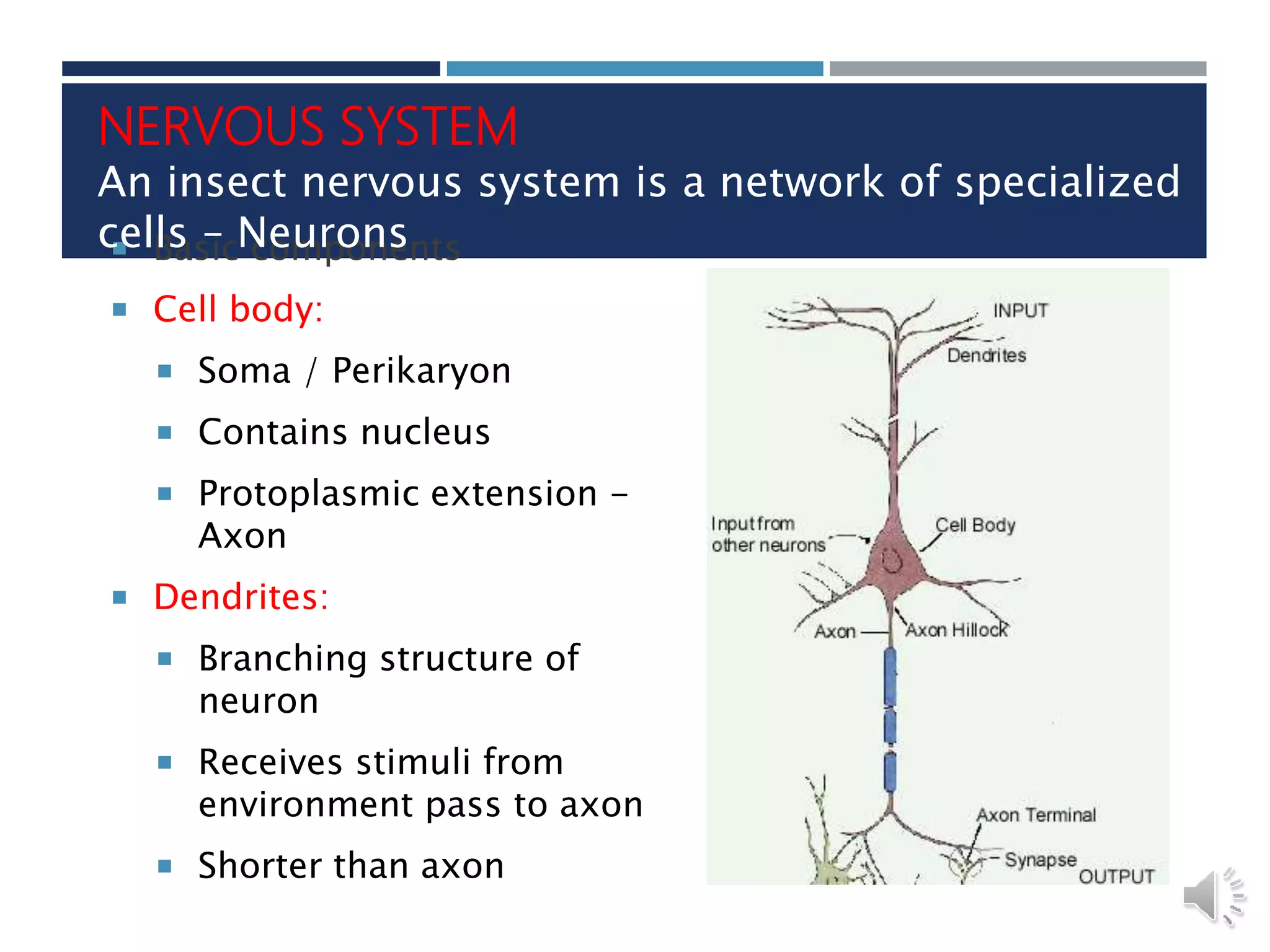
 Cell body:
 Soma / Perikaryon
 Contains nucleus
 Protoplasmic extension -
Axon
 Dendrites:
 Branching structure of
neuron
 Receives stimuli from
environment pass to axon
 Shorter than axon
An insect nervous system is a network of specialized
cells – Neurons
NERVOUS SYSTEM
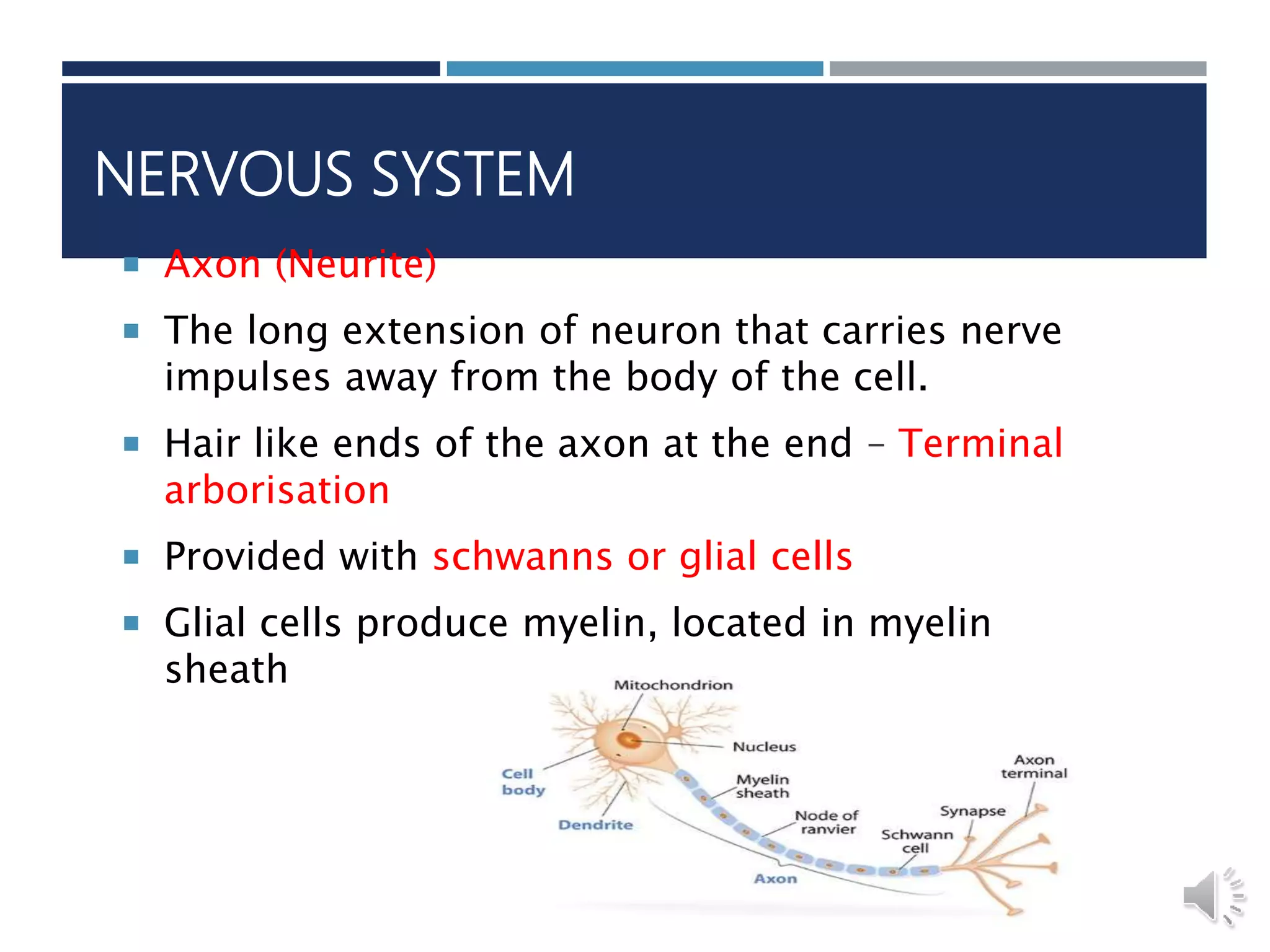
 Axon (Neurite)
 The long extension of neuron that carries nerve
impulses away from the body of the cell.
 Hair like ends of the axon at the end – Terminal
arborisation
 Provided with schwanns or glial cells
 Glial cells produce myelin, located in myelin
sheath
TYPES OF NEURONS
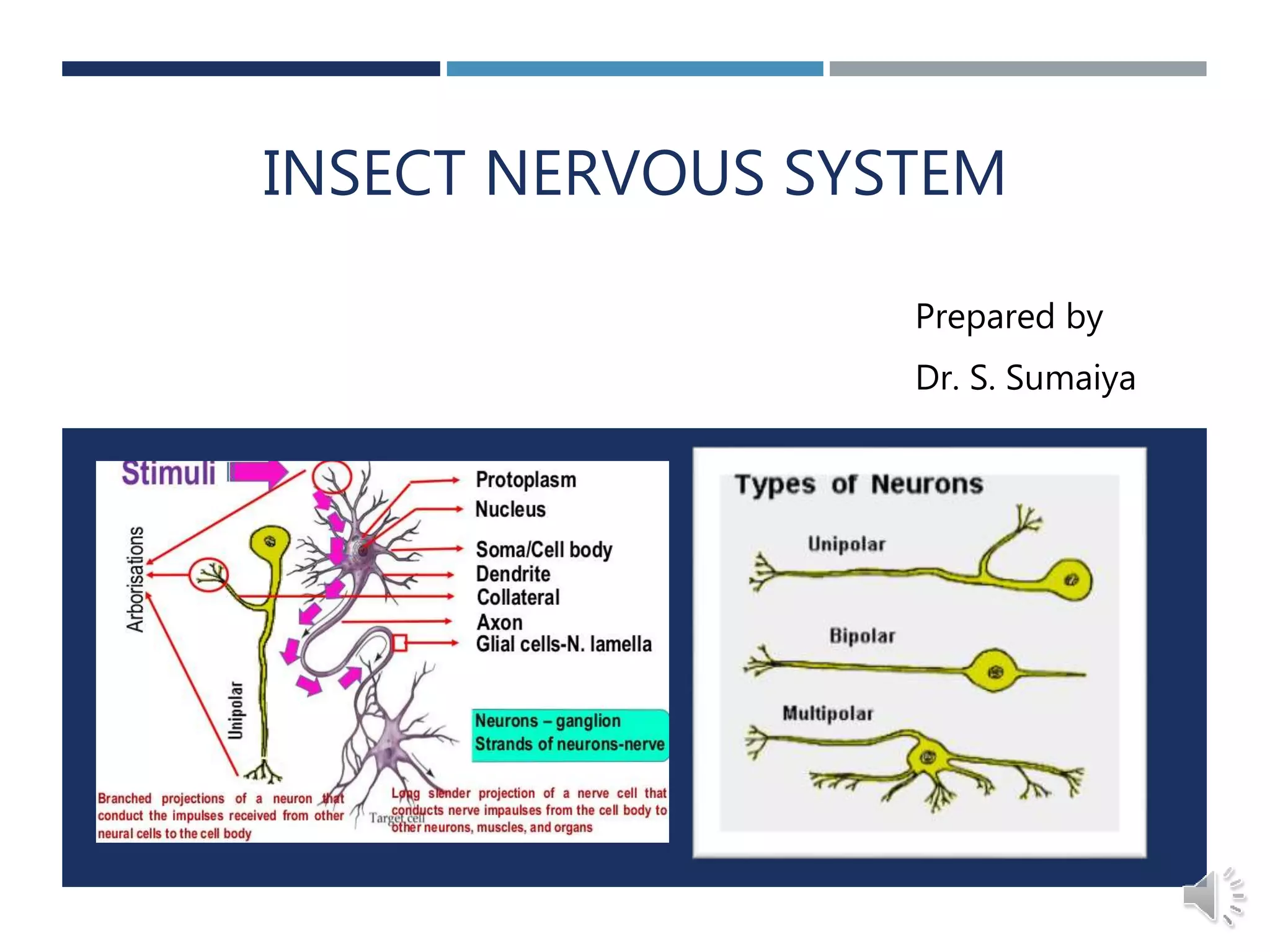
A. Structural basis
i. Monopolar : neuron with a
single axon
ii. Bipolar : neuron with a
proximal axon and a long
distal dendrite.
iii. Multipolar : neuron with
a proximal axon and many
distal dendrites.
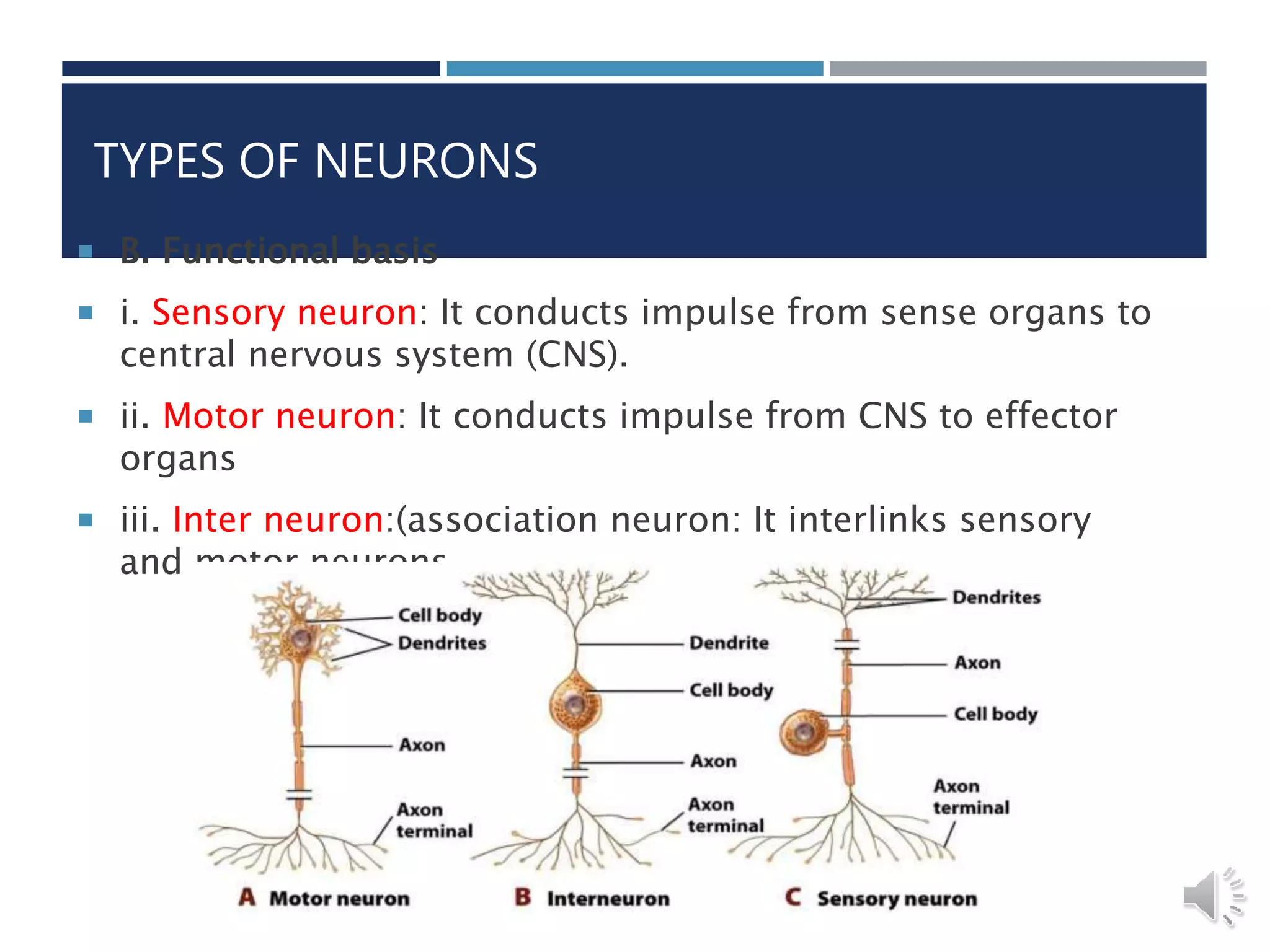
 B. Functional basis
 i. Sensory neuron: It conducts impulse from sense organs to
central nervous system (CNS).
 ii. Motor neuron: It conducts impulse from CNS to effector
organs
 iii. Inter neuron:(association neuron: It interlinks sensory
and motor neurons.
TYPES OF NEURONS
MECHANISM OF IMPULSE CONDUCTION
 Impulses are conducted by the neurons by two means.
 A. Axonic conduction: Ionic composition varies between
inside and outside of axon resulting in excitable conditions,
which leads to impulse conduction as electrical response.
 B. Synaptic conduction: Neuro chemical transmitters are
involved in the impulse conduction through the synaptic
gap. Neuro transmitters and the type of reactions helping in
the impulse conduction is as follows.
 Acetyl CO-A + Choline (choline acetylase ) Acetyl
choline
 Acetyl choline + Water (Acetyl choline esterase ) Choline
+ Acetic acid
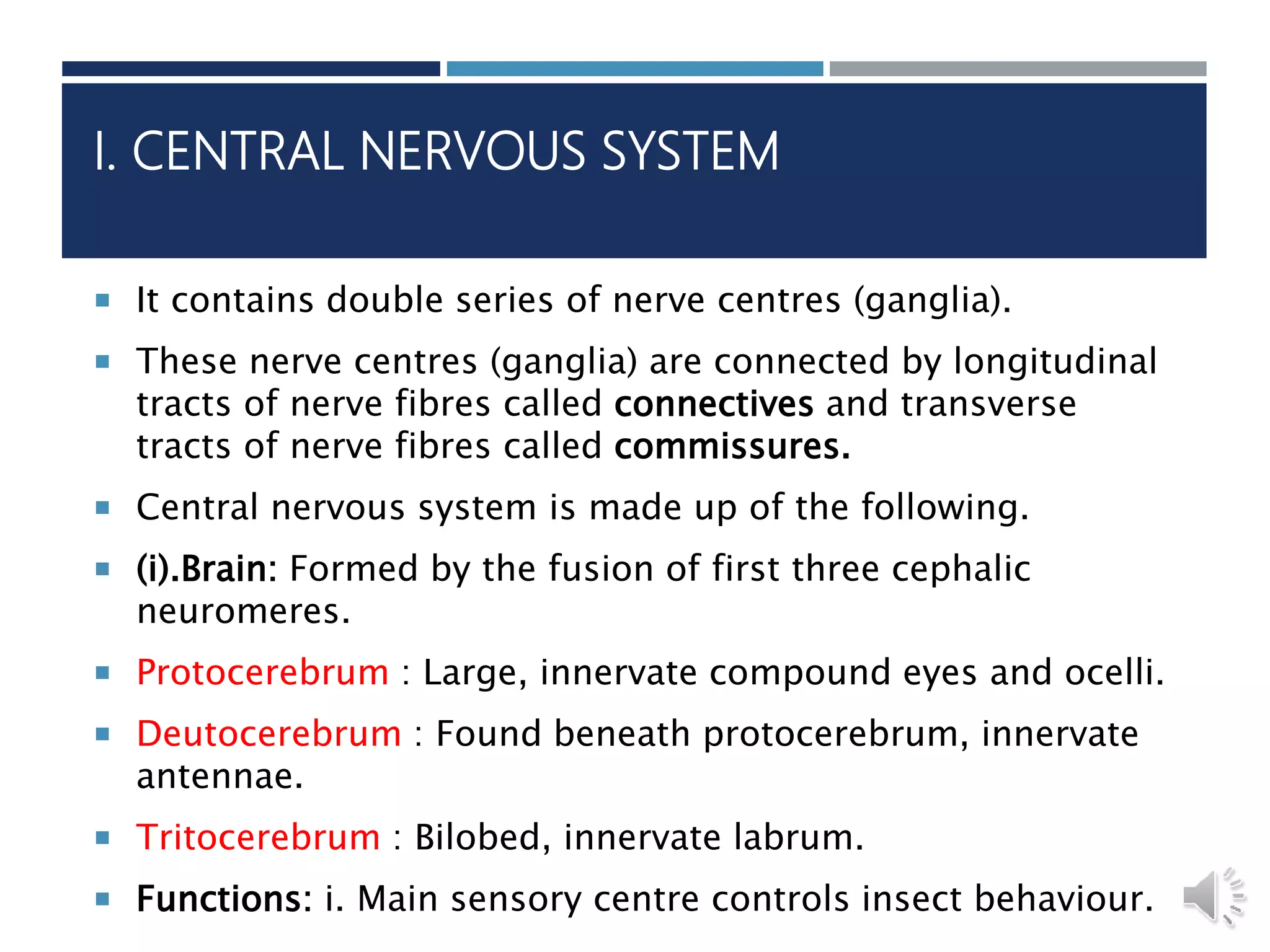
NERVOUS SYSTEM
 i. Central nervous system (CNS)
 ii. Visceral nervous system (VNS)
 iii. Peripheral nervous system (PNS)
I. CENTRAL NERVOUS SYSTEM
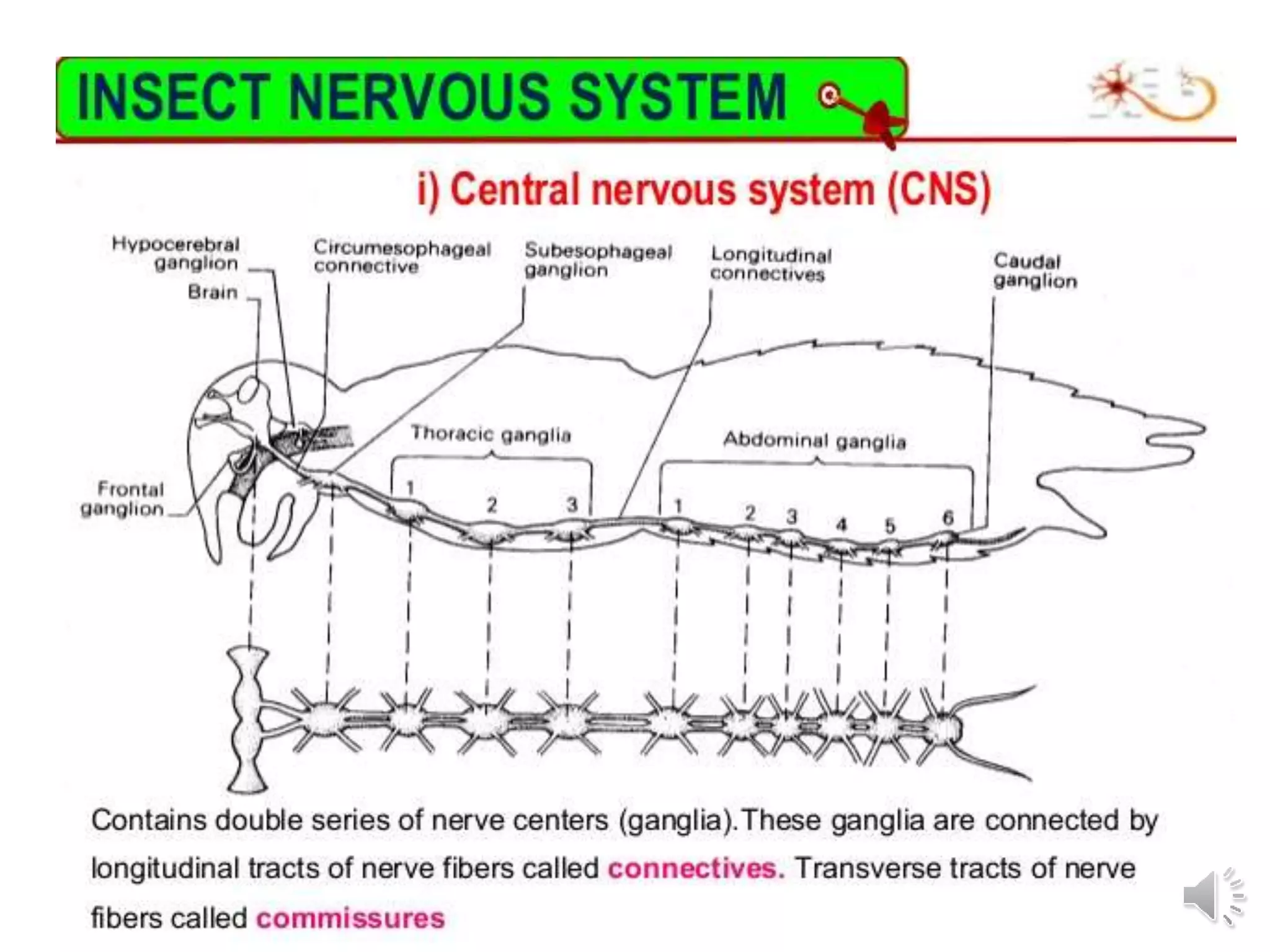
 It contains double series of nerve centres (ganglia).
 These nerve centres (ganglia) are connected by longitudinal
tracts of nerve fibres called connectives and transverse
tracts of nerve fibres called commissures.
 Central nervous system is made up of the following.
 (i).Brain: Formed by the fusion of first three cephalic
neuromeres.
 Protocerebrum : Large, innervate compound eyes and ocelli.
 Deutocerebrum : Found beneath protocerebrum, innervate
antennae.
 Tritocerebrum : Bilobed, innervate labrum.
 Functions: i. Main sensory centre controls insect behaviour.
I. CENTRAL NERVOUS SYSTEM
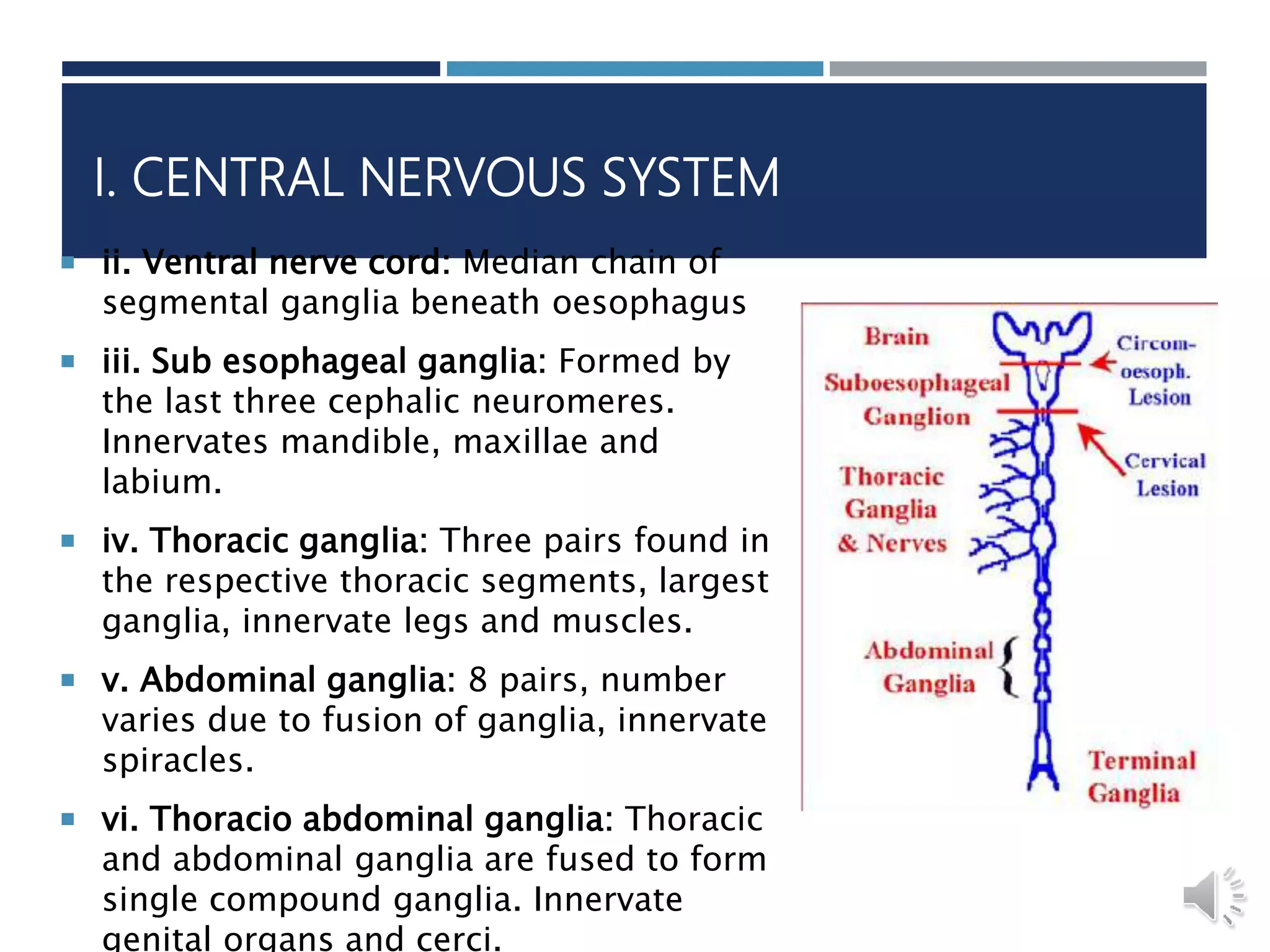
 ii. Ventral nerve cord: Median chain of
segmental ganglia beneath oesophagus
 iii. Sub esophageal ganglia: Formed by
the last three cephalic neuromeres.
Innervates mandible, maxillae and
labium.
 iv. Thoracic ganglia: Three pairs found in
the respective thoracic segments, largest
ganglia, innervate legs and muscles.
 v. Abdominal ganglia: 8 pairs, number
varies due to fusion of ganglia, innervate
spiracles.
 vi. Thoracio abdominal ganglia: Thoracic
and abdominal ganglia are fused to form
single compound ganglia. Innervate
genital organs and cerci.
II. VISCERAL NERVOUS SYSTEM
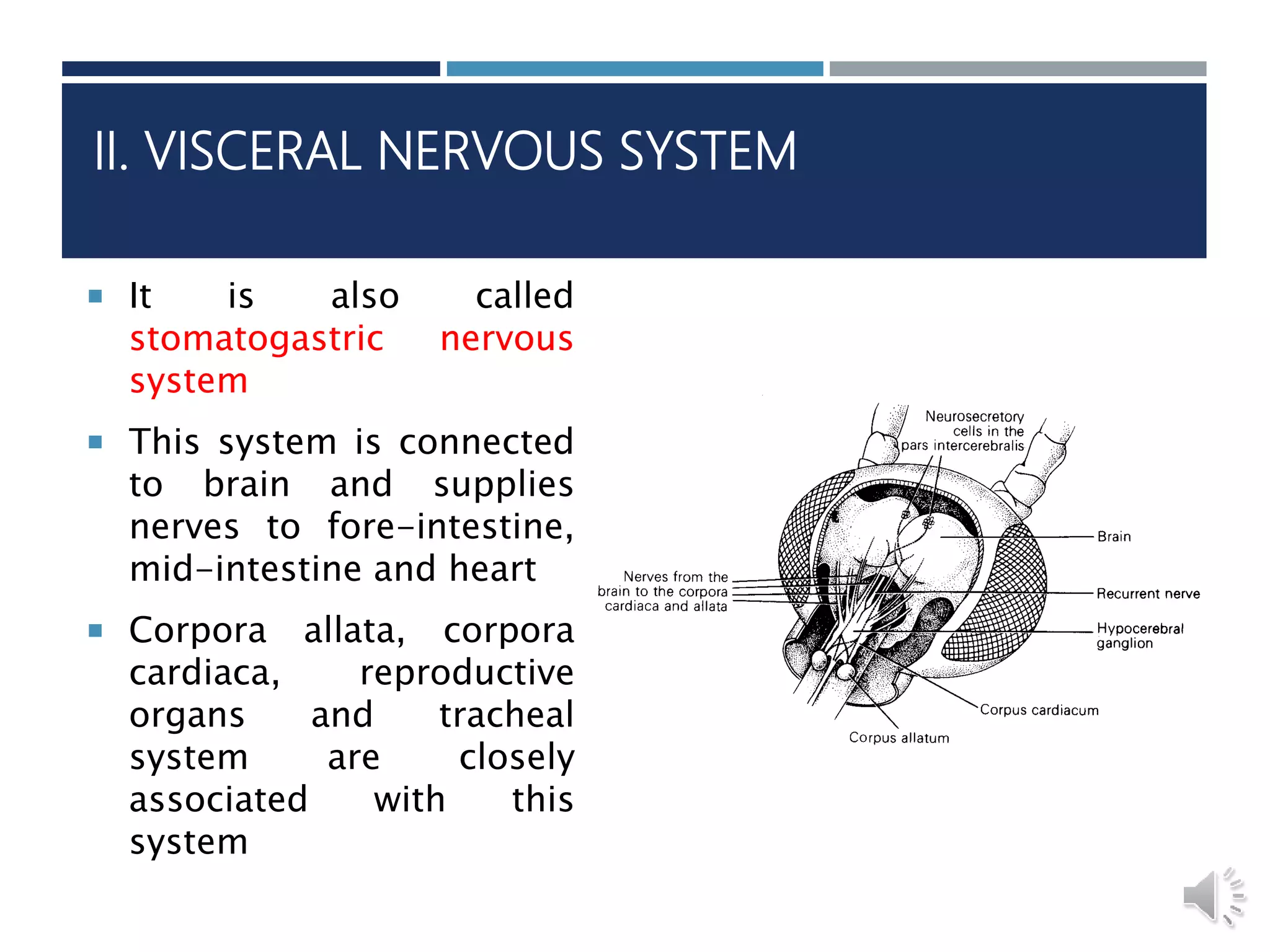
 It is also called
stomatogastric nervous
system
 This system is connected
to brain and supplies
nerves to fore-intestine,
mid-intestine and heart
 Corpora allata, corpora
cardiaca, reproductive
organs and tracheal
system are closely
associated with this
system
PERIPHERAL NERVOUS SYSTEM
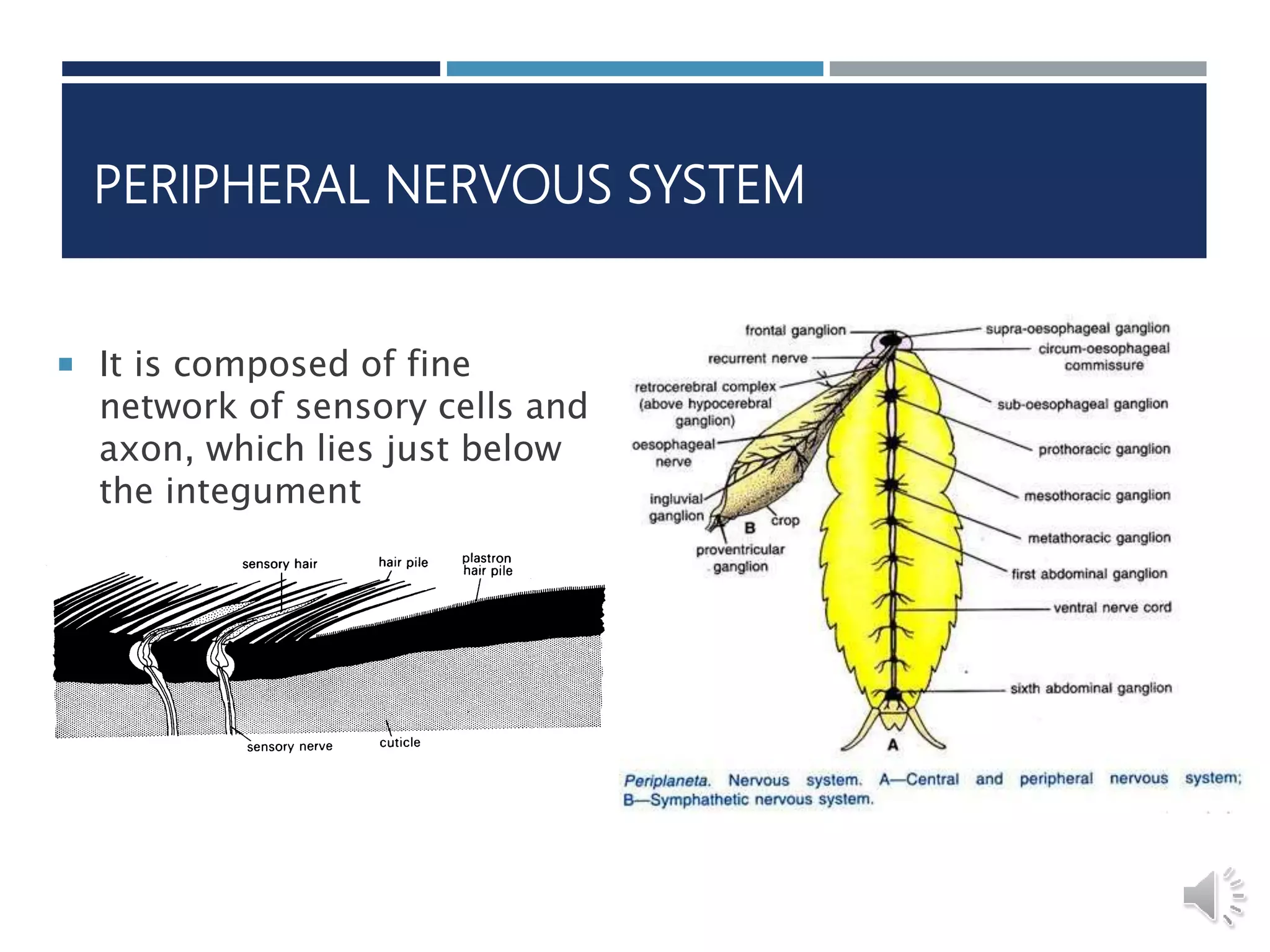
 It is composed of fine
network of sensory cells and
axon, which lies just below
the integument

Lecture 13 insect nervous system

  • 1.
  • 2.
    NERVOUS SYSTEM  Basiccomponents  Cell body:  Soma / Perikaryon  Contains nucleus  Protoplasmic extension - Axon  Dendrites:  Branching structure of neuron  Receives stimuli from environment pass to axon  Shorter than axon An insect nervous system is a network of specialized cells – Neurons
  • 3.
    NERVOUS SYSTEM  Axon(Neurite)  The long extension of neuron that carries nerve impulses away from the body of the cell.  Hair like ends of the axon at the end – Terminal arborisation  Provided with schwanns or glial cells  Glial cells produce myelin, located in myelin sheath
  • 4.
    TYPES OF NEURONS A.Structural basis i. Monopolar : neuron with a single axon ii. Bipolar : neuron with a proximal axon and a long distal dendrite. iii. Multipolar : neuron with a proximal axon and many distal dendrites.
  • 5.
     B. Functionalbasis  i. Sensory neuron: It conducts impulse from sense organs to central nervous system (CNS).  ii. Motor neuron: It conducts impulse from CNS to effector organs  iii. Inter neuron:(association neuron: It interlinks sensory and motor neurons. TYPES OF NEURONS
  • 6.
    MECHANISM OF IMPULSECONDUCTION  Impulses are conducted by the neurons by two means.  A. Axonic conduction: Ionic composition varies between inside and outside of axon resulting in excitable conditions, which leads to impulse conduction as electrical response.  B. Synaptic conduction: Neuro chemical transmitters are involved in the impulse conduction through the synaptic gap. Neuro transmitters and the type of reactions helping in the impulse conduction is as follows.  Acetyl CO-A + Choline (choline acetylase ) Acetyl choline  Acetyl choline + Water (Acetyl choline esterase ) Choline + Acetic acid
  • 7.
    NERVOUS SYSTEM  i.Central nervous system (CNS)  ii. Visceral nervous system (VNS)  iii. Peripheral nervous system (PNS)
  • 8.
    I. CENTRAL NERVOUSSYSTEM  It contains double series of nerve centres (ganglia).  These nerve centres (ganglia) are connected by longitudinal tracts of nerve fibres called connectives and transverse tracts of nerve fibres called commissures.  Central nervous system is made up of the following.  (i).Brain: Formed by the fusion of first three cephalic neuromeres.  Protocerebrum : Large, innervate compound eyes and ocelli.  Deutocerebrum : Found beneath protocerebrum, innervate antennae.  Tritocerebrum : Bilobed, innervate labrum.  Functions: i. Main sensory centre controls insect behaviour.
  • 10.
    I. CENTRAL NERVOUSSYSTEM  ii. Ventral nerve cord: Median chain of segmental ganglia beneath oesophagus  iii. Sub esophageal ganglia: Formed by the last three cephalic neuromeres. Innervates mandible, maxillae and labium.  iv. Thoracic ganglia: Three pairs found in the respective thoracic segments, largest ganglia, innervate legs and muscles.  v. Abdominal ganglia: 8 pairs, number varies due to fusion of ganglia, innervate spiracles.  vi. Thoracio abdominal ganglia: Thoracic and abdominal ganglia are fused to form single compound ganglia. Innervate genital organs and cerci.
  • 11.
    II. VISCERAL NERVOUSSYSTEM  It is also called stomatogastric nervous system  This system is connected to brain and supplies nerves to fore-intestine, mid-intestine and heart  Corpora allata, corpora cardiaca, reproductive organs and tracheal system are closely associated with this system
  • 12.
    PERIPHERAL NERVOUS SYSTEM It is composed of fine network of sensory cells and axon, which lies just below the integument