Lecture # 10
Economic Value Added
Disposal of Assets
1 Dr. A. Alim
EVA - Explained
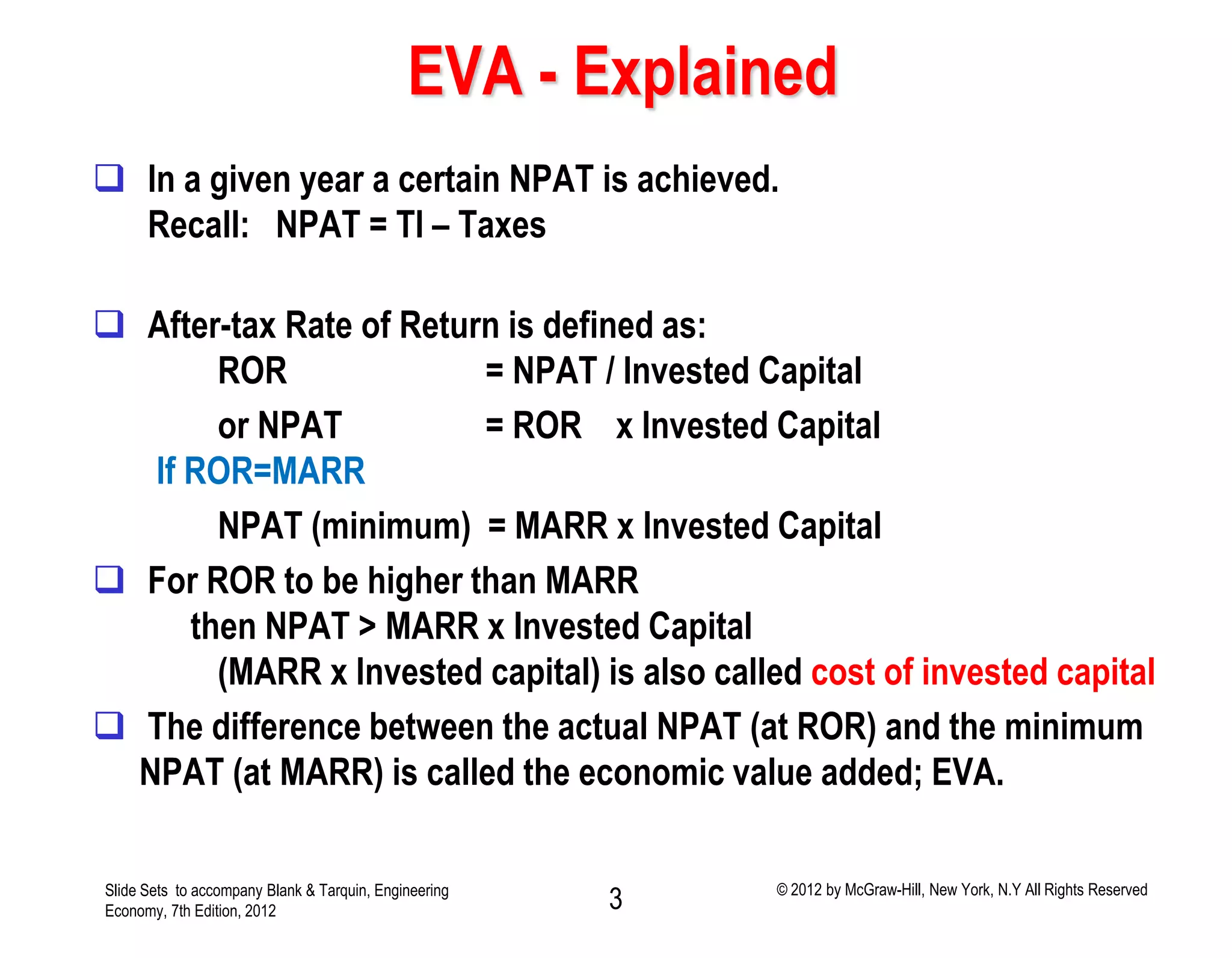
 In a given year a certain NPAT is achieved.
Recall: NPAT = TI – Taxes
 After-tax Rate of Return is defined as:
ROR = NPAT / Invested Capital
or NPAT = ROR x Invested Capital
If ROR=MARR
NPAT (minimum) = MARR x Invested Capital
 For ROR to be higher than MARR
then NPAT > MARR x Invested Capital
(MARR x Invested capital) is also called cost of invested capital
 The difference between the actual NPAT (at ROR) and the minimum
NPAT (at MARR) is called the economic value added; EVA.
Slide Sets to accompany Blank & Tarquin, Engineering
Economy, 7th Edition, 2012 3 © 2012 by McGraw-Hill, New York, N.Y All Rights Reserved
EVA - Explained
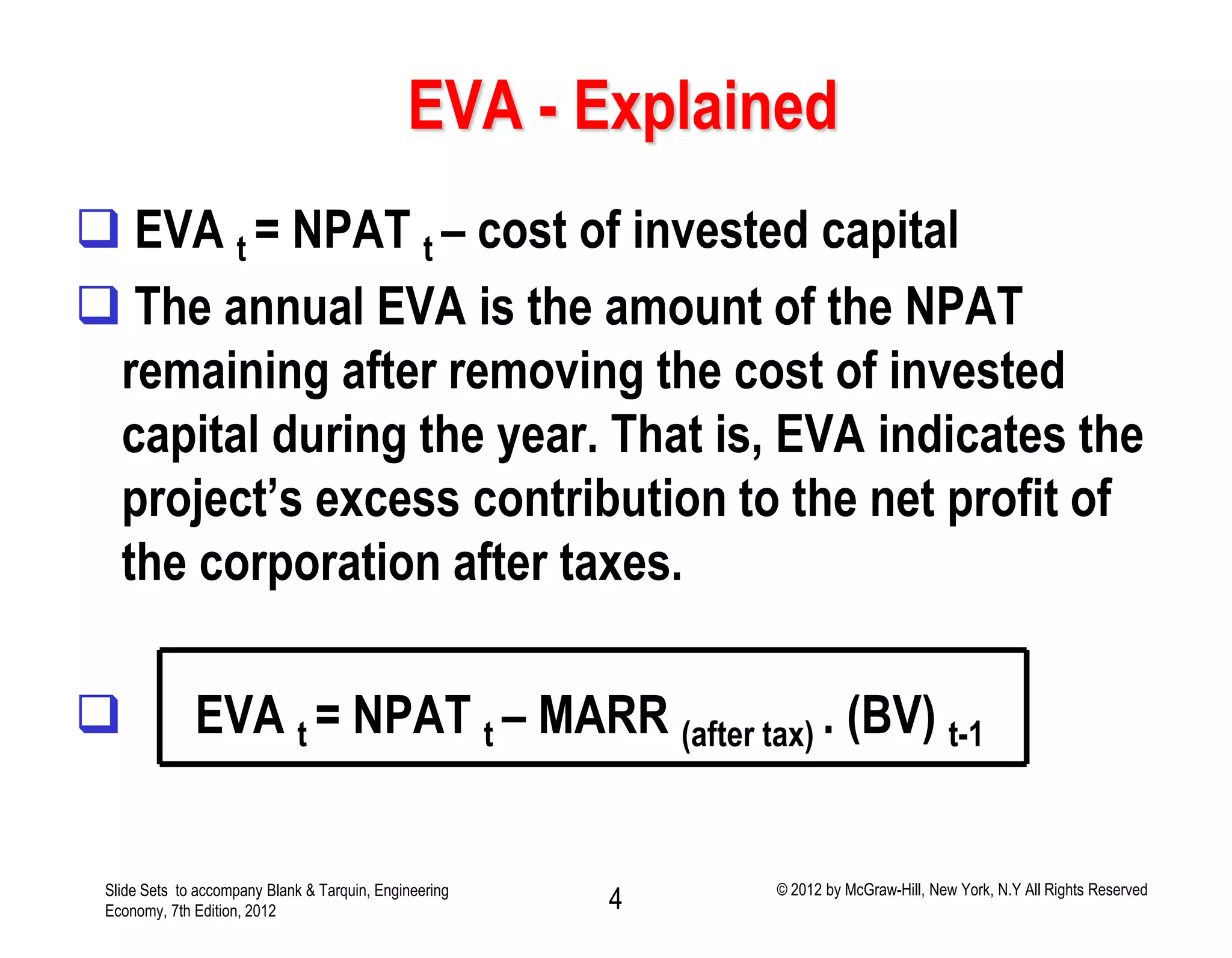
 EVA t = NPAT t – cost of invested capital
 The annual EVA is the amount of the NPAT
remaining after removing the cost of invested
capital during the year. That is, EVA indicates the
project’s excess contribution to the net profit of
the corporation after taxes.
 EVA t = NPAT t – MARR (after tax) . (BV) t-1
Slide Sets to accompany Blank & Tarquin, Engineering
Economy, 7th Edition, 2012 4 © 2012 by McGraw-Hill, New York, N.Y All Rights Reserved
EVA - Explained
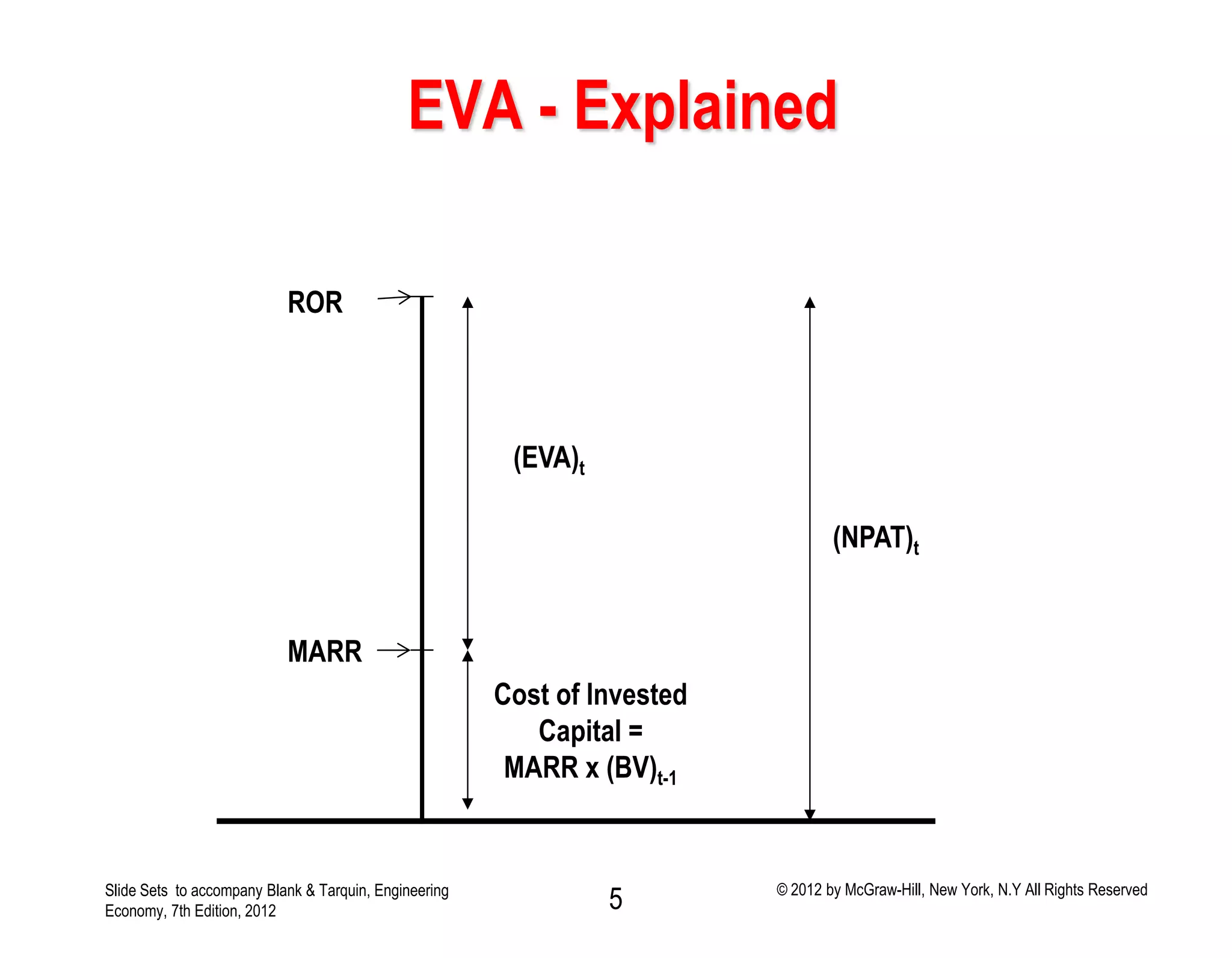
ROR
(EVA)t
Cost of Invested
Capital =
MARR x (BV)t-1
(NPAT)t
Slide Sets to accompany Blank & Tarquin, Engineering
Economy, 7th Edition, 2012 5 © 2012 by McGraw-Hill, New York, N.Y All Rights Reserved
MARR
EVA - Explained
 EVA is a useful tool to evaluate the worth of a project. It
reflects the added value achieved by realizing a ROR
higher than MARR. The bigger the delta is (ROR –
MARR), the higher the EVA is.
 Usually the AW of a series of yearly EVA’s is computed.
 AW > 0 is desirable, the more positive it is , the
better.
 Comparing AW of EVA for two projects can be
used to decide on which project to invest in.
 Similar analysis of AW of CFAT may also be
conducted.
Slide Sets to accompany Blank & Tarquin, Engineering
Economy, 7th Edition, 2012 6 © 2012 by McGraw-Hill, New York, N.Y All Rights Reserved
EVA - Explained
 Recall, firms often have two sets of books
relating to depreciation:
One for tax purposes and,
One for internal management use. (book
depreciation).
For EVA, book depreciation is more often used.
 More closely represent the true rate of usage of the assets in
question.
 Typically, the classical SL method with zero salvage value is
used.
Slide Sets to accompany Blank & Tarquin, Engineering
Economy, 7th Edition, 2012 7 © 2012 by McGraw-Hill, New York, N.Y All Rights Reserved
Slide Sets to accompany Blank & Tarquin, Engineering
Economy, 7th Edition, 2012
© 2012 by McGraw-Hill, New York, N.Y All Rights Reserved8
CFAT and EVA Analysis – Example 13.11, Basics of Engineering
Economy, McGraw Hill, 2008, by Blank and Tarquin. Page 336.
Slide Sets to accompany Blank & Tarquin, Engineering
Economy, 7th Edition, 2012
9 © 2012 by McGraw-Hill, New York, N.Y All Rights Reserved
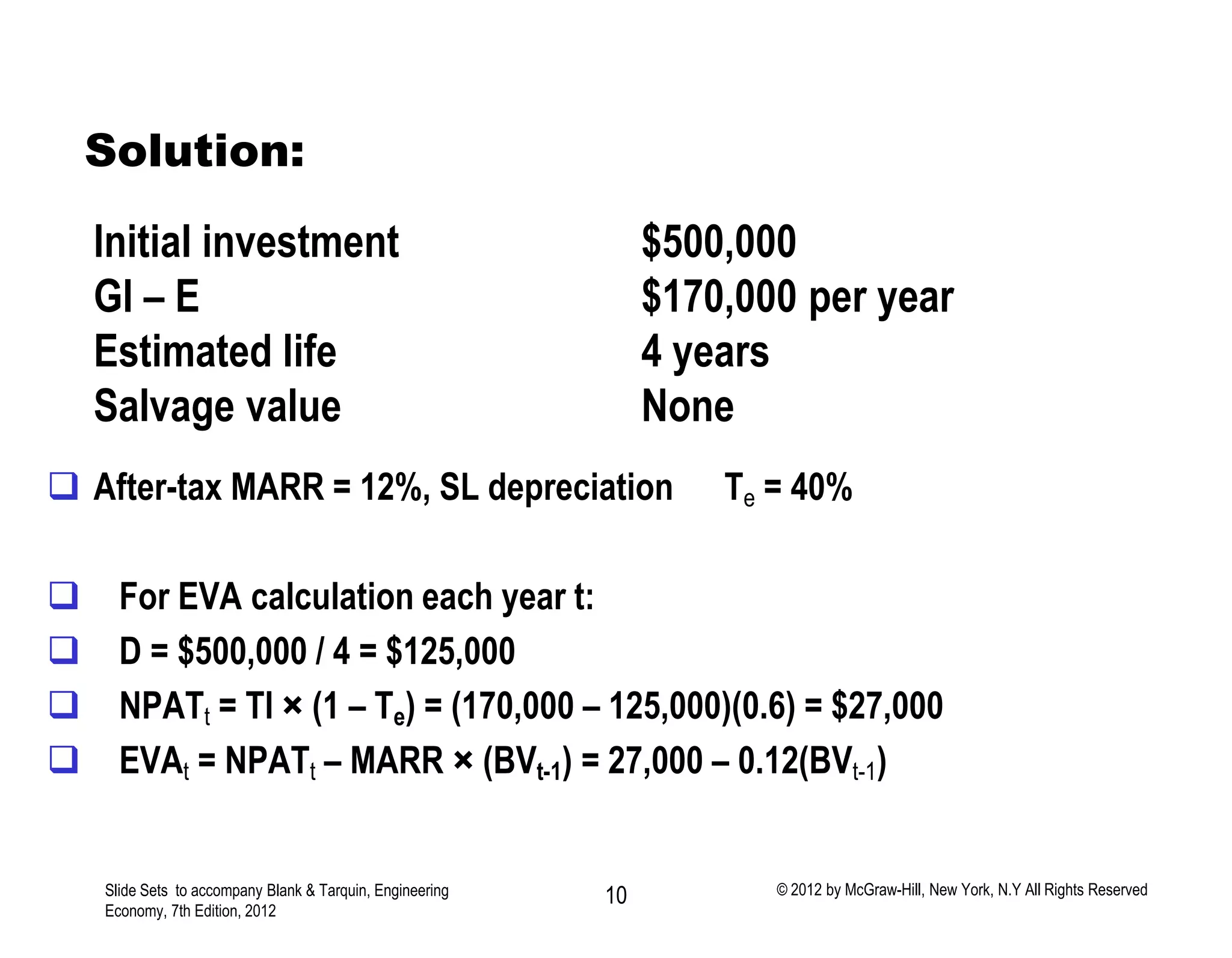
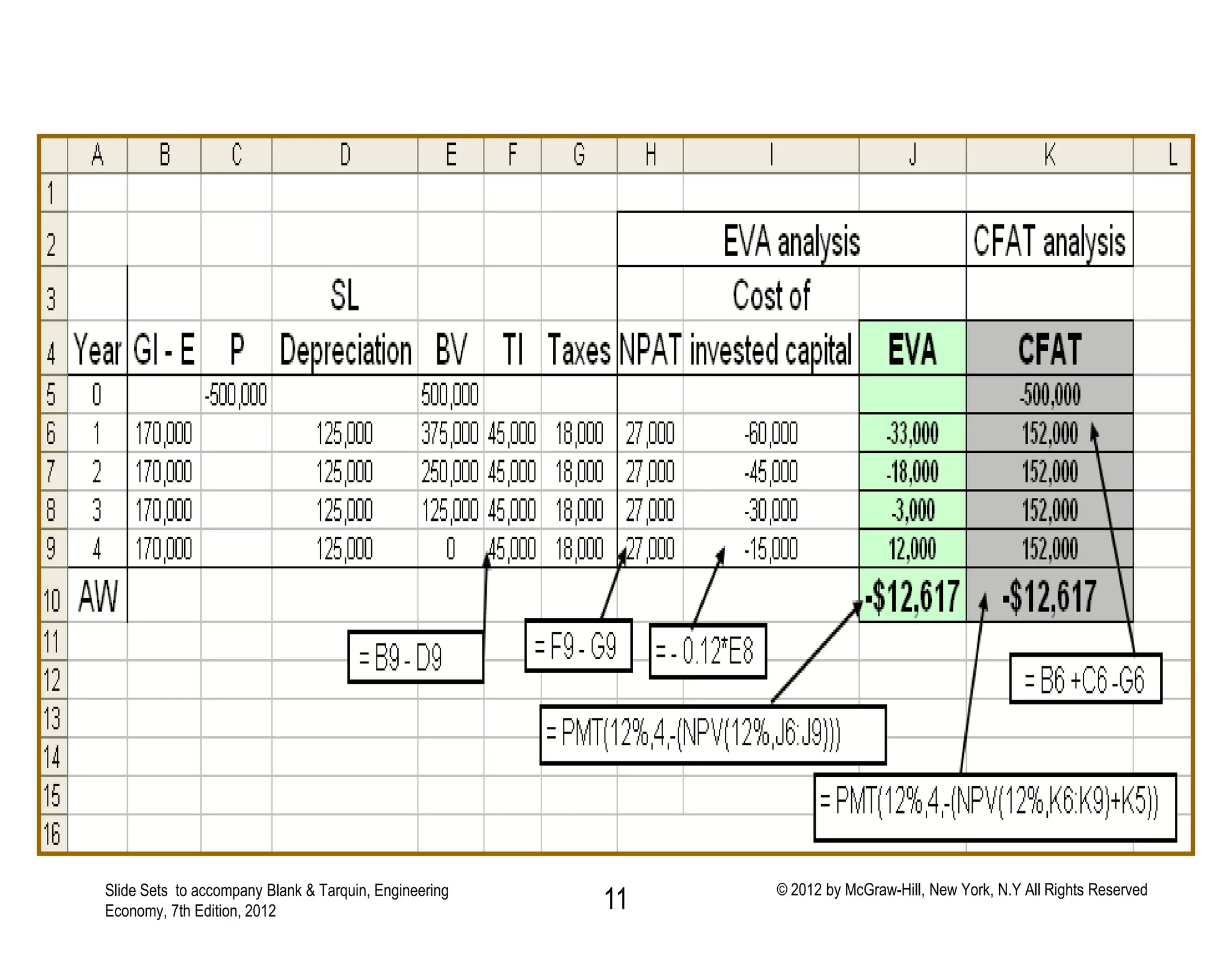
 After-tax MARR = 12%, SL depreciation Te = 40%
 For EVA calculation each year t:
 D = $500,000 / 4 = $125,000
 NPATt = TI × (1 – Te) = (170,000 – 125,000)(0.6) = $27,000
 EVAt = NPATt – MARR × (BVt-1) = 27,000 – 0.12(BVt-1)
Solution:
Slide Sets to accompany Blank & Tarquin, Engineering
Economy, 7th Edition, 2012
10 © 2012 by McGraw-Hill, New York, N.Y All Rights Reserved
Initial investment $500,000
GI – E $170,000 per year
Estimated life 4 years
Salvage value None
Slide Sets to accompany Blank & Tarquin, Engineering
Economy, 7th Edition, 2012 11 © 2012 by McGraw-Hill, New York, N.Y All Rights Reserved
Slide Sets to accompany Blank & Tarquin, Engineering
Economy, 7th Edition, 2012 12 © 2012 by McGraw-Hill, New York, N.Y All Rights Reserved
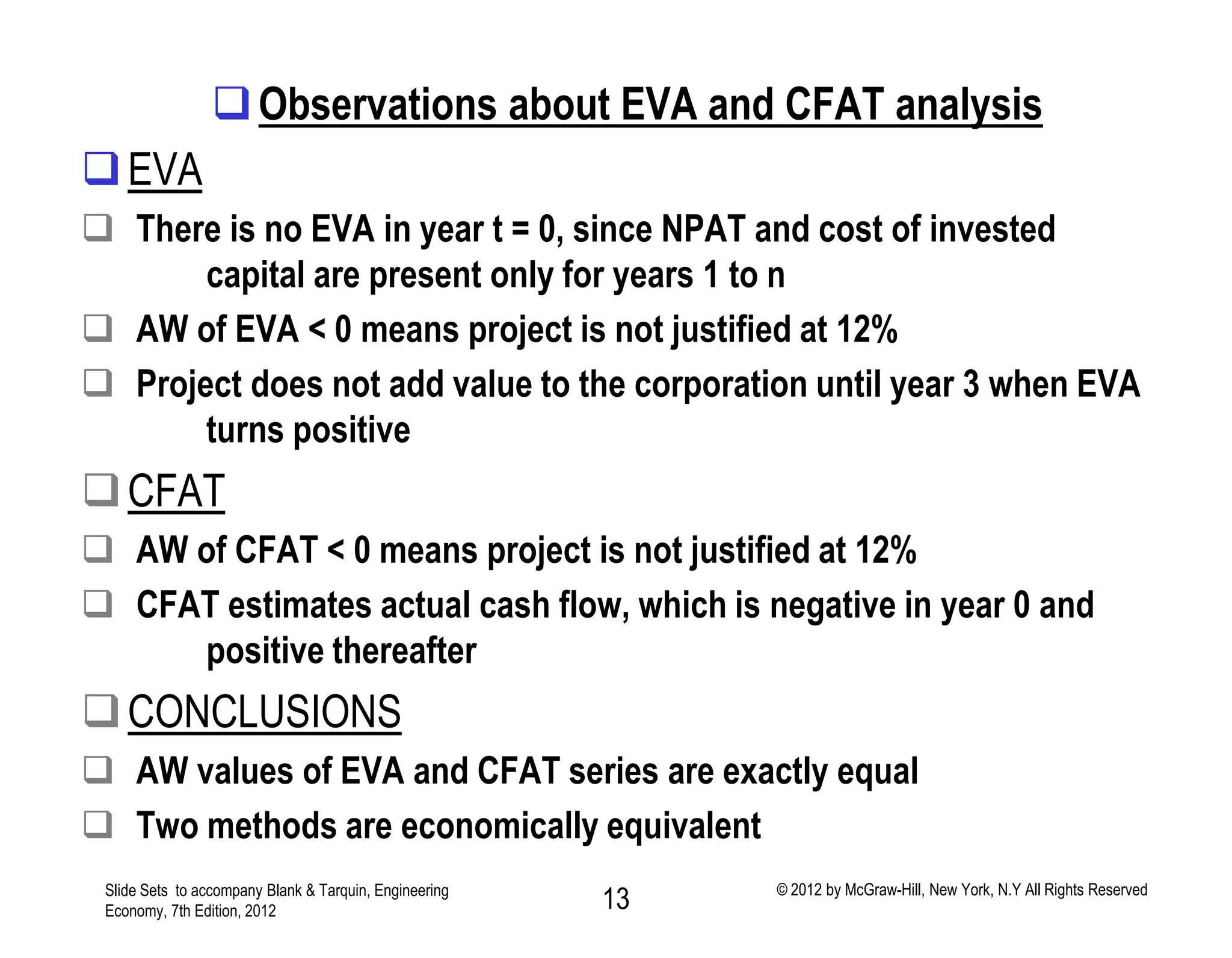
Observations about EVA and CFAT analysis
EVA
 There is no EVA in year t = 0, since NPAT and cost of invested
capital are present only for years 1 to n
 AW of EVA < 0 means project is not justified at 12%
 Project does not add value to the corporation until year 3 when EVA
turns positive
CFAT
 AW of CFAT < 0 means project is not justified at 12%
 CFAT estimates actual cash flow, which is negative in year 0 and
positive thereafter
CONCLUSIONS
 AW values of EVA and CFAT series are exactly equal
 Two methods are economically equivalent
Slide Sets to accompany Blank & Tarquin, Engineering
Economy, 7th Edition, 2012 13 © 2012 by McGraw-Hill, New York, N.Y All Rights Reserved
Conclusion: EVA and CFAT
 EVA values represent a project’s periodic contribution to the
value of the corporation or firm.
 The CFAT values represent the actual cash flows – after tax –
into the corporation or firm.
 Corporate executives generally prefer to view the EVA values.
Studies have shown that EVA correlates better with stock price.
 Popular concept in Europe
 Value-added taxes are imposed in Europe on certain products
and paid to the government.
 EVA analysis is a good tool to compare alternative investments.
Slide Sets to accompany Blank & Tarquin, Engineering
Economy, 7th Edition, 2012 14 © 2012 by McGraw-Hill, New York, N.Y All Rights Reserved
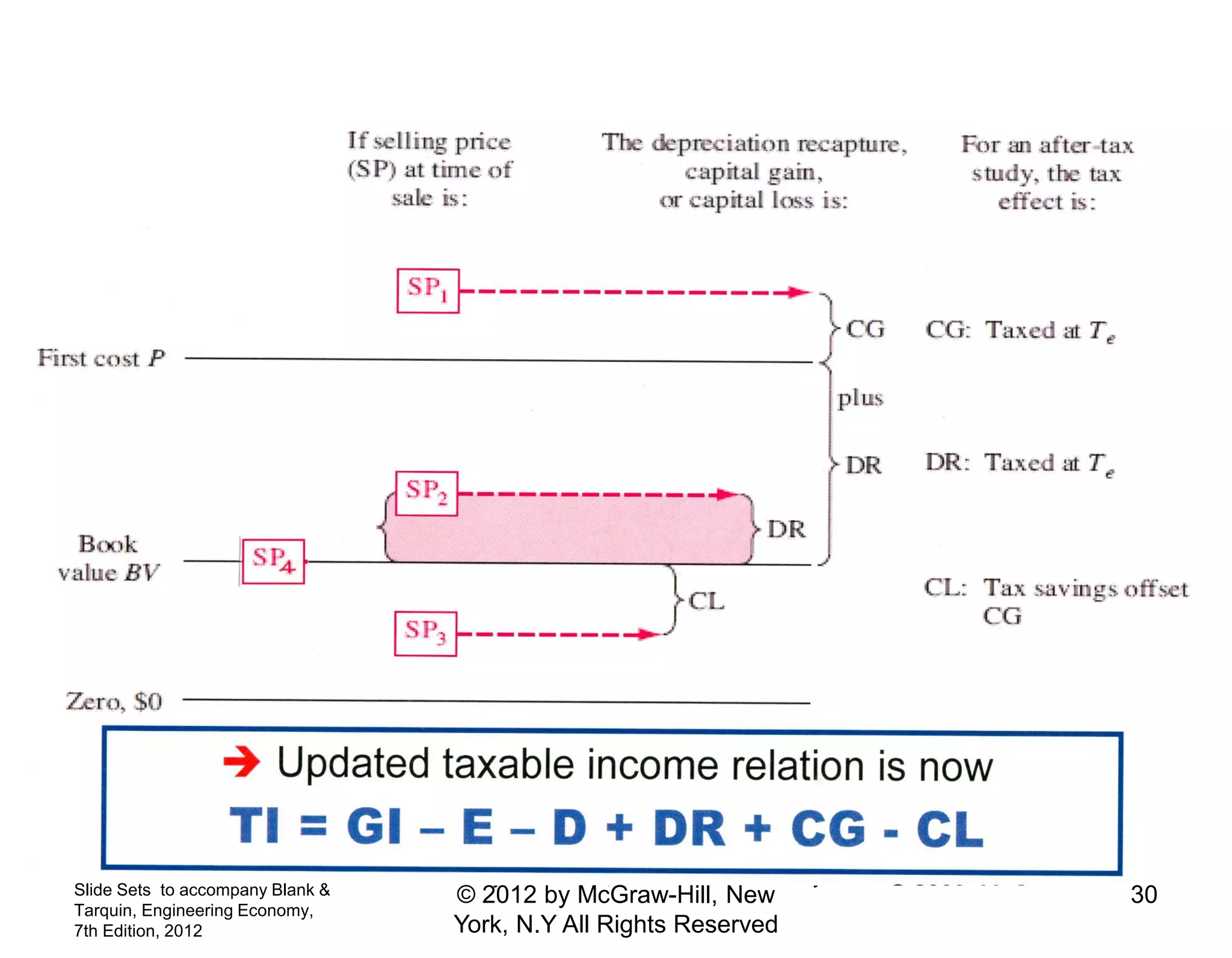
Disposal of assets
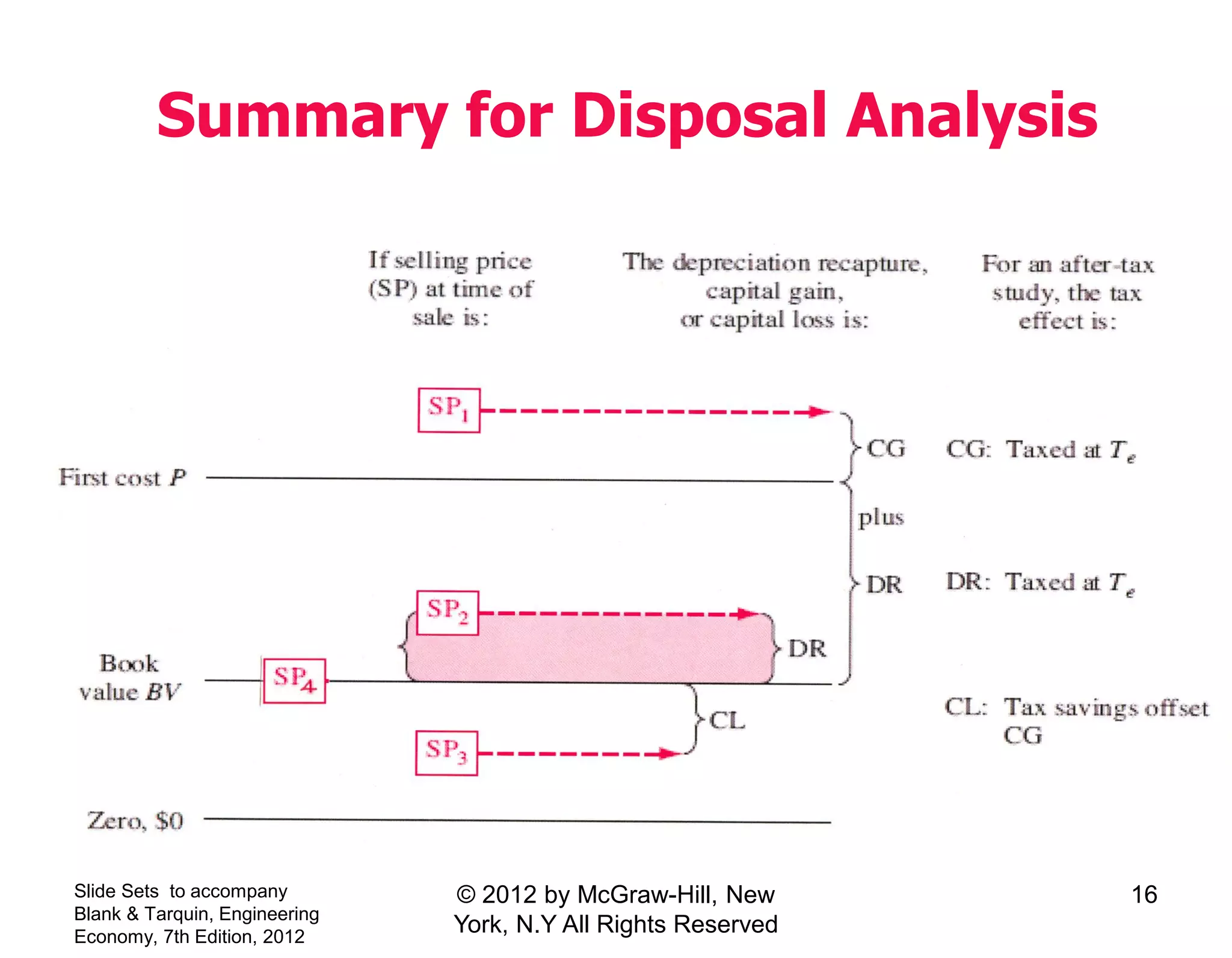
• Firms sell or dispose of assets from time to time.
• If the asset has not been fully depreciated at the
selling time, it will have a book value BVt
• Four possible situations may occur, depending on
how the selling price SP relates to first cost P and
to the current book value BVt
Slide Sets to accompany
Blank & Tarquin, Engineering
Economy, 7th Edition, 2012
15© 2012 by McGraw-Hill, New
York, N.Y All Rights Reserved
Summary for Disposal Analysis
Slide Sets to accompany
Blank & Tarquin, Engineering
Economy, 7th Edition, 2012
16© 2012 by McGraw-Hill, New
York, N.Y All Rights Reserved
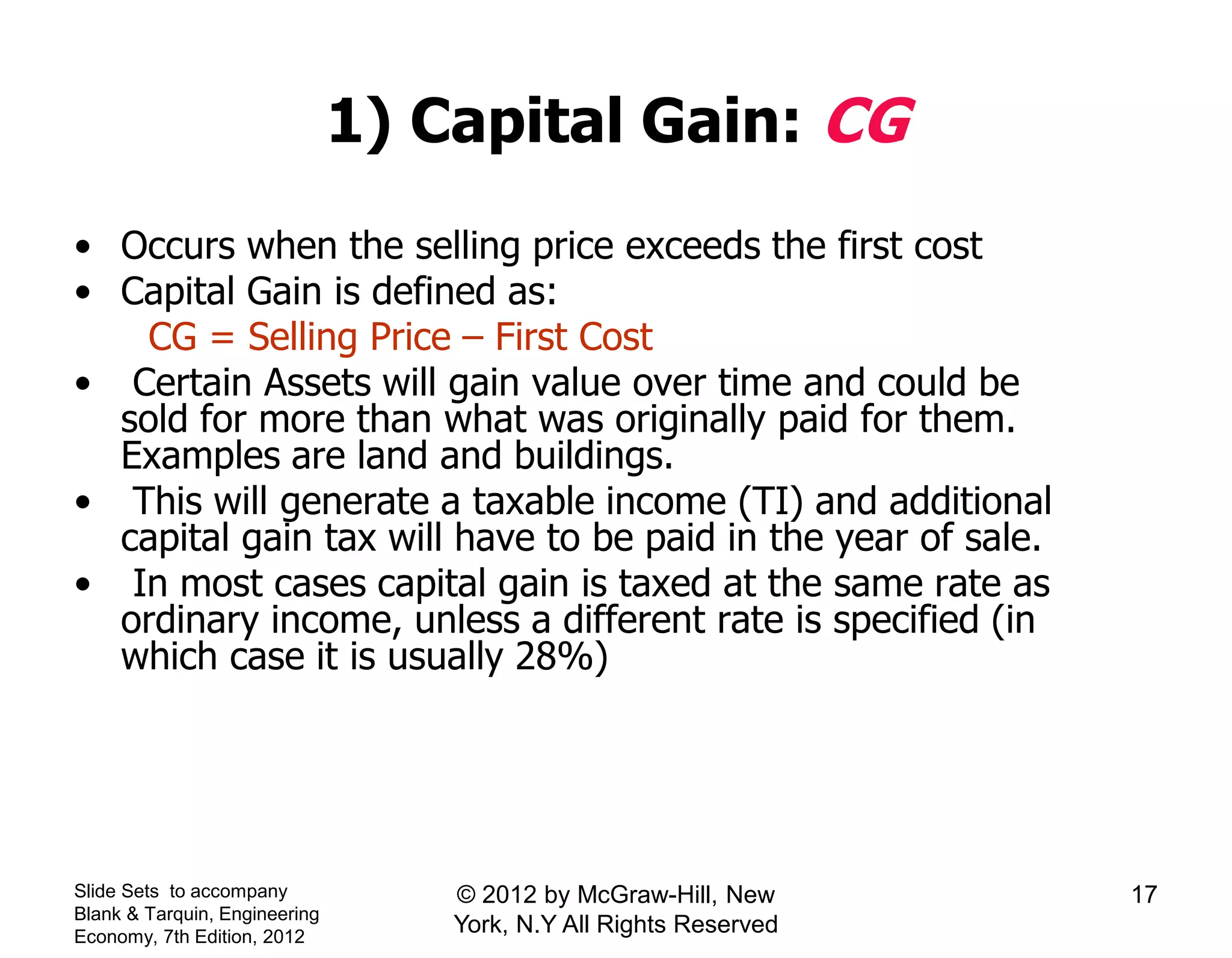
1) Capital Gain: CG
• Occurs when the selling price exceeds the first cost
• Capital Gain is defined as:
CG = Selling Price – First Cost
• Certain Assets will gain value over time and could be
sold for more than what was originally paid for them.
Examples are land and buildings.
• This will generate a taxable income (TI) and additional
capital gain tax will have to be paid in the year of sale.
• In most cases capital gain is taxed at the same rate as
ordinary income, unless a different rate is specified (in
which case it is usually 28%)
Slide Sets to accompany
Blank & Tarquin, Engineering
Economy, 7th Edition, 2012
17© 2012 by McGraw-Hill, New
York, N.Y All Rights Reserved
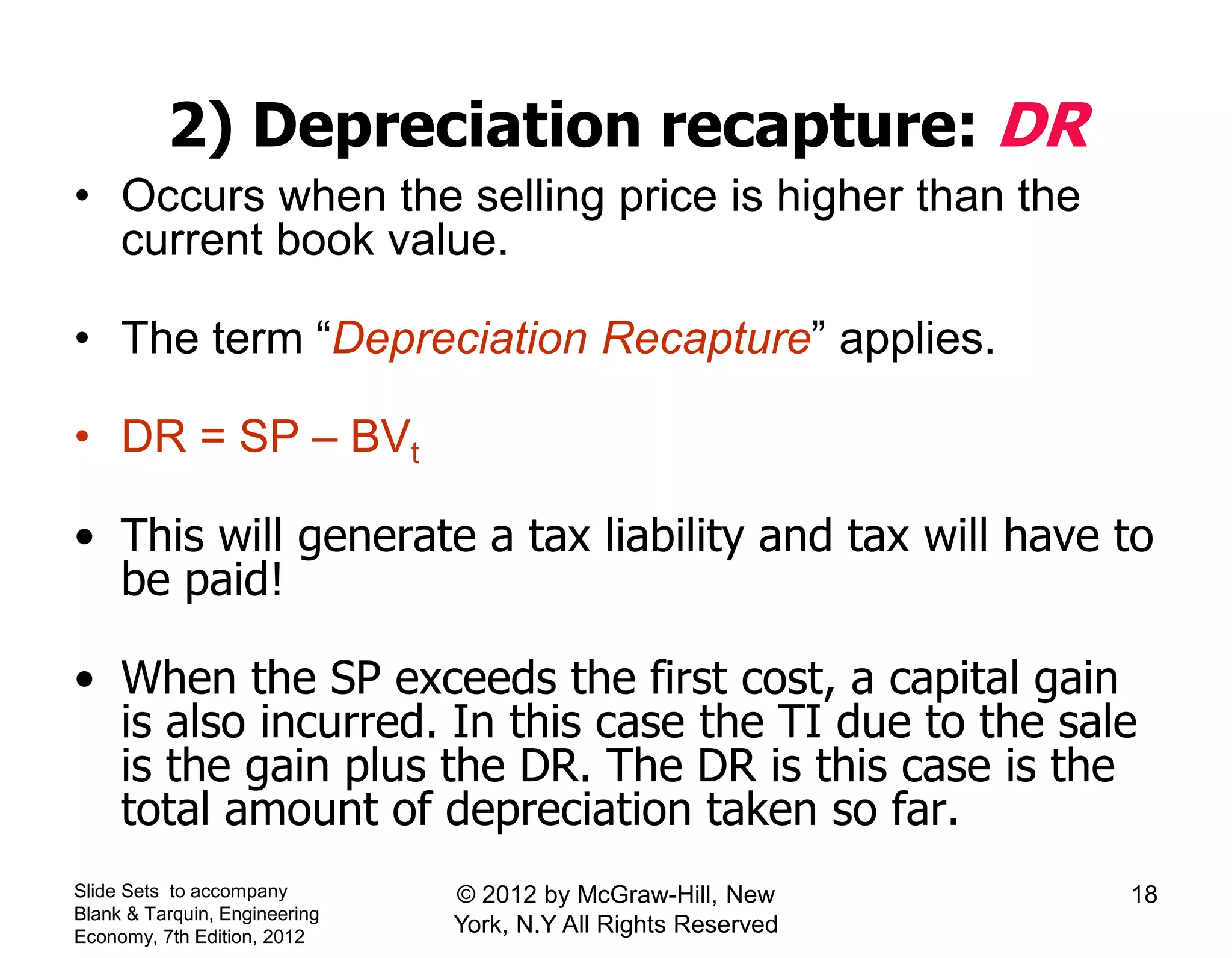
2) Depreciation recapture: DR
• Occurs when the selling price is higher than the
current book value.
• The term “Depreciation Recapture” applies.
• DR = SP – BVt
• This will generate a tax liability and tax will have to
be paid!
• When the SP exceeds the first cost, a capital gain
is also incurred. In this case the TI due to the sale
is the gain plus the DR. The DR is this case is the
total amount of depreciation taken so far.
Slide Sets to accompany
Blank & Tarquin, Engineering
Economy, 7th Edition, 2012
18© 2012 by McGraw-Hill, New
York, N.Y All Rights Reserved
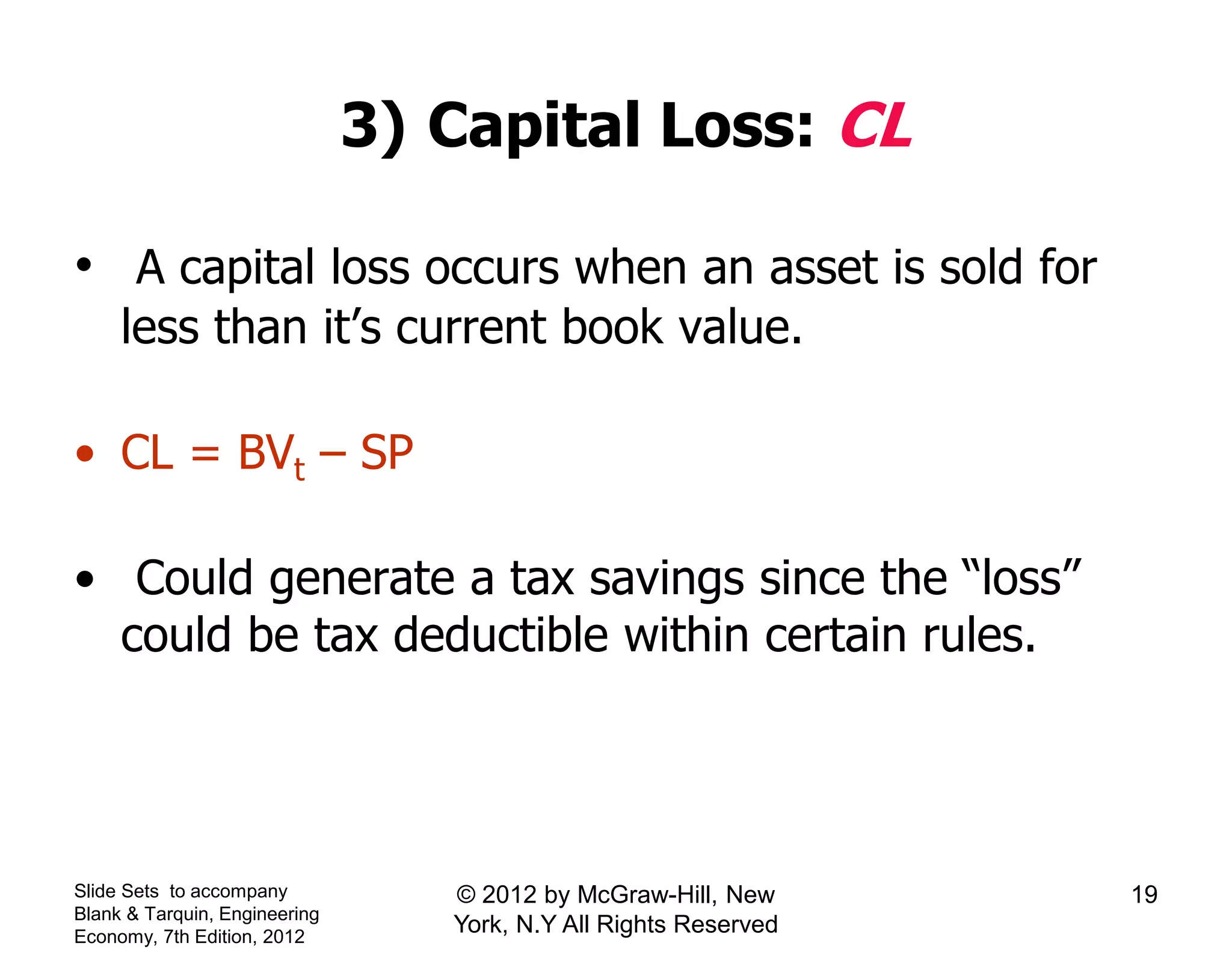
3) Capital Loss: CL
• A capital loss occurs when an asset is sold for
less than it’s current book value.
• CL = BVt – SP
• Could generate a tax savings since the “loss”
could be tax deductible within certain rules.
Slide Sets to accompany
Blank & Tarquin, Engineering
Economy, 7th Edition, 2012
19© 2012 by McGraw-Hill, New
York, N.Y All Rights Reserved
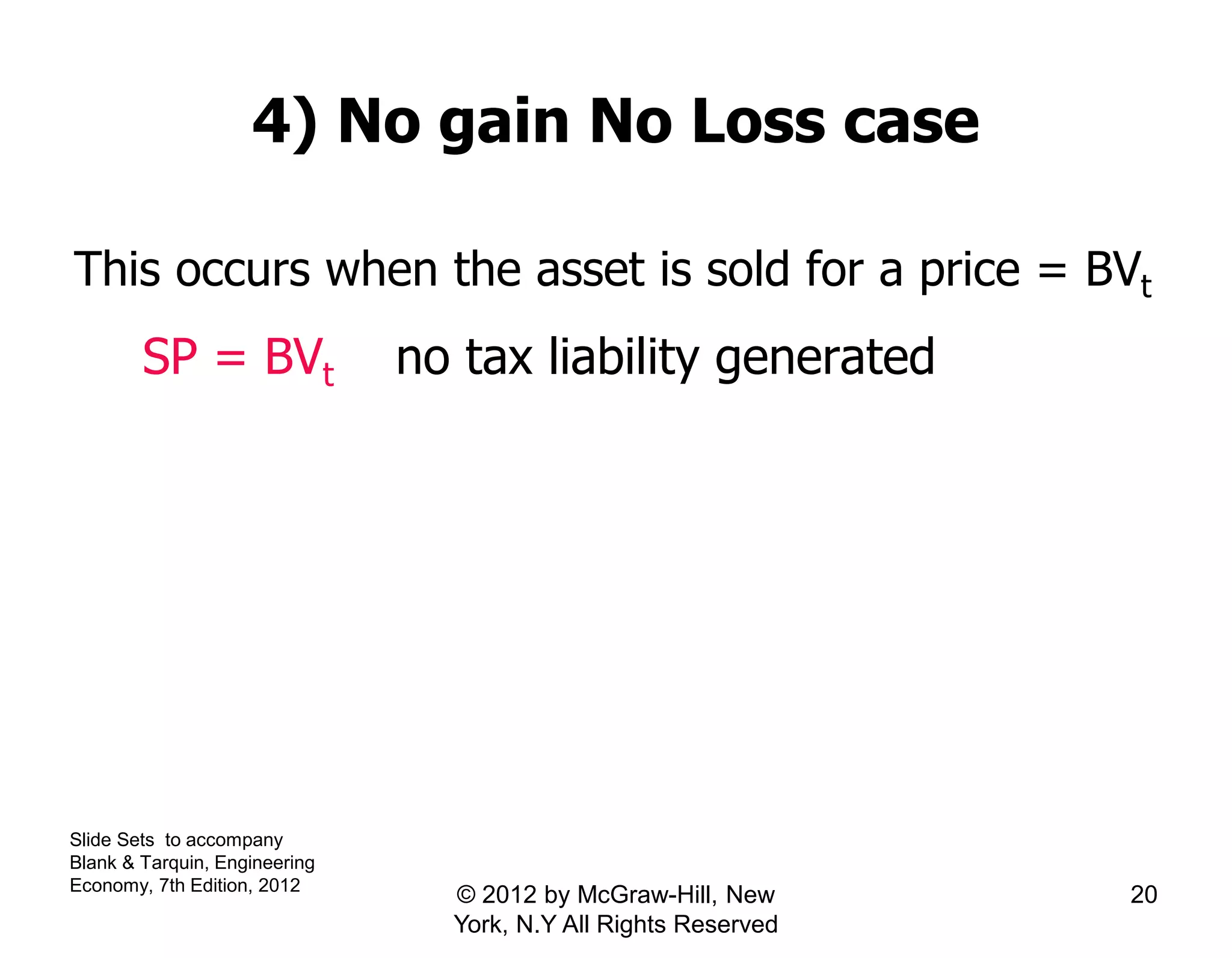
4) No gain No Loss case
This occurs when the asset is sold for a price = BVt
SP = BVt no tax liability generated
Slide Sets to accompany
Blank & Tarquin, Engineering
Economy, 7th Edition, 2012
20© 2012 by McGraw-Hill, New
York, N.Y All Rights Reserved
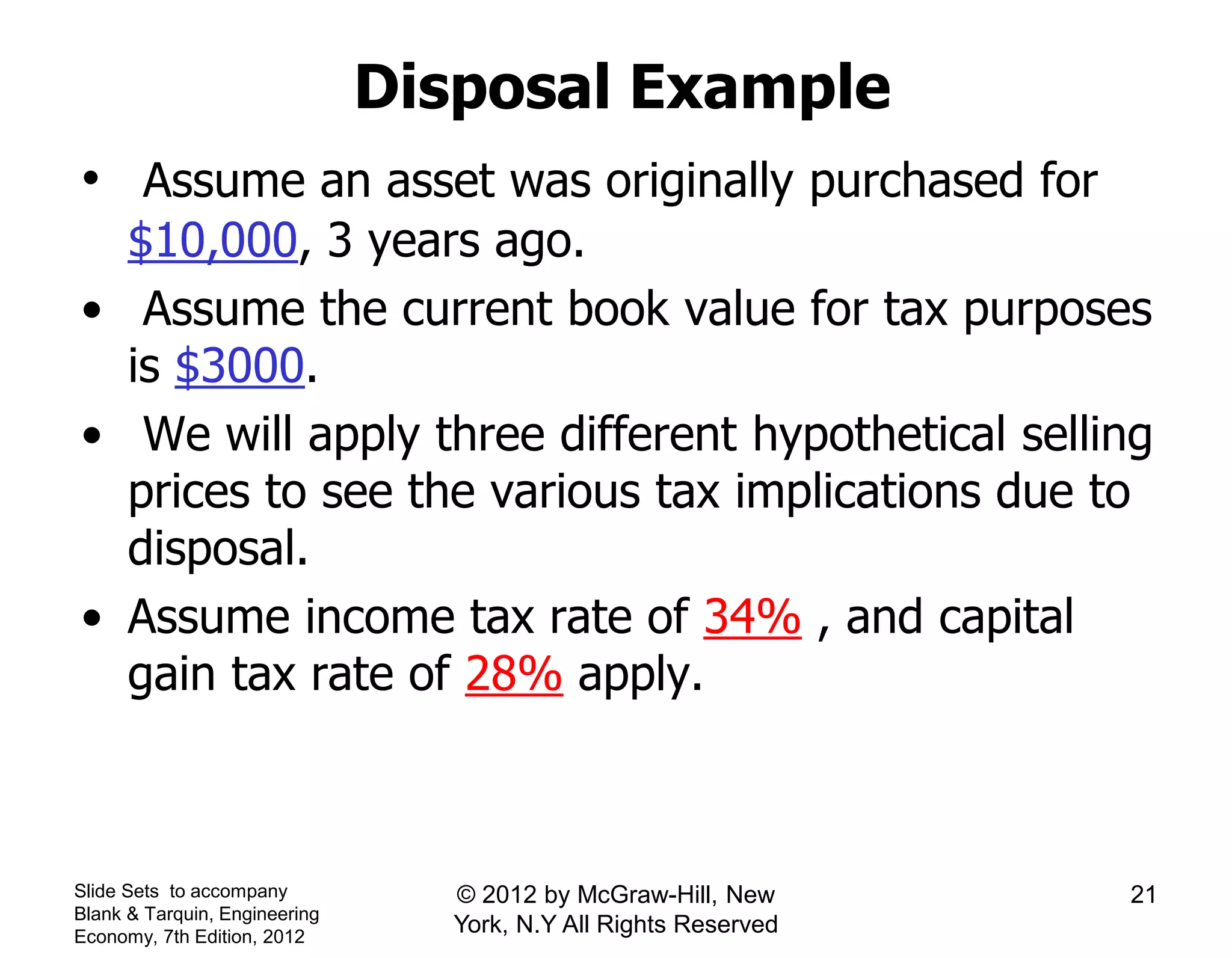
Disposal Example
• Assume an asset was originally purchased for
$10,000, 3 years ago.
• Assume the current book value for tax purposes
is $3000.
• We will apply three different hypothetical selling
prices to see the various tax implications due to
disposal.
• Assume income tax rate of 34% , and capital
gain tax rate of 28% apply.
Slide Sets to accompany
Blank & Tarquin, Engineering
Economy, 7th Edition, 2012
21© 2012 by McGraw-Hill, New
York, N.Y All Rights Reserved
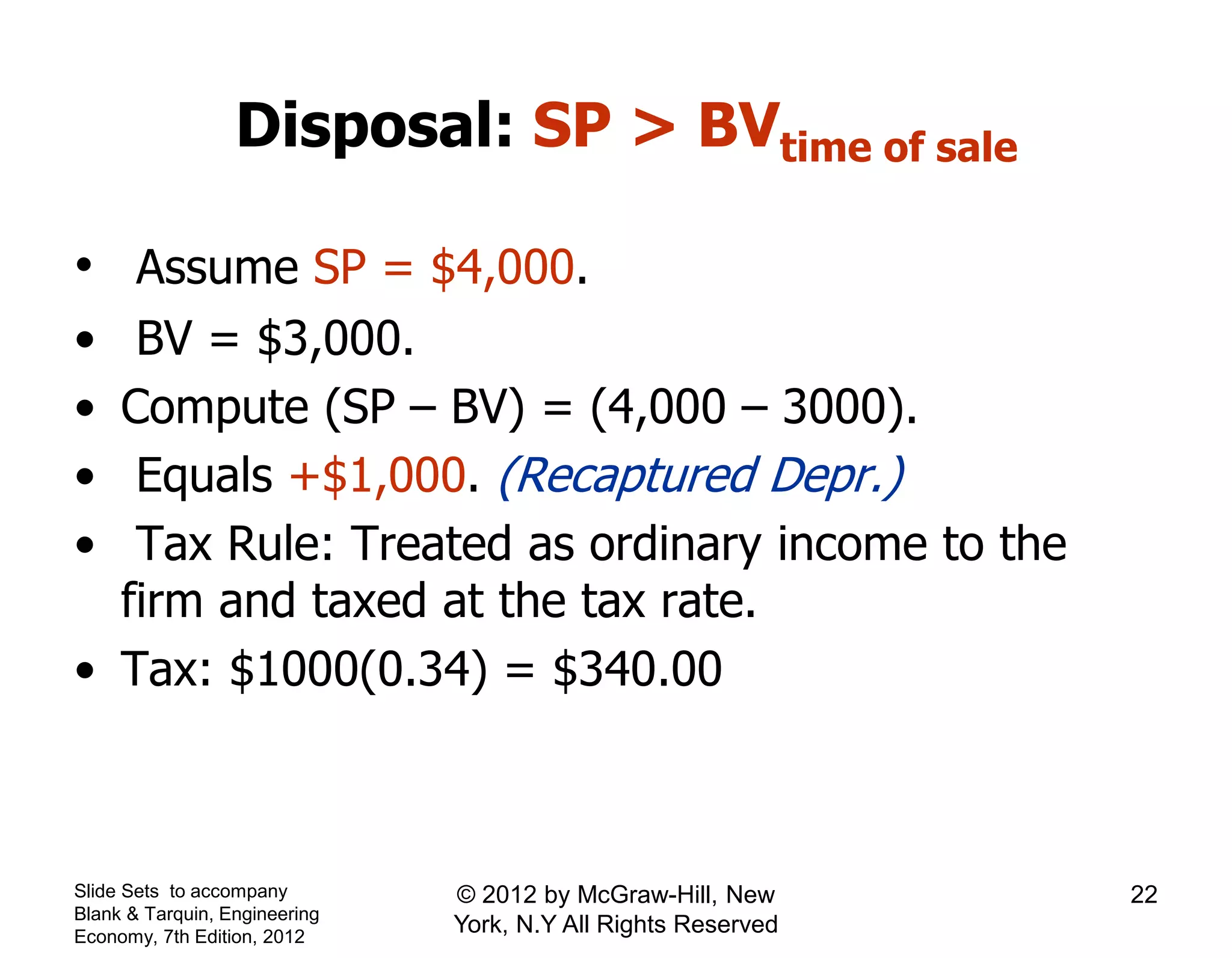
Disposal: SP > BVtime of sale
• Assume SP = $4,000.
• BV = $3,000.
• Compute (SP – BV) = (4,000 – 3000).
• Equals +$1,000. (Recaptured Depr.)
• Tax Rule: Treated as ordinary income to the
firm and taxed at the tax rate.
• Tax: $1000(0.34) = $340.00
Slide Sets to accompany
Blank & Tarquin, Engineering
Economy, 7th Edition, 2012
22© 2012 by McGraw-Hill, New
York, N.Y All Rights Reserved
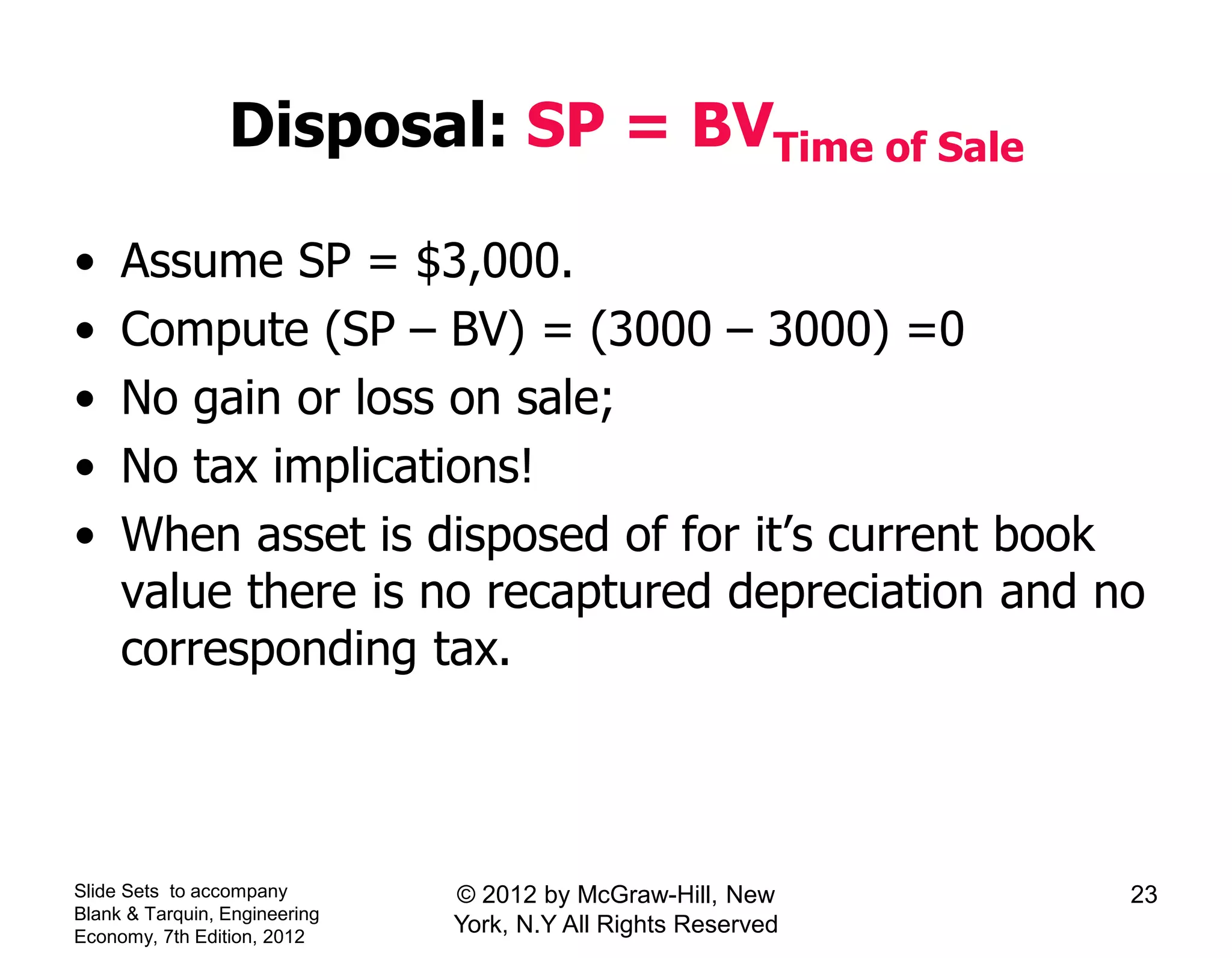
Disposal: SP = BVTime of Sale
• Assume SP = $3,000.
• Compute (SP – BV) = (3000 – 3000) =0
• No gain or loss on sale;
• No tax implications!
• When asset is disposed of for it’s current book
value there is no recaptured depreciation and no
corresponding tax.
Slide Sets to accompany
Blank & Tarquin, Engineering
Economy, 7th Edition, 2012
23© 2012 by McGraw-Hill, New
York, N.Y All Rights Reserved
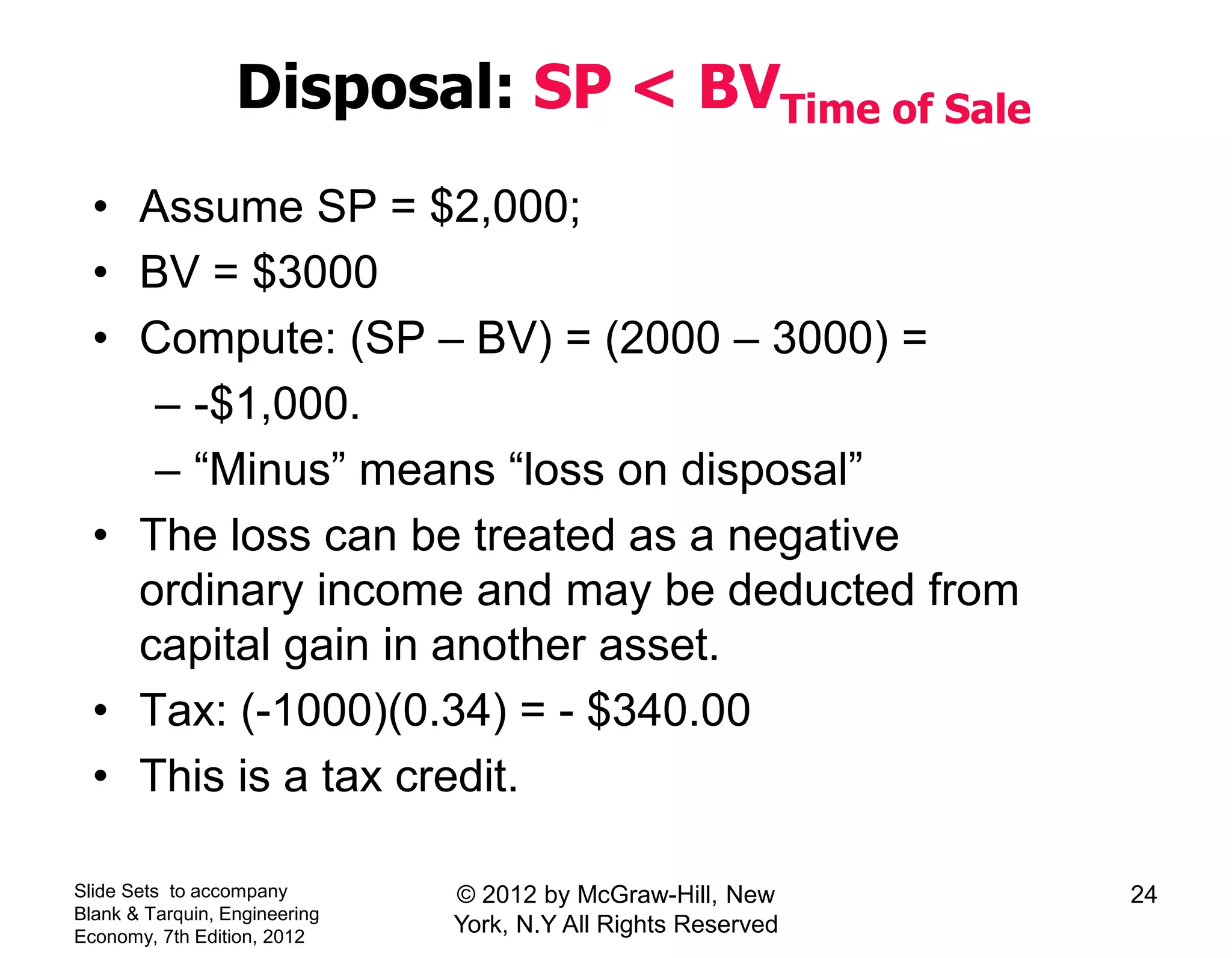
Disposal: SP < BVTime of Sale
• Assume SP = $2,000;
• BV = $3000
• Compute: (SP – BV) = (2000 – 3000) =
– -$1,000.
– “Minus” means “loss on disposal”
• The loss can be treated as a negative
ordinary income and may be deducted from
capital gain in another asset.
• Tax: (-1000)(0.34) = - $340.00
• This is a tax credit.
Slide Sets to accompany
Blank & Tarquin, Engineering
Economy, 7th Edition, 2012
24© 2012 by McGraw-Hill, New
York, N.Y All Rights Reserved
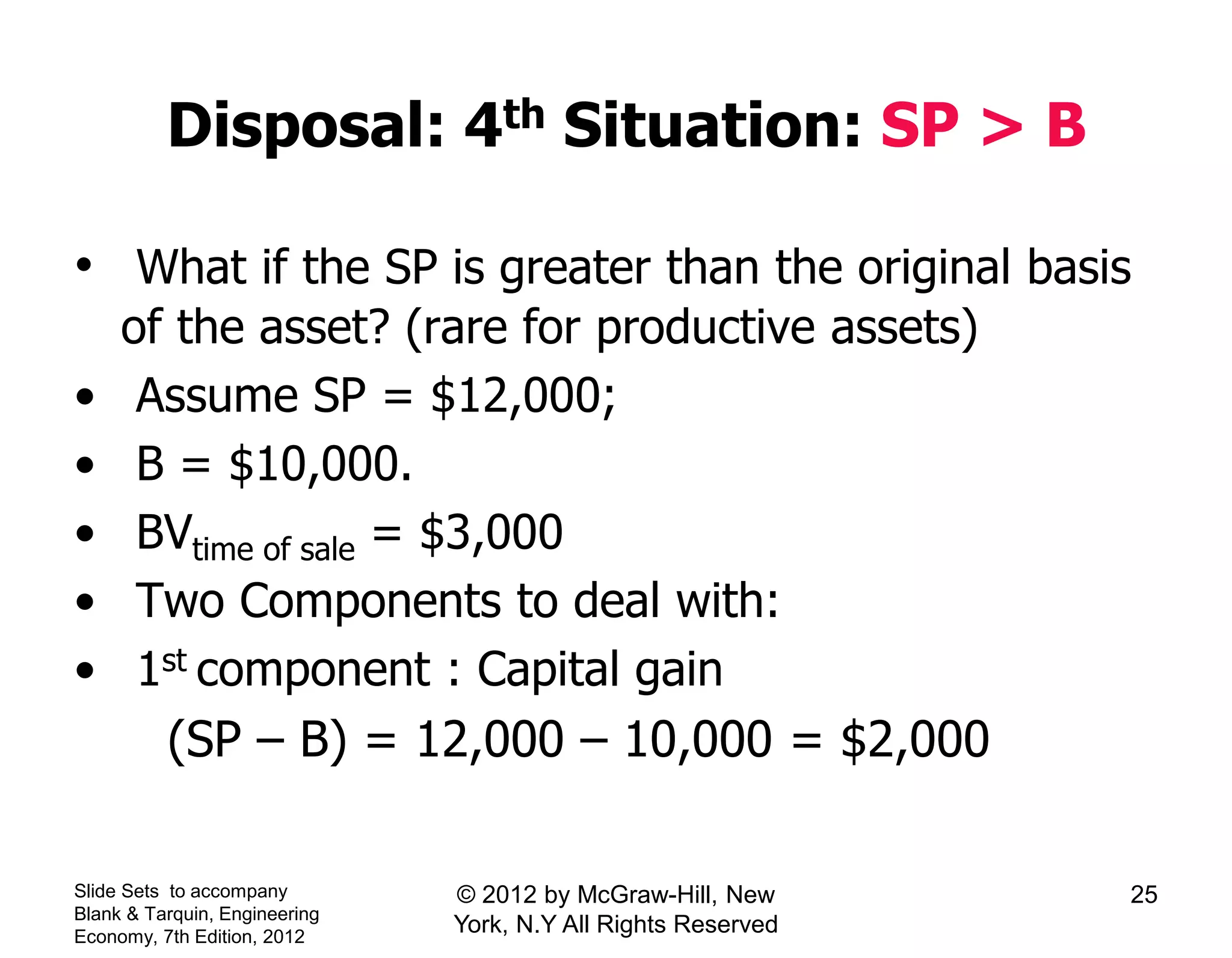
Disposal: 4th Situation: SP > B
• What if the SP is greater than the original basis
of the asset? (rare for productive assets)
• Assume SP = $12,000;
• B = $10,000.
• BVtime of sale = $3,000
• Two Components to deal with:
• 1st component : Capital gain
(SP – B) = 12,000 – 10,000 = $2,000
Slide Sets to accompany
Blank & Tarquin, Engineering
Economy, 7th Edition, 2012
25© 2012 by McGraw-Hill, New
York, N.Y All Rights Reserved
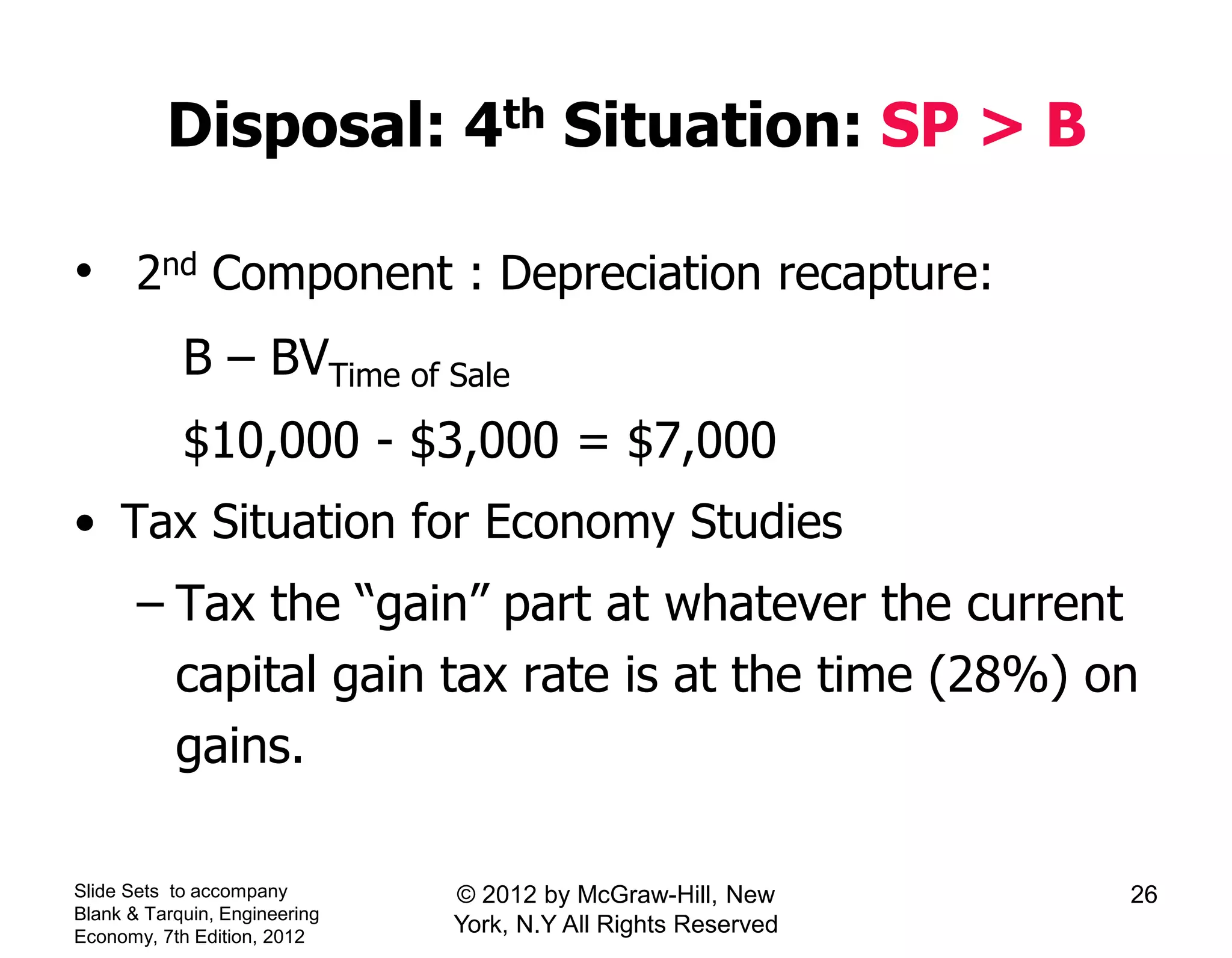
Disposal: 4th Situation: SP > B
• 2nd Component : Depreciation recapture:
B – BVTime of Sale
$10,000 - $3,000 = $7,000
• Tax Situation for Economy Studies
– Tax the “gain” part at whatever the current
capital gain tax rate is at the time (28%) on
gains.
Slide Sets to accompany
Blank & Tarquin, Engineering
Economy, 7th Edition, 2012
26© 2012 by McGraw-Hill, New
York, N.Y All Rights Reserved
Disposal: 4th Situation: SP > B
• Possible Tax Evaluation assuming the
“gain” part is taxed at 28% and DR at 34%
– Gain: $2000(0.28) = $560.
– DR: $7000(0.34) = $2380
– Total Tax: $2940
Slide Sets to accompany
Blank & Tarquin, Engineering
Economy, 7th Edition, 2012
27© 2012 by McGraw-Hill, New
York, N.Y All Rights Reserved
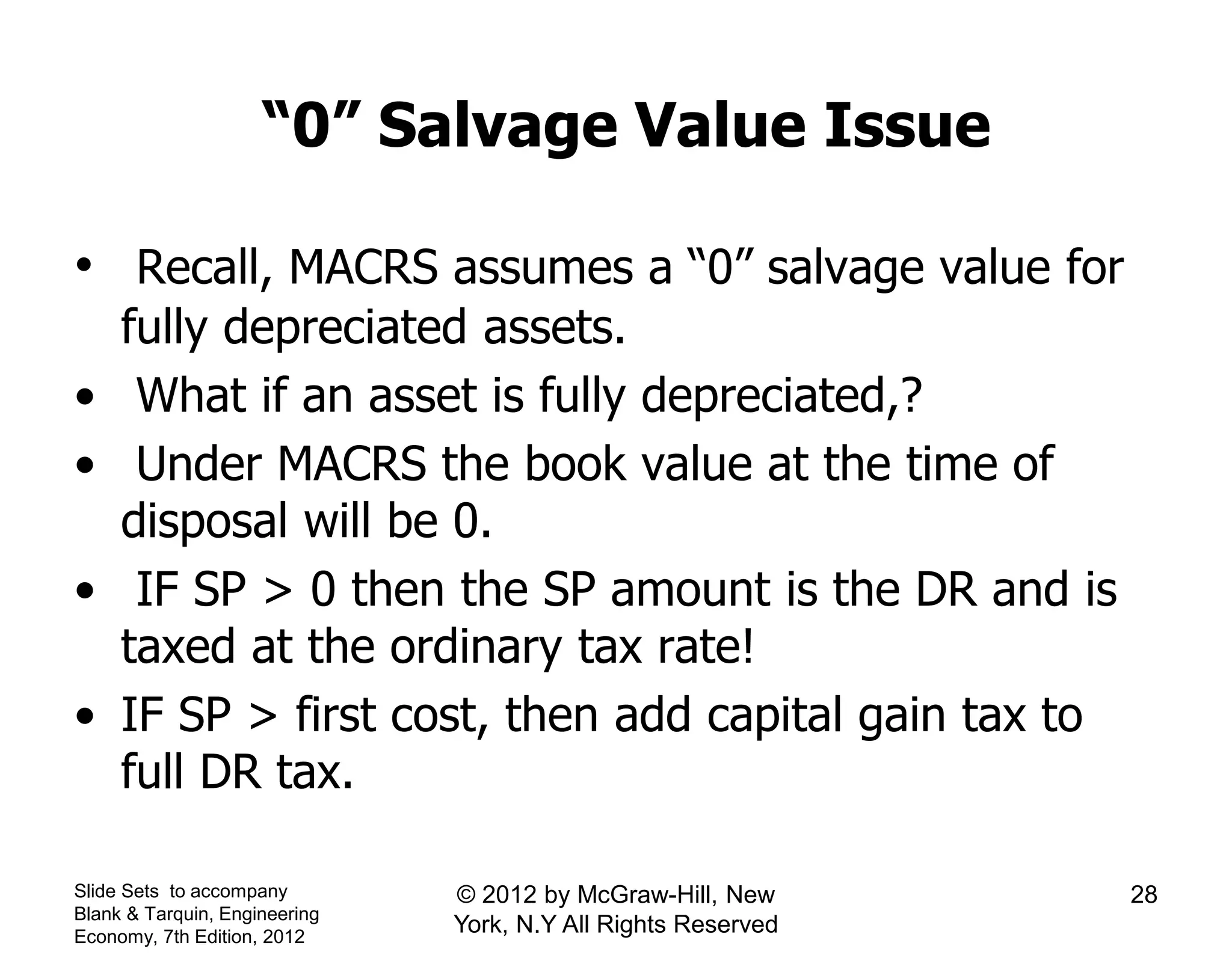
“0” Salvage Value Issue
• Recall, MACRS assumes a “0” salvage value for
fully depreciated assets.
• What if an asset is fully depreciated,?
• Under MACRS the book value at the time of
disposal will be 0.
• IF SP > 0 then the SP amount is the DR and is
taxed at the ordinary tax rate!
• IF SP > first cost, then add capital gain tax to
full DR tax.
Slide Sets to accompany
Blank & Tarquin, Engineering
Economy, 7th Edition, 2012
28© 2012 by McGraw-Hill, New
York, N.Y All Rights Reserved
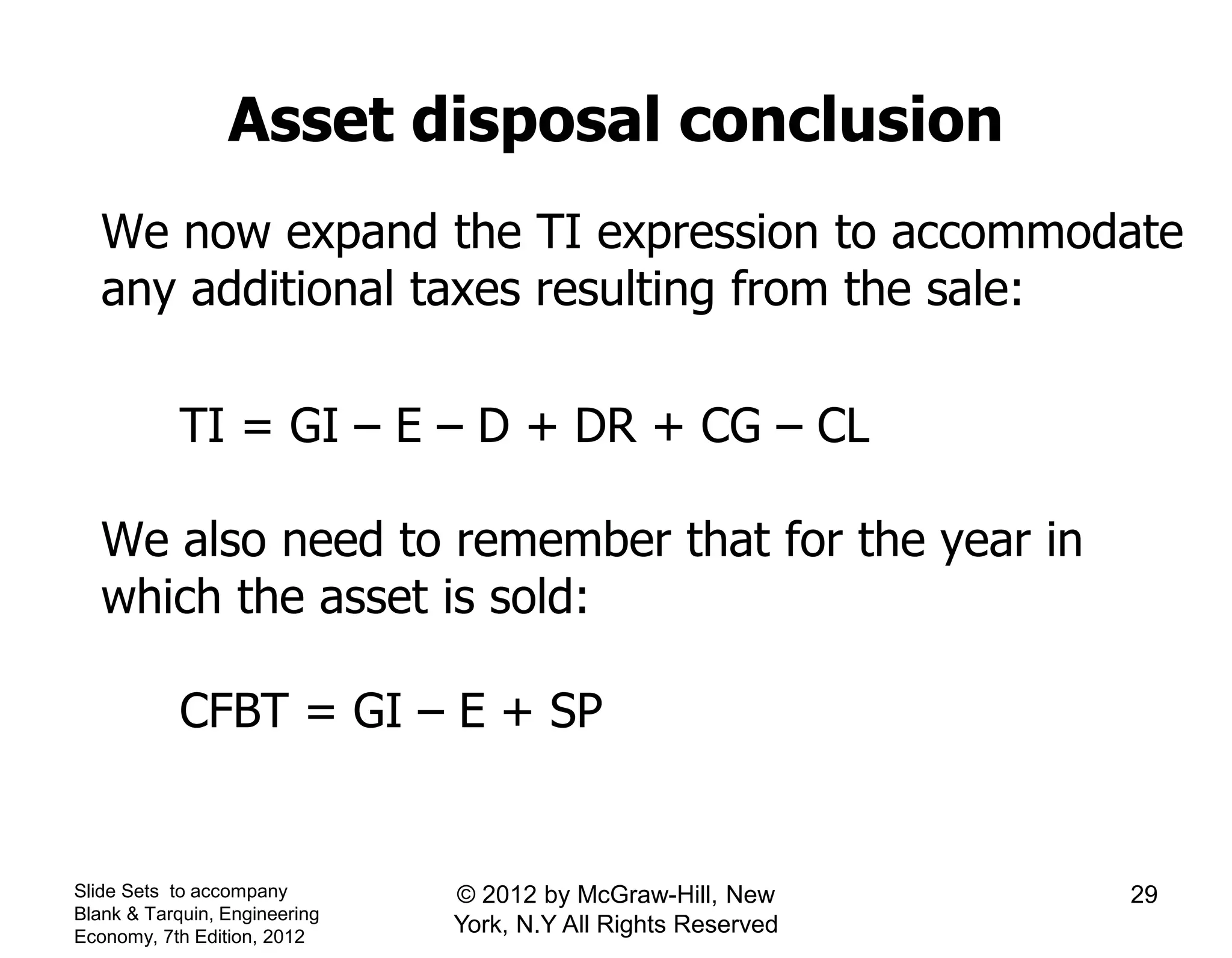
Asset disposal conclusion
We now expand the TI expression to accommodate
any additional taxes resulting from the sale:
TI = GI – E – D + DR + CG – CL
We also need to remember that for the year in
which the asset is sold:
CFBT = GI – E + SP
Slide Sets to accompany
Blank & Tarquin, Engineering
Economy, 7th Edition, 2012
29© 2012 by McGraw-Hill, New
York, N.Y All Rights Reserved
Authored by Don Smith, Texas A&M University 2004
Slide Sets to accompany Blank &
Tarquin, Engineering Economy,
7th Edition, 2012
30© 2012 by McGraw-Hill, New
York, N.Y All Rights Reserved
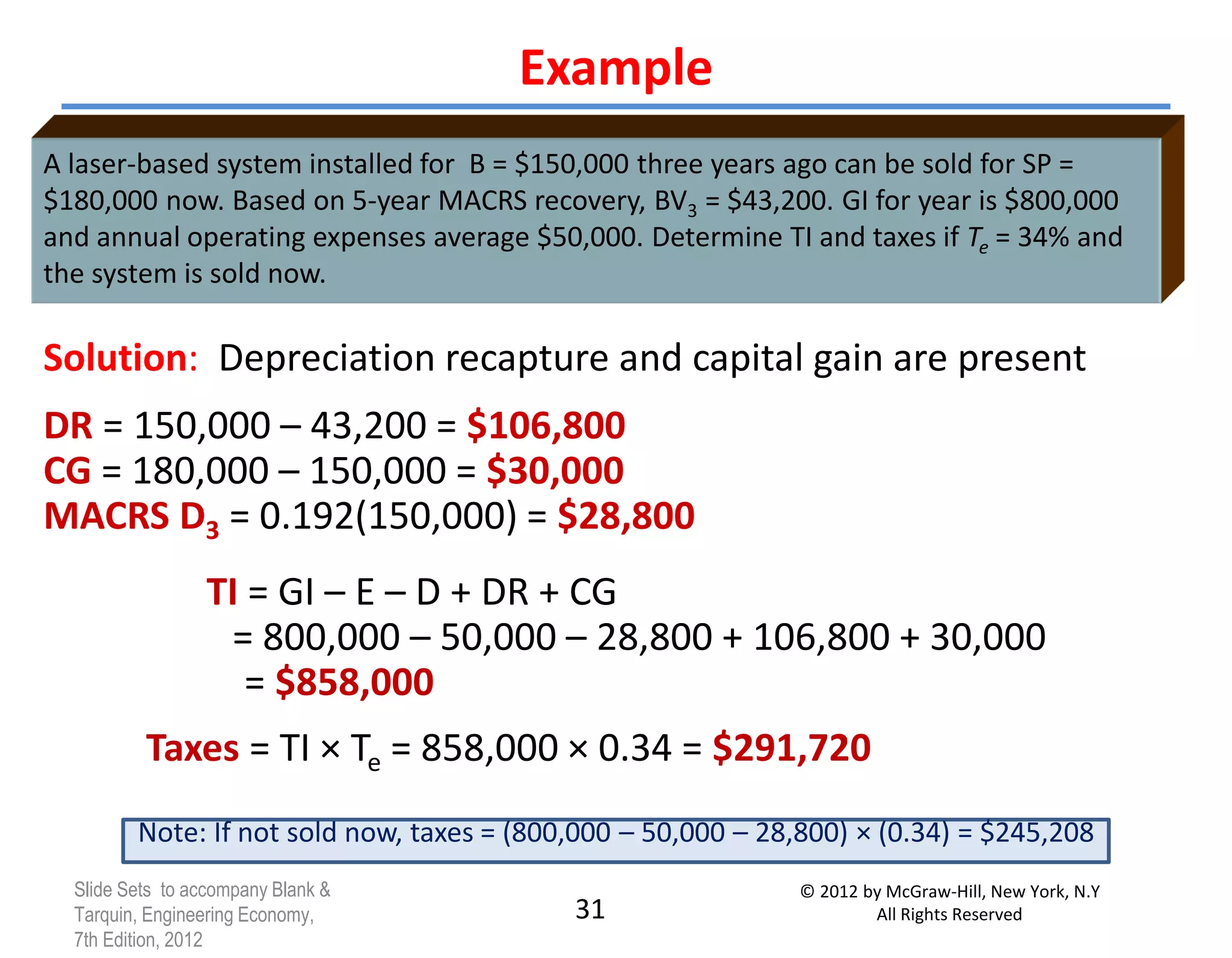
Example
Solution: Depreciation recapture and capital gain are present
DR = 150,000 – 43,200 = $106,800
CG = 180,000 – 150,000 = $30,000
MACRS D3 = 0.192(150,000) = $28,800
TI = GI – E – D + DR + CG
= 800,000 – 50,000 – 28,800 + 106,800 + 30,000
= $858,000
Taxes = TI × Te = 858,000 × 0.34 = $291,720
Note: If not sold now, taxes = (800,000 – 50,000 – 28,800) × (0.34) = $245,208
© 2012 by McGraw-Hill, New York, N.Y
All Rights Reserved31
A laser-based system installed for B = $150,000 three years ago can be sold for SP =
$180,000 now. Based on 5-year MACRS recovery, BV3 = $43,200. GI for year is $800,000
and annual operating expenses average $50,000. Determine TI and taxes if Te = 34% and
the system is sold now.
Slide Sets to accompany Blank &
Tarquin, Engineering Economy,
7th Edition, 2012
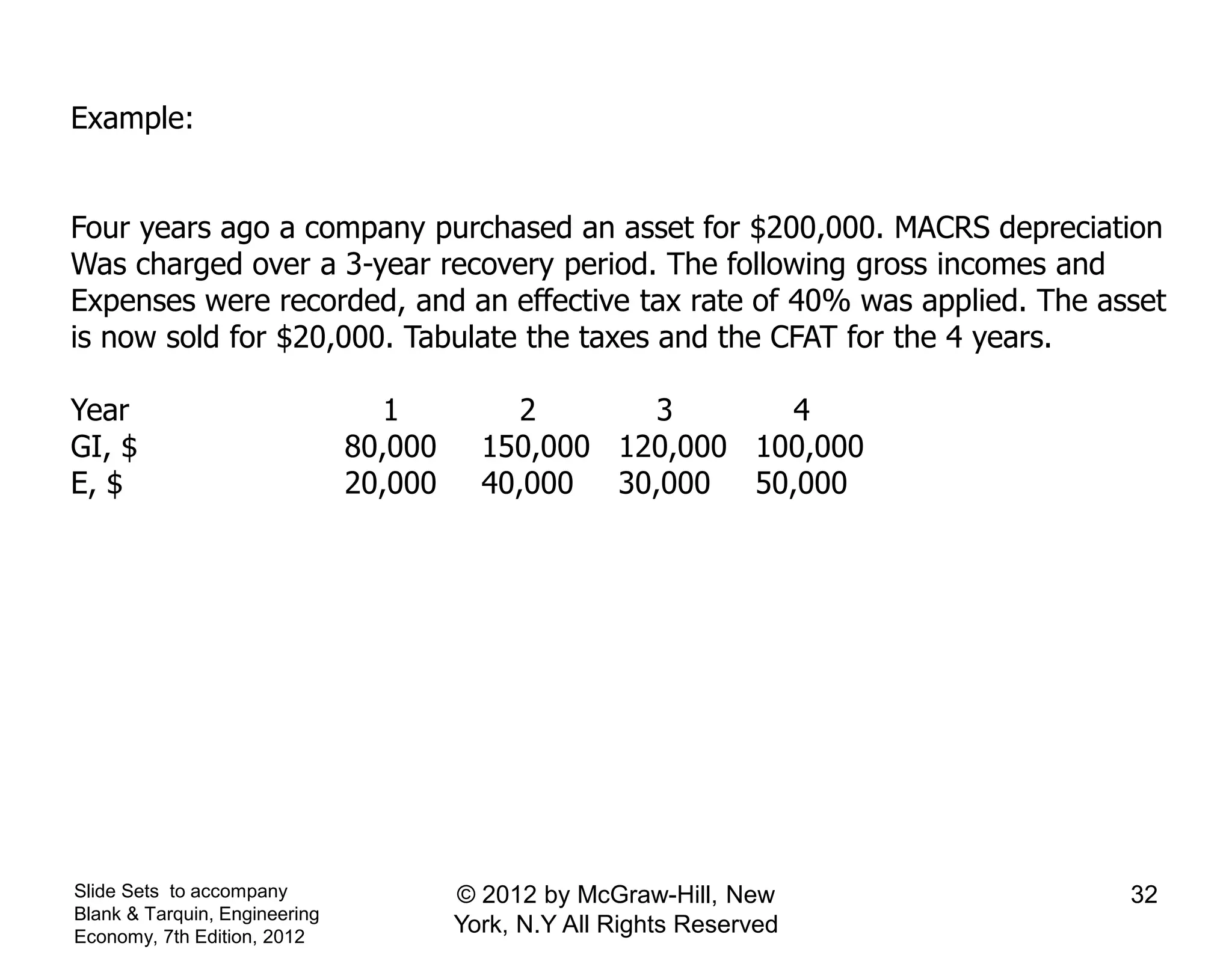
Example:
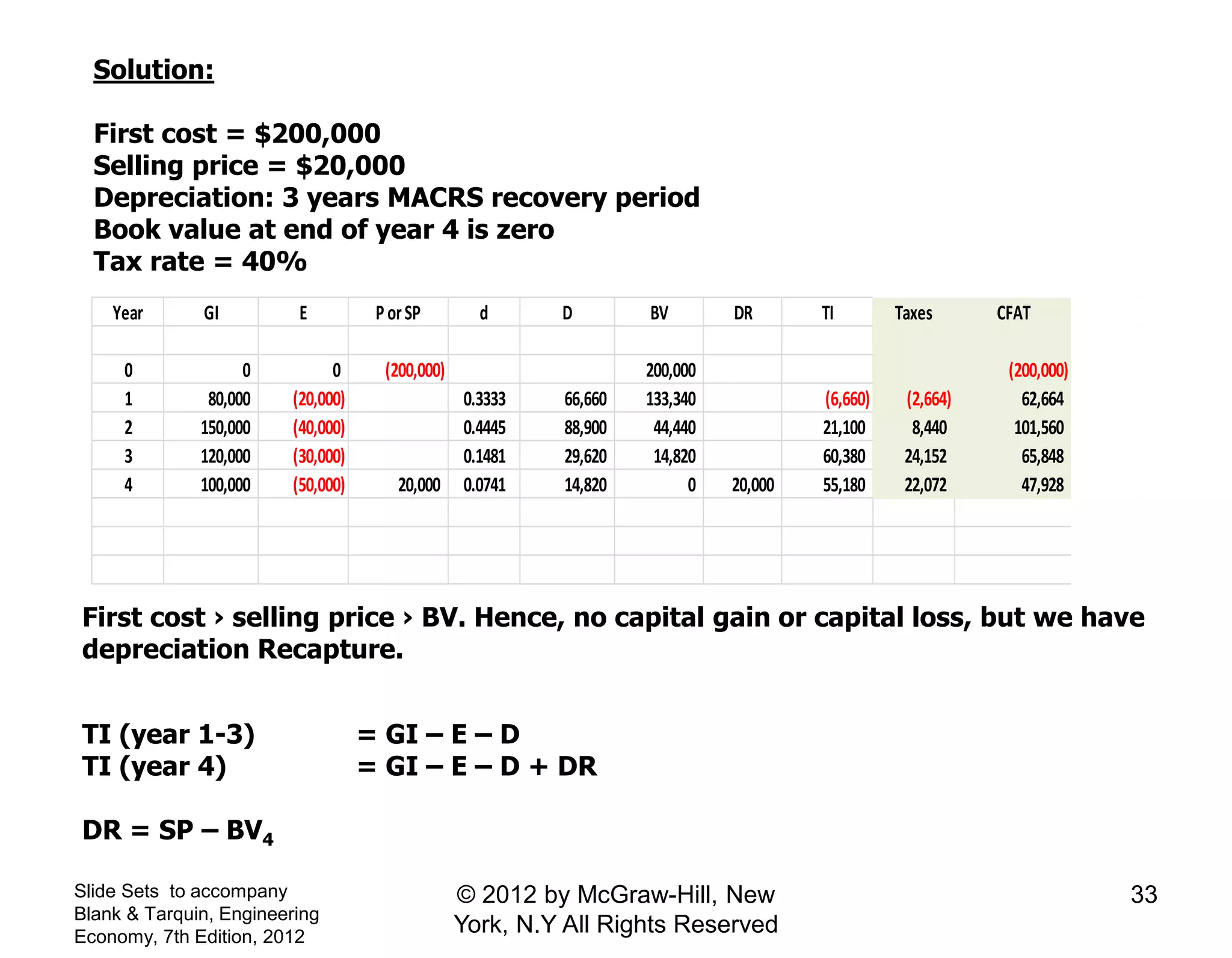
Four years ago a company purchased an asset for $200,000. MACRS depreciation
Was charged over a 3-year recovery period. The following gross incomes and
Expenses were recorded, and an effective tax rate of 40% was applied. The asset
is now sold for $20,000. Tabulate the taxes and the CFAT for the 4 years.
Year 1 2 3 4
GI, $ 80,000 150,000 120,000 100,000
E, $ 20,000 40,000 30,000 50,000
Slide Sets to accompany
Blank & Tarquin, Engineering
Economy, 7th Edition, 2012
32© 2012 by McGraw-Hill, New
York, N.Y All Rights Reserved
Year GI E PorSP d D BV DR TI Taxes CFAT
0 0 0 (200,000) 200,000 (200,000)
1 80,000 (20,000) 0.3333 66,660 133,340 (6,660) (2,664) 62,664
2 150,000 (40,000) 0.4445 88,900 44,440 21,100 8,440 101,560
3 120,000 (30,000) 0.1481 29,620 14,820 60,380 24,152 65,848
4 100,000 (50,000) 20,000 0.0741 14,820 0 20,000 55,180 22,072 47,928
Solution:
First cost = $200,000
Selling price = $20,000
Depreciation: 3 years MACRS recovery period
Book value at end of year 4 is zero
Tax rate = 40%
First cost › selling price › BV. Hence, no capital gain or capital loss, but we have
depreciation Recapture.
TI (year 1-3) = GI – E – D
TI (year 4) = GI – E – D + DR
DR = SP – BV4
Slide Sets to accompany
Blank & Tarquin, Engineering
Economy, 7th Edition, 2012
33© 2012 by McGraw-Hill, New
York, N.Y All Rights Reserved
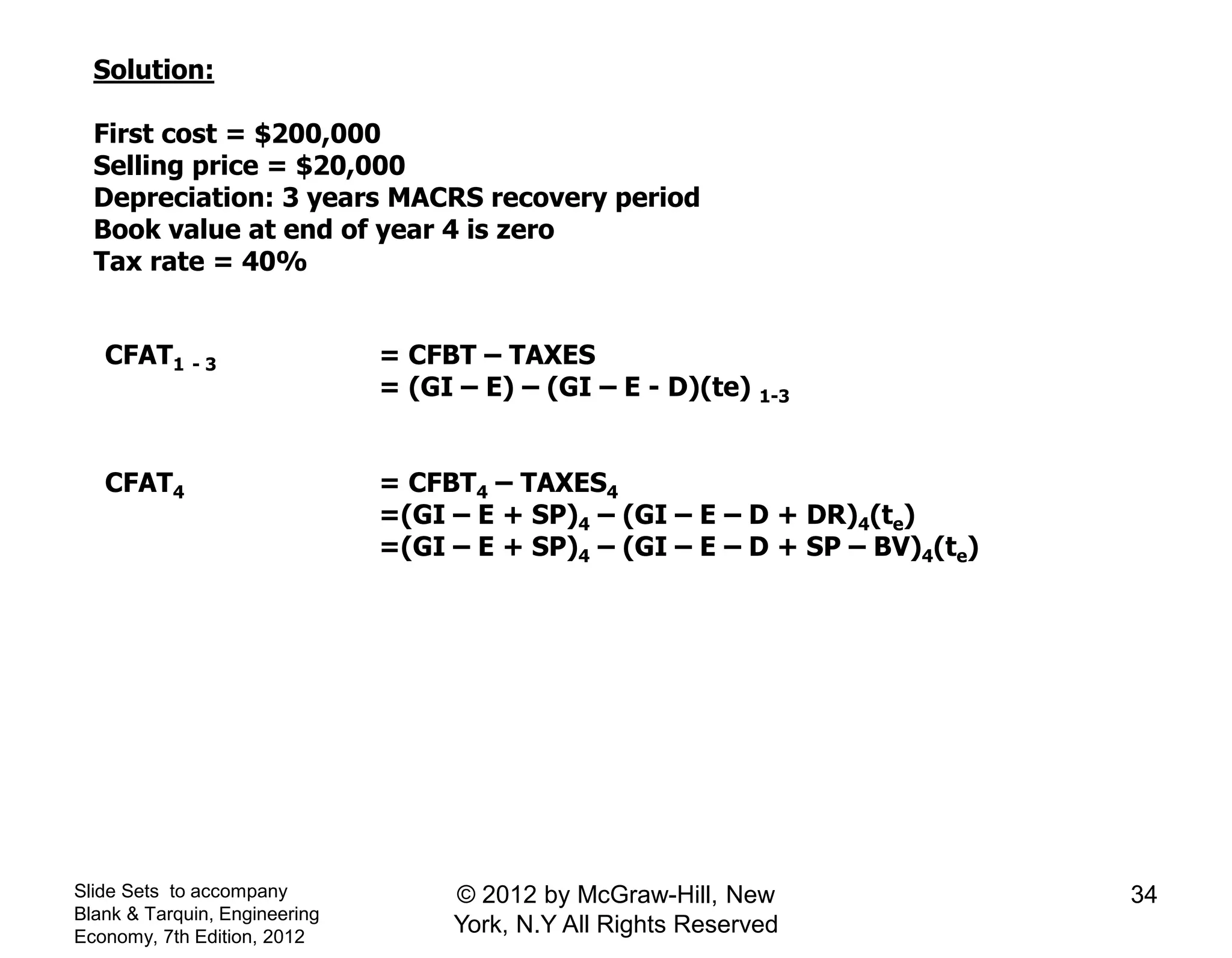
Solution:
First cost = $200,000
Selling price = $20,000
Depreciation: 3 years MACRS recovery period
Book value at end of year 4 is zero
Tax rate = 40%
CFAT1 - 3 = CFBT – TAXES
= (GI – E) – (GI – E - D)(te) 1-3
CFAT4 = CFBT4 – TAXES4
=(GI – E + SP)4 – (GI – E – D + DR)4(te)
=(GI – E + SP)4 – (GI – E – D + SP – BV)4(te)
Slide Sets to accompany
Blank & Tarquin, Engineering
Economy, 7th Edition, 2012
34© 2012 by McGraw-Hill, New
York, N.Y All Rights Reserved
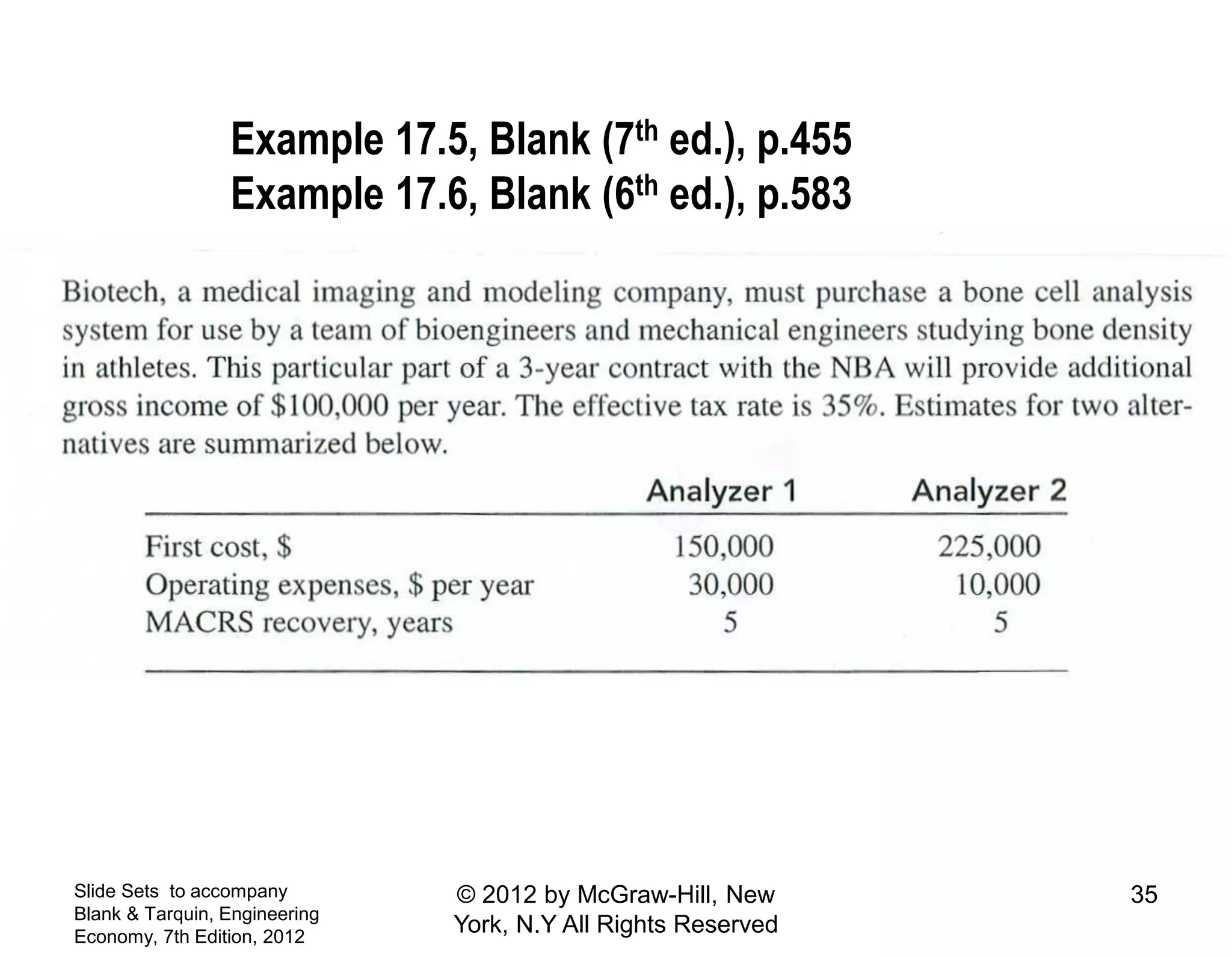
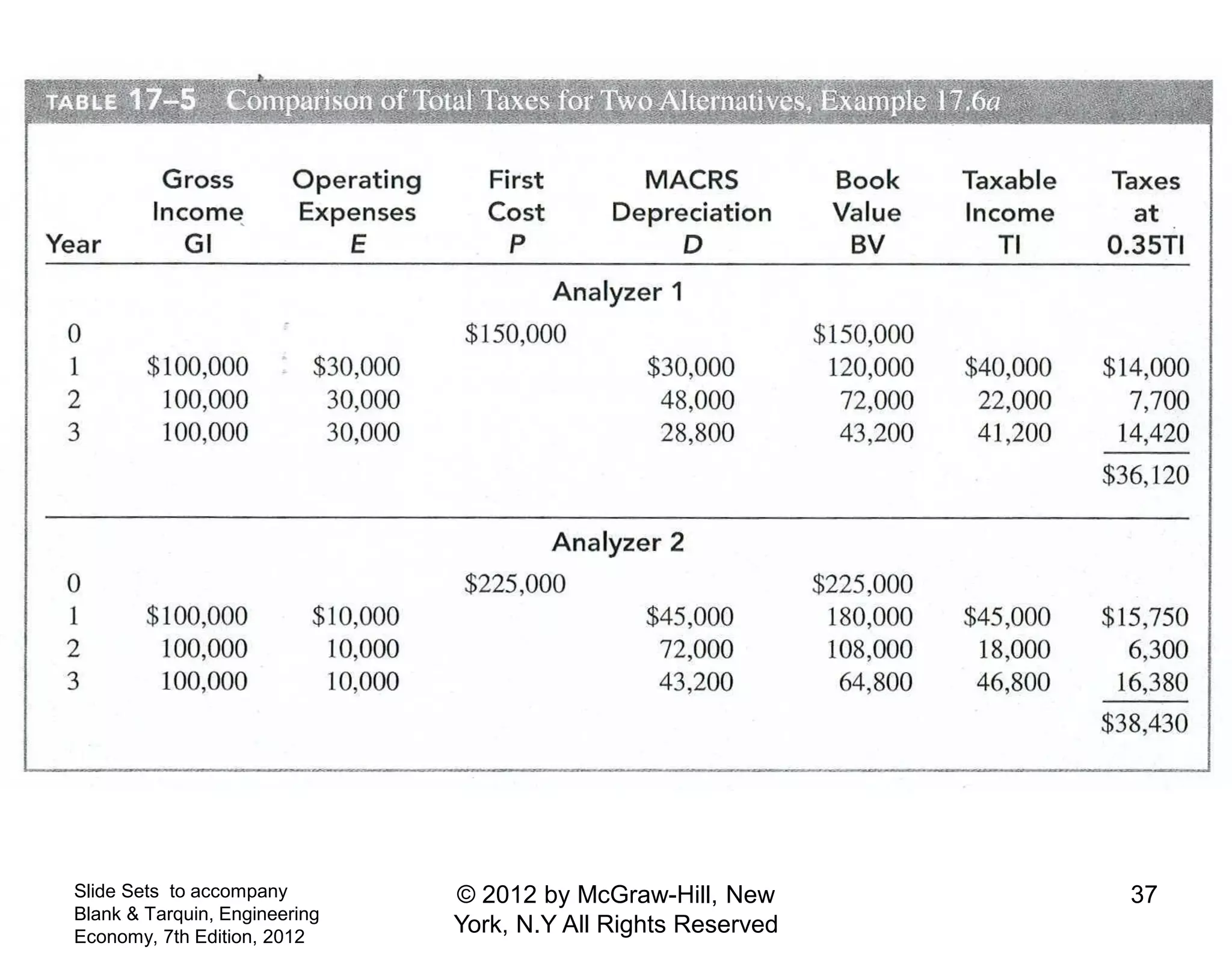
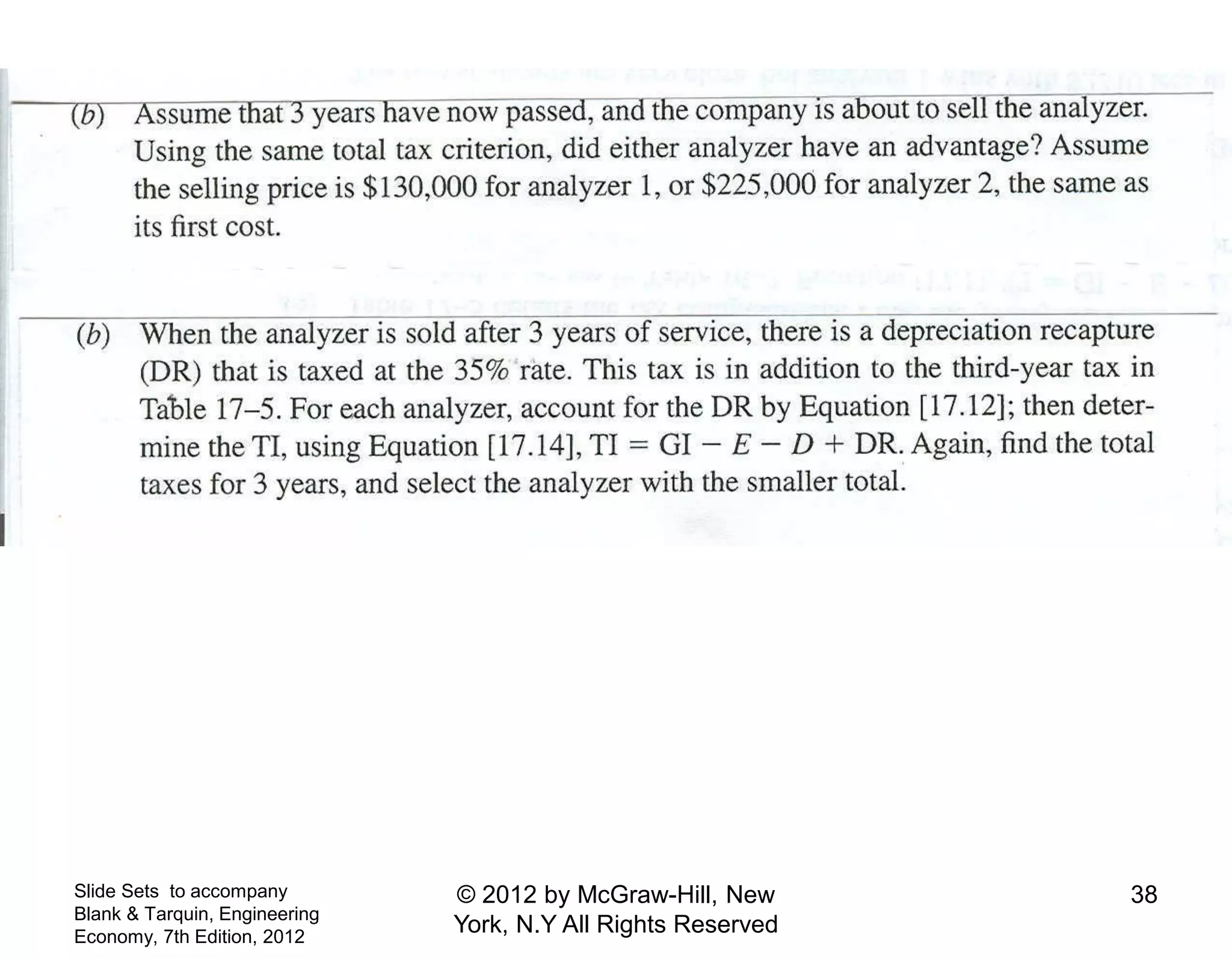
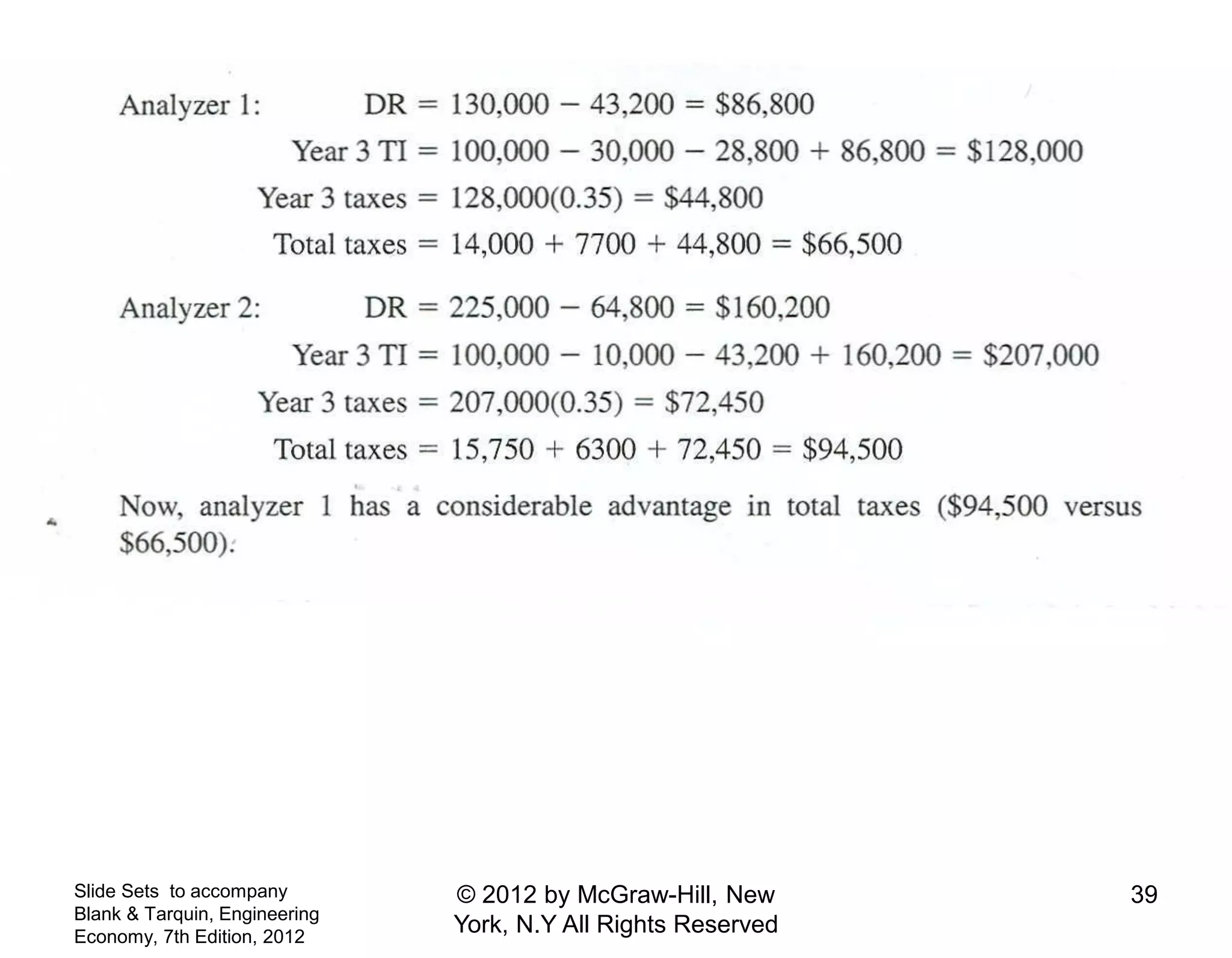
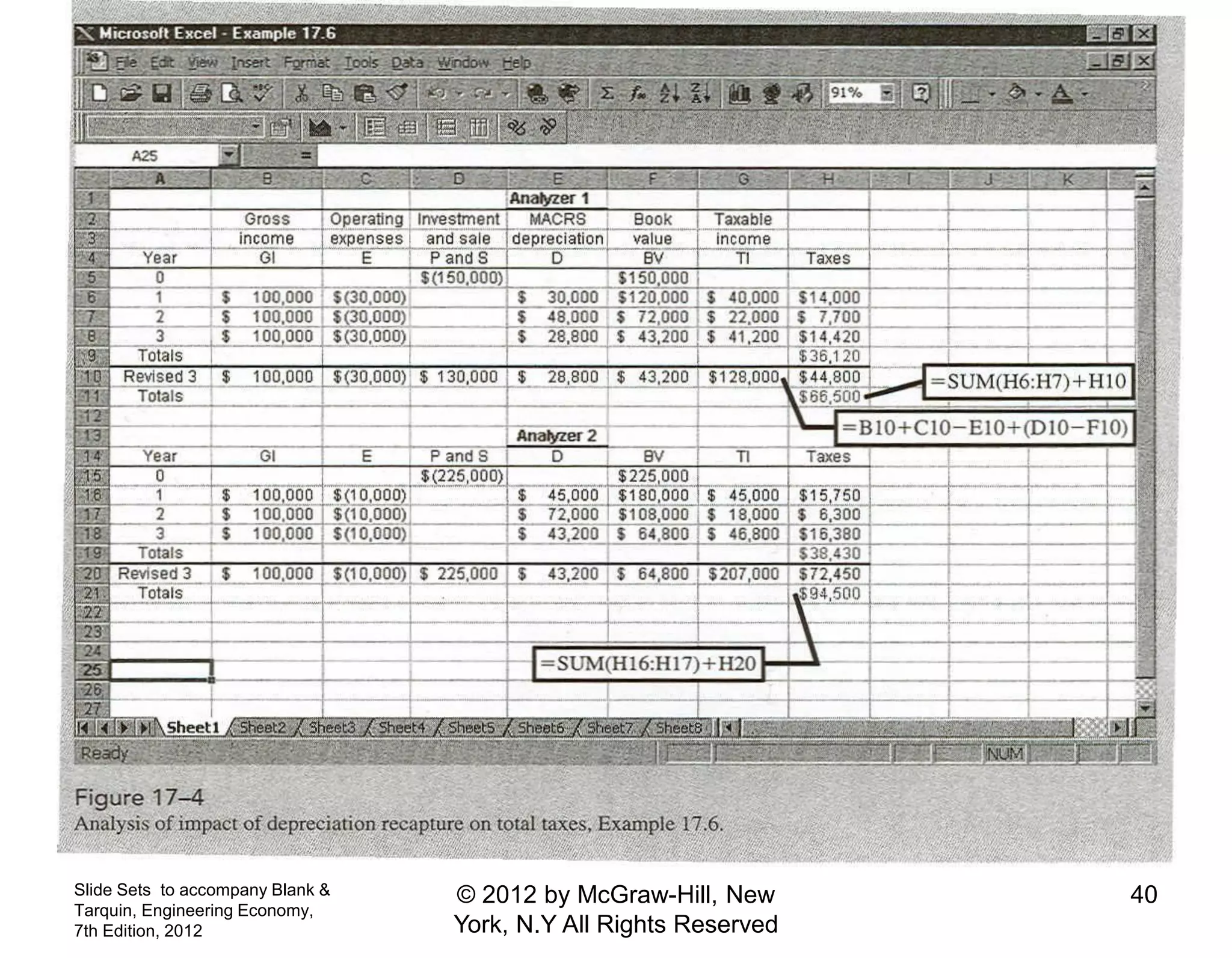
Example 17.5, Blank (7th ed.), p.455
Example 17.6, Blank (6th ed.), p.583
Slide Sets to accompany
Blank & Tarquin, Engineering
Economy, 7th Edition, 2012
35© 2012 by McGraw-Hill, New
York, N.Y All Rights Reserved
Slide Sets to accompany
Blank & Tarquin, Engineering
Economy, 7th Edition, 2012
36© 2012 by McGraw-Hill, New
York, N.Y All Rights Reserved
Slide Sets to accompany
Blank & Tarquin, Engineering
Economy, 7th Edition, 2012
37© 2012 by McGraw-Hill, New
York, N.Y All Rights Reserved
Slide Sets to accompany
Blank & Tarquin, Engineering
Economy, 7th Edition, 2012
38© 2012 by McGraw-Hill, New
York, N.Y All Rights Reserved
Slide Sets to accompany
Blank & Tarquin, Engineering
Economy, 7th Edition, 2012
39© 2012 by McGraw-Hill, New
York, N.Y All Rights Reserved
Slide Sets to accompany Blank &
Tarquin, Engineering Economy,
7th Edition, 2012
40© 2012 by McGraw-Hill, New
York, N.Y All Rights Reserved
Slide Sets to accompany Blank &
Tarquin, Engineering Economy,
7th Edition, 2012
41© 2012 by McGraw-Hill, New
York, N.Y All Rights Reserved
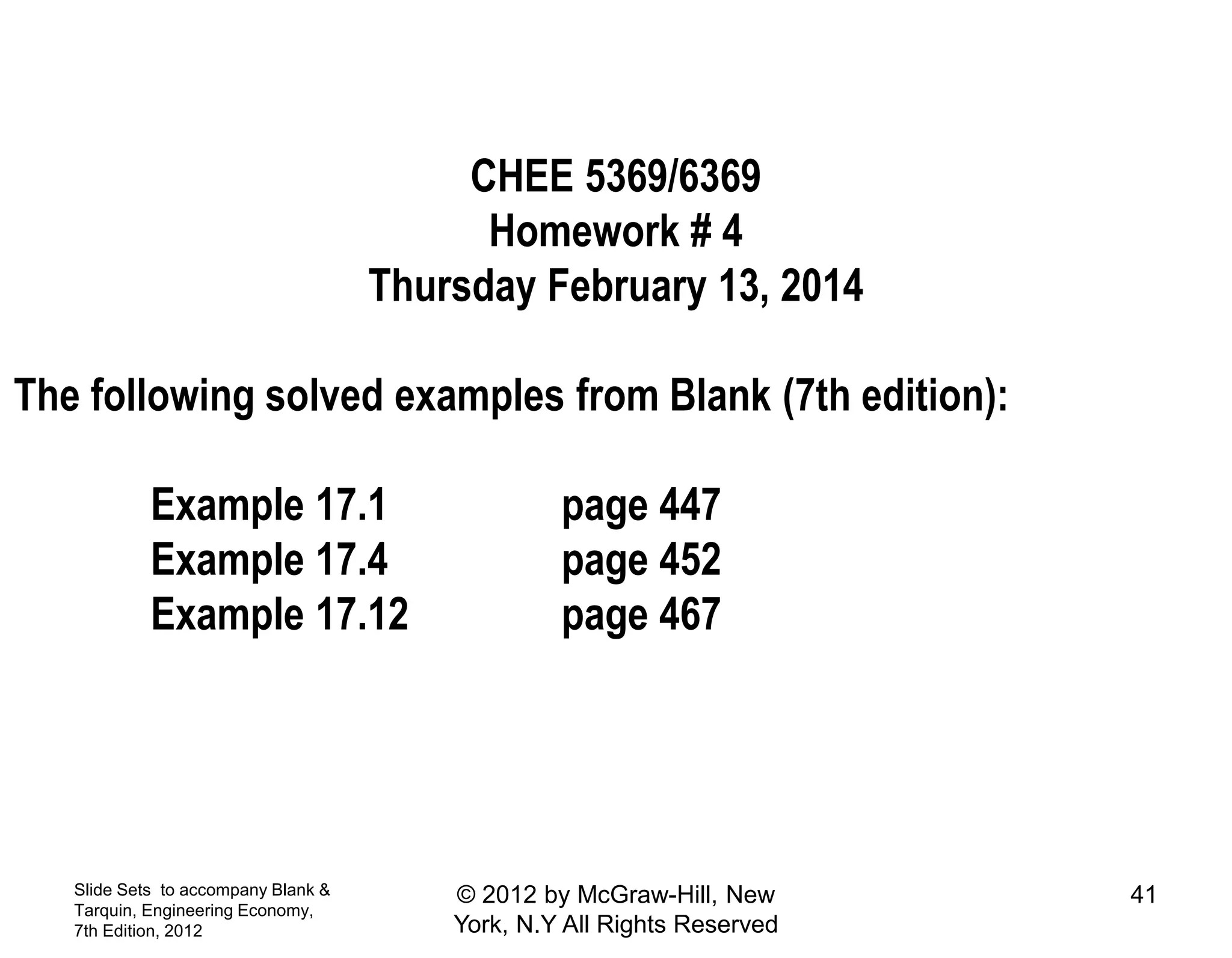
CHEE 5369/6369
Homework # 4
Thursday February 13, 2014
The following solved examples from Blank (7th edition):
Example 17.1 page 447
Example 17.4 page 452
Example 17.12 page 467

Lecture # 10 eva and disposal of assets

  • 1.
    Lecture # 10 EconomicValue Added Disposal of Assets 1 Dr. A. Alim
  • 2.
    EVA - Explained In a given year a certain NPAT is achieved. Recall: NPAT = TI – Taxes  After-tax Rate of Return is defined as: ROR = NPAT / Invested Capital or NPAT = ROR x Invested Capital If ROR=MARR NPAT (minimum) = MARR x Invested Capital  For ROR to be higher than MARR then NPAT > MARR x Invested Capital (MARR x Invested capital) is also called cost of invested capital  The difference between the actual NPAT (at ROR) and the minimum NPAT (at MARR) is called the economic value added; EVA. Slide Sets to accompany Blank & Tarquin, Engineering Economy, 7th Edition, 2012 3 © 2012 by McGraw-Hill, New York, N.Y All Rights Reserved
  • 3.
    EVA - Explained EVA t = NPAT t – cost of invested capital  The annual EVA is the amount of the NPAT remaining after removing the cost of invested capital during the year. That is, EVA indicates the project’s excess contribution to the net profit of the corporation after taxes.  EVA t = NPAT t – MARR (after tax) . (BV) t-1 Slide Sets to accompany Blank & Tarquin, Engineering Economy, 7th Edition, 2012 4 © 2012 by McGraw-Hill, New York, N.Y All Rights Reserved
  • 4.
    EVA - Explained ROR (EVA)t Costof Invested Capital = MARR x (BV)t-1 (NPAT)t Slide Sets to accompany Blank & Tarquin, Engineering Economy, 7th Edition, 2012 5 © 2012 by McGraw-Hill, New York, N.Y All Rights Reserved MARR
  • 5.
    EVA - Explained EVA is a useful tool to evaluate the worth of a project. It reflects the added value achieved by realizing a ROR higher than MARR. The bigger the delta is (ROR – MARR), the higher the EVA is.  Usually the AW of a series of yearly EVA’s is computed.  AW > 0 is desirable, the more positive it is , the better.  Comparing AW of EVA for two projects can be used to decide on which project to invest in.  Similar analysis of AW of CFAT may also be conducted. Slide Sets to accompany Blank & Tarquin, Engineering Economy, 7th Edition, 2012 6 © 2012 by McGraw-Hill, New York, N.Y All Rights Reserved
  • 6.
    EVA - Explained Recall, firms often have two sets of books relating to depreciation: One for tax purposes and, One for internal management use. (book depreciation). For EVA, book depreciation is more often used.  More closely represent the true rate of usage of the assets in question.  Typically, the classical SL method with zero salvage value is used. Slide Sets to accompany Blank & Tarquin, Engineering Economy, 7th Edition, 2012 7 © 2012 by McGraw-Hill, New York, N.Y All Rights Reserved
  • 7.
    Slide Sets toaccompany Blank & Tarquin, Engineering Economy, 7th Edition, 2012 © 2012 by McGraw-Hill, New York, N.Y All Rights Reserved8 CFAT and EVA Analysis – Example 13.11, Basics of Engineering Economy, McGraw Hill, 2008, by Blank and Tarquin. Page 336.
  • 8.
    Slide Sets toaccompany Blank & Tarquin, Engineering Economy, 7th Edition, 2012 9 © 2012 by McGraw-Hill, New York, N.Y All Rights Reserved
  • 9.
     After-tax MARR= 12%, SL depreciation Te = 40%  For EVA calculation each year t:  D = $500,000 / 4 = $125,000  NPATt = TI × (1 – Te) = (170,000 – 125,000)(0.6) = $27,000  EVAt = NPATt – MARR × (BVt-1) = 27,000 – 0.12(BVt-1) Solution: Slide Sets to accompany Blank & Tarquin, Engineering Economy, 7th Edition, 2012 10 © 2012 by McGraw-Hill, New York, N.Y All Rights Reserved Initial investment $500,000 GI – E $170,000 per year Estimated life 4 years Salvage value None
  • 10.
    Slide Sets toaccompany Blank & Tarquin, Engineering Economy, 7th Edition, 2012 11 © 2012 by McGraw-Hill, New York, N.Y All Rights Reserved
  • 11.
    Slide Sets toaccompany Blank & Tarquin, Engineering Economy, 7th Edition, 2012 12 © 2012 by McGraw-Hill, New York, N.Y All Rights Reserved
  • 12.
    Observations about EVAand CFAT analysis EVA  There is no EVA in year t = 0, since NPAT and cost of invested capital are present only for years 1 to n  AW of EVA < 0 means project is not justified at 12%  Project does not add value to the corporation until year 3 when EVA turns positive CFAT  AW of CFAT < 0 means project is not justified at 12%  CFAT estimates actual cash flow, which is negative in year 0 and positive thereafter CONCLUSIONS  AW values of EVA and CFAT series are exactly equal  Two methods are economically equivalent Slide Sets to accompany Blank & Tarquin, Engineering Economy, 7th Edition, 2012 13 © 2012 by McGraw-Hill, New York, N.Y All Rights Reserved
  • 13.
    Conclusion: EVA andCFAT  EVA values represent a project’s periodic contribution to the value of the corporation or firm.  The CFAT values represent the actual cash flows – after tax – into the corporation or firm.  Corporate executives generally prefer to view the EVA values. Studies have shown that EVA correlates better with stock price.  Popular concept in Europe  Value-added taxes are imposed in Europe on certain products and paid to the government.  EVA analysis is a good tool to compare alternative investments. Slide Sets to accompany Blank & Tarquin, Engineering Economy, 7th Edition, 2012 14 © 2012 by McGraw-Hill, New York, N.Y All Rights Reserved
  • 14.
    Disposal of assets •Firms sell or dispose of assets from time to time. • If the asset has not been fully depreciated at the selling time, it will have a book value BVt • Four possible situations may occur, depending on how the selling price SP relates to first cost P and to the current book value BVt Slide Sets to accompany Blank & Tarquin, Engineering Economy, 7th Edition, 2012 15© 2012 by McGraw-Hill, New York, N.Y All Rights Reserved
  • 15.
    Summary for DisposalAnalysis Slide Sets to accompany Blank & Tarquin, Engineering Economy, 7th Edition, 2012 16© 2012 by McGraw-Hill, New York, N.Y All Rights Reserved
  • 16.
    1) Capital Gain:CG • Occurs when the selling price exceeds the first cost • Capital Gain is defined as: CG = Selling Price – First Cost • Certain Assets will gain value over time and could be sold for more than what was originally paid for them. Examples are land and buildings. • This will generate a taxable income (TI) and additional capital gain tax will have to be paid in the year of sale. • In most cases capital gain is taxed at the same rate as ordinary income, unless a different rate is specified (in which case it is usually 28%) Slide Sets to accompany Blank & Tarquin, Engineering Economy, 7th Edition, 2012 17© 2012 by McGraw-Hill, New York, N.Y All Rights Reserved
  • 17.
    2) Depreciation recapture:DR • Occurs when the selling price is higher than the current book value. • The term “Depreciation Recapture” applies. • DR = SP – BVt • This will generate a tax liability and tax will have to be paid! • When the SP exceeds the first cost, a capital gain is also incurred. In this case the TI due to the sale is the gain plus the DR. The DR is this case is the total amount of depreciation taken so far. Slide Sets to accompany Blank & Tarquin, Engineering Economy, 7th Edition, 2012 18© 2012 by McGraw-Hill, New York, N.Y All Rights Reserved
  • 18.
    3) Capital Loss:CL • A capital loss occurs when an asset is sold for less than it’s current book value. • CL = BVt – SP • Could generate a tax savings since the “loss” could be tax deductible within certain rules. Slide Sets to accompany Blank & Tarquin, Engineering Economy, 7th Edition, 2012 19© 2012 by McGraw-Hill, New York, N.Y All Rights Reserved
  • 19.
    4) No gainNo Loss case This occurs when the asset is sold for a price = BVt SP = BVt no tax liability generated Slide Sets to accompany Blank & Tarquin, Engineering Economy, 7th Edition, 2012 20© 2012 by McGraw-Hill, New York, N.Y All Rights Reserved
  • 20.
    Disposal Example • Assumean asset was originally purchased for $10,000, 3 years ago. • Assume the current book value for tax purposes is $3000. • We will apply three different hypothetical selling prices to see the various tax implications due to disposal. • Assume income tax rate of 34% , and capital gain tax rate of 28% apply. Slide Sets to accompany Blank & Tarquin, Engineering Economy, 7th Edition, 2012 21© 2012 by McGraw-Hill, New York, N.Y All Rights Reserved
  • 21.
    Disposal: SP >BVtime of sale • Assume SP = $4,000. • BV = $3,000. • Compute (SP – BV) = (4,000 – 3000). • Equals +$1,000. (Recaptured Depr.) • Tax Rule: Treated as ordinary income to the firm and taxed at the tax rate. • Tax: $1000(0.34) = $340.00 Slide Sets to accompany Blank & Tarquin, Engineering Economy, 7th Edition, 2012 22© 2012 by McGraw-Hill, New York, N.Y All Rights Reserved
  • 22.
    Disposal: SP =BVTime of Sale • Assume SP = $3,000. • Compute (SP – BV) = (3000 – 3000) =0 • No gain or loss on sale; • No tax implications! • When asset is disposed of for it’s current book value there is no recaptured depreciation and no corresponding tax. Slide Sets to accompany Blank & Tarquin, Engineering Economy, 7th Edition, 2012 23© 2012 by McGraw-Hill, New York, N.Y All Rights Reserved
  • 23.
    Disposal: SP <BVTime of Sale • Assume SP = $2,000; • BV = $3000 • Compute: (SP – BV) = (2000 – 3000) = – -$1,000. – “Minus” means “loss on disposal” • The loss can be treated as a negative ordinary income and may be deducted from capital gain in another asset. • Tax: (-1000)(0.34) = - $340.00 • This is a tax credit. Slide Sets to accompany Blank & Tarquin, Engineering Economy, 7th Edition, 2012 24© 2012 by McGraw-Hill, New York, N.Y All Rights Reserved
  • 24.
    Disposal: 4th Situation:SP > B • What if the SP is greater than the original basis of the asset? (rare for productive assets) • Assume SP = $12,000; • B = $10,000. • BVtime of sale = $3,000 • Two Components to deal with: • 1st component : Capital gain (SP – B) = 12,000 – 10,000 = $2,000 Slide Sets to accompany Blank & Tarquin, Engineering Economy, 7th Edition, 2012 25© 2012 by McGraw-Hill, New York, N.Y All Rights Reserved
  • 25.
    Disposal: 4th Situation:SP > B • 2nd Component : Depreciation recapture: B – BVTime of Sale $10,000 - $3,000 = $7,000 • Tax Situation for Economy Studies – Tax the “gain” part at whatever the current capital gain tax rate is at the time (28%) on gains. Slide Sets to accompany Blank & Tarquin, Engineering Economy, 7th Edition, 2012 26© 2012 by McGraw-Hill, New York, N.Y All Rights Reserved
  • 26.
    Disposal: 4th Situation:SP > B • Possible Tax Evaluation assuming the “gain” part is taxed at 28% and DR at 34% – Gain: $2000(0.28) = $560. – DR: $7000(0.34) = $2380 – Total Tax: $2940 Slide Sets to accompany Blank & Tarquin, Engineering Economy, 7th Edition, 2012 27© 2012 by McGraw-Hill, New York, N.Y All Rights Reserved
  • 27.
    “0” Salvage ValueIssue • Recall, MACRS assumes a “0” salvage value for fully depreciated assets. • What if an asset is fully depreciated,? • Under MACRS the book value at the time of disposal will be 0. • IF SP > 0 then the SP amount is the DR and is taxed at the ordinary tax rate! • IF SP > first cost, then add capital gain tax to full DR tax. Slide Sets to accompany Blank & Tarquin, Engineering Economy, 7th Edition, 2012 28© 2012 by McGraw-Hill, New York, N.Y All Rights Reserved
  • 28.
    Asset disposal conclusion Wenow expand the TI expression to accommodate any additional taxes resulting from the sale: TI = GI – E – D + DR + CG – CL We also need to remember that for the year in which the asset is sold: CFBT = GI – E + SP Slide Sets to accompany Blank & Tarquin, Engineering Economy, 7th Edition, 2012 29© 2012 by McGraw-Hill, New York, N.Y All Rights Reserved
  • 29.
    Authored by DonSmith, Texas A&M University 2004 Slide Sets to accompany Blank & Tarquin, Engineering Economy, 7th Edition, 2012 30© 2012 by McGraw-Hill, New York, N.Y All Rights Reserved
  • 30.
    Example Solution: Depreciation recaptureand capital gain are present DR = 150,000 – 43,200 = $106,800 CG = 180,000 – 150,000 = $30,000 MACRS D3 = 0.192(150,000) = $28,800 TI = GI – E – D + DR + CG = 800,000 – 50,000 – 28,800 + 106,800 + 30,000 = $858,000 Taxes = TI × Te = 858,000 × 0.34 = $291,720 Note: If not sold now, taxes = (800,000 – 50,000 – 28,800) × (0.34) = $245,208 © 2012 by McGraw-Hill, New York, N.Y All Rights Reserved31 A laser-based system installed for B = $150,000 three years ago can be sold for SP = $180,000 now. Based on 5-year MACRS recovery, BV3 = $43,200. GI for year is $800,000 and annual operating expenses average $50,000. Determine TI and taxes if Te = 34% and the system is sold now. Slide Sets to accompany Blank & Tarquin, Engineering Economy, 7th Edition, 2012
  • 31.
    Example: Four years agoa company purchased an asset for $200,000. MACRS depreciation Was charged over a 3-year recovery period. The following gross incomes and Expenses were recorded, and an effective tax rate of 40% was applied. The asset is now sold for $20,000. Tabulate the taxes and the CFAT for the 4 years. Year 1 2 3 4 GI, $ 80,000 150,000 120,000 100,000 E, $ 20,000 40,000 30,000 50,000 Slide Sets to accompany Blank & Tarquin, Engineering Economy, 7th Edition, 2012 32© 2012 by McGraw-Hill, New York, N.Y All Rights Reserved
  • 32.
    Year GI EPorSP d D BV DR TI Taxes CFAT 0 0 0 (200,000) 200,000 (200,000) 1 80,000 (20,000) 0.3333 66,660 133,340 (6,660) (2,664) 62,664 2 150,000 (40,000) 0.4445 88,900 44,440 21,100 8,440 101,560 3 120,000 (30,000) 0.1481 29,620 14,820 60,380 24,152 65,848 4 100,000 (50,000) 20,000 0.0741 14,820 0 20,000 55,180 22,072 47,928 Solution: First cost = $200,000 Selling price = $20,000 Depreciation: 3 years MACRS recovery period Book value at end of year 4 is zero Tax rate = 40% First cost › selling price › BV. Hence, no capital gain or capital loss, but we have depreciation Recapture. TI (year 1-3) = GI – E – D TI (year 4) = GI – E – D + DR DR = SP – BV4 Slide Sets to accompany Blank & Tarquin, Engineering Economy, 7th Edition, 2012 33© 2012 by McGraw-Hill, New York, N.Y All Rights Reserved
  • 33.
    Solution: First cost =$200,000 Selling price = $20,000 Depreciation: 3 years MACRS recovery period Book value at end of year 4 is zero Tax rate = 40% CFAT1 - 3 = CFBT – TAXES = (GI – E) – (GI – E - D)(te) 1-3 CFAT4 = CFBT4 – TAXES4 =(GI – E + SP)4 – (GI – E – D + DR)4(te) =(GI – E + SP)4 – (GI – E – D + SP – BV)4(te) Slide Sets to accompany Blank & Tarquin, Engineering Economy, 7th Edition, 2012 34© 2012 by McGraw-Hill, New York, N.Y All Rights Reserved
  • 34.
    Example 17.5, Blank(7th ed.), p.455 Example 17.6, Blank (6th ed.), p.583 Slide Sets to accompany Blank & Tarquin, Engineering Economy, 7th Edition, 2012 35© 2012 by McGraw-Hill, New York, N.Y All Rights Reserved
  • 35.
    Slide Sets toaccompany Blank & Tarquin, Engineering Economy, 7th Edition, 2012 36© 2012 by McGraw-Hill, New York, N.Y All Rights Reserved
  • 36.
    Slide Sets toaccompany Blank & Tarquin, Engineering Economy, 7th Edition, 2012 37© 2012 by McGraw-Hill, New York, N.Y All Rights Reserved
  • 37.
    Slide Sets toaccompany Blank & Tarquin, Engineering Economy, 7th Edition, 2012 38© 2012 by McGraw-Hill, New York, N.Y All Rights Reserved
  • 38.
    Slide Sets toaccompany Blank & Tarquin, Engineering Economy, 7th Edition, 2012 39© 2012 by McGraw-Hill, New York, N.Y All Rights Reserved
  • 39.
    Slide Sets toaccompany Blank & Tarquin, Engineering Economy, 7th Edition, 2012 40© 2012 by McGraw-Hill, New York, N.Y All Rights Reserved
  • 40.
    Slide Sets toaccompany Blank & Tarquin, Engineering Economy, 7th Edition, 2012 41© 2012 by McGraw-Hill, New York, N.Y All Rights Reserved CHEE 5369/6369 Homework # 4 Thursday February 13, 2014 The following solved examples from Blank (7th edition): Example 17.1 page 447 Example 17.4 page 452 Example 17.12 page 467