Elementary TCP Sockets
Network Programming
Lecture 1
Dr. Mona Sayed
Introduction
 First: Elementary socket functions
 Next: TCP client-server example
 Concurrent services

Common Unix server technique

Allows server to simultaneously
serve multiple clients

Server forks a separate process to
serve each client
Typical TCP Client-
Server Scenario
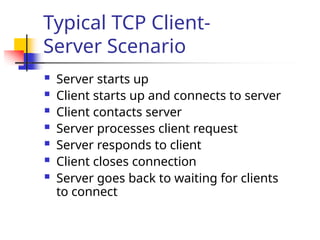
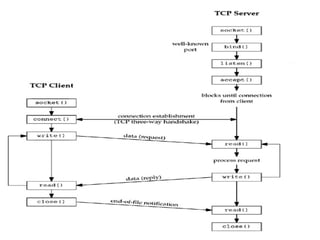
 Server starts up
 Client starts up and connects to server
 Client contacts server
 Server processes client request
 Server responds to client
 Client closes connection
 Server goes back to waiting for clients
to connect
socket()
 To perform network I/O, a process
first calls socket()

Called by both client and server
 #include <sys/socket.h>
 int socket(int family, int type, int
protocol);
 returns a socket descriptor
socket() parameters
 family specifies the protocol family or
domain

AF_INET: IPv4 protocols

AF_INET6: IPv6 protocols

AF_LOCAL: Unix domain protocols

AF_ROUTE: Routing sockets

AF_KEY: Key socket
 Usually: AF_INET
 AF_LOCAL might work on CATS machines
socket() parameters
 type specifies type of communication

SOCK_STREAM: stream socket (Reliable,
connection-oriented (TCP))

SOCK_DGRAM: datagram socket (Unreliable,
connectionless (UDP))

SOCK_SEQPACKET: sequenced packet socket
(Reliable, Connection-Oriented, Preserves
Message Boundaries (SCTP))

SOCK_RAW: raw socket (for direct IP packet
access)
socket() parameters
 protocol specifies transport protocol

IPPROTO_TCP: TCP transport protocol

IPPROTO_UDP: UDP transport protocol
 IPPROTO_SCTP: SCTP transport protocol
 TCP provides reliable, in-order
streaming communication
 Resends lost packets, guarantees order
 UDP provides possibly unreliable,
possibly out-of-order message delivery
 Doesn’t guarantee anything, but usually
works fine
socket() parameters
 Return Value:
 On success Returns a socket
→
descriptor (a non-negative integer,
similar to a file descriptor).
 On failure Returns -1 (error can be
→
checked using errno).
socket() parameters
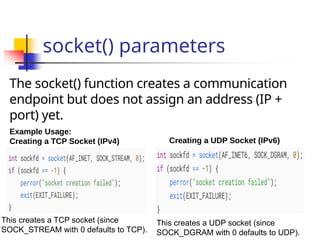
The socket() function creates a communication
endpoint but does not assign an address (IP +
port) yet.
Example Usage:
Creating a TCP Socket (IPv4)
This creates a TCP socket (since
SOCK_STREAM with 0 defaults to TCP).
Creating a UDP Socket (IPv6)
This creates a UDP socket (since
SOCK_DGRAM with 0 defaults to UDP).
connect()
 Use by a TCP client to establish
a connection with a TCP server
 #include <sys/socket.h>
 int connect(int sockfd, const struct
sockaddr *servaddr, socklen_t
addrlen);
 Returns when the connection has
been established
connect()
connect() parameters
 sockfd is the socket descriptor
returned by socket()
 servaddr is the socket address

Contains the IP address and port
number of the server

Typically, struct sockaddr_in (IPv4) or
struct sockaddr_in6 (IPv6) is used.
 addrlen is the size of the
address structure
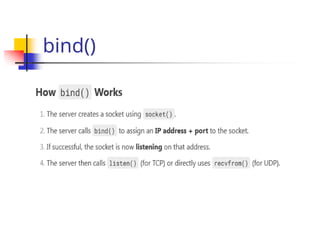
bind()
 Used by server to bind a socket to an
IP address/port pair. This allows
clients to know where to connect.
 #include <sys/socket.h>
 int bind(int sockfd, const struct
sockaddr *myaddr, socklen_t
addrlen);
 Common error: EADDRINUSE (The
requested port is already in use by
bind() parameters
 sockfd is the socket descriptor
returned by socket()
 myaddr is the address of this server

Containing the local IP address and port.

Note: addresses are protocol-specific

Usually well-known addresses so
that clients can find the server
 addrlen is the length of the
address
bind()
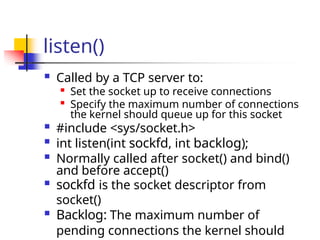
listen()
 Called by a TCP server to:
 Set the socket up to receive connections

Specify the maximum number of connections
the kernel should queue up for this socket
 #include <sys/socket.h>
 int listen(int sockfd, int backlog);
 Normally called after socket() and bind()
and before accept()
 sockfd is the socket descriptor from
socket()
 Backlog: The maximum number of
pending connections the kernel should
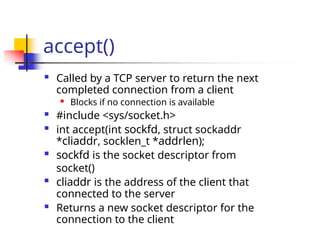
accept()
 Called by a TCP server to return the next
completed connection from a client
 Blocks if no connection is available
 #include <sys/socket.h>
 int accept(int sockfd, struct sockaddr
*cliaddr, socklen_t *addrlen);
 sockfd is the socket descriptor from
socket()
 cliaddr is the address of the client that
connected to the server
 Returns a new socket descriptor for the
connection to the client
int main(int argc, char
**argv) { int listenfd,
connfd;
struct sockaddr_in servaddr;
char buff[maxline];
time_t ticks;
listenfd = socket(AF_INET,
SOCK_STREAM, 0);
bzero(&servaddr, sizeof(servaddr);
servaddr.sin_family = AF_INET;
servaddr.sin_addr.s_addr =
htonl(INADDR_ANY); servaddr.sin_port =
htons(13); // daytime sever
bind(listenfd, (SA *) &servaddr, sizeof(servaddr));
listen(listenfd, LISTENQ);
while(1) {
connfd = accept(listenfd, (SA *)NULL, NULL);
ticks = time(NULL);
snprintf(buff, sizeof(buff), “%.24srn”, ctime(&ticks));
write(connfd, buff, strlen(buff));
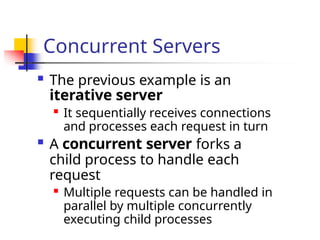
Concurrent Servers
 The previous example is an
iterative server

It sequentially receives connections
and processes each request in turn
 A concurrent server forks a
child process to handle each
request

Multiple requests can be handled in
parallel by multiple concurrently
executing child processes
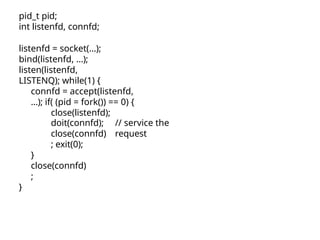
pid_t pid;
int listenfd, connfd;
listenfd = socket(…);
bind(listenfd, …);
listen(listenfd,
LISTENQ); while(1) {
connfd = accept(listenfd,
…); if( (pid = fork()) == 0) {
close(listenfd);
// service the
request
doit(connfd);
close(connfd)
; exit(0);
}
close(connfd)
;
}
close()
 Normal close() is used to close
sockets
 #include <unistd.h>
 int close(int sockfd);
getsockname() and
getpeername()
 getsockname() returns the local
protocol address (IP+Port) associate
with a socket

Used to get socket address when
responding to a wildcard
connection (INADDR_ANY)
 getpeername() returns the
foreign protocol address
associated with a socket

Used to get client address in an
execed process
Lecture 1 Socket programming elementary tcp sockets.pptx

  • 1.
    Elementary TCP Sockets NetworkProgramming Lecture 1 Dr. Mona Sayed
  • 2.
    Introduction  First: Elementarysocket functions  Next: TCP client-server example  Concurrent services  Common Unix server technique  Allows server to simultaneously serve multiple clients  Server forks a separate process to serve each client
  • 3.
    Typical TCP Client- ServerScenario  Server starts up  Client starts up and connects to server  Client contacts server  Server processes client request  Server responds to client  Client closes connection  Server goes back to waiting for clients to connect
  • 5.
    socket()  To performnetwork I/O, a process first calls socket()  Called by both client and server  #include <sys/socket.h>  int socket(int family, int type, int protocol);  returns a socket descriptor
  • 6.
    socket() parameters  familyspecifies the protocol family or domain  AF_INET: IPv4 protocols  AF_INET6: IPv6 protocols  AF_LOCAL: Unix domain protocols  AF_ROUTE: Routing sockets  AF_KEY: Key socket  Usually: AF_INET  AF_LOCAL might work on CATS machines
  • 7.
    socket() parameters  typespecifies type of communication  SOCK_STREAM: stream socket (Reliable, connection-oriented (TCP))  SOCK_DGRAM: datagram socket (Unreliable, connectionless (UDP))  SOCK_SEQPACKET: sequenced packet socket (Reliable, Connection-Oriented, Preserves Message Boundaries (SCTP))  SOCK_RAW: raw socket (for direct IP packet access)
  • 8.
    socket() parameters  protocolspecifies transport protocol  IPPROTO_TCP: TCP transport protocol  IPPROTO_UDP: UDP transport protocol  IPPROTO_SCTP: SCTP transport protocol  TCP provides reliable, in-order streaming communication  Resends lost packets, guarantees order  UDP provides possibly unreliable, possibly out-of-order message delivery  Doesn’t guarantee anything, but usually works fine
  • 9.
    socket() parameters  ReturnValue:  On success Returns a socket → descriptor (a non-negative integer, similar to a file descriptor).  On failure Returns -1 (error can be → checked using errno).
  • 10.
    socket() parameters The socket()function creates a communication endpoint but does not assign an address (IP + port) yet. Example Usage: Creating a TCP Socket (IPv4) This creates a TCP socket (since SOCK_STREAM with 0 defaults to TCP). Creating a UDP Socket (IPv6) This creates a UDP socket (since SOCK_DGRAM with 0 defaults to UDP).
  • 11.
    connect()  Use bya TCP client to establish a connection with a TCP server  #include <sys/socket.h>  int connect(int sockfd, const struct sockaddr *servaddr, socklen_t addrlen);  Returns when the connection has been established
  • 12.
  • 13.
    connect() parameters  sockfdis the socket descriptor returned by socket()  servaddr is the socket address  Contains the IP address and port number of the server  Typically, struct sockaddr_in (IPv4) or struct sockaddr_in6 (IPv6) is used.  addrlen is the size of the address structure
  • 14.
    bind()  Used byserver to bind a socket to an IP address/port pair. This allows clients to know where to connect.  #include <sys/socket.h>  int bind(int sockfd, const struct sockaddr *myaddr, socklen_t addrlen);  Common error: EADDRINUSE (The requested port is already in use by
  • 15.
    bind() parameters  sockfdis the socket descriptor returned by socket()  myaddr is the address of this server  Containing the local IP address and port.  Note: addresses are protocol-specific  Usually well-known addresses so that clients can find the server  addrlen is the length of the address
  • 16.
  • 17.
    listen()  Called bya TCP server to:  Set the socket up to receive connections  Specify the maximum number of connections the kernel should queue up for this socket  #include <sys/socket.h>  int listen(int sockfd, int backlog);  Normally called after socket() and bind() and before accept()  sockfd is the socket descriptor from socket()  Backlog: The maximum number of pending connections the kernel should
  • 18.
    accept()  Called bya TCP server to return the next completed connection from a client  Blocks if no connection is available  #include <sys/socket.h>  int accept(int sockfd, struct sockaddr *cliaddr, socklen_t *addrlen);  sockfd is the socket descriptor from socket()  cliaddr is the address of the client that connected to the server  Returns a new socket descriptor for the connection to the client
  • 19.
    int main(int argc,char **argv) { int listenfd, connfd; struct sockaddr_in servaddr; char buff[maxline]; time_t ticks; listenfd = socket(AF_INET, SOCK_STREAM, 0); bzero(&servaddr, sizeof(servaddr); servaddr.sin_family = AF_INET; servaddr.sin_addr.s_addr = htonl(INADDR_ANY); servaddr.sin_port = htons(13); // daytime sever bind(listenfd, (SA *) &servaddr, sizeof(servaddr)); listen(listenfd, LISTENQ); while(1) { connfd = accept(listenfd, (SA *)NULL, NULL); ticks = time(NULL); snprintf(buff, sizeof(buff), “%.24srn”, ctime(&ticks)); write(connfd, buff, strlen(buff));
  • 20.
    Concurrent Servers  Theprevious example is an iterative server  It sequentially receives connections and processes each request in turn  A concurrent server forks a child process to handle each request  Multiple requests can be handled in parallel by multiple concurrently executing child processes
  • 21.
    pid_t pid; int listenfd,connfd; listenfd = socket(…); bind(listenfd, …); listen(listenfd, LISTENQ); while(1) { connfd = accept(listenfd, …); if( (pid = fork()) == 0) { close(listenfd); // service the request doit(connfd); close(connfd) ; exit(0); } close(connfd) ; }
  • 22.
    close()  Normal close()is used to close sockets  #include <unistd.h>  int close(int sockfd);
  • 23.
    getsockname() and getpeername()  getsockname()returns the local protocol address (IP+Port) associate with a socket  Used to get socket address when responding to a wildcard connection (INADDR_ANY)  getpeername() returns the foreign protocol address associated with a socket  Used to get client address in an execed process