LECTURE 1: Introduction to Programming
CODE &TITLE: CS 2104 Visual Programming
LECTURER :MR. AKRAM ALI OMAR
EMAIL: akram.ali.omar@gmail.com
Mobile: 0778695626
1
Content
 What is Computer Programming?
 Your First C# Program
 What is C#?
 What is .NET Framework?
 What is Visual Studio?
 Compiling, Running and Debugging C# Programs
 What is MSDN Library?
2
Define: Computer Programming
Google Definition
Computer programming: creating a sequence of
instructions to enable the computer to do something
3
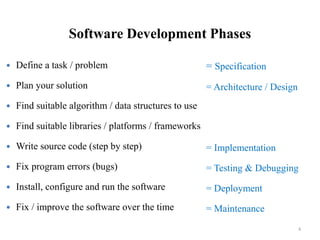
 Define a task / problem
 Plan your solution
 Find suitable algorithm / data structures to use
 Find suitable libraries / platforms / frameworks
 Write source code (step by step)
 Fix program errors (bugs)
 Install, configure and run the software
 Fix / improve the software over the time
Software Development Phases
4
= Specification
= Architecture / Design
= Implementation
= Testing & Debugging
= Deployment
= Maintenance
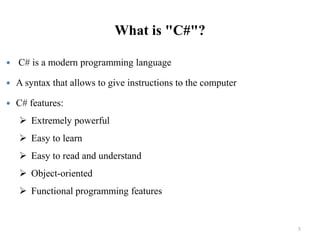
What is "C#"?
 C# is a modern programming language
 A syntax that allows to give instructions to the computer
 C# features:
 Extremely powerful
 Easy to learn
 Easy to read and understand
 Object-oriented
 Functional programming features
5
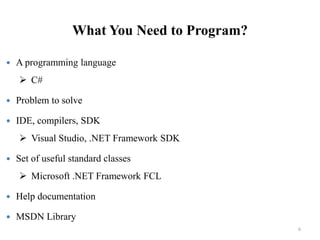
What You Need to Program?
 A programming language
 C#
 Problem to solve
 IDE, compilers, SDK
 Visual Studio, .NET Framework SDK
 Set of useful standard classes
 Microsoft .NET Framework FCL
 Help documentation
 MSDN Library
6
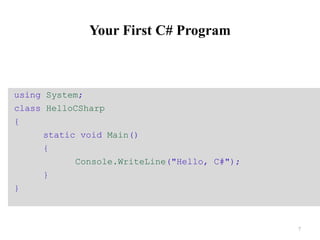
Your First C# Program
using System;
class HelloCSharp
{
static void Main()
{
Console.WriteLine("Hello, C#");
}
}
7
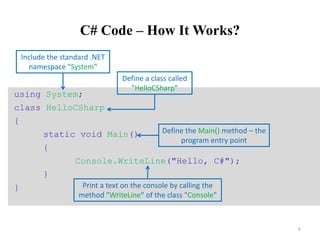
C# Code – How It Works?
using System;
class HelloCSharp
{
static void Main()
{
Console.WriteLine("Hello, C#");
}
}
8
Include the standard .NET
namespace "System"
Define a class called
"HelloCSharp"
Define the Main() method – the
program entry point
Print a text on the console by calling the
method "WriteLine" of the class "Console"
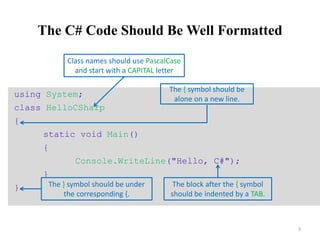
The C# Code Should Be Well Formatted
using System;
class HelloCSharp
{
static void Main()
{
Console.WriteLine("Hello, C#");
}
}
9
Class names should use PascalCase
and start with a CAPITAL letter
The { symbol should be
alone on a new line.
The } symbol should be under
the corresponding {.
The block after the { symbol
should be indented by a TAB.
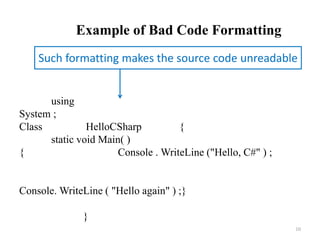
Example of Bad Code Formatting
10
using
System ;
Class HelloCSharp {
static void Main( )
{ Console . WriteLine ("Hello, C#" ) ;
Console. WriteLine ( "Hello again" ) ;}
}
Such formatting makes the source code unreadable
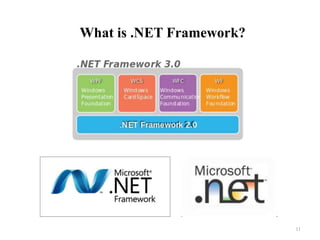
What is .NET Framework?
11
What is .NET Framework?
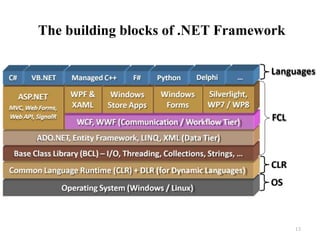
 Environment for execution of .NET programs (CLR)
 Powerful library of classes (FCL)
 Common execution engine for many programming languages
 C#
 Visual Basic .NET
 Managed C++
 ... and many others
12
The building blocks of .NET Framework
13
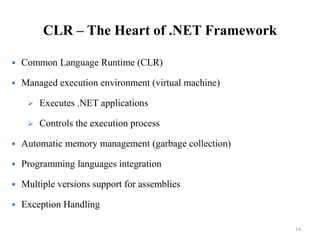
CLR – The Heart of .NET Framework
 Common Language Runtime (CLR)
 Managed execution environment (virtual machine)
 Executes .NET applications
 Controls the execution process
 Automatic memory management (garbage collection)
 Programming languages integration
 Multiple versions support for assemblies
 Exception Handling
14
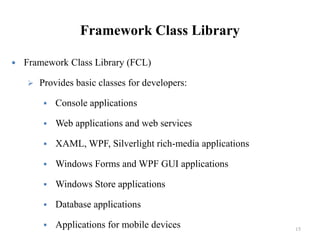
Framework Class Library
 Framework Class Library (FCL)
 Provides basic classes for developers:
 Console applications
 Web applications and web services
 XAML, WPF, Silverlight rich-media applications
 Windows Forms and WPF GUI applications
 Windows Store applications
 Database applications
 Applications for mobile devices 15
What is Visual Studio?
16
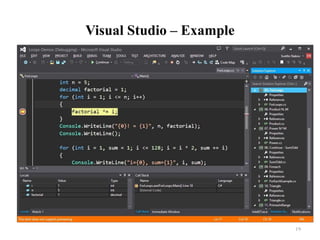
Visual Studio
• Visual Studio – Integrated Development Environment (IDE)
• Development tool that helps us to:
 Write code
 Design user interface
 Compile code
 Execute / test / debug applications
 Browse the help
 Manage project's files
17
Benefits of Visual Studio
• Single tool for:
 Writing code in many languages (C#, VB.NET, Python, …)
 Using different technologies (Web Forms, MVC, WPF, EF, WCF, …)
 For different platforms (Win8, Silverlight, Windows Phone, …)
• Full integration of most development activities (coding, compiling,
testing, debugging, deployment, version control, ...)
• Very easy to use!
18
Visual Studio – Example
19
Visual Studio
Compiling, Running and Debugging C# Programs
20
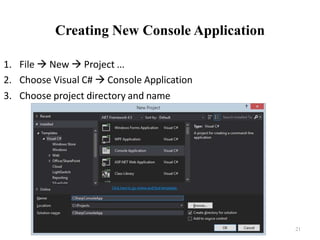
Creating New Console Application
1. File  New  Project ...
2. Choose Visual C#  Console Application
3. Choose project directory and name
21
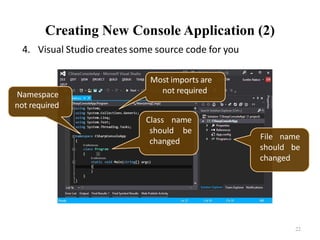
Creating New Console Application (2)
22
4. Visual Studio creates some source code for you
Namespace
not required
Class name
should be
changed
Most imports are
not required
File name
should be
changed
Compiling the Source Code
• The process of compiling includes:
 Syntactic checks
 Type safety checks
 Translation of the source code to lower level language (MSIL)
 Creating executable files (assemblies)
• You can start compilation by
 Using Build->Build Solution/Project
 Pressing [F6] or [Shift+Ctrl+B]
23
Running Programs
• The process of running application includes:
 Compiling (if project not compiled)
 Starting the application
• You can run application by:
 Using Debug->Start menu
 By pressing [F5] or [Ctrl+F5]
• * NOTE: Not all types of projects are able to be started!
24
Debugging The Code
• The process of debugging application includes:
 Spotting an error
 Finding the lines of code that cause the error
 Fixing the error in the code
 Testing to check if the error is gone and no new errors are introduced
• Iterative and continuous process
• Debuggers help a lot
25
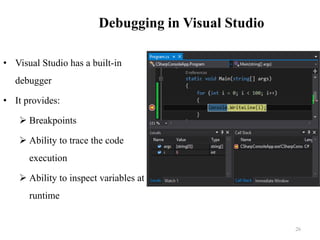
Debugging in Visual Studio
• Visual Studio has a built-in
debugger
• It provides:
 Breakpoints
 Ability to trace the code
execution
 Ability to inspect variables at
runtime
26
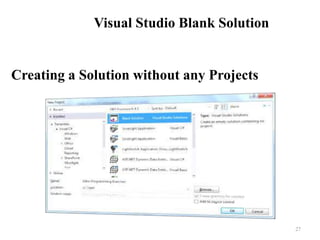
Visual Studio Blank Solution
Creating a Solution without any Projects
27
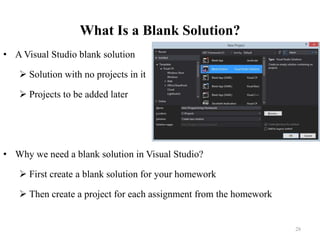
What Is a Blank Solution?
• A Visual Studio blank solution
 Solution with no projects in it
 Projects to be added later
• Why we need a blank solution in Visual Studio?
 First create a blank solution for your homework
 Then create a project for each assignment from the homework
28
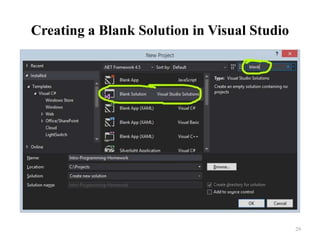
Creating a Blank Solution in Visual Studio
29
What is MSDN Library?
30
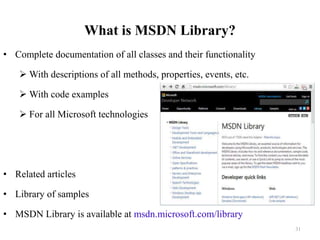
What is MSDN Library?
• Complete documentation of all classes and their functionality
 With descriptions of all methods, properties, events, etc.
 With code examples
 For all Microsoft technologies
• Related articles
• Library of samples
• MSDN Library is available at msdn.microsoft.com/library
31
How to Use MSDN Library?
32
 Search in Google for certain class / method / property
 E.g.
 Or
 Or
 Use Visual Studio's built-in help system
 Press [F1] in Visual Studio in the code
 Browse http://msdn.microsoft.com Press [F1] to view
the documentation
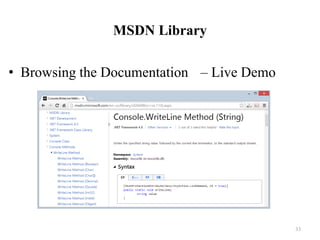
MSDN Library
• Browsing the Documentation – Live Demo
33
Summary
• Programming: creating a sequence of instructions (source code)
• C#: modern programming language, easy to learn
• C# programs: class + main method + code in it
• .NET Framework – a modern platform for software development by
Microsoft
• Visual Studio – powerful IDE for .NET developers: write / compile /
execute / debug code
• MSDN Library – the C# and .NET documentation
34
END
35

LECTURE 1 - Introduction to Programming.pptx

  • 1.
    LECTURE 1: Introductionto Programming CODE &TITLE: CS 2104 Visual Programming LECTURER :MR. AKRAM ALI OMAR EMAIL: akram.ali.omar@gmail.com Mobile: 0778695626 1
  • 2.
    Content  What isComputer Programming?  Your First C# Program  What is C#?  What is .NET Framework?  What is Visual Studio?  Compiling, Running and Debugging C# Programs  What is MSDN Library? 2
  • 3.
    Define: Computer Programming GoogleDefinition Computer programming: creating a sequence of instructions to enable the computer to do something 3
  • 4.
     Define atask / problem  Plan your solution  Find suitable algorithm / data structures to use  Find suitable libraries / platforms / frameworks  Write source code (step by step)  Fix program errors (bugs)  Install, configure and run the software  Fix / improve the software over the time Software Development Phases 4 = Specification = Architecture / Design = Implementation = Testing & Debugging = Deployment = Maintenance
  • 5.
    What is "C#"? C# is a modern programming language  A syntax that allows to give instructions to the computer  C# features:  Extremely powerful  Easy to learn  Easy to read and understand  Object-oriented  Functional programming features 5
  • 6.
    What You Needto Program?  A programming language  C#  Problem to solve  IDE, compilers, SDK  Visual Studio, .NET Framework SDK  Set of useful standard classes  Microsoft .NET Framework FCL  Help documentation  MSDN Library 6
  • 7.
    Your First C#Program using System; class HelloCSharp { static void Main() { Console.WriteLine("Hello, C#"); } } 7
  • 8.
    C# Code –How It Works? using System; class HelloCSharp { static void Main() { Console.WriteLine("Hello, C#"); } } 8 Include the standard .NET namespace "System" Define a class called "HelloCSharp" Define the Main() method – the program entry point Print a text on the console by calling the method "WriteLine" of the class "Console"
  • 9.
    The C# CodeShould Be Well Formatted using System; class HelloCSharp { static void Main() { Console.WriteLine("Hello, C#"); } } 9 Class names should use PascalCase and start with a CAPITAL letter The { symbol should be alone on a new line. The } symbol should be under the corresponding {. The block after the { symbol should be indented by a TAB.
  • 10.
    Example of BadCode Formatting 10 using System ; Class HelloCSharp { static void Main( ) { Console . WriteLine ("Hello, C#" ) ; Console. WriteLine ( "Hello again" ) ;} } Such formatting makes the source code unreadable
  • 11.
    What is .NETFramework? 11
  • 12.
    What is .NETFramework?  Environment for execution of .NET programs (CLR)  Powerful library of classes (FCL)  Common execution engine for many programming languages  C#  Visual Basic .NET  Managed C++  ... and many others 12
  • 13.
    The building blocksof .NET Framework 13
  • 14.
    CLR – TheHeart of .NET Framework  Common Language Runtime (CLR)  Managed execution environment (virtual machine)  Executes .NET applications  Controls the execution process  Automatic memory management (garbage collection)  Programming languages integration  Multiple versions support for assemblies  Exception Handling 14
  • 15.
    Framework Class Library Framework Class Library (FCL)  Provides basic classes for developers:  Console applications  Web applications and web services  XAML, WPF, Silverlight rich-media applications  Windows Forms and WPF GUI applications  Windows Store applications  Database applications  Applications for mobile devices 15
  • 16.
    What is VisualStudio? 16
  • 17.
    Visual Studio • VisualStudio – Integrated Development Environment (IDE) • Development tool that helps us to:  Write code  Design user interface  Compile code  Execute / test / debug applications  Browse the help  Manage project's files 17
  • 18.
    Benefits of VisualStudio • Single tool for:  Writing code in many languages (C#, VB.NET, Python, …)  Using different technologies (Web Forms, MVC, WPF, EF, WCF, …)  For different platforms (Win8, Silverlight, Windows Phone, …) • Full integration of most development activities (coding, compiling, testing, debugging, deployment, version control, ...) • Very easy to use! 18
  • 19.
  • 20.
    Visual Studio Compiling, Runningand Debugging C# Programs 20
  • 21.
    Creating New ConsoleApplication 1. File  New  Project ... 2. Choose Visual C#  Console Application 3. Choose project directory and name 21
  • 22.
    Creating New ConsoleApplication (2) 22 4. Visual Studio creates some source code for you Namespace not required Class name should be changed Most imports are not required File name should be changed
  • 23.
    Compiling the SourceCode • The process of compiling includes:  Syntactic checks  Type safety checks  Translation of the source code to lower level language (MSIL)  Creating executable files (assemblies) • You can start compilation by  Using Build->Build Solution/Project  Pressing [F6] or [Shift+Ctrl+B] 23
  • 24.
    Running Programs • Theprocess of running application includes:  Compiling (if project not compiled)  Starting the application • You can run application by:  Using Debug->Start menu  By pressing [F5] or [Ctrl+F5] • * NOTE: Not all types of projects are able to be started! 24
  • 25.
    Debugging The Code •The process of debugging application includes:  Spotting an error  Finding the lines of code that cause the error  Fixing the error in the code  Testing to check if the error is gone and no new errors are introduced • Iterative and continuous process • Debuggers help a lot 25
  • 26.
    Debugging in VisualStudio • Visual Studio has a built-in debugger • It provides:  Breakpoints  Ability to trace the code execution  Ability to inspect variables at runtime 26
  • 27.
    Visual Studio BlankSolution Creating a Solution without any Projects 27
  • 28.
    What Is aBlank Solution? • A Visual Studio blank solution  Solution with no projects in it  Projects to be added later • Why we need a blank solution in Visual Studio?  First create a blank solution for your homework  Then create a project for each assignment from the homework 28
  • 29.
    Creating a BlankSolution in Visual Studio 29
  • 30.
    What is MSDNLibrary? 30
  • 31.
    What is MSDNLibrary? • Complete documentation of all classes and their functionality  With descriptions of all methods, properties, events, etc.  With code examples  For all Microsoft technologies • Related articles • Library of samples • MSDN Library is available at msdn.microsoft.com/library 31
  • 32.
    How to UseMSDN Library? 32  Search in Google for certain class / method / property  E.g.  Or  Or  Use Visual Studio's built-in help system  Press [F1] in Visual Studio in the code  Browse http://msdn.microsoft.com Press [F1] to view the documentation
  • 33.
    MSDN Library • Browsingthe Documentation – Live Demo 33
  • 34.
    Summary • Programming: creatinga sequence of instructions (source code) • C#: modern programming language, easy to learn • C# programs: class + main method + code in it • .NET Framework – a modern platform for software development by Microsoft • Visual Studio – powerful IDE for .NET developers: write / compile / execute / debug code • MSDN Library – the C# and .NET documentation 34
  • 35.