Lecture 2
Digital Logic Design
 Basics
 Combinational Circuits
 Sequential Circuits
Thanks to Adapted from the slides prepared by S. Dandamudi for the book,
Fundamentals of Computer Organization and Design.
Inam Ul-Haq
Senior Lecturer in Computer Science
University of Education Okara Campus
Inam.bth@gmail.com
Member at IEEE & ACM
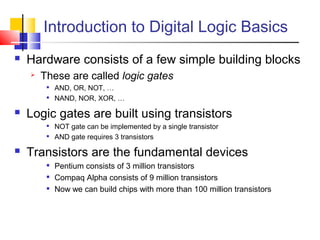
Introduction to Digital Logic Basics
 Hardware consists of a few simple building blocks
 These are called logic gates

AND, OR, NOT, …

NAND, NOR, XOR, …
 Logic gates are built using transistors

NOT gate can be implemented by a single transistor

AND gate requires 3 transistors
 Transistors are the fundamental devices

Pentium consists of 3 million transistors

Compaq Alpha consists of 9 million transistors

Now we can build chips with more than 100 million transistors
Basic Concepts
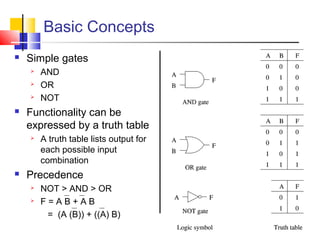
 Simple gates
 AND
 OR
 NOT
 Functionality can be
expressed by a truth table
 A truth table lists output for
each possible input
combination
 Precedence
 NOT > AND > OR
 F = A B + A B
= (A (B)) + ((A) B)
Basic Concepts (cont.)
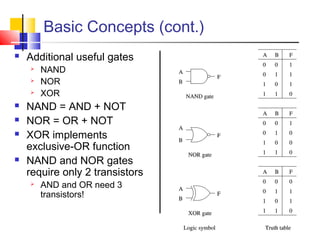
 Additional useful gates
 NAND
 NOR
 XOR
 NAND = AND + NOT
 NOR = OR + NOT
 XOR implements
exclusive-OR function
 NAND and NOR gates
require only 2 transistors
 AND and OR need 3
transistors!
Basic Concepts (cont.)
 Number of functions
 With N logical variables, we can define
22
N
functions
 Some of them are useful

AND, NAND, NOR, XOR, …
 Some are not useful:

Output is always 1

Output is always 0
 “Number of functions” definition is useful in proving
completeness property
Basic Concepts (cont.)
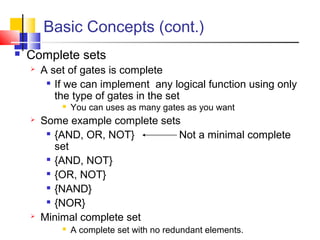
 Complete sets
 A set of gates is complete

If we can implement any logical function using only
the type of gates in the set
 You can uses as many gates as you want
 Some example complete sets

{AND, OR, NOT} Not a minimal complete
set

{AND, NOT}

{OR, NOT}

{NAND}

{NOR}
 Minimal complete set
 A complete set with no redundant elements.
Basic Concepts (cont.)
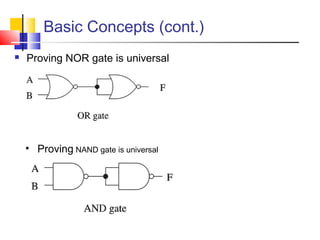
 Proving NOR gate is universal
• Proving NAND gate is universal
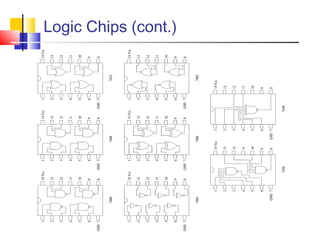
Logic Chips (cont.)
Logic Chips (cont.)
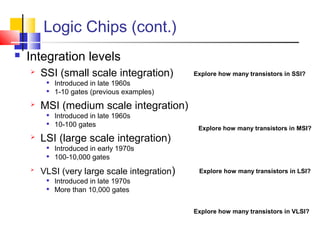
 Integration levels
 SSI (small scale integration)

Introduced in late 1960s

1-10 gates (previous examples)
 MSI (medium scale integration)

Introduced in late 1960s

10-100 gates
 LSI (large scale integration)

Introduced in early 1970s

100-10,000 gates

VLSI (very large scale integration)

Introduced in late 1970s

More than 10,000 gates
Explore how many transistors in SSI?
Explore how many transistors in MSI?
Explore how many transistors in LSI?
Explore how many transistors in VLSI?
Logic Functions
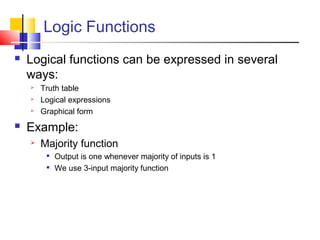
 Logical functions can be expressed in several
ways:
 Truth table
 Logical expressions
 Graphical form
 Example:
 Majority function

Output is one whenever majority of inputs is 1

We use 3-input majority function
Logic Functions (cont.)
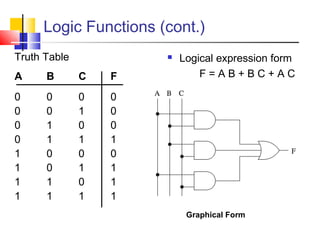
Truth Table
A B C F
0 0 0 0
0 0 1 0
0 1 0 0
0 1 1 1
1 0 0 0
1 0 1 1
1 1 0 1
1 1 1 1
 Logical expression form
F = A B + B C + A C
Graphical Form
Logical Equivalence
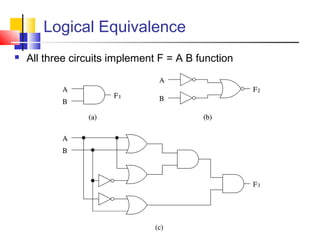
 All three circuits implement F = A B function
Logical Equivalence (cont.)
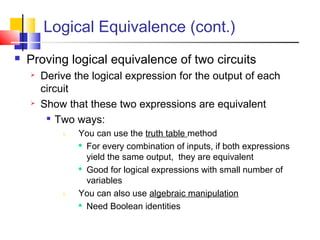
 Proving logical equivalence of two circuits
 Derive the logical expression for the output of each
circuit
 Show that these two expressions are equivalent

Two ways:
1. You can use the truth table method

For every combination of inputs, if both expressions
yield the same output, they are equivalent

Good for logical expressions with small number of
variables
1. You can also use algebraic manipulation

Need Boolean identities
Logical Equivalence (cont.)
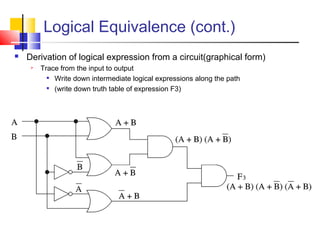
 Derivation of logical expression from a circuit(graphical form)
 Trace from the input to output

Write down intermediate logical expressions along the path

(write down truth table of expression F3)
Logical Equivalence (cont.)
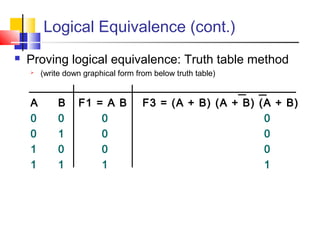
 Proving logical equivalence: Truth table method
 (write down graphical form from below truth table)
A B F1 = A B F3 = (A + B) (A + B) (A + B)
0 0 0 0
0 1 0 0
1 0 0 0
1 1 1 1
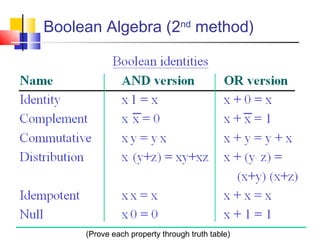
Boolean Algebra (2nd
method)
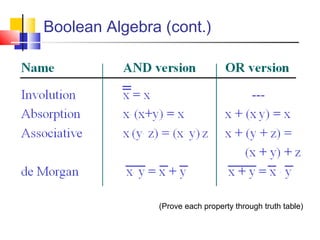
(Prove each property through truth table)
Boolean Algebra (cont.)
(Prove each property through truth table)
Boolean Algebra (cont.)
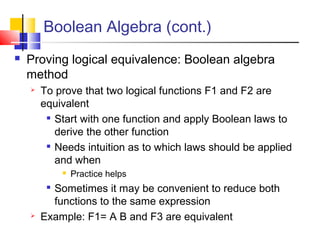
 Proving logical equivalence: Boolean algebra
method
 To prove that two logical functions F1 and F2 are
equivalent

Start with one function and apply Boolean laws to
derive the other function

Needs intuition as to which laws should be applied
and when
 Practice helps

Sometimes it may be convenient to reduce both
functions to the same expression
 Example: F1= A B and F3 are equivalent
Logic Circuit Design Process
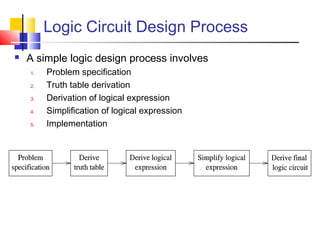
 A simple logic design process involves
1. Problem specification
2. Truth table derivation
3. Derivation of logical expression
4. Simplification of logical expression
5. Implementation
Deriving Logical Expressions
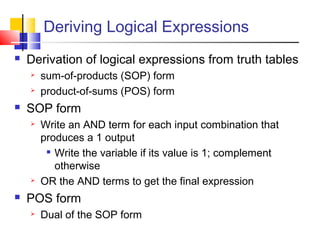
 Derivation of logical expressions from truth tables
 sum-of-products (SOP) form
 product-of-sums (POS) form
 SOP form
 Write an AND term for each input combination that
produces a 1 output

Write the variable if its value is 1; complement
otherwise
 OR the AND terms to get the final expression
 POS form
 Dual of the SOP form
Deriving Logical Expressions (cont.)
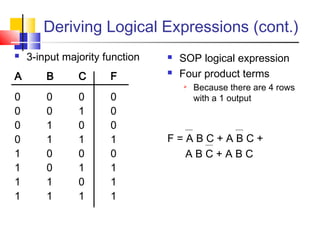
 3-input majority function
A B C F
0 0 0 0
0 0 1 0
0 1 0 0
0 1 1 1
1 0 0 0
1 0 1 1
1 1 0 1
1 1 1 1
 SOP logical expression
 Four product terms
 Because there are 4 rows
with a 1 output
F = A B C + A B C +
A B C + A B C
Deriving Logical Expressions (cont.)
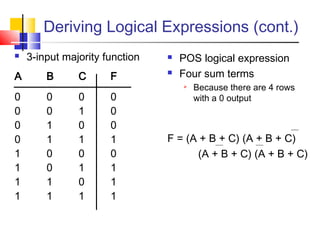
 3-input majority function
A B C F
0 0 0 0
0 0 1 0
0 1 0 0
0 1 1 1
1 0 0 0
1 0 1 1
1 1 0 1
1 1 1 1
 POS logical expression
 Four sum terms
 Because there are 4 rows
with a 0 output
F = (A + B + C) (A + B + C)
(A + B + C) (A + B + C)
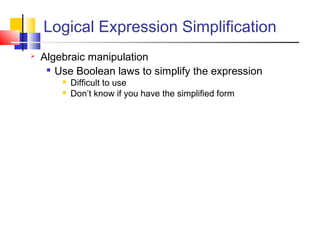
Logical Expression Simplification
 Algebraic manipulation

Use Boolean laws to simplify the expression
 Difficult to use
 Don’t know if you have the simplified form
Algebraic Manipulation
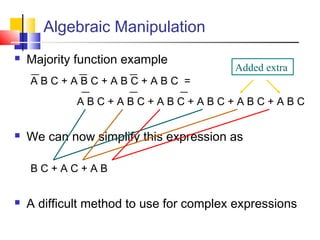
 Majority function example
A B C + A B C + A B C + A B C =
A B C + A B C + A B C + A B C + A B C + A B C
 We can now simplify this expression as
B C + A C + A B
 A difficult method to use for complex expressions
Added extra
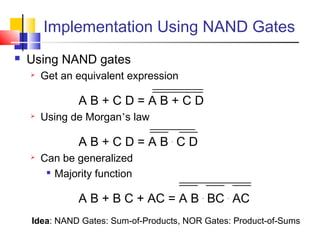
Implementation Using NAND Gates
 Using NAND gates
 Get an equivalent expression
A B + C D = A B + C D
 Using de Morgan’s law
A B + C D = A B .
C D
 Can be generalized

Majority function
A B + B C + AC = A B .
BC .
AC
Idea: NAND Gates: Sum-of-Products, NOR Gates: Product-of-Sums
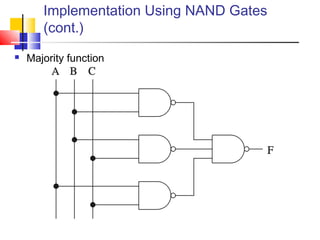
Implementation Using NAND Gates
(cont.)
 Majority function
Introduction to Combinational Circuits
 Combinational circuits

Output depends only on the current inputs
 Combinational circuits provide a higher level of
abstraction
 Help in reducing design complexity
 Reduce chip count
 We look at some useful combinational circuits
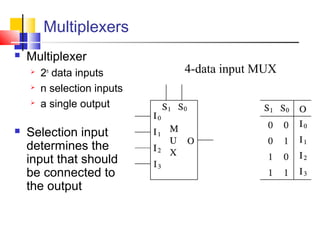
Multiplexers
 Multiplexer
 2n
data inputs
 n selection inputs
 a single output
 Selection input
determines the
input that should
be connected to
the output
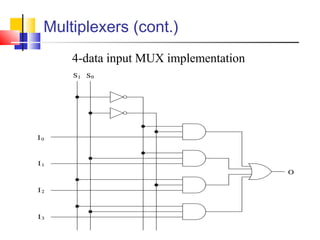
4-data input MUX
Multiplexers (cont.)
4-data input MUX implementation
Multiplexers (cont.)
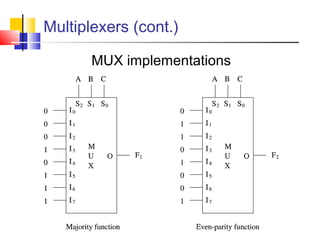
MUX implementations
Multiplexers (cont.)
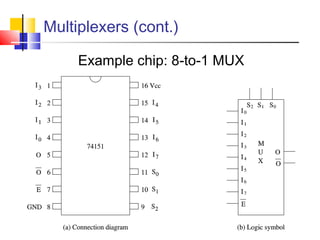
Example chip: 8-to-1 MUX
Multiplexers (cont.)
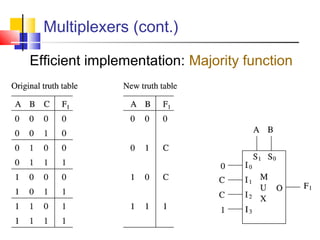
Efficient implementation: Majority function
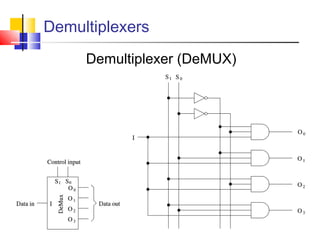
Demultiplexers
Demultiplexer (DeMUX)
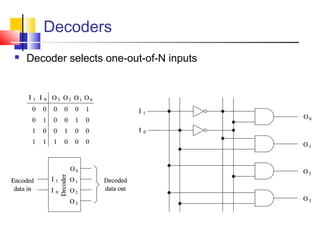
Decoders
 Decoder selects one-out-of-N inputs
Decoders (cont.)
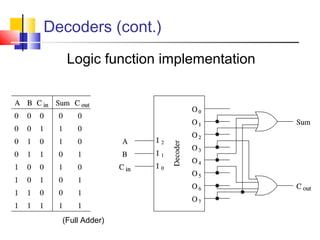
Logic function implementation
(Full Adder)
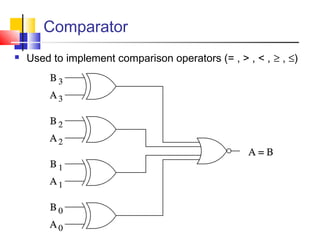
Comparator
 Used to implement comparison operators (= , > , < , ≥ , ≤)
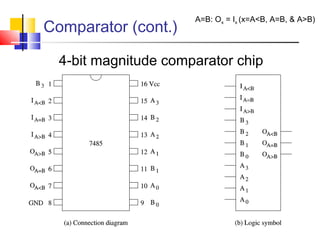
Comparator (cont.)
4-bit magnitude comparator chip
A=B: Ox = Ix (x=A<B, A=B, & A>B)
Comparator (cont.)
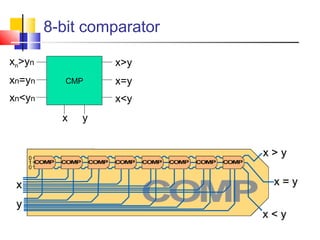
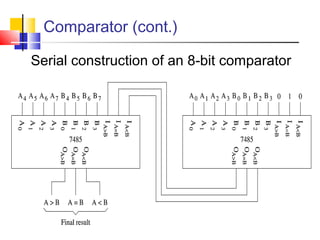
Serial construction of an 8-bit comparator
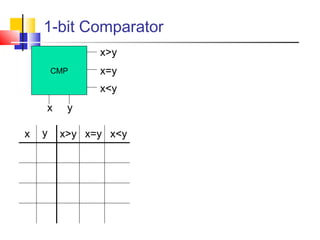
1-bit Comparator
x y
x>y
x=y
x<y
x y x>y x=y x<y
CMP
8-bit comparator
x y
x>y
x=y
x<y
CMP
xn>yn
xn=yn
xn<yn
Adders
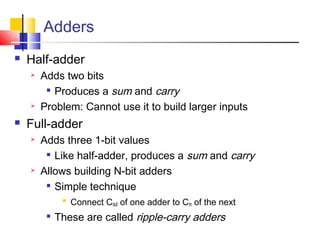
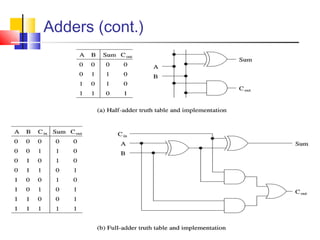
 Half-adder
 Adds two bits

Produces a sum and carry
 Problem: Cannot use it to build larger inputs
 Full-adder
 Adds three 1-bit values

Like half-adder, produces a sum and carry
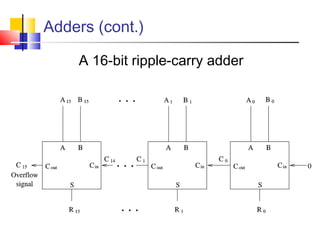
 Allows building N-bit adders

Simple technique

Connect Cout of one adder to Cin of the next

These are called ripple-carry adders
Adders (cont.)
Adders (cont.)
A 16-bit ripple-carry adder
Adders (cont.)
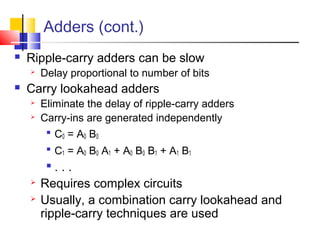
 Ripple-carry adders can be slow
 Delay proportional to number of bits
 Carry lookahead adders
 Eliminate the delay of ripple-carry adders
 Carry-ins are generated independently

C0 = A0 B0

C1 = A0 B0 A1 + A0 B0 B1 + A1 B1

. . .
 Requires complex circuits
 Usually, a combination carry lookahead and
ripple-carry techniques are used
1-bit Arithmetic and Logic Unit
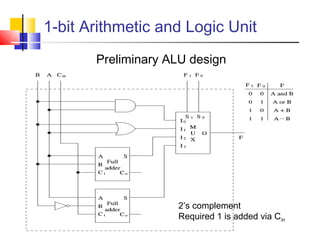
Preliminary ALU design
2’s complement
Required 1 is added via Cin
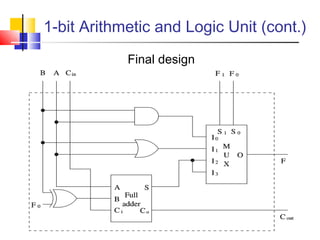
1-bit Arithmetic and Logic Unit (cont.)
Final design
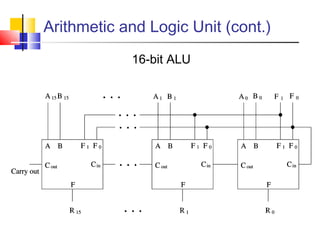
Arithmetic and Logic Unit (cont.)
16-bit ALU
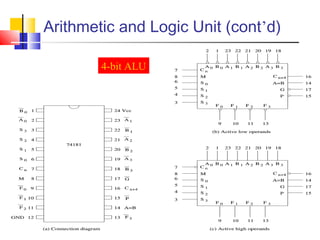
Arithmetic and Logic Unit (cont’d)
4-bit ALU

Lec 2 digital basics

  • 1.
    Lecture 2 Digital LogicDesign  Basics  Combinational Circuits  Sequential Circuits Thanks to Adapted from the slides prepared by S. Dandamudi for the book, Fundamentals of Computer Organization and Design. Inam Ul-Haq Senior Lecturer in Computer Science University of Education Okara Campus Inam.bth@gmail.com Member at IEEE & ACM
  • 2.
    Introduction to DigitalLogic Basics  Hardware consists of a few simple building blocks  These are called logic gates  AND, OR, NOT, …  NAND, NOR, XOR, …  Logic gates are built using transistors  NOT gate can be implemented by a single transistor  AND gate requires 3 transistors  Transistors are the fundamental devices  Pentium consists of 3 million transistors  Compaq Alpha consists of 9 million transistors  Now we can build chips with more than 100 million transistors
  • 3.
    Basic Concepts  Simplegates  AND  OR  NOT  Functionality can be expressed by a truth table  A truth table lists output for each possible input combination  Precedence  NOT > AND > OR  F = A B + A B = (A (B)) + ((A) B)
  • 4.
    Basic Concepts (cont.) Additional useful gates  NAND  NOR  XOR  NAND = AND + NOT  NOR = OR + NOT  XOR implements exclusive-OR function  NAND and NOR gates require only 2 transistors  AND and OR need 3 transistors!
  • 5.
    Basic Concepts (cont.) Number of functions  With N logical variables, we can define 22 N functions  Some of them are useful  AND, NAND, NOR, XOR, …  Some are not useful:  Output is always 1  Output is always 0  “Number of functions” definition is useful in proving completeness property
  • 6.
    Basic Concepts (cont.) Complete sets  A set of gates is complete  If we can implement any logical function using only the type of gates in the set  You can uses as many gates as you want  Some example complete sets  {AND, OR, NOT} Not a minimal complete set  {AND, NOT}  {OR, NOT}  {NAND}  {NOR}  Minimal complete set  A complete set with no redundant elements.
  • 7.
    Basic Concepts (cont.) Proving NOR gate is universal • Proving NAND gate is universal
  • 8.
  • 9.
    Logic Chips (cont.) Integration levels  SSI (small scale integration)  Introduced in late 1960s  1-10 gates (previous examples)  MSI (medium scale integration)  Introduced in late 1960s  10-100 gates  LSI (large scale integration)  Introduced in early 1970s  100-10,000 gates  VLSI (very large scale integration)  Introduced in late 1970s  More than 10,000 gates Explore how many transistors in SSI? Explore how many transistors in MSI? Explore how many transistors in LSI? Explore how many transistors in VLSI?
  • 10.
    Logic Functions  Logicalfunctions can be expressed in several ways:  Truth table  Logical expressions  Graphical form  Example:  Majority function  Output is one whenever majority of inputs is 1  We use 3-input majority function
  • 11.
    Logic Functions (cont.) TruthTable A B C F 0 0 0 0 0 0 1 0 0 1 0 0 0 1 1 1 1 0 0 0 1 0 1 1 1 1 0 1 1 1 1 1  Logical expression form F = A B + B C + A C Graphical Form
  • 12.
    Logical Equivalence  Allthree circuits implement F = A B function
  • 13.
    Logical Equivalence (cont.) Proving logical equivalence of two circuits  Derive the logical expression for the output of each circuit  Show that these two expressions are equivalent  Two ways: 1. You can use the truth table method  For every combination of inputs, if both expressions yield the same output, they are equivalent  Good for logical expressions with small number of variables 1. You can also use algebraic manipulation  Need Boolean identities
  • 14.
    Logical Equivalence (cont.) Derivation of logical expression from a circuit(graphical form)  Trace from the input to output  Write down intermediate logical expressions along the path  (write down truth table of expression F3)
  • 15.
    Logical Equivalence (cont.) Proving logical equivalence: Truth table method  (write down graphical form from below truth table) A B F1 = A B F3 = (A + B) (A + B) (A + B) 0 0 0 0 0 1 0 0 1 0 0 0 1 1 1 1
  • 16.
    Boolean Algebra (2nd method) (Proveeach property through truth table)
  • 17.
    Boolean Algebra (cont.) (Proveeach property through truth table)
  • 18.
    Boolean Algebra (cont.) Proving logical equivalence: Boolean algebra method  To prove that two logical functions F1 and F2 are equivalent  Start with one function and apply Boolean laws to derive the other function  Needs intuition as to which laws should be applied and when  Practice helps  Sometimes it may be convenient to reduce both functions to the same expression  Example: F1= A B and F3 are equivalent
  • 19.
    Logic Circuit DesignProcess  A simple logic design process involves 1. Problem specification 2. Truth table derivation 3. Derivation of logical expression 4. Simplification of logical expression 5. Implementation
  • 20.
    Deriving Logical Expressions Derivation of logical expressions from truth tables  sum-of-products (SOP) form  product-of-sums (POS) form  SOP form  Write an AND term for each input combination that produces a 1 output  Write the variable if its value is 1; complement otherwise  OR the AND terms to get the final expression  POS form  Dual of the SOP form
  • 21.
    Deriving Logical Expressions(cont.)  3-input majority function A B C F 0 0 0 0 0 0 1 0 0 1 0 0 0 1 1 1 1 0 0 0 1 0 1 1 1 1 0 1 1 1 1 1  SOP logical expression  Four product terms  Because there are 4 rows with a 1 output F = A B C + A B C + A B C + A B C
  • 22.
    Deriving Logical Expressions(cont.)  3-input majority function A B C F 0 0 0 0 0 0 1 0 0 1 0 0 0 1 1 1 1 0 0 0 1 0 1 1 1 1 0 1 1 1 1 1  POS logical expression  Four sum terms  Because there are 4 rows with a 0 output F = (A + B + C) (A + B + C) (A + B + C) (A + B + C)
  • 23.
    Logical Expression Simplification Algebraic manipulation  Use Boolean laws to simplify the expression  Difficult to use  Don’t know if you have the simplified form
  • 24.
    Algebraic Manipulation  Majorityfunction example A B C + A B C + A B C + A B C = A B C + A B C + A B C + A B C + A B C + A B C  We can now simplify this expression as B C + A C + A B  A difficult method to use for complex expressions Added extra
  • 25.
    Implementation Using NANDGates  Using NAND gates  Get an equivalent expression A B + C D = A B + C D  Using de Morgan’s law A B + C D = A B . C D  Can be generalized  Majority function A B + B C + AC = A B . BC . AC Idea: NAND Gates: Sum-of-Products, NOR Gates: Product-of-Sums
  • 26.
    Implementation Using NANDGates (cont.)  Majority function
  • 27.
    Introduction to CombinationalCircuits  Combinational circuits  Output depends only on the current inputs  Combinational circuits provide a higher level of abstraction  Help in reducing design complexity  Reduce chip count  We look at some useful combinational circuits
  • 28.
    Multiplexers  Multiplexer  2n datainputs  n selection inputs  a single output  Selection input determines the input that should be connected to the output 4-data input MUX
  • 29.
  • 30.
  • 31.
  • 32.
  • 33.
  • 34.
    Decoders  Decoder selectsone-out-of-N inputs
  • 35.
    Decoders (cont.) Logic functionimplementation (Full Adder)
  • 36.
    Comparator  Used toimplement comparison operators (= , > , < , ≥ , ≤)
  • 37.
    Comparator (cont.) 4-bit magnitudecomparator chip A=B: Ox = Ix (x=A<B, A=B, & A>B)
  • 38.
  • 39.
  • 40.
  • 41.
    Adders  Half-adder  Addstwo bits  Produces a sum and carry  Problem: Cannot use it to build larger inputs  Full-adder  Adds three 1-bit values  Like half-adder, produces a sum and carry  Allows building N-bit adders  Simple technique  Connect Cout of one adder to Cin of the next  These are called ripple-carry adders
  • 42.
  • 43.
    Adders (cont.) A 16-bitripple-carry adder
  • 44.
    Adders (cont.)  Ripple-carryadders can be slow  Delay proportional to number of bits  Carry lookahead adders  Eliminate the delay of ripple-carry adders  Carry-ins are generated independently  C0 = A0 B0  C1 = A0 B0 A1 + A0 B0 B1 + A1 B1  . . .  Requires complex circuits  Usually, a combination carry lookahead and ripple-carry techniques are used
  • 45.
    1-bit Arithmetic andLogic Unit Preliminary ALU design 2’s complement Required 1 is added via Cin
  • 46.
    1-bit Arithmetic andLogic Unit (cont.) Final design
  • 47.
    Arithmetic and LogicUnit (cont.) 16-bit ALU
  • 48.
    Arithmetic and LogicUnit (cont’d) 4-bit ALU