london management centre®
www.lmcuk.com®
®
lmc
®
Leading and Managing
Change
london management centre®
www.lmcuk.com®
®
lmc
®
Types of Change
There are two types of change: strategic and
operational.
• Strategic change is concerned with organisational
transformation.
– Analysing current state and planning future
state,
– Setting policies related to:
• quality,
• innovation
• People development,
• customer needs
• technologies
• product and process development,
• finance and human resource management.
london management centre®
www.lmcuk.com®
®
lmc
®
Types of Change
There are two types of change: strategic
and operational.
• Operational change relates to new systems,
procedures
– structures or technology which have an
immediate effect on working arrangements within
a part of the organisation.
– Their impact on people can be more significant
than the broader strategic change and have to be
handled just as carefully.
london management centre®
www.lmcuk.com®
®
lmc
®
Why do Organisations need to change?
• Survival
• Competition
• Change is now a constant
• Technology
• Innovation
• Limited resources
• Deregulation
• Privatisation
london management centre®
www.lmcuk.com®
®
lmc
®
External factors
• Economic situation
• Raw material shortages
• Legislation
• Technology
• Competition/market forces
• Customer behaviour
• Educational/expectations
• Environmental issues
london management centre®
www.lmcuk.com®
®
lmc
®
Why is change resisted
(in the workplace) some reasons
•Feeling threatened
•Feeling uncertain or insecure
•Not seeing any benefits
•Fear of redundancy, short time, etc
•Feeling present work is being criticised,
•‘Not good enough’
•Comfort/satisfaction with the present
•Fear of not being able to cope with new demands
•Fear that old work teams/relationships will
disappear
london management centre®
www.lmcuk.com®
®
lmc
®
Employee's Survival
Guide to Change
• Excerpt: "When change is happening to others, it can be interesting -- even
something good to talk about. However, when change is happening to you, it
can be worrisome and create uncertainty. Sometimes it can cause downright
fear about your job or your future”.
• So what does it take to be a survivor in today's rapidly
changing corporate environments:
– A solid understanding of the change process and your role in that
process.
– Answers to Qs that you and your fellow employees have about
change.
– A set of tools to help you manage change and navigate to the
outcome you want.
london management centre®
www.lmcuk.com®
®
lmc
®
What is a team,
• An ideal team may be defined as
– An energetic group of two or more people
who share and are aware they share a
common goal
– Who are committed to achieving that
common goal
– Who work well together
– And who produce high quality results.
“A team is a group of people with complementary
skills committed to achieving the same objectives
and abiding by the same values”
london management centre®
www.lmcuk.com®
®
lmc
®
Characteristics Evident, when
Teams are Operating Effectively:
• Team goals
• Participation
• Feedback
• Team decision making
• Leadership
• Problem solving,
• Conflict is not suppressed
• Team member resources
• Risk taking and creativity is encouraged
london management centre®
www.lmcuk.com®
®
lmc
®
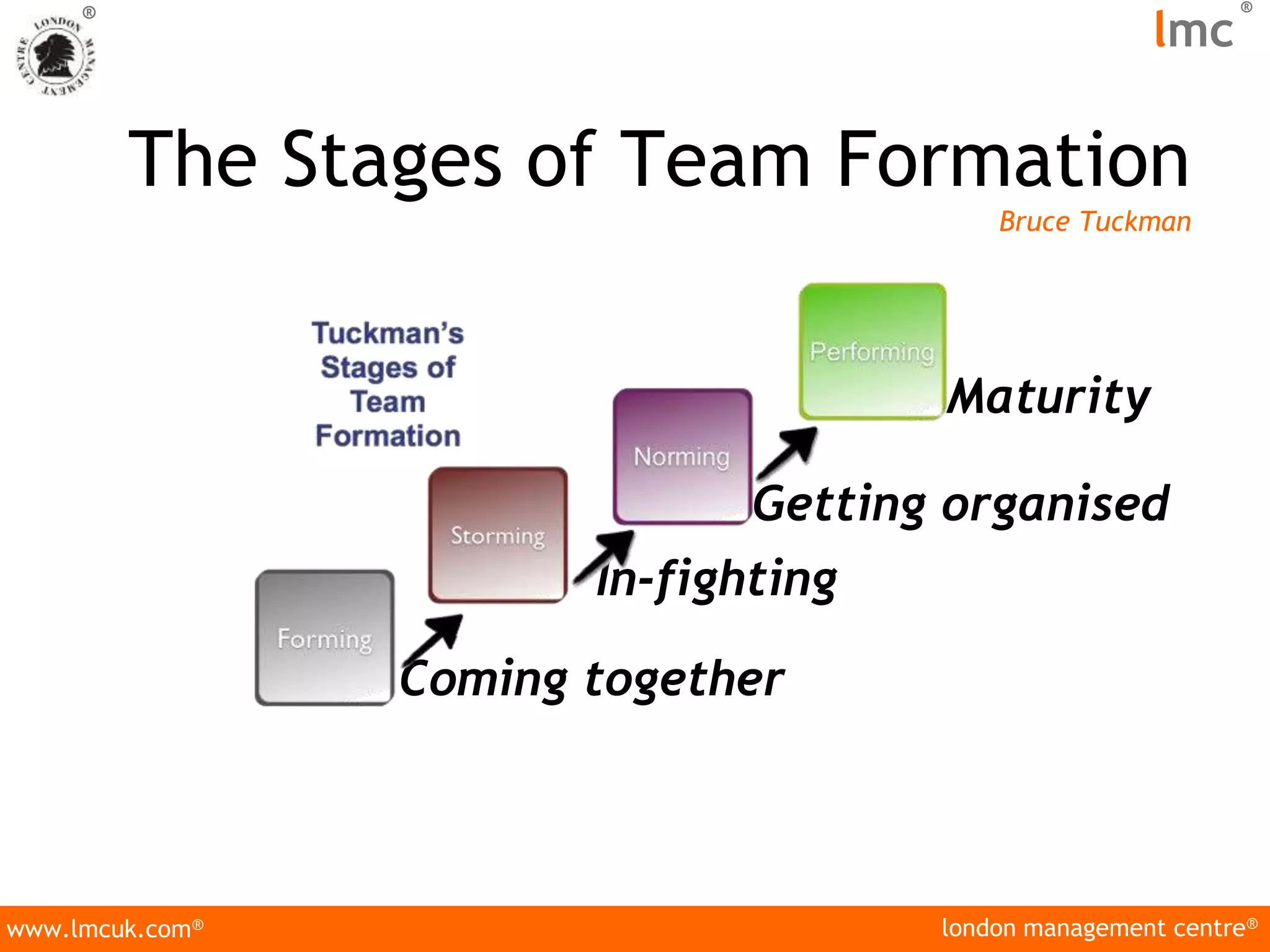
The Stages of Team Formation
Bruce Tuckman
Coming together
In-fighting
Getting organised
Maturity
london management centre®
www.lmcuk.com®
®
lmc
®
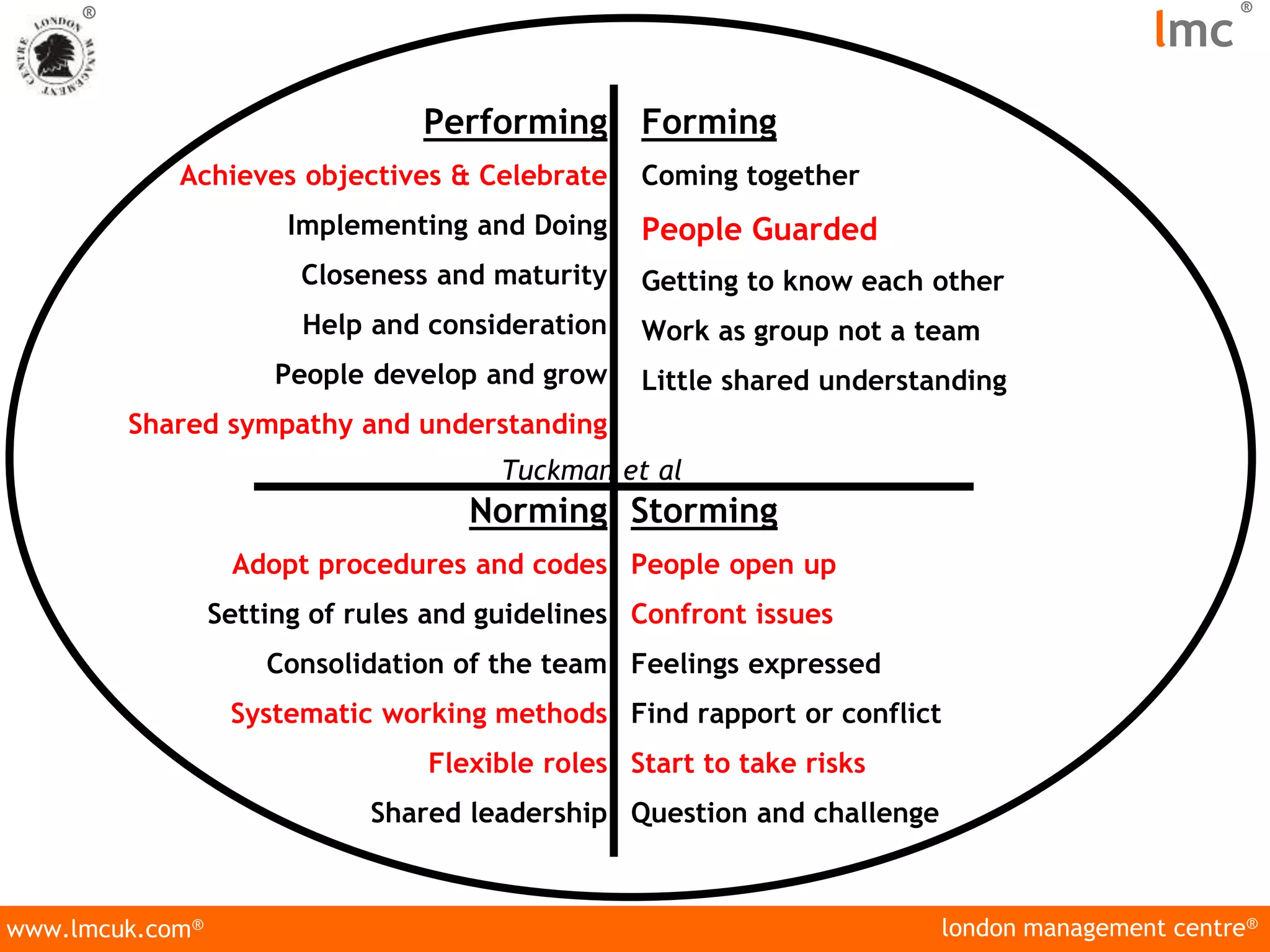
Forming
Coming together
People Guarded
Getting to know each other
Work as group not a team
Little shared understanding
Storming
People open up
Confront issues
Feelings expressed
Find rapport or conflict
Start to take risks
Question and challenge
Norming
Adopt procedures and codes
Setting of rules and guidelines
Consolidation of the team
Systematic working methods
Flexible roles
Shared leadership
Performing
Achieves objectives & Celebrate
Implementing and Doing
Closeness and maturity
Help and consideration
People develop and grow
Shared sympathy and understanding
Tuckman et al
london management centre®
www.lmcuk.com®
®
lmc
®
Why?
• More than 70% of all major
transformation/change efforts fail.
• Why?
• Because organisations do not take a consistent,
holistic approach to changing themselves, nor
do they engage their workforces effectively.
John Kotter
london management centre®
www.lmcuk.com®
®
lmc
®
Becoming a Positive Change
Agent
(change agents) – People who act as
catalysts for change…
As Malcom Gladwell describes in his
book, “The Tipping Point“, he states:
The success of any kind of social
epidemic is heavily dependent on the
involvement of people with a particular
and rare set of social gifts.
london management centre®
www.lmcuk.com®
®
lmc
®
Change Agents
• 5 Characteristics of a Change Agent
– Clear Vision
– Patient yet persistent
– Asks tough questions
– Knowledgeable and leads by example
– Strong relationships built on trust
london management centre®
www.lmcuk.com®
®
lmc
®
“Everyone thinks of
changing the world, but no
one thinks of changing
himself.”
Leo Tolstoy

Leading and Managing Change in Your Business

  • 1.
  • 2.
    london management centre® www.lmcuk.com® ® lmc ® Typesof Change There are two types of change: strategic and operational. • Strategic change is concerned with organisational transformation. – Analysing current state and planning future state, – Setting policies related to: • quality, • innovation • People development, • customer needs • technologies • product and process development, • finance and human resource management.
  • 3.
    london management centre® www.lmcuk.com® ® lmc ® Typesof Change There are two types of change: strategic and operational. • Operational change relates to new systems, procedures – structures or technology which have an immediate effect on working arrangements within a part of the organisation. – Their impact on people can be more significant than the broader strategic change and have to be handled just as carefully.
  • 4.
    london management centre® www.lmcuk.com® ® lmc ® Whydo Organisations need to change? • Survival • Competition • Change is now a constant • Technology • Innovation • Limited resources • Deregulation • Privatisation
  • 5.
    london management centre® www.lmcuk.com® ® lmc ® Externalfactors • Economic situation • Raw material shortages • Legislation • Technology • Competition/market forces • Customer behaviour • Educational/expectations • Environmental issues
  • 6.
    london management centre® www.lmcuk.com® ® lmc ® Whyis change resisted (in the workplace) some reasons •Feeling threatened •Feeling uncertain or insecure •Not seeing any benefits •Fear of redundancy, short time, etc •Feeling present work is being criticised, •‘Not good enough’ •Comfort/satisfaction with the present •Fear of not being able to cope with new demands •Fear that old work teams/relationships will disappear
  • 7.
    london management centre® www.lmcuk.com® ® lmc ® Employee'sSurvival Guide to Change • Excerpt: "When change is happening to others, it can be interesting -- even something good to talk about. However, when change is happening to you, it can be worrisome and create uncertainty. Sometimes it can cause downright fear about your job or your future”. • So what does it take to be a survivor in today's rapidly changing corporate environments: – A solid understanding of the change process and your role in that process. – Answers to Qs that you and your fellow employees have about change. – A set of tools to help you manage change and navigate to the outcome you want.
  • 8.
    london management centre® www.lmcuk.com® ® lmc ® Whatis a team, • An ideal team may be defined as – An energetic group of two or more people who share and are aware they share a common goal – Who are committed to achieving that common goal – Who work well together – And who produce high quality results. “A team is a group of people with complementary skills committed to achieving the same objectives and abiding by the same values”
  • 9.
    london management centre® www.lmcuk.com® ® lmc ® CharacteristicsEvident, when Teams are Operating Effectively: • Team goals • Participation • Feedback • Team decision making • Leadership • Problem solving, • Conflict is not suppressed • Team member resources • Risk taking and creativity is encouraged
  • 10.
    london management centre® www.lmcuk.com® ® lmc ® TheStages of Team Formation Bruce Tuckman Coming together In-fighting Getting organised Maturity
  • 11.
    london management centre® www.lmcuk.com® ® lmc ® Forming Comingtogether People Guarded Getting to know each other Work as group not a team Little shared understanding Storming People open up Confront issues Feelings expressed Find rapport or conflict Start to take risks Question and challenge Norming Adopt procedures and codes Setting of rules and guidelines Consolidation of the team Systematic working methods Flexible roles Shared leadership Performing Achieves objectives & Celebrate Implementing and Doing Closeness and maturity Help and consideration People develop and grow Shared sympathy and understanding Tuckman et al
  • 12.
    london management centre® www.lmcuk.com® ® lmc ® Why? •More than 70% of all major transformation/change efforts fail. • Why? • Because organisations do not take a consistent, holistic approach to changing themselves, nor do they engage their workforces effectively. John Kotter
  • 13.
    london management centre® www.lmcuk.com® ® lmc ® Becominga Positive Change Agent (change agents) – People who act as catalysts for change… As Malcom Gladwell describes in his book, “The Tipping Point“, he states: The success of any kind of social epidemic is heavily dependent on the involvement of people with a particular and rare set of social gifts.
  • 14.
    london management centre® www.lmcuk.com® ® lmc ® ChangeAgents • 5 Characteristics of a Change Agent – Clear Vision – Patient yet persistent – Asks tough questions – Knowledgeable and leads by example – Strong relationships built on trust
  • 15.
    london management centre® www.lmcuk.com® ® lmc ® “Everyonethinks of changing the world, but no one thinks of changing himself.” Leo Tolstoy