Applications not forHadoop
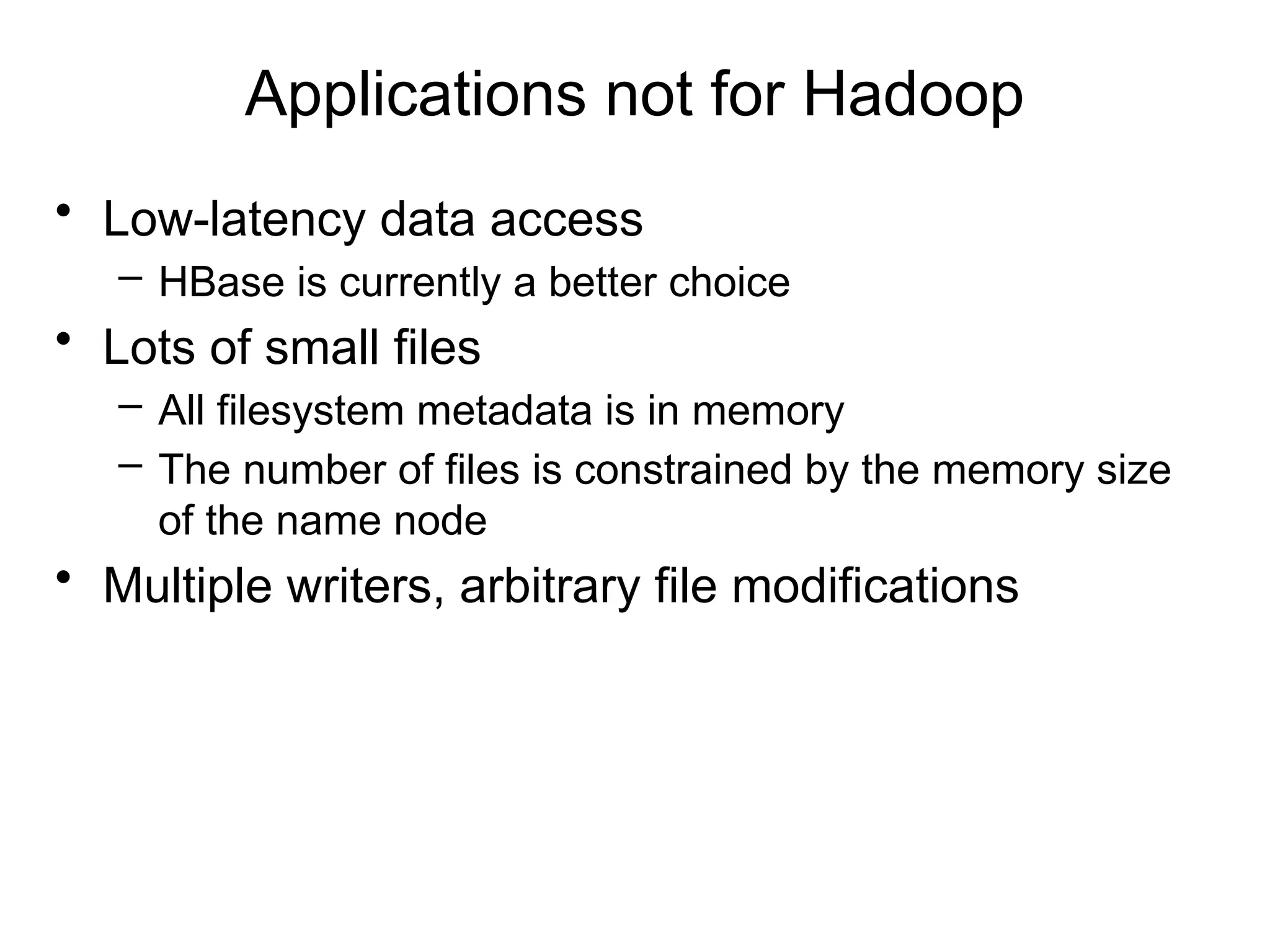
• Low-latency data access
– HBase is currently a better choice
• Lots of small files
– All filesystem metadata is in memory
– The number of files is constrained by the memory size
of the name node
• Multiple writers, arbitrary file modifications
5.
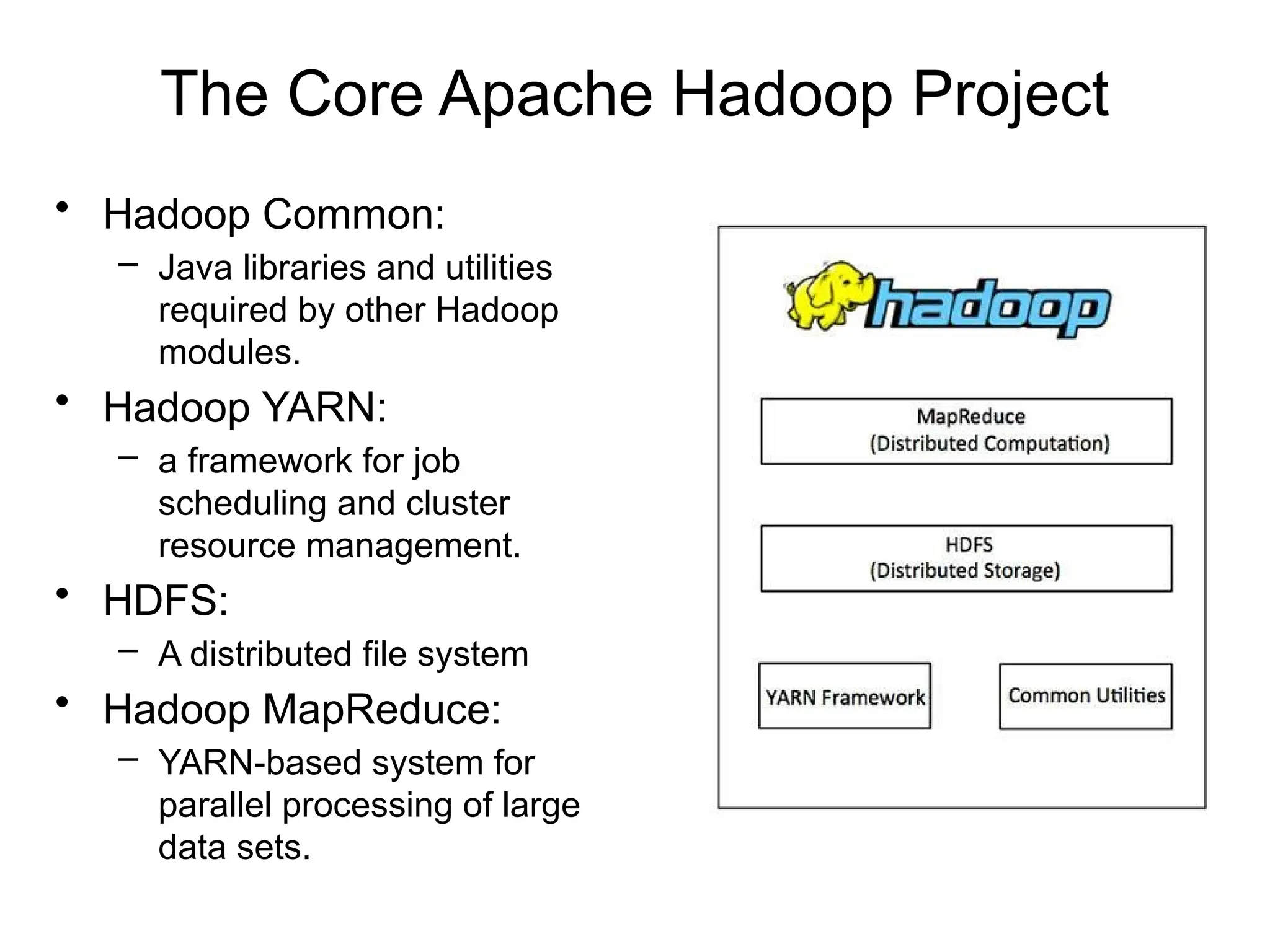
The Core ApacheHadoop Project
• Hadoop Common:
– Java libraries and utilities
required by other Hadoop
modules.
• Hadoop YARN:
– a framework for job
scheduling and cluster
resource management.
• HDFS:
– A distributed file system
• Hadoop MapReduce:
– YARN-based system for
parallel processing of large
data sets.
6.
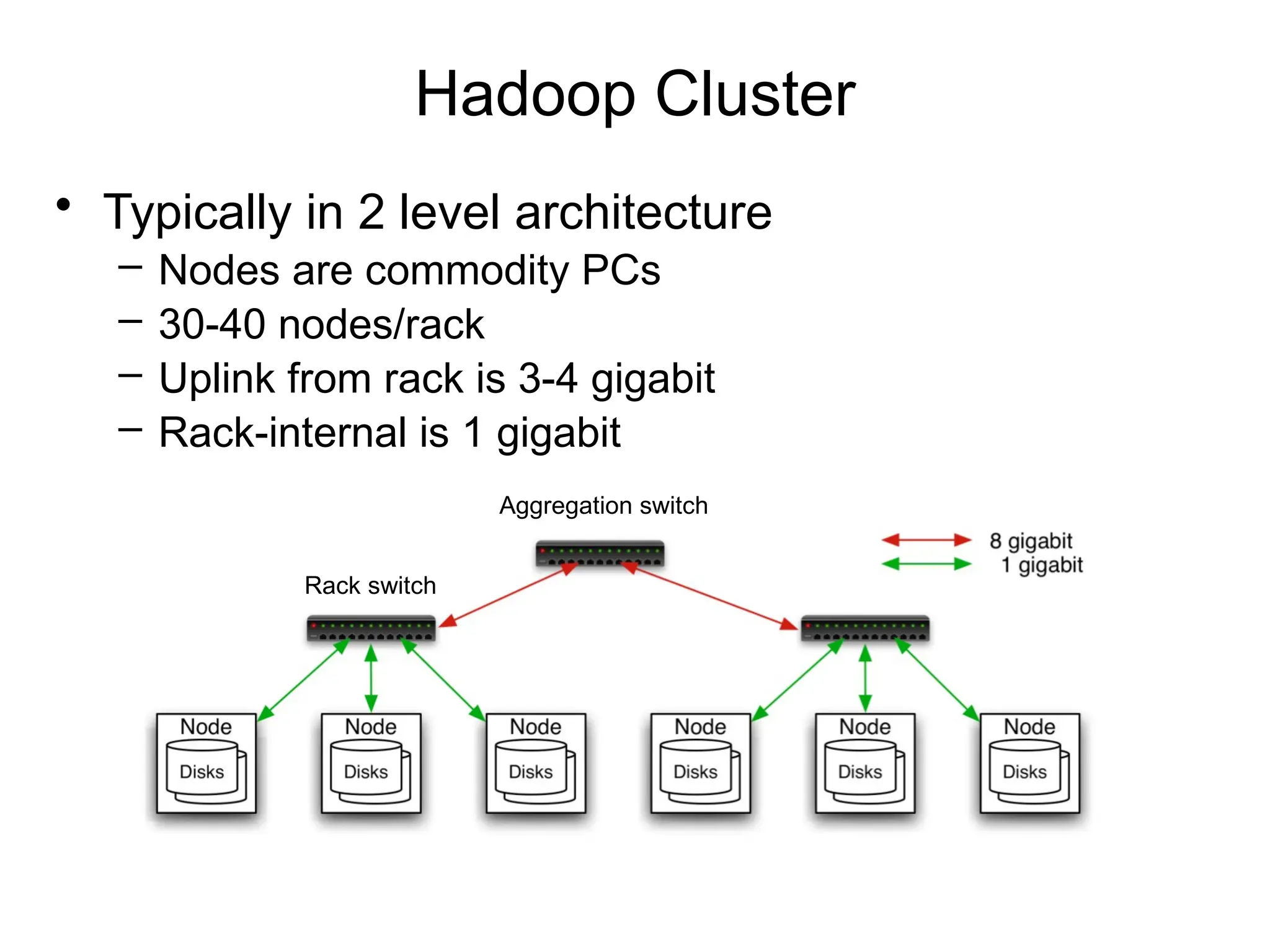
Hadoop Cluster
• Typicallyin 2 level architecture
– Nodes are commodity PCs
– 30-40 nodes/rack
– Uplink from rack is 3-4 gigabit
– Rack-internal is 1 gigabit
Aggregation switch
Rack switch
7.
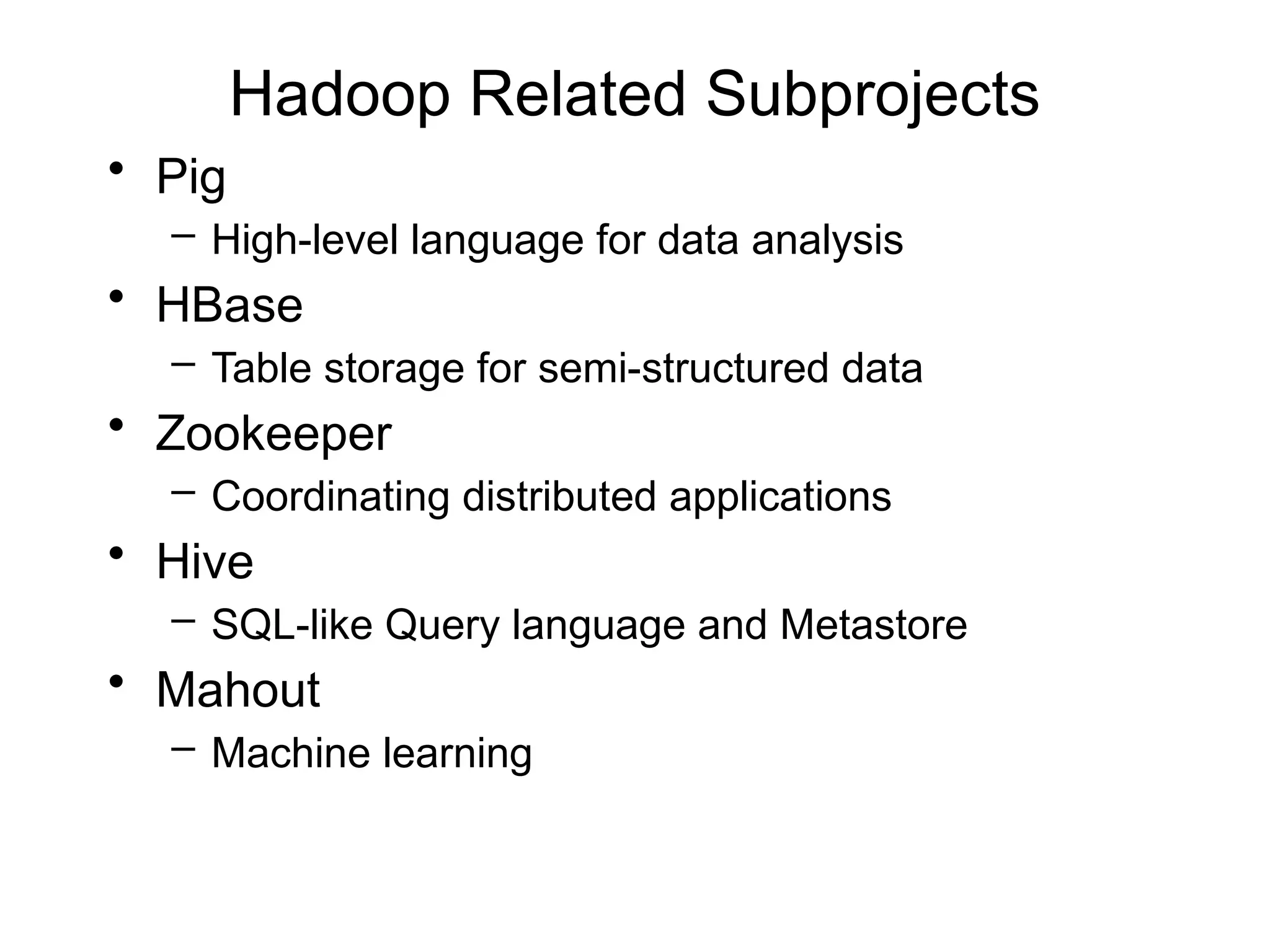
Hadoop Related Subprojects
•Pig
– High-level language for data analysis
• HBase
– Table storage for semi-structured data
• Zookeeper
– Coordinating distributed applications
• Hive
– SQL-like Query language and Metastore
• Mahout
– Machine learning
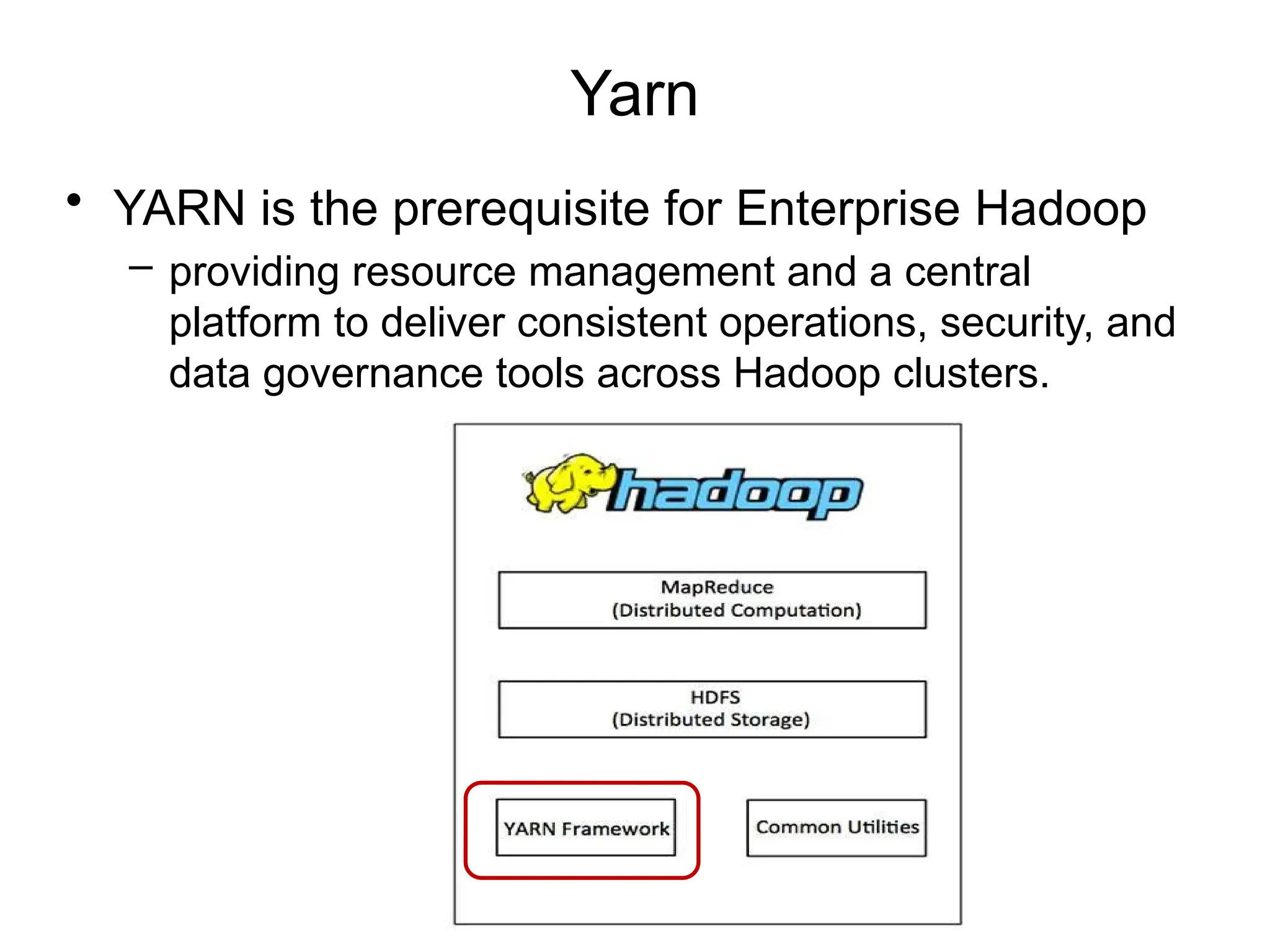
Yarn
• YARN isthe prerequisite for Enterprise Hadoop
– providing resource management and a central
platform to deliver consistent operations, security, and
data governance tools across Hadoop clusters.
10.
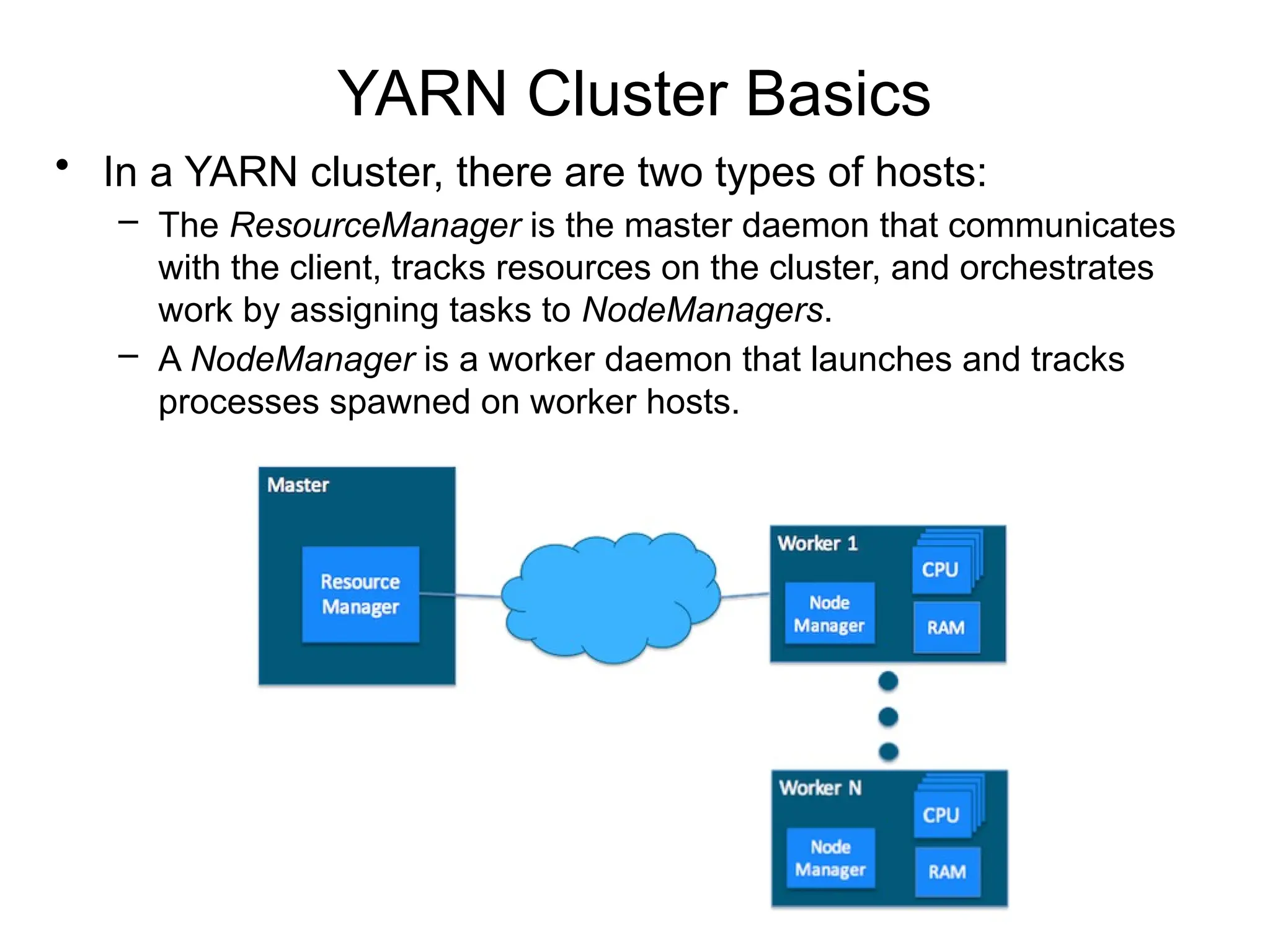
YARN Cluster Basics
•In a YARN cluster, there are two types of hosts:
– The ResourceManager is the master daemon that communicates
with the client, tracks resources on the cluster, and orchestrates
work by assigning tasks to NodeManagers.
– A NodeManager is a worker daemon that launches and tracks
processes spawned on worker hosts.
11.
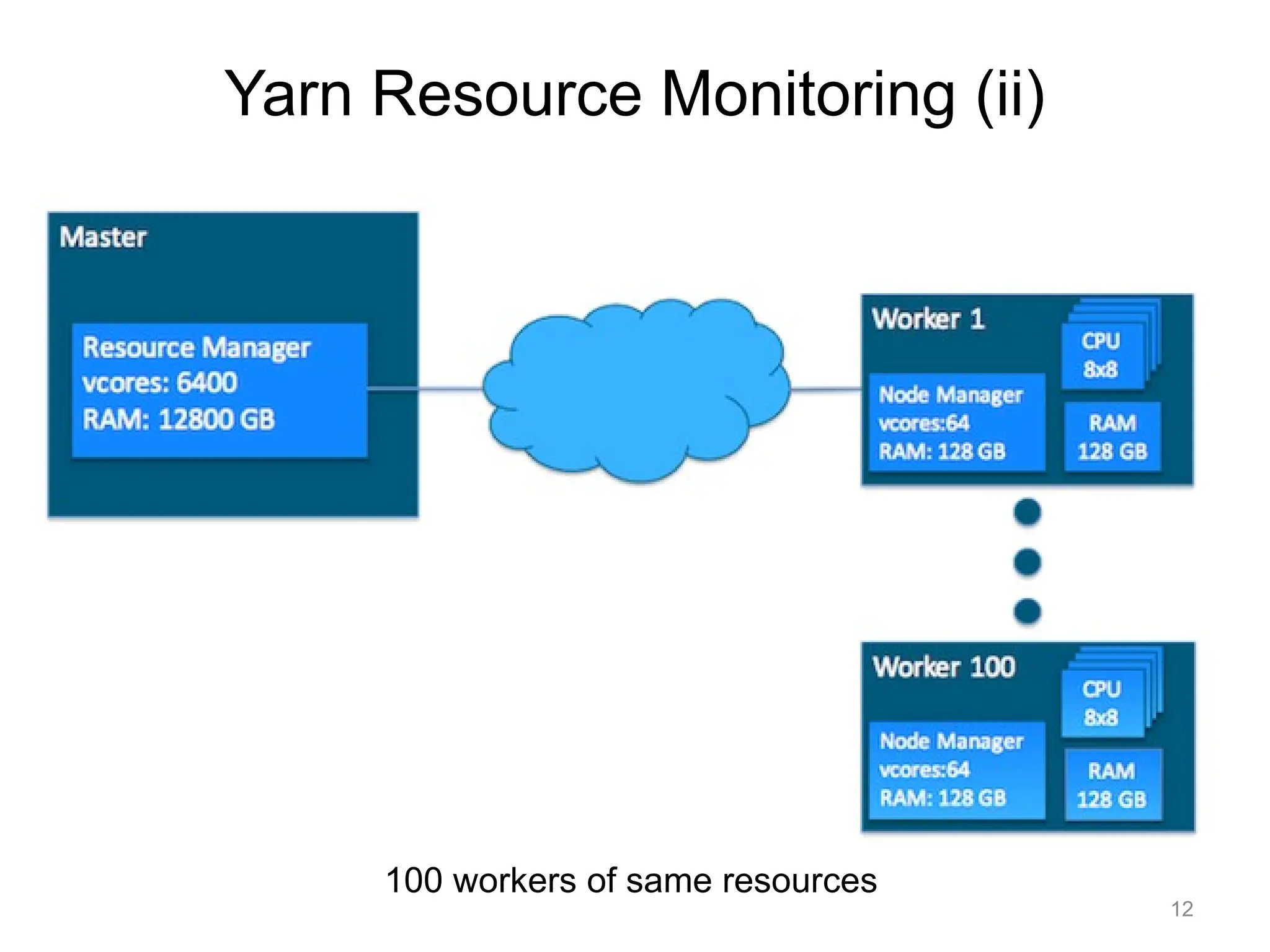
11
• YARN currentlydefines two resources:
– v-cores
– memory.
• Each NodeManager tracks
– its own local resources and
– communicates its resource configuration to the
ResourceManager
• The ResourceManager keeps
– a running total of the cluster’s available resources.
Yarn Resource Monitoring (i)
13
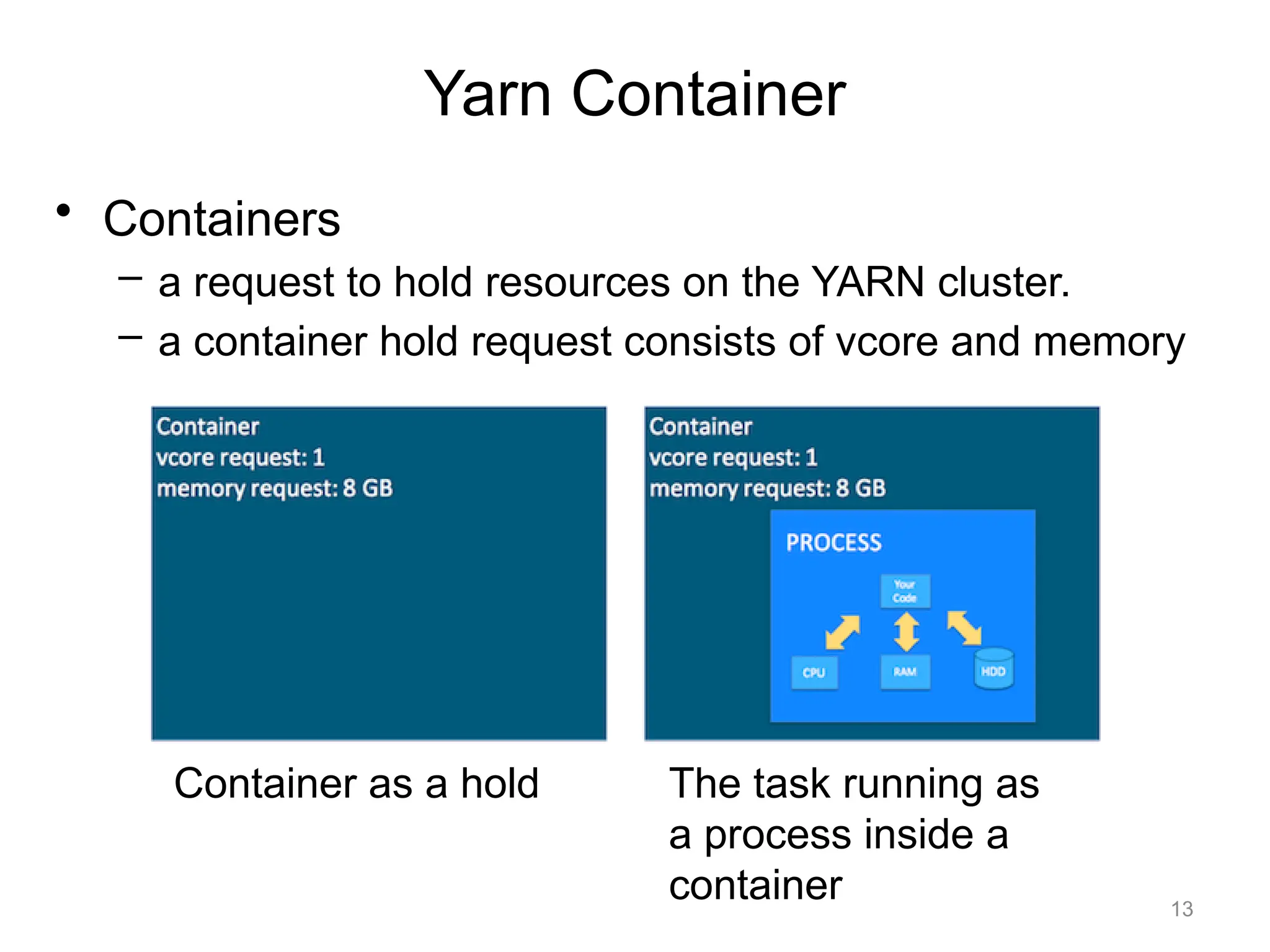
• Containers
– arequest to hold resources on the YARN cluster.
– a container hold request consists of vcore and memory
Yarn Container
Container as a hold The task running as
a process inside a
container
14.
14
• Yarn application
–It is a YARN client program that is made up of one or
more tasks
– Example: MapReduce Application
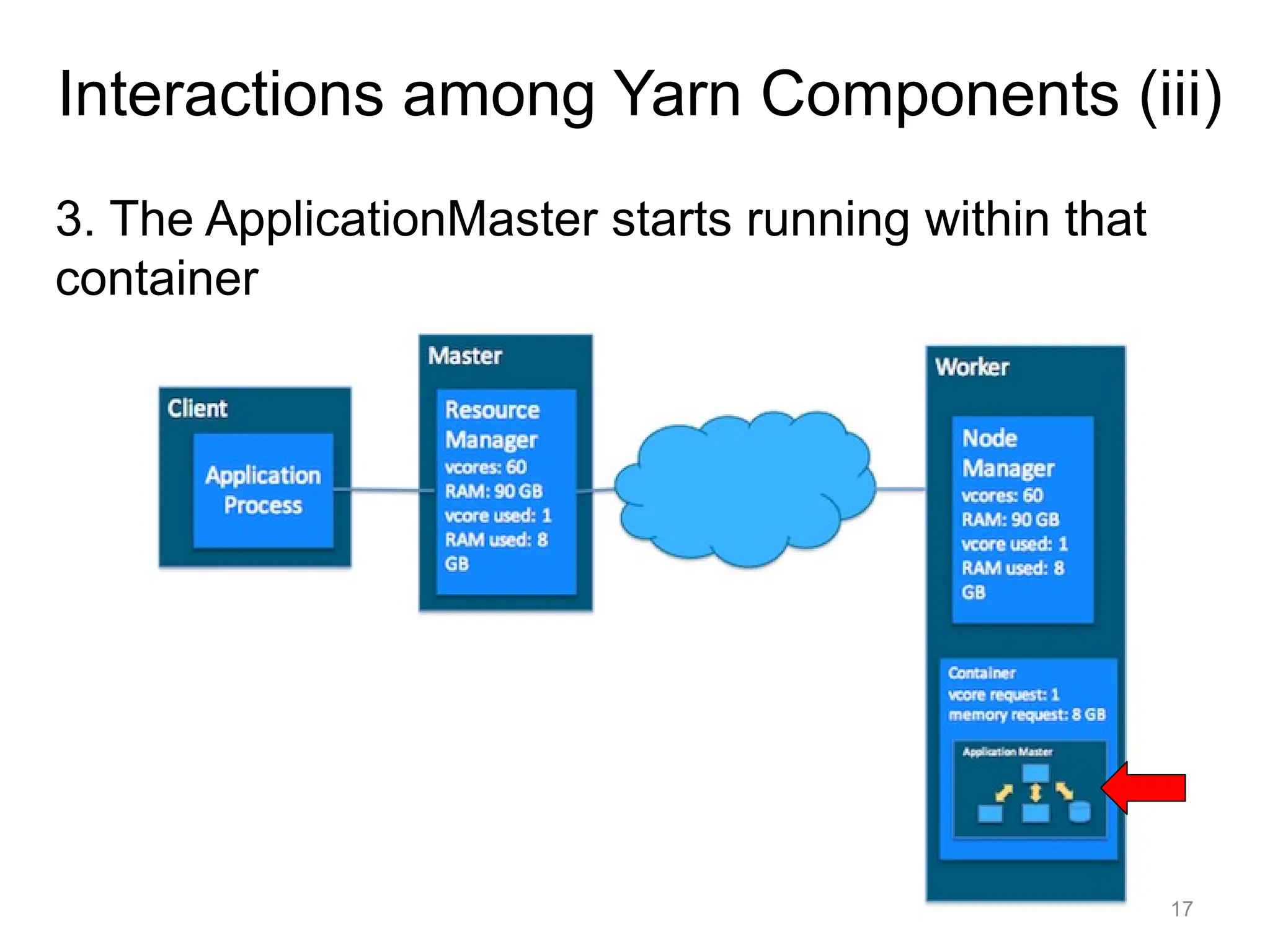
• ApplicationMaster
– It helps coordinate tasks on the YARN cluster for each
running application
– It is the first process run after the application starts.
Yarn Application and ApplicationMaster
15.
15
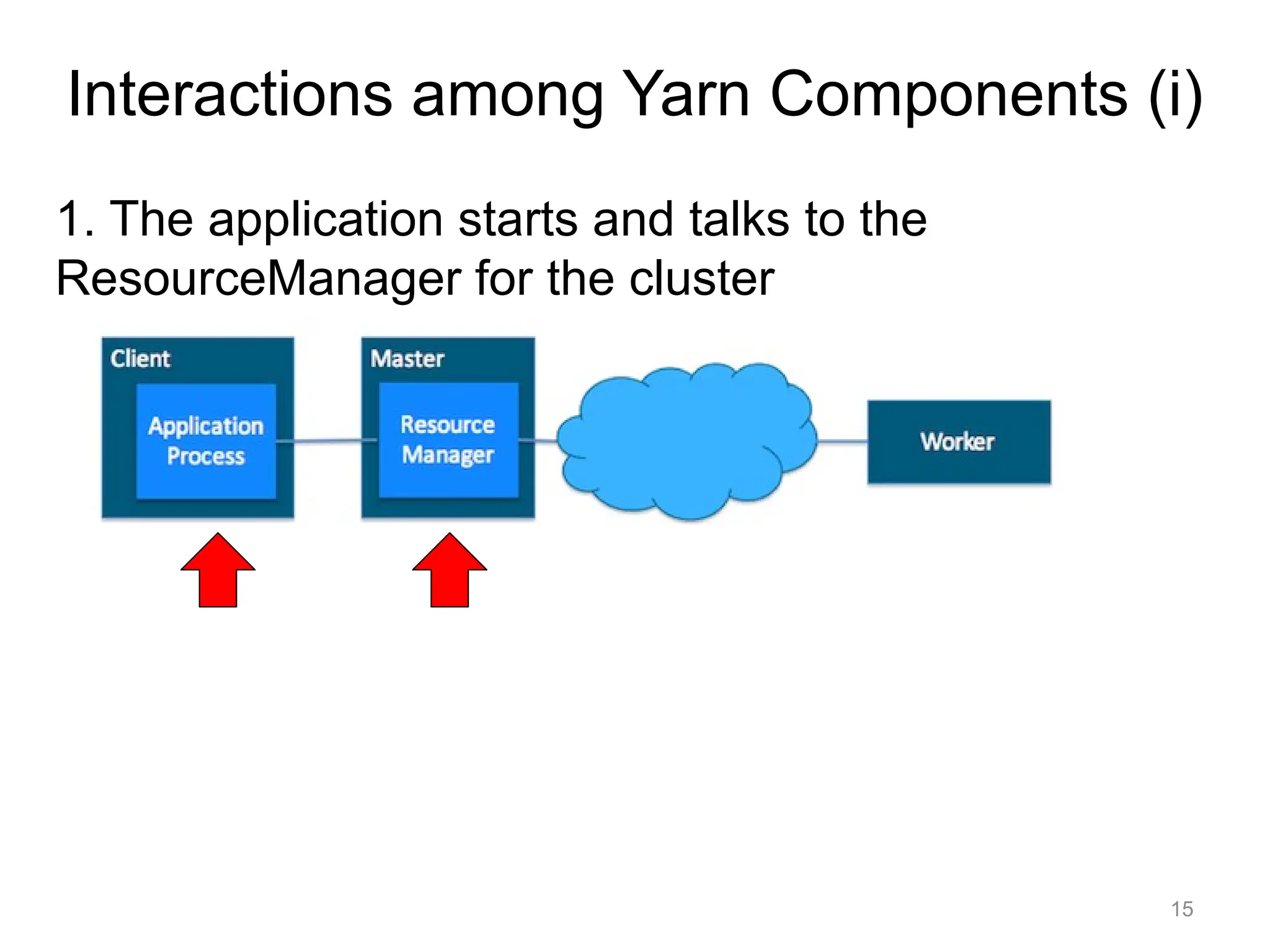
1. The applicationstarts and talks to the
ResourceManager for the cluster
Interactions among Yarn Components (i)
16.
16
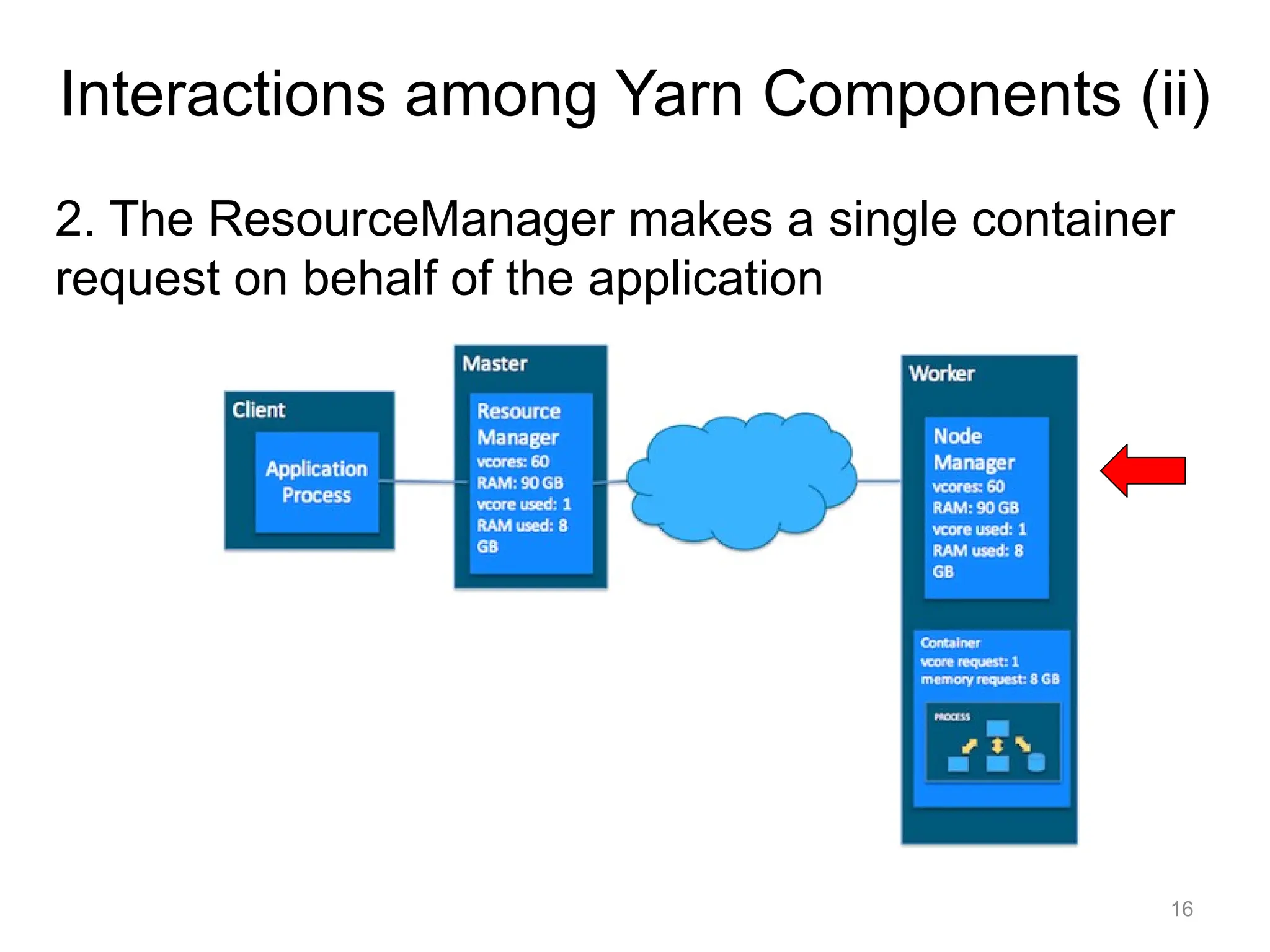
2. The ResourceManagermakes a single container
request on behalf of the application
Interactions among Yarn Components (ii)
18
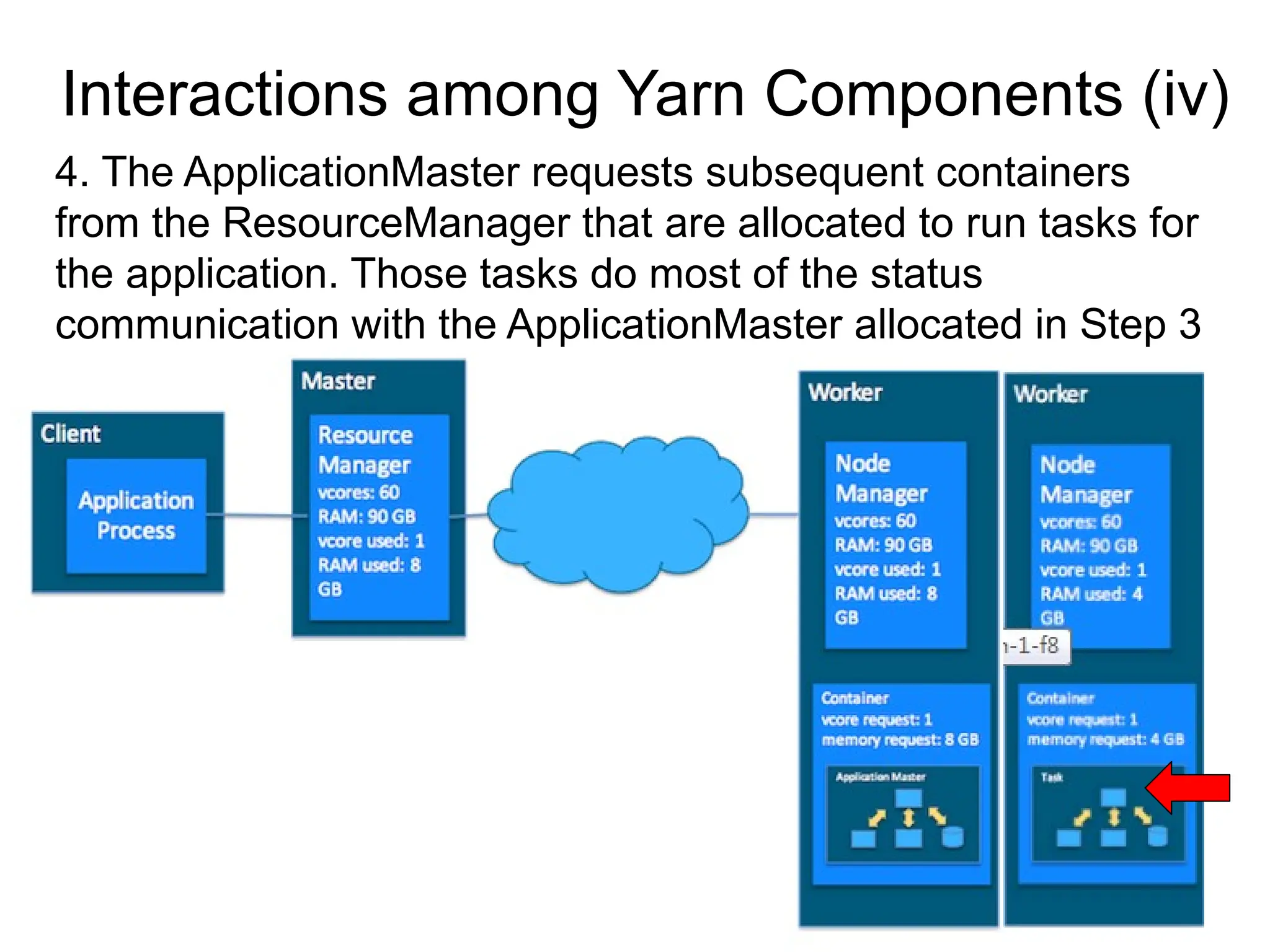
4. The ApplicationMasterrequests subsequent containers
from the ResourceManager that are allocated to run tasks for
the application. Those tasks do most of the status
communication with the ApplicationMaster allocated in Step 3
Interactions among Yarn Components (iv)
19.
19
5. Once alltasks are finished, the ApplicationMaster
exits. The last container is de-allocated from the
cluster.
6. The application client exits. (The
ApplicationMaster launched in a container is more
specifically called a managed AM. Unmanaged
ApplicationMasters run outside of YARN’s control.)
Interactions among Yarn Components (v)
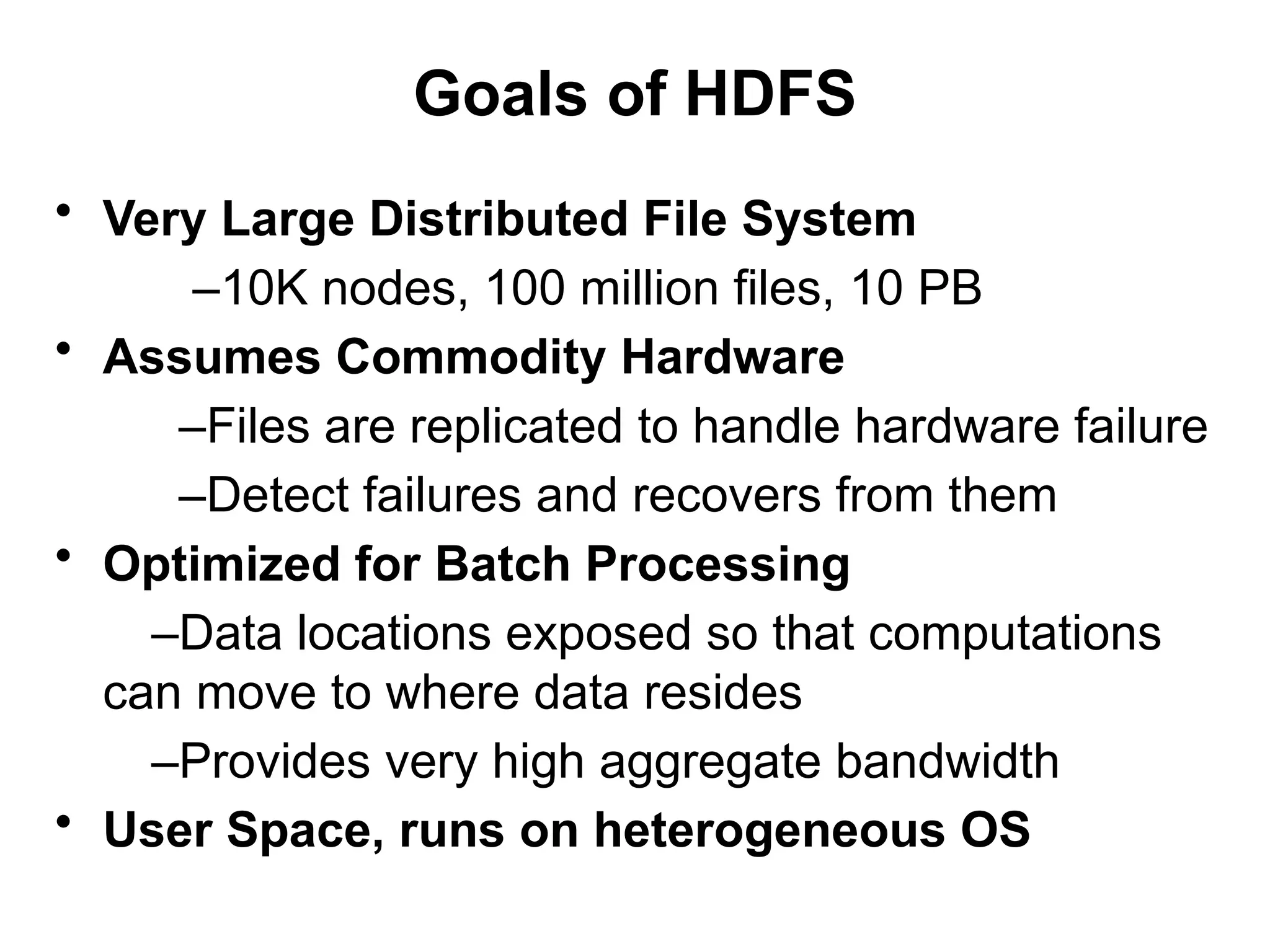
Goals of HDFS
•Very Large Distributed File System
–10K nodes, 100 million files, 10 PB
• Assumes Commodity Hardware
–Files are replicated to handle hardware failure
–Detect failures and recovers from them
• Optimized for Batch Processing
–Data locations exposed so that computations
can move to where data resides
–Provides very high aggregate bandwidth
• User Space, runs on heterogeneous OS
22.
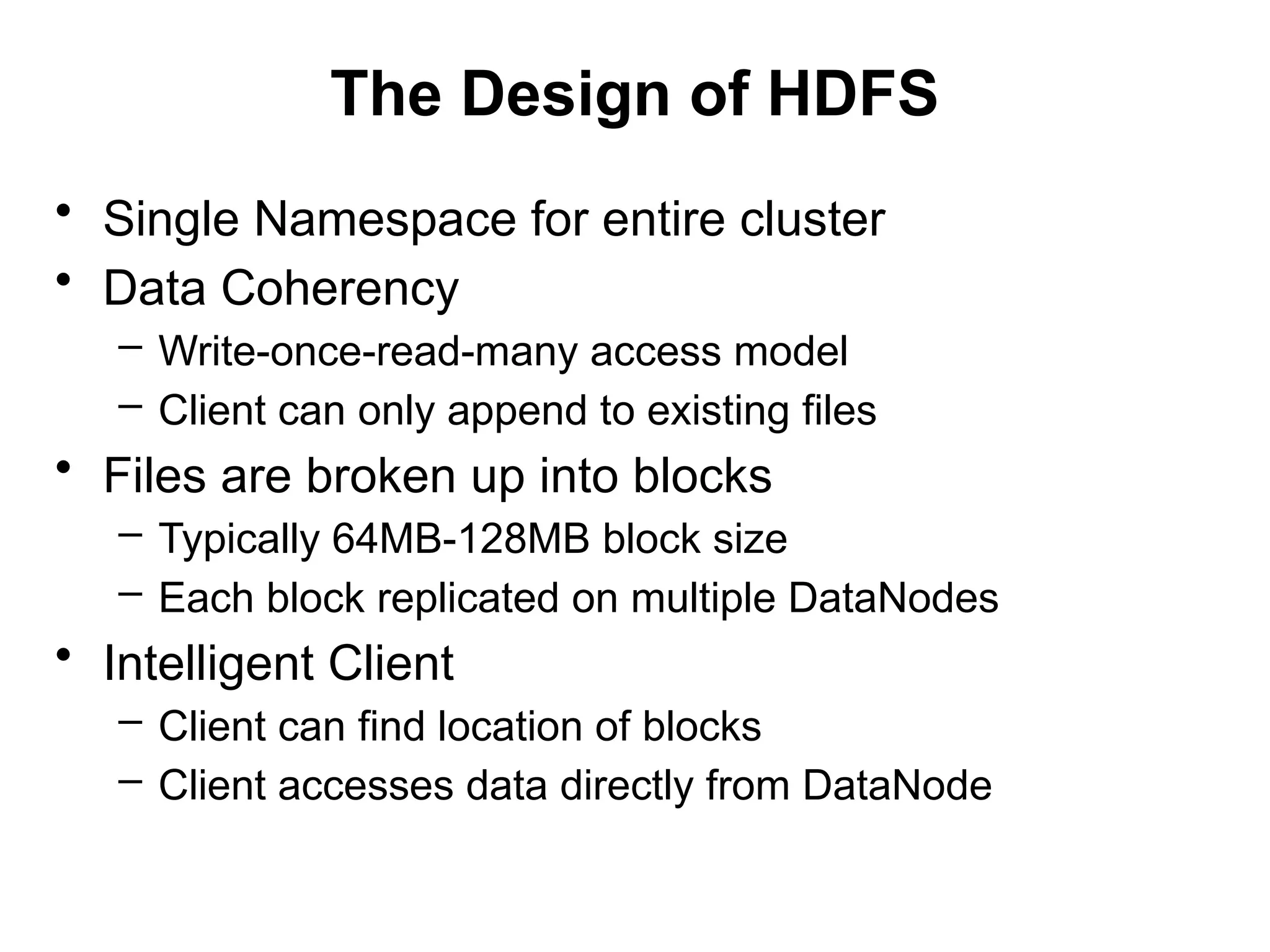
The Design ofHDFS
• Single Namespace for entire cluster
• Data Coherency
– Write-once-read-many access model
– Client can only append to existing files
• Files are broken up into blocks
– Typically 64MB-128MB block size
– Each block replicated on multiple DataNodes
• Intelligent Client
– Client can find location of blocks
– Client accesses data directly from DataNode
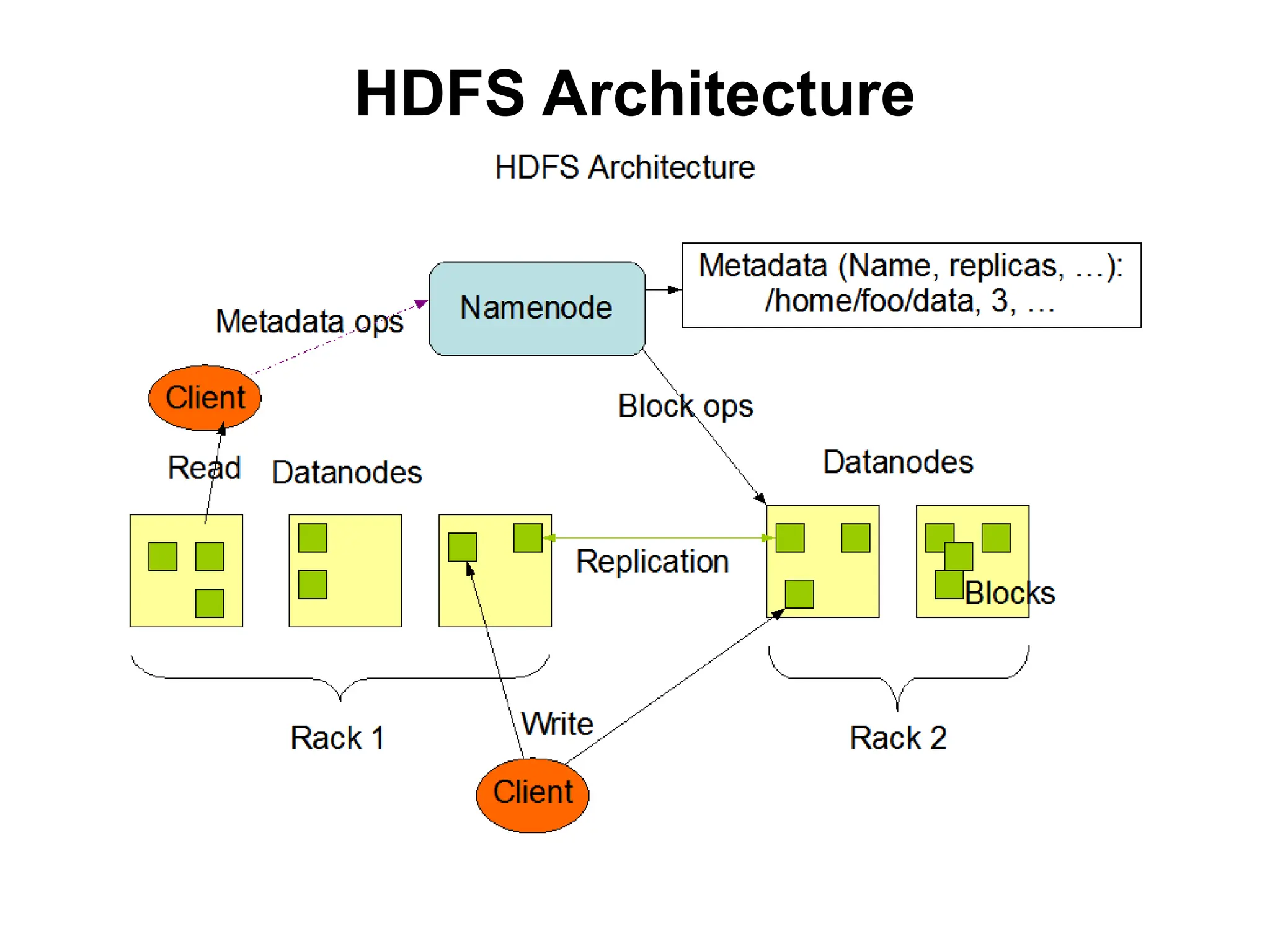
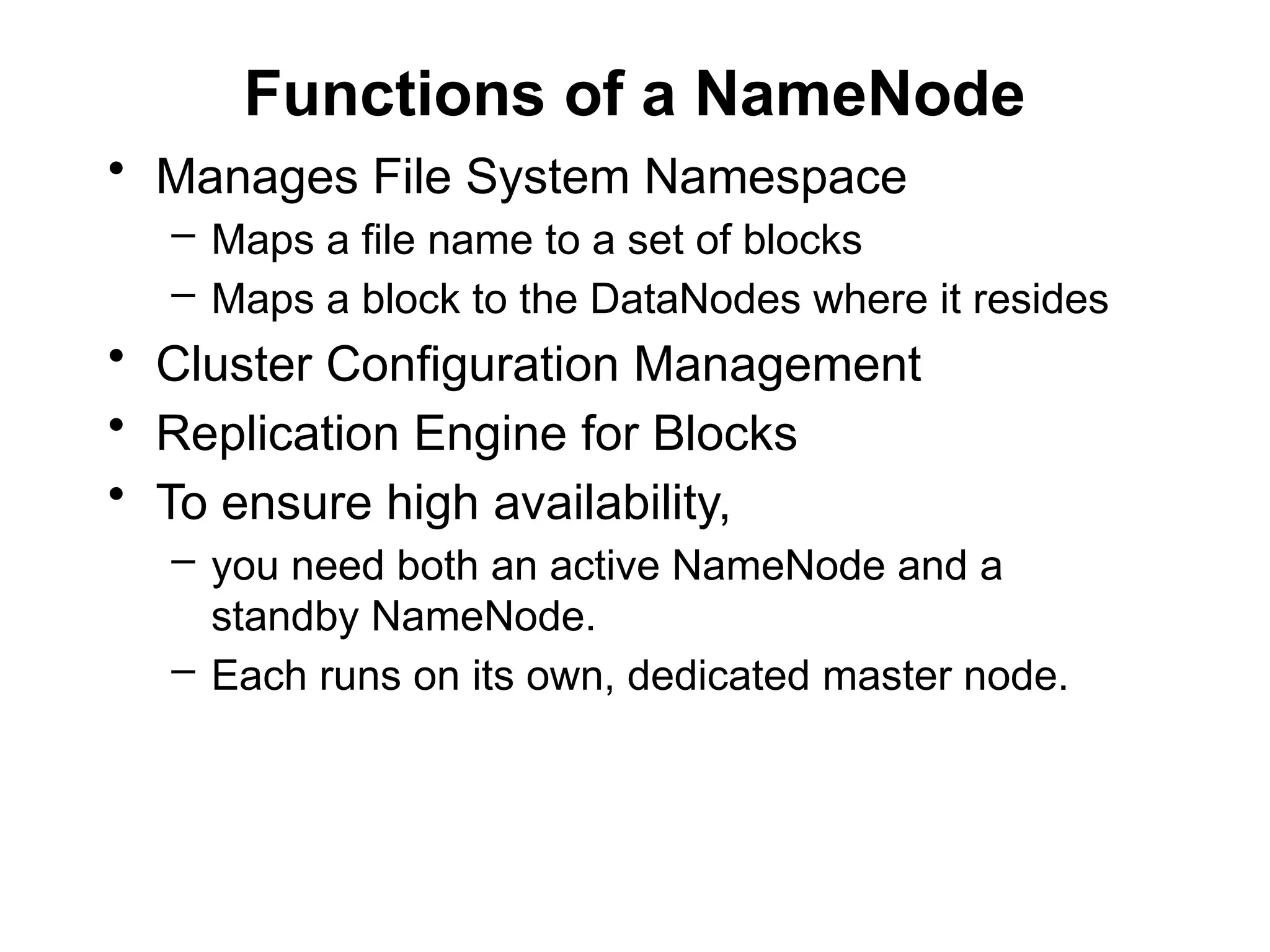
Functions of aNameNode
• Manages File System Namespace
– Maps a file name to a set of blocks
– Maps a block to the DataNodes where it resides
• Cluster Configuration Management
• Replication Engine for Blocks
• To ensure high availability,
– you need both an active NameNode and a
standby NameNode.
– Each runs on its own, dedicated master node.
25.
NameNode Metadata
• Metadatain Memory
– The entire metadata is in main memory
– No demand paging of metadata
• Types of metadata
– List of files
– List of Blocks for each file
– List of DataNodes for each block
– File attributes, e.g. creation time, replication factor
• A Transaction Log
– Records file creations, file deletions etc
26.
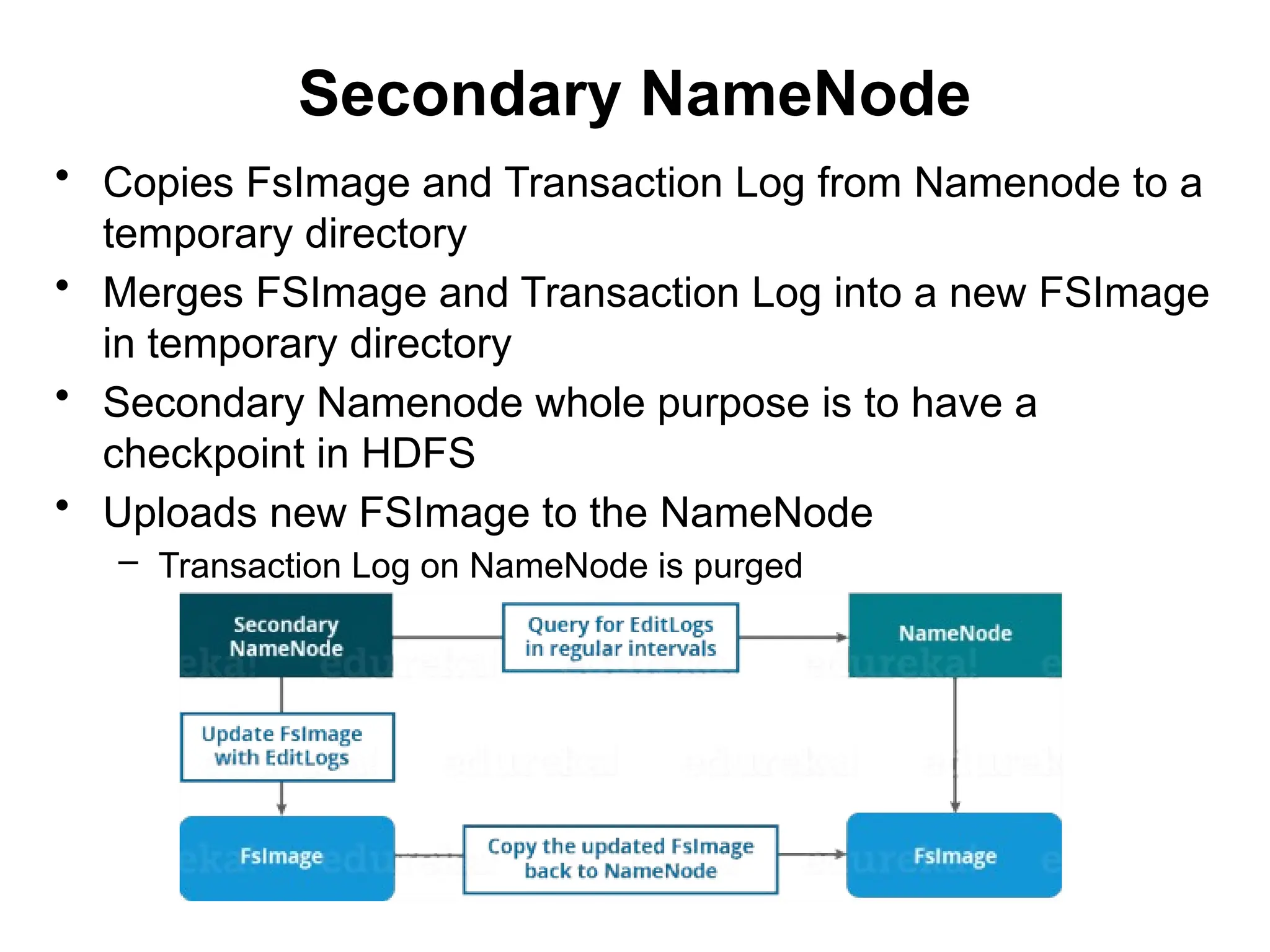
Secondary NameNode
• CopiesFsImage and Transaction Log from Namenode to a
temporary directory
• Merges FSImage and Transaction Log into a new FSImage
in temporary directory
• Secondary Namenode whole purpose is to have a
checkpoint in HDFS
• Uploads new FSImage to the NameNode
– Transaction Log on NameNode is purged
27.
DataNode
• A BlockServer
– Stores data in the local file system (e.g. ext3)
– Stores metadata of a block (e.g. CRC)
– Serves data and metadata to Clients
• Block Report
– Periodically sends a report of all existing blocks to
the NameNode
• Facilitates Pipelining of Data
– Forwards data to other specified DataNodes
28.
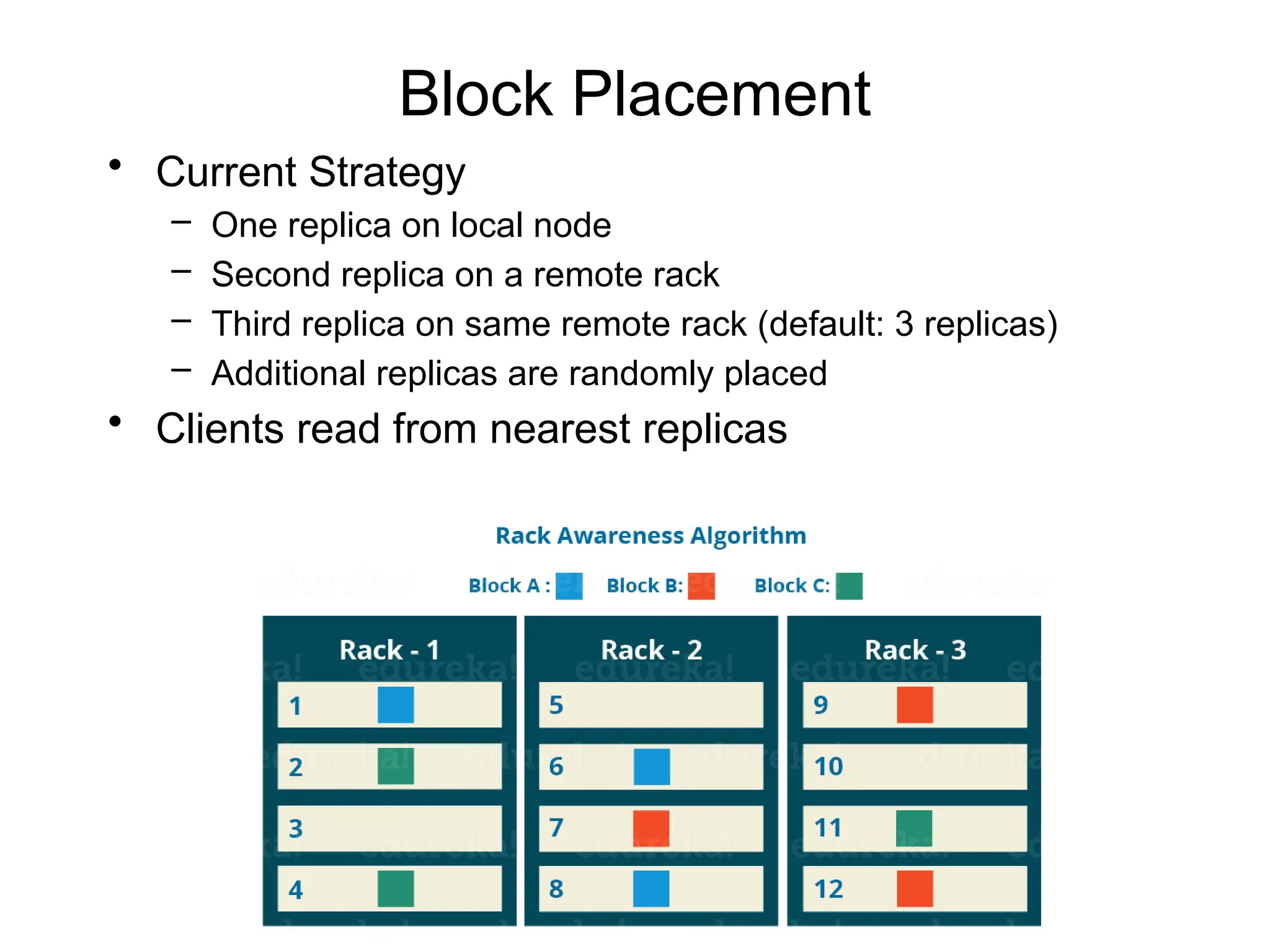
Block Placement
• CurrentStrategy
– One replica on local node
– Second replica on a remote rack
– Third replica on same remote rack (default: 3 replicas)
– Additional replicas are randomly placed
• Clients read from nearest replicas
29.
29
• "Hadoop: TheDefinitive Guide", Tom White,
O'Reilly Media, Inc.
• https://blog.cloudera.com/blog/2015/09/untangling-
apache-hadoop-yarn-part-1/
• https://hadoop.apache.org/docs/r2.7.2/
References


![[db tech showcase Tokyo 2014] C32: Hadoop最前線 - 開発の現場から by NTT 小沢健史](https://cdn.slidesharecdn.com/ss_thumbnails/dbtstokyo2014c32ntthadoop-141203014329-conversion-gate01-thumbnail.jpg?width=640&height=640&fit=bounds)


