Commands and the Command Voice
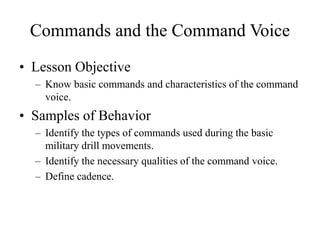
• Lesson Objective
– Know basic commands and characteristics of the command
voice.
• Samples of Behavior
– Identify the types of commands used during the basic
military drill movements.
– Identify the necessary qualities of the command voice.
– Define cadence.
Commands and the Command Voice
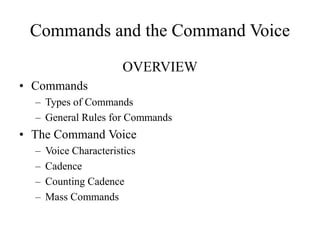
OVERVIEW
• Commands
– Types of Commands
– General Rules for Commands
• The Command Voice
– Voice Characteristics
– Cadence
– Counting Cadence
– Mass Commands
A. Not very ready... my mind is
distracted by other things.
B. A little slow to get going... but
starting to wake up.
C. Good to go... bring on the lesson.
D. I am focused, alert, energized and
ready to learn!
(LE500-C2:LQ1)
1
1
1
1
A. B.
0 0
(LE500-C2:LQ2)
A. True
B. False
1. Explain what movement will be
2. Oral order
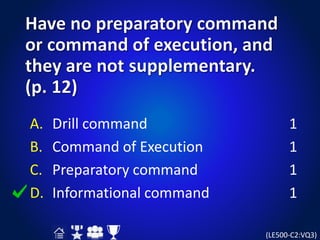
3. Have no preparatory command
4. Follows preparatory command
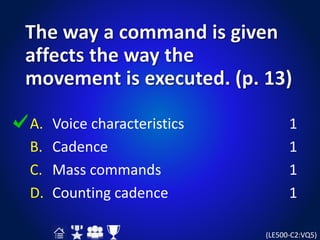
5. Way a command is given affects
the way the movement is
executed
6. Develop confidence by making
the individual give/execute the
proper commands
7. Helps teach coordination
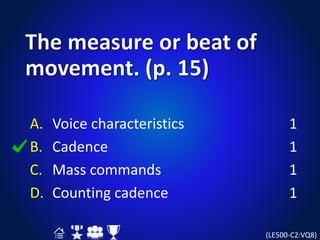
8. Measure/beat of movement
Click any link below to go directly to polling that question.
Click here to return to this index.
Commands and the Command Voice
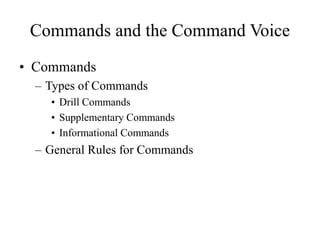
• Commands
– Types of Commands
• Drill Commands
• Supplementary Commands
• Informational Commands
– General Rules for Commands
Commands and the Command Voice
• The Command Voice
– Voice Characteristics
• Loudness
• Projection
• Distinctiveness
• Inflection
• Snap
A. the commander's name.
B. the unit's name.
C. the unit's designation.
D. the unit's goal.
(LE500-C2:LQ3)
1
1
1
1
A. B.
0 0
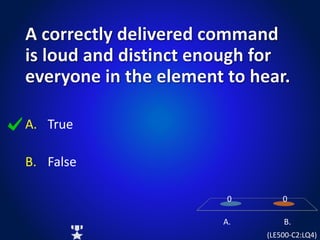
(LE500-C2:LQ4)
A. True
B. False
Commands and the Command Voice
• Diaphragm Exercise
Commands and the Command Voice
• Commands Portrayed
Graphically
A. heart.
B. leg muscles.
C. arm muscles.
D. diaphragm.
(LE500-C2:LQ5)
1
1
1
1
A. inflection.
B. tone.
C. snap.
D. projection.
(LE500-C2:LQ6)
1
1
1
1
Commands and the Command Voice
• Cadence
• Counting Cadence
• Mass Commands
A. snap.
B. cadence.
C. flank.
D. march.
(LE500-C2:LQ7)
1
1
1
1
A. B.
0 0
(LE500-C2:LQ8)
A. True
B. False
(LE500-C2:LQ9)
Note to Instructors:
Click the Show/Hide Response Display Button
(LE500-C2:LQ10)
Note to Instructors:
Click the Show/Hide Response Display Button
A. Drill command
B. Command of Execution
C. Preparatory command
D. Informational command
(LE500-C2:VQ1)
1
1
1
1
A. Drill command
B. Command of Execution
C. Preparatory command
D. Informational command
(LE500-C2:VQ2)
1
1
1
1
A. Drill command
B. Command of Execution
C. Preparatory command
D. Informational command
(LE500-C2:VQ3)
1
1
1
1
A. Drill command
B. Command of Execution
C. Preparatory command
D. Informational command
(LE500-C2:VQ4)
1
1
1
1
A. Voice characteristics
B. Cadence
C. Mass commands
D. Counting cadence
(LE500-C2:VQ5)
1
1
1
1
A. Voice characteristics
B. Cadence
C. Mass commands
D. Counting cadence
(LE500-C2:VQ6)
1
1
1
1
A. Voice characteristics
B. Cadence
C. Mass commands
D. Counting cadence
(LE500-C2:VQ7)
1
1
1
1
A. Voice characteristics
B. Cadence
C. Mass commands
D. Counting cadence
(LE500-C2:VQ8)
1
1
1
1

LE500-C2L1_-__Commands_and_the_Command_Voice.pptx

  • 1.
    Commands and theCommand Voice • Lesson Objective – Know basic commands and characteristics of the command voice. • Samples of Behavior – Identify the types of commands used during the basic military drill movements. – Identify the necessary qualities of the command voice. – Define cadence.
  • 2.
    Commands and theCommand Voice OVERVIEW • Commands – Types of Commands – General Rules for Commands • The Command Voice – Voice Characteristics – Cadence – Counting Cadence – Mass Commands
  • 3.
    A. Not veryready... my mind is distracted by other things. B. A little slow to get going... but starting to wake up. C. Good to go... bring on the lesson. D. I am focused, alert, energized and ready to learn! (LE500-C2:LQ1) 1 1 1 1
  • 4.
  • 5.
    1. Explain whatmovement will be 2. Oral order 3. Have no preparatory command 4. Follows preparatory command 5. Way a command is given affects the way the movement is executed 6. Develop confidence by making the individual give/execute the proper commands 7. Helps teach coordination 8. Measure/beat of movement Click any link below to go directly to polling that question. Click here to return to this index.
  • 6.
    Commands and theCommand Voice • Commands – Types of Commands • Drill Commands • Supplementary Commands • Informational Commands – General Rules for Commands
  • 7.
    Commands and theCommand Voice • The Command Voice – Voice Characteristics • Loudness • Projection • Distinctiveness • Inflection • Snap
  • 8.
    A. the commander'sname. B. the unit's name. C. the unit's designation. D. the unit's goal. (LE500-C2:LQ3) 1 1 1 1
  • 9.
  • 10.
    Commands and theCommand Voice • Diaphragm Exercise
  • 11.
    Commands and theCommand Voice • Commands Portrayed Graphically
  • 12.
    A. heart. B. legmuscles. C. arm muscles. D. diaphragm. (LE500-C2:LQ5) 1 1 1 1
  • 13.
    A. inflection. B. tone. C.snap. D. projection. (LE500-C2:LQ6) 1 1 1 1
  • 14.
    Commands and theCommand Voice • Cadence • Counting Cadence • Mass Commands
  • 15.
    A. snap. B. cadence. C.flank. D. march. (LE500-C2:LQ7) 1 1 1 1
  • 16.
  • 17.
    (LE500-C2:LQ9) Note to Instructors: Clickthe Show/Hide Response Display Button
  • 18.
    (LE500-C2:LQ10) Note to Instructors: Clickthe Show/Hide Response Display Button
  • 19.
    A. Drill command B.Command of Execution C. Preparatory command D. Informational command (LE500-C2:VQ1) 1 1 1 1
  • 20.
    A. Drill command B.Command of Execution C. Preparatory command D. Informational command (LE500-C2:VQ2) 1 1 1 1
  • 21.
    A. Drill command B.Command of Execution C. Preparatory command D. Informational command (LE500-C2:VQ3) 1 1 1 1
  • 22.
    A. Drill command B.Command of Execution C. Preparatory command D. Informational command (LE500-C2:VQ4) 1 1 1 1
  • 23.
    A. Voice characteristics B.Cadence C. Mass commands D. Counting cadence (LE500-C2:VQ5) 1 1 1 1
  • 24.
    A. Voice characteristics B.Cadence C. Mass commands D. Counting cadence (LE500-C2:VQ6) 1 1 1 1
  • 25.
    A. Voice characteristics B.Cadence C. Mass commands D. Counting cadence (LE500-C2:VQ7) 1 1 1 1
  • 26.
    A. Voice characteristics B.Cadence C. Mass commands D. Counting cadence (LE500-C2:VQ8) 1 1 1 1