The L-Co-R co-evolutionary
algorithm: a comparative
analysis in
medium-term time-series
forecasting problems
Parras-Gutiérrez, Rivas and Merelo
U. Jaén & Granada (Spain)
http://geneura.wordpress.com
Parras et al. #lcor 2
It's difficult to
make
predictions,
especially about
the future
Yogi Berra
Parras et al. #lcor 3
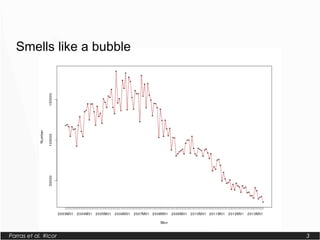
Smells like a bubble
Parras et al. #lcor 4
Using
coevolution
to predict
bubble-
bursting
Parras et al. #lcor 5
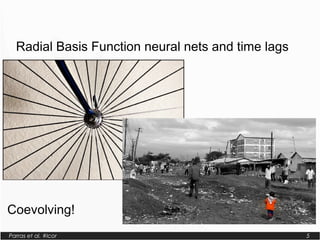
Radial Basis Function neural nets and time lags
Coevolving!
Parras et al. #lcor 6
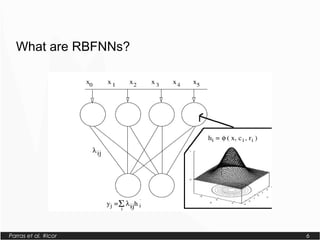
What are RBFNNs?
Parras et al. #lcor 7
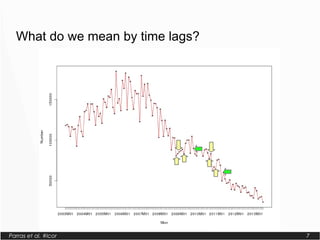
What do we mean by time lags?
Parras et al. #lcor 8
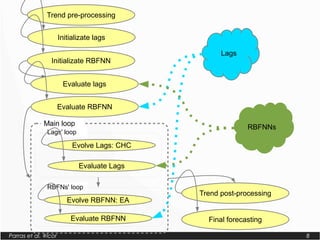
Trend pre-processing
Trend post-processing
Initializate lags
Initializate RBFNN
Evaluate lags
Evolve Lags: CHC
Evaluate RBFNN
Evaluate Lags
Evolve RBFNN: EA
Evaluate RBFNN
RBFNNs
Lags
Main loop
Lags' loop
RBFNs' loop
Final forecasting
Parras et al. #lcor 9
Let's fight
●
Data sets taken from Spanish National Statistics Institute+ Time
Series book by D. Peña + NN3 competition
– Check them out at https://sites.google.com/site/presetemp/datos
– Airline passengers, mortgages, prices...
●
Comparison with other five methods:
– Exponential Smoothing Method.
– Croston
– Theta
– Random Walk
– ARIMA
Parras et al. #lcor 10
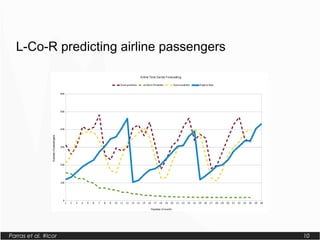
L-Co-R predicting airline passengers
Parras et al. #lcor 11
How do we measure success?
●
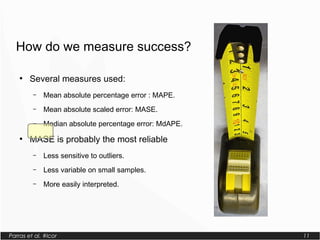
Several measures used:
– Mean absolute percentage error : MAPE.
– Mean absolute scaled error: MASE.
– Median absolute percentage error: MdAPE.
●
MASE is probably the most reliable
– Less sensitive to outliers.
– Less variable on small samples.
– More easily interpreted.
Parras et al. #lcor 12
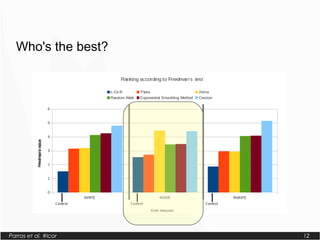
Who's the best?
Parras et al. #lcor 13
That's all
Any questions?Any questions?
Check us out atCheck us out at
@geneura@geneura
@canubeproject@canubeproject
@anyselfproject@anyselfproject
@sipesca@sipesca
ANYSELF
AnyselfProject

The L-Co-R co-evolutionary algorithm: a comparative analysis in medium-term time-series forecasting problems

  • 1.
    The L-Co-R co-evolutionary algorithm:a comparative analysis in medium-term time-series forecasting problems Parras-Gutiérrez, Rivas and Merelo U. Jaén & Granada (Spain) http://geneura.wordpress.com
  • 2.
    Parras et al.#lcor 2 It's difficult to make predictions, especially about the future Yogi Berra
  • 3.
    Parras et al.#lcor 3 Smells like a bubble
  • 4.
    Parras et al.#lcor 4 Using coevolution to predict bubble- bursting
  • 5.
    Parras et al.#lcor 5 Radial Basis Function neural nets and time lags Coevolving!
  • 6.
    Parras et al.#lcor 6 What are RBFNNs?
  • 7.
    Parras et al.#lcor 7 What do we mean by time lags?
  • 8.
    Parras et al.#lcor 8 Trend pre-processing Trend post-processing Initializate lags Initializate RBFNN Evaluate lags Evolve Lags: CHC Evaluate RBFNN Evaluate Lags Evolve RBFNN: EA Evaluate RBFNN RBFNNs Lags Main loop Lags' loop RBFNs' loop Final forecasting
  • 9.
    Parras et al.#lcor 9 Let's fight ● Data sets taken from Spanish National Statistics Institute+ Time Series book by D. Peña + NN3 competition – Check them out at https://sites.google.com/site/presetemp/datos – Airline passengers, mortgages, prices... ● Comparison with other five methods: – Exponential Smoothing Method. – Croston – Theta – Random Walk – ARIMA
  • 10.
    Parras et al.#lcor 10 L-Co-R predicting airline passengers
  • 11.
    Parras et al.#lcor 11 How do we measure success? ● Several measures used: – Mean absolute percentage error : MAPE. – Mean absolute scaled error: MASE. – Median absolute percentage error: MdAPE. ● MASE is probably the most reliable – Less sensitive to outliers. – Less variable on small samples. – More easily interpreted.
  • 12.
    Parras et al.#lcor 12 Who's the best?
  • 13.
    Parras et al.#lcor 13 That's all Any questions?Any questions? Check us out atCheck us out at @geneura@geneura @canubeproject@canubeproject @anyselfproject@anyselfproject @sipesca@sipesca ANYSELF AnyselfProject

Editor's Notes

  • #3 Cropped from Image by Pensiero at http://www.flickr.com/photos/pensiero/2878055175/
  • #5 Image by Light Knight at http://www.flickr.com/photos/lightknight/3176554248
  • #6 Image by JWPĥotowerks at http://www.flickr.com/photos/john_whitworth_photography/3017645549 (spokes) and Eduardo Zárate at http://www.flickr.com/photos/eduardozarate/3513912756/
  • #8 Horizon is what lies between the predicted value and the first previous datum used to predict it. A consistent value of horizon was used throughout the experiments.
  • #9 “ CHC combines conservative selection strategy with disruptive recombination HUX”: http://neo.lcc.uma.es/mallba/easy-mallba/html/algorithms.html#chc CHC is called also Adaptive Search Algorithm EvRBF is an already published evolutionary algorithm Trend is removed and then added to avoid it to dominate the prediction.
  • #10 75% for training - 25% for testing 30 executions with average published.
  • #12 Imagen by tudedude at http://www.flickr.com/photos/tudedude/3516187441
  • #13 Differences are significant anyways