International Research Journal of Engineering and Technology (IRJET) e-ISSN: 2395-0056
Volume: 09 Issue: 11 | Nov 2022 www.irjet.net p-ISSN: 2395-0072
© 2022, IRJET | Impact Factor value: 7.529 | ISO 9001:2008 Certified Journal | Page 678
Departure Delay Prediction using Machine Learning.
Prof.Shardha Thete1, Jaya Rao2, Pratik Satao3, Anish Mate4, Arfat Shaikh5
ALARD COLLEGE OF ENGINEERING & MANAGEMENT
(ALARD Knowledge Park, Survey No. 50, Marunji, Near Rajiv Gandhi IT Park, Hinjewadi, Pune-411057)
Approved by AICTE. Recognized by DTE. NAAC Accredited. Affiliated to SPPU (Pune University).
---------------------------------------------------------------------***---------------------------------------------------------------------
Abstract - Many companies rely on different airlines to link
them with other regions of the world nowadays since the
aviation industry is so important to the global transportation
sector. Extreme weather, however, canhaveadirectimpact on
the airline. In order to address this problem, reliable
forecasting of these flight delays helps travelers to preparefor
the disruption to their travel plans and enables airlines to
address the causes of the flight delays in advance to lessen the
impact. This project’s goal is to examine the methods for
creating forecasting models for aircraft delays brought on by
adverse weather. In the present research, a machine learning
flight delay prediction model is established with the help of
machine learning ensemble models. Three different machine
learning techniques such as Naive Bayes, K-Nearest Neighbor
(KNN) and Support Vector Machine (SVM) applied to the
Airline dataset. To validate the per- formanceandefficiency of
the proposed method, a comparative analysis is performed.
Key Words: (Naive Bayes, K-Nearest Neighbor (KNN) and
Support Vector Machine (SVM): Machinelearning,Prediction,
reprocess) …
1. Introduction:
Passenger airlines, cargo airlines, and air traffic control
systems are the main elements of any transportationsystem
in the modern world. Nations all around the world have
attempted to develop various methodologies over time to
enhance the airline transportation system. This has
significantly altered how airlines operate. Modern travelers
may experience annoyance from flight delays. Around
20Flight operations on commercial aircraft have become
increasingly complex and dynamic. The daily operations of
airlines require adjustments to be made in response to
factors such as weather conditions, mechanical issues, or
passenger complaints.Thesevariablescanalsoimpactroutes
and schedules, increasing variability in flight activity at
commercial airports. Managing the complex interaction
between passengers, planes, airports and the demands of
aviation stakeholders is challenging for airlines and traffic
flow managers atcommercial airports who must respond
quickly to unexpected changes in demand.
1.1 Pre-Process:
There may be a lot of useless information and gaps in the
data. Data preparation is carried out to handle this portion.
Numerous data pre-processing techniques, such as data
cleansing, data transformation, and data reduction.
Preprocessing is the process of converting unprocessed
characteristics into information that a machine learning
algorithm can comprehend and learn from. As illustrated,
selecting the appropriate methods and preprocessing
approaches for machine learning needs careful examination
of the raw data and is somewhat of an art form.
1.2 Normalization
Normalization is a scalingmethod,a mappingmethod,ora
first stage of processing. From an existing range, we can
build a new range. It can be quite beneficial for objectives of
forecasting or prediction. As we all know, there are several
techniques to predict or forecast, but they can all differ
significantly from one another. Therefore,theNormalization
approach is needed to bring prediction and forecasting
closer while maintaining their wide range. Data should be
transformed such that they are either dimensionlessorhave
equal distributions in order to be normalized. Other names
for this normalizing procedure include standardization,
feature scaling, etc. In every machine learning application,
model fitting, and data pre-processing, normalizing is a vital
step. Each variable is given an equal amount of weight
during normalizing to ensure that no one variable can affect
model performance just because they have larger amounts
1.3 Feature Extraction:
The process of translating raw data into numerical features
that may be processed while keeping the information in the
original data set is referred to as feature extraction. It
produces better outcomes than applying machine learning
straight to raw data.
It is possible to extract features manually or automatically:
Identification and description of the characteristics that are
important to a particular situation are necessary for manual
feature extraction, as well as the implementation of a
method to extract those features. A good understanding of
International Research Journal of Engineering and Technology (IRJET) e-ISSN: 2395-0056
Volume: 09 Issue: 11 | Nov 2022 www.irjet.net p-ISSN: 2395-0072
© 2022, IRJET | Impact Factor value: 7.529 | ISO 9001:2008 Certified Journal | Page 679
the context or domain may often aid in making judgments
about which characteristics could be helpful.
2. Algorithms:
2.1 Naïve Bayes
The supervised learning technique is known as the Naive
Bayes algorithm, that is built on the Bayes theorem, is often
used to resolve classification issues. It is mostly applied in
text summarization with a large training set. The Naive
Bayes Classifier is one of the most suitable and efficient
classification algorithms available today. It assists in the
development of rapid machine learning models capable of
making accurate predictions. Being a classification
algorithm, it makes predictions based on the chancesthat an
object will appear. It is a family of algorithms rather than a
single method, and they are all based on the idea that every
pair of features being classified is independent of the other.
2.2 SVM
Support Vector Machine is a common Supervised Learning
technique for Classification issues. However, it is largely
employed in Machine Learning. The SVM algorithm's
objective is to establish the optimal lines or distance
measure that can divide n-dimensional area into classes,
allowing us to quickly classify fresh data points in theahead.
A hyperplane is the name given to this optimal decision
border. SVM selects the maximum vectors and points that
helps in the creation of the hyperplane. Support vectors,
which are used to represent such high instances, form the
basis for the SVM method.
2.3 KNN
One of the simplest machine learning algorithms, K-Nearest
Neighbor uses the supervised learning method. A new data
item is classified using the K-NN algorithm based on
similarity after all the existing data has been stored. This
means that utilizing the K-NN method, fresh data may be
quickly and accurately sorted into a suitable category.
Although the K-NN approach is most frequently employed
for classification issues, it mayalsobeutilizedforregression.
3.1. Objectives of the study
The Main Goal is to study and analyzeFlightDelayPrediction
system using machine learning techniques andtodesign and
develop feature extraction and selection techniques to
achieve better classification accuracy and to design and
develop machine learning techniques for effective flight
delay prediction, also we need to explore and validate the
proposed system results with various existing systems and
show the system’s effectiveness.
3.2. Methodology
We imported the dataset out from directories using one of
the machine learninglibrariescalledPandasbecauseitoffers
an express, robust, and an array that simply tries to
manipulate the data throughout many other environments.
The dataset is in the csv format usedindata science.Comma-
separated values, or CSV in this case, may be imported into
pandas from a local directory.
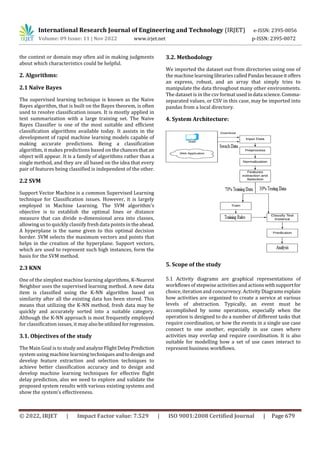
4. System Architecture:
5. Scope of the study
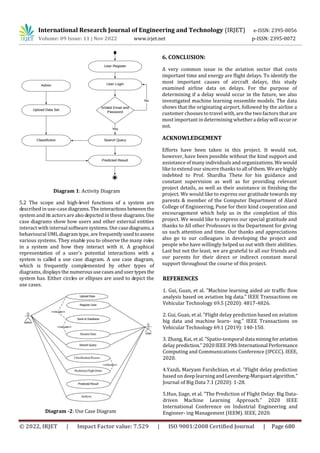
5.1 Activity diagrams are graphical representations of
workflows of stepwise activities and actionswithsupportfor
choice, iteration and concurrency. Activity Diagrams explain
how activities are organized to create a service at various
levels of abstraction. Typically, an event must be
accomplished by some operations, especially when the
operation is designed to do a number of different tasks that
require coordination, or how the events in a single use case
connect to one another, especially in use cases where
activities may overlap and require coordination. It is also
suitable for modelling how a set of use cases interact to
represent business workflows.
International Research Journal of Engineering and Technology (IRJET) e-ISSN: 2395-0056
Volume: 09 Issue: 11 | Nov 2022 www.irjet.net p-ISSN: 2395-0072
© 2022, IRJET | Impact Factor value: 7.529 | ISO 9001:2008 Certified Journal | Page 680
Diagram 1: Activity Diagram
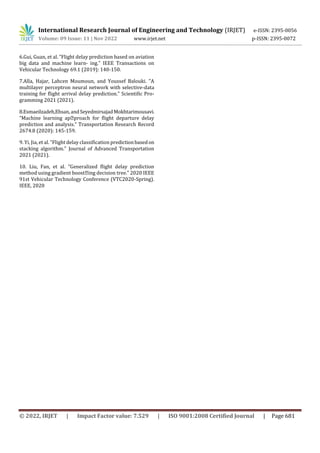
5.2 The scope and high-level functions of a system are
described in use-case diagrams.Theinteractions betweenthe
system and its actors are also depicted in these diagrams.Use
case diagrams show how users and other external entities
interact with internal software systems. Use case diagrams,a
behavioural UML diagram type, are frequentlyusedtoassess
various systems. They enable you to observe the many roles
in a system and how they interact with it. A graphical
representation of a user's potential interactions with a
system is called a use case diagram. A use case diagram,
which is frequently complemented by other types of
diagrams, displays the numeroususecasesandusertypesthe
system has. Either circles or ellipses are used to depict the
use cases.
Diagram -2: Use Case Diagram
6. CONCLUSION:
A very common issue in the aviation sector that costs
important time and energy are flight delays. To identify the
most important causes of aircraft delays, this study
examined airline data on delays. For the purpose of
determining if a delay would occur in the future, we also
investigated machine learning ensemble models. The data
shows that the originating airport, followed by the airline a
customer chooses to travel with, are the two factors that are
most important in determining whethera delaywill occuror
not.
ACKNOWLEDGEMENT
Efforts have been taken in this project. It would not,
however, have been possible without the kind support and
assistance of many individuals and organizations. We would
like to extend our sincere thanks toall ofthem. Wearehighly
indebted to Prof. Shardha Thete for his guidance and
constant supervision as well as for providing relevant
project details, as well as their assistance in finishing the
project. We would like to express our gratitude towards my
parents & member of the Computer Department of Alard
College of Engineering, Pune for their kind cooperation and
encouragement which help us in the completion of this
project. We would like to express our special gratitude and
thanks to All other Professors in the Department for giving
us such attention and time. Our thanks and appreciations
also go to our colleagues in developing the project and
people who have willingly helped us out with their abilities.
Last but not the least, we are grateful to all our friends and
our parents for their direct or indirect constant moral
support throughout the course of this project.
REFERENCES
1. Gui, Guan, et al. ”Machine learning aided air traffic flow
analysis based on aviation big data.” IEEE Transactions on
Vehicular Technology 69.5 (2020): 4817-4826.
2. Gui, Guan, et al. ”Flight delay prediction based on aviation
big data and machine learn- ing.” IEEE Transactions on
Vehicular Technology 69.1 (2019): 140-150.
3. Zhang, Kai, et al. ”Spatio-temporal data miningforaviation
delay prediction.”2020IEEE 39thInternational Performance
Computing and Communications Conference (IPCCC). IEEE,
2020.
4.Yazdi, Maryam Farshchian, et al. ”Flight delay prediction
based on deep learning andLevenberg-Marquartalgorithm.”
Journal of Big Data 7.1 (2020): 1-28.
5.Huo, Jiage, et al. ”The Prediction of Flight Delay: Big Data-
driven Machine Learning Approach.” 2020 IEEE
International Conference on Industrial Engineering and
Engineer- ing Management (IEEM). IEEE, 2020.
International Research Journal of Engineering and Technology (IRJET) e-ISSN: 2395-0056
Volume: 09 Issue: 11 | Nov 2022 www.irjet.net p-ISSN: 2395-0072
© 2022, IRJET | Impact Factor value: 7.529 | ISO 9001:2008 Certified Journal | Page 681
6.Gui, Guan, et al. ”Flight delay prediction based on aviation
big data and machine learn- ing.” IEEE Transactions on
Vehicular Technology 69.1 (2019): 140-150.
7.Alla, Hajar, Lahcen Moumoun, and Youssef Balouki. ”A
multilayer perceptron neural network with selective-data
training for flight arrival delay prediction.” Scientific Pro-
gramming 2021 (2021).
8.Esmaeilzadeh,Ehsan,andSeyedmirsajadMokhtarimousavi.
”Machine learning approach for flight departure delay
prediction and analysis.” Transportation Research Record
2674.8 (2020): 145-159.
9. Yi, Jia, et al. ”Flight delay classification predictionbasedon
stacking algorithm.” Journal of Advanced Transportation
2021 (2021).
10. Liu, Fan, et al. ”Generalized flight delay prediction
method using gradient boosting decision tree.” 2020 IEEE
91st Vehicular Technology Conference (VTC2020-Spring).
IEEE, 2020

Departure Delay Prediction using Machine Learning.

  • 1.
    International Research Journalof Engineering and Technology (IRJET) e-ISSN: 2395-0056 Volume: 09 Issue: 11 | Nov 2022 www.irjet.net p-ISSN: 2395-0072 © 2022, IRJET | Impact Factor value: 7.529 | ISO 9001:2008 Certified Journal | Page 678 Departure Delay Prediction using Machine Learning. Prof.Shardha Thete1, Jaya Rao2, Pratik Satao3, Anish Mate4, Arfat Shaikh5 ALARD COLLEGE OF ENGINEERING & MANAGEMENT (ALARD Knowledge Park, Survey No. 50, Marunji, Near Rajiv Gandhi IT Park, Hinjewadi, Pune-411057) Approved by AICTE. Recognized by DTE. NAAC Accredited. Affiliated to SPPU (Pune University). ---------------------------------------------------------------------***--------------------------------------------------------------------- Abstract - Many companies rely on different airlines to link them with other regions of the world nowadays since the aviation industry is so important to the global transportation sector. Extreme weather, however, canhaveadirectimpact on the airline. In order to address this problem, reliable forecasting of these flight delays helps travelers to preparefor the disruption to their travel plans and enables airlines to address the causes of the flight delays in advance to lessen the impact. This project’s goal is to examine the methods for creating forecasting models for aircraft delays brought on by adverse weather. In the present research, a machine learning flight delay prediction model is established with the help of machine learning ensemble models. Three different machine learning techniques such as Naive Bayes, K-Nearest Neighbor (KNN) and Support Vector Machine (SVM) applied to the Airline dataset. To validate the per- formanceandefficiency of the proposed method, a comparative analysis is performed. Key Words: (Naive Bayes, K-Nearest Neighbor (KNN) and Support Vector Machine (SVM): Machinelearning,Prediction, reprocess) … 1. Introduction: Passenger airlines, cargo airlines, and air traffic control systems are the main elements of any transportationsystem in the modern world. Nations all around the world have attempted to develop various methodologies over time to enhance the airline transportation system. This has significantly altered how airlines operate. Modern travelers may experience annoyance from flight delays. Around 20Flight operations on commercial aircraft have become increasingly complex and dynamic. The daily operations of airlines require adjustments to be made in response to factors such as weather conditions, mechanical issues, or passenger complaints.Thesevariablescanalsoimpactroutes and schedules, increasing variability in flight activity at commercial airports. Managing the complex interaction between passengers, planes, airports and the demands of aviation stakeholders is challenging for airlines and traffic flow managers atcommercial airports who must respond quickly to unexpected changes in demand. 1.1 Pre-Process: There may be a lot of useless information and gaps in the data. Data preparation is carried out to handle this portion. Numerous data pre-processing techniques, such as data cleansing, data transformation, and data reduction. Preprocessing is the process of converting unprocessed characteristics into information that a machine learning algorithm can comprehend and learn from. As illustrated, selecting the appropriate methods and preprocessing approaches for machine learning needs careful examination of the raw data and is somewhat of an art form. 1.2 Normalization Normalization is a scalingmethod,a mappingmethod,ora first stage of processing. From an existing range, we can build a new range. It can be quite beneficial for objectives of forecasting or prediction. As we all know, there are several techniques to predict or forecast, but they can all differ significantly from one another. Therefore,theNormalization approach is needed to bring prediction and forecasting closer while maintaining their wide range. Data should be transformed such that they are either dimensionlessorhave equal distributions in order to be normalized. Other names for this normalizing procedure include standardization, feature scaling, etc. In every machine learning application, model fitting, and data pre-processing, normalizing is a vital step. Each variable is given an equal amount of weight during normalizing to ensure that no one variable can affect model performance just because they have larger amounts 1.3 Feature Extraction: The process of translating raw data into numerical features that may be processed while keeping the information in the original data set is referred to as feature extraction. It produces better outcomes than applying machine learning straight to raw data. It is possible to extract features manually or automatically: Identification and description of the characteristics that are important to a particular situation are necessary for manual feature extraction, as well as the implementation of a method to extract those features. A good understanding of
  • 2.
    International Research Journalof Engineering and Technology (IRJET) e-ISSN: 2395-0056 Volume: 09 Issue: 11 | Nov 2022 www.irjet.net p-ISSN: 2395-0072 © 2022, IRJET | Impact Factor value: 7.529 | ISO 9001:2008 Certified Journal | Page 679 the context or domain may often aid in making judgments about which characteristics could be helpful. 2. Algorithms: 2.1 Naïve Bayes The supervised learning technique is known as the Naive Bayes algorithm, that is built on the Bayes theorem, is often used to resolve classification issues. It is mostly applied in text summarization with a large training set. The Naive Bayes Classifier is one of the most suitable and efficient classification algorithms available today. It assists in the development of rapid machine learning models capable of making accurate predictions. Being a classification algorithm, it makes predictions based on the chancesthat an object will appear. It is a family of algorithms rather than a single method, and they are all based on the idea that every pair of features being classified is independent of the other. 2.2 SVM Support Vector Machine is a common Supervised Learning technique for Classification issues. However, it is largely employed in Machine Learning. The SVM algorithm's objective is to establish the optimal lines or distance measure that can divide n-dimensional area into classes, allowing us to quickly classify fresh data points in theahead. A hyperplane is the name given to this optimal decision border. SVM selects the maximum vectors and points that helps in the creation of the hyperplane. Support vectors, which are used to represent such high instances, form the basis for the SVM method. 2.3 KNN One of the simplest machine learning algorithms, K-Nearest Neighbor uses the supervised learning method. A new data item is classified using the K-NN algorithm based on similarity after all the existing data has been stored. This means that utilizing the K-NN method, fresh data may be quickly and accurately sorted into a suitable category. Although the K-NN approach is most frequently employed for classification issues, it mayalsobeutilizedforregression. 3.1. Objectives of the study The Main Goal is to study and analyzeFlightDelayPrediction system using machine learning techniques andtodesign and develop feature extraction and selection techniques to achieve better classification accuracy and to design and develop machine learning techniques for effective flight delay prediction, also we need to explore and validate the proposed system results with various existing systems and show the system’s effectiveness. 3.2. Methodology We imported the dataset out from directories using one of the machine learninglibrariescalledPandasbecauseitoffers an express, robust, and an array that simply tries to manipulate the data throughout many other environments. The dataset is in the csv format usedindata science.Comma- separated values, or CSV in this case, may be imported into pandas from a local directory. 4. System Architecture: 5. Scope of the study 5.1 Activity diagrams are graphical representations of workflows of stepwise activities and actionswithsupportfor choice, iteration and concurrency. Activity Diagrams explain how activities are organized to create a service at various levels of abstraction. Typically, an event must be accomplished by some operations, especially when the operation is designed to do a number of different tasks that require coordination, or how the events in a single use case connect to one another, especially in use cases where activities may overlap and require coordination. It is also suitable for modelling how a set of use cases interact to represent business workflows.
  • 3.
    International Research Journalof Engineering and Technology (IRJET) e-ISSN: 2395-0056 Volume: 09 Issue: 11 | Nov 2022 www.irjet.net p-ISSN: 2395-0072 © 2022, IRJET | Impact Factor value: 7.529 | ISO 9001:2008 Certified Journal | Page 680 Diagram 1: Activity Diagram 5.2 The scope and high-level functions of a system are described in use-case diagrams.Theinteractions betweenthe system and its actors are also depicted in these diagrams.Use case diagrams show how users and other external entities interact with internal software systems. Use case diagrams,a behavioural UML diagram type, are frequentlyusedtoassess various systems. They enable you to observe the many roles in a system and how they interact with it. A graphical representation of a user's potential interactions with a system is called a use case diagram. A use case diagram, which is frequently complemented by other types of diagrams, displays the numeroususecasesandusertypesthe system has. Either circles or ellipses are used to depict the use cases. Diagram -2: Use Case Diagram 6. CONCLUSION: A very common issue in the aviation sector that costs important time and energy are flight delays. To identify the most important causes of aircraft delays, this study examined airline data on delays. For the purpose of determining if a delay would occur in the future, we also investigated machine learning ensemble models. The data shows that the originating airport, followed by the airline a customer chooses to travel with, are the two factors that are most important in determining whethera delaywill occuror not. ACKNOWLEDGEMENT Efforts have been taken in this project. It would not, however, have been possible without the kind support and assistance of many individuals and organizations. We would like to extend our sincere thanks toall ofthem. Wearehighly indebted to Prof. Shardha Thete for his guidance and constant supervision as well as for providing relevant project details, as well as their assistance in finishing the project. We would like to express our gratitude towards my parents & member of the Computer Department of Alard College of Engineering, Pune for their kind cooperation and encouragement which help us in the completion of this project. We would like to express our special gratitude and thanks to All other Professors in the Department for giving us such attention and time. Our thanks and appreciations also go to our colleagues in developing the project and people who have willingly helped us out with their abilities. Last but not the least, we are grateful to all our friends and our parents for their direct or indirect constant moral support throughout the course of this project. REFERENCES 1. Gui, Guan, et al. ”Machine learning aided air traffic flow analysis based on aviation big data.” IEEE Transactions on Vehicular Technology 69.5 (2020): 4817-4826. 2. Gui, Guan, et al. ”Flight delay prediction based on aviation big data and machine learn- ing.” IEEE Transactions on Vehicular Technology 69.1 (2019): 140-150. 3. Zhang, Kai, et al. ”Spatio-temporal data miningforaviation delay prediction.”2020IEEE 39thInternational Performance Computing and Communications Conference (IPCCC). IEEE, 2020. 4.Yazdi, Maryam Farshchian, et al. ”Flight delay prediction based on deep learning andLevenberg-Marquartalgorithm.” Journal of Big Data 7.1 (2020): 1-28. 5.Huo, Jiage, et al. ”The Prediction of Flight Delay: Big Data- driven Machine Learning Approach.” 2020 IEEE International Conference on Industrial Engineering and Engineer- ing Management (IEEM). IEEE, 2020.
  • 4.
    International Research Journalof Engineering and Technology (IRJET) e-ISSN: 2395-0056 Volume: 09 Issue: 11 | Nov 2022 www.irjet.net p-ISSN: 2395-0072 © 2022, IRJET | Impact Factor value: 7.529 | ISO 9001:2008 Certified Journal | Page 681 6.Gui, Guan, et al. ”Flight delay prediction based on aviation big data and machine learn- ing.” IEEE Transactions on Vehicular Technology 69.1 (2019): 140-150. 7.Alla, Hajar, Lahcen Moumoun, and Youssef Balouki. ”A multilayer perceptron neural network with selective-data training for flight arrival delay prediction.” Scientific Pro- gramming 2021 (2021). 8.Esmaeilzadeh,Ehsan,andSeyedmirsajadMokhtarimousavi. ”Machine learning approach for flight departure delay prediction and analysis.” Transportation Research Record 2674.8 (2020): 145-159. 9. Yi, Jia, et al. ”Flight delay classification predictionbasedon stacking algorithm.” Journal of Advanced Transportation 2021 (2021). 10. Liu, Fan, et al. ”Generalized flight delay prediction method using gradient boosting decision tree.” 2020 IEEE 91st Vehicular Technology Conference (VTC2020-Spring). IEEE, 2020