GCE MARKING SCHEME


LAW
AS/Advanced

JANUARY 2011
INTRODUCTION

The marking schemes which follow were those used by WJEC for the January 2011
examination in GCE LAW. They were finalised after detailed discussion at examiners'
conferences by all the examiners involved in the assessment. The conferences were held
shortly after the papers were taken so that reference could be made to the full range of
candidates' responses, with photocopied scripts forming the basis of discussion. The aim of
the conferences was to ensure that the marking schemes were interpreted and applied in the
same way by all examiners.

It is hoped that this information will be of assistance to centres but it is recognised at the
same time that, without the benefit of participation in the examiners' conferences, teachers
may have different views on certain matters of detail or interpretation.

WJEC regrets that it cannot enter into any discussion or correspondence about these
marking schemes.


                                                                            Page

               LA1 (AS)                                                        1
               LA2 (AS)                                                       13
               LA3 (A2) - Option 1                                            24
               LA3 (A2) - Option 2                                            33
               LA3 (A2) - Option 3                                            38
               LA4 (A2) - Option 1                                            42
               LA4 (A2) - Option 2                                            55
               LA4 (A2) - Option 3                                            59
LAW - LA 1
            UNDERSTANDING LEGAL VALUES, STRUCTURES & PROCESSES

Q.1   (a)     Explain the importance of the rule of law in England and Wales            [14]
              Credit reference to:
              • The approach of Dicey. He held that there were three elements that
                 created the rule of law namely an absence of arbitrary power on the part
                 of the State; equality before the law; supremacy of ordinary law.
              • Note the view of Hayek and also those of Raz.
              • The Constitutional Reform Act 2005 recognised the rule of law and the
                 importance of the independence of the judiciary.
              • The principles of natural justice should be observed such as requiring an
                 open and fair hearing with all parties being given the opportunity to put
                 their case.
              • Rule of law within a wider context with overseas examples.

                Marks                                   AO3
                          Presents effective communication using appropriate legal
                          terminology. Nonetheless, there may be several errors in
                  1
                          grammar, punctuation and spelling, although not enough to
                          detract from communication of meaning.
                          Fails to communicate and present logical argument, including
                          inadequate use of legal terminology. There are significant
                  0
                          errors of grammar, punctuation and spelling which detract from
                          communication of meaning.

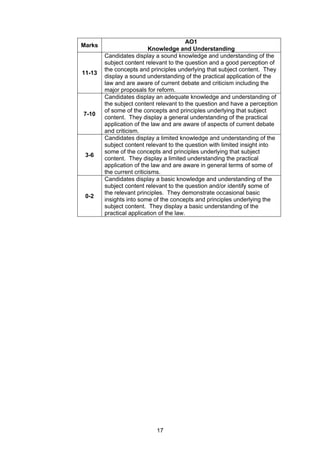
                                                          AO1
                Marks
                                            Knowledge and Understanding
                          Candidates display a sound knowledge and understanding of
                          the subject content relevant to the question and a good
                          perception of the concepts and principles underlying that subject
                11-13
                          content. They display a sound understanding of the practical
                          application of the law and are aware of current debate and
                          criticism including the major proposals for reform.
                          Candidates display an adequate knowledge and understanding
                          of the subject content relevant to the question and have a
                          perception of some of the concepts and principles underlying
                 7-10
                          that subject content. They display a general understanding of
                          the practical application of the law and are aware of aspects of
                          current debate and criticism.
                          Candidates display a limited knowledge and understanding of
                          the subject content relevant to the question with limited insight
                          into some of the concepts and principles underlying that subject
                 3-6
                          content. They display a limited understanding the practical
                          application of the law and are aware in general terms of some of
                          the current criticisms.
                          Candidates display a basic knowledge and understanding of the
                          subject content relevant to the question and/or identify some of
                          the relevant principles. They demonstrate occasional basic
                 0-2
                          insights into some of the concepts and principles underlying the
                          subject content. They display a basic understanding of the
                          practical application of the law.


                                            1
(b)   Discuss the impact of the Human Rights Act 1998 on the legal system of
      England and Wales.                                                     [11]

      Credit reference to:
      • The Human Rights Act 1998 and the European Convention on Human
         Rights.
      • The role of human rights and precedent and also statutory interpretation
         and also trials.
      • The impact of the role of human rights within a modern legal system.
      • Human rights affecting the principles of sentencing.
      • Judicial appointment and the need to ensure that at least the length of
         appointments provides a guarantee of independence of the judiciary from
         the Government.
      • The relationship between the rule of law, human rights and morality as
         pervasive concepts in the development of a modern legal system.

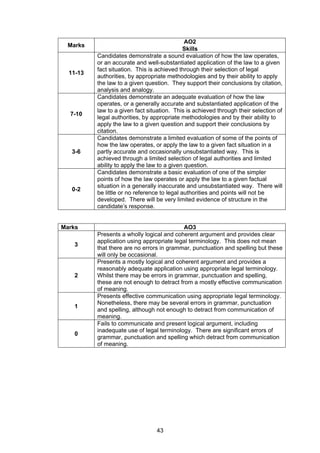
        Marks                                   AO3
                  Presents a wholly logical and coherent argument and provides
                  clear application using appropriate legal terminology. This
           2
                  does not mean that there are no errors in grammar,
                  punctuation and spelling but these will only be occasional.
                  Presents a mostly logical and coherent argument and provides
                  a reasonably adequate application using appropriate legal
           1      terminology. Whilst there may be errors in grammar,
                  punctuation and spelling, these are not enough to detract from
                  a most effective communication of meaning.

                                                   AO2
        Marks
                                                  Skills
                  Candidates demonstrate a sound evaluation of how the law
                  operates, or an accurate and well-substantiated application of
                  the law to a given fact situation. This is achieved through their
          8-9
                  selection of legal authorities, by appropriate methodologies and
                  by their ability to apply the law to a given question. They
                  support their conclusions by citation, analysis and analogy.
                  Candidates demonstrate an adequate evaluation of how the
                  law operates, or a generally accurate and substantiated
                  application of the law to a given fact situation. This is achieved
          6-7
                  through their selection of legal authorities, by appropriate
                  methodologies and by their ability to apply the law to a given
                  question and support their conclusions by citation.
                  Candidates demonstrate a limited evaluation of some of the
                  points of how the law operates, or apply the law to a given fact
                  situation in a partly accurate and occasionally unsubstantiated
          4-5
                  way. This is achieved through a limited selection of legal
                  authorities and limited ability to apply the law to a given
                  question.
                  Candidates demonstrate a basic evaluation of one of the
                  simpler points of how the law operates or apply the law to a
                  given factual situation in a generally inaccurate and
          0-3
                  unsubstantiated way. There will be little or no reference to
                  legal authorities and points will not be developed. There will be
                  very limited evidence of structure in the candidate’s response.


                                    2
Q.2   (a)   Explain the sources of funding available to access justice in England and
            Wales.                                                                    [14]

            Credit reference to:
            • Community Legal Service.
            • Criminal Defence Service and Public Defender Service.
            • The various advice schemes.
            • Alternative methods of funding.
            • Conditional fee arrangements.
            • The role of the Legal Services Commission.

             Marks                                  AO3
                      Presents effective communication using appropriate legal
                      terminology. Nonetheless, there may be several errors in
                1
                      grammar, punctuation and spelling, although not enough to
                      detract from communication of meaning.
                      Fails to communicate and present logical argument, including
                      inadequate use of legal terminology. There are significant errors
                0
                      of grammar, punctuation and spelling which detract from
                      communication of meaning.

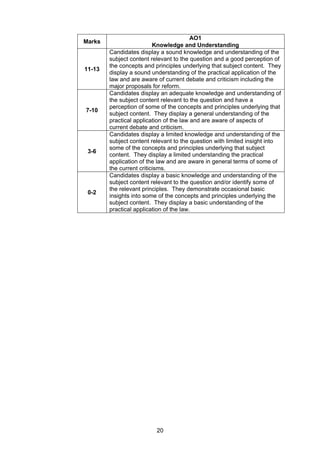
                                                        AO1
             Marks
                                         Knowledge and Understanding
                      Candidates display a sound knowledge and understanding of the
                      subject content relevant to the question and a good perception of
                      the concepts and principles underlying that subject content. They
             11-13
                      display a sound understanding of the practical application of the
                      law and are aware of current debate and criticism including the
                      major proposals for reform.
                      Candidates display an adequate knowledge and understanding of
                      the subject content relevant to the question and have a perception
                      of some of the concepts and principles underlying that subject
              7-10
                      content. They display a general understanding of the practical
                      application of the law and are aware of aspects of current debate
                      and criticism.
                      Candidates display a limited knowledge and understanding of the
                      subject content relevant to the question with limited insight into
                      some of the concepts and principles underlying that subject
              3-6
                      content. They display a limited understanding the practical
                      application of the law and are aware in general terms of some of
                      the current criticisms.
                      Candidates display a basic knowledge and understanding of the
                      subject content relevant to the question and/or identify some of
                      the relevant principles. They demonstrate occasional basic
              0-2
                      insights into some of the concepts and principles underlying the
                      subject content. They display a basic understanding of the
                      practical application of the law.


                                           3
(b)   Discuss the extent to which there are unmet legal needs in England and
      Wales.                                                                 [11]

      Credit reference to:
      • The problems of advice deserts was considered by the Constitutional
         Affairs Select Committee in 2004. There is plenty of evidence of the
         dilemma of rurality and indeed this is one of the major issues being
         addressed in the allocation of legal aid.
      • The establishment of Community Legal Service which seeks to develop a
         joined up approach to legal services.
      • The significance of the third sector.
      • The bringing together of consortia under one bidding process and the
         importance of efficiency.

       Marks                                    AO3
                Presents a wholly logical and coherent argument and provides
                clear application using appropriate legal terminology. This does
          2
                not mean that there are no errors in grammar, punctuation and
                spelling but these will only be occasional.
                Presents a mostly logical and coherent argument and provides a
                reasonably adequate application using appropriate legal
          1     terminology. Whilst there may be errors in grammar, punctuation
                and spelling, these are not enough to detract from a most
                effective communication of meaning.

                                                  AO2
       Marks
                                                 Skills
                Candidates demonstrate a sound evaluation of how the law
                operates, or an accurate and well-substantiated application of
                the law to a given fact situation. This is achieved through their
         8-9
                selection of legal authorities, by appropriate methodologies and
                by their ability to apply the law to a given question. They support
                their conclusions by citation, analysis and analogy.
                Candidates demonstrate an adequate evaluation of how the law
                operates, or a generally accurate and substantiated application
                of the law to a given fact situation. This is achieved through their
         6-7
                selection of legal authorities, by appropriate methodologies and
                by their ability to apply the law to a given question and support
                their conclusions by citation.
                Candidates demonstrate a limited evaluation of some of the
                points of how the law operates, or apply the law to a given fact
         4-5    situation in a partly accurate and occasionally unsubstantiated
                way. This is achieved through a limited selection of legal
                authorities and limited ability to apply the law to a given question.
                Candidates demonstrate a basic evaluation of one of the simpler
                points of how the law operates or apply the law to a given factual
                situation in a generally inaccurate and unsubstantiated way.
         0-3
                There will be little or no reference to legal authorities and points
                will not be developed. There will be very limited evidence of
                structure in the candidate’s response.


                                    4
Q.3   (a)   Explain the role of the institutions of the European Union.              [14]
            Credit reference to:
            • The emphasis is on presenting cases “on paper”. Lawyers are required to
               present their arguments in a written form and there is far less reliance on
               oral presentation of a case.
            • The difficulty of operating a European court where there is a wide range of
               languages involved though French is the traditional language of the court.
            • The use of the Advocate General. The independent lawyer is not used in
               English law. However in the European Court of Justice the Advocate
               General will present his findings on the law after the parties have made
               their submissions.
            • The deliberations of the judges are secret and where necessary the
               decision will be made by a majority vote. However when the judgement is
               delivered again in written form it is signed by all the judges who formed
               part of the panel so that it is not known if any judges disagreed with the
               majority. This contrasts strongly with the English system.
            • The European Court of Justice is not bound by its own previous decisions.
            • The court has wide rights to study extrinsic material when deciding the
               meaning of provisions and may study preparatory documents.

             Marks                                  AO3
                      Presents effective communication using appropriate legal
                      terminology. Nonetheless, there may be several errors in
                1
                      grammar, punctuation and spelling, although not enough to
                      detract from communication of meaning.
                      Fails to communicate and present logical argument, including
                      inadequate use of legal terminology. There are significant errors
                0
                      of grammar, punctuation and spelling which detract from
                      communication of meaning.

                                                        AO1
             Marks
                                         Knowledge and Understanding
                      Candidates display a sound knowledge and understanding of the
                      subject content relevant to the question and a good perception of
                      the concepts and principles underlying that subject content. They
             11-13
                      display a sound understanding of the practical application of the
                      law and are aware of current debate and criticism including the
                      major proposals for reform.
                      Candidates display an adequate knowledge and understanding of
                      the subject content relevant to the question and have a perception
                      of some of the concepts and principles underlying that subject
              7-10
                      content. They display a general understanding of the practical
                      application of the law and are aware of aspects of current debate
                      and criticism.
                      Candidates display a limited knowledge and understanding of the
                      subject content relevant to the question with limited insight into
                      some of the concepts and principles underlying that subject
               3-6
                      content. They display a limited understanding the practical
                      application of the law and are aware in general terms of some of
                      the current criticisms.
                      Candidates display a basic knowledge and understanding of the
                      subject content relevant to the question and/or identify some of
                      the relevant principles. They demonstrate occasional basic
               0-2
                      insights into some of the concepts and principles underlying the
                      subject content. They display a basic understanding of the
                      practical application of the law.

                                            5
(b)   Evaluate the role of the European Court of Justice in the development of
      European law.                                                            [11]

      Credit reference to:
      • Structure, member ship and powers of the Parliament Commission
         Council
      • The court sits in Luxembourg and has 27 judges one from each member
         state
      • The function of the ECJ as set out in Article 19 of TEU.
      • The court sits in Luxembourg and has 27 judges one from each member
         state. The court is assisted by 9 advocates general.
      • The court’s task is to ensure that the law is applied uniformly in all
         member states. For an early example of whether a member state has
         failed to fulfil its obligations in respect of the United Kingdom see, for
         example, Re Tachographs (1979).
      • Preliminary rulings and Article 234 (TFEU).
      • Discretionary referrals, for example, Bulmer v Bollinger (1974).

        Marks                                     AO3
                  Presents a wholly logical and coherent argument and provides
                  clear application using appropriate legal terminology. This does
           2
                  not mean that there are no errors in grammar, punctuation and
                  spelling but these will only be occasional.
                  Presents a mostly logical and coherent argument and provides
                  a reasonably adequate application using appropriate legal
           1      terminology. Whilst there may be errors in grammar,
                  punctuation and spelling, these are not enough to detract from a
                  most effective communication of meaning.

                                                   AO2
        Marks
                                                  Skills
                  Candidates demonstrate a sound evaluation of how the law
                  operates, or an accurate and well-substantiated application of
                  the law to a given fact situation. This is achieved through their
          8-9
                  selection of legal authorities, by appropriate methodologies and
                  by their ability to apply the law to a given question. They
                  support their conclusions by citation, analysis and analogy.
                  Candidates demonstrate an adequate evaluation of how the law
                  operates, or a generally accurate and substantiated application
                  of the law to a given fact situation. This is achieved through
          6-7
                  their selection of legal authorities, by appropriate methodologies
                  and by their ability to apply the law to a given question and
                  support their conclusions by citation.
                  Candidates demonstrate a limited evaluation of some of the
                  points of how the law operates, or apply the law to a given fact
                  situation in a partly accurate and occasionally unsubstantiated
          4-5
                  way. This is achieved through a limited selection of legal
                  authorities and limited ability to apply the law to a given
                  question.
                  Candidates demonstrate a basic evaluation of one of the
                  simpler points of how the law operates or apply the law to a
                  given factual situation in a generally inaccurate and
          0-3
                  unsubstantiated way. There will be little or no reference to legal
                  authorities and points will not be developed. There will be very
                  limited evidence of structure in the candidate’s response.


                                     6
Q.4   (a)   Explain the powers available to grant bail.                                  [14]
            Credit reference to:
            • Police powers to grant bail – Section 38 of PACE as amended by the
               Criminal Justice and Public Order Act 1994.
            • Conditional bail – the types of conditions include asking the suspect to
               surrender his passport, report at regular intervals to the police station or get
               another person to stand surety for him.
            • Where the police do not grant bail they must bring the defendant in front of
               the Magistrates Court at the first possible opportunity. Bail can be granted
               by the Magistrates Court and also by the Crown Court.
            • The Bail Act 1976 whether it is a presumption in favour of bail so long as
               there is no significant risk of further offending or where there are
               exceptional circumstances taking into account the nature of the offence
               such as murder or manslaughter or rape.
            • In all cases bail can be refused if there are reasonable grounds for
               believing that the defendant would fail to surrender or would commit further
               offences or would interfere with witnesses.
            • Some of those in prison are awaiting trial and could have been given bail
               and there is a problem of balancing this against the need to protect the
               public.

             Marks                                    AO3
                      Presents effective communication using appropriate legal
                      terminology. Nonetheless, there may be several errors in grammar,
                1
                      punctuation and spelling, although not enough to detract from
                      communication of meaning.
                      Fails to communicate and present logical argument, including
                      inadequate use of legal terminology. There are significant errors of
                0
                      grammar, punctuation and spelling which detract from
                      communication of meaning.

                                                       AO1
             Marks
                                         Knowledge and Understanding
                      Candidates display a sound knowledge and understanding of the
                      subject content relevant to the question and a good perception of
                      the concepts and principles underlying that subject content. They
             11-13
                      display a sound understanding of the practical application of the law
                      and are aware of current debate and criticism including the major
                      proposals for reform.
                      Candidates display an adequate knowledge and understanding of
                      the subject content relevant to the question and have a perception of
              7-10    some of the concepts and principles underlying that subject content.
                      They display a general understanding of the practical application of
                      the law and are aware of aspects of current debate and criticism.
                      Candidates display a limited knowledge and understanding of the
                      subject content relevant to the question with limited insight into
               3-6    some of the concepts and principles underlying that subject content.
                      They display a limited understanding the practical application of the
                      law and are aware in general terms of some of the current criticisms.
                      Candidates display a basic knowledge and understanding of the
                      subject content relevant to the question and/or identify some of the
                      relevant principles. They demonstrate occasional basic insights into
               0-2
                      some of the concepts and principles underlying the subject content.
                      They display a basic understanding of the practical application of the
                      law.


                                            7
(b)   Discuss the role of the Crown Prosecution Service within the English and
      Welsh legal system.                                                      [11]

      Credit reference to:
      • Deciding on what offences should be charged.
      • Reviewing all cases passed to them by the police.
      • Being responsible for the case as it has been passed to them by the
         police.
      • Conducting the prosecution of cases in the Magistrates Court.
      • Conducting cases in the Crown Court – this can be done either by
         instructing an independent lawyer to act as Prosecuting Council of the
         Court or a Crown Prosecutor with the appropriate advocacy qualification.
      • Discontinuation of cases by reference to the evidential test and the public
         interest test.

       Marks                                     AO3
                Presents a wholly logical and coherent argument and provides
                clear application using appropriate legal terminology. This does
          2
                not mean that there are no errors in grammar, punctuation and
                spelling but these will only be occasional.
                Presents a mostly logical and coherent argument and provides a
                reasonably adequate application using appropriate legal
          1     terminology. Whilst there may be errors in grammar, punctuation
                and spelling, these are not enough to detract from a most
                effective communication of meaning.

                                                  AO2
       Marks
                                                 Skills
                Candidates demonstrate a sound evaluation of how the law
                operates, or an accurate and well-substantiated application of the
                law to a given fact situation. This is achieved through their
        8-9
                selection of legal authorities, by appropriate methodologies and
                by their ability to apply the law to a given question. They support
                their conclusions by citation, analysis and analogy.
                Candidates demonstrate an adequate evaluation of how the law
                operates, or a generally accurate and substantiated application of
                the law to a given fact situation. This is achieved through their
        6-7
                selection of legal authorities, by appropriate methodologies and
                by their ability to apply the law to a given question and support
                their conclusions by citation.
                Candidates demonstrate a limited evaluation of some of the
                points of how the law operates, or apply the law to a given fact
        4-5     situation in a partly accurate and occasionally unsubstantiated
                way. This is achieved through a limited selection of legal
                authorities and limited ability to apply the law to a given question.
                Candidates demonstrate a basic evaluation of one of the simpler
                points of how the law operates or apply the law to a given factual
                situation in a generally inaccurate and unsubstantiated way.
        0-3
                There will be little or no reference to legal authorities and points
                will not be developed. There will be very limited evidence of
                structure in the candidate’s response.


                                     8
Q.5   (a)   Explain the civil appeal process                                             [14]
            Credit reference to:
            • The main Appellate Courts are the Divisional Courts, the Court of Appeal and
               the House of Lords.
            • The Divisional Courts, the QBD which has two main functions to hear appeals
               by way of case stated from the criminal cases; it also has supervisory prowess
               over inferior courts and tribunals and also over the actions and decisions of
               public bodies and Government Ministers through judicial review; the Chancery
               Division Court; the Family Division Court.
            • The Court of Appeal Civil Division was set up by the Judicature Act 1873 and
               was initially intended to be the final Court of Appeal. However the position of
               the House of Lords and the final Appellate Court was reinstated by the
               Appellate Jurisdiction Act 1876. Today the Court of Appeal has two Divisions,
               Civil and Criminal. The Civil Division is the main Appellate Court for civil
               cases and is headed by the Master of the Rolls. The Court of Appeal mainly
               hears appeals from the following courts – all three Divisions of the High Court;
               the County Court for multi-track cases; the upper tier tribunal.
            • The Supreme Court is the final Court of Appeal in England and Wales. Prior
               to 2009 the final Court of Appeal was the House of Lords.
            • The mechanisms available in terms of permission to appeal and the appeal
               routes in civil cases.

             Marks                                     AO3
                      Presents effective communication using appropriate legal terminology.
                      Nonetheless, there may be several errors in grammar, punctuation
               1
                      and spelling, although not enough to detract from communication of
                      meaning.
                      Fails to communicate and present logical argument, including
                      inadequate use of legal terminology. There are significant errors of
               0
                      grammar, punctuation and spelling which detract from communication
                      of meaning.

                                                       AO1
             Marks
                                         Knowledge and Understanding
                      Candidates display a sound knowledge and understanding of the
                      subject content relevant to the question and a good perception of the
                      concepts and principles underlying that subject content. They display
             11-13
                      a sound understanding of the practical application of the law and are
                      aware of current debate and criticism including the major proposals
                      for reform.
                      Candidates display an adequate knowledge and understanding of the
                      subject content relevant to the question and have a perception of
              7-10    some of the concepts and principles underlying that subject content.
                      They display a general understanding of the practical application of
                      the law and are aware of aspects of current debate and criticism.
                      Candidates display a limited knowledge and understanding of the
                      subject content relevant to the question with limited insight into some
               3-6    of the concepts and principles underlying that subject content. They
                      display a limited understanding the practical application of the law
                      and are aware in general terms of some of the current criticisms.
                      Candidates display a basic knowledge and understanding of the
                      subject content relevant to the question and/or identify some of the
                      relevant principles. They demonstrate occasional basic insights into
               0-2
                      some of the concepts and principles underlying the subject content.
                      They display a basic understanding of the practical application of the
                      law.

                                           9
(b)   Discuss the nature of Equitable Remedies available to the courts in England
      and Wales.                                                               [11]

      Credit reference to:
      • These are remedies which have been developed by equity and the key
         fact of such remedies is that they are not given automatically. The court
         has discretion in deciding whether or not an Equitable remedy should be
         granted.
      • Injunctions including interlocutory injunctions.
      • Specific performance.
      • Rescission.
      • Rectification.
      • Credit shall be given for appropriate citation.

       Marks                                     AO3
                Presents a wholly logical and coherent argument and provides
                clear application using appropriate legal terminology. This does
         2
                not mean that there are no errors in grammar, punctuation and
                spelling but these will only be occasional.
                Presents a mostly logical and coherent argument and provides a
                reasonably adequate application using appropriate legal
         1      terminology. Whilst there may be errors in grammar, punctuation
                and spelling, these are not enough to detract from a most
                effective communication of meaning.

                                                  AO2
       Marks
                                                 Skills
                Candidates demonstrate a sound evaluation of how the law
                operates, or an accurate and well-substantiated application of the
                law to a given fact situation. This is achieved through their
        8-9
                selection of legal authorities, by appropriate methodologies and
                by their ability to apply the law to a given question. They support
                their conclusions by citation, analysis and analogy.
                Candidates demonstrate an adequate evaluation of how the law
                operates, or a generally accurate and substantiated application of
                the law to a given fact situation. This is achieved through their
        6-7
                selection of legal authorities, by appropriate methodologies and
                by their ability to apply the law to a given question and support
                their conclusions by citation.
                Candidates demonstrate a limited evaluation of some of the
                points of how the law operates, or apply the law to a given fact
        4-5     situation in a partly accurate and occasionally unsubstantiated
                way. This is achieved through a limited selection of legal
                authorities and limited ability to apply the law to a given question.
                Candidates demonstrate a basic evaluation of one of the simpler
                points of how the law operates or apply the law to a given factual
                situation in a generally inaccurate and unsubstantiated way.
        0-3
                There will be little or no reference to legal authorities and points
                will not be developed. There will be very limited evidence of
                structure in the candidate’s response.


                                     10
Q.6   (a)   Explain the different types of jury trial available in England and Wales.   [14]

            Credit reference to:
            • Criminal and civil juries including coroner’s courts.
            • Candidates will be rewarded for relevant citation.

             Marks                                   AO3
                      Presents effective communication using appropriate legal
                      terminology. Nonetheless, there may be several errors in
               1
                      grammar, punctuation and spelling, although not enough to detract
                      from communication of meaning.
                      Fails to communicate and present logical argument, including
                      inadequate use of legal terminology. There are significant errors
               0
                      of grammar, punctuation and spelling which detract from
                      communication of meaning.

                                                        AO1
             Marks
                                         Knowledge and Understanding
                      Candidates display a sound knowledge and understanding of the
                      subject content relevant to the question and a good perception of
                      the concepts and principles underlying that subject content. They
             11-13
                      display a sound understanding of the practical application of the
                      law and are aware of current debate and criticism including the
                      major proposals for reform.
                      Candidates display an adequate knowledge and understanding of
                      the subject content relevant to the question and have a perception
                      of some of the concepts and principles underlying that subject
              7-10
                      content. They display a general understanding of the practical
                      application of the law and are aware of aspects of current debate
                      and criticism.
                      Candidates display a limited knowledge and understanding of the
                      subject content relevant to the question with limited insight into
                      some of the concepts and principles underlying that subject
               3-6
                      content. They display a limited understanding the practical
                      application of the law and are aware in general terms of some of
                      the current criticisms.
                      Candidates display a basic knowledge and understanding of the
                      subject content relevant to the question and/or identify some of
                      the relevant principles. They demonstrate occasional basic
               0-2
                      insights into some of the concepts and principles underlying the
                      subject content. They display a basic understanding of the
                      practical application of the law.


                                           11
(b)       To what extent is trial by jury reliable?                                    [11]

          Credit reference to:
      •   The role of juries particularly in complex matters, for example, involving fraud.
      •   The selection and composition of the jury. Occasional evidence emerges
          which supports the contention that verdicts are reached on inappropriate
          criteria.
      •   Candidates will be rewarded for citation of appropriate legal research.
      •   Candidates will be rewarded for discussion on measures proposed to limit
          jury trial, for example, the Roscoe Committee on Fraud Trails; the Diplock
          Courts and Northern Ireland.

           Marks                                      AO3
                     Presents a wholly logical and coherent argument and provides
                     clear application using appropriate legal terminology. This does
              2
                     not mean that there are no errors in grammar, punctuation and
                     spelling but these will only be occasional.
                     Presents a mostly logical and coherent argument and provides a
                     reasonably adequate application using appropriate legal
              1      terminology. Whilst there may be errors in grammar, punctuation
                     and spelling, these are not enough to detract from a most
                     effective communication of meaning.

                                                       AO2
           Marks
                                                      Skills
                     Candidates demonstrate a sound evaluation of how the law
                     operates, or an accurate and well-substantiated application of the
                     law to a given fact situation. This is achieved through their
             8-9
                     selection of legal authorities, by appropriate methodologies and
                     by their ability to apply the law to a given question. They support
                     their conclusions by citation, analysis and analogy.
                     Candidates demonstrate an adequate evaluation of how the law
                     operates, or a generally accurate and substantiated application of
                     the law to a given fact situation. This is achieved through their
             6-7
                     selection of legal authorities, by appropriate methodologies and
                     by their ability to apply the law to a given question and support
                     their conclusions by citation.
                     Candidates demonstrate a limited evaluation of some of the
                     points of how the law operates, or apply the law to a given fact
             4-5     situation in a partly accurate and occasionally unsubstantiated
                     way. This is achieved through a limited selection of legal
                     authorities and limited ability to apply the law to a given question.
                     Candidates demonstrate a basic evaluation of one of the simpler
                     points of how the law operates or apply the law to a given factual
                     situation in a generally inaccurate and unsubstantiated way.
             0-3
                     There will be little or no reference to legal authorities and points
                     will not be developed. There will be very limited evidence of
                     structure in the candidate’s response.


                                          12
LAW - LA2

                   UNDERSTANDING LEGAL REASONING, PERSONNEL AND METHODS


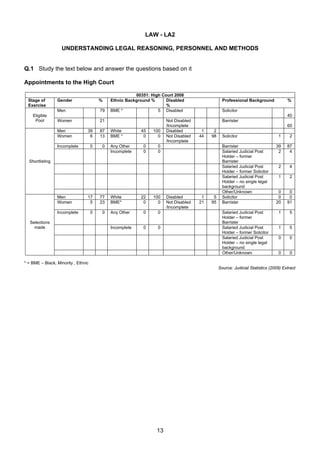
Q.1 Study the text below and answer the questions based on it

Appointments to the High Court

                                                         00351: High Court 2008
  Stage of       Gender                  %    Ethnic Background %      Disabled                   Professional Background            %
  Exercise                                                             %
                 Men                     79   BME *                5 Disabled                     Solicitor
    Eligible                                                                                                                         40
     Pool        Women                   21                            Not Disabled               Barrister
                                                                       /Incomplete                                                   60
                 Men             39      87   White        45    100   Disabled        1    2
                 Women            6      13   BME *         0      0   Not Disabled   44   98     Solicitor                     1     2
                                                                       /Incomplete
                 Incomplete          0   0    Any Other     0      0                              Barrister                    39    87
                                              Incomplete    0      0                              Salaried Judicial Post        2     4
                                                                                                  Holder – former
  Shortlisting                                                                                    Barrister
                                                                                                  Salaried Judicial Post        2     4
                                                                                                  Holder – former Solicitor
                                                                                                  Salaried Judicial Post        1     2
                                                                                                  Holder – no single legal
                                                                                                  background
                                                                                                  Other/Unknown                 0     0
                 Men             17      77   White        22    100   Disabled        1    5     Solicitor                     0     0
                 Women            5      23   BME*          0      0   Not Disabled   21   95     Barrister                    20    91
                                                                       /Incomplete
                 Incomplete          0    0   Any Other     0      0                              Salaried Judicial Post        1     5
                                                                                                  Holder – former
   Selections                                                                                     Barrister
     made                                     Incomplete    0      0                              Salaried Judicial Post        1     5
                                                                                                  Holder – former Solicitor
                                                                                                  Salaried Judicial Post        0     0
                                                                                                  Holder – no single legal
                                                                                                  background
                                                                                                  Other/Unknown                 0     0

* = BME – Black, Minority , Ethnic
                                                                                                Source: Judicial Statistics (2009) Extract


                                                                  13
(a)   Explain the appointment of High Court Judges.                            [14]

      Credit reference to:
      • CRA 2005
      • Judicial Appointment Commission
      • Jurisdiction


       Marks                                  AO3
               Presents effective communication using appropriate legal
               terminology. Nonetheless, there may be several errors in
         1
               grammar, punctuation and spelling, although not enough to detract
               from communication of meaning.
               Fails to communicate and present logical argument, including
               inadequate use of legal terminology. There are significant errors of
         0
               grammar, punctuation and spelling which detract from
               communication of meaning.

                                                AO1
       Marks
                                  Knowledge and Understanding
               Candidates display a sound knowledge and understanding of the
               subject content relevant to the question and a good perception of
               the concepts and principles underlying that subject content. They
       11-13
               display a sound understanding of the practical application of the
               law and are aware of current debate and criticism including the
               major proposals for reform.
               Candidates display an adequate knowledge and understanding of
               the subject content relevant to the question and have a perception
               of some of the concepts and principles underlying that subject
        7-10
               content. They display a general understanding of the practical
               application of the law and are aware of aspects of current debate
               and criticism.
               Candidates display a limited knowledge and understanding of the
               subject content relevant to the question with limited insight into
               some of the concepts and principles underlying that subject
        3-6
               content. They display a limited understanding the practical
               application of the law and are aware in general terms of some of
               the current criticisms.
               Candidates display a basic knowledge and understanding of the
               subject content relevant to the question and/or identify some of the
               relevant principles. They demonstrate occasional basic insights
        0-2
               into some of the concepts and principles underlying the subject
               content. They display a basic understanding of the practical
               application of the law.


                                   14
(b)   To what extent are High Court Judges representative of society?                   [11]

      Credit reference to:
      • High Court judges are by legislation restricted to Solicitors and Barristers.
      • Unrepresentative of sectors of society notably women and racial minorities.
      • The role of judges in interpreting the law and the impact of
         representativeness of society as being part of the legitimacy of the legal
         system.
      • The impact of failure to ensure that judges are not a statistical cross
         section of society – the nature of the restrictions placed upon the
         appointment process in terms of the essential competencies for High
         Court judicial appointments.

      The role of the
      • There are around 115 High Court judges sitting in the three divisions of the
         High Court. Many try cases in London but in addition at each major court
         centre throughout the country there will be two or three High Court judges
         trying criminal, civil and family law cases in that area.
      • The role of the circuit system and the hierarchy of judges particularly when
         High Court judges visit the regions.
      • The implications of the circuit system and the fact that judges very often stay
         in lodgings.
      • The role of the High Court in the system of precedent.

       Marks                                     AO3
                 Presents a wholly logical and coherent argument and provides clear
                 application using appropriate legal terminology. This does not mean
          2
                 that there are no errors in grammar, punctuation and spelling but
                 these will only be occasional.
                 Presents a mostly logical and coherent argument and provides a
                 reasonably adequate application using appropriate legal
          1      terminology. Whilst there may be errors in grammar, punctuation
                 and spelling, these are not enough to detract from a most effective
                 communication of meaning.

                                                     AO2
        Marks
                                                     Skills
                 Candidates demonstrate a sound evaluation of how the law
                 operates, or an accurate and well-substantiated application of the
                 law to a given fact situation. This is achieved through their selection
         8-9
                 of legal authorities, by appropriate methodologies and by their ability
                 to apply the law to a given question. They support their conclusions
                 by citation, analysis and analogy.
                 Candidates demonstrate an adequate evaluation of how the law
                 operates, or a generally accurate and substantiated application of
                 the law to a given fact situation. This is achieved through their
         6-7
                 selection of legal authorities, by appropriate methodologies and by
                 their ability to apply the law to a given question and support their
                 conclusions by citation.
                 Candidates demonstrate a limited evaluation of some of the points
                 of how the law operates, or apply the law to a given fact situation in
         4-5     a partly accurate and occasionally unsubstantiated way. This is
                 achieved through a limited selection of legal authorities and limited
                 ability to apply the law to a given question.
                 Candidates demonstrate a basic evaluation of one of the simpler
                 points of how the law operates or apply the law to a given factual
                 situation in a generally inaccurate and unsubstantiated way. There
         0-3
                 will be little or no reference to legal authorities and points will not be
                 developed. There will be very limited evidence of structure in the
                 candidate’s response.
                                      15
Q.2   Study the text and answer the questions based on it.
      “Pressure groups are an important element in promoting the reform of English and
      Welsh law. They are organisations of people who all believe in the same cause.
      Whether it is a sectional group, campaigning for personal gain, or a cause group,
      working towards a specific cause, they all possess strongly held views and wish to
      influence some aspect of society. They use many methods to influence including the
      use of traditional media such as newspapers but more commonly nowadays through
      the use of electronic media such as the internet. Other than these, the most common
      methods they tend to use involve carrying out petitions, distributing leaflets whilst
      some pressure groups employ professional lobbyists to speak to MPs on the group’s
      behalf.”
                                                                           Source – unattributed


      (a)    Explain with examples the role of pressure groups in promoting law reform.
                                                                                     [14]
             Credit reference to:
             • Distinguishing between groups campaigning for personal gain and groups
                working towards a specific cause. Examples could include the Firearms
                (Amendment) Act of 1997 which arose out of the Dunblane gun massacre
                in March 1996.
             • The Anti-Terrorism, Crime and Security Act 2001 arose out of the terrorist
                attack on the Twin Towers in New York in September 2001. One of the
                provisions of this Act was to allow the detention without charge of non UK
                citizens where the Home Secretary believes that the person’s presence in
                the UK is a risk to National Security. This provision was held to be a
                breach of Human Rights in 2005.
             • Pressure groups may also cause the Government to reconsider the law
                on certain areas, for example, the Disability Discrimination Act; the Civil
                Partnership Act 2004 which gave the right to same sex couples to register
                their partnership and have a civil ceremony. This was the result of
                changing attitudes to same sex partnerships.

              Marks                                   AO3
                       Presents effective communication using appropriate legal
                       terminology. Nonetheless, there may be several errors in
                 1
                       grammar, punctuation and spelling, although not enough to detract
                       from communication of meaning.
                       Fails to communicate and present logical argument, including
                       inadequate use of legal terminology. There are significant errors of
                 0
                       grammar, punctuation and spelling which detract from
                       communication of meaning.


                                           16
AO1
Marks
                           Knowledge and Understanding
        Candidates display a sound knowledge and understanding of the
        subject content relevant to the question and a good perception of
        the concepts and principles underlying that subject content. They
11-13
        display a sound understanding of the practical application of the
        law and are aware of current debate and criticism including the
        major proposals for reform.
        Candidates display an adequate knowledge and understanding of
        the subject content relevant to the question and have a perception
        of some of the concepts and principles underlying that subject
7-10
        content. They display a general understanding of the practical
        application of the law and are aware of aspects of current debate
        and criticism.
        Candidates display a limited knowledge and understanding of the
        subject content relevant to the question with limited insight into
        some of the concepts and principles underlying that subject
 3-6
        content. They display a limited understanding the practical
        application of the law and are aware in general terms of some of
        the current criticisms.
        Candidates display a basic knowledge and understanding of the
        subject content relevant to the question and/or identify some of
        the relevant principles. They demonstrate occasional basic
 0-2
        insights into some of the concepts and principles underlying the
        subject content. They display a basic understanding of the
        practical application of the law.


                           17
(b)   Evaluate the role of the Law Commission in the law reform process in
      England and Wales.                                                            [11]
      Credit reference to:
      • The mission of the Law Commission is to make the law simpler, fairer,
         cheaper to use. This is anticipated in the legislation establishing the Law
         Commission in 1966.
      • The appropriateness of the Law Commission in the context of the devolved
         settlement – there are separate Law Commissions for Scotland, Northern
         Ireland but there is a combined Law Commission for England and Wales.
      • Reform projects are included in the Programme of Works submitted to
         Parliament – identification of the examples of the work of the Law
         Commission.
      • Identification of the process involved in the Law Commission cycle, for
         example, the publication of a Consultation Paper following research and
         analysis of case law, legislation and academic and profession opinion.
      • Credit should be given to references from the data available on the
         effectiveness of the Law Commission as a reforming mechanism in English
         law.

       Marks                                    AO3
                Presents a wholly logical and coherent argument and provides clear
                application using appropriate legal terminology. This does not
         2
                mean that there are no errors in grammar, punctuation and spelling
                but these will only be occasional.
                Presents a mostly logical and coherent argument and provides a
                reasonably adequate application using appropriate legal
         1      terminology. Whilst there may be errors in grammar, punctuation
                and spelling, these are not enough to detract from a most effective
                communication of meaning.

                                                    AO2
       Marks
                                                    Skills
                Candidates demonstrate a sound evaluation of how the law
                operates, or an accurate and well-substantiated application of the
                law to a given fact situation. This is achieved through their selection
        8-9
                of legal authorities, by appropriate methodologies and by their ability
                to apply the law to a given question. They support their conclusions
                by citation, analysis and analogy.
                Candidates demonstrate an adequate evaluation of how the law
                operates, or a generally accurate and substantiated application of
                the law to a given fact situation. This is achieved through their
        6-7
                selection of legal authorities, by appropriate methodologies and by
                their ability to apply the law to a given question and support their
                conclusions by citation.
                Candidates demonstrate a limited evaluation of some of the points of
                how the law operates, or apply the law to a given fact situation in a
        4-5     partly accurate and occasionally unsubstantiated way. This is
                achieved through a limited selection of legal authorities and limited
                ability to apply the law to a given question.
                Candidates demonstrate a basic evaluation of one of the simpler
                points of how the law operates or apply the law to a given factual
                situation in a generally inaccurate and unsubstantiated way. There
        0-3
                will be little or no reference to legal authorities and points will not be
                developed. There will be very limited evidence of structure in the
                candidate’s response.


                                     18
Q.3   Study the text and answer the questions based on it.
      “Cases do not necessarily stay as good law for ever. Case law constantly evolves
      and cases may be overruled at a later date. In order to determine whether it is
      possible for a lawyer to rely on a case as authority the knowledge of the history of the
      case will be important. For the purposes of binding precedent a case can have direct
      as well as an indirect history. The direct history of a case refers to other court
      decisions on the same case. Indirect history of a case refers to how the case has
      been affected by other cases.

      A number of events may apply to a case in its history, for example, whether the case
      is applied; considered; doubted; distinguished; explained; not followed; overruled.
      Electronic sources of law such as Westlaw or Lawtel or LexisNexis will provide the
      history of a case. The current law case citatory will also provide similar information.”
                         [Source: The English Legal System, Legal Skills Guide web site (Routledge and Cavendish]


      (a)    Explain with appropriate examples, how judges avoid awkward precedents.
                                                                                        [14]
             Credit reference to:
             • Applied is where a subsequent court has used the same principle with a
                new set of facts
             • Considered is where the decision in the original case was discussed but
                not actually applied, followed or distinguished.
             • Doubted is where a subsequent court doubted the decision of the original
                case but had no authority to overrule it.
             • Distinguished is where a subsequent court chooses not to follow the
                original decision by demonstrating that there are significant differences
                between the two cases even though the subsequent court is otherwise
                bound by the doctrine of binding precedent.
             • Explained is where a subsequent court further elaborates on what was
                meant in the original decision.
             • Not followed is where a decision is not followed by a court of co-ordinate
                jurisdiction.
             • Overruled is where a superior court subsequently declares that the
                decision in the original case is wrong.
             • Credit will be given for relevant citation.

              Marks                                     AO3
                          Presents effective communication using appropriate legal
                          terminology. Nonetheless, there may be several errors in
                  1
                          grammar, punctuation and spelling, although not enough to
                          detract from communication of meaning.
                          Fails to communicate and present logical argument, including
                          inadequate use of legal terminology. There are significant
                  0
                          errors of grammar, punctuation and spelling which detract from
                          communication of meaning.


                                                  19
AO1
Marks
                          Knowledge and Understanding
        Candidates display a sound knowledge and understanding of the
        subject content relevant to the question and a good perception of
        the concepts and principles underlying that subject content. They
11-13
        display a sound understanding of the practical application of the
        law and are aware of current debate and criticism including the
        major proposals for reform.
        Candidates display an adequate knowledge and understanding of
        the subject content relevant to the question and have a
        perception of some of the concepts and principles underlying that
7-10
        subject content. They display a general understanding of the
        practical application of the law and are aware of aspects of
        current debate and criticism.
        Candidates display a limited knowledge and understanding of the
        subject content relevant to the question with limited insight into
        some of the concepts and principles underlying that subject
 3-6
        content. They display a limited understanding the practical
        application of the law and are aware in general terms of some of
        the current criticisms.
        Candidates display a basic knowledge and understanding of the
        subject content relevant to the question and/or identify some of
        the relevant principles. They demonstrate occasional basic
 0-2
        insights into some of the concepts and principles underlying the
        subject content. They display a basic understanding of the
        practical application of the law.


                          20
(b)   Evaluate the advantages and disadvantages of the doctrine of precedent in
      English and Welsh law.                                                  [11]

      Credit reference to:
      • The main advantages are certainty, consistency and fairness in the law;
         precision; flexibility; time saving.
      • The main disadvantages are rigidity; complexity; illogical distinctions;
         slowness of growth.
      • Credit reference shall be given for relevant citation.

       Marks                                    AO3
               Presents a wholly logical and coherent argument and provides
               clear application using appropriate legal terminology. This does
         2
               not mean that there are no errors in grammar, punctuation and
               spelling but these will only be occasional.
               Presents a mostly logical and coherent argument and provides a
               reasonably adequate application using appropriate legal
         1     terminology. Whilst there may be errors in grammar, punctuation
               and spelling, these are not enough to detract from a most effective
               communication of meaning.

                                                  AO2
       Marks
                                                 Skills
                Candidates demonstrate a sound evaluation of how the law
                operates, or an accurate and well-substantiated application of the
                law to a given fact situation. This is achieved through their
        8-9
                selection of legal authorities, by appropriate methodologies and
                by their ability to apply the law to a given question. They support
                their conclusions by citation, analysis and analogy.
                Candidates demonstrate an adequate evaluation of how the law
                operates, or a generally accurate and substantiated application of
                the law to a given fact situation. This is achieved through their
        6-7
                selection of legal authorities, by appropriate methodologies and
                by their ability to apply the law to a given question and support
                their conclusions by citation.
                Candidates demonstrate a limited evaluation of some of the
                points of how the law operates, or apply the law to a given fact
        4-5     situation in a partly accurate and occasionally unsubstantiated
                way. This is achieved through a limited selection of legal
                authorities and limited ability to apply the law to a given question.
                Candidates demonstrate a basic evaluation of one of the simpler
                points of how the law operates or apply the law to a given factual
                situation in a generally inaccurate and unsubstantiated way.
        0-3
                There will be little or no reference to legal authorities and points
                will not be developed. There will be very limited evidence of
                structure in the candidate’s response.


                                     21
Q.4   Study the text and answer the questions based on it.

      House of Commons Written Answer June 2010

      Lisa Nandy: To ask the Secretary of State for Business, Innovation and Skills whether he
      plans to seek any amendment to the EU Agency Workers Directive. [1659]
      Mr Davey: The agency workers directive was proposed by the European Commission in
      2002, it was finally adopted by the European Council of Ministers in June 2008 and by the
      European Parliament in October 2008.
      The final version of the directive was published in December 2008 and has to be
      implemented by all member states into national law by December 2011. Therefore we do
      not intend to seek any amendment as the directive has already been finalised.
      The directive does foresee a review by the European Commission in December 2013 in
      consultation with member states and social partners at European level to review the
      application of the directive. This may result in proposals for amendments. This is normal
      practice for similar directives.
                                                                  Source: Parliament website (June 14 2010)

      (a)    Explain the role of European directives in English and Welsh law.                        [14]

             Credit reference to:
             • Not directly applicable (Article 288).
             • Have a vertical direct effect if give individual rights and are clear (the Marshall
                case).
             • No horizontal direct effect (Duke v GEC Reliance).
             • Individual can claim against State for loss cause by failure to implement (the
             Francovich case).

              Marks                                       AO3
                        Presents effective communication using appropriate legal terminology.
                 1      Nonetheless, there may be several errors in grammar, punctuation and
                        spelling, although not enough to detract from communication of meaning.
                        Fails to communicate and present logical argument, including inadequate
                 0      use of legal terminology. There are significant errors of grammar,
                        punctuation and spelling which detract from communication of meaning.

                                                           AO1
               Marks
                                             Knowledge and Understanding
                        Candidates display a sound knowledge and understanding of the subject
                        content relevant to the question and a good perception of the concepts
               11-13    and principles underlying that subject content. They display a sound
                        understanding of the practical application of the law and are aware of
                        current debate and criticism including the major proposals for reform.
                        Candidates display an adequate knowledge and understanding of the
                        subject content relevant to the question and have a perception of some
                7-10    of the concepts and principles underlying that subject content. They
                        display a general understanding of the practical application of the law
                        and are aware of aspects of current debate and criticism.
                        Candidates display a limited knowledge and understanding of the subject
                        content relevant to the question with limited insight into some of the
                3-6     concepts and principles underlying that subject content. They display a
                        limited understanding the practical application of the law and are aware
                        in general terms of some of the current criticisms.
                        Candidates display a basic knowledge and understanding of the subject
                        content relevant to the question and/or identify some of the relevant
                0-2     principles. They demonstrate occasional basic insights into some of the
                        concepts and principles underlying the subject content. They display a
                        basic understanding of the practical application of the law.


                                              22
(b)   Evaluate the primary and secondary sources of European law.                           [11]

      Credit reference to:
      • The primary sources are mainly the treaties, the most important of which is the
         Treaty of Rome.
      • The effect of the European Communities Act 1972, Section 2 (1) which states
         that treaties are without further enforcement to be given legal effect within the
         UK. Relevant cases here could be Van Duyn v Home Office (1974); Macarthys
         Limited v Smith (1980).
      • The growing influence of European law is shown in that British courts are now
         prepared to apply European law directly rather than wait for the European Court
         of Justice to make ruling on a point, for example, the Connaughton case (1996).
      • Secondary sources of legislation are those passed by the Institutions of the
         Union under Article 288. This secondary legislation is of three types:
         regulations, directives, and decisions.
      • Regulations – the relevant provisions relate to Article 288 (TFEU).
      • As with the regulations it is Article 288 (TFEU) that gives the power to the Union
         to issue directives. Note difference from the regulations in that Article 288 says
         that such directives bind any Member of State to which they are addressed as to
         the result to be achieved, while leaving the domestic agencies competence as
         to form and to means. Credit reference to appropriate directives such as the
         working time directive.
      • Decisions, for example, decisions issued under the power of Article 288 by the
         European Court of Justice.

       Marks                                        AO3
                Presents a wholly logical and coherent argument and provides clear
                application using appropriate legal terminology. This does not mean that
         2
                there are no errors in grammar, punctuation and spelling but these will only
                be occasional.
                Presents a mostly logical and coherent argument and provides a
                reasonably adequate application using appropriate legal terminology.
         1
                Whilst there may be errors in grammar, punctuation and spelling, these are
                not enough to detract from a most effective communication of meaning.

                                                       AO2
       Marks
                                                      Skills
                Candidates demonstrate a sound evaluation of how the law operates, or
                an accurate and well-substantiated application of the law to a given fact
        8-9     situation. This is achieved through their selection of legal authorities, by
                appropriate methodologies and by their ability to apply the law to a given
                question. They support their conclusions by citation, analysis and analogy.
                Candidates demonstrate an adequate evaluation of how the law operates,
                or a generally accurate and substantiated application of the law to a given
        6-7     fact situation. This is achieved through their selection of legal authorities,
                by appropriate methodologies and by their ability to apply the law to a
                given question and support their conclusions by citation.
                Candidates demonstrate a limited evaluation of some of the points of how
                the law operates, or apply the law to a given fact situation in a partly
        4-5     accurate and occasionally unsubstantiated way. This is achieved through
                a limited selection of legal authorities and limited ability to apply the law to
                a given question.
                Candidates demonstrate a basic evaluation of one of the simpler points of
                how the law operates or apply the law to a given factual situation in a
        0-3     generally inaccurate and unsubstantiated way. There will be little or no
                reference to legal authorities and points will not be developed. There will
                be very limited evidence of structure in the candidate’s response.


                                       23
LAW - LA3

                       UNDERSTANDING SUBSTANTIVE LAW


                     OPTION 1 - CONTRACT AND CONSUMER LAW

                                 Answer two questions.


Q.1   Study the text and answer the questions based on it.

      Charlie is a promoter and owns the Wales Exhibition Centre. He also collects coal
      sculptures and despite having no formal training considers himself an authority in
      respect of such sculptures. Whilst looking around Dave’s “Great Welsh Coal” Art
      Gallery he sees a sculpture entitled “Nutty Slack” and thinking it to be a Robert
      Bando, a famous sculptor of the school, buys it for £30,000.

      Charlie plans to exhibit the sculpture in the Wales Exhibition Centre and receives
      £15,000 in advance ticket sales and a separate £45,000 from the Cambrian Museum
      which wants to borrow the sculpture for an exhibition. The Wales Exhibition Centre is
      destroyed by fire the night before the exhibition begins along with the sculpture.
      Additionally, when the sculpture remains were examined by the insurers it was
      discovered that the sculpture was made of much lower grade coal, that it had been
      mass produced in a souvenir shop in Yorkshire and was worth only £2.50.

      Charlie is now being pursued by members of the public for the return of the money
      from the advance ticket sales and also by the Cambrian Museum for the £45,000
      paid to him.

      (a)    In the light of reported case law and other sources of law, advise Charlie. [14]

             Credit reference to:
             • Frustration.
             • Common mistake.
             • The nature of frustrating events.
             • Impossibility.
             • Discussions on the doctrine of frustration including common assumption;
                contract becoming more onerous; event provided for; self induced
                frustration; supervening event foreseeable.
             • Credit will be given for relevant citation.

              Marks                                  AO3
                       Presents effective communication using appropriate legal
                       terminology. Nonetheless, there may be several errors in
                 1
                       grammar, punctuation and spelling, although not enough to
                       detract from communication of meaning.
                       Fails to communicate and present logical argument, including
                       inadequate use of legal terminology. There are significant errors
                 0
                       of grammar, punctuation and spelling which detract from
                       communication of meaning.


                                            24
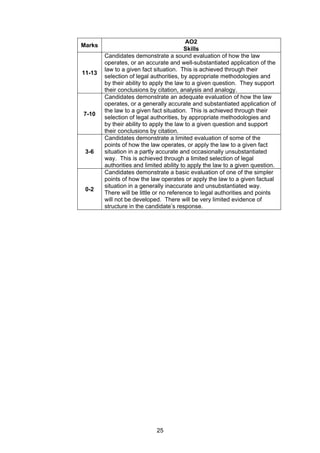
AO2
Marks
                                         Skills
        Candidates demonstrate a sound evaluation of how the law
        operates, or an accurate and well-substantiated application of the
        law to a given fact situation. This is achieved through their
11-13
        selection of legal authorities, by appropriate methodologies and
        by their ability to apply the law to a given question. They support
        their conclusions by citation, analysis and analogy.
        Candidates demonstrate an adequate evaluation of how the law
        operates, or a generally accurate and substantiated application of
        the law to a given fact situation. This is achieved through their
7-10
        selection of legal authorities, by appropriate methodologies and
        by their ability to apply the law to a given question and support
        their conclusions by citation.
        Candidates demonstrate a limited evaluation of some of the
        points of how the law operates, or apply the law to a given fact
 3-6    situation in a partly accurate and occasionally unsubstantiated
        way. This is achieved through a limited selection of legal
        authorities and limited ability to apply the law to a given question.
        Candidates demonstrate a basic evaluation of one of the simpler
        points of how the law operates or apply the law to a given factual
        situation in a generally inaccurate and unsubstantiated way.
 0-2
        There will be little or no reference to legal authorities and points
        will not be developed. There will be very limited evidence of
        structure in the candidate’s response.


                             25
(b)   Explain the importance of legislation and the approach taken by judges in the
      interpretation of statutes in the above scenario.                         [11]
      Credit reference to:
      • Section 6 Sale of Goods Act 1979.
      • Section 7 Sale of Goods Act 1979.
      • The approach of the Sale of Goods Act as codifying precedent and the
         application of case law in interpretation.
      • Law Reform (Frustrated Contracts) Act 1943.
      • Candidates will be rewarded for appropriate citation.

       Marks                                    AO3
               Presents a wholly logical and coherent argument and provides clear
               application using appropriate legal terminology. This does not mean
         2
               that there are no errors in grammar, punctuation and spelling but
               these will only be occasional.
               Presents a mostly logical and coherent argument and provides a
               reasonably adequate application using appropriate legal
         1     terminology. Whilst there may be errors in grammar, punctuation
               and spelling, these are not enough to detract from a mostly effective
               communication of meaning.

                                                 AO1
       Marks
                                  Knowledge and Understanding
                Candidates display a sound knowledge and understanding of the
                subject content relevant to the question and a good perception of
                the concepts and principles underlying that subject content making
                an entirely convincing synoptic connection with elements of
        8-9     knowledge gained in understanding legal reasoning and methods
                and understanding legal structures and processes. They display a
                sound understanding of the practical application of the law and are
                aware of current debate and criticism including the major proposals
                for reform.
                Candidates display an adequate knowledge and understanding of
                the subject content relevant to the question and have a perception
                of some of the concepts and principles underlying that subject
                content making a convincing synoptic connection with elements of
        6-7
                knowledge gained in understanding legal reasoning and methods
                and understanding legal structures and processes. They display a
                general understanding of the practical application of the law and are
                aware of aspects of current debate and criticism.
                Candidates display a limited knowledge and understanding of the
                subject content relevant to the question with limited insight into
                some of the concepts and principles underlying that subject content
                making a limited synoptic connection with elements of knowledge
        3-5
                gained in understanding legal reasoning and methods and
                understanding legal structures and processes. They display a
                limited understanding the practical application of the law and are
                aware in general terms of some of the current criticisms.
                Candidates display a basic knowledge and understanding of the
                subject content relevant to the question and/or identify some of the
                relevant principles. They demonstrate occasional basic insights
                into some of the concepts and principles underlying the subject
        0-2
                content making a limited synoptic connection with basic elements of
                knowledge gained in understanding legal reasoning and methods
                and understanding legal structures and processes. They display a
                basic understanding of the practical application of the law.

                                    26
Q.2   Study the text below and answer the questions based on it.
      John is the tenant of “The Moon” public house in Tewkville. The terms of the lease
      agreement provided that John should pay Philip, the landlord, £2,000 per month for a
      period of 8 years from January 1st 2010. Payment was due in advance on the first working
      day of each month.
      One year after starting the tenancy another pub opened in the locality and John suffered a
      slump in business. He informed Philip that he could not pay full rent of £2,000 per month.
      It was agreed that the rent be reduced to £1,000 per month “until things improved”. For the
      next six months John paid the revised amount of £1,000 on the first day of the month by
      bank transfer.
      On July 1st 2010 payment was not received by Philip because for technical reasons the
      Bank could not transfer the money. In fact the Bank was able to transfer money on July 2nd
      2010 and this was credited to Philip’s account on July 3rd 2010. Having not received the
      money on July 1st, Philip telephoned John and said that he was now reverting to the
      original agreement and that John should also pay him £6,000 being the amount owed to
      him.
      (a)    In the light of reported case law and other sources of law advise John.         [14]
             Credit reference to:
             • Doctrine of promissory estoppel.
             • Estoppel of where this is a shield and not a sword
             • Past consideration.
             • Credit will be given for relevant citation.
              Marks                                      AO3
                       Presents effective communication using appropriate legal terminology.
                       Nonetheless, there may be several errors in grammar, punctuation and
                 1
                       spelling, although not enough to detract from communication of
                       meaning.
                       Fails to communicate and present logical argument, including
                       inadequate use of legal terminology. There are significant errors of
                 0
                       grammar, punctuation and spelling which detract from communication of
                       meaning.
                                                            AO2
               Marks
                                                           Skills
                        Candidates demonstrate a sound evaluation of how the law operates,
                        or an accurate and well-substantiated application of the law to a given
                        fact situation. This is achieved through their selection of legal
               11-13
                        authorities, by appropriate methodologies and by their ability to apply
                        the law to a given question. They support their conclusions by citation,
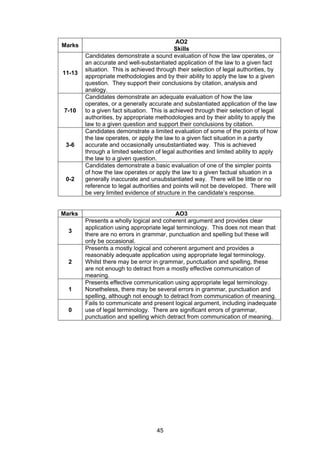
                        analysis and analogy.
                        Candidates demonstrate an adequate evaluation of how the law
                        operates, or a generally accurate and substantiated application of the
                        law to a given fact situation. This is achieved through their selection of
                7-10
                        legal authorities, by appropriate methodologies and by their ability to
                        apply the law to a given question and support their conclusions by
                        citation.
                        Candidates demonstrate a limited evaluation of some of the points of
                        how the law operates, or apply the law to a given fact situation in a
                3-6     partly accurate and occasionally unsubstantiated way. This is
                        achieved through a limited selection of legal authorities and limited
                        ability to apply the law to a given question.
                        Candidates demonstrate a basic evaluation of one of the simpler points
                        of how the law operates or apply the law to a given factual situation in
                        a generally inaccurate and unsubstantiated way. There will be little or
                0-2
                        no reference to legal authorities and points will not be developed.
                        There will be very limited evidence of structure in the candidate’s
                        response.

                                             27
(b)   Explain the significance of doctrine of precedent in the above scenario.   [11]

      Credit reference to:
      • The Doctrine of promissory estoppel is a creature of precedent.
      • Development of the Doctrine of promissory estoppel within the context of
         case law should be fully discussed.
      • The nature of what is a binding decision and the hierarchy of courts.
      • Credit will be given for relevant citation.

       Marks                                   AO3
               Presents a wholly logical and coherent argument and provides
               clear application using appropriate legal terminology. This does not
         2
               mean that there are no errors in grammar, punctuation and spelling
               but these will only be occasional.
               Presents a mostly logical and coherent argument and provides a
               reasonably adequate application using appropriate legal
         1     terminology. Whilst there may be errors in grammar, punctuation
               and spelling, these are not enough to detract from a mostly
               effective communication of meaning.

                                                 AO1
       Marks
                                  Knowledge and Understanding
                Candidates display a sound knowledge and understanding of the
                subject content relevant to the question and a good perception of
                the concepts and principles underlying that subject content making
                an entirely convincing synoptic connection with elements of
         8-9    knowledge gained in understanding legal reasoning and methods
                and understanding legal structures and processes. They display a
                sound understanding of the practical application of the law and are
                aware of current debate and criticism including the major proposals
                for reform.
                Candidates display an adequate knowledge and understanding of
                the subject content relevant to the question and have a perception
                of some of the concepts and principles underlying that subject
                content making a convincing synoptic connection with elements of
         6-7
                knowledge gained in understanding legal reasoning and methods
                and understanding legal structures and processes. They display a
                general understanding of the practical application of the law and
                are aware of aspects of current debate and criticism.
                Candidates display a limited knowledge and understanding of the
                subject content relevant to the question with limited insight into
                some of the concepts and principles underlying that subject
                content making a limited synoptic connection with elements of
         3-5
                knowledge gained in understanding legal reasoning and methods
                and understanding legal structures and processes. They display a
                limited understanding the practical application of the law and are
                aware in general terms of some of the current criticisms.
                Candidates display a basic knowledge and understanding of the
                subject content relevant to the question and/or identify some of the
                relevant principles. They demonstrate occasional basic insights
                into some of the concepts and principles underlying the subject
         0-2    content making a limited synoptic connection with basic elements
                of knowledge gained in understanding legal reasoning and
                methods and understanding legal structures and processes. They
                display a basic understanding of the practical application of the
                law.

                                    28
Q.3   Study the text below and answer the questions based on it.
      Bobby wanted to sell a Highland Terrier pup. He put the following advertisement into
      the Dog Monthly Magazine.
      “For sale, 3 month old, thoroughbred Highland Terrier pup, £150.”
      Margaret, a mother of three young children, came to see the dog. In answer to her
      questions, Bobby confirmed that the pup was sweet-tempered, house-trained and
      ideal for small children. Margaret decided to buy the pup.
      When she returned home the dog became very vicious and the dog bit her children, it
      also became obvious that the dog was not house-trained. When Margaret took the
      dog to the vet he confirmed that it was a cross-breed between a Highland Terrier and
      a Bull-Dog.

      (a)   In the light of reported case law and other sources of law, advise Margaret. [14]
             Credit reference to:
             • Nature of the advertisement as a representation.
             • Innocent, negligent, fraudulent misrepresentation.
             • Limits to the rights of rescission.
             • Credit will be given for relevant citation.

              Marks                                   AO3
                       Presents effective communication using appropriate legal
                       terminology. Nonetheless, there may be several errors in
                 1
                       grammar, punctuation and spelling, although not enough to detract
                       from communication of meaning.
                       Fails to communicate and present logical argument, including
                       inadequate use of legal terminology. There are significant errors
                 0
                       of grammar, punctuation and spelling which detract from
                       communication of meaning.

                                                          AO2
               Marks
                                                         Skills
                        Candidates demonstrate a sound evaluation of how the law
                        operates, or an accurate and well-substantiated application of the
                        law to a given fact situation. This is achieved through their
               11-13
                        selection of legal authorities, by appropriate methodologies and
                        by their ability to apply the law to a given question. They support
                        their conclusions by citation, analysis and analogy.
                        Candidates demonstrate an adequate evaluation of how the law
                        operates, or a generally accurate and substantiated application of
                        the law to a given fact situation. This is achieved through their
                7-10
                        selection of legal authorities, by appropriate methodologies and
                        by their ability to apply the law to a given question and support
                        their conclusions by citation.
                        Candidates demonstrate a limited evaluation of some of the
                        points of how the law operates, or apply the law to a given fact
                3-6     situation in a partly accurate and occasionally unsubstantiated
                        way. This is achieved through a limited selection of legal
                        authorities and limited ability to apply the law to a given question.
                        Candidates demonstrate a basic evaluation of one of the simpler
                        points of how the law operates or apply the law to a given factual
                        situation in a generally inaccurate and unsubstantiated way.
                0-2
                        There will be little or no reference to legal authorities and points
                        will not be developed. There will be very limited evidence of
                        structure in the candidate’s response.
                                             29
(b)   Explain the available sources of assistance for Margaret in funding litigation.
                                                                                   [11]
      Credit reference to:
      • Analysis of the financial position and discussion of the Community Legal
      • Service fund.
      • Private means.
      • Conditional fees.
      • The significance of legal insurance.

       Marks                                     AO3
                Presents a wholly logical and coherent argument and provides
                clear application using appropriate legal terminology. This does
         2
                not mean that there are no errors in grammar, punctuation and
                spelling but these will only be occasional.
                Presents a mostly logical and coherent argument and provides a
                reasonably adequate application using appropriate legal
         1      terminology. Whilst there may be errors in grammar, punctuation
                and spelling, these are not enough to detract from a mostly
                effective communication of meaning.

                                                AO1
       Marks
                                 Knowledge and Understanding
                Candidates display a sound knowledge and understanding of the
                subject content relevant to the question and a good perception of
                the concepts and principles underlying that subject content
                making an entirely convincing synoptic connection with elements
         8-9    of knowledge gained in understanding legal reasoning and
                methods and understanding legal structures and processes.
                They display a sound understanding of the practical application of
                the law and are aware of current debate and criticism including
                the major proposals for reform.
                Candidates display an adequate knowledge and understanding of
                the subject content relevant to the question and have a perception
                of some of the concepts and principles underlying that subject
                content making a convincing synoptic connection with elements of
         6-7
                knowledge gained in understanding legal reasoning and methods
                and understanding legal structures and processes. They display
                a general understanding of the practical application of the law and
                are aware of aspects of current debate and criticism.
                Candidates display a limited knowledge and understanding of the
                subject content relevant to the question with limited insight into
                some of the concepts and principles underlying that subject
                content making a limited synoptic connection with elements of
         3-5
                knowledge gained in understanding legal reasoning and methods
                and understanding legal structures and processes. They display
                a limited understanding the practical application of the law and
                are aware in general terms of some of the current criticisms.
                Candidates display a basic knowledge and understanding of the
                subject content relevant to the question and/or identify some of
                the relevant principles. They demonstrate occasional basic
                insights into some of the concepts and principles underlying the
         0-2    subject content making a limited synoptic connection with basic
                elements of knowledge gained in understanding legal reasoning
                and methods and understanding legal structures and processes.
                They display a basic understanding of the practical application of
                the law.

                                     30
Q.4   Study the text below and answer the questions based on it.
      Francis shops at Cheap Supermarkets Ltd. Last August, he went and did his family
      shopping and selected most of the items from the shelves. However, the meat was
      cut and weighed and given to him from the meat counter in the store. He also bought
      6 bottles of wine at a special price of £4 each.
      At the cash desk Francis did not notice that the cashier had rung up £5 for each of
      the bottles of wine. Whilst the other items were being rung up he changed his mind
      about buying the meat and left it to one side. When the total was added up Francis
      paid by credit card. When he checked the bill on the way out of the store he
      discovered the discrepancy in the price charged for the wine. He was so angry that
      he now wishes to reject all the shopping.
      (a)    In the light of important case law and other sources of lawm, advise Francis.
                                                                                       [14]
             Credit reference to:
             • Offer and acceptance.
             • Supermarket scenario and case law.
             • Acceptance of goods and unilateral offer.
             • Section 75 Consumer Credit Act 1974 and financial limits.
             • Candidates will be rewarded for relevant citation.

              Marks                                   AO3
                       Presents effective communication using appropriate legal
                       terminology. Nonetheless, there may be several errors in
                 1
                       grammar, punctuation and spelling, although not enough to detract
                       from communication of meaning.
                       Fails to communicate and present logical argument, including
                       inadequate use of legal terminology. There are significant errors of
                 0
                       grammar, punctuation and spelling which detract from
                       communication of meaning.

                                                           AO2
              Marks
                                                          Skills
                       Candidates demonstrate a sound evaluation of how the law
                       operates, or an accurate and well-substantiated application of the
                       law to a given fact situation. This is achieved through their
               11-13
                       selection of legal authorities, by appropriate methodologies and by
                       their ability to apply the law to a given question. They support their
                       conclusions by citation, analysis and analogy.
                       Candidates demonstrate an adequate evaluation of how the law
                       operates, or a generally accurate and substantiated application of
                       the law to a given fact situation. This is achieved through their
               7-10
                       selection of legal authorities, by appropriate methodologies and by
                       their ability to apply the law to a given question and support their
                       conclusions by citation.
                       Candidates demonstrate a limited evaluation of some of the points
                       of how the law operates, or apply the law to a given fact situation in
                3-6    a partly accurate and occasionally unsubstantiated way. This is
                       achieved through a limited selection of legal authorities and limited
                       ability to apply the law to a given question.
                       Candidates demonstrate a basic evaluation of one of the simpler
                       points of how the law operates or apply the law to a given factual
                       situation in a generally inaccurate and unsubstantiated way. There
                0-2
                       will be little or no reference to legal authorities and points will not
                       be developed. There will be very limited evidence of structure in
                       the candidate’s response.

                                            31
(b)   Explain the mechanisms available outside of litigation in resolving this dispute.
                                                                                      [11]

      Credit reference to:
      • The civil procedure rules and pre-action protocols.
      • Alternative dispute resolution mechanisms.
      • Codes of practice adopted voluntarily by certain Trade Associations.
      • Informal mechanisms.
      • Trading standards.
      • Candidates will be rewarded for appropriate citation.

       Marks                                      AO3
                 Presents a wholly logical and coherent argument and provides clear
                 application using appropriate legal terminology. This does not mean
          2
                 that there are no errors in grammar, punctuation and spelling but
                 these will only be occasional.
                 Presents a mostly logical and coherent argument and provides a
                 reasonably adequate application using appropriate legal terminology.
          1      Whilst there may be errors in grammar, punctuation and spelling,
                 these are not enough to detract from a mostly effective
                 communication of meaning.

                                                   AO1
       Marks
                                     Knowledge and Understanding
                 Candidates display a sound knowledge and understanding of the
                 subject content relevant to the question and a good perception of the
                 concepts and principles underlying that subject content making an
                 entirely convincing synoptic connection with elements of knowledge
         8-9
                 gained in understanding legal reasoning and methods and
                 understanding legal structures and processes. They display a sound
                 understanding of the practical application of the law and are aware of
                 current debate and criticism including the major proposals for reform.
                 Candidates display an adequate knowledge and understanding of
                 the subject content relevant to the question and have a perception of
                 some of the concepts and principles underlying that subject content
                 making a convincing synoptic connection with elements of knowledge
         6-7
                 gained in understanding legal reasoning and methods and
                 understanding legal structures and processes. They display a
                 general understanding of the practical application of the law and are
                 aware of aspects of current debate and criticism.
                 Candidates display a limited knowledge and understanding of the
                 subject content relevant to the question with limited insight into some
                 of the concepts and principles underlying that subject content making
                 a limited synoptic connection with elements of knowledge gained in
         3-5
                 understanding legal reasoning and methods and understanding legal
                 structures and processes. They display a limited understanding the
                 practical application of the law and are aware in general terms of
                 some of the current criticisms.
                 Candidates display a basic knowledge and understanding of the
                 subject content relevant to the question and/or identify some of the
                 relevant principles. They demonstrate occasional basic insights into
                 some of the concepts and principles underlying the subject content
         0-2
                 making a limited synoptic connection with basic elements of
                 knowledge gained in understanding legal reasoning and methods
                 and understanding legal structures and processes. They display a
                 basic understanding of the practical application of the law.


                                      32
LAW - LA3

                        UNDERSTANDING SUBSTANTIVE LAW

                       OPTION 02 – CRIMINAL LAW & JUSTICE


Q.1   Liam caught his girlfriend kissing Noel. Liam became angry and hit Noel with a
      baseball bat. Noel suffered a fractured skull, and spent a month in hospital. One day
      he was told by his doctor, Shelagh, that he could be discharged the next day as his
      injury had almost completely healed, although he would need to take painkillers for
      several more weeks. On the day of his leaving hospital Noel was given his painkillers
      by Rodney, the hospital pharmacist. Rodney had wrongly calculated the dose, and
      each painkiller contained four times the recommended dose. The next day Noel took
      one of the painkillers and collapsed. Two days later Noel died.

      (a)    In the light of reported case law and other sources of law, consider whether
             Liam may be criminally liable for Noel’s death.                           [14]

      (b)    Explain the avenues of appeal available to Liam if he is convicted by the
             Crown Court.                                                              [11]
             Credit reference to:
             Part (a)
             • Elements of murder and manslaughter.
             • Mens rea of murder: intention to kill or cause grievous bodily harm. Case
                law, e.g., Cunningham, Maloney.
             • Actus reus of murder and manslaughter: common law definition.
             • Causation: causation in fact – the “but-for” test (e.g., White, Dalloway);
                causation in law and the de minimis principle.
             • Case law on causation where it is alleged that medical negligence has
                contributed to the death of the victim: Smith, Jordan, Cheshire.
             • Discussion of whether chain of causation is broken on the facts of the
                problem.
             • Manslaughter: voluntary and involuntary.
             • Voluntary manslaughter: defences to murder; provocation/loss of control;
                diminished responsibility.
             • Involuntary manslaughter: unlawful act manslaughter; manslaughter by
                gross negligence (Adomoko).
             Part (b)
             • Appeal from the Crown Court to the Court of Appeal (Criminal Division).
             • Appeal may be against conviction, sentence or both.
             • Criminal Appeal Act 1995 – appeal against conviction – a defendant must
                obtain either a certificate from the trial judge stating that the case is fit for
                appeal, or leave from the Court of Appeal (Criminal Division).
             • Admission of fresh evidence – the CA may admit new evidence, provided
                it seems capable of belief, it may afford a ground of appeal, and there is a
                reasonable explanation why it was not called at the trial before the Crown
                Court.
             • The Court of Appeal (Criminal Division) will allow the appeal if they
                consider that the conviction was “unsafe”.
             • An appeal against sentence will only be allowed if the sentence was
                wrong in principle.
             • Further appeal to the Supreme Court only on a point of law of public
                importance: leave is required.

                                             33
 
Q.2   Harriet was arrested after the police found a bag containing Class A drugs in her
      garden shed. She was taken to the police station, where she had her fingerprints and
      a DNA sample taken. Harriet asked if she could let her mother know of her arrest,
      and speak to a solicitor. Both requests were refused. Harriet was then questioned for
      twelve hours without a break. Throughout the interview she continually denied any
      knowledge of the bag, until one of the officers told her that her fingerprints had been
      found on the bag. This was completely untrue, but by this time Harriet was so
      distressed that she agreed to sign a confession.

      (a)    In the light of reported case law and other sources of law, consider the legality
             of the actions of the police.                                               [14]

      (b)    Explain the factors which the Crown Prosecution Service would consider
             when deciding whether to prosecute Harriet.                            [11]

             Credit reference to:

             Part (a)
             • Police and Criminal Evidence Act 1984 (PACE), and the Codes of
                Practice.
             • Arrest – s.24 as amended; s.28; s.30; Code G.
             • Role of custody officer; written notice to be given to the suspect of his/her
                  rights and entitlements.
             • Fingerprints – may be taken without authorisation or consent under s.61
                  as amended by the CJA 2003; may be retained under Criminal Justice
                  and Police Act 2001, s.82, whether or not the suspect is charged with
                  any offence.
             • DNA samples – may be taken without consent if taken as a non-intimate
                  sample under s.65, and may be retained under CJPA 2001, s.82.
             • Right of suspect to have someone informed of arrest: s.56.
             • Right of suspect to free legal advice: s.58.
             • Circumstances where the above rights may be delayed for up to 36 hours.
             • Interviews – must be recorded: s.60, and the suspect cautioned before the
                interview begins. Code C governs the conduct of interviews, including the
                length of time for which suspects may be questioned without a break and
                their entitlement to rest periods.
             • Confession evidence may be excluded at trial if obtained by oppression:
                s.76(2)(a), or in circumstances which make it unreliable: s.76(2)(b) – e.g.,
                failure to provide access to legal advice (Samuel, Chung) or failure to
                comply with Code C, such as failure to caution before interview (Doolan).
             • Any evidence including a confession may be excluded under s.78 on the
                ground that it would adversely affect the fairness of the trial, e.g., serious
                and substantial breaches of PACE or the Codes.


                                            34
Part (b)
• Code for Crown Prosecutors issued under the Prosecution of Offences
   Act 1985.
• The Full Code test – two parts, both of which must be satisfied in order to
   bring a prosecution.
• The Evidential Test – whether the evidence is substantial and reliable;
   whether it was obtained in circumstances which would make it admissible
   in court; whether on the evidence there is a realistic prospect of
   conviction. If this test is not passed, then the case should not proceed.
• The Public Interest Test – whether it is in the public interest for a
   prosecution to be brought in this particular case. Matters which should be
   considered, e.g., the seriousness of the offence; the likelihood of a
   substantial sentence; the prevalence of such offences; the nature of the
   victim; whether the offence was against a police officer or someone
   serving the public; the characteristics of the defendant (whether old, very
   young, whether the prosecution might have harmful effects on his/her
   physical or mental health, etc.).


                              35
Q.3   Kyle, Jordan and Ciaren went to their end of term prom. After all three had drunk a
      considerable quantity of alcohol, Kyle accidentally spilt a glass of wine on Jordan’s
      dress. Jordan thought Kyle had done this on purpose, and aimed a blow at Kyle, but
      missed and hit Ciaren instead. Ciaren stumbled backwards and broke his elbow.
      Jordan went to help Ciaren, but Kyle thought Jordan was going to hit him again, and
      rugby-tackled Jordan to the floor with such force that she suffered serious internal
      injuries. Kyle was later arrested by the police.

      (a)    In the light of reported case law and other sources of law, consider whether
             Jordan and Kyle have committed any offences, taking account of any
             defences which might be available to them.                                [14]

      (b)    Explain the powers of the police to grant Kyle bail and impose conditions
             upon him.                                                                 [11]

             Credit reference to:

             Part (a)
             • Assault and battery at common law; Criminal Justice Act 1988, s.39.
             • More serious offences of assault and battery under the Offences Against
                the Person Act 1861 – s.47: causing actual bodily harm; s.20: malicious
                wounding/inflicting grievous bodily harm; s.18: causing grievous bodily
                harm with intent.
             • Elements of these offences and application to the scenario, with reference
                to case law.
             • Transferred malice, e.g., Latimer.
             • Possible defences –
             • Private defence; reasonable force in the prevention of crime under
                Criminal Law Act 1967, s.3. The need for the force used to have been
                reasonable in the circumstances as the defendant believed them to be:
                case law on private defence and mistaken belief in the necessity for
                private defence.
             • Effects of intoxication upon criminal liability; distinction between offences
                of basic and specific intent; case of Majewski.

             Part (b)
             • Power of custody officer to grant bail: Police and Criminal Evidence Act
                1984, s.38, as amended by the Criminal Justice and Public Order Act
                1994.
             • The general presumption of a right to bail under the Bail Act 1976, s.4.
             • Circumstances in which bail need not be granted: where the name and
                address of the suspect cannot be ascertained or is believed to be false;
                where the suspect may commit further offences; where the suspect may
                cause harm to others or to him/herself; where there is a need to keep the
                suspect in custody for his/her own protection; where the suspect may
                interfere with witnesses or evidence.
             • If bail is not granted by the police, the suspect must be brought before the
                magistrates as soon as possible.
             • Conditions which may be attached to bail; examples of bail conditions.


                                            36
Q.4   Chris is a diabetic who often ignores his doctor’s advice to ensure that he takes his
      insulin and eats regularly. One day he drove into town without bothering to take his
      insulin first. This caused him to lose concentration and drive too close to a tree,
      disturbing a nest of bees. The angry bees swarmed into the car through the open
      sunroof and began to sting Chris, causing him to lose control of the car and crash
      into a shop window. Chris was not injured, but Jane, a customer in the shop, was cut
      by flying glass.

      (a)    In the light of reported case law and other sources of law, consider whether
             any possible defences might be available to Chris if he were charged with a
             criminal offence.                                                         [14]

      (b)    Explain what sources of legal funding may be available to Jane if she decides
             to sue Chris.                                                             [11]

             Credit reference to:

             Part (a)
             • Defence of automatism – absence of voluntary control over bodily
                  movements: A-G’s Reference (No.2 of 1992).
             • Examples, e.g., concussion or the swarm of bees example given in Hill v
                  Baxter.
             • Self-induced automatism – the distinction between offences of specific
                  and basic intent recognised in Bailey - held by the CA that the defendant
                  will not be convicted of an offence of specific intent.
             • Held further in Bailey that the defendant can be convicted of an offence of
                  basic intent if he was reckless in the sense of appreciating before he did
                  the act which caused him to become an automaton that it would have
                  this effect, but deliberately ran the risk of endangering others by
                  becoming aggressive or uncontrollable.
             • Relationship between insane and non-insane automatism – the distinction
                  between external causes and internal causes – cases such as
                  Henessey, Sullivan, Quick.

             Part (b)
             • Access to civil legal aid – reformed by the Access to Justice Act 1999 –
                the Legal Services Commission now controls the Community Legal
                Service Fund and makes contracts with solicitors and other agencies to
                provide legal services.
             • Exclusion of personal injury cases from the above.
             • Alternatives – the conditional fee scheme, introduced in 1995 under the
                Courts and Legal Services Act 1990, allows solicitors to take personal
                injury cases on the basis that if they win they can charge the normal fee.
                (This can be uplifted to 25% of the damages awarded through the
                recovery of costs from the other side).
             • The Law Society’s “Accident Help Line” deals with personal injury cases
                under the conditional fee scheme and covers both legal advice and
                representation on a “no win, no fee” basis.


                                           37
LAW - LA3

                        UNDERSTANDING SUBSTANTIVE LAW

 OPTION 03 - FREEDOM OF THE INDIVIDUAL AND THE PROTECTION OF HUMAN
                                RIGHTS


Q.1   Rhoda has learning difficulties. She was seen by PC Will and PC Hay wandering
      down the High Street offering £5 notes to passers-by. PC Will and PC Hay
      approached Rhoda and asked what she was doing, but could not understand her
      response. PC Will held Rhoda’s arms behind her back while PC Hay searched her
      pockets and found a number of £5 notes. The two officers took Rhoda to the police
      station. On arriving, PC Will said to the custody officer: “You won’t get any sense out
      of this one. Just chuck her in a cell and we’ll sort her out later.” Rhoda was kept in a
      cell for 16 hours. During that time she was subjected to an intimate search by PC
      Hay. Rhoda was released after 25 hours when the care home which looks after her
      reported her missing.

      (a)    In the light of reported case law and other sources of law, consider the legality
             of the actions of the police.                                               [14]

      (b)    Explain what legal advice and assistance is available to Rhoda if she wishes
             to sue the police in the civil courts.                                    [11]

             Credit reference to:

             Part (a)
             Police and Criminal Evidence Act 1984.
             Stop and search powers, PACE ss.1-3 and Code A.
             Arrest: PACE s.24 as amended by SOCAPA 2005.
             Duties of custody officer under PACE and Code C.
             Rights of persons in detention: right to have someone informed of arrest
             (s.56); right to legal advice (s.58).
             Intimate search: PACE s.65 – authorisation; grounds (to recover something
             capable of causing injury, or a Class A drug); normally must be carried out by
             doctor or nurse: drug search only to be carried out on medical premises by
             doctor or nurse; search for something capable of causing injury may be
             carried out by officer of same sex if authorising officer considers it
             impracticable.
             Time limits on detention: PACE s.41 as amended.
             Detention review: PACE s.41.

             Part (b)
             • Access to Justice Act 1999.
             • Legal Services Commission.
             • Community Legal Service Fund; fixed budget.
             • Community Legal Service provision.
             • Eligibility: means test and merits test.


                                             38
Q.2   John was on his way home from work one evening when he was caught up in an
      anti-war demonstration that was taking place. As he tried to push his way through the
      large group of protesters, he heard a police officer shout through a loud-hailer that
      everyone was to stay where they were and that nobody was to leave. The police then
      proceeded to put up a cordon around the group to stop them from moving. John tried
      to speak to one of the police officers to explain that he was not involved in the
      demonstration and was on his way home. The officer told him to shut up and said
      they were all being detained for breach of the peace. When John continued to argue,
      the officer arrested him.

             (a)    In the light of reported case law and other sources of law, consider
                    whether the police were acting within their powers                  [14]

             (b)    Explain to John the powers of the police to grant bail.            [11]

                    Credit reference to:

                    Part (a)
                    • Breach of the peace: power of police to detain or arrest.
                    • Actual and anticipated breach: Moss v McLachlan.
                    • Human Rights Act 1998, art.10 of the ECHR – freedom of
                       expression; art.11 – freedom of assembly.
                    • Need to take account of whether the response of police is
                       proportionate and necessary to prevent a breach – Steel v UK,
                       Laporte.
                    • Austin – police can justify the actions as an exercise of the powers
                       under s.12 and s.14 of the Public Order Act 1986 even if they did
                       not have these powers in mind.

                    Part (b)
                    • Power of custody officer to grant bail under the Police and Criminal
                       Evidence Act 1984, s.38.
                    • Circumstances when bail need not be granted – name and
                       address of suspect cannot be ascertained or believed to be false;
                       reasonable belief that suspect will re-offend, interfere with
                       witnesses, be a danger to others or him/herself; necessary to keep
                       suspect in custody for his/her own protection.
                    • If suspect is not given bail, must be brought before magistrates as
                       soon as possible.
                    • Conditions which may be attached to bail: examples.
                    • Street bail.


                                           39
Q.3   Preston Past, a famous footballer, went to a nightclub to celebrate the birth of his first
      child and drank several bottles of champagne. He was approached by a female fan,
      who asked him for his autograph. Preston signed the fan’s autograph book, gave her
      a kiss on the cheek, and posed with his arm around her while her friend took a
      photograph of them with a mobile phone. The fan sent a copy of the photograph to a
      national newspaper, the Daily Slur. The next week the Daily Slur ran the headline:
      “Cheating Past Scores At Last”, and claimed that a drunken Past had cheated on his
      wife with a fan while she was in hospital recovering from giving birth.

      (a)    In the light of reported case law and other sources of law, consider whether
             Preston Past has any legal redress against the fan or the Daily Slur.     [14]

      (b)    Explain the role of juries in civil cases.                                    [11]

             Credit reference to:

             Part (a)
             • Action for defamation; libel and slander.
             • What constitutes defamation: the statement must have a tendency to
                lower the person in the eyes of right-thinking persons: Sim v Stretch,
                Byrne v Dean.
             • Elements of defamation: statement must refer to the claimant; must be
                published; must be defamatory.
             • Need to take whole article into account and not just a photo or headline:
                Charlesworth v NGN.
             • Possible defences: justification; fair comment on a matter of public
                interest; absolute privilege; qualified privilege; offer of amends and
                payment of damages.
             • Matters connected with bringing an action for defamation: cost; amount of
                damages; trial by jury; fast-track procedure.

             Part (b)
             • Limited use of juries to try civil cases in the Queen’s Bench Division of the
                High Court. Use of civil juries is now very unusual.
             • Cases where juries still used: defamation, malicious prosecution, false
                imprisonment, fraud.
             • Jury trial may be refused by the judge if the case is likely to be extremely
                long or complex, or involve a lot of scientific or documentary evidence.
             • Role of jury: to hear the evidence and reach a decision in favour of the
                claimant or defendant; to recommend the level of damages.


                                              40
Q.4   Martha Mutton, the editor of the Daily Digger, was given a sensational story that a
      Member of Parliament, Davina White, had been taking illegal drugs. Martha Mutton
      was aware that Davina White was due to appear in the Crown Court in two weeks’
      time on charges connected with fraudulent expense claims. Martha Mutton printed
      the story about the illegal drugs on the front page of the Sunday edition just a few
      days before Davina White’s trial started.

      (a)    In the light of reported case law and other sources of law, consider whether
             Martha Mutton and the Daily Digger may have committed contempt of court.
                                                                                       [14]

      (b)    Explain the ways in which the Government is made subject to the Rule of
             Law.                                                                    [11]

             Credit reference to:

             Part (a)
             • The offence of contempt of court; proceedings usually brought by
                Attorney-General.
             • Contempt of Court Act 1981.
             • Strict liability rule: s.1.
             • Proceedings must be “active”: s.2.
             • When proceedings are active (schedule 1).
             • The publication must create a substantial risk of serious prejudice: s.2.
             • “Substantial” relates to proximity of the risk – whether close in time to the
                trial - A-G v NGN (Ian Botham case); A-G v ITN; A-G v BBC (the Have I
                got News for You? Case); whether publication widespread or restricted.
             • Serious prejudice – prejudging the outcome of a case; turning the jury
                against a party, etc.
             • Not necessary to imply that a defendant is guilty of the crime for which
                he/she is being tried (e.g., the Michael Fagan case; the Dr Leonard Arthur
                trial).

             Part (b)
             • Meaning of the rule of law.
             • Reference to Dicey and possibly other theorists such as Joseph Raz.
             • Aspects of the Rule of Law ideal which impinge on government, e.g.,
                government not exempt from the requirement to conform with the law;
                members of the government and Parliament are bound to obey the law in
                the same way as ordinary citizens; no arbitrary powers; government only
                has powers which are created in accordance with normal constitutional
                procedures such as by Parliament or through common law; government
                bound by principles of natural justice, etc.


                                            41
LAW - LA4

                       UNDERSTANDING SUBSTANTIVE LAW

                   OPTION 1 - CONTRACT AND CONSUMER LAW


        Answer two questions from Section A and one question from Section B.

                                      SECTION A

Q.1   Evaluate the civil remedies available for a consumer under the general law of
      contract for breach of a contractual term.                                       [25]
      Credit reference to:
      • Specific performance and the limits to specific performance. See, for example,
         Section 52 of the Sale of Goods Act 1979.
      • Rescission for misrepresentation; perishing of goods; exercising a contractual or
         statutory right of cancellation.
      • Distinction between warranty and conditions of a contract – see Section 61 (1) of
         the 1979 Sale of Goods Act; compare Section 11 (3) of the Sales of Goods Act
         1979.
      • Slight breaches – Section 15A Sale of Goods Act 1979.
      • Loss of right to reject – for example, Section 11 (4) Sale of Goods Act 1979.
         Note where a contract is severable.
      • What is acceptance – Section 35 Sales of Goods Act 1979.
      • Rules of remoteness in respect of compensation and duty of mitigation. General
         principles of compensation.
      • Candidates will be rewarded for appropriate citation of legal authorities.

                                                      AO1
         Marks
                                        Knowledge and Understanding
                    Candidates display a sound knowledge and understanding of the
                    subject content relevant to the question and a good perception of the
                    concepts and principles underlying that subject content. They display
           8-9
                    a sound understanding of the practical application of the law and are
                    aware of current debate and criticism including the major proposals for
                    reform.
                    Candidates display an adequate knowledge and understanding of the
                    subject content relevant to the question and have a perception of
           6-7      some of the concepts and principles underlying that subject content.
                    They display a general understanding of the practical application of the
                    law and are aware of aspects of current debate and criticism.
                    Candidates display a limited knowledge and understanding of the
                    subject content relevant to the question with limited insight into some
           3-5      of the concepts and principles underlying that subject content. They
                    display a limited understanding of the practical application of the law
                    and are aware in general terms of some of the current criticisms.
                    Candidates display a basic knowledge and understanding of the
                    subject content relevant to the question and/or identify some of the
                    relevant principles. They demonstrate occasional basic insights into
           0-2
                    some of the concepts and principles underlying the subject content.
                    They display a basic understanding of the practical application of the
                    law.


                                           42
AO2
 Marks
                                              Skills
          Candidates demonstrate a sound evaluation of how the law operates,
          or an accurate and well-substantiated application of the law to a given
          fact situation. This is achieved through their selection of legal
  11-13
          authorities, by appropriate methodologies and by their ability to apply
          the law to a given question. They support their conclusions by citation,
          analysis and analogy.
          Candidates demonstrate an adequate evaluation of how the law
          operates, or a generally accurate and substantiated application of the
          law to a given fact situation. This is achieved through their selection of
  7-10
          legal authorities, by appropriate methodologies and by their ability to
          apply the law to a given question and support their conclusions by
          citation.
          Candidates demonstrate a limited evaluation of some of the points of
          how the law operates, or apply the law to a given fact situation in a
   3-6    partly accurate and occasionally unsubstantiated way. This is
          achieved through a limited selection of legal authorities and limited
          ability to apply the law to a given question.
          Candidates demonstrate a basic evaluation of one of the simpler
          points of how the law operates or apply the law to a given factual
          situation in a generally inaccurate and unsubstantiated way. There will
   0-2
          be little or no reference to legal authorities and points will not be
          developed. There will be very limited evidence of structure in the
          candidate’s response.


Marks                                       AO3
          Presents a wholly logical and coherent argument and provides clear
          application using appropriate legal terminology. This does not mean
   3
          that there are no errors in grammar, punctuation and spelling but these
          will only be occasional.
          Presents a mostly logical and coherent argument and provides a
          reasonably adequate application using appropriate legal terminology.
   2      Whilst there may be errors in grammar, punctuation and spelling,
          these are not enough to detract from a mostly effective communication
          of meaning.
          Presents effective communication using appropriate legal terminology.
          Nonetheless, there may be several errors in grammar, punctuation
   1
          and spelling, although not enough to detract from communication of
          meaning.
          Fails to communicate and present logical argument, including
          inadequate use of legal terminology. There are significant errors of
   0
          grammar, punctuation and spelling which detract from communication
          of meaning.


                                 43
Q.2   Critically examine the role of Ombudsmen in protecting consumers.               [25]

      Credit reference to:
      • Background of Ombudsman schemes can be found in the Nordic countries. In
         the United Kingdom most of the schemes have been set up by statute. The most
         recent example of this can be seen in the Financial Services Ombudsman and
         also the role of the Ombudsman now under the Consumer Credit Act 2006.
      • The largest scheme by far is the Financial Ombudsman Service created by the
         Financial Services and Markets Act 2000. Most Ombudsmen are now creatures
         of statute with voluntary schemes becoming fewer – the Ombudsman for Estate
         Agents is a continuing example.
      • Jurisdiction and powers and procedures of Ombudsman.
      • Remedies available for Ombudsman.
      • Sanctions. Every Ombudsman publishes an annual report which would normally
         give examples of complaints made in the previous year and statistics on the
         number and type of complaints.

                                                    AO1
       Marks
                                     Knowledge and Understanding
               Candidates display a sound knowledge and understanding of the subject
               content relevant to the question and a good perception of the concepts and
        8-9    principles underlying that subject content. They display a sound
               understanding of the practical application of the law and are aware of
               current debate and criticism including the major proposals for reform.
               Candidates display an adequate knowledge and understanding of the
               subject content relevant to the question and have a perception of some of
        6-7    the concepts and principles underlying that subject content. They display
               a general understanding of the practical application of the law and are
               aware of aspects of current debate and criticism.
               Candidates display a limited knowledge and understanding of the subject
               content relevant to the question with limited insight into some of the
        3-5    concepts and principles underlying that subject content. They display a
               limited understanding of the practical application of the law and are aware
               in general terms of some of the current criticisms.
               Candidates display a basic knowledge and understanding of the subject
               content relevant to the question and/or identify some of the relevant
        0-2    principles. They demonstrate occasional basic insights into some of the
               concepts and principles underlying the subject content. They display a
               basic understanding of the practical application of the law.


                                          44
AO2
Marks
                                            Skills
        Candidates demonstrate a sound evaluation of how the law operates, or
        an accurate and well-substantiated application of the law to a given fact
        situation. This is achieved through their selection of legal authorities, by
11-13
        appropriate methodologies and by their ability to apply the law to a given
        question. They support their conclusions by citation, analysis and
        analogy.
        Candidates demonstrate an adequate evaluation of how the law
        operates, or a generally accurate and substantiated application of the law
7-10    to a given fact situation. This is achieved through their selection of legal
        authorities, by appropriate methodologies and by their ability to apply the
        law to a given question and support their conclusions by citation.
        Candidates demonstrate a limited evaluation of some of the points of how
        the law operates, or apply the law to a given fact situation in a partly
 3-6    accurate and occasionally unsubstantiated way. This is achieved
        through a limited selection of legal authorities and limited ability to apply
        the law to a given question.
        Candidates demonstrate a basic evaluation of one of the simpler points
        of how the law operates or apply the law to a given factual situation in a
 0-2    generally inaccurate and unsubstantiated way. There will be little or no
        reference to legal authorities and points will not be developed. There will
        be very limited evidence of structure in the candidate’s response.


Marks                                      AO3
        Presents a wholly logical and coherent argument and provides clear
        application using appropriate legal terminology. This does not mean that
  3
        there are no errors in grammar, punctuation and spelling but these will
        only be occasional.
        Presents a mostly logical and coherent argument and provides a
        reasonably adequate application using appropriate legal terminology.
  2     Whilst there may be error in grammar, punctuation and spelling, these
        are not enough to detract from a mostly effective communication of
        meaning.
        Presents effective communication using appropriate legal terminology.
  1     Nonetheless, there may be several errors in grammar, punctuation and
        spelling, although not enough to detract from communication of meaning.
        Fails to communicate and present logical argument, including inadequate
  0     use of legal terminology. There are significant errors of grammar,
        punctuation and spelling which detract from communication of meaning.


                                    45
Q.3   Evaluate the cancellation rights of consumers in a case where a consumer may be
      pressurised by a doorstep salesman to sign an agreement.                      [25]

      Credit reference to:
      • Cancellation provisions in Section 67-73 of the Consumer Credit Act 1974.
         Consumer will also have cancellation rights in cases covered by the Cancellation
         of Contracts made in a Consumer’s Home or Place of Work Regulations 2008
         and also under the Distance Selling Regulations.
      • A regulated consumer credit or hire agreement is cancellable if two conditions are
         satisfied namely a) order representations are made by or on behalf of the
         negotiator in the presence of the debtor or hirer and b) the unexecuted
         agreement was not signed by the debtor or hirer at premises where the business
         was carried on.
      • The copy provisions are set out in Sections 62 and 63. The OFT can grant
         exemption from the duty to send a cancellation notice in certain specified cases.
      • The time of cancellation starts when the debtor or hirer signs the unexecuted
         agreement and ends 5 days after the debtor or hirer receives the statutory
         second copy or notice.
      • Section 69 sets out how the cancellation is effected. Subject to exceptions the
         general effect of cancellation is to treat the agreement and most linked
         transactions as if it had never been made – see Section 69 (4) of the Consumer
         Credit Act 1974.
      • The duty to return goods. Section 73 deals with the part exchange allowance.

                                                     AO1
        Marks
                                       Knowledge and Understanding
                  Candidates display a sound knowledge and understanding of the subject
                  content relevant to the question and a good perception of the concepts
         8-9      and principles underlying that subject content. They display a sound
                  understanding of the practical application of the law and are aware of
                  current debate and criticism including the major proposals for reform.
                  Candidates display an adequate knowledge and understanding of the
                  subject content relevant to the question and have a perception of some
         6-7      of the concepts and principles underlying that subject content. They
                  display a general understanding of the practical application of the law
                  and are aware of aspects of current debate and criticism.
                  Candidates display a limited knowledge and understanding of the subject
                  content relevant to the question with limited insight into some of the
         3-5      concepts and principles underlying that subject content. They display a
                  limited understanding of the practical application of the law and are
                  aware in general terms of some of the current criticisms.
                  Candidates display a basic knowledge and understanding of the subject
                  content relevant to the question and/or identify some of the relevant
         0-2      principles. They demonstrate occasional basic insights into some of the
                  concepts and principles underlying the subject content. They display a
                  basic understanding of the practical application of the law.


                                           46
AO2
Marks
                                            Skills
         Candidates demonstrate a sound evaluation of how the law operates,
         or an accurate and well-substantiated application of the law to a given
         fact situation. This is achieved through their selection of legal
 11-13
         authorities, by appropriate methodologies and by their ability to apply
         the law to a given question. They support their conclusions by citation,
         analysis and analogy.
         Candidates demonstrate an adequate evaluation of how the law
         operates, or a generally accurate and substantiated application of the
         law to a given fact situation. This is achieved through their selection of
 7-10
         legal authorities, by appropriate methodologies and by their ability to
         apply the law to a given question and support their conclusions by
         citation.
         Candidates demonstrate a limited evaluation of some of the points of
         how the law operates, or apply the law to a given fact situation in a
  3-6    partly accurate and occasionally unsubstantiated way. This is achieved
         through a limited selection of legal authorities and limited ability to apply
         the law to a given question.
         Candidates demonstrate a basic evaluation of one of the simpler points
         of how the law operates or apply the law to a given factual situation in a
  0-2    generally inaccurate and unsubstantiated way. There will be little or no
         reference to legal authorities and points will not be developed. There
         will be very limited evidence of structure in the candidate’s response.


Marks                                      AO3
         Presents a wholly logical and coherent argument and provides clear
         application using appropriate legal terminology. This does not mean
  3
         that there are no errors in grammar, punctuation and spelling but these
         will only be occasional.
         Presents a mostly logical and coherent argument and provides a
         reasonably adequate application using appropriate legal terminology.
  2      Whilst there may be error in grammar, punctuation and spelling, these
         are not enough to detract from a mostly effective communication of
         meaning.
         Presents effective communication using appropriate legal terminology.
         Nonetheless, there may be several errors in grammar, punctuation and
  1
         spelling, although not enough to detract from communication of
         meaning.
         Fails to communicate and present logical argument, including
         inadequate use of legal terminology. There are significant errors of
  0
         grammar, punctuation and spelling which detract from communication
         of meaning.


                                    47
Q.4   To what extent can Section 75 of the Consumer Credit Act 1974 be considered a vital
      provision for consumers where a supplier of goods or services refuses to meet its
      obligations under the contract or becomes insolvent?                             [25]

      Credit reference to:
      • Section 75 (1) is a vital provision in that it provides that any claim against the
         supplier in respect of a misrepresentation or breach of contact shall be also
         available against a creditor who with the supplier be considered jointly and
         severally liable.
      • Section 75 (3) lays down two limitations.
      • The effect of credit cards and particularly credit cards abroad. See Office of Fair
         Trading v Lloyds TSB (2007) where the House of Lords unanimously affirmed the
         decision of the Court of Appeal that Section 75 applies to overseas transactions.
      • Section 75 can only be used by a consumer if the relevant credit agreement was
         a regulated agreement.
      • Candidates will be rewarded for relevant citation.

                                                   AO1
       Marks
                                    Knowledge and Understanding
               Candidates display a sound knowledge and understanding of the subject
               content relevant to the question and a good perception of the concepts
        8-9    and principles underlying that subject content. They display a sound
               understanding of the practical application of the law and are aware of
               current debate and criticism including the major proposals for reform.
               Candidates display an adequate knowledge and understanding of the
               subject content relevant to the question and have a perception of some of
        6-7    the concepts and principles underlying that subject content. They display
               a general understanding of the practical application of the law and are
               aware of aspects of current debate and criticism.
               Candidates display a limited knowledge and understanding of the subject
               content relevant to the question with limited insight into some of the
        3-5    concepts and principles underlying that subject content. They display a
               limited understanding of the practical application of the law and are aware
               in general terms of some of the current criticisms.
               Candidates display a basic knowledge and understanding of the subject
               content relevant to the question and/or identify some of the relevant
        0-2    principles. They demonstrate occasional basic insights into some of the
               concepts and principles underlying the subject content. They display a
               basic understanding of the practical application of the law.


                                           48
AO2
Marks
                                            Skills
        Candidates demonstrate a sound evaluation of how the law operates, or
        an accurate and well-substantiated application of the law to a given fact
        situation. This is achieved through their selection of legal authorities, by
11-13
        appropriate methodologies and by their ability to apply the law to a given
        question. They support their conclusions by citation, analysis and
        analogy.
        Candidates demonstrate an adequate evaluation of how the law
        operates, or a generally accurate and substantiated application of the law
7-10    to a given fact situation. This is achieved through their selection of legal
        authorities, by appropriate methodologies and by their ability to apply the
        law to a given question and support their conclusions by citation.
        Candidates demonstrate a limited evaluation of some of the points of how
        the law operates, or apply the law to a given fact situation in a partly
 3-6    accurate and occasionally unsubstantiated way. This is achieved
        through a limited selection of legal authorities and limited ability to apply
        the law to a given question.
        Candidates demonstrate a basic evaluation of one of the simpler points
        of how the law operates or apply the law to a given factual situation in a
 0-2    generally inaccurate and unsubstantiated way. There will be little or no
        reference to legal authorities and points will not be developed. There will
        be very limited evidence of structure in the candidate’s response.


Marks                                      AO3
        Presents a wholly logical and coherent argument and provides clear
        application using appropriate legal terminology. This does not mean that
  3
        there are no errors in grammar, punctuation and spelling but these will
        only be occasional.
        Presents a mostly logical and coherent argument and provides a
        reasonably adequate application using appropriate legal terminology.
  2     Whilst there may be error in grammar, punctuation and spelling, these
        are not enough to detract from a mostly effective communication of
        meaning.
        Presents effective communication using appropriate legal terminology.
  1     Nonetheless, there may be several errors in grammar, punctuation and
        spelling, although not enough to detract from communication of meaning.
        Fails to communicate and present logical argument, including inadequate
  0     use of legal terminology. There are significant errors of grammar,
        punctuation and spelling which detract from communication of meaning.


                                    49
SECTION B
Q.5   Study the text and answer the questions based on it.
      “Office of Fair Trading v Abbey National plc (2008) is concerned with terms imposing certain
      bank charges and the Unfair Terms in Consumer Contracts Regulations 1999. It illustrates
      two significant advances in consumer protection over the last decade or so, one cultural and
      one legal. On the cultural front, it shows the power of the internet to galvanise consumer
      activity, with many consumers being prompted to try to reclaim bank charges by the
      information and form documents supplied by consumer advocates on the internet. On the
      legal front, the foundation of those claims is basically the Regulations which provide for
      terms in contracts between consumers and sellers or suppliers to be found unfair and not
      binding on the consumer.”
                                                               Source: Macdonald (2008) Modern Law Review

      (a)    Explain the application of the Unfair Terms in Consumer Contracts Regulations
             (1999) in promoting fairness of the standard terms encountered by consumers.           [11]
             Credit reference to:
             • The test of unfairness in Regulation 5 (1) and the underlying test of good faith.
             • The core provisions namely Regulation 6 (2) dealing with plain, intelligible
                language and that the assessment of fairness of the term will not relate to the
                definition of the main subject matter of the contract or to the adequacy of the
                price.
             • The term will be unfair if it is contrary to the requirement of good faith and causes
                a significant imbalance in the party’s rights and obligations.
             • The distinction between consumer contracts and business contracts.
             • Credit will be given for relevant citation.
              Marks                                        AO3
                       Presents a wholly logical and coherent argument and provides clear
                       application using appropriate legal terminology. This does not mean that
                 2
                       there are no errors in grammar, punctuation and spelling but these will
                       only be occasional.
                       Presents a mostly logical and coherent argument and provides a
                       reasonably adequate application using appropriate legal terminology.
                 1
                       Whilst there may be error in grammar, punctuation and spelling, these are
                       not enough to detract from a mostly effective communication of meaning.

                                                           AO1
              Marks
                                            Knowledge and Understanding
                       Candidates display a sound knowledge and understanding of the subject
                       content relevant to the question and a good perception of the concepts
                8-9    and principles underlying that subject content. They display a sound
                       understanding of the practical application of the law and are aware of
                       current debate and criticism including the major proposals for reform.
                       Candidates display an adequate knowledge and understanding of the
                       subject content relevant to the question and have a perception of some of
                6-7    the concepts and principles underlying that subject content. They display
                       a general understanding of the practical application of the law and are
                       aware of aspects of current debate and criticism.
                       Candidates display a limited knowledge and understanding of the subject
                       content relevant to the question with limited insight into some of the
                3-5    concepts and principles underlying that subject content. They display a
                       limited understanding of the practical application of the law and are aware
                       in general terms of some of the current criticisms.
                       Candidates display a basic knowledge and understanding of the subject
                       content relevant to the question and/or identify some of the relevant
                0-2    principles. They demonstrate occasional basic insights into some of the
                       concepts and principles underlying the subject content. They display a
                       basic understanding of the practical application of the law.


                                             50
(b)   Evaluate the mechanisms available for promoting reform for the enforcement of
      Consumer Law.                                                              [14]
      Credit reference to:
      • The role of pressure groups some of which may be cause related as in the
         case of the bank charges example.
      • The role of the OFT.
      • Class actions.
      • The role of EU particularly through regulations and directives.
      • The role of the Law Commission.
      • Candidates will be rewarded for accurate and relevant citation.

       Marks                                      AO3
                Presents effective communication using appropriate legal terminology.
                Nonetheless, there may be several errors in grammar, punctuation and
          1
                spelling, although not enough to detract from communication of
                meaning.
                Fails to communicate and present logical argument, including
                inadequate use of legal terminology. There are significant errors of
          0
                grammar, punctuation and spelling which detract from communication
                of meaning.

                                                    AO2
       Marks
                                                   Skills
                Candidates demonstrate a sound evaluation of how the law operates,
                or an accurate and well-substantiated application of the law to a given
                fact situation, making an entirely convincing synoptic connection with
                elements of skills gained in understanding legal reasoning, personnel
       11-13    and methods and understanding legal values, structures and
                processes. This is achieved through their selection of legal authorities,
                by appropriate methodologies and by their ability to apply the law to a
                given question. They support their conclusions by citation, analysis
                and analogy.
                Candidates demonstrate an adequate evaluation of how the law
                operates, or a generally accurate and substantiated application of the
                law to a given fact situation, making a convincing synoptic connection
                with elements of skills gained in understanding legal reasoning,
        7-10
                personnel and methods and understanding legal values, structures and
                processes. This is achieved through their selection of legal authorities,
                by appropriate methodologies and by their ability to apply the law to a
                given question and support their conclusions by citation.
                Candidates demonstrate a limited evaluation of some of the points of
                how the law operates, or apply the law to a given fact situation in a
                partly accurate and occasionally unsubstantiated way, making a limited
                synoptic connection with elements of skills gained in understanding
         3-6
                legal reasoning, personnel and methods and understanding legal
                values, structures and processes. This is achieved through a limited
                selection of legal authorities and limited ability to apply the law to a
                given question.
                Candidates demonstrate a basic evaluation of one of the simpler points
                of how the law operates or apply the law to a given factual situation in
                a generally inaccurate and unsubstantiated way, making some basic
                synoptic connection with elements of skills gained in understanding
         0-2
                legal reasoning, personnel and methods and understanding legal
                values, structures and processes. There will be little or no reference to
                legal authorities and points will not be developed. There will be very
                limited evidence of structure in the candidate’s response.


                                     51
Q.6   Study the text and answer the questions based on it.

      “About 7,000 people in Great Britain die each year from accidents in the home, over
      a tenth of them from fires. This is comparable to the number killed on the roads. In
      addition over 100,000 receive hospital in-patient treatment for home accident injuries.
      No central statistics are kept for those not admitted to hospital but it is estimated that
      in England and Wales 650,000 receive out-patient care in hospitals and 500,000
      attend their general practitioner for treatment.

      Apart from the toll of human suffering which these figures represent, there are
      substantial economic costs, both direct – through damage to property, as in the case
      of the 50,000 or so fires in the home each year – and indirect – e.g. the cost of
      medical treatment and hours lost from work.

      This Consultative Document is concerned with ways of reducing the cost and
      suffering caused by home accidents. It considers how information, publicity and
      education on causes of home accidents and means of avoiding them can be
      improved; and in particular it discusses how the law can best ensure that goods
      which reach consumers are as safe to use as the public may reasonably expect.”

                             Source: Consumer Safety: A Consultative Document (Green Paper, Cmnd 6398, 1976)


      (a)    Explain the legal approaches taken to promote the safety of goods for
             consumers in the law of England and Wales.                                               [11]

             Credit reference to:
             • Consumer Safety Act 1978; Consumer Safety (Amendment) Act 1986 –
                this legislation provides a historical context.
             • Consumer Protection Act 1987 Part 2.
             • General safety requirement.
             • General Product Safety Regulations 2005. The role of the common law
                and statutory implied terms.
             • Candidates will be rewarded for accurate citation.

              Marks                                      AO3
                        Presents a wholly logical and coherent argument and provides clear
                        application using appropriate legal terminology. This does not mean
                 2
                        that there are no errors in grammar, punctuation and spelling but
                        these will only be occasional.
                        Presents a mostly logical and coherent argument and provides a
                        reasonably adequate application using appropriate legal
                 1      terminology. Whilst there may be error in grammar, punctuation and
                        spelling, these are not enough to detract from a mostly effective
                        communication of meaning.


                                                52
AO1
       Marks
                                   Knowledge and Understanding
                Candidates display a sound knowledge and understanding of the
                subject content relevant to the question and a good perception of
                the concepts and principles underlying that subject content. They
         8-9
                display a sound understanding of the practical application of the
                law and are aware of current debate and criticism including the
                major proposals for reform.
                Candidates display an adequate knowledge and understanding of
                the subject content relevant to the question and have a perception
                of some of the concepts and principles underlying that subject
         6-7
                content. They display a general understanding of the practical
                application of the law and are aware of aspects of current debate
                and criticism.
                Candidates display a limited knowledge and understanding of the
                subject content relevant to the question with limited insight into
                some of the concepts and principles underlying that subject
         3-5
                content. They display a limited understanding of the practical
                application of the law and are aware in general terms of some of
                the current criticisms.
                Candidates display a basic knowledge and understanding of the
                subject content relevant to the question and/or identify some of
                the relevant principles. They demonstrate occasional basic
         0-2
                insights into some of the concepts and principles underlying the
                subject content. They display a basic understanding of the
                practical application of the law.


(b)   Evaluate the role of Regulations and Directives in promoting the safety of
      goods to consumers.                                                        [14]

      Credit reference to:
      • Regulations are directly applicable. They have direct effect both vertically
         and horizontal if give individual rights and are clear – Article 288 (TFEU)
      • Directives are not directly applicable but they have vertical direct effect if
         give individual rights and are clear. They have no horizontal direct effect.
         However an individual can claim against the state for loss caused by
         failure to implement.
      • The significance of the EU General Products Safety Directive 2001/95.
      • The problem of overlap between the general safety requirement and the
         specific EU or UK rules. Primacy of EU law.
      • Neither EU directives nor UK legislation extend beyond the safety of
         goods to cover services too. See however the European Commission
         Consultation Paper, Safety of Services.

       Marks                                   AO3
                 Presents effective communication using appropriate legal
                 terminology. Nonetheless, there may be several errors in
          1
                 grammar, punctuation and spelling, although not enough to
                 detract from communication of meaning.
                 Fails to communicate and present logical argument, including
                 inadequate use of legal terminology. There are significant errors
          0
                 of grammar, punctuation and spelling which detract from
                 communication of meaning.


                                     53
AO2
Marks
                                         Skills
        Candidates demonstrate a sound evaluation of how the law
        operates, or an accurate and well-substantiated application of
        the law to a given fact situation, making an entirely convincing
        synoptic connection with elements of skills gained in
        understanding legal reasoning, personnel and methods and
11-13
        understanding legal values, structures and processes. This is
        achieved through their selection of legal authorities, by
        appropriate methodologies and by their ability to apply the law to
        a given question. They support their conclusions by citation,
        analysis and analogy.
        Candidates demonstrate an adequate evaluation of how the law
        operates, or a generally accurate and substantiated application
        of the law to a given fact situation, making a convincing synoptic
        connection with elements of skills gained in understanding legal
7-10    reasoning, personnel and methods and understanding legal
        values, structures and processes. This is achieved through their
        selection of legal authorities, by appropriate methodologies and
        by their ability to apply the law to a given question and support
        their conclusions by citation.
        Candidates demonstrate a limited evaluation of some of the
        points of how the law operates, or apply the law to a given fact
        situation in a partly accurate and occasionally unsubstantiated
        way, making a limited synoptic connection with elements of skills
 3-6
        gained in understanding legal reasoning, personnel and methods
        and understanding legal values, structures and processes. This
        is achieved through a limited selection of legal authorities and
        limited ability to apply the law to a given question.
        Candidates demonstrate a basic evaluation of one of the simpler
        points of how the law operates or apply the law to a given factual
        situation in a generally inaccurate and unsubstantiated way,
        making some basic synoptic connection with elements of skills
 0-2    gained in understanding legal reasoning, personnel and methods
        and understanding legal values, structures and processes.
        There will be little or no reference to legal authorities and points
        will not be developed. There will be very limited evidence of
        structure in the candidate’s response.


                           54
LAW - LA4

                         UNDERSTANDING LAW IN CONTEXT

                        OPTION 02 - CRIMINAL LAW & JUSTICE

                                        SECTION A

                         Answer two questions from this section.

Q.1   “Consent is rarely a defence to a crime.” Critically evaluate this statement.     [25]
      Credit reference to:
      • Appreciation of the difference between situations where absence of consent is a
         positive ingredient of an offence (e.g., taking without consent) and cases where
         consent is a defence to an action which would otherwise be criminal.
      • Significance of consent as a defence mainly confined to offences against the
         person.
      • Common assault or battery is not committed where the victim has given valid
         consent. In cases of actual bodily harm or worse, whether or not consent can be
         a defence is the subject of a large body of case law, and answers should
         demonstrate some knowledge of this.
      • In A-G’s Reference (No.6 of 1980) the CA stated that consent was irrelevant if
         actual bodily harm was intended and/or caused, except in certain accepted
         situations where the conduct is regarded as lawful provided the victim has
         consented.
      • Situations where consent can be a defence – properly conducted games or
         sports; reasonable surgical intervention; tattooing and piercing; horseplay;
         dangerous exhibitions. Examples of case law, e.g., Jones, Aitken, Brown.
      • Requirement of valid consent – must not be vitiated by force, deception or
         incapacity. Cases such as Richardson, Dica, Bolduc and Bird, Burrell v Harmer,
         etc.
      • Public policy considerations – Brown, Wilson.


Q.2   Consider whether the powers of the courts to grant bail contain sufficient safeguards
      to protect the public.                                                           [25]
      Credit reference to –
      • Bail Act 1976, s.4 – presumption of entitlement to bail.
      • Circumstances in which bail need not be granted: Bail Act 1976 Schedule 1 (e.g.,
         defendant is likely to fail to surrender, commit further offences or interfere with
         witnesses).
      • Factors to be taken into account when considering grant of bail.
      • Modifications of the general presumption of entitlement to bail – bail only granted
         in exceptional circumstances where defendant charged with murder,
         manslaughter, rape, or where previously charged with a specified serious
         offence, or where the offence was committed while already on bail (under the
         Criminal Justice and Public Order Act 1994 as amended by the Crime and
         Disorder Act 1998).
      • Right of the CPS to appeal against the grant of bail.
      • Problems of offences committed while on bail; powers of police to arrest for
         breach of bail conditions.
      • Power of courts to impose conditions on bail, with examples.
      • Evaluation of whether safeguards are sufficient to protect the public.


                                             55
Q.3    To what extent can diminished responsibility be a defence to a criminal charge? [25] 
       Credit reference to:
       • Homicide Act 1957, s.2 – diminished responsibility only a defence to murder; has
          the effect of reducing murder to manslaughter.
       • Definition of diminished responsibility, as amended by the Coroners and Justice
          Act 2008.
       • Meaning of abnormal mental condition – Byrne – covers impairment of self
          control (“irresistible impulse”) as well as impairment of rational judgement.
       • Defence covers common mental illness such as depression, e.g., Seers.
       • Uses of the defence in practice – a plea of guilty to manslaughter on grounds of
          diminished responsibility is commonly accepted by the courts in cases such as
          battered woman syndrome, mercy killing, etc.

Q.4
       Consider whether the Crown Prosecution Service has changed the criminal justice
       system in England and Wales for the better.                               [25]

       Credit reference to:
       • Background to and reasons for the establishment of the Crown Prosecution
          Service (e.g., Phillips Commission, Justice Report).
       • Prosecution of Offences Act 1985.
       • Role of the CPS in the criminal justice system – the decision whether to
          prosecute; advising the police; conducting prosecutions in the magistrates’ court
          and Crown Court.
       • Early problems and proposals for reform: Glidewell Report, Narey Report.
       • Major reforms: the Narey fast-track system; the establishment of CPS units within
          police stations; closer working between CPS and police.
       • Present structure of the CPS.
       • Recent reforms, e.g., extension of advocacy rights, CPS has taken over charging
          from police in all but minor cases, establishment of CPS Direct.
       • Evaluation: importance of an independent prosecution service; whether the CPS
          is now too closely involved with the police, etc.


                                            56
SECTION B

                         Answer one question from this section.

Q.5   Study the text and answer the questions based on it.
      “In addition to the statutory provisions, a court sentencing a young offender must be
      aware of obligations under a range of international conventions which emphasise the
      importance of avoiding “criminalisation” of young people whilst ensuring that they are
      held responsible for their actions and, where possible, take part in repairing the
      damage that they have caused. This includes recognition of the damage caused to
      the victims and understanding by the young person that the deed was not
      acceptable. Within a system that provides for both the acknowledgement of guilt and
      sanction which rehabilitate, the intention is to establish responsibility and, at the
      same time, to promote re-integration rather than to impose retribution.”
      The Sentencing Guidelines Council
      Overarching Principles – Sentencing Youths: The Definitive Guide 2009 p.3.
      (a)    Describe the general principles behind the sentencing of young offenders.[11]
      (b)    Evaluate the advantages and disadvantages of trial by jury in the criminal
             justice system in England and Wales.                                       [14]
             Credit reference to:
             Part (a)
             • General principles of punishment: retribution, deterrence, denunciation,
                reform and rehabilitation.
             • Particular considerations that apply to young offenders – may be more
                likely to offend due to immaturity and lack of understanding; greater
                potential for reform and rehabilitation, etc.
             • Need to have regard to international conventions, e.g., the International
                Convention on the Rights of the Child; the approach of the ECtHR in
                cases such as Venables and Thompson v UK.
             • Crime and Disorder Act 1998, s.37 – the principal aim of the youth justice
                system shall be to prevent offending by children and young persons.
             • Current emphasis on prevention and rehabilitation.

             Part (b)
             • Arguments in favour of jury trial – generally popular, considered to be a
                bulwark of citizens’ liberties, juries considered to be good at judging the
                credibility of witnesses and defendants, enables the public to participate in
                the legal process, counteracts the remoteness of the law.
             • Arguments against – trial by jury is more expensive, tends to take longer,
                juries more ready to acquit or tender perverse verdicts, juries more likely
                to be swayed by good advocacy, juries tend to be influenced by the
                media, there are no formal tests to exclude people who may be
                unintelligent, illiterate or prejudiced, juries may not understand the law,
                juries are more vulnerable to intimidation, many people are reluctant to
                serve on juries.
             • Difficulty of assessing arguments – the Contempt of Court Act 1981
                prevents finding out how juries actually decide cases.
             • Juries gradually falling into disuse – very limited in civil cases, and
                increasingly so in criminal cases as the right to jury trial has been
                removed in relation to many offences.


                                            57
Q.6    Study the text and answer the questions based on it.
       “...[W]henever a section is silent as to mens rea there is a presumption that, in order
       to give effect to the will of Parliament, we must read in words appropriate to require
       mens rea ... it is firmly established by a host of authorities that mens rea is an
       essential ingredient of every offence unless some reason can be found for holding
       that it is not necessary ... In the absence of a clear indication in the Act that an
       offence is intended to be an absolute offence, it is necessary to go outside the Act
       and examine all relevant circumstances in order to establish that this must have been
       the intention of Parliament. I say ‘must have been’ because it is a universal principle
       that if a penal provision is reasonably capable of two interpretations, that
       interpretation which is most favourable to the accused must be adopted.”

       Lord Reid in Sweet v Parsley [1970] A.C.132, 148H

       (a)    Describe the principles used by the courts when deciding whether an
              offence is one of strict liability.                            [11]

       (b)    Evaluate the extent to which the courts can refer to extrinsic aids when
              interpreting statutes.                                                     [14]
              Credit reference to:

              Part (a)
              • Nature of strict liability.
              • General presumption that mens rea is required: Sweet v Parsley, A-G for
                 Hong Kong v Gammon.
              • The principles set out in Gammon as to when the presumption of
                 mens rea can be displaced.
              • Examples of case law, e.g., Callow v Tillstone, Sweet v Parsley, DPP v
                 B(A minor), Smedleys v Breed, Shah, Storkwain, Alphacell v Woodward.
              Part (b)
              • Problems of determining Parliament’s intention – old statutes, changes in
                 the meaning of words, situations not anticipated when the statute was
                 passed, etc.
              • Pepper v Hart - reference to Hansard is permitted where the legislation is
                 ambiguous or obscure or leads to an absurd result, where a statement
                 has been made in Parliament by a minister or the promoter of the Bill, and
                 where the statement to be used is clear in its meaning.
              • Other extrinsic materials which may be used – the Oxford English
                 Dictionary, other statutes, cases, Law Commission Reports.
              • Human Rights Act 1998, sections 2, 3 and 6.


                                             58
LAW - LA4

      FREEDOM OF THE INDIVIDUAL AND PROTECTION OF HUMAN RIGHTS

                   OPTION -3 - UNDERSTANDING LAW IN CONTEXT

                                         SECTION A

                                    Answer two questions


Q.1   To what extent does the law of England and Wales protect different religions?          [25]
      Credit reference to:
      • Art.9 of the European Convention on Human Rights – the right to freedom of
         thought, conscience and religion.
      • Art.9(2) - qualifies the right to manifest one’s religion or beliefs by permitting
         restrictions in the interests of public safety, prevention of disorder or crime,
         protection of health or morals, or protection of the rights and freedoms of others.
      • Human Rights Act 1998 – Section 13 requires a court to have “particular regard”
         to the importance of the right under Art.9 where the court’s determination of a
         question under the HRA 1998 may affect the exercise of this right by a religious
         organisation.
      • Human Rights Act 1998 - Section 14 prohibits discrimination in the exercise of
         Convention rights on grounds of religion.
      • Protection from discrimination on grounds of religion – Equality Act 2010.
      • Blasphemy – abolished by the Criminal Justice and Immigration Act 2008, s.79.
      • Religiously aggravated offences.
      • Offences relating to religious hatred - Racial and Religious Hatred Act 2006 adds
         Part IIIA to the Public Order Act 1986.
      • Public Order Act 1986, s.29J provides that nothing in Part IIIA prohibits or
         restricts discussion, criticism, expressions of antipathy or dislike, ridicule, insult or
         abuse of particular religions.


Q.2   To what extent does the law of England and Wales provide the individual with
      effective protection against unjustifiable intrusion by the media?                     [25]
      Credit reference to:
      • European Convention on Human Rights, Art.8: Right to Private and Family Life.
      • Human Rights Act 1998 incorporates Art.8 – otherwise, no specific right to
         privacy: Kaye v Robertson.
      • Protection against physical intrusion: trespass, private nuisance (Bernstein v
         Skyviews).
      • Breach of confidence: impact of HRA 1998; use of injunction to prevent
         disclosure by the media, e.g., Douglas v Hello! Ltd; Venables v News Group
         Newspapers; Campbell v Mirror Group Newspapers; X v O’Brian (Mary Bell
         case); A v B and C, etc.
      • Potential conflict between Art.8 and Art.10; importance of freedom of the press;
         question of whether publication is in the public interest; whether people in the
         public eye are entitled to less protection than private persons.
      • Press Complaints Council and Code of Practice – standards of voluntary self-
         regulation can be relevant to whether newspaper can rely on s.12 of the HRA
         1998: Douglas v Hello!.
      • Proposals for reform; failure to implement Calcutt Report; left to the courts to
         develop remedy.


                                              59
Q.3   By what means, and to what extent, does the law provide for control and
      accountability over the use of secret surveillance by the police?                   [25]

      Credit reference to:
      • Regulation of Investigatory Powers Act 2000 (RIPA).
      • RIPA Part II – three types of surveillance: directed surveillance, intrusive
         surveillance, and use of covert human intelligence sources (s.26). Directed
         surveillance is covert but not intrusive surveillance undertaken for the purposes of
         a specific investigation and likely to result in obtaining private information about a
         person. Surveillance is intrusive if it involves surveillance of what goes in
         residential premises or a private vehicle and involves either the presence of an
         individual or is carried out by means of a surveillance device.
      • Authorisation – directed surveillance or surveillance involving a human source
         can be authorised by a superintendent or an inspector in cases of urgency.
         Intrusive surveillance requires authorisation from the Home Secretary or the chief
         constable.
      • Grounds – the authorising officer believes that the action is necessary because it
         will be of substantial value in the prevention of detection of crime (not necessarily
         serious crime), and that the action is proportionate to what is being sought to be
         achieved. (Also includes grounds of national security, economic well-being of the
         UK, public safety, public health and tax collection – very wide.) In the case of
         intrusive surveillance the grounds are more limited – national security, economic
         well-being of the UK and “serious” crime.
      • “Serious crime” – same as for interception of communications under RIPA –
         either involves the use of violence, results in substantial financial gain, or is
         conduct by a large number of persons in pursuit of a common purpose, or the
         offence is one for which a person at least 21 years old with no previous
         convictions could reasonably be expected to be imprisoned for three years or
         more.
      • Authorisation must be approved by a Surveillance Commissioner. Lasts for 3
         months and can be renewed indefinitely.
      • RIPA Tribunal is the only route of complaint against use of surveillance. Problems
         – people don’t know they are under surveillance; the Tribunal ousts the
         jurisdiction of the ordinary courts and is the only recourse of someone who is a
         “victim” under s.7 of the HRA 1998; proceedings are secretive and no reasons
         given for decision.


                                             60
Q.4   Discuss whether the United Kingdom would benefit from a Bill of Rights.               [25]

      Credit reference to:
      • Arguments in favour of a Bill of Rights -
      • Britain has no written constitution setting out the rights of citizens.
      • Almost all developed Western nations have a Bill of Rights.
      • The Human Rights Act 1998 is a piece of ordinary legislation which could be
         repealed by any government.
      • The HRA 1998 is based on the ECHR, which is not adequate to a modern
         society. It is half a century old, and does not provide for social, economic or
         political rights. It does not reflect the specific needs of the UK. Many of the ECHR
         rights are qualified in ways that allow them to be effectively overridden by a UK
         government. The UK government is not prevented from passing legislation which
         infringes human and civil rights.
      • The HRA 1998 depends for its effectiveness on the willingness of the judiciary to
         uphold human and civil rights.
      • A Bill of Rights could include rights which meet the needs of the UK.
      • A Bill of Rights would be entrenched.
      • A Bill of Rights would set permanent limits on the actions of the executive.
      • A Bill of Rights would make governments more accountable for their actions.
      • Arguments against a Bill of Rights –
      • A Bill of Rights would further increase the powers of the judiciary, who are not
         elected, as against the elected Parliament.
      • A Bill of Rights would be difficult to alter if needs change, and can be a block to
         reform, e.g., the problem of gun control in the USA.
      • A Bill of Rights is just as liable to be interpreted in light of political considerations
         as any other document, e.g., the USA struggle for civil rights for African-
         Americans and other minorities.


                                              61
SECTION B

                                    Answer one question.

Q.5   Study the text and answer the questions based on it.

      “What are Human Rights?

      Human rights are the basic rights and freedoms that belong to every person in the
      world.

      Ideas about human rights have evolved over many centuries. But they achieved
      strong international support following the Holocaust and World War II. To protect
      future generations from a repeat of these horrors, the United Nations adopted the
      Universal Declaration of Human Rights in 1948.

      For the first time, the Universal Declaration set out the fundamental rights and
      freedoms shared by all human beings. These rights and freedoms – based on core
      principles like dignity, equality and respect – inspired a range of international and
      regional human rights treaties. For example, they formed the basis for the European
      Convention on Human Rights in 1950. The European Convention protects the human
      rights of people in countries that belong to the Council of Europe. This includes the
      United Kingdom”.
                                                  Source: Equality and Human Rights Commission homepage.


      (a)    Explain what is meant by a declaration of incompatibility.                           [11]

      (b)    Evaluate the extent to which the European Convention on Human Rights
             protects human rights within the United Kingdom.                     [14]

             Credit reference to:
             Part (a)
             • Human Rights Act 1998 s.3 imposes a duty on courts to read and give
                effect to primary and subordinate legislation in a way which is compatible
                with Convention rights “so far as is possible to do so”.
             • Legislation which cannot be interpreted in a way which is compatible with
                Convention rights must nevertheless be enforced, except where the
                legislation is subordinate legislation and the primary legislation under
                which it was made does not require it to be framed in a way which is
                incompatible with Convention rights.
             • HRA 1998, s.4 – power of judges of High Court and above to issue a
                declaration of incompatibility where it is not possible to interpret legislation
                in a way which is compatible with Convention rights.
             • A declaration of incompatibility may be overturned on appeal to a higher
                court, e.g., Alconbury, Wilson v First County Trust Ltd.
             • Effect of a declaration of incompatibility – the courts must continue to give
                effect to the legislation until it is changed by Parliament.
             • HRA 1998 s.10 and schedule 2 creates a fast-track procedure whereby a
                Minister may amend primary or subordinate legislation so as to remove
                the incompatibility by means of an order approved by both Houses of
                Parliament.
             • Examples of case law where declarations have been made, e.g., H v
                North and East Region Mental Health Review Tribunal; R(M) v Secretary
                of State for Health; International Transport GmbH Roth v Secretary of
                State for the Home Department; R(Anderson) v Secretary of State for the
                Home Department; A v Secretary of State for the Home Department, etc.

                                             62
Part (b)
             • Nature and background of European Convention on Human Rights –
                general information about how the ECHR is enforced.
             • Content of the ECHR: outline of Articles and the rights which are
                protected; absolute and qualified rights.
             • Outline of how UK citizens can bring cases before the European Court of
                Human Rights: examples of cases, e.g., Tyrer v UK, Malone v UK,
                Goodwin v UK.
             • Protection of human rights via the Human Rights Act 1998: incorporation
                of Convention Articles; duty imposed by s.6 on all public authorities to act
                in a way which is compatible with Convention rights; s.3 requirement that
                UK law should be interpreted in a way which is compatible with
                Convention Articles; s.19 requirement that legislation should include a
                statement of compatibility or statement that the Government wishes to
                proceed with the legislation anyway.
             • Examples of protection of human rights in the UK.


Q.6   Study the text and answer the questions based on it.

      Claims accepted by Employment Tribunals 1 April 2007 to 31 March 2008

      Nature of Claim                                                  2005/6       2006/7       2007/8
      Sex discrimination                                               14,250       28,153       26,907
      Disability discrimination                                          4,585        5,533        5,833
      Equal pay                                                        17,268       44,013       62,706
      Race discrimination                                                4,103        3,780        4,130
      Discrimination on grounds of Religion or Belief                      486          648           709
      Discrimination on grounds of Sexual Orientation                      395          470           582
      Age discrimination                                                    n/a         972        2,949
                                      Source: Tribunals Service: Employment Tribunal and EAT Statistics (GB).


      (a)    Explain the difference between direct discrimination and indirect
             discrimination.                                                                           [11]

      (b)    Evaluate the work of tribunals.                                                           [14]

             Credit reference to:
             Part (a)
             • Context – the terms come from the Sex Discrimination Act 1975 and the
                Race Relations Act 1976, which define three types of discrimination:
                direct, indirect, and victimisation.
             • Direct and indirect discrimination were redefined by the Equality Act 2010.
                The language of the definitions is simpler, but the substance is still very
                similar. Also, the EA 2010 only came into force on October 1 2010.
                Candidates who refer to the pre-Equality Act definitions should be credited
                for this knowledge.
             • Direct discrimination is defined in s.13 of the Equality Act 2010. It occurs
                when a person is treated less favourably than another person would have
                been because of a protected characteristic - their sex, race, disability,
                marital status or civil partnership, sexual orientation, gender
                reassignment, religion or age.

                                               63
•   Indirect discrimination is defined in s.19 of the Equality Act 2010. It occurs
                     where a policy which is applied equally to everyone has an effect which is
                     particularly disadvantageous to people with a protected characteristic, and
                     cannot be shown to be a proportionate means of achieving a legitimate
                     aim. Indirect discrimination can also occur where a policy would put a
                     person at a disadvantage if it were applied, e.g., put someone off applying
                     for a job or using a service.
                 •   Examples of case law on direct and indirect discrimination.

                 Part (b)
                 • Nature of tribunals – part of the civil process; decide disputes either
                    between a party and an official body or state organisation, or between
                    parties, but without the formality and expense of going to the civil courts.
                    Cases usually heard by a panel of three, with a legally qualified
                    chairperson and two lay experts reflecting each side of the dispute (e.g.,
                    trade union representative and employers’ representative).
                 • Kinds of tribunal – domestic tribunals are used by the professions and
                    certain other occupations to determine issues involving the professional
                    conduct of members of the profession; staffed by senior members of the
                    profession; usually have power to fine, suspend or prevent a member
                    from practising the occupation in question. Administrative tribunals have a
                    more general jurisdiction covering matters such as employment, welfare
                    entitlement, taxation, and the like. They are usually set up individually by
                    specific legislation.
                 • Advantages of tribunals – faster than courts; staffed by experts; cheaper
                    than taking a case to court, as parties can present their own case (only
                    funding to cover legal advice and not representation is available);
                    generally less formal procedure.
                 • Problems with tribunals: Leggatt Report 2001 – tribunals system found to
                    be haphazard, problems over appeals – some tribunals had appeal route,
                    while others could only be appealed by way of judicial review – many
                    delays, stressful for lay users, tendency towards increasing use of legal
                    representation by stronger party, e.g., employers; some tribunals
                    unnecessarily formal and court-like in their procedures; lack of clear
                    independence from state organisations in case of tribunals dealing with
                    matters such as tax, immigration, social security, education, housing, etc.
                 • Tribunals Courts and Enforcement Act 2007 – sets up a single unified
                    system of tribunals, divided into Divisions. First layer tribunals hear most
                    cases, but not all, and second layer tribunals hear appeals and cases in
                    certain specialist areas.
                 • Presidents of second layer tribunals are now judges: senior president is a
                    senior judge – tribunals starting to look more like a second judicial system
                    adapted to specialist kinds of dispute.


GCE Law MS - January 2011


                                                 64
WJEC
245 Western Avenue
Cardiff CF5 2YX
Tel No 029 2026 5000
Fax 029 2057 5994
E-mail: exams@wjec.co.uk
website: www.wjec.co.uk

Law-Exchange.co.uk Shared Resource

  • 1.
  • 2.
    INTRODUCTION The marking schemeswhich follow were those used by WJEC for the January 2011 examination in GCE LAW. They were finalised after detailed discussion at examiners' conferences by all the examiners involved in the assessment. The conferences were held shortly after the papers were taken so that reference could be made to the full range of candidates' responses, with photocopied scripts forming the basis of discussion. The aim of the conferences was to ensure that the marking schemes were interpreted and applied in the same way by all examiners. It is hoped that this information will be of assistance to centres but it is recognised at the same time that, without the benefit of participation in the examiners' conferences, teachers may have different views on certain matters of detail or interpretation. WJEC regrets that it cannot enter into any discussion or correspondence about these marking schemes. Page LA1 (AS) 1 LA2 (AS) 13 LA3 (A2) - Option 1 24 LA3 (A2) - Option 2 33 LA3 (A2) - Option 3 38 LA4 (A2) - Option 1 42 LA4 (A2) - Option 2 55 LA4 (A2) - Option 3 59
  • 3.
    LAW - LA1 UNDERSTANDING LEGAL VALUES, STRUCTURES & PROCESSES Q.1 (a) Explain the importance of the rule of law in England and Wales [14] Credit reference to: • The approach of Dicey. He held that there were three elements that created the rule of law namely an absence of arbitrary power on the part of the State; equality before the law; supremacy of ordinary law. • Note the view of Hayek and also those of Raz. • The Constitutional Reform Act 2005 recognised the rule of law and the importance of the independence of the judiciary. • The principles of natural justice should be observed such as requiring an open and fair hearing with all parties being given the opportunity to put their case. • Rule of law within a wider context with overseas examples. Marks AO3 Presents effective communication using appropriate legal terminology. Nonetheless, there may be several errors in 1 grammar, punctuation and spelling, although not enough to detract from communication of meaning. Fails to communicate and present logical argument, including inadequate use of legal terminology. There are significant 0 errors of grammar, punctuation and spelling which detract from communication of meaning. AO1 Marks Knowledge and Understanding Candidates display a sound knowledge and understanding of the subject content relevant to the question and a good perception of the concepts and principles underlying that subject 11-13 content. They display a sound understanding of the practical application of the law and are aware of current debate and criticism including the major proposals for reform. Candidates display an adequate knowledge and understanding of the subject content relevant to the question and have a perception of some of the concepts and principles underlying 7-10 that subject content. They display a general understanding of the practical application of the law and are aware of aspects of current debate and criticism. Candidates display a limited knowledge and understanding of the subject content relevant to the question with limited insight into some of the concepts and principles underlying that subject 3-6 content. They display a limited understanding the practical application of the law and are aware in general terms of some of the current criticisms. Candidates display a basic knowledge and understanding of the subject content relevant to the question and/or identify some of the relevant principles. They demonstrate occasional basic 0-2 insights into some of the concepts and principles underlying the subject content. They display a basic understanding of the practical application of the law. 1
  • 4.
    (b) Discuss the impact of the Human Rights Act 1998 on the legal system of England and Wales. [11] Credit reference to: • The Human Rights Act 1998 and the European Convention on Human Rights. • The role of human rights and precedent and also statutory interpretation and also trials. • The impact of the role of human rights within a modern legal system. • Human rights affecting the principles of sentencing. • Judicial appointment and the need to ensure that at least the length of appointments provides a guarantee of independence of the judiciary from the Government. • The relationship between the rule of law, human rights and morality as pervasive concepts in the development of a modern legal system. Marks AO3 Presents a wholly logical and coherent argument and provides clear application using appropriate legal terminology. This 2 does not mean that there are no errors in grammar, punctuation and spelling but these will only be occasional. Presents a mostly logical and coherent argument and provides a reasonably adequate application using appropriate legal 1 terminology. Whilst there may be errors in grammar, punctuation and spelling, these are not enough to detract from a most effective communication of meaning. AO2 Marks Skills Candidates demonstrate a sound evaluation of how the law operates, or an accurate and well-substantiated application of the law to a given fact situation. This is achieved through their 8-9 selection of legal authorities, by appropriate methodologies and by their ability to apply the law to a given question. They support their conclusions by citation, analysis and analogy. Candidates demonstrate an adequate evaluation of how the law operates, or a generally accurate and substantiated application of the law to a given fact situation. This is achieved 6-7 through their selection of legal authorities, by appropriate methodologies and by their ability to apply the law to a given question and support their conclusions by citation. Candidates demonstrate a limited evaluation of some of the points of how the law operates, or apply the law to a given fact situation in a partly accurate and occasionally unsubstantiated 4-5 way. This is achieved through a limited selection of legal authorities and limited ability to apply the law to a given question. Candidates demonstrate a basic evaluation of one of the simpler points of how the law operates or apply the law to a given factual situation in a generally inaccurate and 0-3 unsubstantiated way. There will be little or no reference to legal authorities and points will not be developed. There will be very limited evidence of structure in the candidate’s response. 2
  • 5.
    Q.2 (a) Explain the sources of funding available to access justice in England and Wales. [14] Credit reference to: • Community Legal Service. • Criminal Defence Service and Public Defender Service. • The various advice schemes. • Alternative methods of funding. • Conditional fee arrangements. • The role of the Legal Services Commission. Marks AO3 Presents effective communication using appropriate legal terminology. Nonetheless, there may be several errors in 1 grammar, punctuation and spelling, although not enough to detract from communication of meaning. Fails to communicate and present logical argument, including inadequate use of legal terminology. There are significant errors 0 of grammar, punctuation and spelling which detract from communication of meaning. AO1 Marks Knowledge and Understanding Candidates display a sound knowledge and understanding of the subject content relevant to the question and a good perception of the concepts and principles underlying that subject content. They 11-13 display a sound understanding of the practical application of the law and are aware of current debate and criticism including the major proposals for reform. Candidates display an adequate knowledge and understanding of the subject content relevant to the question and have a perception of some of the concepts and principles underlying that subject 7-10 content. They display a general understanding of the practical application of the law and are aware of aspects of current debate and criticism. Candidates display a limited knowledge and understanding of the subject content relevant to the question with limited insight into some of the concepts and principles underlying that subject 3-6 content. They display a limited understanding the practical application of the law and are aware in general terms of some of the current criticisms. Candidates display a basic knowledge and understanding of the subject content relevant to the question and/or identify some of the relevant principles. They demonstrate occasional basic 0-2 insights into some of the concepts and principles underlying the subject content. They display a basic understanding of the practical application of the law. 3
  • 6.
    (b) Discuss the extent to which there are unmet legal needs in England and Wales. [11] Credit reference to: • The problems of advice deserts was considered by the Constitutional Affairs Select Committee in 2004. There is plenty of evidence of the dilemma of rurality and indeed this is one of the major issues being addressed in the allocation of legal aid. • The establishment of Community Legal Service which seeks to develop a joined up approach to legal services. • The significance of the third sector. • The bringing together of consortia under one bidding process and the importance of efficiency. Marks AO3 Presents a wholly logical and coherent argument and provides clear application using appropriate legal terminology. This does 2 not mean that there are no errors in grammar, punctuation and spelling but these will only be occasional. Presents a mostly logical and coherent argument and provides a reasonably adequate application using appropriate legal 1 terminology. Whilst there may be errors in grammar, punctuation and spelling, these are not enough to detract from a most effective communication of meaning. AO2 Marks Skills Candidates demonstrate a sound evaluation of how the law operates, or an accurate and well-substantiated application of the law to a given fact situation. This is achieved through their 8-9 selection of legal authorities, by appropriate methodologies and by their ability to apply the law to a given question. They support their conclusions by citation, analysis and analogy. Candidates demonstrate an adequate evaluation of how the law operates, or a generally accurate and substantiated application of the law to a given fact situation. This is achieved through their 6-7 selection of legal authorities, by appropriate methodologies and by their ability to apply the law to a given question and support their conclusions by citation. Candidates demonstrate a limited evaluation of some of the points of how the law operates, or apply the law to a given fact 4-5 situation in a partly accurate and occasionally unsubstantiated way. This is achieved through a limited selection of legal authorities and limited ability to apply the law to a given question. Candidates demonstrate a basic evaluation of one of the simpler points of how the law operates or apply the law to a given factual situation in a generally inaccurate and unsubstantiated way. 0-3 There will be little or no reference to legal authorities and points will not be developed. There will be very limited evidence of structure in the candidate’s response. 4
  • 7.
    Q.3 (a) Explain the role of the institutions of the European Union. [14] Credit reference to: • The emphasis is on presenting cases “on paper”. Lawyers are required to present their arguments in a written form and there is far less reliance on oral presentation of a case. • The difficulty of operating a European court where there is a wide range of languages involved though French is the traditional language of the court. • The use of the Advocate General. The independent lawyer is not used in English law. However in the European Court of Justice the Advocate General will present his findings on the law after the parties have made their submissions. • The deliberations of the judges are secret and where necessary the decision will be made by a majority vote. However when the judgement is delivered again in written form it is signed by all the judges who formed part of the panel so that it is not known if any judges disagreed with the majority. This contrasts strongly with the English system. • The European Court of Justice is not bound by its own previous decisions. • The court has wide rights to study extrinsic material when deciding the meaning of provisions and may study preparatory documents. Marks AO3 Presents effective communication using appropriate legal terminology. Nonetheless, there may be several errors in 1 grammar, punctuation and spelling, although not enough to detract from communication of meaning. Fails to communicate and present logical argument, including inadequate use of legal terminology. There are significant errors 0 of grammar, punctuation and spelling which detract from communication of meaning. AO1 Marks Knowledge and Understanding Candidates display a sound knowledge and understanding of the subject content relevant to the question and a good perception of the concepts and principles underlying that subject content. They 11-13 display a sound understanding of the practical application of the law and are aware of current debate and criticism including the major proposals for reform. Candidates display an adequate knowledge and understanding of the subject content relevant to the question and have a perception of some of the concepts and principles underlying that subject 7-10 content. They display a general understanding of the practical application of the law and are aware of aspects of current debate and criticism. Candidates display a limited knowledge and understanding of the subject content relevant to the question with limited insight into some of the concepts and principles underlying that subject 3-6 content. They display a limited understanding the practical application of the law and are aware in general terms of some of the current criticisms. Candidates display a basic knowledge and understanding of the subject content relevant to the question and/or identify some of the relevant principles. They demonstrate occasional basic 0-2 insights into some of the concepts and principles underlying the subject content. They display a basic understanding of the practical application of the law. 5
  • 8.
    (b) Evaluate the role of the European Court of Justice in the development of European law. [11] Credit reference to: • Structure, member ship and powers of the Parliament Commission Council • The court sits in Luxembourg and has 27 judges one from each member state • The function of the ECJ as set out in Article 19 of TEU. • The court sits in Luxembourg and has 27 judges one from each member state. The court is assisted by 9 advocates general. • The court’s task is to ensure that the law is applied uniformly in all member states. For an early example of whether a member state has failed to fulfil its obligations in respect of the United Kingdom see, for example, Re Tachographs (1979). • Preliminary rulings and Article 234 (TFEU). • Discretionary referrals, for example, Bulmer v Bollinger (1974). Marks AO3 Presents a wholly logical and coherent argument and provides clear application using appropriate legal terminology. This does 2 not mean that there are no errors in grammar, punctuation and spelling but these will only be occasional. Presents a mostly logical and coherent argument and provides a reasonably adequate application using appropriate legal 1 terminology. Whilst there may be errors in grammar, punctuation and spelling, these are not enough to detract from a most effective communication of meaning. AO2 Marks Skills Candidates demonstrate a sound evaluation of how the law operates, or an accurate and well-substantiated application of the law to a given fact situation. This is achieved through their 8-9 selection of legal authorities, by appropriate methodologies and by their ability to apply the law to a given question. They support their conclusions by citation, analysis and analogy. Candidates demonstrate an adequate evaluation of how the law operates, or a generally accurate and substantiated application of the law to a given fact situation. This is achieved through 6-7 their selection of legal authorities, by appropriate methodologies and by their ability to apply the law to a given question and support their conclusions by citation. Candidates demonstrate a limited evaluation of some of the points of how the law operates, or apply the law to a given fact situation in a partly accurate and occasionally unsubstantiated 4-5 way. This is achieved through a limited selection of legal authorities and limited ability to apply the law to a given question. Candidates demonstrate a basic evaluation of one of the simpler points of how the law operates or apply the law to a given factual situation in a generally inaccurate and 0-3 unsubstantiated way. There will be little or no reference to legal authorities and points will not be developed. There will be very limited evidence of structure in the candidate’s response. 6
  • 9.
    Q.4 (a) Explain the powers available to grant bail. [14] Credit reference to: • Police powers to grant bail – Section 38 of PACE as amended by the Criminal Justice and Public Order Act 1994. • Conditional bail – the types of conditions include asking the suspect to surrender his passport, report at regular intervals to the police station or get another person to stand surety for him. • Where the police do not grant bail they must bring the defendant in front of the Magistrates Court at the first possible opportunity. Bail can be granted by the Magistrates Court and also by the Crown Court. • The Bail Act 1976 whether it is a presumption in favour of bail so long as there is no significant risk of further offending or where there are exceptional circumstances taking into account the nature of the offence such as murder or manslaughter or rape. • In all cases bail can be refused if there are reasonable grounds for believing that the defendant would fail to surrender or would commit further offences or would interfere with witnesses. • Some of those in prison are awaiting trial and could have been given bail and there is a problem of balancing this against the need to protect the public. Marks AO3 Presents effective communication using appropriate legal terminology. Nonetheless, there may be several errors in grammar, 1 punctuation and spelling, although not enough to detract from communication of meaning. Fails to communicate and present logical argument, including inadequate use of legal terminology. There are significant errors of 0 grammar, punctuation and spelling which detract from communication of meaning. AO1 Marks Knowledge and Understanding Candidates display a sound knowledge and understanding of the subject content relevant to the question and a good perception of the concepts and principles underlying that subject content. They 11-13 display a sound understanding of the practical application of the law and are aware of current debate and criticism including the major proposals for reform. Candidates display an adequate knowledge and understanding of the subject content relevant to the question and have a perception of 7-10 some of the concepts and principles underlying that subject content. They display a general understanding of the practical application of the law and are aware of aspects of current debate and criticism. Candidates display a limited knowledge and understanding of the subject content relevant to the question with limited insight into 3-6 some of the concepts and principles underlying that subject content. They display a limited understanding the practical application of the law and are aware in general terms of some of the current criticisms. Candidates display a basic knowledge and understanding of the subject content relevant to the question and/or identify some of the relevant principles. They demonstrate occasional basic insights into 0-2 some of the concepts and principles underlying the subject content. They display a basic understanding of the practical application of the law. 7
  • 10.
    (b) Discuss the role of the Crown Prosecution Service within the English and Welsh legal system. [11] Credit reference to: • Deciding on what offences should be charged. • Reviewing all cases passed to them by the police. • Being responsible for the case as it has been passed to them by the police. • Conducting the prosecution of cases in the Magistrates Court. • Conducting cases in the Crown Court – this can be done either by instructing an independent lawyer to act as Prosecuting Council of the Court or a Crown Prosecutor with the appropriate advocacy qualification. • Discontinuation of cases by reference to the evidential test and the public interest test. Marks AO3 Presents a wholly logical and coherent argument and provides clear application using appropriate legal terminology. This does 2 not mean that there are no errors in grammar, punctuation and spelling but these will only be occasional. Presents a mostly logical and coherent argument and provides a reasonably adequate application using appropriate legal 1 terminology. Whilst there may be errors in grammar, punctuation and spelling, these are not enough to detract from a most effective communication of meaning. AO2 Marks Skills Candidates demonstrate a sound evaluation of how the law operates, or an accurate and well-substantiated application of the law to a given fact situation. This is achieved through their 8-9 selection of legal authorities, by appropriate methodologies and by their ability to apply the law to a given question. They support their conclusions by citation, analysis and analogy. Candidates demonstrate an adequate evaluation of how the law operates, or a generally accurate and substantiated application of the law to a given fact situation. This is achieved through their 6-7 selection of legal authorities, by appropriate methodologies and by their ability to apply the law to a given question and support their conclusions by citation. Candidates demonstrate a limited evaluation of some of the points of how the law operates, or apply the law to a given fact 4-5 situation in a partly accurate and occasionally unsubstantiated way. This is achieved through a limited selection of legal authorities and limited ability to apply the law to a given question. Candidates demonstrate a basic evaluation of one of the simpler points of how the law operates or apply the law to a given factual situation in a generally inaccurate and unsubstantiated way. 0-3 There will be little or no reference to legal authorities and points will not be developed. There will be very limited evidence of structure in the candidate’s response. 8
  • 11.
    Q.5 (a) Explain the civil appeal process [14] Credit reference to: • The main Appellate Courts are the Divisional Courts, the Court of Appeal and the House of Lords. • The Divisional Courts, the QBD which has two main functions to hear appeals by way of case stated from the criminal cases; it also has supervisory prowess over inferior courts and tribunals and also over the actions and decisions of public bodies and Government Ministers through judicial review; the Chancery Division Court; the Family Division Court. • The Court of Appeal Civil Division was set up by the Judicature Act 1873 and was initially intended to be the final Court of Appeal. However the position of the House of Lords and the final Appellate Court was reinstated by the Appellate Jurisdiction Act 1876. Today the Court of Appeal has two Divisions, Civil and Criminal. The Civil Division is the main Appellate Court for civil cases and is headed by the Master of the Rolls. The Court of Appeal mainly hears appeals from the following courts – all three Divisions of the High Court; the County Court for multi-track cases; the upper tier tribunal. • The Supreme Court is the final Court of Appeal in England and Wales. Prior to 2009 the final Court of Appeal was the House of Lords. • The mechanisms available in terms of permission to appeal and the appeal routes in civil cases. Marks AO3 Presents effective communication using appropriate legal terminology. Nonetheless, there may be several errors in grammar, punctuation 1 and spelling, although not enough to detract from communication of meaning. Fails to communicate and present logical argument, including inadequate use of legal terminology. There are significant errors of 0 grammar, punctuation and spelling which detract from communication of meaning. AO1 Marks Knowledge and Understanding Candidates display a sound knowledge and understanding of the subject content relevant to the question and a good perception of the concepts and principles underlying that subject content. They display 11-13 a sound understanding of the practical application of the law and are aware of current debate and criticism including the major proposals for reform. Candidates display an adequate knowledge and understanding of the subject content relevant to the question and have a perception of 7-10 some of the concepts and principles underlying that subject content. They display a general understanding of the practical application of the law and are aware of aspects of current debate and criticism. Candidates display a limited knowledge and understanding of the subject content relevant to the question with limited insight into some 3-6 of the concepts and principles underlying that subject content. They display a limited understanding the practical application of the law and are aware in general terms of some of the current criticisms. Candidates display a basic knowledge and understanding of the subject content relevant to the question and/or identify some of the relevant principles. They demonstrate occasional basic insights into 0-2 some of the concepts and principles underlying the subject content. They display a basic understanding of the practical application of the law. 9
  • 12.
    (b) Discuss the nature of Equitable Remedies available to the courts in England and Wales. [11] Credit reference to: • These are remedies which have been developed by equity and the key fact of such remedies is that they are not given automatically. The court has discretion in deciding whether or not an Equitable remedy should be granted. • Injunctions including interlocutory injunctions. • Specific performance. • Rescission. • Rectification. • Credit shall be given for appropriate citation. Marks AO3 Presents a wholly logical and coherent argument and provides clear application using appropriate legal terminology. This does 2 not mean that there are no errors in grammar, punctuation and spelling but these will only be occasional. Presents a mostly logical and coherent argument and provides a reasonably adequate application using appropriate legal 1 terminology. Whilst there may be errors in grammar, punctuation and spelling, these are not enough to detract from a most effective communication of meaning. AO2 Marks Skills Candidates demonstrate a sound evaluation of how the law operates, or an accurate and well-substantiated application of the law to a given fact situation. This is achieved through their 8-9 selection of legal authorities, by appropriate methodologies and by their ability to apply the law to a given question. They support their conclusions by citation, analysis and analogy. Candidates demonstrate an adequate evaluation of how the law operates, or a generally accurate and substantiated application of the law to a given fact situation. This is achieved through their 6-7 selection of legal authorities, by appropriate methodologies and by their ability to apply the law to a given question and support their conclusions by citation. Candidates demonstrate a limited evaluation of some of the points of how the law operates, or apply the law to a given fact 4-5 situation in a partly accurate and occasionally unsubstantiated way. This is achieved through a limited selection of legal authorities and limited ability to apply the law to a given question. Candidates demonstrate a basic evaluation of one of the simpler points of how the law operates or apply the law to a given factual situation in a generally inaccurate and unsubstantiated way. 0-3 There will be little or no reference to legal authorities and points will not be developed. There will be very limited evidence of structure in the candidate’s response. 10
  • 13.
    Q.6 (a) Explain the different types of jury trial available in England and Wales. [14] Credit reference to: • Criminal and civil juries including coroner’s courts. • Candidates will be rewarded for relevant citation. Marks AO3 Presents effective communication using appropriate legal terminology. Nonetheless, there may be several errors in 1 grammar, punctuation and spelling, although not enough to detract from communication of meaning. Fails to communicate and present logical argument, including inadequate use of legal terminology. There are significant errors 0 of grammar, punctuation and spelling which detract from communication of meaning. AO1 Marks Knowledge and Understanding Candidates display a sound knowledge and understanding of the subject content relevant to the question and a good perception of the concepts and principles underlying that subject content. They 11-13 display a sound understanding of the practical application of the law and are aware of current debate and criticism including the major proposals for reform. Candidates display an adequate knowledge and understanding of the subject content relevant to the question and have a perception of some of the concepts and principles underlying that subject 7-10 content. They display a general understanding of the practical application of the law and are aware of aspects of current debate and criticism. Candidates display a limited knowledge and understanding of the subject content relevant to the question with limited insight into some of the concepts and principles underlying that subject 3-6 content. They display a limited understanding the practical application of the law and are aware in general terms of some of the current criticisms. Candidates display a basic knowledge and understanding of the subject content relevant to the question and/or identify some of the relevant principles. They demonstrate occasional basic 0-2 insights into some of the concepts and principles underlying the subject content. They display a basic understanding of the practical application of the law. 11
  • 14.
    (b) To what extent is trial by jury reliable? [11] Credit reference to: • The role of juries particularly in complex matters, for example, involving fraud. • The selection and composition of the jury. Occasional evidence emerges which supports the contention that verdicts are reached on inappropriate criteria. • Candidates will be rewarded for citation of appropriate legal research. • Candidates will be rewarded for discussion on measures proposed to limit jury trial, for example, the Roscoe Committee on Fraud Trails; the Diplock Courts and Northern Ireland. Marks AO3 Presents a wholly logical and coherent argument and provides clear application using appropriate legal terminology. This does 2 not mean that there are no errors in grammar, punctuation and spelling but these will only be occasional. Presents a mostly logical and coherent argument and provides a reasonably adequate application using appropriate legal 1 terminology. Whilst there may be errors in grammar, punctuation and spelling, these are not enough to detract from a most effective communication of meaning. AO2 Marks Skills Candidates demonstrate a sound evaluation of how the law operates, or an accurate and well-substantiated application of the law to a given fact situation. This is achieved through their 8-9 selection of legal authorities, by appropriate methodologies and by their ability to apply the law to a given question. They support their conclusions by citation, analysis and analogy. Candidates demonstrate an adequate evaluation of how the law operates, or a generally accurate and substantiated application of the law to a given fact situation. This is achieved through their 6-7 selection of legal authorities, by appropriate methodologies and by their ability to apply the law to a given question and support their conclusions by citation. Candidates demonstrate a limited evaluation of some of the points of how the law operates, or apply the law to a given fact 4-5 situation in a partly accurate and occasionally unsubstantiated way. This is achieved through a limited selection of legal authorities and limited ability to apply the law to a given question. Candidates demonstrate a basic evaluation of one of the simpler points of how the law operates or apply the law to a given factual situation in a generally inaccurate and unsubstantiated way. 0-3 There will be little or no reference to legal authorities and points will not be developed. There will be very limited evidence of structure in the candidate’s response. 12
  • 15.
    LAW - LA2 UNDERSTANDING LEGAL REASONING, PERSONNEL AND METHODS Q.1 Study the text below and answer the questions based on it Appointments to the High Court 00351: High Court 2008 Stage of Gender % Ethnic Background % Disabled Professional Background % Exercise % Men 79 BME * 5 Disabled Solicitor Eligible 40 Pool Women 21 Not Disabled Barrister /Incomplete 60 Men 39 87 White 45 100 Disabled 1 2 Women 6 13 BME * 0 0 Not Disabled 44 98 Solicitor 1 2 /Incomplete Incomplete 0 0 Any Other 0 0 Barrister 39 87 Incomplete 0 0 Salaried Judicial Post 2 4 Holder – former Shortlisting Barrister Salaried Judicial Post 2 4 Holder – former Solicitor Salaried Judicial Post 1 2 Holder – no single legal background Other/Unknown 0 0 Men 17 77 White 22 100 Disabled 1 5 Solicitor 0 0 Women 5 23 BME* 0 0 Not Disabled 21 95 Barrister 20 91 /Incomplete Incomplete 0 0 Any Other 0 0 Salaried Judicial Post 1 5 Holder – former Selections Barrister made Incomplete 0 0 Salaried Judicial Post 1 5 Holder – former Solicitor Salaried Judicial Post 0 0 Holder – no single legal background Other/Unknown 0 0 * = BME – Black, Minority , Ethnic Source: Judicial Statistics (2009) Extract 13
  • 16.
    (a) Explain the appointment of High Court Judges. [14] Credit reference to: • CRA 2005 • Judicial Appointment Commission • Jurisdiction Marks AO3 Presents effective communication using appropriate legal terminology. Nonetheless, there may be several errors in 1 grammar, punctuation and spelling, although not enough to detract from communication of meaning. Fails to communicate and present logical argument, including inadequate use of legal terminology. There are significant errors of 0 grammar, punctuation and spelling which detract from communication of meaning. AO1 Marks Knowledge and Understanding Candidates display a sound knowledge and understanding of the subject content relevant to the question and a good perception of the concepts and principles underlying that subject content. They 11-13 display a sound understanding of the practical application of the law and are aware of current debate and criticism including the major proposals for reform. Candidates display an adequate knowledge and understanding of the subject content relevant to the question and have a perception of some of the concepts and principles underlying that subject 7-10 content. They display a general understanding of the practical application of the law and are aware of aspects of current debate and criticism. Candidates display a limited knowledge and understanding of the subject content relevant to the question with limited insight into some of the concepts and principles underlying that subject 3-6 content. They display a limited understanding the practical application of the law and are aware in general terms of some of the current criticisms. Candidates display a basic knowledge and understanding of the subject content relevant to the question and/or identify some of the relevant principles. They demonstrate occasional basic insights 0-2 into some of the concepts and principles underlying the subject content. They display a basic understanding of the practical application of the law. 14
  • 17.
    (b) To what extent are High Court Judges representative of society? [11] Credit reference to: • High Court judges are by legislation restricted to Solicitors and Barristers. • Unrepresentative of sectors of society notably women and racial minorities. • The role of judges in interpreting the law and the impact of representativeness of society as being part of the legitimacy of the legal system. • The impact of failure to ensure that judges are not a statistical cross section of society – the nature of the restrictions placed upon the appointment process in terms of the essential competencies for High Court judicial appointments. The role of the • There are around 115 High Court judges sitting in the three divisions of the High Court. Many try cases in London but in addition at each major court centre throughout the country there will be two or three High Court judges trying criminal, civil and family law cases in that area. • The role of the circuit system and the hierarchy of judges particularly when High Court judges visit the regions. • The implications of the circuit system and the fact that judges very often stay in lodgings. • The role of the High Court in the system of precedent. Marks AO3 Presents a wholly logical and coherent argument and provides clear application using appropriate legal terminology. This does not mean 2 that there are no errors in grammar, punctuation and spelling but these will only be occasional. Presents a mostly logical and coherent argument and provides a reasonably adequate application using appropriate legal 1 terminology. Whilst there may be errors in grammar, punctuation and spelling, these are not enough to detract from a most effective communication of meaning. AO2 Marks Skills Candidates demonstrate a sound evaluation of how the law operates, or an accurate and well-substantiated application of the law to a given fact situation. This is achieved through their selection 8-9 of legal authorities, by appropriate methodologies and by their ability to apply the law to a given question. They support their conclusions by citation, analysis and analogy. Candidates demonstrate an adequate evaluation of how the law operates, or a generally accurate and substantiated application of the law to a given fact situation. This is achieved through their 6-7 selection of legal authorities, by appropriate methodologies and by their ability to apply the law to a given question and support their conclusions by citation. Candidates demonstrate a limited evaluation of some of the points of how the law operates, or apply the law to a given fact situation in 4-5 a partly accurate and occasionally unsubstantiated way. This is achieved through a limited selection of legal authorities and limited ability to apply the law to a given question. Candidates demonstrate a basic evaluation of one of the simpler points of how the law operates or apply the law to a given factual situation in a generally inaccurate and unsubstantiated way. There 0-3 will be little or no reference to legal authorities and points will not be developed. There will be very limited evidence of structure in the candidate’s response. 15
  • 18.
    Q.2 Study the text and answer the questions based on it. “Pressure groups are an important element in promoting the reform of English and Welsh law. They are organisations of people who all believe in the same cause. Whether it is a sectional group, campaigning for personal gain, or a cause group, working towards a specific cause, they all possess strongly held views and wish to influence some aspect of society. They use many methods to influence including the use of traditional media such as newspapers but more commonly nowadays through the use of electronic media such as the internet. Other than these, the most common methods they tend to use involve carrying out petitions, distributing leaflets whilst some pressure groups employ professional lobbyists to speak to MPs on the group’s behalf.” Source – unattributed (a) Explain with examples the role of pressure groups in promoting law reform. [14] Credit reference to: • Distinguishing between groups campaigning for personal gain and groups working towards a specific cause. Examples could include the Firearms (Amendment) Act of 1997 which arose out of the Dunblane gun massacre in March 1996. • The Anti-Terrorism, Crime and Security Act 2001 arose out of the terrorist attack on the Twin Towers in New York in September 2001. One of the provisions of this Act was to allow the detention without charge of non UK citizens where the Home Secretary believes that the person’s presence in the UK is a risk to National Security. This provision was held to be a breach of Human Rights in 2005. • Pressure groups may also cause the Government to reconsider the law on certain areas, for example, the Disability Discrimination Act; the Civil Partnership Act 2004 which gave the right to same sex couples to register their partnership and have a civil ceremony. This was the result of changing attitudes to same sex partnerships. Marks AO3 Presents effective communication using appropriate legal terminology. Nonetheless, there may be several errors in 1 grammar, punctuation and spelling, although not enough to detract from communication of meaning. Fails to communicate and present logical argument, including inadequate use of legal terminology. There are significant errors of 0 grammar, punctuation and spelling which detract from communication of meaning. 16
  • 19.
    AO1 Marks Knowledge and Understanding Candidates display a sound knowledge and understanding of the subject content relevant to the question and a good perception of the concepts and principles underlying that subject content. They 11-13 display a sound understanding of the practical application of the law and are aware of current debate and criticism including the major proposals for reform. Candidates display an adequate knowledge and understanding of the subject content relevant to the question and have a perception of some of the concepts and principles underlying that subject 7-10 content. They display a general understanding of the practical application of the law and are aware of aspects of current debate and criticism. Candidates display a limited knowledge and understanding of the subject content relevant to the question with limited insight into some of the concepts and principles underlying that subject 3-6 content. They display a limited understanding the practical application of the law and are aware in general terms of some of the current criticisms. Candidates display a basic knowledge and understanding of the subject content relevant to the question and/or identify some of the relevant principles. They demonstrate occasional basic 0-2 insights into some of the concepts and principles underlying the subject content. They display a basic understanding of the practical application of the law. 17
  • 20.
    (b) Evaluate the role of the Law Commission in the law reform process in England and Wales. [11] Credit reference to: • The mission of the Law Commission is to make the law simpler, fairer, cheaper to use. This is anticipated in the legislation establishing the Law Commission in 1966. • The appropriateness of the Law Commission in the context of the devolved settlement – there are separate Law Commissions for Scotland, Northern Ireland but there is a combined Law Commission for England and Wales. • Reform projects are included in the Programme of Works submitted to Parliament – identification of the examples of the work of the Law Commission. • Identification of the process involved in the Law Commission cycle, for example, the publication of a Consultation Paper following research and analysis of case law, legislation and academic and profession opinion. • Credit should be given to references from the data available on the effectiveness of the Law Commission as a reforming mechanism in English law. Marks AO3 Presents a wholly logical and coherent argument and provides clear application using appropriate legal terminology. This does not 2 mean that there are no errors in grammar, punctuation and spelling but these will only be occasional. Presents a mostly logical and coherent argument and provides a reasonably adequate application using appropriate legal 1 terminology. Whilst there may be errors in grammar, punctuation and spelling, these are not enough to detract from a most effective communication of meaning. AO2 Marks Skills Candidates demonstrate a sound evaluation of how the law operates, or an accurate and well-substantiated application of the law to a given fact situation. This is achieved through their selection 8-9 of legal authorities, by appropriate methodologies and by their ability to apply the law to a given question. They support their conclusions by citation, analysis and analogy. Candidates demonstrate an adequate evaluation of how the law operates, or a generally accurate and substantiated application of the law to a given fact situation. This is achieved through their 6-7 selection of legal authorities, by appropriate methodologies and by their ability to apply the law to a given question and support their conclusions by citation. Candidates demonstrate a limited evaluation of some of the points of how the law operates, or apply the law to a given fact situation in a 4-5 partly accurate and occasionally unsubstantiated way. This is achieved through a limited selection of legal authorities and limited ability to apply the law to a given question. Candidates demonstrate a basic evaluation of one of the simpler points of how the law operates or apply the law to a given factual situation in a generally inaccurate and unsubstantiated way. There 0-3 will be little or no reference to legal authorities and points will not be developed. There will be very limited evidence of structure in the candidate’s response. 18
  • 21.
    Q.3 Study the text and answer the questions based on it. “Cases do not necessarily stay as good law for ever. Case law constantly evolves and cases may be overruled at a later date. In order to determine whether it is possible for a lawyer to rely on a case as authority the knowledge of the history of the case will be important. For the purposes of binding precedent a case can have direct as well as an indirect history. The direct history of a case refers to other court decisions on the same case. Indirect history of a case refers to how the case has been affected by other cases. A number of events may apply to a case in its history, for example, whether the case is applied; considered; doubted; distinguished; explained; not followed; overruled. Electronic sources of law such as Westlaw or Lawtel or LexisNexis will provide the history of a case. The current law case citatory will also provide similar information.” [Source: The English Legal System, Legal Skills Guide web site (Routledge and Cavendish] (a) Explain with appropriate examples, how judges avoid awkward precedents. [14] Credit reference to: • Applied is where a subsequent court has used the same principle with a new set of facts • Considered is where the decision in the original case was discussed but not actually applied, followed or distinguished. • Doubted is where a subsequent court doubted the decision of the original case but had no authority to overrule it. • Distinguished is where a subsequent court chooses not to follow the original decision by demonstrating that there are significant differences between the two cases even though the subsequent court is otherwise bound by the doctrine of binding precedent. • Explained is where a subsequent court further elaborates on what was meant in the original decision. • Not followed is where a decision is not followed by a court of co-ordinate jurisdiction. • Overruled is where a superior court subsequently declares that the decision in the original case is wrong. • Credit will be given for relevant citation. Marks AO3 Presents effective communication using appropriate legal terminology. Nonetheless, there may be several errors in 1 grammar, punctuation and spelling, although not enough to detract from communication of meaning. Fails to communicate and present logical argument, including inadequate use of legal terminology. There are significant 0 errors of grammar, punctuation and spelling which detract from communication of meaning. 19
  • 22.
    AO1 Marks Knowledge and Understanding Candidates display a sound knowledge and understanding of the subject content relevant to the question and a good perception of the concepts and principles underlying that subject content. They 11-13 display a sound understanding of the practical application of the law and are aware of current debate and criticism including the major proposals for reform. Candidates display an adequate knowledge and understanding of the subject content relevant to the question and have a perception of some of the concepts and principles underlying that 7-10 subject content. They display a general understanding of the practical application of the law and are aware of aspects of current debate and criticism. Candidates display a limited knowledge and understanding of the subject content relevant to the question with limited insight into some of the concepts and principles underlying that subject 3-6 content. They display a limited understanding the practical application of the law and are aware in general terms of some of the current criticisms. Candidates display a basic knowledge and understanding of the subject content relevant to the question and/or identify some of the relevant principles. They demonstrate occasional basic 0-2 insights into some of the concepts and principles underlying the subject content. They display a basic understanding of the practical application of the law. 20
  • 23.
    (b) Evaluate the advantages and disadvantages of the doctrine of precedent in English and Welsh law. [11] Credit reference to: • The main advantages are certainty, consistency and fairness in the law; precision; flexibility; time saving. • The main disadvantages are rigidity; complexity; illogical distinctions; slowness of growth. • Credit reference shall be given for relevant citation. Marks AO3 Presents a wholly logical and coherent argument and provides clear application using appropriate legal terminology. This does 2 not mean that there are no errors in grammar, punctuation and spelling but these will only be occasional. Presents a mostly logical and coherent argument and provides a reasonably adequate application using appropriate legal 1 terminology. Whilst there may be errors in grammar, punctuation and spelling, these are not enough to detract from a most effective communication of meaning. AO2 Marks Skills Candidates demonstrate a sound evaluation of how the law operates, or an accurate and well-substantiated application of the law to a given fact situation. This is achieved through their 8-9 selection of legal authorities, by appropriate methodologies and by their ability to apply the law to a given question. They support their conclusions by citation, analysis and analogy. Candidates demonstrate an adequate evaluation of how the law operates, or a generally accurate and substantiated application of the law to a given fact situation. This is achieved through their 6-7 selection of legal authorities, by appropriate methodologies and by their ability to apply the law to a given question and support their conclusions by citation. Candidates demonstrate a limited evaluation of some of the points of how the law operates, or apply the law to a given fact 4-5 situation in a partly accurate and occasionally unsubstantiated way. This is achieved through a limited selection of legal authorities and limited ability to apply the law to a given question. Candidates demonstrate a basic evaluation of one of the simpler points of how the law operates or apply the law to a given factual situation in a generally inaccurate and unsubstantiated way. 0-3 There will be little or no reference to legal authorities and points will not be developed. There will be very limited evidence of structure in the candidate’s response. 21
  • 24.
    Q.4 Study the text and answer the questions based on it. House of Commons Written Answer June 2010 Lisa Nandy: To ask the Secretary of State for Business, Innovation and Skills whether he plans to seek any amendment to the EU Agency Workers Directive. [1659] Mr Davey: The agency workers directive was proposed by the European Commission in 2002, it was finally adopted by the European Council of Ministers in June 2008 and by the European Parliament in October 2008. The final version of the directive was published in December 2008 and has to be implemented by all member states into national law by December 2011. Therefore we do not intend to seek any amendment as the directive has already been finalised. The directive does foresee a review by the European Commission in December 2013 in consultation with member states and social partners at European level to review the application of the directive. This may result in proposals for amendments. This is normal practice for similar directives. Source: Parliament website (June 14 2010) (a) Explain the role of European directives in English and Welsh law. [14] Credit reference to: • Not directly applicable (Article 288). • Have a vertical direct effect if give individual rights and are clear (the Marshall case). • No horizontal direct effect (Duke v GEC Reliance). • Individual can claim against State for loss cause by failure to implement (the Francovich case). Marks AO3 Presents effective communication using appropriate legal terminology. 1 Nonetheless, there may be several errors in grammar, punctuation and spelling, although not enough to detract from communication of meaning. Fails to communicate and present logical argument, including inadequate 0 use of legal terminology. There are significant errors of grammar, punctuation and spelling which detract from communication of meaning. AO1 Marks Knowledge and Understanding Candidates display a sound knowledge and understanding of the subject content relevant to the question and a good perception of the concepts 11-13 and principles underlying that subject content. They display a sound understanding of the practical application of the law and are aware of current debate and criticism including the major proposals for reform. Candidates display an adequate knowledge and understanding of the subject content relevant to the question and have a perception of some 7-10 of the concepts and principles underlying that subject content. They display a general understanding of the practical application of the law and are aware of aspects of current debate and criticism. Candidates display a limited knowledge and understanding of the subject content relevant to the question with limited insight into some of the 3-6 concepts and principles underlying that subject content. They display a limited understanding the practical application of the law and are aware in general terms of some of the current criticisms. Candidates display a basic knowledge and understanding of the subject content relevant to the question and/or identify some of the relevant 0-2 principles. They demonstrate occasional basic insights into some of the concepts and principles underlying the subject content. They display a basic understanding of the practical application of the law. 22
  • 25.
    (b) Evaluate the primary and secondary sources of European law. [11] Credit reference to: • The primary sources are mainly the treaties, the most important of which is the Treaty of Rome. • The effect of the European Communities Act 1972, Section 2 (1) which states that treaties are without further enforcement to be given legal effect within the UK. Relevant cases here could be Van Duyn v Home Office (1974); Macarthys Limited v Smith (1980). • The growing influence of European law is shown in that British courts are now prepared to apply European law directly rather than wait for the European Court of Justice to make ruling on a point, for example, the Connaughton case (1996). • Secondary sources of legislation are those passed by the Institutions of the Union under Article 288. This secondary legislation is of three types: regulations, directives, and decisions. • Regulations – the relevant provisions relate to Article 288 (TFEU). • As with the regulations it is Article 288 (TFEU) that gives the power to the Union to issue directives. Note difference from the regulations in that Article 288 says that such directives bind any Member of State to which they are addressed as to the result to be achieved, while leaving the domestic agencies competence as to form and to means. Credit reference to appropriate directives such as the working time directive. • Decisions, for example, decisions issued under the power of Article 288 by the European Court of Justice. Marks AO3 Presents a wholly logical and coherent argument and provides clear application using appropriate legal terminology. This does not mean that 2 there are no errors in grammar, punctuation and spelling but these will only be occasional. Presents a mostly logical and coherent argument and provides a reasonably adequate application using appropriate legal terminology. 1 Whilst there may be errors in grammar, punctuation and spelling, these are not enough to detract from a most effective communication of meaning. AO2 Marks Skills Candidates demonstrate a sound evaluation of how the law operates, or an accurate and well-substantiated application of the law to a given fact 8-9 situation. This is achieved through their selection of legal authorities, by appropriate methodologies and by their ability to apply the law to a given question. They support their conclusions by citation, analysis and analogy. Candidates demonstrate an adequate evaluation of how the law operates, or a generally accurate and substantiated application of the law to a given 6-7 fact situation. This is achieved through their selection of legal authorities, by appropriate methodologies and by their ability to apply the law to a given question and support their conclusions by citation. Candidates demonstrate a limited evaluation of some of the points of how the law operates, or apply the law to a given fact situation in a partly 4-5 accurate and occasionally unsubstantiated way. This is achieved through a limited selection of legal authorities and limited ability to apply the law to a given question. Candidates demonstrate a basic evaluation of one of the simpler points of how the law operates or apply the law to a given factual situation in a 0-3 generally inaccurate and unsubstantiated way. There will be little or no reference to legal authorities and points will not be developed. There will be very limited evidence of structure in the candidate’s response. 23
  • 26.
    LAW - LA3 UNDERSTANDING SUBSTANTIVE LAW OPTION 1 - CONTRACT AND CONSUMER LAW Answer two questions. Q.1 Study the text and answer the questions based on it. Charlie is a promoter and owns the Wales Exhibition Centre. He also collects coal sculptures and despite having no formal training considers himself an authority in respect of such sculptures. Whilst looking around Dave’s “Great Welsh Coal” Art Gallery he sees a sculpture entitled “Nutty Slack” and thinking it to be a Robert Bando, a famous sculptor of the school, buys it for £30,000. Charlie plans to exhibit the sculpture in the Wales Exhibition Centre and receives £15,000 in advance ticket sales and a separate £45,000 from the Cambrian Museum which wants to borrow the sculpture for an exhibition. The Wales Exhibition Centre is destroyed by fire the night before the exhibition begins along with the sculpture. Additionally, when the sculpture remains were examined by the insurers it was discovered that the sculpture was made of much lower grade coal, that it had been mass produced in a souvenir shop in Yorkshire and was worth only £2.50. Charlie is now being pursued by members of the public for the return of the money from the advance ticket sales and also by the Cambrian Museum for the £45,000 paid to him. (a) In the light of reported case law and other sources of law, advise Charlie. [14] Credit reference to: • Frustration. • Common mistake. • The nature of frustrating events. • Impossibility. • Discussions on the doctrine of frustration including common assumption; contract becoming more onerous; event provided for; self induced frustration; supervening event foreseeable. • Credit will be given for relevant citation. Marks AO3 Presents effective communication using appropriate legal terminology. Nonetheless, there may be several errors in 1 grammar, punctuation and spelling, although not enough to detract from communication of meaning. Fails to communicate and present logical argument, including inadequate use of legal terminology. There are significant errors 0 of grammar, punctuation and spelling which detract from communication of meaning. 24
  • 27.
    AO2 Marks Skills Candidates demonstrate a sound evaluation of how the law operates, or an accurate and well-substantiated application of the law to a given fact situation. This is achieved through their 11-13 selection of legal authorities, by appropriate methodologies and by their ability to apply the law to a given question. They support their conclusions by citation, analysis and analogy. Candidates demonstrate an adequate evaluation of how the law operates, or a generally accurate and substantiated application of the law to a given fact situation. This is achieved through their 7-10 selection of legal authorities, by appropriate methodologies and by their ability to apply the law to a given question and support their conclusions by citation. Candidates demonstrate a limited evaluation of some of the points of how the law operates, or apply the law to a given fact 3-6 situation in a partly accurate and occasionally unsubstantiated way. This is achieved through a limited selection of legal authorities and limited ability to apply the law to a given question. Candidates demonstrate a basic evaluation of one of the simpler points of how the law operates or apply the law to a given factual situation in a generally inaccurate and unsubstantiated way. 0-2 There will be little or no reference to legal authorities and points will not be developed. There will be very limited evidence of structure in the candidate’s response. 25
  • 28.
    (b) Explain the importance of legislation and the approach taken by judges in the interpretation of statutes in the above scenario. [11] Credit reference to: • Section 6 Sale of Goods Act 1979. • Section 7 Sale of Goods Act 1979. • The approach of the Sale of Goods Act as codifying precedent and the application of case law in interpretation. • Law Reform (Frustrated Contracts) Act 1943. • Candidates will be rewarded for appropriate citation. Marks AO3 Presents a wholly logical and coherent argument and provides clear application using appropriate legal terminology. This does not mean 2 that there are no errors in grammar, punctuation and spelling but these will only be occasional. Presents a mostly logical and coherent argument and provides a reasonably adequate application using appropriate legal 1 terminology. Whilst there may be errors in grammar, punctuation and spelling, these are not enough to detract from a mostly effective communication of meaning. AO1 Marks Knowledge and Understanding Candidates display a sound knowledge and understanding of the subject content relevant to the question and a good perception of the concepts and principles underlying that subject content making an entirely convincing synoptic connection with elements of 8-9 knowledge gained in understanding legal reasoning and methods and understanding legal structures and processes. They display a sound understanding of the practical application of the law and are aware of current debate and criticism including the major proposals for reform. Candidates display an adequate knowledge and understanding of the subject content relevant to the question and have a perception of some of the concepts and principles underlying that subject content making a convincing synoptic connection with elements of 6-7 knowledge gained in understanding legal reasoning and methods and understanding legal structures and processes. They display a general understanding of the practical application of the law and are aware of aspects of current debate and criticism. Candidates display a limited knowledge and understanding of the subject content relevant to the question with limited insight into some of the concepts and principles underlying that subject content making a limited synoptic connection with elements of knowledge 3-5 gained in understanding legal reasoning and methods and understanding legal structures and processes. They display a limited understanding the practical application of the law and are aware in general terms of some of the current criticisms. Candidates display a basic knowledge and understanding of the subject content relevant to the question and/or identify some of the relevant principles. They demonstrate occasional basic insights into some of the concepts and principles underlying the subject 0-2 content making a limited synoptic connection with basic elements of knowledge gained in understanding legal reasoning and methods and understanding legal structures and processes. They display a basic understanding of the practical application of the law. 26
  • 29.
    Q.2 Study the text below and answer the questions based on it. John is the tenant of “The Moon” public house in Tewkville. The terms of the lease agreement provided that John should pay Philip, the landlord, £2,000 per month for a period of 8 years from January 1st 2010. Payment was due in advance on the first working day of each month. One year after starting the tenancy another pub opened in the locality and John suffered a slump in business. He informed Philip that he could not pay full rent of £2,000 per month. It was agreed that the rent be reduced to £1,000 per month “until things improved”. For the next six months John paid the revised amount of £1,000 on the first day of the month by bank transfer. On July 1st 2010 payment was not received by Philip because for technical reasons the Bank could not transfer the money. In fact the Bank was able to transfer money on July 2nd 2010 and this was credited to Philip’s account on July 3rd 2010. Having not received the money on July 1st, Philip telephoned John and said that he was now reverting to the original agreement and that John should also pay him £6,000 being the amount owed to him. (a) In the light of reported case law and other sources of law advise John. [14] Credit reference to: • Doctrine of promissory estoppel. • Estoppel of where this is a shield and not a sword • Past consideration. • Credit will be given for relevant citation. Marks AO3 Presents effective communication using appropriate legal terminology. Nonetheless, there may be several errors in grammar, punctuation and 1 spelling, although not enough to detract from communication of meaning. Fails to communicate and present logical argument, including inadequate use of legal terminology. There are significant errors of 0 grammar, punctuation and spelling which detract from communication of meaning. AO2 Marks Skills Candidates demonstrate a sound evaluation of how the law operates, or an accurate and well-substantiated application of the law to a given fact situation. This is achieved through their selection of legal 11-13 authorities, by appropriate methodologies and by their ability to apply the law to a given question. They support their conclusions by citation, analysis and analogy. Candidates demonstrate an adequate evaluation of how the law operates, or a generally accurate and substantiated application of the law to a given fact situation. This is achieved through their selection of 7-10 legal authorities, by appropriate methodologies and by their ability to apply the law to a given question and support their conclusions by citation. Candidates demonstrate a limited evaluation of some of the points of how the law operates, or apply the law to a given fact situation in a 3-6 partly accurate and occasionally unsubstantiated way. This is achieved through a limited selection of legal authorities and limited ability to apply the law to a given question. Candidates demonstrate a basic evaluation of one of the simpler points of how the law operates or apply the law to a given factual situation in a generally inaccurate and unsubstantiated way. There will be little or 0-2 no reference to legal authorities and points will not be developed. There will be very limited evidence of structure in the candidate’s response. 27
  • 30.
    (b) Explain the significance of doctrine of precedent in the above scenario. [11] Credit reference to: • The Doctrine of promissory estoppel is a creature of precedent. • Development of the Doctrine of promissory estoppel within the context of case law should be fully discussed. • The nature of what is a binding decision and the hierarchy of courts. • Credit will be given for relevant citation. Marks AO3 Presents a wholly logical and coherent argument and provides clear application using appropriate legal terminology. This does not 2 mean that there are no errors in grammar, punctuation and spelling but these will only be occasional. Presents a mostly logical and coherent argument and provides a reasonably adequate application using appropriate legal 1 terminology. Whilst there may be errors in grammar, punctuation and spelling, these are not enough to detract from a mostly effective communication of meaning. AO1 Marks Knowledge and Understanding Candidates display a sound knowledge and understanding of the subject content relevant to the question and a good perception of the concepts and principles underlying that subject content making an entirely convincing synoptic connection with elements of 8-9 knowledge gained in understanding legal reasoning and methods and understanding legal structures and processes. They display a sound understanding of the practical application of the law and are aware of current debate and criticism including the major proposals for reform. Candidates display an adequate knowledge and understanding of the subject content relevant to the question and have a perception of some of the concepts and principles underlying that subject content making a convincing synoptic connection with elements of 6-7 knowledge gained in understanding legal reasoning and methods and understanding legal structures and processes. They display a general understanding of the practical application of the law and are aware of aspects of current debate and criticism. Candidates display a limited knowledge and understanding of the subject content relevant to the question with limited insight into some of the concepts and principles underlying that subject content making a limited synoptic connection with elements of 3-5 knowledge gained in understanding legal reasoning and methods and understanding legal structures and processes. They display a limited understanding the practical application of the law and are aware in general terms of some of the current criticisms. Candidates display a basic knowledge and understanding of the subject content relevant to the question and/or identify some of the relevant principles. They demonstrate occasional basic insights into some of the concepts and principles underlying the subject 0-2 content making a limited synoptic connection with basic elements of knowledge gained in understanding legal reasoning and methods and understanding legal structures and processes. They display a basic understanding of the practical application of the law. 28
  • 31.
    Q.3 Study the text below and answer the questions based on it. Bobby wanted to sell a Highland Terrier pup. He put the following advertisement into the Dog Monthly Magazine. “For sale, 3 month old, thoroughbred Highland Terrier pup, £150.” Margaret, a mother of three young children, came to see the dog. In answer to her questions, Bobby confirmed that the pup was sweet-tempered, house-trained and ideal for small children. Margaret decided to buy the pup. When she returned home the dog became very vicious and the dog bit her children, it also became obvious that the dog was not house-trained. When Margaret took the dog to the vet he confirmed that it was a cross-breed between a Highland Terrier and a Bull-Dog. (a) In the light of reported case law and other sources of law, advise Margaret. [14] Credit reference to: • Nature of the advertisement as a representation. • Innocent, negligent, fraudulent misrepresentation. • Limits to the rights of rescission. • Credit will be given for relevant citation. Marks AO3 Presents effective communication using appropriate legal terminology. Nonetheless, there may be several errors in 1 grammar, punctuation and spelling, although not enough to detract from communication of meaning. Fails to communicate and present logical argument, including inadequate use of legal terminology. There are significant errors 0 of grammar, punctuation and spelling which detract from communication of meaning. AO2 Marks Skills Candidates demonstrate a sound evaluation of how the law operates, or an accurate and well-substantiated application of the law to a given fact situation. This is achieved through their 11-13 selection of legal authorities, by appropriate methodologies and by their ability to apply the law to a given question. They support their conclusions by citation, analysis and analogy. Candidates demonstrate an adequate evaluation of how the law operates, or a generally accurate and substantiated application of the law to a given fact situation. This is achieved through their 7-10 selection of legal authorities, by appropriate methodologies and by their ability to apply the law to a given question and support their conclusions by citation. Candidates demonstrate a limited evaluation of some of the points of how the law operates, or apply the law to a given fact 3-6 situation in a partly accurate and occasionally unsubstantiated way. This is achieved through a limited selection of legal authorities and limited ability to apply the law to a given question. Candidates demonstrate a basic evaluation of one of the simpler points of how the law operates or apply the law to a given factual situation in a generally inaccurate and unsubstantiated way. 0-2 There will be little or no reference to legal authorities and points will not be developed. There will be very limited evidence of structure in the candidate’s response. 29
  • 32.
    (b) Explain the available sources of assistance for Margaret in funding litigation. [11] Credit reference to: • Analysis of the financial position and discussion of the Community Legal • Service fund. • Private means. • Conditional fees. • The significance of legal insurance. Marks AO3 Presents a wholly logical and coherent argument and provides clear application using appropriate legal terminology. This does 2 not mean that there are no errors in grammar, punctuation and spelling but these will only be occasional. Presents a mostly logical and coherent argument and provides a reasonably adequate application using appropriate legal 1 terminology. Whilst there may be errors in grammar, punctuation and spelling, these are not enough to detract from a mostly effective communication of meaning. AO1 Marks Knowledge and Understanding Candidates display a sound knowledge and understanding of the subject content relevant to the question and a good perception of the concepts and principles underlying that subject content making an entirely convincing synoptic connection with elements 8-9 of knowledge gained in understanding legal reasoning and methods and understanding legal structures and processes. They display a sound understanding of the practical application of the law and are aware of current debate and criticism including the major proposals for reform. Candidates display an adequate knowledge and understanding of the subject content relevant to the question and have a perception of some of the concepts and principles underlying that subject content making a convincing synoptic connection with elements of 6-7 knowledge gained in understanding legal reasoning and methods and understanding legal structures and processes. They display a general understanding of the practical application of the law and are aware of aspects of current debate and criticism. Candidates display a limited knowledge and understanding of the subject content relevant to the question with limited insight into some of the concepts and principles underlying that subject content making a limited synoptic connection with elements of 3-5 knowledge gained in understanding legal reasoning and methods and understanding legal structures and processes. They display a limited understanding the practical application of the law and are aware in general terms of some of the current criticisms. Candidates display a basic knowledge and understanding of the subject content relevant to the question and/or identify some of the relevant principles. They demonstrate occasional basic insights into some of the concepts and principles underlying the 0-2 subject content making a limited synoptic connection with basic elements of knowledge gained in understanding legal reasoning and methods and understanding legal structures and processes. They display a basic understanding of the practical application of the law. 30
  • 33.
    Q.4 Study the text below and answer the questions based on it. Francis shops at Cheap Supermarkets Ltd. Last August, he went and did his family shopping and selected most of the items from the shelves. However, the meat was cut and weighed and given to him from the meat counter in the store. He also bought 6 bottles of wine at a special price of £4 each. At the cash desk Francis did not notice that the cashier had rung up £5 for each of the bottles of wine. Whilst the other items were being rung up he changed his mind about buying the meat and left it to one side. When the total was added up Francis paid by credit card. When he checked the bill on the way out of the store he discovered the discrepancy in the price charged for the wine. He was so angry that he now wishes to reject all the shopping. (a) In the light of important case law and other sources of lawm, advise Francis. [14] Credit reference to: • Offer and acceptance. • Supermarket scenario and case law. • Acceptance of goods and unilateral offer. • Section 75 Consumer Credit Act 1974 and financial limits. • Candidates will be rewarded for relevant citation. Marks AO3 Presents effective communication using appropriate legal terminology. Nonetheless, there may be several errors in 1 grammar, punctuation and spelling, although not enough to detract from communication of meaning. Fails to communicate and present logical argument, including inadequate use of legal terminology. There are significant errors of 0 grammar, punctuation and spelling which detract from communication of meaning. AO2 Marks Skills Candidates demonstrate a sound evaluation of how the law operates, or an accurate and well-substantiated application of the law to a given fact situation. This is achieved through their 11-13 selection of legal authorities, by appropriate methodologies and by their ability to apply the law to a given question. They support their conclusions by citation, analysis and analogy. Candidates demonstrate an adequate evaluation of how the law operates, or a generally accurate and substantiated application of the law to a given fact situation. This is achieved through their 7-10 selection of legal authorities, by appropriate methodologies and by their ability to apply the law to a given question and support their conclusions by citation. Candidates demonstrate a limited evaluation of some of the points of how the law operates, or apply the law to a given fact situation in 3-6 a partly accurate and occasionally unsubstantiated way. This is achieved through a limited selection of legal authorities and limited ability to apply the law to a given question. Candidates demonstrate a basic evaluation of one of the simpler points of how the law operates or apply the law to a given factual situation in a generally inaccurate and unsubstantiated way. There 0-2 will be little or no reference to legal authorities and points will not be developed. There will be very limited evidence of structure in the candidate’s response. 31
  • 34.
    (b) Explain the mechanisms available outside of litigation in resolving this dispute. [11] Credit reference to: • The civil procedure rules and pre-action protocols. • Alternative dispute resolution mechanisms. • Codes of practice adopted voluntarily by certain Trade Associations. • Informal mechanisms. • Trading standards. • Candidates will be rewarded for appropriate citation. Marks AO3 Presents a wholly logical and coherent argument and provides clear application using appropriate legal terminology. This does not mean 2 that there are no errors in grammar, punctuation and spelling but these will only be occasional. Presents a mostly logical and coherent argument and provides a reasonably adequate application using appropriate legal terminology. 1 Whilst there may be errors in grammar, punctuation and spelling, these are not enough to detract from a mostly effective communication of meaning. AO1 Marks Knowledge and Understanding Candidates display a sound knowledge and understanding of the subject content relevant to the question and a good perception of the concepts and principles underlying that subject content making an entirely convincing synoptic connection with elements of knowledge 8-9 gained in understanding legal reasoning and methods and understanding legal structures and processes. They display a sound understanding of the practical application of the law and are aware of current debate and criticism including the major proposals for reform. Candidates display an adequate knowledge and understanding of the subject content relevant to the question and have a perception of some of the concepts and principles underlying that subject content making a convincing synoptic connection with elements of knowledge 6-7 gained in understanding legal reasoning and methods and understanding legal structures and processes. They display a general understanding of the practical application of the law and are aware of aspects of current debate and criticism. Candidates display a limited knowledge and understanding of the subject content relevant to the question with limited insight into some of the concepts and principles underlying that subject content making a limited synoptic connection with elements of knowledge gained in 3-5 understanding legal reasoning and methods and understanding legal structures and processes. They display a limited understanding the practical application of the law and are aware in general terms of some of the current criticisms. Candidates display a basic knowledge and understanding of the subject content relevant to the question and/or identify some of the relevant principles. They demonstrate occasional basic insights into some of the concepts and principles underlying the subject content 0-2 making a limited synoptic connection with basic elements of knowledge gained in understanding legal reasoning and methods and understanding legal structures and processes. They display a basic understanding of the practical application of the law. 32
  • 35.
    LAW - LA3 UNDERSTANDING SUBSTANTIVE LAW OPTION 02 – CRIMINAL LAW & JUSTICE Q.1 Liam caught his girlfriend kissing Noel. Liam became angry and hit Noel with a baseball bat. Noel suffered a fractured skull, and spent a month in hospital. One day he was told by his doctor, Shelagh, that he could be discharged the next day as his injury had almost completely healed, although he would need to take painkillers for several more weeks. On the day of his leaving hospital Noel was given his painkillers by Rodney, the hospital pharmacist. Rodney had wrongly calculated the dose, and each painkiller contained four times the recommended dose. The next day Noel took one of the painkillers and collapsed. Two days later Noel died. (a) In the light of reported case law and other sources of law, consider whether Liam may be criminally liable for Noel’s death. [14] (b) Explain the avenues of appeal available to Liam if he is convicted by the Crown Court. [11] Credit reference to: Part (a) • Elements of murder and manslaughter. • Mens rea of murder: intention to kill or cause grievous bodily harm. Case law, e.g., Cunningham, Maloney. • Actus reus of murder and manslaughter: common law definition. • Causation: causation in fact – the “but-for” test (e.g., White, Dalloway); causation in law and the de minimis principle. • Case law on causation where it is alleged that medical negligence has contributed to the death of the victim: Smith, Jordan, Cheshire. • Discussion of whether chain of causation is broken on the facts of the problem. • Manslaughter: voluntary and involuntary. • Voluntary manslaughter: defences to murder; provocation/loss of control; diminished responsibility. • Involuntary manslaughter: unlawful act manslaughter; manslaughter by gross negligence (Adomoko). Part (b) • Appeal from the Crown Court to the Court of Appeal (Criminal Division). • Appeal may be against conviction, sentence or both. • Criminal Appeal Act 1995 – appeal against conviction – a defendant must obtain either a certificate from the trial judge stating that the case is fit for appeal, or leave from the Court of Appeal (Criminal Division). • Admission of fresh evidence – the CA may admit new evidence, provided it seems capable of belief, it may afford a ground of appeal, and there is a reasonable explanation why it was not called at the trial before the Crown Court. • The Court of Appeal (Criminal Division) will allow the appeal if they consider that the conviction was “unsafe”. • An appeal against sentence will only be allowed if the sentence was wrong in principle.   • Further appeal to the Supreme Court only on a point of law of public importance: leave is required. 33
  • 36.
      Q.2 Harriet was arrested after the police found a bag containing Class A drugs in her garden shed. She was taken to the police station, where she had her fingerprints and a DNA sample taken. Harriet asked if she could let her mother know of her arrest, and speak to a solicitor. Both requests were refused. Harriet was then questioned for twelve hours without a break. Throughout the interview she continually denied any knowledge of the bag, until one of the officers told her that her fingerprints had been found on the bag. This was completely untrue, but by this time Harriet was so distressed that she agreed to sign a confession. (a) In the light of reported case law and other sources of law, consider the legality of the actions of the police. [14] (b) Explain the factors which the Crown Prosecution Service would consider when deciding whether to prosecute Harriet. [11] Credit reference to: Part (a) • Police and Criminal Evidence Act 1984 (PACE), and the Codes of Practice. • Arrest – s.24 as amended; s.28; s.30; Code G. • Role of custody officer; written notice to be given to the suspect of his/her rights and entitlements. • Fingerprints – may be taken without authorisation or consent under s.61 as amended by the CJA 2003; may be retained under Criminal Justice and Police Act 2001, s.82, whether or not the suspect is charged with any offence. • DNA samples – may be taken without consent if taken as a non-intimate sample under s.65, and may be retained under CJPA 2001, s.82. • Right of suspect to have someone informed of arrest: s.56. • Right of suspect to free legal advice: s.58. • Circumstances where the above rights may be delayed for up to 36 hours. • Interviews – must be recorded: s.60, and the suspect cautioned before the interview begins. Code C governs the conduct of interviews, including the length of time for which suspects may be questioned without a break and their entitlement to rest periods. • Confession evidence may be excluded at trial if obtained by oppression: s.76(2)(a), or in circumstances which make it unreliable: s.76(2)(b) – e.g., failure to provide access to legal advice (Samuel, Chung) or failure to comply with Code C, such as failure to caution before interview (Doolan). • Any evidence including a confession may be excluded under s.78 on the ground that it would adversely affect the fairness of the trial, e.g., serious and substantial breaches of PACE or the Codes. 34
  • 37.
    Part (b) • Codefor Crown Prosecutors issued under the Prosecution of Offences Act 1985. • The Full Code test – two parts, both of which must be satisfied in order to bring a prosecution. • The Evidential Test – whether the evidence is substantial and reliable; whether it was obtained in circumstances which would make it admissible in court; whether on the evidence there is a realistic prospect of conviction. If this test is not passed, then the case should not proceed. • The Public Interest Test – whether it is in the public interest for a prosecution to be brought in this particular case. Matters which should be considered, e.g., the seriousness of the offence; the likelihood of a substantial sentence; the prevalence of such offences; the nature of the victim; whether the offence was against a police officer or someone serving the public; the characteristics of the defendant (whether old, very young, whether the prosecution might have harmful effects on his/her physical or mental health, etc.). 35
  • 38.
    Q.3 Kyle, Jordan and Ciaren went to their end of term prom. After all three had drunk a considerable quantity of alcohol, Kyle accidentally spilt a glass of wine on Jordan’s dress. Jordan thought Kyle had done this on purpose, and aimed a blow at Kyle, but missed and hit Ciaren instead. Ciaren stumbled backwards and broke his elbow. Jordan went to help Ciaren, but Kyle thought Jordan was going to hit him again, and rugby-tackled Jordan to the floor with such force that she suffered serious internal injuries. Kyle was later arrested by the police. (a) In the light of reported case law and other sources of law, consider whether Jordan and Kyle have committed any offences, taking account of any defences which might be available to them. [14] (b) Explain the powers of the police to grant Kyle bail and impose conditions upon him. [11] Credit reference to: Part (a) • Assault and battery at common law; Criminal Justice Act 1988, s.39. • More serious offences of assault and battery under the Offences Against the Person Act 1861 – s.47: causing actual bodily harm; s.20: malicious wounding/inflicting grievous bodily harm; s.18: causing grievous bodily harm with intent. • Elements of these offences and application to the scenario, with reference to case law. • Transferred malice, e.g., Latimer. • Possible defences – • Private defence; reasonable force in the prevention of crime under Criminal Law Act 1967, s.3. The need for the force used to have been reasonable in the circumstances as the defendant believed them to be: case law on private defence and mistaken belief in the necessity for private defence. • Effects of intoxication upon criminal liability; distinction between offences of basic and specific intent; case of Majewski. Part (b) • Power of custody officer to grant bail: Police and Criminal Evidence Act 1984, s.38, as amended by the Criminal Justice and Public Order Act 1994. • The general presumption of a right to bail under the Bail Act 1976, s.4. • Circumstances in which bail need not be granted: where the name and address of the suspect cannot be ascertained or is believed to be false; where the suspect may commit further offences; where the suspect may cause harm to others or to him/herself; where there is a need to keep the suspect in custody for his/her own protection; where the suspect may interfere with witnesses or evidence. • If bail is not granted by the police, the suspect must be brought before the magistrates as soon as possible. • Conditions which may be attached to bail; examples of bail conditions. 36
  • 39.
    Q.4 Chris is a diabetic who often ignores his doctor’s advice to ensure that he takes his insulin and eats regularly. One day he drove into town without bothering to take his insulin first. This caused him to lose concentration and drive too close to a tree, disturbing a nest of bees. The angry bees swarmed into the car through the open sunroof and began to sting Chris, causing him to lose control of the car and crash into a shop window. Chris was not injured, but Jane, a customer in the shop, was cut by flying glass. (a) In the light of reported case law and other sources of law, consider whether any possible defences might be available to Chris if he were charged with a criminal offence. [14] (b) Explain what sources of legal funding may be available to Jane if she decides to sue Chris. [11] Credit reference to: Part (a) • Defence of automatism – absence of voluntary control over bodily movements: A-G’s Reference (No.2 of 1992). • Examples, e.g., concussion or the swarm of bees example given in Hill v Baxter. • Self-induced automatism – the distinction between offences of specific and basic intent recognised in Bailey - held by the CA that the defendant will not be convicted of an offence of specific intent. • Held further in Bailey that the defendant can be convicted of an offence of basic intent if he was reckless in the sense of appreciating before he did the act which caused him to become an automaton that it would have this effect, but deliberately ran the risk of endangering others by becoming aggressive or uncontrollable. • Relationship between insane and non-insane automatism – the distinction between external causes and internal causes – cases such as Henessey, Sullivan, Quick. Part (b) • Access to civil legal aid – reformed by the Access to Justice Act 1999 – the Legal Services Commission now controls the Community Legal Service Fund and makes contracts with solicitors and other agencies to provide legal services. • Exclusion of personal injury cases from the above. • Alternatives – the conditional fee scheme, introduced in 1995 under the Courts and Legal Services Act 1990, allows solicitors to take personal injury cases on the basis that if they win they can charge the normal fee. (This can be uplifted to 25% of the damages awarded through the recovery of costs from the other side). • The Law Society’s “Accident Help Line” deals with personal injury cases under the conditional fee scheme and covers both legal advice and representation on a “no win, no fee” basis. 37
  • 40.
    LAW - LA3 UNDERSTANDING SUBSTANTIVE LAW OPTION 03 - FREEDOM OF THE INDIVIDUAL AND THE PROTECTION OF HUMAN RIGHTS Q.1 Rhoda has learning difficulties. She was seen by PC Will and PC Hay wandering down the High Street offering £5 notes to passers-by. PC Will and PC Hay approached Rhoda and asked what she was doing, but could not understand her response. PC Will held Rhoda’s arms behind her back while PC Hay searched her pockets and found a number of £5 notes. The two officers took Rhoda to the police station. On arriving, PC Will said to the custody officer: “You won’t get any sense out of this one. Just chuck her in a cell and we’ll sort her out later.” Rhoda was kept in a cell for 16 hours. During that time she was subjected to an intimate search by PC Hay. Rhoda was released after 25 hours when the care home which looks after her reported her missing. (a) In the light of reported case law and other sources of law, consider the legality of the actions of the police. [14] (b) Explain what legal advice and assistance is available to Rhoda if she wishes to sue the police in the civil courts. [11] Credit reference to: Part (a) Police and Criminal Evidence Act 1984. Stop and search powers, PACE ss.1-3 and Code A. Arrest: PACE s.24 as amended by SOCAPA 2005. Duties of custody officer under PACE and Code C. Rights of persons in detention: right to have someone informed of arrest (s.56); right to legal advice (s.58). Intimate search: PACE s.65 – authorisation; grounds (to recover something capable of causing injury, or a Class A drug); normally must be carried out by doctor or nurse: drug search only to be carried out on medical premises by doctor or nurse; search for something capable of causing injury may be carried out by officer of same sex if authorising officer considers it impracticable. Time limits on detention: PACE s.41 as amended. Detention review: PACE s.41. Part (b) • Access to Justice Act 1999. • Legal Services Commission. • Community Legal Service Fund; fixed budget. • Community Legal Service provision. • Eligibility: means test and merits test. 38
  • 41.
    Q.2 John was on his way home from work one evening when he was caught up in an anti-war demonstration that was taking place. As he tried to push his way through the large group of protesters, he heard a police officer shout through a loud-hailer that everyone was to stay where they were and that nobody was to leave. The police then proceeded to put up a cordon around the group to stop them from moving. John tried to speak to one of the police officers to explain that he was not involved in the demonstration and was on his way home. The officer told him to shut up and said they were all being detained for breach of the peace. When John continued to argue, the officer arrested him. (a) In the light of reported case law and other sources of law, consider whether the police were acting within their powers [14] (b) Explain to John the powers of the police to grant bail. [11] Credit reference to: Part (a) • Breach of the peace: power of police to detain or arrest. • Actual and anticipated breach: Moss v McLachlan. • Human Rights Act 1998, art.10 of the ECHR – freedom of expression; art.11 – freedom of assembly. • Need to take account of whether the response of police is proportionate and necessary to prevent a breach – Steel v UK, Laporte. • Austin – police can justify the actions as an exercise of the powers under s.12 and s.14 of the Public Order Act 1986 even if they did not have these powers in mind. Part (b) • Power of custody officer to grant bail under the Police and Criminal Evidence Act 1984, s.38. • Circumstances when bail need not be granted – name and address of suspect cannot be ascertained or believed to be false; reasonable belief that suspect will re-offend, interfere with witnesses, be a danger to others or him/herself; necessary to keep suspect in custody for his/her own protection. • If suspect is not given bail, must be brought before magistrates as soon as possible. • Conditions which may be attached to bail: examples. • Street bail. 39
  • 42.
    Q.3 Preston Past, a famous footballer, went to a nightclub to celebrate the birth of his first child and drank several bottles of champagne. He was approached by a female fan, who asked him for his autograph. Preston signed the fan’s autograph book, gave her a kiss on the cheek, and posed with his arm around her while her friend took a photograph of them with a mobile phone. The fan sent a copy of the photograph to a national newspaper, the Daily Slur. The next week the Daily Slur ran the headline: “Cheating Past Scores At Last”, and claimed that a drunken Past had cheated on his wife with a fan while she was in hospital recovering from giving birth. (a) In the light of reported case law and other sources of law, consider whether Preston Past has any legal redress against the fan or the Daily Slur. [14] (b) Explain the role of juries in civil cases. [11] Credit reference to: Part (a) • Action for defamation; libel and slander. • What constitutes defamation: the statement must have a tendency to lower the person in the eyes of right-thinking persons: Sim v Stretch, Byrne v Dean. • Elements of defamation: statement must refer to the claimant; must be published; must be defamatory. • Need to take whole article into account and not just a photo or headline: Charlesworth v NGN. • Possible defences: justification; fair comment on a matter of public interest; absolute privilege; qualified privilege; offer of amends and payment of damages. • Matters connected with bringing an action for defamation: cost; amount of damages; trial by jury; fast-track procedure. Part (b) • Limited use of juries to try civil cases in the Queen’s Bench Division of the High Court. Use of civil juries is now very unusual. • Cases where juries still used: defamation, malicious prosecution, false imprisonment, fraud. • Jury trial may be refused by the judge if the case is likely to be extremely long or complex, or involve a lot of scientific or documentary evidence. • Role of jury: to hear the evidence and reach a decision in favour of the claimant or defendant; to recommend the level of damages. 40
  • 43.
    Q.4 Martha Mutton, the editor of the Daily Digger, was given a sensational story that a Member of Parliament, Davina White, had been taking illegal drugs. Martha Mutton was aware that Davina White was due to appear in the Crown Court in two weeks’ time on charges connected with fraudulent expense claims. Martha Mutton printed the story about the illegal drugs on the front page of the Sunday edition just a few days before Davina White’s trial started. (a) In the light of reported case law and other sources of law, consider whether Martha Mutton and the Daily Digger may have committed contempt of court. [14] (b) Explain the ways in which the Government is made subject to the Rule of Law. [11] Credit reference to: Part (a) • The offence of contempt of court; proceedings usually brought by Attorney-General. • Contempt of Court Act 1981. • Strict liability rule: s.1. • Proceedings must be “active”: s.2. • When proceedings are active (schedule 1). • The publication must create a substantial risk of serious prejudice: s.2. • “Substantial” relates to proximity of the risk – whether close in time to the trial - A-G v NGN (Ian Botham case); A-G v ITN; A-G v BBC (the Have I got News for You? Case); whether publication widespread or restricted. • Serious prejudice – prejudging the outcome of a case; turning the jury against a party, etc. • Not necessary to imply that a defendant is guilty of the crime for which he/she is being tried (e.g., the Michael Fagan case; the Dr Leonard Arthur trial). Part (b) • Meaning of the rule of law. • Reference to Dicey and possibly other theorists such as Joseph Raz. • Aspects of the Rule of Law ideal which impinge on government, e.g., government not exempt from the requirement to conform with the law; members of the government and Parliament are bound to obey the law in the same way as ordinary citizens; no arbitrary powers; government only has powers which are created in accordance with normal constitutional procedures such as by Parliament or through common law; government bound by principles of natural justice, etc. 41
  • 44.
    LAW - LA4 UNDERSTANDING SUBSTANTIVE LAW OPTION 1 - CONTRACT AND CONSUMER LAW Answer two questions from Section A and one question from Section B. SECTION A Q.1 Evaluate the civil remedies available for a consumer under the general law of contract for breach of a contractual term. [25] Credit reference to: • Specific performance and the limits to specific performance. See, for example, Section 52 of the Sale of Goods Act 1979. • Rescission for misrepresentation; perishing of goods; exercising a contractual or statutory right of cancellation. • Distinction between warranty and conditions of a contract – see Section 61 (1) of the 1979 Sale of Goods Act; compare Section 11 (3) of the Sales of Goods Act 1979. • Slight breaches – Section 15A Sale of Goods Act 1979. • Loss of right to reject – for example, Section 11 (4) Sale of Goods Act 1979. Note where a contract is severable. • What is acceptance – Section 35 Sales of Goods Act 1979. • Rules of remoteness in respect of compensation and duty of mitigation. General principles of compensation. • Candidates will be rewarded for appropriate citation of legal authorities. AO1 Marks Knowledge and Understanding Candidates display a sound knowledge and understanding of the subject content relevant to the question and a good perception of the concepts and principles underlying that subject content. They display 8-9 a sound understanding of the practical application of the law and are aware of current debate and criticism including the major proposals for reform. Candidates display an adequate knowledge and understanding of the subject content relevant to the question and have a perception of 6-7 some of the concepts and principles underlying that subject content. They display a general understanding of the practical application of the law and are aware of aspects of current debate and criticism. Candidates display a limited knowledge and understanding of the subject content relevant to the question with limited insight into some 3-5 of the concepts and principles underlying that subject content. They display a limited understanding of the practical application of the law and are aware in general terms of some of the current criticisms. Candidates display a basic knowledge and understanding of the subject content relevant to the question and/or identify some of the relevant principles. They demonstrate occasional basic insights into 0-2 some of the concepts and principles underlying the subject content. They display a basic understanding of the practical application of the law. 42
  • 45.
    AO2 Marks Skills Candidates demonstrate a sound evaluation of how the law operates, or an accurate and well-substantiated application of the law to a given fact situation. This is achieved through their selection of legal 11-13 authorities, by appropriate methodologies and by their ability to apply the law to a given question. They support their conclusions by citation, analysis and analogy. Candidates demonstrate an adequate evaluation of how the law operates, or a generally accurate and substantiated application of the law to a given fact situation. This is achieved through their selection of 7-10 legal authorities, by appropriate methodologies and by their ability to apply the law to a given question and support their conclusions by citation. Candidates demonstrate a limited evaluation of some of the points of how the law operates, or apply the law to a given fact situation in a 3-6 partly accurate and occasionally unsubstantiated way. This is achieved through a limited selection of legal authorities and limited ability to apply the law to a given question. Candidates demonstrate a basic evaluation of one of the simpler points of how the law operates or apply the law to a given factual situation in a generally inaccurate and unsubstantiated way. There will 0-2 be little or no reference to legal authorities and points will not be developed. There will be very limited evidence of structure in the candidate’s response. Marks AO3 Presents a wholly logical and coherent argument and provides clear application using appropriate legal terminology. This does not mean 3 that there are no errors in grammar, punctuation and spelling but these will only be occasional. Presents a mostly logical and coherent argument and provides a reasonably adequate application using appropriate legal terminology. 2 Whilst there may be errors in grammar, punctuation and spelling, these are not enough to detract from a mostly effective communication of meaning. Presents effective communication using appropriate legal terminology. Nonetheless, there may be several errors in grammar, punctuation 1 and spelling, although not enough to detract from communication of meaning. Fails to communicate and present logical argument, including inadequate use of legal terminology. There are significant errors of 0 grammar, punctuation and spelling which detract from communication of meaning. 43
  • 46.
    Q.2 Critically examine the role of Ombudsmen in protecting consumers. [25] Credit reference to: • Background of Ombudsman schemes can be found in the Nordic countries. In the United Kingdom most of the schemes have been set up by statute. The most recent example of this can be seen in the Financial Services Ombudsman and also the role of the Ombudsman now under the Consumer Credit Act 2006. • The largest scheme by far is the Financial Ombudsman Service created by the Financial Services and Markets Act 2000. Most Ombudsmen are now creatures of statute with voluntary schemes becoming fewer – the Ombudsman for Estate Agents is a continuing example. • Jurisdiction and powers and procedures of Ombudsman. • Remedies available for Ombudsman. • Sanctions. Every Ombudsman publishes an annual report which would normally give examples of complaints made in the previous year and statistics on the number and type of complaints. AO1 Marks Knowledge and Understanding Candidates display a sound knowledge and understanding of the subject content relevant to the question and a good perception of the concepts and 8-9 principles underlying that subject content. They display a sound understanding of the practical application of the law and are aware of current debate and criticism including the major proposals for reform. Candidates display an adequate knowledge and understanding of the subject content relevant to the question and have a perception of some of 6-7 the concepts and principles underlying that subject content. They display a general understanding of the practical application of the law and are aware of aspects of current debate and criticism. Candidates display a limited knowledge and understanding of the subject content relevant to the question with limited insight into some of the 3-5 concepts and principles underlying that subject content. They display a limited understanding of the practical application of the law and are aware in general terms of some of the current criticisms. Candidates display a basic knowledge and understanding of the subject content relevant to the question and/or identify some of the relevant 0-2 principles. They demonstrate occasional basic insights into some of the concepts and principles underlying the subject content. They display a basic understanding of the practical application of the law. 44
  • 47.
    AO2 Marks Skills Candidates demonstrate a sound evaluation of how the law operates, or an accurate and well-substantiated application of the law to a given fact situation. This is achieved through their selection of legal authorities, by 11-13 appropriate methodologies and by their ability to apply the law to a given question. They support their conclusions by citation, analysis and analogy. Candidates demonstrate an adequate evaluation of how the law operates, or a generally accurate and substantiated application of the law 7-10 to a given fact situation. This is achieved through their selection of legal authorities, by appropriate methodologies and by their ability to apply the law to a given question and support their conclusions by citation. Candidates demonstrate a limited evaluation of some of the points of how the law operates, or apply the law to a given fact situation in a partly 3-6 accurate and occasionally unsubstantiated way. This is achieved through a limited selection of legal authorities and limited ability to apply the law to a given question. Candidates demonstrate a basic evaluation of one of the simpler points of how the law operates or apply the law to a given factual situation in a 0-2 generally inaccurate and unsubstantiated way. There will be little or no reference to legal authorities and points will not be developed. There will be very limited evidence of structure in the candidate’s response. Marks AO3 Presents a wholly logical and coherent argument and provides clear application using appropriate legal terminology. This does not mean that 3 there are no errors in grammar, punctuation and spelling but these will only be occasional. Presents a mostly logical and coherent argument and provides a reasonably adequate application using appropriate legal terminology. 2 Whilst there may be error in grammar, punctuation and spelling, these are not enough to detract from a mostly effective communication of meaning. Presents effective communication using appropriate legal terminology. 1 Nonetheless, there may be several errors in grammar, punctuation and spelling, although not enough to detract from communication of meaning. Fails to communicate and present logical argument, including inadequate 0 use of legal terminology. There are significant errors of grammar, punctuation and spelling which detract from communication of meaning. 45
  • 48.
    Q.3 Evaluate the cancellation rights of consumers in a case where a consumer may be pressurised by a doorstep salesman to sign an agreement. [25] Credit reference to: • Cancellation provisions in Section 67-73 of the Consumer Credit Act 1974. Consumer will also have cancellation rights in cases covered by the Cancellation of Contracts made in a Consumer’s Home or Place of Work Regulations 2008 and also under the Distance Selling Regulations. • A regulated consumer credit or hire agreement is cancellable if two conditions are satisfied namely a) order representations are made by or on behalf of the negotiator in the presence of the debtor or hirer and b) the unexecuted agreement was not signed by the debtor or hirer at premises where the business was carried on. • The copy provisions are set out in Sections 62 and 63. The OFT can grant exemption from the duty to send a cancellation notice in certain specified cases. • The time of cancellation starts when the debtor or hirer signs the unexecuted agreement and ends 5 days after the debtor or hirer receives the statutory second copy or notice. • Section 69 sets out how the cancellation is effected. Subject to exceptions the general effect of cancellation is to treat the agreement and most linked transactions as if it had never been made – see Section 69 (4) of the Consumer Credit Act 1974. • The duty to return goods. Section 73 deals with the part exchange allowance. AO1 Marks Knowledge and Understanding Candidates display a sound knowledge and understanding of the subject content relevant to the question and a good perception of the concepts 8-9 and principles underlying that subject content. They display a sound understanding of the practical application of the law and are aware of current debate and criticism including the major proposals for reform. Candidates display an adequate knowledge and understanding of the subject content relevant to the question and have a perception of some 6-7 of the concepts and principles underlying that subject content. They display a general understanding of the practical application of the law and are aware of aspects of current debate and criticism. Candidates display a limited knowledge and understanding of the subject content relevant to the question with limited insight into some of the 3-5 concepts and principles underlying that subject content. They display a limited understanding of the practical application of the law and are aware in general terms of some of the current criticisms. Candidates display a basic knowledge and understanding of the subject content relevant to the question and/or identify some of the relevant 0-2 principles. They demonstrate occasional basic insights into some of the concepts and principles underlying the subject content. They display a basic understanding of the practical application of the law. 46
  • 49.
    AO2 Marks Skills Candidates demonstrate a sound evaluation of how the law operates, or an accurate and well-substantiated application of the law to a given fact situation. This is achieved through their selection of legal 11-13 authorities, by appropriate methodologies and by their ability to apply the law to a given question. They support their conclusions by citation, analysis and analogy. Candidates demonstrate an adequate evaluation of how the law operates, or a generally accurate and substantiated application of the law to a given fact situation. This is achieved through their selection of 7-10 legal authorities, by appropriate methodologies and by their ability to apply the law to a given question and support their conclusions by citation. Candidates demonstrate a limited evaluation of some of the points of how the law operates, or apply the law to a given fact situation in a 3-6 partly accurate and occasionally unsubstantiated way. This is achieved through a limited selection of legal authorities and limited ability to apply the law to a given question. Candidates demonstrate a basic evaluation of one of the simpler points of how the law operates or apply the law to a given factual situation in a 0-2 generally inaccurate and unsubstantiated way. There will be little or no reference to legal authorities and points will not be developed. There will be very limited evidence of structure in the candidate’s response. Marks AO3 Presents a wholly logical and coherent argument and provides clear application using appropriate legal terminology. This does not mean 3 that there are no errors in grammar, punctuation and spelling but these will only be occasional. Presents a mostly logical and coherent argument and provides a reasonably adequate application using appropriate legal terminology. 2 Whilst there may be error in grammar, punctuation and spelling, these are not enough to detract from a mostly effective communication of meaning. Presents effective communication using appropriate legal terminology. Nonetheless, there may be several errors in grammar, punctuation and 1 spelling, although not enough to detract from communication of meaning. Fails to communicate and present logical argument, including inadequate use of legal terminology. There are significant errors of 0 grammar, punctuation and spelling which detract from communication of meaning. 47
  • 50.
    Q.4 To what extent can Section 75 of the Consumer Credit Act 1974 be considered a vital provision for consumers where a supplier of goods or services refuses to meet its obligations under the contract or becomes insolvent? [25] Credit reference to: • Section 75 (1) is a vital provision in that it provides that any claim against the supplier in respect of a misrepresentation or breach of contact shall be also available against a creditor who with the supplier be considered jointly and severally liable. • Section 75 (3) lays down two limitations. • The effect of credit cards and particularly credit cards abroad. See Office of Fair Trading v Lloyds TSB (2007) where the House of Lords unanimously affirmed the decision of the Court of Appeal that Section 75 applies to overseas transactions. • Section 75 can only be used by a consumer if the relevant credit agreement was a regulated agreement. • Candidates will be rewarded for relevant citation. AO1 Marks Knowledge and Understanding Candidates display a sound knowledge and understanding of the subject content relevant to the question and a good perception of the concepts 8-9 and principles underlying that subject content. They display a sound understanding of the practical application of the law and are aware of current debate and criticism including the major proposals for reform. Candidates display an adequate knowledge and understanding of the subject content relevant to the question and have a perception of some of 6-7 the concepts and principles underlying that subject content. They display a general understanding of the practical application of the law and are aware of aspects of current debate and criticism. Candidates display a limited knowledge and understanding of the subject content relevant to the question with limited insight into some of the 3-5 concepts and principles underlying that subject content. They display a limited understanding of the practical application of the law and are aware in general terms of some of the current criticisms. Candidates display a basic knowledge and understanding of the subject content relevant to the question and/or identify some of the relevant 0-2 principles. They demonstrate occasional basic insights into some of the concepts and principles underlying the subject content. They display a basic understanding of the practical application of the law. 48
  • 51.
    AO2 Marks Skills Candidates demonstrate a sound evaluation of how the law operates, or an accurate and well-substantiated application of the law to a given fact situation. This is achieved through their selection of legal authorities, by 11-13 appropriate methodologies and by their ability to apply the law to a given question. They support their conclusions by citation, analysis and analogy. Candidates demonstrate an adequate evaluation of how the law operates, or a generally accurate and substantiated application of the law 7-10 to a given fact situation. This is achieved through their selection of legal authorities, by appropriate methodologies and by their ability to apply the law to a given question and support their conclusions by citation. Candidates demonstrate a limited evaluation of some of the points of how the law operates, or apply the law to a given fact situation in a partly 3-6 accurate and occasionally unsubstantiated way. This is achieved through a limited selection of legal authorities and limited ability to apply the law to a given question. Candidates demonstrate a basic evaluation of one of the simpler points of how the law operates or apply the law to a given factual situation in a 0-2 generally inaccurate and unsubstantiated way. There will be little or no reference to legal authorities and points will not be developed. There will be very limited evidence of structure in the candidate’s response. Marks AO3 Presents a wholly logical and coherent argument and provides clear application using appropriate legal terminology. This does not mean that 3 there are no errors in grammar, punctuation and spelling but these will only be occasional. Presents a mostly logical and coherent argument and provides a reasonably adequate application using appropriate legal terminology. 2 Whilst there may be error in grammar, punctuation and spelling, these are not enough to detract from a mostly effective communication of meaning. Presents effective communication using appropriate legal terminology. 1 Nonetheless, there may be several errors in grammar, punctuation and spelling, although not enough to detract from communication of meaning. Fails to communicate and present logical argument, including inadequate 0 use of legal terminology. There are significant errors of grammar, punctuation and spelling which detract from communication of meaning. 49
  • 52.
    SECTION B Q.5 Study the text and answer the questions based on it. “Office of Fair Trading v Abbey National plc (2008) is concerned with terms imposing certain bank charges and the Unfair Terms in Consumer Contracts Regulations 1999. It illustrates two significant advances in consumer protection over the last decade or so, one cultural and one legal. On the cultural front, it shows the power of the internet to galvanise consumer activity, with many consumers being prompted to try to reclaim bank charges by the information and form documents supplied by consumer advocates on the internet. On the legal front, the foundation of those claims is basically the Regulations which provide for terms in contracts between consumers and sellers or suppliers to be found unfair and not binding on the consumer.” Source: Macdonald (2008) Modern Law Review (a) Explain the application of the Unfair Terms in Consumer Contracts Regulations (1999) in promoting fairness of the standard terms encountered by consumers. [11] Credit reference to: • The test of unfairness in Regulation 5 (1) and the underlying test of good faith. • The core provisions namely Regulation 6 (2) dealing with plain, intelligible language and that the assessment of fairness of the term will not relate to the definition of the main subject matter of the contract or to the adequacy of the price. • The term will be unfair if it is contrary to the requirement of good faith and causes a significant imbalance in the party’s rights and obligations. • The distinction between consumer contracts and business contracts. • Credit will be given for relevant citation. Marks AO3 Presents a wholly logical and coherent argument and provides clear application using appropriate legal terminology. This does not mean that 2 there are no errors in grammar, punctuation and spelling but these will only be occasional. Presents a mostly logical and coherent argument and provides a reasonably adequate application using appropriate legal terminology. 1 Whilst there may be error in grammar, punctuation and spelling, these are not enough to detract from a mostly effective communication of meaning. AO1 Marks Knowledge and Understanding Candidates display a sound knowledge and understanding of the subject content relevant to the question and a good perception of the concepts 8-9 and principles underlying that subject content. They display a sound understanding of the practical application of the law and are aware of current debate and criticism including the major proposals for reform. Candidates display an adequate knowledge and understanding of the subject content relevant to the question and have a perception of some of 6-7 the concepts and principles underlying that subject content. They display a general understanding of the practical application of the law and are aware of aspects of current debate and criticism. Candidates display a limited knowledge and understanding of the subject content relevant to the question with limited insight into some of the 3-5 concepts and principles underlying that subject content. They display a limited understanding of the practical application of the law and are aware in general terms of some of the current criticisms. Candidates display a basic knowledge and understanding of the subject content relevant to the question and/or identify some of the relevant 0-2 principles. They demonstrate occasional basic insights into some of the concepts and principles underlying the subject content. They display a basic understanding of the practical application of the law. 50
  • 53.
    (b) Evaluate the mechanisms available for promoting reform for the enforcement of Consumer Law. [14] Credit reference to: • The role of pressure groups some of which may be cause related as in the case of the bank charges example. • The role of the OFT. • Class actions. • The role of EU particularly through regulations and directives. • The role of the Law Commission. • Candidates will be rewarded for accurate and relevant citation. Marks AO3 Presents effective communication using appropriate legal terminology. Nonetheless, there may be several errors in grammar, punctuation and 1 spelling, although not enough to detract from communication of meaning. Fails to communicate and present logical argument, including inadequate use of legal terminology. There are significant errors of 0 grammar, punctuation and spelling which detract from communication of meaning. AO2 Marks Skills Candidates demonstrate a sound evaluation of how the law operates, or an accurate and well-substantiated application of the law to a given fact situation, making an entirely convincing synoptic connection with elements of skills gained in understanding legal reasoning, personnel 11-13 and methods and understanding legal values, structures and processes. This is achieved through their selection of legal authorities, by appropriate methodologies and by their ability to apply the law to a given question. They support their conclusions by citation, analysis and analogy. Candidates demonstrate an adequate evaluation of how the law operates, or a generally accurate and substantiated application of the law to a given fact situation, making a convincing synoptic connection with elements of skills gained in understanding legal reasoning, 7-10 personnel and methods and understanding legal values, structures and processes. This is achieved through their selection of legal authorities, by appropriate methodologies and by their ability to apply the law to a given question and support their conclusions by citation. Candidates demonstrate a limited evaluation of some of the points of how the law operates, or apply the law to a given fact situation in a partly accurate and occasionally unsubstantiated way, making a limited synoptic connection with elements of skills gained in understanding 3-6 legal reasoning, personnel and methods and understanding legal values, structures and processes. This is achieved through a limited selection of legal authorities and limited ability to apply the law to a given question. Candidates demonstrate a basic evaluation of one of the simpler points of how the law operates or apply the law to a given factual situation in a generally inaccurate and unsubstantiated way, making some basic synoptic connection with elements of skills gained in understanding 0-2 legal reasoning, personnel and methods and understanding legal values, structures and processes. There will be little or no reference to legal authorities and points will not be developed. There will be very limited evidence of structure in the candidate’s response. 51
  • 54.
    Q.6 Study the text and answer the questions based on it. “About 7,000 people in Great Britain die each year from accidents in the home, over a tenth of them from fires. This is comparable to the number killed on the roads. In addition over 100,000 receive hospital in-patient treatment for home accident injuries. No central statistics are kept for those not admitted to hospital but it is estimated that in England and Wales 650,000 receive out-patient care in hospitals and 500,000 attend their general practitioner for treatment. Apart from the toll of human suffering which these figures represent, there are substantial economic costs, both direct – through damage to property, as in the case of the 50,000 or so fires in the home each year – and indirect – e.g. the cost of medical treatment and hours lost from work. This Consultative Document is concerned with ways of reducing the cost and suffering caused by home accidents. It considers how information, publicity and education on causes of home accidents and means of avoiding them can be improved; and in particular it discusses how the law can best ensure that goods which reach consumers are as safe to use as the public may reasonably expect.” Source: Consumer Safety: A Consultative Document (Green Paper, Cmnd 6398, 1976) (a) Explain the legal approaches taken to promote the safety of goods for consumers in the law of England and Wales. [11] Credit reference to: • Consumer Safety Act 1978; Consumer Safety (Amendment) Act 1986 – this legislation provides a historical context. • Consumer Protection Act 1987 Part 2. • General safety requirement. • General Product Safety Regulations 2005. The role of the common law and statutory implied terms. • Candidates will be rewarded for accurate citation. Marks AO3 Presents a wholly logical and coherent argument and provides clear application using appropriate legal terminology. This does not mean 2 that there are no errors in grammar, punctuation and spelling but these will only be occasional. Presents a mostly logical and coherent argument and provides a reasonably adequate application using appropriate legal 1 terminology. Whilst there may be error in grammar, punctuation and spelling, these are not enough to detract from a mostly effective communication of meaning. 52
  • 55.
    AO1 Marks Knowledge and Understanding Candidates display a sound knowledge and understanding of the subject content relevant to the question and a good perception of the concepts and principles underlying that subject content. They 8-9 display a sound understanding of the practical application of the law and are aware of current debate and criticism including the major proposals for reform. Candidates display an adequate knowledge and understanding of the subject content relevant to the question and have a perception of some of the concepts and principles underlying that subject 6-7 content. They display a general understanding of the practical application of the law and are aware of aspects of current debate and criticism. Candidates display a limited knowledge and understanding of the subject content relevant to the question with limited insight into some of the concepts and principles underlying that subject 3-5 content. They display a limited understanding of the practical application of the law and are aware in general terms of some of the current criticisms. Candidates display a basic knowledge and understanding of the subject content relevant to the question and/or identify some of the relevant principles. They demonstrate occasional basic 0-2 insights into some of the concepts and principles underlying the subject content. They display a basic understanding of the practical application of the law. (b) Evaluate the role of Regulations and Directives in promoting the safety of goods to consumers. [14] Credit reference to: • Regulations are directly applicable. They have direct effect both vertically and horizontal if give individual rights and are clear – Article 288 (TFEU) • Directives are not directly applicable but they have vertical direct effect if give individual rights and are clear. They have no horizontal direct effect. However an individual can claim against the state for loss caused by failure to implement. • The significance of the EU General Products Safety Directive 2001/95. • The problem of overlap between the general safety requirement and the specific EU or UK rules. Primacy of EU law. • Neither EU directives nor UK legislation extend beyond the safety of goods to cover services too. See however the European Commission Consultation Paper, Safety of Services. Marks AO3 Presents effective communication using appropriate legal terminology. Nonetheless, there may be several errors in 1 grammar, punctuation and spelling, although not enough to detract from communication of meaning. Fails to communicate and present logical argument, including inadequate use of legal terminology. There are significant errors 0 of grammar, punctuation and spelling which detract from communication of meaning. 53
  • 56.
    AO2 Marks Skills Candidates demonstrate a sound evaluation of how the law operates, or an accurate and well-substantiated application of the law to a given fact situation, making an entirely convincing synoptic connection with elements of skills gained in understanding legal reasoning, personnel and methods and 11-13 understanding legal values, structures and processes. This is achieved through their selection of legal authorities, by appropriate methodologies and by their ability to apply the law to a given question. They support their conclusions by citation, analysis and analogy. Candidates demonstrate an adequate evaluation of how the law operates, or a generally accurate and substantiated application of the law to a given fact situation, making a convincing synoptic connection with elements of skills gained in understanding legal 7-10 reasoning, personnel and methods and understanding legal values, structures and processes. This is achieved through their selection of legal authorities, by appropriate methodologies and by their ability to apply the law to a given question and support their conclusions by citation. Candidates demonstrate a limited evaluation of some of the points of how the law operates, or apply the law to a given fact situation in a partly accurate and occasionally unsubstantiated way, making a limited synoptic connection with elements of skills 3-6 gained in understanding legal reasoning, personnel and methods and understanding legal values, structures and processes. This is achieved through a limited selection of legal authorities and limited ability to apply the law to a given question. Candidates demonstrate a basic evaluation of one of the simpler points of how the law operates or apply the law to a given factual situation in a generally inaccurate and unsubstantiated way, making some basic synoptic connection with elements of skills 0-2 gained in understanding legal reasoning, personnel and methods and understanding legal values, structures and processes. There will be little or no reference to legal authorities and points will not be developed. There will be very limited evidence of structure in the candidate’s response. 54
  • 57.
    LAW - LA4 UNDERSTANDING LAW IN CONTEXT OPTION 02 - CRIMINAL LAW & JUSTICE SECTION A Answer two questions from this section. Q.1 “Consent is rarely a defence to a crime.” Critically evaluate this statement. [25] Credit reference to: • Appreciation of the difference between situations where absence of consent is a positive ingredient of an offence (e.g., taking without consent) and cases where consent is a defence to an action which would otherwise be criminal. • Significance of consent as a defence mainly confined to offences against the person. • Common assault or battery is not committed where the victim has given valid consent. In cases of actual bodily harm or worse, whether or not consent can be a defence is the subject of a large body of case law, and answers should demonstrate some knowledge of this. • In A-G’s Reference (No.6 of 1980) the CA stated that consent was irrelevant if actual bodily harm was intended and/or caused, except in certain accepted situations where the conduct is regarded as lawful provided the victim has consented. • Situations where consent can be a defence – properly conducted games or sports; reasonable surgical intervention; tattooing and piercing; horseplay; dangerous exhibitions. Examples of case law, e.g., Jones, Aitken, Brown. • Requirement of valid consent – must not be vitiated by force, deception or incapacity. Cases such as Richardson, Dica, Bolduc and Bird, Burrell v Harmer, etc. • Public policy considerations – Brown, Wilson. Q.2 Consider whether the powers of the courts to grant bail contain sufficient safeguards to protect the public. [25] Credit reference to – • Bail Act 1976, s.4 – presumption of entitlement to bail. • Circumstances in which bail need not be granted: Bail Act 1976 Schedule 1 (e.g., defendant is likely to fail to surrender, commit further offences or interfere with witnesses). • Factors to be taken into account when considering grant of bail. • Modifications of the general presumption of entitlement to bail – bail only granted in exceptional circumstances where defendant charged with murder, manslaughter, rape, or where previously charged with a specified serious offence, or where the offence was committed while already on bail (under the Criminal Justice and Public Order Act 1994 as amended by the Crime and Disorder Act 1998). • Right of the CPS to appeal against the grant of bail. • Problems of offences committed while on bail; powers of police to arrest for breach of bail conditions. • Power of courts to impose conditions on bail, with examples. • Evaluation of whether safeguards are sufficient to protect the public. 55
  • 58.
    Q.3  To what extent can diminished responsibility be a defence to a criminal charge? [25]  Credit reference to: • Homicide Act 1957, s.2 – diminished responsibility only a defence to murder; has the effect of reducing murder to manslaughter. • Definition of diminished responsibility, as amended by the Coroners and Justice Act 2008. • Meaning of abnormal mental condition – Byrne – covers impairment of self control (“irresistible impulse”) as well as impairment of rational judgement. • Defence covers common mental illness such as depression, e.g., Seers. • Uses of the defence in practice – a plea of guilty to manslaughter on grounds of diminished responsibility is commonly accepted by the courts in cases such as battered woman syndrome, mercy killing, etc. Q.4 Consider whether the Crown Prosecution Service has changed the criminal justice system in England and Wales for the better. [25] Credit reference to: • Background to and reasons for the establishment of the Crown Prosecution Service (e.g., Phillips Commission, Justice Report). • Prosecution of Offences Act 1985. • Role of the CPS in the criminal justice system – the decision whether to prosecute; advising the police; conducting prosecutions in the magistrates’ court and Crown Court. • Early problems and proposals for reform: Glidewell Report, Narey Report. • Major reforms: the Narey fast-track system; the establishment of CPS units within police stations; closer working between CPS and police. • Present structure of the CPS. • Recent reforms, e.g., extension of advocacy rights, CPS has taken over charging from police in all but minor cases, establishment of CPS Direct. • Evaluation: importance of an independent prosecution service; whether the CPS is now too closely involved with the police, etc. 56
  • 59.
    SECTION B Answer one question from this section. Q.5 Study the text and answer the questions based on it. “In addition to the statutory provisions, a court sentencing a young offender must be aware of obligations under a range of international conventions which emphasise the importance of avoiding “criminalisation” of young people whilst ensuring that they are held responsible for their actions and, where possible, take part in repairing the damage that they have caused. This includes recognition of the damage caused to the victims and understanding by the young person that the deed was not acceptable. Within a system that provides for both the acknowledgement of guilt and sanction which rehabilitate, the intention is to establish responsibility and, at the same time, to promote re-integration rather than to impose retribution.” The Sentencing Guidelines Council Overarching Principles – Sentencing Youths: The Definitive Guide 2009 p.3. (a) Describe the general principles behind the sentencing of young offenders.[11] (b) Evaluate the advantages and disadvantages of trial by jury in the criminal justice system in England and Wales. [14] Credit reference to: Part (a) • General principles of punishment: retribution, deterrence, denunciation, reform and rehabilitation. • Particular considerations that apply to young offenders – may be more likely to offend due to immaturity and lack of understanding; greater potential for reform and rehabilitation, etc. • Need to have regard to international conventions, e.g., the International Convention on the Rights of the Child; the approach of the ECtHR in cases such as Venables and Thompson v UK. • Crime and Disorder Act 1998, s.37 – the principal aim of the youth justice system shall be to prevent offending by children and young persons. • Current emphasis on prevention and rehabilitation. Part (b) • Arguments in favour of jury trial – generally popular, considered to be a bulwark of citizens’ liberties, juries considered to be good at judging the credibility of witnesses and defendants, enables the public to participate in the legal process, counteracts the remoteness of the law. • Arguments against – trial by jury is more expensive, tends to take longer, juries more ready to acquit or tender perverse verdicts, juries more likely to be swayed by good advocacy, juries tend to be influenced by the media, there are no formal tests to exclude people who may be unintelligent, illiterate or prejudiced, juries may not understand the law, juries are more vulnerable to intimidation, many people are reluctant to serve on juries. • Difficulty of assessing arguments – the Contempt of Court Act 1981 prevents finding out how juries actually decide cases. • Juries gradually falling into disuse – very limited in civil cases, and increasingly so in criminal cases as the right to jury trial has been removed in relation to many offences. 57
  • 60.
    Q.6  Study the text and answer the questions based on it. “...[W]henever a section is silent as to mens rea there is a presumption that, in order to give effect to the will of Parliament, we must read in words appropriate to require mens rea ... it is firmly established by a host of authorities that mens rea is an essential ingredient of every offence unless some reason can be found for holding that it is not necessary ... In the absence of a clear indication in the Act that an offence is intended to be an absolute offence, it is necessary to go outside the Act and examine all relevant circumstances in order to establish that this must have been the intention of Parliament. I say ‘must have been’ because it is a universal principle that if a penal provision is reasonably capable of two interpretations, that interpretation which is most favourable to the accused must be adopted.” Lord Reid in Sweet v Parsley [1970] A.C.132, 148H (a) Describe the principles used by the courts when deciding whether an offence is one of strict liability. [11] (b) Evaluate the extent to which the courts can refer to extrinsic aids when interpreting statutes. [14] Credit reference to: Part (a) • Nature of strict liability. • General presumption that mens rea is required: Sweet v Parsley, A-G for Hong Kong v Gammon. • The principles set out in Gammon as to when the presumption of mens rea can be displaced. • Examples of case law, e.g., Callow v Tillstone, Sweet v Parsley, DPP v B(A minor), Smedleys v Breed, Shah, Storkwain, Alphacell v Woodward. Part (b) • Problems of determining Parliament’s intention – old statutes, changes in the meaning of words, situations not anticipated when the statute was passed, etc. • Pepper v Hart - reference to Hansard is permitted where the legislation is ambiguous or obscure or leads to an absurd result, where a statement has been made in Parliament by a minister or the promoter of the Bill, and where the statement to be used is clear in its meaning. • Other extrinsic materials which may be used – the Oxford English Dictionary, other statutes, cases, Law Commission Reports. • Human Rights Act 1998, sections 2, 3 and 6. 58
  • 61.
    LAW - LA4 FREEDOM OF THE INDIVIDUAL AND PROTECTION OF HUMAN RIGHTS OPTION -3 - UNDERSTANDING LAW IN CONTEXT SECTION A Answer two questions Q.1 To what extent does the law of England and Wales protect different religions? [25] Credit reference to: • Art.9 of the European Convention on Human Rights – the right to freedom of thought, conscience and religion. • Art.9(2) - qualifies the right to manifest one’s religion or beliefs by permitting restrictions in the interests of public safety, prevention of disorder or crime, protection of health or morals, or protection of the rights and freedoms of others. • Human Rights Act 1998 – Section 13 requires a court to have “particular regard” to the importance of the right under Art.9 where the court’s determination of a question under the HRA 1998 may affect the exercise of this right by a religious organisation. • Human Rights Act 1998 - Section 14 prohibits discrimination in the exercise of Convention rights on grounds of religion. • Protection from discrimination on grounds of religion – Equality Act 2010. • Blasphemy – abolished by the Criminal Justice and Immigration Act 2008, s.79. • Religiously aggravated offences. • Offences relating to religious hatred - Racial and Religious Hatred Act 2006 adds Part IIIA to the Public Order Act 1986. • Public Order Act 1986, s.29J provides that nothing in Part IIIA prohibits or restricts discussion, criticism, expressions of antipathy or dislike, ridicule, insult or abuse of particular religions. Q.2 To what extent does the law of England and Wales provide the individual with effective protection against unjustifiable intrusion by the media? [25] Credit reference to: • European Convention on Human Rights, Art.8: Right to Private and Family Life. • Human Rights Act 1998 incorporates Art.8 – otherwise, no specific right to privacy: Kaye v Robertson. • Protection against physical intrusion: trespass, private nuisance (Bernstein v Skyviews). • Breach of confidence: impact of HRA 1998; use of injunction to prevent disclosure by the media, e.g., Douglas v Hello! Ltd; Venables v News Group Newspapers; Campbell v Mirror Group Newspapers; X v O’Brian (Mary Bell case); A v B and C, etc. • Potential conflict between Art.8 and Art.10; importance of freedom of the press; question of whether publication is in the public interest; whether people in the public eye are entitled to less protection than private persons. • Press Complaints Council and Code of Practice – standards of voluntary self- regulation can be relevant to whether newspaper can rely on s.12 of the HRA 1998: Douglas v Hello!. • Proposals for reform; failure to implement Calcutt Report; left to the courts to develop remedy. 59
  • 62.
    Q.3 By what means, and to what extent, does the law provide for control and accountability over the use of secret surveillance by the police? [25] Credit reference to: • Regulation of Investigatory Powers Act 2000 (RIPA). • RIPA Part II – three types of surveillance: directed surveillance, intrusive surveillance, and use of covert human intelligence sources (s.26). Directed surveillance is covert but not intrusive surveillance undertaken for the purposes of a specific investigation and likely to result in obtaining private information about a person. Surveillance is intrusive if it involves surveillance of what goes in residential premises or a private vehicle and involves either the presence of an individual or is carried out by means of a surveillance device. • Authorisation – directed surveillance or surveillance involving a human source can be authorised by a superintendent or an inspector in cases of urgency. Intrusive surveillance requires authorisation from the Home Secretary or the chief constable. • Grounds – the authorising officer believes that the action is necessary because it will be of substantial value in the prevention of detection of crime (not necessarily serious crime), and that the action is proportionate to what is being sought to be achieved. (Also includes grounds of national security, economic well-being of the UK, public safety, public health and tax collection – very wide.) In the case of intrusive surveillance the grounds are more limited – national security, economic well-being of the UK and “serious” crime. • “Serious crime” – same as for interception of communications under RIPA – either involves the use of violence, results in substantial financial gain, or is conduct by a large number of persons in pursuit of a common purpose, or the offence is one for which a person at least 21 years old with no previous convictions could reasonably be expected to be imprisoned for three years or more. • Authorisation must be approved by a Surveillance Commissioner. Lasts for 3 months and can be renewed indefinitely. • RIPA Tribunal is the only route of complaint against use of surveillance. Problems – people don’t know they are under surveillance; the Tribunal ousts the jurisdiction of the ordinary courts and is the only recourse of someone who is a “victim” under s.7 of the HRA 1998; proceedings are secretive and no reasons given for decision. 60
  • 63.
    Q.4 Discuss whether the United Kingdom would benefit from a Bill of Rights. [25] Credit reference to: • Arguments in favour of a Bill of Rights - • Britain has no written constitution setting out the rights of citizens. • Almost all developed Western nations have a Bill of Rights. • The Human Rights Act 1998 is a piece of ordinary legislation which could be repealed by any government. • The HRA 1998 is based on the ECHR, which is not adequate to a modern society. It is half a century old, and does not provide for social, economic or political rights. It does not reflect the specific needs of the UK. Many of the ECHR rights are qualified in ways that allow them to be effectively overridden by a UK government. The UK government is not prevented from passing legislation which infringes human and civil rights. • The HRA 1998 depends for its effectiveness on the willingness of the judiciary to uphold human and civil rights. • A Bill of Rights could include rights which meet the needs of the UK. • A Bill of Rights would be entrenched. • A Bill of Rights would set permanent limits on the actions of the executive. • A Bill of Rights would make governments more accountable for their actions. • Arguments against a Bill of Rights – • A Bill of Rights would further increase the powers of the judiciary, who are not elected, as against the elected Parliament. • A Bill of Rights would be difficult to alter if needs change, and can be a block to reform, e.g., the problem of gun control in the USA. • A Bill of Rights is just as liable to be interpreted in light of political considerations as any other document, e.g., the USA struggle for civil rights for African- Americans and other minorities. 61
  • 64.
    SECTION B Answer one question. Q.5 Study the text and answer the questions based on it. “What are Human Rights? Human rights are the basic rights and freedoms that belong to every person in the world. Ideas about human rights have evolved over many centuries. But they achieved strong international support following the Holocaust and World War II. To protect future generations from a repeat of these horrors, the United Nations adopted the Universal Declaration of Human Rights in 1948. For the first time, the Universal Declaration set out the fundamental rights and freedoms shared by all human beings. These rights and freedoms – based on core principles like dignity, equality and respect – inspired a range of international and regional human rights treaties. For example, they formed the basis for the European Convention on Human Rights in 1950. The European Convention protects the human rights of people in countries that belong to the Council of Europe. This includes the United Kingdom”. Source: Equality and Human Rights Commission homepage. (a) Explain what is meant by a declaration of incompatibility. [11] (b) Evaluate the extent to which the European Convention on Human Rights protects human rights within the United Kingdom. [14] Credit reference to: Part (a) • Human Rights Act 1998 s.3 imposes a duty on courts to read and give effect to primary and subordinate legislation in a way which is compatible with Convention rights “so far as is possible to do so”. • Legislation which cannot be interpreted in a way which is compatible with Convention rights must nevertheless be enforced, except where the legislation is subordinate legislation and the primary legislation under which it was made does not require it to be framed in a way which is incompatible with Convention rights. • HRA 1998, s.4 – power of judges of High Court and above to issue a declaration of incompatibility where it is not possible to interpret legislation in a way which is compatible with Convention rights. • A declaration of incompatibility may be overturned on appeal to a higher court, e.g., Alconbury, Wilson v First County Trust Ltd. • Effect of a declaration of incompatibility – the courts must continue to give effect to the legislation until it is changed by Parliament. • HRA 1998 s.10 and schedule 2 creates a fast-track procedure whereby a Minister may amend primary or subordinate legislation so as to remove the incompatibility by means of an order approved by both Houses of Parliament. • Examples of case law where declarations have been made, e.g., H v North and East Region Mental Health Review Tribunal; R(M) v Secretary of State for Health; International Transport GmbH Roth v Secretary of State for the Home Department; R(Anderson) v Secretary of State for the Home Department; A v Secretary of State for the Home Department, etc. 62
  • 65.
    Part (b) • Nature and background of European Convention on Human Rights – general information about how the ECHR is enforced. • Content of the ECHR: outline of Articles and the rights which are protected; absolute and qualified rights. • Outline of how UK citizens can bring cases before the European Court of Human Rights: examples of cases, e.g., Tyrer v UK, Malone v UK, Goodwin v UK. • Protection of human rights via the Human Rights Act 1998: incorporation of Convention Articles; duty imposed by s.6 on all public authorities to act in a way which is compatible with Convention rights; s.3 requirement that UK law should be interpreted in a way which is compatible with Convention Articles; s.19 requirement that legislation should include a statement of compatibility or statement that the Government wishes to proceed with the legislation anyway. • Examples of protection of human rights in the UK. Q.6 Study the text and answer the questions based on it. Claims accepted by Employment Tribunals 1 April 2007 to 31 March 2008 Nature of Claim 2005/6 2006/7 2007/8 Sex discrimination 14,250 28,153 26,907 Disability discrimination 4,585 5,533 5,833 Equal pay 17,268 44,013 62,706 Race discrimination 4,103 3,780 4,130 Discrimination on grounds of Religion or Belief 486 648 709 Discrimination on grounds of Sexual Orientation 395 470 582 Age discrimination n/a 972 2,949 Source: Tribunals Service: Employment Tribunal and EAT Statistics (GB). (a) Explain the difference between direct discrimination and indirect discrimination. [11] (b) Evaluate the work of tribunals. [14] Credit reference to: Part (a) • Context – the terms come from the Sex Discrimination Act 1975 and the Race Relations Act 1976, which define three types of discrimination: direct, indirect, and victimisation. • Direct and indirect discrimination were redefined by the Equality Act 2010. The language of the definitions is simpler, but the substance is still very similar. Also, the EA 2010 only came into force on October 1 2010. Candidates who refer to the pre-Equality Act definitions should be credited for this knowledge. • Direct discrimination is defined in s.13 of the Equality Act 2010. It occurs when a person is treated less favourably than another person would have been because of a protected characteristic - their sex, race, disability, marital status or civil partnership, sexual orientation, gender reassignment, religion or age. 63
  • 66.
    Indirect discrimination is defined in s.19 of the Equality Act 2010. It occurs where a policy which is applied equally to everyone has an effect which is particularly disadvantageous to people with a protected characteristic, and cannot be shown to be a proportionate means of achieving a legitimate aim. Indirect discrimination can also occur where a policy would put a person at a disadvantage if it were applied, e.g., put someone off applying for a job or using a service. • Examples of case law on direct and indirect discrimination. Part (b) • Nature of tribunals – part of the civil process; decide disputes either between a party and an official body or state organisation, or between parties, but without the formality and expense of going to the civil courts. Cases usually heard by a panel of three, with a legally qualified chairperson and two lay experts reflecting each side of the dispute (e.g., trade union representative and employers’ representative). • Kinds of tribunal – domestic tribunals are used by the professions and certain other occupations to determine issues involving the professional conduct of members of the profession; staffed by senior members of the profession; usually have power to fine, suspend or prevent a member from practising the occupation in question. Administrative tribunals have a more general jurisdiction covering matters such as employment, welfare entitlement, taxation, and the like. They are usually set up individually by specific legislation. • Advantages of tribunals – faster than courts; staffed by experts; cheaper than taking a case to court, as parties can present their own case (only funding to cover legal advice and not representation is available); generally less formal procedure. • Problems with tribunals: Leggatt Report 2001 – tribunals system found to be haphazard, problems over appeals – some tribunals had appeal route, while others could only be appealed by way of judicial review – many delays, stressful for lay users, tendency towards increasing use of legal representation by stronger party, e.g., employers; some tribunals unnecessarily formal and court-like in their procedures; lack of clear independence from state organisations in case of tribunals dealing with matters such as tax, immigration, social security, education, housing, etc. • Tribunals Courts and Enforcement Act 2007 – sets up a single unified system of tribunals, divided into Divisions. First layer tribunals hear most cases, but not all, and second layer tribunals hear appeals and cases in certain specialist areas. • Presidents of second layer tribunals are now judges: senior president is a senior judge – tribunals starting to look more like a second judicial system adapted to specialist kinds of dispute. GCE Law MS - January 2011 64
  • 67.
    WJEC 245 Western Avenue CardiffCF5 2YX Tel No 029 2026 5000 Fax 029 2057 5994 E-mail: exams@wjec.co.uk website: www.wjec.co.uk