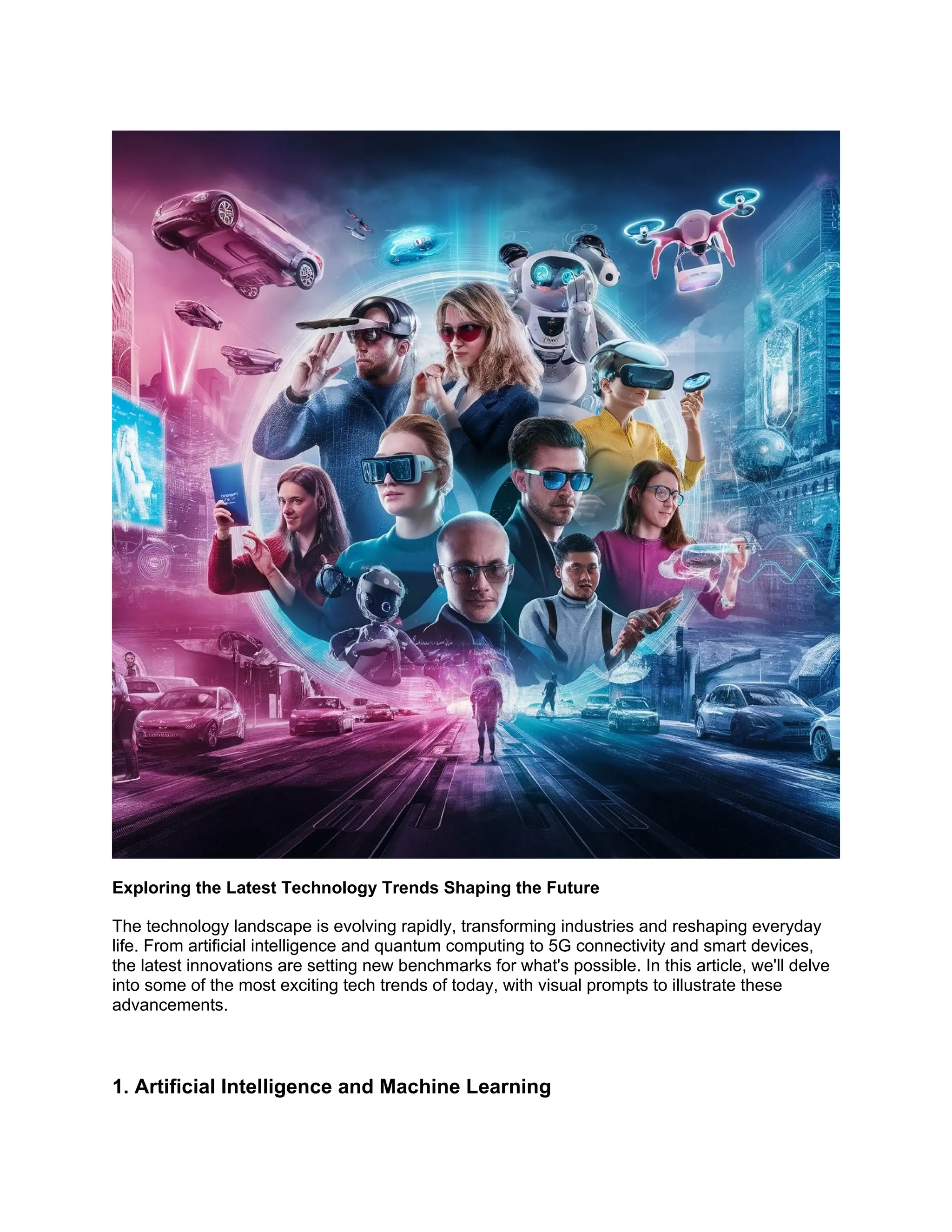
Exploring the Latest Technology Trends Shaping the Future
The technology landscape is evolving rapidly, transforming industries and reshaping everyday
life. From artificial intelligence and quantum computing to 5G connectivity and smart devices,
the latest innovations are setting new benchmarks for what's possible. In this article, we'll delve
into some of the most exciting tech trends of today, with visual prompts to illustrate these
advancements.
1. Artificial Intelligence and Machine Learning
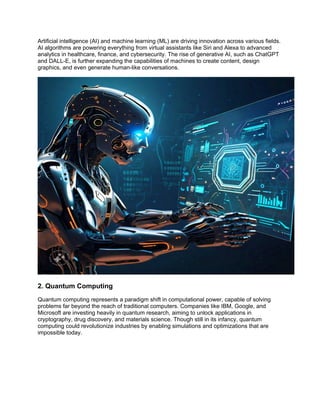
Artificial intelligence (AI) and machine learning (ML) are driving innovation across various fields.
AI algorithms are powering everything from virtual assistants like Siri and Alexa to advanced
analytics in healthcare, finance, and cybersecurity. The rise of generative AI, such as ChatGPT
and DALL-E, is further expanding the capabilities of machines to create content, design
graphics, and even generate human-like conversations.
2. Quantum Computing
Quantum computing represents a paradigm shift in computational power, capable of solving
problems far beyond the reach of traditional computers. Companies like IBM, Google, and
Microsoft are investing heavily in quantum research, aiming to unlock applications in
cryptography, drug discovery, and materials science. Though still in its infancy, quantum
computing could revolutionize industries by enabling simulations and optimizations that are
impossible today.
3. 5G Connectivity
The rollout of 5G technology is bringing faster and more reliable internet connections, with
speeds up to 100 times faster than 4G. This new generation of connectivity is not just about
speed; it's also about enabling the Internet of Things (IoT), self-driving cars, and smart cities by
providing the bandwidth and low latency needed for seamless communication between devices.
4. Internet of Things (IoT)
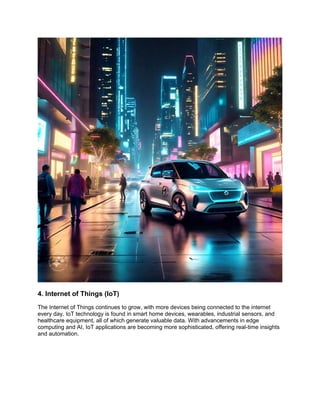
The Internet of Things continues to grow, with more devices being connected to the internet
every day. IoT technology is found in smart home devices, wearables, industrial sensors, and
healthcare equipment, all of which generate valuable data. With advancements in edge
computing and AI, IoT applications are becoming more sophisticated, offering real-time insights
and automation.
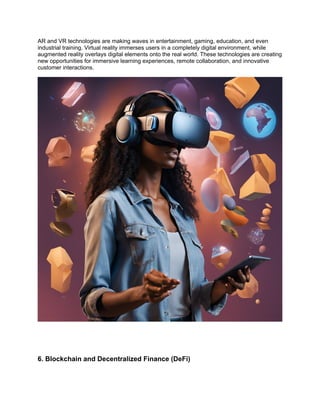
5. Augmented Reality (AR) and Virtual Reality (VR)
AR and VR technologies are making waves in entertainment, gaming, education, and even
industrial training. Virtual reality immerses users in a completely digital environment, while
augmented reality overlays digital elements onto the real world. These technologies are creating
new opportunities for immersive learning experiences, remote collaboration, and innovative
customer interactions.
6. Blockchain and Decentralized Finance (DeFi)
Blockchain technology is moving beyond cryptocurrencies like Bitcoin and Ethereum to enable
decentralized finance (DeFi), supply chain management, and digital identity solutions.
Blockchain's decentralized and secure nature makes it ideal for transparent and tamper-proof
transactions, impacting industries like finance, logistics, and healthcare.
7. Biotechnology and Gene Editing
Advancements in biotechnology, including CRISPR gene-editing technology, are opening new
frontiers in healthcare. Gene editing offers the potential to cure genetic diseases, enhance
agricultural crops, and even extend human lifespan. The ethical implications are significant, but
the benefits could be revolutionary for medicine and the environment.
8. Autonomous Vehicles
Self-driving cars are no longer science fiction, with companies like Tesla, Waymo, and Uber
testing autonomous driving technology. Autonomous vehicles use a combination of AI, sensors,
and real-time data to navigate roads, promising to reduce accidents, improve traffic flow, and
make transportation more efficient.
9. Renewable Energy Technologies
As climate change becomes a more pressing global issue, renewable energy technologies such
as solar, wind, and battery storage are gaining momentum. Innovations in energy storage, smart
grids, and electric vehicles are pushing the world toward a cleaner and more sustainable energy
future.
10. Robotics and Automation
Robotics and automation are transforming manufacturing, logistics, and even healthcare. From
robotic arms on factory floors to automated delivery drones and surgical robots, the capabilities
of robotics are expanding, making processes more efficient and reducing human error.
Final Thoughts
The pace of technological advancement is accelerating, and these trends are reshaping the
future in profound ways. Staying updated with the latest innovations not only provides insight
into the future of various industries but also helps businesses and individuals adapt to change.
From AI-driven breakthroughs to sustainable energy solutions, technology continues to push
boundaries, offering new possibilities for growth, learning, and improvement. The key is to
embrace these changes and leverage them to drive meaningful progress in society.
These visual prompts and technological insights paint a picture of an exciting, rapidly evolving
world—one where technology isn't just a tool but a transformative force shaping the future.

Exploring the Latest Technology Trends Shaping the Future.docx

  • 1.
    Exploring the LatestTechnology Trends Shaping the Future The technology landscape is evolving rapidly, transforming industries and reshaping everyday life. From artificial intelligence and quantum computing to 5G connectivity and smart devices, the latest innovations are setting new benchmarks for what's possible. In this article, we'll delve into some of the most exciting tech trends of today, with visual prompts to illustrate these advancements. 1. Artificial Intelligence and Machine Learning
  • 2.
    Artificial intelligence (AI)and machine learning (ML) are driving innovation across various fields. AI algorithms are powering everything from virtual assistants like Siri and Alexa to advanced analytics in healthcare, finance, and cybersecurity. The rise of generative AI, such as ChatGPT and DALL-E, is further expanding the capabilities of machines to create content, design graphics, and even generate human-like conversations. 2. Quantum Computing Quantum computing represents a paradigm shift in computational power, capable of solving problems far beyond the reach of traditional computers. Companies like IBM, Google, and Microsoft are investing heavily in quantum research, aiming to unlock applications in cryptography, drug discovery, and materials science. Though still in its infancy, quantum computing could revolutionize industries by enabling simulations and optimizations that are impossible today.
  • 3.
    3. 5G Connectivity Therollout of 5G technology is bringing faster and more reliable internet connections, with speeds up to 100 times faster than 4G. This new generation of connectivity is not just about speed; it's also about enabling the Internet of Things (IoT), self-driving cars, and smart cities by providing the bandwidth and low latency needed for seamless communication between devices.
  • 4.
    4. Internet ofThings (IoT) The Internet of Things continues to grow, with more devices being connected to the internet every day. IoT technology is found in smart home devices, wearables, industrial sensors, and healthcare equipment, all of which generate valuable data. With advancements in edge computing and AI, IoT applications are becoming more sophisticated, offering real-time insights and automation.
  • 5.
    5. Augmented Reality(AR) and Virtual Reality (VR)
  • 6.
    AR and VRtechnologies are making waves in entertainment, gaming, education, and even industrial training. Virtual reality immerses users in a completely digital environment, while augmented reality overlays digital elements onto the real world. These technologies are creating new opportunities for immersive learning experiences, remote collaboration, and innovative customer interactions. 6. Blockchain and Decentralized Finance (DeFi)
  • 7.
    Blockchain technology ismoving beyond cryptocurrencies like Bitcoin and Ethereum to enable decentralized finance (DeFi), supply chain management, and digital identity solutions. Blockchain's decentralized and secure nature makes it ideal for transparent and tamper-proof transactions, impacting industries like finance, logistics, and healthcare. 7. Biotechnology and Gene Editing Advancements in biotechnology, including CRISPR gene-editing technology, are opening new frontiers in healthcare. Gene editing offers the potential to cure genetic diseases, enhance agricultural crops, and even extend human lifespan. The ethical implications are significant, but the benefits could be revolutionary for medicine and the environment. 8. Autonomous Vehicles Self-driving cars are no longer science fiction, with companies like Tesla, Waymo, and Uber testing autonomous driving technology. Autonomous vehicles use a combination of AI, sensors, and real-time data to navigate roads, promising to reduce accidents, improve traffic flow, and make transportation more efficient. 9. Renewable Energy Technologies As climate change becomes a more pressing global issue, renewable energy technologies such as solar, wind, and battery storage are gaining momentum. Innovations in energy storage, smart grids, and electric vehicles are pushing the world toward a cleaner and more sustainable energy future. 10. Robotics and Automation Robotics and automation are transforming manufacturing, logistics, and even healthcare. From robotic arms on factory floors to automated delivery drones and surgical robots, the capabilities of robotics are expanding, making processes more efficient and reducing human error. Final Thoughts
  • 8.
    The pace oftechnological advancement is accelerating, and these trends are reshaping the future in profound ways. Staying updated with the latest innovations not only provides insight into the future of various industries but also helps businesses and individuals adapt to change. From AI-driven breakthroughs to sustainable energy solutions, technology continues to push boundaries, offering new possibilities for growth, learning, and improvement. The key is to embrace these changes and leverage them to drive meaningful progress in society. These visual prompts and technological insights paint a picture of an exciting, rapidly evolving world—one where technology isn't just a tool but a transformative force shaping the future.