Large-Margin Multiple Kernel Learning
for
Discriminative Features Selection and
Representation Learning
Babak Hosseini, Barbara Hammer
IJCNN 2019, 14-19 July
Machine Learning Group
https://www.cit-ec.de/en/ML
 Classification and retrieval
Numerous representations (SIFT, HOG, GIST, … )
Hundreds of features (Joints, sensors)
Introduction
2
 Classification and retrieval
Goal:
 Improving accuracy
 Small selection set
Introduction
3
 Preliminaries
 LMMK algorithm
 Experiments
 Summary
Outline
4
 Preliminaries
 LMMK algorithm
 Experiments
 Summary
5
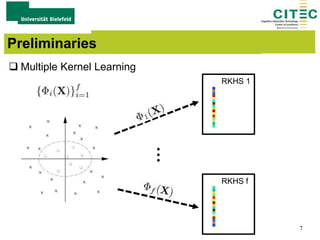
 Multiple Kernel Learning
 Map data to feature space
 Multiple transfers to RKHS
Preliminaries
6
 Multiple Kernel Learning
Preliminaries
RKHS 1
RKHS f
7
 Multiple Kernel Learning
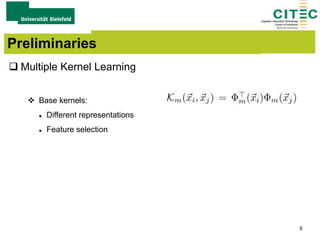
 Base kernels:
 Different representations
 Feature selection
Preliminaries
8
 Multiple Kernel Learning
 Optimal combination of base kernels
 Optimization problem:
Preliminaries
9
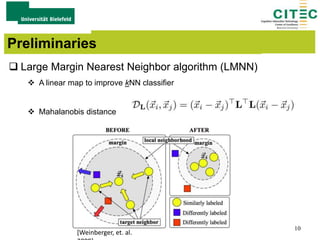
 Large Margin Nearest Neighbor algorithm (LMNN)
 A linear map to improve kNN classifier
 Mahalanobis distance
Preliminaries
[Weinberger, et. al.
10
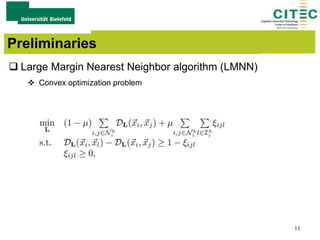
 Large Margin Nearest Neighbor algorithm (LMNN)
 Convex optimization problem
Preliminaries
11
 Preliminaries
 LMMK algorithm
 Experiments
 Summary
12
 Large Margin Multiple Kernel Learning (LMMK)
 Local separation of classes in RKHS
 Mahalanobis distance in RKHS
 B is diagonal
 : m-th entry of diagonal → weight of the m-th representation
LMMK Algorithm
𝛽 𝑚
13
 Large Margin Multiple Kernel Learning (LMMK)
 Local separation of classes in RKHS
 Sparse Combination of base kernels
LMMK Algorithm
14
 Large Margin Multiple Kernel Learning (LMMK)
 Local separation of classes in RKHS
 Sparse Combination of base kernels
 Non-negative for interpretation
LMMK Algorithm
𝛽
15
 Optimization framework
 Non-negative Linear programming
 LP solvers: YALMIP, CVX, etc.
LMMK Algorithm
16
 Preliminaries
 LMMK algorithm
 Experiments
 Summary
17
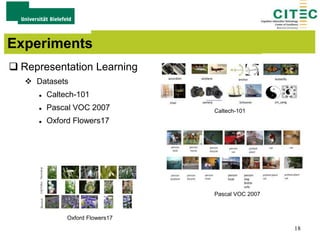
 Representation Learning
 Datasets
 Caltech-101
 Pascal VOC 2007
 Oxford Flowers17
Experiments
Caltech-101
Pascal VOC 2007
Oxford Flowers17
18
 Representation Learning
 Datasets
 Caltech-101
 Pascal VOC 2007
 Oxford Flowers17
 Base kernels → descriptors
Experiments
19
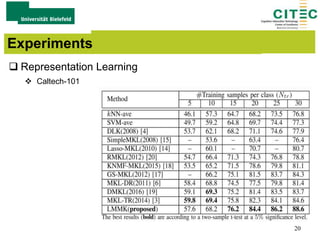
 Representation Learning
 Caltech-101
Experiments
20
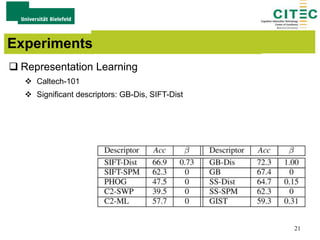
 Representation Learning
 Caltech-101
 Significant descriptors: GB-Dis, SIFT-Dist
Experiments
21
 Representation Learning
 Pascal VOC 2007
 Oxford Flowers17
Experiments
22
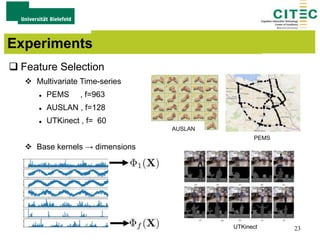
 Feature Selection
 Multivariate Time-series
 PEMS , f=963
 AUSLAN , f=128
 UTKinect , f= 60
 Base kernels → dimensions
Experiments
AUSLAN
PEMS
UTKinect 23
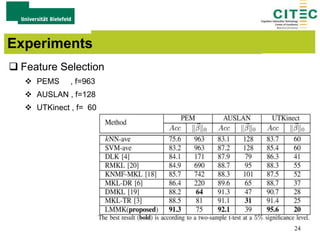
 Feature Selection
 PEMS , f=963
 AUSLAN , f=128
 UTKinect , f= 60
Experiments
24
 Preliminaries
 LMMK algorithm
 Experiments
 Summary
2
5
 A new multiple kernel learning
 Diagonal metric in RKHS
 Linear programming optimization framework
 -norm sparsity leading to compact kernel combination
 Discriminative feature selection
Summary
𝑙1
26
Thank you very much!
Questions?
27

Large-Margin Multiple Kernel Learning for Discriminative Features Selection and Representation Learning

  • 1.
    Large-Margin Multiple KernelLearning for Discriminative Features Selection and Representation Learning Babak Hosseini, Barbara Hammer IJCNN 2019, 14-19 July Machine Learning Group https://www.cit-ec.de/en/ML
  • 2.
     Classification andretrieval Numerous representations (SIFT, HOG, GIST, … ) Hundreds of features (Joints, sensors) Introduction 2
  • 3.
     Classification andretrieval Goal:  Improving accuracy  Small selection set Introduction 3
  • 4.
     Preliminaries  LMMKalgorithm  Experiments  Summary Outline 4
  • 5.
     Preliminaries  LMMKalgorithm  Experiments  Summary 5
  • 6.
     Multiple KernelLearning  Map data to feature space  Multiple transfers to RKHS Preliminaries 6
  • 7.
     Multiple KernelLearning Preliminaries RKHS 1 RKHS f 7
  • 8.
     Multiple KernelLearning  Base kernels:  Different representations  Feature selection Preliminaries 8
  • 9.
     Multiple KernelLearning  Optimal combination of base kernels  Optimization problem: Preliminaries 9
  • 10.
     Large MarginNearest Neighbor algorithm (LMNN)  A linear map to improve kNN classifier  Mahalanobis distance Preliminaries [Weinberger, et. al. 10
  • 11.
     Large MarginNearest Neighbor algorithm (LMNN)  Convex optimization problem Preliminaries 11
  • 12.
     Preliminaries  LMMKalgorithm  Experiments  Summary 12
  • 13.
     Large MarginMultiple Kernel Learning (LMMK)  Local separation of classes in RKHS  Mahalanobis distance in RKHS  B is diagonal  : m-th entry of diagonal → weight of the m-th representation LMMK Algorithm 𝛽 𝑚 13
  • 14.
     Large MarginMultiple Kernel Learning (LMMK)  Local separation of classes in RKHS  Sparse Combination of base kernels LMMK Algorithm 14
  • 15.
     Large MarginMultiple Kernel Learning (LMMK)  Local separation of classes in RKHS  Sparse Combination of base kernels  Non-negative for interpretation LMMK Algorithm 𝛽 15
  • 16.
     Optimization framework Non-negative Linear programming  LP solvers: YALMIP, CVX, etc. LMMK Algorithm 16
  • 17.
     Preliminaries  LMMKalgorithm  Experiments  Summary 17
  • 18.
     Representation Learning Datasets  Caltech-101  Pascal VOC 2007  Oxford Flowers17 Experiments Caltech-101 Pascal VOC 2007 Oxford Flowers17 18
  • 19.
     Representation Learning Datasets  Caltech-101  Pascal VOC 2007  Oxford Flowers17  Base kernels → descriptors Experiments 19
  • 20.
     Representation Learning Caltech-101 Experiments 20
  • 21.
     Representation Learning Caltech-101  Significant descriptors: GB-Dis, SIFT-Dist Experiments 21
  • 22.
     Representation Learning Pascal VOC 2007  Oxford Flowers17 Experiments 22
  • 23.
     Feature Selection Multivariate Time-series  PEMS , f=963  AUSLAN , f=128  UTKinect , f= 60  Base kernels → dimensions Experiments AUSLAN PEMS UTKinect 23
  • 24.
     Feature Selection PEMS , f=963  AUSLAN , f=128  UTKinect , f= 60 Experiments 24
  • 25.
     Preliminaries  LMMKalgorithm  Experiments  Summary 2 5
  • 26.
     A newmultiple kernel learning  Diagonal metric in RKHS  Linear programming optimization framework  -norm sparsity leading to compact kernel combination  Discriminative feature selection Summary 𝑙1 26
  • 27.
    Thank you verymuch! Questions? 27

Editor's Notes