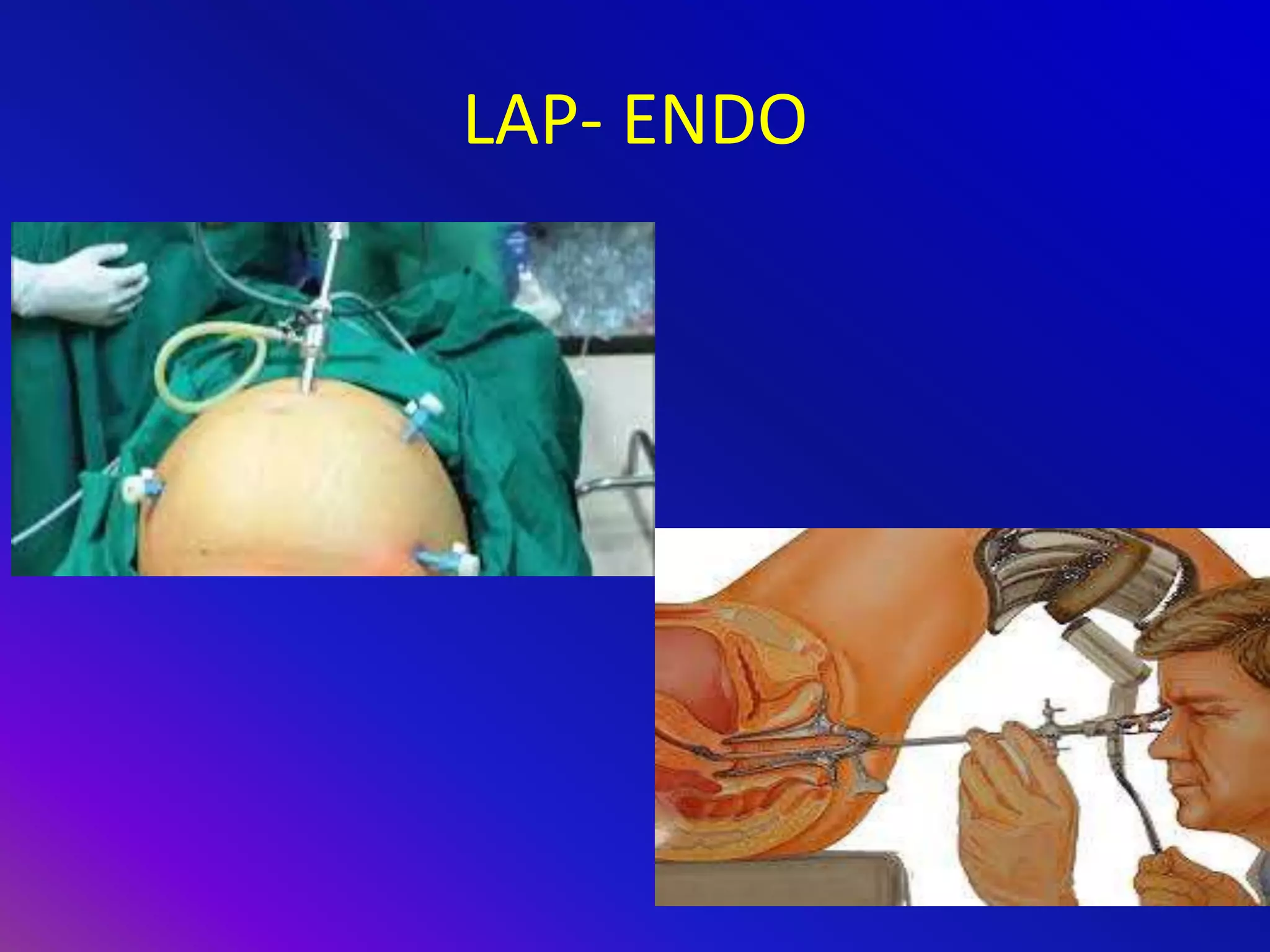

Dr. Sreejoy Patnaik
Shanti Omni Super Speciality
Hospital
Cuttack
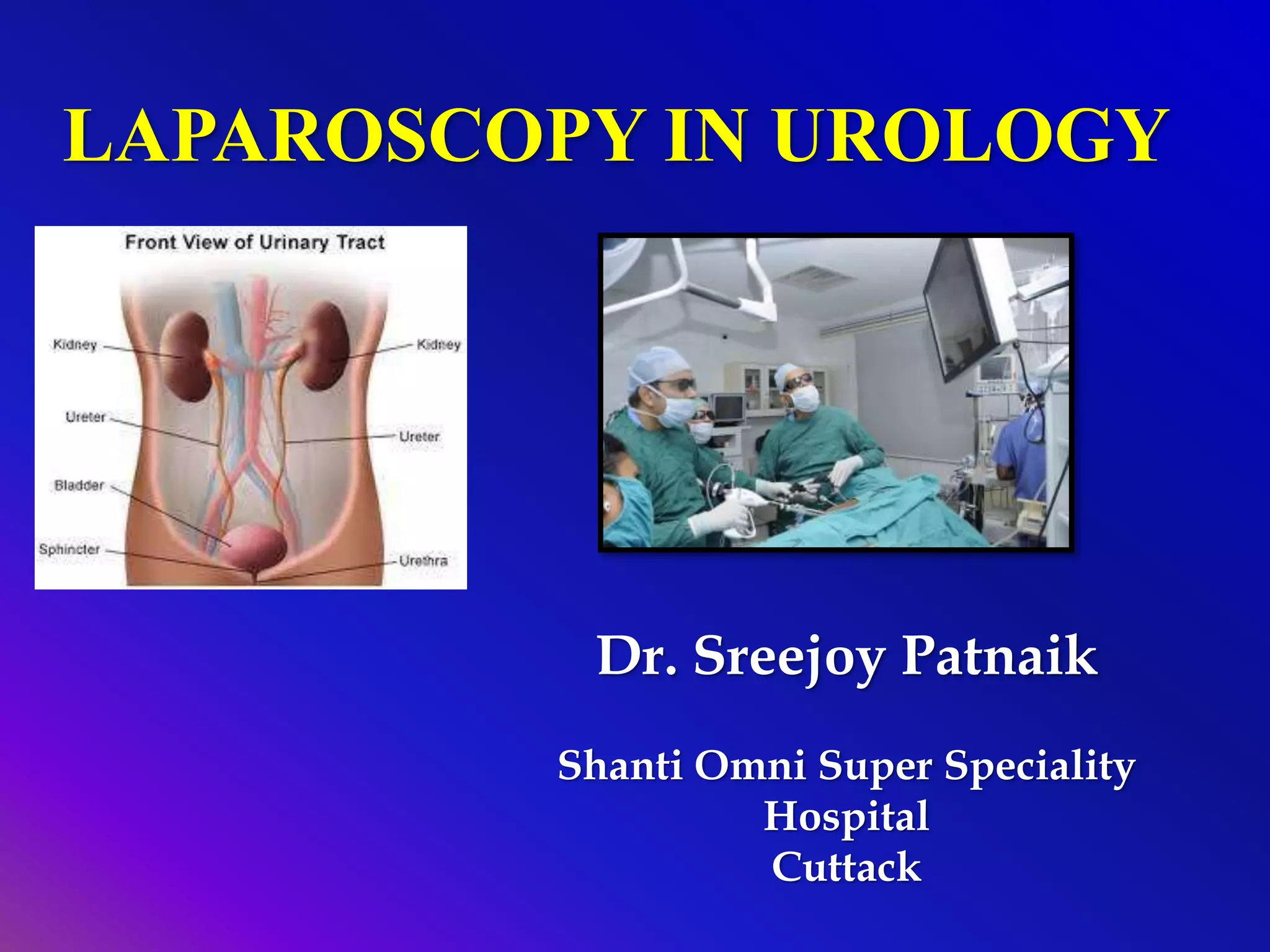
LAPAROSCOPY IN UROLOGY
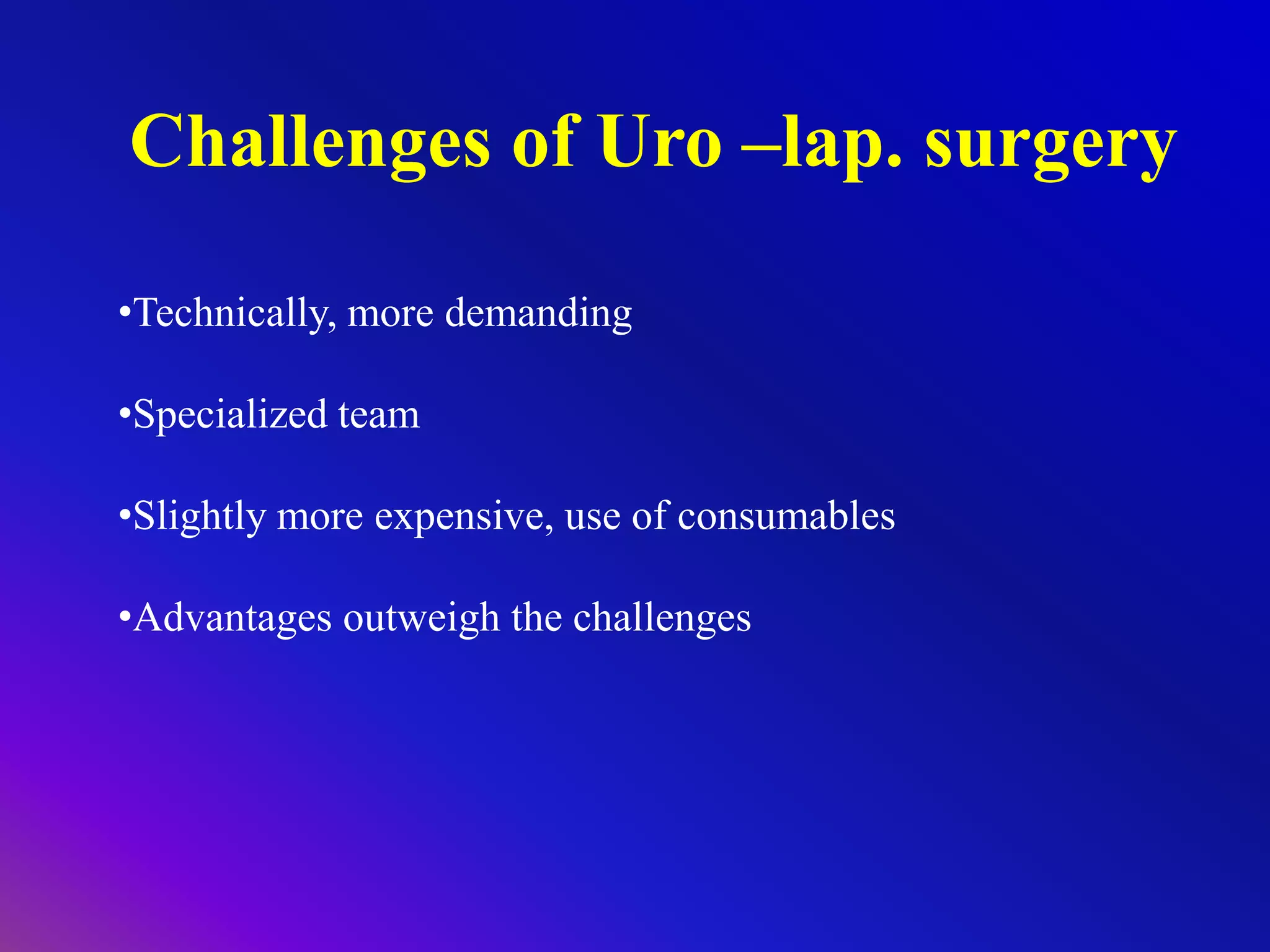
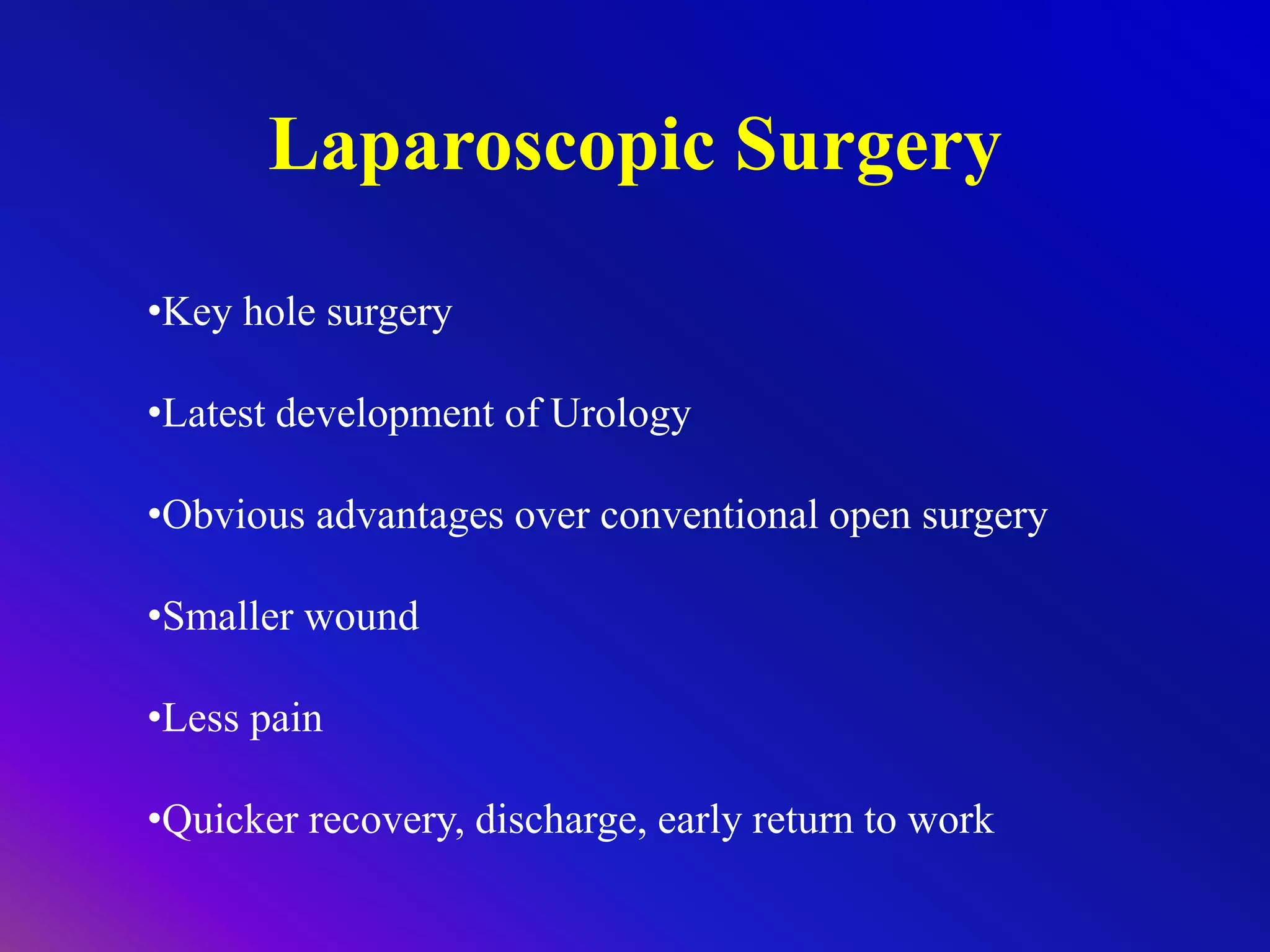
LAP- ENDO
History of Lap. Urology
• The first laparoscopic Nephrectomy was performed in 1990 by
Clayman
• The procedure had an operative time of seven hours and
required a 1-unit transfusion and a six-day inpatient hospital
stay.
Challenges of Uro –lap. surgery
•Technically, more demanding
•Specialized team
•Slightly more expensive, use of consumables
•Advantages outweigh the challenges
Laparoscopic Surgery
•Key hole surgery
•Latest development of Urology
•Obvious advantages over conventional open surgery
•Smaller wound
•Less pain
•Quicker recovery, discharge, early return to work
Laparoscopic Urological Surgery
•Revolutionary development in last 2 decades.
•Experienced centres
•Improves Patient’s peri-operative quality of life
•Provides excellent view due to magnification – less tissue
trauma & minimal blood loss.
Approaches
The 3 three commonly used approaches are
1. Transperitoneal approach
2. Retroperitoneal approach
3. Hand assisted approach
4. Endoscopic Procedures
Transperitoneal approach
•Wider availability
•Working space
•Better identification of important landmarks
•Intestinal Injury ?
Retroperitoneal approach
•Restricted rapid access
•Renal pedicle identification.
•Reduce the incidence of ileus
•Injury to the intraperitoneal contents
Hand assisted approach
•Improved tactile feedback
•Bridge between open surgery
•Lap Gelport TM
•Lap Disc TM
ENDOSCOPIC APPROACHES
• CYSTOSCOPY- TURP/BNI/TURBT/OIU
• URETEROSCOPY-
• RIGID URETETROSCOPY URS
• FLEXIBLE URETEROSCOPY- RIRS
• PCNL- BY RIGID NEPHROSCPE
• MINI PERC - RENAL STONES
Laparoscopic Urological Procedures
Commonest procedures performed :-
Ablative Procedures: Urolithiases:
a) Simple nephrectomy Pyelolithotomy
b) Partial nephrectomy Ureterolithomy
c) Renal cyst marsupilisation Cystolithotomy
d) Radical nephrectomy Urachal Cyst excision
e) Radical cystectomy
f) Radical prostatectomy
Reconstructive Procedures:
a) Pyeloplasty
b) Lower ureteric reconstructions
c) Boari flap reconstruction
d) Ureteric reimplanation/Psoas hitch
e) Ileal ureter implantation
f) Orchipexy
g) Donor nephrectomy
Simple Nephrectomy
•Non functioning Kidney
•Pre renal transplant nephrectomy
(A) – Transperitoneal approach
Pneumoperitoneum - open technique or closed technique.
Ports are inserted in a strategic manner.
Preoperative CT Scan)” if done helps in determining the location of the kidney
and deciding the location of port placement.
Other parameters which determine the site of port placement are extent of
truncal obesity and body mass index (BMI).
Positioning
• Lateral decubitus position
• Near the edge of the table
• Lower limb is flexed
Technique
• Left side colon is reflected
• Iliac bifurcation
• Superiorly the splenorenal
• Renocolic ligaments
• Identify the ureter
• Gonadal vessels
• Ureter is lifted
• Psoas landmark
(B) – Retroperitoneal approach
Gaur etal
15mm incision petit triangle
Lumbodorsal fascia
Balloon dilator
(C) – Hand assist approach
Insert a non dominant
Hand assist device is inserted
Right lower quadrant midway between umbilicus and anterior
superior iliac
Laparoscopic Radical Nephrectomy
•T2 & T3a tumors.
•T1 tumors contraindicated with IVC thrombus
Technique
•Transperitoneal
•Lumbar & adrenal veins are doubly clipped & cut.
Results
•Advantage short hospital
•Low analgesia
•Comparable
•Open laparoscopic approach is a standard of care in T1 & T2.
• Renal thrombus is feasible
Laparoscopic partial nephrectomy
•Small renal masses
• Lesions in a solitary kidney
•Bilateral renal lesions
Technique
- Pneumoperitoneum
- Ports similar to simple nephrectomy
- Ureteric catheter placed per-urethrally - to instill methylene blue
- Identify the pelvicalyceal system prior to suturing
- Colon reflected and the ureter is lifted off the psoas muscle
- Dissection proceeds to the renal hilum
- Renal hilum dissected & satinsky applied
- Renal tumor is cut with cautery or harmonic
- Preferred scissors for excising the tumor should be with wide jaws.
- Pelvicalyceal system is closed followed by the cortical defect
- An indwelling ureteric catheter or alternatively a double J stent is placed for 48hours.
Pyeloplasty
•PUJ Obstruction
•RGP prior to positioning the patient
•5Fr pigtail catheter is inserted into the pelvicalyceal system
Technique
•30 degree Scope - pelvis is identified bulges out
•Dismembered Anderson hynes Pyeloplasty is preferred crossing vessel is
suspected
•Y-V plasty is preferred
The important steps of this procedure are
•Pyelotomy
•Spatulation of the ureter
•Pyelotomy is closed a 3-0/4-0 vicryl
•‘V’ stitch as anterior layer easier step to start , followed by posterior layer.
Donor Nephrectomy
Do no harm to the donor is the dictum
Technique
•Port placement mirrors that of simple nephrectomy
•CT angiography plays a pivotal role for strategic port placement.
•Ureter should be lifted of the psoas “in toto” as an ureterogonadal
packet.
•Dissection of the artery should be a thermal and should be kept to
the minimum.
•Topical papvarine instillation on the vessel helps in relieving spasm
•Upper pole should be separated from the spleen securing the adrenal
vein
•Graft should be adequately perfused by intravenous infusion of
mannitiol and furosemide prior to retrieval
•Retrive the graft through a pfannesteil incision
Laparoscopic ureteral reimplanation
Supine position a 11mm trocar for camera insertion umbilicus
Ureter is lifted transected as distally as possible
The bladder is filled with 200ml saline
Lateral and anterior peritoneum incised a boari flap is preferred
Spatulated ureter and the bladder flap are anastomosed in a tension free
manner with 4-0 polygalactin sutures
A stent is kept indwelling for 6weeks after the surgery
Laparoscopic stone removal
Procedure performed transperitoneal or a retroperitoneal approach
Placement of a stent ureteric catheter
Ureter lifted of the psoas
The ureter is slinged
Using a cold knife the ureter is incised
Spoon may be used for retrieving the stone
Stone may be entrapped in a bag for removal
Ureterotomy is closed with a 3-0 absorbable suture and a drain is placed.
Advanced Laparoscopic Procedures
•Laparoscopic ileal interposition
•Laparoscopic retroperitoneal lymph node dissections
•Laparoscopic radical cystectomy (LRC)
Laproendoscopic single site surgery
(LESS)
•Simple nephrectomy
•Pyeloplasty
•Reconstructive procedures
•Ureteroneocystostomy
•LESS donor nephrectomy
•Technically feasible procedure
•Steep learning curve
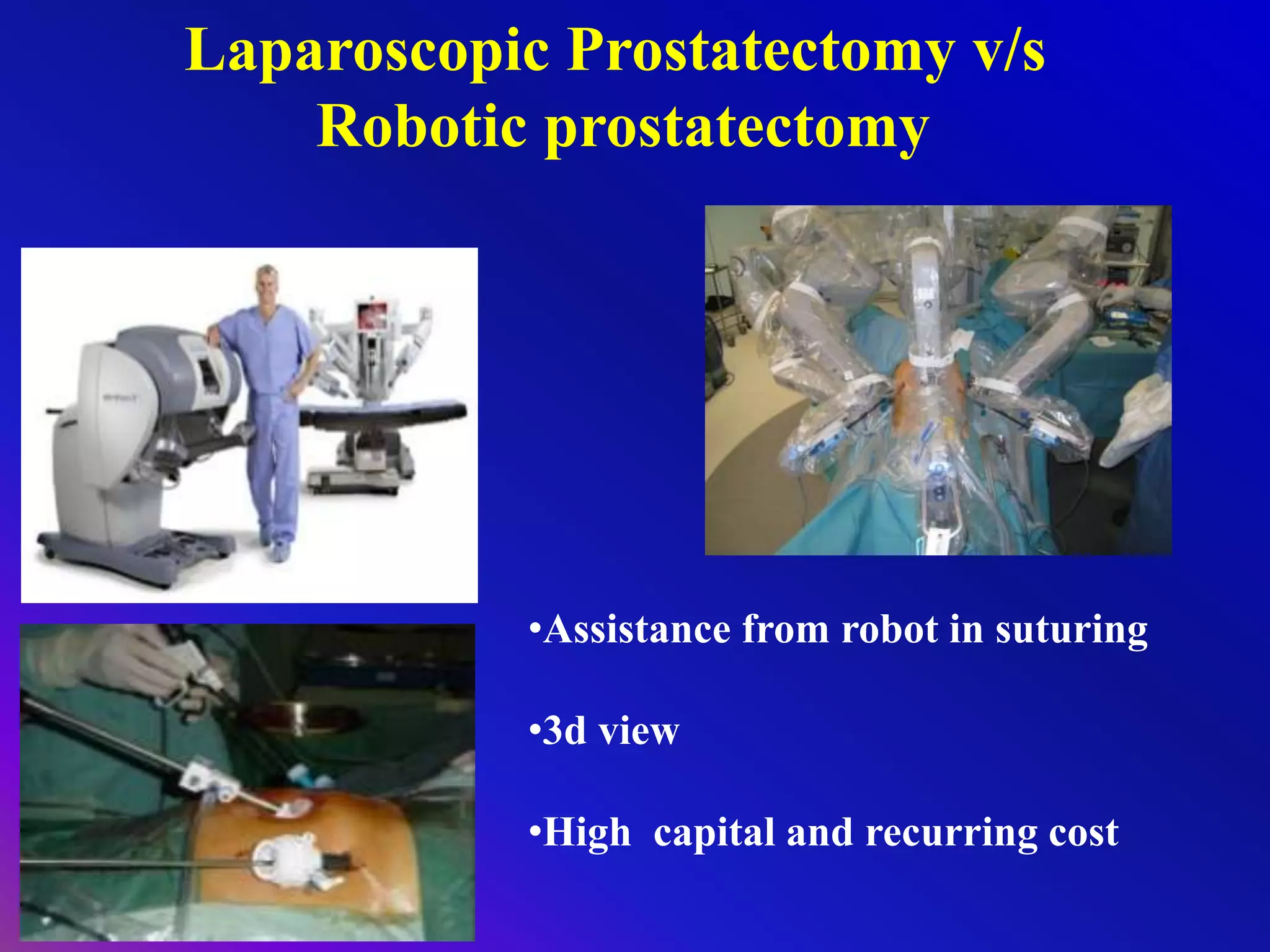
Robot Assisted Laparoscopic Urology
•Prostatectomy ,Pyeloplasty, Nephrectomy & Ureter reconstructions
•Donor nephrectomy
•Adrenalectomy
•Advantages:
•Robotic platform Da Vinci Si
•High definition visual magnification
•Better range of motion
•Additional arm for retraction
•A unprecedented range of accuracy and dexterity
•Its increased range of freedom
•Property of “motion scaling”
•Procedures requiring intracorporeal suturing
•Small spaces pelvis
•The cost benefit ratio is likely to be a driving force in further development and
application of this technology
Laparoscopic Nephrectomy
•Benign, non functioning kidney
•Renal cell carcinoma
Almost all tumours can be
removed laparoscopically
Laparoscopic Nephrectomy
LAP - URETEROLITOTOMY
LAP. PYELOLITHOTOMY
• VIDEO
LAP PARTIAL NEPHRECTOMY
• VIDEO
LAP RADICAL NEPHRO-
URETECTOMY
• VIDEO
LAP URACHAL CYSTECTOMY
• VIDEO
Laparoscopic Prostatectomy
5 small incisions
•Completely mimick all the principles
of open surgery
•Extraperitoneal approach, avoiding
contact with intestine
Laparoscopic Prostatectomy
•4-5 hours surgery
•Less blood loss, minimal blood transfusion
requirement
•Magnification allowing more accurate
dissection and preservation of continence and
erection
•Hospital stay of 2nights, early removal of
urinary catheter.
Laparoscopic radical prostatectomy
• Inverted fan shaped manner
• Endopelvic fascia incised
• Dorsal vein secured
• Vas deferens &
• Dissected secured hem-o-lok
• The lateral detrussor pillars are secured with
clips
• The urethra is dissected be to gain maximum length
• Posterior reconstruction stich “Rocco”
• The van velthowen technique (bidirectinal running suture) technique
with 3-0 monocryl
• Satisfactory oncologic outcome
Radical Prostatectomy
ROBOTIC PROSTATECTOMY
Laparoscopic Prostatectomy v/s
Robotic prostatectomy
•Assistance from robot in suturing
•3d view
•High capital and recurring cost
What is new in laparoscopy in urology?
• Almost all urological procedures can be done laparoscopically
• Reproducible, similar if not better results than open surgery
• What is the standard of care?
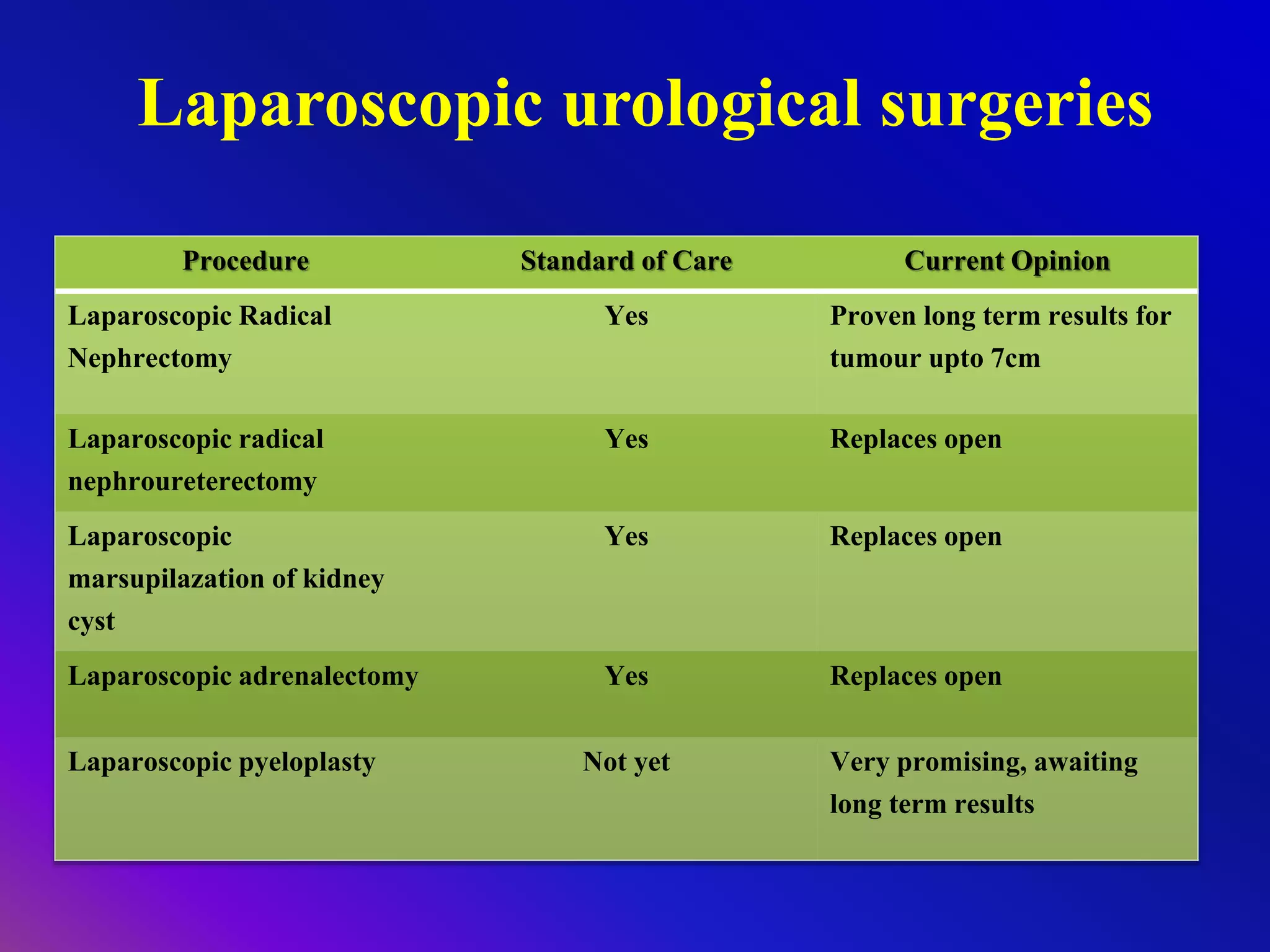
Laparoscopic urological surgeries
Procedure Standard of Care Current Opinion
Laparoscopic Radical
Nephrectomy
Yes Proven long term results for
tumour upto 7cm
Laparoscopic radical
nephroureterectomy
Yes Replaces open
Laparoscopic
marsupilazation of kidney
cyst
Yes Replaces open
Laparoscopic adrenalectomy Yes Replaces open
Laparoscopic pyeloplasty Not yet Very promising, awaiting
long term results
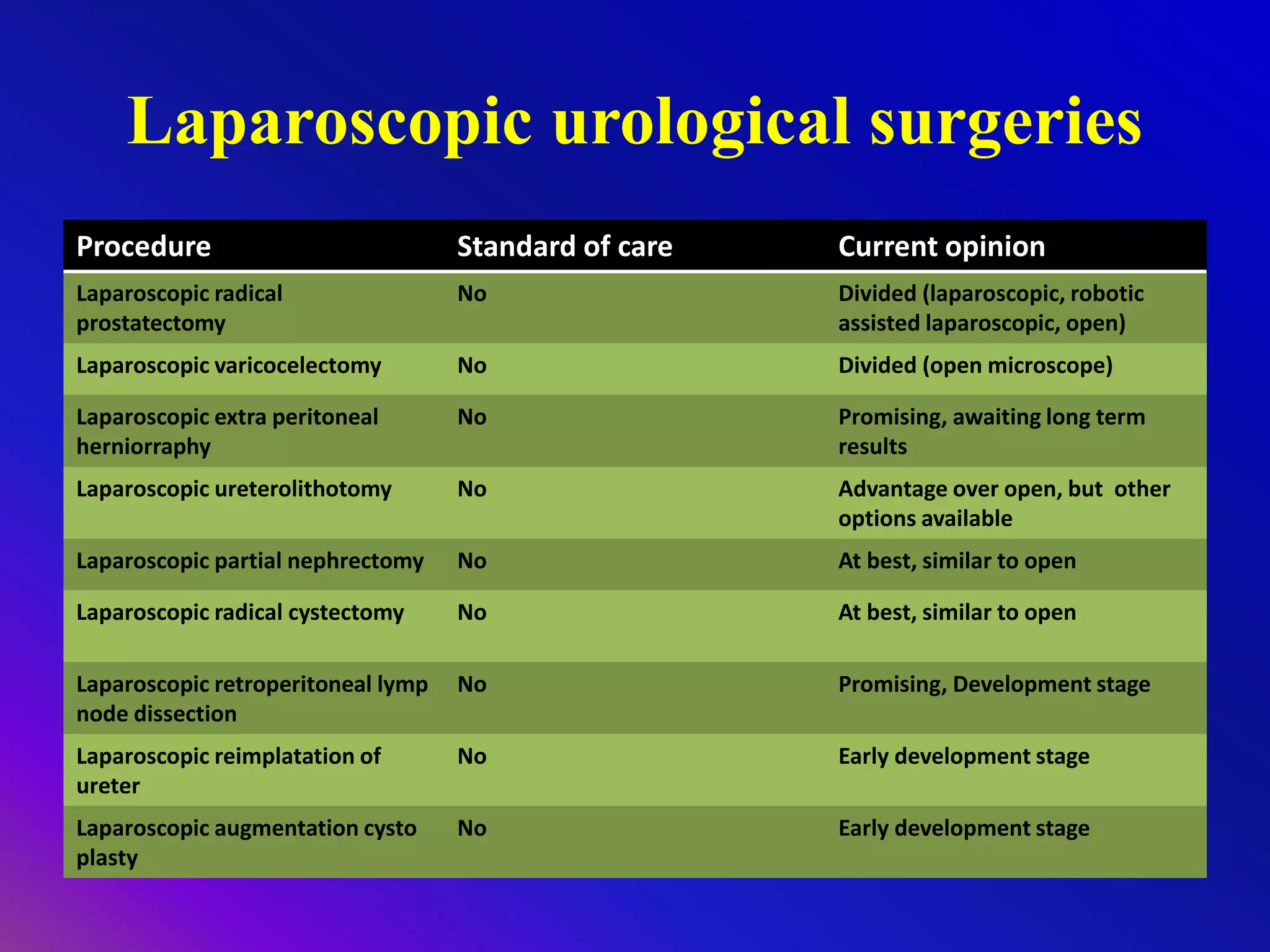
Laparoscopic urological surgeries
Procedure Standard of care Current opinion
Laparoscopic radical
prostatectomy
No Divided (laparoscopic, robotic
assisted laparoscopic, open)
Laparoscopic varicocelectomy No Divided (open microscope)
Laparoscopic extra peritoneal
herniorraphy
No Promising, awaiting long term
results
Laparoscopic ureterolithotomy No Advantage over open, but other
options available
Laparoscopic partial nephrectomy No At best, similar to open
Laparoscopic radical cystectomy No At best, similar to open
Laparoscopic retroperitoneal lymp
node dissection
No Promising, Development stage
Laparoscopic reimplatation of
ureter
No Early development stage
Laparoscopic augmentation cysto
plasty
No Early development stage
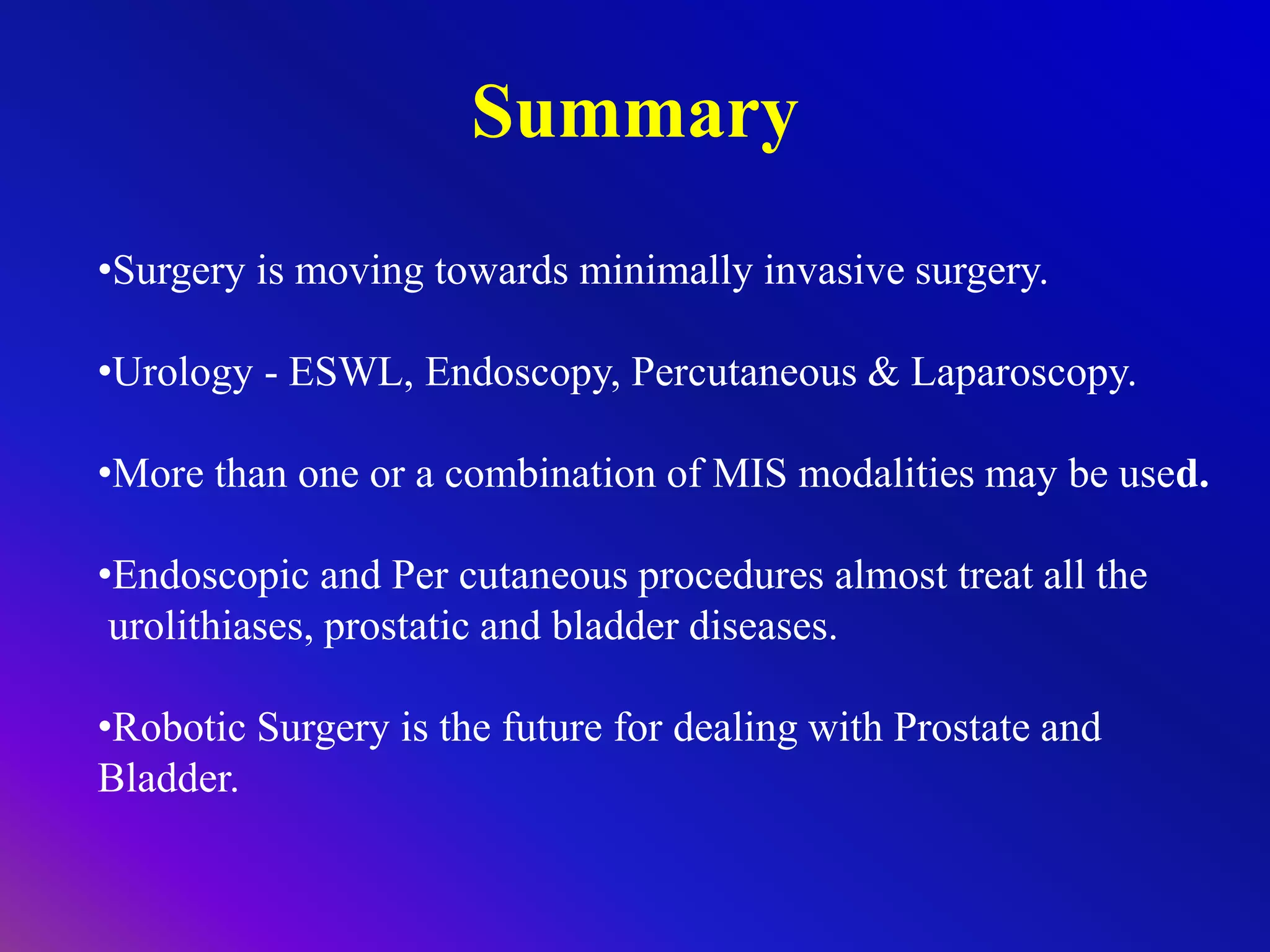
Summary
•Surgery is moving towards minimally invasive surgery.
•Urology - ESWL, Endoscopy, Percutaneous & Laparoscopy.
•More than one or a combination of MIS modalities may be used.
•Endoscopic and Per cutaneous procedures almost treat all the
urolithiases, prostatic and bladder diseases.
•Robotic Surgery is the future for dealing with Prostate and
Bladder.
THANK U FOR YOUR PATIENT HEARING

LAPAROSCOPIC UROLOGICAL SURGERY

  • 1.
    Dr. Sreejoy Patnaik ShantiOmni Super Speciality Hospital Cuttack LAPAROSCOPY IN UROLOGY
  • 2.
  • 3.
    History of Lap.Urology • The first laparoscopic Nephrectomy was performed in 1990 by Clayman • The procedure had an operative time of seven hours and required a 1-unit transfusion and a six-day inpatient hospital stay.
  • 4.
    Challenges of Uro–lap. surgery •Technically, more demanding •Specialized team •Slightly more expensive, use of consumables •Advantages outweigh the challenges
  • 5.
    Laparoscopic Surgery •Key holesurgery •Latest development of Urology •Obvious advantages over conventional open surgery •Smaller wound •Less pain •Quicker recovery, discharge, early return to work
  • 6.
    Laparoscopic Urological Surgery •Revolutionarydevelopment in last 2 decades. •Experienced centres •Improves Patient’s peri-operative quality of life •Provides excellent view due to magnification – less tissue trauma & minimal blood loss.
  • 7.
    Approaches The 3 threecommonly used approaches are 1. Transperitoneal approach 2. Retroperitoneal approach 3. Hand assisted approach 4. Endoscopic Procedures
  • 8.
    Transperitoneal approach •Wider availability •Workingspace •Better identification of important landmarks •Intestinal Injury ? Retroperitoneal approach •Restricted rapid access •Renal pedicle identification. •Reduce the incidence of ileus •Injury to the intraperitoneal contents Hand assisted approach •Improved tactile feedback •Bridge between open surgery •Lap Gelport TM •Lap Disc TM
  • 9.
    ENDOSCOPIC APPROACHES • CYSTOSCOPY-TURP/BNI/TURBT/OIU • URETEROSCOPY- • RIGID URETETROSCOPY URS • FLEXIBLE URETEROSCOPY- RIRS • PCNL- BY RIGID NEPHROSCPE • MINI PERC - RENAL STONES
  • 10.
    Laparoscopic Urological Procedures Commonestprocedures performed :- Ablative Procedures: Urolithiases: a) Simple nephrectomy Pyelolithotomy b) Partial nephrectomy Ureterolithomy c) Renal cyst marsupilisation Cystolithotomy d) Radical nephrectomy Urachal Cyst excision e) Radical cystectomy f) Radical prostatectomy Reconstructive Procedures: a) Pyeloplasty b) Lower ureteric reconstructions c) Boari flap reconstruction d) Ureteric reimplanation/Psoas hitch e) Ileal ureter implantation f) Orchipexy g) Donor nephrectomy
  • 11.
    Simple Nephrectomy •Non functioningKidney •Pre renal transplant nephrectomy (A) – Transperitoneal approach Pneumoperitoneum - open technique or closed technique. Ports are inserted in a strategic manner. Preoperative CT Scan)” if done helps in determining the location of the kidney and deciding the location of port placement. Other parameters which determine the site of port placement are extent of truncal obesity and body mass index (BMI).
  • 12.
    Positioning • Lateral decubitusposition • Near the edge of the table • Lower limb is flexed Technique • Left side colon is reflected • Iliac bifurcation • Superiorly the splenorenal • Renocolic ligaments • Identify the ureter • Gonadal vessels • Ureter is lifted • Psoas landmark
  • 13.
    (B) – Retroperitonealapproach Gaur etal 15mm incision petit triangle Lumbodorsal fascia Balloon dilator (C) – Hand assist approach Insert a non dominant Hand assist device is inserted Right lower quadrant midway between umbilicus and anterior superior iliac
  • 14.
    Laparoscopic Radical Nephrectomy •T2& T3a tumors. •T1 tumors contraindicated with IVC thrombus Technique •Transperitoneal •Lumbar & adrenal veins are doubly clipped & cut. Results •Advantage short hospital •Low analgesia •Comparable •Open laparoscopic approach is a standard of care in T1 & T2. • Renal thrombus is feasible
  • 15.
    Laparoscopic partial nephrectomy •Smallrenal masses • Lesions in a solitary kidney •Bilateral renal lesions Technique - Pneumoperitoneum - Ports similar to simple nephrectomy - Ureteric catheter placed per-urethrally - to instill methylene blue - Identify the pelvicalyceal system prior to suturing - Colon reflected and the ureter is lifted off the psoas muscle - Dissection proceeds to the renal hilum - Renal hilum dissected & satinsky applied - Renal tumor is cut with cautery or harmonic - Preferred scissors for excising the tumor should be with wide jaws. - Pelvicalyceal system is closed followed by the cortical defect - An indwelling ureteric catheter or alternatively a double J stent is placed for 48hours.
  • 16.
    Pyeloplasty •PUJ Obstruction •RGP priorto positioning the patient •5Fr pigtail catheter is inserted into the pelvicalyceal system Technique •30 degree Scope - pelvis is identified bulges out •Dismembered Anderson hynes Pyeloplasty is preferred crossing vessel is suspected •Y-V plasty is preferred The important steps of this procedure are •Pyelotomy •Spatulation of the ureter •Pyelotomy is closed a 3-0/4-0 vicryl •‘V’ stitch as anterior layer easier step to start , followed by posterior layer.
  • 17.
    Donor Nephrectomy Do noharm to the donor is the dictum Technique •Port placement mirrors that of simple nephrectomy •CT angiography plays a pivotal role for strategic port placement. •Ureter should be lifted of the psoas “in toto” as an ureterogonadal packet. •Dissection of the artery should be a thermal and should be kept to the minimum. •Topical papvarine instillation on the vessel helps in relieving spasm •Upper pole should be separated from the spleen securing the adrenal vein •Graft should be adequately perfused by intravenous infusion of mannitiol and furosemide prior to retrieval •Retrive the graft through a pfannesteil incision
  • 18.
    Laparoscopic ureteral reimplanation Supineposition a 11mm trocar for camera insertion umbilicus Ureter is lifted transected as distally as possible The bladder is filled with 200ml saline Lateral and anterior peritoneum incised a boari flap is preferred Spatulated ureter and the bladder flap are anastomosed in a tension free manner with 4-0 polygalactin sutures A stent is kept indwelling for 6weeks after the surgery Laparoscopic stone removal Procedure performed transperitoneal or a retroperitoneal approach Placement of a stent ureteric catheter Ureter lifted of the psoas The ureter is slinged Using a cold knife the ureter is incised Spoon may be used for retrieving the stone Stone may be entrapped in a bag for removal Ureterotomy is closed with a 3-0 absorbable suture and a drain is placed.
  • 19.
    Advanced Laparoscopic Procedures •Laparoscopicileal interposition •Laparoscopic retroperitoneal lymph node dissections •Laparoscopic radical cystectomy (LRC) Laproendoscopic single site surgery (LESS) •Simple nephrectomy •Pyeloplasty •Reconstructive procedures •Ureteroneocystostomy •LESS donor nephrectomy •Technically feasible procedure •Steep learning curve
  • 20.
    Robot Assisted LaparoscopicUrology •Prostatectomy ,Pyeloplasty, Nephrectomy & Ureter reconstructions •Donor nephrectomy •Adrenalectomy •Advantages: •Robotic platform Da Vinci Si •High definition visual magnification •Better range of motion •Additional arm for retraction •A unprecedented range of accuracy and dexterity •Its increased range of freedom •Property of “motion scaling” •Procedures requiring intracorporeal suturing •Small spaces pelvis •The cost benefit ratio is likely to be a driving force in further development and application of this technology
  • 21.
    Laparoscopic Nephrectomy •Benign, nonfunctioning kidney •Renal cell carcinoma Almost all tumours can be removed laparoscopically
  • 22.
  • 23.
  • 24.
  • 25.
  • 26.
  • 27.
  • 28.
    Laparoscopic Prostatectomy 5 smallincisions •Completely mimick all the principles of open surgery •Extraperitoneal approach, avoiding contact with intestine
  • 29.
    Laparoscopic Prostatectomy •4-5 hourssurgery •Less blood loss, minimal blood transfusion requirement •Magnification allowing more accurate dissection and preservation of continence and erection •Hospital stay of 2nights, early removal of urinary catheter.
  • 30.
    Laparoscopic radical prostatectomy •Inverted fan shaped manner • Endopelvic fascia incised • Dorsal vein secured • Vas deferens & • Dissected secured hem-o-lok • The lateral detrussor pillars are secured with clips • The urethra is dissected be to gain maximum length • Posterior reconstruction stich “Rocco” • The van velthowen technique (bidirectinal running suture) technique with 3-0 monocryl • Satisfactory oncologic outcome
  • 31.
  • 32.
  • 33.
    Laparoscopic Prostatectomy v/s Roboticprostatectomy •Assistance from robot in suturing •3d view •High capital and recurring cost
  • 34.
    What is newin laparoscopy in urology? • Almost all urological procedures can be done laparoscopically • Reproducible, similar if not better results than open surgery • What is the standard of care?
  • 35.
    Laparoscopic urological surgeries ProcedureStandard of Care Current Opinion Laparoscopic Radical Nephrectomy Yes Proven long term results for tumour upto 7cm Laparoscopic radical nephroureterectomy Yes Replaces open Laparoscopic marsupilazation of kidney cyst Yes Replaces open Laparoscopic adrenalectomy Yes Replaces open Laparoscopic pyeloplasty Not yet Very promising, awaiting long term results
  • 36.
    Laparoscopic urological surgeries ProcedureStandard of care Current opinion Laparoscopic radical prostatectomy No Divided (laparoscopic, robotic assisted laparoscopic, open) Laparoscopic varicocelectomy No Divided (open microscope) Laparoscopic extra peritoneal herniorraphy No Promising, awaiting long term results Laparoscopic ureterolithotomy No Advantage over open, but other options available Laparoscopic partial nephrectomy No At best, similar to open Laparoscopic radical cystectomy No At best, similar to open Laparoscopic retroperitoneal lymp node dissection No Promising, Development stage Laparoscopic reimplatation of ureter No Early development stage Laparoscopic augmentation cysto plasty No Early development stage
  • 37.
    Summary •Surgery is movingtowards minimally invasive surgery. •Urology - ESWL, Endoscopy, Percutaneous & Laparoscopy. •More than one or a combination of MIS modalities may be used. •Endoscopic and Per cutaneous procedures almost treat all the urolithiases, prostatic and bladder diseases. •Robotic Surgery is the future for dealing with Prostate and Bladder.
  • 38.
    THANK U FORYOUR PATIENT HEARING