RADICAL CYSTECTOMY and
URINARY DIVERSION
DR BRIGHT SINGH R S
MBBS,MS,MCh(Sur.Onco),D.Lap,FIAGES,FMAS,FAIS
• Non muscle invasive
• Muscle invasive
• Metastatic disease.
• Advantages of giving Neo adj chemo Rx over adjuvant
chemo Rx?
1. 5 yr survival benefit by 5% (ABC meta analysis)
2. Neo adj chemo Rx early control of micro mets
3. Chemo Rx is better tolerated as neo adj
4. Potential reflection of in- vitro chemo sensitivity
5. 20-25% of clinical T2NoMo are pathologically T3 or N1
disease; so giving neo adj chemo-Rx is advisable.
• when can you not give neo adj chemo Rx?
1. Poor performance status PS > 2 (ECOG)
2.Impaired renal Function
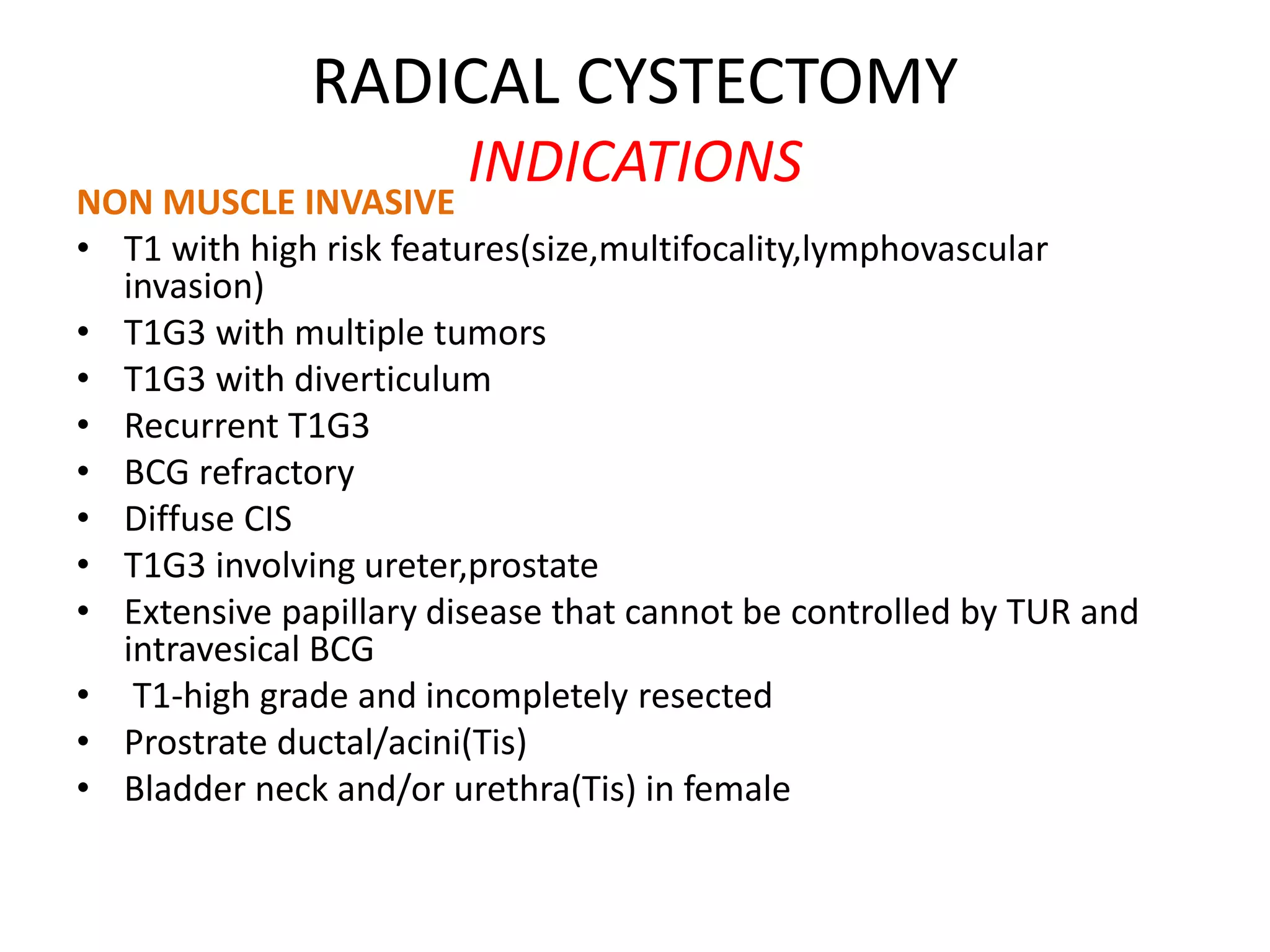
RADICAL CYSTECTOMY
INDICATIONS
NON MUSCLE INVASIVE
• T1 with high risk features(size,multifocality,lymphovascular
invasion)
• T1G3 with multiple tumors
• T1G3 with diverticulum
• Recurrent T1G3
• BCG refractory
• Diffuse CIS
• T1G3 involving ureter,prostate
• Extensive papillary disease that cannot be controlled by TUR and
intravesical BCG
• T1-high grade and incompletely resected
• Prostrate ductal/acini(Tis)
• Bladder neck and/or urethra(Tis) in female
RADICAL CYSTECTOMY
INDICATIONS
MUSCLE INVASIVE
• T2-T4a
OTHERS
• Non urothelial carcinomas(squamous,adeno)
• Salvage cystectomy-non responders to
conservative therapy
• Recurrences after bladder sparing treatments
• Palliative intervension-fistula,pain,recurrent
macro haematuria
CONTRAINDICATIONS-CYSTECTOMY
• Un resectable lymph node metastases
• Bulky lymph node with extensive periurethral
disease
• Bladder is fixed to the pelvic sidewall, or
invading the recto sigmoid colon.
RADICAL CYSTECTOMY
• Technique-removal of bladder and adjacent
organs
• Male-removal of prostate, seminal vesicles
• Female-removal of uterus,cervix,vagina and ovary
• The inclusion of entire prostate in male
patients and extend of urethrectomy and
vaginal resection in female patients-has
recently been questioned
• Autopsy studies shows 23-54% incidence of
prostatic cancer in cysto prostectomy
specimens
URETHRECTOMY
INDICATIONS
• Positive margin at the level of urethral
dissection
• Primary tumor is located at bladder neck or in
urethra
• Extensive infiltration of prostate
EXTEND OF LYMPHADENECTOMY
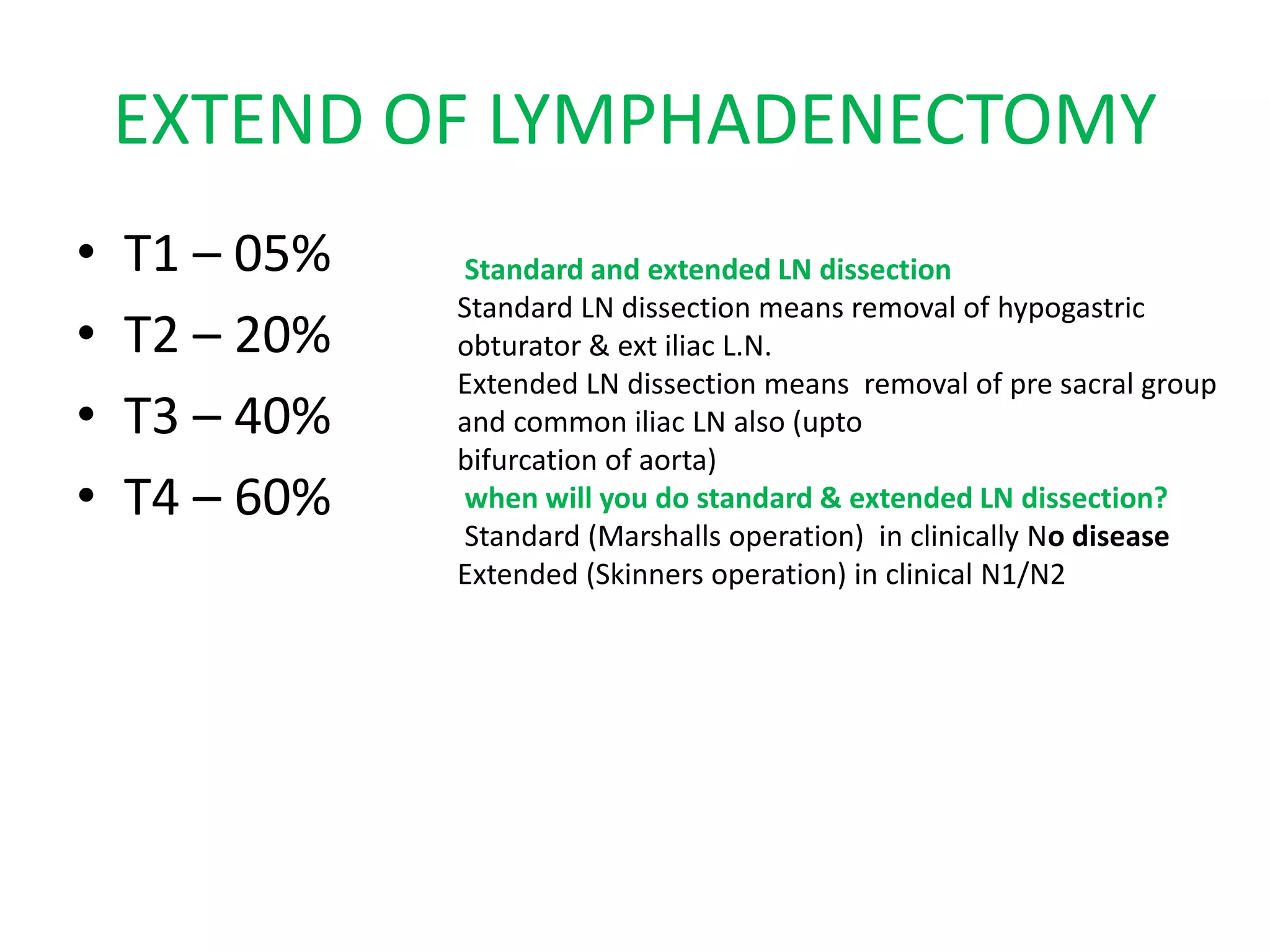
• T1 – 05%
• T2 – 20%
• T3 – 40%
• T4 – 60%
Standard and extended LN dissection
Standard LN dissection means removal of hypogastric
obturator & ext iliac L.N.
Extended LN dissection means removal of pre sacral group
and common iliac LN also (upto
bifurcation of aorta)
when will you do standard & extended LN dissection?
Standard (Marshalls operation) in clinically No disease
Extended (Skinners operation) in clinical N1/N2
Consent
• Pt is explained about his disease and the
diagnosis – MIBC;
• The need for surgery
• The prognosis (5 yr survival 50-60%)
• Organ removed – bladder, - prostate, seminal
vesicles
• Pt is explained about ileal conduit & complication
• VAS deferens ligation
• Erectile dysfn
• Gen compln: infn, bleeding, Trauma.
Pre Op Prep
1. Blood reservation
2. Only liquid diet from morning on the day before
surgery
3. Oval peglec at 12 to noon
4. NBM 12:00 midnight
5. Ileostomy site marking
6. Inform pathology dept for frozen section preparation
7. Part preparation nipple to knee.
On the day of sx
Morning - serum electrolytes, pulse /BP/RBS
- Antibiotics -cephalosporin +Metronidazole
MAIN STEPS
• POSITION
• INCISION
• ABDOMINAL EXPLORATION
• BOWEL MOBILIZATION
• URETERAL DISSECTION
• PELVIC LYMPHADENECTOMY
• LIGATION OF LATERAL VASCULAR PEDICLE
• LIGATION OF POSTERIOR VASCULAR PEDICLE
• ANTERIOR APICAL DISSECTION
Position
• Hyper extended supine position with iliac crest
located below the fulcrum of operating table
• The legs are slightly abducted
• Female patient-lithotomy position-acess to
vagina
Incision
• Vertical midline incision
• Incision should be carried
lateral to umbilicus on the
contra lateral side of stoma
site
• While opening of posterior
rectus sheath ,care should
be taken to remove the
urachus en bloc with
bladder
Abdominal Exploration
• Look for extent and resectability
• Hepatic metastasis
• Gross regional and retroperitoneal
lymphadenopathy
Ureteral resection
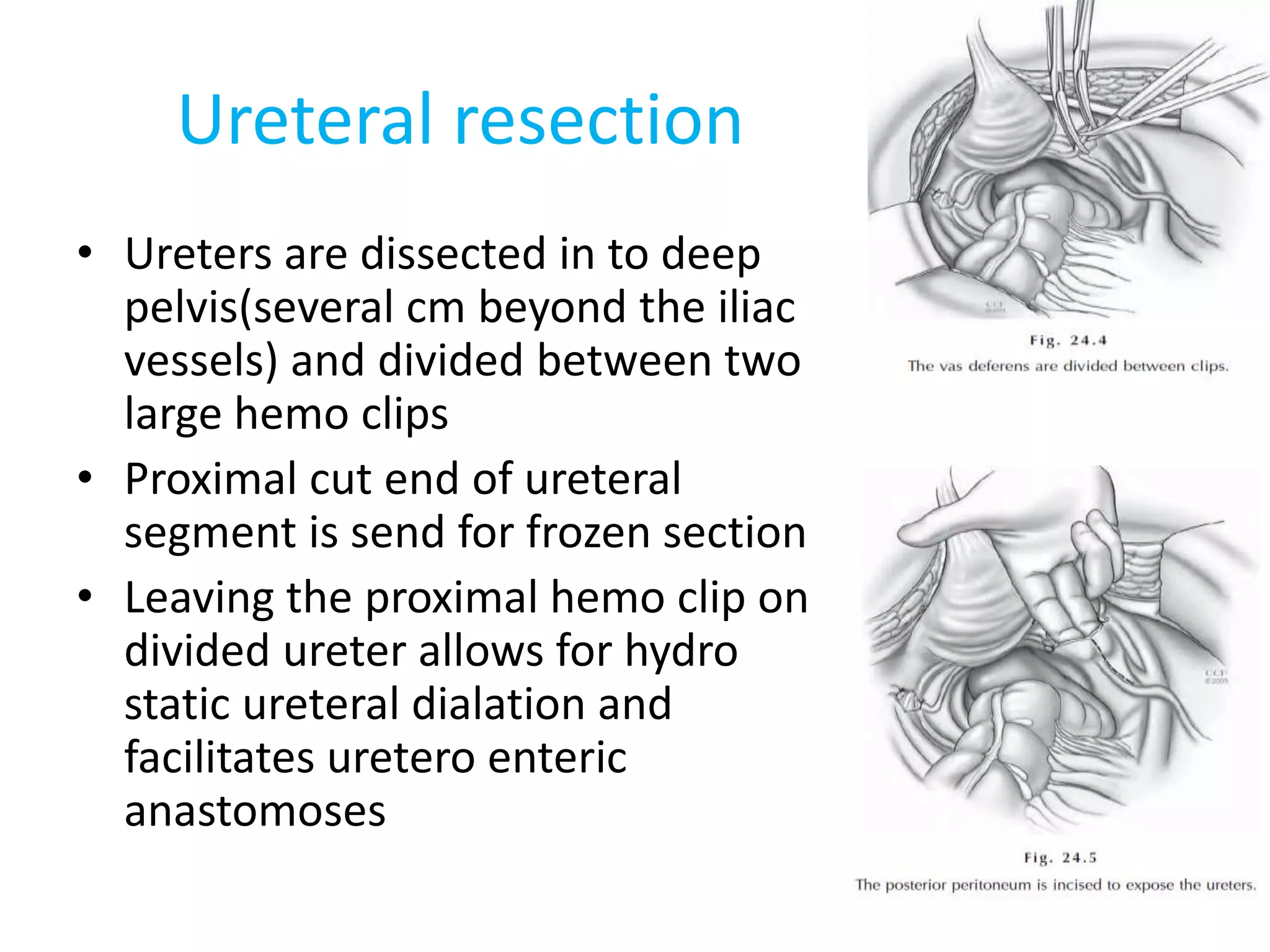
• Ureters are dissected in to deep
pelvis(several cm beyond the iliac
vessels) and divided between two
large hemo clips
• Proximal cut end of ureteral
segment is send for frozen section
• Leaving the proximal hemo clip on
divided ureter allows for hydro
static ureteral dialation and
facilitates uretero enteric
anastomoses
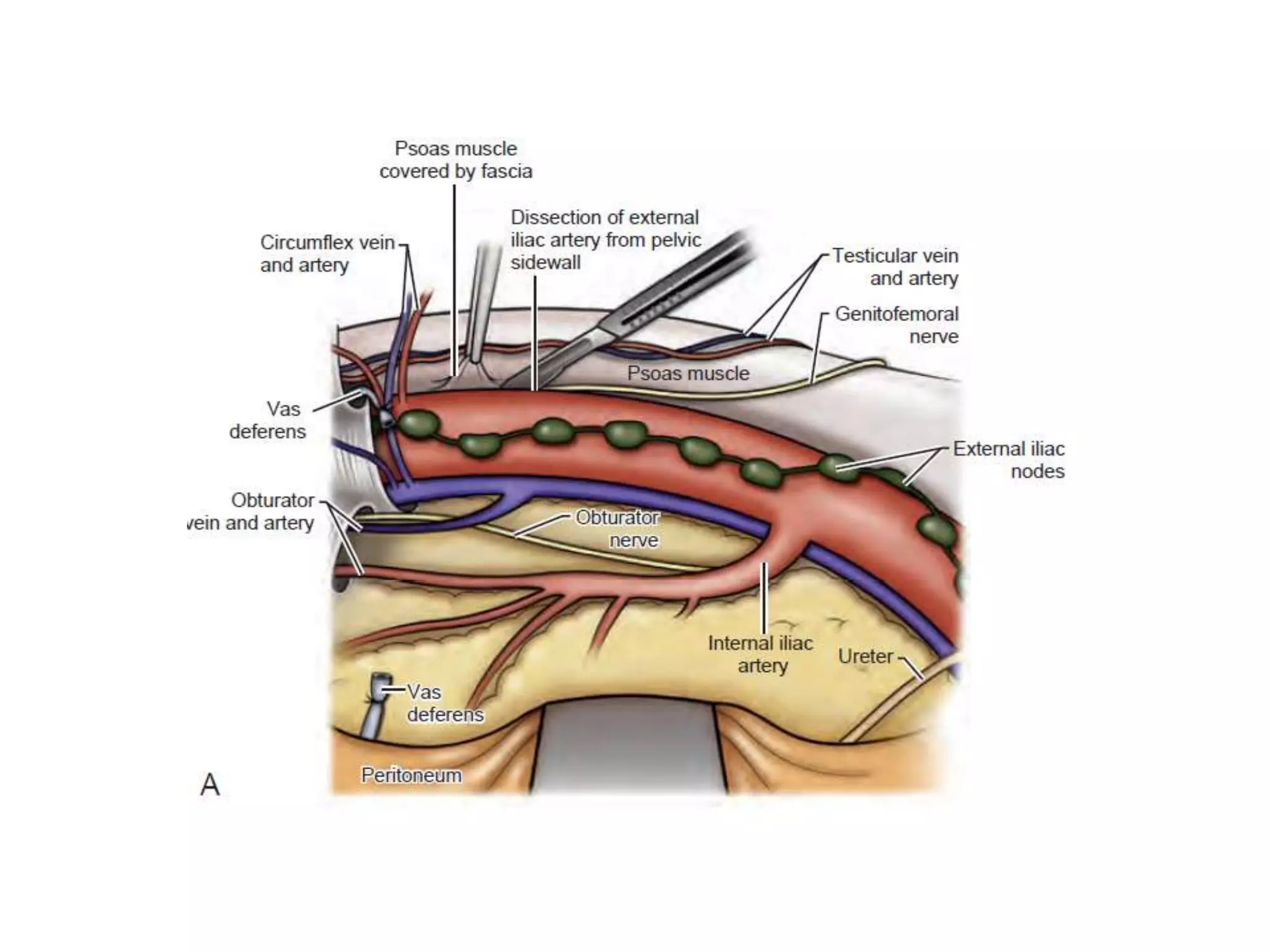
Lymphadenectomy
Boundaries of Standard LN
dissection
Superiorly – ureter crossing the
iliac vessels
Inferior – cooper’s ligament
Laterally – genitor femoral nerve
Medially – int. iliac artery.
Extended LN dissection
Up to aortic bifurcation
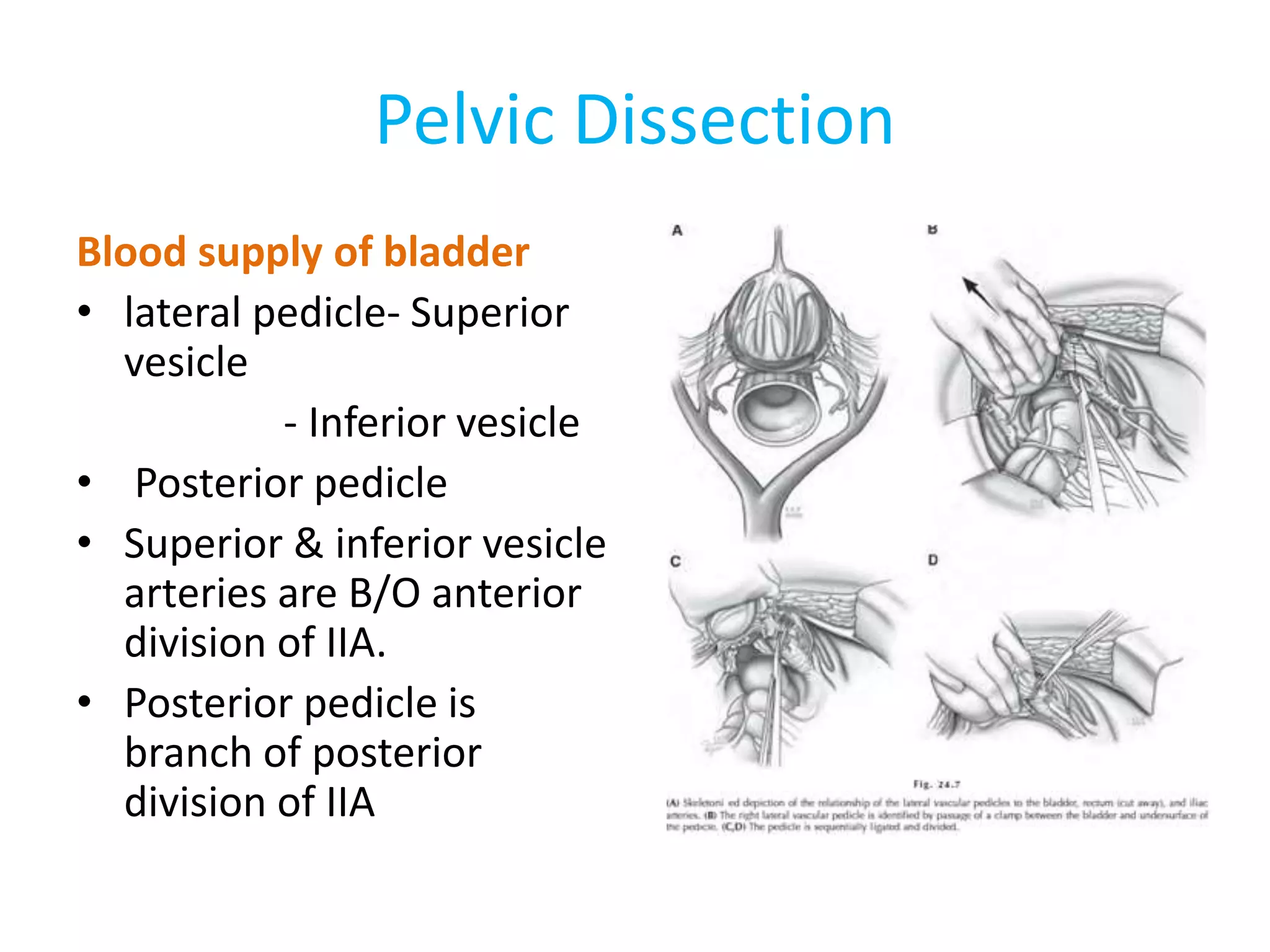
Pelvic Dissection
Blood supply of bladder
• lateral pedicle- Superior
vesicle
- Inferior vesicle
• Posterior pedicle
• Superior & inferior vesicle
arteries are B/O anterior
division of IIA.
• Posterior pedicle is
branch of posterior
division of IIA
Control DVC
vicryl 1-0 or 1 number
and apply “figure of
eight suture” on DVC
complex and fix it to
pubic
symphysis
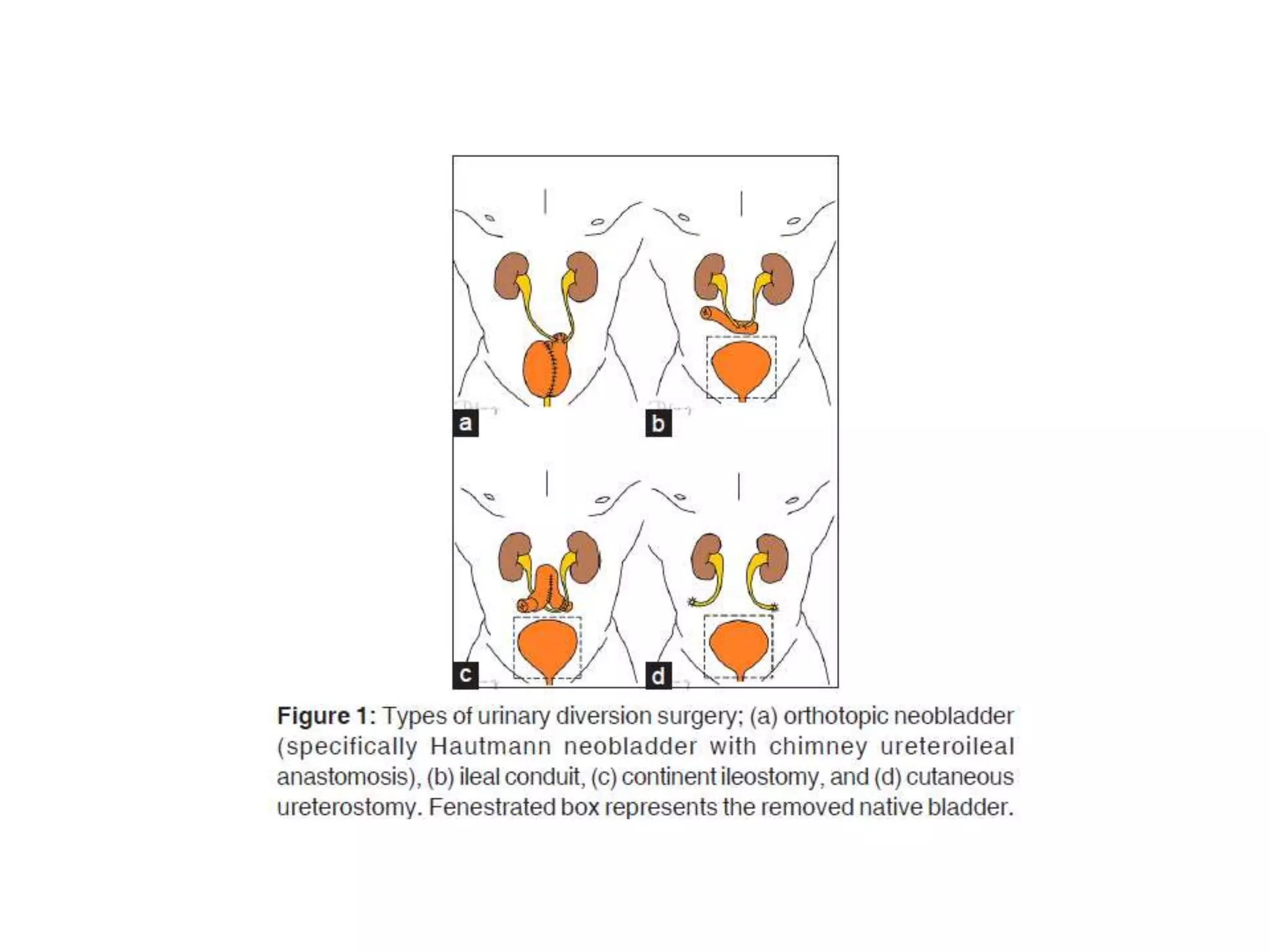
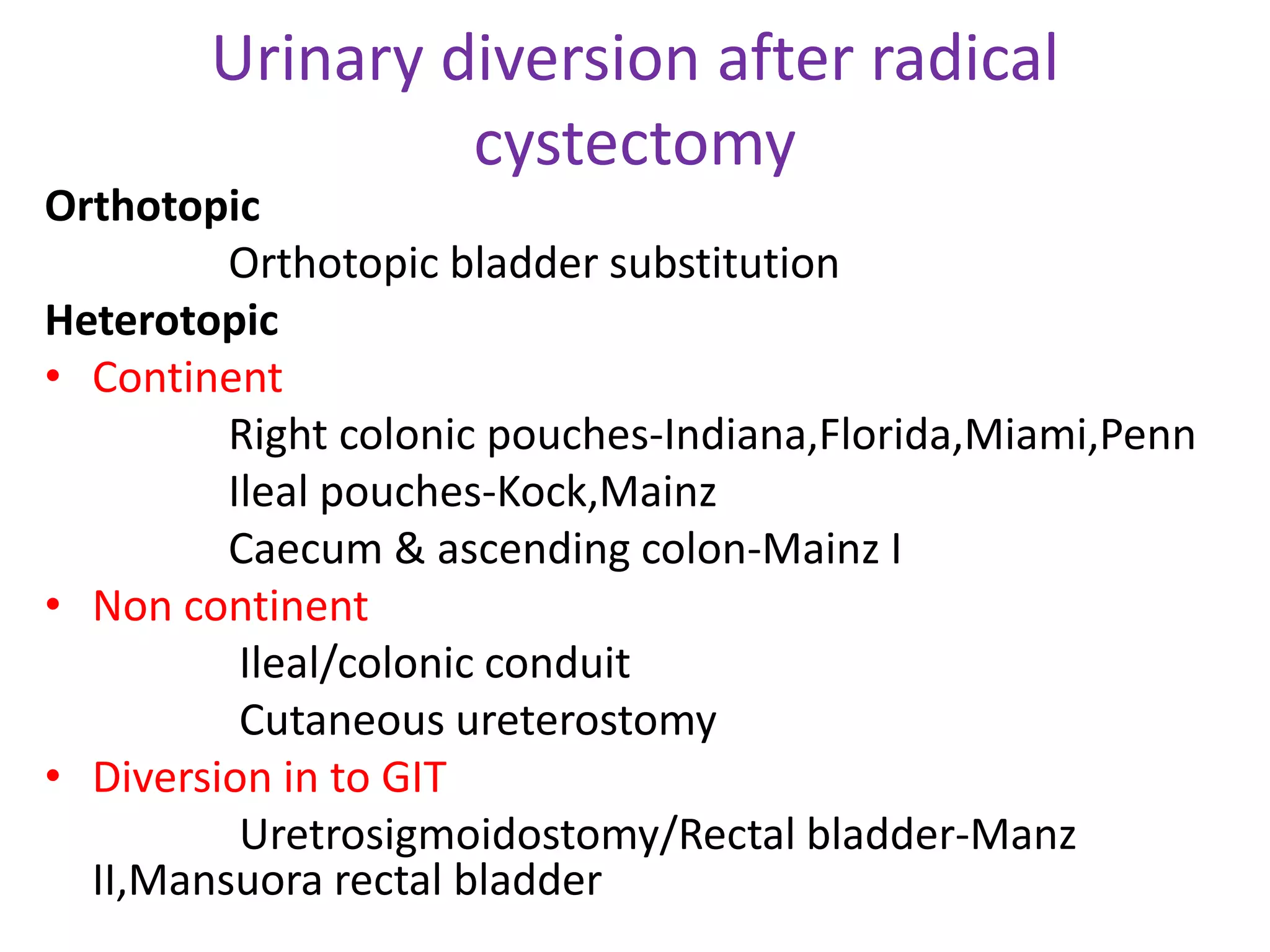
Urinary diversion after radical
cystectomy
Orthotopic
Orthotopic bladder substitution
Heterotopic
• Continent
Right colonic pouches-Indiana,Florida,Miami,Penn
Ileal pouches-Kock,Mainz
Caecum & ascending colon-Mainz I
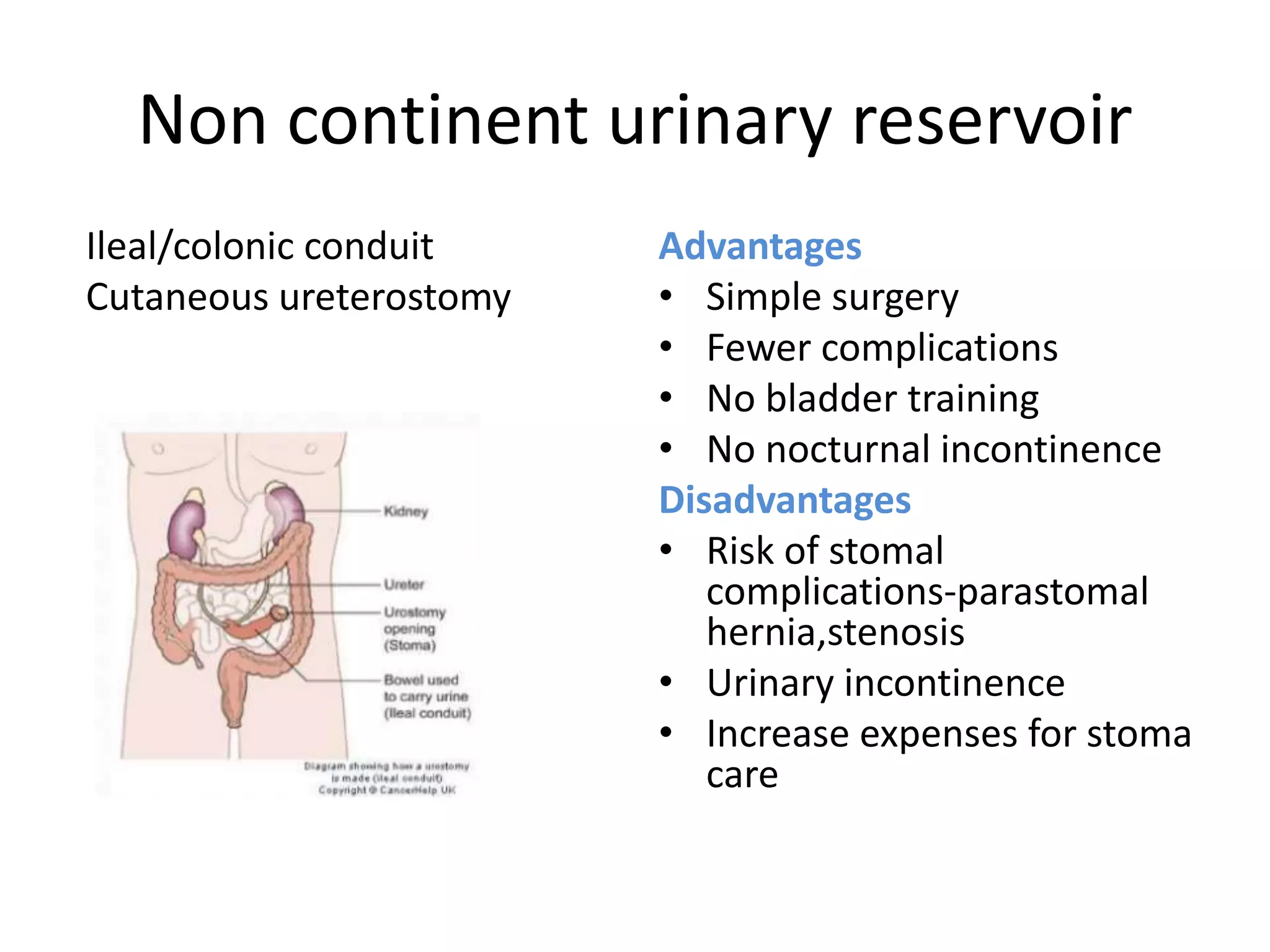
• Non continent
Ileal/colonic conduit
Cutaneous ureterostomy
• Diversion in to GIT
Uretrosigmoidostomy/Rectal bladder-Manz
II,Mansuora rectal bladder
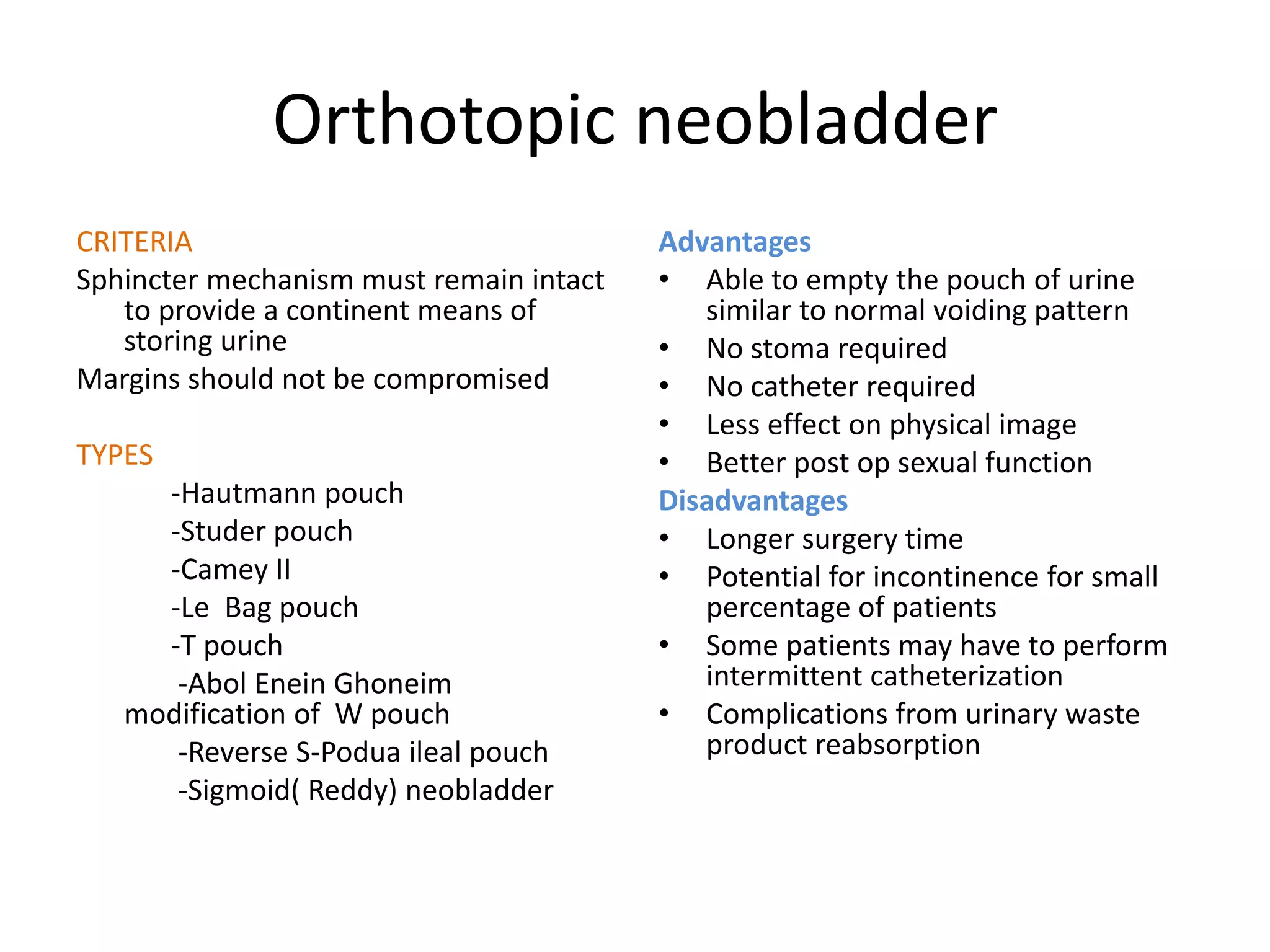
Orthotopic neobladder
CRITERIA
Sphincter mechanism must remain intact
to provide a continent means of
storing urine
Margins should not be compromised
TYPES
-Hautmann pouch
-Studer pouch
-Camey II
-Le Bag pouch
-T pouch
-Abol Enein Ghoneim
modification of W pouch
-Reverse S-Podua ileal pouch
-Sigmoid( Reddy) neobladder
Advantages
• Able to empty the pouch of urine
similar to normal voiding pattern
• No stoma required
• No catheter required
• Less effect on physical image
• Better post op sexual function
Disadvantages
• Longer surgery time
• Potential for incontinence for small
percentage of patients
• Some patients may have to perform
intermittent catheterization
• Complications from urinary waste
product reabsorption
RECONSTRUCTION OF NEO BLADDER
The type of the intestinal segment and the construction type.
• Ileum, colon and sigmoid are commonly used intestinal segments .
• Terminal ileum is more favoured among the three because it is more distensible
and has larger capacity therefore it stores urine at lower pressures and less risk of
causing high-pressure damage to the kidneys. It also experiences more mucosal
atrophy in the long term which leads to reduced risk of metabolic consequences
and less electrolyte exchange across the mucosa.
• The second consideration is the type of construction.
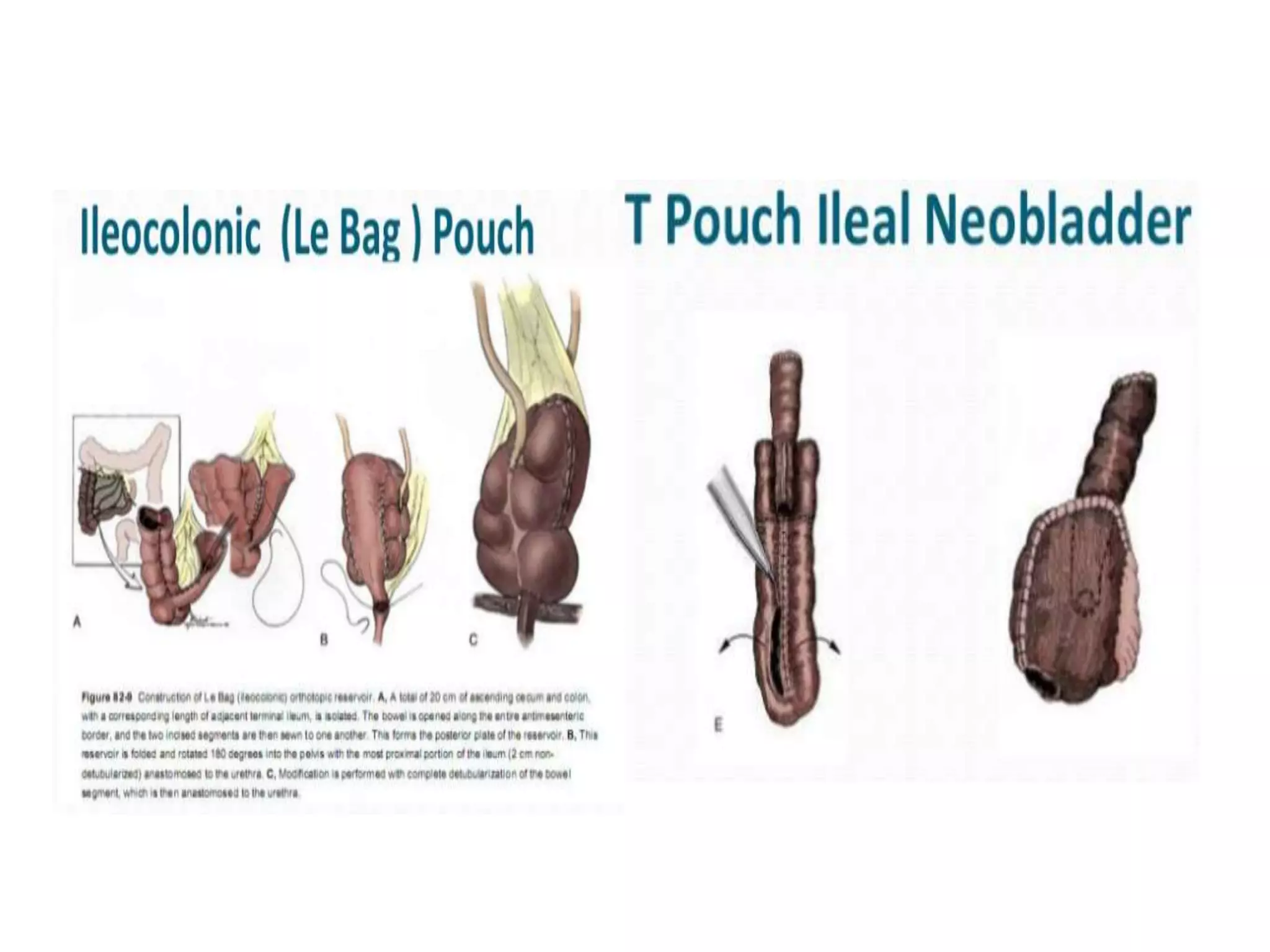
• Intestinal segments are naturally cylindrical in shape but according to Laplace law
this is not the best shape to maintain a low pressure in the reservoir. Due to the
smaller radius in a cylindrical reservoir, there will be higher intraluminal pressures
at lower volumes. Detubularized bowel may be refashioned to a spherical
reservoir; however, the larger radius enables it to contain higher volumes at lower
intraluminal pressures.The sphere has the smallest surface area for the same
volume meaning: This has the smallest risk of metabolic consequences secondary
to electrolyte exchange across the gut mucosal lining in the neo bladder and a
minimal length of intestinal segment is required to form a sphere
Hautmann pouch
Studer pouch
Camey II pouch
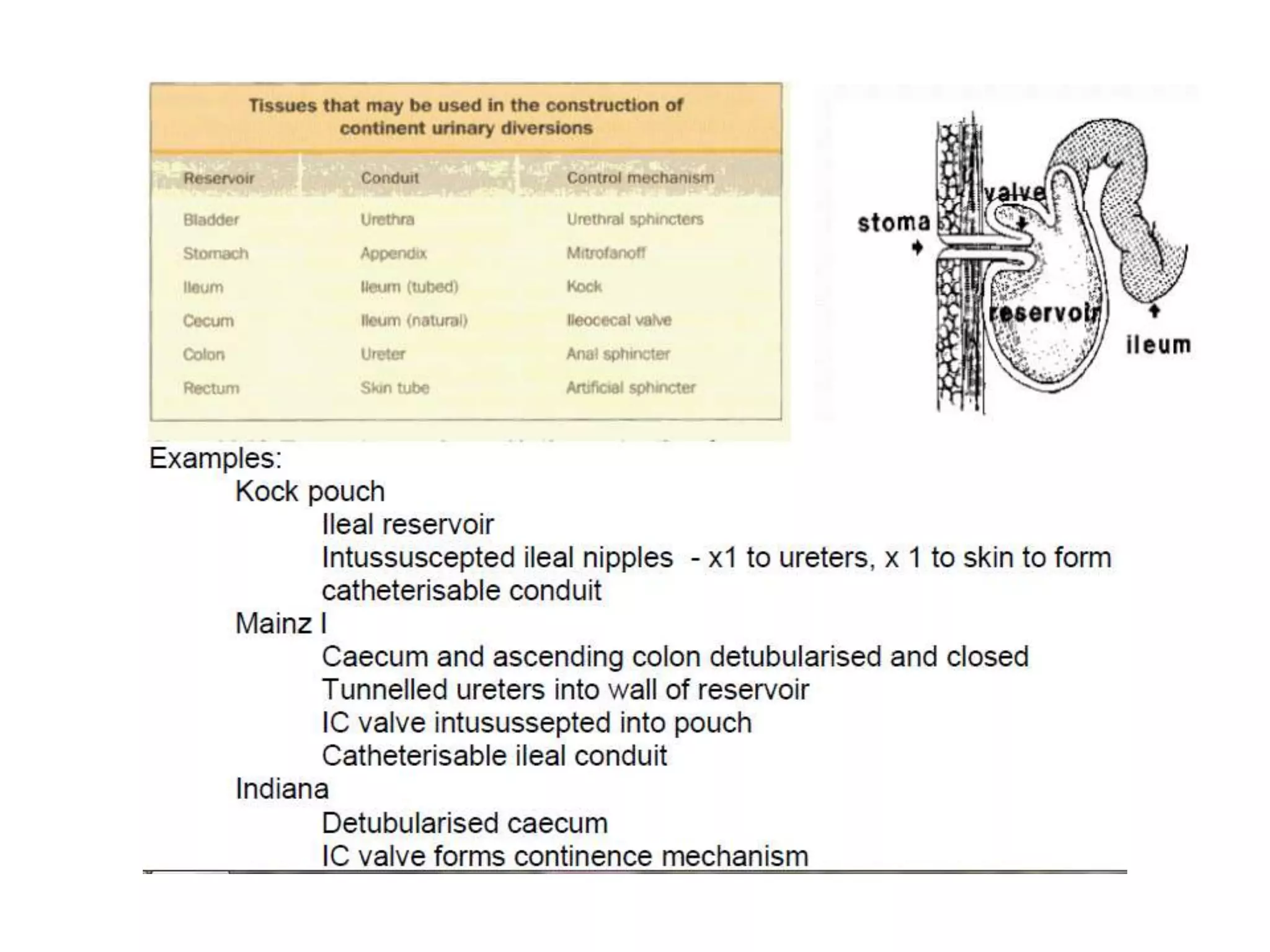
Continent urinary reservoir
Right colonic pouches-
Indiana,Florida,Miami,
Penn
Ileal pouches-Kock,Mainz
Caecum & ascending colon-Mainz I
Advantages
• Normal or near normal urinary
continence
• No nocturnal incontinence
• No need for stoma bag
• Less effect on physical image
Disadvantages
• Technically more difficult surgery
• Stomal complications-parastomal
hernia
• Complications associated with
intermittent catheterization(4-6
hrs)-pouchitis
• Complications from urinary waste
product reabsorption
Continent urinary reservoir
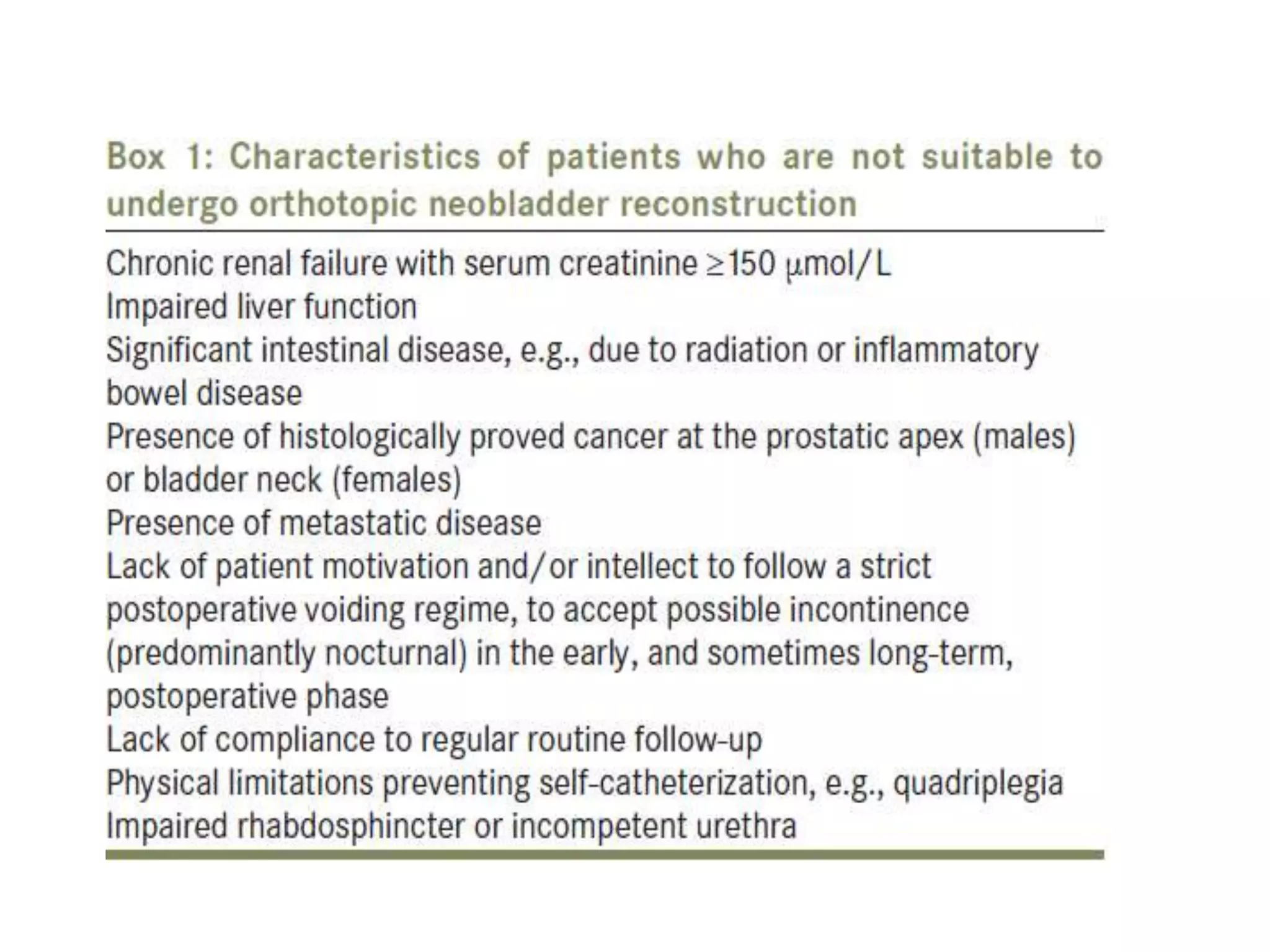
Contraindications
• Renal impairment
• Hepatic impairment
• Bowel dysfunction
• Short bowel syndrome (<1.5m)
• Inflammatory bowel syndrome
• Previous pelvic radiotherapy
• Long-term chemotherapy*/disease modifying drugs (e.g.
methotrexate)
• Psychiatric disorder
• Unable or unwilling to perform CISC
• Possibly age > 65 years (higher nocturnal eneuresis with
orthotopics)
Non continent urinary reservoir
Ileal/colonic conduit
Cutaneous ureterostomy
Advantages
• Simple surgery
• Fewer complications
• No bladder training
• No nocturnal incontinence
Disadvantages
• Risk of stomal
complications-parastomal
hernia,stenosis
• Urinary incontinence
• Increase expenses for stoma
care
Ileal conduit urinary diversion
Originally described by Zaayer in 1911, popularised by Bricker in early 1950s
Reliable, easily performed procedure which has stood test of time
Typically 10-15 cm of ileum, 10-15cm from ileocaecal valve
Contraindications:
Short bowel syndrome
Inflammatory bowel disease
Pelvic irradiation
Diversion in to GIT
• Uretrosigmoidostomy
• Rectal bladder-Manz
II,Mansuora rectal
bladder
Contraindications
• Poorly functioning anal sphincter (neuropathy,
prolapse etc)
• Pelvic radiotherapy
• Severe sigmoid diverticulosis
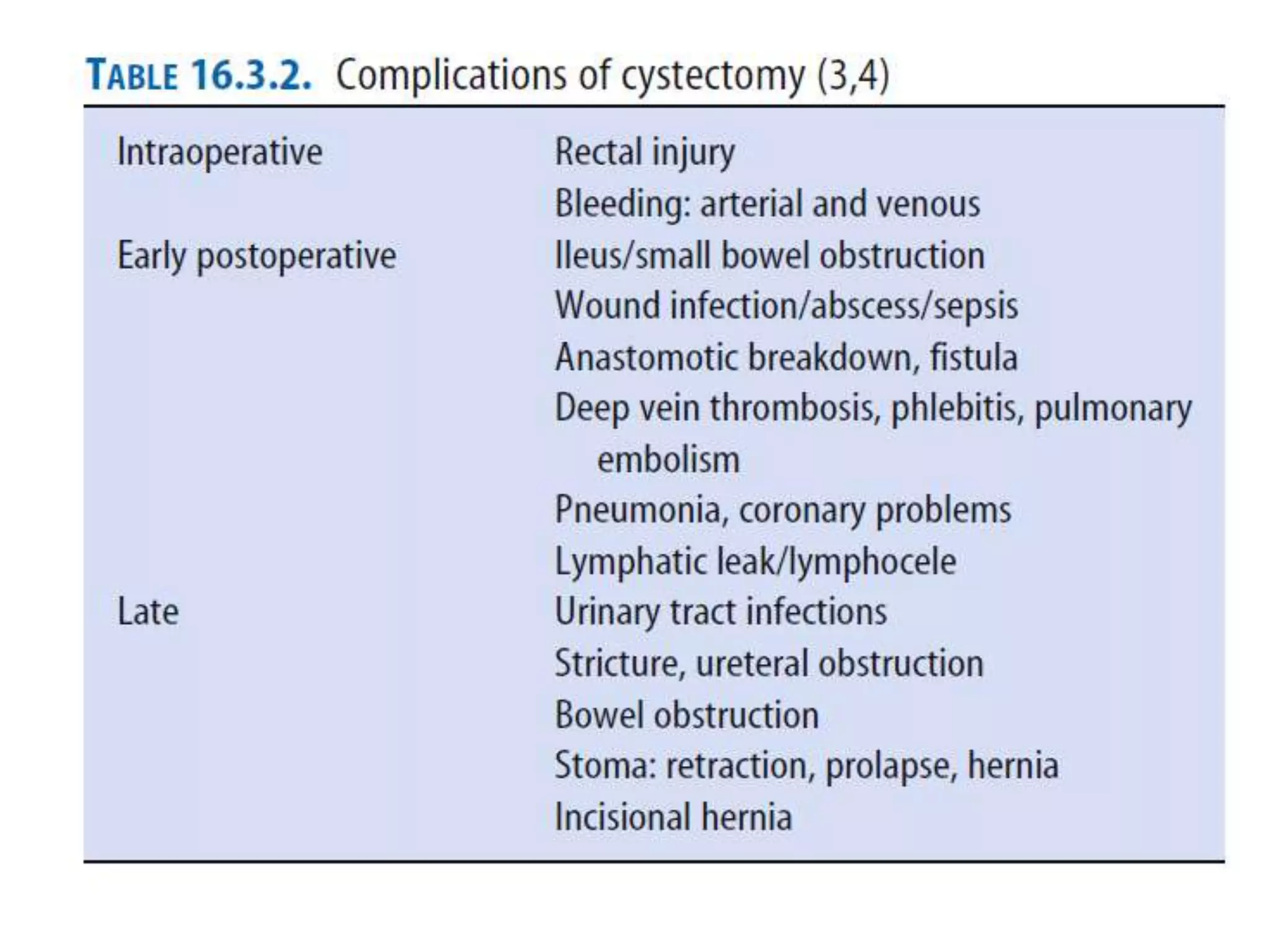
COMPLICATIONS OF URINARY
DIVERSION
• Metabolic
• Neuro-mechanical
• Surgical
Metabolic complications
1. Electrolyte abnormalities
2. Altered sensorium
3. Abnormal drug metabolism
4. Osteomalasia
5. Growth retardation
6. Persistent and recurrent infections
7. Formation of renal and reservoir calculi
8. Problems ensuing from removal of portion of
gut
9. Development of cancer
Neuro-mechanical complications
Two types
Atonic
Hyperperistaltic
Surgical complications
• Pulmonary embolus
• Wound dehiscence
• Pneumonia
• Atelectasis
Radical cystectomy

Radical cystectomy

  • 1.
    RADICAL CYSTECTOMY and URINARYDIVERSION DR BRIGHT SINGH R S MBBS,MS,MCh(Sur.Onco),D.Lap,FIAGES,FMAS,FAIS
  • 4.
    • Non muscleinvasive • Muscle invasive • Metastatic disease.
  • 9.
    • Advantages ofgiving Neo adj chemo Rx over adjuvant chemo Rx? 1. 5 yr survival benefit by 5% (ABC meta analysis) 2. Neo adj chemo Rx early control of micro mets 3. Chemo Rx is better tolerated as neo adj 4. Potential reflection of in- vitro chemo sensitivity 5. 20-25% of clinical T2NoMo are pathologically T3 or N1 disease; so giving neo adj chemo-Rx is advisable. • when can you not give neo adj chemo Rx? 1. Poor performance status PS > 2 (ECOG) 2.Impaired renal Function
  • 10.
    RADICAL CYSTECTOMY INDICATIONS NON MUSCLEINVASIVE • T1 with high risk features(size,multifocality,lymphovascular invasion) • T1G3 with multiple tumors • T1G3 with diverticulum • Recurrent T1G3 • BCG refractory • Diffuse CIS • T1G3 involving ureter,prostate • Extensive papillary disease that cannot be controlled by TUR and intravesical BCG • T1-high grade and incompletely resected • Prostrate ductal/acini(Tis) • Bladder neck and/or urethra(Tis) in female
  • 11.
    RADICAL CYSTECTOMY INDICATIONS MUSCLE INVASIVE •T2-T4a OTHERS • Non urothelial carcinomas(squamous,adeno) • Salvage cystectomy-non responders to conservative therapy • Recurrences after bladder sparing treatments • Palliative intervension-fistula,pain,recurrent macro haematuria
  • 12.
    CONTRAINDICATIONS-CYSTECTOMY • Un resectablelymph node metastases • Bulky lymph node with extensive periurethral disease • Bladder is fixed to the pelvic sidewall, or invading the recto sigmoid colon.
  • 13.
    RADICAL CYSTECTOMY • Technique-removalof bladder and adjacent organs • Male-removal of prostate, seminal vesicles • Female-removal of uterus,cervix,vagina and ovary
  • 14.
    • The inclusionof entire prostate in male patients and extend of urethrectomy and vaginal resection in female patients-has recently been questioned • Autopsy studies shows 23-54% incidence of prostatic cancer in cysto prostectomy specimens
  • 15.
    URETHRECTOMY INDICATIONS • Positive marginat the level of urethral dissection • Primary tumor is located at bladder neck or in urethra • Extensive infiltration of prostate
  • 16.
  • 17.
    EXTEND OF LYMPHADENECTOMY •T1 – 05% • T2 – 20% • T3 – 40% • T4 – 60% Standard and extended LN dissection Standard LN dissection means removal of hypogastric obturator & ext iliac L.N. Extended LN dissection means removal of pre sacral group and common iliac LN also (upto bifurcation of aorta) when will you do standard & extended LN dissection? Standard (Marshalls operation) in clinically No disease Extended (Skinners operation) in clinical N1/N2
  • 18.
    Consent • Pt isexplained about his disease and the diagnosis – MIBC; • The need for surgery • The prognosis (5 yr survival 50-60%) • Organ removed – bladder, - prostate, seminal vesicles • Pt is explained about ileal conduit & complication • VAS deferens ligation • Erectile dysfn • Gen compln: infn, bleeding, Trauma.
  • 19.
    Pre Op Prep 1.Blood reservation 2. Only liquid diet from morning on the day before surgery 3. Oval peglec at 12 to noon 4. NBM 12:00 midnight 5. Ileostomy site marking 6. Inform pathology dept for frozen section preparation 7. Part preparation nipple to knee. On the day of sx Morning - serum electrolytes, pulse /BP/RBS - Antibiotics -cephalosporin +Metronidazole
  • 20.
    MAIN STEPS • POSITION •INCISION • ABDOMINAL EXPLORATION • BOWEL MOBILIZATION • URETERAL DISSECTION • PELVIC LYMPHADENECTOMY • LIGATION OF LATERAL VASCULAR PEDICLE • LIGATION OF POSTERIOR VASCULAR PEDICLE • ANTERIOR APICAL DISSECTION
  • 21.
    Position • Hyper extendedsupine position with iliac crest located below the fulcrum of operating table • The legs are slightly abducted • Female patient-lithotomy position-acess to vagina
  • 22.
    Incision • Vertical midlineincision • Incision should be carried lateral to umbilicus on the contra lateral side of stoma site • While opening of posterior rectus sheath ,care should be taken to remove the urachus en bloc with bladder
  • 23.
    Abdominal Exploration • Lookfor extent and resectability • Hepatic metastasis • Gross regional and retroperitoneal lymphadenopathy
  • 24.
    Ureteral resection • Uretersare dissected in to deep pelvis(several cm beyond the iliac vessels) and divided between two large hemo clips • Proximal cut end of ureteral segment is send for frozen section • Leaving the proximal hemo clip on divided ureter allows for hydro static ureteral dialation and facilitates uretero enteric anastomoses
  • 25.
    Lymphadenectomy Boundaries of StandardLN dissection Superiorly – ureter crossing the iliac vessels Inferior – cooper’s ligament Laterally – genitor femoral nerve Medially – int. iliac artery. Extended LN dissection Up to aortic bifurcation
  • 27.
    Pelvic Dissection Blood supplyof bladder • lateral pedicle- Superior vesicle - Inferior vesicle • Posterior pedicle • Superior & inferior vesicle arteries are B/O anterior division of IIA. • Posterior pedicle is branch of posterior division of IIA
  • 29.
    Control DVC vicryl 1-0or 1 number and apply “figure of eight suture” on DVC complex and fix it to pubic symphysis
  • 32.
    Urinary diversion afterradical cystectomy Orthotopic Orthotopic bladder substitution Heterotopic • Continent Right colonic pouches-Indiana,Florida,Miami,Penn Ileal pouches-Kock,Mainz Caecum & ascending colon-Mainz I • Non continent Ileal/colonic conduit Cutaneous ureterostomy • Diversion in to GIT Uretrosigmoidostomy/Rectal bladder-Manz II,Mansuora rectal bladder
  • 33.
    Orthotopic neobladder CRITERIA Sphincter mechanismmust remain intact to provide a continent means of storing urine Margins should not be compromised TYPES -Hautmann pouch -Studer pouch -Camey II -Le Bag pouch -T pouch -Abol Enein Ghoneim modification of W pouch -Reverse S-Podua ileal pouch -Sigmoid( Reddy) neobladder Advantages • Able to empty the pouch of urine similar to normal voiding pattern • No stoma required • No catheter required • Less effect on physical image • Better post op sexual function Disadvantages • Longer surgery time • Potential for incontinence for small percentage of patients • Some patients may have to perform intermittent catheterization • Complications from urinary waste product reabsorption
  • 35.
    RECONSTRUCTION OF NEOBLADDER The type of the intestinal segment and the construction type. • Ileum, colon and sigmoid are commonly used intestinal segments . • Terminal ileum is more favoured among the three because it is more distensible and has larger capacity therefore it stores urine at lower pressures and less risk of causing high-pressure damage to the kidneys. It also experiences more mucosal atrophy in the long term which leads to reduced risk of metabolic consequences and less electrolyte exchange across the mucosa. • The second consideration is the type of construction. • Intestinal segments are naturally cylindrical in shape but according to Laplace law this is not the best shape to maintain a low pressure in the reservoir. Due to the smaller radius in a cylindrical reservoir, there will be higher intraluminal pressures at lower volumes. Detubularized bowel may be refashioned to a spherical reservoir; however, the larger radius enables it to contain higher volumes at lower intraluminal pressures.The sphere has the smallest surface area for the same volume meaning: This has the smallest risk of metabolic consequences secondary to electrolyte exchange across the gut mucosal lining in the neo bladder and a minimal length of intestinal segment is required to form a sphere
  • 36.
  • 37.
  • 38.
  • 40.
    Continent urinary reservoir Rightcolonic pouches- Indiana,Florida,Miami, Penn Ileal pouches-Kock,Mainz Caecum & ascending colon-Mainz I Advantages • Normal or near normal urinary continence • No nocturnal incontinence • No need for stoma bag • Less effect on physical image Disadvantages • Technically more difficult surgery • Stomal complications-parastomal hernia • Complications associated with intermittent catheterization(4-6 hrs)-pouchitis • Complications from urinary waste product reabsorption
  • 42.
    Continent urinary reservoir Contraindications •Renal impairment • Hepatic impairment • Bowel dysfunction • Short bowel syndrome (<1.5m) • Inflammatory bowel syndrome • Previous pelvic radiotherapy • Long-term chemotherapy*/disease modifying drugs (e.g. methotrexate) • Psychiatric disorder • Unable or unwilling to perform CISC • Possibly age > 65 years (higher nocturnal eneuresis with orthotopics)
  • 43.
    Non continent urinaryreservoir Ileal/colonic conduit Cutaneous ureterostomy Advantages • Simple surgery • Fewer complications • No bladder training • No nocturnal incontinence Disadvantages • Risk of stomal complications-parastomal hernia,stenosis • Urinary incontinence • Increase expenses for stoma care
  • 44.
    Ileal conduit urinarydiversion Originally described by Zaayer in 1911, popularised by Bricker in early 1950s Reliable, easily performed procedure which has stood test of time Typically 10-15 cm of ileum, 10-15cm from ileocaecal valve Contraindications: Short bowel syndrome Inflammatory bowel disease Pelvic irradiation
  • 46.
    Diversion in toGIT • Uretrosigmoidostomy • Rectal bladder-Manz II,Mansuora rectal bladder
  • 47.
    Contraindications • Poorly functioninganal sphincter (neuropathy, prolapse etc) • Pelvic radiotherapy • Severe sigmoid diverticulosis
  • 49.
    COMPLICATIONS OF URINARY DIVERSION •Metabolic • Neuro-mechanical • Surgical
  • 50.
    Metabolic complications 1. Electrolyteabnormalities 2. Altered sensorium 3. Abnormal drug metabolism 4. Osteomalasia 5. Growth retardation 6. Persistent and recurrent infections 7. Formation of renal and reservoir calculi 8. Problems ensuing from removal of portion of gut 9. Development of cancer
  • 51.
  • 52.
    Surgical complications • Pulmonaryembolus • Wound dehiscence • Pneumonia • Atelectasis