 Historical Background of the Language
Policy
 The Role of English in the Philippines
 Language Policy in the Philippines
 Legal Bases of MTB-MLE
2
Point of Discussion
Historical
Background of the
Language Policy
4
5
6
7
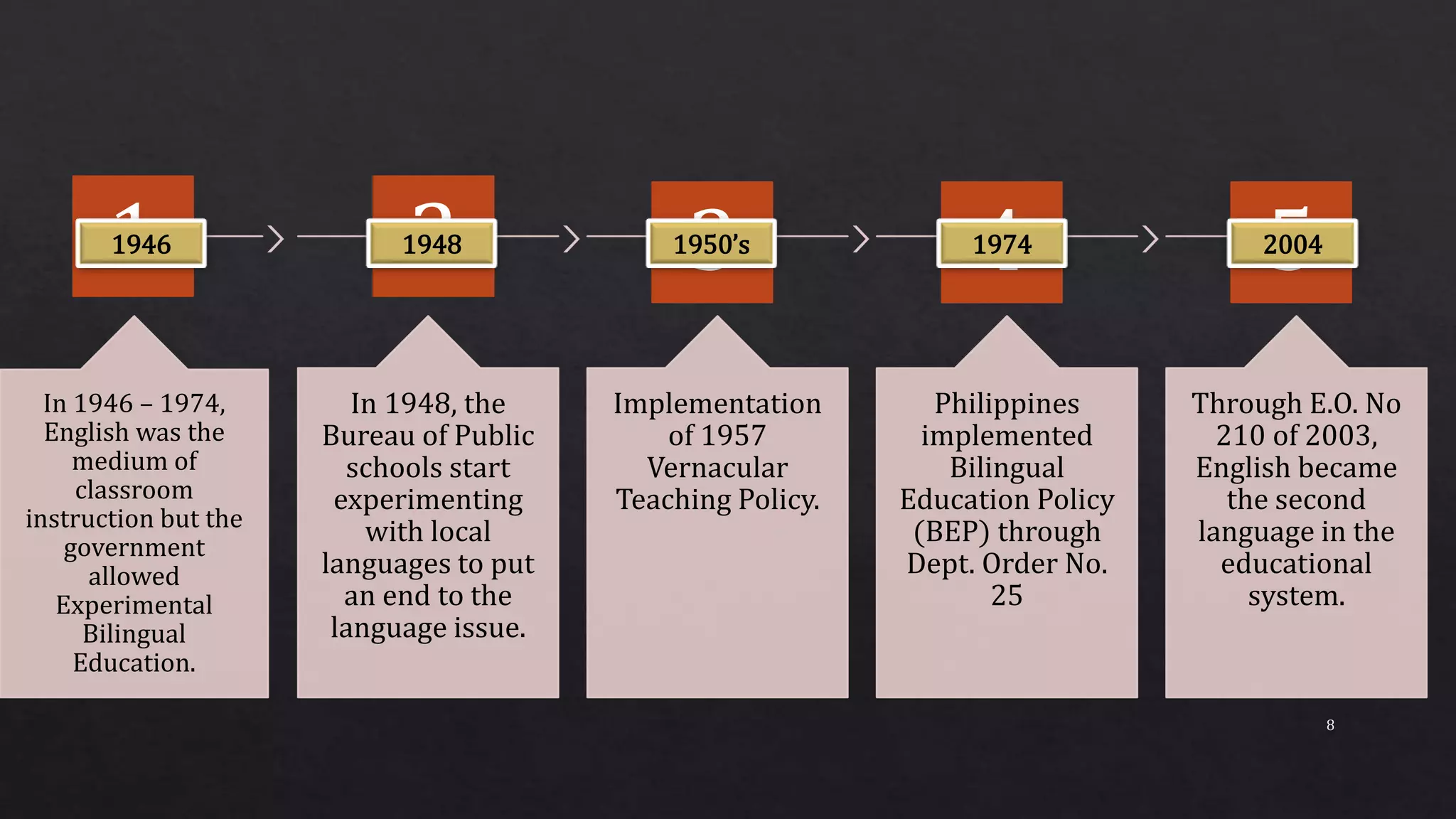
1
In 1946 – 1974,
English was the
medium of
classroom
instruction but the
government
allowed
Experimental
Bilingual
Education.
2
In 1948, the
Bureau of Public
schools start
experimenting
with local
languages to put
an end to the
language issue.
3
Implementation
of 1957
Vernacular
Teaching Policy.
4
Philippines
implemented
Bilingual
Education Policy
(BEP) through
Dept. Order No.
25
5
Through E.O. No
210 of 2003,
English became
the second
language in the
educational
system.
8
1946 1948 1950’s 1974 2004
Passing of House Bill 4701 on “Strengthening and
Enhancing the Use of English as the Medium of
Instruction in the Philippine Schools and certified by
President Gloria Macapagal-Arroyo.
The use of English become related to Philippines’ global
competitiveness and comparative advantage in its large
English-speaking work force.
Article XIV - Language
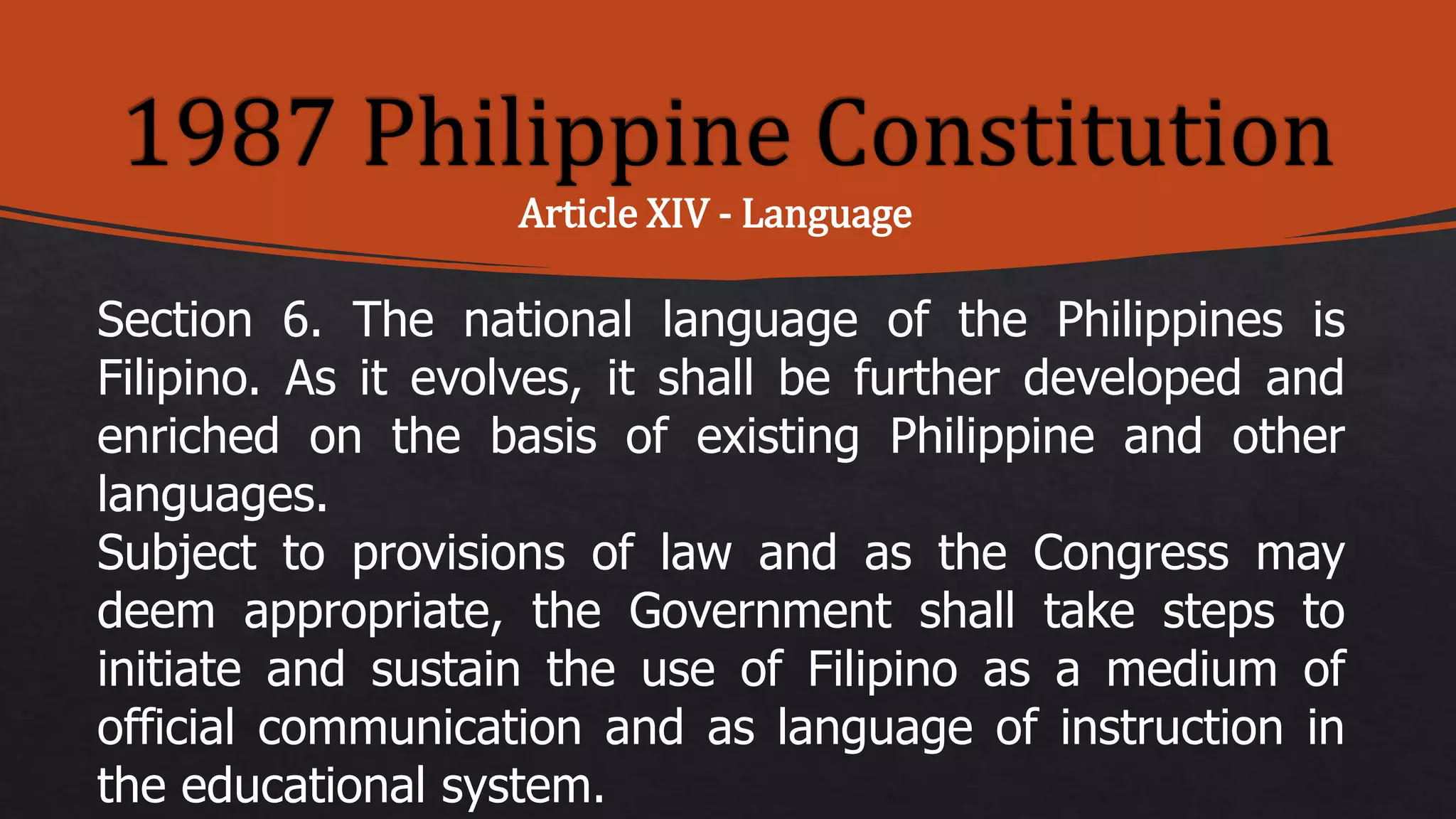
Section 6. The national language of the Philippines is
Filipino. As it evolves, it shall be further developed and
enriched on the basis of existing Philippine and other
languages.
Subject to provisions of law and as the Congress may
deem appropriate, the Government shall take steps to
initiate and sustain the use of Filipino as a medium of
official communication and as language of instruction in
the educational system.
Article XIV - Language
Section 7. For purposes of communication and instruction,
the official languages of the Philippines are Filipino and,
until otherwise provided by law, English.
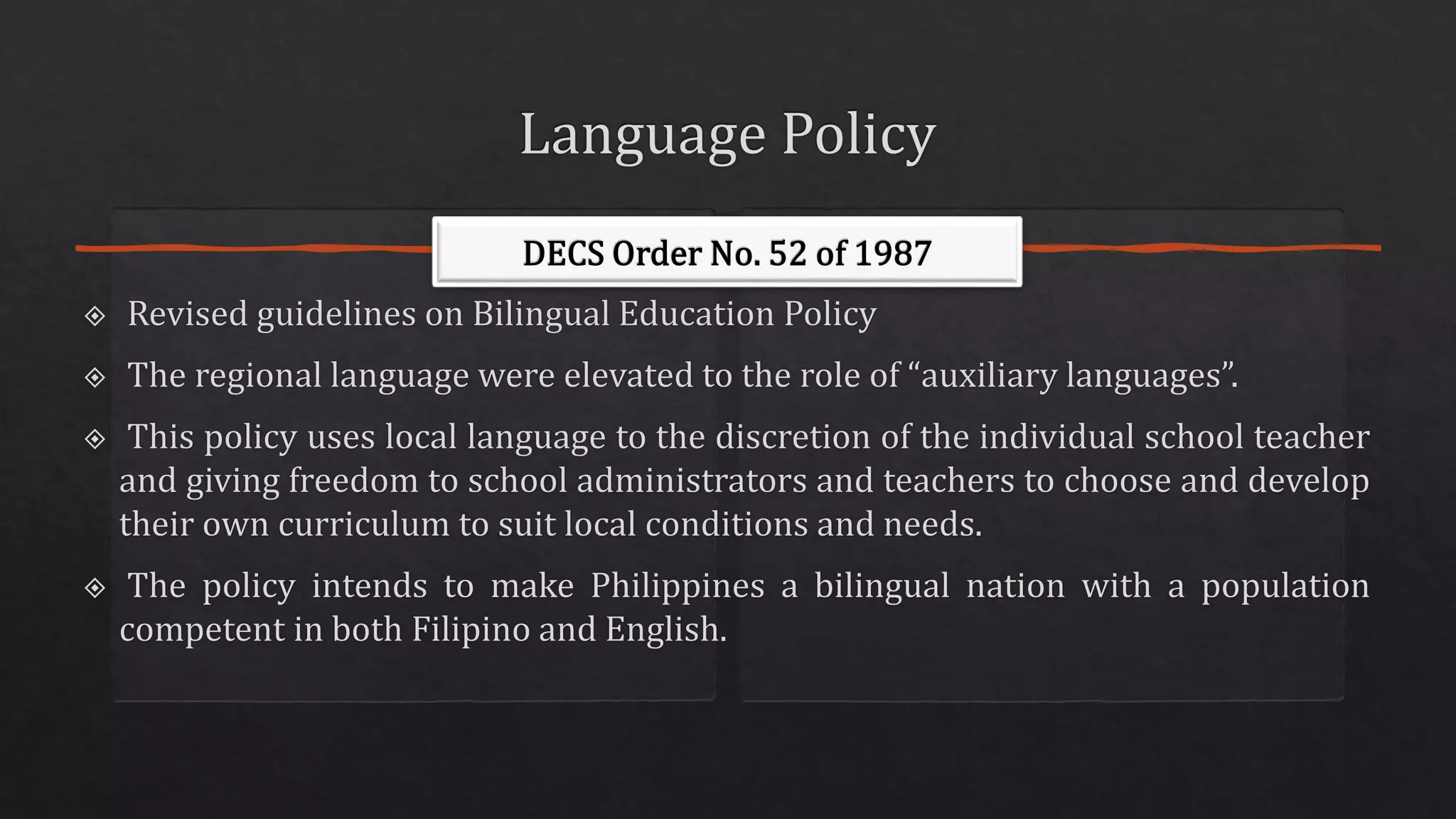
The regional languages are the auxiliary official languages
in the regions and shall serve as auxiliary media of
instruction therein.
Spanish and Arabic shall be promoted on a voluntary and
optional basis.
Article XIV - Language
Section 8. This Constitution shall be promulgated in
Filipino and English and shall be translated into major
regional languages, Arabic, and Spanish.
Section 9. The Congress shall establish a national
language commission composed of representatives of
various regions and disciplines which shall undertake,
coordinate, and promote researches for the
development, propagation, and preservation of Filipino
and other languages.
Article XIV - Language
Section 14. The State shall foster the preservation,
enrichment, and dynamic evolution of a Filipino national
culture based on the principle of unity in diversity in a
climate of free artistic and intellectual expression.
Article XIV – Arts and Culture
Section 15. Arts and letters shall enjoy the patronage of
the State. The State shall conserve, promote, and
popularize the nation’s historical and cultural heritage
and resources, as well as artistic creations.
Article XIV – Arts and Culture
Section 17. The State shall recognize, respect, and
protect the rights of indigenous cultural communities to
preserve and develop their cultures, traditions, and
institutions. It shall consider these rights in the
formulation of national plans and policies.
Article XIV – Arts and Culture
Section 18. (1) The State shall ensure equal access to
cultural opportunities through the educational system,
public or private cultural entities, scholarships, grants
and other incentives, and community cultural centers,
and other public venues.
Article XIV – Arts and Culture
SEC. 5. Medium of Instruction. – The State shall hereby
adopt the mother tongue-based multilingual education
(MTB-MLE) method. The mother tongue of the learner
shall be the primary medium of instruction for teaching
and learning in the kindergarten level.
“Kindergarten Act of 2011”
SEC. 2. …Basic education shall be delivered in
languages understood by the learners as the language
plays a strategic role in shaping the formative years of
learners.
“Enhanced Basic Education Act of 2013”
Section 2 (Declaration of Policy). (c) Make education
learner-oriented and responsive to the needs, cognitive
and cultural capacity, the circumstances and diversity of
learners, schools and communities through the
appropriate languages of teaching and learning,
including mother tongue as a learning resource.
“Enhanced Basic Education Act of 2013”
Section 4. For kindergarten and the first three (3) years of
elementary education, instruction, teaching materials and
assessment shall be in the regional or native language of the
learners. The Department of Education (DepED) shall formulate
a mother language transition program from Grade 4 to Grade 6
so that Filipino and English shall be gradually introduced as
languages of instruction until such time when these two (2)
languages can become the primary languages of instruction at
the secondary level.
“Enhanced Basic Education Act of 2013”
Section 5. Curriculum Development. The
standards and principles which served as guide in
the development of the K to 12 curriculum that
have the bearing on MTBMLE are:
“Enhanced Basic Education Act of 2013”
(a) The curriculum shall be learner-centered,
inclusive and developmentally appropriate;
(b) The curriculum shall be relevant, responsive
and research-based;
(c) The curriculum shall be culture-sensitive;
(d) The curriculum shall be contextualized and
global;
“Enhanced Basic Education Act of 2013”
(f) The curriculum shall adhere to the principles and
framework of Mother Tongue-Based Multilingual Education
(MTB-MLE) which starts from where the learners are and
from what they already knew proceeding from the known
to the unknown; instructional materials and capable
teachers to implement the MTB-MLE curriculum shall be
available;
“Enhanced Basic Education Act of 2013”
(h) The curriculum shall be flexible enough to enable and allow
schools to localize, indigenize and enhance the same based on
their respective educational and social contexts. The production
and development of locally produced teaching materials shall be
encouraged and approval of these materials shall devolve to the
regional and division education units.
“Enhanced Basic Education Act of 2013”
(h) The curriculum shall be flexible enough to enable and allow
schools to localize, indigenize and enhance the same based on
their respective educational and social contexts. The production
and development of locally produced teaching materials shall be
encouraged and approval of these materials shall devolve to the
regional and division education units.
Institutionalizing Mother Tongue-Based Multilingual Education
(MLE)
1. The lessons and findings of various local initiatives and
international studies in basic education have validated the
superiority of the use of the learner’s mother tongue or first
language in improving learning outcomes and promoting
Education for All (EFA).
Institutionalizing Mother Tongue-Based Multilingual Education
(MLE)
2. Mother Tongue-Based Multilingual Education, hereinafter
referred to as MLE, is the effective use of more than two
languages for literacy and instruction. Henceforth, it shall be
institutionalized as a fundamental educational policy and program
in this Department in the whole stretch of formal education
including pre-school and in the Alternative Learning System (ALS).
Institutionalizing Mother Tongue-Based Multilingual Education
(MTB-MLE)
3. The learners first language (L1) is the primary medium of
instruction (MOI) from pre-school until, at least grade three.
During such period, L1 shall be the main vehicle to teach
understanding and mastery of all subjects areas.
Guidelines on the Implementation of The Mother Tongue-Based-
Multilingual Education (MTB-MLE)
Starting School Year (SY) 2012-2013, public schools are
required, specifically in Kindergarten, Grades 1, 2, and 3, to
implement the Mother Tongue Based-Multilingual Education as
part of the K to 12 Basic Education Program.
“Institutionalizing Mother Tongue-Based Multilingual Education
(MTB-MLE)”
Eight (8) major languages or Lingua Franca and others as cited
below shall be offered as a learning area and utilized as language
of instruction for SY 2012-2013:
a. Tagalog; g. Hiligaynon;
b. Kapampangan; h. Waray;
c. Pangasinense; i. Tausug;
d. Iloko; j. Maguindanaoan;
e. Bikol; k. Maranao; and
f. Cebuano; l. Chabacano
“Clarifications on the Policy Guidelines on the Implementation of
the Language Learning Areas and Their Time Allotment in Grades
1 and 2 of the K to 12 Basic Education Program”
a. Mother Tongue is used as a Medium of Instruction (MOI)
for Grades 1 and 2 for teaching Mathematics, Araling
Panlipunan (AP), Music, Arts, Physical Education and Health
(MAPEH) and Edukasyon sa Pagpapakatao (EsP);
b. Mother Tongue is taught as a separate Learning Area in
Grades 1 and 2;
“Clarifications on the Policy Guidelines on the Implementation of the
Language Learning Areas and Their Time Allotment in Grades 1 and 2 of the
K to 12 Basic Education Program”
c. Filipino, as a Learning Area, is first introduced in
Grade 1 during the second quarter (2nd Q)/grading
period;
d. English, as a Learning Area, is first introduced in
Grade 1 during the third quarter (3rd Q)/grading
period…
“Establishing Iloko as an Official Provincial Language of La
Union and Institutionalizing its Use in Relevant Sectors,
Alongside Existing National and Official Language”
SECTION 14. Inclusion of Local Language in Education. With lloko as La
Union’s main heritage language and mother tongue, educational
establishments at all levels shall be encouraged:
14.1. To include it in their daily administrative activities, including their
regular
interactions with students;
14.2. Not to prohibit anyone from expressing himself/herself in lloko or
other native
languages in the province, unless when another language is the specific
demand of the situation, and if so, must be done in a spirit of respect,
goodwill, and consideration for the limitations of the individual;
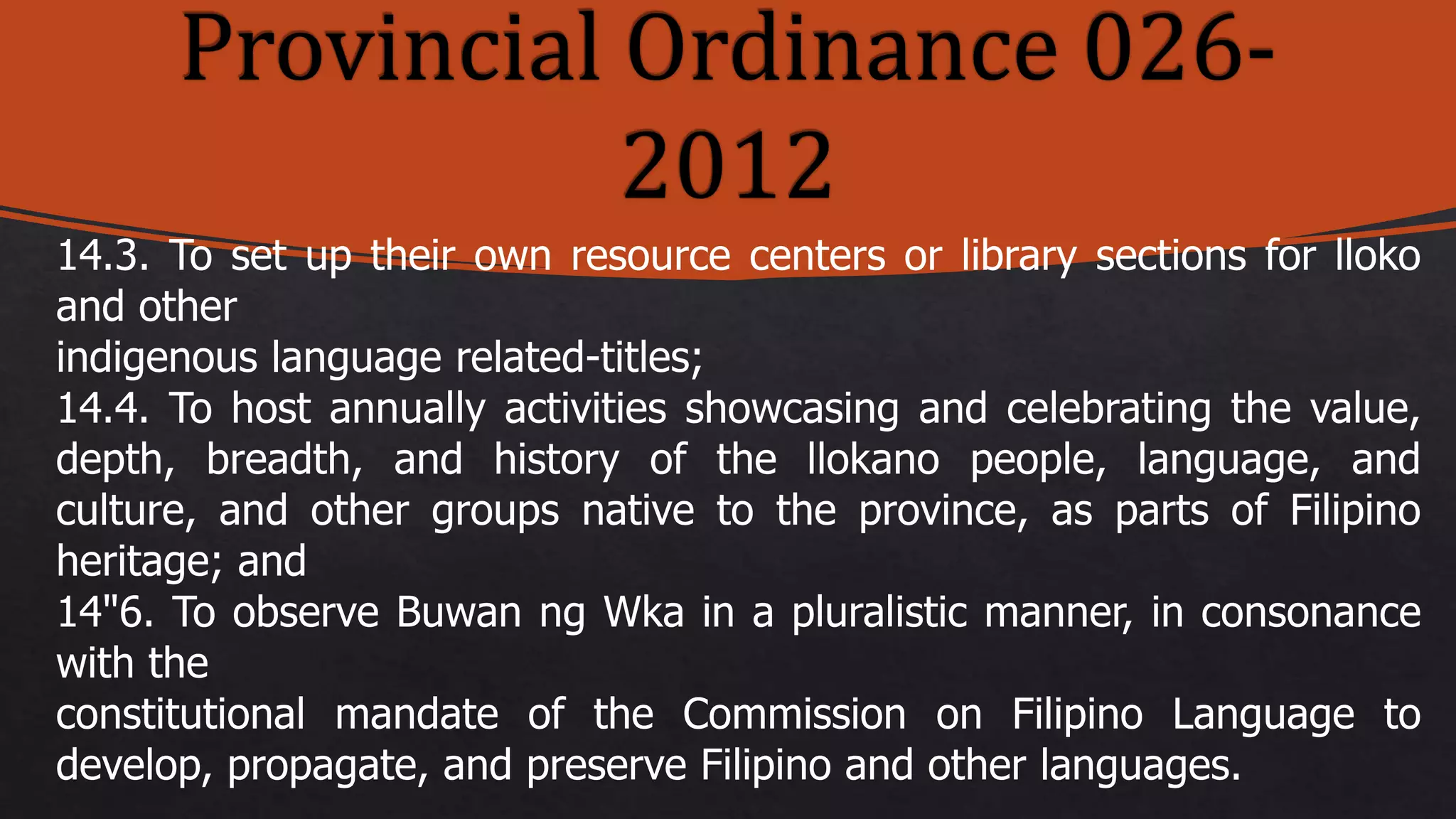
14.3. To set up their own resource centers or library sections for lloko
and other
indigenous language related-titles;
14.4. To host annually activities showcasing and celebrating the value,
depth, breadth, and history of the llokano people, language, and
culture, and other groups native to the province, as parts of Filipino
heritage; and
14"6. To observe Buwan ng Wka in a pluralistic manner, in consonance
with the
constitutional mandate of the Commission on Filipino Language to
develop, propagate, and preserve Filipino and other languages.
SEC Basic Education. This Code provides on basic education the
following:
15.1. As the principal mother tongue of the province, lloko shall be used
as the main vehicle of teaching and learning in daycare, pre-school, and
primary education in accordance with Mother Tongue-Based Multilingual
Education;
15.2. In secondary education, educational authorities shall establish
curricular enrichment programs or separate language subjects so as to
ensure adequate exposure to Iloko for students. In all subject teaching
staff are encouraged and entitled to incorporate lloko in the classroom
as an auxiliary medium of instruction as granted by the Constitution of
the Philippines.
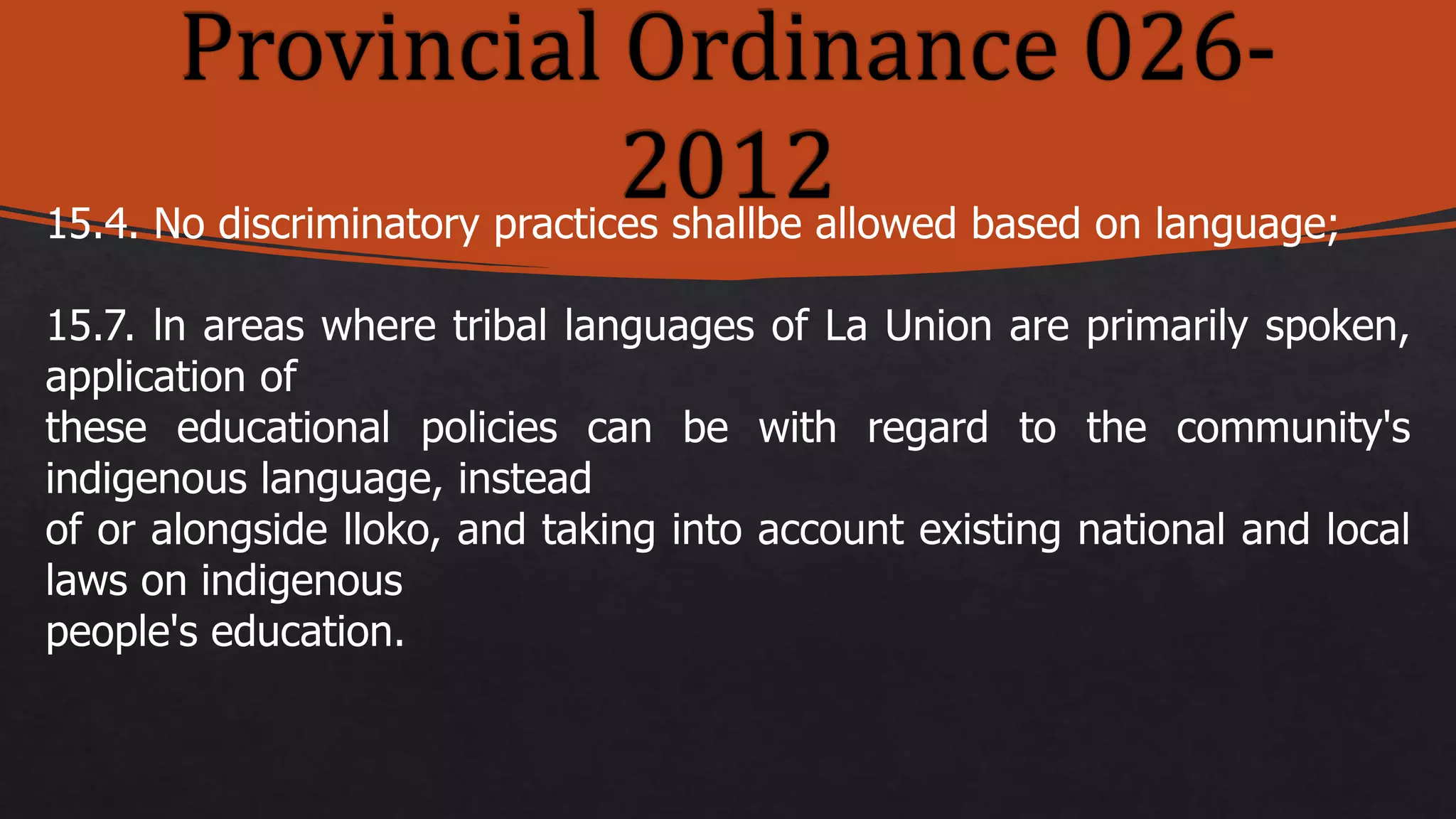
15.4. No discriminatory practices shallbe allowed based on language;
15.7. ln areas where tribal languages of La Union are primarily spoken,
application of
these educational policies can be with regard to the community's
indigenous language, instead
of or alongside lloko, and taking into account existing national and local
laws on indigenous
people's education.
Language Policy in the Philippines and Legal Bases.pptx

Language Policy in the Philippines and Legal Bases.pptx

  • 2.
     Historical Backgroundof the Language Policy  The Role of English in the Philippines  Language Policy in the Philippines  Legal Bases of MTB-MLE 2 Point of Discussion
  • 3.
  • 4.
  • 5.
  • 6.
  • 7.
  • 8.
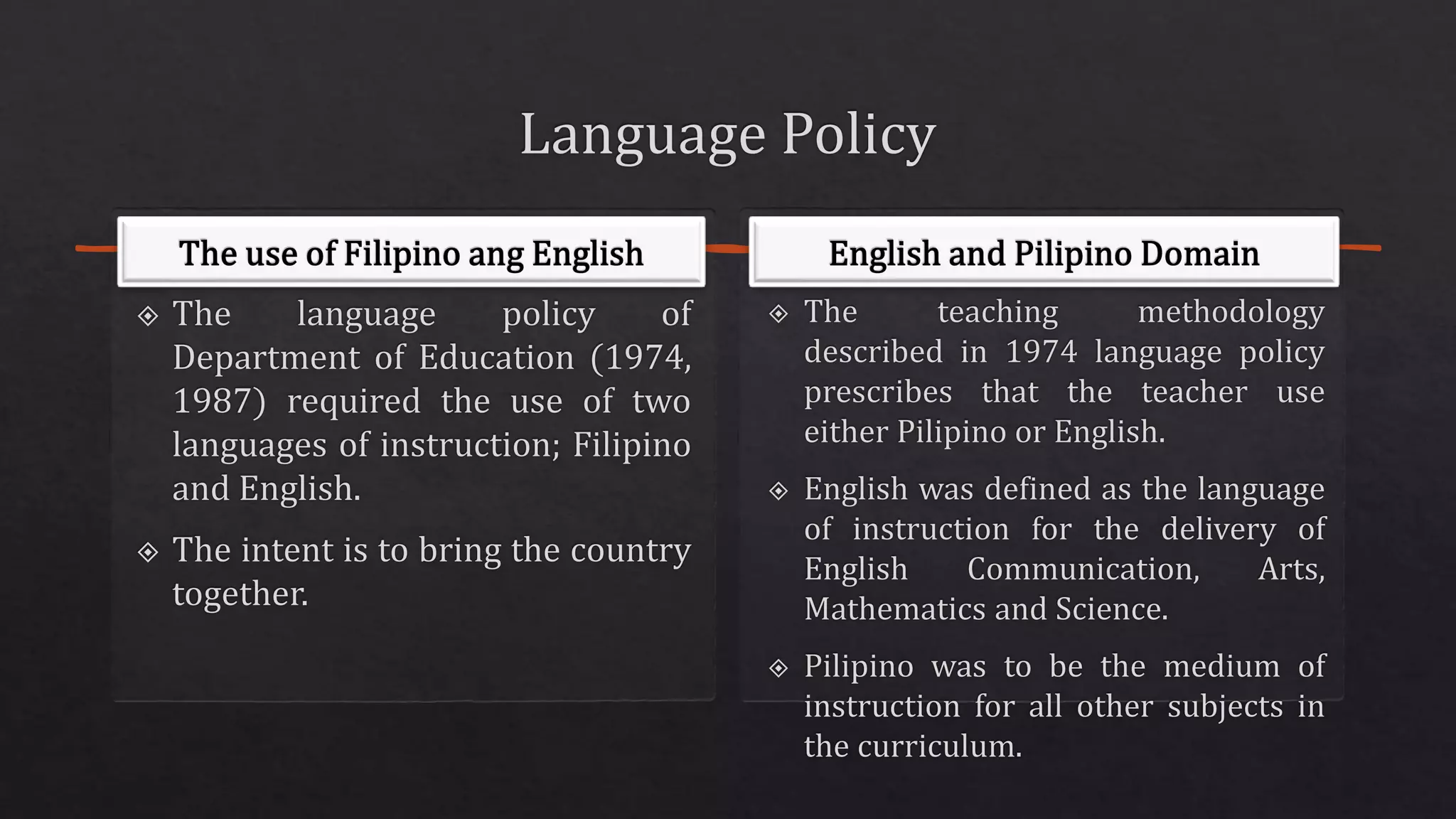
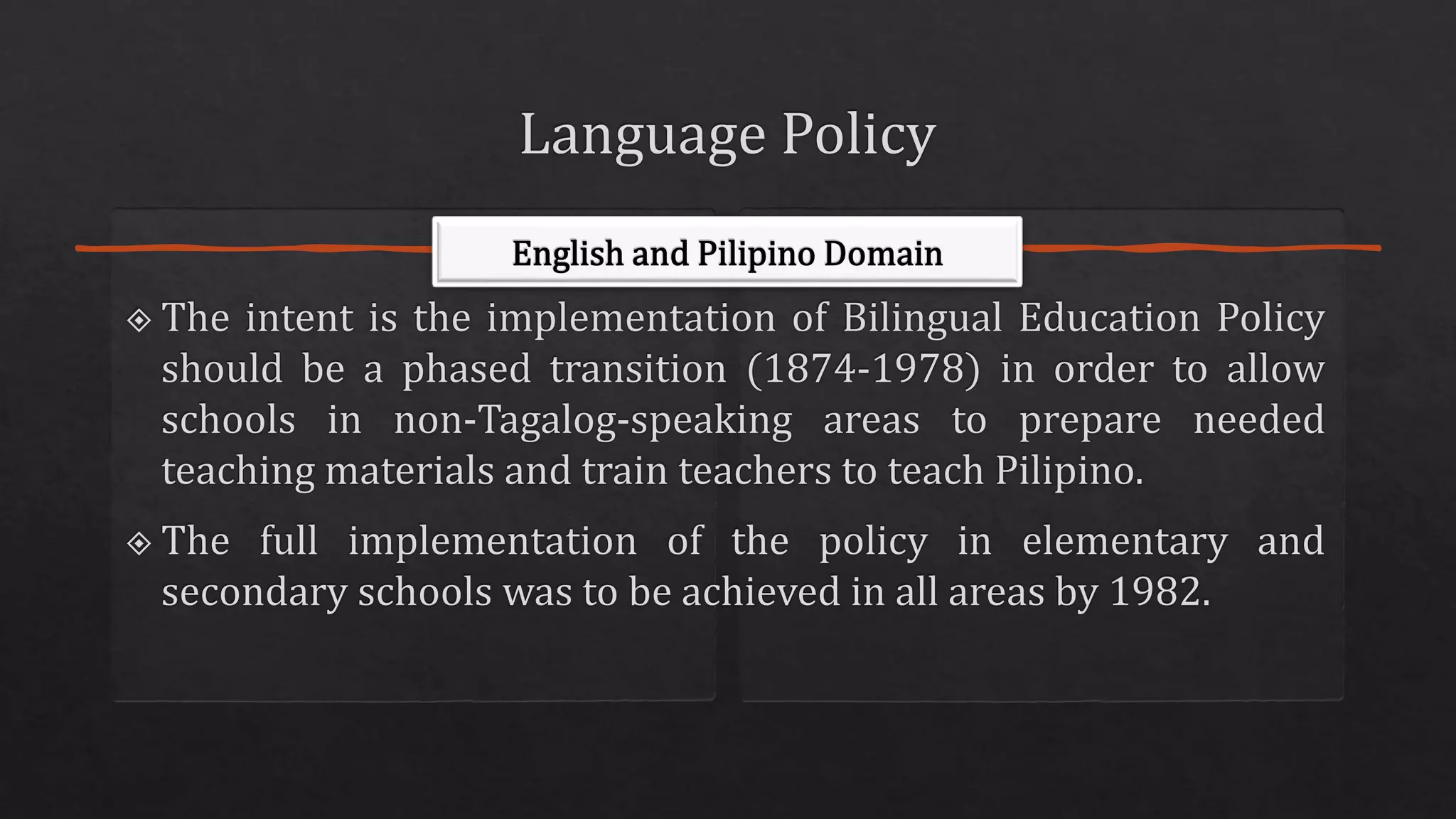
    1 In 1946 –1974, English was the medium of classroom instruction but the government allowed Experimental Bilingual Education. 2 In 1948, the Bureau of Public schools start experimenting with local languages to put an end to the language issue. 3 Implementation of 1957 Vernacular Teaching Policy. 4 Philippines implemented Bilingual Education Policy (BEP) through Dept. Order No. 25 5 Through E.O. No 210 of 2003, English became the second language in the educational system. 8 1946 1948 1950’s 1974 2004
  • 10.
    Passing of HouseBill 4701 on “Strengthening and Enhancing the Use of English as the Medium of Instruction in the Philippine Schools and certified by President Gloria Macapagal-Arroyo. The use of English become related to Philippines’ global competitiveness and comparative advantage in its large English-speaking work force.
  • 17.
    Article XIV -Language Section 6. The national language of the Philippines is Filipino. As it evolves, it shall be further developed and enriched on the basis of existing Philippine and other languages. Subject to provisions of law and as the Congress may deem appropriate, the Government shall take steps to initiate and sustain the use of Filipino as a medium of official communication and as language of instruction in the educational system.
  • 18.
    Article XIV -Language Section 7. For purposes of communication and instruction, the official languages of the Philippines are Filipino and, until otherwise provided by law, English. The regional languages are the auxiliary official languages in the regions and shall serve as auxiliary media of instruction therein. Spanish and Arabic shall be promoted on a voluntary and optional basis.
  • 19.
    Article XIV -Language Section 8. This Constitution shall be promulgated in Filipino and English and shall be translated into major regional languages, Arabic, and Spanish.
  • 20.
    Section 9. TheCongress shall establish a national language commission composed of representatives of various regions and disciplines which shall undertake, coordinate, and promote researches for the development, propagation, and preservation of Filipino and other languages. Article XIV - Language
  • 21.
    Section 14. TheState shall foster the preservation, enrichment, and dynamic evolution of a Filipino national culture based on the principle of unity in diversity in a climate of free artistic and intellectual expression. Article XIV – Arts and Culture
  • 22.
    Section 15. Artsand letters shall enjoy the patronage of the State. The State shall conserve, promote, and popularize the nation’s historical and cultural heritage and resources, as well as artistic creations. Article XIV – Arts and Culture
  • 23.
    Section 17. TheState shall recognize, respect, and protect the rights of indigenous cultural communities to preserve and develop their cultures, traditions, and institutions. It shall consider these rights in the formulation of national plans and policies. Article XIV – Arts and Culture
  • 24.
    Section 18. (1)The State shall ensure equal access to cultural opportunities through the educational system, public or private cultural entities, scholarships, grants and other incentives, and community cultural centers, and other public venues. Article XIV – Arts and Culture
  • 25.
    SEC. 5. Mediumof Instruction. – The State shall hereby adopt the mother tongue-based multilingual education (MTB-MLE) method. The mother tongue of the learner shall be the primary medium of instruction for teaching and learning in the kindergarten level. “Kindergarten Act of 2011”
  • 26.
    SEC. 2. …Basiceducation shall be delivered in languages understood by the learners as the language plays a strategic role in shaping the formative years of learners. “Enhanced Basic Education Act of 2013”
  • 27.
    Section 2 (Declarationof Policy). (c) Make education learner-oriented and responsive to the needs, cognitive and cultural capacity, the circumstances and diversity of learners, schools and communities through the appropriate languages of teaching and learning, including mother tongue as a learning resource. “Enhanced Basic Education Act of 2013”
  • 28.
    Section 4. Forkindergarten and the first three (3) years of elementary education, instruction, teaching materials and assessment shall be in the regional or native language of the learners. The Department of Education (DepED) shall formulate a mother language transition program from Grade 4 to Grade 6 so that Filipino and English shall be gradually introduced as languages of instruction until such time when these two (2) languages can become the primary languages of instruction at the secondary level. “Enhanced Basic Education Act of 2013”
  • 29.
    Section 5. CurriculumDevelopment. The standards and principles which served as guide in the development of the K to 12 curriculum that have the bearing on MTBMLE are: “Enhanced Basic Education Act of 2013”
  • 30.
    “Enhanced Basic EducationAct of 2013” (a) The curriculum shall be learner-centered, inclusive and developmentally appropriate; (b) The curriculum shall be relevant, responsive and research-based; (c) The curriculum shall be culture-sensitive; (d) The curriculum shall be contextualized and global;
  • 31.
    “Enhanced Basic EducationAct of 2013” (f) The curriculum shall adhere to the principles and framework of Mother Tongue-Based Multilingual Education (MTB-MLE) which starts from where the learners are and from what they already knew proceeding from the known to the unknown; instructional materials and capable teachers to implement the MTB-MLE curriculum shall be available;
  • 32.
    “Enhanced Basic EducationAct of 2013” (h) The curriculum shall be flexible enough to enable and allow schools to localize, indigenize and enhance the same based on their respective educational and social contexts. The production and development of locally produced teaching materials shall be encouraged and approval of these materials shall devolve to the regional and division education units.
  • 33.
    “Enhanced Basic EducationAct of 2013” (h) The curriculum shall be flexible enough to enable and allow schools to localize, indigenize and enhance the same based on their respective educational and social contexts. The production and development of locally produced teaching materials shall be encouraged and approval of these materials shall devolve to the regional and division education units.
  • 34.
    Institutionalizing Mother Tongue-BasedMultilingual Education (MLE) 1. The lessons and findings of various local initiatives and international studies in basic education have validated the superiority of the use of the learner’s mother tongue or first language in improving learning outcomes and promoting Education for All (EFA).
  • 35.
    Institutionalizing Mother Tongue-BasedMultilingual Education (MLE) 2. Mother Tongue-Based Multilingual Education, hereinafter referred to as MLE, is the effective use of more than two languages for literacy and instruction. Henceforth, it shall be institutionalized as a fundamental educational policy and program in this Department in the whole stretch of formal education including pre-school and in the Alternative Learning System (ALS).
  • 36.
    Institutionalizing Mother Tongue-BasedMultilingual Education (MTB-MLE) 3. The learners first language (L1) is the primary medium of instruction (MOI) from pre-school until, at least grade three. During such period, L1 shall be the main vehicle to teach understanding and mastery of all subjects areas.
  • 37.
    Guidelines on theImplementation of The Mother Tongue-Based- Multilingual Education (MTB-MLE) Starting School Year (SY) 2012-2013, public schools are required, specifically in Kindergarten, Grades 1, 2, and 3, to implement the Mother Tongue Based-Multilingual Education as part of the K to 12 Basic Education Program.
  • 38.
    “Institutionalizing Mother Tongue-BasedMultilingual Education (MTB-MLE)” Eight (8) major languages or Lingua Franca and others as cited below shall be offered as a learning area and utilized as language of instruction for SY 2012-2013: a. Tagalog; g. Hiligaynon; b. Kapampangan; h. Waray; c. Pangasinense; i. Tausug; d. Iloko; j. Maguindanaoan; e. Bikol; k. Maranao; and f. Cebuano; l. Chabacano
  • 39.
    “Clarifications on thePolicy Guidelines on the Implementation of the Language Learning Areas and Their Time Allotment in Grades 1 and 2 of the K to 12 Basic Education Program” a. Mother Tongue is used as a Medium of Instruction (MOI) for Grades 1 and 2 for teaching Mathematics, Araling Panlipunan (AP), Music, Arts, Physical Education and Health (MAPEH) and Edukasyon sa Pagpapakatao (EsP); b. Mother Tongue is taught as a separate Learning Area in Grades 1 and 2;
  • 40.
    “Clarifications on thePolicy Guidelines on the Implementation of the Language Learning Areas and Their Time Allotment in Grades 1 and 2 of the K to 12 Basic Education Program” c. Filipino, as a Learning Area, is first introduced in Grade 1 during the second quarter (2nd Q)/grading period; d. English, as a Learning Area, is first introduced in Grade 1 during the third quarter (3rd Q)/grading period…
  • 41.
    “Establishing Iloko asan Official Provincial Language of La Union and Institutionalizing its Use in Relevant Sectors, Alongside Existing National and Official Language”
  • 42.
    SECTION 14. Inclusionof Local Language in Education. With lloko as La Union’s main heritage language and mother tongue, educational establishments at all levels shall be encouraged: 14.1. To include it in their daily administrative activities, including their regular interactions with students; 14.2. Not to prohibit anyone from expressing himself/herself in lloko or other native languages in the province, unless when another language is the specific demand of the situation, and if so, must be done in a spirit of respect, goodwill, and consideration for the limitations of the individual;
  • 43.
    14.3. To setup their own resource centers or library sections for lloko and other indigenous language related-titles; 14.4. To host annually activities showcasing and celebrating the value, depth, breadth, and history of the llokano people, language, and culture, and other groups native to the province, as parts of Filipino heritage; and 14"6. To observe Buwan ng Wka in a pluralistic manner, in consonance with the constitutional mandate of the Commission on Filipino Language to develop, propagate, and preserve Filipino and other languages.
  • 44.
    SEC Basic Education.This Code provides on basic education the following: 15.1. As the principal mother tongue of the province, lloko shall be used as the main vehicle of teaching and learning in daycare, pre-school, and primary education in accordance with Mother Tongue-Based Multilingual Education; 15.2. In secondary education, educational authorities shall establish curricular enrichment programs or separate language subjects so as to ensure adequate exposure to Iloko for students. In all subject teaching staff are encouraged and entitled to incorporate lloko in the classroom as an auxiliary medium of instruction as granted by the Constitution of the Philippines.
  • 45.
    15.4. No discriminatorypractices shallbe allowed based on language; 15.7. ln areas where tribal languages of La Union are primarily spoken, application of these educational policies can be with regard to the community's indigenous language, instead of or alongside lloko, and taking into account existing national and local laws on indigenous people's education.

Editor's Notes

  • #4  Of the more than a hundred languages being spoken by the different ethnolinguistic groups of dwellers in the more than seven thousand and one hundred islands comprising the Philippines, eight of them are considered major languages. These major languages are Ilocano, Pangasinan, Pampango, Tagalog, Bicol, Cebuano, Hiligaynon and Waray-Samarnon.
  • #16 “Filipino and English shall be used as media of instruction, the use allocated to specific subjects in the curriculum as indicated in DECS Order No. 25, s. 1974”.  The two languages shall also be taught as subjects in all levels to achieve bilingual competence.