Series 3
1
2
3
4
5
Series 1
Series 2
Series 3
It’s a process wherein the learners
acquire the planned or intended knowledge,
skills and attitudes that are aimed at enabling
the same learners to functions effectively in the
society.
Curriculum Implementation
Putting into practice the written
curriculum that has been designed in the
syllabi, course of study, curricular guides, and
subjects.
Loucks and Lieberman- they defined it as the
trying out of a new practice and what it looks
like when actually used in school system. It
simply means that implementation should
bring desired change and improvement.
Ornstein and Hunkins - as the inter action
between the curricula that has been written and
planned and the persons(teachers) who are in
charged to deliver it.
Concept of Change
Change is a constant law of nature. It
bring improvements. Change is an ongoing
process.
Not all changes lead to improvement, but all
improvement requires change. The ability to
develop, test, and implement changes is essential
for any individual, group, or organization that
wants to continuously improve.
Features of Change-
• It’s a PROCESS not an EVENT
• It requires time, energy and resources.
• It is achieved incrementally and entails
development in feelings and skills.
Process of curriculum change may be
assisted by permissiveness and support
in accordance of with a helpful
improvement in curriculum. Changing
curriculum changes individuals.
It must be necessary in consideration
that the resources of implementation of
curriculum are available or not.
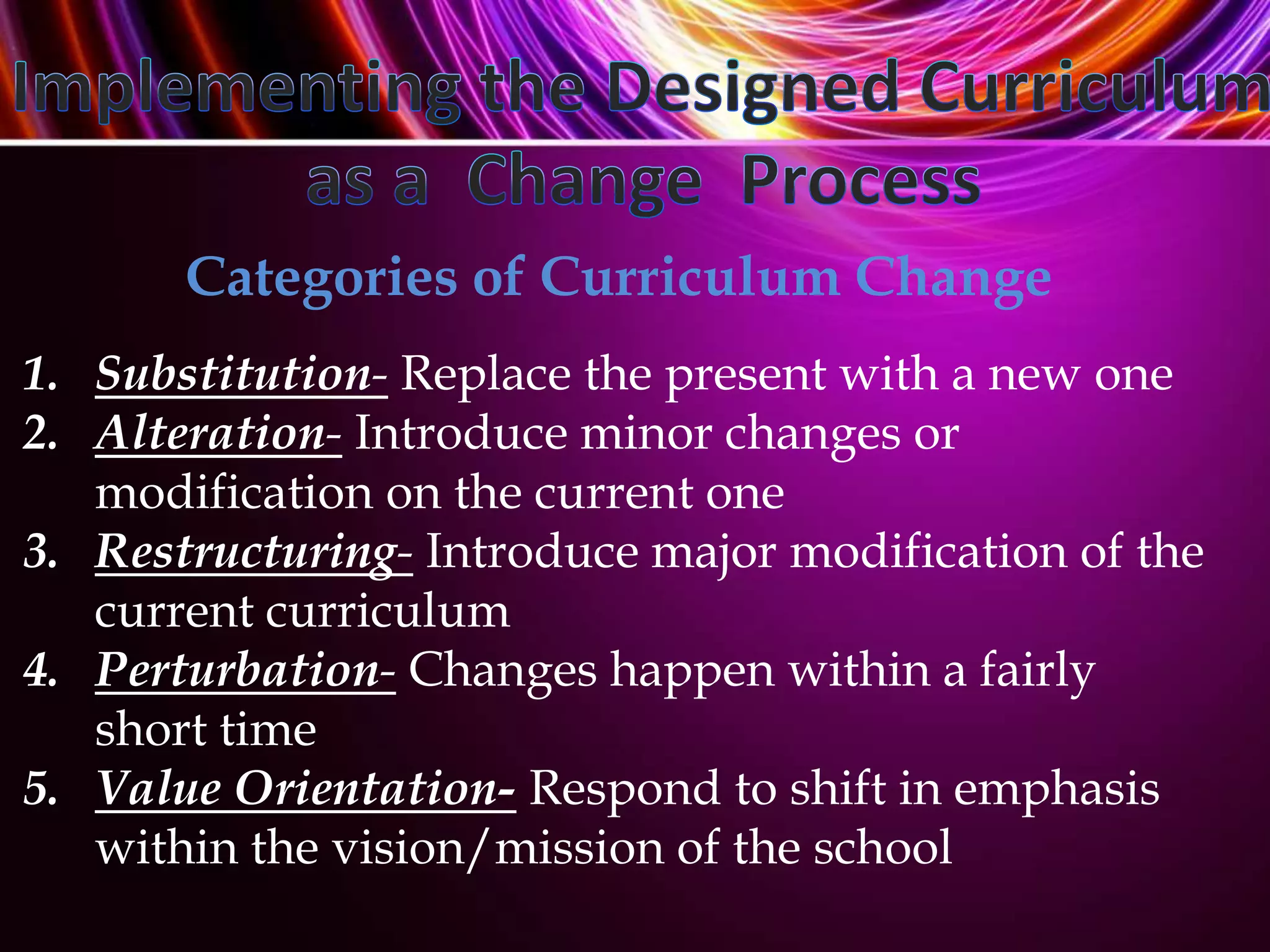
Categories of Curriculum Change
1. Substitution- Replace the present with a new one
2. Alteration- Introduce minor changes or
modification on the current one
3. Restructuring- Introduce major modification of the
current curriculum
4. Perturbation- Changes happen within a fairly
short time
5. Value Orientation- Respond to shift in emphasis
within the vision/mission of the school
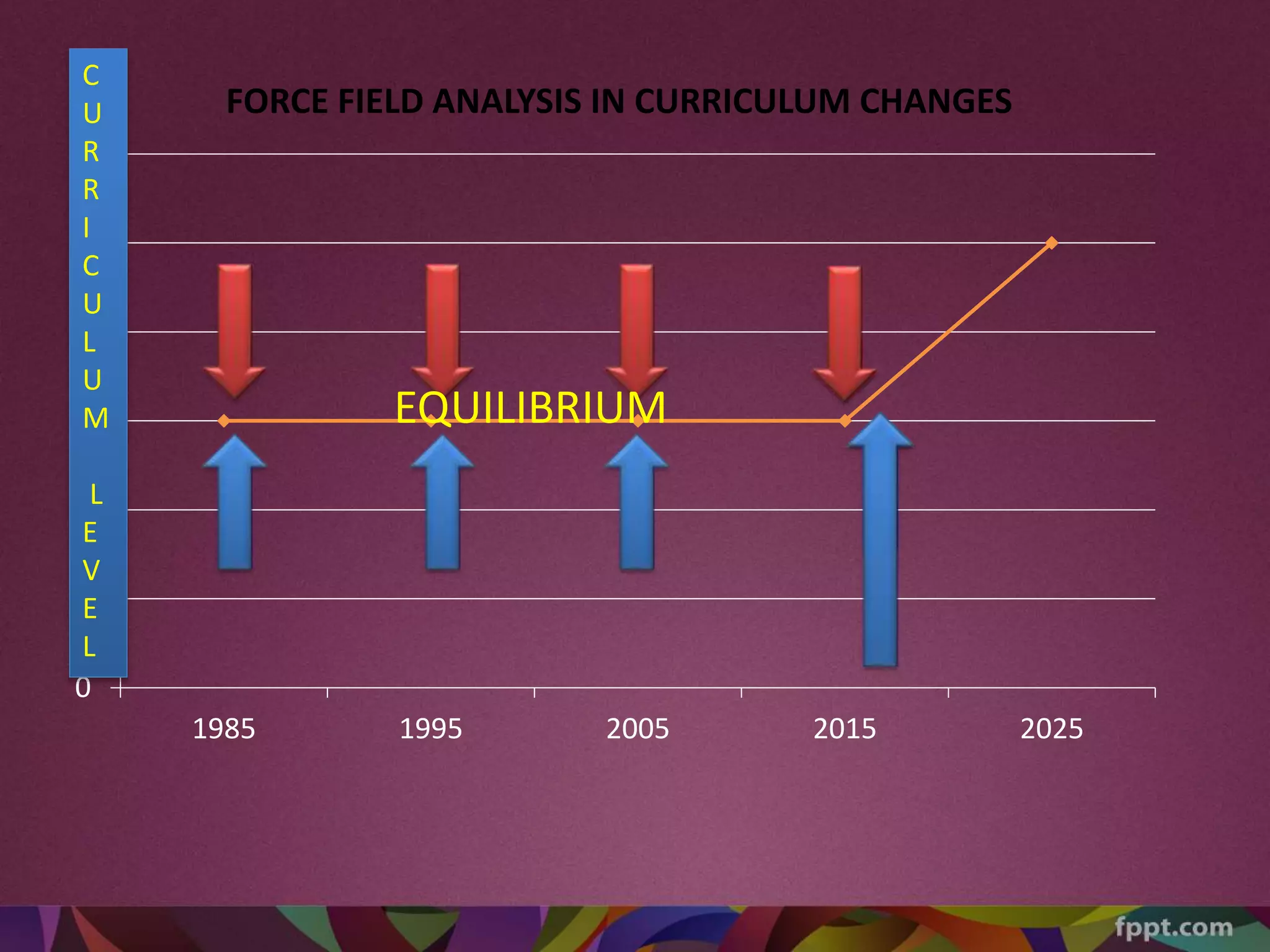
Force Field Analysis
in Curriculum Change
0
1
2
3
4
5
Series 1
Series 2
Series 3
Restraining ForcesDriving Forces
Force Field Analysis in Curriculum Change
Government Interventions
Society’s Values
Administrative Support
Technological Changes
Knowledge Explosions
Fear of the unknown
Negative Attitudes to change
Tradition Values
Limited Resources
Obsolete Equipment
C
H
A
N
G
E
E
Q
U
I
L
I
B
R
U
I
M
Restraining Forces
0
1
2
3
4
5
6
1985 1995 2005 2015 2025
FORCE FIELD ANALYSIS IN CURRICULUM CHANGES
C
U
R
R
I
C
U
L
U
M
L
E
V
E
L
EQUILIBRIUM
IMPLEMENTING THE CURRICULUM AS A CHANGE PROCESS

IMPLEMENTING THE CURRICULUM AS A CHANGE PROCESS

  • 1.
  • 3.
    It’s a processwherein the learners acquire the planned or intended knowledge, skills and attitudes that are aimed at enabling the same learners to functions effectively in the society. Curriculum Implementation Putting into practice the written curriculum that has been designed in the syllabi, course of study, curricular guides, and subjects.
  • 4.
    Loucks and Lieberman-they defined it as the trying out of a new practice and what it looks like when actually used in school system. It simply means that implementation should bring desired change and improvement. Ornstein and Hunkins - as the inter action between the curricula that has been written and planned and the persons(teachers) who are in charged to deliver it.
  • 5.
    Concept of Change Changeis a constant law of nature. It bring improvements. Change is an ongoing process. Not all changes lead to improvement, but all improvement requires change. The ability to develop, test, and implement changes is essential for any individual, group, or organization that wants to continuously improve.
  • 6.
    Features of Change- •It’s a PROCESS not an EVENT • It requires time, energy and resources. • It is achieved incrementally and entails development in feelings and skills.
  • 7.
    Process of curriculumchange may be assisted by permissiveness and support in accordance of with a helpful improvement in curriculum. Changing curriculum changes individuals. It must be necessary in consideration that the resources of implementation of curriculum are available or not.
  • 8.
    Categories of CurriculumChange 1. Substitution- Replace the present with a new one 2. Alteration- Introduce minor changes or modification on the current one 3. Restructuring- Introduce major modification of the current curriculum 4. Perturbation- Changes happen within a fairly short time 5. Value Orientation- Respond to shift in emphasis within the vision/mission of the school
  • 10.
    Force Field Analysis inCurriculum Change 0 1 2 3 4 5 Series 1 Series 2 Series 3
  • 11.
    Restraining ForcesDriving Forces ForceField Analysis in Curriculum Change Government Interventions Society’s Values Administrative Support Technological Changes Knowledge Explosions Fear of the unknown Negative Attitudes to change Tradition Values Limited Resources Obsolete Equipment C H A N G E E Q U I L I B R U I M Restraining Forces
  • 12.
    0 1 2 3 4 5 6 1985 1995 20052015 2025 FORCE FIELD ANALYSIS IN CURRICULUM CHANGES C U R R I C U L U M L E V E L EQUILIBRIUM

Editor's Notes

  • #4 it means teaching what has been written in the lesson plan. Implementing means using the plan as a guide to engage with the learners in the teacher-learning process with the end in the view that learning occurred and the learning outcomes have been achieved.