Language learning strategies
Learner ownership of the learning process
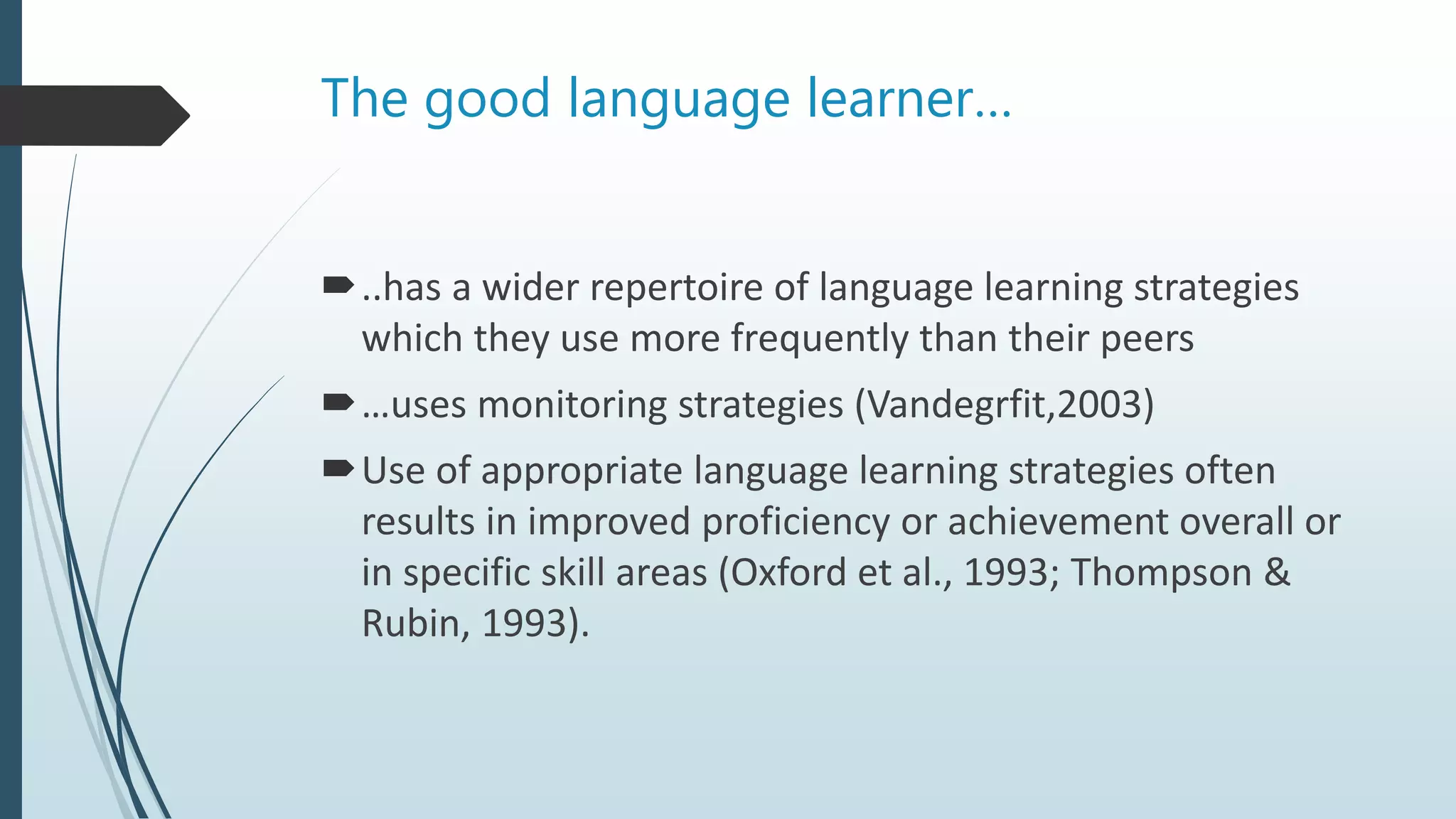
The good language learner…
..has a wider repertoire of language learning strategies
which they use more frequently than their peers
…uses monitoring strategies (Vandegrfit,2003)
Use of appropriate language learning strategies often
results in improved proficiency or achievement overall or
in specific skill areas (Oxford et al., 1993; Thompson &
Rubin, 1993).
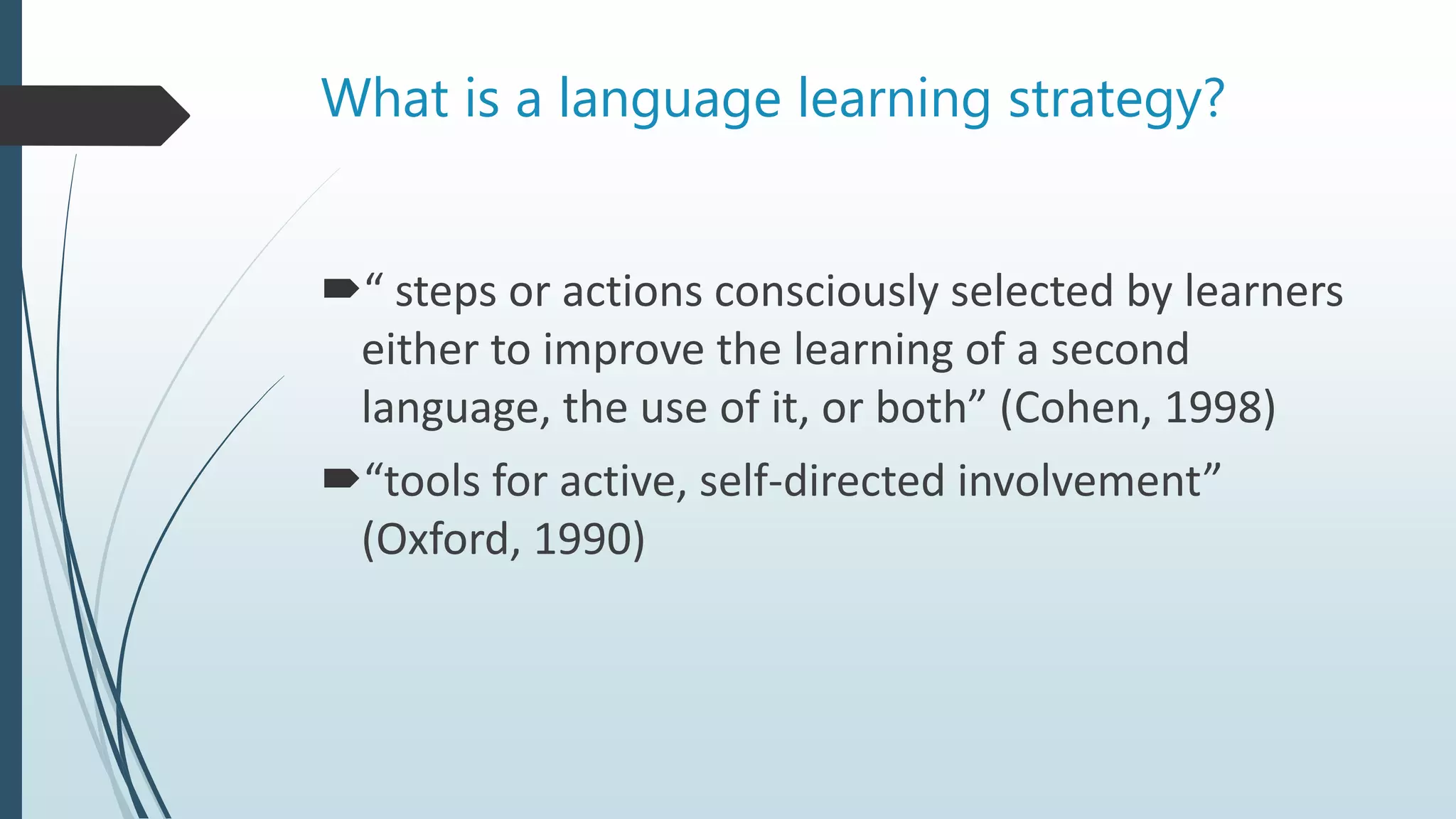
What is a language learning strategy?
“ steps or actions consciously selected by learners
either to improve the learning of a second
language, the use of it, or both” (Cohen, 1998)
“tools for active, self-directed involvement”
(Oxford, 1990)
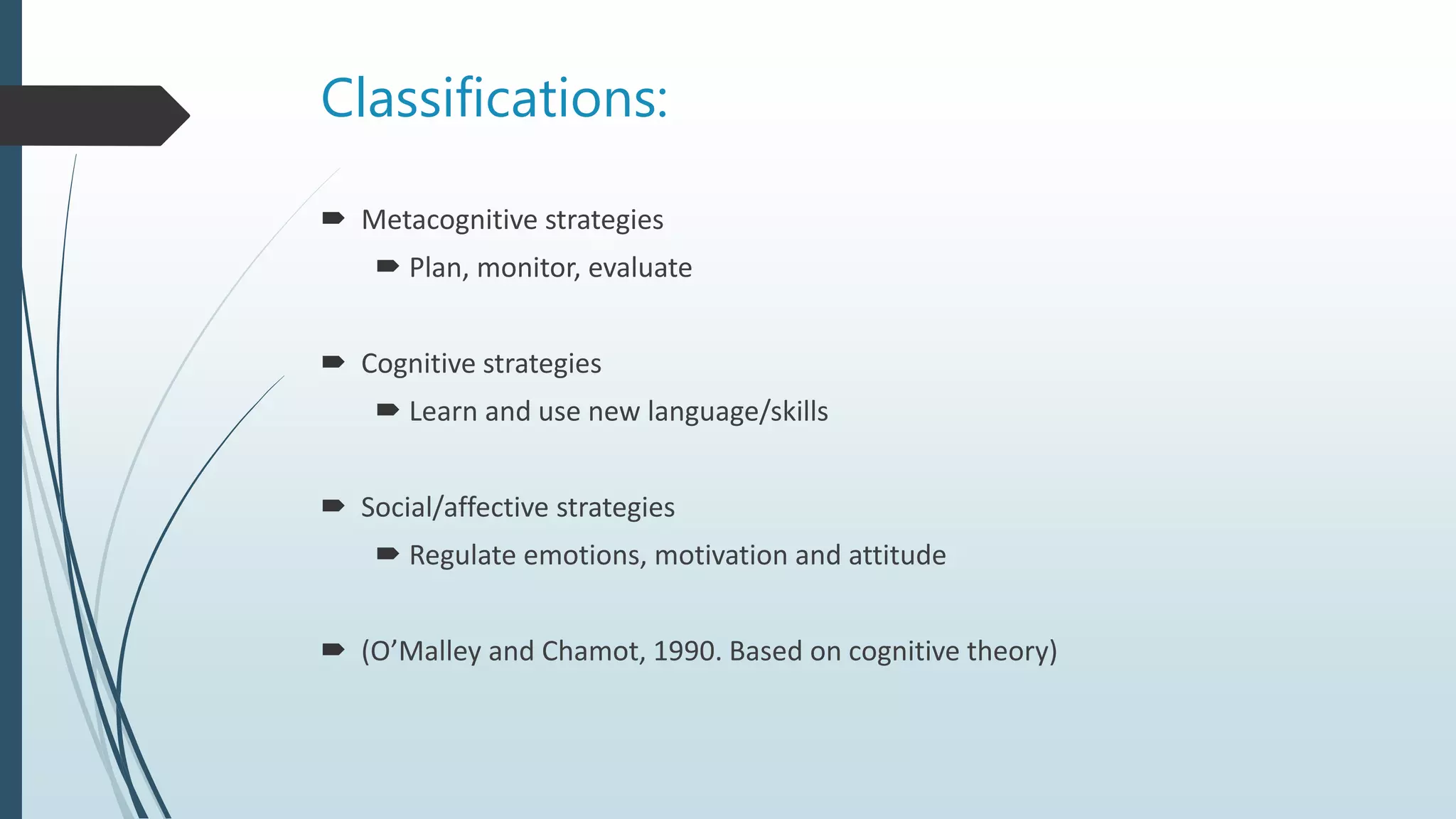
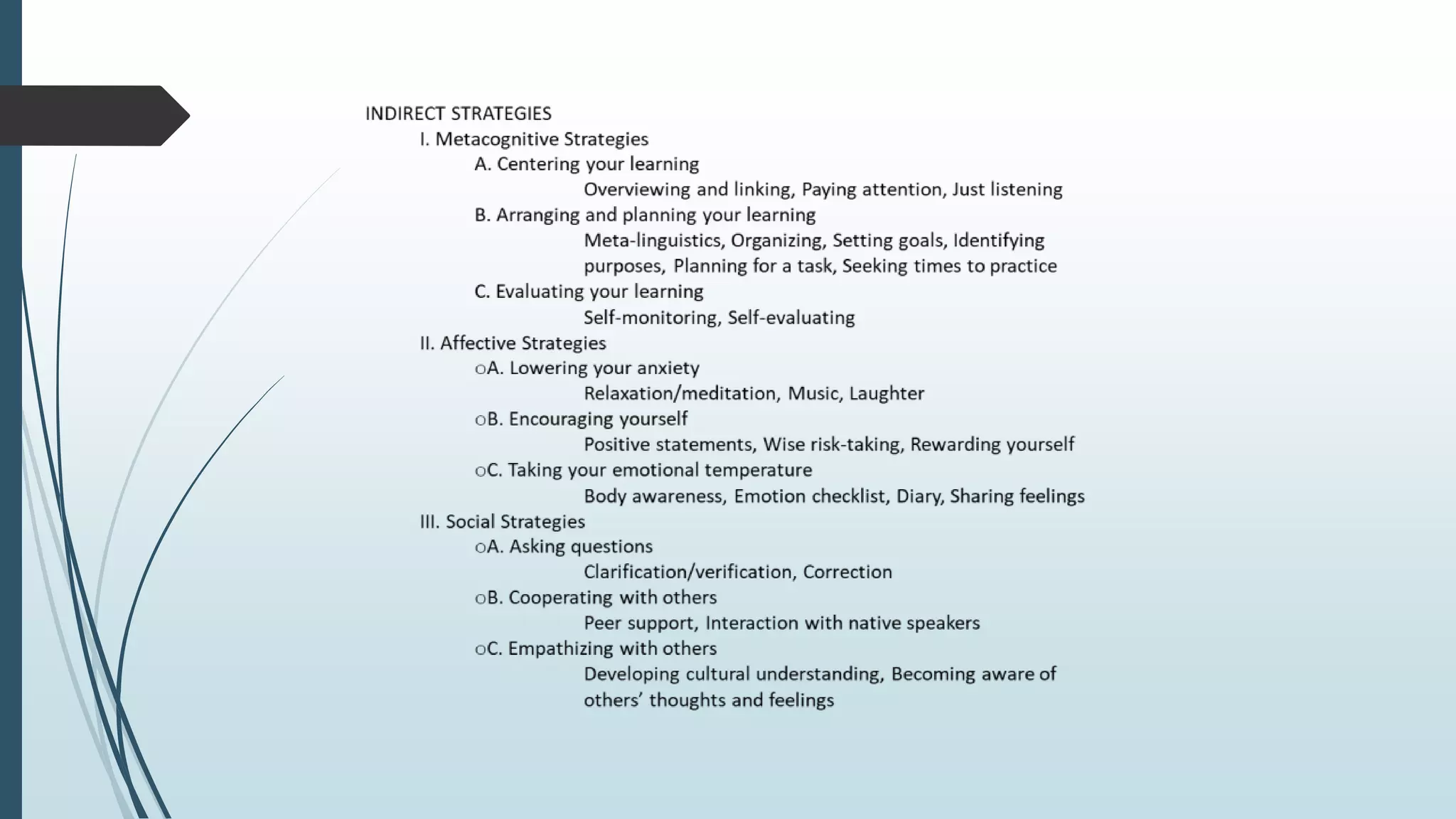
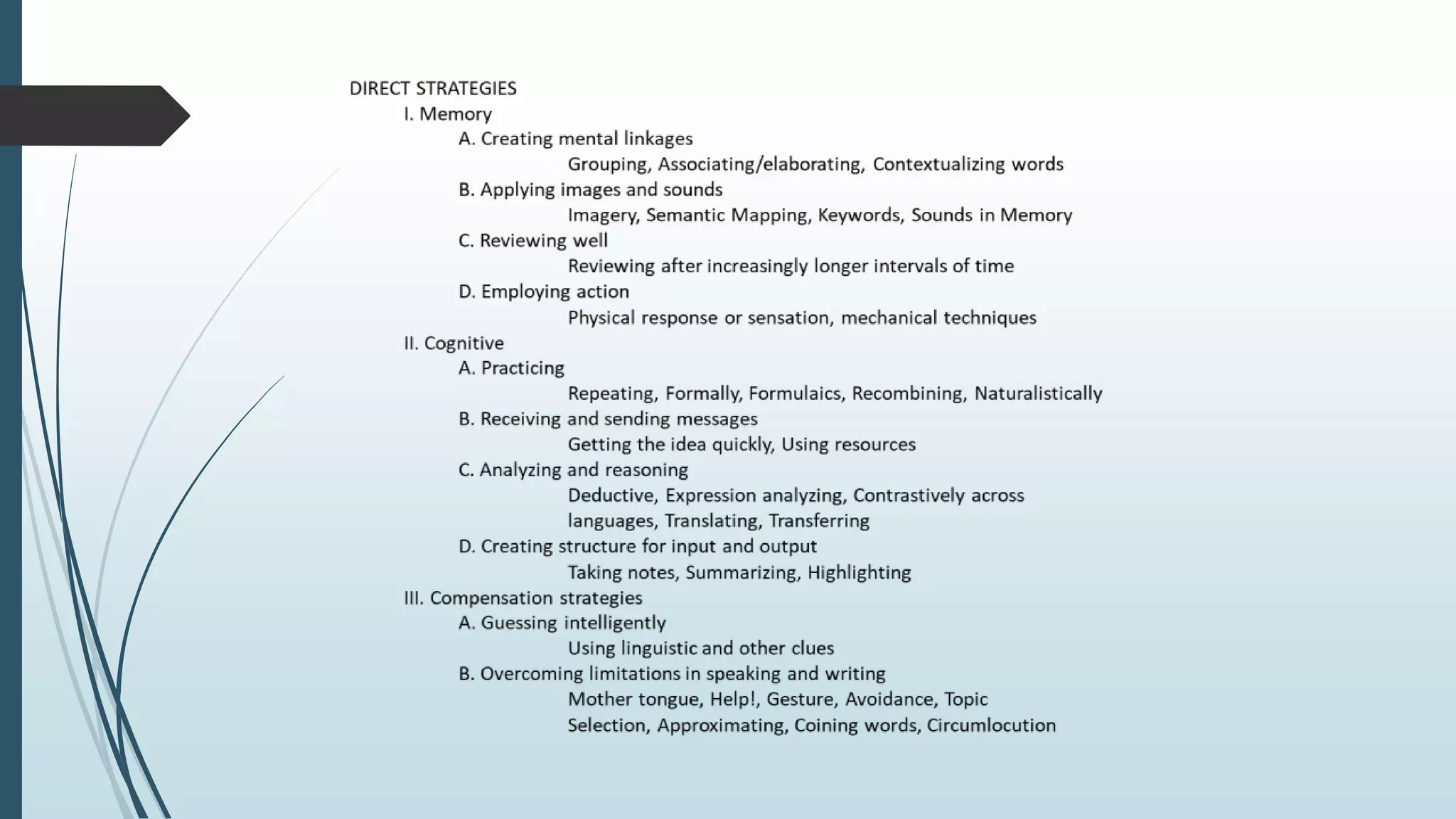
Classifications:
 Metacognitive strategies
 Plan, monitor, evaluate
 Cognitive strategies
 Learn and use new language/skills
 Social/affective strategies
 Regulate emotions, motivation and attitude
 (O’Malley and Chamot, 1990. Based on cognitive theory)
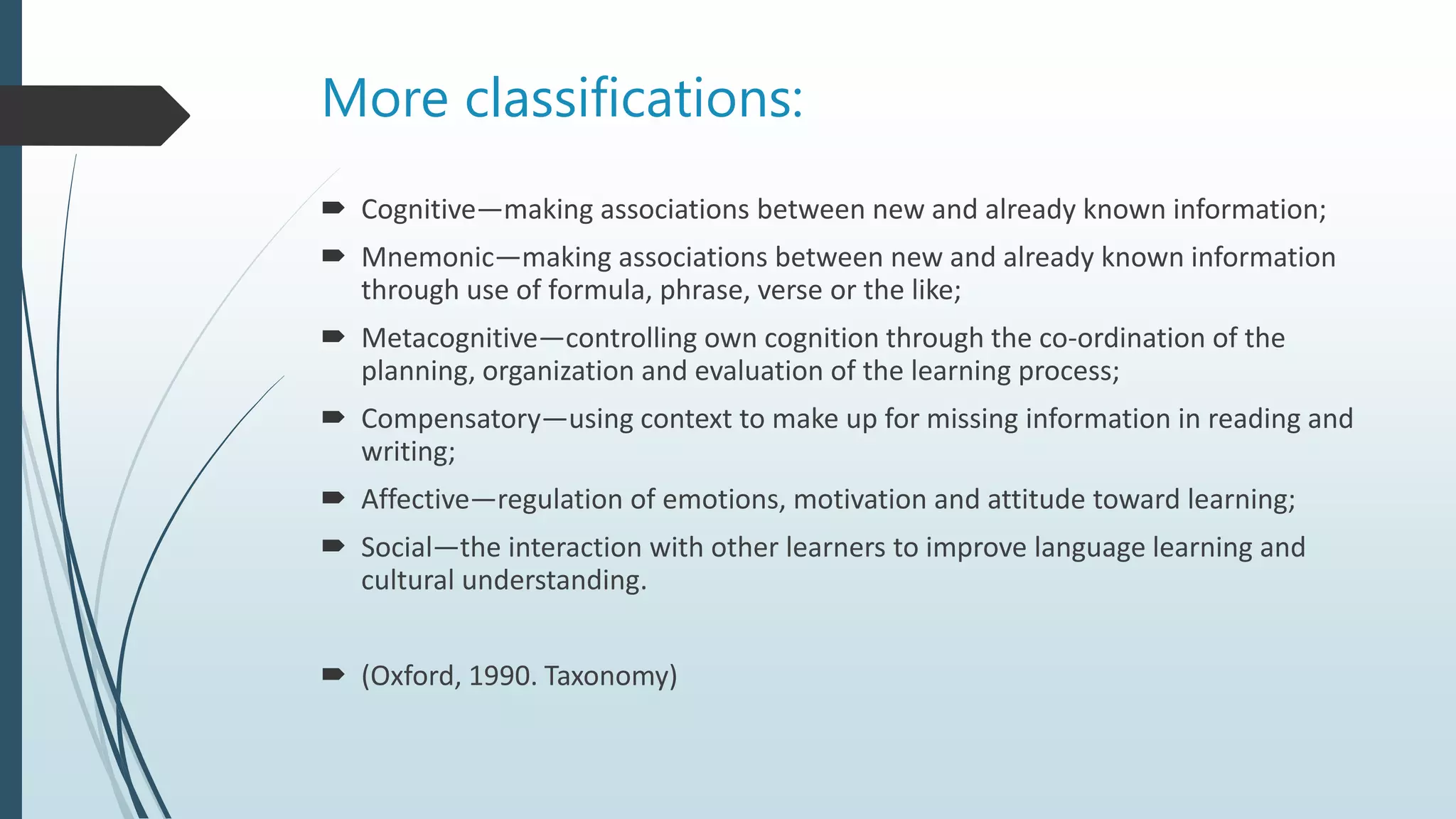
More classifications:
 Cognitive—making associations between new and already known information;
 Mnemonic—making associations between new and already known information
through use of formula, phrase, verse or the like;
 Metacognitive—controlling own cognition through the co-ordination of the
planning, organization and evaluation of the learning process;
 Compensatory—using context to make up for missing information in reading and
writing;
 Affective—regulation of emotions, motivation and attitude toward learning;
 Social—the interaction with other learners to improve language learning and
cultural understanding.
 (Oxford, 1990. Taxonomy)
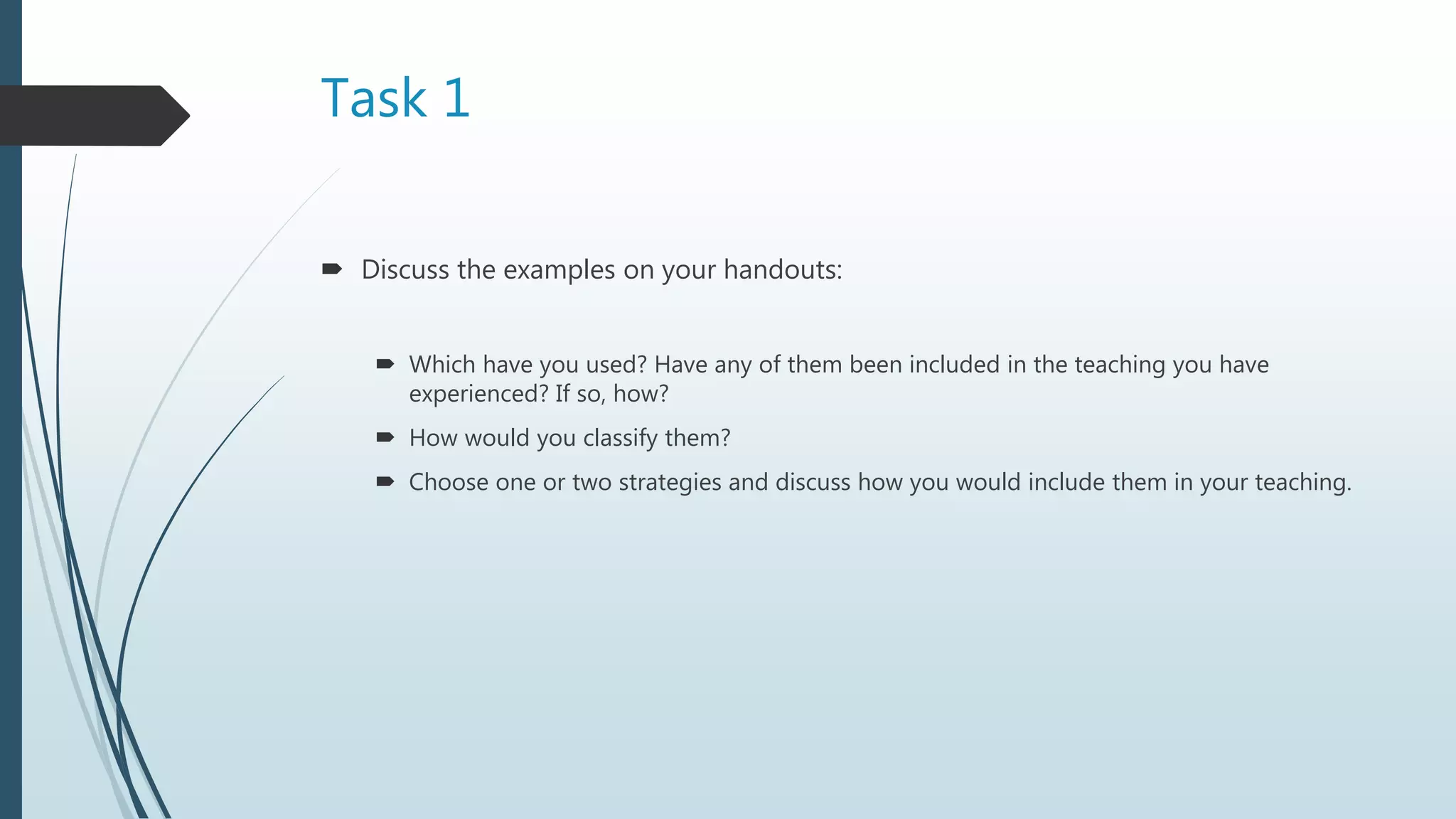
Task 1
 Discuss the examples on your handouts:
 Which have you used? Have any of them been included in the teaching you have
experienced? If so, how?
 How would you classify them?
 Choose one or two strategies and discuss how you would include them in your teaching.
Does strategy instruction work?
 The problems of definition
 The issue of generalisability
 Need for a research framework
“The acknowledged link between strategic competence in language learning, learner
autonomy and successful outcomes is a powerful argument for bringing together
state-of-the-art research into the theory and practice of language learning strategies
in learning environments that do not rely on the physical presence of the teacher.”
(Hurd & Lewis, 2008, p. xii)
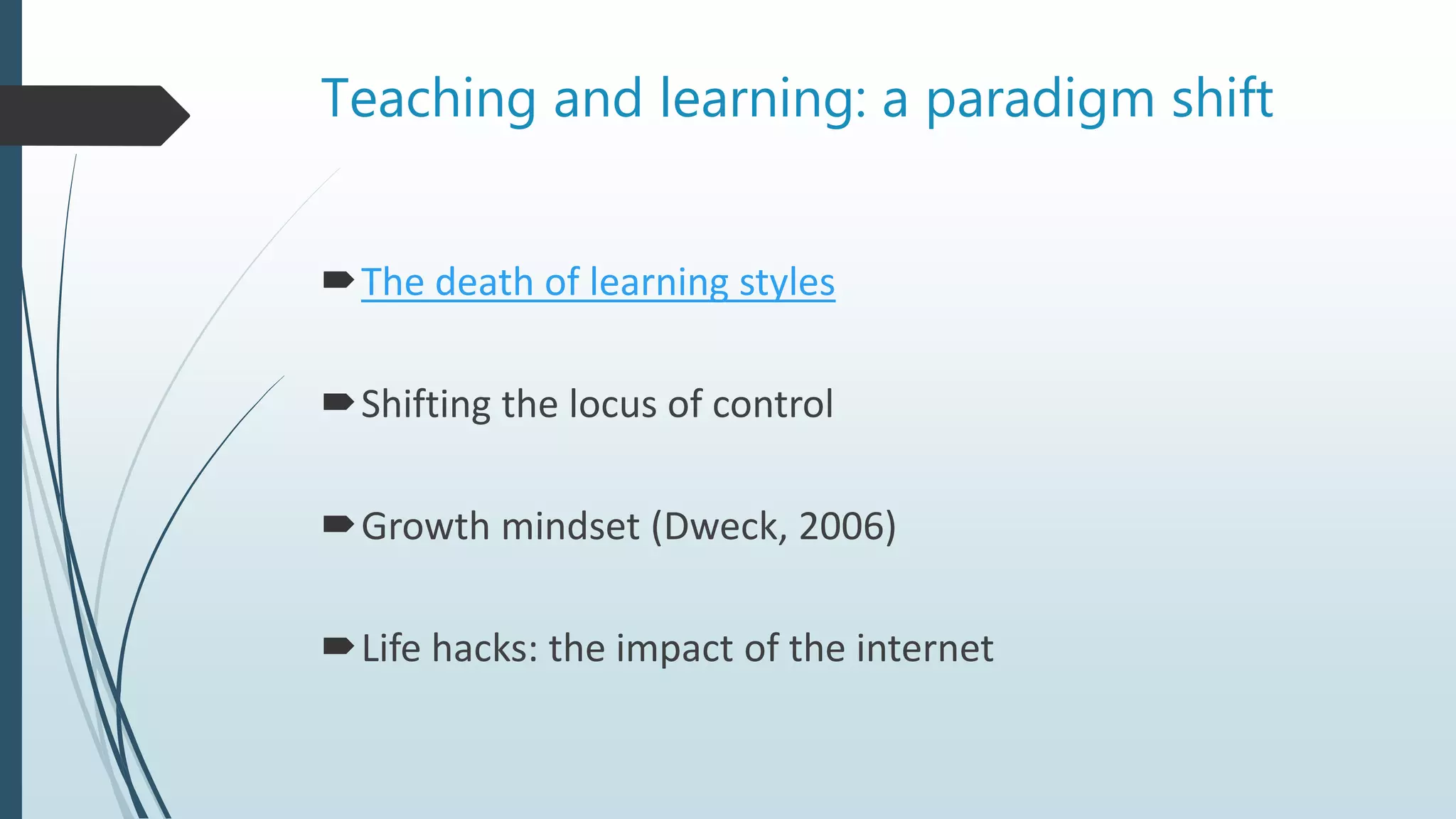
Teaching and learning: a paradigm shift
The death of learning styles
Shifting the locus of control
Growth mindset (Dweck, 2006)
Life hacks: the impact of the internet
Task 2:
What would you do to progress this area of
language learning?
In groups, discuss the issues, risks and potential
for language learning strategies.

Language learning strategies

  • 1.
    Language learning strategies Learnerownership of the learning process
  • 2.
    The good languagelearner… ..has a wider repertoire of language learning strategies which they use more frequently than their peers …uses monitoring strategies (Vandegrfit,2003) Use of appropriate language learning strategies often results in improved proficiency or achievement overall or in specific skill areas (Oxford et al., 1993; Thompson & Rubin, 1993).
  • 3.
    What is alanguage learning strategy? “ steps or actions consciously selected by learners either to improve the learning of a second language, the use of it, or both” (Cohen, 1998) “tools for active, self-directed involvement” (Oxford, 1990)
  • 5.
    Classifications:  Metacognitive strategies Plan, monitor, evaluate  Cognitive strategies  Learn and use new language/skills  Social/affective strategies  Regulate emotions, motivation and attitude  (O’Malley and Chamot, 1990. Based on cognitive theory)
  • 6.
    More classifications:  Cognitive—makingassociations between new and already known information;  Mnemonic—making associations between new and already known information through use of formula, phrase, verse or the like;  Metacognitive—controlling own cognition through the co-ordination of the planning, organization and evaluation of the learning process;  Compensatory—using context to make up for missing information in reading and writing;  Affective—regulation of emotions, motivation and attitude toward learning;  Social—the interaction with other learners to improve language learning and cultural understanding.  (Oxford, 1990. Taxonomy)
  • 9.
    Task 1  Discussthe examples on your handouts:  Which have you used? Have any of them been included in the teaching you have experienced? If so, how?  How would you classify them?  Choose one or two strategies and discuss how you would include them in your teaching.
  • 10.
    Does strategy instructionwork?  The problems of definition  The issue of generalisability  Need for a research framework “The acknowledged link between strategic competence in language learning, learner autonomy and successful outcomes is a powerful argument for bringing together state-of-the-art research into the theory and practice of language learning strategies in learning environments that do not rely on the physical presence of the teacher.” (Hurd & Lewis, 2008, p. xii)
  • 11.
    Teaching and learning:a paradigm shift The death of learning styles Shifting the locus of control Growth mindset (Dweck, 2006) Life hacks: the impact of the internet
  • 12.
    Task 2: What wouldyou do to progress this area of language learning? In groups, discuss the issues, risks and potential for language learning strategies.

Editor's Notes

  • #12 http://www.steve-wheeler.co.uk/2011/11/convenient-untruth.html https://www.stem.org.uk/system/files/community-resources/2016/06/DweckEducationWeek.pdf