LANGUAGE ACQUISITION (Krashen)
Language Acquisitin teiry:
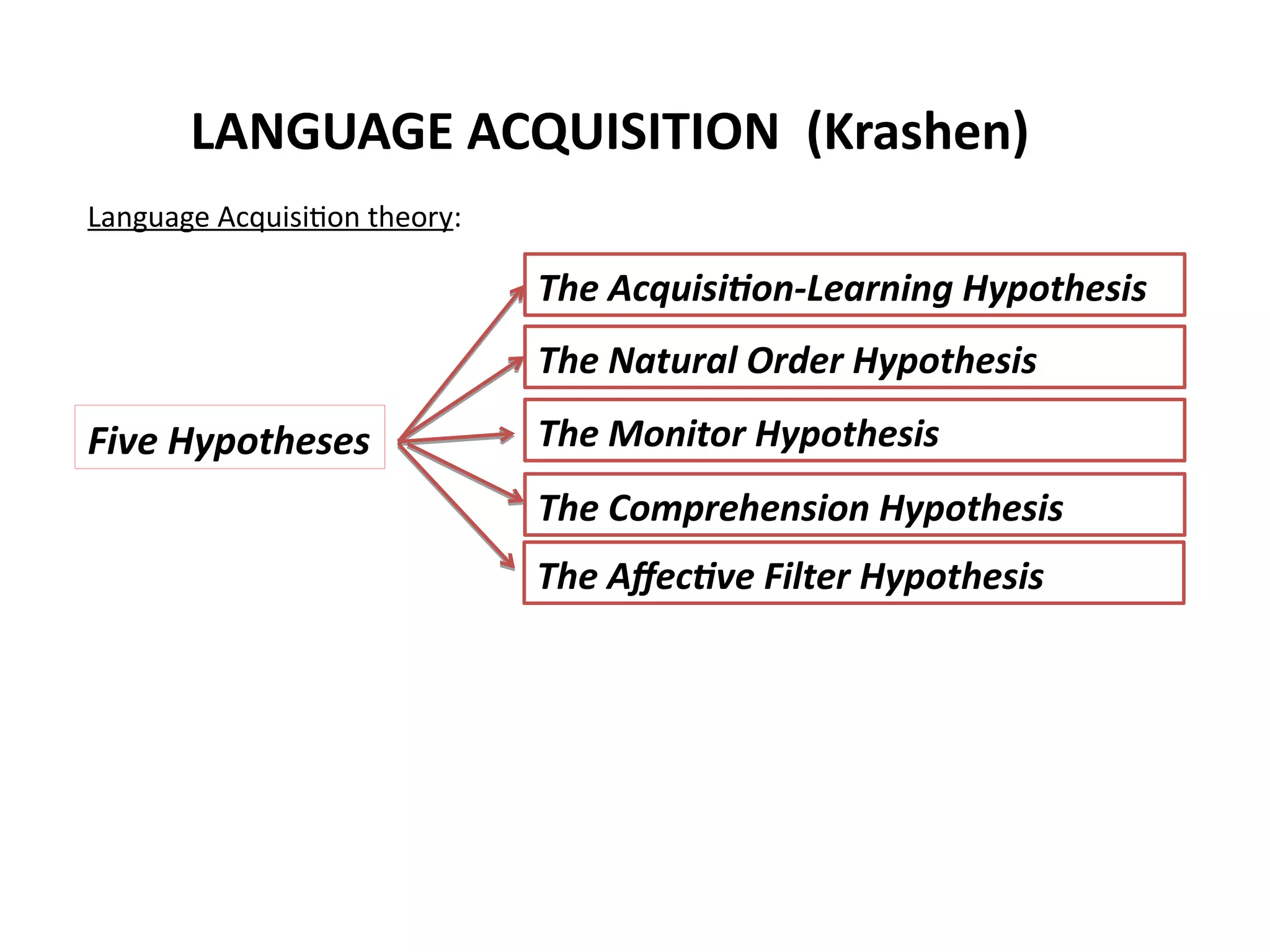
Five Hypotheses
The Acquisiton-Learning Hypothesis
The Natural Order Hypothesis
The Monitor Hypothesis
The Comprehension Hypothesis
The Afectve Filter Hypothesis
1. The Acquisiton-Learning Hypothesis
We have two very diferent ways of developing ability in another language:
 We can acquire language
 We can learn language
 Language acquisiton:
o Occurs subconciously: while it is happening, we are not aware that it is
happening. We think we are having a conversaton, reading a book,
watching a movie. Of course, we are, but at the same tme, we might
be acquiring language.
o The knowledge is stored in our brains subconciously.
o The research strongly supports the view that both children and adults
can subconciously acquire language.
o Both oral and writen language can be acquired.
o Acquisiton is sometmes referred to as «picking up» a language.
PICK UP = TO ACQUIRE
 Language learning:
o It is a conscious process: when we are learning, we know we are
learning and we are trying to learn.
o Language learning is what we did in school, in everyday language,
when we talk about «rules» And «grammar», we are talking about
«Learning».
o Error correcton is supposed to help learning. When we make a mistake
and are corrected, we are supposed to change our conscious version of
the rule.
2. The Natural Order Hypothesis
o We acquire (not learn) the parts of a language in a predictable order.
o The order is not exact: not every acquirer proceeds in exactly the same
order. But the variaton among acquirers is not extreme.
o Research has come up some surprising facts about the natural order:
 First, it is not true that «simple» rules are acquired early and
complicated rules are acquired later.
 Second, the natural order cannot be changed. We cannot alter the
order in which students acquire language by providing explanaton,
drills, and exercises. It will not be acquired untl the acquirer is ready for
it.
3. The monitor Hypothesis
Consciously learned language is only available to us as a Monitor or editor.
o The ability to produce language fuenty and easily comes from what we
have acquired.
o The grammar rules that we learned in school have only one functon: They
act as a Monitor or editor.
o When we are about to say something in another language, the sentence
pops into our mind, thanks to our subconsciously acquired competence.
Then just before we actually produce the sentence, just before we say it, we
scan it internally, inspect it, and use our consciously learned system to correct
errors.
o Sometmes we realize that something we said is incorrect afer we say it,
and we self-correct using the conscious Monitor.
o It is extremly difcult to use the Monitor.
In order to use the Monitor successfully three very stringent conditons must
be met:

The Monitor user must know the rule. This is a very difcult conditon to
meet. Even the best students:
✗
don´t learn all the rules that are taught.
✗
don´t remember all the rules they have learned.
✗
can´t always use the rules they do remember.

The acquirer must be thinking about correctness, or focussed on form:
This is very difcult to do. It is hard to be thinking about what you are saying
and how you are saying it at the same tme.
●
The acquirer must have tme: Normal conversaton doesn´t provide enough
tme to think much about grammar rules.
o Research indicates that we use grammar – that we Monitor – only when all
of these conditons are fully met. (Krashen 1982, 2003). For most people,
this happens only when they take a grammar test.
4. The comprehension Hypothesis
We acquire language when we understand messages.
“The comprehension Hypothesis is the centerpiece of language acquisiton
theory. It atemps to answer the most important queston in the felds of
language acquisiton and language educaton:
How Do wE ACQUIRE LANGUAGE?”
“We acquire language when we understand what people tell us or when we understand
what we read. And there is no other way it can happen.”
o Here are two amazing facts about language acquisiton:
a) First, it is efortless; it envolves no energy, no work. All that is necessary is to
understand messages.
b) Second, language acquisiton is involuntary. Given comprehensible input,
you must acquire – YOU HAVE NO CHOICE.
o According to the comprehension hypothesis, we acquire language by input,
not by output.
Thus, more output, more speaking (or writng) will not result in more language
acquisiton. If you speak French out loud to yourself every morning while
driving to work, your french will not improve.
o We acquire language when we understand messages that contain aspects
of language (vocabulary, grammar) we have not yet acquired, but that we
are “ready” to acquire.
The ability to speak is the result of language acquisition, not the cause.
o If we provide students with enough comprehensible input, the structures
they are ready to acquire will be present in the input. i + 1
o Students will acquire the language in a natural order as a result of getng
comprehensible input.
5. The Afectve Filter Hypothesis
If the acquirer is anxious, has low self-esteem, does not consider himself or
herself to be a potencial member of the group that speaks the language.
He or she may understand the input, but it will not reach the language
acquisiton device (the part of the brain responsible for language
acquisiton).
 A block – the afectve flter – will keep it out.
The presence of the affective filter explains how two students can receive the same
(comprehensible) input, yet one makes progress while the other does not. One is “open” to
the input while the other is not.

Language acquisition

  • 1.
    LANGUAGE ACQUISITION (Krashen) LanguageAcquisitin teiry: Five Hypotheses The Acquisiton-Learning Hypothesis The Natural Order Hypothesis The Monitor Hypothesis The Comprehension Hypothesis The Afectve Filter Hypothesis
  • 2.
    1. The Acquisiton-LearningHypothesis We have two very diferent ways of developing ability in another language:  We can acquire language  We can learn language  Language acquisiton: o Occurs subconciously: while it is happening, we are not aware that it is happening. We think we are having a conversaton, reading a book, watching a movie. Of course, we are, but at the same tme, we might be acquiring language. o The knowledge is stored in our brains subconciously. o The research strongly supports the view that both children and adults can subconciously acquire language. o Both oral and writen language can be acquired. o Acquisiton is sometmes referred to as «picking up» a language. PICK UP = TO ACQUIRE
  • 3.
     Language learning: oIt is a conscious process: when we are learning, we know we are learning and we are trying to learn. o Language learning is what we did in school, in everyday language, when we talk about «rules» And «grammar», we are talking about «Learning». o Error correcton is supposed to help learning. When we make a mistake and are corrected, we are supposed to change our conscious version of the rule. 2. The Natural Order Hypothesis o We acquire (not learn) the parts of a language in a predictable order. o The order is not exact: not every acquirer proceeds in exactly the same order. But the variaton among acquirers is not extreme. o Research has come up some surprising facts about the natural order:
  • 4.
     First, itis not true that «simple» rules are acquired early and complicated rules are acquired later.  Second, the natural order cannot be changed. We cannot alter the order in which students acquire language by providing explanaton, drills, and exercises. It will not be acquired untl the acquirer is ready for it. 3. The monitor Hypothesis Consciously learned language is only available to us as a Monitor or editor. o The ability to produce language fuenty and easily comes from what we have acquired. o The grammar rules that we learned in school have only one functon: They act as a Monitor or editor. o When we are about to say something in another language, the sentence pops into our mind, thanks to our subconsciously acquired competence.
  • 5.
    Then just beforewe actually produce the sentence, just before we say it, we scan it internally, inspect it, and use our consciously learned system to correct errors. o Sometmes we realize that something we said is incorrect afer we say it, and we self-correct using the conscious Monitor. o It is extremly difcult to use the Monitor. In order to use the Monitor successfully three very stringent conditons must be met:  The Monitor user must know the rule. This is a very difcult conditon to meet. Even the best students: ✗ don´t learn all the rules that are taught. ✗ don´t remember all the rules they have learned. ✗ can´t always use the rules they do remember.
  • 6.
     The acquirer mustbe thinking about correctness, or focussed on form: This is very difcult to do. It is hard to be thinking about what you are saying and how you are saying it at the same tme. ● The acquirer must have tme: Normal conversaton doesn´t provide enough tme to think much about grammar rules. o Research indicates that we use grammar – that we Monitor – only when all of these conditons are fully met. (Krashen 1982, 2003). For most people, this happens only when they take a grammar test. 4. The comprehension Hypothesis We acquire language when we understand messages. “The comprehension Hypothesis is the centerpiece of language acquisiton theory. It atemps to answer the most important queston in the felds of language acquisiton and language educaton:
  • 7.
    How Do wEACQUIRE LANGUAGE?” “We acquire language when we understand what people tell us or when we understand what we read. And there is no other way it can happen.” o Here are two amazing facts about language acquisiton: a) First, it is efortless; it envolves no energy, no work. All that is necessary is to understand messages. b) Second, language acquisiton is involuntary. Given comprehensible input, you must acquire – YOU HAVE NO CHOICE. o According to the comprehension hypothesis, we acquire language by input, not by output. Thus, more output, more speaking (or writng) will not result in more language acquisiton. If you speak French out loud to yourself every morning while driving to work, your french will not improve. o We acquire language when we understand messages that contain aspects of language (vocabulary, grammar) we have not yet acquired, but that we are “ready” to acquire.
  • 8.
    The ability tospeak is the result of language acquisition, not the cause. o If we provide students with enough comprehensible input, the structures they are ready to acquire will be present in the input. i + 1 o Students will acquire the language in a natural order as a result of getng comprehensible input. 5. The Afectve Filter Hypothesis If the acquirer is anxious, has low self-esteem, does not consider himself or herself to be a potencial member of the group that speaks the language. He or she may understand the input, but it will not reach the language acquisiton device (the part of the brain responsible for language acquisiton).
  • 9.
     A block– the afectve flter – will keep it out. The presence of the affective filter explains how two students can receive the same (comprehensible) input, yet one makes progress while the other does not. One is “open” to the input while the other is not.