Discovered by Esther Lederburg in 1950.
Classification of λ bacteriophage
Group: Group I (dsDNA)
Order : Candovirales
Family: Siphoviridae
Genus: Lambda-like virus
Species: Lambda phage
The lambda (λ) phage is a virus that
infects E. coli.
It is an example of temperate phage.
It leads its life cycle in two different
phases.
1. Virulent phase (Lytic cycle).
2. Non-virulent phase. (Lysigenic cycle).
Morphology & structure
of λ Phage
• The λ phage particles are composed of
50% protein and 50% DNA.
CAPSID
• The head (capsid) is icosahedral in shape.
55 nm in diameter.
• Capsid consists of 300-600 Capsomers.
( molecular weight of 37,500 daltons.)
• The capsomers are arranged in clusters of 5 or
6 subunits,( Pentamers & Hexamers).
TAIL
• The tail is a flexible tube of about 180 nm
long .
• Tail possesses a thin tail fiber (25 nm long).
• Unlike T-even phage, it is a simple structure
devoid of the tail sheath.
• Tail is connected to head by a head-tail
connector.
•
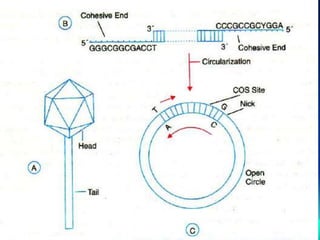
• The λ phage contains dsDNA.
Length about 17 µm.
Molecular weight of about 31×106 Daltons.
Consist of about 48,500 base pairs.
• The 5' ends of duplex have single stranded
regions, (cohesive ends).
Each cohesive end consists of 12 nucleotides that
are complementary to each other.
• The genome of λ consists of three regions.
1. Right operon.
vegetative function of the phage
(DNA replication, head synthesis, tail synthesis, and lysis).
2. Left operon.
Integration and recombination events of lysogenic cycle.
3. Immunity operon.
Decide whether the phage will initiate lytic cycle (or)
lysogenic cycle.
• After injecting its DNA into the host
cell, the Lambda phage leads two life
cycles, they are:
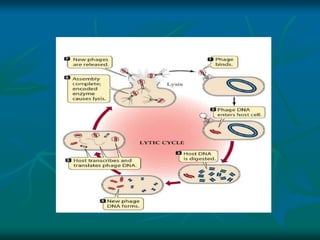
• Lytic cycle.
• Lysogenic cycle.
LYTIC CYCLE
• In the Lytic cycle, phage genes are expressed and
DNA is replicated resulting in production of several
phage particles.
• The Lytic cycle ends with lysis of E.Coli cell and
liberation of phage particles.
• Therefore Lytic cycle is called as virulent (or)
Sin temperate cycle.
• Lytic life cycle of phage λ is 45 minutes long
• Time (t) = 0 minutes: Phage adsorbed and DNA is injected.
• = 3 minutes: First early mRNA is synthesized.
• = 5 minutes: Two classes of early mRNA are synthesized.
• = 6 minutes: DNA replication begins.
• = 9 minutes: Synthesis of late mRNA begins.
• = 10 minutes: Synthesis of the structural protein occurs.
• = 22 minutes: First phage particle is completed.
• = 45 minutes: Lysis of bacterial cell envelope and release of
progeny phage.
The events of lytic cycle are
 1. CIRCULARIZATION OF THE CHROMOSOME
 2. TRANSCRIPTION
(i) Early period.
(ii) Late period.
Genes are expressed during these two periods are :
1. Immediate early genes.
2. Delayed early genes.
3. Late genes.
 3. REPLICATION
(i) Early replication stage. (theta mode)
(ii) Late replication stage. ( rolling circle mode)
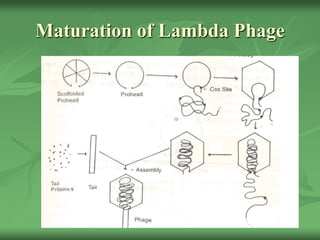
 4. MATURATION
 5. LYSIS
Maturation of Lambda Phage
LYSOGENIC CYCLE
 The phage genome is integrated into bacterial
chromosomes.
 The host cells that contain integrated phage DNA, i.e.
prophage, is called the lysogen. (Lysogenic bacteria ).
 The prophage is excised from the bacterial chromosome
due to stimulation by UV irradiation (or) mitomycin C.
After excision of DNA, the phage leads lytic cycle and the
host cell is killed.
 The lysogenic state is brought about in two stages
1. Establishment
2. Maintenance
Establishment of lysogeny requires the integration
( insertion ) of the phage genome into the bacterial
chromosome and the beginning of repressor synthesis to
prevent expression of lytic genes.
Maintenance of lysogenic state requires that the
synthesis of repressor must be continued.
STAGES OF LYSOGENY
 Integration :
 (i) The linear phage DNA is converted into a
circular form by end joining.
 (ii) A single reciprocal recombination at
specific loci in each chromosome results in the insertion of
the phage chromosome into the host chromosome
 Attachment sites :
The site of attachment on the phage genome is
called att (or att P)
The site on the bacterial chromosome where
lambda DNA integrates is known as att λ (or att B).
 Replication:
Prophage replication takes place under the
control of the host by the normal bacterial DNA
replication mechanism.
 Excision
When the host cell is unable to survive,
the λ prophage leaves the E.Coli genome and begins
the production of new phages. This process is known
as induction.
It is triggered by a drop in λ repressor level.
Whenever, the repressor will decline, the lytic cycle will
commence.
lambda str & life cycle.ppt

lambda str & life cycle.ppt

  • 2.
    Discovered by EstherLederburg in 1950. Classification of λ bacteriophage Group: Group I (dsDNA) Order : Candovirales Family: Siphoviridae Genus: Lambda-like virus Species: Lambda phage
  • 3.
    The lambda (λ)phage is a virus that infects E. coli. It is an example of temperate phage. It leads its life cycle in two different phases. 1. Virulent phase (Lytic cycle). 2. Non-virulent phase. (Lysigenic cycle).
  • 4.
  • 6.
    • The λphage particles are composed of 50% protein and 50% DNA. CAPSID • The head (capsid) is icosahedral in shape. 55 nm in diameter. • Capsid consists of 300-600 Capsomers. ( molecular weight of 37,500 daltons.) • The capsomers are arranged in clusters of 5 or 6 subunits,( Pentamers & Hexamers).
  • 7.
    TAIL • The tailis a flexible tube of about 180 nm long . • Tail possesses a thin tail fiber (25 nm long). • Unlike T-even phage, it is a simple structure devoid of the tail sheath. • Tail is connected to head by a head-tail connector.
  • 8.
  • 9.
    • The λphage contains dsDNA. Length about 17 µm. Molecular weight of about 31×106 Daltons. Consist of about 48,500 base pairs. • The 5' ends of duplex have single stranded regions, (cohesive ends). Each cohesive end consists of 12 nucleotides that are complementary to each other.
  • 12.
    • The genomeof λ consists of three regions. 1. Right operon. vegetative function of the phage (DNA replication, head synthesis, tail synthesis, and lysis). 2. Left operon. Integration and recombination events of lysogenic cycle. 3. Immunity operon. Decide whether the phage will initiate lytic cycle (or) lysogenic cycle.
  • 14.
    • After injectingits DNA into the host cell, the Lambda phage leads two life cycles, they are: • Lytic cycle. • Lysogenic cycle.
  • 15.
    LYTIC CYCLE • Inthe Lytic cycle, phage genes are expressed and DNA is replicated resulting in production of several phage particles. • The Lytic cycle ends with lysis of E.Coli cell and liberation of phage particles. • Therefore Lytic cycle is called as virulent (or) Sin temperate cycle.
  • 16.
    • Lytic lifecycle of phage λ is 45 minutes long • Time (t) = 0 minutes: Phage adsorbed and DNA is injected. • = 3 minutes: First early mRNA is synthesized. • = 5 minutes: Two classes of early mRNA are synthesized. • = 6 minutes: DNA replication begins. • = 9 minutes: Synthesis of late mRNA begins. • = 10 minutes: Synthesis of the structural protein occurs. • = 22 minutes: First phage particle is completed. • = 45 minutes: Lysis of bacterial cell envelope and release of progeny phage.
  • 17.
    The events oflytic cycle are  1. CIRCULARIZATION OF THE CHROMOSOME  2. TRANSCRIPTION (i) Early period. (ii) Late period. Genes are expressed during these two periods are : 1. Immediate early genes. 2. Delayed early genes. 3. Late genes.  3. REPLICATION (i) Early replication stage. (theta mode) (ii) Late replication stage. ( rolling circle mode)  4. MATURATION  5. LYSIS
  • 18.
  • 20.
    LYSOGENIC CYCLE  Thephage genome is integrated into bacterial chromosomes.  The host cells that contain integrated phage DNA, i.e. prophage, is called the lysogen. (Lysogenic bacteria ).  The prophage is excised from the bacterial chromosome due to stimulation by UV irradiation (or) mitomycin C. After excision of DNA, the phage leads lytic cycle and the host cell is killed.
  • 22.
     The lysogenicstate is brought about in two stages 1. Establishment 2. Maintenance Establishment of lysogeny requires the integration ( insertion ) of the phage genome into the bacterial chromosome and the beginning of repressor synthesis to prevent expression of lytic genes. Maintenance of lysogenic state requires that the synthesis of repressor must be continued.
  • 23.
    STAGES OF LYSOGENY Integration :  (i) The linear phage DNA is converted into a circular form by end joining.  (ii) A single reciprocal recombination at specific loci in each chromosome results in the insertion of the phage chromosome into the host chromosome
  • 24.
     Attachment sites: The site of attachment on the phage genome is called att (or att P) The site on the bacterial chromosome where lambda DNA integrates is known as att λ (or att B).
  • 25.
     Replication: Prophage replicationtakes place under the control of the host by the normal bacterial DNA replication mechanism.  Excision When the host cell is unable to survive, the λ prophage leaves the E.Coli genome and begins the production of new phages. This process is known as induction. It is triggered by a drop in λ repressor level. Whenever, the repressor will decline, the lytic cycle will commence.