Charles Noussair
                                           Tilburg University


Trends in publication: Experimental Economics
What I do here
 Study is in the spirit of the Journal of Economic
  Surveys, and the conference theme of Current and
  Future Trends.
 I try to give some broad perspective about research
  trends within a field, in this case experimental
  economics.
 I consider developments in journal publishing
  patterns in the field of experimental economics
  during the decade Jan. 2001 – Dec. 2010.
 Analyze what has been published in the area in 9
  leading outlets. Consider trends within the 10 year
  period, topics covered, and geographical location
  of research.
              Trends in publication: Experimental Economics
The type of articles considered
 I consider laboratory experiments only. The unit of
  observation is the journal article.
 Include only studies conducted using traditional laboratory
  techniques. If this methodology is employed to gather at
  least some of the data reported in the paper, it is included
  in the data set.
 Features of the methodology
        Student subjects as participants
        Conducted in a controlled laboratory setting


                   Trends in publication: Experimental Economics
Typical Physical Layout of an
 Experimental Laboratory


     Trends in publication: Experimental Economics
What is not included
 I leave out field experiments. These are experimental
 studies that relax one or more of the aforementioned
 aspects of the methodology.
       The boundary between field experimental and non-experimental
        research is hard to precisely establish.
 I also leave out neuroeconomic studies, since they
  arguably involve a new methodology, and their prime
  focus is on physiological data.
 I leave out comments, and replies, as well as surveys
  and meta-analyses that do not report new data.


                  Trends in publication: Experimental Economics
The data set
 Consists of all experimental papers published in nine prominent
  journals.
 Six of these are prestigious general interest journals.
    American Economic Review (not including Papers and
     Proceedings), Econometrica, The Economic Journal, Journal
     of Political Economy, The Quarterly Journal of
     Economics, and Review of Economic Studies.
 The three others are prestigious specialized journals that publish
  many articles in experimental economics.
    Games and Economic Behavior, Journal of Economic Behavior
     and Organization, and Experimental Economics.
 A total number of 716 experimental papers identified


                 Trends in publication: Experimental Economics
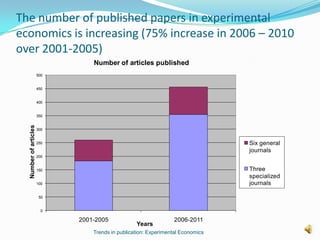
The number of published papers in experimental
economics is increasing (75% increase in 2006 – 2010
over 2001-2005)
                                 Number of articles published
                       500


                       450


                       400


                       350
  Number of articles


                       300


                       250                                                       Six general
                                                                                 journals
                       200


                       150                                                       Three
                                                                                 specialized
                       100                                                       journals

                        50


                         0

                             2001-2005                           2006-2011
                                                  Years
                                 Trends in publication: Experimental Economics
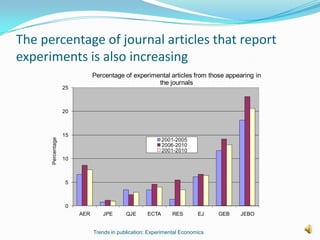
The percentage of journal articles that report
experiments is also increasing
                              Percentage of experimental articles from those appearing in
                                                    the journals
                   25


                   20


                   15
      Percentage


                                                           2001-2005
                                                           2006-2010
                                                           2001-2010
                   10


                    5


                    0
                        AER      JPE       QJE      ECTA      RES       EJ    GEB   JEBO


                              Trends in publication: Experimental Economics
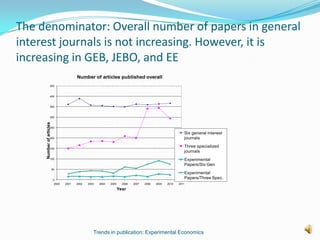
The denominator: Overall number of papers in general
interest journals is not increasing. However, it is
increasing in GEB, JEBO, and EE
                                         Number of articles published overall
                   450


                   400


                   350


                   300
     Number of articles


                   250

                                                                                                             Six general interest
                   200                                                                                       journals

                   150
                                                                                                             Three specialized
                                                                                                             journals
                   100                                                                                       Experimental
                                                                                                             Papers/Six Gen
                          50
                                                                                                             Experimental
                           0
                                                                                                             Papers/Three Spec.
                           2000   2001   2002   2003   2004   2005     2006   2007   2008   2009   2010   2011

                                                                     Year


                                                   Trends in publication: Experimental Economics
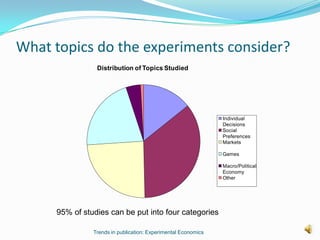
What topics do the experiments consider?
                Distribution of Topics Studied


                                                               Individual
                                                               Decisions
                                                               Social
                                                               Preferences
                                                               Markets

                                                               Games

                                                               Macro/Political
                                                               Economy
                                                               Other


     95% of studies can be put into four categories

               Trends in publication: Experimental Economics
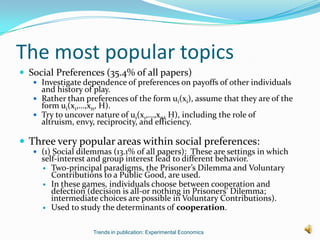
The most popular topics
 Social Preferences (35.4% of all papers)
    Investigate dependence of preferences on payoffs of other individuals
     and history of play.
    Rather than preferences of the form ui(xi), assume that they are of the
     form ui(x1,…,xn, H).
    Try to uncover nature of ui(x1,…,xn, H), including the role of
     altruism, envy, reciprocity, and efficiency.

 Three very popular areas within social preferences:
    (1) Social dilemmas (13.1% of all papers): These are settings in which
     self-interest and group interest lead to different behavior.
      Two-principal paradigms, the Prisoner’s Dilemma and Voluntary
        Contributions to a Public Good, are used.
      In these games, individuals choose between cooperation and
        defection (decision is all-or nothing in Prisoners’ Dilemma;
        intermediate choices are possible in Voluntary Contributions).
      Used to study the determinants of cooperation.


                    Trends in publication: Experimental Economics
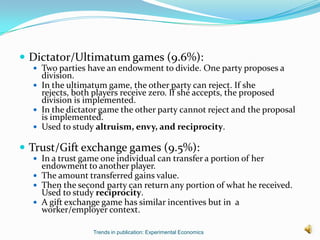
 Dictator/Ultimatum games (9.6%):
   Two parties have an endowment to divide. One party proposes a
    division.
   In the ultimatum game, the other party can reject. If she
    rejects, both players receive zero. If she accepts, the proposed
    division is implemented.
   In the dictator game the other party cannot reject and the proposal
    is implemented.
   Used to study altruism, envy, and reciprocity.

 Trust/Gift exchange games (9.5%):
   In a trust game one individual can transfer a portion of her
    endowment to another player.
   The amount transferred gains value.
   Then the second party can return any portion of what he received.
    Used to study reciprocity.
   A gift exchange game has similar incentives but in a
    worker/employer context.

                  Trends in publication: Experimental Economics
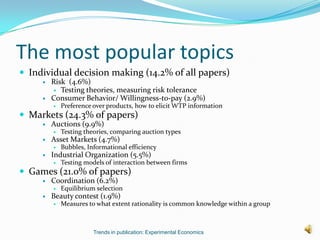
The most popular topics
 Individual decision making (14.2% of all papers)
        Risk (4.6%)
          Testing theories, measuring risk tolerance
        Consumer Behavior/ Willingness-to-pay (2.9%)
            Preference over products, how to elicit WTP information
 Markets (24.3% of papers)
        Auctions (9.9%)
            Testing theories, comparing auction types
        Asset Markets (4.7%)
            Bubbles, Informational efficiency
        Industrial Organization (5.5%)
            Testing models of interaction between firms
 Games (21.0% of papers)
        Coordination (6.2%)
            Equilibrium selection
        Beauty contest (1.9%)
            Measures to what extent rationality is common knowledge within a group


                        Trends in publication: Experimental Economics
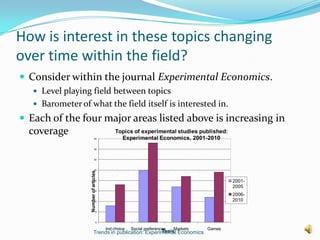
How is interest in these topics changing
over time within the field?
 Consider within the journal Experimental Economics.
    Level playing field between topics
    Barometer of what the field itself is interested in.
 Each of the four major areas listed above is increasing in
  coverage                                  Topics of experimental studies published:
                             40               Experimental Economics, 2001-2010
                             35


                             30


                             25
                   Number of articles


                             20                                                             2001-
                                                                                            2005
                             15
                                                                                            2006-
                             10                                                             2010

                                  5


                                  0

                                        Ind choice   Social preferences   Markets   Games
                                                       Topic
                          Trends in publication: Experimental Economics
What topics interest the broader profession?
Consider the six general interest journals
                                                       Topics: SIx General Interest Journals
                   30
                                                                                                  Interest growing
                                                                                                  in Social
                   25
                                                                                                  Preferences, Ind
                                                                                                  ividual
                                                                                                  Choice, and
                   20
                                                                                                  Games
     Number of articles


                                                                                                   2001-2005
                   15
                                                                                                   2006-2010


                   10


                          5


                          0

                              Individual Decisions Social Preferences     Markets         Games
                                                                    Topic


                                          Trends in publication: Experimental Economics
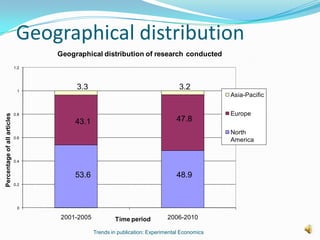
Geographical distribution
                                   Geographical distribution of research conducted
                             1.2


                              1
                                        3.3                                       3.2
                                                                                               Asia-Pacific


                                                                                               Europe
Percentage of all articles


                             0.8

                                        43.1                                    47.8
                                                                                               North
                             0.6
                                                                                               America


                             0.4


                                        53.6                                    48.9
                             0.2


                              0

                                   2001-2005           Time period           2006-2010

                                               Trends in publication: Experimental Economics
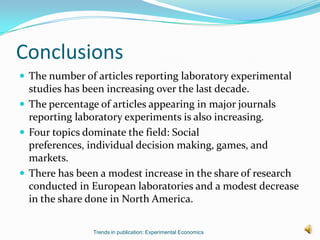
Conclusions
 The number of articles reporting laboratory experimental
  studies has been increasing over the last decade.
 The percentage of articles appearing in major journals
  reporting laboratory experiments is also increasing.
 Four topics dominate the field: Social
  preferences, individual decision making, games, and
  markets.
 There has been a modest increase in the share of research
  conducted in European laboratories and a modest decrease
  in the share done in North America.

               Trends in publication: Experimental Economics

Laboratory Experiments - Charles Noussair

  • 1.
    Charles Noussair Tilburg University Trends in publication: Experimental Economics
  • 2.
    What I dohere  Study is in the spirit of the Journal of Economic Surveys, and the conference theme of Current and Future Trends.  I try to give some broad perspective about research trends within a field, in this case experimental economics.  I consider developments in journal publishing patterns in the field of experimental economics during the decade Jan. 2001 – Dec. 2010.  Analyze what has been published in the area in 9 leading outlets. Consider trends within the 10 year period, topics covered, and geographical location of research. Trends in publication: Experimental Economics
  • 3.
    The type ofarticles considered  I consider laboratory experiments only. The unit of observation is the journal article.  Include only studies conducted using traditional laboratory techniques. If this methodology is employed to gather at least some of the data reported in the paper, it is included in the data set.  Features of the methodology  Student subjects as participants  Conducted in a controlled laboratory setting Trends in publication: Experimental Economics
  • 4.
    Typical Physical Layoutof an Experimental Laboratory Trends in publication: Experimental Economics
  • 5.
    What is notincluded  I leave out field experiments. These are experimental studies that relax one or more of the aforementioned aspects of the methodology.  The boundary between field experimental and non-experimental research is hard to precisely establish.  I also leave out neuroeconomic studies, since they arguably involve a new methodology, and their prime focus is on physiological data.  I leave out comments, and replies, as well as surveys and meta-analyses that do not report new data. Trends in publication: Experimental Economics
  • 6.
    The data set Consists of all experimental papers published in nine prominent journals.  Six of these are prestigious general interest journals.  American Economic Review (not including Papers and Proceedings), Econometrica, The Economic Journal, Journal of Political Economy, The Quarterly Journal of Economics, and Review of Economic Studies.  The three others are prestigious specialized journals that publish many articles in experimental economics.  Games and Economic Behavior, Journal of Economic Behavior and Organization, and Experimental Economics.  A total number of 716 experimental papers identified Trends in publication: Experimental Economics
  • 7.
    The number ofpublished papers in experimental economics is increasing (75% increase in 2006 – 2010 over 2001-2005) Number of articles published 500 450 400 350 Number of articles 300 250 Six general journals 200 150 Three specialized 100 journals 50 0 2001-2005 2006-2011 Years Trends in publication: Experimental Economics
  • 8.
    The percentage ofjournal articles that report experiments is also increasing Percentage of experimental articles from those appearing in the journals 25 20 15 Percentage 2001-2005 2006-2010 2001-2010 10 5 0 AER JPE QJE ECTA RES EJ GEB JEBO Trends in publication: Experimental Economics
  • 9.
    The denominator: Overallnumber of papers in general interest journals is not increasing. However, it is increasing in GEB, JEBO, and EE Number of articles published overall 450 400 350 300 Number of articles 250 Six general interest 200 journals 150 Three specialized journals 100 Experimental Papers/Six Gen 50 Experimental 0 Papers/Three Spec. 2000 2001 2002 2003 2004 2005 2006 2007 2008 2009 2010 2011 Year Trends in publication: Experimental Economics
  • 10.
    What topics dothe experiments consider? Distribution of Topics Studied Individual Decisions Social Preferences Markets Games Macro/Political Economy Other 95% of studies can be put into four categories Trends in publication: Experimental Economics
  • 11.
    The most populartopics  Social Preferences (35.4% of all papers)  Investigate dependence of preferences on payoffs of other individuals and history of play.  Rather than preferences of the form ui(xi), assume that they are of the form ui(x1,…,xn, H).  Try to uncover nature of ui(x1,…,xn, H), including the role of altruism, envy, reciprocity, and efficiency.  Three very popular areas within social preferences:  (1) Social dilemmas (13.1% of all papers): These are settings in which self-interest and group interest lead to different behavior.  Two-principal paradigms, the Prisoner’s Dilemma and Voluntary Contributions to a Public Good, are used.  In these games, individuals choose between cooperation and defection (decision is all-or nothing in Prisoners’ Dilemma; intermediate choices are possible in Voluntary Contributions).  Used to study the determinants of cooperation. Trends in publication: Experimental Economics
  • 12.
     Dictator/Ultimatum games(9.6%):  Two parties have an endowment to divide. One party proposes a division.  In the ultimatum game, the other party can reject. If she rejects, both players receive zero. If she accepts, the proposed division is implemented.  In the dictator game the other party cannot reject and the proposal is implemented.  Used to study altruism, envy, and reciprocity.  Trust/Gift exchange games (9.5%):  In a trust game one individual can transfer a portion of her endowment to another player.  The amount transferred gains value.  Then the second party can return any portion of what he received. Used to study reciprocity.  A gift exchange game has similar incentives but in a worker/employer context. Trends in publication: Experimental Economics
  • 13.
    The most populartopics  Individual decision making (14.2% of all papers)  Risk (4.6%)  Testing theories, measuring risk tolerance  Consumer Behavior/ Willingness-to-pay (2.9%)  Preference over products, how to elicit WTP information  Markets (24.3% of papers)  Auctions (9.9%)  Testing theories, comparing auction types  Asset Markets (4.7%)  Bubbles, Informational efficiency  Industrial Organization (5.5%)  Testing models of interaction between firms  Games (21.0% of papers)  Coordination (6.2%)  Equilibrium selection  Beauty contest (1.9%)  Measures to what extent rationality is common knowledge within a group Trends in publication: Experimental Economics
  • 14.
    How is interestin these topics changing over time within the field?  Consider within the journal Experimental Economics.  Level playing field between topics  Barometer of what the field itself is interested in.  Each of the four major areas listed above is increasing in coverage Topics of experimental studies published: 40 Experimental Economics, 2001-2010 35 30 25 Number of articles 20 2001- 2005 15 2006- 10 2010 5 0 Ind choice Social preferences Markets Games Topic Trends in publication: Experimental Economics
  • 15.
    What topics interestthe broader profession? Consider the six general interest journals Topics: SIx General Interest Journals 30 Interest growing in Social 25 Preferences, Ind ividual Choice, and 20 Games Number of articles 2001-2005 15 2006-2010 10 5 0 Individual Decisions Social Preferences Markets Games Topic Trends in publication: Experimental Economics
  • 16.
    Geographical distribution Geographical distribution of research conducted 1.2 1 3.3 3.2 Asia-Pacific Europe Percentage of all articles 0.8 43.1 47.8 North 0.6 America 0.4 53.6 48.9 0.2 0 2001-2005 Time period 2006-2010 Trends in publication: Experimental Economics
  • 17.
    Conclusions  The numberof articles reporting laboratory experimental studies has been increasing over the last decade.  The percentage of articles appearing in major journals reporting laboratory experiments is also increasing.  Four topics dominate the field: Social preferences, individual decision making, games, and markets.  There has been a modest increase in the share of research conducted in European laboratories and a modest decrease in the share done in North America. Trends in publication: Experimental Economics