DR. MRUDULA DEVI
I MDS
CONTENTS
1. INTRODUCTION
2. DEFINITION
3. CHARACTERISTICS OF A LAB
TEST
4. BASIC PRINCIPLES OF LAB
TESTS
5. TYPES OF LAB TESTS
6. INDIVIDUAL LAB
INVESTIGATIONS
7. CONCLUSION
8. REFERENCES
โ€œA correct diagnosis is three fourths the remedyโ€
- M. Gandhi
Clinical/lab investigation data must be used to
distinguish between different diagnoses.
Lab Tests
โ€ข Screen for disease in asymptomatic
individuals.
โ€ข Assist in the management of patient.
DEFINITION
Laboratory investigations are an extension of
physical examination in which tissue, blood,
urine or other specimens are obtained from
patients and subjected to microscopic,
biochemical, microbiological or immunological
examination.
Key to use lab tests lies in
โ–ช Selection of appropriate tests
โ–ช Knowing the strength and weakness of tests
โ–ช Selecting the useful data for specific
diagnosis
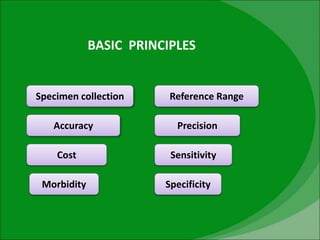
Specimen collection Reference Range
Accuracy
Cost
Morbidity Specificity
Sensitivity
Precision
BASIC PRINCIPLES
The ideal diagnostic test should be
1. Highly specific, sensitive and reproducible
2. Simple to perform, rapid, one-stage or a two-stage
procedure.
3. Non-invasive.
4. Versatile
5. Amenable to chair-side use.
6. Economical.
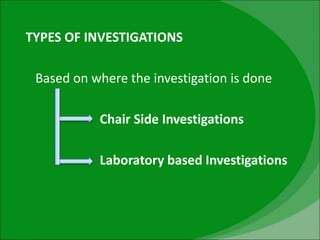
TYPES OF INVESTIGATIONS
Based on where the investigation is done
Chair Side Investigations
Laboratory based Investigations
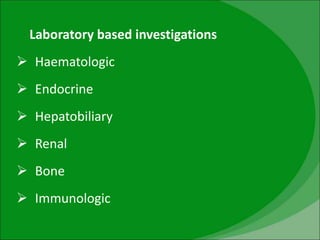
Laboratory based investigations
๏ƒ˜ Haematologic
๏ƒ˜ Endocrine
๏ƒ˜ Hepatobiliary
๏ƒ˜ Renal
๏ƒ˜ Bone
๏ƒ˜ Immunologic
HAEMATOLOGICAL INVESTIGATIONS
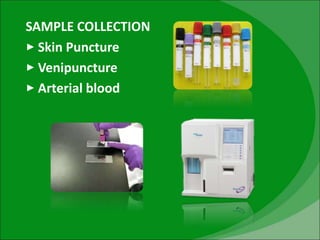
SAMPLE COLLECTION
โ€ฃ Skin Puncture
โ€ฃ Venipuncture
โ€ฃ Arterial blood
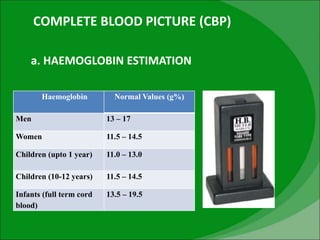
COMPLETE BLOOD PICTURE (CBP)
a. HAEMOGLOBIN ESTIMATION
Haemoglobin Normal Values (g%)
Men 13 โ€“ 17
Women 11.5 โ€“ 14.5
Children (upto 1 year) 11.0 โ€“ 13.0
Children (10-12 years) 11.5 โ€“ 14.5
Infants (full term cord
blood)
13.5 โ€“ 19.5
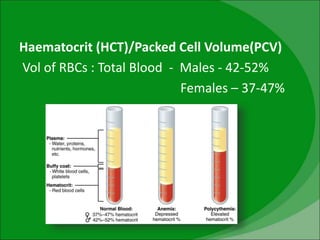
Haematocrit (HCT)/Packed Cell Volume(PCV)
Vol of RBCs : Total Blood - Males - 42-52%
Females โ€“ 37-47%
b. RED BLOOD CELL INDICES
i) RBC Count
Male : 4.5-6.0 million/mm3
Female: 4.0-4.5 million/mm3
ii) MCV โ€“ HCT/RBC : 80-100 fL
iii) MCH โ€“ Hb/RBC : 27-31 pg/cell
iv) MCHC โ€“ Hb/HCT : 32-36 g/dL
v) RCDW โ€“ 11.5-14.5%
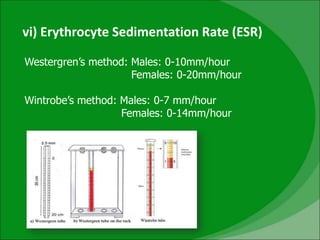
vi) Erythrocyte Sedimentation Rate (ESR)
Westergrenโ€™s method: Males: 0-10mm/hour
Females: 0-20mm/hour
Wintrobeโ€™s method: Males: 0-7 mm/hour
Females: 0-14mm/hour
C. WHITE BLOOD CELL INVESTIGATIONS
i) Total Leucocyte Count :
Adults :
4,000 โ€“ 11,000 / cu.mm (ยตl).
At birth :
10,000 โ€“ 25,000 /cu.mm (ยตl).
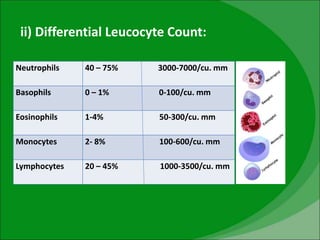
ii) Differential Leucocyte Count:
Neutrophils 40 โ€“ 75% 3000-7000/cu. mm
Basophils 0 โ€“ 1% 0-100/cu. mm
Eosinophils 1-4% 50-300/cu. mm
Monocytes 2- 8% 100-600/cu. mm
Lymphocytes 20 โ€“ 45% 1000-3500/cu. mm
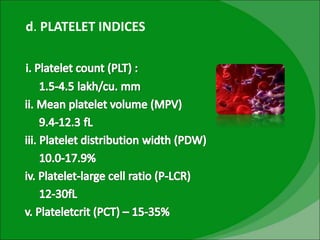
d. PLATELET INDICES
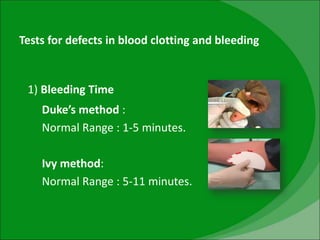
Tests for defects in blood clotting and bleeding
1) Bleeding Time
Dukeโ€™s method :
Normal Range : 1-5 minutes.
Ivy method:
Normal Range : 5-11 minutes.
2) Clotting Time
Capillary Method :
4 to 9 minutes.
3) Prothrombin time
Normal PT range : 10-14sec.
4) Partial Thromboplastin Time
Normal PTT range - 60-80 sec
aPTT range - 30-45 sec
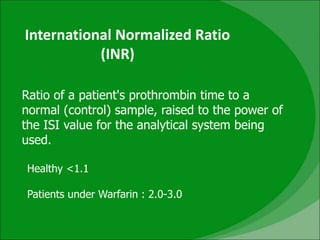
International Normalized Ratio
(INR)
Ratio of a patient's prothrombin time to a
normal (control) sample, raised to the power of
the ISI value for the analytical system being
used.
Healthy <1.1
Patients under Warfarin : 2.0-3.0
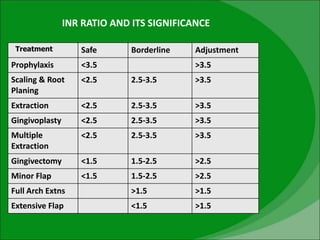
INR RATIO AND ITS SIGNIFICANCE
Treatment Safe Borderline Adjustment
Prophylaxis <3.5 >3.5
Scaling & Root
Planing
<2.5 2.5-3.5 >3.5
Extraction <2.5 2.5-3.5 >3.5
Gingivoplasty <2.5 2.5-3.5 >3.5
Multiple
Extraction
<2.5 2.5-3.5 >3.5
Gingivectomy <1.5 1.5-2.5 >2.5
Minor Flap <1.5 1.5-2.5 >2.5
Full Arch Extns >1.5 >1.5
Extensive Flap <1.5 >1.5
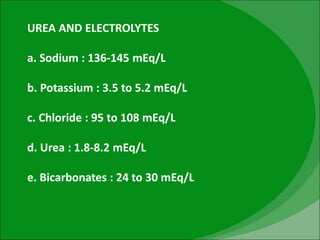
UREA AND ELECTROLYTES
a. Sodium : 136-145 mEq/L
b. Potassium : 3.5 to 5.2 mEq/L
c. Chloride : 95 to 108 mEq/L
d. Urea : 1.8-8.2 mEq/L
e. Bicarbonates : 24 to 30 mEq/L
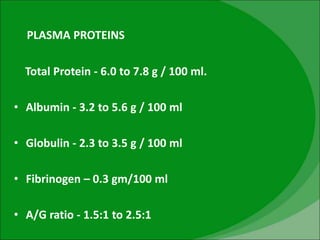
PLASMA PROTEINS
Total Protein - 6.0 to 7.8 g / 100 ml.
โ€ข Albumin - 3.2 to 5.6 g / 100 ml
โ€ข Globulin - 2.3 to 3.5 g / 100 ml
โ€ข Fibrinogen โ€“ 0.3 gm/100 ml
โ€ข A/G ratio - 1.5:1 to 2.5:1
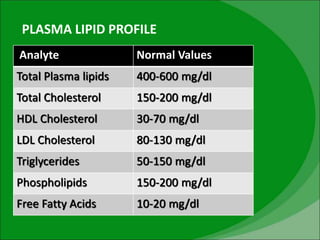
Analyte Normal Values
Total Plasma lipids 400-600 mg/dl
Total Cholesterol 150-200 mg/dl
HDL Cholesterol 30-70 mg/dl
LDL Cholesterol 80-130 mg/dl
Triglycerides 50-150 mg/dl
Phospholipids 150-200 mg/dl
Free Fatty Acids 10-20 mg/dl
PLASMA LIPID PROFILE
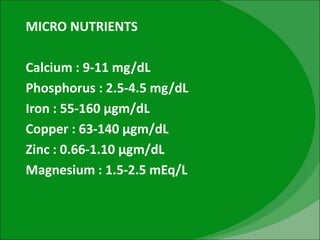
MICRO NUTRIENTS
Calcium : 9-11 mg/dL
Phosphorus : 2.5-4.5 mg/dL
Iron : 55-160 ยตgm/dL
Copper : 63-140 ยตgm/dL
Zinc : 0.66-1.10 ยตgm/dL
Magnesium : 1.5-2.5 mEq/L
ENDOCRINE INVESTIGATIONS
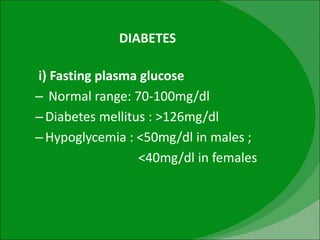
DIABETES
i) Fasting plasma glucose
โ€“ Normal range: 70-100mg/dl
โ€“Diabetes mellitus : >126mg/dl
โ€“Hypoglycemia : <50mg/dl in males ;
<40mg/dl in females
ii) Post prandial blood glucose
Normal: <140mg/dL
iii) Random blood glucose
Normal range : 79-160 mg/dL
iv) Oral Glucose Tolerance Test (OGTT)
โ€“ Fasting: <105mg/dl
โ€“ After 1 hour: <190mg/dl
โ€“ After 2 hours: <165mg/dl
โ€“ After 3 hours: <145mg/dl
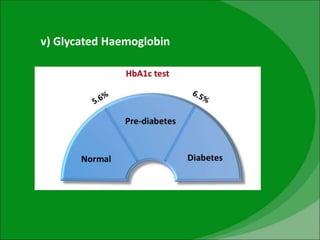
v) Glycated Haemoglobin
KETONE BODIES
i. Acetone
ii. Acetoacetate
iii. Beta Hydroxy Butyrate
Normal Conc. in blood : 1mg/dL
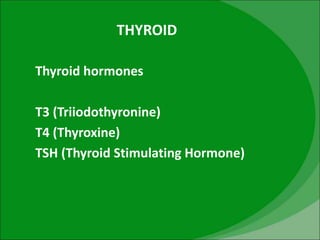
THYROID
Thyroid hormones
T3 (Triiodothyronine)
T4 (Thyroxine)
TSH (Thyroid Stimulating Hormone)
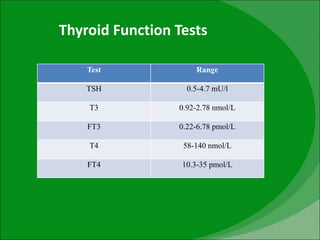
Thyroid Function Tests
Test Range
TSH 0.5-4.7 mU/l
T3 0.92-2.78 nmol/L
FT3 0.22-6.78 pmol/L
T4 58-140 nmol/L
FT4 10.3-35 pmol/L
HEPATOBILIARY INVESTIGATIONS
LIVER FUNCTION TESTS
Bilirubin : 0.1 to 1.2 mg / 100 ml.
Alanine aminotransferase : 3โ€“ 26 IU/ L
Asparate aminotransferase : 6 -25 IU/ L
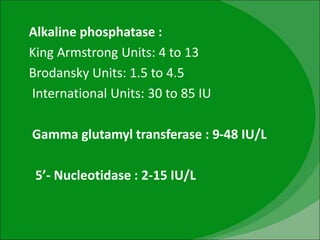
Alkaline phosphatase :
King Armstrong Units: 4 to 13
Brodansky Units: 1.5 to 4.5
International Units: 30 to 85 IU
Gamma glutamyl transferase : 9-48 IU/L
5โ€™- Nucleotidase : 2-15 IU/L
RENAL INVESTIGATIONS
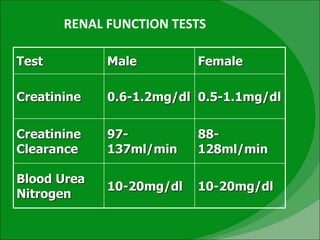
Test Male Female
Creatinine 0.6-1.2mg/dl 0.5-1.1mg/dl
Creatinine
Clearance
97-
137ml/min
88-
128ml/min
Blood Urea
Nitrogen
10-20mg/dl 10-20mg/dl
RENAL FUNCTION TESTS
BONE INVESTIGATIONS
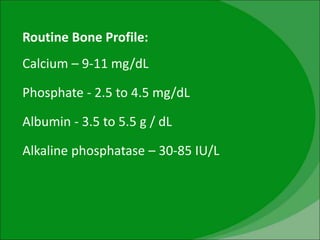
Routine Bone Profile:
Calcium โ€“ 9-11 mg/dL
Phosphate - 2.5 to 4.5 mg/dL
Albumin - 3.5 to 5.5 g / dL
Alkaline phosphatase โ€“ 30-85 IU/L
IMMUNOLOGIC INVESTIGATIONS
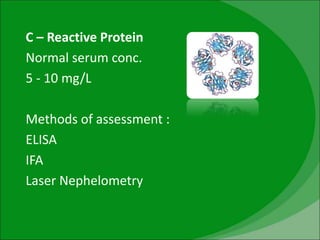
C โ€“ Reactive Protein
Normal serum conc.
5 - 10 mg/L
Methods of assessment :
ELISA
IFA
Laser Nephelometry
AIDS Serology
Lymphocyte Immuno-phenotyping
T cells - 800-2500/ ยตL.
CD4 Cells - 600-1500/ยตL.
CD8 Cells - 300-1000/ ยตL.
CD4 : CD8 โ€“ 2 ( <1 in HIV)
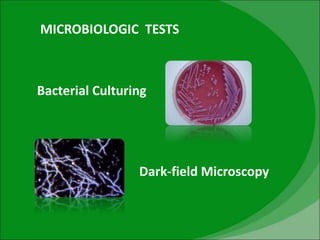
MICROBIOLOGIC TESTS
Bacterial Culturing
Dark-field Microscopy
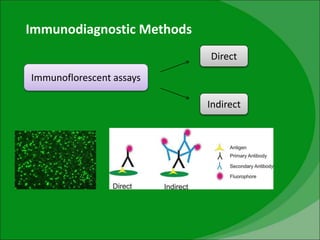
Immunodiagnostic Methods
Immunoflorescent assays
Direct
Indirect
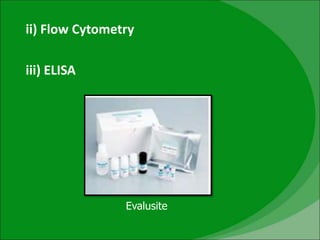
ii) Flow Cytometry
iii) ELISA
Evalusite
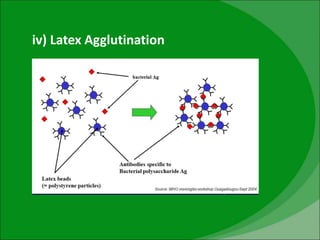
iv) Latex Agglutination
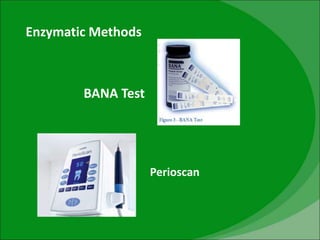
Enzymatic Methods
BANA Test
Perioscan
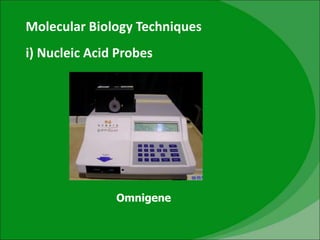
Molecular Biology Techniques
i) Nucleic Acid Probes
Omnigene
DNA-DNA Hybridization
a. FISH
b. Checkerboard
c. Reverse Capture
Polymerase Chain Reaction
a. Single target
b. Multiplex
c. Real Time
Other Biochemical test kits :
Periocheck
Prognostik
Biolase
Pocket watch
TOPAS
Recent Diagnostic Kits :
OFNASET
Electronic taste chips
IMPOD
Salimeterics
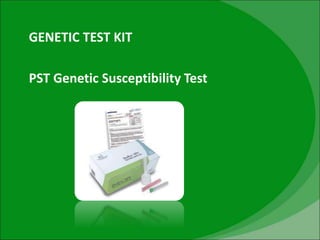
GENETIC TEST KIT
PST Genetic Susceptibility Test
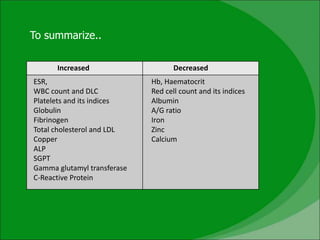
Increased Decreased
ESR,
WBC count and DLC
Platelets and its indices
Globulin
Fibrinogen
Total cholesterol and LDL
Copper
ALP
SGPT
Gamma glutamyl transferase
C-Reactive Protein
Hb, Haematocrit
Red cell count and its indices
Albumin
A/G ratio
Iron
Zinc
Calcium
To summarize..
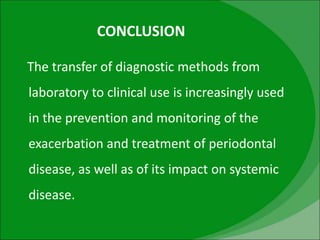
CONCLUSION
The transfer of diagnostic methods from
laboratory to clinical use is increasingly used
in the prevention and monitoring of the
exacerbation and treatment of periodontal
disease, as well as of its impact on systemic
disease.
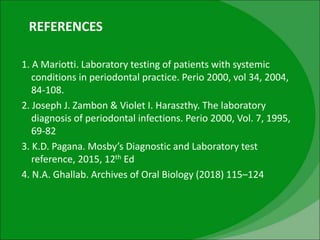
REFERENCES
1. A Mariotti. Laboratory testing of patients with systemic
conditions in periodontal practice. Perio 2000, vol 34, 2004,
84-108.
2. Joseph J. Zambon & Violet I. Haraszthy. The laboratory
diagnosis of periodontal infections. Perio 2000, Vol. 7, 1995,
69-82
3. K.D. Pagana. Mosbyโ€™s Diagnostic and Laboratory test
reference, 2015, 12th Ed
4. N.A. Ghallab. Archives of Oral Biology (2018) 115โ€“124
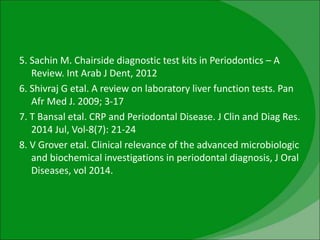
5. Sachin M. Chairside diagnostic test kits in Periodontics โ€“ A
Review. Int Arab J Dent, 2012
6. Shivraj G etal. A review on laboratory liver function tests. Pan
Afr Med J. 2009; 3-17
7. T Bansal etal. CRP and Periodontal Disease. J Clin and Diag Res.
2014 Jul, Vol-8(7): 21-24
8. V Grover etal. Clinical relevance of the advanced microbiologic
and biochemical investigations in periodontal diagnosis, J Oral
Diseases, vol 2014.

Lab investigations and their impocations

  • 1.
  • 2.
    CONTENTS 1. INTRODUCTION 2. DEFINITION 3.CHARACTERISTICS OF A LAB TEST 4. BASIC PRINCIPLES OF LAB TESTS 5. TYPES OF LAB TESTS 6. INDIVIDUAL LAB INVESTIGATIONS 7. CONCLUSION 8. REFERENCES
  • 3.
    โ€œA correct diagnosisis three fourths the remedyโ€ - M. Gandhi Clinical/lab investigation data must be used to distinguish between different diagnoses.
  • 4.
    Lab Tests โ€ข Screenfor disease in asymptomatic individuals. โ€ข Assist in the management of patient.
  • 5.
    DEFINITION Laboratory investigations arean extension of physical examination in which tissue, blood, urine or other specimens are obtained from patients and subjected to microscopic, biochemical, microbiological or immunological examination.
  • 6.
    Key to uselab tests lies in โ–ช Selection of appropriate tests โ–ช Knowing the strength and weakness of tests โ–ช Selecting the useful data for specific diagnosis
  • 7.
    Specimen collection ReferenceRange Accuracy Cost Morbidity Specificity Sensitivity Precision BASIC PRINCIPLES
  • 8.
    The ideal diagnostictest should be 1. Highly specific, sensitive and reproducible 2. Simple to perform, rapid, one-stage or a two-stage procedure. 3. Non-invasive. 4. Versatile 5. Amenable to chair-side use. 6. Economical.
  • 9.
    TYPES OF INVESTIGATIONS Basedon where the investigation is done Chair Side Investigations Laboratory based Investigations
  • 10.
    Laboratory based investigations ๏ƒ˜Haematologic ๏ƒ˜ Endocrine ๏ƒ˜ Hepatobiliary ๏ƒ˜ Renal ๏ƒ˜ Bone ๏ƒ˜ Immunologic
  • 11.
  • 12.
    SAMPLE COLLECTION โ€ฃ SkinPuncture โ€ฃ Venipuncture โ€ฃ Arterial blood
  • 13.
    COMPLETE BLOOD PICTURE(CBP) a. HAEMOGLOBIN ESTIMATION Haemoglobin Normal Values (g%) Men 13 โ€“ 17 Women 11.5 โ€“ 14.5 Children (upto 1 year) 11.0 โ€“ 13.0 Children (10-12 years) 11.5 โ€“ 14.5 Infants (full term cord blood) 13.5 โ€“ 19.5
  • 14.
    Haematocrit (HCT)/Packed CellVolume(PCV) Vol of RBCs : Total Blood - Males - 42-52% Females โ€“ 37-47%
  • 15.
    b. RED BLOODCELL INDICES i) RBC Count Male : 4.5-6.0 million/mm3 Female: 4.0-4.5 million/mm3 ii) MCV โ€“ HCT/RBC : 80-100 fL iii) MCH โ€“ Hb/RBC : 27-31 pg/cell iv) MCHC โ€“ Hb/HCT : 32-36 g/dL v) RCDW โ€“ 11.5-14.5%
  • 16.
    vi) Erythrocyte SedimentationRate (ESR) Westergrenโ€™s method: Males: 0-10mm/hour Females: 0-20mm/hour Wintrobeโ€™s method: Males: 0-7 mm/hour Females: 0-14mm/hour
  • 17.
    C. WHITE BLOODCELL INVESTIGATIONS i) Total Leucocyte Count : Adults : 4,000 โ€“ 11,000 / cu.mm (ยตl). At birth : 10,000 โ€“ 25,000 /cu.mm (ยตl).
  • 18.
    ii) Differential LeucocyteCount: Neutrophils 40 โ€“ 75% 3000-7000/cu. mm Basophils 0 โ€“ 1% 0-100/cu. mm Eosinophils 1-4% 50-300/cu. mm Monocytes 2- 8% 100-600/cu. mm Lymphocytes 20 โ€“ 45% 1000-3500/cu. mm
  • 19.
  • 20.
    Tests for defectsin blood clotting and bleeding 1) Bleeding Time Dukeโ€™s method : Normal Range : 1-5 minutes. Ivy method: Normal Range : 5-11 minutes.
  • 21.
    2) Clotting Time CapillaryMethod : 4 to 9 minutes. 3) Prothrombin time Normal PT range : 10-14sec. 4) Partial Thromboplastin Time Normal PTT range - 60-80 sec aPTT range - 30-45 sec
  • 22.
    International Normalized Ratio (INR) Ratioof a patient's prothrombin time to a normal (control) sample, raised to the power of the ISI value for the analytical system being used. Healthy <1.1 Patients under Warfarin : 2.0-3.0
  • 23.
    INR RATIO ANDITS SIGNIFICANCE Treatment Safe Borderline Adjustment Prophylaxis <3.5 >3.5 Scaling & Root Planing <2.5 2.5-3.5 >3.5 Extraction <2.5 2.5-3.5 >3.5 Gingivoplasty <2.5 2.5-3.5 >3.5 Multiple Extraction <2.5 2.5-3.5 >3.5 Gingivectomy <1.5 1.5-2.5 >2.5 Minor Flap <1.5 1.5-2.5 >2.5 Full Arch Extns >1.5 >1.5 Extensive Flap <1.5 >1.5
  • 24.
    UREA AND ELECTROLYTES a.Sodium : 136-145 mEq/L b. Potassium : 3.5 to 5.2 mEq/L c. Chloride : 95 to 108 mEq/L d. Urea : 1.8-8.2 mEq/L e. Bicarbonates : 24 to 30 mEq/L
  • 25.
    PLASMA PROTEINS Total Protein- 6.0 to 7.8 g / 100 ml. โ€ข Albumin - 3.2 to 5.6 g / 100 ml โ€ข Globulin - 2.3 to 3.5 g / 100 ml โ€ข Fibrinogen โ€“ 0.3 gm/100 ml โ€ข A/G ratio - 1.5:1 to 2.5:1
  • 26.
    Analyte Normal Values TotalPlasma lipids 400-600 mg/dl Total Cholesterol 150-200 mg/dl HDL Cholesterol 30-70 mg/dl LDL Cholesterol 80-130 mg/dl Triglycerides 50-150 mg/dl Phospholipids 150-200 mg/dl Free Fatty Acids 10-20 mg/dl PLASMA LIPID PROFILE
  • 27.
    MICRO NUTRIENTS Calcium :9-11 mg/dL Phosphorus : 2.5-4.5 mg/dL Iron : 55-160 ยตgm/dL Copper : 63-140 ยตgm/dL Zinc : 0.66-1.10 ยตgm/dL Magnesium : 1.5-2.5 mEq/L
  • 28.
  • 29.
    DIABETES i) Fasting plasmaglucose โ€“ Normal range: 70-100mg/dl โ€“Diabetes mellitus : >126mg/dl โ€“Hypoglycemia : <50mg/dl in males ; <40mg/dl in females
  • 30.
    ii) Post prandialblood glucose Normal: <140mg/dL iii) Random blood glucose Normal range : 79-160 mg/dL iv) Oral Glucose Tolerance Test (OGTT) โ€“ Fasting: <105mg/dl โ€“ After 1 hour: <190mg/dl โ€“ After 2 hours: <165mg/dl โ€“ After 3 hours: <145mg/dl
  • 31.
  • 32.
    KETONE BODIES i. Acetone ii.Acetoacetate iii. Beta Hydroxy Butyrate Normal Conc. in blood : 1mg/dL
  • 33.
    THYROID Thyroid hormones T3 (Triiodothyronine) T4(Thyroxine) TSH (Thyroid Stimulating Hormone)
  • 34.
    Thyroid Function Tests TestRange TSH 0.5-4.7 mU/l T3 0.92-2.78 nmol/L FT3 0.22-6.78 pmol/L T4 58-140 nmol/L FT4 10.3-35 pmol/L
  • 35.
  • 36.
    LIVER FUNCTION TESTS Bilirubin: 0.1 to 1.2 mg / 100 ml. Alanine aminotransferase : 3โ€“ 26 IU/ L Asparate aminotransferase : 6 -25 IU/ L
  • 37.
    Alkaline phosphatase : KingArmstrong Units: 4 to 13 Brodansky Units: 1.5 to 4.5 International Units: 30 to 85 IU Gamma glutamyl transferase : 9-48 IU/L 5โ€™- Nucleotidase : 2-15 IU/L
  • 38.
  • 39.
    Test Male Female Creatinine0.6-1.2mg/dl 0.5-1.1mg/dl Creatinine Clearance 97- 137ml/min 88- 128ml/min Blood Urea Nitrogen 10-20mg/dl 10-20mg/dl RENAL FUNCTION TESTS
  • 40.
  • 41.
    Routine Bone Profile: Calciumโ€“ 9-11 mg/dL Phosphate - 2.5 to 4.5 mg/dL Albumin - 3.5 to 5.5 g / dL Alkaline phosphatase โ€“ 30-85 IU/L
  • 42.
  • 43.
    C โ€“ ReactiveProtein Normal serum conc. 5 - 10 mg/L Methods of assessment : ELISA IFA Laser Nephelometry
  • 44.
    AIDS Serology Lymphocyte Immuno-phenotyping Tcells - 800-2500/ ยตL. CD4 Cells - 600-1500/ยตL. CD8 Cells - 300-1000/ ยตL. CD4 : CD8 โ€“ 2 ( <1 in HIV)
  • 45.
  • 46.
  • 47.
    ii) Flow Cytometry iii)ELISA Evalusite
  • 48.
  • 49.
  • 50.
    Molecular Biology Techniques i)Nucleic Acid Probes Omnigene
  • 51.
    DNA-DNA Hybridization a. FISH b.Checkerboard c. Reverse Capture
  • 52.
    Polymerase Chain Reaction a.Single target b. Multiplex c. Real Time
  • 53.
    Other Biochemical testkits : Periocheck Prognostik Biolase Pocket watch TOPAS
  • 54.
    Recent Diagnostic Kits: OFNASET Electronic taste chips IMPOD Salimeterics
  • 55.
    GENETIC TEST KIT PSTGenetic Susceptibility Test
  • 56.
    Increased Decreased ESR, WBC countand DLC Platelets and its indices Globulin Fibrinogen Total cholesterol and LDL Copper ALP SGPT Gamma glutamyl transferase C-Reactive Protein Hb, Haematocrit Red cell count and its indices Albumin A/G ratio Iron Zinc Calcium To summarize..
  • 57.
    CONCLUSION The transfer ofdiagnostic methods from laboratory to clinical use is increasingly used in the prevention and monitoring of the exacerbation and treatment of periodontal disease, as well as of its impact on systemic disease.
  • 58.
    REFERENCES 1. A Mariotti.Laboratory testing of patients with systemic conditions in periodontal practice. Perio 2000, vol 34, 2004, 84-108. 2. Joseph J. Zambon & Violet I. Haraszthy. The laboratory diagnosis of periodontal infections. Perio 2000, Vol. 7, 1995, 69-82 3. K.D. Pagana. Mosbyโ€™s Diagnostic and Laboratory test reference, 2015, 12th Ed 4. N.A. Ghallab. Archives of Oral Biology (2018) 115โ€“124
  • 59.
    5. Sachin M.Chairside diagnostic test kits in Periodontics โ€“ A Review. Int Arab J Dent, 2012 6. Shivraj G etal. A review on laboratory liver function tests. Pan Afr Med J. 2009; 3-17 7. T Bansal etal. CRP and Periodontal Disease. J Clin and Diag Res. 2014 Jul, Vol-8(7): 21-24 8. V Grover etal. Clinical relevance of the advanced microbiologic and biochemical investigations in periodontal diagnosis, J Oral Diseases, vol 2014.