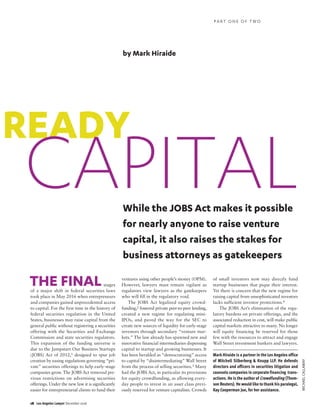
DECEMBER 2016 / $5
THE MAGAZINE OF THE LOS ANGELES COUNTY BAR ASSOCIATION
NEW
PARTNERSHIP
AUDIT RULES
page 24
Estate
Form
8971
page 12
On Direct:
Eli Broad
page 8
EARN MCLE CREDIT PLUS
SOCIAL
MEDIA IN
LITIGATION
page 30
Los Angeles lawyer Mark Hiraide
analyzes the regulatory regime
and impact of the Jumpstart Our
Business Startups (JOBS) Act
page 18
Ready
Capital
18 Los Angeles Lawyer December 2016
MICHAELCALLAWAY
stages
of a major shift in federal securities laws
took place in May 2016 when entrepreneurs
and companies gained unprecedented access
to capital. For the first time in the history of
federal securities regulation in the United
States, businesses may raise capital from the
general public without registering a securities
offering with the Securities and Exchange
Commission and state securities regulators.
This expansion of the funding universe is
due to the Jumpstart Our Business Startups
(JOBS) Act of 2012,1 designed to spur job
creation by easing regulations governing “pri-
vate” securities offerings to help early-stage
companies grow. The JOBS Act removed pre-
vious restrictions on advertising securities
offerings. Under the new law it is significantly
easier for entrepreneurial clients to fund their
ventures using other people’s money (OPM).
However, lawyers must remain vigilant as
regulators view lawyers as the gatekeepers
who will fill in the regulatory void.
The JOBS Act legalized equity crowd-
funding,2 fostered private peer-to-peer lending,
created a new regime for regulating mini-
IPOs, and paved the way for the SEC to
create new sources of liquidity for early-stage
investors through secondary “venture mar-
kets.” The law already has spawned new and
innovative financial intermediaries dispensing
capital to startup and growing businesses. It
has been heralded as “democratizing” access
to capital by “disintermediating” Wall Street
from the process of selling securities.3 Many
hail the JOBS Act, in particular its provisions
for equity crowdfunding, as allowing every-
day people to invest in an asset class previ-
ously reserved for venture capitalists. Crowds
of small investors now may directly fund
startup businesses that pique their interest.
Yet there is concern that the new regime for
raising capital from unsophisticated investors
lacks sufficient investor protections.4
The JOBS Act’s elimination of the regu-
latory burdens on private offerings, and the
associated reduction in cost, will make public
capital markets attractive to many. No longer
will equity financing be reserved for those
few with the resources to attract and engage
Wall Street investment bankers and lawyers.
Mark Hiraide is a partner in the Los Angeles office
of Mitchell Silberberg & Knupp LLP. He defends
directors and officers in securities litigation and
counsels companies in corporate financing trans-
actions. He is the author of Crowdfunding (Thom-
son Reuters). He would like to thankhis paralegal,
Kay Cooperman Jue, for her assistance.
READY
CAPITALWhile the JOBS Act makes it possible
for nearly anyone to raise venture
capital, it also raises the stakes for
business attorneys as gatekeepers
by Mark Hiraide
THE FINAL
P A R T O N E O F T W O
This “Uberization” of capital markets5 will
make capital more readily accessible to every
budding entrepreneur, and it will have sig-
nificant ramifications for the practice of busi-
ness law.
A growing awareness of access to capital
by the public will lead to a demand for legal
services. Lawyers have an opportunity to
expand their business practices, but they will
need to better understand the specialized field
of securities law. The new laws and rules
raise many new questions, the answers to
which often are informed by years of old
interpretations and customary practices in
the law of corporate financing transactions.
Today’s business lawyers must have at least
a working knowledge of the new methods
and rules for raising capital under Regulation
CF (crowdfunding), Regulation D, and
Regulation A under Titles II, III, and IV of
the JOBS Act. They must understand the
interplay between federal and state securities
laws. They must advise clients about the
often draconian statutory liabilities under
those laws. And they must be clear about
their role as securities lawyers and the lia-
bilities they assume.
When Congress enacted the Securities Act
of 1933 (Securities Act) and Securities Ex-
change Act of 1934 (Exchange Act) and
created the Securities and Exchange Com-
mission, the business of raising investment
capital—taking OPM—became subject to
extensive regulation. The federal securities
laws, and each state’s “blue sky” securities
laws, mandate that all offers and sales of
securities be registered with the SEC and
qualified with state securities regulators unless
exempt from such registration.
Prior to the JOBS Act, the most common
exemption from registration was for non-
public securities offerings,6 which placed
strict limitations on soliciting investors and
advertising the offering. The SEC and the
courts had long interpreted the nonpublic
offering exemption to prohibit any form of
general solicitation.7 They did not, however,
set forth clear guidelines for determining
what constituted a general solicitation. The
Supreme Court in 1953 outlined the contours
of what constitutes a private offering for pur-
poses of the exemption. In SEC v. Ralston
Purina Co., the Court examined the knowl-
edge of the investor and its relationship with
the issuer as a basis for distinguishing a
private offering from a public offering.8 The
boundaries, however, were far from clear.
Prior to the SEC’s promulgation of Regulation
D in 1982, many members of the securities
bar were uncomfortable rendering “no reg-
istration” opinions. Even after Regulation
D, until the enactment of the JOBS Act,
issuers, who in litigation bear the burden of
proving an exemption from registration, typ-
ically restricted their unregistered offerings
to prospective investors with whom they
could demonstrate a “pre-existing substantive
business relationship.”9
In recent years, organized groups of indi-
viduals with high net worth (angel investors)
have been a source of early-stage capital, but
attracting the attention of angel investors is
nearly impossible without some initial seed
capital to validate or prove a business model
or product. The only other alternative for
raising capital—soliciting the public—required
registering the securities offering with the
SEC, the same process undertaken by com-
panies going public through an initial public
offering (IPO). Registration is cost-prohibitive
for most early-stage companies.10 Even if a
company could afford the legal and audit
fees charged for public offerings, after the
dot-com crash in the early 1990s, the public
equity markets became inhospitable for early-
stage small (less than $50 million) IPOs.
Changes in market regulation, including the
decimalization and deregulation of commis-
sions, shrinking profits of smaller investment
banking firms, increased regulation of those
investment banking firms by the Financial
Industry Regulatory Authority (FINRA) in
response to microcap stock frauds, and other
structural changes to the industry, resulted
in the exodus of regional investment banking
underwriters to small public offerings.11
The Securities Act’s restrictions on solic-
iting investors—well-intentioned in the after-
math of the stock market crash of 1929 and
the Great Depression—made the ambition
of successfully raising capital for startups
unattainable for most people. It relegated
entrepreneurs to raising seed capital from
friends, family, and others with whom the
entrepreneur had the requisite relationship.12
Small issuers were frequently unable to com-
ply with Securities Act provisions because of
a combination of exorbitant costs, unwork-
able resale provisions, ambiguity, and taint
of prior illegal stock sales.
Consequently, an entrepreneur’s parents,
family, and friends, and the geographic neigh-
borhood in which one lived were significant
factors in determining who received funding,
who became owners of a business, and what
demographic eventually accumulated capital
and wealth in this country. To close the capital
gap for early-stage financing, stimulate job
growth, and address issues of unequal access
to capital, in 2012, President Obama signed
into law the JOBS Act. In relaxing the restric-
tions on soliciting investors, the new law
reflects the advent of the Internet, modern
communication technology, and social media,
which made the 90-year-old restrictions on
advertising securities offerings increasingly
impractical.
The JOBS Act dramatically changed the
rules relating to private securities offerings
by creating three new methods of conducting
public offerings that are exempt from SEC
registration. These offering exemptions are
found in Titles II, III, and IV of the JOBS
Act and are often referred to by these JOBS
Act titles. The differences among the three
exemptions relate to the size of the offering,
investor qualifications, and manner in which
the securities may be offered. The new exemp-
tions from registration afforded by Title II
and Title IV allow unrestricted general solic-
itation of investors; in effect, they permit
unregistered public offerings. Title III provides
a new exemption for selling securities through
crowdfunding. All three exemptions preempt
certain aspects of state blue sky securities
law regulation.
Title II: Rule 506(c) of Regulation D
Title II of the JOBS Act dramatically changed
the rules for raising capital from accredited
20 Los Angeles Lawyer December 2016
State Blue Sky Laws
“Blue sky laws” are state laws regulating the offer and sale of securities. The term originated from the
Supreme Court’s description of fraudulent securities as “speculative schemes which have no more
basis than so many feet of ‘blue sky.’”1 Although many states have adopted some form of the Uniform
Securities Act drafted by the National Conference of Commissioners of Uniform State Laws, others,
including California, have not adopted the uniform act and have their own unique securities law. Many
of these state securities laws provide the state securities regulator with the authority to deny a
securities offering based on the merits of the terms of the securities. California is one such “merit
review” state, and the commissioner of the Department of Business Oversight must make a finding
that an offering is “fair, just and equitable” before she will issue a permit to allow sale of the securities
in California. A principal feature of the JOBS Act is its preemption of blue sky laws for certain securities
offerings. However, federal preemption under the JOBS Act is limited. In most cases, it does not
preempt state regulation of offers and sales by shareholders (i.e., secondary transactions) or state
broker-dealer registration requirements. Similarly, each state blue sky statute provides investors with
statutory civil rescission remedies that are not subject to federal preemption.
1 Hall v. Geiger-Jones Co., 242 U.S. 539, 550 (1917).
investors who, in the case of an individual,
is a person with 1) an individual income in
excess of $200,000 in each of the two most
recent years or joint income with that person’s
spouse in excess of $300,000 in each of those
years and has a reasonable expectation of
reaching the same income level in the current
year, or 2) a net worth in excess of $1 million
excluding home equity.13 Title II amended
Rule 506 of Regulation D by adding new
paragraph c, which eliminated completely
the prohibition on general solicitation. This
means that a company can widely advertise
its offering as long as it takes “reasonable
steps to verify” that investors are accredited,
“using such method as determined by the
Commission.”14 Issuers must have a reason-
able belief that all purchasers are accredited
investors.15 Prior to Title II of the JOBS Act,
which went into effect in September 2014,
issuers customarily relied on self-certifications,
or check-the-box certifications as to accred-
itation. Self-certifications will not satisfy the
new verification requirement applicable to
public offerings under Rule 506(c).
Rule 506 of Regulation D has become
the cornerstone of the regulatory regime for
nonregistered offerings. The rule provides
bright line “safe harbor” rules to establish
an exemption from SEC registration. In 1996,
Congress addressed the duplication of dual
federal and state securities regulation in the
National Securities Markets Improvements
Act of 1996,16 and preempted state blue sky
registration or qualification of federal covered
securities, i.e., those offered in compliance
with Rule 506 of Regulation D. In addition
to federal preemption, the absence of any
limitation in Rule 506 on the offering amount
and number of investors as well as absence
of specific disclosure requirements for ac-
credited investors made Rule 506 the most
commonly used private offering exemption.
Today, 99 percent of all private offerings
under Regulation D are conducted pursuant
to Rule 506. Moreover, amounts raised
through unregistered securities offerings have
outpaced the level of capital formation
through registered securities offerings during
recent years. In 2014, there were 33,429
Regulation D offerings reported on Form
D filings, accounting for more than $1.3 tril-
lion raised.17 The JOBS Act adds securities
offered pursuant to Title III and Title IV to
the list of securities preempted from state
regulation.
The new rules provide a nonexclusive safe
harbor for an issuer to satisfy its verification
requirement by obtaining tax returns to veri-
fy income, or bank or brokerage statements
and a credit report to verify net worth. How-
ever, many investors are unwilling to furnish
confidential tax returns and brokerage state-
ments. Fortunately, the issuer is not required
to use the safe-harbor methods of verification.
In assessing whether an issuer has taken rea-
sonable steps to verify that investors are
accredited, the SEC takes a principles-based
approach that does not depend on bright-
line rules but relies rather on the particular
facts and circumstances of each purchaser
and transaction to determine whether the
steps taken are “reasonable.” Under this prin-
ciples-based approach, the documentation,
if any, that an issuer should obtain from a
potential investor will depend on answers to
questions such as:
• How much information about the prospec-
tive purchaser does the issuer already have?
The more information the issuer has indi-
cating that the person is an accredited investor,
the fewer verification steps it may have to
take to comply with the rule’s requirements.
For example, membership in an established
angel investor group is information that may
affect the likelihood of the person being an
accredited investor.
• How did the issuer find the prospective
investor? A person that the issuer located
through publicly accessible and widely dis-
seminated means of solicitation may need to
undergo a greater level of verification scrutiny
than a person who may have been prescreened
as an accredited investor by a reasonably
reliable third party.
• Are the terms of the offering such that only
a person who is truly an accredited investor
could participate? The ability of a purchaser
to satisfy a minimum investment amount
requirement that is sufficiently high such that
only accredited investors, using their own
cash, could reasonably be expected to meet
it is relevant in deciding what other steps are
needed to verify accredited investor status.18
Lastly, the SEC envisioned a role for third
parties that may wish to enter into the busi-
ness of verifying the accredited investor status
of prospective investors on behalf of issuers
and allowed for such third-party verification
under the principles-based approach as long
as the issuer has a reasonable basis to rely
on such third party.19
Securities sold pursuant to Rule 506 of
Regulation D must contain restrictions on
transferability, and the issuer must exercise
reasonable care to assure that the purchasers
of the securities do not intend to act as under-
writers by engaging in a distribution of the
securities purchased.20 Issuers should affix
a legend on the share certificates setting forth
the restrictions on transferability and make
reasonable inquiry to determine if the investor
is acquiring the securities for himself and not
for other persons.21 The JOBS Act Title II
amendments to Regulation D also imple-
mented a provision of the Dodd-Frank Wall
Street Reform and Consumer Protection Act
that directed the SEC to make the Rule 506
exemption unavailable for offerings in which
certain disqualified persons (“bad actors”)
participate, subject to a “reasonable care”
exception.22 There is no dollar limit on offer-
ings under Rule 506 and very few other lim-
itations.
The old Rule 506, which prohibits general
solicitation but allows issuers to include up
to 35 nonaccredited investors, remains avail-
able in paragraph (b) of Rule 506. Issuers
relying on the old rule also need not verify
that investors are accredited, as required by
new Rule 507(c). Moreover, recently issued
Compliance and Disclosure Interpretations
by the staff of the SEC Division of Corpor-
ation Finance expand the availability of the
old rule. These interpretations clarify that in
appropriate circumstances communications
in a closed network among members of an
informal, personal network of individuals
with experience investing in private offerings
will not be deemed to be a general solicitation.
Issuers may now conduct offerings on angel
investor networks and make presentations
at demo days and venture fairs without risk
that such activities will be deemed to be a
Los Angeles Lawyer December 2016 21
Tackling the Resale Problem
By preempting state blue sky regulation of tier 2 Regulation A+ offerings, the SEC paved the way for the
creation of secondary trading in Regulation A+ securities in markets recently coined “Venture Exchanges.”
However, further regulatory action will be required to make an active market for Regulation A+ securities
a reality. To facilitate a secondary market, the SEC amended Exchange Act Rule 15c2-11 to permit an
issuer’s ongoing reports filed under tier 2 of Regulation A+ to satisfy a broker-dealer’s obligations to
review and maintain certain information about an issuer’s quoted securities. However, because all offers
and sales of securities, even those by shareholders, are regulated by federal and state securities laws,
the secondary offer and sale by the shareholder must also comply with state blue sky laws unless such
state laws are preempted. Regulation A+ preempts the primary sale of securities by the issuer. The sec-
ondary sale by the shareholder is not subject to preemption. The Fixing America’s Surface Transportation
Act, enacted in December 2015, provides a partial solution for secondary sales to accredited investors. It
codified a resale exemption, commonly known as the “Section 4(11
⁄2)” exemption, for private resales of
restricted securities to accredited investors, and it preempted state blue sky law regulation of these
secondary transactions.
general solicitation.23 On the other hand, the
staff also clarified that one method of estab-
lishing the absence of a general solicitation—
showing a preexisting “substantive business
relationship” with prospective investors—
requires that the issuer possess sufficient
information to evaluate the offeree’s financial
circumstances and sophistication. Self-certi-
fication, without any other information about
the prospective offeree, is not enough to be
considered substantive.
Despite the staff’s recent efforts to provide
guidance on issues arising under the JOBS
Act, answers to many questions require resort-
ing to years of SEC staff interpretation and
judicial precedent. For example, in response
to the question, “What information can an
issuer widely disseminate about itself without
contravening Regulation D’s prohibition on
general solicitation?” the staff responded that
factual business information that “does not
condition the public mind or arouse public
interest in a securities offering” will not
violate the rule.24 To understand the response,
however, one must look to the SEC staff’s
long-time guidance on when such commu-
nications will be deemed an “offer”25 and
be aware that courts have interpreted the
term for securities law purposes broadly
beyond the common law concept of an offer.26
Title IV: Regulation A+
Title IV of the JOBS Act is commonly known
as “Regulation A+” and has also been dubbed
a “mini-IPO.” Once qualified, the offering
may be sold to anyone. There is no require-
ment that the investor be accredited or sophis-
ticated, no restriction on the means of sol-
icitation, and no federal restriction on trans-
ferability of the securities. Effective since June
2015, it amends the former SEC Regulation
A by increasing the old offering limit of $5
million to $50 million. An offering under
the new Regulation A requires an offering
circular containing specific disclosures similar
to those made in an IPO prospectus, and the
offering is subject to SEC review and quali-
fication of the offering circular. The offering
circular must include financial statements
consisting of the prior year’s balance sheet
and income statements for the most recent
two years. The SEC review process for
Regulation A+ offerings is similar to the reg-
istration process for a registered IPO. The
staff of the SEC’s Division of Corporation
Finance reviews all Regulation A+ offering
circulars and approximately 30 days from
the filing date of the offering circular on
Form 1-A, the staff will issue its written com-
ments. The company responds to these staff
comments by filing a series of amendments
to the offering circular until all staff comments
are resolved. Only then will the SEC declare
the offering statement “qualified.” No sales
of securities may be made until the SEC
declares the statement qualified. In most
cases, the time period from SEC filing to the
effective date is at least 60 days and in many
cases much longer.
A principal benefit of Regulation A+ is
its “test the waters” provisions. An issuer
may solicit indications of interest before and
after an offering circular is filed. While no
sale commitments may be accepted until the
offering circular is qualified by the SEC, there
are few restrictions on the content of test-
the-waters materials. Through a social media
campaign, for example, companies may ask
potential investors for their contact infor-
mation and the dollar amount of their invest-
ment interest by asking them to reserve shares
for purchase when, and if, the SEC qualifies
the offering. If there is sufficient interest,
upon qualification of the offering by the SEC,
the issuer may then formally offer and accept
subscriptions from those prospective investors
who had previously expressed interest in the
offering.
Regulation A+ has two tiers: tier 1, with
a maximum offering limit of $20 million,
and tier 2 with a maximum offering limit of
$50 million. The principal difference between
them is that tier 2 offerings preempt state
securities laws. The SEC left intact state blue
sky regulation of tier 1 offerings under Reg-
ulation A+. Another difference between the
two tiers is tier 2 offerings require a financial
statement audit, and the issuer must file with
the SEC ongoing annual, semiannual, and
current reports. Also, nonaccredited investors
in a tier 2 offering may not invest more than
the greater of 10 percent of their net worth
or annual income in any single Regulation
A+ offering. Finally, because there is no pre-
emption of state securities laws with tier 1
offerings, audited financial statements in
most cases will be necessary even though the
SEC does not require financial statements to
be audited in tier 1 offerings. This provision
is necessary because many states require
audited financial statements in order to qual-
ify the offering in the state.
The ongoing SEC reporting required of
companies conducting tier 2 Regulation A+
offerings is considered to be a “lite” form of
the periodic reporting required of companies
that conduct registered offerings. Unlike com-
panies registering their securities offerings
under the Securities Act on Form S-1, an
issuer selling securities under the Regulation
A exemption from registration does not
become subject to the full regulatory regime
under Section 12 of the Exchange Act, which
automatically applies to issuers registering
an offering under the Securities Act.27 Com-
panies conducting registered offerings must
file periodic reports—annual reports on Form
10-K, quarterly reports on Form 10-Q, and
current reports on Form 8-K—proxy state-
ments and beneficial ownership reports by
the company’s officers, directors and 10-per-
cent shareholders.
The annual financial statement audit
required of tier 2 Regulation A+ issuers need
not be performed by auditors who are regis-
tered with the Public Company Accounting
Board, which is a requirement for audits of
SEC-registered companies. The six-month
semiannual report required of Regulation
A+ issuers need only contain financial state-
22 Los Angeles Lawyer December 2016
Solving the Facebook Problem
A privately held company automatically becomes subject to the full SEC regulatory regime under the
Exchange Act once it elects to register its initial public offering under the Securities Act. A privately held
company may also be required to register under the Exchange Act, if its assets and shareholder base
grows to a certain size. One of the more important changes included in the JOBS Act was to increase
these Exchange Act registration thresholds to mitigate what has been known as the Facebook problem,
a problem confronting many startups with large numbers of stockholders. Prior to the JOBS Act, Section
12(g) of the Exchange Act required that a company with more than $10 million in total assets register
any class of securities held by more than 500 shareholders of record, whether accredited or not. This
Exchange Act registration triggers all of the SEC’s regulations governing publicly traded companies,
including, among others, periodic reporting, insider security transaction reporting, proxy statement fil-
ing, and short-swing insider trading prohibitions. The JOBS Act raised the thresholds for registration
(and termination) of registration for a class of securities under the Exchange Act. As a result, an issuer
that is not a bank, bank holding company, or savings and loan holding company is required to register
a class of equity securities if it has more than $10 million total assets and the securities are held of
record by either 2,000 or 500 persons who are not accredited investors. The JOBS Act also directed the
SEC to revise the definition of “held of record” to exclude securities held by persons who received the
securities under an employee compensation plan in transactions exempted from registration under the
Securities Act. This last requirement addressed the Facebook problem. Prior to its IPO, Facebook, hav-
ing more than $10 million in assets and more than 500 stockholders, decided to register its IPO under
the Securities Act because it would have been required to register its common stock under the
Exchange Act in any event.
ments that management certifies are prepared
in accordance with generally accepted ac-
counting principles in the United States. There
is no requirement that the six-month financial
statements in the semiannual report be re-
viewed by an independent auditor, as required
for quarterly reports of SEC-registered com-
panies. The ongoing reporting regime for tier
2 Regulation A+ issuers also includes a “lite”
current events requirement to report certain
specified events, including fundamental
changes in the issuer’s business, changes in
control of the issuer, a departure of the prin-
cipal executive officer, principal financial
officer, or principal accounting officer, and
any unregistered sales of 10 percent or more
of outstanding equity securities.28
Restrictive securities laws in effect for the
90 years prior to the JOBS Act made it diffi-
cult to start and finance businesses for those
who did not have access to capital sources
or friends and family to provide funding.
The JOBS Act enables anyone to reach out
to capital sources and raise equity capital.
But the “disintermediation” of Wall Street
places a heavier burden on the business attor-
ney. Without professional financial interme-
diaries, such as investment bankers, it will
be up to business attorneys to navigate the
new securities rules and regulations to ensure
that they and their clients follow the right
path. n
[Editor’s note: In a subsequent issue of
Los Angeles Lawyer, Part 2 of this article on
the JOBS Act will discuss Title III Crowd-
funding and how attorneys can counsel clients
to raise capital while managing the securities
law liability to their clients and themselves.]
1 Jumpstart Our Business Startups (JOBS) Act, Pub.
L. No. 112-106, §§301–05, 126 Stat. 306, 315–23
(2012) (codified in scattered sections of 15 U.S.C.).
2 Equity crowdfunding involves investments in “secu-
rities,” as the term is defined under the Securities Act
of 1933 (Securities Act) and Securities Exchange Act
of 1934 (Exchange Act). See §2(a)(1), 15 U.S.C.
§77b(1); §3(a)(10), 15 U.S.C. §78c(a)(10). A “security”
includes not only stocks, bonds, limited partnership
and limited liability company membership interests,
but also any “investment contract” that is “a contract,
transaction or scheme whereby a person invests his
money in a common enterprise and is led to expect
profits solely from the efforts of the promoter or a
third party….” SEC v. W.J. Howey Co., 328 U.S. 293,
298-99 (1946). Prior to the JOBS Act, private offering
exemptions from the Securities Act’s registration
requirement did not allow for equity crowdfunding,
which, by definition, involves a public offering to the
crowd.
3 See, e.g., Chance Barnett, SEC Democratizes Equity
Crowdfunding With JOBS Act Title IV, FORBES (Mar.
25, 2015), available at http://www.forbes.com;
Crowdfunding: Decentralizing, Disintermediating,
Disrupting, CROWDFUNDER INSIDER (Apr. 28, 2013),
available at http://www.crowdfundinsider.com;
Jumpstart Our Business Startups Act Frequently Asked
Questions About Crowdfunding Intermediaries, U.S.
Sec. & Exchange Comm’n (May 7, 2012), https://www
.sec.gov (last visited Oct. 26, 2016).
4 See, e.g., Robert C. Pozen, JOBS Act: Jumpstarting
Business or Bilking Investors?, BROOKINGS INST. (Apr.
3, 2012), available at https://www.brookings.edu; The
JOBS Act Fails Investors and Entrepreneurs, N. Am.
Sec. Admins. Ass’n (Apr. 5, 2012) http://www.nasaa.org.
5 The Uberization of Money, WALL ST. J., Nov. 4, 2015,
available at http://www.wsj.com.
6 15 U.S.C. §77d(a)(2).
7 SEC v. Ralston Purina Co., 345 U.S. 119 (1953); Final
Rule: Nonpublic Offering Exemption, SEC Release
No. 33-4552 (Nov. 6, 1962).
8 Ralston Purina, 346 U.S. 119.
9 David B.H. Martin, Jr. and L. Keith Parsons, The
Preexisting Relationship Doctrine Under Regulation
D: A Rule Without Reason?, 45 WASH. & LEE L. REV.
1031 (1988).
10 Two surveys cited by the SEC last fall concluded
that the average initial compliance cost associated
with conducting an IPO is $2.5 million, followed by
an ongoing compliance cost for issuers, once public,
of $1.5 million per year. The SEC staff notes that
these estimates should be interpreted with the caveat
that most firms in the IPO Task Force surveys likely
raised more than $1 million. See IPO TASK FORCE,
REBUILDING THE IPO ON-RAMP (Oct. 20, 2011), avail-
able at http://www.sec.gov.
11 See David Weild and Edward Kim, Market structure
is causing the IPO crisis—and more, GRANT THORNTON
(June 2010), available at http://www. weildco.com..
12 See, generally, Rutherford B Campbell, Jr., The
Plight of Small Issuers Under the Securities Act of
1933: Practical Foreclosure from the Capital Market,
DUKE L.J. 1139 (1977).
13 17 C.F.R. §230.501.
14 JOBS Act, §201(a)(1).
15 See 17 C.F.R. §230.501(a) (accredited investors are
persons that the issuer reasonably believes come within
the specified categories).
16 National Securities Markets Improvements Act of
1996, Pub. L. No. 104-290,110 Stat. 3416 (1996).
17 Scott Baugess, et al., Capital Raising in the U.S.:
An Analysis of the Market for Unregistered Securities
Offerings, 2009-2014, SEC Div. of Econ. and Risk
Analysis (Oct. 2015), available at https://www.sec.gov.
18 Keith F. Higgins, Dir., Div. of Corp. Fin., Keynote
Address at the 2014 Angel Capital Association Summit,
Wash., D.C. (Mar. 28, 2014), available at https://www
.sec.gov.
19 Final Rule: Eliminated the Prohibition Against
General Solicitation and General Advertising in Rule
506 and Rule 144A Offerings, SEC Release No. 33-
9415 (July 10, 2013).
20 15 U.S.C. §77b(a)(11).
21 17 C.F.R. §230.502(d).
22 17 C.F.R. §230.506(d).
21 See Compliance and Disclosure Interpretations
(CDIs), Securities Act Rules, §§256.23 – 256.33 (Aug.
6, 2015), available at https://www.sec.gov/divisions
/corpfin/guidance/securitiesactrules-interps.htm [here-
inafter CDIs]. For information regarding policies and
procedures for establishing a preexisting substantive
relationship with prospective offerees over the Internet,
see Citizen VC, Inc., SEC No-Action letter (Aug. 6,
2015), available at http://www.sec.gov/divisions/corpfin
/cf-noaction/2015/citizen-vc-inc-080615-502.htm.
24 See CDIs, Question 256.24.
25 See 17 C.F.R. §230.169; Securities Offering Reform,
SEC Release No. 33-8591 (July 19, 2005) [70 FR
44722 (Aug. 3, 2005)] at 44731.
26 See, e.g., Diskin v. Lomasney & Co., 452 F. 2d 871
(2d. Cir. 1971).
27 See 15 U.S.C. §78o(d); 15 U.S.C. §78m.
28 See 17 C.F.R. §230.257.
Los Angeles Lawyer December 2016 23

LA Lawyer Article Dec 2016 - Hiraide

  • 1.
    DECEMBER 2016 /$5 THE MAGAZINE OF THE LOS ANGELES COUNTY BAR ASSOCIATION NEW PARTNERSHIP AUDIT RULES page 24 Estate Form 8971 page 12 On Direct: Eli Broad page 8 EARN MCLE CREDIT PLUS SOCIAL MEDIA IN LITIGATION page 30 Los Angeles lawyer Mark Hiraide analyzes the regulatory regime and impact of the Jumpstart Our Business Startups (JOBS) Act page 18 Ready Capital
  • 2.
    18 Los AngelesLawyer December 2016 MICHAELCALLAWAY stages of a major shift in federal securities laws took place in May 2016 when entrepreneurs and companies gained unprecedented access to capital. For the first time in the history of federal securities regulation in the United States, businesses may raise capital from the general public without registering a securities offering with the Securities and Exchange Commission and state securities regulators. This expansion of the funding universe is due to the Jumpstart Our Business Startups (JOBS) Act of 2012,1 designed to spur job creation by easing regulations governing “pri- vate” securities offerings to help early-stage companies grow. The JOBS Act removed pre- vious restrictions on advertising securities offerings. Under the new law it is significantly easier for entrepreneurial clients to fund their ventures using other people’s money (OPM). However, lawyers must remain vigilant as regulators view lawyers as the gatekeepers who will fill in the regulatory void. The JOBS Act legalized equity crowd- funding,2 fostered private peer-to-peer lending, created a new regime for regulating mini- IPOs, and paved the way for the SEC to create new sources of liquidity for early-stage investors through secondary “venture mar- kets.” The law already has spawned new and innovative financial intermediaries dispensing capital to startup and growing businesses. It has been heralded as “democratizing” access to capital by “disintermediating” Wall Street from the process of selling securities.3 Many hail the JOBS Act, in particular its provisions for equity crowdfunding, as allowing every- day people to invest in an asset class previ- ously reserved for venture capitalists. Crowds of small investors now may directly fund startup businesses that pique their interest. Yet there is concern that the new regime for raising capital from unsophisticated investors lacks sufficient investor protections.4 The JOBS Act’s elimination of the regu- latory burdens on private offerings, and the associated reduction in cost, will make public capital markets attractive to many. No longer will equity financing be reserved for those few with the resources to attract and engage Wall Street investment bankers and lawyers. Mark Hiraide is a partner in the Los Angeles office of Mitchell Silberberg & Knupp LLP. He defends directors and officers in securities litigation and counsels companies in corporate financing trans- actions. He is the author of Crowdfunding (Thom- son Reuters). He would like to thankhis paralegal, Kay Cooperman Jue, for her assistance. READY CAPITALWhile the JOBS Act makes it possible for nearly anyone to raise venture capital, it also raises the stakes for business attorneys as gatekeepers by Mark Hiraide THE FINAL P A R T O N E O F T W O
  • 4.
    This “Uberization” ofcapital markets5 will make capital more readily accessible to every budding entrepreneur, and it will have sig- nificant ramifications for the practice of busi- ness law. A growing awareness of access to capital by the public will lead to a demand for legal services. Lawyers have an opportunity to expand their business practices, but they will need to better understand the specialized field of securities law. The new laws and rules raise many new questions, the answers to which often are informed by years of old interpretations and customary practices in the law of corporate financing transactions. Today’s business lawyers must have at least a working knowledge of the new methods and rules for raising capital under Regulation CF (crowdfunding), Regulation D, and Regulation A under Titles II, III, and IV of the JOBS Act. They must understand the interplay between federal and state securities laws. They must advise clients about the often draconian statutory liabilities under those laws. And they must be clear about their role as securities lawyers and the lia- bilities they assume. When Congress enacted the Securities Act of 1933 (Securities Act) and Securities Ex- change Act of 1934 (Exchange Act) and created the Securities and Exchange Com- mission, the business of raising investment capital—taking OPM—became subject to extensive regulation. The federal securities laws, and each state’s “blue sky” securities laws, mandate that all offers and sales of securities be registered with the SEC and qualified with state securities regulators unless exempt from such registration. Prior to the JOBS Act, the most common exemption from registration was for non- public securities offerings,6 which placed strict limitations on soliciting investors and advertising the offering. The SEC and the courts had long interpreted the nonpublic offering exemption to prohibit any form of general solicitation.7 They did not, however, set forth clear guidelines for determining what constituted a general solicitation. The Supreme Court in 1953 outlined the contours of what constitutes a private offering for pur- poses of the exemption. In SEC v. Ralston Purina Co., the Court examined the knowl- edge of the investor and its relationship with the issuer as a basis for distinguishing a private offering from a public offering.8 The boundaries, however, were far from clear. Prior to the SEC’s promulgation of Regulation D in 1982, many members of the securities bar were uncomfortable rendering “no reg- istration” opinions. Even after Regulation D, until the enactment of the JOBS Act, issuers, who in litigation bear the burden of proving an exemption from registration, typ- ically restricted their unregistered offerings to prospective investors with whom they could demonstrate a “pre-existing substantive business relationship.”9 In recent years, organized groups of indi- viduals with high net worth (angel investors) have been a source of early-stage capital, but attracting the attention of angel investors is nearly impossible without some initial seed capital to validate or prove a business model or product. The only other alternative for raising capital—soliciting the public—required registering the securities offering with the SEC, the same process undertaken by com- panies going public through an initial public offering (IPO). Registration is cost-prohibitive for most early-stage companies.10 Even if a company could afford the legal and audit fees charged for public offerings, after the dot-com crash in the early 1990s, the public equity markets became inhospitable for early- stage small (less than $50 million) IPOs. Changes in market regulation, including the decimalization and deregulation of commis- sions, shrinking profits of smaller investment banking firms, increased regulation of those investment banking firms by the Financial Industry Regulatory Authority (FINRA) in response to microcap stock frauds, and other structural changes to the industry, resulted in the exodus of regional investment banking underwriters to small public offerings.11 The Securities Act’s restrictions on solic- iting investors—well-intentioned in the after- math of the stock market crash of 1929 and the Great Depression—made the ambition of successfully raising capital for startups unattainable for most people. It relegated entrepreneurs to raising seed capital from friends, family, and others with whom the entrepreneur had the requisite relationship.12 Small issuers were frequently unable to com- ply with Securities Act provisions because of a combination of exorbitant costs, unwork- able resale provisions, ambiguity, and taint of prior illegal stock sales. Consequently, an entrepreneur’s parents, family, and friends, and the geographic neigh- borhood in which one lived were significant factors in determining who received funding, who became owners of a business, and what demographic eventually accumulated capital and wealth in this country. To close the capital gap for early-stage financing, stimulate job growth, and address issues of unequal access to capital, in 2012, President Obama signed into law the JOBS Act. In relaxing the restric- tions on soliciting investors, the new law reflects the advent of the Internet, modern communication technology, and social media, which made the 90-year-old restrictions on advertising securities offerings increasingly impractical. The JOBS Act dramatically changed the rules relating to private securities offerings by creating three new methods of conducting public offerings that are exempt from SEC registration. These offering exemptions are found in Titles II, III, and IV of the JOBS Act and are often referred to by these JOBS Act titles. The differences among the three exemptions relate to the size of the offering, investor qualifications, and manner in which the securities may be offered. The new exemp- tions from registration afforded by Title II and Title IV allow unrestricted general solic- itation of investors; in effect, they permit unregistered public offerings. Title III provides a new exemption for selling securities through crowdfunding. All three exemptions preempt certain aspects of state blue sky securities law regulation. Title II: Rule 506(c) of Regulation D Title II of the JOBS Act dramatically changed the rules for raising capital from accredited 20 Los Angeles Lawyer December 2016 State Blue Sky Laws “Blue sky laws” are state laws regulating the offer and sale of securities. The term originated from the Supreme Court’s description of fraudulent securities as “speculative schemes which have no more basis than so many feet of ‘blue sky.’”1 Although many states have adopted some form of the Uniform Securities Act drafted by the National Conference of Commissioners of Uniform State Laws, others, including California, have not adopted the uniform act and have their own unique securities law. Many of these state securities laws provide the state securities regulator with the authority to deny a securities offering based on the merits of the terms of the securities. California is one such “merit review” state, and the commissioner of the Department of Business Oversight must make a finding that an offering is “fair, just and equitable” before she will issue a permit to allow sale of the securities in California. A principal feature of the JOBS Act is its preemption of blue sky laws for certain securities offerings. However, federal preemption under the JOBS Act is limited. In most cases, it does not preempt state regulation of offers and sales by shareholders (i.e., secondary transactions) or state broker-dealer registration requirements. Similarly, each state blue sky statute provides investors with statutory civil rescission remedies that are not subject to federal preemption. 1 Hall v. Geiger-Jones Co., 242 U.S. 539, 550 (1917).
  • 5.
    investors who, inthe case of an individual, is a person with 1) an individual income in excess of $200,000 in each of the two most recent years or joint income with that person’s spouse in excess of $300,000 in each of those years and has a reasonable expectation of reaching the same income level in the current year, or 2) a net worth in excess of $1 million excluding home equity.13 Title II amended Rule 506 of Regulation D by adding new paragraph c, which eliminated completely the prohibition on general solicitation. This means that a company can widely advertise its offering as long as it takes “reasonable steps to verify” that investors are accredited, “using such method as determined by the Commission.”14 Issuers must have a reason- able belief that all purchasers are accredited investors.15 Prior to Title II of the JOBS Act, which went into effect in September 2014, issuers customarily relied on self-certifications, or check-the-box certifications as to accred- itation. Self-certifications will not satisfy the new verification requirement applicable to public offerings under Rule 506(c). Rule 506 of Regulation D has become the cornerstone of the regulatory regime for nonregistered offerings. The rule provides bright line “safe harbor” rules to establish an exemption from SEC registration. In 1996, Congress addressed the duplication of dual federal and state securities regulation in the National Securities Markets Improvements Act of 1996,16 and preempted state blue sky registration or qualification of federal covered securities, i.e., those offered in compliance with Rule 506 of Regulation D. In addition to federal preemption, the absence of any limitation in Rule 506 on the offering amount and number of investors as well as absence of specific disclosure requirements for ac- credited investors made Rule 506 the most commonly used private offering exemption. Today, 99 percent of all private offerings under Regulation D are conducted pursuant to Rule 506. Moreover, amounts raised through unregistered securities offerings have outpaced the level of capital formation through registered securities offerings during recent years. In 2014, there were 33,429 Regulation D offerings reported on Form D filings, accounting for more than $1.3 tril- lion raised.17 The JOBS Act adds securities offered pursuant to Title III and Title IV to the list of securities preempted from state regulation. The new rules provide a nonexclusive safe harbor for an issuer to satisfy its verification requirement by obtaining tax returns to veri- fy income, or bank or brokerage statements and a credit report to verify net worth. How- ever, many investors are unwilling to furnish confidential tax returns and brokerage state- ments. Fortunately, the issuer is not required to use the safe-harbor methods of verification. In assessing whether an issuer has taken rea- sonable steps to verify that investors are accredited, the SEC takes a principles-based approach that does not depend on bright- line rules but relies rather on the particular facts and circumstances of each purchaser and transaction to determine whether the steps taken are “reasonable.” Under this prin- ciples-based approach, the documentation, if any, that an issuer should obtain from a potential investor will depend on answers to questions such as: • How much information about the prospec- tive purchaser does the issuer already have? The more information the issuer has indi- cating that the person is an accredited investor, the fewer verification steps it may have to take to comply with the rule’s requirements. For example, membership in an established angel investor group is information that may affect the likelihood of the person being an accredited investor. • How did the issuer find the prospective investor? A person that the issuer located through publicly accessible and widely dis- seminated means of solicitation may need to undergo a greater level of verification scrutiny than a person who may have been prescreened as an accredited investor by a reasonably reliable third party. • Are the terms of the offering such that only a person who is truly an accredited investor could participate? The ability of a purchaser to satisfy a minimum investment amount requirement that is sufficiently high such that only accredited investors, using their own cash, could reasonably be expected to meet it is relevant in deciding what other steps are needed to verify accredited investor status.18 Lastly, the SEC envisioned a role for third parties that may wish to enter into the busi- ness of verifying the accredited investor status of prospective investors on behalf of issuers and allowed for such third-party verification under the principles-based approach as long as the issuer has a reasonable basis to rely on such third party.19 Securities sold pursuant to Rule 506 of Regulation D must contain restrictions on transferability, and the issuer must exercise reasonable care to assure that the purchasers of the securities do not intend to act as under- writers by engaging in a distribution of the securities purchased.20 Issuers should affix a legend on the share certificates setting forth the restrictions on transferability and make reasonable inquiry to determine if the investor is acquiring the securities for himself and not for other persons.21 The JOBS Act Title II amendments to Regulation D also imple- mented a provision of the Dodd-Frank Wall Street Reform and Consumer Protection Act that directed the SEC to make the Rule 506 exemption unavailable for offerings in which certain disqualified persons (“bad actors”) participate, subject to a “reasonable care” exception.22 There is no dollar limit on offer- ings under Rule 506 and very few other lim- itations. The old Rule 506, which prohibits general solicitation but allows issuers to include up to 35 nonaccredited investors, remains avail- able in paragraph (b) of Rule 506. Issuers relying on the old rule also need not verify that investors are accredited, as required by new Rule 507(c). Moreover, recently issued Compliance and Disclosure Interpretations by the staff of the SEC Division of Corpor- ation Finance expand the availability of the old rule. These interpretations clarify that in appropriate circumstances communications in a closed network among members of an informal, personal network of individuals with experience investing in private offerings will not be deemed to be a general solicitation. Issuers may now conduct offerings on angel investor networks and make presentations at demo days and venture fairs without risk that such activities will be deemed to be a Los Angeles Lawyer December 2016 21 Tackling the Resale Problem By preempting state blue sky regulation of tier 2 Regulation A+ offerings, the SEC paved the way for the creation of secondary trading in Regulation A+ securities in markets recently coined “Venture Exchanges.” However, further regulatory action will be required to make an active market for Regulation A+ securities a reality. To facilitate a secondary market, the SEC amended Exchange Act Rule 15c2-11 to permit an issuer’s ongoing reports filed under tier 2 of Regulation A+ to satisfy a broker-dealer’s obligations to review and maintain certain information about an issuer’s quoted securities. However, because all offers and sales of securities, even those by shareholders, are regulated by federal and state securities laws, the secondary offer and sale by the shareholder must also comply with state blue sky laws unless such state laws are preempted. Regulation A+ preempts the primary sale of securities by the issuer. The sec- ondary sale by the shareholder is not subject to preemption. The Fixing America’s Surface Transportation Act, enacted in December 2015, provides a partial solution for secondary sales to accredited investors. It codified a resale exemption, commonly known as the “Section 4(11 ⁄2)” exemption, for private resales of restricted securities to accredited investors, and it preempted state blue sky law regulation of these secondary transactions.
  • 6.
    general solicitation.23 Onthe other hand, the staff also clarified that one method of estab- lishing the absence of a general solicitation— showing a preexisting “substantive business relationship” with prospective investors— requires that the issuer possess sufficient information to evaluate the offeree’s financial circumstances and sophistication. Self-certi- fication, without any other information about the prospective offeree, is not enough to be considered substantive. Despite the staff’s recent efforts to provide guidance on issues arising under the JOBS Act, answers to many questions require resort- ing to years of SEC staff interpretation and judicial precedent. For example, in response to the question, “What information can an issuer widely disseminate about itself without contravening Regulation D’s prohibition on general solicitation?” the staff responded that factual business information that “does not condition the public mind or arouse public interest in a securities offering” will not violate the rule.24 To understand the response, however, one must look to the SEC staff’s long-time guidance on when such commu- nications will be deemed an “offer”25 and be aware that courts have interpreted the term for securities law purposes broadly beyond the common law concept of an offer.26 Title IV: Regulation A+ Title IV of the JOBS Act is commonly known as “Regulation A+” and has also been dubbed a “mini-IPO.” Once qualified, the offering may be sold to anyone. There is no require- ment that the investor be accredited or sophis- ticated, no restriction on the means of sol- icitation, and no federal restriction on trans- ferability of the securities. Effective since June 2015, it amends the former SEC Regulation A by increasing the old offering limit of $5 million to $50 million. An offering under the new Regulation A requires an offering circular containing specific disclosures similar to those made in an IPO prospectus, and the offering is subject to SEC review and quali- fication of the offering circular. The offering circular must include financial statements consisting of the prior year’s balance sheet and income statements for the most recent two years. The SEC review process for Regulation A+ offerings is similar to the reg- istration process for a registered IPO. The staff of the SEC’s Division of Corporation Finance reviews all Regulation A+ offering circulars and approximately 30 days from the filing date of the offering circular on Form 1-A, the staff will issue its written com- ments. The company responds to these staff comments by filing a series of amendments to the offering circular until all staff comments are resolved. Only then will the SEC declare the offering statement “qualified.” No sales of securities may be made until the SEC declares the statement qualified. In most cases, the time period from SEC filing to the effective date is at least 60 days and in many cases much longer. A principal benefit of Regulation A+ is its “test the waters” provisions. An issuer may solicit indications of interest before and after an offering circular is filed. While no sale commitments may be accepted until the offering circular is qualified by the SEC, there are few restrictions on the content of test- the-waters materials. Through a social media campaign, for example, companies may ask potential investors for their contact infor- mation and the dollar amount of their invest- ment interest by asking them to reserve shares for purchase when, and if, the SEC qualifies the offering. If there is sufficient interest, upon qualification of the offering by the SEC, the issuer may then formally offer and accept subscriptions from those prospective investors who had previously expressed interest in the offering. Regulation A+ has two tiers: tier 1, with a maximum offering limit of $20 million, and tier 2 with a maximum offering limit of $50 million. The principal difference between them is that tier 2 offerings preempt state securities laws. The SEC left intact state blue sky regulation of tier 1 offerings under Reg- ulation A+. Another difference between the two tiers is tier 2 offerings require a financial statement audit, and the issuer must file with the SEC ongoing annual, semiannual, and current reports. Also, nonaccredited investors in a tier 2 offering may not invest more than the greater of 10 percent of their net worth or annual income in any single Regulation A+ offering. Finally, because there is no pre- emption of state securities laws with tier 1 offerings, audited financial statements in most cases will be necessary even though the SEC does not require financial statements to be audited in tier 1 offerings. This provision is necessary because many states require audited financial statements in order to qual- ify the offering in the state. The ongoing SEC reporting required of companies conducting tier 2 Regulation A+ offerings is considered to be a “lite” form of the periodic reporting required of companies that conduct registered offerings. Unlike com- panies registering their securities offerings under the Securities Act on Form S-1, an issuer selling securities under the Regulation A exemption from registration does not become subject to the full regulatory regime under Section 12 of the Exchange Act, which automatically applies to issuers registering an offering under the Securities Act.27 Com- panies conducting registered offerings must file periodic reports—annual reports on Form 10-K, quarterly reports on Form 10-Q, and current reports on Form 8-K—proxy state- ments and beneficial ownership reports by the company’s officers, directors and 10-per- cent shareholders. The annual financial statement audit required of tier 2 Regulation A+ issuers need not be performed by auditors who are regis- tered with the Public Company Accounting Board, which is a requirement for audits of SEC-registered companies. The six-month semiannual report required of Regulation A+ issuers need only contain financial state- 22 Los Angeles Lawyer December 2016 Solving the Facebook Problem A privately held company automatically becomes subject to the full SEC regulatory regime under the Exchange Act once it elects to register its initial public offering under the Securities Act. A privately held company may also be required to register under the Exchange Act, if its assets and shareholder base grows to a certain size. One of the more important changes included in the JOBS Act was to increase these Exchange Act registration thresholds to mitigate what has been known as the Facebook problem, a problem confronting many startups with large numbers of stockholders. Prior to the JOBS Act, Section 12(g) of the Exchange Act required that a company with more than $10 million in total assets register any class of securities held by more than 500 shareholders of record, whether accredited or not. This Exchange Act registration triggers all of the SEC’s regulations governing publicly traded companies, including, among others, periodic reporting, insider security transaction reporting, proxy statement fil- ing, and short-swing insider trading prohibitions. The JOBS Act raised the thresholds for registration (and termination) of registration for a class of securities under the Exchange Act. As a result, an issuer that is not a bank, bank holding company, or savings and loan holding company is required to register a class of equity securities if it has more than $10 million total assets and the securities are held of record by either 2,000 or 500 persons who are not accredited investors. The JOBS Act also directed the SEC to revise the definition of “held of record” to exclude securities held by persons who received the securities under an employee compensation plan in transactions exempted from registration under the Securities Act. This last requirement addressed the Facebook problem. Prior to its IPO, Facebook, hav- ing more than $10 million in assets and more than 500 stockholders, decided to register its IPO under the Securities Act because it would have been required to register its common stock under the Exchange Act in any event.
  • 7.
    ments that managementcertifies are prepared in accordance with generally accepted ac- counting principles in the United States. There is no requirement that the six-month financial statements in the semiannual report be re- viewed by an independent auditor, as required for quarterly reports of SEC-registered com- panies. The ongoing reporting regime for tier 2 Regulation A+ issuers also includes a “lite” current events requirement to report certain specified events, including fundamental changes in the issuer’s business, changes in control of the issuer, a departure of the prin- cipal executive officer, principal financial officer, or principal accounting officer, and any unregistered sales of 10 percent or more of outstanding equity securities.28 Restrictive securities laws in effect for the 90 years prior to the JOBS Act made it diffi- cult to start and finance businesses for those who did not have access to capital sources or friends and family to provide funding. The JOBS Act enables anyone to reach out to capital sources and raise equity capital. But the “disintermediation” of Wall Street places a heavier burden on the business attor- ney. Without professional financial interme- diaries, such as investment bankers, it will be up to business attorneys to navigate the new securities rules and regulations to ensure that they and their clients follow the right path. n [Editor’s note: In a subsequent issue of Los Angeles Lawyer, Part 2 of this article on the JOBS Act will discuss Title III Crowd- funding and how attorneys can counsel clients to raise capital while managing the securities law liability to their clients and themselves.] 1 Jumpstart Our Business Startups (JOBS) Act, Pub. L. No. 112-106, §§301–05, 126 Stat. 306, 315–23 (2012) (codified in scattered sections of 15 U.S.C.). 2 Equity crowdfunding involves investments in “secu- rities,” as the term is defined under the Securities Act of 1933 (Securities Act) and Securities Exchange Act of 1934 (Exchange Act). See §2(a)(1), 15 U.S.C. §77b(1); §3(a)(10), 15 U.S.C. §78c(a)(10). A “security” includes not only stocks, bonds, limited partnership and limited liability company membership interests, but also any “investment contract” that is “a contract, transaction or scheme whereby a person invests his money in a common enterprise and is led to expect profits solely from the efforts of the promoter or a third party….” SEC v. W.J. Howey Co., 328 U.S. 293, 298-99 (1946). Prior to the JOBS Act, private offering exemptions from the Securities Act’s registration requirement did not allow for equity crowdfunding, which, by definition, involves a public offering to the crowd. 3 See, e.g., Chance Barnett, SEC Democratizes Equity Crowdfunding With JOBS Act Title IV, FORBES (Mar. 25, 2015), available at http://www.forbes.com; Crowdfunding: Decentralizing, Disintermediating, Disrupting, CROWDFUNDER INSIDER (Apr. 28, 2013), available at http://www.crowdfundinsider.com; Jumpstart Our Business Startups Act Frequently Asked Questions About Crowdfunding Intermediaries, U.S. Sec. & Exchange Comm’n (May 7, 2012), https://www .sec.gov (last visited Oct. 26, 2016). 4 See, e.g., Robert C. Pozen, JOBS Act: Jumpstarting Business or Bilking Investors?, BROOKINGS INST. (Apr. 3, 2012), available at https://www.brookings.edu; The JOBS Act Fails Investors and Entrepreneurs, N. Am. Sec. Admins. Ass’n (Apr. 5, 2012) http://www.nasaa.org. 5 The Uberization of Money, WALL ST. J., Nov. 4, 2015, available at http://www.wsj.com. 6 15 U.S.C. §77d(a)(2). 7 SEC v. Ralston Purina Co., 345 U.S. 119 (1953); Final Rule: Nonpublic Offering Exemption, SEC Release No. 33-4552 (Nov. 6, 1962). 8 Ralston Purina, 346 U.S. 119. 9 David B.H. Martin, Jr. and L. Keith Parsons, The Preexisting Relationship Doctrine Under Regulation D: A Rule Without Reason?, 45 WASH. & LEE L. REV. 1031 (1988). 10 Two surveys cited by the SEC last fall concluded that the average initial compliance cost associated with conducting an IPO is $2.5 million, followed by an ongoing compliance cost for issuers, once public, of $1.5 million per year. The SEC staff notes that these estimates should be interpreted with the caveat that most firms in the IPO Task Force surveys likely raised more than $1 million. See IPO TASK FORCE, REBUILDING THE IPO ON-RAMP (Oct. 20, 2011), avail- able at http://www.sec.gov. 11 See David Weild and Edward Kim, Market structure is causing the IPO crisis—and more, GRANT THORNTON (June 2010), available at http://www. weildco.com.. 12 See, generally, Rutherford B Campbell, Jr., The Plight of Small Issuers Under the Securities Act of 1933: Practical Foreclosure from the Capital Market, DUKE L.J. 1139 (1977). 13 17 C.F.R. §230.501. 14 JOBS Act, §201(a)(1). 15 See 17 C.F.R. §230.501(a) (accredited investors are persons that the issuer reasonably believes come within the specified categories). 16 National Securities Markets Improvements Act of 1996, Pub. L. No. 104-290,110 Stat. 3416 (1996). 17 Scott Baugess, et al., Capital Raising in the U.S.: An Analysis of the Market for Unregistered Securities Offerings, 2009-2014, SEC Div. of Econ. and Risk Analysis (Oct. 2015), available at https://www.sec.gov. 18 Keith F. Higgins, Dir., Div. of Corp. Fin., Keynote Address at the 2014 Angel Capital Association Summit, Wash., D.C. (Mar. 28, 2014), available at https://www .sec.gov. 19 Final Rule: Eliminated the Prohibition Against General Solicitation and General Advertising in Rule 506 and Rule 144A Offerings, SEC Release No. 33- 9415 (July 10, 2013). 20 15 U.S.C. §77b(a)(11). 21 17 C.F.R. §230.502(d). 22 17 C.F.R. §230.506(d). 21 See Compliance and Disclosure Interpretations (CDIs), Securities Act Rules, §§256.23 – 256.33 (Aug. 6, 2015), available at https://www.sec.gov/divisions /corpfin/guidance/securitiesactrules-interps.htm [here- inafter CDIs]. For information regarding policies and procedures for establishing a preexisting substantive relationship with prospective offerees over the Internet, see Citizen VC, Inc., SEC No-Action letter (Aug. 6, 2015), available at http://www.sec.gov/divisions/corpfin /cf-noaction/2015/citizen-vc-inc-080615-502.htm. 24 See CDIs, Question 256.24. 25 See 17 C.F.R. §230.169; Securities Offering Reform, SEC Release No. 33-8591 (July 19, 2005) [70 FR 44722 (Aug. 3, 2005)] at 44731. 26 See, e.g., Diskin v. Lomasney & Co., 452 F. 2d 871 (2d. Cir. 1971). 27 See 15 U.S.C. §78o(d); 15 U.S.C. §78m. 28 See 17 C.F.R. §230.257. Los Angeles Lawyer December 2016 23